Body Contouring as Gender-Affirming Surgery in Transgender Patients: A Systematic Review of the Current Literature

 ,
,  ,
, 
Abstract
1. Introduction
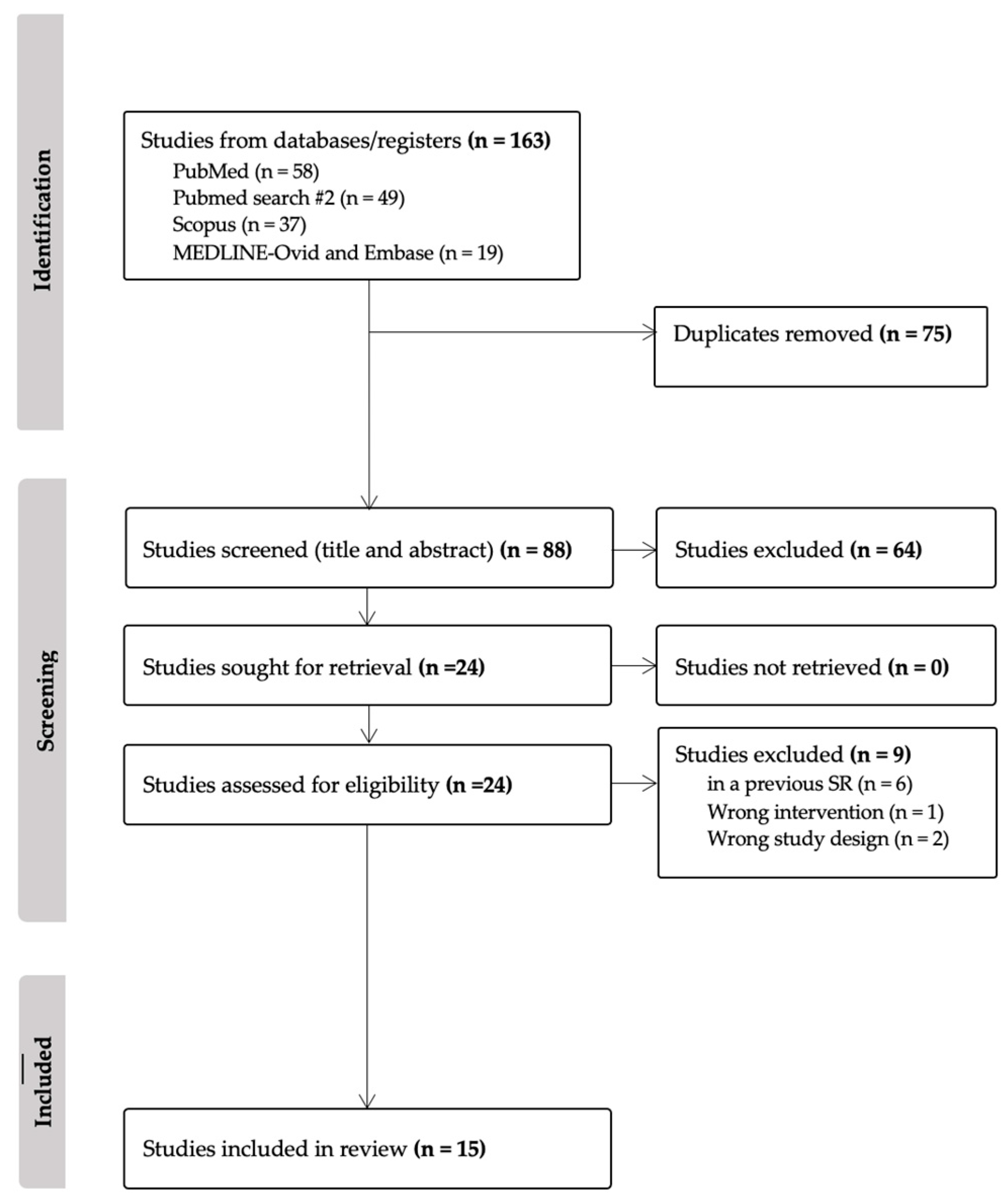
2. Materials and Methods
Data Collection and Data Analysis
3. Results

| Author | Study |
|---|---|
| Whitehead 2018 [19] | A Single Surgeon’s Experience with Transgender Female-to-Male Chest Surgery |
| Junn 2021 [14] | Hockey stick incision: a modified technique for chest wall masculinization |
| Decuypere 2020 [24] | Male-to-female gender affirmation surgery: breast reconstruction with Ergonomix round prostheses |
| Bustos 2020 [15] | The Nipple Split Sharing vs. Conventional Nipple Graft Technique in Chest Wall Masculinization Surgery: Can We Improve Patient Satisfaction and Aesthetic Outcomes? |
| Stein 2021 [17] | Surgical and patient-reported outcomes following double incision and free nipple grafting for female to male gender affirmation: does obesity make a difference? |
| Tamulevicius 2024 [16] | Subcutaneous mastectomy in female-to-male transsexuals is associated with higher risk of postoperative bleeding complications. |
| Sundhagen 2023 [18] | Chest Wall Contouring in Transgender Men: A 20-Year Experience from a National Center. |
| Elias 2022 [20] | Breaking the Binary: The Approach to Chest Masculinizing Gender-Affirming Surgery in Transgender Men |
| Makkonen 2024 [22] | Masculinizing chest-wall surgeries in transgender patients, a retrospective single-center study |
| Klassen 2021 [12] | The BODY-Q Chest Module: Further Validation in a Canadian Chest Masculinization Surgery Sample |
| Saarinen 2023 [23] | Quality of Chest Masculinization in Trans Men: A Retrospective Study Evaluating Surgical Technique, Complications, Secondary Corrections, and Trends |
| Kamali 2021 [21] | Improved Surgical Outcome with Double Incision and Free Nipple Graft in Gender Confirmation Mastectomy |
| Del Vecchio 2021 [10] | Body Feminization Combining Large-Volume Fat Grafting and Gluteal Implants |
| Cardenas-Camarena 2023 [26] | Aesthetic Augmentation of the Trochanteric Gluteal Region in Patients with Gender Dysphoria: Lipoinjection, Gluteal Implants, and Hip Implants |
| Cárdenas-Camarena 2020 [25] | Tridimensional Combined Gluteoplasty: Liposuction, Buttock Implants, and Fat Transfer |
| Author | Intervention | Incision Type | Patients | Mean Age | BMI | Follow Up (Months) |
|---|---|---|---|---|---|---|
| Whitehead 2018 [19] | DIFNG vs. DINTP | DIFNG N = 20 DINTP N = 79 | N = 99 | DIFNG: 33.8 ** 22.1–63.5 DINTP: 33.0 17.3–60.6 | DIFNG: 31.1 22.7–48.5 DINTP: 26.2 18.1–48.5 | DIFNG: 3.7 1.0–29.0 DINTP: 7.3 1.0–114.4 |
| Junn 2021 [14] | Compares HS, conventional DIFNG, periareolar | HS cohort 1 + 2 N = 14 DMFNG N = 6 Periareolar N = 6 | N = 73 39 (53.4%) Answered survey 27 (37%) Provided complete data. | P: 18.8 ± 1.7 I: 25.8 ± 9.7 HS1: 30.1 ± 5.9 HS2 36.4 ± 5.5 | Normal weight P: 6 (100%), I: 1 (16.7%) HS1: 3 (27.3%), HS2: 0 (0.0%) Overweight P 0 (0.0%), I: 1 (16.7%) HS1: 2 (18.2%), HS2: 0 Obese P 0 (0.0%), I: 4 (66.7%) HS1: 6 (54.5%), HS2: 4 (100%) | P: 166.2 ± 203.52 I: 73.2 ± 114.6 HS1: 205.5 ± 280.2 HS2: 53.0 ± 53.6 |
| Bustos 2020 [15] | Conventional DIFNG vs. nipple split sharing | DIFNG N = 18, 36 Bs DINS N = 16, 32 Bs | N = 34 | DINS: 27 (22–30) ** DMFNG: 24 (18–48) | DINS: 35.4 (22–38.2) DIFNG: 32.2 (23.1–45.3) | DINS: 13 (12–23) DIFNG: 11.5 (9–15) |
| Stein 2021 [17] | DIFNG obese vs. non-obese patients | DIFNG NO N = 54 DIFNG OB N = 43 | N = 97 | NO: 24 (6.1) OB: 29 (8.6) | NO: 25 (3.1) OB: 35 (5.9) | NO: 62 (12–112) OB: 61 (10–127) |
| Tamulevicius 2024 [16] | Compares incisions: CC, SC, IPMR, IMFNG | CC N = 10 SC N = 6 IPMR: N = 4 IMFNG: N = 24 | N = 22 | CC: 27.2 ± 7.8 IPMR 17.5 ± 2.1 IMFNG 22.4 ± 7.5 SC 63 ± 4.0 | CC: 23.7 ± 1.7 IPMR 22.6 ± 0.8 IMFNG 27.8 ± 6.3 SC 24.1 ± 2. | NA |
| Sundhagen 2023 [18] | IFNG vs. periareolar | IFNG: N = 209 P: N = 124 | N = 333 | P: 20.2 (5.9) IFNG: 21.7 (8.5) | P: 22.4 (0.4) IFNG: 26.2 (0.3) | NA |
| Elias 2022 [20] | Compares: PNAC vs. OSR vs. SSSM vs. CMFNG | PNAC: N = 14 OSR: N = 2 SSSM: N = 38 CMFNG: N = 56 | N = 110 | PNAC: 24.6 ± 6.8 OSR: 26.5 ± 6.3 SSSM: 22.3 ± 6.3 CMFNG: 22.0 ± 5.9 | NA | |
| Makkonen 2024 [22] | Periareolar vs. double incision | P N = 8 DI N = 8 | N = 16 | P: 22.8 ± 3.10 DI: 27.5 ± 9.15 | P: 21.7 ± 2.52 DI: 27.8 2.92 | P: 90.3 46.1 DI: 69.1 31.9 |
| Klassen 2021 [12] | BODY Q | no technique comparison | N = 115 | mean range 26 (16–61) | 27 (117.5–46.8) | Survey at 6 weeks and 6 months postop. |
| Saarinen 2023 [23] | BODY Q | no technique comparison | N = 123 respondents | median IQR 23 (7) | 23.5 (6.2) | 15 (19) |
| Kamali 2021 [21] | DIFNG vs. periareolar vs. semicircular | DIFNG N = 243, 52.4% P: N = 113, 24.4% SC: N = 67, 14.4% | N = 464 | mean range 24.1 (14–64) | BMI < 18.5: 8 (1.7%) 18.5–24.9: 216 (46.6%) 25.0–29.9: 102 (22.0%) >30.0: 36 (7.8%) Missing: 102 (22.0%) | NA |
| Author | Intervention | Patients | Mean Age | BMI | Follow-Up (Months) |
|---|---|---|---|---|---|
| Cardenas Camarena 2020 [25] | Buttock implant placement, frame liposuction, lipoinjection in the lateral third of the buttock | N = 53 11 Trans female 41 cis female | 33.3 23–49 | NA | NA |
| Cardenas Camarena 2023 [26] | Trochanteric gluteal region liposuction + lipoinjection + gluteal + hip implant placement. | N = 172 1: N = 132 (76.7%) 2: N = 22, 12.7% 3. N =10 (10.4%) 4. N = 8 | 36.4 (23–56) | 24.3 (21.2–27.1) | 26 (3–45) |
| Del Vecchio 2021 [10] | Large-volume fat transplantation with or without gluteal implants. | 36 Trans female F: N = 24 F + I: N = 12 | F: 29.8 ± 6.0 F + I: 30.3 ± 7.0 | F: 24.8 ± 1.8 F + I: 25.0 ± 2.0 | Range (8–24) |
| Decuypere 2020 [24] | Breast augmentation: submuscular plane + inframammary incision | N = 109 Trans female | 33.2 ± 14.6 | 23.6 ± 4.3 | 19.5 ± 7.9 |
3.1. Surgical Outcomes
| Author | Specimen Weight | Bleeding | Seroma | Hematoma | Infection | NAC Necrosis | Fat Necrosis | Dehiscence | RTOR |
|---|---|---|---|---|---|---|---|---|---|
| Whitehead 2018 [19] | DIFNG: 872.0 198.0–1908 DINTP: 398.0 116.0–1481 | NA | DIFNG: 1 (5.0) DINTP: 2 (2.5) | DIFNG: 1 (5.0) DINTP: 2 (2.5) | NA | DIFNG 0 DINTP: 1 (1.0) | NA | NA | DIFNG: 6 (30.0) DINTP: 31 (39.2) |
| Junn 2021 [14] | P: 320.8 ± 191.5 I: 1769.5 ± 946.8 HS1: 2030.7 ± 1036.9 HS2: 3623.7 ± 1312.9 | NA | P: 1 = 16.7% I: 1 = 16.7% HS1: 1 HS2: 0 | P: 2 (33.3%) I: 0% H: 0 HS2: 0 | P: 0 I: 1 (16.7%) H: 2 (18.2% ) HS2: 0 | P: 0% I: 0 H: 0 HS2: 0 | P: 0% I: 0 H: 0 HS2: 0 | P: 0% I: 1 (16.4%) HS1: 4 (36.4%) HS2: 2 (50%) | P: 0% I: 0 H: 0 |
| Bustos 2020 [15] | DINS: 750 g (85–1.000) DIFNG: 820 g (100–1.515) | NA | DIFNG: 0 DINS: 0 | DIFNG: 0 DINS: 0 | DIFNG: 0 DINS: 0 | DIFNG: 0 DINS: 0 Partial DIFNG: 4 DINS: 0 | NA | DIFNG: 1(2.8%) DINS: 0 | NA |
| Stein 2021 [17] | NO: 464 (270), R: 445 (255) OB: L: 961 (553), R 919 (522) | NO: 62.0 (84.2) OB: 113 (100) | NO: 0 OB:2 (2.6) | NO: 0 OB:1 (2.3) | NO:3 (5.6) OB:1 (2.3) | NO: 0 OB: graft loss = 1 2.3% | NA | NO: 0 OB: 3 (7.0) | NA |
| Tamulevicus 2024 [16] | CC: 201.2 ± 191.6 IPM 416.5 ± 84.2 ISFNG 1167.9 ± 662.0 SC 200.7 ± 135.5 | CC: 1 (10.0%) IPM: 1 (25%) ISFNG 5 (20.8%) SC 2 (33.3%) | N = 1, 2.3% | NA | NA | 0 reported | NA | grouped with seroma | NA |
| Sundhagen 2023 [18] | NA | P: 17 (13.7) I: 15 (7.2) | P: 4 (3.2) I: 3 (1.4) | P: NA I: NA | P: 6 (4.8) I: 7 (3.3) | P: 7 (5.6) I: 7 (3.3) | P: NA I: NA | P: 1 (0.8) I: 2(1.0) | |
| Elias 2022 [20] | PNAC: 485 ± 362 OSR: 310 ± 56 SSM:681 ± 394 CMFNG: 1157 ± 853 | NA | NA | PNAC: 0 OSMR: 0 SSSM: 3, 7.9% CMFNG: 3, 5.3% | PNAC: 7 (50%) OSR: 1 (50%) SSSM: 7 (50%) CMFNG: 3 (5.3%) | ||||
| Makkonen 2024 [22] | NA | P: NA D: NA | P: 0 D:1 (1.11) | P: 1 (1.11) D:1 (1.11) | P: 1 (1.11) D:2 (2.22) | P: 0 D:1 (1.11) | P: NA D: NA | P: NA D: NA | P: 6 (85.7) D:3 (33.3) |
| Klassen 2021 [12] | NA | N = 7 | N = 8 | N = 5 | |||||
| Saarinen 2023 [23] | NA | NA | NA | NA | NA | NA | NA | NA | NA |
| Kamali 2021 [21] | NA | NA | NA | NA | NA | NA | NA | NA | DIFNG: 8 (3.3%) P: 14 (12.4%) SC: 8 (11.9%) Other techniques 33 (7.3%) Total N = 33 (7.1%) |
| Author | Implant Size mL | Implant Issues | Fat Transfer Volume | Fat Reabsorption | Seroma | Dehiscence | RTOR | Other |
|---|---|---|---|---|---|---|---|---|
| Cardenas Camarena 2020 [25] | 258.1 (100–400) | Implant exposure: 1 (1.9) | Mean range Hip: 258.1 100–400 TA: 141.6 50–200 OI: 137.5 100–175 | NA | NA | Partial: 6 (11.5) | For revision: 1 (1.9) | NA |
| Cardenas Camarena 2023 [26] | 1. No implant 2. 210–450 (310) 3. GI: 180–400 (290) HI: 180–250 (220) 4. GI: 200–420 (280) HI: 180–230 (200) | 1. No implant 2. 1 asymmetry 3. 2 HI displacements, 1 implant removal, 1 implant rupture 4. None | Volume per side 1. 220–630 (423) 2. 220–390 (sss318) 3. Not applicable 4. 80–120 (105) | 1.10 (7.5) 2. 3 (13.6) 3. not applicable 4. 0 (0) | 1. 0 2. 0 3. 0 4. 1 (12.5) sss | Gluteal dehiscence 1. not applicable 2. 3 (13.6) 3. 1 (10) 4. 0 | NA | Satisfaction 1. 122 (92.4) 2. 18 (81.8) 3. 6 (60) 4. 8 (100) Dissatisfaction: 4 of 10 subfascial plane implant |
| Del Vecchio 2021 [10] | N = 12 intramuscular implants Due to not enough fat available. round cohesive gel implants, 270 (235–335) | NA | Mean transplanted per buttock mL:1100 Average harvested 2.700 mL | NA | NA | NA | Second round fat grafting N = 4 no group specified | Waist-hip ratio Preop F: 1.1 ± 0.1 F + I: 1.1 ± 0.1 Post op F: 0.88 ± 0.06 F + I: 0.75 ± 0.06 |
| Decuypere 2020 [24] | 402 ± 70 cc | 0 | No fat grafting | No fat grafting | 0 | 0 | Hematoma N = 1 Surgical drainage | Satisfaction: with breasts N = 51 76.8 ± 18.9 with outcome 74.8 ± 21.8 with implants 7.0 ± 1.5 Physical well-being: chest 85.9 ± 17.4 |
3.2. Aesthetic and Patient-Reported Outcomes
| Author | Excess Skin Revision | Healing/Scar Issues | Other | Aesthetic Scores | Body Q Chest | Body Q Nipple | Overall Score |
|---|---|---|---|---|---|---|---|
| Whitehead 2018 [19] | Dog ear excision: DIFNG: 2 (10.0) DINTP: 23 (29.1) | Problematic scarring: DIFNG: 4 (20) DINTP: 13 (16.5) Steroid injection: DMFNG: 3 (15) DINTP: 5 (6.3) Revision: DMFNG: 2 (2.0) DINTP: 0 | NAC depigmentation DIFNG: 6 (30.0) DINTP: 6 (7.6) Nipple sensation DINTP: 94.1% at least some nipple sensation. 66.2% = full bilateral 20.6% = some bilateral 7.4% = some unilateral 5.9% = no sensation Not evaluated for DIFNG | NA | DIFNG: NA | DIFNG: NA | DIFNG: NA |
| Junn 2021 [14] | NA | Scar revision None in all groups | POP complications by BMI N: N = 10, C = 4 OV: N = 3, C: 1, OB: N = 14, C = 8 | NA | P: 67.33 ± 27.35 I: 62.83 ± 34.45 HS1:89.6 ± 11.9, HS2: 72.0 ± 24.7 by BMI Chest: N: 79.70 ± 25.98 OV: 62.33 ± 54.37 OB: 76.50 ± 17.19 | P: 63.00 ± 27.12 I: 68.33 ± 39.33 HS1:86.8 ± 15.9 HS2: 74.3 ± 25.3 by BMI Nipples: N: 74.60 ± 26.80 OV: 66.67 ± 57.74 OB: 78.14 ± 19.72 | P: 645.17 ± 65 I: 657.67 ± 178.55 HS1: 722.7 ± 63.8 HS2: 669.3 ± 33.7 |
| Bustos 2020 [15] | NA | DMFNG:1 DINS: 1 (3.1%) | Nipple depigmentation DIFNG: 2 (5.6%) DINS: 0 | AIS scores DIFNG: 3.4 (1–5) DINS: 3.9 (1–5) | DMFNG: 75.8 (40–100) DINS: 84.3 (83–87) | Nipple → p < 0.0001 DMFNG: 58.1 (0–90) DINS: 90.7 (82–100 | NA |
| Stein 2021 [17] | NA | NA | NA | NA | Mean/SD N: 89 (11) O: 84 (13) | N: 74 (19) O: 74 (18) non-p < 0.001 | N:63 (22) O: 65 (18) |
| Tamulevicius 2024 [16] | NA | NA | NA | NA | NA | NA | NA |
| Sundhagen 2023 [18] | P: 7 (5.6) I: 14 (6.7) | P: 24 (19.4) I: 3 (14.4) Revisions P: 39 (31.5) I: 44 (21.1) | Lipo revision P: 13 (10.5) I: 8 (3.8) | NA | NA | NA | NA |
| Elias 2022 [20] | NA | NA | Revisions: PNAC: 7(50%) OSR: 1(50%) SSSM: 4(10.5%) CMFNG: 3 (5.3%) | PNAC 2.5 ± 1.55 OSR: 1.4 ± 0.71 SSSM: 4.19 ± 0.75 CMFNG:4.07 ± 1.00 | NA | NA | NA |
| Makkonen 2024 [22] | NA | Secondary aesthetic corrections P: 5, 71.4 DI: 3 (33.33) | NA | NA | N = 2 DI and N = 4 P P: 47 D: 85 | P: 63 D: 67 | NA |
| Klassen 2021 [12] | Dog ear: N = 9 | Delayed wound healing: N = 5 | Complications not specified: 0: N = 87 (79.1%) 1: N = 17 (15.5%) >1: N = 6 (5.5) | NA | Scores presented in graphics | Scores presented in graphics | NA |
| Saarinen 2023 [23] | NA | NA | NA | NA | NA Scores displayed in graphics | NA | NA |
| Kamali 2021 [21] | NA | NA | Complications: not specified DI: 46 (18.9%) P: 32 (28.3%) SC: 13 (19.4%) other techniques: 8 (19.5%) | NA | NA | NA | NA |
4. Discussion
5. Conclusions
Supplementary Materials
Author Contributions
Funding
Institutional Review Board Statement
Informed Consent Statement
Data Availability Statement
Conflicts of Interest
References
- Canner, J.K.; Harfouch, O.; Kodadek, L.M.; Pelaez, D.; Coon, D.; Offodile, A.C.; Haider, A.H.; Lau, B.D. Temporal Trends in Gender-Affirming Surgery Among Transgender Patients in the United States. JAMA Surg. 2018, 153, 609–616. [Google Scholar] [CrossRef] [PubMed]
- Tristani-Firouzi, B.; Veith, J.; Simpson, A.; Hoerger, K.; Rivera, A.; Agarwal, C.A. Preferences for and barriers to gender affirming surgeries in transgender and non-binary individuals. Int. J. Transgend. Health 2022, 23, 458–471. [Google Scholar] [CrossRef] [PubMed]
- Poteat, T.; Davis, A.M.; Gonzalez, A. Standards of Care for Transgender and Gender Diverse People. JAMA Am. Med. Assoc. 2023, 329, 1872–1874. [Google Scholar] [CrossRef] [PubMed]
- Almazan, A.N.; Keuroghlian, A.S. Association between Gender-Affirming Surgeries and Mental Health Outcomes. JAMA Surg. 2021, 156, 611–618. [Google Scholar] [CrossRef] [PubMed]
- Aristizábal, A.; Escandón, J.M.; Ciudad, P.; Manrique, O.J. The Limited Coverage of Facial Feminization Surgery in the United States: A Literature Review of Policy Constraints and Implications. J. Clin. Med. 2023, 12, 5308. [Google Scholar] [CrossRef] [PubMed]
- Coleman, E.; Radix, A.E.; Bouman, W.P.; Brown, G.R.; de Vries, A.L.C.; Deutsch, M.B.; Ettner, R.; Fraser, L.; Goodman, M.; Green, J.; et al. Standards of Care for the Health of Transgender and Gender Diverse People, Version 8. Int. J. Transgend. Health 2022, 23 (Suppl. 1), S1–S259. [Google Scholar] [CrossRef] [PubMed]
- Asokan, A.; Sudheendran, M.K. Gender Affirming Body Contouring and Physical Transformation in Transgender Individuals. Indian J. Plast. Surg. 2022, 55, 179–187. [Google Scholar] [CrossRef] [PubMed]
- Morrison, S.D.; Wilson, S.C.; Mosser, S.W. Breast and Body Contouring for Transgender and Gender Nonconforming Individuals. Clin. Plast. Surg. 2018, 45, 333–342. [Google Scholar] [CrossRef]
- Peitzmeier, S.; Gardner, I.; Weinand, J.; Corbet, A.; Acevedo, K. Health impact of chest binding among transgender adults: A community-engaged, cross-sectional study. Cult. Health Sex. 2017, 19, 64–75. [Google Scholar] [CrossRef]
- Del Vecchio, D.; Bravo, M.G.; Mandlik, V.; Aslani, A. Body Feminization Combining Large-Volume Fat Grafting and Gluteal Implants. Plast. Reconstr. Surg. 2022, 149, 1197–1203. [Google Scholar] [CrossRef]
- Cohen, W.A.; Shah, N.R.; Iwanicki, M.; Therattil, P.J.; Keith, J.D. Female-to-Male Transgender Chest Contouring: A Systematic Review of Outcomes and Knowledge Gaps. Ann. Plast. Surg. 2019, 83, 589–593. [Google Scholar] [CrossRef] [PubMed]
- Klassen, A.F.; McEvenue, G.; Wang, Y.; Rae, C.; Kaur, M.; Johnson, N.; Savard, K.; Semple, J.; Pusic, A. The BODY-Q Chest Module: Further Validation in a Canadian Chest Masculinization Surgery Sample. Aesthet. Surg. J. 2021, 41, 566–574. [Google Scholar] [CrossRef] [PubMed]
- Page, M.J.; Moher, D.; Bossuyt, P.M.; Boutron, I.; Hoffmann, T.C.; Mulrow, C.D.; Shamseer, L.; Tetzlaff, J.M.; Akl, E.A.; Brennan, S.E.; et al. PRISMA 2020 explanation and elaboration: Updated guidance and exemplars for reporting systematic reviews. BMJ 2021, 372, n160. [Google Scholar] [CrossRef] [PubMed]
- Junn, A.; Khetpal, S.; Smetona, J.; Dinis, J.; Hirschman, A.; Mozaffari, M.A.; Singh, A.; Ching, A.H.; Alperovich, M.; Lu, X.; et al. Hockey stick incision: A modified technique for chest wall masculinization. Ann. Transl. Med. 2021, 9, 600. [Google Scholar] [CrossRef] [PubMed]
- Bustos, S.S.; Forte, A.J.; Ciudad, P.; Manrique, O.J. The Nipple Split Sharing vs. Conventional Nipple Graft Technique in Chest Wall Masculinization Surgery: Can We Improve Patient Satisfaction and Aesthetic Outcomes? Aesthetic Plast. Surg. 2020, 44, 1478–1486. [Google Scholar] [CrossRef] [PubMed]
- Tamulevicius, M.; Obed, D.; Dastagir, N.; Mett, T.R.; Vogt, P.M.; Dastagir, K. Subcutaneous mastectomy in female-to-male transsexuals is associated with higher risk of postoperative bleeding complications. JPRAS Open 2024, 39, 60–70. [Google Scholar] [CrossRef] [PubMed]
- Stein, M.J.; Grigor, E.; Hardy, J.; Jarmuske, M. Surgical and patient-reported outcomes following double incision and free nipple grafting for female to male gender affirmation: Does obesity make a difference? J. Plast. Reconstr. Aesthetic Surg. 2021, 74, 1743–1751. [Google Scholar] [CrossRef] [PubMed]
- Sundhagen, H.P.; Opheim, A.B.; Wæhre, A.; Oliver, N.K.; Tønseth, K.A. Chest Wall Contouring in Transgender Men: A 20-Year Experience from a National Center. Plast. Reconstr. Surg. 2023, 11, E4952. [Google Scholar] [CrossRef] [PubMed]
- Whitehead, D.M.; Weiss, P.R.; Podolsky, D. A Single Surgeon’s Experience with Transgender Female-to-Male Chest Surgery. Ann. Plast. Surg. 2018, 81, 353–359. [Google Scholar] [CrossRef]
- Elias, N.; Rysin, R.; Kwartin, S.; Wolf, Y. Breaking the binary: The approach to Chest Masculinizing Gender- Affirming Surgery in Transgender Men. IMAJ 2022, 24, 20–24. [Google Scholar]
- Kamali, A.; Sigurjónsson, H.; Gran, I.; Farnebo, F.; Lundgren, K.C.; Granath, F.; Sommar, P. Improved Surgical Outcome with Double Incision and Free Nipple Graft in Gender Confirmation Mastectomy. Plast. Reconstr. Surg. Glob. Open 2021, 9, E3628. [Google Scholar] [CrossRef] [PubMed]
- Makkonen, M.; Myllykangas, H.M.; Kaarela, O.; Nuutinen, H. Masculinizing chest-wall surgeries in transgender patients, a retrospective single-center study. Ann. Chir. Plast. Esthet. 2024, 69, 131–135. [Google Scholar] [CrossRef] [PubMed]
- Saarinen, M.; Ojala, K.; Suominen, S.; Repo, J. Validation of the BODY-Q Chest module in Finnish trans men undergoing chest wall masculinization. Scand. J. Surg. 2023, 112, 180–186. [Google Scholar] [CrossRef] [PubMed]
- Decuypere, F.; De Wolf, E.; Vyncke, T.; Claes, K.; Monstrey, S.; Buncamper, M. Male-to-female gender affirmation surgery: Breast reconstruction with Ergonomix round prostheses. Int. J. Impot. Res. 2020, 33, 720–725. [Google Scholar] [CrossRef] [PubMed]
- Cárdenas-Camarena, L.; Trujillo-Méndez, R.; Díaz-Barriga, J.C. Tridimensional Combined Gluteoplasty: Liposuction, Buttock Implants, and Fat Transfer. Plast. Reconstr. Surg. 2020, 146, 53–63. [Google Scholar] [CrossRef] [PubMed]
- Cárdenas-Camarena, L.; López-Fabila, D.A.; Vargas-Flores, E.; Reyes-Herrera, M.F. Aesthetic Augmentation of the Trochanteric Gluteal Region in Patients with Gender Dysphoria: Lipoinjection, Gluteal Implants, and Hip Implants. Plast. Reconstr. Surg. Glob. Open 2023, 11, E5387. [Google Scholar] [CrossRef]
- Cohen, W.A.; Mundy, L.R.; Ballard, T.N.; Klassen, A.; Cano, S.J.; Browne, J.; Pusic, A.L. The BREAST-Q In Surgical Research: A Review Of The Literature 2009–2015. J. Plast. Reconstr. Aesthet. Surg. 2016, 69, 149. Available online: https://www.ncbi.nlm.nih.gov/pmc/articles/PMC4995882/ (accessed on 1 June 2024). [CrossRef]
- Knox, A.D.C.; Ho, A.L.; Leung, L.; Hynes, S.; Tashakkor, A.Y.; Park, Y.S.; Macadam, S.A.; Bowman, C.C. A Review of 101 Consecutive Subcutaneous Mastectomies and Male Chest Contouring Using the Concentric Circular and Free Nipple Graft Techniques in Female-to-Male Transgender Patients. Plast. Reconstr. Surg. 2017, 139, 1260e–1272e. [Google Scholar] [CrossRef]

Disclaimer/Publisher’s Note: The statements, opinions and data contained in all publications are solely those of the individual author(s) and contributor(s) and not of MDPI and/or the editor(s). MDPI and/or the editor(s) disclaim responsibility for any injury to people or property resulting from any ideas, methods, instructions or products referred to in the content. |
© 2024 by the authors. Licensee MDPI, Basel, Switzerland. This article is an open access article distributed under the terms and conditions of the Creative Commons Attribution (CC BY) license (https://creativecommons.org/licenses/by/4.0/).
Share and Cite
Aristizábal, A.; Ríos-Sánchez, M.; Escandón, J.M.; DeRoberts, D.; Armenta, E.; Del Corral, G.; Mascaro, A.; Manrique, O.J. Body Contouring as Gender-Affirming Surgery in Transgender Patients: A Systematic Review of the Current Literature. J. Clin. Med. 2024, 13, 3523. https://doi.org/10.3390/jcm13123523
Aristizábal A, Ríos-Sánchez M, Escandón JM, DeRoberts D, Armenta E, Del Corral G, Mascaro A, Manrique OJ. Body Contouring as Gender-Affirming Surgery in Transgender Patients: A Systematic Review of the Current Literature. Journal of Clinical Medicine. 2024; 13(12):3523. https://doi.org/10.3390/jcm13123523
Chicago/Turabian StyleAristizábal, Alejandra, María Ríos-Sánchez, Joseph M. Escandón, Dean DeRoberts, Enrique Armenta, Gabriel Del Corral, Andrés Mascaro, and Oscar J. Manrique. 2024. "Body Contouring as Gender-Affirming Surgery in Transgender Patients: A Systematic Review of the Current Literature" Journal of Clinical Medicine 13, no. 12: 3523. https://doi.org/10.3390/jcm13123523
APA StyleAristizábal, A., Ríos-Sánchez, M., Escandón, J. M., DeRoberts, D., Armenta, E., Del Corral, G., Mascaro, A., & Manrique, O. J. (2024). Body Contouring as Gender-Affirming Surgery in Transgender Patients: A Systematic Review of the Current Literature. Journal of Clinical Medicine, 13(12), 3523. https://doi.org/10.3390/jcm13123523