


Primary Care Clinicians’ Prescribing Patterns of Reduced-Dose Direct Oral Anticoagulants for Extended-Phase Venous Thromboembolism Treatment

 , , ,
, , ,  , and
for the Venous thromboEmbolism Network US (VENUS) VTE Treatment and Anticoagulation Management Group
, and
for the Venous thromboEmbolism Network US (VENUS) VTE Treatment and Anticoagulation Management Group
Abstract
:1. Introduction
2. Methods
2.1. Survey Development
2.2. Inclusion/Exclusion Criteria
2.3. Statistical Analysis
2.4. Unsupervised Machine Learning
3. Results
3.1. Demographics
3.2. Prescribing Behaviors
3.3. Prescribing Behaviors Clusters
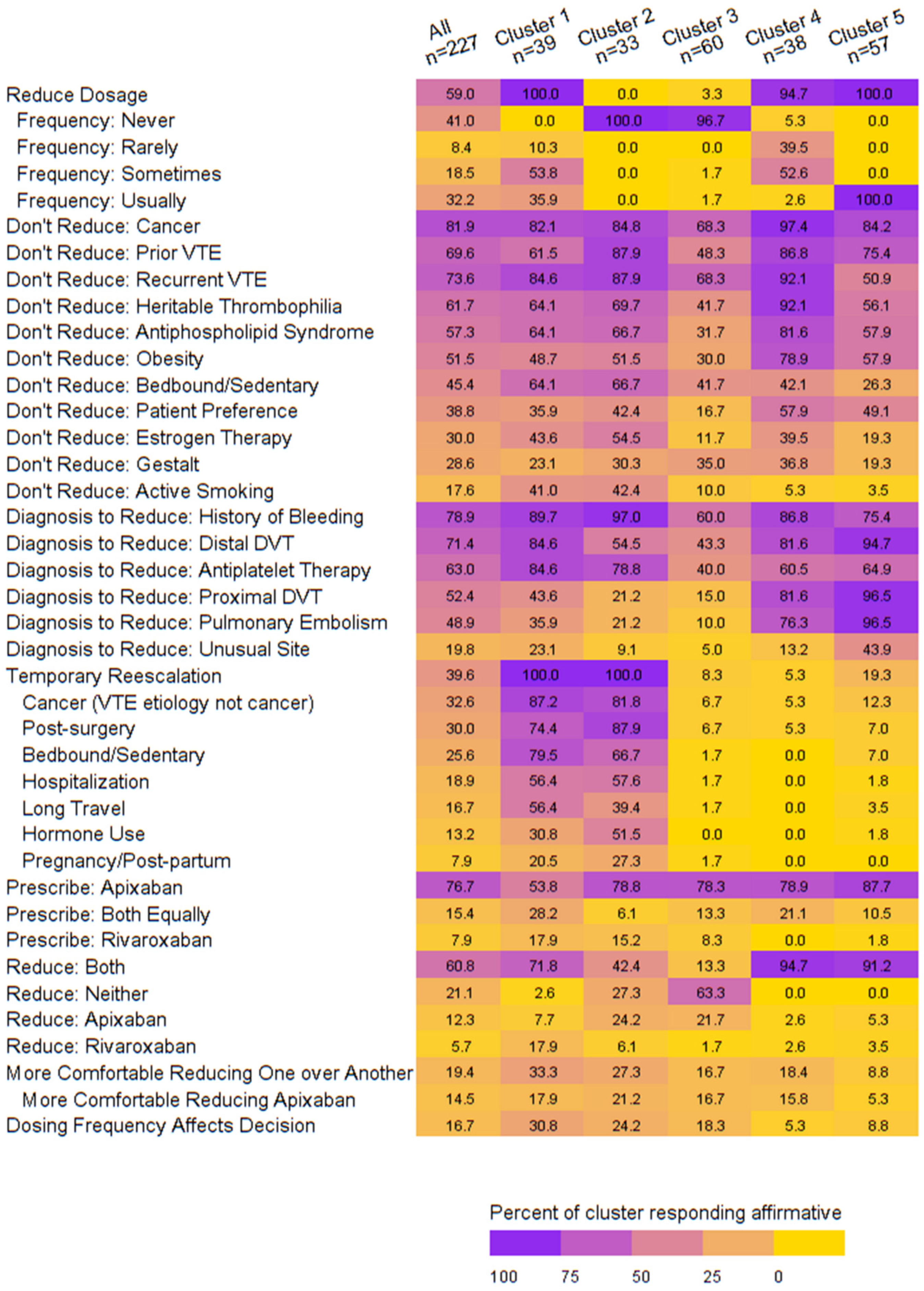
- Cluster 1: Sometimes or usually dose reduces, moderate rates for reasons/diagnoses to reduce/not reduce, always temporarily re-escalates dosing, prescribes both apixaban and rivaroxaban, reduces both, and is more comfortable reducing apixaban, possibly due to the dosing frequency.
- Cluster 2: Never dose reduces, moderate rates for reasons/diagnoses to reduce/not reduce, always temporarily re-escalates, preferentially prescribes apixaban, reduces both.
- Cluster 3: Never dose reduces, low rates for reasons/diagnoses to reduce/not reduce, does not temporarily escalate, preferentially prescribes apixaban, reduces neither.
- Cluster 4: Rarely or sometimes dose reduces, high rates for reasons to not dose reduce, does not temporarily re-escalate dosing, prescribes both with a preference for apixaban, reduces both.
- Cluster 5: Usually dose reduces, moderate rates for reasons to not reduce, high rates for diagnoses to reduce, infrequently temporarily re-escalates dosing, preferentially prescribes apixaban, reduces both. (Figure 1, Supplemental Table S3)
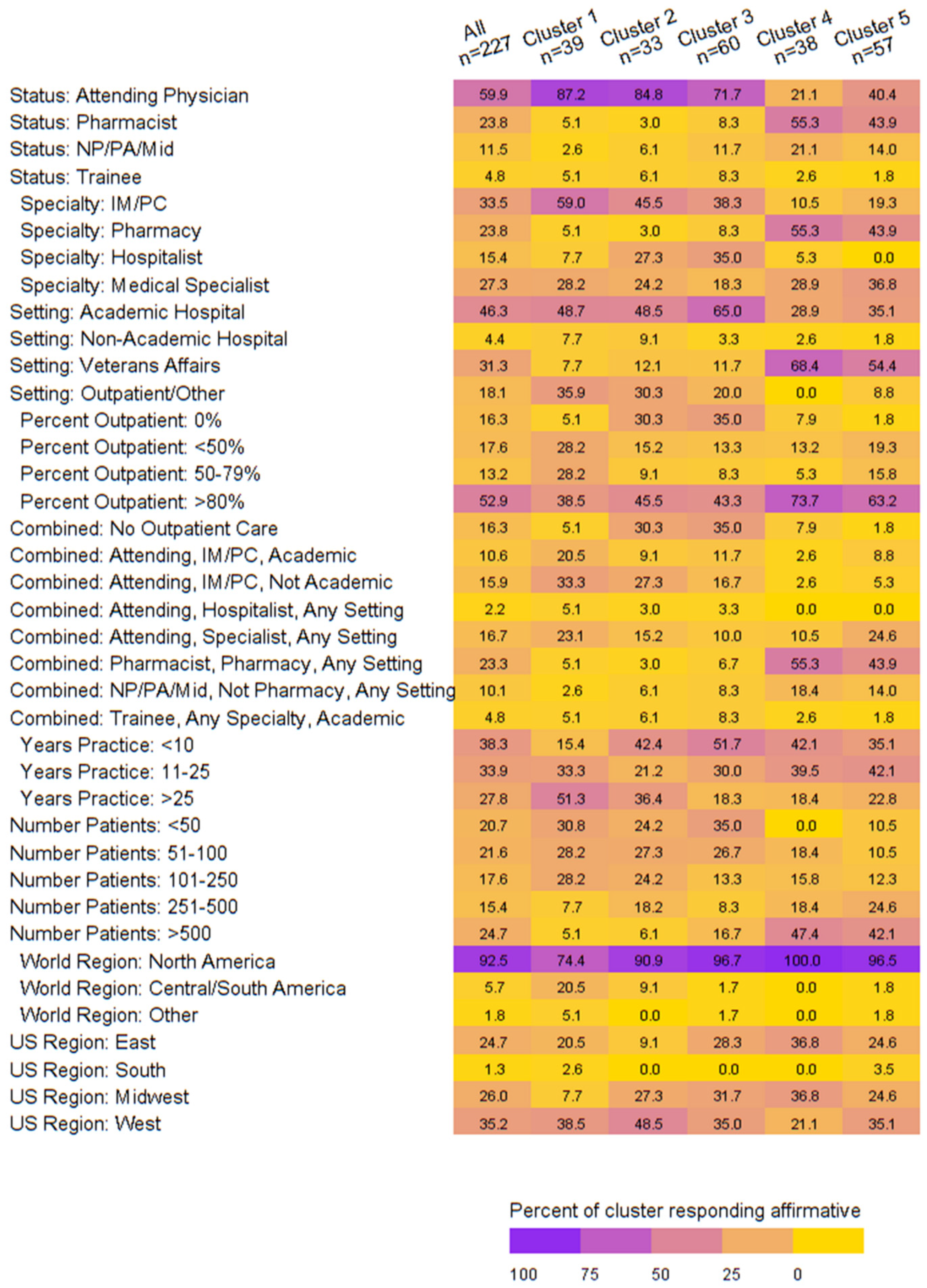
- Cluster 1: Attending physicians in internal medicine/primary care treating patients in academic or outpatient settings outside of the United States (US) with >25 years in practice and <250 patients.
- Cluster 2: Attending physicians in academic/outpatient settings who do not provide outpatient care and treat <250 patients residing in the West and Midwest US.
- Cluster 3: Attending physicians or trainees or hospitalists who provide no outpatient care at an academic hospital with <25 years’ experience and <100 patients equally representing the East, West, and Midwest US.
- Cluster 4: Pharmacists at the VA with >80% of their time spent treating in the outpatient setting with <25 years’ experience treating >500 patients in the East or Midwest US.
- Cluster 5: Attendings with a medical specialty or pharmacists at the VA who spend >80% of their time in outpatient care with <25 years’ experience and >250 patients. (Figure 2)
4. Discussion
Supplementary Materials
Author Contributions
Funding
Institutional Review Board Statement
Informed Consent Statement
Data Availability Statement
Acknowledgments
Conflicts of Interest
References
- Stevens, S.M.; Woller, S.C.; Kreuziger, L.B.; Bounameaux, H.; Doerschug, K.; Geersing, G.J.; Huisman, M.V.; Kearon, C.; King, C.S.; Knighton, A.J.; et al. Antithrombotic Therapy for VTE Disease: Second Update of the CHEST Guideline and Expert Panel Report. Chest 2021, 160, e545–e608. [Google Scholar] [CrossRef] [PubMed]
- Ortel, T.L.; Neumann, I.; Ageno, W.; Beyth, R.; Clark, N.P.; Cuker, A.; Hutten, B.A.; Jaff, M.R.; Manja, V.; Schulman, S.; et al. American Society of Hematology 2020 guidelines for management of venous thromboembolism: Treatment of deep vein thrombosis and pulmonary embolism. Blood Adv. 2020, 4, 4693–4738. [Google Scholar] [CrossRef] [PubMed]
- Guidelines on diagnosis and management of acute pulmonary embolism. Task Force on Pulmonary Embolism, European Society of Cardiology. Eur. Heart J. 2000, 21, 1301–1336. [Google Scholar] [CrossRef]
- Konstantinides, S.V.; Meyer, G.; Becattini, C.; Bueno, H.; Geersing, G.J.; Harjola, V.P.; Huisman, M.V.; Humbert, M.; Jennings, C.S.; Jiménez, D.; et al. 2019 ESC Guidelines for the diagnosis and management of acute pulmonary embolism developed in collaboration with the European Respiratory Society (ERS): The Task Force for the diagnosis and management of acute pulmonary embolism of the European Society of Cardiology (ESC). Eur. Heart J. 2020, 41, 543–603. [Google Scholar] [CrossRef]
- ELIQUIS Package Insert. 2021. Available online: https://packageinserts.bms.com/pi/pi_eliquis.pdf (accessed on 15 December 2020).
- XARELTO Package Insert. 2021. Package Insert. Available online: http://www.janssenlabels.com/package-insert/product-monograph/prescribing-information/XARELTO-pi.pdf (accessed on 3 October 2019).
- Agnelli, G.; Buller, H.R.; Cohen, A.; Curto, M.; Gallus, A.S.; Johnson, M.; Masiukiewicz, U.; Pak, R.; Thompson, J.; Raskob, G.E.; et al. Oral apixaban for the treatment of acute venous thromboembolism. N. Engl. J. Med. 2013, 369, 799–808. [Google Scholar] [CrossRef] [PubMed]
- Agnelli, G.; Buller, H.R.; Cohen, A.; Curto, M.; Gallus, A.S.; Johnson, M.; Porcari, A.; Raskob, G.E.; Weitz, J.I.; Investigators, A.-E. Apixaban for extended treatment of venous thromboembolism. N. Engl. J. Med. 2013, 368, 699–708. [Google Scholar] [CrossRef] [PubMed]
- Buller, H.R.; Prins, M.H.; Lensin, A.W.; Decousus, H.; Jacobson, B.F.; Minar, E.; Chlumsky, J.; Verhamme, P.; Wells, P.; Agnelli, G.; et al. Oral rivaroxaban for the treatment of symptomatic pulmonary embolism. N. Engl. J. Med. 2012, 366, 1287–1297. [Google Scholar] [CrossRef] [PubMed]
- Weitz, J.I.; Lensing, A.W.A.; Prins, M.H.; Bauersachs, R.; Beyer-Westendorf, J.; Bounameaux, H.; Brighton, T.A.; Cohen, A.T.; Davidson, B.L.; Decousus, H.; et al. Rivaroxaban or Aspirin for Extended Treatment of Venous Thromboembolism. N. Engl. J. Med. 2017, 376, 1211–1222. [Google Scholar] [CrossRef] [PubMed]
- Colacci, M.; Tseng, E.K.; Sacks, C.A.; Fralick, M. Oral anticoagulant utilization in the United States and United Kingdom. J. Gen. Int. Med. 2020, 35, 2505–2507. [Google Scholar] [CrossRef] [PubMed]
- Giustozzi, M.; Agnelli, G.; Del Toro-Cervera, J.; Klok, F.A.; Rosovsky, R.P.; Martin, A.C.; Herold, J.; Tzoran, I.; Szmit, S.; Bertoletti, L.; et al. Direct Oral Anticoagulants for the Treatment of Acute Venous Thromboembolism Associated with Cancer: A Systematic Review and Meta-Analysis. Thromb. Haemost. 2020, 120, 1128–1136. [Google Scholar] [CrossRef] [PubMed]
- Martin, K.A.; Lancki, N.; Li, C.; Eyster, M.E.; Sanfilippo, K.; Woller, I.A.; Woller, S.C.; Kreuziger, L.B.; Rosovsky, R.P. DOAC compared with warfarin for VTE in patients with obesity: A retrospective cohort study conducted through the VENUS network. J. Thromb. Thrombolysis 2023, 55, 685–690. [Google Scholar] [CrossRef] [PubMed]
- Martin, K.A.; Beyer-Westendorf, J.; Davidson, B.L.; Huisman, M.V.; Sandset, P.M.; Moll, S. Use of direct oral anticoagulants in patients with obesity for treatment and prevention of venous thromboembolism: Updated communication from the ISTH SSC Subcommittee on Control of Anticoagulation. J. Thromb. Haemost. 2021, 19, 1874–1882. [Google Scholar] [CrossRef] [PubMed]
- Luca, F.; Oliva, F.; Abrignani, M.G.; Di Fusco, S.A.; Parrini, I.; Canale, M.L.; Giubilato, S.; Cornara, S.; Nesti, M.; Rao, C.M.; et al. Management of Patients Treated with Direct Oral Anticoagulants in Clinical Practice and Challenging Scenarios. J. Clin. Med. 2023, 12, 5955. [Google Scholar] [CrossRef] [PubMed]
- Faruquee, C.F.; Guirguis, L.M.; Hughes, C.A.; Makowsky, M.J.; Sadowski, C.A.; Schindel, T.J.; Cor, K.M.; Yuksel, N. Characterizing pharmacist prescribers in Alberta using cluster analysis. J. Pharm. Health Serv. Res. 2019, 10, 5–12. [Google Scholar] [CrossRef]
- Groat, D.; Martin, K.A.; Rosovsky, R.P.; Sanfilippo, K.M.; Gaddh, M.; Kreuziger, L.B.; Eyster, M.E.; Woller, S.C.; Venous thromboEmbolism Network US (VENUS) VTE Treatment, Anticoagulation Management Group. Physician perceptions and use of reduced-dose direct oral anticoagulants for extended phase venous thromboembolism treatment. Res. Pract. Thromb. Haemost. 2022, 6, e12740. [Google Scholar] [CrossRef] [PubMed]
- Hartigan, J.A.; Wong, M.A. Algorithm AS 136: A k-means clustering algorithm. J. Roy. Stat. Soc. Ser. C 1979, 28, 100–108. [Google Scholar] [CrossRef]
- Rousseeuw, P.J. Silhouettes: A graphical aid to the interpretation and validation of cluster analysis. J. Comp. App. Math. 1987, 20, 53–65. [Google Scholar] [CrossRef]
- Kearon, C.; Ginsberg, J.S.; Kovacs, M.J.; Anderson, D.R.; Wells, P.; Julian, J.A.; MacKinnon, B.; Weitz, J.I.; Crowther, M.A.; Dolan, S.; et al. Comparison of low-intensity warfarin therapy with conventional-intensity warfarin therapy for long-term prevention of recurrent venous thromboembolism. N. Engl. J. Med. 2003, 349, 631–639. [Google Scholar] [CrossRef] [PubMed]

| Attribute | N (%) |
|---|---|
| Present status | |
| Attending Physician | 136 (59.9%) |
| Pharmacist | 54 (23.8%) |
| Nurse Practitioner/Physician Assistant/Mid-Level Provider (NP/PA/ML) | 26 (11.5%) |
| Trainee | 11 (4.8%) |
| Specialty | |
| Internal Medicine/Primary Care (IM/PC) | 76 (33.5%) |
| Medical Specialist | 62 (27.3%) |
| Pharmacy | 54 (23.8%) |
| Hospitalist | 35 (15.4%) |
| Setting | |
| Academic hospital | 100 (44.1%) |
| Veterans Affairs (VA) | 71 (31.3%) |
| Private practice | 24 (10.6%) |
| Outpatient clinic | 13 (5.7%) |
| Private non-teaching hospital | 10 (4.4%) |
| Academic non-teaching hospital | 5 (2.2%) |
| Other | 4 (1.8%) |
| Percent of clinical time is outpatient care | |
| I provide no outpatient care | 37 (16.3%) |
| 1–50% | 40 (17.6%) |
| 50–79% | 30 (13.2%) |
| ≥80% | 120 (52.9%) |
| Combined Status, Specialty, Setting, Outpatient Care | |
| Pharmacist, Pharmacy, Any Setting, Outpatient Care | 53 (23.3%) |
| Attending Physician/Specialist, Any Setting, Outpatient Care | 38 (16.7%) |
| Any Status, Any Specialty, Any Setting, No Outpatient Care | 37 (16.3%) |
| Attending Physician, IM/PC, Not Academic/VA, Outpatient Care | 36 (15.9%) |
| Attending Physician, IM/PC, Academic Hospital, Outpatient Care | 24 (10.6%) |
| NP/PA/ML, Not Pharmacy, Any Setting, Outpatient Care | 23 (10.1%) |
| Any Status, Not Pharmacy, Any Setting, Outpatient Care | 16 (7.0%) |
| Years in practice | |
| ≤10 | 87 (38.3%) |
| 11–25 | 77 (33.9%) |
| ≥25 | 63 (27.8%) |
| Number of patients prescribed DOACs annually | |
| ≤50 | 47 (20.7%) |
| 51–100 | 49 (21.6%) |
| 101–250 | 40 (17.6%) |
| 251–500 | 35 (15.4%) |
| ≥500 | 56 (24.7%) |
| Protocol in place | |
| No | 154 (67.8%) |
| Don’t Know | 49 (21.6%) |
| Yes | 24 (10.6%) |
| World Region | |
| North America | 210 (92.5%) |
| Central/South America | 13 (5.7%) |
| Other | 4 (1.8%) |
| US Region | |
| West | 80 (35.2%) |
| Midwest | 59 (26.0%) |
| East | 56 (24.7%) |
| South | 3 (1.3%) |
| Attribute | N (%) |
|---|---|
| Reduce dosage | |
| Yes | 134 (59.0%) |
| Frequency of dose reduction | |
| Never (0%) | 93 (41.0%) |
| Rarely (between 0–25%) | 19 (8.4%) |
| Sometimes (25–50% of the time) | 42 (18.5%) |
| Usually (between 50–100%) | 73 (32.2%) |
| Risk factors for no dose reduction | |
| Cancer | 186 (81.9%) |
| Recurrent VTE * | 167 (73.6%) |
| Prior VTE event or therapy | 158 (69.6%) |
| Heritable Thrombophilia | 140 (61.7%) |
| Antiphospholipid Syndrome | 131 (56.7%) |
| Obesity, Body mass index > 30 | 117 (51.5%) |
| Bedbound/Immobility/Sedentary | 103 (45.4%) |
| Patient Preference | 88 (38.8%) |
| Estrogen-based hormone therapy | 68 (30.0%) |
| Gestalt | 65 (28.6%) |
| Active Smoking | 40 (17.6%) |
| Insurance Coverage | 18 (7.9%) |
| Age | 15 (6.6%) |
| ECOG Performance Status | 12 (5.3%) |
| Does not apply/Unaware | 10 (4.4%) |
| Male Sex | 4 (1.8%) |
| Diagnosis for reduction | |
| History of bleeding | 179 (78.9%) |
| Distal DVT * | 162 (71.4%) |
| Concurrent use of antiplatelet therapy | 143 (63.0%) |
| Proximal DVT | 119 (52.4%) |
| Pulmonary Embolism | 111 (48.9%) |
| Unusual Site | 45 (19.8%) |
| Temporary reescalation to therapeutic dose | |
| Yes | 90 (39.6%) |
| Reason for temporary reescalation | |
| Cancer (if etiology for VTE was not cancer) | 74 (32.6%) |
| Post-surgery | 68 (30.0%) |
| Bedbound/Immobility/Sedentary | 58 (25.6%) |
| Hospitalization | 43 (18.9%) |
| Long travel | 38 (16.7%) |
| Hormone use | 30 (13.2%) |
| Pregnancy or post-partum | 18 (7.9%) |
| DOAC prescribed most often | |
| Apixaban | 174 (76.7%) |
| Prescribe Apixaban and Rivaroxaban equally | 33 (14.5%) |
| Rivaroxaban | 18 (7.9%) |
| Which medication dose-reduced | |
| Both | 138 (60.8%) |
| Neither | 47 (20.7%) |
| Apixaban | 28 (12.3%) |
| Rivaroxaban | 13 (5.7%) |
| More comfortable reducing one over another | |
| No | 179 (78.9%) |
| Yes | 44 (19.4%) |
| Which | |
| Apixaban | 33 (14.5%) |
| Rivaroxaban | 11 (4.8%) |
| Dose frequency affects decision | |
| Yes | 38 (16.7%) |
| Demographic | Odds Ratio (95% CI) | p-Value |
|---|---|---|
| Combined Status, Specialty, and Setting | ||
| No Outpatient Care | 0.094 (0.034–0.222) | <0.001 |
| Attending Physician, IM/PC, Academic Hospital | 0.968 (0.413–2.345) | 0.941 |
| Attending Physician, IM/PC, Not Academic/VA | 0.566 (0.274–1.159) | 0.119 |
| Attending Physician, Specialist, Any Setting | 2.578 (1.198–6.049) | 0.021 |
| Pharmacist, Pharmacy, Any Setting | 6.422 (2.911–16.28) | <0.001 |
| NP/PA/Mid-Level, Not Pharmacy, Any Setting | 1.666 (0.679–4.495) | 0.282 |
| Any Status, Not Pharmacy, Any Setting | 0.389 (0.128–1.088) | 0.078 |
| Years in practice | ||
| <10 | 0.526 (0.304–0.906) | 0.021 |
| 11–25 | 1.725 (0.977–3.098) | 0.063 |
| >25 | 1.180 (0.654–2.160) | 0.585 |
| Number of patients where you are involved in DOAC prescriptions | ||
| <50 | 0.384 (0.196–0.735) | 0.004 |
| 51–100 | 0.659 (0.348–1.249) | 0.199 |
| 101–250 | 1.050 (0.527–2.139) | 0.891 |
| 251–500 | 1.399 (0.668–3.059) | 0.383 |
| >500 | 2.908 (1.494–5.985) | 0.002 |
| Protocol in place | ||
| No | 2.310 (1.312–4.100) | 0.004 |
| Don’t Know | 0.219 (0.108–0.426) | <0.001 |
| Yes | 2.250 (0.901–6.419) | 0.099 |
Disclaimer/Publisher’s Note: The statements, opinions and data contained in all publications are solely those of the individual author(s) and contributor(s) and not of MDPI and/or the editor(s). MDPI and/or the editor(s) disclaim responsibility for any injury to people or property resulting from any ideas, methods, instructions or products referred to in the content. |
© 2023 by the authors. Licensee MDPI, Basel, Switzerland. This article is an open access article distributed under the terms and conditions of the Creative Commons Attribution (CC BY) license (https://creativecommons.org/licenses/by/4.0/).
Share and Cite
Groat, D.; Martin, K.A.; Rosovsky, R.P.; Sanfilippo, K.M.; Gaddh, M.; Baumann Kreuziger, L.; Federici, E.; Woller, S.C., for the Venous thromboEmbolism Network US (VENUS) VTE Treatment and Anticoagulation Management Group. Primary Care Clinicians’ Prescribing Patterns of Reduced-Dose Direct Oral Anticoagulants for Extended-Phase Venous Thromboembolism Treatment. J. Clin. Med. 2024, 13, 96. https://doi.org/10.3390/jcm13010096
Groat D, Martin KA, Rosovsky RP, Sanfilippo KM, Gaddh M, Baumann Kreuziger L, Federici E, Woller SC for the Venous thromboEmbolism Network US (VENUS) VTE Treatment and Anticoagulation Management Group. Primary Care Clinicians’ Prescribing Patterns of Reduced-Dose Direct Oral Anticoagulants for Extended-Phase Venous Thromboembolism Treatment. Journal of Clinical Medicine. 2024; 13(1):96. https://doi.org/10.3390/jcm13010096
Chicago/Turabian StyleGroat, Danielle, Karlyn A. Martin, Rachel P. Rosovsky, Kristen M. Sanfilippo, Manila Gaddh, Lisa Baumann Kreuziger, Elizabeth Federici, and Scott C. Woller for the Venous thromboEmbolism Network US (VENUS) VTE Treatment and Anticoagulation Management Group. 2024. "Primary Care Clinicians’ Prescribing Patterns of Reduced-Dose Direct Oral Anticoagulants for Extended-Phase Venous Thromboembolism Treatment" Journal of Clinical Medicine 13, no. 1: 96. https://doi.org/10.3390/jcm13010096
APA StyleGroat, D., Martin, K. A., Rosovsky, R. P., Sanfilippo, K. M., Gaddh, M., Baumann Kreuziger, L., Federici, E., & Woller, S. C., for the Venous thromboEmbolism Network US (VENUS) VTE Treatment and Anticoagulation Management Group. (2024). Primary Care Clinicians’ Prescribing Patterns of Reduced-Dose Direct Oral Anticoagulants for Extended-Phase Venous Thromboembolism Treatment. Journal of Clinical Medicine, 13(1), 96. https://doi.org/10.3390/jcm13010096

