


Clinical Significance and Outcome in Patients with Asymptomatic Versus Symptomatic Subsegmental Pulmonary Embolism


 , , and
Abstract
1. Introduction
2. Materials and Methods
2.1. Data Source
2.2. Inclusion Criteria
2.3. Study Design
2.4. Treatment and Follow-Up
2.5. Study Variables
2.6. Statistical Analysis
3. Results
4. Discussion
5. Conclusions
Author Contributions
Funding
Institutional Review Board Statement
Informed Consent Statement
Data Availability Statement
Acknowledgments
Conflicts of Interest
Appendix A
References
- Wiener, R.S.; Schwartz, L.M.; Woloshin, S. Time trends in pulmonary embolism in the United States: Evidence of overdiagnosis. Arch. Intern. Med. 2011, 171, 831–837. [Google Scholar] [CrossRef]
- Stein, P.D.; Goodman, L.R.; Hull, R.D.; Dalen, J.E.; Matta, F. Diagnosis and management of isolated subsegmental pulmonary embolism: Review and assessment of the options. Clin. Appl. Thromb. Hemost. 2012, 18, 20–26. [Google Scholar] [CrossRef]
- Le Gal, G.; Righini, M.; Parent, F.; van Strijen, M.; Couturaud, F. Diagnosis and management of subsegmental pulmonary embolism. J. Thromb. Haemost. 2006, 4, 724–731. [Google Scholar] [CrossRef]
- Carrier, M.; Klok, F.A. Symptomatic subsegmental pulmonary embolism: To treat or not to treat? Hematol. Am. Soc. Hematol. Educ. Program. 2017, 2017, 237–241. [Google Scholar] [CrossRef]
- Carrier, M.; Righini, M.; Wells, P.S.; Perrier, A.; Anderson, D.R.; Rodger, M.A.; Pleasance, S.; Le Gal, G. Subsegmental pulmonary embolism diagnosed by computed tomography: Incidence and clinical implications. A systematic review and meta-analysis of the management outcome studies. J. Thromb. Haemost. 2010, 8, 1716–1722. [Google Scholar] [CrossRef]
- Monreal, M.; Falgá, C.; Valdés, M.; Suárez, C.; Gabriel, F.; Tolosa, C.; Montes, J.; Riete Investigators. Fatal pulmonary embolism and fatal bleeding in cancer patients with venous thromboembolism: Findings from the RIETE registry. J. Thromb. Haemost. 2006, 4, 1950–1956. [Google Scholar] [CrossRef]
- Fernández-Capitán, C.; Rodriguez Cobo, A.; Jiménez, D.; Madridano, O.; Ciammaichella, M.; Usandizaga, E.; Otero, R.; Di Micco, P.; Moustafa, F.; Monreal, M.; et al. Symptomatic subsegmental versus more central pulmonary embolism: Clinical outcomes during anticoagulation. Res. Pract. Thromb. Haemost. 2020, 5, 168–178. [Google Scholar] [CrossRef]
- Nieto, J.A.; Solano, R.; Ruiz-Ribó, M.D.; Ruiz-Gimenez, N.; Prandoni, P.; Kearon, C.; Monreal, M.; Riete Investigators. Fatal bleeding in patients receiving anticoagulant therapy for venous thromboembolism: Findings from the RIETE registry. J. Thromb. Haemost. 2010, 8, 1216–1222. [Google Scholar] [CrossRef]
- Laporte, S.; Mismetti, P.; Décousus, H.; Uresandi, F.; Otero, R.; Lobo, J.L.; Monreal, M.; RIETE Investigators. Clinical predictors for fatal pulmonary embolism in 15,520 patients with venous thromboembolism: Findings from the Registro Informatizado de la Enfermedad TromboEmbolica venosa (RIETE) Registry. Circulation 2008, 117, 1711–1716. [Google Scholar] [CrossRef]
- Bikdeli, B.; Jimenez, D.; Hawkins, M.; Ortíz, S.; Prandoni, P.; Brenner, B.; Decousus, H.; Masoudi, F.A.; Trujillo-Santos, J.; Krumholz, H.M.; et al. Rationale, Design and Methodology of the Computerized Registry of Patients with Venous Thromboembolism (RIETE). Thromb. Haemost. 2018, 118, 214–224. [Google Scholar] [CrossRef]
- Hirao-Try, Y.; Vlazny, D.T.; Meverden, R.; Houghton, D.E.; Casanegra, A.I.; Froehling, D.A.; Hodge, D.O.; Peterson, L.G.; McBane, R.D.; Wysokinski, W.E. Single versus multiple and incidental versus symptomatic subsegmental pulmonary embolism: Clinical characteristics and outcome. J. Thromb. Thrombolysis 2022, 54, 82–90. [Google Scholar] [CrossRef]
- Bariteau, A.; Stewart, L.K.; Emmett, T.W.; Kline, J.A. Systematic Review and Meta-Analysis of Outcomes of Patients with Subsegmental Pulmonary Embolism with and without Anticoagulation Treatment. Acad. Emerg. Med. 2018, 25, 828–835. [Google Scholar] [CrossRef]
- Kearon, C.; Akl, E.A.; Ornelas, J.; Blaivas, A.; Jimenez, D.; Bounameaux, H.; Huisman, M.; King, C.S.; Morris, T.A.; Sood, N.; et al. Antithrombotic therapy for VTE disease: CHEST guideline and expert panel report. Chest 2016, 149, 315–352. [Google Scholar] [CrossRef]
- Le Gal, G.; Kovacs, M.J.; Bertoletti, L.; Couturaud, F.; Dennie, C.; Hirsch, A.M.; Huisman, M.V.; Klok, F.A.; Kraaijpoel, N.; Mallick, R.; et al. Risk for Recurrent Venous Thromboembolism in Patients with Subsegmental Pulmonary Embolism Managed without Anticoagulation. Ann. Intern. Med. 2022, 175, 29–35. [Google Scholar] [CrossRef]
- Konstantinides, S.V.; Meyer, G.; Becattini, C.; Bueno, H.; Geersing, G.J.; Harjola, V.P.; Huisman, M.V.; Humbert, M.; Jennings, C.S.; Jimenez, D.; et al. 2019 ESC Guidelines for the diagnosis and management of acute pulmonary embolism developed in collaboration with the European Respiratory Society (ERS). Eur. Heart J. 2020, 41, 543–603. [Google Scholar] [CrossRef]
- Yoo, H.H.; Nunes-Nogueira, V.S.; Fortes Villas Boas, P.J. Anticoagulant Treatment for Subsegmental Pulmonary Embolism. Cochrane Vascular Group, Ed.; Cochrane Database Syst. Rev. Internet.. 2020. Available online: http://doi.wiley.com/10.1002/14651858.CD010222.pub4 (accessed on 5 June 2022).
- Pena, E.; Kimpton, M.; Dennie, C.; Peterson, R.; Le Gal, G.; Carrier, M. Difference in interpretation of computed tomography pulmonary angiography diagnosis of subsegmental thrombosis in patients with suspected pulmonary embolism. J. Thromb. Haemost. 2012, 10, 496–498. [Google Scholar] [CrossRef]
- Stein, P.D.; Fowler, S.E.; Goodman, L.R.; Gottschalk, A.; Hales, C.A.; Hull, R.D.; Leeper, K.V., Jr.; Popovich, J., Jr.; Quinn, D.A.; Sos, T.A.; et al. Multidetector computed tomography for acute pulmonary embolism. N. Engl. J. Med. 2006, 354, 2317–2327. [Google Scholar] [CrossRef]
- Hutchinson, B.D.; Navin, P.; Marom, E.M.; Truong, M.T.; Bruzzi, J.F. Overdiagnosis of pulmonary embolism by pulmonary CT angiography. Am. J. Roentgenol. 2015, 205, 271–277. [Google Scholar] [CrossRef]
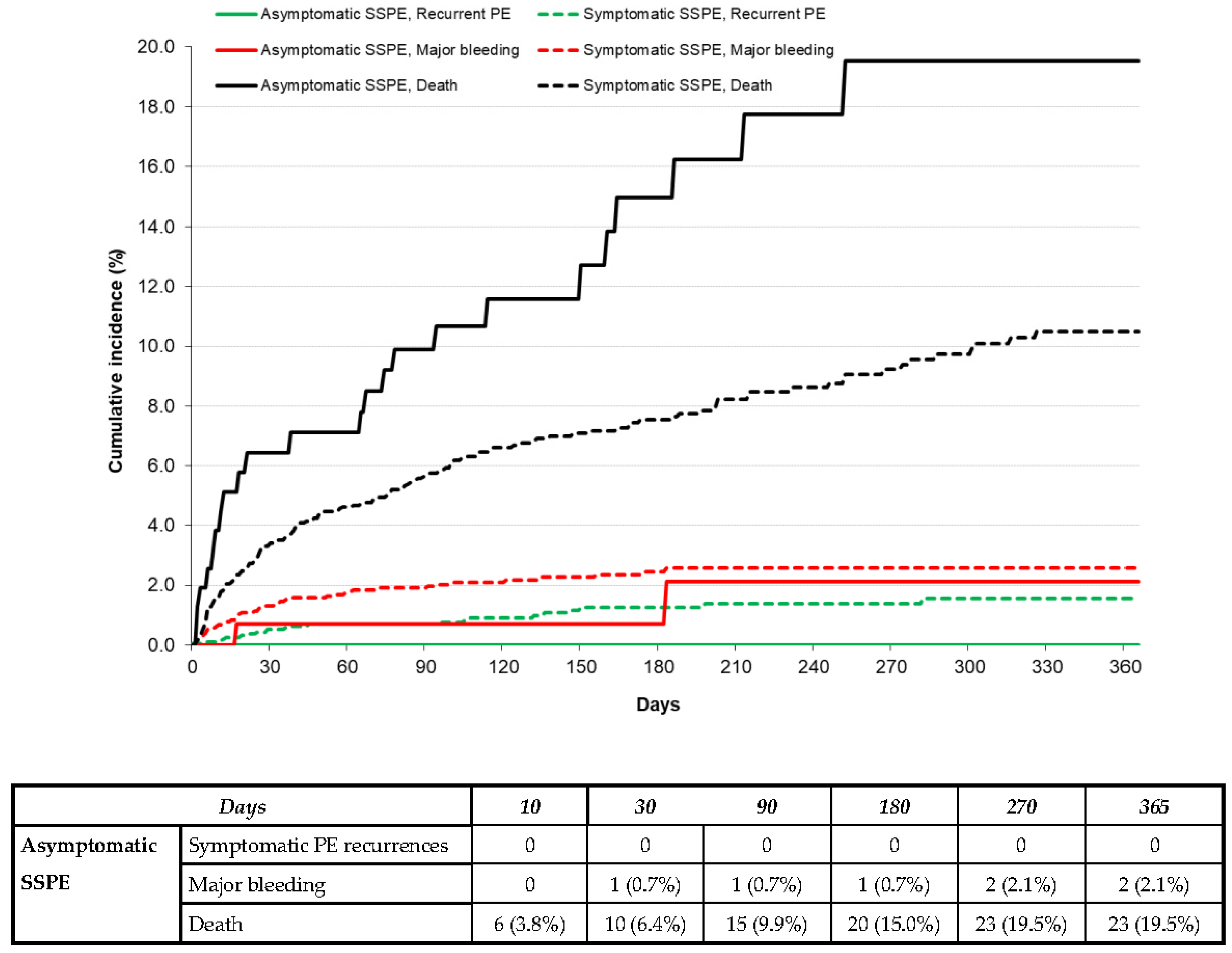
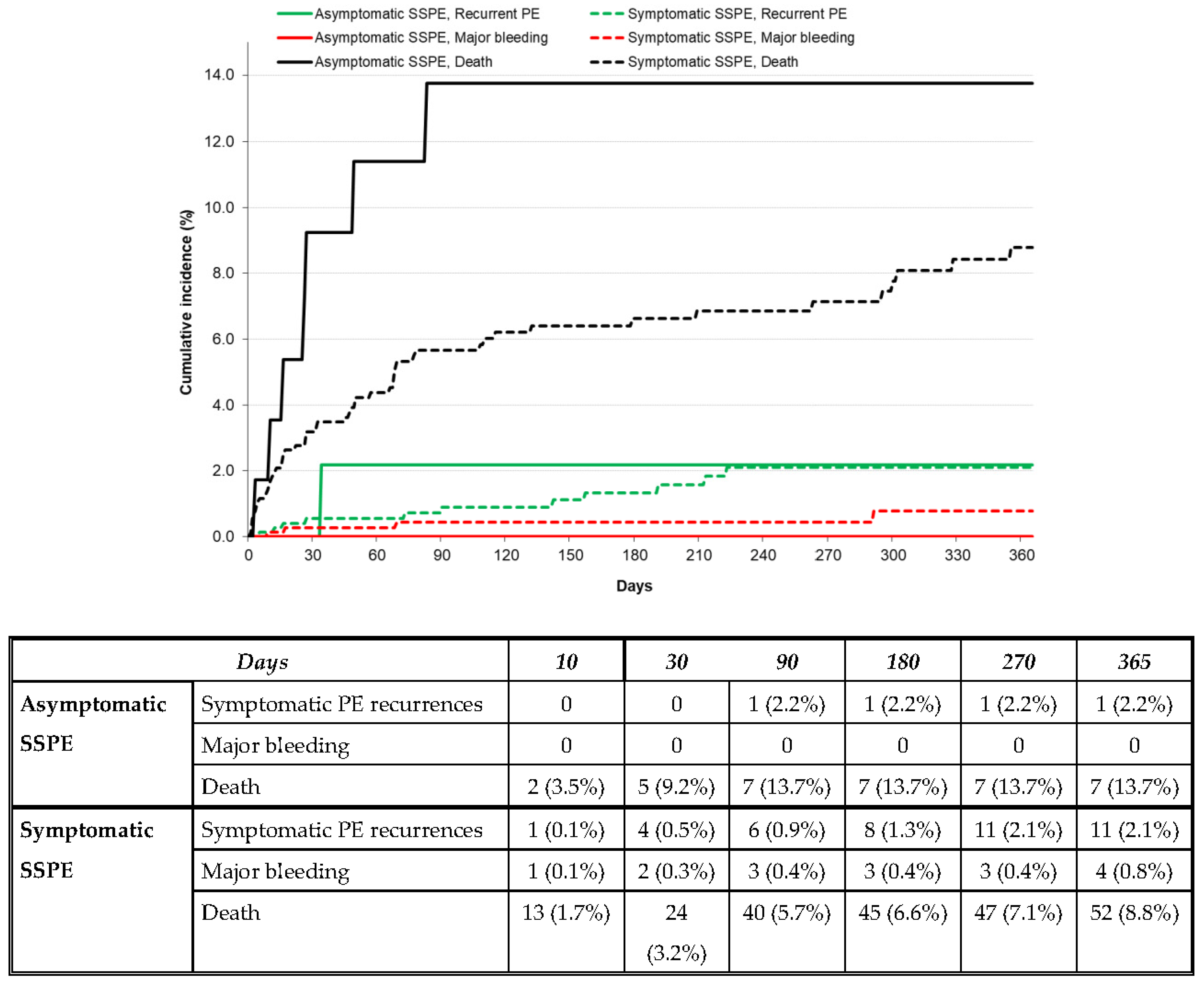

| Asymptomatic SSPE | Symptomatic SSPE | Odds Ratio (95% CI) | |
|---|---|---|---|
| Patients, N | 160 | 1975 | |
| Demographics, | |||
| Male gender | 83 (52%) | 987 (50%) | 1.08 (0.78–1.49) |
| Age (mean years ± SD) | 68 ± 15 † | 64 ± 17 | p = 0.009 |
| Body weight (mean kg ± SD) | 72 ± 15 * | 76 ± 17 | p = 0.039 |
| Comorbidities, | |||
| Hypertension | 65 (41%) | 871 (44%) | 0.87 (0.62–1.20) |
| Diabetes | 20 (13%) | 294 (16%) | 0.82 (0.50–1.34) |
| Atrial fibrillation | 7 (4.4%) | 105 (5.3%) | 0.81 (0.37–1.78) |
| Chronic lung disease | 18 (11%) | 292 (15%) | 0.73 (0.44–1.21) |
| Chronic heart failure | 8 (5.0%) | 182 (9.2%) | 0.52 (0.25–1.07) |
| Prior myocardial infarction | 6 (3.8%) | 140 (7.1%) | 0.51 (0.22–1.18) |
| Prior ischemic stroke | 15 (9.4%) | 117 (5.9%) | 1.64 (0.94–2.89) |
| Peripheral artery disease | 6 (4.0%) | 67 (3.6%) | 1.12 (0.48–2.62) |
| Recent major bleeding | 8 (5.0%) | 60 (3.0%) | 1.68 (0.79–3.58) |
| Recent COVID-19 infection | 14 (8.8%) | 278 (14.0%) | 0.59 (0.33–1.03) |
| Risk factors for PE, | |||
| Active cancer | 68 (43%) ‡ | 310 (16%) | 3.97 (2.84–5.56) |
| Recent immobilization | 35 (22%) | 478 (24%) | 0.88 (0.59–1.29) |
| Recent surgery | 26 (16%) | 215 (11%) | 1.59 (1.02–2.47) |
| Hormonal use | 5 (3.2%) | 111 (5.8%) | 0.53 (0.21–1.32) |
| Recent travel | 2 (1.3%) | 49 (2.6%) | 0.49 (0.12–2.04) |
| Pregnancy | 1 (0.63%) | 23 (1.2%) | 0.53 (0.07–3.98) |
| None of the above (unprovoked) | 49 (31%) ‡ | 962 (49%) | 0.46 (0.33–0.66) |
| Asymptomatic SSPE | Symptomatic SSPE | Odds Ratio (95% CI) | |
|---|---|---|---|
| Patients, N | 160 | 1975 | |
| Signs/symptoms, | |||
| Dyspnea | 0 ‡ | 1337 (68%) | - |
| Chest pain | 0 ‡ | 796 (40%) | - |
| Syncope | 0 ‡ | 165 (8.4%) | - |
| Hemoptysis | 0 ‡ | 81 (4.1%) | - |
| Lower-limb pain | 0 ‡ | 409 (21%) | - |
| Lower-limb swelling | 0 ‡ | 387 (20%) | - |
| SBP levels < 100 mmHg | 10 (7.0%) | 99 (5.0%) | 1.43 (0.73–2.80) |
| Heart rate > 110 bpm | 16 (11%) | 214 (11%) | 1.00 (0.58–1.71) |
| Blood levels, | |||
| Sat O2 levels < 90% (n = 876) | 7 (13%) | 156 (19%) | 0.64 (0.28–1.43) |
| Positive D-dimer (n = 1491) | 68 (96%) | 1339 (94%) | 1.37 (0.42–4.45) |
| Raised troponin (n = 965) | 15 (32%) | 200 (22%) | 1.68 (0.89–3.17) |
| Lower-limb ultrasound, | |||
| Proximal DVT | 14 (8.8%) | 278 (14%) | 0.59 (0.33–1.03) |
| Distal DVT | 11 (6.9%) | 111 (5.6%) | 1.24 (0.65–2.35) |
| Normal | 37 (23%) | 502 (25%) | 0.88 (0.60–1.29) |
| Not performed | 98 (61%) * | 1042 (53%) | 1.42 (1.02–1.97) |
| Prognostic scoring, | |||
| Simplified PESI < 1 points | 49 (31%) ‡ | 909 (46%) | 0.52 (0.37–0.73) |
| Initial therapy, | |||
| Low-molecular-weight heparin | 133 (83%) | 1640 (83%) | 1.01 (0.65–1.55) |
| Unfractionated heparin | 10 (6.3%) | 82 (4.2%) | 1.54 (0.78–3.03) |
| Fondaparinux | 3 (1.9%) | 27 (1.4%) | 1.38 (0.41–4.59) |
| Direct oral anticoagulants | 5 (3.3%) † | 187 (9.5%) | 0.32 (0.13–0.80) |
| Rivaroxaban | 2 (1.3%) * | 113 (5.7%) | 0.21 (0.05–0.85) |
| Apixaban | 2 (1.3%) | 59 (3%) | 0.41 (0.10–1.70) |
| Thrombolytics | 0 | 2 (0.10%) | - |
| No initial therapy | 5 (3.1%) | 12 (0.6%) | 5.17 (1.84–15.2) |
| Long-term therapy, | |||
| Low-molecular-weight heparin | 83 (52%) ‡ | 549 (28%) | 2.80 (2.02–3.88) |
| Vitamin K antagonists | 33 (21%) ‡ | 753 (38%) | 0.42 (0.28–0.63) |
| Fondaparinux | 0 | 12 (0.61%) | - |
| Direct oral anticoagulants | 31 (21%) * | 585 (31%) | 0.60 (0.40–0.91) |
| Rivaroxaban | 12 (7.5%) † | 299 (15%) | 0.45 (0.25–0.83) |
| Apixaban | 13 (8.1%) | 195 (9.9%) | 0.81 (0.45–1.45) |
| Edoxaban | 5 (3.1%) | 68 (3.4%) | 0.90 (0.36–2.28) |
| Dabigatran | 1 (0.6%) | 23 (1.2%) | 0.53 (0.07–3.98) |
| No long-term therapy | 4 (2.5%) | 18 (0.9%) | 2.78 (0.93–8.34) |
| Asymptomatic SSPE | Symptomatic SSPE | Hazard Ratio (95% CI) | |||
|---|---|---|---|---|---|
| N | Events per 100 Patient Years | N | Events per 100 Patient Years | ||
| During anticoagulation | |||||
| Patients, N | 160 | 1975 | |||
| Duration of therapy, | |||||
| Median days (IQR) | 148 (94–306) | 173 (101–306) | |||
| Mean days ± SD | 240 ± 267 | 277 ± 382 | p = 0.101 | ||
| Outcomes, | |||||
| Recurrent VTE | 3 | 2.98 (0.76–8.10) | 38 | 2.60 (1.86–3.53) | 1.15 (0.28–3.32) |
| Recurrent PE | 2 | 1.98 (0.33–6.55) | 12 | 0.81 (0.44–1.37) | 2.46 (0.37–9.74) |
| Recurrent DVT | 1 | 0.97 (0.05–4.79) | 27 | 1.84 (1.24–2.64) | 0.53 (0.03–2.80) |
| Major bleeding | 3 | 2.91 (0.74–7.93) | 51 | 3.44 (2.59–4.48) | 0.85 (0.21–2.42) |
| Gastrointestinal | 2 | 1.94 (0.33–6.42) | 16 | 1.07 (0.64–1.71) | 1.81 (0.28–6.85) |
| Intracranial | 1 | 0.97 (0.05–4.79) | 9 | 0.60 (0.29–1.10) | 1.61 (0.07–9.82) |
| Death | 24 | 23.3 (15.3–34.1) † | 179 | 12.0 (10.3–13.8) | 1.95 (1.25–2.94) |
| Fatal PE | 0 | - | 6 | 0.40 (0.16–0.83) | - |
| Fatal bleeding | 1 | 0.97 (0.05–4.79) | 11 | 0.74 (0.39–1.28) | 1.32 (0.06–7.73) |
| After discontinuing anticoagulant therapy | |||||
| Patients, N | 58 | 781 | |||
| Duration of therapy, | |||||
| Median days (IQR) | 154 (43–331) | 198 (75–475) | |||
| Mean days ± SD | 287 ± 419 | 367 ± 485 | p = 0.169 | ||
| Outcomes, | |||||
| Recurrent VTE | 2 | 4.38 (0.73–14.5) | 40 | 5.16 (3.74–6.96) | 0.85 (0.14–2.96) |
| Recurrent PE | 2 | 4.38 (0.73–14.48) | 27 | 3.45 (2.32–4.95) | 1.27 (0.20–4.55) |
| Recurrent DVT | 0 | - | 13 | 1.67 (0.93–2.79) | - |
| Major bleeding | 0 | - | 6 | 0.77 (0.31–1.59) | - |
| Gastrointestinal | 0 | - | 4 | 0.51 (0.16–1.23) | - |
| Intracranial | 0 | - | 0 | - | - |
| Death | 8 | 17.5 (8.14–33.3) | 67 | 8.53 (6.66–10.8) | 2.06 (0.92–4.10) |
| Causes of death | |||||
| Fatal PE | 0 | - | 1 | 0.13 (0.01–0.63) | - |
| Fatal bleeding | 0 | - | 5 | 0.64 (0.23–1.41) | - |
| Asymptomatic SSPE | Symptomatic SSPE | Hazard Ratio (95% CI) | |||
|---|---|---|---|---|---|
| N | Events per 100 Patient Years | N | Events per 100 Patient Years | ||
| In patients on LMWH, N | |||||
| Symptomatic PE | 0 | - | 3 | 0.52 (0.13–1.41) | - |
| Symptomatic DVT | 0 | - | 2 | 0.34 (0.06–1.14) | - |
| Major bleeding | 3 | 4.80 (1.22–13.1) | 28 | 4.85 (3.29–6.92) | 0.99 (0.24–2.93) |
| In patients on VKAs, N | |||||
| Symptomatic PE | 1 | 3.18 (0.16–15.7) | 24 | 3.16 (2.07–4.63) | 1.01 (0.05–5.37) |
| Symptomatic DVT | 2 | 6.83 (1.15–22.6) | 10 | 1.29 (0.65–2.29) | 5.31 (0.79–21.8) |
| Major bleeding | 0 | - | 18 | 2.32 (1.42–3.59) | - |
| In patients on DOACs, N | |||||
| Symptomatic PE | 0 | - | 0 | - | - |
| Symptomatic DVT | 0 | - | 0 | - | - |
| Major bleeding | 0 | - | 3 | 2.43 (0.62–6.62) | - |
| In patients on other drugs, N | |||||
| Symptomatic PE | 0 | - | 0 | - | - |
| Symptomatic DVT | 0 | - | 0 | - | - |
| Major bleeding | 0 | - | 2 | 33.0 (5.54–109.2) | - |
| Asymptomatic SSPE | Symptomatic SSPE | |||||||
|---|---|---|---|---|---|---|---|---|
| Confirmed DVT | No DVT | Confirmed DVT | No DVT | |||||
| N | Events per 100 Patient Years | N | Events per 100 Patient Years | N | Events per 100 Patient Years | N | Events per 100 Patient Years | |
| During anticoagulation | ||||||||
| Patients, N | 25 | 37 | 389 | 502 | ||||
| Median days (IQR) | 218 ± 253 | 240 ± 179 | 357 ± 586 | 275 ± 313 | ||||
| Mean days ± SD | 97 (38–257) | 199 (98–342) | 185 (104–349) | 184 (102–345) | ||||
| Outcomes, | ||||||||
| Recurrent VTE | 0 | - | 0 | - | 9 | 2.46 (1.20–4.51) | 9 | 2.41 (1.18–4.43) |
| Recurrent PE | 0 | - | 0 | - | 6 | 1.64 (0.66–3.40) | 8 | 2.14 (1.00–4.07) |
| Recurrent DVT | 0 | - | 0 | - | 4 | 1.05 (0.34–2.54) | 1 | 0.26 (0.01–1.31) |
| Major bleeding | 0 | - | 0 | - | 10 | 2.66 (1.35–4.75) | 12 | 3.20 (1.73–5.44) |
| Gastrointestinal | 0 | - | 0 | - | 4 | 1.06 (0.34–2.55) | 5 | 1.33 (0.49–2.94) |
| Intracranial | 0 | - | 0 | - | 2 | 0.53 (0.09–1.74) | 1 | 0.26 (0.01–1.31) |
| Death | 5 | 33.5 (12.3–74.3) | 2 | 8.46 (1.42–27.9) | 31 | 8.16 (5.64–11.4) | 30 | 7.94 (5.46–11.2) |
| After discontinuing anticoagulant therapy | ||||||||
| Patients, N | 5 | 14 | 119 | 198 | ||||
| Median days (IQR) | 184 ± 72 | 445 ± 627 | 452 ± 582 | 418 ± 533 | ||||
| Mean days ± SD | 199 (130–208) | 162 (58–596) | 206 (65–636) | 243 (88–529) | ||||
| Outcomes, | ||||||||
| Recurrent VTE | 0 | - | 0 | - | 10 | 7.21 (3.66–12.8) | 10 | 4.42 (2.24–7.87) |
| Recurrent PE | 0 | - | 0 | - | 4 | 2.74 (0.87–6.61) | 9 | 3.97 (1.94–7.29) |
| Recurrent DVT | 0 | - | 0 | - | 6 | 4.28 (1.74–8.91) * | 1 | 0.44 (0.02–2.18) * |
| Major bleeding | 0 | - | 0 | - | 0 | - | 1 | 0.44 (0.02–2.19) |
| Death | 0 | - | 1 | 5.86 (0.29–28.9) | 11 | 7.47 (3.93–13.0) | 18 | 7.94 (4.85–12.3) |
| Symptomatic PE Recurrences | Death | |||
|---|---|---|---|---|
| Univariable | Multivariable | Univariable | Multivariable | |
| Patients, N | ||||
| Demographics, | ||||
| Male gender | 1.18 (0.70–1.98) | - | 1.36 (1.06–1.76) * | 0.67 (0.52–0.87) † |
| Age >70 years | 0.68 (0.39–1.17) | - | 2.47 (1.90–3.19) ‡ | 1.81 (1.38–2.37) ‡ |
| Body weight >75 kg | 1.71 (1.01–2.89) * | 1.77 (1.05–2.98) * | 0.49 (0.38–0.65) ‡ | 0.59 (0.45–0.77) ‡ |
| Comorbidities, | ||||
| Hypertension | 1.35 (0.74–0.81) | - | 1.33 (1.03–1.71) * | 0.82 (0.62–1.07) |
| Diabetes | 1.54 (0.81–2.93) | - | 2.01 (1.47–2.74) ‡ | 1.63 (1.20–2.20) † |
| Atrial fibrillation | 1.20 (0.43–3.32) | - | 2.62 (1.69–4.06) ‡ | 1.90 (1.26–2.87) † |
| Chronic lung disease | 1.32 (0.70–2.52) | - | 2.16 (1.59–2.93) ‡ | 1.16 (0.86–1.57) |
| Chronic heart failure | 0.61 (0.22–1.70) | - | 2.20 (1.53–3.17) ‡ | 1.83 (1.26–2.66) † |
| Prior myocardial infarction | 0.41 (0.10–1.67) | - | 2.17 (1.45–3.26) ‡ | 1.42 (0.96–2.11) |
| Prior ischemic stroke | 1.50 (0.60–3.75) | - | 2.50 (1.66–3.78) ‡ | 1.47 (0.99–2.18) |
| Peripheral artery disease | 0.52 (0.07–3.81) | - | 2.28 (1.32–3.94) † | 1.36 (0.81–2.28) |
| Recent major bleeding | 1.32 (0.32–5.48) | - | 1.61 (0.87–2.98) | - |
| Risk factors for SSPE, | ||||
| Unprovoked | Ref. | Ref. | Ref. | Ref. |
| Transient risk factors | 0.70 (0.38–1.20) | - | 1.90 (1.32–2.74) † | 2.15 (1.48–3.13) ‡ |
| Active cancer | 1.70 (0.95–3.03) | 1.94 (1.08–3.50) * | 12.2 (8.72–17.2) † | 10.9 (7.77–15.2) ‡ |
| Initial SSPE presentation, | ||||
| Asymptomatic SSPE | 0.77 (0.25–2.37) | 0.70 (0.22–2.24) | 1.83 (1.22–2.75) † | 1.07 (0.73–1.56) |
| Use of anticoagulant therapy, | ||||
| Off anticoagulation | 1.69 (1.01–2.81) * | 1.77 (1.07–2.91) * | 0.54 (0.41–0.72) † | 0.50 (0.38–0.66) ‡ |
Disclaimer/Publisher’s Note: The statements, opinions and data contained in all publications are solely those of the individual author(s) and contributor(s) and not of MDPI and/or the editor(s). MDPI and/or the editor(s) disclaim responsibility for any injury to people or property resulting from any ideas, methods, instructions or products referred to in the content. |
© 2023 by the authors. Licensee MDPI, Basel, Switzerland. This article is an open access article distributed under the terms and conditions of the Creative Commons Attribution (CC BY) license (https://creativecommons.org/licenses/by/4.0/).
Share and Cite
Rodríguez-Cobo, A.; Fernández-Capitán, C.; Tung-Chen, Y.; Salgueiro-Origlia, G.; Ballaz, A.; Bortoluzzi, C.; Sarlon-Bartoli, G.; Pesce, M.L.; Najib, D.; Monreal, M.; et al. Clinical Significance and Outcome in Patients with Asymptomatic Versus Symptomatic Subsegmental Pulmonary Embolism. J. Clin. Med. 2023, 12, 1640. https://doi.org/10.3390/jcm12041640
Rodríguez-Cobo A, Fernández-Capitán C, Tung-Chen Y, Salgueiro-Origlia G, Ballaz A, Bortoluzzi C, Sarlon-Bartoli G, Pesce ML, Najib D, Monreal M, et al. Clinical Significance and Outcome in Patients with Asymptomatic Versus Symptomatic Subsegmental Pulmonary Embolism. Journal of Clinical Medicine. 2023; 12(4):1640. https://doi.org/10.3390/jcm12041640
Chicago/Turabian StyleRodríguez-Cobo, Ana, Carmen Fernández-Capitán, Yale Tung-Chen, Giorgina Salgueiro-Origlia, Aitor Ballaz, Cristiano Bortoluzzi, Gabrielle Sarlon-Bartoli, Maria Lourdes Pesce, Dally Najib, Manuel Monreal, and et al. 2023. "Clinical Significance and Outcome in Patients with Asymptomatic Versus Symptomatic Subsegmental Pulmonary Embolism" Journal of Clinical Medicine 12, no. 4: 1640. https://doi.org/10.3390/jcm12041640
APA StyleRodríguez-Cobo, A., Fernández-Capitán, C., Tung-Chen, Y., Salgueiro-Origlia, G., Ballaz, A., Bortoluzzi, C., Sarlon-Bartoli, G., Pesce, M. L., Najib, D., Monreal, M., & The RIETE Investigators. (2023). Clinical Significance and Outcome in Patients with Asymptomatic Versus Symptomatic Subsegmental Pulmonary Embolism. Journal of Clinical Medicine, 12(4), 1640. https://doi.org/10.3390/jcm12041640


