


The Limited Coverage of Facial Feminization Surgery in the United States: A Literature Review of Policy Constraints and Implications




Abstract
:1. Introduction
2. Materials and Methods
3. Results
3.1. Commercial Policies
3.2. Coverage by State
3.3. Procedures Covered
3.4. Medical Necessity Criteria
4. Discussion
5. Conclusions
Author Contributions
Funding
Institutional Review Board Statement
Informed Consent Statement
Data Availability Statement
Conflicts of Interest
References
- Tristani-Firouzi, B.; Veith, J.; Simpson, A.; Hoerger, K.; Rivera, A.; Agarwal, C.A. Preferences for and barriers to gender affirming surgeries in transgender and non-binary individuals. Int. J. Transgend. Health 2022, 23, 458–471. [Google Scholar] [CrossRef] [PubMed]
- American Society of Plastic Surgeons. Plastic Surgery Statistics Report. 2020. Available online: https://www.plasticsurgery.org/documents/News/Statistics/2020/plastic-surgery-statistics-full-report-2020.pdf (accessed on 5 June 2023).
- Shane, D.M.; Krishna, S.V.; Saba, M.; Katherine, M.G.; Michael, T.C.; Vania, R.; Thomas, S.; William, K.; Paul, S.C. Facial Feminization: Systematic Review of the Literature. Plast. Reconstr. Surg. 2016, 137, 1759–1770. [Google Scholar]
- Dubov, A.; Fraenkel, L. Facial Feminization Surgery: The Ethics of Gatekeeping in Transgender Health. Am. J. Bioethics 2018, 18, 3–9. [Google Scholar] [CrossRef] [PubMed]
- Wiegmann, A.L.; Young, E.I.; Baker, K.E.; Khalid, S.I.; Seu, M.; Shenaq, D.S.; Dorafshar, A.H.; Schechter, L.S. The Affordable Care Act and Its Impact on Plastic and Gender-Affirmation Surgery. Plast. Reconstr. Surg. 2021, 147, 135e–153e. [Google Scholar] [CrossRef] [PubMed]
- Ngaage, L.M.; Xue, S.; Borrelli, M.R.; Safa, B.; Berli, J.U.; Bluebond-Langner, R.; Rasko, Y.M. Gender-Affirming Health Insurance Reform in the United States. Ann. Plast. Surg. 2021, 87, 119–122. [Google Scholar] [CrossRef] [PubMed]
- Ngaage, L.M.; McGlone, K.L.; Xue, S.; Knighton, B.J.; Benzel, C.A.; Rada, E.M.; Coon, D.; Berli, J.; Rasko, Y.M. Gender Surgery Beyond Chest and Genitals: Current Insurance Landscape. Aesthet. Surg. J. 2020, 40, NP202–NP210. [Google Scholar] [CrossRef] [PubMed]
- Gadkaree, S.K.; DeVore, E.K.; Richburg, K.; Lee, L.N.; Derakhshan, A.; McCarty, J.C.; Seth, R.; Shaye, D.A. National Variation of Insurance Coverage for Gender-Affirming Facial Feminization Surgery. Facial Plast. Surg. Aesthetic Med. 2021, 23, 270–277. [Google Scholar] [CrossRef] [PubMed]
- Gorbea, E.; Gidumal, S.; Kozato, A.; Pang, J.H.; Safer, J.D.; Rosenberg, J. Insurance Coverage of Facial Gender Affirmation Surgery: A Review of Medicaid and Commercial Insurance. Otolaryngol. Head Neck Surg. 2021, 165, 791–797. [Google Scholar] [CrossRef]
- Almazan, A.N.; Benson, T.A.; Boskey, E.R.; Ganor, O. Associations Between Transgender Exclusion Prohibitions and Insurance Coverage of Gender-Affirming Surgery. LGBT Health 2020, 7, 254–263. [Google Scholar] [CrossRef]
- Hu, A.C.; Dang, B.N.; Bertrand, A.A.; Jain, N.S.; Chan, C.H.; Lee, J.C. Facial Feminization Surgery under Insurance: The University of California Los Angeles Experience. Plast. Reconstr. Surg. Glob. Open 2021, 9, e3572. [Google Scholar] [CrossRef]
- Hauc, S.C.; Mateja, K.L.; Long, A.S.; Glahn, J.Z.; Acuna Higaki, A.R.; Rivera, J.C.; Ihnat, J.M.H.; Mukherjee, T.; Oh, S.J.; Alperovich, M. Limited Access to Facial Feminization Geographically Despite Nationwide Expansion of Other Gender-Affirming Surgeries. Plast. Reconstr. Surg. Glob. Open 2022, 10, e4521. [Google Scholar] [CrossRef]
- Ousterhout, D.K. Feminization of the forehead: Contour changing to improve female aesthetics. Plast. Reconstr. Surg. 1987, 79, 701–713. [Google Scholar] [CrossRef] [PubMed]
- Escandón, J.M.; Morrison, C.S.; Langstein, H.N.; Ciudad, P.; Del Corral, G.; Manrique, O.J. Applications of three-dimensional surgical planning in facial feminization surgery: A systematic review. J. Plast. Reconstr. Aesthet. Surg. 2022, 75, e1–e14. [Google Scholar] [CrossRef] [PubMed]
- Human Rights Campaign. LGBTQ Equality at the Fortune 500. Available online: https://www.hrc.org/resources/lgbt-equality-at-the-fortune-500 (accessed on 7 June 2023).
- Coleman, E.; Radix, A.E.; Bouman, W.P.; Brown, G.R.; de Vries, A.L.C.; Deutsch, M.B.; Ettner, R.; Fraser, L.; Goodman, M.; Green, J.; et al. Standards of Care for the Health of Transgender and Gender Diverse People, Version 8. Int. J. Transgend. Health 2022, 23, S1–S259. [Google Scholar] [CrossRef] [PubMed]
- Kim, K.G.; Bekeny, J.C.; Pine, E.; Manrique, O.J.; Del Corral, G. Building a gender-affirming surgery service: The fundamentals. Surgery 2022, 171, 498–503. [Google Scholar] [CrossRef] [PubMed]
- Bustos, S.S.; Bustos, V.P.; Mascaro, A.; Ciudad, P.; Forte, A.J.; Del Corral, G.; Manrique, O.J. Complications and Patient-reported Outcomes in Transfemale Vaginoplasty: An Updated Systematic Review and Meta-analysis. Plast. Reconstr. Surg. Glob. Open 2021, 9, e3510. [Google Scholar] [CrossRef] [PubMed]
- Manrique, O.J.; Adabi, K.; Martinez-Jorge, J.; Ciudad, P.; Nicoli, F.; Kiranantawat, K. Complications and Patient-Reported Outcomes in Male-to-Female Vaginoplasty-Where We Are Today: A Systematic Review and Meta-Analysis. Ann. Plast. Surg. 2018, 80, 684–691. [Google Scholar] [CrossRef] [PubMed]
- Manrique, O.J.; Adabi, K.; Huang, T.C.; Jorge-Martinez, J.; Meihofer, L.E.; Brassard, P.; Galan, R. Assessment of Pelvic Floor Anatomy for Male-to-Female Vaginoplasty and the Role of Physical Therapy on Functional and Patient-Reported Outcomes. Ann. Plast. Surg. 2019, 82, 661–666. [Google Scholar] [CrossRef] [PubMed]
- Bekeny, J.C.; Zolper, E.G.; Manrique, O.J.; Fan, K.L.; Del Corral, G. Breast augmentation in the transgender patient: Narrative review of current techniques and complications. Ann. Transl. Med. 2021, 9, 611. [Google Scholar] [CrossRef] [PubMed]
- Hu, A.C.; Dang, B.C.; Bertrand, A.A.; Jain, N.S.; Chan, C.C.; Lee, J.C. Insurance Barriers and Appeals for Facial Feminization Surgery: A Cost-Analysis. J. Am. Coll. Surg. 2020, 231, S228. [Google Scholar] [CrossRef]
- Paris, F. See The States That Have Passed Laws Directed at Young Trans People. The New York Times, 5 June 2023. [Google Scholar]
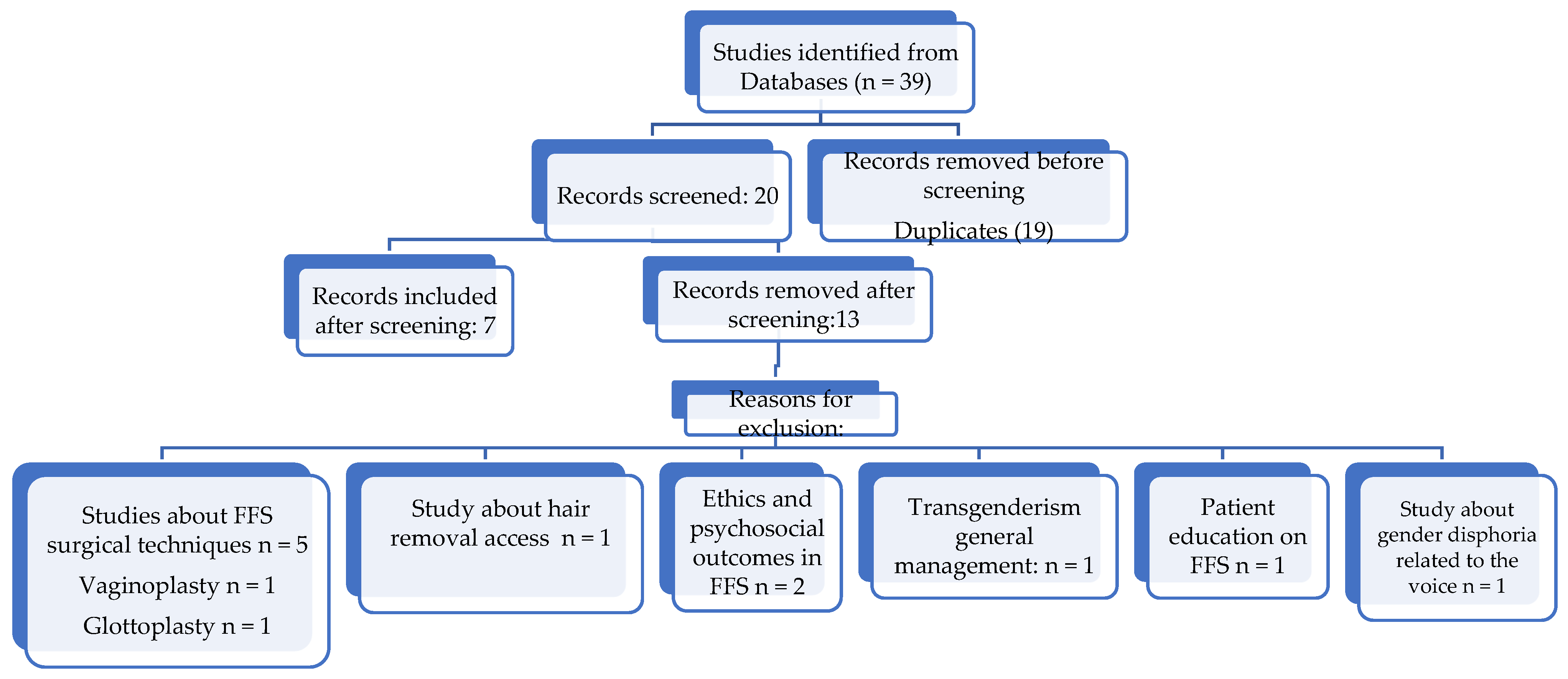

| Year | Author | Study | Location | Study Type | Observation Period | Summary | Outcomes | |||
|---|---|---|---|---|---|---|---|---|---|---|
| Policy Coverage | State Policy | Procedures Covered | Medical Necessity Criteria | |||||||
| 2021 | Ngaage et al. [6] | Gender-Affirming Health Insurance Reform in the United States | United States | Cross sectional | 2007–2018 | To examine changes in insurance policies after the Department of Health and Human Services prohibited insurance discrimination of transgender individuals in 2014. | x | |||
| 2020 | Ngage et al. [7] | Gender Surgery Beyond Chest and Genitals: Current Insurance Landscape | United States | Cross sectional | 12/2018–02/2019 | To assess the frequency of coverage provision for ancillary transition-related surgeries through a cross-sectional analysis of US insurance policies. | x | x | x | |
| 2021 | Gadkaree et al. [8] | National Variation of Insurance coverage For Gender affirming Facial Feminization Surgery | United States | Cross sectional | 2018–2019 | To determine insurance coverage and ease of finding policy information for FFSs, and analyze differences based on state advocacy. | x | x | x | |
| 2021 | Gorbea et al. [9] | Insurance Coverage of Facial Gender Affirmation Surgery: A Review of medicaid and commercial insurance | United States | Systematic review | 01/2020–05/2020 | To review state policies on transgender care for 50 states. | x | x | x | x |
| 2020 | Almazan et al. [10] | Associations Between Transgender Exclusion Prohibitions and Insurance Coverage of Gender-Affirming Surgery | United States | Cross sectional | 05/2019–08/2019 | To evaluate coverage of gender-affirming surgery between states that do and do not have prohibitions against explicit transgender exclusions in private insurance. | x | x | x | x |
| 2021 | Hu et al. [11] | Facial Feminization Surgery Under insurance, The university of California, LA, Experience | LA, California | Case series | 2018–2020 | To assess time and costs of the FFS insurance coverage and authorization process in California. | x | x | ||
| 2022 | Hauc et al. [12] | Limited Access to Facial Feminization Geographically Despite Nationwide Expansion of Other Gender-Affirming Surgeries | United States | Case series | 2008–2017 for all GAS FFS data only through 2015–2017 | To estimate trends in GAS and access to FFS depending on geographical zone and primary payer in the US. | x | |||
| Year | Author | Study | Study Type | Observation Period | Methods | Companies Included | Policies | Any Policies for FFS |
|---|---|---|---|---|---|---|---|---|
| 2021 | Ngaage et al. [6] | Gender-Affirming Health Insurance Reform in the United States | Cross sectional | 2007–2018 | Insurance providers were selected based on company market share. We conducted a Web-based search and telephone interviews to identify policies related to GAS. | 92 | Stated GAS: 86 No coverage: 2 No GAS policy: 6 | Not assessed |
| 2020 | Ngage et al. [7] | Gender Surgery Beyond Chest and Genitals: Current Insurance Landscape | Cross sectional | 12/2018–02/2019 | The top 3 insurers from each state were cross-referenced with market share. Thus, 63 insurance companies were included, representing 80% of the market share. | 63 | Stated GAS: 61 No GAS policy: 2 | 14 (23%) |
| 2021 | Gadkaree et al. [8] | National Variation of Insurance coverage For Gender affirming Facial Feminization Surgery | Cross sectional | 2018–2019 | The top three largest commercial health plans per state based on 2019 enrollment data were included. | 150 | Stated GAS: 149 no public policy: 1 | 27 (18%) |
| 2021 | Gorbea et al. [9] | Insurance Coverage of Facial Gender Affirmation Surgery: A Review of Medicaid and commercial insurance | Systematic review | 01/2020–05/2020 | State policies on transgender care were collected for 50 states. The largest companies were identified using the national association of insurance commissioners’ market. | 50 | Stated 45 No GAS policy 4 No public policy 1 | 27 (60%) excluded all FFS procedures, 18(40%) offered some degree of coverage |
| 2020 | Almazan et al. [10] | Associations Between Transgender Exclusion Prohibitions and Insurance Coverage of Gender-Affirming Surgery | Cross sectional | 05/2019–08/2019 | Insurance policies for gender-affirming surgery were obtained from the three largest insurers, by market share, in each state. | 124 | Stated GAS: 95 No available policy: 29 | 24.7% |
| Year | Author | Study | Type | Observation Period | Methods | Coverage Findings | FFS Related Policies |
|---|---|---|---|---|---|---|---|
| 2021 | Hu et al. [11] | Facial Feminization Surgery Under insurance, The university of California, LA, Experience | Case series | 2018–2020 | FFS consults (n = 40) at UCLA were reviewed for time and cost to authorization. | 1. Medical (n = 13), Medicare (4), and private California insured plans (9) had an authorization time of 1.1 months. 2. Private insurance (n = 10) 7 months for authorization 3. Private insurance from ERISA (n = 4) denied. | 90% of 40 patients were accepted for one stage FFS in UCLA between 2018 and 2020. |
| 2022 | Hauc et al. [12] | Limited Access to Facial Feminization Geographically Despite Nationwide Expansion of Other Gender-Affirming Surgeries | Case series | 2008–2017 for all GAS FFS data only through 2015–2017 | Subtracted data from NIS National inpatient sample and reviewed the primary payer for GAS and FFS based on ICD dx on hospital stays. | Most FFS procedures occurred. 1. West (50%) 2. Northeast 35 (31.8%) 3. South 15 (13.6%) 4. Midwest (5, 4.8%) | 1. Connecticut, Massachusetts, and Washington cover FFS extensively without case-by-case clause. 2. Maryland, California, and Oregon cover certain procedures. 3. Colorado started to cover jaw, cheek, and facial bone remodel in 2023. |
| 2020 | Ngage et al. [7] | Gender Surgery Beyond Chest and Genitals: Current Insurance Landscape | Cross sectional | 12/2018–02/2019 | The top 3 insurers from each state were cross-referenced with market share. Thus, 63 insurance companies were included, representing 80% of the market share. | States with greater coverage are the ones with transgender exclusion prohibitions in private insurance plans. | States without any ancillary procedure coverage = 19 States with favorable coverage for FFS = 26 |
| 2021 | Gorbea et al. [9] | Insurance Coverage of Facial Gender Affirmation Surgery: A Review of Medicaid and commercial insurance | Systematic review | 01/2020–05/2020 | State policies on transgender care were collected for 50 states. The largest companies were identified using the national association of insurance commissioners’ market. | States with GAS policies: 30 GAS coverage: 18 Denied Coverage: 13 | FFS policies: 7 Coverage: 3 Denied coverage 4 Extensive coverage; Washington, Connecticut, Massachusetts |
| 2020 | Almazan et al. [10] | Associations Between Transgender Exclusion Prohibitions and Insurance Coverage of Gender-Affirming Surgery | Cross sectional | 05/2019–08/2019 | Insurance policies for GAS obtained from the three largest insurers, by market share, in each state. | Policies based in states with TG insurance prohibitions: 46 (37.1%) Policies in states that do not prohibit TG exclusions in private insurance: 78 (62.9%) | 1. FFS covered by 19.6% of policies in states with TG exclusion prohibitions. 2. 5.1% of policies in states without exclusion prohibitions |
| Year/Author | Study | Covered Procedures | Covered Procedures from Most Covered to Least | % of Policies That Cover the Procedure |
|---|---|---|---|---|
| Gorbea et al., 2021 | Insurance Coverage of Facial Gender Affirmation Surgery: A Review of Medicaid and commercial insurance. [9] | 1. Most covered FGAS by commercial insurers 2. Was described as a medically necessary aspect of transgender care in 100% of the commercial policies reviewed 3. Variable coverage and recognition as medical necessity |
|
|
| Gadkaree et al., 2021 | National Variation of Insurance Coverage for Gender Affirming Facial Feminization Surgery. [8] | 1. Chondrolaryngoplasty with preauthorization by 78% (n = 21) of favorable policies. -Nine companies provided coverage for chondrolaryngoplasty only |
|
|
| Almazan et al., 2020 | Associations Between Transgender Exclusion Prohibitions and Insurance Coverage of Gender-Affirming Surgery. [10] | Phalloplasty and vaginoplasty covered in 95% insurers in states that prohibit transgender exclusions--> coverage is very consistent through private insurers even in states that do not prohibit TG exclusions. |
| Policies of top insurers in states that do not prohibit transgender exclusions.
|
| Ngaage et al., 2020 | Gender Surgery Beyond Chest and Genitals: Current Insurance Landscape. [7] | 1. 60% (n = 30) of states have favorable policies for chondrolaryngoplasty across the US 2. n = 14 have favorable coverage for facial procedures 23% (n = 14) of companies covered at least 1 FFS procedure. blepharoplasty 8% always covered and 13% on case-by case basis |
|
|
| Hu et al., 2022 | Facial Feminization Surgery Under insurance, The university of California, LA, Experience. [11] |
|
|
| Criteria for Surgery According to WPATH (World Professional Association for Transgender Health) [16] |
|---|
| a. Gender incongruence is marked and sustained. b. Meets diagnostic criteria for gender incongruence prior to gender-affirming surgical intervention in regions where a diagnosis is necessary to access healthcare. c. Demonstrates capacity to consent for the specific gender-affirming surgical intervention. d. Understands the effect of gender-affirming surgical intervention on reproduction and they have explored reproductive options. e. Other possible causes of apparent gender incongruence have been identified and excluded. f. Mental health and physical conditions that could negatively impact the outcome of gender-affirming surgical intervention have been assessed, with risks and benefits having been discussed. g. Stable on their gender-affirming hormonal treatment regime (which may include at least 6 months of hormone treatment or a longer period if required to achieve the desired surgical result, unless hormone therapy is either not desired or is medically contraindicated) |
| Author | Study | Medical Necessity Criteria | |
|---|---|---|---|
| Gadkaree et al. 2020 [8] | National Variation of Insurance Coverage for Gender Affirming Facial Feminization Surgery | Available for 26 companies | |
| 1. Gender dysphoria diagnosis 2. Age of majority 3. 12 months of congruent experience 4. Regular visits with a mental health provider 5. Referral from a mental health provider | 1. n = 25 2. n = 21 3. n = 19 4. n = 19 5. n = 18 | ||
| Gorbea et al. 2021 [9] | Insurance Coverage of Facial Gender Affirmation Surgery: A Review of Medicaid and commercial insurance | Medical necessity criteria for FFS stated by each company | |
| Ngaage et al. 2020 [7] | Gender Surgery Beyond Chest and Genitals: Current Insurance Landscape | Available for 12 companies | Policies |
| Age > 18 years | 7 | ||
| Age is not a requirement | 5 | ||
| Hormone therapy > 12 months | 7 | ||
| Hormone therapy not a requirement | 5 | ||
| Continuous living in congruent gender role for 12 m | 6 | ||
| Continuous living in congruent gender role for 24 m | 1 | ||
| Continuous living in congruent gender role not required | 5 | ||
| One referral from health professional | 3 | ||
| Two referrals from health professional | 4 | ||
| Referral from health professional not required | 5 | ||
| Almazan et al. 2020 [10] | Associations Between Transgender Exclusion Prohibitions and Insurance Coverage of Gender-Affirming Surgery | Medical necessity criteria for FFS stated by the company | |
Disclaimer/Publisher’s Note: The statements, opinions and data contained in all publications are solely those of the individual author(s) and contributor(s) and not of MDPI and/or the editor(s). MDPI and/or the editor(s) disclaim responsibility for any injury to people or property resulting from any ideas, methods, instructions or products referred to in the content. |
© 2023 by the authors. Licensee MDPI, Basel, Switzerland. This article is an open access article distributed under the terms and conditions of the Creative Commons Attribution (CC BY) license (https://creativecommons.org/licenses/by/4.0/).
Share and Cite
Aristizábal, A.; Escandón, J.M.; Ciudad, P.; Manrique, O.J. The Limited Coverage of Facial Feminization Surgery in the United States: A Literature Review of Policy Constraints and Implications. J. Clin. Med. 2023, 12, 5308. https://doi.org/10.3390/jcm12165308
Aristizábal A, Escandón JM, Ciudad P, Manrique OJ. The Limited Coverage of Facial Feminization Surgery in the United States: A Literature Review of Policy Constraints and Implications. Journal of Clinical Medicine. 2023; 12(16):5308. https://doi.org/10.3390/jcm12165308
Chicago/Turabian StyleAristizábal, Alejandra, Joseph M. Escandón, Pedro Ciudad, and Oscar J. Manrique. 2023. "The Limited Coverage of Facial Feminization Surgery in the United States: A Literature Review of Policy Constraints and Implications" Journal of Clinical Medicine 12, no. 16: 5308. https://doi.org/10.3390/jcm12165308
APA StyleAristizábal, A., Escandón, J. M., Ciudad, P., & Manrique, O. J. (2023). The Limited Coverage of Facial Feminization Surgery in the United States: A Literature Review of Policy Constraints and Implications. Journal of Clinical Medicine, 12(16), 5308. https://doi.org/10.3390/jcm12165308

