

Abstract
Integrated systems for water recovery from laundry wastewater were investigated to close the water cycle loop. The grey water from the washing cycle of cotton fabrics with a softening detergent was prefiltered, purified in a low-pressure membrane process, and further purified in a high-pressure membrane process or alternatively in an adsorption process. In all of the proposed systems, the recovered water was clarified and completely free of cationic surfactants. The system based on nanofiltration as the final stage of purification allows soft water, which promotes better cleaning results, reduces the consumption of detergents, and extends the lifetime of the devices involved. Adsorption on activated carbon effectively reduced the concentration of organic compounds, including fragrance compounds.
1. Introduction
The laundry business is widely recognised as a significant water consumer. On average, one hotel room generates 6.4 kg of laundry per day [1] while washing 1 kg of textiles requires approximately 15 L of fresh water [2] and generates wastewater containing a variety of organic and inorganic pollutants. Organic contaminants include soaps, detergents, fabric softeners, and grease; while inorganic pollutants consist of heavy metals, sand, silt, clay, metal ions, particles, phosphorus, and nitrogen compounds [3,4].
In the initial stage of the laundry cycle, the main impurities (fats, oils, greases, and suspended solids) [5] are removed from the textiles using ‘heavy duty’ detergents. These detergents are primarily composed of a mixture of anionic surfactants, such as linear alkylbenzene sulfonates (LABS), sodium lauryl ether sulphate (SLES), sodium dodecyl sulphate (SDS), and ether sulphates with nonionic surfactants such as alcohol ethoxylates. Additionally, builders, enzymes, polymers, and sometimes bleaches are included as active ingredients in these formulations [6]. Anionic surfactants exhibit excellent washing properties; however, they are sensitive to the presence of multivalent ions in hard water. In contrast, nonionic surfactants are highly soluble and largely unaffected by water hardness, but they are generally less effective than anionic surfactants in removing dirt and particulate matter from fabrics [7]. During the rinse stage, impurities and residual detergents are washed out of the laundry load. In the following stage, fabric softeners are applied to enhance the softness of the fabric, provide antistatic properties, and prevent static charge on the fibre. The softening effect is mainly attributed to the action of cationic surfactants.
Surfactants are classified into four groups (anionic, nonionic, cationic, and amphoteric) based on their molecular structure and charge of the hydrophilic part. Because of the positive charge of the ionic group in cationic surfactants, these compounds exhibit the ability to adsorb onto negatively charged surfaces. This phenomenon affects the antistatic and biocidal properties of cationic surfactants; however, the best softening properties are exhibited by cationic surfactants characterised by two long alkyl chains [8].
Currently, the primary cationic surfactants used in fabric softeners are esterquats, including diethyloxyesterdimethylammonium chloride (DEEDMAC), Hamburg esterquat (HEC), and triethanolamine-based esterquat (TEAQ) [9]. Esterquats are quaternary ammonium salts containing two long fatty acid chains (comprising 16 to 18 carbon atoms) with two weak ester bonds. The first compounds in the esterquat group were patented in the 1970s. Due to their softening effect, favourable environmental profile, and lower toxicity, esterquats replaced previously used dialkyldimethylammonium salts in the 1990s [10]. In 2024, the esterquat industry was valued at USD 2.6 billion and is projected to reach more than USD 6.2 billion by 2034 [11].
The composition of laundry wastewater (LWW) can vary depending on the type of laundry facility (domestic, hospital, or industrial) due to differences in the types of fabrics washed, the detergents used and the nature of the contaminants that are removed (Table 1). For example, hospital laundry wastewater often contains blood or urine [12] as well as significant amounts of disinfecting chemicals (such as peroxides, chlorine, and aldehydes). It should be noted that the main load of pollutants is generated during the first stages of laundry, while the wastewater obtained during the finishing is generally less contaminated.

Table 1.
Characteristics of LWW.
Industrial laundry wastewater accounts for approximately 10% of urban wastewater [19] and offers an opportunity to mitigate shortages and reduce environmental impacts [20]. Depending on the efficiency of the treatment processes and the quality of the purified water, reclaimed water can be reused for various non-potable applications (Figure 1, Table 2). Moderately treated wastewater can be used for flushing toilets and irrigation of the landscape, while advanced treatment methods, such as membrane filtration or oxidation processes, allow reuse in laundry operations [21]. In cases of high purification efficiency (e.g., reverse osmosis process), recovered water may even be suitable for boiler feed applications, enhancing industrial water sustainability.
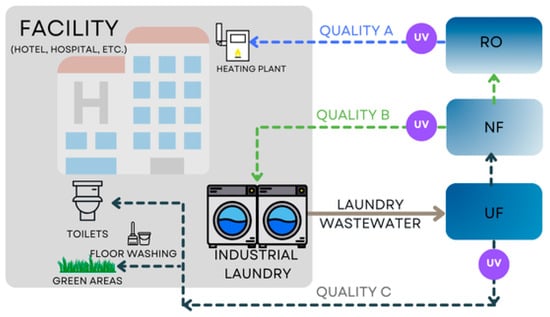
Figure 1.
Scheme of water recycling from industrial laundries.
Table 2.
Water reuse standards established to ensure environmental protection, human health safety, and compatibility with the intended application [18].
The treatment of laundry wastewater (LWW) employs various methods aimed at minimizing its environmental footprint and enabling water reuse. These methods can be classified into physicochemical, biological, or integrated systems [22,23]. Due to its complexity and variety depending on the specification of the washing process, laundry wastewater treatment requires multiple approaches [19,23,24].
Recent studies have examined a wide range of LWW treatment technologies, including conventional physicochemical processes such as coagulation and flocculation [13,16], biological treatment [19], and advanced oxidation processes (AOPs), including ozonation and UV/H2O2 [15,21]. For example, Deressa et al. [13] reported that coagulation/flocculation at pH 6 with a coagulant dose of 2.5 g/L reduced anionic surfactants, COD, and turbidity by 92%, 83%, and 85%, respectively, in domestic LWW. In industrial applications, Nascimento et al. [16] demonstrated that combining coagulation, flocculation and sedimentation with microfiltration achieved removal efficiencies of 72% for anionic surfactants, 69% for COD, and 99% for turbidity. AOPs have demonstrated high efficiency in the degradation of organic pollutants, yet they often involve significant operational costs and energy requirements, limiting their widespread application in industrial laundries [17].
More recently, pressure-driven membrane processes (PDMPs), including ultrafiltration (UF), nanofiltration (NF), and reverse osmosis (RO), are being increasingly used in laundry wastewater treatment, both as unit processes and in integrated systems [5,16,20]. Compared to conventional technologies, PDMPs offer high pollutant removal efficiency and a compact footprint, but are limited by membrane fouling.
The application of microfiltration, ultrafiltration and nanofiltration as unit processes in LWW treatment was effective in the removal of COD and turbidity, with reported efficiencies of 57 ± 0.8% [25], 88% [26], and 97% [27] for COD, and 77 ± 2.8% [25], 98.4% [26], and 98% [27] for turbidity. PDMPs integrated into treatment systems with conventional methods may yield even better results. For example, implementing coagulation as a pretreatment step before MF has led to a 61% reduction in COD and 100% decrease in turbidity [28]. Similarly, a treatment system combining granular activated carbon adsorption followed by UF achieved 87% COD and 99% turbidity removal [4]. However, most studies focus primarily on general water quality indicators such as COD, BOD, or turbidity, while the concentration of surfactants, particularly cationic compounds, is rarely measured. This significantly limits understanding of their behaviour during treatment and their potential environmental impact.
Despite advancements in treatment technologies, effluent quality is often inadequate for reuse in laundry operations due to the presence of oils, surfactants, suspended solids, and high COD, as well as trace organic solvents and heavy metals [19]. Furthermore, most studies address the treatment of combined effluent from the entire wash cycle, which is typically highly polluted. As an alternative, wastewater generated during the final rinse and fabric softening stages may offer a less contaminated and more manageable stream for targeted treatment.
The number of papers related to fabric softening in the laundry process is very limited. Furthermore, despite its significant production and utilisation, only a few papers have raised the issue of esterquat removal from aqueous solutions and environmental pollution [9]. Previous research [29] proved that the application of ceramic microfiltration modules allowed capture of 70% esterquat from a model solution of a very wide range of concentrations (50–1000 mg/L).
The objectives of this study included the identification and characterization of laundry wastewater containing esterquat surfactant, based on which purification systems were implemented. The quality of treated wastewater was compared to the Polish standard for the discharge of wastewater into the environment (water and ground) [30]. The possibility of reusing recovered water was also discussed.
2. Materials and Methods
2.1. Wastewater
The laundry wastewater was obtained from the cotton fabric softening cycle in a hotel laundry located in Poland and collected in an equalization tank. The fabric softening process was carried out using a detergent containing cationic surfactant (esterquat distearoylethyl/dipalmitoylethyl dimonium chloride), benzisothiazolinone, parfum, benzyl salicylate, citronellol, hexyl cinnamal, limonene, linalool.
Characterization Methods
The concentration of cationic surfactants (CSs) in wastewater was measured using cuvette tests LCK331 (Hach, Wrocław, Poland), together with a DR3900 spectrophotometer (Hach, Loveland, CO, USA). Total organic carbon (TOC) concentrations were measured by means of the high temperature catalytic combustion method (550 TOC-TN, Hach, Loveland, CO, USA). The 2100N IS (Hach, USA) was used for turbidity analyses. For pH and conductivity measurements, the following devices were used: pH meter CP-315M, Elmetron (Zabrze, Poland), and conductivity meter CC-411, Elmetron (Zabrze, Poland).
2.2. Set-Up
Laundry wastewater at a temperature of 22 °C was submitted for purification within 24 h after its generation. Before membrane filtration, wastewater was pretreated with bag filters (ChemTech, Wrocław, Poland) made of nylon monofilament mesh with a pore size of 100 µm. Membrane processes were carried out using the pilot installation (Figure 2).
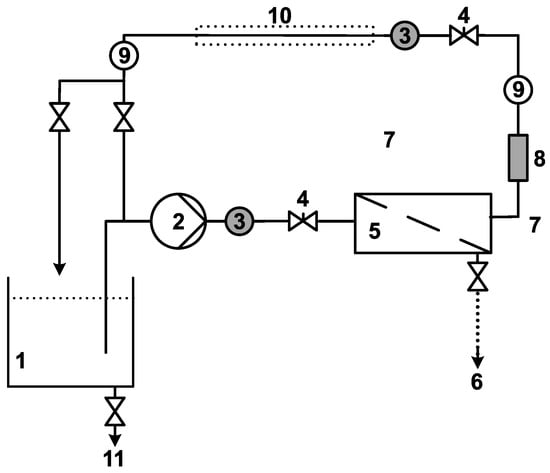
Figure 2.
Schematic diagram of the membrane installation: (1) feeding tank, (2) pump, (3) manometer, (4) pressure regulation valve, (5) membrane module, (6) permeate, (7) concentrate, (8) rotameter, (9) thermometer, (10) cooler, (11) drain valve.
All membrane filtration processes in this study were performed in cross-flow mode under a transmembrane pressure of 0.3 MPa. The flow velocity along the membrane surface was set at 3 m/s for MF and UF, and 0.6 m/s for NF. The system included a cooler to maintain constant temperature (22 ± 1 °C) during operation.
2.3. Membrane Modules
The study used microfiltration (MF) and ultrafiltration (UF) modules, as well as nanofiltration (NF) modules, the characteristics of which are presented in Table 3. Ceramic MF and UF modules were applied in the first stages of the treatment, while a denser, polymeric NF module was applied in the second stage. Ceramic membranes were chosen for their high chemical and thermal stability, low fouling tendency, and superior permeability, characteristics which should be highlighted in terms of LWW treatment in situ [21].
Table 3.
Module characteristics.
During the experiments, the hydraulic capacity as permeate volume flux (J) of the modules was assessed:
where V is the volume of permeate sample collected, L; t is time, h; and A is the effective area of a module surface, m2.
To designate the membrane’s susceptibility to fouling, the relative flux (RF) was evaluated:
where J is the permeate volume flux, L/m2h; and J0 is the distilled water flux, L/m2h.
The concentration factor (CF) was evaluated using the following formula:
where V0 is the initial feed volume of LWW, L; Vt is the feed volume of LWW at time t, L.
2.4. Purification Systems
Permeate collected in low-pressure-driven membrane processes (MF or UF) was submitted for the second stage of purification, which was the final membrane treatment (NF) or adsorption process (performed in a flow reactor and batch reactor). Four integrated purification systems were verified, as detailed in Table 4.
Table 4.
Integrated purification systems with process parameters.
The adsorption stage was conducted using granular activated carbon (GAC) and powdered activated carbon (PAC), both supplied by Chemviron (Feluy, Belgium). GAC was used in a flow-through column mode, with a bed height of 0.15 m and a filtration rate of 5 m/h (bed volume 0.4 L). PAC adsorption was carried out in batch reactors with doses of 0.5 g/L and 1 g/L, under mixing conditions of 150 rpm for 30 min, followed by 60 min of sedimentation. After sedimentation, treated samples were filtered using 0.45 µm cellulose syringe filters (Qpore, Gdańsk, Poland) to remove residual carbon particles.
3. Results and Discussion
3.1. Wastewater Characteristics
Laundry wastewater was generated during the cotton fabric softening cycle, which included rinsing with a fabric softener fluid containing esterquat group cationic surfactants and centrifugation. The characteristics of laundry wastewater are summarised in Table 5. The concentration of CSs in the wastewater was approximately 30 mg/L, which is within the range reported in the literature (from 10 to 100 mg/L) [33]. The wastewater also exhibited significant turbidity (around 45 NTU), grey colour, and visible solid fractions, which comprised remnants of fabrics. Additionally, the samples emitted a strong odour associated with the presence of fragrances in the applied detergent.
Table 5.
Laundry wastewater characteristics.
3.2. Filtration
Preliminary treatment in all variants included a filtration process using bag filters with a pore size of 100 µm. As a result of filtration, the concentrations of CSs, COD, TOC, and turbidity were reduced to 21.3 mg/L, 78 mg/L, 41.6 mg/L, and 31.5 NTU, respectively, indicating an efficiency of approximately 20–30%. Solid fractions were removed.
3.3. Microfiltration—0.45 µm Module
In three of the proposed variants, microfiltration using a ceramic module with a pore size of 0.45 µm was applied as the primary membrane process. The permeate obtained from the MF was characterised by the following parameters: CSs 1.45 mg/L, turbidity 0.4 NTU, and TOC 16.9 mg/L, resulting in a process efficiency to decrease these factors of 93%, 98%, and 60%, respectively. Both CSs and TOC concentrations in the wastewater after MF were lower than the permissible values established by the Polish regulations [30] (5 mg CSs/L and 30 mg TOC/L). In addition, MF permeate fulfils the requirements for landscape irrigation and toilet flushing, but cannot be reused in the laundry process due to the elevated hardness. In the permeate obtained, an intense detergent odour was noticeable, leading to the decision to implement further treatment.
3.4. Variant I: Filtration—Microfiltration—Nanofiltration
The treatment system (Figure 3) included filtration, microfiltration using a ceramic module with a pore size of 0.45 µm, and nanofiltration using the AFC30 polymer module (to obtain 2 L of solution (concentration factor equal to 1.5)).

Figure 3.
Sequential LWW treatment system: F–MF–NF.
Membrane filtration with the AFC30 module ensured the complete removal of cationic surfactants. However, TOC removal was not complete (with the permeate containing 10.6 mg TOC/L), and was most likely due to the presence of fragrance compounds with low molecular weight. The COD of the treated wastewater was below the detection limit of the applied method.
The nanofiltration process allows for the removal of chemical compounds responsible for the hardness of the water, which, in the case of reuse of water for laundry purposes, brings many benefits, such as reduced detergent consumption, improved washing efficiency, and extended lifespan of industrial laundry equipment.
The wastewater after MF directed to the nanofiltration module had a total hardness of 15.1° dH (268.8 mg CaCO3/L), indicating a medium hardness. The use of the AFC30 module reduced the hardness to 4.1° dH (73 mg CaCO3/L), resulting in very soft water that meets the hardness standard for laundry water [18].
LWW treatment was associated with a decrease in hydraulic performance of the MF module to approximately 0.4 (Figure 4). It is important to note that the most significant decrease in relative flux values occurred during the initial stages of filtration, and after reaching a concentration factor (CF) of 1.5, no further deterioration in the module’s relative permeability was observed. The removal of a substantial portion of organic contaminants by the microfiltration module effectively mitigated fouling in the second stage of membrane treatment (Figure 5). At the beginning of the process, the relative permeability of the AFC30 module dropped to 0.8 (at a CF of approximately 1.2), after which the module’s permeability subsequently improved, resulting in a flux slightly higher than that of distilled water. A decrease in permeate flux was related to the interaction of the surfactant micelles with the membrane surface and pore structure. In particular, cationic surfactants, such as esterquats, are known to adsorb onto negatively charged membrane surfaces due to electrostatic and hydrophobic interactions. These mechanisms, along with micelle-induced gel layer formation, have been described in detail in our previous works [29,34], where the influence of surfactant type and concentration on flux decline and pore blockage was systematically investigated.
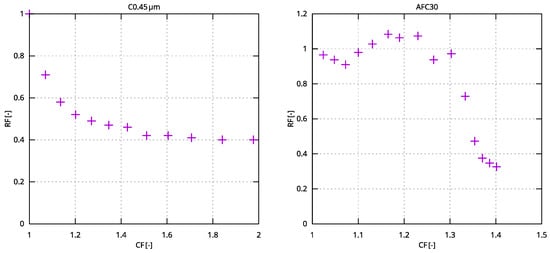
Figure 4.
Relative permeability of MF (C0.45 µm) and NF (AFC30) modules vs. concentration factor (TMP = 0.3 MPa).
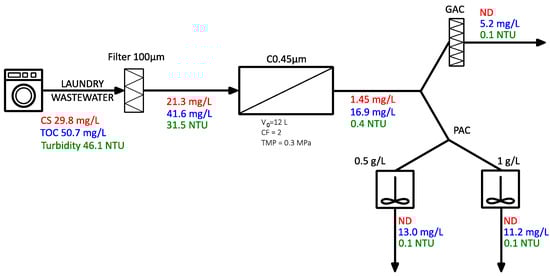
Figure 5.
Sequential LWW treatment system: F–MF–ADS.
3.5. Variant II, III: Filtration—Microfiltration—Adsorption
Adsorption using activated carbon is a widely studied method for the removal of organic pollutants, including surfactants, from effluents [35,36,37,38]. This method was shown to be effective for the removal of fragrances and odours [39,40,41]. The No. II and III designed systems (Figure 5) involved filtration, microfiltration, and adsorption on activated carbon, implemented in three variants. In the first variant, the permeate obtained from the MF was directed to a GAC column, where the adsorption was carried out under flow conditions. In the second and third systems, powdered activated carbon was used for the adsorption process at doses of 0.5 and 1 g/L, respectively. The experiments were carried out in batch reactors with rapid mixing (150 rpm) for 30 min, followed by 60 min of sedimentation.
The implementation of activated carbon adsorption as the final stage of treatment resulted in lower concentrations of total organic carbon (TOC) compared to the sequence of F–MF–NF processes. In the flow system, the TOC concentration in the averaged sample decreased to approximately 5 mg/L, while under batch conditions it decreased to approximately 13 mg/L and 11 mg/L at carbon doses of 0.5 and 1 g/L, respectively. The higher adsorption efficiency observed in the flow system is likely due to the larger mass of the adsorbent relative to the mass of the adsorbate. In all variants tested, the treated solution was odourless.
3.6. Variant IV: Filtration—Ultrafiltration—Nanofiltration
In the fourth treatment system (Figure 6), ultrafiltration (C300) and nanofiltration (AFC30) were applied after the filtration process. Membrane processes were carried out at a transmembrane pressure (TMP) of 0.3 MPa, achieving a concentration factor of 2 for the UF module and 1.4 for the NF module, respectively.

Figure 6.
Sequential LWW treatment system: F–UF–NF.
LWW treatment led to a decrease in the relative permeability of the C300 module to approximately 0.4 at the end of the experiment, corresponding to a flux of approximately 40 L/m2h. The study demonstrated that the UF module exhibited a similar susceptibility to fouling (Figure 7) as the microfiltration module C0.45 µm (Figure 5), but with a lower separation efficiency for contaminants. The TOC concentration in the UF permeate was approximately twice as high as in the MF permeate, resulting in an increased organic load entering the AFC30 module in the next treatment stage.
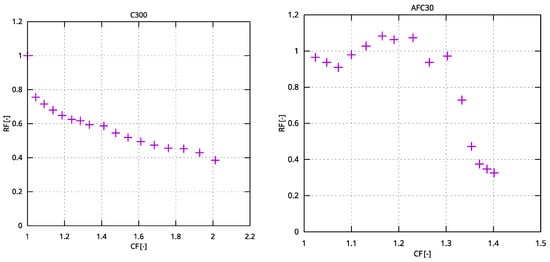
Figure 7.
Relative permeability of UF (C300) and NF (AFC30) modules vs. concentration factor (TMP = 0.3 MPa).
Using the AFC30 polymer nanofiltration module in the next step of purification resulted in a reduction of the concentration of cationic surfactants below the detection limit of the applied analytical method, and a reduction of TOC by approximately 50%. However, compared to the F–MF–NF system, there was a noticeable deterioration in the hydraulic performance of the AFC30 module (Figure 7), likely due to the higher concentration of organic contaminants entering the module. The wastewater after the sequence of the treatment process had a characteristic detergent odour.
The relationship between membrane pore size and process performance plays a key role in the design of membrane-based treatment systems. In general, membranes with smaller pore sizes, such as nanofiltration, offer higher separation efficiency for organic compounds and surfactants. However, they typically operate at lower permeate fluxes and require higher transmembrane pressures, increasing pumping energy demand and operational costs. To address these limitations and make optimal use of each membrane stage, a sequential treatment approach was proposed. By combining different membrane processes and adsorption stages, the system was designed to maximize pollutant removal while minimizing the negative effects associated with pressure loss and fouling intensity. The treatment efficiency obtained in this study, including complete removal of cationic surfactants and high reductions in turbidity and total organic carbon, is consistent with or higher than the results reported in previous studies [16,20]. Our findings confirm the effectiveness of combining adsorption and membrane filtration for the treatment of final rinse wastewater containing cationic surfactants; thus, they fill the gap in this research area.
4. Conclusions
The study demonstrated the effectiveness of integrated membrane-based processes combined with conventional purification techniques for treating laundry wastewater obtained in the softening stage of cotton fabrics. The wastewater treated in the filtration–microfiltration and filtration–ultrafiltration processes met the regulatory standards for the discharge of industrial wastewater and could be reused for landscape irrigation and flushing of toilets. Furthermore, the implementation of nanofiltration as a final step produced a filtrate suitable for reuse in the laundry process because of the removal of hardness. Activated carbon adsorption proved to be a promising post-treatment step, significantly reducing organic compound concentrations and eliminating odours. The choice of treatment method should be based on the intended reuse of the recovered water.
Despite these promising results, challenges remain to minimise the membrane fouling phenomenon which is significant because of the surfactant action. Another crucial challenge is the management of concentrates generated during membrane separation processes. These streams contain high concentrations of pollutants that pose challenges in their disposal.
The study highlights the potential of integrated wastewater treatment systems to improve water recovery, minimise environmental impact, and support sustainable industrial practices.
Author Contributions
Conceptualization, A.K. and I.K.; methodology, A.K. and I.K.; software, A.K.; validation, A.K. and I.K.; formal analysis, A.K. and I.K.; investigation, A.K.; resources, A.K. and I.K.; data curation, A.K.; writing—original draft preparation, A.K. and I.K.; writing—review and editing, A.K. and I.K.; visualization, A.K.; supervision, I.K.; project administration, A.K. and I.K.; funding acquisition, A.K. and I.K. All authors have read and agreed to the published version of the manuscript.
Funding
This research was funded by Wrocław University of Science and Technology (Grant umber 825 305 0501).
Institutional Review Board Statement
Not applicable.
Informed Consent Statement
Not applicable.
Data Availability Statement
The original contributions presented in this study are included in the article. Further inquiries can be directed to the corresponding authors.
Conflicts of Interest
The authors declare no conflicts of interest.
Abbreviations
The following abbreviations are used in this manuscript:
| A | Effective Membrane Surface Area (m2) |
| BOD5 | Biochemical Oxygen Demand (5-day) |
| CF | Concentration Factor (–) |
| COD | Chemical Oxygen Demand |
| CSs | Cationic Surfactants |
| DC | Dose of Carbon (g/L) |
| F | Filtration |
| GAC | Granular Activated Carbon |
| H | Bed Height (m) |
| J | Permeate Volume Flux (L/m2·h) |
| J0 | Distilled Water Flux (L/m2·h) |
| LWW | Laundry Wastewater |
| MF | Microfiltration |
| NF | Nanofiltration |
| NTU | Nephelometric Turbidity Unit |
| PAC | Powdered Activated Carbon |
| RF | Relative Flux (J/J0) |
| t | Time (h or min, depending on context) |
| tm | Mixing Time (min) |
| ts | Sedimentation Time (min) |
| TMP | Transmembrane Pressure (MPa) |
| TOC | Total Organic Carbon |
| TS | Total Solids |
| TSS | Total Suspended Solids |
| UF | Ultrafiltration |
| v | Filtration Rate |
| VB | Volume of Carbon Bed (L) |
| V0 | Initial Feed Volume (L) |
| Vt | Volume at Time t (L) |
| ν | Flow velocity along membrane surface (m/s) |
References
- Buy Unity Now. (n.d.). Unity Commercial Washing Machines for Hotels. Available online: https://buyunitynow.com/unity-commercial-washing-machines-hotels/ (accessed on 5 February 2025).
- Nicolaidis, C.; Vyrides, I. Closing the water cycle for industrial laundries: An operational performance and techno-economic evaluation of a full-scale membrane bioreactor system. Resour. Conserv. Recycl. 2014, 92, 128–135. [Google Scholar] [CrossRef]
- Jayanto, G.D.; Widyastuti, M.; Hadi, M.P. Laundry wastewater characteristics and their relationship with river water quality as an indicator of water pollution: Case study of Code Watershed, Yogyakarta. E3S Web Conf. 2021, 325, 02011. [Google Scholar] [CrossRef]
- Ciabatti, I.; Cesaro, F.; Faralli, L.; Fatarella, E.; Tognotti, F. Demonstration of a treatment system for purification and reuse of laundry wastewater. Desalination 2009, 245, 451–459. [Google Scholar] [CrossRef]
- Vishali, S.; Poonguzhali, E.; Banerjee, I.; George, S.S.; Srinivasan, P. Purification of domestic laundry wastewater in an integrated treatment system consists of coagulation and ultrafiltration membrane process. Chemosphere 2023, 314, 137662. [Google Scholar] [CrossRef]
- Babajanzadeh, B.; Sherizadeh, S.; Ranji, H. Detergents and surfactants: A brief review. Open Access J. Sci. 2019, 3, 94–99. [Google Scholar] [CrossRef]
- Cheng, K.C.; Khoo, Z.S.; Lo, N.W.; Tan, W.J.; Chemmangattuvalappil, N.G. Design and performance optimisation of detergent product containing binary mixture of anionic-nonionic surfactants. Heliyon 2020, 6, e03861. [Google Scholar] [CrossRef]
- Mondal, M.G.; Pratap, A.P. Synthesis and performance properties of cationic fabric softeners derived from free fatty acid of tallow fat. J. Oleo Sci. 2016, 65, 691–700. [Google Scholar] [CrossRef]
- Yoshii, S.; Nakajima, D.; Saito, N.; Terasaki, M.; Endo, S. Triethanolamine-based esterquat in sediments: New analytical method, environmental occurrence, and homologue composition. Chemosphere 2024, 361, 142495. [Google Scholar] [CrossRef]
- Mishra, S.; Tyagi, V.K. Esterquats: The novel class of cationic fabric softeners. J. Oleo Sci. 2007, 56, 269–276. [Google Scholar] [CrossRef]
- Global Market Insights. Esterquats Market Size & Share Analysis Report, 2024–2032. 21 October 2024. Available online: https://www.gminsights.com/industry-analysis/esterquats-market (accessed on 18 January 2025).
- Šostar-Turk, S.; Petrinić, I.; Simonič, M. Laundry wastewater treatment using coagulation and membrane filtration. Resour. Conserv. Recycl. 2005, 44, 185–196. [Google Scholar] [CrossRef]
- Deressa, S.; Endale, H.; Dadi, D.; Kitte, S.A. Removal of anionic surfactant from residential laundry wastewater using jackfruit (Artocarpus heterophyllus) seeds. Adv. Environ. Technol. 2019, 1, 47–53. [Google Scholar] [CrossRef]
- Corona, R.R.B.; Sad, C.M.S.; Silva, M.; Lopes, D.L.; Leite, J.S.D.; Viegas, G.M.F.; Gonçalves, G.R.; Filgueiras, P.R.; Castro, E.V.R. Adsorption of anionic surfactant in graphite oxide: A study for treatment of laundry wastewater. J. Environ. Chem. Eng. 2021, 9, 106858. [Google Scholar] [CrossRef]
- Zotesso, J.P.; Cossich, E.S.; Janeiro, V.; Tavares, C.R.G. Treatment of hospital laundry wastewater by UV/H2O2 process. Environ. Sci. Pollut. Res. 2017, 24, 6278–6287. [Google Scholar] [CrossRef] [PubMed]
- Nascimento, C.O.C.; Veit, M.T.; Palácio, S.M.; Gonçalves, G.C.; Fagundes-Klen, M.R. Combined application of coagulation/flocculation/sedimentation and membrane separation for the treatment of laundry wastewater. Int. J. Chem. Eng. 2019, 2019, 8324710. [Google Scholar] [CrossRef]
- Melián, E.P.; Santiago, D.E.; León, E.; Vaswani Reboso, J.; Herrera-Melián, J.A. Treatment of laundry wastewater by different processes: Optimization and life cycle assessment. J. Environ. Chem. Eng. 2023, 11, 109302. [Google Scholar] [CrossRef]
- Lade, O.; Gbagba, Z. Sustainable water supply: Potential of recycling laundry wastewater for domestic use. J. Civ. Eng. Environ. Sci. 2018, 4, 056–060. [Google Scholar] [CrossRef]
- Benis, K.Z.; Behnami, A.; Aghayani, E.; Farabi, S.; Pourakbar, M. Water recovery and on-site reuse of laundry wastewater by a facile and cost-effective system: Combined biological and advanced oxidation process. Sci. Total Environ. 2021, 789, 148068. [Google Scholar] [CrossRef]
- Bilad, M.R.; Mat Nawi, N.I.; Subramaniam, D.D.; Shamsuddin, N.; Khan, A.L.; Jaafar, J.; Nandiyanto, A.B.D. Low-pressure submerged membrane filtration for potential reuse of detergent and water from laundry wastewater. J. Water Process Eng. 2020, 36, 101264. [Google Scholar] [CrossRef]
- Kumar, S.; Khosravanipour Mostafazadeh, A.; Kumar, L.R.; Tyagi, R.D.; Drogui, P.; Brien, E. Advancements in laundry wastewater treatment for reuse: A review. J. Environ. Sci. Health Part A 2022, 57, 927–946. [Google Scholar] [CrossRef]
- Procházková, M.; Máša, V. Sustainable wastewater management in industrial laundries. Chem. Eng. Trans. 2022, 94, 577–582. [Google Scholar] [CrossRef]
- Ho, K.C.; Teow, Y.H.; Sum, J.Y.; Ng, Z.J.; Mohammad, A.W. Water pathways through the ages: Integrated laundry wastewater treatment for pollution prevention. Sci. Total Environ. 2021, 760, 143966. [Google Scholar] [CrossRef]
- Khan, N.A.; Bokhari, A.; Mubashir, M.; Klemeš, J.J.; El Morabet, R.; Khan, R.A.; Alsubih, M.; Azam, M.; Saqib, S.; Mukhtar, A.; et al. Treatment of hospital wastewater with submerged aerobic fixed film reactor coupled with tube-settler. Chemosphere 2022, 286, 131838. [Google Scholar] [CrossRef] [PubMed]
- Barumbu, A.; Bilad, M.R.; Nordin, N.A.H.M.; Mavukkandy, M.O.; Al-Gharabli, S. Detergent Recovery from Laundry Wastewater Using Self-Made Flat Sheet Membrane. Membranes 2020, 10, 260. [Google Scholar] [CrossRef]
- Sumisha, A.; Arthanareeswaran, G.; Lukka Thuyavan, Y.; Ismail, A.F.; Chakraborty, S. Treatment of laundry wastewater using polyethersulfone/polyvinylpyrollidone ultrafiltration membranes. Ecotoxicol. Environ. Saf. 2015, 121, 174–179. [Google Scholar] [CrossRef] [PubMed]
- Guilbaud, J.; Massé, A.; Andrs, Y.; Combe, F.; Jaouen, P. Laundry water recycling in ship by direct nanofiltration with tubular membranes. Resour. Conserv. Recycl. 2010, 55, 148–154. [Google Scholar] [CrossRef]
- Shang, X.; Kim, H.C.; Huang, J.H.; Dempsey, B.A. Coagulation strategies to decrease fouling and increase critical flux and contaminant removal in microfiltration of laundry wastewater. Sep. Purif. Technol. 2015, 147, 44–50. [Google Scholar] [CrossRef]
- Klimonda, A.; Kowalska, I. Separation and concentration of cationic surfactant solutions with the use of ceramic modules. Environ. Prot. Eng. 2020, 46, 41–51. [Google Scholar] [CrossRef]
- Regulation of the Minister of Maritime Economy and Inland Navigation. On Substances Particularly Harmful to the Aquatic Environment and the Conditions That Must Be Met When Introducing Wastewater into Water or Soil, as Well as When Discharging Stormwater or Meltwater into Water or Water Facilities. 2019. Available online: https://isap.sejm.gov.pl/isap.nsf/download.xsp/WDU20190001311/O/D20191311.pdf (accessed on 11 March 2025). (In Polish)
- Kudlek, E.; Bohdziewicz, J.; Dudziak, M. Influence of water matrix on the retention of pharmaceuticals by high-pressure membrane filtration. Ecol. Chem. Eng. A 2015, 22, 469–479. [Google Scholar] [CrossRef]
- Otero-Fernández, A.; Díaz, P.; Otero, J.A.; Ibáñez, R.; Maroto-Valiente, A.; Palacio, L.; Prádanos, P.; Carmona, F.J.; Hernández, A. Morphological, chemical and electrical characterization of a family of commercial nanofiltration polyvinyl alcohol coated polypiperazineamide membranes. Eur. Polym. J. 2020, 126, 109544. [Google Scholar] [CrossRef]
- Turkay, O.; Barışçı, S.; Sillanpää, M. E-peroxone process for the treatment of laundry wastewater: A case study. J. Environ. Chem. Eng. 2017, 5, 4282–4290. [Google Scholar] [CrossRef]
- Klimonda, A.; Kowalska, I. Surfactant Fouling in Pressure-Driven Membrane Processes. Environ. Prot. Eng. 2023, 49, 65–78. [Google Scholar] [CrossRef]
- Atesci, Z.C.; Inan, H. Removal of microfiber and surfactants from household laundry washing effluents by powdered activated carbon: Kinetics and isotherm studies. Water Sci. Technol. 2023, 88, 1578. [Google Scholar] [CrossRef] [PubMed]
- Siyal, A.A.; Shamsuddin, M.R.; Low, A.; Rabat, N.E. A review on recent developments in the adsorption of surfactants from wastewater. J. Environ. Manag. 2020, 254, 109797. [Google Scholar] [CrossRef] [PubMed]
- Kaleta, J. Removal of surfactant substances from aqueous solution by adsorption. In Proceedings of the XX-th Jubilee-National, VII-th International Scientific and Technical Conference “Water Supply and Water Quality”, Poznań, Poland, 15–18 June 2008. [Google Scholar]
- Sahu, D.; Pervez, S.; Karbhal, I.; Tanrakar, A.; Mishra, A.; Verma, S.R.; Deb, M.K.; Ghosh, K.K.; Pervez, Y.F.; Shrivas, K.; et al. Applications of different adsorbent materials for the removal of organic and inorganic contaminants from water and wastewater—A review. Desalination Water Treat. 2024, 254, 100253. [Google Scholar] [CrossRef]
- Wang, F.; Li, X.; Liu, T.; Li, X.; Cui, Y.; Xu, L.; Huo, S.; Zou, B.; Qian, J.; Ma, A.; et al. Removal of Taste and Odor Compounds from Water: Methods, Mechanism and Prospects. Catalysts 2023, 13, 1356. [Google Scholar] [CrossRef]
- Zhang, J.; Lu, F.; He, X.; Liao, Y.; Chen, R.; Xia, R.; Shang, Y.; Wang, Q.; Yu, J. The adsorption of biogenetic odorants onto activated carbon: Adsorption characteristics and impacts of algal organic matter. Environ. Res. 2023, 238, 117072. [Google Scholar] [CrossRef]
- Paulino, R.; Tamburic, B.; Stuetz, R.M.; Zamyadi, A.; Crosbie, N.; Henderson, R.K. Critical review of adsorption and biodegradation mechanisms for removal of biogenic taste and odour compounds in granular and biological activated carbon contactors. J. Water Process Eng. 2023, 52, 103518. [Google Scholar] [CrossRef]
Disclaimer/Publisher’s Note: The statements, opinions and data contained in all publications are solely those of the individual author(s) and contributor(s) and not of MDPI and/or the editor(s). MDPI and/or the editor(s) disclaim responsibility for any injury to people or property resulting from any ideas, methods, instructions or products referred to in the content. |
© 2025 by the authors. Licensee MDPI, Basel, Switzerland. This article is an open access article distributed under the terms and conditions of the Creative Commons Attribution (CC BY) license (https://creativecommons.org/licenses/by/4.0/).