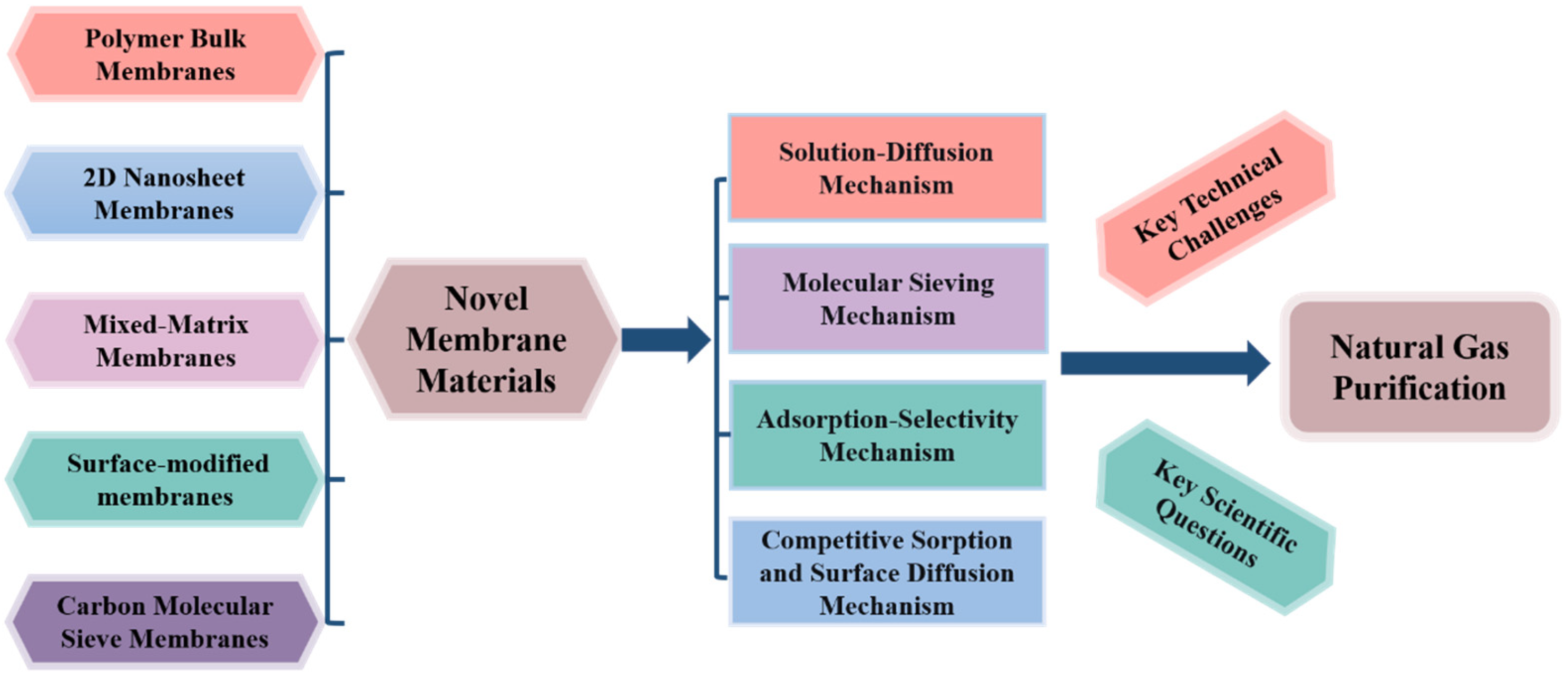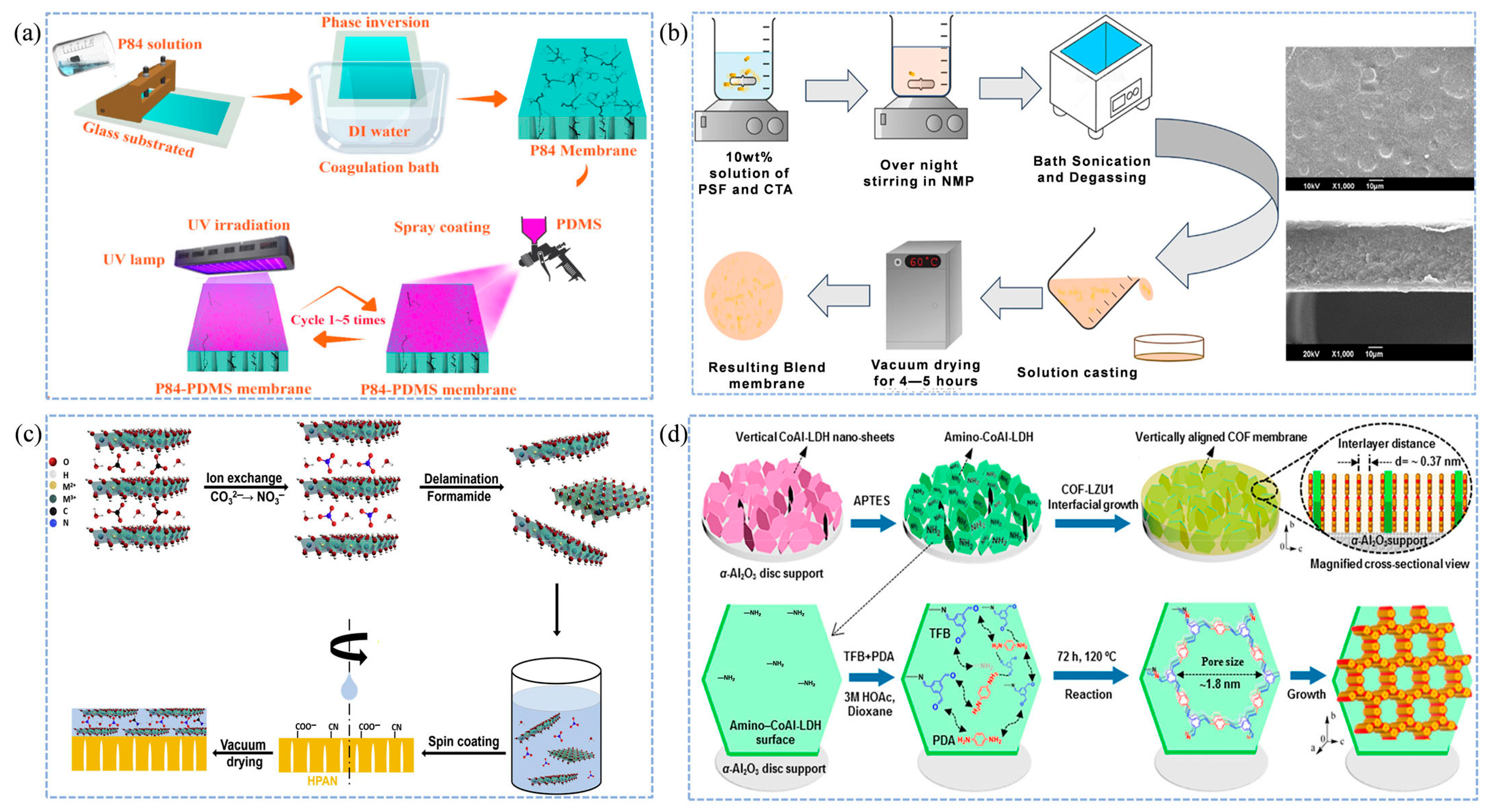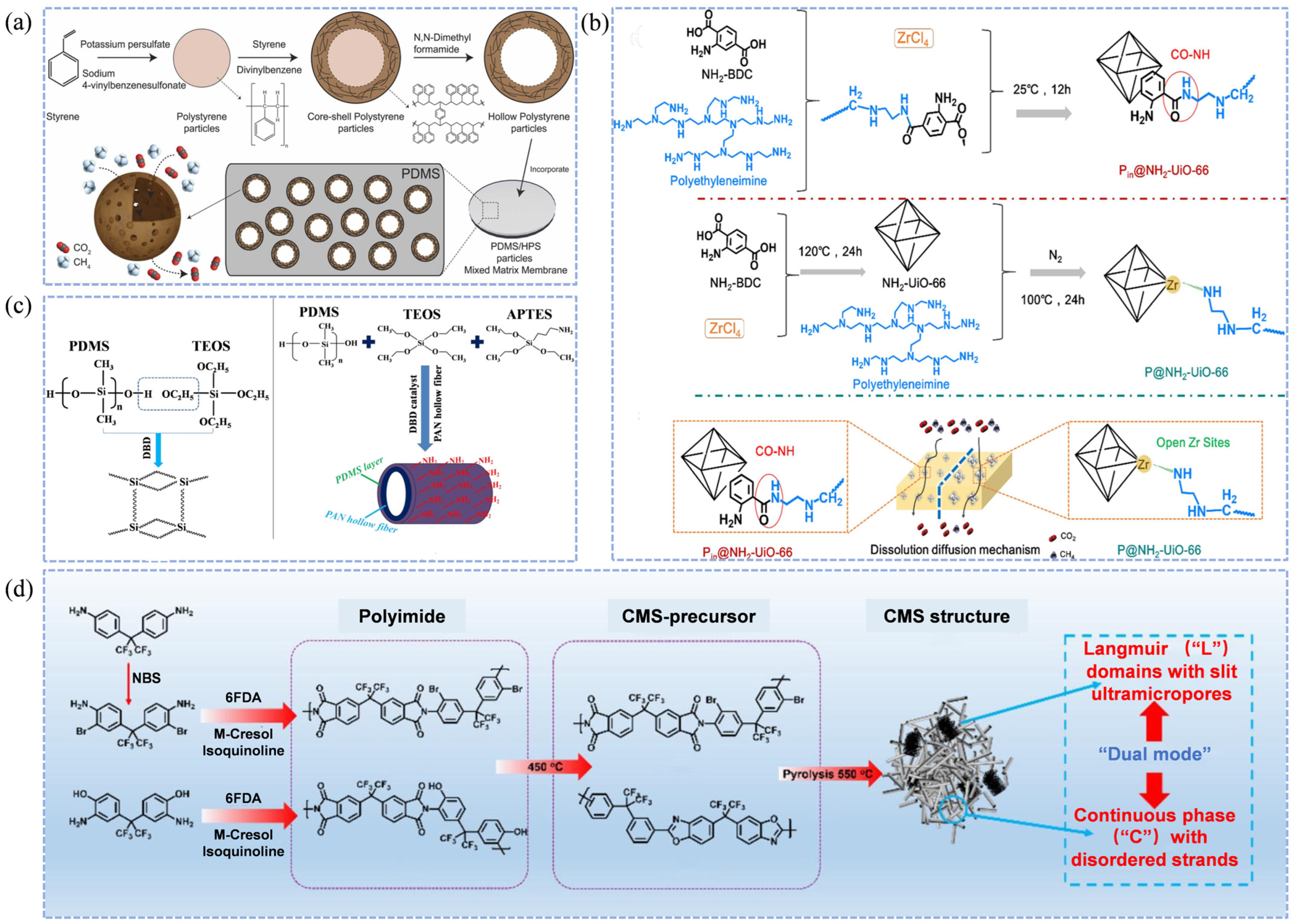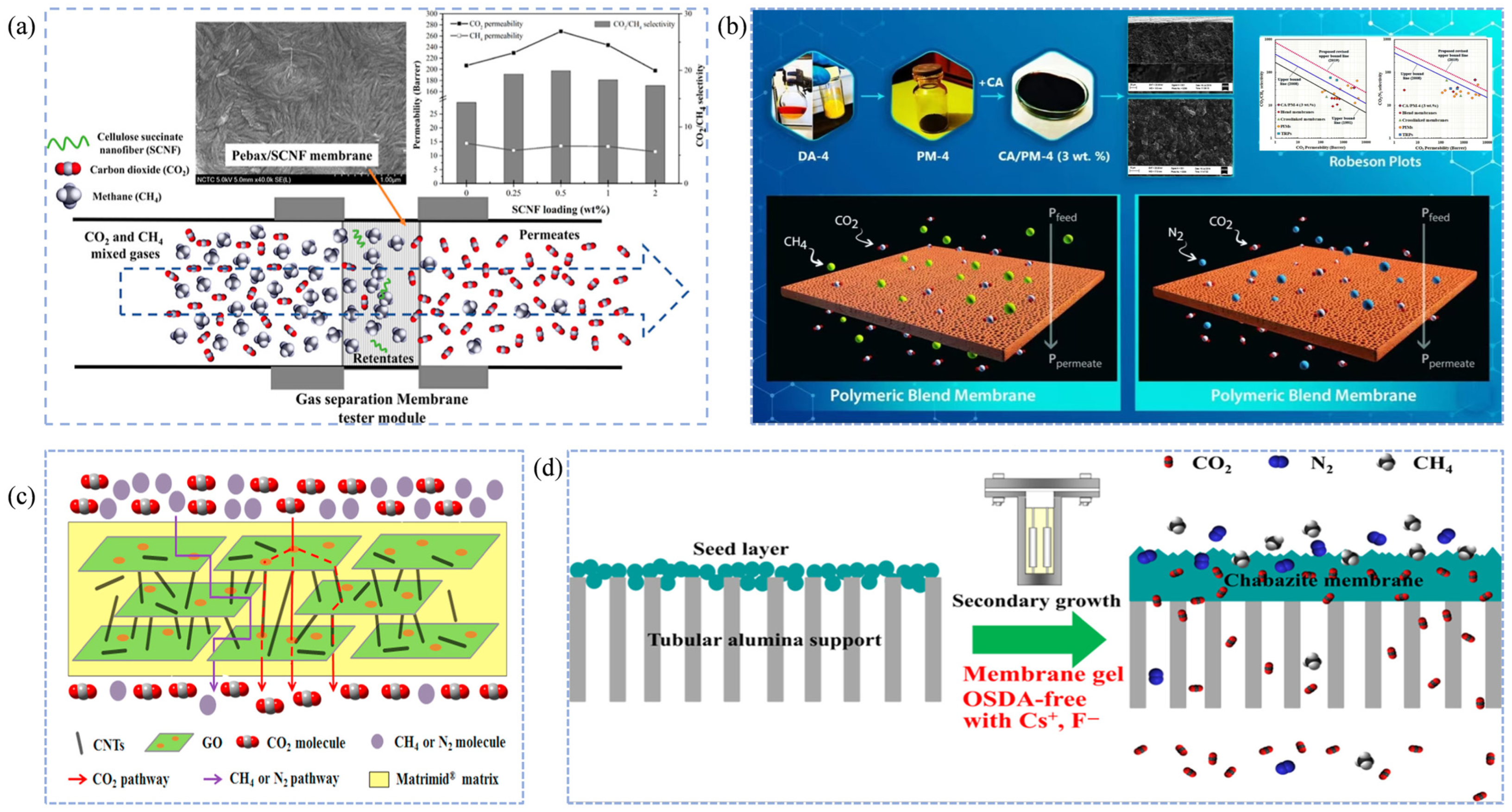

Recent Advances in Advanced Membrane Materials for Natural Gas Purification: A Review of Material Design and Separation Mechanisms



Abstract
1. Introduction
2. Gas Purification Efficiency of Membrane Technologies and Other Separation Methods
2.1. Efficiency of Membrane Separation Technology
2.2. Other Gas Purification Technologies
3. Membrane Materials for Natural Gas Purification
3.1. Polymer Bulk Membranes
3.2. Two-Dimensional Nanosheet Membranes
3.3. Mixed-Matrix Membranes
3.4. Surface-Modified Membranes
3.5. Carbon Molecular Sieve Membranes
4. Separation Mechanisms
4.1. Solution-Diffusion Mechanism
4.2. Molecular Sieving Mechanism
4.3. Adsorption-Selectivity Mechanism
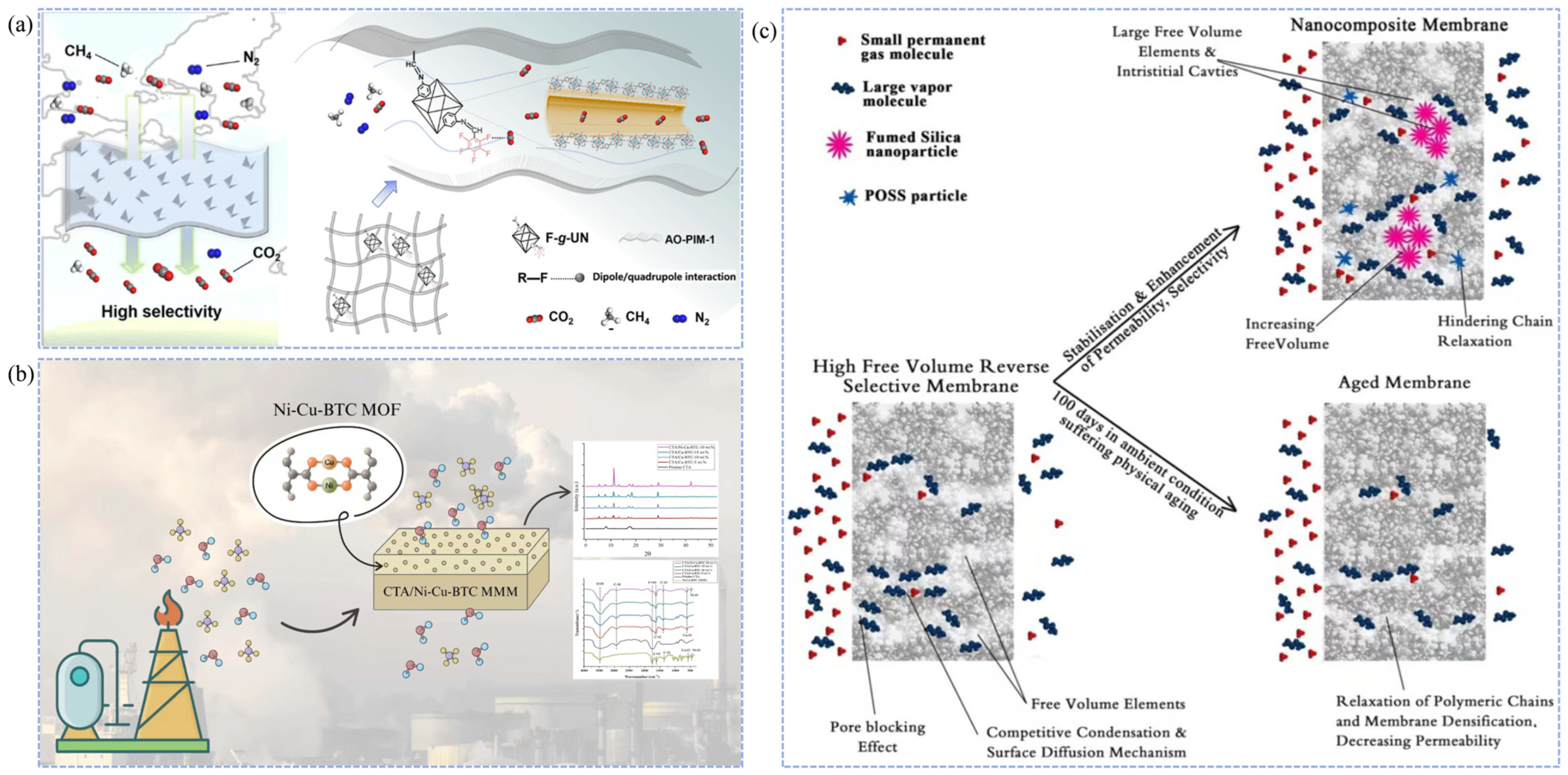
4.4. Competitive Sorption and Surface Diffusion Mechanism
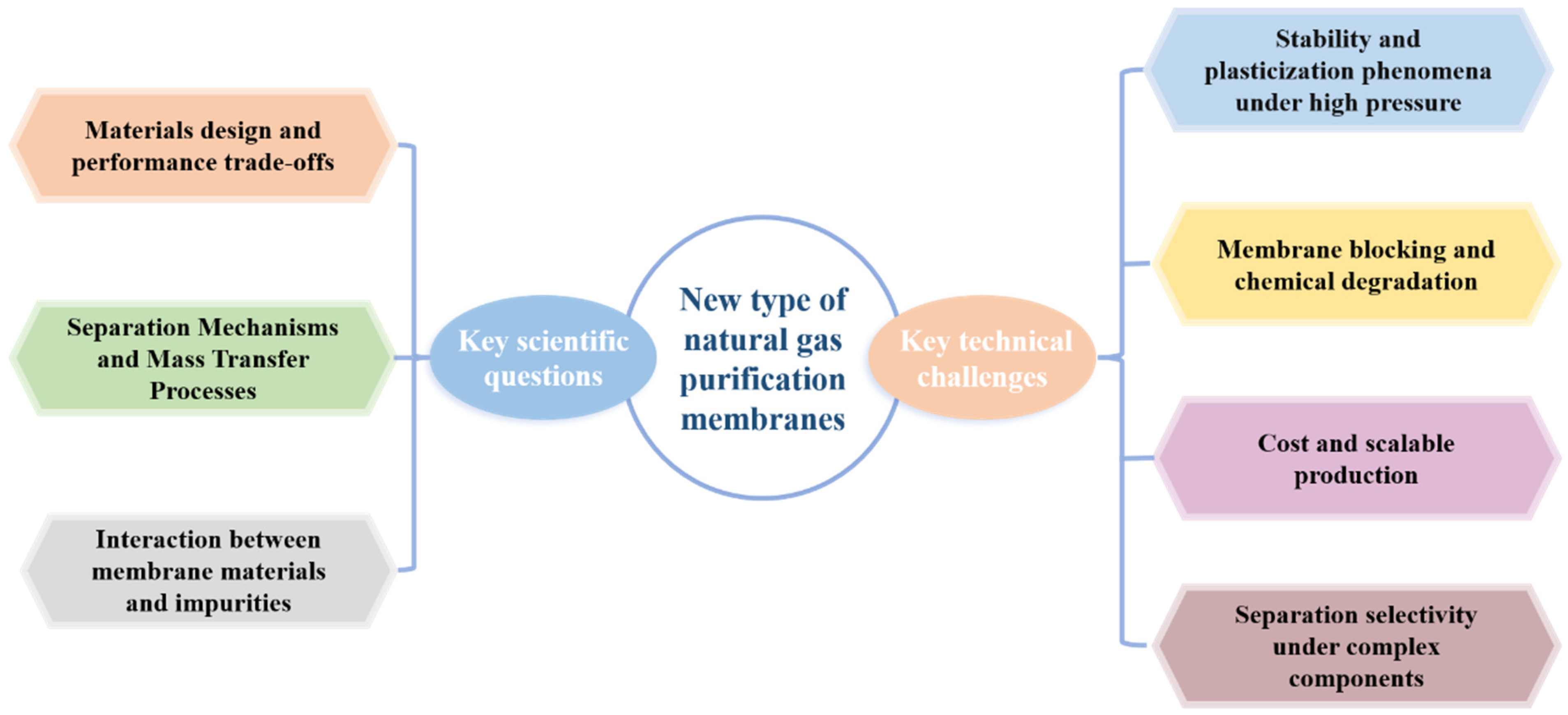
5. Key Scientific Questions and Technical Challenges
5.1. Key Scientific Questions
5.2. Key Technical Challenges
6. Conclusions and Outlook
6.1. Conclusions
6.2. Outlook
Author Contributions
Funding
Institutional Review Board Statement
Informed Consent Statement
Data Availability Statement
Conflicts of Interest
References
- Chen, X.; Liu, G.; Jin, W. Natural gas purification by asymmetric membranes: An overview. Green Energy Environ. 2021, 6, 176. [Google Scholar] [CrossRef]
- Vakili, M.; Koutník, P.; Kohout, J. Addressing Hydrogen Sulfide Corrosion in Oil and Gas Industries: A Sustainable Perspective. Sustainability 2024, 16, 1661. [Google Scholar] [CrossRef]
- Valdez, B.; Schorr, M.; Bastidas, J.M. The natural gas industry: Equipment, materials, and corrosion. Corros. Rev. 2015, 33, 175–185. [Google Scholar] [CrossRef]
- Toghyani, M.; Dadkhahfar, S.; Alishahi, A. Chapter Nineteen—Economic assessment and environmental challenges of methane storage and transportation. In Advances and Technology Development in Greenhouse Gases: Emission, Capture and Conversion; Rahimpour, M.R., Makarem, M.A., Meshksar, M., Eds.; Elsevier: Amsterdam, The Netherlands, 2024; pp. 463–510. [Google Scholar]
- Ding, H.; Wen, C.; Yang, Y. Conventional Natural Gas Processing. In Supersonic Separators for Sustainable Gas Purification; Ding, H., Wen, C., Yang, Y., Eds.; Springer Nature: Cham, Switzerland, 2025; pp. 33–62. [Google Scholar]
- Taqvi, S.A.A.; Ellaf, A. 1—Introduction to natural gas sweetening methods and technologies. In Advances in Natural Gas: Formation, Processing, and Applications. Volume 2: Natural Gas Sweetening; Rahimpour, M.R., Makarem, M.A., Meshksar, M., Eds.; Elsevier: Amsterdam, The Netherlands, 2024; pp. 3–32. [Google Scholar]
- Jepleting, A.; Mecha, A.C.; Sombei, D.; Moraa, D.; Chollom, M.N. Potential of low-cost materials for biogas purification, a review of recent developments. Renew. Sustain. Energy Rev. 2025, 210, 115152. [Google Scholar] [CrossRef]
- Krótki, A.; Bigda, J.; Spietz, T.; Ignasiak, K.; Matusiak, P.; Kowol, D. Performance Evaluation of Pressure Swing Adsorption for Hydrogen Separation from Syngas and Water–Gas Shift Syngas. Energies 2025, 18, 1887. [Google Scholar] [CrossRef]
- Imtiaz, A.; Othman, M.H.D.; Jilani, A.; Khan, I.U.; Kamaludin, R.; Iqbal, J.; Al-Sehemi, A.G. Challenges, Opportunities and Future Directions of Membrane Technology for Natural Gas Purification: A Critical Review. Membranes 2022, 12, 646. [Google Scholar] [CrossRef]
- Tay, W.H.; Lau, K.K.; Lai, L.S.; Shariff, A.M.; Wang, T. Current development and challenges in the intensified absorption technology for natural gas purification at offshore condition. J. Nat. Gas Sci. Eng. 2019, 71, 102977. [Google Scholar] [CrossRef]
- Wang, X.; Wilson, T.J.; Maroon, C.R.; Laub, J.A.; Rheingold, S.E.; Vogiatzis, K.D.; Long, B.K. Vinyl-Addition Fluoroalkoxysilyl-Substituted Polynorbornene Membranes for CO2/CH4 Separation. ACS Appl. Polym. Mater. 2022, 4, 7976–7988. [Google Scholar] [CrossRef]
- Qiu, H.; Chen, P.; Li, C.; Qin, Y.; Lu, Q.; Li, M.; Liu, Q. Mixed matrix membranes for CO2 separation from associated gas: A review. J. Environ. Chem. Eng. 2025, 13, 120179. [Google Scholar] [CrossRef]
- Farnam, M.; bin Mukhtar, H.; bin Mohd Shariff, A. A Review on Glassy and Rubbery Polymeric Membranes for Natural Gas Purification. ChemBioEng Rev. 2021, 8, 90–109. [Google Scholar] [CrossRef]
- Rezakazemi, M.; Heydari, I.; Zhang, Z. Hybrid systems: Combining membrane and absorption technologies leads to more efficient acid gases (CO2 and H2S) removal from natural gas. J. CO2 Util. 2017, 18, 362–369. [Google Scholar] [CrossRef]
- Baker, R.W.; Lokhandwala, K. Natural Gas Processing with Membranes: An Overview. Ind. Eng. Chem. Res. 2008, 47, 2109–2121. [Google Scholar] [CrossRef]
- Khosravi, A.; Vatani, A.; Mohammadi, T. Application of polyhedral oligomeric silsesquioxane to the stabilization and performance enhancement of poly(4-methyl-2-pentyne) nanocomposite membranes for natural gas conditioning. J. Appl. Polym. Sci. 2017, 134, 45158. [Google Scholar] [CrossRef]
- Lei, L.; Bai, L.; Lindbråthen, A.; Pan, F.; Zhang, X.; He, X. Carbon membranes for CO2 removal: Status and perspectives from materials to processes. Chem. Eng. J. 2020, 401, 126084. [Google Scholar] [CrossRef]
- Al-Megren, H. Natural Gas Purification Technologies—Major Advances for CO2 Separation and Future Directions. In Advances in Natural Gas Technology; IntechOpen: Rijeka, Croatia, 2012. [Google Scholar] [CrossRef]
- Park, H.B.; Kamcev, J.; Robeson, L.M.; Elimelech, M.; Freeman, B.D. Maximizing the right stuff: The trade-off between membrane permeability and selectivity. Science 2017, 356, 1138–1148. [Google Scholar] [CrossRef]
- Khan, I.U.; Othman, M.H.D.; Jilani, A.; Ismail, A.F.; Hashim, H.; Jaafar, J.; Zulhairun, A.K.; Rahman, M.A.; Rehman, G.U. ZIF-8 based polysulfone hollow fiber membranes for natural gas purification. Polym. Test 2020, 84, 106415. [Google Scholar] [CrossRef]
- Alcheikhhamdon, Y.; Hoorfar, M. Natural gas quality enhancement: A review of the conventional treatment processes, and the industrial challenges facing emerging technologies. J. Nat. Gas Sci. Eng. 2016, 34, 689–701. [Google Scholar] [CrossRef]
- Scholes, C.A.; Stevens, G.W.; Kentish, S.E. Membrane gas separation applications in natural gas processing. Fuel 2012, 96, 15–28. [Google Scholar] [CrossRef]
- Li, P.; Xiao, G.; Hou, M.; Lu, Y.; Li, L.; Wang, T. Boosted gas separation performances of polyimide and thermally rearranged membranes by Fe-doping. Chem. Eng. J. 2024, 499, 156108. [Google Scholar] [CrossRef]
- Faiz, R.; Al-Marzouqi, M. Insights on natural gas purification: Simultaneous absorption of CO2 and H2S using membrane contactors. Sep. Purif. Technol. 2011, 76, 351–361. [Google Scholar] [CrossRef]
- Bashir, Z.; Lock, S.S.M.; Hira, N.e.; Ilyas, S.U.; Lim, L.G.; Lock, I.S.M.; Yiin, C.L.; Darban, M.A. A review on recent advances of cellulose acetate membranes for gas separation. RSC Adv. 2024, 14, 19560–19580. [Google Scholar] [CrossRef] [PubMed]
- Osman, A.I.; Chen, Z.; Elgarahy, A.M.; Farghali, M.; Mohamed, I.M.A.; Priya, A.K.; Hawash, H.B.; Yap, P.S. Membrane Technology for Energy Saving: Principles, Techniques, Applications, Challenges, and Prospects. Adv. Energy Sustain. Res. 2024, 5, 2400011. [Google Scholar] [CrossRef]
- Zhang, Y.; Sunarso, J.; Liu, S.; Wang, R. Current status and development of membranes for CO2/CH4 separation: A review. Int. J. Greenh. Gas Control 2013, 12, 84–107. [Google Scholar] [CrossRef]
- Wang, T.; Hovland, J.; Jens, K.J. Amine reclaiming technologies in post-combustion carbon dioxide capture. J. Environ. Sci. 2015, 27, 276–289. [Google Scholar] [CrossRef]
- Golubeva, I.A.; Dashkina, A.V.; Shulga, I.V. Demanding Problems of Amine Treating of Natural Gas: Analysis and Ways of Solution. Pet. Chem. 2020, 60, 45–50. [Google Scholar] [CrossRef]
- Koh, D.-Y.; Kang, H.; Lee, J.-W.; Park, Y.; Kim, S.-J.; Lee, J.; Lee, J.Y.; Lee, H. Energy-efficient natural gas hydrate production using gas exchange. Appl. Energy 2016, 162, 114–130. [Google Scholar] [CrossRef]
- Loachamin, D.; Casierra, J.; Calva, V.; Palma-Cando, A.; Ávila, E.E.; Ricaurte, M. Amine-Based Solvents and Additives to Improve the CO2 Capture Processes: A Review. ChemEngineering 2024, 8, 129. [Google Scholar] [CrossRef]
- Gao, F.; Li, J.; Yang, C.; Zhang, W.; Huang, H.; Peng, Z.; Gong, T. Advances on research of H2S removal by deep eutectic solvents as green solvent. Nat. Gas Ind. B 2025, 12, 26–36. [Google Scholar] [CrossRef]
- Hashemzadeh, S.; Rahimpour, M.R. 7—Swing processes for natural gas dehydration: Pressure, thermal, vacuum, and mixed swing processes. In Advances in Natural Gas: Formation, Processing, and Applications. Volume 4: Natural Gas Dehydration; Rahimpour, M.R., Makarem, M.A., Meshksar, M., Eds.; Elsevier: Amsterdam, The Netherlands, 2024; pp. 161–178. [Google Scholar]
- Khoramzadeh, E.; Bakhtyari, A.; Mofarahi, M. 10—Nitrogen rejection from natural gas by adsorption processes and swing technologies. In Advances in Natural Gas: Formation, Processing, and Applications. Volume 5: Natural Gas Impurities and Condensate Removal; Rahimpour, M.R., Makarem, M.A., Meshksar, M., Eds.; Elsevier: Amsterdam, The Netherlands, 2024; pp. 201–228. [Google Scholar]
- Vieira, K.d.N.; Trierweiler, J.O.; Farenzena, M.; Trierweiler, L.F. 7—Modeling and simulating natural gas dehydration by adsorption technologies: Pressure swing adsorption, temperature swing adsorption, vacuum swing adsorption. In Advances Natural Gas: Formation, Processing, and Applications. Volume 8: Natural Gas Process Modelling and Simulation; Rahimpour, M.R., Makarem, M.A., Meshksar, M., Eds.; Elsevier: Amsterdam, The Netherlands, 2024; pp. 185–209. [Google Scholar]
- Vakili, S.S.; Kargari, A.; Sanaeepur, H. Chapter twelve—Cryogenic-membrane gas separation hybrid processes. In Current Trends and Future Developments on (Bio-) Membranes; Basile, A., Favvas, E.P., Eds.; Elsevier: Amsterdam, The Netherlands, 2024; pp. 349–368. [Google Scholar]
- Lak, S.Z.; Rostami, M.; Rahimpour, M.R. 9—Nitrogen separation from natural gas using absorption and cryogenic processes. In Advances in Natural Gas: Formation, Processing, and Applications. Volume 5: Natural Gas Impurities and Condensate Removal; Rahimpour, M.R., Makarem, M.A., Meshksar, M., Eds.; Elsevier: Amsterdam, The Netherlands, 2024; pp. 185–200. [Google Scholar]
- He, T.; Si, B.; Gundersen, T.; Lin, W.; Chen, L.; Zhang, K. High ethane content enables efficient CO2 capture from natural gas by cryogenic distillation. Sep. Purif. Technol. 2025, 352, 128153. [Google Scholar] [CrossRef]
- Vo, H.T.; Chen, L.; Gorgojo, P. Simulation study of a hybrid cryogenic and membrane separation system for SF6 recovery from aged gas mixture in electrical power apparatus. In Computer Aided Chemical Engineering; Manenti, F., Reklaitis, G.V., Eds.; Elsevier: Amsterdam, The Netherlands, 2024; Volume 53, pp. 703–708. [Google Scholar]
- Suleman, M.S.; Lau, K.K.; Yeong, Y.F. Enhanced gas separation performance of PSF membrane after modification to PSF/PDMS composite membrane in CO2/CH4 separation. J. Appl. Polym. Sci. 2018, 135, 45650. [Google Scholar] [CrossRef]
- Li, G.; Si, Z.; Yang, S.; Xue, T.; Baeyens, J.; Qin, P. Fast layer-by-layer assembly of PDMS for boosting the gas separation of P84 membranes. Chem. Eng. Sci. 2022, 253, 117588. [Google Scholar] [CrossRef]
- Chen, B.; Zhao, G.; Lau, C.H.; Wang, F.; Fan, S.; Niu, C.; Ren, Z.; Tang, G.; Qin, P.; Liu, Y.; et al. Fabrication of high-flux defect-free hollow fiber membranes derived from a phenolphthalein-based copolyimide for gas separation. Sep. Purif. Technol. 2024, 331, 125724. [Google Scholar] [CrossRef]
- Roafi, H.; Farrukh, S.; Salahuddin, Z.; Raza, A.; Karim, S.S.; Waheed, H. Fabrication and Permeation Analysis of Polysulfone (PSf) Modified Cellulose Triacetate (CTA) Blend Membranes for CO2 Separation from Methane (CH4). J. Polym. Environ. 2024, 32, 2414–2430. [Google Scholar] [CrossRef]
- Ren, Y.; Peng, D.; Wu, H.; Yang, L.; Wu, X.; Wu, Y.; Wang, S.; Jiang, Z. Enhanced carbon dioxide flux by catechol–Zn2+ synergistic manipulation of graphene oxide membranes. Chem. Eng. Sci. 2019, 195, 230–238. [Google Scholar] [CrossRef]
- Liu, Y.; Wu, H.; Min, L.; Song, S.; Yang, L.; Ren, Y.; Wu, Y.; Zhao, R.; Wang, H.; Jiang, Z. 2D layered double hydroxide membranes with intrinsic breathing effect toward CO2 for efficient carbon capture. J. Membr. Sci. 2020, 598, 117663. [Google Scholar] [CrossRef]
- Song, S.; Wang, W.; Zhao, Y.; Wu, W.; Wei, Y.; Wang, H. Tuning the Stacking Modes of Ultrathin Two-Dimensional Metal–Organic Framework Nanosheet Membranes for Highly Efficient Hydrogen Separation. Angew. Chem. Int. Ed. 2023, 62, e202312995. [Google Scholar] [CrossRef]
- Fan, H.; Peng, M.; Strauss, I.; Mundstock, A.; Meng, H.; Caro, J. High-Flux Vertically Aligned 2D Covalent Organic Framework Membrane with Enhanced Hydrogen Separation. J. Am. Chem. Soc. 2020, 142, 6872–6877. [Google Scholar] [CrossRef]
- Martínez-Izquierdo, L.; García-Comas, C.; Dai, S.; Navarro, M.; Tissot, A.; Serre, C.; Téllez, C.; Coronas, J. Ultrasmall Functionalized UiO-66 Nanoparticle/Polymer Pebax 1657 Thin-Film Nanocomposite Membranes for Optimal CO2 Separation. ACS Appl. Mater. Interfaces 2024, 16, 4024–4034. [Google Scholar] [CrossRef]
- Guo, C.; Li, X.; Wu, Y.; Yang, P.; Yang, Y.; Huo, S.; Wen, P.; Wu, J.; Zhang, Y.; Lan, Y. Encapsulation of hollow polystyrene particles in PDMS membranes for efficient natural gas purification. J. Environ. Chem. Eng. 2025, 13, 116853. [Google Scholar] [CrossRef]
- Cui, Y.; Cui, X.; Tosheva, L.; Wang, C.; Chai, Y.; Kang, Z.; Gao, Q.; Wang, K.; Zhang, Z.; Guo, H.; et al. Polyethyleneimine NH2-UiO-66 nanofiller-based mixed matrix membranes for natural gas purification. Sep. Purif. Technol. 2025, 353, 128403. [Google Scholar] [CrossRef]
- Wang, J.; Li, M.; Wan, J.; Duan, J.; Jin, W. Enhancing natural gas purification in mixed matrix membranes: Stepwise MOF filler functionalization through amino grafting and defect engineering. J. Membr. Sci. 2026, 738, 124765. [Google Scholar] [CrossRef]
- Aydani, A.; Maghsoudi, H.; Brunetti, A.; Barbieri, G. Silica sol gel assisted defect patching of SSZ-13 zeolite membranes for CO2/CH4 separation. Sep. Purif. Technol. 2021, 277, 119518. [Google Scholar] [CrossRef]
- Zhang, Y.; Sheng, K.; Wang, Z.; Wu, W.; Yin, B.H.; Zhu, J.; Zhang, Y. Rational Design of MXene Hollow Fiber Membranes for Gas Separations. Nano Lett. 2023, 23, 2710–2718. [Google Scholar] [CrossRef] [PubMed]
- Huang, T.; Wu, Q.; Qi, D.; Yang, F.; Xie, Y.; Zhang, G.; Liu, X.; Liu, G.; Zhu, H. Plasma-treated polymer of intrinsic microporosity membranes for enhanced CO2/CH4 separation. Sep. Purif. Technol. 2025, 376, 134025. [Google Scholar] [CrossRef]
- Hu, L.; Cheng, J.; Li, Y.; Liu, J.; Zhou, J.; Cen, K. Amino-functionalized surface modification of polyacrylonitrile hollow fiber-supported polydimethylsiloxane membranes. Appl. Surf. Sci. 2017, 413, 27–34. [Google Scholar] [CrossRef]
- Sun, L.; Chu, J.; Zuo, H.; Wang, M.; Wu, C.; Riaz, A.; Liu, L.; Guo, W.; Li, J.; Ma, X. The influence of debromination and TR on the microstructure and properties of CMSMs. Sep. Purif. Technol. 2025, 352, 128167. [Google Scholar] [CrossRef]
- Wang, K.; Fang, C.; Li, Z.; Zhao, G.; Wang, Y.; Song, Z.; Lei, L.; Xu, Z. Oxygen-enriched carbon molecular sieve hollow fiber membrane for efficient CO2 removal from natural gas. Sep. Purif. Technol. 2024, 347, 127611. [Google Scholar] [CrossRef]
- Hazazi, K.; Ma, X.; Wang, Y.; Ogieglo, W.; Alhazmi, A.; Han, Y.; Pinnau, I. Ultra-selective carbon molecular sieve membranes for natural gas separations based on a carbon-rich intrinsically microporous polyimide precursor. J. Membr. Sci. 2019, 585, 1–9. [Google Scholar] [CrossRef]
- Ye, C.; Bai, L.; Weng, Y.; Xu, Z.; Huang, L.; Huang, J.; Li, J.; Wang, Y.; Ma, X. Fine tune gas separation property of intrinsic microporous polyimides and their carbon molecular sieve membranes by gradient bromine substitution/removal. J. Membr. Sci. 2023, 669, 121310. [Google Scholar] [CrossRef]
- Rao, S.; Prasad, B.; Han, Y.; Ho, W.S.W. Polymeric Membranes for H2S and CO2 Removal from Natural Gas for Hydrogen Production: A Review. Energies 2023, 16, 5713. [Google Scholar] [CrossRef]
- Wu, Z.; Chen, J.; Chen, Z.; Gong, H.; Guo, X.; Chen, L. Feasibility study of polydimethylsiloxane (PDMS) membranes for siloxane removal from biogas. Sep. Purif. Technol. 2025, 379, 135047. [Google Scholar] [CrossRef]
- Haider, B.; Dilshad, M.R.; Atiq ur Rehman, M.; Akram, M.S.; Kaspereit, M. Highly permeable innovative PDMS coated polyethersulfone membranes embedded with activated carbon for gas separation. J. Nat. Gas Sci. Eng. 2020, 81, 103406. [Google Scholar] [CrossRef]
- Meshkat, S.; Kaliaguine, S.; Rodrigue, D. Enhancing CO2 separation performance of Pebax® MH-1657 with aromatic carboxylic acids. Sep. Purif. Technol. 2019, 212, 901–912. [Google Scholar] [CrossRef]
- Robeson, L.M.; Burgoyne, W.F.; Langsam, M.; Savoca, A.C.; Tien, C.F. High performance polymers for membrane separation. Polymer 1994, 35, 4970–4978. [Google Scholar] [CrossRef]
- Balasooriya, W. Aging and Long-Term Performance of Elastomers for Utilization in Harsh Environments. Ph.D. Thesis, Technical University of Leoben, Leoben, Austria, 2019. [Google Scholar]
- Wong, D.A.; Haddad, E.E.; Lin, S.; Sharber, S.A.; Yang, J.; Lawrence, J.A.; Harrigan, D.J.; Wright, P.T.; Liu, Y.; Sundell, B.J. Rational design of melamine-crosslinked poly(ethylene glycol) membranes for sour gas purification. J. Membr. Sci. 2024, 709, 123082. [Google Scholar] [CrossRef]
- Favvas, E.P.; Katsaros, F.K.; Papageorgiou, S.K.; Sapalidis, A.A.; Mitropoulos, A.C. A review of the latest development of polyimide based membranes for CO2 separations. React. Funct. Polym. 2017, 120, 104–130. [Google Scholar] [CrossRef]
- Russo, F.; Galiano, F.; Iulianelli, A.; Basile, A.; Figoli, A. Biopolymers for sustainable membranes in CO2 separation: A review. Fuel Process. Technol. 2021, 213, 106643. [Google Scholar] [CrossRef]
- Liu, Z.; Liu, Y.; Qiu, W.; Koros, W.J. Molecularly Engineered 6FDA-Based Polyimide Membranes for Sour Natural Gas Separation. Angew. Chem. Int. Ed. 2020, 59, 14877–14883. [Google Scholar] [CrossRef]
- Swaidan, R.; Ghanem, B.; Litwiller, E.; Pinnau, I. Physical Aging, Plasticization and Their Effects on Gas Permeation in “Rigid” Polymers of Intrinsic Microporosity. Macromolecules 2015, 48, 6553–6561. [Google Scholar] [CrossRef]
- Kadirkhan, F.; Goh, P.S.; Ismail, A.F.; Wan Mustapa, W.N.; Halim, M.H.; Soh, W.K.; Yeo, S.Y. Recent Advances of Polymeric Membranes in Tackling Plasticization and Aging for Practical Industrial CO2/CH4 Applications—A Review. Membranes 2022, 12, 71. [Google Scholar] [CrossRef]
- Wu, Y.; Guo, Z.; Wu, H.; Zhu, K.; Yang, L.; Ren, Y.; Liu, Y.; Wu, X.; Zhao, R.; Khan, N.A.; et al. Plasticization- and aging-resistant membranes with venation-like architecture for efficient carbon capture. J. Membr. Sci. 2020, 609, 118215. [Google Scholar] [CrossRef]
- Alcheikhhamdon, Y.; Hoorfar, M. Natural gas purification from acid gases using membranes: A review of the history, features, techno-commercial challenges, and process intensification of commercial membranes. Chem. Eng. Process. Process Intensif. 2017, 120, 105–113. [Google Scholar] [CrossRef]
- Wallace, D.W. Crosslinked Hollow Fiber Membranes for Natural Gas Purification and Their Manufacture from Novel Polymers. Ph.D. Thesis, The University of Texas at Austin, Austin, TX, USA, 2004. [Google Scholar]
- Sridhar, S.; Smitha, B.; Aminabhavi, T.M. Separation of Carbon Dioxide from Natural Gas Mixtures through Polymeric Membranes—A Review. Sep. Purif. Rev. 2007, 36, 113–174. [Google Scholar] [CrossRef]
- Liu, Q.; Yang, Z.; Liu, G.; Sun, L.; Xu, R.; Zhong, J. Functionalized GO Membranes for Efficient Separation of Acid Gases from Natural Gas: A Computational Mechanistic Understanding. Membranes 2022, 12, 1155. [Google Scholar] [CrossRef] [PubMed]
- Li, M.; Xu, C.; Wu, M.; Zhang, X.-F.; Yao, J. Deep eutectic solvent- and nanocellulose-tuned MXene membranes for efficient gas separation. J. Membr. Sci. 2025, 727, 124090. [Google Scholar] [CrossRef]
- Wu, W.; Cai, X.; Yang, X.; Wei, Y.; Ding, L.; Li, L.; Wang, H. Accurate stacking engineering of MOF nanosheets as membranes for precise H2 sieving. Nat. Commun. 2024, 15, 10730. [Google Scholar] [CrossRef]
- He, Y.; Guo, S.; Zhang, X.; Qu, L.; Fan, T.; Miao, J. Ultrathin two-dimensional membranes by assembling graphene and MXene nanosheets for high-performance precise separation. J. Mater. Chem. A 2024, 12, 30121–30168. [Google Scholar] [CrossRef]
- Gao, J.; Song, Y.; Jia, C.; Sun, L.; Wang, Y.; Wang, Y.; Kipper, M.J.; Huang, L.; Tang, J. A comprehensive review of recent developments and challenges for gas separation membranes based on two-dimensional materials. FlatChem 2024, 43, 100594. [Google Scholar] [CrossRef]
- Moses, I.A.; Barone, V. Gas processing with intrinsically porous 2D membranes. Mater. Chem. Phys. 2022, 276, 125426. [Google Scholar] [CrossRef]
- Shahzad, A.; Oh, J.-M.; Azam, M.; Iqbal, J.; Hussain, S.; Miran, W.; Rasool, K. Advances in the Synthesis and Application of Anti-Fouling Membranes Using Two-Dimensional Nanomaterials. Membranes 2021, 11, 605. [Google Scholar] [CrossRef]
- Luo, M.; Zhao, Y.; Wei, Y.; Wang, H. Dual-module integration of large-area tubular 2D MXene membranes for H2 purification. Chem. Eng. Sci. 2024, 283, 119392. [Google Scholar] [CrossRef]
- Liu, S.; Cheng, L.; Liu, G.; Jin, W. Sub-Nanometer Channels in Two-Dimensional-Material Membranes for Gas Separation. In Porous Membranes; Scrivener Publishing LLC: Beverly, MA, USA, 2025; pp. 313–336. [Google Scholar]
- Li, W.; Goh, K.; Chuah, C.Y.; Bae, T.-H. Mixed-matrix carbon molecular sieve membranes using hierarchical zeolite: A simple approach towards high CO2 permeability enhancements. J. Membr. Sci. 2019, 588, 117220. [Google Scholar] [CrossRef]
- Ilyas, A.; Muhammad, N.; Gilani, M.A.; Vankelecom, I.F.J.; Khan, A.L. Effect of zeolite surface modification with ionic liquid [APTMS][Ac] on gas separation performance of mixed matrix membranes. Sep. Purif. Technol. 2018, 205, 176–183. [Google Scholar] [CrossRef]
- Ahmad, M.Z.; Navarro, M.; Lhotka, M.; Zornoza, B.; Téllez, C.; de Vos, W.M.; Benes, N.E.; Konnertz, N.M.; Visser, T.; Semino, R.; et al. Enhanced gas separation performance of 6FDA-DAM based mixed matrix membranes by incorporating MOF UiO-66 and its derivatives. J. Membr. Sci. 2018, 558, 64–77. [Google Scholar] [CrossRef]
- Khan, I.U.; Othman, M.H.D.; Rahman, M.A.; Iftikhar, M.; Ali, Z.; Muqeet, M.; Jaafar, J.; Jilani, A.; Ramli, M.K.N. Enhanced CO2/CH4 separation using amine-modified ZIF-8 mixed matrix membranes. Mater. Chem. Phys. 2025, 334, 130404. [Google Scholar] [CrossRef]
- Ferrante, F.; Lo Celso, F.; Duca, D. Construction and characterization of models of hypercrosslinked polystyrene. Colloid Polym. Sci. 2012, 290, 1443–1450. [Google Scholar] [CrossRef]
- Zeng, G.; Zheng, X.; Wang, P.; Chen, X.; Wang, H.; Xiang, Y.; Luo, J.; Chiao, Y.-H.; Pu, S. High-performance membranes based on two-dimensional materials for removing emerging contaminants from water systems: Progress and challenges. Desalination 2025, 594, 118294. [Google Scholar] [CrossRef]
- Jiang, F.; Zhao, J.; Wan, J.; Zheng, B.; Chang, I.Y.; Duan, J.; Jin, W. Enhanced natural gas purification by a mixed-matrix membrane with a soft MOF that has a CO2-adapted nanochannel. J. Membr. Sci. 2024, 708, 123080. [Google Scholar] [CrossRef]
- Lim, W.; He, W.; Ma, J.; Hassan, S.U.; Du, J.; Sun, Q.; Cao, D.; Guan, J.; Zhang, H.; Liu, J. Membranes with hollow bowl-shaped window for CO2 removal from natural gas. Adv. Membr. 2025, 5, 100129. [Google Scholar] [CrossRef]
- Rizzuto, C.; Zhou, H.; Antonangelo, A.R.; Bezzu, C.G.; Jansen, J.C.; Carta, M.; Fuoco, A. Enhancement of the gas separation performance of mixed matrix membranes (MMMs) with functionalized triptycene hypercrosslinked polymers of intrinsic microporosity (HCP-PIMs). Sep. Purif. Technol. 2025, 382, 135814. [Google Scholar] [CrossRef]
- Ding, Y.; Dai, Y.; Wang, H.; Yang, X.; Yu, M.; Zheng, W.; Ruan, X.; Xi, Y.; Liang, H.; Liu, H.; et al. Synergistic improvement in gas separation performance of MMMs by porogenic action and strong molecular forces of ZIF-93. Sep. Purif. Technol. 2024, 345, 127214. [Google Scholar] [CrossRef]
- Khulbe, K.C.; Feng, C.; Matsuura, T. The art of surface modification of synthetic polymeric membranes. J. Appl. Polym. Sci. 2010, 115, 855–895. [Google Scholar] [CrossRef]
- Roslan, R.A.; Lau, W.J.; Ismail, A.F.; Kartohardjono, S. Recent 10-year development on surface modification of polymeric hollow fiber membranes via surface coating approach for gas separation: A review. J. Mater. Sci. 2024, 59, 10083–10118. [Google Scholar] [CrossRef]
- Han, S.; Yu, J.; Wang, F.; Li, X.; Ni, H.; Wang, Y.; Wang, Z. Surface-Modified Sodalite (SOD) Zeolite and Preparation of Mixed Matrix Membranes with Polymers of Intrinsic Microporosity (PIM-1) for Efficient Gas Separation. ACS Appl. Polym. Mater. 2024, 6, 8640–8650. [Google Scholar] [CrossRef]
- Upadhyaya, L.; Qian, X.; Ranil Wickramasinghe, S. Chemical modification of membrane surface—Overview. Curr. Opin. Chem. Eng. 2018, 20, 13–18. [Google Scholar] [CrossRef]
- Zhou, Y.; Li, W.; Hu, H.; Wang, Z.; Cui, Z. DOPA/PEI surface-modified poly-4-methyl-1-pentene membranes and application in membrane aeration biofilm reactor. Chin. J. Chem. Eng. 2025, 77, 114–122. [Google Scholar] [CrossRef]
- Yu, H.J.; An, H.; Shin, J.H.; Brunetti, A.; Lee, J.S. A new dip-coating approach for plasticization-resistant polyimide hollow fiber membranes: In situ thermal imidization and cross-linking of polyamic acid. Chem. Eng. J. 2023, 473, 145378. [Google Scholar] [CrossRef]
- Ismail, N.H.; Salleh, W.N.W.; Sazali, N.; Ismail, A.F.; Yusof, N.; Aziz, F. Disk supported carbon membrane via spray coating method: Effect of carbonization temperature and atmosphere. Sep. Purif. Technol. 2018, 195, 295–304. [Google Scholar] [CrossRef]
- Aljumaily, M.M.; Alsaadi, M.A.; Hashim, N.A.; Alsalhy, Q.F.; Das, R.; Mjalli, F.S. Embedded high-hydrophobic CNMs prepared by CVD technique with PVDF-co-HFP membrane for application in water desalination by DCMD. Desalin. Water Treat. 2019, 142, 37–48. [Google Scholar] [CrossRef]
- Lee, X.J.; Show, P.L.; Katsuda, T.; Chen, W.-H.; Chang, J.-S. Surface grafting techniques on the improvement of membrane bioreactor: State-of-the-art advances. Bioresour. Technol. 2018, 269, 489–502. [Google Scholar] [CrossRef]
- Xie, C.; Yang, Z.; Ma, W.; Chen, X.; Zhao, L.; Liu, G.; Li, N. Facile fabrication of 6FDA-DAM/PGMA blend membranes for advanced gas separation. Sep. Purif. Technol. 2025, 360, 130895. [Google Scholar] [CrossRef]
- Li, G.; Fan, S.; Zhang, Z.; Wang, Y.; Lang, X.; Li, J. Mild ultraviolet detemplation of SAPO-34 zeolite membranes toward pore structure control and highly selective gas separation. Sep. Purif. Technol. 2023, 318, 123988. [Google Scholar] [CrossRef]
- Roy, S.; Das, R.; Gagrai, M.K.; Sarkar, S. Preparation of carbon molecular sieve membrane derived from phenolic resin over macroporous clay-alumina based support for hydrogen separation. J. Porous Mater. 2016, 23, 1653–1662. [Google Scholar] [CrossRef]
- Zhao, M.; Zhang, C.; Weng, Y.; Li, P. Synergistic improvement of CO2/CH4 separation performance of phenolphthalein-based polyimide membranes by thermal decomposition and thermal-oxidative crosslinking. Polymer 2022, 263, 125528. [Google Scholar] [CrossRef]
- Zhang, Y.; Xin, J.; Huo, G.; Zhang, Z.; Zhou, X.; Bi, J.; Kang, S.; Dai, Z.; Li, N. Cross-linked PI membranes with simultaneously improved CO2 permeability and plasticization resistance via tunning polymer precursor orientation degree. J. Membr. Sci. 2023, 687, 121994. [Google Scholar] [CrossRef]
- Cao, Y.; Zhang, K.; Sanyal, O.; Koros, W.J. Carbon Molecular Sieve Membrane Preparation by Economical Coating and Pyrolysis of Porous Polymer Hollow Fibers. Angew. Chem. Int. Ed. 2019, 58, 12149–12153. [Google Scholar] [CrossRef]
- Cai, M.; Liu, H.; Chen, J.; Wu, J.; Han, Z.; Chen, Z.; Zhang, S.; Min, Y. Excellent gas separation performance of hybrid carbon molecular sieve membrane derived from polyimide/10X zeolite for hydrogen purification. Microporous Mesoporous Mater. 2024, 365, 112889. [Google Scholar] [CrossRef]
- Yu, L.; Hao, L.; Zhang, C.; Qiao, L.; Pang, J.; Wang, H.; Chang, H.; Fan, W.; Fan, L.; Wang, R.; et al. Porous organic cage induced high CO2/CH4 separation efficiency of carbon molecular sieve membranes. J. Membr. Sci. 2024, 711, 123231. [Google Scholar] [CrossRef]
- Wu, Y.; Wang, F.; Zhang, B.; Zhao, D.; Wang, T.; Qiu, J. A simple one-step drop-coating approach on fabrication of supported carbon molecular sieve membranes with high gas separation performance. Asia Pac. J. Chem. Eng. 2018, 13, e2251. [Google Scholar] [CrossRef]
- Wang, Q.; Huang, F.; Cornelius, C.J.; Fan, Y. Carbon molecular sieve membranes derived from crosslinkable polyimides for CO2/CH4 and C2H4/C2H6 separations. J. Membr. Sci. 2021, 621, 118785. [Google Scholar] [CrossRef]
- Xu, S.; Li, G.; Yu, R.; Wang, P.; Ji, Y. High-Performance Carbon Capture with Fluorine-Tailored Carbon Molecular Sieve Membranes. Adv. Mater. 2025, 37, 2420477. [Google Scholar] [CrossRef] [PubMed]
- Deng, M.; Wei, J.; Ma, Y.; Qin, Z.; Song, J.; Yang, L.; Yao, L.; Jiang, W.; Yi, S.; Li, N.; et al. Next-generation carbon molecule sieve membranes derived from polyimides and polymers of intrinsic microporosity for key energy intensive gas separations and carbon capture. J. Mater. Chem. A 2024, 12, 19806–19838. [Google Scholar] [CrossRef]
- Koros, W.J.; Fleming, G.K.; Jordan, S.M.; Kim, T.H.; Hoehn, H.H. Polymeric membrane materials for solution-diffusion based permeation separations. Prog. Polym. Sci. 1988, 13, 339–401. [Google Scholar] [CrossRef]
- Wijmans, J.G.; Baker, R.W. The solution-diffusion model: A review. J. Membr. Sci. 1995, 107, 1–21. [Google Scholar] [CrossRef]
- Cao, H.; Gou, M.; Wang, C.; Guo, R. Constructing solubility-diffusion domain in pebax by hybrid-phase MOFs for efficient separation of carbon dioxide and methane. Microporous Mesoporous Mater. 2022, 346, 112328. [Google Scholar] [CrossRef]
- He, J.; Fan, H.; Elimelech, M.; Li, Y. Molecular simulations of organic solvent transport in dense polymer membranes: Solution-diffusion or pore-flow mechanism? J. Membr. Sci. 2024, 708, 123055. [Google Scholar] [CrossRef]
- Almarjeh, R.A.B.; Yeo, J.Y.J.; Atassi, Y.; Hosseini, S.S.; Sunarso, J. An Improved Permeation Model for Solution–Diffusion-Based Hollow Fiber Gas Separation Membrane: Implementation and Analysis. Asia Pac. J. Chem. Eng. 2025, 20, e3182. [Google Scholar] [CrossRef]
- Reimund, K.K.; Sujanani, R.; Hernandez, J.M.; Gleason, K.L.; Freeman, B.D. Experimental observation of nonlinear relation between pressure and water flux is consistent with the solution-diffusion model. J. Membr. Sci. 2026, 737, 124756. [Google Scholar] [CrossRef]
- Vaezi, M.J.; Javadi, H.; Babaluo, A.A. Effect of Polymer–Zeolite Interactions on the Separation Performance of Modified DD3R Membrane. J. Appl. Polym. Sci. 2025, 142, e57073. [Google Scholar] [CrossRef]
- Qian, J.; Wang, R.; Wu, H.; Wang, F.; Elimelech, M. Molecular simulations reveal gas transport mechanisms in polyamide membranes. J. Membr. Sci. 2025, 731, 124056. [Google Scholar] [CrossRef]
- Shovon, S.M.; Akash, F.A.; Monir, M.U.; Ahmed, M.T.; Aziz, A.A. 18—Membrane technology for CO2 removal from CO2-rich natural gas. In Advances in Natural Gas: Formation, Processing, and Applications. Volume 2: Natural Gas Sweetening; Rahimpour, M.R., Makarem, M.A., Meshksar, M., Eds.; Elsevier: Amsterdam, The Netherlands, 2024; pp. 487–508. [Google Scholar]
- Yeo, Z.Y.; Chew, T.L.; Zhu, P.W.; Mohamed, A.R.; Chai, S.-P. Conventional processes and membrane technology for carbon dioxide removal from natural gas: A review. J. Nat. Gas Chem. 2012, 21, 282–298. [Google Scholar] [CrossRef]
- Yin, Q.; Wang, M.; Xia, C.; Wang, Z.; Liu, S.; Lyu, W.; Liao, B.; Sun, Z.; Wei, B.; Lu, X. Revolutionary insights into CO2 solubility in nanoporous MXenes: Atomic-Scale revelations in CO2/CH4 separation and permeance optimization. Mater. Today Phys. 2025, 57, 101802. [Google Scholar] [CrossRef]
- Narkkun, T.; Kraithong, W.; Ruangdit, S.; Klaysom, C.; Faungnawakij, K.; Itthibenchapong, V. Pebax/Modified Cellulose Nanofiber Composite Membranes for Highly Enhanced CO2/CH4 Separation. ACS Omega 2023, 8, 45428–45437. [Google Scholar] [CrossRef] [PubMed]
- Akbarzadeh, E.; Shockravi, A.; Vatanpour, V. High performance compatible thiazole-based polymeric blend cellulose acetate membrane as selective CO2 absorbent and molecular sieve. Carbohydr. Polym. 2021, 252, 117215. [Google Scholar] [CrossRef]
- Li, X.; Ma, L.; Zhang, H.; Wang, S.; Jiang, Z.; Guo, R.; Wu, H.; Cao, X.; Yang, J.; Wang, B. Synergistic effect of combining carbon nanotubes and graphene oxide in mixed matrix membranes for efficient CO2 separation. J. Membr. Sci. 2015, 479, 1–10. [Google Scholar] [CrossRef]
- Liu, B.; Zhou, R.; Yogo, K.; Kita, H. Preparation of CHA zeolite (chabazite) crystals and membranes without organic structural directing agents for CO2 separation. J. Membr. Sci. 2019, 573, 333–343. [Google Scholar] [CrossRef]
- Cai, M.; Chen, J.; Liu, H.; Sun, L.; Wu, J.; Han, Z.; Chen, Z.; Cui, T.; Zhang, S.; Ma, X.; et al. Remarkably enhanced molecular sieving effect of carbon molecular sieve membrane by enhancing the concentration of thermally rearranged precursors. Sep. Purif. Technol. 2024, 341, 126945. [Google Scholar] [CrossRef]
- Cheng, Y.; Wang, X.; Jia, C.; Wang, Y.; Zhai, L.; Wang, Q.; Zhao, D. Ultrathin mixed matrix membranes containing two-dimensional metal-organic framework nanosheets for efficient CO2/CH4 separation. J. Membr. Sci. 2017, 539, 213–223. [Google Scholar] [CrossRef]
- Zhao, B.; Li, H.; Chen, Z.; Lin, J.; Liu, Y. Enhancing gas separation performance of polyimide with Tröger’s bases: Unveiling the impact on polymer and carbon molecular sieve membranes. Sep. Purif. Technol. 2024, 336, 126286. [Google Scholar] [CrossRef]
- Dasgupta, S.; Amal, R.S.; Maiti, P.K. Unifying mixed gas adsorption in molecular sieve membranes and MOFs using machine learning. Sep. Purif. Technol. 2025, 353, 128477. [Google Scholar] [CrossRef]
- Xu, J.; Zhao, W.; Xu, S.; Cao, Q.; Zhang, M.; Qu, Y.; Geng, C.; Jia, H.; Wang, X. Convenient preparation of inexpensive sandwich-type poly(vinylidene fluoride)/molecular sieve/ethyl cellulose mixed matrix membranes and their effective pre-exploration for the selective separation of CO2 in large-scale industrial utilization. Sep. Purif. Technol. 2025, 354, 129154. [Google Scholar] [CrossRef]
- Yin, L.; Wang, S.; Shen, T.; Gai, F.; Ma, Z.; Liu, G.; Li, J.; Wang, H. High-performance carbon molecular sieve membrane derived from PEK-N polymer for CO2 separation. J. Membr. Sci. 2025, 713, 123337. [Google Scholar] [CrossRef]
- Hou, M.; Li, L.; Xu, R.; Lu, Y.; Song, J.; Jiang, Z.; Wang, T.; Jian, X. Precursor-chemistry engineering toward ultrapermeable carbon molecular sieve membrane for CO2 capture. J. Energy Chem. 2025, 102, 421–430. [Google Scholar] [CrossRef]
- Chen, X.; Fan, Y.; Wu, L.; Zhang, L.; Guan, D.; Ma, C.; Li, N. Ultra-selective molecular-sieving gas separation membranes enabled by multi-covalent-crosslinking of microporous polymer blends. Nat. Commun. 2021, 12, 6140. [Google Scholar] [CrossRef] [PubMed]
- Wang, B.; Wang, Y.; Li, X.; Zhong, S.; Zhou, R. Highly CO2-selective and moisture-resistant bilayer silicalite-1/SSZ-13 membranes with gradient pores for wet CO2/CH4 and CO2/N2 separations. J. Membr. Sci. 2021, 636, 119565. [Google Scholar] [CrossRef]
- Alcantara, M.L.; de Almeida Ribeiro Oliveira, G.; Lião, L.M.; Ortiz, A.; Mattedi, S. Highly Selective CO2/CH4 Membranes Based on Ethanolamine Ionic Liquids. Ind. Eng. Chem. Res. 2024, 63, 8306–8318. [Google Scholar] [CrossRef]
- Shi, Z.; Liao, L.; Peng, S.; Wei, Y.; Li, L. Computational screening of covalent organic frameworks for He purification with adsorption or membrane separation. Green Energy Environ. 2025, in press. [Google Scholar] [CrossRef]
- Zhang, Y.; Chen, S.; Wu, Y.; Zhang, Z.; Zhang, W.; Ma, H. Enhanced adsorption selectivity of ultra-microporous porphyrin-based MOFs for F-gases via induced polarization effect. Sep. Purif. Technol. 2025, 374, 133716. [Google Scholar] [CrossRef]
- Wang, S.-M.; Xu, L.; Zhang, L.-P.; Li, Y.-T.; Wang, T.; Yang, Q.-Y. Rational Design of a π-Electron Rich Co-MOF Enabling Benchmark C2H6/CH4 Selectivity in Natural Gas Purification. Adv. Funct. Mater. 2025, 35, 2504251. [Google Scholar] [CrossRef]
- Capelo-Avilés, S.; de Fez-Febré, M.; Balestra, S.R.G.; Cabezas-Giménez, J.; Tomazini de Oliveira, R.; Gallo Stampino, I.I.; Vidal-Ferran, A.; González-Cobos, J.; Lillo, V.; Fabelo, O.; et al. Selective adsorption of CO2 in TAMOF-1 for the separation of CO2/CH4 gas mixtures. Nat. Commun. 2025, 16, 3243. [Google Scholar] [CrossRef]
- Bernardo, P.; Drioli, E.; Golemme, G. Membrane Gas Separation: A Review/State of the Art. Ind. Eng. Chem. Res. 2009, 48, 4638–4663. [Google Scholar] [CrossRef]
- Zhao, L.; Guo, Y.; Liu, P.; Xu, P.; Wang, Z.; Wang, Q.; Zhang, X. CO2/CH4 separation through monolayer nanoporous graphene oxide supported ionic liquid membrane. J. Mol. Liq. 2023, 390, 123044. [Google Scholar] [CrossRef]
- Rizzuto, C.; Tocci, E.; Esposito, E.; Calucci, L.; Nardelli, F.; Taddei, M.; Lessi, M.; Costantino, F.; Guiotto, V.; Signorile, M.; et al. Perfluorinated Nanoporous Metal–Organic Framework-Based Mixed-Matrix Membranes for CO2 Capture. ACS Appl. Nano Mater. 2024, 7, 23684–23695. [Google Scholar] [CrossRef]
- Zhang, J.; Sun, X.; Xin, J.; Wang, L.; Fan, Y.; Zheng, J.; Li, S.; Xu, J.; Li, N.; Zhang, S. Facile Preparation of Mixed-Matrix Membrane for Highly Selective Separation of CO2 via a Defected Zr-MOF Fluorination-Modified Strategy. ACS Sustain. Chem. Eng. 2025, 13, 2368–2379. [Google Scholar] [CrossRef]
- Asad, E.; Raza, A.; Safdar, A.; Khan, M.N.A.; Roafi, H. Advanced Cellulose Triacetate-Based Mixed Matrix Membranes Enhanced by Bimetallic Ni-Cu-BTC MOFs for CO2/CH4 Separation. Polymers 2025, 17, 2258. [Google Scholar] [CrossRef]
- Merkel, T.C.; Freeman, B.D.; Spontak, R.J.; He, Z.; Pinnau, I.; Meakin, P.; Hill, A.J. Sorption, Transport, and Structural Evidence for Enhanced Free Volume in Poly(4-methyl-2-pentyne)/Fumed Silica Nanocomposite Membranes. Chem. Mater. 2003, 15, 109–123. [Google Scholar] [CrossRef]
- Fan, W.; Xin, Q.; Dai, Y.; Chen, Y.; Liu, S.; Zhang, X.; Yang, Y.; Gao, X. Competitive transport and adsorption of CO2/H2O in the graphene nano-slit pore: A molecular dynamics simulation study. Sep. Purif. Technol. 2025, 353, 128394. [Google Scholar] [CrossRef]
- Wang, F.; Liu, Y.; Du, P.; Wang, Z.; Tang, G.; Qin, P.; Li, P. Sub-Tg cross-linked thermally rearranged polybenzoxazole derived from phenolphthalein diamine for natural gas purification. J. Membr. Sci. 2023, 687, 122033. [Google Scholar] [CrossRef]
- Hsu, K.-J.; Li, S.; Micari, M.; Chi, H.-Y.; Villalobos, L.F.; Huang, S.; Zhong, L.; Song, S.; Duan, X.; Züttel, A.; et al. Graphene membranes with pyridinic nitrogen at pore edges for high-performance CO2 capture. Nat. Energy 2024, 9, 964–974. [Google Scholar] [CrossRef]
- Wang, Q.; Guo, Y.; Long, Y.; Liu, Y.; Wang, Z.; Liu, Y.; Zhang, X. Efficient separation of CO2/CH4 by covering ultrathin ionic liquid film on COF membrane. J. Membr. Sci. 2024, 701, 122766. [Google Scholar] [CrossRef]
- Febriasari, A.; Suhartini, M.; Rahmawati; Hotimah, B.; Anggarini, N.H.; Yunus, A.L.; Hermana, R.F.; Deswita; Silvianti, F.; Maniar, D.; et al. Enhancing the CO2/CH4 Separation Properties of Cellulose Acetate Membranes Using Polyethylene Glycol Methyl Ether Acrylate Radiation Grafting. J. Polym. Environ. 2024, 32, 4855–4868. [Google Scholar] [CrossRef]
- Sunder, N.; Fong, Y.Y.; Bustam, M.A.; Suhaimi, N.H. Development of Amine-Functionalized Metal-Organic Frameworks Hollow Fiber Mixed Matrix Membranes for CO2 and CH4 Separation: A Review. Polymers 2022, 14, 1408. [Google Scholar] [CrossRef] [PubMed]
- Phan, B.K.; Shen, K.-H.; Gurnani, R.; Tran, H.; Lively, R.; Ramprasad, R. Gas permeability, diffusivity, and solubility in polymers: Simulation-experiment data fusion and multi-task machine learning. NPJ Comput. Mater. 2024, 10, 186. [Google Scholar] [CrossRef]
- Neyertz, S.; Brown, D.; Salimi, S.; Radmanesh, F.; Benes, N.E. Molecular Characterization of Membrane Gas Separation under Very High Temperatures and Pressure: Single- and Mixed-Gas CO2/CH4 and CO2/N2 Permselectivities in Hybrid Networks. Membranes 2022, 12, 526. [Google Scholar] [CrossRef]
- Kanehashi, S.; Aguiar, A.; Lu, H.T.; Chen, G.Q.; Kentish, S.E. Effects of industrial gas impurities on the performance of mixed matrix membranes. J. Membr. Sci. 2018, 549, 686–692. [Google Scholar] [CrossRef]
- Chen, M.; Coasne, B.; Guyer, R.; Derome, D.; Carmeliet, J. Role of hydrogen bonding in hysteresis observed in sorption-induced swelling of soft nanoporous polymers. Nat. Commun. 2018, 9, 3507. [Google Scholar] [CrossRef]
- Ahmad, A.L.; Adewole, J.K.; Leo, C.P.; Ismail, S.; Sultan, A.S.; Olatunji, S.O. Prediction of plasticization pressure of polymeric membranes for CO2 removal from natural gas. J. Membr. Sci. 2015, 480, 39–46. [Google Scholar] [CrossRef]
- Al Madan, A.; Hussein, A.; Akhtar, S.S. A review on internal corrosion of pipelines in the oil and gas industry due to hydrogen sulfide and the role of coatings as a solution. Corros. Rev. 2025, 43, 189–208. [Google Scholar] [CrossRef]
- Nemestóthy, N.; Bakonyi, P.; Lajtai-Szabó, P.; Bélafi-Bakó, K. The Impact of Various Natural Gas Contaminant Exposures on CO2/CH4 Separation by a Polyimide Membrane. Membranes 2020, 10, 324. [Google Scholar] [CrossRef]
- Zhang, Y.; Liang, C.; Chen, J.; Li, Z.; Li, X. Constructing metal-π sites in MOF to enhance CO2/CH4 separation performance within mixed matrix membranes. Chem. Eng. J. 2025, 509, 161233. [Google Scholar] [CrossRef]
- Fan, S.; Zhao, G.; Tang, G.; Liu, Y.; Li, P. Fabrication of high-performance carbon molecular sieve membranes derived from phenolphthalein-based crosslinked thermally rearranged copolyimide for CO2/CH4 separation. J. Membr. Sci. 2025, 729, 124170. [Google Scholar] [CrossRef]
- Regmi, C.; Ashtiani, S.; Průša, F.; Friess, K. Synergistic effect of hybridized TNT@GO fillers in CTA-based mixed matrix membranes for selective CO2/CH4 separation. Sep. Purif. Technol. 2022, 282, 120128. [Google Scholar] [CrossRef]
- Abd, A.A.; Naji, S.Z.; Hashim, A.S. Effects of non-hydrocarbons impurities on the typical natural gas mixture flows through a pipeline. J. Nat. Gas Sci. Eng. 2020, 76, 103218. [Google Scholar] [CrossRef]



| Technology | CH4 Recovery Efficiency | Core Advantages | Major Limitations |
|---|---|---|---|
| Membrane Separation | High separation efficiency for H2O, H2S, CO2, and H2 | Simple equipment Modular design Small footprint Low energy consumption Easy operation Environmentally friendly | Physical aging Membrane blocking Robeson upper bound Limited long-term stability |
| Amine Absorption | Highly efficient and deep removal of H2S and CO2 | Mature technology High purification efficiency Widely applied Regenerable solvent | Large equipment size High energy consumption Corrosion issues Chemical waste generation |
| Pressure Swing Adsorption | High removal efficiency for H2S and CO2 | High product purity Low energy consumption Fully automated Mild operation conditions | Lower product recovery Small processing capacity Product purity fluctuates with pressure cycles |
| Cryogenic Separation | Effective removal of H2O and heavy hydrocarbons | Simultaneous removal of water and heavy hydrocarbons Efficient at large scale Environmentally friendly | Clogging devices Limited removal effect High material requirements Product loss |
| Membrane Material | Condition | Gas Pair | Permeability (GPU) | Selectivity | Ref. | |
|---|---|---|---|---|---|---|
| Polymer Bulk Membranes | PSF/PDMS | 25 °C 2 bar | CO2/CH4 | CO2: 50 CH4: 1.1 | 56.7 | [40] |
| P84-PDMS-3A | 35 °C 1 bar | H2/CH4 CO2/CH4 | H2: 20.85 CO2: 3.65 CH4: 0.09 | 180 40.56 | [41] | |
| 6FDA-DAM:DAP(2:1) | 25 °C 3.8 bar | CO2/CH4 | CO2: 713 CH4: 25.3 | 28.2 | [42] | |
| CTA/PSF | 25 °C 4 bar | CO2/CH4 | H2: 12 CO2: 1.12 CH4: 0.036 | 30.7 | [43] | |
| Two-Dimensional Nanosheet Membranes | GO-PDA-Zn2+@PES | 30 °C 1 bar | CO2/CH4 | CO2: 44 | 32.9 | [44] |
| LDH | 30 °C 2 bar | CO2/CH4 | CO2: 105 CH4: 1 | 37 | [45] | |
| [Cu2Br(IN)2]n MOF | 25 °C 1 bar | H2/CH4 | H2: 527.4 CH4: 0.1 | 293.5 | [46] | |
| 2D COF-LZU1 | 25 °C 1 bar | H2/CH4 | H2: 3671.1 CH4: 116.1 | 31.6 | [47] | |
| Mixed-Matrix Membranes | UiO-66/Pebax 1657 | 25 °C 0.15 bar | CO2/CH4 | CO2: 192 | 19 | [48] |
| PDMS/HPS | 25 °C 0.1 bar | CO2/CH4 | CO2: 5.21 | 5.86 | [49] | |
| 30-Pin@NH2-UiO-66-PEI | 25 °C 1 bar | CO2/CH4 | CO2: 2498.9 CH4: 90.4 | 27 | [50] | |
| NTU-101-NH2/6DFA-DAM | 25 °C 1.5 bar | CO2/CH4 | CO2: 190 | 43.9 | [51] | |
| Surface-Modified Membranes | Si-functionalized SSZ-13 | 30 °C 2 bar | CO2/CH4 | CO2: 2370 | 660 | [52] |
| Pebax/PEGDA-MXene@PVDF | 25 °C 1 bar | CO2/CH4 | CO2: 770 | 55.2 | [53] | |
| PIM-1 | 40 °C 6 bar | CO2/CH4 | CO2: 2045 | 32.6 | [54] | |
| APTES/PDMS@PAN | 30 °C 0.2 bar | CO2/CH4 | CO2: 1986 | 3.3 | [55] | |
| Carbon Molecular Sieve Membranes | PI-Br-550 | 30 °C 2 bar | H2/CH4 CO2/CH4 | H2: 5590.8 CO4: 2492.4 CH4: 5.48 | 102 45.5 | [56] |
| CMS-600 | 25 °C 2 bar | CO2/CH4 | CO2: 112.5 | 125 | [57] | |
| PIM-PI(900 °C) | 35 °C 2 bar | N2/CH4 CO2/CH4 | N2: 0.7 CO2: 30 CH4: 0.02 | 35 1472 | [58] | |
| 6FDBPI-550 | 25 °C 2 bar | H2/CH4 CO2/CH4 | H2: 3867.9 CO2: 2591.4 CH4: 83 | 46.6 37.1 | [59] | |
Disclaimer/Publisher’s Note: The statements, opinions and data contained in all publications are solely those of the individual author(s) and contributor(s) and not of MDPI and/or the editor(s). MDPI and/or the editor(s) disclaim responsibility for any injury to people or property resulting from any ideas, methods, instructions or products referred to in the content. |
© 2025 by the authors. Licensee MDPI, Basel, Switzerland. This article is an open access article distributed under the terms and conditions of the Creative Commons Attribution (CC BY) license (https://creativecommons.org/licenses/by/4.0/).
Share and Cite
Fan, Q.; Xiao, R.; Yang, C.; Xin, M.; Zheng, X.; Zeng, G. Recent Advances in Advanced Membrane Materials for Natural Gas Purification: A Review of Material Design and Separation Mechanisms. Membranes 2025, 15, 377. https://doi.org/10.3390/membranes15120377
Fan Q, Xiao R, Yang C, Xin M, Zheng X, Zeng G. Recent Advances in Advanced Membrane Materials for Natural Gas Purification: A Review of Material Design and Separation Mechanisms. Membranes. 2025; 15(12):377. https://doi.org/10.3390/membranes15120377
Chicago/Turabian StyleFan, Qijie, Rui Xiao, Cheng Yang, Meixuan Xin, Xia Zheng, and Guangyong Zeng. 2025. "Recent Advances in Advanced Membrane Materials for Natural Gas Purification: A Review of Material Design and Separation Mechanisms" Membranes 15, no. 12: 377. https://doi.org/10.3390/membranes15120377
APA StyleFan, Q., Xiao, R., Yang, C., Xin, M., Zheng, X., & Zeng, G. (2025). Recent Advances in Advanced Membrane Materials for Natural Gas Purification: A Review of Material Design and Separation Mechanisms. Membranes, 15(12), 377. https://doi.org/10.3390/membranes15120377