Post-Transplantation Seroprotection Rates in Liver, Lung, and Heart Transplant Recipients Vaccinated Pre-Transplantation against Hepatitis B Virus and Invasive Pneumococcal Disease
 , ,
, ,  , , , , ,
Abstract
1. Introduction
2. Methods
2.1. Study Design and Population
2.2. Pre-Transplantation Serology and Vaccination
2.3. Post-Transplantation Serology
2.4. Data Retrieval
2.5. Definitions
2.6. Statistical Analysis
3. Results
3.1. Cohort Characteristics
3.2. Hepatitis B Virus
3.3. Invasive Pneumococcal Disease
4. Discussion
5. Conclusions
6. Summary of Key Findings
- ⇒
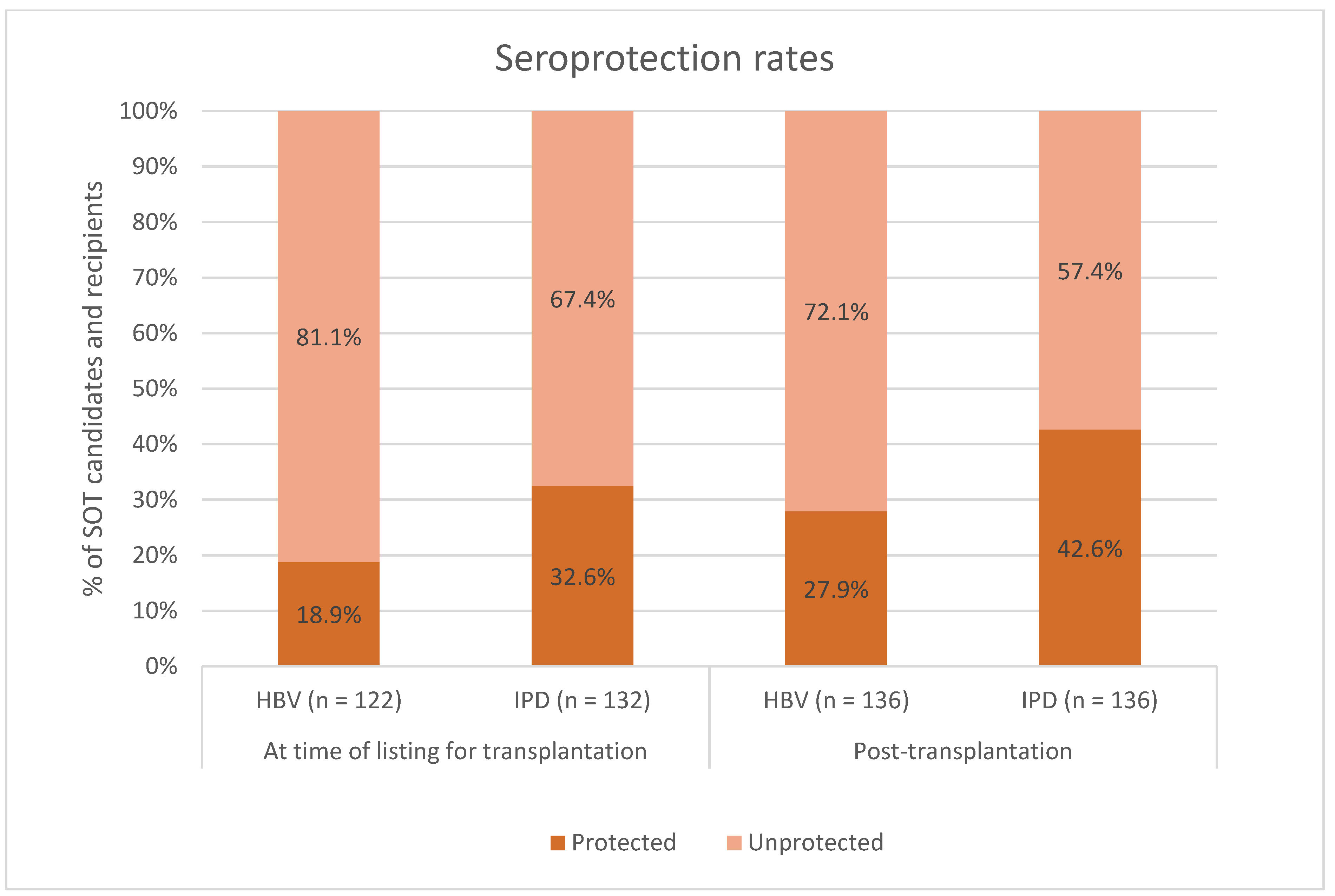
- Post-transplantation seroprotection rates for both hepatitis B virus (HBV) and invasive pneumococcal disease (IPD) were 27.9% (n = 38) and 42.6% (n = 58) against HBV and IPD, respectively;
- ⇒
- Risk factors for HBV non-response were completed HBV vaccination post-transplantation, incomplete HBV vaccination, and shorter time from assessment at the vaccination clinic to transplantation;
- ⇒
- SOT recipients with seroprotection at the time of listing for organ transplantation had lower odds of non-response against HBV and IPD.
Author Contributions
Funding
Institutional Review Board Statement
Informed Consent Statement
Data Availability Statement
Conflicts of Interest
References
- Nelson, J.; Alvey, N.; Bowman, L.; Schulte, J.; Segovia, M.C.; McDermott, J.; Te, H.S.; Kapila, N.; Levine, D.J.; Gottlieb, R.L.; et al. Consensus Recommendations for Use of Maintenance Immunosuppression in Solid Organ Transplantation: Endorsed by the American College of Clinical Pharmacy, American Society of Transplantation, and the International Society for Heart and Lung Transplantation. Pharmacotherapy 2022, 42, 599–633. [Google Scholar] [CrossRef] [PubMed]
- Rezahosseini, O.; Møller, D.L.; Sørensen, S.S.; Perch, M.; Gustafsson, F.; Gelpi, M.; Knudsen, J.; Helleberg, M.; Rasmussen, A.; Nielsen, S.D.; et al. An Observational Prospective Cohort Study of Incidence and Outcome of Streptococcus pneumoniae and Hemophilus influenzae Infections in Adult Solid Organ Transplant Recipients. Microorganisms 2021, 9, 1371. [Google Scholar] [CrossRef] [PubMed]
- Ayoub, W.S.; Martin, P.; Bhamidimarri, K.R. Hepatitis B Virus Infection and Organ Transplantation. Gastroenterol. Hepatol. 2018, 14, 33–40. [Google Scholar]
- Skalski, M.; Patkowski, W.; Grąt, M.; Zieniewicz, K.; Wróblewski, T.; Hołówko, W.; Krawczyk, M. Utilization of Donors with Hepatitis B Core Antibodies in Liver Transplantation. Ann. Transpl. 2015, 20, 667–675. [Google Scholar] [CrossRef] [PubMed]
- He, W.Q.; Guo, G.N.; Li, C. The Impact of Hepatitis B Vaccination in the United States, 1999–2018. Hepatology 2022, 75, 1566–1578. [Google Scholar] [CrossRef]
- Bonten, M.J.M.; Huijts, S.M.; Bolkenbaas, M.; Webber, C.; Patterson, S.; Gault, S.; van Werkhoven, C.H.; van Deursen, A.M.M.; Sanders, E.A.M.; Verheij, T.J.M.; et al. Polysaccharide Conjugate Vaccine against Pneumococcal Pneumonia in Adults. N. Engl. J. Med. 2015, 372, 1114–1125. [Google Scholar] [CrossRef]
- Loinaz, C.; de Juanes, J.R.; Gonzalez, E.M.; López, A.; Lumbreras, C.; Gómez, R.; Gonzalez-Pinto, I.; Jiménez, C.; Garcia, I.; Fuertes, A. Hepatitis B Vaccination Results in 140 Liver Transplant Recipients. Hepatogastroenterology 1997, 44, 235–238. [Google Scholar]
- Dendle, C.; Stuart, R.L.; Mulley, W.R.; Holdsworth, S.R. Pneumococcal Vaccination in Adult Solid Organ Transplant Recipients: A Review of Current Evidence. Vaccine 2018, 36, 6253–6261. [Google Scholar] [CrossRef]
- Dansk Selskab for Infektionsmedicin and Dansk Transplantationsselskab. Vaccination Af Voksne Kandidater Og Recipienter Til Solid Organtransplantation (2022). Available online: https://www.infmed.dk/guidelines#vaccination_af_voksne_kandidater_og_recipienter_til_solid_organtransplantation_2022.pdf (accessed on 2 August 2023).
- Bahakel, H.; Feldman, A.G.; Danziger-Isakov, L. Immunization of Solid Organ Transplant Candidates and Recipients: A 2022 Update. Infect. Dis. Clin. N. Am. 2023, 37, 427–441. [Google Scholar] [CrossRef]
- Danziger-Isakov, L.; Kumar, D. AST ID Community of Practice. Vaccination of Solid Organ Transplant Candidates and Recipients: Guidelines from the American Society of Transplantation Infectious Diseases Community of Practice. Clin. Transpl. 2019, 33, e13563. [Google Scholar] [CrossRef]
- Wang, L.; Verschuuren, E.A.M.; Paap, D.; Rondaan, C.; Raveling-Eelsing, E.; Westra, J.; Bos, N.A. Prophylactic Vaccination with a Live-Attenuated Herpes Zoster Vaccine in Lung Transplant Candidates. J. Heart L. Transpl. 2020, 39, 1445–1454. [Google Scholar] [CrossRef]
- Sokal, E.M.; Ulla, L.; Otte, J.B. Hepatitis B Vaccine Response before and after Transplantation in 55 Extrahepatic Biliary Atresia Children. Dig. Dis. Sci. 1992, 37, 1250–1252. [Google Scholar] [CrossRef] [PubMed]
- Rodríguez-Tajes, S.; Pocurull, A.; Lens, S.; Mariño, Z.; Olivas, I.; Soy, G.; Alonso, A.; Vilella, A.; Forns, X. Efficacy of an Accelerated Double-Dose Hepatitis B Vaccine Regimen in Patients with Cirrhosis. J. Viral. Hepat. 2021, 28, 1019–1024. [Google Scholar] [CrossRef] [PubMed]
- Bonazzi, P.R.; Bacchella, T.; Freitas, A.C.; Osaki, K.T.; Lopes, M.H.; Freire, M.P.; Machado, M.C.C.; Abdalala, E. Double-Dose Hepatitis B Vaccination in Cirrhotic Patients on a Liver Transplant Waiting List. Braz. J. Infect. Dis. 2008, 12, 306–309. [Google Scholar] [CrossRef] [PubMed]
- Gutierrez Domingo, I.; Pascasio Acevedo, J.M.; Alcalde Vargas, A.; Ramos Cuadra, A.; Ferrer Ríos, M.T.; Sousa Martin, J.M.; Sayago Mota, M.; Giráldez Gallego, A.; Suárez Artacho, G. Response to Vaccination against Hepatitis B Virus with a Schedule of Four 40-Μg Doses in Cirrhotic Patients Evaluated for Liver Transplantation: Factors Associated with a Response. Transpl. Proc. 2012, 44, 1499–1501. [Google Scholar] [CrossRef] [PubMed]
- Serrano, B.; Bayas, J.M.; Bruni, L.; Díez, C. Solid Organ Transplantation and Response to Vaccination. Vaccine 2007, 25, 7331–7338. [Google Scholar] [CrossRef] [PubMed]
- McCashland, T.M.; Preheim, L.C.; Gentry-Nielsen, M.J. Pneumococcal Vaccine Response in Cirrhosis and Liver Transplantation. J. Infect. Dis. 2000, 181, 757–760. [Google Scholar] [CrossRef]
- Arslan, M.; Wiesner, R.H.; Sievers, C.; Egan, K.; Zein, N.N. Double-Dose Accelerated Hepatitis B Vaccine in Patients With End-Stage Liver Disease. Liver Transpl. 2001, 7, 314–320. [Google Scholar] [CrossRef]
- Eriksson, M.; Käyhty, H.; Lahdenkari, M.; Mäkisalo, H.; Anttila, V.-J. A Randomized, Controlled Trial Comparing the Immunogenicity and Safety of a 23-Valent Pneumococcal Polysaccharide Vaccination to a Repeated Dose 13-Valent Pneumococcal Conjugate Vaccination in Adult Liver Transplant Recipients. Vaccine 2021, 39, 2351–2359. [Google Scholar] [CrossRef]
- Harboe, Z.B.; Hald, A.; Ekenberg, C.; Ete Wareham, N.; Fogt Lundbo, L.; Holler, J.G.; Qvist, T.; Rask Hamm, S.; Bjerrum, S.; Rezahosseini, O.; et al. Implementation of a Vaccination Clinic for Adult Solid Organ Transplant Candidates: A Single-Center Experience. Vaccine 2023, 41, 6637–6644. [Google Scholar] [CrossRef]
- Grove Krause, T.; Jakobsen, S.; Haarh, M.; Mølbak, K. The Danish Vaccination Register. Euro. Surveill. 2012, 17, 2. [Google Scholar] [CrossRef] [PubMed]
- Voldstedlund, M.; Haarh, M.; Mølbak, K.; MiBa Board of Representatives. The Danish Microbiology Database (MiBa) 2010 to 2013. Euro. Surveill. 2014, 19, 20667. [Google Scholar] [CrossRef] [PubMed]
- WHO. Correlates of Vaccine-Induced Protection: Methods and Implications Immunization, Vaccines and Biologicals; WHO: Geneva, Switzerland, 2013. [Google Scholar]
- Andrews, N.J.; Waight, P.A.; Burbidge, P.; Pearce, E.; Roalfe, L.; Zancolli, M.; Slack, M.; Ladhani, S.N.; Miller, E.; Goldblatt, D. Serotype-Specific Effectiveness and Correlates of Protection for the 13-Valent Pneumococcal Conjugate Vaccine: A Postlicensure Indirect Cohort Study. Lancet Infect. Dis. 2014, 14, 839–846. [Google Scholar] [CrossRef] [PubMed]
- Moal, V.; Motte, A.; Vacher-Coponat, H.; Tamalet, C.; Berland, Y.; Colson, P. Considerable Decrease in Antibodies against Hepatitis B Surface Antigen Following Kidney Transplantation. J. Clin. Virol. 2015, 68, 32–36. [Google Scholar] [CrossRef]
- Vargas, J.I.; Jensen, D.; Martínez, F.; Sarmiento, V.; Peirano, F.; Acuña, P.; Provoste, F.; Bustos, V.; Cornejo, F.; Fuster, A.; et al. Comparative Efficacy of a High-Dose vs Standard-Dose Hepatitis B Revaccination Schedule Among Patients With HIV A Randomized Clinical Trial + Visual Abstract + Invited Commentary + Supplemental Content. JAMA Netw. Open 2021, 4, 2120929. [Google Scholar] [CrossRef]
- Sarmiento, E.; Rodríguez-Hernández, C.; Rodríguez-Molina, J.; Fernández-Yánez, J.; Palomo, J.; Anguita, J.; Pérez, J.L.; Lanio, N.; Fernández-Cruz, E.; Carbone, J. Impaired Anti-Pneumococcal Polysaccharide Antibody Production and Invasive Pneumococcal Infection Following Heart Transplantation. Int. Immunopharmacol. 2006, 6, 2027–2030. [Google Scholar] [CrossRef]
- Van Kessel, D.A.; Hoffman, T.W.; Kwakkel-Van Erp, J.M.; Oudijk, E.J.D.; Zanen, P.; Rijkers, G.T.; Grutters, J.C. Long-Term Follow-up of Humoral Immune Status in Adult Lung Transplant Recipients. Transplantation 2017, 101, 2477–2483. [Google Scholar] [CrossRef]
- Larsen, L.; Bistrup, C.; Sørensen, S.S.; Boesby, L.; Svaerke, C.; Nielsen, C.; Somuncu, I. Durability of Antibody Response after Primary Pneumococcal Double-Dose Prime-Boost Vaccination in Adult Kidney Transplant Recipients and Candidates: 18-Month Follow-Up in a Non-Blinded, Randomised Clinical Trial. Vaccines 2022, 10, 1091. [Google Scholar] [CrossRef]


| Total (n = 136) | |
|---|---|
| Age (median (IQR) in years) | 53 (45.8, 59.2) |
| Male sex, n (%) | 79 (58.1) |
| Transplant type, n (%) | |
| Liver | 87 (64.0) |
| Lung | 34 (25.0) |
| Heart | 15 (11.0) |
| Re-transplantation, n (%) | 7 (5.1) |
| Anti-HBs, n (%) | |
| Protected | 23 (18.9) |
| Unprotected | 99 (81.1) |
| Missing | 14 |
| Pneumococcal antibodies, n (%) | |
| Protected | 43 (32.6) |
| Unprotected | 89 (67.4) |
| Missing | 4 |
| Immunosuppressive therapy, n (%) (yes/no) | 44 (32.4) |
| Prednisolon | 28 (20.6) |
| Mycophenolate mofetil | 12 (8.8) |
| Azathioprine | 11 (8.1) |
| Tacrolimus | 11 (8.1) |
| Other (cyclosporine, chemotherapy, ibrutinib, TNF-α-inhibitor) | 6 (4.4) |
| Comorbidities, n (%) | |
| Diabetes mellitus | 16 (11.8) |
| Cancer | 21 (15.4) |
| Dialysis | <5 |
| Protected (n = 38) | Unprotected (n = 98) | p-Value * | |
|---|---|---|---|
| Age at serology (median (IQR) in years) | 52.5 (35.0, 58.0) | 57.5 (50.2, 62.0) | 0.015 |
| Age at time of listing for transplantation (median (IQR) in years) | 51 (33.2, 56.8) | 55 (48.0, 60.0) | 0.015 |
| Male sex, n (%) | 24 (63.2) | 55 (56.1) | 0.581 |
| Transplant type, n (%) | 0.491 | ||
| Liver | 22 (57.9) | 65 (66.3) | |
| Lung | 10 (26.3) | 24 (24.5) | |
| Heart | 6 (15.8) | 9 (9.2) | |
| Re-transplantation, n (%) | <5 | 5 (5.1%) | NA |
| Anti-HBs at time of listing for transplantation, n (%) | <0.001 | ||
| Unprotected | 14 (43.8) | 85 (94.4) | |
| Protected | 18 (56.2) | 5 (5.6) | |
| Missing | 6 | 8 | |
| HBV vaccination status, n (%) | <0.001 | ||
| Completed pre-transplantation | 19 (50.0) | 22 (22.4) | |
| Completed after transplantation | 5 (13.2) | 53 (54.1) | |
| Incomplete | <5 | 16 (16.3) | |
| Protected at time of listing and boosted | 12 (31.6) | 7 (7.1) | |
| Time from transplantation to serology (median (IQR) in days) | 394 (234.5, 605.0) | 479.5 (298.2, 668.5) | 0.127 |
| Time from vaccination to serology (median (IQR) in days) | 610.5 (453.5, 771.8) | 607.5 (469.0, 754.5) | 0.888 |
| Time from vaccination to transplantation (median (IQR) in days) | 160 (91.5, 338.0) | 101 (40.0, 194.8) | 0.006 |
| Comorbidities after transplantation, n (%) | |||
| Diabetes mellitus | <5 | 24 (24.5) | NA |
| Dialysis | <5 | <5 | NA |
| Cancer | <5 | <5 | NA |
| Immunosuppressive therapy | |||
| Immunosupp. at time of listing for transplantation, n (%) | 13 (34.2) | 31 (31.6) | 0.933 |
| Induction therapy, n (%) | 0.926 | ||
| No induction | 22 (57.9) | 55 (56.1) | |
| Simulect/basiliximab | 6 (15.8) | 22 (22.4) | |
| ATG | 10 (26.3) | 21 (21.4) | |
| Maintenance immunosuppresive therapy, n (%) | |||
| Corticosteroid | 30 (78.9) | 70 (71.4) | 0.500 |
| Tacrolimus | 28 (73.7) | 76 (77.6) | 0.801 |
| Cyclosporine | 9 (23.7) | 16 (16.3) | 0.346 |
| mTOR-inhibitors | <5 | 14 (14.3) | NA |
| Antimetabolites | 0.665 | ||
| Azathioprine | <5 | <5 | |
| Mycophenolate mofetil | 33 (86.8) | 81 (82.7) | |
| None | <5 | 13 (13.3) | |
| Rejection treated with pulse-steroid, n (%) | 7 (18.4) | 14 (14.3) | 0.738 |
| Unadjusted Model | Adjusted Model * | |||||
|---|---|---|---|---|---|---|
| OR (Crude) | 95% CI | p-Value | OR (Adjusted) | 95% CI | p-Value | |
| Age at time of listing for transplantation per 10-year increase | 1.5 | 1.1–2.1 | 0.009 | |||
| Male sex | 0.7 | 0.4–1.6 | 0.456 | |||
| Transplant type | ||||||
| Liver | Ref. | Ref. | Ref. | |||
| Heart | 0.5 | 0.2–1.6 | 0.244 | |||
| Lung | 0.8 | 0.3–2.0 | 0.644 | |||
| Time variables | ||||||
| Time from transplantation to serology per year | 1.4 | 0.8–2.3 | 0.262 | 1.4 | 0.8–2.4 | 0.260 |
| Time from vaccination to transplantation per 3 months | 0.7 | 0.6–0.9 | 0.008 | 0.8 | 0.6–1.0 | 0.043 |
| HBV vaccination status | ||||||
| Completed pre-transplantation | Ref. | Ref. | Ref. | Ref. | Ref. | Ref. |
| Completed after transplantation | 9.2 | 3.0–27.6 | <0.001 | 7.8 | 2.5–24.5 | <0.001 |
| Incomplete | 6.9 | 1.4–34.0 | 0.017 | 6.3 | 1.2–32.6 | 0.028 |
| Protected at time of listing and boosted | 0.5 | 0.2–1.5 | 0.229 | 0.4 | 0.1–1.4 | 0.166 |
| Comorbidities after transplantation | ||||||
| Diabetes mellitus | 3.8 | 1.1–13.4 | 0.039 | 3.5 | 0.9–13.4 | 0.068 |
| Immunosuppres. therapy after transplantation | ||||||
| Antimetabolites | ||||||
| None | Ref. | Ref. | Ref. | Ref. | Ref. | Ref. |
| Azathioprine | 0.5 | 0.1–3.8 | 0.473 | 0.6 | 0.1–6.1 | 0.705 |
| Mycophenolate mofetil | 0.6 | 0.2–2.1 | 0.398 | 0.4 | 0.1–1.9 | 0.270 |
| Calcineurin inhibitors | ||||||
| Tacrolimus | 1.2 | 0.5–2.9 | 0.644 | 1.2 | 0.4–3.4 | 0.786 |
| Cyclosporine | 0.6 | 0.3–1.6 | 0.323 | 0.6 | 0.2–2.0 | 0.409 |
| mTOR-inhibitors | 1.9 | 0.5–7.2 | 0.319 | 2.8 | 0.5–14.5 | 0.225 |
| Corticosteroids | 0.7 | 0.3–1.6 | 0.374 | 0.6 | 0.2–1.6 | 0.289 |
| Rejection treated with pulse-steroid | 0.7 | 0.3–2.0 | 0.550 | 0.8 | 0.3–2.2 | 0.622 |
| Unadjusted Model | Adjusted Model * | |||||
|---|---|---|---|---|---|---|
| OR (Crude) | 95% CI | p-Value | aOR (Adjusted) | 95% CI | p-Value | |
| HBV (n = 122) | ||||||
| Age at time of listing for transplantation per 10-year increase | 1.5 | 1.1–2.1 | 0.009 | |||
| Male sex | 0.8 | 0.3–1.7 | 0.496 | |||
| Transplant type | ||||||
| Liver | Ref. | Ref. | Ref. | |||
| Heart | 0.6 | 0.2–1.9 | 0.349 | |||
| Lung | 1.3 | 0.4–4.0 | 0.614 | |||
| Anti-HBs at time of listing for transplantation | ||||||
| Unprotected | Ref. | Ref. | Ref. | Ref. | Ref. | Ref. |
| Protected | 0.1 | 0.0–0.1 | <0.001 | 0.04 | 0.0–0.1 | <0.001 |
| Invasive pneumococcal disease (n = 132) | ||||||
| Age at time of listing for transplantation per 10-year increase | 1.1 | 0.8–1.5 | 0.494 | |||
| Male sex | 0.4 | 0.2–0.9 | 0.020 | |||
| Transplant type | ||||||
| Liver | Ref. | Ref. | Ref. | |||
| Heart | 1.2 | 3.8 | 0.707 | |||
| Lung | 1.3 | 0.6–2.9 | 0.567 | |||
| Pneumococcal antibodies at time of listing for transplantation | ||||||
| Unprotected | Ref. | Ref. | Ref. | Ref. | Ref. | Ref. |
| Protected | 0.4 | 0.2–0.9 | 0.017 | 0.3 | 0.1–0.7 | 0.007 |
| Protected (n = 58) | Unprotected (n = 78) | p-Value * | |
|---|---|---|---|
| Age at serology (median (IQR) in years) | 55 (46.2, 61.8) | 55.5 (49.2, 61.0) | 0.827 |
| Age at time of listing for transplantation (median (IQR) in years) | 53.5 (44.2, 60.0) | 53 (48, 59) | 0.708 |
| Male sex, n (%) | 40 (69.0) | 39 (50.0) | 0.041 |
| Transplant type, n (%) | 0.786 | ||
| Liver | 39 (67.2) | 48 (61.5) | |
| Lung | 13 (22.4) | 21 (26.9) | |
| Heart | 6 (10.3) | 9 (11.5) | |
| Re-transplantation, n (%) | <5 | 5 (8.6) | NA |
| Pneumococcal antibodies at time of listing for transplantation, n (%) | 0.026 | ||
| Unprotected | 32 (56.1) | 57 (76.0) | |
| Protected | 25 (43.9) | 18 (24.0) | |
| Missing | 1 | 3 | |
| Pneumococcal vaccination status, n (%) | 0.008 | ||
| Completed pre-transplantation | 44 (75.9) | 52 (66.7) | |
| Completed after transplantation | 12 (20.7) | 26 (33.3) | |
| Incomplete | <5 | <5 | |
| Time from transplantation to serology (median (IQR) in days) | 696 (444.8, 977.8) | 554.5 (298.2, 870.2) | 0.103 |
| Time from vaccination to serology (median (IQR) in days) | 792 (584.2, 1104.5) | 701 (497.2, 1043.5) | 0.122 |
| Time from vaccination to transplantation (median (IQR) in days) | 116 (57.2, 194.5) | 120 (54.0, 233.8) | 0.639 |
| Comorbidities after transplantation, n (%) | |||
| Diabetes mellitus | 15 (25.9) | 14 (17.9) | 0.367 |
| Dialysis | <5 | <5 | NA |
| Cancer | <5 | <5 | NA |
| Immunosuppressive therapy | |||
| Immunosupp. at time of listing for transplantation, n (%) | 21 (36.2) | 23 (29.5) | 0.520 |
| Induction therapy, n (%) | 0.874 | ||
| No induction | 34 (58.6) | 43 (55.1) | |
| Simulect/basiliximab | 12 (20.7) | 16 (20.5) | |
| ATG | 12 (20.7) | 19 (24.4) | |
| Maintenance immunosuppresive therapy, n (%) | |||
| Corticosteroid | 36 (62.1) | 55 (70.5) | 0.395 |
| Tacrolimus | 45 (77.6) | 59 (75.6) | 0.952 |
| Cyclosporine | 9 (15.5) | 17 (21.8) | 0.484 |
| mTOR-inhibitors | 8 (13.8) | 8 (10.3) | 0.716 |
| Antimetabolites | 0.953 | ||
| Azathioprine | <5 | 5 (6.4) | |
| Mycophenolate mofetil | 47 (81.0) | 64 (82.1) | |
| None | 7 (12.1) | 9 (11.5) | |
| Rejection treated with pulse-steroid, n (%) | 6 (10.3) | 15 (19.2) | 0.239 |
| Unadjusted Model | Adjusted Model * | |||||
|---|---|---|---|---|---|---|
| OR (Crude) | 95% CI | p-Value | OR (Adjusted) | 95% CI | p-Value | |
| Age at the time of listing for transplantation per 10-year increase | 1.1 | 0.8–1.5 | 0.530 | |||
| Male sex | 0.5 | 0.2–0.9 | 0.028 | |||
| Transplant type | ||||||
| Liver | Ref. | Ref. | Ref. | |||
| Heart | 1.2 | 0.4–3.7 | 0.728 | |||
| Lung | 1.3 | 0.6–3.0 | 0.511 | |||
| Time variables | ||||||
| Time from transplantation to serology per year | 0.7 | 0.5–1.1 | 0.115 | 0.7 | 0.5–1.1 | 0.116 |
| Time from vaccination to transplantation per 3 months | 1.1 | 0.9–1.3 | 0.519 | 1.1 | 0.8–1.4 | 0.546 |
| IPD vaccination status | ||||||
| Completed pre-transplantation | Ref. | Ref. | Ref. | Ref. | Ref. | Ref. |
| Completed after transplantation | 1.8 | 0.8–4.1 | 0.134 | 1.9 | 0.8–4.4 | 0.153 |
| Incomplete | - | - | - | - | - | - |
| Comorbidities after transplantation | ||||||
| Diabetes mellitus | 0.6 | 0.3–1.4 | 0.267 | 0.7 | 0.3–1.9 | 0.515 |
| Immunosuppress. therapy after transplantation | ||||||
| Antimetabolites | ||||||
| None | Ref. | Ref. | Ref. | Ref. | Ref. | Ref. |
| Azathioprine | 1.0 | 0.2–5.0 | 0.973 | 1.0 | 0.2–5.4 | 0.963 |
| Mycophenolate mofetil | 1.1 | 04–3.1 | 0.915 | 1.3 | 0.4–3.9 | 0.646 |
| Calcineurin inhibitors | ||||||
| Tacrolimus | 0.9 | 0.4–2.0 | 0.791 | 1.0 | 0.4–2.8 | 0.957 |
| Cyclosporine | 1.5 | 0.6–3.7 | 0.359 | 1.5 | 0.5–4.8 | 0.533 |
| mTOR-inhibitors | 0.7 | 0.3–2.0 | 0.528 | 0.7 | 0.2–2.0 | 0.513 |
| Corticosteroids | 1.5 | 0.7–3.0 | 0.302 | 1.2 | 0.5–2.6 | 0.725 |
| Rejection treated with pulse-steroid | 2.1 | 0.7–5.7 | 0.162 | 2.2 | 0.8–6.3 | 0.149 |
Disclaimer/Publisher’s Note: The statements, opinions and data contained in all publications are solely those of the individual author(s) and contributor(s) and not of MDPI and/or the editor(s). MDPI and/or the editor(s) disclaim responsibility for any injury to people or property resulting from any ideas, methods, instructions or products referred to in the content. |
© 2024 by the authors. Licensee MDPI, Basel, Switzerland. This article is an open access article distributed under the terms and conditions of the Creative Commons Attribution (CC BY) license (https://creativecommons.org/licenses/by/4.0/).
Share and Cite
Hornung, L.B.; Hamm, S.R.; Hald, A.; Harboe, Z.B.; Lundbo, L.F.; Wareham, N.E.; Heftdal, L.D.; Ekenberg, C.; Bjerrum, S.; Holler, J.G.; et al. Post-Transplantation Seroprotection Rates in Liver, Lung, and Heart Transplant Recipients Vaccinated Pre-Transplantation against Hepatitis B Virus and Invasive Pneumococcal Disease. Vaccines 2024, 12, 1092. https://doi.org/10.3390/vaccines12101092
Hornung LB, Hamm SR, Hald A, Harboe ZB, Lundbo LF, Wareham NE, Heftdal LD, Ekenberg C, Bjerrum S, Holler JG, et al. Post-Transplantation Seroprotection Rates in Liver, Lung, and Heart Transplant Recipients Vaccinated Pre-Transplantation against Hepatitis B Virus and Invasive Pneumococcal Disease. Vaccines. 2024; 12(10):1092. https://doi.org/10.3390/vaccines12101092
Chicago/Turabian StyleHornung, Lise Bank, Sebastian Rask Hamm, Annemette Hald, Zitta Barrella Harboe, Lene Fogt Lundbo, Neval Ete Wareham, Line Dam Heftdal, Christina Ekenberg, Stephanie Bjerrum, Jon Gitz Holler, and et al. 2024. "Post-Transplantation Seroprotection Rates in Liver, Lung, and Heart Transplant Recipients Vaccinated Pre-Transplantation against Hepatitis B Virus and Invasive Pneumococcal Disease" Vaccines 12, no. 10: 1092. https://doi.org/10.3390/vaccines12101092
APA StyleHornung, L. B., Hamm, S. R., Hald, A., Harboe, Z. B., Lundbo, L. F., Wareham, N. E., Heftdal, L. D., Ekenberg, C., Bjerrum, S., Holler, J. G., Mathiesen, I. H. M., Krohn, P. S., Bjerring, P. N., Gustafsson, F., Perch, M., Rasmussen, A., & Nielsen, S. D. (2024). Post-Transplantation Seroprotection Rates in Liver, Lung, and Heart Transplant Recipients Vaccinated Pre-Transplantation against Hepatitis B Virus and Invasive Pneumococcal Disease. Vaccines, 12(10), 1092. https://doi.org/10.3390/vaccines12101092