


Sex-Related Differences in Oxidative, Platelet, and Vascular Function in Chronic Users of Heat-not-Burn vs. Traditional Combustion Cigarettes
 ,
,  ,
,  ,
,  ,
,  , , ,
, , ,  ,
,  and
and 
Abstract
:1. Introduction
2. Materials and Methods
2.1. Design
2.2. Flow-Mediated Dilation
2.3. Laboratory Analyses
2.3.1. Plasma Soluble CD40 Ligand Assay
2.3.2. Plasma Soluble P-Selectin
2.3.3. Platelet Preparation and Aggregation
2.3.4. Serum Cotinine
2.3.5. Serum Nitric Oxide Bioavailability
2.3.6. Serum Hydrogen Peroxide Production
2.3.7. Serum Soluble Nox2-Derived Peptide Assay
2.4. Statistical Analysis
3. Results
4. Discussion
5. Conclusions
Author Contributions
Funding
Institutional Review Board Statement
Informed Consent Statement
Data Availability Statement
Conflicts of Interest
References
- Beaglehole, R.; Bonita, R.; Yach, D.; Mackay, J.; Reddy, K.S. A tobacco-free world: A call to action to phase out the sale of tobacco products by 2040. Lancet 2015, 385, 1011–1018. [Google Scholar] [CrossRef]
- Saglietto, A.; Manfredi, R.; Elia, E.; D’Ascenzo, F.; De Ferrari, G.M.; Biondi-Zoccai, G.; Munzel, T. Cardiovascular disease burden: Italian and global perspectives. Minerva Cardiol. Angiol. 2021, 69, 231–240. [Google Scholar] [CrossRef] [PubMed]
- Frati, G.; Carnevale, R.; Nocella, C.; Peruzzi, M.; Marullo, A.G.M.; De Falco, E.; Chimenti, I.; Cammisotto, V.; Valenti, V.; Cavarretta, E.; et al. Profiling the Acute Effects of Modified Risk Products: Evidence from the SUR-VAPES (Sapienza University of Rome-Vascular Assessment of Proatherosclerotic Effects of Smoking) Cluster Study. Curr. Atheroscler. Rep. 2020, 22, 8. [Google Scholar] [CrossRef] [PubMed]
- Hartmann-Boyce, J.; Livingstone-Banks, J.; Ordóñez-Mena, J.M.; Fanshawe, T.R.; Lindson, N.; Freeman, S.C.; Sutton, A.J.; Theodoulou, A.; Aveyard, P. Behavioural interventions for smoking cessation: An overview and network meta-analysis. Cochrane Database Syst. Rev. 2021, 1, Cd013229. [Google Scholar] [CrossRef]
- Quigley, J.M.; Walsh, C.; Lee, C.; Long, J.; Kennelly, H.; McCarthy, A.; Kavanagh, P. Efficacy and safety of electronic cigarettes as a smoking cessation intervention: A systematic review and network meta-analysis. Tob. Prev. Cessat. 2021, 7, 69. [Google Scholar] [CrossRef]
- Suissa, K.; Larivière, J.; Eisenberg, M.J.; Eberg, M.; Gore, G.C.; Grad, R.; Joseph, L.; Reynier, P.M.; Filion, K.B. Efficacy and Safety of Smoking Cessation Interventions in Patients With Cardiovascular Disease: A Network Meta-Analysis of Randomized Controlled Trials. Circulation. Cardiovasc. Qual. Outcomes 2017, 10, e002458. [Google Scholar] [CrossRef]
- Salman, R.; Talih, S.; El-Hage, R.; Haddad, C.; Karaoghlanian, N.; El-Hellani, A.; Saliba, N.A.; Shihadeh, A. Free-Base and Total Nicotine, Reactive Oxygen Species, and Carbonyl Emissions From IQOS, a Heated Tobacco Product. Nicotine Tob. Res. Off. J. Soc. Res. Nicotine Tob. 2019, 21, 1285–1288. [Google Scholar] [CrossRef]
- Auer, R.; Concha-Lozano, N.; Jacot-Sadowski, I.; Cornuz, J.; Berthet, A. Heat-Not-Burn Tobacco Cigarettes: Smoke by Any Other Name. JAMA Intern. Med. 2017, 177, 1050–1052. [Google Scholar] [CrossRef] [Green Version]
- Bekki, K.; Inaba, Y.; Uchiyama, S.; Kunugita, N. Comparison of Chemicals in Mainstream Smoke in Heat-not-burn Tobacco and Combustion Cigarettes. J. UOEH 2017, 39, 201–207. [Google Scholar] [CrossRef] [Green Version]
- Carnevale, R.; Sciarretta, S.; Violi, F.; Nocella, C.; Loffredo, L.; Perri, L.; Peruzzi, M.; Marullo, A.G.; De Falco, E.; Chimenti, I.; et al. Acute Impact of Tobacco vs Electronic Cigarette Smoking on Oxidative Stress and Vascular Function. Chest 2016, 150, 606–612. [Google Scholar] [CrossRef]
- West, R. Tobacco smoking: Health impact, prevalence, correlates and interventions. Psychol. Health 2017, 32, 1018–1036. [Google Scholar] [CrossRef] [PubMed] [Green Version]
- Ikonomidis, I.; Marinou, M.; Vlastos, D.; Kourea, K.; Andreadou, I.; Liarakos, N.; Triantafyllidi, H.; Pavlidis, G.; Tsougos, E.; Parissis, J.; et al. Effects of varenicline and nicotine replacement therapy on arterial elasticity, endothelial glycocalyx and oxidative stress during a 3-month smoking cessation program. Atherosclerosis 2017, 262, 123–130. [Google Scholar] [CrossRef] [PubMed]
- Peruzzi, M.; Biondi-Zoccai, G.; Carnevale, R.; Cavarretta, E.; Frati, G.; Versaci, F. Vaping Cardiovascular Health Risks: An Updated Umbrella Review. Curr. Emerg. Hosp. Med. Rep. 2020, 8, 103–109. [Google Scholar] [CrossRef]
- Farsalinos, K.E.; Yannovits, N.; Sarri, T.; Voudris, V.; Poulas, K.; Leischow, S.J. Carbonyl emissions from a novel heated tobacco product (IQOS): Comparison with an e-cigarette and a tobacco cigarette. Addiction 2018, 113, 2099–2106. [Google Scholar] [CrossRef] [PubMed]
- Li, X.; Luo, Y.; Jiang, X.; Zhang, H.; Zhu, F.; Hu, S.; Hou, H.; Hu, Q.; Pang, Y. Chemical Analysis and Simulated Pyrolysis of Tobacco Heating System 2.2 Compared to Conventional Cigarettes. Nicotine Tob. Res. Off. J. Soc. Res. Nicotine Tob. 2019, 21, 111–118. [Google Scholar] [CrossRef]
- Archie, S.R.; Sharma, S.; Burks, E.; Abbruscato, T. Biological determinants impact the neurovascular toxicity of nicotine and tobacco smoke: A pharmacokinetic and pharmacodynamics perspective. Neurotoxicology 2022, 89, 140–160. [Google Scholar] [CrossRef]
- Khan, N.A.; Sundar, I.K.; Rahman, I. Strain- and sex-dependent pulmonary toxicity of waterpipe smoke in mouse. Physiol. Rep. 2018, 6, e13579. [Google Scholar] [CrossRef] [Green Version]
- Rerkpattanapipat, P.; Stanek, M.S.; Kotler, M.N. Sex and the heart: What is the role of the cardiologist? Eur. Heart J. 2001, 22, 201–208. [Google Scholar] [CrossRef] [Green Version]
- Loffredo, L.; Carnevale, R.; Battaglia, S.; Marti, R.; Pizzolo, S.; Bartimoccia, S.; Nocella, C.; Cammisotto, V.; Sciarretta, S.; Chimenti, I.; et al. Impact of chronic use of heat-not-burn cigarettes on oxidative stress, endothelial dysfunction and platelet activation: The SUR-VAPES Chronic Study. Thorax 2021, 76, 618–620. [Google Scholar] [CrossRef]
- Violi, F.; Sanguigni, V.; Loffredo, L.; Carnevale, R.; Buchetti, B.; Finocchi, A.; Tesauro, M.; Rossi, P.; Pignatelli, P. Nox2 is determinant for ischemia-induced oxidative stress and arterial vasodilatation: A pilot study in patients with hereditary Nox2 deficiency. Arterioscler. Thromb. Vasc. Biol. 2006, 26, e131–e132. [Google Scholar] [CrossRef] [Green Version]
- Fried, N.D.; Gardner, J.D. Heat-not-burn tobacco products: An emerging threat to cardiovascular health. Am. J. Physiol. Heart Circ. Physiol. 2020, 319, H1234–H1239. [Google Scholar] [CrossRef] [PubMed]
- Sakaguchi, C.; Nagata, Y.; Kikuchi, A.; Takeshige, Y.; Minami, N. Differences in Levels of Biomarkers of Potential Harm Among Users of a Heat-Not-Burn Tobacco Product, Cigarette Smokers, and Never-Smokers in Japan: A Post-Marketing Observational Study. Nicotine Tob. Res. Off. J. Soc. Res. Nicotine Tob. 2021, 23, 1143–1152. [Google Scholar] [CrossRef] [PubMed]
- Ikonomidis, I.; Vlastos, D.; Kostelli, G.; Kourea, K.; Katogiannis, K.; Tsoumani, M.; Parissis, J.; Andreadou, I.; Alexopoulos, D. Differential effects of heat-not-burn and conventional cigarettes on coronary flow, myocardial and vascular function. Sci. Rep. 2021, 11, 11808. [Google Scholar] [CrossRef] [PubMed]
- Connett, J.E.; Murray, R.P.; Buist, A.S.; Wise, R.A.; Bailey, W.C.; Lindgren, P.G.; Owens, G.R. Changes in smoking status affect women more than men: Results of the Lung Health Study. Am. J. Epidemiol. 2003, 157, 973–979. [Google Scholar] [CrossRef] [Green Version]
- Haghani, A.; Arpawong, T.E.; Kim, J.K.; Lewinger, J.P.; Finch, C.E.; Crimmins, E. Female vulnerability to the effects of smoking on health outcomes in older people. PLoS ONE 2020, 15, e0234015. [Google Scholar] [CrossRef]
- Howe, M.; Leidal, A.; Montgomery, D.; Jackson, E. Role of cigarette smoking and gender in acute coronary syndrome events. Am. J. Cardiol. 2011, 108, 1382–1386. [Google Scholar] [CrossRef]
- Gemmati, D.; Varani, K.; Bramanti, B.; Piva, R.; Bonaccorsi, G.; Trentini, A.; Manfrinato, M.C.; Tisato, V.; Carè, A.; Bellini, T. “Bridging the Gap” Everything that Could Have Been Avoided if We Had Applied Gender Medicine, Pharmacogenetics and Personalized Medicine in the Gender-Omics and Sex-Omics Era. Int. J. Mol. Sci. 2019, 21, 296. [Google Scholar] [CrossRef] [Green Version]
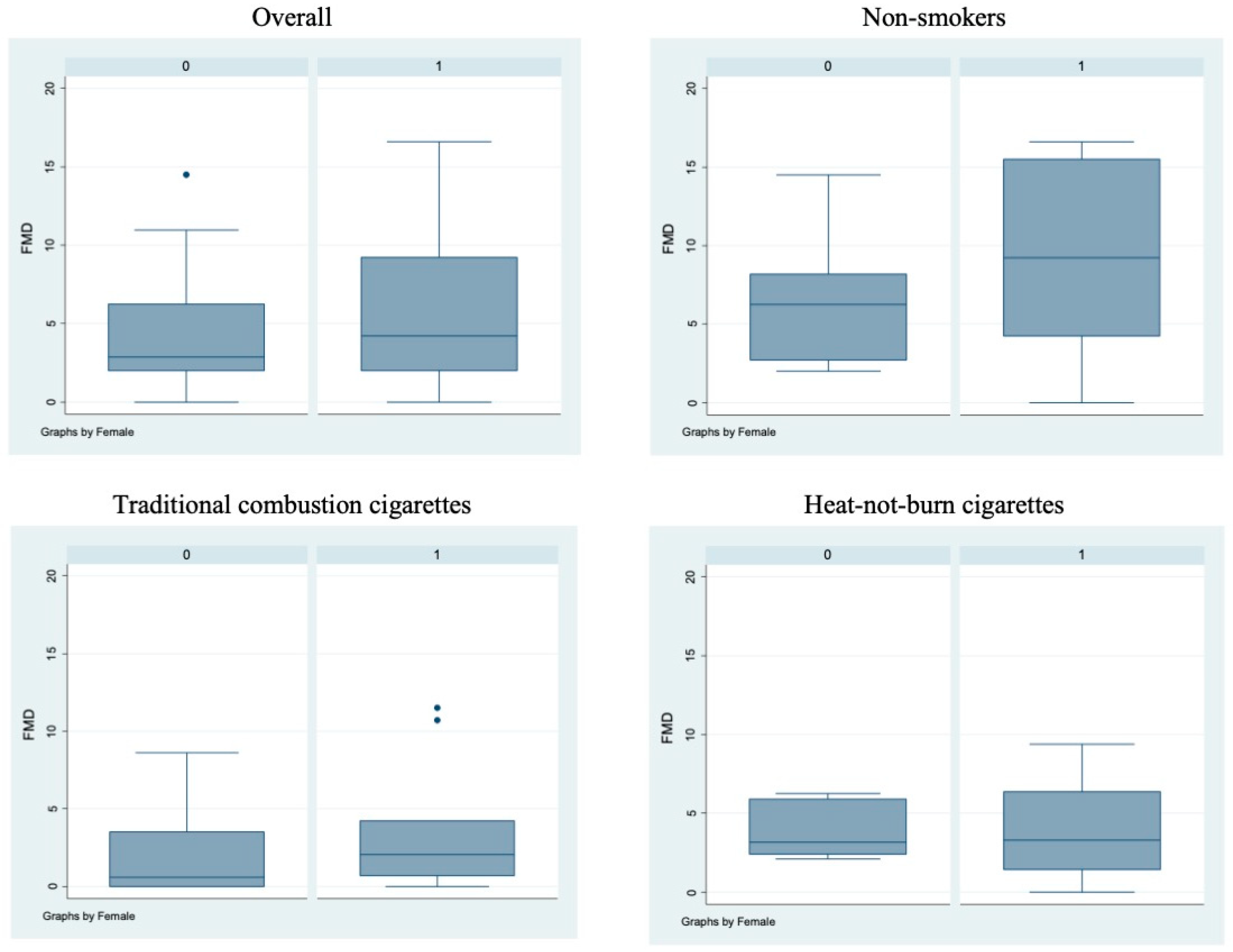

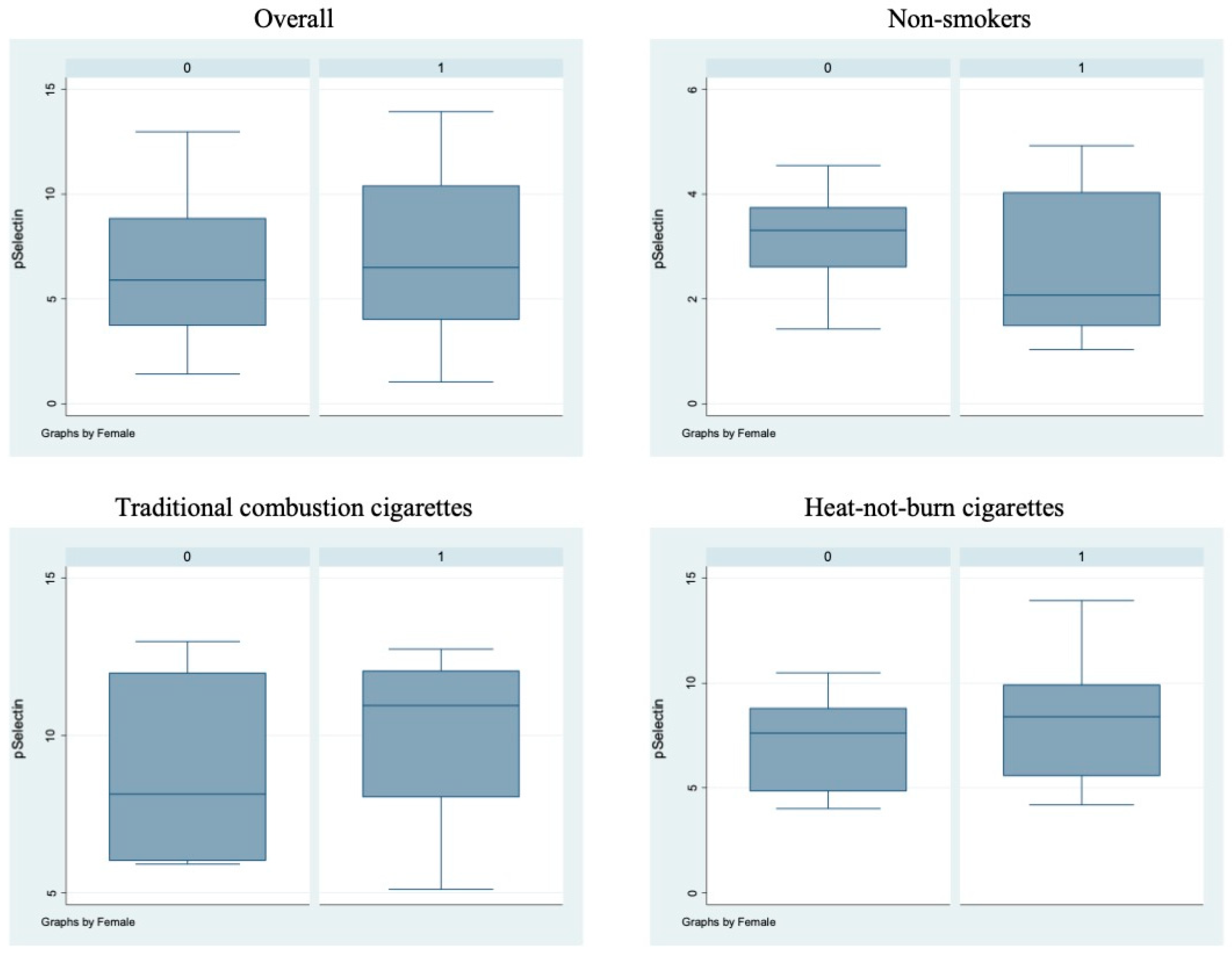
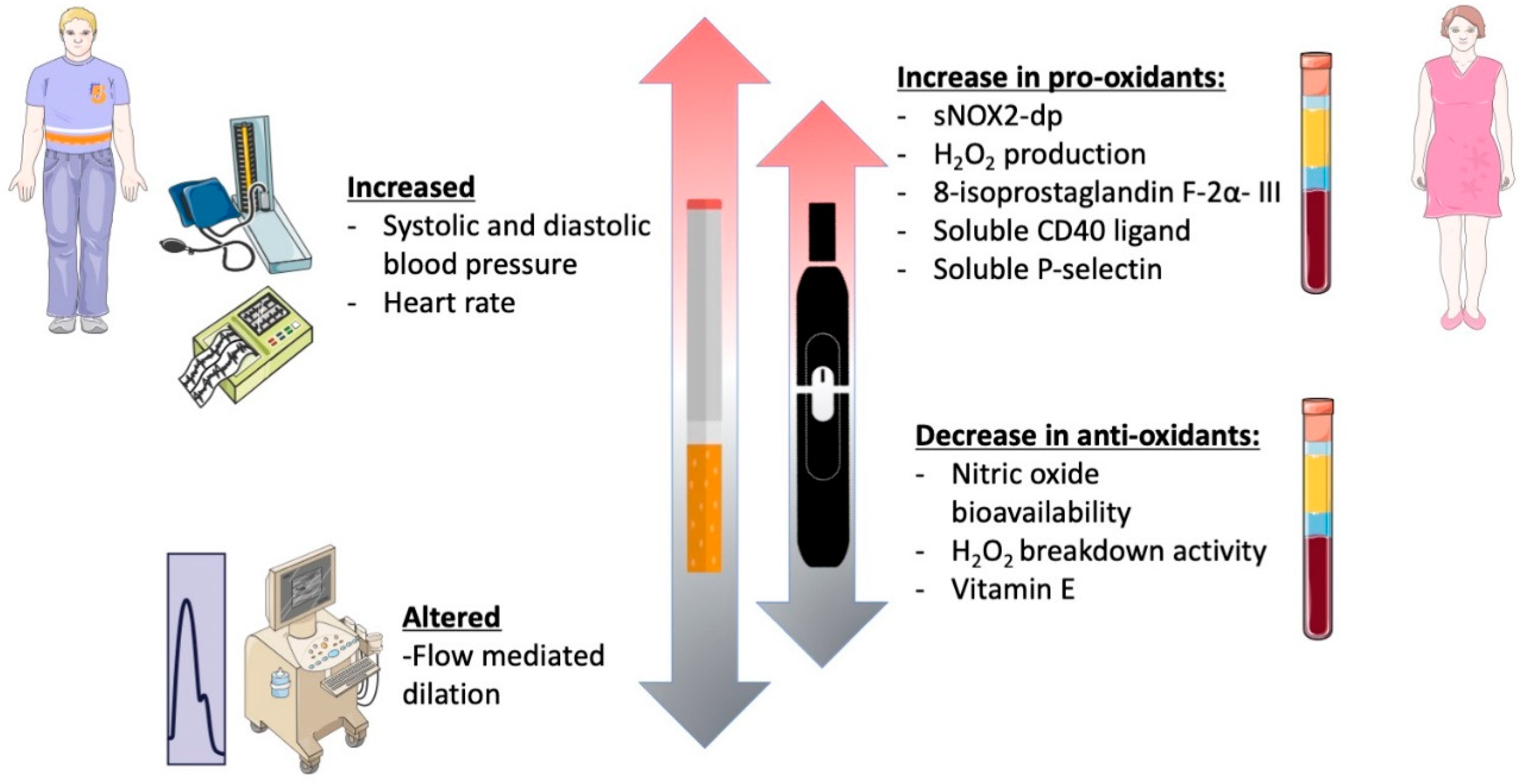

| Characteristic | Male | Female | p |
|---|---|---|---|
| Subjects | 27 | 33 | - |
| Age (years) | 30.2 ± 8.5 | 30.8 ± 7.7 | 0.763 |
| Height (cm) | 178.3 ± 6.4 | 165.9 ± 7.5 | <0.001 |
| Weight (kg) | 77.4 ± 8.9 | 58.4 ± 7.1 | <0.001 |
| Body mass index (kg/m2) | 24.4 ± 2.7 | 21.3 ± 2.5 | <0.001 |
| Systolic blood pressure (mmHg) | 123.2 ± 14.3 | 112.4 ± 8.9 | <0.001 |
| Diastolic blood pressure (mmHg) | 77.5 ± 7.2 | 71.4 ± 9.4 | 0.007 |
| Mean blood pressure (mmHg) | 92.7 ± 6.6 | 85.1 ± 8.4 | <0.001 |
| Total cholesterol (mg/dL) | 180.0 ± 14.2 | 174.7 ± 14.5 | 0.163 |
| Smoking status | 0.946 | ||
| Non-smoker | 9 (33.3%) | 11 (33.3%) | |
| Traditional combustion cigarette smoker | 10 (37.0%) | 10 (30.3%) | |
| Heat-not-burn cigarette smoker | 8 (29.6%) | 12 (36.4%) | |
| Years of smoking | 2.2 ± 2.2 | 3.0 ± 4.0 | 0.349 |
| Cigarettes per day | 9.8 ± 9.3 | 8.0 ± 6.6 | 0.390 |
| Flow-mediated dilation (%) | 4.0 ± 3.6 | 5.5 ± 5.0 | 0.198 |
| Nitric oxide (µmol/L) | 20.8 ± 15.8 | 22.1 ± 18.6 | 0.767 |
| sNox2-dp (ng/mL) | 34.3 ± 13.0 | 33.9 ± 12.9 | 0.887 |
| H2O2 (µmol/L) | 25.6 ± 15.7 | 22.8 ± 16.7 | 0.519 |
| sCD40L (ng/mL) | 2.5 ± 1.1 | 2.7 ± 1.2 | 0.322 |
| sP-selectin (ng/mL) | 6.4 ± 3.2 | 7.0 ± 3.9 | 0.584 |
| Platelet aggregation (%) | 71.3 ± 12.4 | 73.4 ± 10.4 | 0.465 |
| Cotinine (ng/mL) | 95.5 ± 78.5 | 94.2 ± 72.0 | 0.949 |
| Characteristic | Male | Female | p |
|---|---|---|---|
| Subjects | 9 | 11 | - |
| Age (years) | 30.0 ± 6.5 | 27.6 ± 5.2 | 0.380 |
| Height (cm) | 175 ± 6.6 | 161 ± 6.8 | <0.001 |
| Weight (kg) | 76.3 ± 5.9 | 57.6 ± 8.1 | <0.001 |
| Body mass index (kg/m2) | 25.0 ± 2.4 | 22.1 ± 2.3 | <0.05 |
| Systolic blood pressure (mmHg) | 130 ± 20.9 | 111.2 ± 7.2 | <0.05 |
| Diastolic blood pressure (mmHg) | 78.9 ± 8.2 | 68.2 ± 10.6 | <0.05 |
| Mean blood pressure (mmHg) | 95.9 ± 8.2 | 82.5 ± 9.0 | <0.01 |
| Total cholesterol (mg/dL) | 181.1 ± 9.4 | 176.4 ± 16.7 | <0.459 |
| Flow-mediated dilation (%) | 6.3 ± 4.4 | 9.1 ± 5.7 | 0.244 |
| Nitric oxide (µmol/L) | 41.4 ± 8.3 | 46.1 ± 11.8 | 0.333 |
| sNox2-dp (ng/mL) | 18.2 ± 5.3 | 20.4 ± 9.4 | 0.550 |
| H2O2 (µmol/L) | 9.7 ± 3.8 | 8.4 ± 3.6 | 0.434 |
| sCD40L (ng/mL) | 1.4 ± 0.5 | 1.6 ± 0.6 | 0.465 |
| sP-selectin (ng/mL) | 3.2 ± 1.0 | 2.7 ± 1.4 | 0.335 |
| Platelet aggregation (%) | 59.3 ± 8.6 | 64.0 ± 7.5 | 0.209 |
| Cotinine (ng/mL) | 2.2 ± 0.7 | 2.2 ± 0.8 | 0.898 |
| Characteristic | Male | Female | p |
|---|---|---|---|
| Subjects | 10 | 10 | |
| Age (years) | 24.7 ± 2.9 | 29.8 ± 5.0 | 0.012 |
| Height (cm) | 179.7 ± 7.0 | 164.3 ± 6.8 | <0.001 |
| Weight (kg) | 78.6 ± 11.9 | 58.4 ± 6.4 | <0.001 |
| Body mass index (kg/m2) | 24.3 ± 3.5 | 21.6 ± 2.0 | 0.046 |
| Systolic blood pressure (mmHg) | 121.5 ± 8.8 | 115 ± 9.7 | 0.135 |
| Diastolic blood pressure (mmHg) | 79.2 ± 5.8 | 71 ± 9.1 | 0.027 |
| Mean blood pressure (mmHg) | 93.3 ± 2.8 | 85.7 ± 8.5 | 0.015 |
| Total cholesterol (mg/dL) | 180.1 ± 15.4 | 183.1 ± 10.3 | 0.615 |
| Years of smoking | 4.5 ± 1.8 | 8.2 ± 3.5 | 0.009 |
| Cigarettes per day | 13.4 ± 8.0 | 12.8 ± 2.66 | 0.824 |
| Flow-mediated dilation (%) | 2.1 ± 2.9 | 3.5 ± 4.2 | 0.380 |
| Nitric oxide (µmol/L) | 11.7 ± 3.0 | 9.2 ± 2.5 | 0.060 |
| sNox2-dp (ng/mL) | 46.4 ± 4.2 | 41.7 ± 11.4 | 0.236 |
| H2O2 (µmol/L) | 36.1 ± 15.0 | 32.9 ± 22.9 | 0.720 |
| sCD40L (ng/mL) | 3.1 ± 1.0 | 3.5 ± 1.0 | 0.388 |
| sP-selectin (ng/mL) | 8.8 ± 2.8 | 9.9 ± 2.7 | 0.366 |
| Platelet aggregation (%) | 78 ± 9.9 | 81.2 ± 7.5 | 0.426 |
| Cotinine (ng/mL) | 147.6 ± 63.2 | 145.1 ± 24.9 | 0.909 |
| Characteristic | Male | Female | p |
|---|---|---|---|
| Subjects | 8 | 12 | |
| Age (years) | 37.3 ± 10.5 | 34.6 ± 10.0 | 0.573 |
| Height (cm) | 180.1 ± 4.0 | 171.7 ± 4.9 | 0.000 |
| Weight (kg) | 77.3 ± 8.5 | 59.2 ± 7.3 | 0.000 |
| Body mass index (kg/m2) | 23.8 ± 2.1 | 20.1 ± 2.9 | 0.006 |
| Systolic blood pressure (mmHg) | 117.5 ± 7.6 | 111.3 ± 9.8 | 0.145 |
| Diastolic blood pressure (mmHg) | 73.9 ± 7.0 | 74.8 ± 8.1 | 0.806 |
| Mean blood pressure (mmHg) | 88.4 ± 6.1 | 86.9 ± 7.9 | 0.656 |
| Total cholesterol (mg/dL) | 178.5 ± 18.4 | 166.2 ± 11.2 | 0.077 |
| Smoking status | |||
| Non-smoker | 0 | 0 | |
| Combustion cigarette smoker | 0 | 0 | |
| Heat-not-burn cigarette smoker | 8 | 12 | |
| Years of smoking | 1.6 ± 0.4 | 1.3 ± 0.5 | 0.185 |
| Cigarettes per day | 16.3 ± 6.9 | 11.3 ± 4.8 | 0.077 |
| Flow-mediated dilation (%) | 3.9 ± 1.8 | 3.9 ± 3.0 | 0.999 |
| Nitric oxide (µmol/L) | 8.9 ± 3.3 | 10.9 ± 3.2 | 0.187 |
| sNox2-dp (ng/mL) | 37.4 ± 4.2 | 39.7 ± 5.1 | 0.305 |
| H2O2 (µmol/L) | 30.3 ± 10.2 | 27.7 ± 6.5 | 0.493 |
| sCD40L (ng/mL) | 2.8 ± 0.6 | 3.1 ± 0.9 | 0.318 |
| sP-selectin (ng/mL) | 7.1 ± 2.3 | 8.4 ± 3.0 | 0.326 |
| Platelet aggregation (%) | 76.3 ± 9.2 | 75.6 ± 8.3 | 0.868 |
| Cotinine (ng/mL) | 135.3 ± 29.6 | 136.2 ± 42.8 | 0.959 |
| Characteristic | Main Effects | Interactions | |||||
|---|---|---|---|---|---|---|---|
| TCC vs. NS | HNBC vs. NS | HNBC vs. TCC | Female Sex | TCC vs. NS | HNBC vs. NS | HNBC vs. TCC | |
| Flow-mediated dilation | p < 0.001 (−4.9 [−7.4; −2.5]) | p = 0.002 (−4.0 [−6.5; −1.5]) | p = 0.453 (0.9 [−1.5; 3.4]) | p = 0.166 (1.4 [−0.6; 3.5] | p = 0.594 | p = 0.273 | p = 0.566 |
| Nitric oxide | p < 0.001 (−33.3 [−37.6; −29.3]) | p < 0.001 (−34.0 [−38.1; −29.8]) | p = 0.816 (−0.5 [−4.7; 3.7]) | p = 0.424 (1.4 [−2.0; 4.8] | p = 0.088 | p = 0.534 | p = 0.279 |
| sNox2-dp | p < 0.001 (24.6 [20.0; 29.3]) | p < 0.001 (19.3 [14.7; 24.0]) | p = 0.026 (−5.3 [−9.9; −0.7]) | p = 0.949 (−0.1 [−3.9; 3.7]) | p = 0.142 | p = 0.971 | p = 0.136 |
| H2O2 | p < 0.001 (25.4 [17.7; 33.1]) | p < 0.001 (19.9 [12.2; 27.5]) | p = 0.154 (−5.5 [−13.2; 2.1]) | p = 0.456 (−2.4 [−8.7; 3.9]) | p = 0.817 | p = 0.873 | p = 0.945 |
| sCD40L | p < 0.001 (1.8 [1.3; 2.3]) | p < 0.001 (1.5 [1.0; 2.0]) | p = 0.147 (−0.4 [−0.9; 0.1]) | p = 0.130 (0.3 [−0.1; 0.7]) | p = 0.665 | p = 0.730 | p = 0.932 |
| sP-selectin | p < 0.001 (6.4 [4.9; 7.9]) | p < 0.001 (4.9 [3.5; 6.4]) | p = 0.050 (−1.5 [−3.0; 0.0]) | p = 0.316 (0.6 [−0.6; 1.8]) | p = 0.268 | p = 0.232 | p = 0.919 |
| Platelet aggregation | p < 0.001 (17.8 [12.5; 23.1]) | p < 0.001 (13.8 [8.5; 19.2]) | p = 0.140 (−4.0 [−9.3; 1.3]) | p = 0.270 (2.4 [−1.9; 6.8]) | p = 0.786 | p = 0.330 | p = 0.478 |
| Cotinine | p < 0.001 (144.1 [122.1; 166.2]) | p < 0.001 (133.7 [111.6; 155.7]) | p = 0.346 (−10.5 [−32.6; 11.6]) | p = 0.953 (−0.5 [−18.7; 17.6]) | p = 0.910 | p = 0.969 | p = 0.881 |
Publisher’s Note: MDPI stays neutral with regard to jurisdictional claims in published maps and institutional affiliations. |
© 2022 by the authors. Licensee MDPI, Basel, Switzerland. This article is an open access article distributed under the terms and conditions of the Creative Commons Attribution (CC BY) license (https://creativecommons.org/licenses/by/4.0/).
Share and Cite
Schirone, L.; Loffredo, L.; Carnevale, R.; Battaglia, S.; Marti, R.; Pizzolo, S.; Bartimoccia, S.; Nocella, C.; Cammisotto, V.; Saade, W.; et al. Sex-Related Differences in Oxidative, Platelet, and Vascular Function in Chronic Users of Heat-not-Burn vs. Traditional Combustion Cigarettes. Antioxidants 2022, 11, 1237. https://doi.org/10.3390/antiox11071237
Schirone L, Loffredo L, Carnevale R, Battaglia S, Marti R, Pizzolo S, Bartimoccia S, Nocella C, Cammisotto V, Saade W, et al. Sex-Related Differences in Oxidative, Platelet, and Vascular Function in Chronic Users of Heat-not-Burn vs. Traditional Combustion Cigarettes. Antioxidants. 2022; 11(7):1237. https://doi.org/10.3390/antiox11071237
Chicago/Turabian StyleSchirone, Leonardo, Lorenzo Loffredo, Roberto Carnevale, Simona Battaglia, Roberta Marti, Stefano Pizzolo, Simona Bartimoccia, Cristina Nocella, Vittoria Cammisotto, Wael Saade, and et al. 2022. "Sex-Related Differences in Oxidative, Platelet, and Vascular Function in Chronic Users of Heat-not-Burn vs. Traditional Combustion Cigarettes" Antioxidants 11, no. 7: 1237. https://doi.org/10.3390/antiox11071237
APA StyleSchirone, L., Loffredo, L., Carnevale, R., Battaglia, S., Marti, R., Pizzolo, S., Bartimoccia, S., Nocella, C., Cammisotto, V., Saade, W., Tanzilli, A., Sciarretta, S., Chimenti, I., De Falco, E., Cavarretta, E., Picchio, V., Peruzzi, M., Marullo, A., Miraldi, F., ... Frati, G. (2022). Sex-Related Differences in Oxidative, Platelet, and Vascular Function in Chronic Users of Heat-not-Burn vs. Traditional Combustion Cigarettes. Antioxidants, 11(7), 1237. https://doi.org/10.3390/antiox11071237


