


Abstract
Air particulate matter (PM) exposure has been associated with increased cardiovascular risk, especially in obesity. By triggering inflammation and oxidative stress, PM could impact atheroprotection by high-density lipoproteins (HDL). The aim of the study was to assess the relationship between short-term exposure to PM and HDL function, and the modifying effect of body mass index (BMI). Daily exposures to PM10 and PM2.5 of 50 subjects with overweight/obesity and 41 healthy volunteers with BMI < 30 kg/m2 were obtained from fixed monitoring stations. HDL function was assessed as promotion of nitric oxide (NO) release by endothelial cells and reduction in cholesterol in macrophages. HDL-induced NO release progressively declined with the increase in BMI. No association was found between HDL function and PM exposure, but a modifying effect of BMI was observed. The positive association between PM10 exposure at day −1 and NO production found at normal BMI values was lost in participants with higher BMI. Similar results were obtained for the reduction in macrophage cholesterol. The loss of the compensatory response of HDL function to PM exposure at increasing BMI levels could contribute to the endothelial dysfunction induced by PM and help to explain the susceptibility of subjects with obesity to air pollution.
1. Introduction
Ischemic heart disease (IHD) and stroke are the main causes of morbidity and mortality worldwide [1], with hypertension, diabetes, obesity, and dyslipidemia representing the most important modifiable risk factors. Regarding dyslipidemia, higher plasma levels of total and non-high-density lipoprotein cholesterol and reduced high-density lipoprotein cholesterol (HDL-C) are associated with an increased risk of IHD and stroke [2]. Nowadays, both short- and long-term exposures to environmental pollution are also recognized as relevant risk factors for cardio- and cerebrovascular diseases [1]. The detrimental effect of pollution is possibly related to the ability of air pollutants to trigger inflammation and oxidative stress, which can directly affect the cardiovascular system or indirectly impair other key players such as blood pressure and lipids [3]. There is evidence for increased susceptibility to the effects of pollution for elderly subjects, those with obesity, or in secondary prevention [4].
Exposure to air pollutants has been variably associated with changes in plasma lipid profile, including a reduction in HDL-C [5]. HDL can exert a series of protective activities against the development and progression of atherosclerosis [6]. The key role of HDL in the reverse cholesterol transport (RCT) from peripheral cells, especially macrophages in the arterial wall, to the liver has been widely considered the most relevant atheroprotective function of HDL. In particular, HDL are the main extracellular acceptors of cholesterol from cells, which represents the first and rate-limiting step of RCT. Moreover, HDL can exert antioxidant and anti-inflammatory activities and can preserve endothelial homeostasis. Since endothelial dysfunction is deeply involved in atherosclerosis development and progression, the ability of HDL to preserve the endothelial barrier as a continuous and anti-adhesive layer and to contribute to the regulation of vascular tone has gained attention. In particular, the capacity of HDL to promote the release of nitric oxide (NO) by endothelial cells was tested in the context of several clinical conditions [7]. The development of cell-free and cell-based assays to measure the various atheroprotective activities of HDL allowed understanding that many pathologic conditions, as well as therapeutic interventions, can affect HDL function independently from changes in HDL-C, suggesting that HDL function is more relevant than their concentrations (at least when expressed as their cholesterol content) to estimate HDL-mediated cardiovascular protection. In particular, pathologic conditions associated with acute or chronic inflammatory states, such as obesity, diabetes, myocardial infarction, infections, and autoimmune diseases, were associated with a general impairment of HDL function [7]. In this context, since air pollutants trigger inflammation, exposure to environmental pollution could also impact HDL function. To date, the ability of HDL to promote cholesterol efflux and their antioxidant/anti-inflammatory index through a cell-free assay have been investigated in the context of short- or long-term exposure to air pollutants with inconsistent results [8]. On the contrary, the capacity of HDL to promote NO release by endothelial cells has not been investigated yet. Interestingly, it has been shown that acute exposure to diesel exhaust can impair vascular function for the following 24 h, likely due to the reduced availability of NO [9].
Thus, the aim of the present study was (i) to assess the relationship between short-term exposure to air pollutants and HDL function, measured as their ability to reduce cell cholesterol content in macrophages and to promote NO release by endothelial cells, and (ii) to investigate whether body mass index (BMI) could modulate such a relationship.
2. Materials and Methods
2.1. Subjects
Fifty subjects with overweight/obesity were enrolled at the Center for Obesity and Work (COW; Department of Preventive Medicine, IRCCS Fondazione Ca’ Granda–Ospedale Maggiore Policlinico, Milan, Italy) as part of the cross-sectional study SPHERE [10]. Forty-one healthy volunteers with BMI ≤ 30 kg/m2 were enrolled by answering an ad hoc developed announcement posted on the SPHERE Project website (http://users.unimi.it/sphere, accessed on 29 August 2022). Subjects were enrolled between January 2013 and March 2015. Each participant signed an informed consent form, which had been approved by the Ethics Committee of Fondazione IRCCS Cà Granda Ospedale Maggiore Policlinico (approval number 1425), in accordance with the principles of the Declaration of Helsinki [11].
2.2. Collection of Personal Data and Biological Samples
Epidemiological and clinical data were collected as described [10]. Blood samples were collected after an overnight fast. Serum was prepared by low-speed centrifugation at 4 °C and immediately frozen at −80 °C. Apolipoprotein B-depleted (apoB-D) serum was obtained by the precipitation of apoB-containing lipoproteins with PEG 6000 in 10 mM HEPES at 4 °C for 30 min, followed by centrifugation at 2200 g for 30 min.
2.3. Exposure Assessment
Short-term particulate matter (PM) with an aerodynamic diameter of 10 μm or less (PM10) and PM with an aerodynamic diameter of 2.5 μm or less (PM2.5) exposure was evaluated as one-week lag exposure time window.
Daily PM concentrations were collected from fixed monitoring stations of the Regional Environmental Protection Agency (ARPA Lombardy). Using ArcGIS® software (Desktop: Release 10.1, Environmental Systems Research Institute, Esri, Redlands, CA, USA), we assigned each subject the daily PM concentrations from the nearest monitor to that subject’s home address for the six days preceding recruitment and the nearest monitor to the hospital (Ospedale Maggiore Policlinico, Milan, Italy) for the day of recruitment. Meteorological data were obtained from the ARPA monitoring stations, measuring temperature and relative humidity. The apparent temperature was calculated as previously reported [12]. Detailed information on the exposure assessment method has been previously described [13,14].
2.4. Biochemical Analysis
The concentrations of total cholesterol, triglycerides, and HDL-C levels in serum were assessed by standard enzymatic or turbidimetric techniques on a Cobas c311 auto-analyzer (Roche Diagnostics, Milan, Italy). Low-density lipoprotein cholesterol (LDL-C) was calculated by the Friedewald formula [15]. Inflammatory markers and mitochondrial DNA copy number (mtDNAcn) were measured as described [16].
2.5. Nitric Oxide Production
Primary cultures of human umbilical vein endothelial cells (HUVECs) were purchased from PromoCell (Heidelberg, Germany) and subcultured for 1–3 passages according to manufacturer instructions. Experiments were performed in M199 with 0.75% bovine serum albumin (BSA) and 1% fetal calf serum (FCS) (Euroclone, Milan, Italy). To evaluate NO production, HUVECs were incubated with apoB-D sera for 30 min. The generated NO was measured by fluorescence using a diacetate derivative of 4,5-diaminofluorescein (DAF-2 DA, Sigma-Aldrich Chemie, Steinheim, Germany) [17]. For each sample, fluorescence was normalized by the protein concentration of the total cell lysate, assessed by the microBCA method (Thermo Fischer Scientific, Waltham, MA, USA).
2.6. Macrophage Cholesterol Mass
The human monocytic leukaemia cell line THP-1 was purchased from the American Type Culture Collection (ATCC, Manassas, VA, USA) and cultured in Roswell Park Memorial Institute (RPMI) 1640 medium supplemented with 10% (v/v) fetal bovine serum (FBS), 1 mM sodium pyruvate, and 50 μM 2-mercaptoethanol. To induce the differentiation into macrophage-like cells, THP-1 cells were cultured in the presence of 100 ng/mL phorbol 12-myristate 13-acetate (PMA) for 72 h. Macrophages were loaded with acetylated LDL (50 μg of protein/mL) for 24 h in the presence of 2 μg/mL of an acyl-CoA:cholesterol acyltransferase inhibitor and then incubated with 2.5% apoB-D serum for 7 h. At the end of the experiment, cells were washed with PBS and lysed overnight in 1% sodium cholate and 10 U/mL of DNase (Sigma-Aldrich Chemie, Steinheim, Germany) at room temperature. Total cholesterol was measured by fluorescence using the Amplex Red Cholesterol Assay Kit (Sigma-Aldrich Chemie, Steinheim, Germany), according to the manufacturer’s instructions [18]. For each sample, cholesterol concentration was normalized by the protein concentration of the total cell lysate, assessed by the microBCA assay (ThermoFisher Scientific, Waltham, MA, USA).
2.7. Statistical Analysis
Descriptive statistics were performed on all variables. Categorical variables were presented as absolute numbers and percentages. Continuous data were expressed as the mean ± standard deviation (SD) or as the median and interquartile range (Q1–Q3), as appropriate. Normality assumption was verified by graphical inspection. Baseline demographic, lifestyle, biochemical, and clinical characteristics were compared by BMI groups (normal weight: 18.5–24.99 kg/m2; overweight: 25–29.99 kg/m2; obesity: ≥30 kg/m2) for continuous variables with one-way analysis of variance (ANOVA) or Kruskal–Wallis test as appropriate. Categorical data were compared with the chi-square test or Fisher exact test as appropriate.
Univariate and multivariable linear regression models were used to test the relationship between NO production or macrophage cholesterol mass in HDL-treated cells and PM exposure as the continuous predictor. Multiple analysis was adjusted for a priori covariates (age, gender, BMI, smoking habits, and HDL cholesterol) and for variables that were significantly related to NO production or cholesterol mass in univariate analysis (p < 0.05). To determine the best-performing models, we ran several regression equations separately for evaluating the β coefficients, standard errors (SE), p-values, as well as the goodness of fit (R2). Finally, the best models selected to predict the association between NO production or macrophage cholesterol mass and PM exposure were adjusted for: age, gender, BMI, smoking habits, HDL cholesterol, triglycerides, interleukin-8, and apparent temperature on the day of recruitment. MtDNAcn, an established biomarker of oxidative stress, was not associated with NO production and macrophage cholesterol mass.
To examine the potential effect modification of BMI, we added the interaction term PM * BMI to the multivariable selected models. We evaluated whether the effect of PM10 and PM2.5 exposure on NO production and macrophage cholesterol mass differs depending on BMI levels.
All statistical analyses were performed with SAS software (version 9.4; SAS Institute Inc., Cary, NC, USA). Two-sided p-values below 0.05 were considered statistically significant.
3. Results
3.1. Anthropometric, Biochemical, and Clinical Features of Enrolled Subjects
Enrolled subjects were mainly females and had a mean age of 52.1 ± 9.6 years (Table 1). On average, their lipid profile was characterized by normal plasma levels of HDL-C and triglycerides and by borderline levels of total and LDL cholesterol (Table 1). Subjects were stratified according to their BMI into three groups: BMI 18.5–24.9 kg/m2 (n = 23), BMI 25–29.9 kg/m2 (n = 26) and BMI ≥ 30 kg/m2 (n = 42) (Table 1). Subjects with higher BMI levels were older and characterized by lower levels of education and occupation. In addition, higher BMI levels were associated with higher triglycerides and lower HDL-C. Interestingly, no differences were detected in inflammatory and oxidative stress markers. The prevalence of diabetes was similar among the three groups, while the prevalence of hypertension significantly increased with BMI (Table 1).

Table 1.
Anthropometric, biochemical, and clinical features of enrolled subjects.
The estimated levels of exposure to PM10 and PM2.5 in the last week before recruitment are reported in Table 2. A similarity in pollutant concentrations across the days of exposure was evident. Mean PM10 concentrations were above the annual regional air quality standards of 40 μg/m3. Mean PM2.5 concentrations were higher than the annual limits set at 25 μg/m3.
Table 2.
Mean concentrations of PM10 and PM2.5 exposure evaluated from one week before the enrollment of participants.
3.2. Production of NO by Endothelial Cells
An average 1.36 ± 0.32-fold increase in NO production was observed in endothelial cells after treatment with HDL. When subjects were divided according to their BMI, HDL’s ability to promote NO release progressively declined with the increase in BMI (p < 0.0001, Figure 1A). Indeed, NO production was 1.59 ± 0.32-fold in the group with BMI 18.5–24.9 kg/m2 and decreased to 1.21 ± 0.20 fold in the group with BMI ≥ 30 kg/m2. No association was found between NO production and PM10 or PM2.5 exposures (Table 3). Nevertheless, when the interaction term between BMI and PM concentrations was taken into account, a significant modifying effect of BMI on PM10 was observed on the day before the recruitment. In subjects with a normal BMI, we found a positive association between day -1 PM10 exposure and NO production (Figure 2A): HDL’s ability to induce NO release increased by 0.072 fold every 10 μg/m3 increase in PM10 concentration measured at day -1 (p = 0.0061). In overweight subjects, NO production still increased by 0.032 fold every 10 μg/m3 increase in PM10 concentration measured at day -1 (p = 0.0331). On the contrary, HDL compensatory response to PM10 exposure was completely lost in participants with BMI ≥ 30 kg/m2, with a tendency towards a negative association (Figure 2A). Although not statistically significant, a similar interaction between BMI and PM2.5 was observed (Figure 2B).
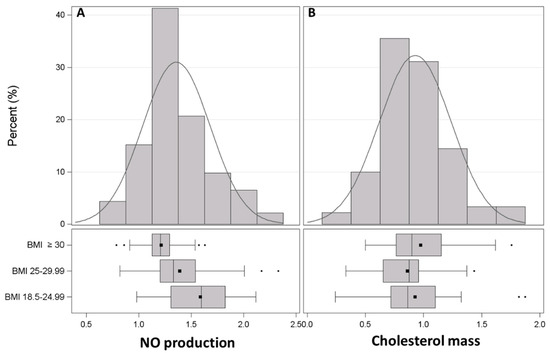
Figure 1.
Frequency distribution of HDL function and impact of BMI. (A), Frequency distribution of NO production by endothelial cells exposed to apoB-D sera in the whole cohort and by BMI groups. Data are expressed as fold increase in untreated cells. (B), Frequency distribution of cholesterol mass of macrophages exposed to apoB-D sera in the whole cohort and by BMI groups. Results are expressed as fold reduction in untreated cells. All data are presented as histograms and boxplots; squares indicate the mean values and dots the outliers.
Table 3.
Association between HDL-mediated NO production, HDL-mediated reduction in cholesterol mass, and PM exposures.
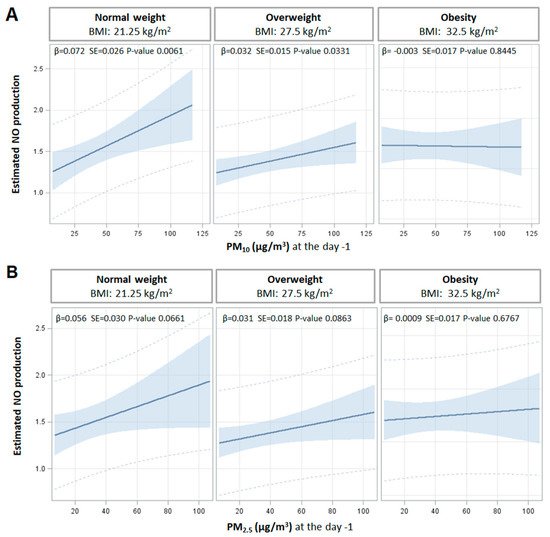
Figure 2.
Interaction effect of particulate matter on NO production. Interaction effect of PM10 (A) and PM2.5 (B) and BMI on NO production by endothelial cells exposed to apoB-D sera. Strength of association between PM the day before the enrollment and NO production at three selected levels of BMI (normal weight 21.75 kg/m2, overweight 27.5 kg/m2, and obesity 32.5 kg/m2). Adjusted β regression coefficients were reported for 10 µg/m3 increases in PM concentration, at each level of BMI. p-values of interaction terms PM*BMI were 0.0203 and 0.2163, respectively, for PM10 and PM2.5. Linear regression models in both panels A and panel B were adjusted for age, gender, smoking habit, HDL-C, triglycerides, IL-8, and apparent temperature on the day of recruitment.
3.3. Macrophage Cholesterol Mass
The exposure to HDL reduced cholesterol mass in THP-1-derived macrophages by 0.93 ± 0.31 fold. HDL’s ability to promote cell cholesterol removal was independent of BMI (p = 0.34, Figure 1B). No association was found between macrophage cholesterol mass after HDL and PM10 or PM2.5 exposures (Table 3).
BMI interacted with the association between cholesterol mass after HDL and PM10 exposure measured the day -1 (Table 4). Indeed, in subjects with normal BMI, a significant negative relationship between cell cholesterol mass after HDL and PM10 exposure was observed, with a 0.065-fold decrease every 10 μg/m3 increase in PM10 (p = 0.034). This association was markedly attenuated in overweight subjects and completely lost in subjects with BMI ≥ 30 kg/m2, with a tendency towards a positive association.
Table 4.
Modifying effect of BMI on the association between HDL-mediated reduction in macrophage cholesterol mass and PM exposure the day before the enrollment.
The modifying effect of BMI on the relationship between cell cholesterol mass after HDL and PM2.5 exposure was not significant, with the three groups for BMI categories displaying similar associations (Table 4).
4. Discussion
This retrospective analysis showed that HDL function, especially HDL’s endothelial protective activity, was affected by short-term exposure to air pollutants. More interestingly, the effect of PM exposure on HDL function was modulated by BMI. Indeed, in subjects with normal weight, a compensatory response was observed, i.e., HDL’s ability to induce NO production increased with exposure to higher concentrations of air pollutants the day before sample collection. However, this compensatory response was progressively lost at increasing BMI levels. Similarly, the ability of HDL to reduce cholesterol mass in macrophage-like cells increased with exposure to higher levels of PM only in subjects with normal weight. In addition, our results confirmed an impaired HDL ability to preserve endothelial homeostasis in obesity [7] and integrate previous findings showing impaired antioxidant and anti-inflammatory activities of HDL after PM exposure [19]. Exposure to environmental pollutants is known to trigger inflammation and oxidative stress and HDL should be able to limit the extent of such events. However, the loss of the compensatory response observed in subjects with elevated BMI likely indicates that in this condition, which is a chronic inflammatory status per se, HDL lose their ability to manage additional detrimental stimuli. Since inflammation and oxidative stress could directly impact HDL composition and function, related markers, such as interleukin 8 and mitochondrial DNA copy number, and smoking habits were included in the model. Similarly, the outdoor temperature was included, since it could influence the effect of PM on HDL function, as previously shown [20]. Finally, obesity alters plasma lipid profile, resulting in higher triglyceride and lower HDL-C levels in subjects with elevated BMI; thus, these variables were also included in the model.
Nitric oxide is a key player in the regulation of vascular tone and in preserving the endothelium as an anti-adhesive surface for circulating cells [21]. Consequently, a reduction in its availability is associated with impaired vasodilation, as previously observed in many clinical conditions. Rapid alterations in systemic microvascular and macrovascular tone were also observed after short-term exposure to coarse, fine, and ultrafine PM [9,22,23]. With HDL being the main activator of endothelial NO synthase (eNOS) in serum [17], an impairment of its function could explain the reduced vasodilation after PM exposure, together with sympathetic nervous system activation [24]. Interestingly, the significant modifying effect of BMI on the interaction between HDL function and PM exposure is consistent with the higher impairment of vasodilation observed in subjects with obesity [25]. Thus, our results provide additional evidence supporting endothelial dysfunction as a key mechanism leading to ischemic events in subjects exposed to environmental pollutants, especially in those with obesity [26].
Similar results were obtained when another HDL atheroprotective function was assessed, i.e., the ability to promote the removal of cholesterol from peripheral cells, including macrophages in the arterial wall. In this case, HDL’s ability to reduce cholesterol mass was not affected by BMI and the modifying effect of BMI on the interaction between HDL functionality and PM exposure was attenuated if compared to that observed for NO production. Previous studies assessed the impact of environmental pollutants on cholesterol efflux to HDL with variable results [8]. These inconsistencies could be partly explained by the different cell types and experimental settings used, which can be specific for one or some efflux pathways. Thus, in the present study, we decided to evaluate the net changes in cholesterol mass in LDL-loaded macrophages after HDL exposure in order to provide an overall estimation of HDL effect, irrespective of the specific underlying efflux mechanisms.
In the literature, there is evidence of an association of both short- and long-term exposures to environmental pollutants with cardiovascular morbidity and mortality [27]. Long-term exposure could favor the development and progression of atherosclerosis by establishing a chronic low-grade inflammatory state and by upregulating the sympathetic nervous system [3]. Regarding the clinical relevance of short-term exposure, the transient loss of a compensatory response by HDL that we observed in subjects with elevated BMI supports the hypothesis that a susceptible individual, who is at high risk for IHD due to multiple risk factors, may experience an event or face an unfavorable prognosis when acutely exposed to high levels of PM.
The present study has some limitations. PM exposure was estimated according to air-quality-monitoring-station data, whose measurements might inaccurately capture the real exposure at residential addresses. The exposure assessment did not include personal monitoring; thus, we were not able to take into account the indoor activities of the subjects. Obesity is a clinical condition characterized by several chronic comorbidities. Thus, although we evaluated the possible contribution of these diseases in modulating HDL function, we cannot completely exclude they are part of the “obesity” effect rather than the BMI only. In addition, we cannot rule out the effect of eNOS gene polymorphisms on the relationship between HDL function and PM exposure, since these DNA variants were previously shown to modify the effect of PM on oxidative stress biomarkers [28]. Even if blood samples were collected, processed, and stored according to standardized procedures, we cannot completely exclude that storage time could have partially affected HDL function. Lastly, the limited sample size and the observational design of the study highlight an association between HDL function and PM exposure but foreclose any causative link.
5. Conclusions
Our results support the hypothesis of a transient impairment of NO-mediated vasodilation after PM exposure [9] and suggest a role for HDL dysfunction among the underlying mechanisms. Moreover, the loss of the compensatory response of HDL function to PM exposure at increasing BMI levels could help to explain why subjects with obesity seem more susceptible to the detrimental effects of air pollution.
Author Contributions
Conceptualization, V.B. and M.G.; Methodology and Formal Analysis A.O. and C.F.; Investigation, A.O., L.V. and A.C.P.; Data Curation, V.B. and M.G.; Writing—Original Draft Preparation, M.G.; Writing—Review and Editing, A.O., C.F., L.V., A.C.P. and V.B.; Visualization, A.O. and C.F.; Supervision, M.G.; Funding Acquisition, V.B. and M.G. All authors have read and agreed to the published version of the manuscript.
Funding
This research was funded by an intramural grant of Università degli Studi di Milano to MG (PSR2019 Linea 2 Azione A) and by the EU Programme “Ideas”, European Research Council, to VB (ERC-2011-StG 282413).
Institutional Review Board Statement
The study was conducted in accordance with the Declaration of Helsinki, and the protocol was approved by the Ethics Committee of Fondazione IRCCS Cà Granda Ospedale Maggiore Policlinico (approval number 1425).
Informed Consent Statement
All subjects gave their informed consent for inclusion before they participated in the study.
Data Availability Statement
The data presented in this study are available on request from the corresponding authors. The data are not publicly available due to ethical reasons.
Conflicts of Interest
The authors declare no conflict of interest.
References
- GBD 2019 Diseases and Injuries Collaborators. Global burden of 369 diseases and injuries in 204 countries and territories, 1990–2019: A systematic analysis for the Global Burden of Disease Study 2019. Lancet 2020, 396, 1204–1222. [Google Scholar] [CrossRef]
- Mach, F.; Baigent, C.; Catapano, A.L.; Koskinas, K.C.; Casula, M.; Badimon, L.; Chapman, M.J.; De Backer, G.G.; Delgado, V.; Ference, B.A.; et al. 2019 ESC/EAS Guidelines for the management of dyslipidaemias: Lipid modification to reduce cardiovascular risk. Eur. Heart J. 2020, 41, 111–188. [Google Scholar] [CrossRef] [PubMed]
- Joshi, S.S.; Miller, M.R.; Newby, D.E. Air pollution and cardiovascular disease: The Paul Wood Lecture, British Cardiovascular Society 2021. Heart 2022, 108, 1267–1273. [Google Scholar] [CrossRef] [PubMed]
- Brook, R.D.; Franklin, B.; Cascio, W.; Hong, Y.; Howard, G.; Lipsett, M.; Luepker, R.; Mittleman, M.; Samet, J.; Smith, S.C.; et al. Air pollution and cardiovascular disease: A statement for healthcare professionals from the Expert Panel on Population and Prevention Science of the American Heart Association. Circulation 2004, 109, 2655–2671. [Google Scholar] [CrossRef] [PubMed]
- Zhang, W.; Liu, J.; Hu, D.; Li, L.; Cui, L.; Xu, J.; Wang, W.; Deng, F.; Guo, X. Joint effect of multiple air pollutants on lipid profiles in obese and normal-weight young adults: The key role of ozone. Environ. Pollut. 2022, 292 Pt A, 118247. [Google Scholar] [CrossRef]
- Calabresi, L.; Gomaraschi, M.; Rossoni, G.; Franceschini, G. Synthetic high density lipoproteins for the treatment of myocardial ischemia/reperfusion injury. Pharmacol. Ther. 2006, 111, 836–854. [Google Scholar] [CrossRef] [PubMed]
- Ossoli, A.; Pavanello, C.; Giorgio, E.; Calabresi, L.; Gomaraschi, M. Dysfunctional HDL as a Therapeutic Target for Atherosclerosis Prevention. Curr. Med. Chem. 2019, 26, 1610–1630. [Google Scholar] [CrossRef]
- Holme, S.A.N.; Sigsgaard, T.; Holme, J.A.; Holst, G.J. Effects of particulate matter on atherosclerosis: A link via high-density lipoprotein (HDL) functionality? Part. Fibre Toxicol. 2020, 17, 36. [Google Scholar] [CrossRef]
- Mills, N.L.; Törnqvist, H.; Robinson, S.D.; Gonzalez, M.; Darnley, K.; MacNee, W.; Boon, N.A.; Donaldson, K.; Blomberg, A.; Sandstrom, T.; et al. Diesel exhaust inhalation causes vascular dysfunction and impaired endogenous fibrinolysis. Circulation 2005, 112, 3930–3936. [Google Scholar] [CrossRef]
- Bollati, V.; Iodice, S.; Favero, C.; Angelici, L.; Albetti, B.; Cacace, R.; Cantone, L.; Carugno, M.; Cavalleri, T.; De Giorgio, B.; et al. Susceptibility to particle health effects, miRNA and exosomes: Rationale and study protocol of the SPHERE study. BMC Public Health 2014, 14, 1137. [Google Scholar] [CrossRef]
- World Medical Association. World Medical Association Declaration of Helsinki: Ethical principles for medical research involving human subjects. JAMA 2013, 310, 2191–2194. [Google Scholar] [CrossRef] [PubMed]
- Analitis, A.; Katsouyanni, K.; Biggeri, A.; Baccini, M.; Forsberg, B.; Bisanti, L.; Kirchmayer, U.; Ballester, F.; Cadum, E.; Goodman, P.; et al. Effects of cold weather on mortality: Results from 15 European cities within the PHEWE project. Am. J. Epidemiol. 2008, 168, 1397–1408. [Google Scholar] [CrossRef] [PubMed]
- Pergoli, L.; Cantone, L.; Favero, C.; Angelici, L.; Iodice, S.; Pinatel, E.; Hoxha, M.; Dioni, L.; Letizia, M.; Albetti, B.; et al. Extracellular vesicle-packaged miRNA release after short-term exposure to particulate matter is associated with increased coagulation. Part. Fibre Toxicol. 2017, 14, 32. [Google Scholar] [CrossRef] [PubMed]
- Bonzini, M.; Pergoli, L.; Cantone, L.; Hoxha, M.; Spinazzè, A.; Del Buono, L.; Favero, C.; Carugno, M.; Angelici, L.; Broggi, L.; et al. Short-term particulate matter exposure induces extracellular vesicle release in overweight subjects. Environ. Res. 2017, 155, 228–234. [Google Scholar] [CrossRef]
- Friedewald, W.T.; Levy, R.I.; Fredrickson, D.S. Estimation of the concentration of low-density lipoprotein cholesterol in plasma, without use of the preparative ultracentrifuge. Clin. Chem. 1972, 18, 499–502. [Google Scholar] [CrossRef] [PubMed]
- Pavanello, S.; Dioni, L.; Hoxha, M.; Fedeli, U.; Mielzynska-Svach, D.; Baccarelli, A.A. Mitochondrial DNA copy number and exposure to polycyclic aromatic hydrocarbons. Cancer Epidemiol. Biomark. Prev. 2013, 22, 1722–1729. [Google Scholar] [CrossRef] [PubMed]
- Arnaboldi, L.; Ossoli, A.; Giorgio, E.; Pisciotta, L.; Lucchi, T.; Grigore, L.; Pavanello, C.; Granata, A.; Pasta, A.; Arosio, B.; et al. LIPA gene mutations affect the composition of lipoproteins: Enrichment in ACAT-derived cholesteryl esters. Atherosclerosis 2020, 297, 8–15. [Google Scholar] [CrossRef]
- Calabresi, L.; Nilsson, P.; Pinotti, E.; Gomaraschi, M.; Favari, E.; Adorni, M.P.; Bernini, F.; Sirtori, C.R.; Calandra, S.; Franceschini, G.; et al. A novel homozygous mutation in CETP gene as a cause of CETP deficiency in a Caucasian kindred. Atherosclerosis 2009, 205, 506–511. [Google Scholar] [CrossRef]
- Li, J.; Zhou, C.; Xu, H.; Brook, R.D.; Liu, S.; Yi, T.; Wang, Y.; Feng, B.; Zhao, M.; Wang, X.; et al. Ambient Air Pollution Is Associated With HDL (High-Density Lipoprotein) Dysfunction in Healthy Adults. Arter. Thromb. Vasc. Biol. 2019, 39, 513–522. [Google Scholar] [CrossRef]
- Mathew, A.V.; Yu, J.; Guo, Y.; Byun, J.; Chen, Y.E.; Wang, L.; Liu, M.; Bard, R.L.; Morishita, M.; Huang, W.; et al. Effect of Ambient Fine Particulate Matter Air Pollution and Colder Outdoor Temperatures on High-Density Lipoprotein Function. Am. J. Cardiol. 2018, 122, 565–570. [Google Scholar] [CrossRef]
- Calabresi, L.; Gomaraschi, M.; Franceschini, G. Endothelial protection by high-density lipoproteins: From bench to bedside. Arterioscler. Thromb. Vasc. Biol. 2003, 23, 1724–1731. [Google Scholar] [CrossRef] [PubMed]
- Wauters, A.; Dreyfuss, C.; Pochet, S.; Hendrick, P.; Berkenboom, G.; van de Borne, P.; Argacha, J.F. Acute exposure to diesel exhaust impairs nitric oxide-mediated endothelial vasomotor function by increasing endothelial oxidative stress. Hypertension 2013, 62, 352–358. [Google Scholar] [CrossRef] [PubMed]
- Lucking, A.J.; Lundbäck, M.; Barath, S.L.; Mills, N.L.; Sidhu, M.K.; Langrish, J.P.; Boon, N.A.; Pourazar, J.; Badimon, J.J.; Gerlofs-Nijland, M.E.; et al. Particle traps prevent adverse vascular and prothrombotic effects of diesel engine exhaust inhalation in men. Circulation 2011, 123, 1721–1728. [Google Scholar] [CrossRef]
- Rankin, G.D.; Kabéle, M.; Brown, R.; Macefield, V.G.; Sandström, T.; Bosson, J.A. Acute Exposure to Diesel Exhaust Increases Muscle Sympathetic Nerve Activity in Humans. J. Am. Heart Assoc. 2021, 10, e018448. [Google Scholar] [CrossRef] [PubMed]
- Hemmingsen, J.G.; Rissler, J.; Lykkesfeldt, J.; Sallsten, G.; Kristiansen, J.; Møller, P.P.; Loft, S. Controlled exposure to particulate matter from urban street air is associated with decreased vasodilation and heart rate variability in overweight and older adults. Part. Fibre Toxicol. 2015, 12, 6. [Google Scholar] [CrossRef] [PubMed]
- Münzel, T.; Gori, T.; Al-Kindi, S.; Deanfield, J.; Lelieveld, J.; Daiber, A.; Rajagopalan, S. Effects of gaseous and solid constituents of air pollution on endothelial function. Eur. Heart J. 2018, 39, 3543–3550. [Google Scholar] [CrossRef]
- de Bont, J.; Jaganathan, S.; Dahlquist, M.; Persson, Å.; Stafoggia, M.; Ljungman, P. Ambient air pollution and cardiovascular diseases: An umbrella review of systematic reviews and meta-analyses. J. Intern. Med. 2022, 291, 779–800. [Google Scholar] [CrossRef]
- Kim, J.H.; Choi, Y.H.; Bae, S.; Park, H.Y.; Hong, Y.C. eNOS gene polymorphisms modify the association of PM10 with oxidative stress. Toxicol. Lett. 2012, 214, 263–267. [Google Scholar] [CrossRef]
Publisher’s Note: MDPI stays neutral with regard to jurisdictional claims in published maps and institutional affiliations. |
© 2022 by the authors. Licensee MDPI, Basel, Switzerland. This article is an open access article distributed under the terms and conditions of the Creative Commons Attribution (CC BY) license (https://creativecommons.org/licenses/by/4.0/).