Bioadsorbents for the Removal of Pollutants in Wastewater: Adsorption Kinetics, Validation Test Using Methylene Blue and Methyl Orange

Abstract
1. Introduction
1.1. Water Pollution
1.2. Adsorbents and Adsorption
1.2.1. Adsorbent 1: Waste Biomass—Pine Nut Shells
1.2.2. Adsorbent 2: Waste Biomass—Olive Stones
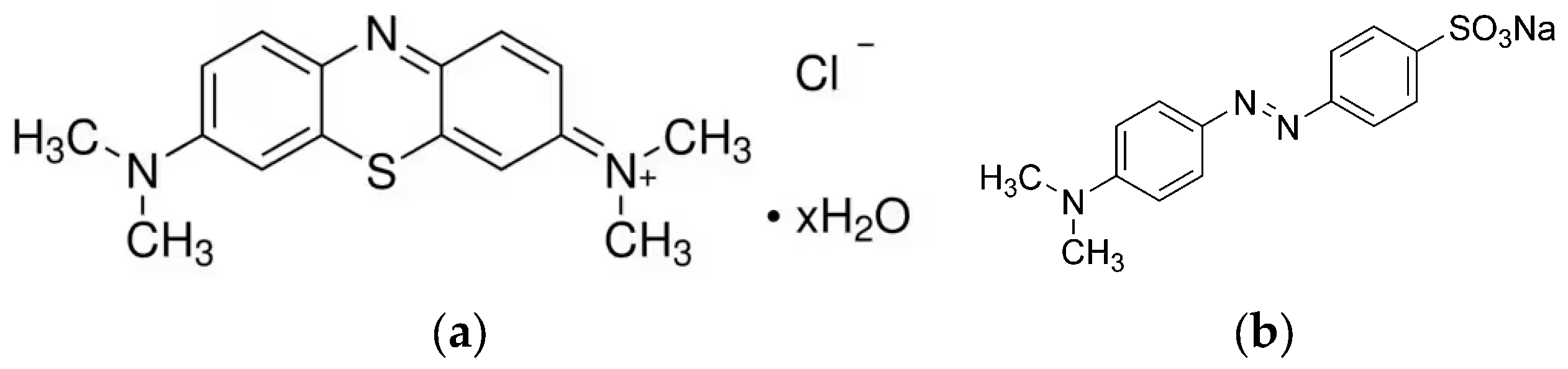
1.3. Adsorbates
1.3.1. Adsorbate 1: Methylene Blue
1.3.2. Adsorbate 2: Methyl Orange
2. Materials and Methods
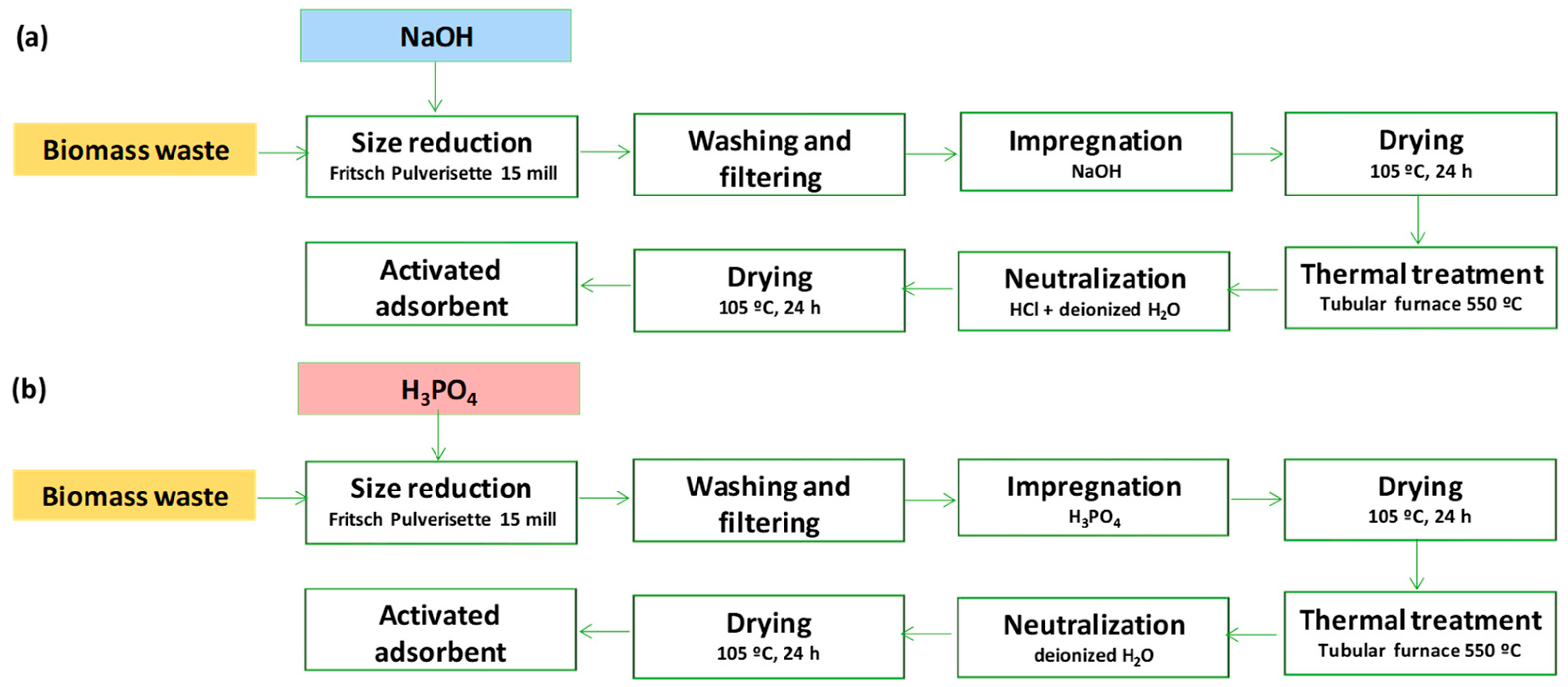
2.1. Activation of the Adsorbents and Characterization of Waste Biomass
2.2. Adsorption Process
3. Results and Discussion
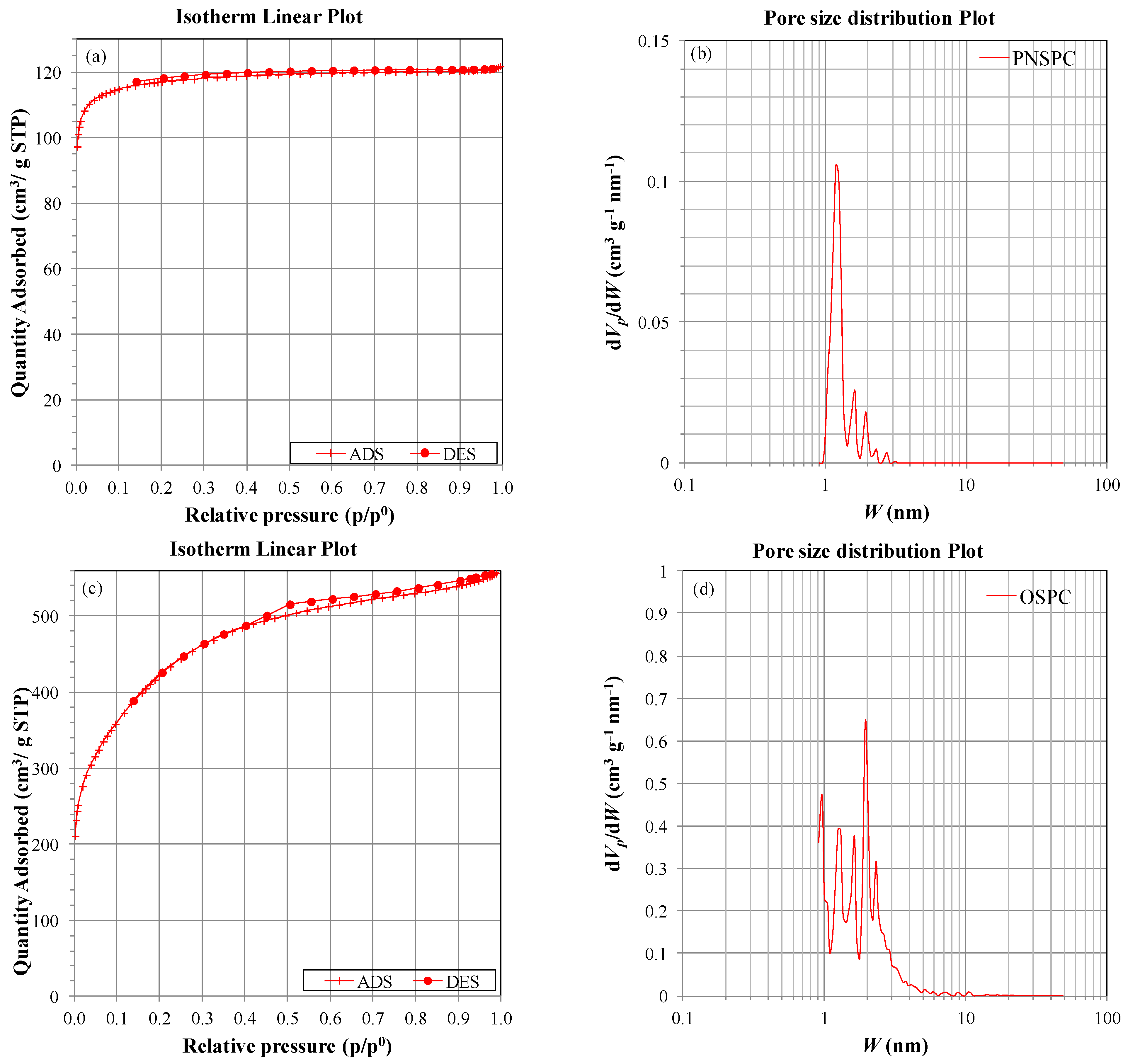
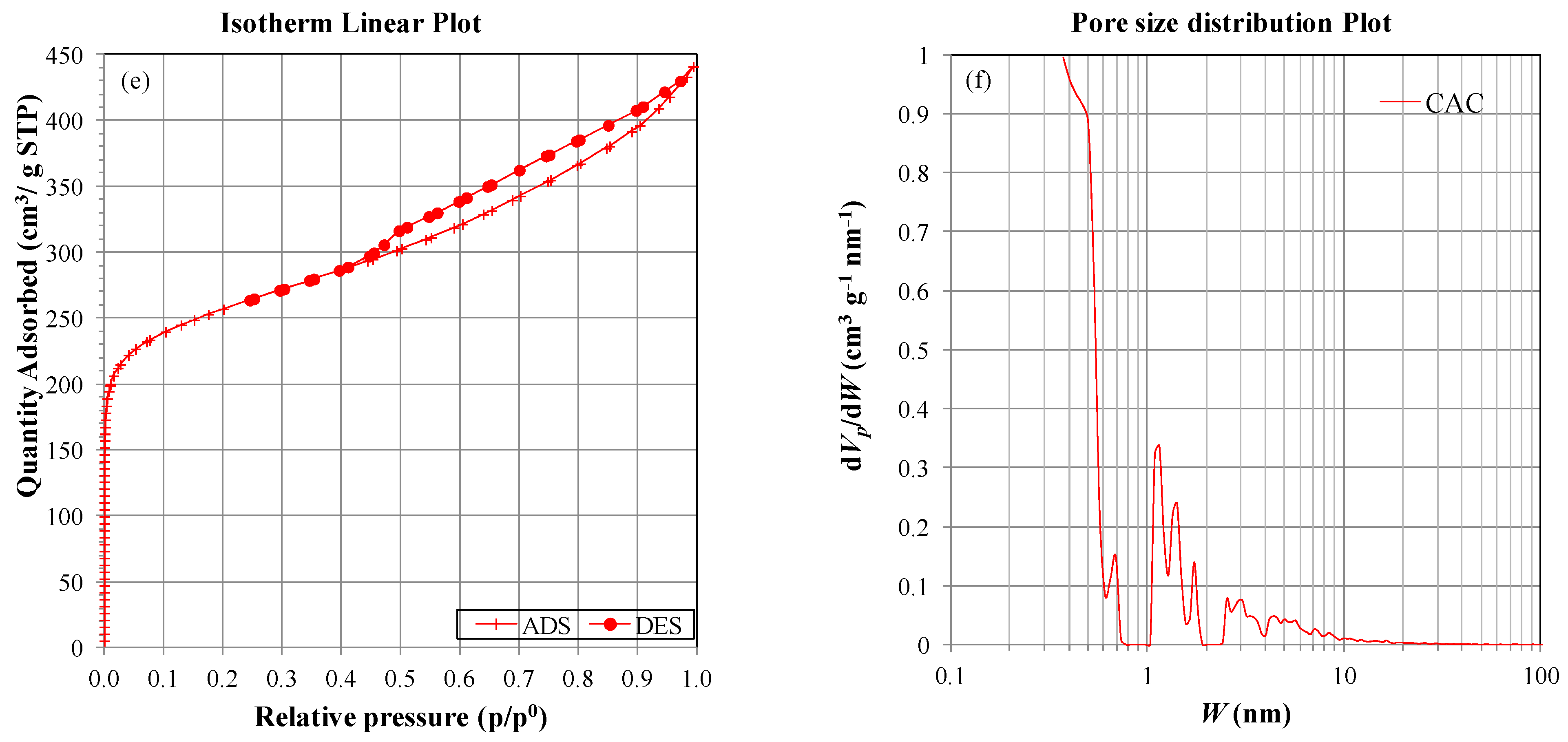
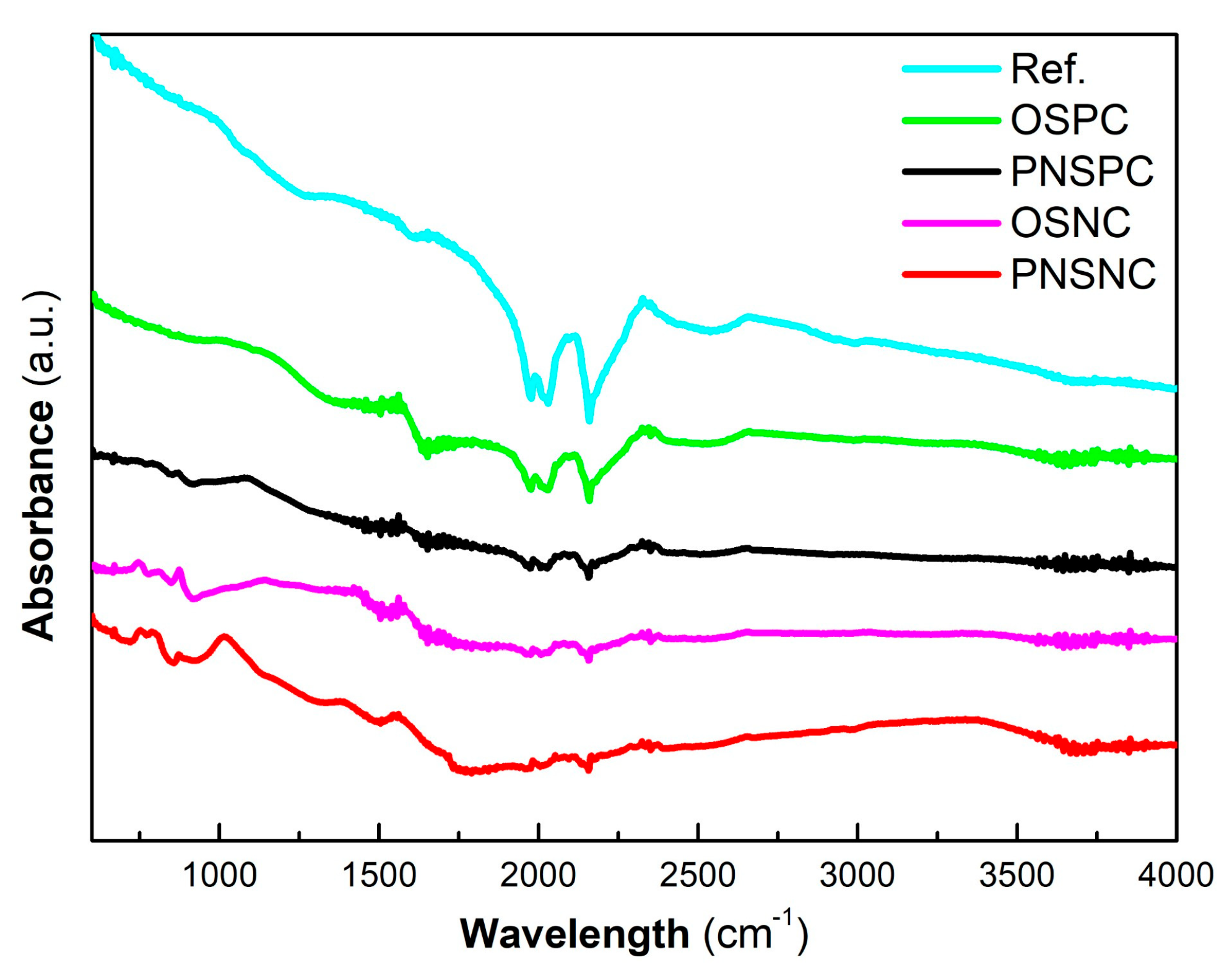
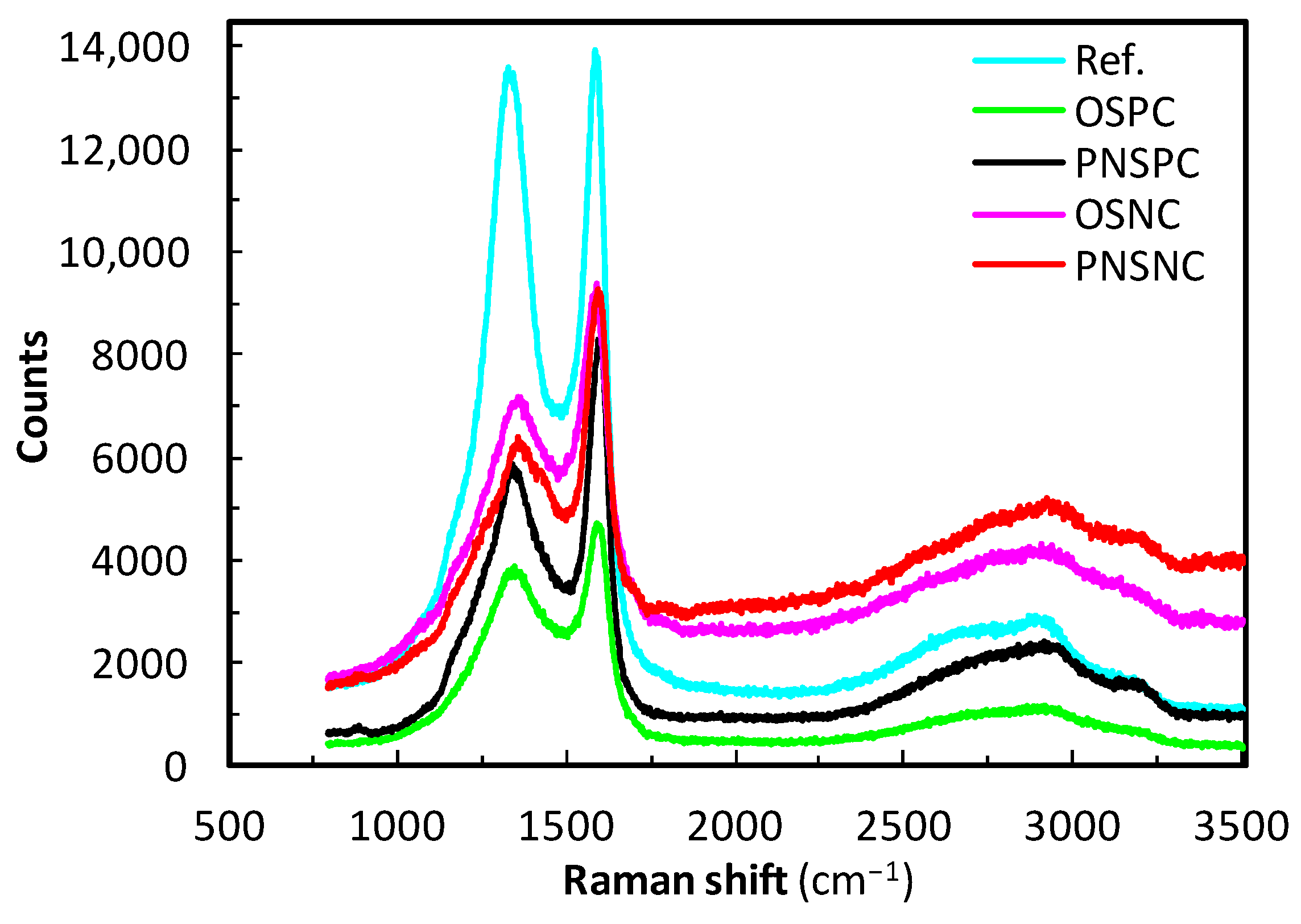
3.1. Characterization of the Activated Adsorbents
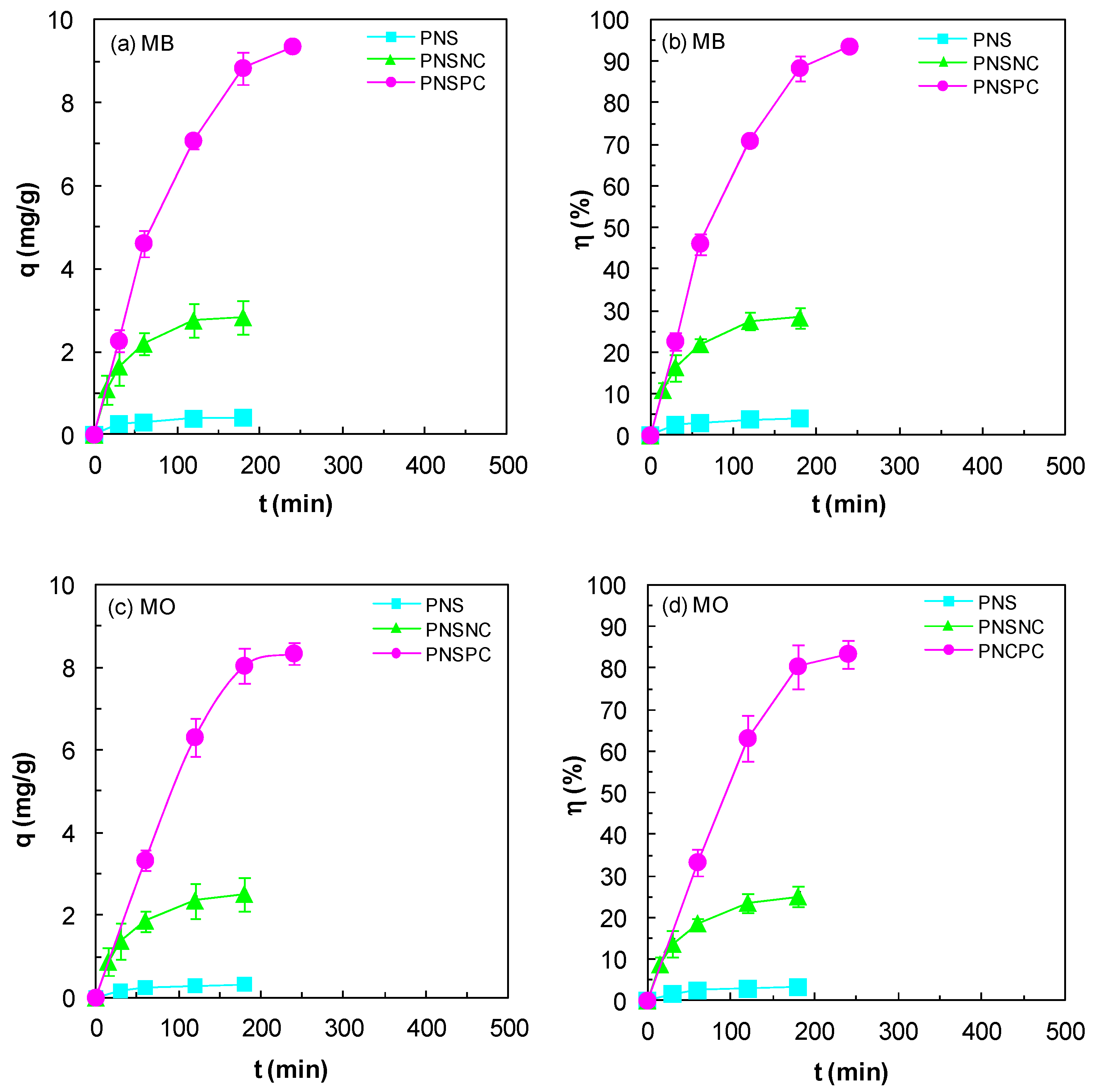
3.2. Adsorption Capacity and Efficiency of the Activated Adsorbents
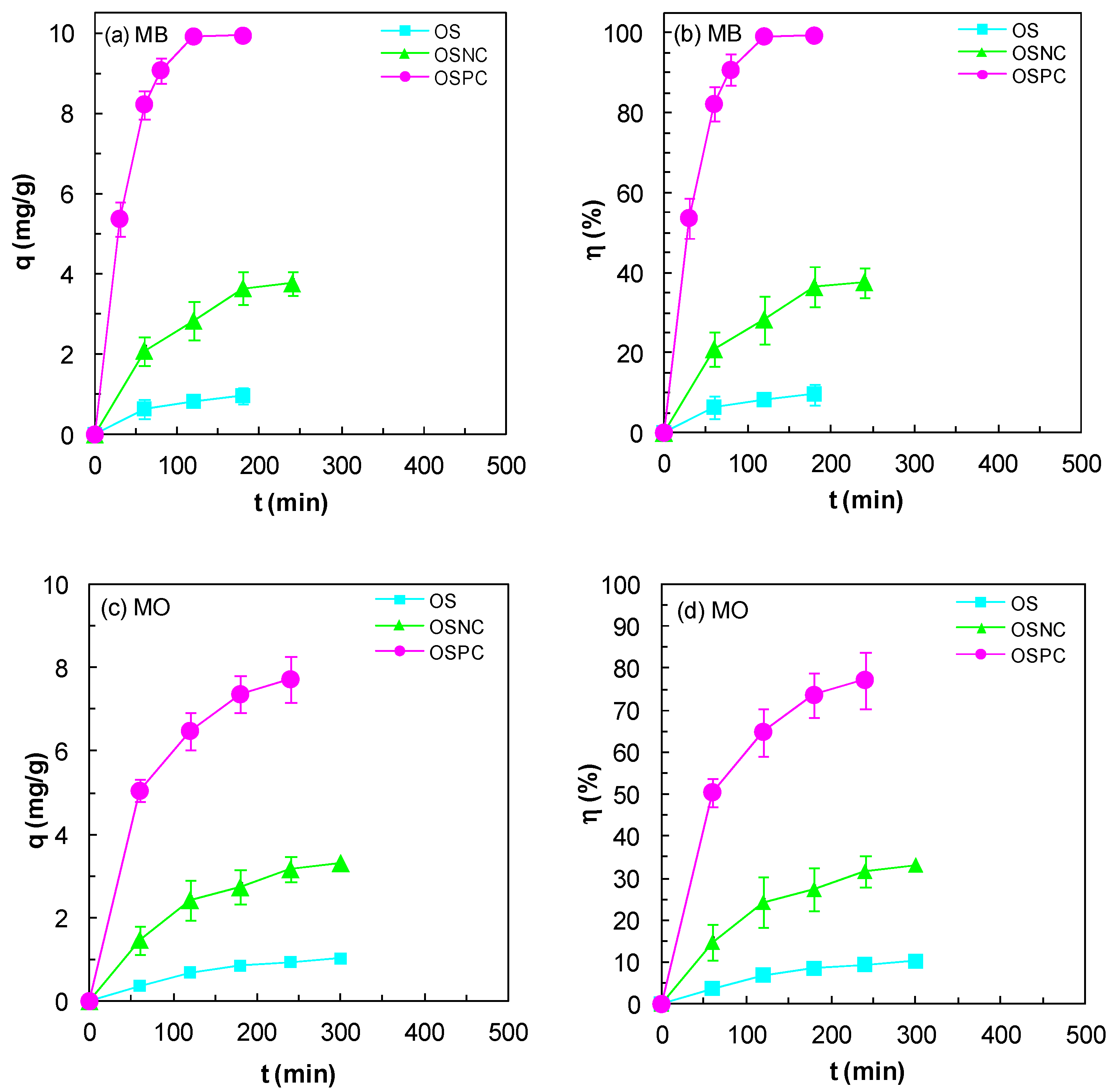
3.2.1. Effect of the Activation Method
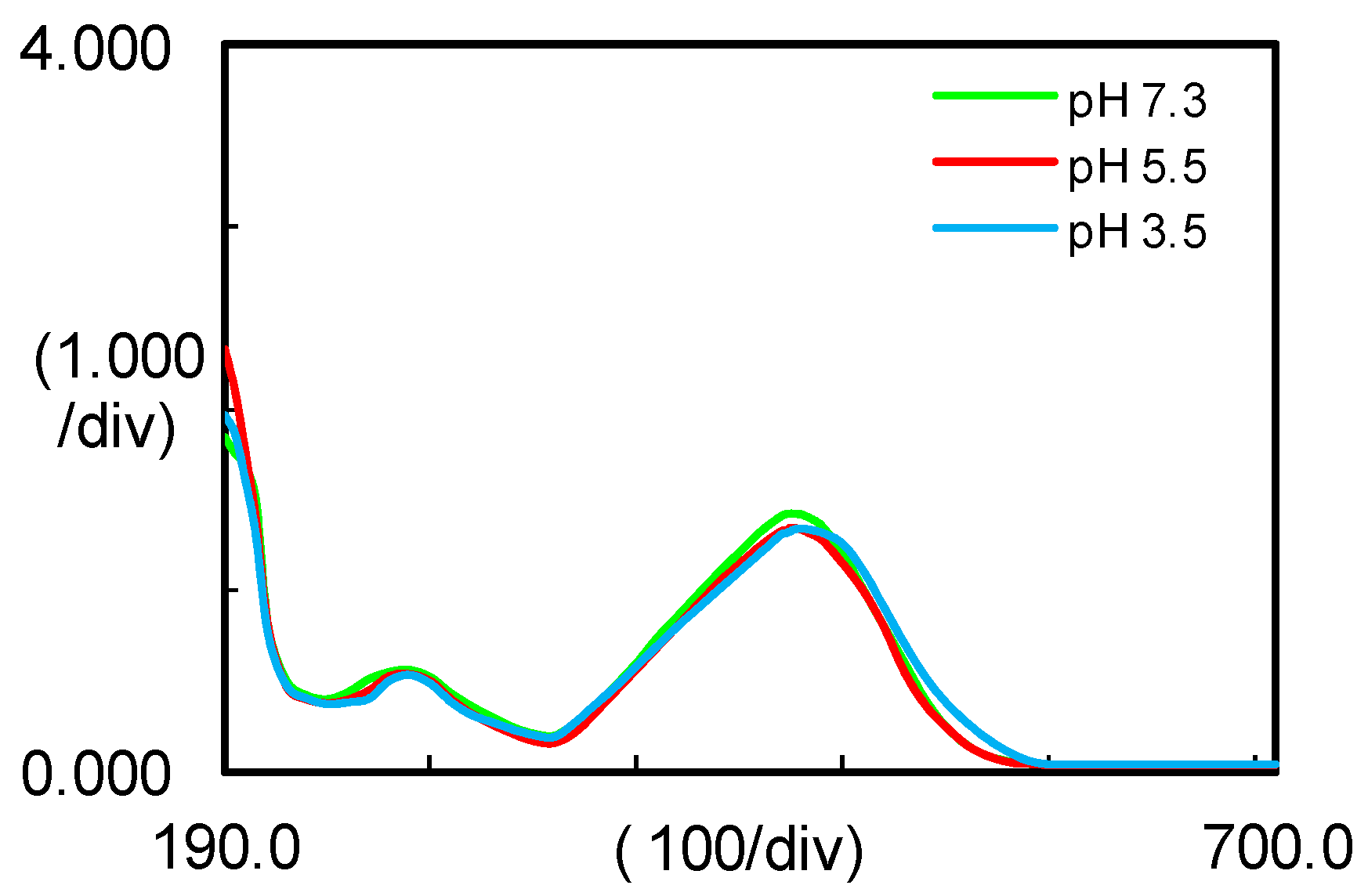
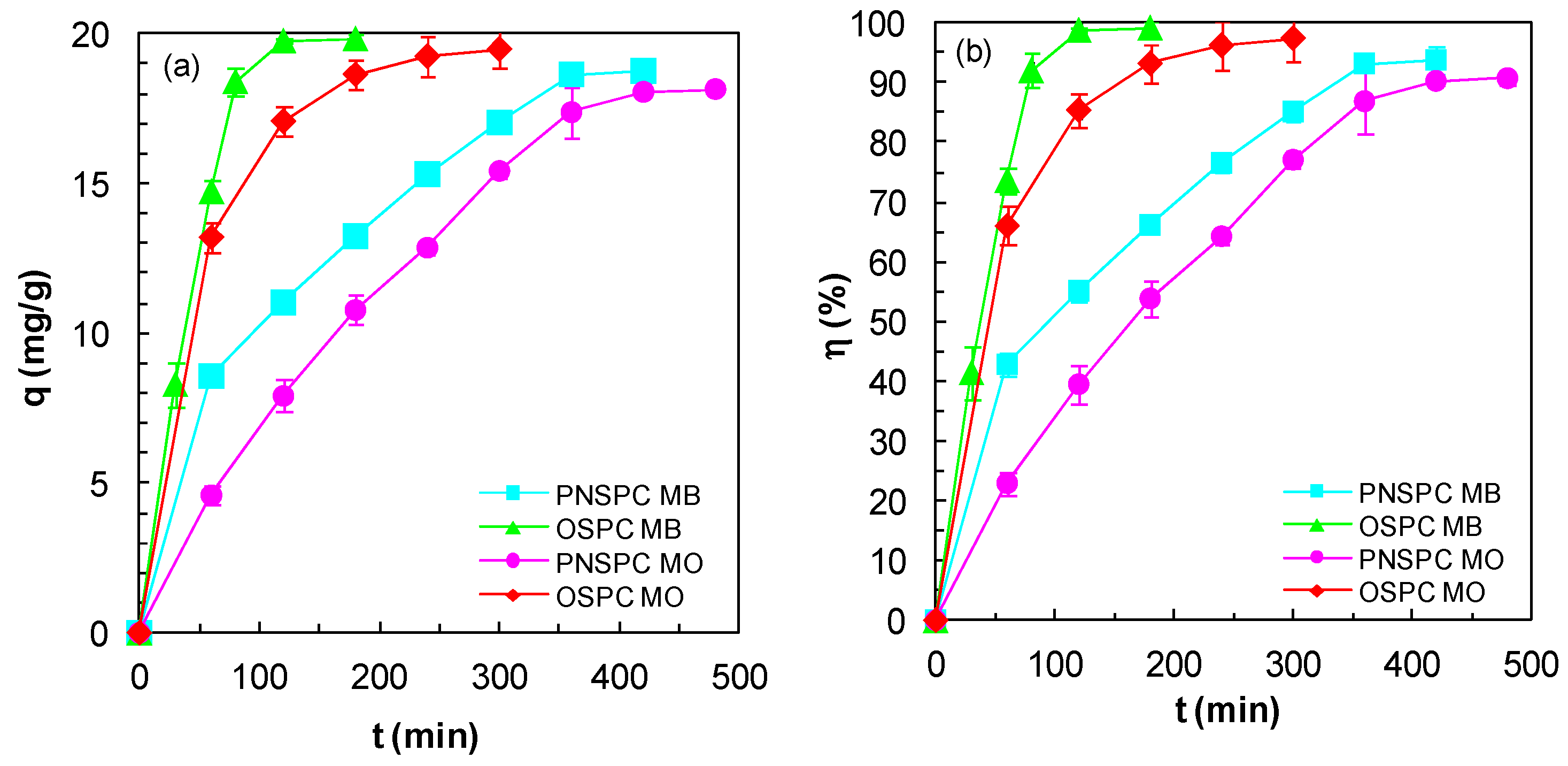
3.2.2. Effect of the Dye Type
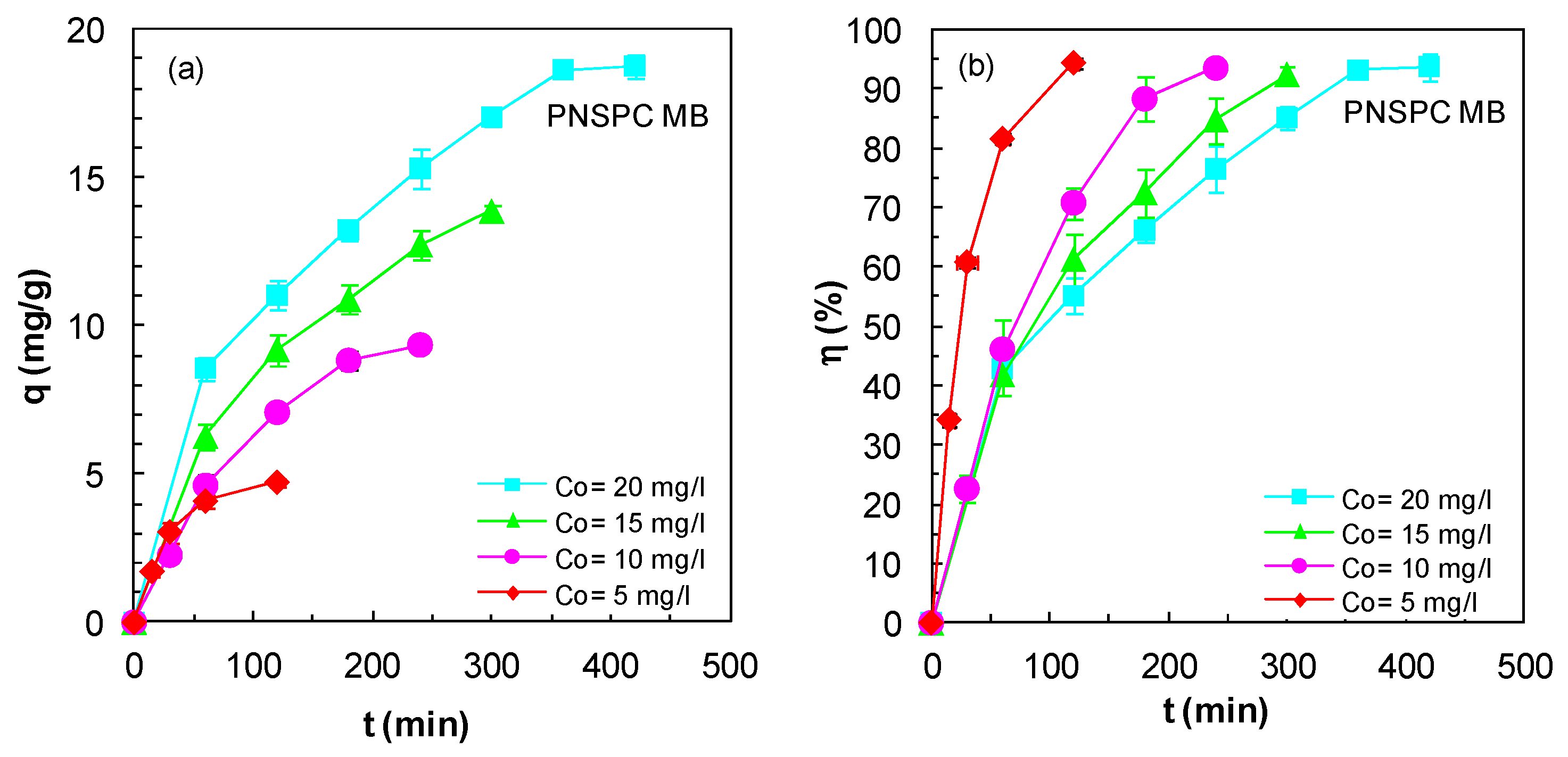
3.2.3. Effect of the Initial Concentration of the Adsorbate
3.2.4. Effect of the Adsorbent Concentration
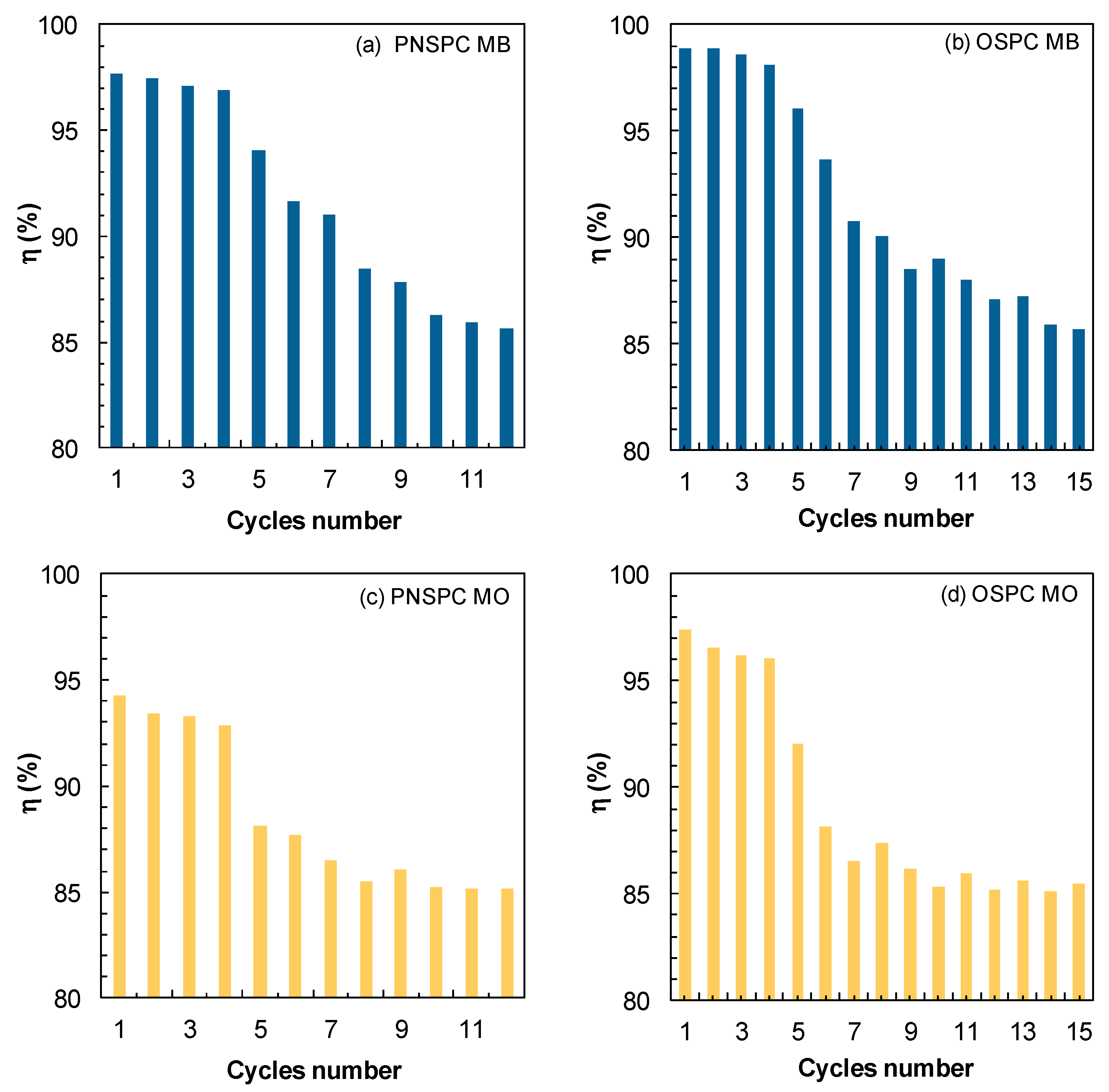
3.2.5. Reutilization Capacity of the Adsorbents
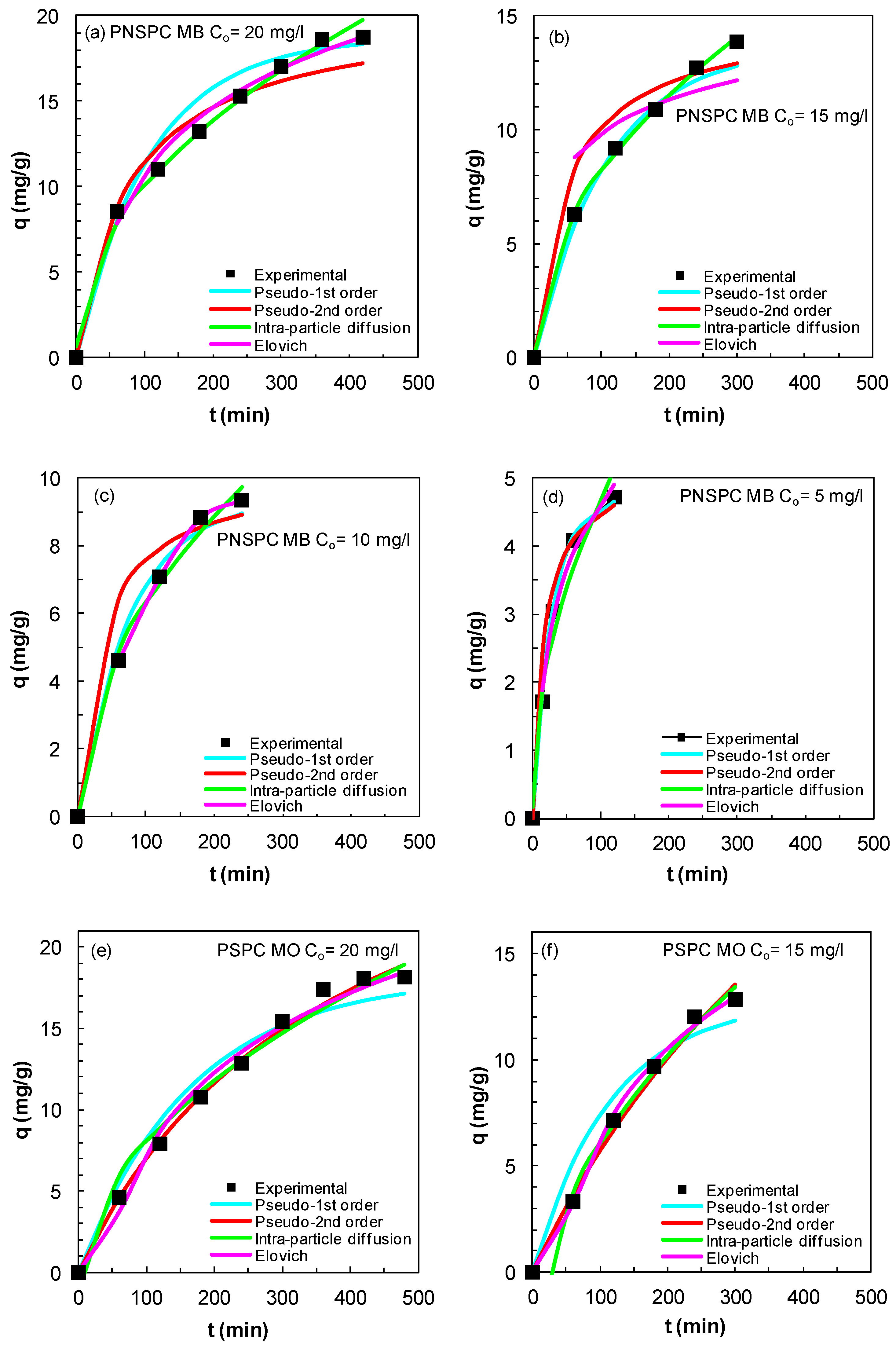
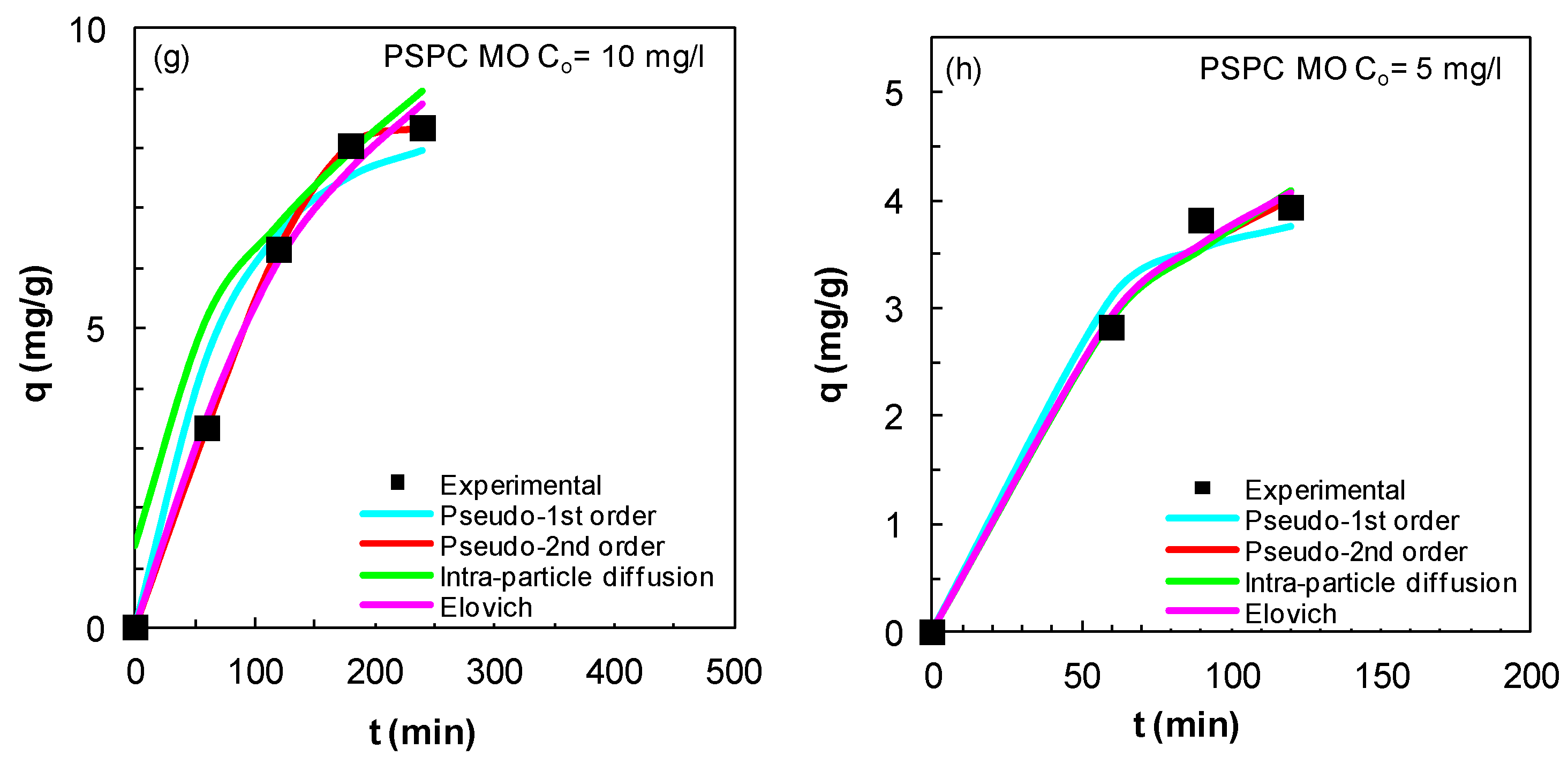
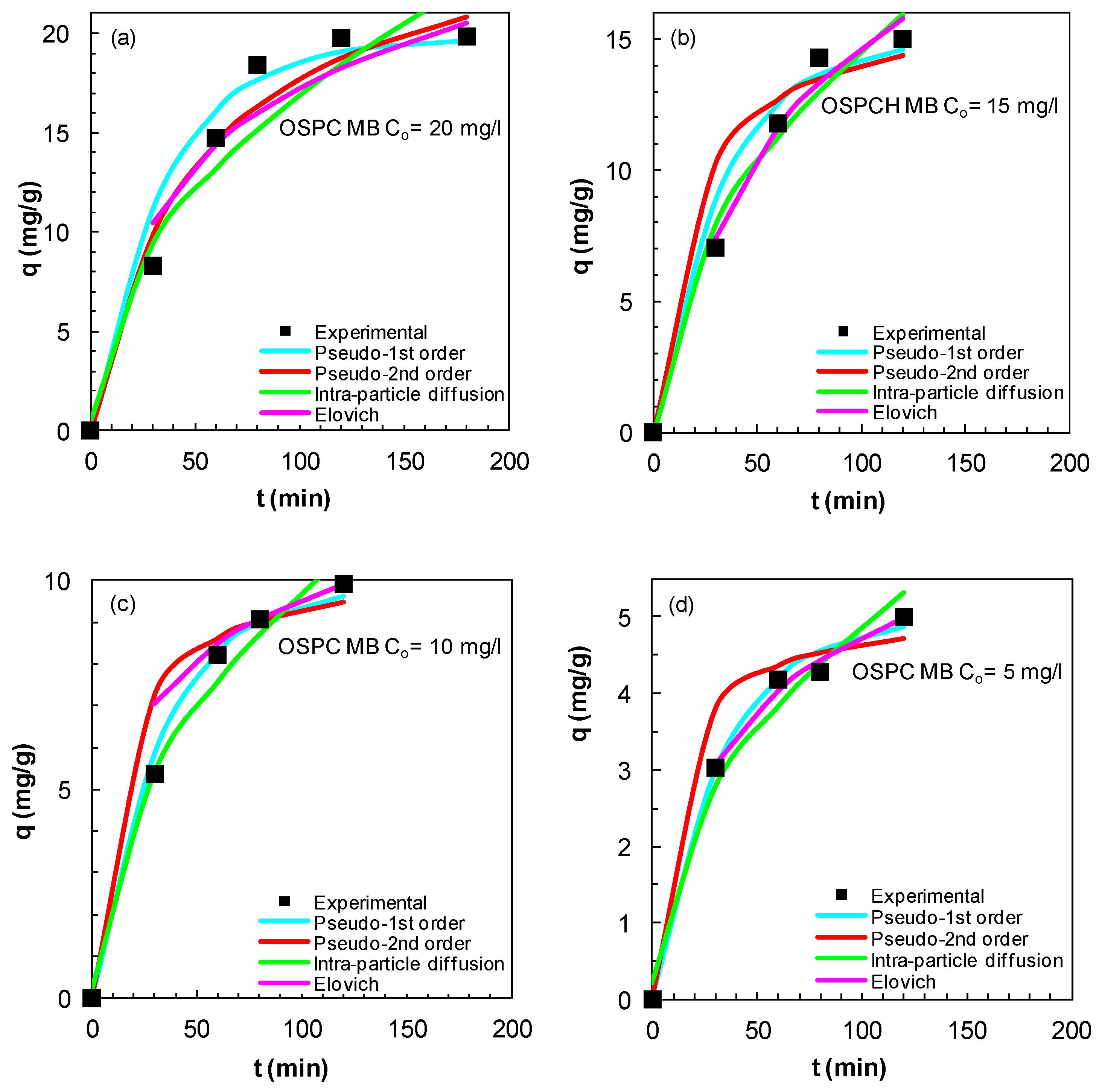
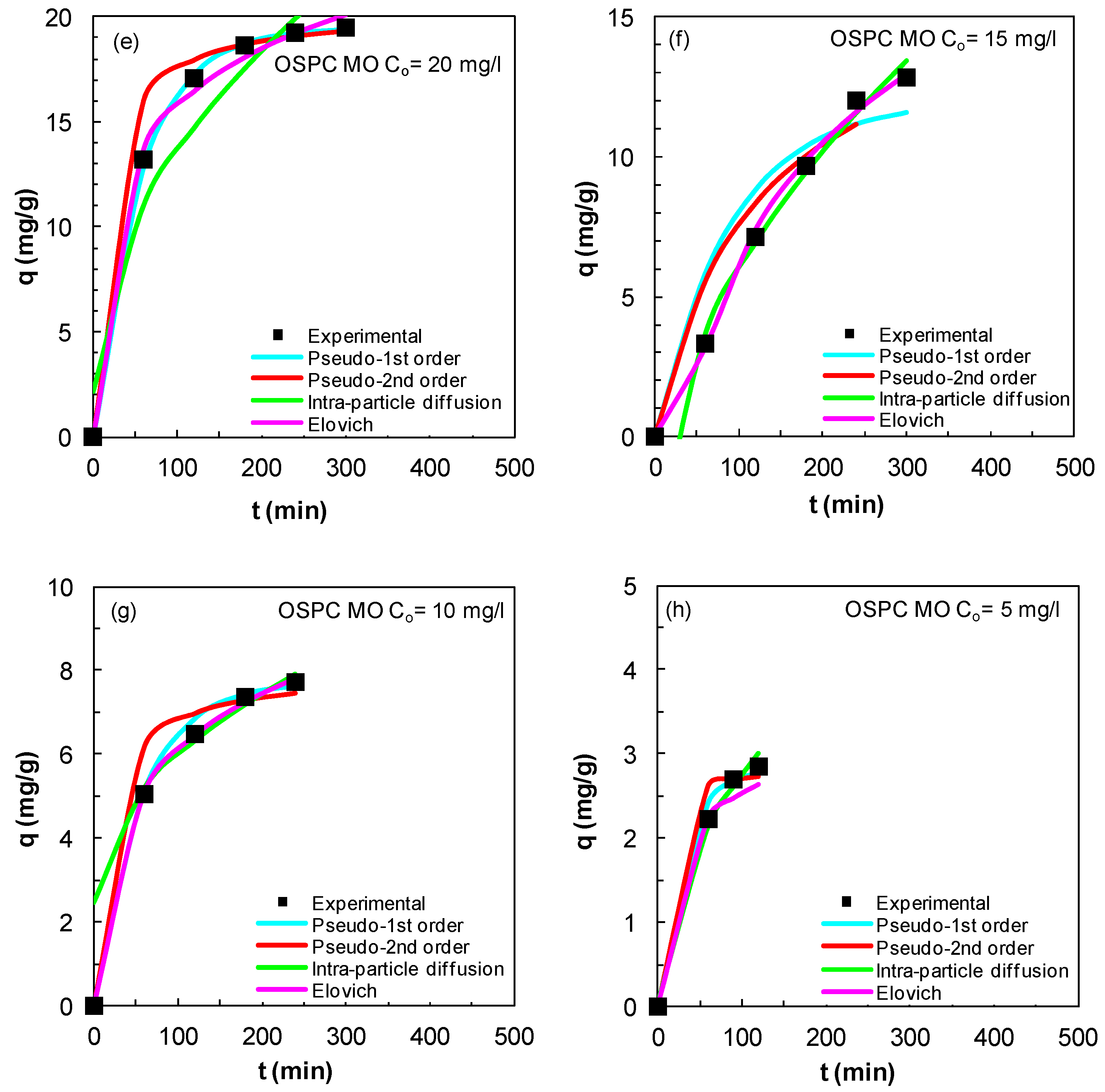
3.3. Adsorption Process Kinetic Modeling
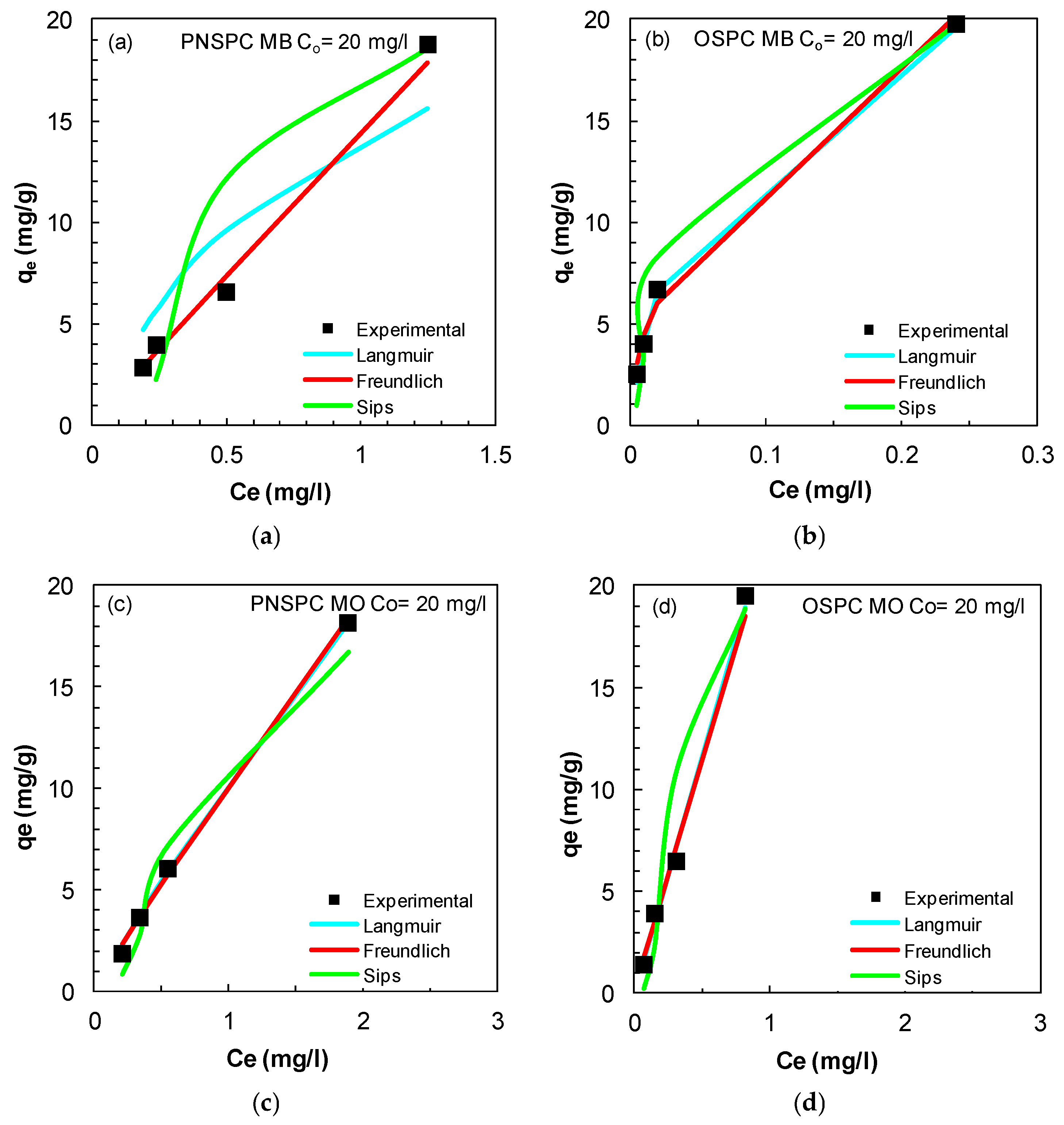
3.4. Adsorption Isotherms
4. Conclusions
Author Contributions
Funding
Institutional Review Board Statement
Informed Consent Statement
Data Availability Statement
Conflicts of Interest
Nomenclature
| 1/n | factor of heterogeneity of the Freundlich isotherm model (-) |
| a | adsorption constant of the Elovich kinetic model (mg g−1) |
| b | initial rate of adsorption of the Elovich kinetic model (mg g−1) |
| Ce, Co, C | concentration of the adsorbate at the equilibrium, initial concentration of the adsorbate and concentration of the adsorbate at the time t, respectively (mg L−1) |
| I | value of the thickness of the boundary layer (mg g−1) |
| KF | adsorbent–adsorbate equilibrium constant of the Freundlich isotherm model (mg1−1/n g−1L1/n) |
| KL | adsorbent–adsorbate equilibrium constant of the Langmuir isotherm model (L mg−1) |
| KS | adsorbent–adsorbate equilibrium constant of the Sips isotherm model (L mg−1) |
| k1 | equilibrium constant of the pseudo-first-order kinetic adsorption model (min−1) |
| k2 | equilibrium constant of the pseudo-second-order kinetic model (g mg−1 min−1) |
| ki | equilibrium constant of the intra-particle diffusion kinetic model (mg g−1/min−0.5) |
| MB | methylene blue |
| MO | methyl orange |
| q, qm, qe, qt | adsorption capacity, maximum adsorption capacity, adsorption capacities at the equilibrium and at any time, respectively (mg g−1) |
| S | the mass of the adsorbent (g) |
| V | volume of the solution (mL) |
| Greek Letters | |
| η | adsorption efficiency (%) |
Abbreviations
| MB | methylene blue |
| MO | methyl orange |
| OS | olive stones |
| OSNC | olive stones activated with NaOH and carbonized |
| OSPC | olive stones activated with H3PO4 and carbonized |
| PNS | pine nut shells |
| PNSNC | pine nut shells activated with NaOH and carbonized |
| PNSPC | pine nut shells activated with H3PO4 and carbonized |
References
- Cárdenas, J. Calidad de Agua Para Estudiantes de Ciencias Ambientales, 2nd ed.; ECOE Ediciones: Bogotá, Colombia, 2022. [Google Scholar]
- Kant, R. Textile dyeing industry an environmental hazard. Nat. Sci. 2012, 4, 22–26. [Google Scholar] [CrossRef]
- European Environment Agency. Textiles and the Environment: The Role of Design in Europe’s Circular Economy. 2025. Available online: https://www.eea.europa.eu/en/analysis/publications/textiles-and-the-environment-the-role-of-design-in-europes-circular-economy-1 (accessed on 30 December 2025).
- Biyada, S.; Urbonavičius, J. Circularity in textile waste: Challenges and pathways to sustainability. Clean. Eng. Technol. 2025, 24, 100905. [Google Scholar] [CrossRef]
- Bopape, D.A.; Ntsendwana, B.; Mabasa, F.D. Photocatalysis as a pre-discharge treatment to improve the effect of textile dyes on human health: A critical review. Heliyon 2024, 10, e39316. [Google Scholar] [CrossRef]
- Fernández, C.; González-Doncel, M.; Pro, J.; Carbonell, G.; Tarazona, J.V. Ocurrence of pharmaceutical active compounds in surface waters in the Henares-Jarama-Tajo river (Madrid-Spain) and a potencial risk characterization. Sci. Total. Environ. 2010, 408, 543–551. [Google Scholar] [CrossRef]
- Riva, F.; Zuccato, E.; Davoli, E.; Fattore, E.; Castiglioni, S. Risk assessment of a mixture of emerging contaminants in surface water in a highly urbanized area in Italy. J. Hazard. Mater. 2019, 361, 103–110. [Google Scholar] [CrossRef]
- Uddin, M.K.; Baig, U. Synthesis of Co3O4 nanoparticles and their performance towards methyl orange dye removal: Characterisation, adsorption and response surface methodology. J. Clean. Prod. 2019, 211, 1141–1153. [Google Scholar] [CrossRef]
- Directive 2024/3019 of the European Parliament and of the Council of 27 November 2024 Concerning Urban Wastewater Treatment. Official Journal of the European Union. Available online: http://data.europa.eu/eli/dir/2024/3019/oj (accessed on 1 September 2025).
- Commission Implementing Decision EU 2022/679 Establishing a Watch List of Substances and Compounds of Concern for Water Intended for Human Consumption as Provided for in Directive (EU) 2020/2184 of the European Parliament and of the Council. Official Journal of the European Union. L 124, 65. Available online: https://eur-lex.europa.eu/eli/dec_impl/2022/679/oj/eng (accessed on 1 September 2025).
- Rout, P.R.; Zhang, T.C.; Bhunia, P.; Surampalli, R.Y. Treatment Technologies for emerging contaminants in wastewater treatment plants. A review. Sci. Total. Environ. 2021, 753, 141990. [Google Scholar] [CrossRef] [PubMed]
- Royal Decree 140/2003, of February 7, Which Establishes the Health Criteria for the Quality of Drinking Water. BOE. 2003. Available online: https://www.sanidad.gob.es/profesionales/saludPublica/docs/royal_decree_140_2003.pdf (accessed on 1 September 2025).
- Mukhlish, M.B.; Khan, M.R.; Islam, M.S.; Nazir, M.I.; Snigdha, J.S.; Akter, R.; Ahmad, H. Decolorization of reactive dyes from aqueous solution using combined coagulation-flocculation and photochemical oxidation (UV/H2O2). Sustain. Chem. Eng. 2020, 1, 51–61. [Google Scholar] [CrossRef]
- Huszánk, R.; Nagy, G.; Rajta, I.; Czeglédi, A.M. In-air proton beam irradiation induced radiolysis of methyl orange in aqueous solution. Radiat. Phys. Chem. 2021, 180, 109322. [Google Scholar] [CrossRef]
- Gasmi, A.; Ibrahimi, S.; Elboughdiri, N.; Tekaya, M.A.; Ghernaout, D.; Hannachi, A.; Mesloub, A.; Ayadi, B.; Kolsi, L. Comparative study of chemical coagulation and electrocoagulation for the treatment of real textile wastewater: Optimization and operating cost estimation. ACS Omega 2022, 7, 22456–22476. [Google Scholar] [CrossRef] [PubMed]
- Yang, J.; Guo, S.; Dong, H.; Liu, Y.; Wang, J.; Quan, G.; Zhang, X.; Lei, J.; Liu, N. Enhanced visible-light-driven photocatalysis of ibuprofen by NH2 modified MIL-53(Fe) graphene aerogel: Performance, mechanism, pathway and toxicity assessment. Colloids Surf. A Physicochem. Eng. Asp. 2025, 726, 137769. [Google Scholar] [CrossRef]
- Aldama-Huerta, O.A.; Medellín-Castillo, N.A.; Carrasco Marín, F.; Reyes-López, S.Y. Photocatalytic Degradation of Methyl Orange, Eriochrome Black T, and Methylene Blue by Silica–Titania Fibers. Appl. Sci. 2025, 15, 12084. [Google Scholar] [CrossRef]
- Lee, J.; Weon, S.; Lee, S.S.S.; Yun, E.T.; Chung, M.W.; Kim, C.; Wang, H.; Fortner, J.D. Microwave-enhanced catalytic degradation of organic compounds with silica-coated iron oxide nanocrystals via fenton-like reaction pathway. npj Clean Water 2025, 8, 25. [Google Scholar] [CrossRef] [PubMed]
- Nam, Y.; Nam, D.; Lee, S.; Park, J.; Cho, G.; Myung, Y.; Kim, C. Highly efficient Cu-BiOCl catalysts for continuous microwave-assisted water treatment. J. Chem. Eng. 2025, 520, 166399. [Google Scholar] [CrossRef]
- Alardhi, S.M.; Fiyadh, S.S.; Salman, A.D.; Adelikhah, M. Prediction of methyl orange dye (MO) adsorption using activated carbon with an artificial neural network optimization modeling. Heliyon 2023, 9, e12888. [Google Scholar] [CrossRef]
- Varsha, M.; Kumar, P.S.; Rathi, B.S. A review on recent trends in the removal of emerging contaminants from aquatic environment using low-cost adsorbents. Chemosphere 2022, 287, 132270. [Google Scholar] [CrossRef]
- Satyam, S.; Patra, S. Innovations and challenges in adsorption-based wastewater remediation: A comprehensive review. Heliyon 2024, 10, e29573. [Google Scholar] [CrossRef]
- Tang, C.; Lin, B.; Niu, H.; Zheng, K.; Liu, Y.; Chen, X.; Zhong, K.; Zhu, R.; Chen, Y.; Li, H. Highly dispersed ZIF-67 derived cobalt nanoparticle supported on g-C3N4 for rapid degradation of sulfamethoxazole by Fenton-like oxidation: Enhanced adsorption and electron transfer. J. Colloid Interface Sci. 2025, 698, 138062. [Google Scholar] [CrossRef]
- Patel, J.R.; Ambegaonkar, N.J.; Patel, R.; Rajaraman, T.S.; Patel, P.; Patel, P.; Tahilramani, N.H.; Patel, S.R. Utilization of sugarcane bagasse ash as green adsorbent for Fuchsin basic dye removal. Sci. Rep. 2025, 15, 37393. [Google Scholar] [CrossRef]
- Lima, C.L.B.S.; Moreira, I.T.A.; Campos, L.M.A.; Pontes, L.A.M.; Teixeira, L.S.G. Removal of arsenic from landfill leachate using green coconut fiber. Sci. Rep. 2025, 15, 37064. [Google Scholar] [CrossRef] [PubMed]
- Torres-Castañón, L.A.; Robledo-Peralta, A.; Antileo, C.; Silerio-Vázquez, F.J.; Proal-Nájera, J.B. Sawdust-based adsorbents for water treatment: An assessment of their potential and challenges in heavy metal adsorption. J. Hazard. Mater. Adv. 2025, 18, 100758. [Google Scholar] [CrossRef]
- Arusei, D.K.; Kipkorir, E.C.; Nzila, C. Performance Evaluation of an Activated-Sand-Based Point of Use Water Treatment System for Removal of Physicochemical Contaminants from River Water. J. Sustain. Dev. Nat. Resour. Manag. 2025, 1, 1010571. [Google Scholar] [CrossRef]
- Liu, Q.; Sun, J.; Liu, X.; Li, Y.; Shen, C.; Gadow, S.I.; Li, H.; Zhang, Y. Low-cost municipal solid waste incineration fly ash adsorbents for phosphate recovery: A potential green treatment process. J. Environ. Chem. Eng. 2025, 13, 117998. [Google Scholar] [CrossRef]
- Heryanto, H.; Tahir, D.; Akmal, A.; Setiawan, V. Advancements in clay mineral adsorbents of montmorillonite and kaolinite for effective water contamination remediation. Int. J. Environ. Sci. Technol. 2025, 22, 14693–14718. [Google Scholar] [CrossRef]
- Selvasembian, R.; Gwenzi, W.; Chaukura, N.; Mthembu, S. Recent advances in the polyurethane-based adsorbents for the decontamination of hazardous wastewater pollutants. J. Hazard. Mater. 2021, 417, 125960. [Google Scholar] [CrossRef]
- Moteallemi, A.; Taherkhani, S.; Ahmadfazeli, A.; Dehghani, M.H. A systematic review of plastic wastes as new adsorbents for dye removal in aqueous environments. Environ. Sci. Eur. 2025, 37, 115. [Google Scholar] [CrossRef]
- Hamad, K.; Yasser, A.; Nabil, R.; Tarek, R.; Hesham, E.; El-Telbany, A.; Saeed, A.; Selim, S.; Abdelhamid, A. Nylon fiber waste as a prominent adsorbent for Congo red dye removal. Sci. Rep. 2024, 14, 1088. [Google Scholar] [CrossRef]
- Chen, H.Y.; Lo, I.T. Theoretical and Experimental Adsorption of Silica Gel and Activated Carbon onto Chlorinated Organic Compounds in Water: A Case Study on the Remediation Assessment of a Contaminated Groundwater Site. Appl. Sci. 2022, 12, 11955. [Google Scholar] [CrossRef]
- Cho, B.G.; Lee, K.Y.; Mun, S.B.; Lim, C.R.; Yun, Y.S.; Cho, C.W. Adsorptive removal of micropollutants by natural and faujasite zeolites: Structural effect of micropollutants on adsorption. Ecotoxicol. Environ. Saf. 2024, 270, 115869. [Google Scholar] [CrossRef]
- Zheng, X.; Alam, O.; Zhou, Y.; Du, D.; Li, G.; Zhu, W. Heavy metals detection and removal from contaminated water: A critical review of adsorption methods. J. Environ. Chem. Eng. 2024, 12, 114366. [Google Scholar] [CrossRef]
- Zango, Z.U.; Rozaini, M.N.H.; Bakar, N.H.H.A.; Zango, M.U.; Haruna, M.A.; Dennis, J.O.; Alsadig, A.; Ibnaouf, K.H.; Aldaghri, O.A.; Wadi, I.A. Advancements in clay materials for trace level determination and remediation of phenols from wastewater: A review. Separations 2023, 10, 125. [Google Scholar] [CrossRef]
- Alardhi, S.M.; Salih, H.G.; Ali, N.S.; Khalbas, A.H.; Salih, I.K.; Saady, N.M.C.; Zendehboudi, S.; Albayati, T.M.; Harharah, H.N. Olive stone as an eco-friendly bio-adsorbent for elimination of methylene blue dye from industrial wastewater. Sci. Rep. 2023, 13, 2106. [Google Scholar] [CrossRef]
- Kim, H.J.; Han, J.W.; Yu, J.H.; Jun, B.M.; Chon, K. Adsorption of charged synthetic organic dyes by pine nut husk biochars modified with hydroxyapatite: Adsorption mechanisms and reusability. Desalination Water Treat. 2025, 321, 100970. [Google Scholar] [CrossRef]
- Heidarinejad, Z.; Dehghani, M.H.; Heidari, M.; Javedan, G.; Ali, I.; Sillanpää, M. Methods for preparation and activation of activated carbon: A review. Environ. Chem. Lett. 2020, 18, 393–415. [Google Scholar] [CrossRef]
- Demiral, İ.; Şamdan, C.A. Preparation and characterisation of activated carbon from pumpkin seed shell using H3PO4. Anadolu Univ. J. Sci. Technol. A Appl. Sci. Eng. 2016, 17, 125–138. [Google Scholar] [CrossRef]
- Ozcan, D.O.; Hendekcï, M.C.; Ovez, B. Enhancing the adsorption capacity of organic and inorganic pollutants onto impregnated olive stone derived activated carbon. Heliyon 2024, 10, e32792. [Google Scholar] [CrossRef]
- Ischia, G.; Fiori, L. Hydrothermal carbonization of organic waste and biomass: A review on process, reactor, and plant modelling. Waste Biomass Valorization 2021, 12, 2797–2824. [Google Scholar] [CrossRef]
- Marzbali, M.H.; Kundu, S.; Halder, P.M.; Patel, S.; Hakeem, I.G.; Paz-Ferreiro, J.; Madapusi, S.; Surapaneni, A.; Shah, K. Wet organic waste treatment via hydrothermal processing: A critical review. Chemosphere 2021, 279, 130557. [Google Scholar] [CrossRef] [PubMed]
- Qian, W.C.; Luo, X.P.; Wang, X.; Guo, M.; Li, B. Removal of methylene blue from aqueous solution by modified bamboo hydrochar. Ecotoxicol. Environ. Saf. 2018, 157, 300–306. [Google Scholar] [CrossRef] [PubMed]
- Kruse, A.; Dahmen, N. Hydrothermal biomass conversion: Quo vadis? J. Supercrit. Fluids 2018, 134, 114–123. [Google Scholar] [CrossRef]
- Masoumi, S.; Dalai, A.K. Optimized Production and Characterization of Highly Porous Activated Carbon from Algal-Derived Hydrochar. J. Clean. Prod. 2020, 263, 121427. [Google Scholar] [CrossRef]
- Danso-Boateng, E.; Mohammed, A.S.; Sander, G.; Wheatley, A.D.; Nyktari, E.; Usen, I.C. Production and characterisation of adsorbents synthesised by hydrothermal carbonisation of biomass wastes. SN Appl. Sci. 2021, 3, 257. [Google Scholar] [CrossRef]
- Alomar, T.S.; Hameed, B.H. Insights into the adsorptive application of solvent assisted hydrothermal carbonization products. J. Environ. Chem. Eng. 2025, 13, 117464. [Google Scholar] [CrossRef]
- Ndlwana, L.; Raleie, N.; Dimpe, K.M.; Ogutu, H.F.; Oseghe, E.O.; Motsa, M.M.; Msagati, T.A.M.; Mamba, B.B. Sustainable Hydrothermal and Solvothermal Synthesis of Advanced Carbon Materials in Multidimensional Applications: A Review. Materials 2021, 14, 5094. [Google Scholar] [CrossRef]
- Gallego-Mena, L.; Campana, R.; Villardon, A.; Dorado, F.; Sánchez-Silva, L. Optimisation of hydrothermal carbonisation of olive stones for enhanced CO2 capture: Impact of zinc chloride activation. J. Environ. Chem. Eng. 2025, 13, 117321. [Google Scholar] [CrossRef]
- Wang, K.; Peng, N.; Sun, J.; Lu, G.; Chen, M.; Deng, F.; Dou, R.; Nie, L.; Zhong, Y. Synthesis of silica-composited biochars from alkali-fused fly ash and agricultural wastes for enhanced adsorption of methylene blue. Sci. Total Environ. 2020, 729, 139055. [Google Scholar] [CrossRef]
- Xu, C.; Feng, Y.; Li, H.; Wu, R.; Ju, J.; Liu, S.; Yang, Y.; Wang, B. Adsorption of heavy metal ions by iron tailings: Behavior, mechanism, evaluation and new perspectives. J. Clean. Prod. 2022, 344, 131065. [Google Scholar] [CrossRef]
- Liu, G.; Li, Y.; Hou, J.; Wang, Y.; Lin, D. A review on the industrial waste based adsorbents for the removal of pollutants from water: Modification methods and adsorption study. Resour. Environ. Sustain. 2025, 19, 100183. [Google Scholar] [CrossRef]
- Wang, L.; Shi, C.; Pan, L.; Zhang, X.; Zou, J.J. Rational design, synthesis, adsorption principles and applications of metal oxide adsorbents: A review. Nanoscale 2020, 12, 4790–4815. [Google Scholar] [CrossRef]
- Ramesh, B.; Saravanan, A.; Kumar, P.S.; Yaashikaa, P.R.; Thamarai, P.; Shaji, A.; Rangasamy, G. A review on algae biosorption for the removal of hazardous pollutants from wastewater: Limiting factors, prospects and recommendations. Environ. Pollut. 2023, 327, 121572. [Google Scholar] [CrossRef]
- Law 7/2022, April 8, on Waste and Contaminated Soils for a Circular Economy. Official State Gazette Agency, BOE, 85, 2022. Available online: https://www.boe.es/buscar/act.php?id=BOE-A-2022-5809 (accessed on 1 September 2025).
- Bianchi, G. Lipids and phenols in table olives. Eur. J. Lipid Sci. Technol. 2003, 105, 229–242. [Google Scholar] [CrossRef]
- Bai, Y.; Arulrajah, A.; Horpibulsuk, S.; Chu, J. Gasified olive stone biochar as a green construction fill material. Constr. Build. Mater. 2023, 403, 133003. [Google Scholar] [CrossRef]
- Mediavilla, I.; Barro, R.; Borjabad, E.; Peña, D.; Fernández, M.J. Quality of olive stone as a fuel: Influence of oil content on combustion process. Renew. Energy 2020, 160, 374–384. [Google Scholar] [CrossRef]
- Şen, A.U.; Correia, R.; Longo, A.; Nobre, C.; Alves, O.; Santos, M.; Gonçalves, M.; Miranda, I.; Pereira, H. Chemical composition, morphology, antioxidant, and fuel properties of pine nut shells within a biorefinery perspective. Biomass Conv. Bioref. 2024, 14, 14505–14517. [Google Scholar] [CrossRef]
- Alasalvar, C.; Huang, G.; Bolling, B.W.; Jantip, P.A.; Pegg, R.B.; Wong, X.K.; Chang, S.K.; Pelvan, E.; de Camargo, A.C.; Mandalari, G. Upcycling commercial nut byproducts for food, nutraceutical, and pharmaceutical applications: A comprehensive review. Food Chem. 2025, 467, 142222. [Google Scholar] [CrossRef]
- Younis, H.E.; El Shalakany, W.A.N.; Amin, S.A.R.; Abdel-Reheem, M.A.T.; Ibrahima, H.A.F. Biological activities and related phenolic compounds content of Olive and Plum stones ethanolic extract. Egypt. J. Chem. 2023, 66, 2307–2330. [Google Scholar] [CrossRef]
- Seitkazina, A.; Yan, J.K.; Kim, S. Clinical effectiveness and prospects of methylene blue. Precis Future Med. 2022, 6, 193–208. [Google Scholar] [CrossRef]
- Yukselen, Y.; Kaya, A. Suitability of the methylene blue test for surface area, cation exchange capacity and swell potential determination of clayey soils. Eng. Geol. 2008, 102, 38–45. [Google Scholar] [CrossRef]
- Sen, T.K. Adsorptive removal of dye (methylene blue) organic pollutant from water by pine tree leaf biomass adsorbent. Processes 2023, 11, 1877. [Google Scholar] [CrossRef]
- Bilinska, L.; Gmurek, M. Novel trends in AOPs for textile wastewater treatment. Enhanced dye by-products removal by catalytic and synergistic actions. Water Resour. Ind. 2021, 26, 100160. [Google Scholar] [CrossRef]
- Ramath, R.; Sukumaran, A.M.; Ramachandran, A.; Basheer, S.B. Methyl orange dye adsorption and degradation at low temperature using iron oxide-incorporated biochar derived from industrial by-products. Bioresour. Technol. Rep. 2023, 22, 101470. [Google Scholar] [CrossRef]
- Vaiano, V.; Sacco, O.; Sannino, D.; Ciambelli, P. Nanostructured N-doped TiO2 coated on glass spheres for the photocatalytic removal of organic dyes under UV or visible light irradiation. Appl. Catal. B Environ. 2015, 170–171, 153–161. [Google Scholar] [CrossRef]
- Bal’burova, T.A.; Shiretorova, V.G.; Zoltoev, E.V.; Khanturgaeva, G.I. Production of Activated Carbons from Pine Nutshells. Russ. J. Appl. Chem. 2008, 81, 162–164. [Google Scholar] [CrossRef]
- Mateo, S.; Moya, A.J.; Hodaifa, G.; Sánchez, S.; Cuevas, M. Valorization of olive endocarp from olive oil and table olive processing as a low-cost bioadsorbent for the removal of furfural from aqueous solutions. J. Water Process Eng. 2021, 44, 102442. [Google Scholar] [CrossRef]
- Naushad, M.; Khan, M.A.; Alothman, Z.A.; Khan, M.R.; Kuma, M. Adsorption of methylene blue on chemically modified pine nut shells in single and binary systems: Isotherms, kinetics, and thermodynamic studies. Desalination Water Treat. 2016, 57, 15848–15861. [Google Scholar] [CrossRef]
- Sverguzova, S.; Shaikhiev, I.; Voronina, J.; Doroganova, O. Alkaline treatment of pine nutshells to improve the treatment of model water from dye methylene blue. E3S Web Conf. 2019, 126, 00075. [Google Scholar] [CrossRef]
- Hazzaa, R.; Hussein, M. Adsorption of cationic dye from aqueous solution onto activated carbon prepared from olive stones. Environ. Technol. Innov. 2015, 4, 36–51. [Google Scholar] [CrossRef]
- Wafaa, Y.; Akazdam, S.; Zyade, S.; Chafiq, M.; Ko, Y.G.; Chafi, M.; Tahiri, M.; Alrashdi, A.A.; Lgaz, H. Mechanistic insights into methylene blue removal via olive stone-activated carbon: A study on surface porosity and characterization. J. Saudi Chem. Soc. 2023, 27, 101692. [Google Scholar] [CrossRef]
- Li, H.; Sun, Z.; Zhang, L.; Tian, Y.; Cui, G.; Yan, S. A cost-effective porous carbon derived from pomelo peel for the removal of methyl orange from aqueous solution. Colloids Surf. A Physicochem. Eng. Asp. 2016, 489, 191–199. [Google Scholar] [CrossRef]
- Kataya, G.; Issa, M.; Badran, A.; Cornu, D.; Bechelany, M.; Jellali, S.; Jeguirim, M.; Hijazi, A. Dynamic removal of methylene blue and methyl orange from water using biochar derived from kitchen waste. Sci. Rep. 2025, 15, 29907. [Google Scholar] [CrossRef]
- Rangu, S.D.; Mon, P.P.; Cho, P.P.; Mudadla, U.R.; Rangappa, H.S.; Duvvuri, S.; Subrahmanyam, C. Simultaneous and efficient adsorption of methylene blue and methyl orange by low-cost adsorbent derived from waste tire. Environ. Sci. Pollut. Res. Int. 2025, 1–18. [Google Scholar] [CrossRef]
- Guo, J.Z.; Li, B.; Liu, L.; Lv, K. Removal of methylene blue from aqueous solutions by chemically modified bamboo. Chemosphere 2014, 111, 225–231. [Google Scholar] [CrossRef]
- Yang, Y.; Guan, C. Adsorption properties of activated carbon fiber forhighly effective removal of methyl orange dye. IOP Conf. Ser. Earth Environ. Sci. 2018, 208, 012005. [Google Scholar] [CrossRef]
- ASTM D4239; Standard Test Method for Sulfur in the Analysis Sample of Coal and Coke Using High-Temperature Tube Furnace Combustion. ASTM International: West Conshohocken, PA, USA, 2018.
- ASTM D5865/D5865M-19; Standard Test Method for Gross Calorific Value of Coal and Coke. ASTM International: West Conshohocken, PA, USA, 2019.
- D7582-24; Standard Test Methods for Proximate Analysis of Coal and Coke by Macro Thermogravimetric Analysis. ASTM International: West Conshohocken, PA, USA, 2024.
- ISO 1928:2025; Coal and Coke—Determination of Gross Calorific Value. ISO International: Geneva, Switzerland, 2025.
- D3860-98; Standard Practice for Determination of Adsorptive Capacity of Activated Carbon by Aqueous Phase Isotherm Technique. ASTM International: West Conshohocken, PA, USA, 2020.
- Coates, J. Interpretation of Infrared Spectra, A Practical Approach. In Encyclopedia of Analytical Chemistry; Meyers, R.A., Ed.; Wiley: Chichester, UK, 2000; Volume 12, pp. 10815–10837. [Google Scholar]
- Boehm, H.P. Surface oxides on carbon and their analysis: A critical assessment. Carbon 2002, 40, 145–149. [Google Scholar] [CrossRef]
- Silverstein, R.M.; Webster, F.X.; Kiemle, D.J.; Bryce, D.L. Infrared Spectroscopy. In Spectrometric Identification of Organic Compounds, 8th ed.; Wiley: Chichester, UK, 2014; pp. 71–125. [Google Scholar]
- Royer, B.; Cardoso, N.F.; Lima, E.C.; Vaghetti, J.C.P.; Simon, N.M.; Calvete, T.; Veses, R.C. Applications of Brazilian pine-fruit shell in natural and carbonized forms as adsorbents to removal of methylene blue from aqueous solutions—Kinetic and equilibrium study. J. Hazard Mater. 2009, 164, 1213–1222. [Google Scholar] [CrossRef]
- Plazinski, W.; Rudzinski, W.; Plazinska, A. Theoretical models of sorption kinetics including a surface reaction mechanism: A review. Adv. Colloid Interface Sci. 2009, 152, 2–13. [Google Scholar] [CrossRef]
- Simonin, J.P. On the comparison of pseudo-first order and pseudo-second order rate laws in the modeling of adsorption kinetics. Chem. Eng. J. 2016, 300, 254–263. [Google Scholar] [CrossRef]



| Pine Nut Shells | Olive Stones | Standard | Equipment | |
|---|---|---|---|---|
| Density (kg/m3) | 1212 | 1154 | ||
| Ultimate analysis (wt% d.b.) | ||||
| C | 51.36 | 50.92 | ASTM D4239 [80] | LECO CHN-2000 (LECO Corporation, St. Joseph, MI, USA) |
| H | 5.78 | 6.53 | ASTM D4239 [80] | LECO CHN-2000 (LECO Corporation, St. Joseph, MI, USA) |
| O | 41.34 | 40.62 | By difference | |
| N | 0.25 | 0.27 | ASTM D4239 [80] | LECO CHN-2000(LECO Corporation, St. Joseph, MI, USA) |
| S | 0.02 | 0.04 | ASTM D5865 [81] | LECO S-632 (LECO Corporation, St. Joseph, MI, USA) |
| Proximate analysis (wt% d.b.) | ||||
| Volatile matter (VM) | 73.69 | 76.40 | ASTM D7582 [82] | LECO TGA701 (LECO Corporation, St. Joseph, MI, USA) |
| Fixed carbon (FC) | 25.06 | 21.98 | By difference | |
| Ash | 1.25 | 1.62 | ASTM D7582 [82] | LECO TGA701 (LECO Corporation, St. Joseph, MI, USA) |
| Moisture | 7.94 | 13.12 | ASTM D7582 [82] | LECO TGA701 (LECO Corporation, St. Joseph, MI, USA) |
| Heating values | ||||
| HHV (kcal/kg) | 4922 | 4800 | ISO 1928 [83] | IKA C4000 (IKA Group, Staufen, Germany) |
| LHV (kcal/kg) | 4639 | 4500 | ISO 1928 [83] | IKA C4000 (IKA Group, Staufen, Germany) |
| Adsorbent | D-Band (cm−1) | G-Band (cm−1) | ID/IG Ratio |
|---|---|---|---|
| PNSPC | 1342 | 1603 | 0.684 |
| PNSNC | 1359 | 1595 | 0.617 |
| OSPC | 1349 | 1592 | 0.801 |
| OSNC | 1359 | 1592 | 0.702 |
| Ref. | 1336 | 1587 | 0.967 |
| Adsorbent | Dye | Activating Method | Operating Conditions | Adsorption Capacity (mg/g) | Adsorption Efficiency (%) | References |
|---|---|---|---|---|---|---|
| Pine nut shells | Methylene blue | NaOH | Co = 25–200 mg/L, T = 25 °C | 8.97 | 92.54 | [71] |
| Pine nut shells | Methylene blue | Thermal treatment | Co = 0.3–9.6 mg/L, T = 15–35 °C | 6.09 | 67 | [38] |
| Olive stones | Methylene blue | Washing | Co = 20–140 mg/L, T = 25–45 °C | 44.5 | 93.65 | [37] |
| Olive stones | Methylene blue | H3PO4/KOH | Co = 10–70 mg/L, T = 23–32 °C | 16.78 | - | [74] |
| Olive stones | Methylene blue | Thermal treatment | Co = 50–120 mg/L, T = 25 °C | 4.8 | 96 | [73] |
| Olive stones | Methylene blue | ZnCl2/H3PO4/KOH | Co = 100–300 mg/L, T = 30–50 °C | 294/70/125 | 39–65 | [41] |
| Kitchen waste | Methylene blue | pyrolysis | Co = 5–25 mg/L, T = 25 °C | 30.40 | 99.5 | [76] |
| Waste tyre | Methylene blue | KOH4 + pyrolysis | Co = 30–271 mg/L, T = 5–35 °C | 100–160 | 90 | [77] |
| Data seeds | Methyl orange | H3PO4 + pyrolysis | Co = 5–20 mg/L, T = 25 °C | 7.57 | 15.3–99.82 | [20] |
| Cycle Number | qcumulative (mg/g) | |||
|---|---|---|---|---|
| MB | MO | |||
| PNSPC | OSPC | PNSPC | OSPC | |
| 1 | 19.53 | 19.77 | 18.86 | 19.48 |
| 2 | 39.01 | 39.54 | 37.55 | 38.78 |
| 3 | 58.44 | 59.25 | 56.21 | 58.02 |
| 4 | 77.81 | 78.87 | 74.78 | 77.23 |
| 5 | 96.61 | 98.09 | 92.41 | 95.63 |
| 6 | 114.95 | 116.82 | 109.94 | 113.27 |
| 7 | 133.15 | 134.97 | 127.24 | 130.57 |
| 8 | 150.85 | 152.98 | 144.34 | 148.04 |
| 9 | 168.43 | 170.68 | 161.56 | 165.28 |
| 10 | 185.68 | 188.48 | 178.61 | 182.35 |
| 11 | 202.87 | 206.09 | 195.64 | 199.55 |
| 12 | 220 | 223.51 | 212.67 | 216.6 |
| 13 | 240.96 | 233.72 | ||
| 14 | 258.14 | 250.75 | ||
| 15 | 275.28 | 267.84 | ||
| Model | Model Equation | Equation |
|---|---|---|
| Pseudo-first order | qt = qe (1 − e−k1·t) | (3) |
| Pseudo-second order | (4) | |
| Intra-particle diffusion | qt = ki·t0.5 + I | (5) |
| Elovich | qt = a + b lnt | (6) |
| Adsorbent | Co (mg/L) | ||||
|---|---|---|---|---|---|
| 5 | 10 | 15 | 20 | ||
| PNSPC | qexp (mg/g) | 4.72 | 9.35 | 13.86 | 18.13 |
| Pseudo-1st order | |||||
| qcal (mg/g) | 4.65 | 8.94 | 13.17 | 18.75 | |
| k1 (min−1) | 0.035 | 0.013 | 0.010 | 0.009 | |
| R2 | 0.998 | 0.995 | 0.995 | 0.987 | |
| RMSE | 0.12 | 0.39 | 0.49 | 1.14 | |
| RSS | 0.01 | 0.15 | 0.24 | 1.30 | |
| AIC | −21.97 | −11.13 | −13.18 | −9.78 | |
| Pseudo-2nd order | |||||
| qcal (mg/g) | 5.24 | 10.22 | 15.04 | 17.20 | |
| k2 (g mg−1 min−1) | 0.011 | 0.002 | 0.001 | 0.0006 | |
| R2 | 0.982 | 0.969 | 0.976 | 0.993 | |
| RMSE | 0.42 | 1.03 | 1.23 | 1.68 | |
| RSS | 0.18 | 1.06 | 1.51 | 2.81 | |
| AIC | −10.40 | −3.31 | −3.99 | −4.39 | |
| k1/k2 | 3.182 | 6.500 | 10.000 | 15.333 | |
| Intra-particle diffusion | |||||
| qcal (mg/g) | 5.12 | 9.72 | 14.08 | 18.70 | |
| ki (mg/g/min−0.5) | 0.45 | 0.73 | 0.081 | 0.933 | |
| I (mg/g) | 0.17 | −0.009 | 0.06 | 0.369 | |
| R2 | 0.980 | 0.995 | 0.999 | 0.998 | |
| RMSE | 0.36 | 0.32 | 0.16 | 0.49 | |
| RSS | 0.13 | 0.10 | 0.03 | 0.24 | |
| AIC | −9.71 | −10.76 | −15.57 | −7.25 | |
| Elovich | |||||
| qcal (mg/g) | 4.89 | 9.56 | 12.18 | 17.71 | |
| a (mg/g) | −2.05 | −9.83 | 0.20 | −15.18 | |
| b (mg/g) | 1.45 | 3.54 | 2.1 | 5.61 | |
| R2 | 0.980 | 0.995 | 0.999 | 0.978 | |
| RMSE | 0.17 | 0.18 | 1.51 | 0.57 | |
| RSS | 0.03 | 0.03 | 2.28 | 0.33 | |
| AIC | −15.57 | −15.57 | 1.75 | −5.98 | |
| OSPC | qexp (mg/g) | 5.0 | 9.91 | 15.00 | 19.76 |
| Pseudo-1st order | |||||
| qcal (mg/g) | 4.86 | 9.64 | 14.59 | 19.07 | |
| k1 (min−1) | 0.03 | 0.03 | 0.03 | 0.028 | |
| R2 | 0.997 | 0.997 | 0.987 | 0.982 | |
| RMSE | 0.14 | 0.26 | 1.07 | 1.69 | |
| RSS | 0.01 | 0.07 | 1.14 | 2.87 | |
| AIC | −21.97 | −14.18 | −3.02 | −0.78 | |
| Pseudo-2nd order | |||||
| qcal (mg/g) | 5.13 | 10.55 | 16.61 | 20.77 | |
| k2 (g mg−1 min−1) | 0.018 | 0.007 | 0.003 | 7.4 × 10⁻⁴ | |
| R2 | 0.982 | 0.974 | 0.964 | 0.981 | |
| RMSE | 0.38 | 0.89 | 1.77 | 1.28 | |
| RSS | 0.14 | 0.79 | 3.13 | 1.61 | |
| AIC | −11.41 | −4.49 | 1.02 | −3.67 | |
| k1/k2 | 1.667 | 4.286 | 10.000 | 37.838 | |
| Intra-particle diffusion | |||||
| qcal (mg/g) | 0.22 | 10.62 | 15.96 | 20.53 | |
| ki (mg/g/min−0.5) | 5.31 | 0.94 | −0.06 | 1.91 | |
| I (mg/g) | 0.22 | 0.22 | 1.46 | −0.45 | |
| R2 | 0.989 | 0.991 | 0.988 | 0.987 | |
| RMSE | 0.27 | 0.47 | 0.95 | 1.30 | |
| RSS | 0.07 | 0.22 | 0.91 | 1.69 | |
| AIC | −12.18 | −7.60 | −1.92 | 0.55 | |
| Elovich | |||||
| qcal (mg/g) | 4.98 | 9.91 | 15.77 | 20.66 | |
| a (mg/g) | −1.62 | −0.003 | −13.06 | −20.7 | |
| b (mg/g) | 1.38 | 2.07 | 6.02 | 8.64 | |
| R2 | 0.988 | 0.988 | 0.978 | 0.984 | |
| RMSE | 0.11 | 0.84 | 0.63 | 0.79 | |
| RSS | 0.01 | 0.73 | 0.42 | 0.63 | |
| AIC | −19.97 | −2.80 | −5.02 | −3.39 | |
| Adsorbent | Co (mg/L) | ||||
|---|---|---|---|---|---|
| 5 | 10 | 15 | 20 | ||
| PNSPC | qexp (mg/g) | 3.93 | 8.34 | 12.84 | 18.14 |
| Pseudo-1st order | |||||
| qcal (mg/g) | 3.93 | 8.23 | 12.37 | 18.05 | |
| k1 (min−1) | 0.026 | 0.013 | 0.008 | 0.011 | |
| R2 | 0.992 | 0.983 | 0.981 | 0.988 | |
| RMSE | 0.210 | 0.612 | 1.021 | 0.780 | |
| RSS | 0.044 | 0.375 | 2.050 | 0.610 | |
| AIC | −16.01 | −10.95 | −8.47 | −22.24 | |
| Pseudo-2nd order | |||||
| qcal (mg/g) | 6.48 | 16.83 | 43.67 | 34.24 | |
| k2 (g mg−1 min−1) | 0.002 | 2.60 × 10⁻⁴ | 3.44 × 10⁻⁵ | 7.52 × 10⁻⁵ | |
| R2 | 0.996 | 0.994 | 0.995 | 0.997 | |
| RMSE | 0.137 | 0.353 | 0.361 | 0.421 | |
| RSS | 0.019 | 0.125 | 0.130 | 0.177 | |
| AIC | −19.43 | 16.45 | −20.98 | −33.34 | |
| k1/k2 | 13.00 | 50.00 | 232.56 | 146.27 | |
| Intra-particle diffusion | |||||
| qcal (mg/g) | 4.09 | 9.42 | 13.42 | 18.84 | |
| ki (mg/g/min−0.5) | 0.373 | 0.491 | 1.021 | 0.916 | |
| I (mg/g) | 0.011 | 1.366 | −4.262 | −1.176 | |
| R2 | 0.995 | 0.994 | 0.979 | 0.990 | |
| RMSE | 0.160 | 1.081 | 1.776 | 0.873 | |
| RSS | 0.026 | 1.168 | 3.156 | 0.763 | |
| AIC | −18.21 | −5.27 | −1.86 | −20.21 | |
| Elovich | |||||
| qcal (mg/g) | 4.06 | 8.74 | 12.96 | 18.19 | |
| a (mg/g) | −3.869 | −11.960 | −21.723 | −25.361 | |
| b (mg/g) | 1.656 | 3.777 | 6.081 | 7.103 | |
| R2 | 0.947 | 0.988 | 0.997 | 0.994 | |
| RMSE | 0.160 | 0.306 | 0.246 | 0.679 | |
| RSS | 0.026 | 0.094 | 0.060 | 0.461 | |
| AIC | −18.21 | −17.28 | −25.60 | −24.74 | |
| OSPC | qexp (mg/g) | 2.85 | 7.72 | 12.84 | 19.48 |
| Pseudo-1st order | |||||
| qcal (mg/g) | 2.78 | 7.72 | 11.57 | 19.39 | |
| k1 (min−1) | 0.031 | 0.018 | 0.011 | 0.018 | |
| R2 | 0.996 | 0.998 | 0.962 | 0.999 | |
| RMSE | 0.101 | 0.186 | 1.534 | 0.174 | |
| RSS | 0.010 | 0.034 | 2.35 | 0.03 | |
| AIC | −21.38 | −22.87 | −3.61 | −29.70 | |
| Pseudo-2nd order | |||||
| qcal (mg/g) | 2.85 | 8.02 | 13.43 | 20.32 | |
| k2 (g mg−1 min−1) | 0.062 | 0.007 | 4.80 × 10⁻⁴ | 0.003 | |
| R2 | 0.986 | 0.984 | 0.975 | 0.987 | |
| RMSE | 0.203 | 0.555 | 1.258 | 1.199 | |
| RSS | 0.041 | 0.308 | 1.581 | 1.438 | |
| AIC | −22.01 | −11.94 | −6.00 | −6.82 | |
| k1/k2 | 0.50 | 2.57 | 22.91 | 6.00 | |
| Intra-particle diffusion | |||||
| qcal (mg/g) | 2.99 | 7.91 | 13.43 | 22.06 | |
| ki (mg/g/min−0.5) | 0.270 | 0.352 | 1.021 | 1.148 | |
| I (mg/g) | 0.039 | 2.459 | −4.262 | 2.180 | |
| R2 | 0.996 | 0.984 | 0.979 | 0.959 | |
| RMSE | 0.101 | 1.110 | 0.392 | 1.907 | |
| RSS | 0.010 | 1.233 | 0.154 | 3.638 | |
| AIC | −28.99 | −5.00 | −19.99 | 0.998 | |
| Elovich | |||||
| qcal (mg/g) | 4.78 | 7.82 | 12.96 | 20.12 | |
| a (mg/g) | −0.139 | −3.004 | −21.723 | −2.571 | |
| b (mg/g) | 0.582 | 1.975 | 6.081 | 3.978 | |
| R2 | 0.983 | 0.997 | 0.999 | 0.998 | |
| RMSE | 0.149 | 0.069 | 0.224 | 0.472 | |
| RSS | 0.022 | 0.005 | 0.05 | 0.223 | |
| AIC | −25.07 | −32.71 | −26.70 | −17.75 | |
| Model | Model Equation | Equation |
|---|---|---|
| Langmuir | (7) | |
| Freundlich | (8) | |
| Sips | (9) |
| Adsorbent | Langmuir | Freundlich | Sips | |||||||||||||||||
|---|---|---|---|---|---|---|---|---|---|---|---|---|---|---|---|---|---|---|---|---|
| Dye | qmax (mg/g) | KL (l/mg) | R2 | RMSE | RSS | AIC | KF (mg1−1/n g−1L1/n) | n | R2 | RMSE | RSS | AIC | qmax (mg/g) | KS (l/mg) | n | R2 | RMSE | RSS | AIC | |
| PNSPC | Methylene blue | 15.6 | 27 | 0.974 | 2.69 | 7.25 | 6.65 | 14.4 | 1.03 | 0.996 | 0.71 | 0.50 | 0.64 | 18.57 | 2.35 | 0.29 | 0.890 | 3.36 | 11.3 | 9.98 |
| OSPC | Methylene blue | 23.9 | 199 | 0.999 | 0.15 | 0.02 | −10.70 | 40.3 | 2.06 | 0.998 | 0.47 | 0.22 | −1.84 | 19.74 | 41.56 | 0.53 | 0.990 | 1.03 | 1.07 | 2.89 |
| PNSPC | Methyl orange | 126.58 | 0.089 | 0.999 | 0.10 | 0.01 | −12.80 | 10.15 | 1.07 | 0.999 | 0.21 | 0.04 | −6.63 | 18.14 | 1.569 | 0.368 | 0.987 | 1.17 | 1.37 | 3.67 |
| OSPC | Methyl orange | 769.23 | 0.031 | 0.996 | 0.610 | 0.372 | −2.26 | 22.37 | 1.04 | 0.996 | 0.76 | 0.57 | 1.03 | 19.48 | 3.489 | 0.328 | 0.925 | 2.72 | 7.41 | 8.71 |
Disclaimer/Publisher’s Note: The statements, opinions and data contained in all publications are solely those of the individual author(s) and contributor(s) and not of MDPI and/or the editor(s). MDPI and/or the editor(s) disclaim responsibility for any injury to people or property resulting from any ideas, methods, instructions or products referred to in the content. |
© 2026 by the authors. Licensee MDPI, Basel, Switzerland. This article is an open access article distributed under the terms and conditions of the Creative Commons Attribution (CC BY) license.
Share and Cite
San José, M.J.; López, R.; Alvarez, S.; Peñas, F.J. Bioadsorbents for the Removal of Pollutants in Wastewater: Adsorption Kinetics, Validation Test Using Methylene Blue and Methyl Orange. Appl. Sci. 2026, 16, 1512. https://doi.org/10.3390/app16031512
San José MJ, López R, Alvarez S, Peñas FJ. Bioadsorbents for the Removal of Pollutants in Wastewater: Adsorption Kinetics, Validation Test Using Methylene Blue and Methyl Orange. Applied Sciences. 2026; 16(3):1512. https://doi.org/10.3390/app16031512
Chicago/Turabian StyleSan José, María J., Raquel López, Sonia Alvarez, and Francisco J. Peñas. 2026. "Bioadsorbents for the Removal of Pollutants in Wastewater: Adsorption Kinetics, Validation Test Using Methylene Blue and Methyl Orange" Applied Sciences 16, no. 3: 1512. https://doi.org/10.3390/app16031512
APA StyleSan José, M. J., López, R., Alvarez, S., & Peñas, F. J. (2026). Bioadsorbents for the Removal of Pollutants in Wastewater: Adsorption Kinetics, Validation Test Using Methylene Blue and Methyl Orange. Applied Sciences, 16(3), 1512. https://doi.org/10.3390/app16031512