Review

Comparative Assessment of Functionalized Geopolymers

by
Ștefan Mira
1,
Adriana-Gabriela Schiopu
1,2,*,
Mihai Oproescu
3 and
Ecaterina Magdalena Modan
4
1
Doctoral School Materials Science and Engineering, National University of Science and Technology Politehnica Bucharest, Splaiul Independentei No. 313, Sector 6, 060042 Bucharest, Romania
2
Faculty of Mechanics and Technology, Pitesti University Centre, National University of Science and Technology Politehnica Bucharest, 110040 Pitesti, Romania
3
Faculty of Electronics, Communication and Computers, Pitesti University Centre, National University of Science and Technology Politehnica Bucharest, 110040 Pitesti, Romania
4
Regional Center of Research & Development for Materials, Processes and Innovative Products Dedicated to the Automotive Industry (CRCD-AUTO), Pitesti University Centre, National University of Science and Technology Politehnica Bucharest, 060042 Bucharest, Romania
*
Author to whom correspondence should be addressed.
Appl. Sci. 2026, 16(3), 1513; https://doi.org/10.3390/app16031513
Submission received: 8 January 2026 / Revised: 27 January 2026 / Accepted: 28 January 2026 / Published: 2 February 2026

Abstract

This review provides a comprehensive and critical analysis of geopolymers, focusing on structure–property relationships and functionalization strategies for sustainable applications. A structured narrative review methodology was adopted, following PRISMA principles, based on literature retrieved from Web of Science, Scopus, ScienceDirect, and MDPI databases, primarily covering the period 2015–2025. The influence of precursor type, alkaline activators, and Si–Al ratio on reaction kinetics, microstructure, porosity, and mechanical performance is systematically discussed. Functionalization approaches using additives are critically reviewed with respect to durability, fire resistance, photocatalytic activity, and antibacterial performance. The analysis highlights that the geopolymer matrix primarily acts as stable and versatile support, while functional performance is governed by the controlled integration of active particles. Key limitations related to the variability of raw materials, lack of standardization, and long-term durability are identified. Future research directions are outlined, emphasizing the need for standardized processing protocols and the application-oriented design of multifunctional geopolymer systems.

1. Introduction

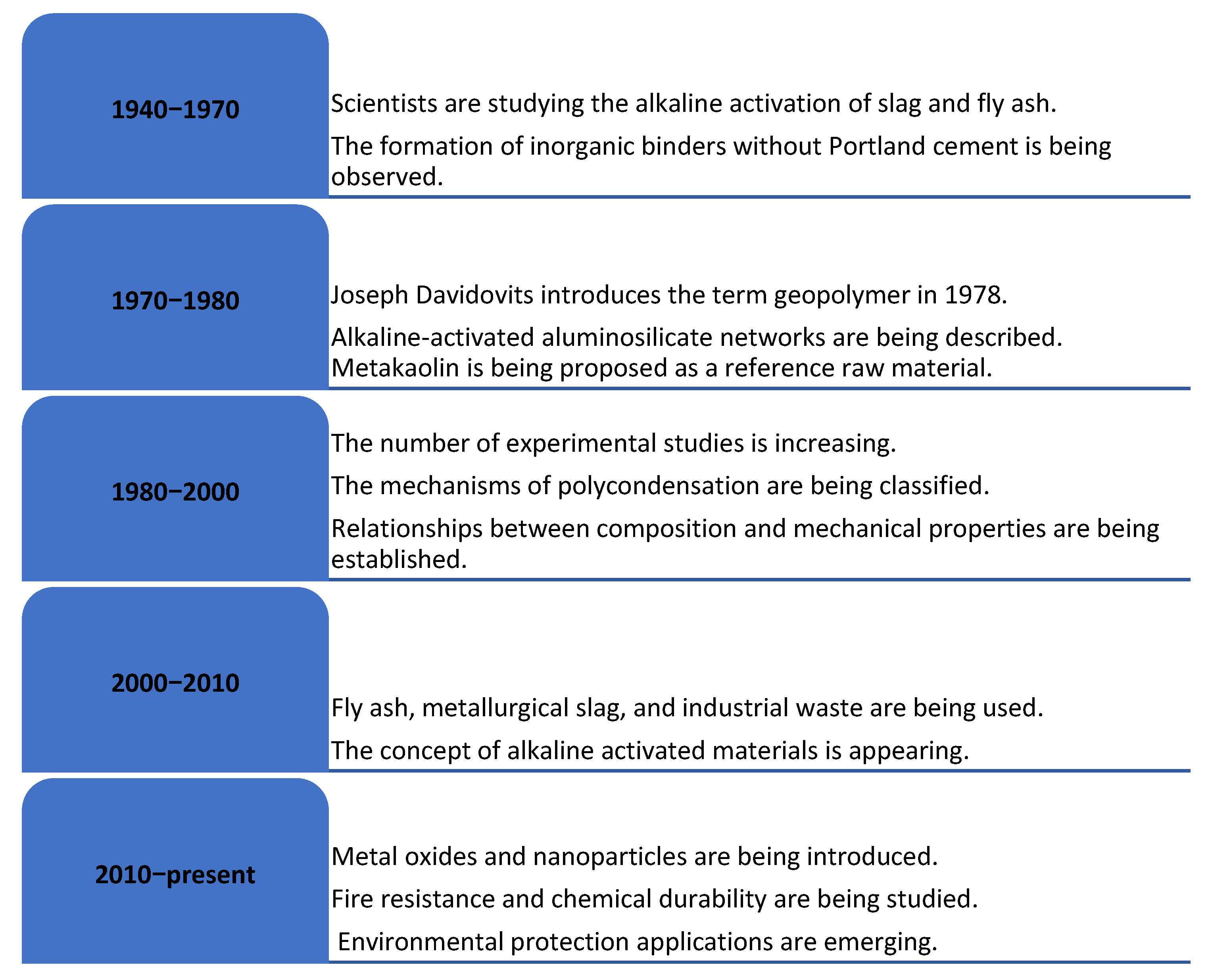
In the context of intensified research on materials ensuring comparable mechanical performance and durability with ordinary Portland cement (OPC), geopolymers have emerged as a promising class of inorganic aluminosilicate materials obtained through the alkaline activation of Si- and Al-rich precursors [1,2]. Unlike OPC-based systems, geopolymer synthesis typically occurs at moderate temperatures without high-temperature calcination and allows for the valorization of industrial by-products such as fly ash and blast furnace slag [2,3,4,5,6,7,8]. From a chemical perspective, geopolymers consist of three-dimensional amorphous or semi-amorphous networks formed by Si–O–Al bonds, whose structure and properties can be tailored by controlling precursor chemistry, alkaline activator composition, and processing parameters [1,2]. The evolution of geopolymer research throughout the years is presented in Figure 1.
Previous studies have shown that optimized geopolymer formulations can reach mechanical performance levels comparable to those of conventional OPC systems under specific processing conditions, although such equivalence is not universal and remains formulation-dependent [8,9,10,11,12,13,14,15,16,17].
Among the available precursors, metakaolin-based geopolymers have attracted particular attention due to their high reactivity, compositional purity, and reproducibility [9]. These characteristics make metakaolin-derived systems suitable as reference materials for understanding geopolymerization mechanisms and establishing structure–property relationships [10,11,12,13,14]. In parallel, fly ash- and slag-based geopolymers offer significant advantages in terms of cost reduction and environmental sustainability, although their inherent chemical variability introduces challenges related to reproducibility and performance predictability [15,16]. An analysis of recent scientific papers places metakaolin-based geopolymers (MK–GP) as an essential step in the development of “green constructions” [3,4,5,6,7,8,9,10,11].
Beyond their role as structural binders, geopolymers have increasingly been investigated as multifunctional materials. The intrinsic porosity, chemical stability, and ion-exchange capacity of geopolymer matrices enable their functionalization with active particles, such as metal oxides or metallic nanoparticles, imparting photocatalytic and antibacterial properties [17,18,19,20,21]. In these hybrid systems, the geopolymer matrix primarily acts as a chemically stable and mechanically robust support, while the functional performance is governed by the nature, dispersion, and interaction of the embedded active phases [22,23]. Such multifunctional geopolymers are of growing interest for applications in water and air purification, self-cleaning construction materials, and hygienic surfaces.
Although numerous review articles have addressed geopolymer synthesis, mechanical performance, and durability [2,6,8,10,17], fewer studies have systematically correlated precursor selection [18,19,24,25], microstructural characteristics [15,26], and functionalization strategies with photocatalytic [27,28,29] and antibacterial performance [30]. Moreover, the role of the geopolymer matrix as active support, rather than as a primary functional phase, is often discussed qualitatively, with limited comparative analysis across different precursor systems.
This present review aims to address these gaps by providing a structured and critical synthesis of the recent literature on geopolymers, with a focus on structure–property relationships and functionalization for sustainable applications. To clearly position the present review within the existing literature, Table 1 summarizes the focus and limitations of representative review articles and highlights the specific contribution of the current work.
Emphasis is placed on metakaolin-, fly ash-, and slag-based systems, analyzing how precursor chemistry, alkaline activators, Si–Al ratio, and porosity influence both structural and functional performance [31]. Photocatalytic and antibacterial geopolymers are critically reviewed to elucidate dominant mechanisms, performance trends, and current limitations. By highlighting unresolved challenges related to raw material variability, standardization, and long-term durability, this review seeks to support the rational design of multifunctional geopolymer systems and to guide future research toward application-oriented development.

2. Literature Selection and Review Framework

This paper is carried out as a structured narrative review, focused on the critical synthesis of the recent literature on metakaolin-based geopolymers, with a focus on structure–property relationships and photocatalytic and antibacterial functionalization. The literature selection was made by consulting the main international scientific databases, namely the Web of Science Core Collection, Scopus, ScienceDirect, and MDPI. These databases were chosen due to the wide coverage of journals in the fields of materials, civil engineering, chemistry, and nanotechnologies.
The analysis focused predominantly on articles published between 2015 and 2025 so as to reflect the current state of the research. Older works have been selectively included when they have played a fundamental role in defining basic concepts, geopolymerization mechanisms, or established classifications of geopolymers. The database searches were performed using structured keyword combinations connected by Boolean operators (AND, OR). Core search strings included combinations such as “geopolymer AND metakaolin”, “alkaline activation AND metakaolin”, “geopolymer AND photocatalytic”, “geopolymer AND antibacterial”, “functionalized geopolymer”, OR “hybrid geopolymer”. These terms were applied to titles, abstracts, and keywords.
Exclusion criteria were applied sequentially during screening and full-text evaluation. Experimental studies were prioritized when they provided clear descriptions of raw materials, formulation parameters, microstructural characterization, and structure–property or structure–function relationships. Review articles were used to contextualize the results, identify a consensus, and highlight unresolved challenges. No formal risk-of-bias scoring was applied due to the heterogeneity of experimental designs and reporting practices; however, potential bias was mitigated by cross-comparing results from multiple independent sources and excluding studies with insufficient methodological detail. Non-peer-reviewed sources were also excluded. Works that represent incomplete or insufficient structurally and chemically characterized results were excluded. They include technical reports, conference papers without peer-review, or studies with strict local relevance. The analysis included experimental research articles, review articles, and comparative studies.
Articles that simultaneously meet the following conditions were included in the analysis: they treat metakaolin-based geopolymers or hybrid systems in which metakaolin is the main precursor; report clear relationships between composition, microstructure, and mechanical, chemical, or functional properties; and address the functionalization of geopolymers through metal oxides, nanoparticles, or other additives with a photocatalytic or antibacterial role. Experimental articles were used to extract trends regarding the influence of synthesis and functionalization parameters, while review articles were used to validate scientific consensus and identify research gaps.
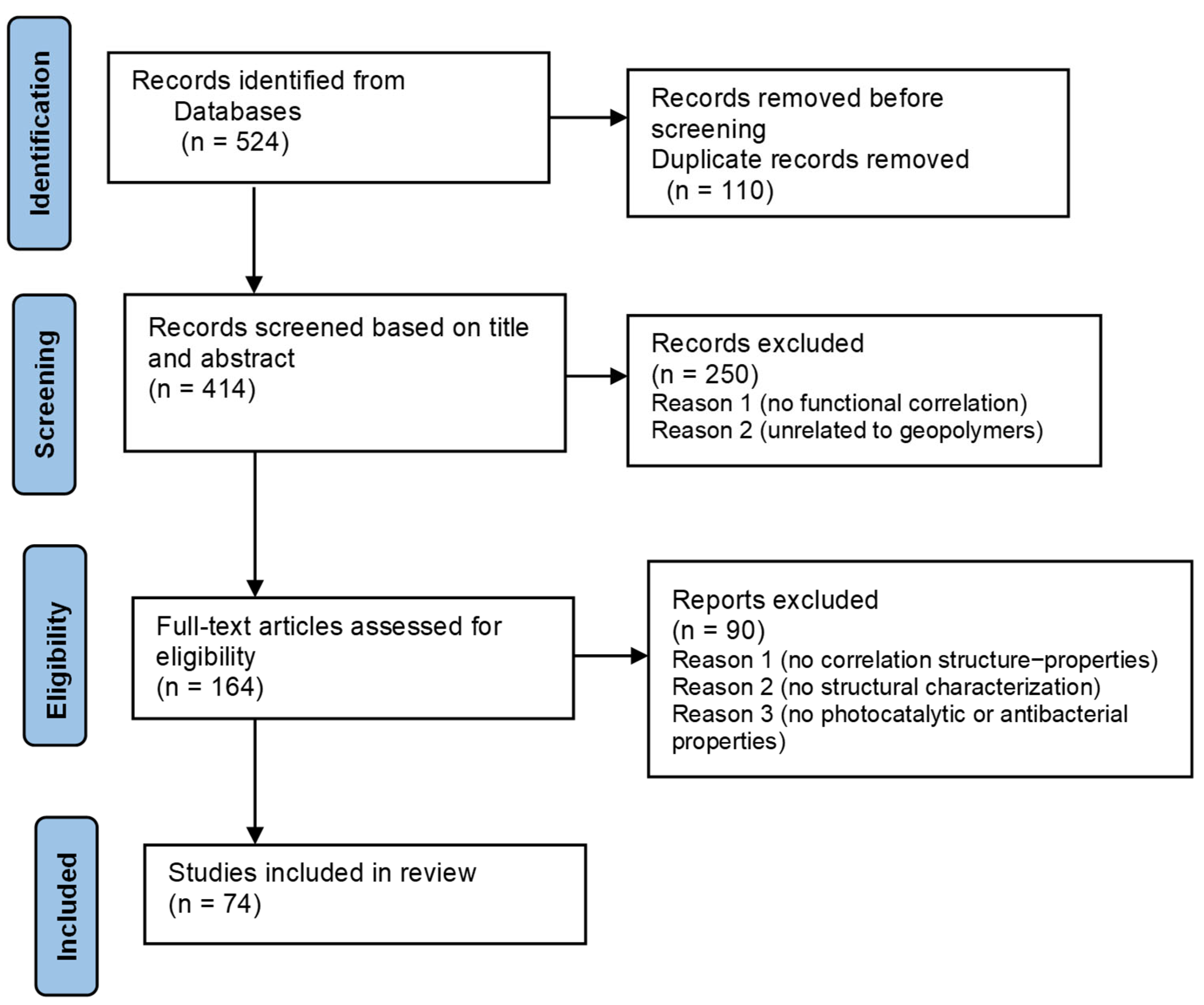
The selected literature was comparatively analyzed with a focus on identifying the dominant mechanisms, the optimal ranges of composition, and the reported limitations, avoiding unwarranted extrapolations beyond the specific conditions of each study. The PRISMA framework was applied in an adapted form, focusing on transparent identification, screening, eligibility assessment, and reporting, rather than on formal meta-analysis [32], as presented in Figure 2.
The initial search in the Web of Science, Scopus, ScienceDirect, and MDPI databases generated approximately 524 records.
After removing the duplicates, about 414 unique items remained. The titles and abstracts have been analyzed for thematic relevance. At this stage, about 250 articles were excluded because they dealt with strictly structural systems and applications without functional correlation or areas with no direct connection to geopolymers. The full text was evaluated for approximately 164 articles. Of these, 90 were excluded based on the exclusion criteria, mainly due to the lack of microstructural characterization, absence of structure–property correlations, or limited relevance for photocatalytic or antibacterial functionalization. A total of 74 articles were included in the final analysis. They formed the basis for the critical synthesis of repolymerization mechanisms, the influence of precursors, and activators, as well as functionalization strategies for advanced applications.
Given the substantial heterogeneity of experimental methodologies reported in the literature—covering variations in precursor chemistry, activator composition, curing regimes, and performance evaluation protocols—a fully normalized quantitative comparison of mechanical, photocatalytic, and antibacterial properties cannot be consistently achieved across studies. Accordingly, this review adopts a structured comparative framework based on normalized performance ranges, relative efficiency classes, and structure–property–function correlations extracted from studies conducted under comparable conditions.

3. Formulation Optimization

3.1. Metakaolin, Fly Ash, or Slag?

Geopolymerization involves the alkaline activation of raw materials rich in silicon (SiO2) and aluminum (Al2O3). Geopolymer synthesis involves a polymerization reaction between an aluminosilicate source (precursor) and an alkaline activator solution (sodium–potassium silicate and sodium–potassium hydroxide). The process takes place at moderate temperatures (25–80 °C) and does not require calcination at high temperatures. Geopolymers are formed by the polycondensation reaction between reactive species of Si4+ and Al3+ in the presence of an alkaline activator (NaOH, KOH, Na2SiO3). Their general formula is M{–(SiO2)z–AlO2}n·wH2O, where M is an alkaline cation z is the Si–Al molar ratio (typically between 1 and 3), n is the degree of polycondensation, and w denotes the physically bound water. The Si–Al ratio significantly influences structural and functional properties. The stages of synthesis include [12,13]:
  • Dissolution of reactive components and formation of reactive species.
Al-Si-O + OH + H2O = Si(OH) + Al(OH)4
2.
Polymerization of aluminosilicate species.
Si(OH)4 + Al(OH)4 = (Si-O-Al-O)n + H2O
3.
Forming a rigid three-dimensional network.
Natural aluminosilicate materials, such as kaolin, clays, or volcanic tuffs, can be used as geopolymer precursors, but their reactivity is generally limited by their high degree of crystallinity. For this reason, they are frequently subjected to thermal activation treatment (calcination) to induce the structural disorder necessary for geopolymerization.
Metakaolin (MK) stands out as a high-performance precursor due to its controlled nature and superior reactivity. MK is obtained by the calcination of kaolinite clay at moderate temperatures, typically ranging between 650 °C and 800 °C. This heat treatment induces a structural disorder, transforming the crystalline kaolinite into an amorphous and highly reactive aluminosilicate [15].
Industrial by-products, such as fly ash (FA) [18], ground granulated blast furnace slag (GGBFS) [19], and residues from the metallurgical or ceramic industry such as bauxite residues (red mud) are a category of precursors of major interest, especially in the context of the development of sustainable materials [4,5].
The major advantage of MK, compared to variable industrial by-products (such as fly ash or slag), is its high and controlled content of SiO2 and Al2O3. The structural homogeneity of MK ensures faster dissolution and superior reactivity even at moderate hardening temperatures, making it easier to achieve early mechanical strengths without requiring intense thermal hardening. These favorable kinetics simplify the production process of metakaolin-based geopolymers (MK–GP). In addition, being synthesized from a relatively pure raw material, MK–GP can serve as a model or benchmark system for setting processing and testing standards. The success of establishing an MK-based geopolymers standard could accelerate the certification and commercialization of other geopolymer composites, addressing the current difficulty of comparing data from different laboratories due to lack of uniformity [14].
The Si–Al ratio of geopolymers produced from MK generally ranges between 0.5 and 3.0. Metakaolin exhibits a distinct reactivity to industrial by-products. While fly ash (FA) and granulated blast furnace slag (GGBFS) release silicon and aluminum at approximately similar rates, metakaolin exhibits a significantly higher release of silicon (Si) from the early stages of dissolution [5,15,16].
The reaction mechanisms differ fundamentally by the speed limitation stages:
  • Metakaolin: Dissolution is mainly controlled by the surface chemical reaction, being adequately described by “shrinking core” models with a first-order reaction to aluminum [17].
  • Fly ash: Its reactivity is much more dependent on temperature (25–145 °C) and particle size. The process includes three consecutive limiting steps: (1) the dissolution of the vitreous phase, (2) Fick diffusion through the surface layer, and (3) diffusive transport through the interstitial gel structure [3,18].
  • Ground granulated blast furnace slag: Being a calcium-rich material, its dissolution induces the formation of a layer of Si on the surface in the initial stages and presents a shorter induction period than in the case of Portland cement, but longer as the fly ash content increases in hybrid systems [19].
Grinding has a contrasting impact on precursors. In the case of fly ash, grinding has the greatest influence, accelerating the rate of release of silicon above that of aluminum. In contrast, for metakaolin, although grinding increases the specific surface area by up to 100%, the dissolution rates increase by only about 30%. Moreover, the excessive grinding of MK (over 5 min) can lead to a decrease in dissolution due to the phenomenon of particle agglomeration [17,20].
A comparison of the characteristics of precursors in the alkaline environment is shown in Table 2.
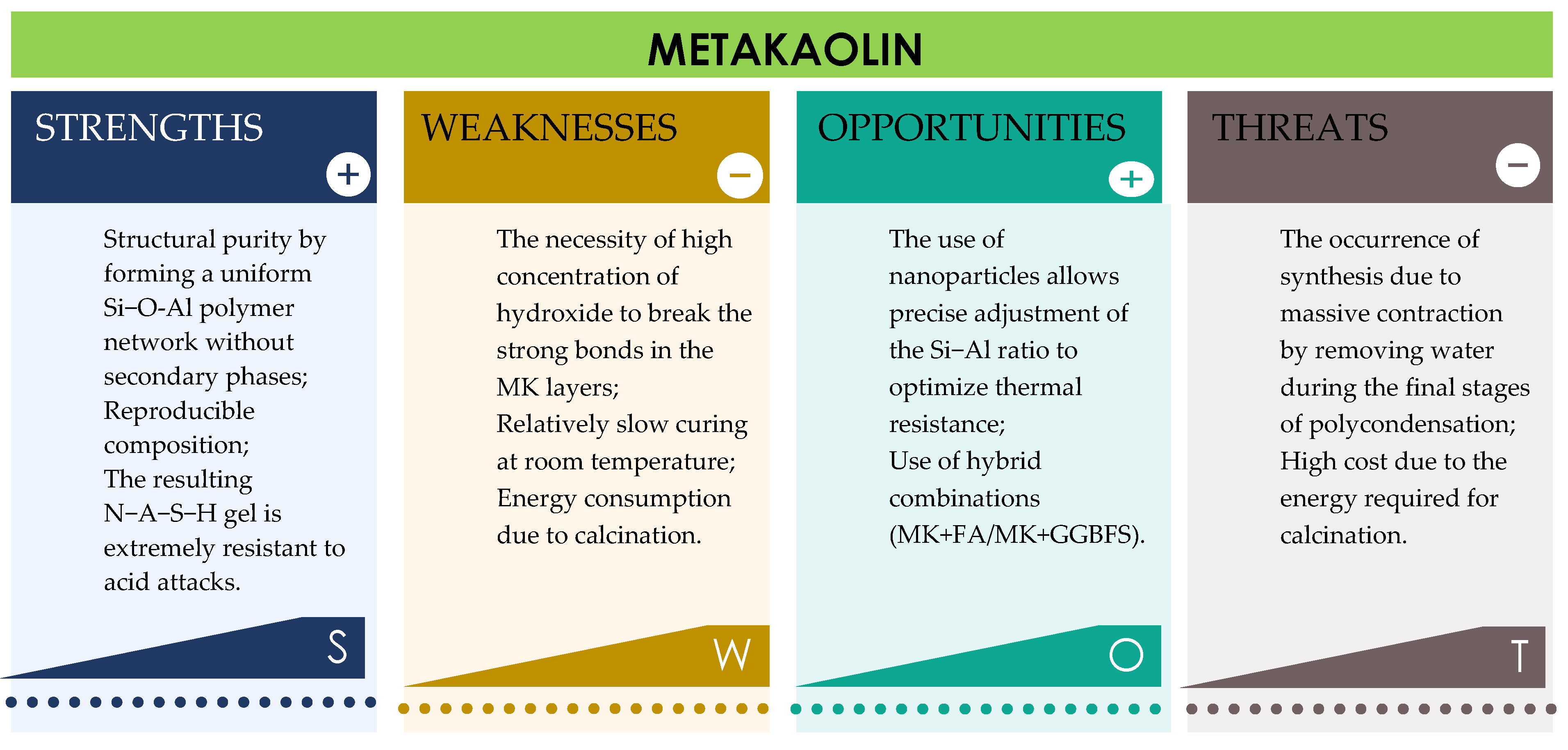
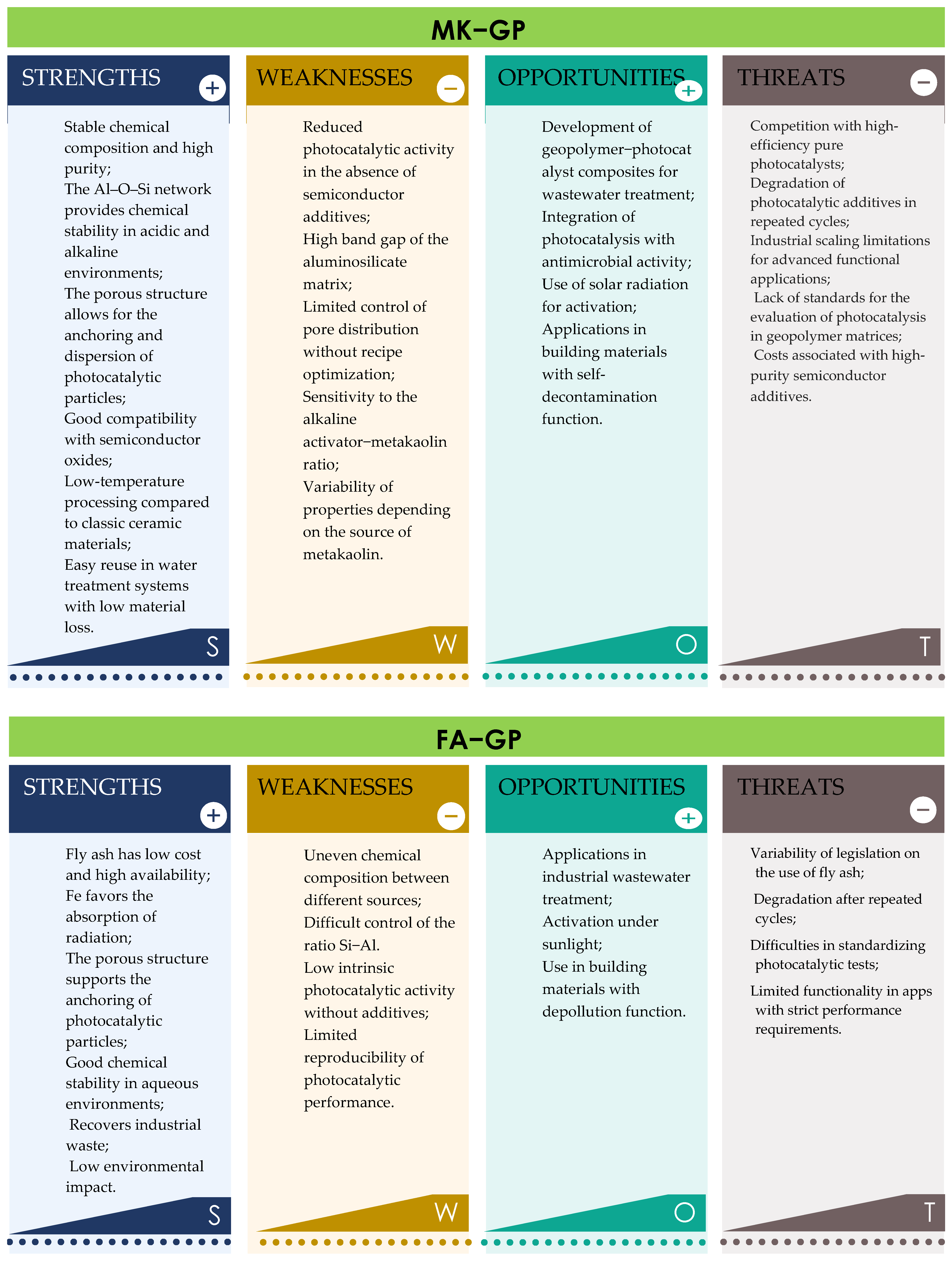
A comparative SWOT analysis of the three precursors used in the synthesis of geopolymers is presented in Figure 3.
Although MK is an excellent precursor, it can be combined with other additional cementitious materials (SCM), such as fly ash (FA) or blast furnace slag (GGBFS), to expand applicability and improve properties, especially room temperature curing capacity [19]. Several studies have reported that the addition of MK to SCMs, especially in combination with FA, produces excellent synergistic effects, improving microstructural development and pozzolanic activity and increasing resistance [18,21]. The MK–FA mix showed the most promising performance gains [23].

3.2. Influence of Alkaline Activators

Geopolymerization is a complex process that initially involves the dissolution of aluminosilicates under the action of an alkaline solution (activator), followed by the transport of the monomers and, finally, their reprecipitation in the form of an amorphous silicoaluminate gel, called N–A–S–H (if sodium is used) or K–A–S–H (if potassium is used). The rate of dissolution and precipitation of amorphous zeolite precursors turns out to be the step limiting the rate of reaction in MK-based systems [33].
Aluminum is the first species to dissolve rapidly (especially at concentrations below 3 M NaOH), while Si dissolution follows an exponential trend relative to alkaline conditions. This rapid release of Al favors early cross-linking of the structure by forming the units Q4(3Al) and Q4(4Al). For MK, in a pH 13 environment, activation energies of 89 kJ/mol for Al and 81 kJ/mol for Si have been reported [15,24].
The choice of the activating ion critically influences the microstructure and, implicitly, the final mechanical performance. Comparative studies investigated the use of Na-based (Na2SiO3 + NaOH) and potassium-based (Na2SiO3 + KOH) activators for the preparation of metakaolin geopolymers at room temperature [18,25]. Although both systems exhibit excellent mechanical properties, the potassium (K)-based geopolymer offers superior performance. The data obtained by testing the optimal ratios at 28 days reveal significant differences in the maximum compressive and flexural strengths [25]. The correlation between activator type and mechanical performance (after 28 days) is presented in Table 3.
The difference in performance is attributed to the kinetics of amorphous phase formation at the expense of crystalline phases. Sodium ions (Na+) are smaller and have better mobility and zeolite capacity in the gel lattice than potassium ions (K+). Although Na+ favors dissolution, its high tendency to form zeolytic (crystalline)-phase products results in a less resistant final matrix. An efficient geopolymerization, which maximizes strength, depends on the formation of a dense amorphous gel (N–A–S–H/K–A–S–H). Therefore, the K+ ion (larger and less mobile) inhibits the excessive formation of zeolites, favoring the stabilization of a more compact amorphous structure, which translates into superior mechanical properties. The mechanical properties can be greatly improved by precisely adjusting the alkaline activator mass ratio to the metakaolin and Na2SiO3–MOH ratio.
The Si–Al ratio in the aluminosilicate precursor is a fundamental parameter that determines the final products and microstructure of geopolymers. Research that involves using nano-silicon to adjust the Si ratio has determined that there is a strict optimal range for achieving maximum strength.
According to Joseph Davidovits, the chemist who coined the term geopolymer, the resulting structures are classified according to the Si–Al ratio, as shown in Table 4 [24].
A Si–Al ratio of 2:1 led to the highest balanced dissolution of Si and Al, promoting the optimal formation of Si–O–T bonds (where T represents Si or Al) in the N–A–S–H gel.
Instead, reports that lead to rapid performance degradation include:
  • Low Si–Al (1:1): Favors the high dissolution of aluminate monomers, leading to the formation of zeolite nuclei (e.g., Zeolite A) and a very low resistance (2.14 MPa).
  • High Si–Al (4:1): Insufficient dissolution of Al (necessary for the polymer lattice) leads to the formation of silicic acid, not producing enough N–A–S–H gel. This imbalance induces high porosity (micropores and mesopores) and a reduction in resistance.
This extreme sensitivity underlines the fact that, for MK–GP, structural performance is critically dependent on achieving a stoichiometric equilibrium that favors the formation of a dense, amorphous silicon-aluminized polymer matrix [27]. The correlation between the Si–Al ratio and structural characteristics is represented in Table 5.
Geopolymers often have an amorphous structure, with dense areas and microcracks generated by shrinkage during hardening. By modification with semiconductor oxides, more porous structures are formed, with a rough topography favorable to reactivity. Porosity is a critical parameter in the design of functional geopolymers, influencing the adsorption capacity, mass transport, dispersion of photocatalysts and contact with pathogens. The porous structure of geopolymers can be modified by composition, activator–silicate ratio, addition of porogens, or addition of metal oxides. Types of porosity encountered are [27,28,29,30,31,32,33,34,35,36,37,38]:
  • Micropores (<2 nm): responsible for specific molecular adsorption. Micropores are directly associated with the amorphous gel network (N–A–S–H, K–A–S–H or C–(N)–A–S–H).
  • Mesopores (2–50 nm): dominant in photocatalytic and antimicrobial applications, ensuring effective diffusion of contaminants. These are associated with geopolymers containing TiO2 particles, Ag or ZnO.
  • Macropores (>50 nm): favors the permeability and mechanical retention of bacterial particles. Macropores are associated with geopolymers with CaTiO3 particles or BaCO3.
The liquid–solid ratio influences the formation of micro- and mesopores. The presence of sodium silicate (Na2SiO3) stabilizes the gel and reduces pore collapse.
The addition of porogens (e.g., H2O2, oils, foams) leads to the development of macropores [36,37,38].
The addition of metal oxides (TiO2, ZnO) introduces structural defects that favor the formation of irregular pores and diffusion networks [39]. In photocatalysis, mesoporic porosity optimizes light contact and redox reactions. In antibacterial applications, >50 nm pores allow for the adsorption of microorganisms and the controlled release of ions. In water treatment, bimodal porosity (mesopores + macropores) is preferred for combined physicochemical retention [40].

4. Specific Properties

4.1. Influence of Additive Particles

Through the integration of metal oxides, nanoparticles, and inorganic pigments, geopolymers become multifunctional materials with extensive applicability in construction, water purification, and architectural design. To improve mechanical properties, durability, and shrinkage strength, the GP matrix can be reinforced with synthetic or natural fibers or particles. They are “added”; therefore, the term “additive” used by the authors in Refs. [41,42] emphasizes their extrinsic character to the basic chemistry of the geopolymer [22,24,43,44,45,46,47,48].
The most critical problem when inserting metal particles (especially Al, Zn, or Fe) is their reaction with the alkaline activator. Aluminum, if not controlled (by dosages of the order of 0.01–0.1%), transforms the geopolymer into a spongy structure, decreasing mechanical strength. However, this effect is used industrially to produce cellular geopolymers (slightly aerated). Studies show that the steel insert significantly increases resistance to dynamic shocks, making these geopolymers suitable for protective structures [49,50]. Correlations between additive particles and their influence on geopolymers properties are presented in Table 6.

4.2. Durability, Chemical Resistance, and Fire Performance

The curing regime plays a crucial role in controlling the kinetics of the polymerization reaction. Thermal curing accelerates the dissolution, polymerization, and reprecipitation processes, contributing to a denser structure and increased compressive strength in a shorter time frame. The optimal temperatures for MK–GP are generally between 40 °C and 80 °C for a curing period of 28 days. For example, it has been reported that an optimal curing temperature of about 60 °C, applied for 7 days, allowed for a compressive strength of 97.9 MPa to be achieved [57].
Although high temperatures improve early strength, excessive polymerization speed can induce long-term adverse effects on the structure. Accelerated hardening can cause rapid evaporation of the reaction water and uncontrolled precipitation of the gel, increasing the volume and size of the pores. This can lead to a less stable structure or a reduction in resistance after 28 days.
In contrast, research shows that curing at lower temperatures, between 20 °C and 40 °C, promotes a continuous gain in endurance from day 1 to day 28, without the decay observed at higher temperatures [55]. For critical structural applications, slower and more controlled hardening kinetics is preferable, as it ensures the formation of a more homogeneous matrix with minimal porosity [57].
One of the biggest competitive advantages of MK-based geopolymers over OPCs is their superior durability in aggressive environments. Comparative studies have validated that MK–GP formulations offer improved durability performance under chemical aggressions, even when cured at room temperature [58].
Research has shown that the MK-based geopolymer, cured at room temperature, achieved a compressive strength of 33 MPa in 90 days, comparable to the cement system (35.2 MPa) [58]. In terms of durability, MK showed significantly higher resistance to sulfate and acid attacks, as well as carbonation, compared to cement systems. This chemical stability is supported by its dense matrix, reflected by the lowest measured water absorption (3.4%) [59].
GP better preserves its structural integrity and poses a lower risk of explosive spalling than OPC-based concrete, especially due to matrix chemistry and the evolution of porosity and heating permeability [60].
The fire resistance of metakaolin-based geopolymers (MK–GP) is explained primarily by their inorganic nature and by the fact that the geopolymer matrix (the N–A–S–H or K–A–S–H networks, depending on the activator) does not suffer the degradations typical of the hydrated phases of Portland cement when heated [61,62,63,64]. In a real fire, the behavior of the MK–GP is governed by a balance between water losses (free and bound), thermal shrinkage, microcracking, and phase transformations. Depending on the formulation and the thermal regime, these processes can either lead to the maintenance of integrity or to embrittlement and loss of residual strength.
The key mechanisms at high temperatures are:
(a)
Dehydration and dehydroxylation (≈100–300 °C).
At relatively low and medium temperatures (approx. 100–300 °C), the main phenomenon is water evaporation and partial dehydration, with the appearance of internal stresses and microcracks.
(b)
Reorganization/sintering and local densification (≈600–900 °C).
In the high range (approx. 600–900 °C), alkaline-activated metakaolin can manifest a sensitive threshold of contraction and structural reorganization. A classic reported result for geopolymers (including MK systems) is that the range of 600–800 °C can be associated with large shrinkages and microstructural changes that explain cracking and, in some formulations, a sharp decrease in mechanical properties [62].
(c)
Phase transformations and crystallization.
At ≈800–1100 °C, crystalline phases appear (compositionally dependent: Si–Al, cation-type Na–K, Ca, etc.) that can stabilize or, on the contrary, induce tensions/embrittlement [59].
(d)
Spalling.
Spalling (thermos–hydro–mechanical mechanism) is related to the accumulation of vapor pressure associated with thermal gradient and internal stress. Many GPs (especially formulations with more “favorable” porosity/permeability) have less spalling than OPC [60].
Based on these properties, studies indicate the use of GP as protective layers on metallic elements or as geopolymeric foams with very low conductivity [63,64].

4.3. Photocatalytic Activity

The photocatalytic activity of geopolymers is determined by the structure of the aluminosilicate matrix and the presence of semiconductor additive particles. Additive-free geopolymers exhibit an amorphous Al–O–Si network with a high band gap, above 4 eV, which limits the absorption of UV radiation and inhibits the generation of charge carriers. Under these conditions, the dominant mechanism is the physicochemical adsorption of pollutants on the surface of the material, followed by low-efficiency surface reactions. Experimental studies report degradation rates below 10–15% for organic dyes after 120 min of UV irradiation, indicating low photocatalytic activity. The functionalization of geopolymers with photocatalytic metal oxide semiconductors (TiO2, ZnO, CuO, Fe2O3, BaCO3) expands the area of applications to the depollution and self-washing of surfaces. The additives introduce active energy levels, reduce the effective band gap of the GP–particle composite, and allow for efficient absorption of UV or visible radiation. Under irradiation, electron-empty pairs are generated, which participate in the formation of reactive oxygen species, especially hydroxyl and superoxide radicals, responsible for the advanced oxidation of organic pollutants [5]. In these systems, the reported degradation efficiencies reach values between 60 and 95% in intervals of 60 to 120 min, depending on the type of additive, mass fraction, and irradiation conditions [26,28,65,66].
In the metal oxide particle (Mox) geopolymer structure, the transfer of charge from Mox to the porous matrix increases the efficiency of redox processes:
MOx + hν → e + h+ (activation)
h+ + H2O → •OH; (formation of hydroxyl radicals)
e + O2 → •O2 (formation of superoxide radicals).
The radicals generate attack organic compounds (dyes, pesticides, pharmaceutical residues), leading to complete mineralization.
The metakaolin-based geopolymer matrix performs several essential functions that improve the performance of the photocatalytic system by:
  • Anchoring and stability: The GP matrix is a stable chemical and mechanical surface for the attachment of catalytic nanoparticles (e.g., by Si–O–M bonds. This prevents leaching (washing) of the catalyst into the liquid medium (water), a major problem of free nanoparticles [67,68].
  • Easy recycling: By incorporating it into a macroscopic geopolymer material, the recovery and reuse of the catalyst after water or air purification becomes much simpler and more economical [68].
  • Adsorption: Geopolymers have an adsorption capacity (due to their porous structure and ion exchange capacity). This initial adsorption concentrates on the pollutant molecules in the vicinity of active catalytic sites, increasing the overall efficiency of degradation [69].
  • Permeability: The porous structure of the geopolymer allows for efficient diffusion of water, air, and pollutants to the embedded catalytic sites.
Catalytic nanoparticles (usually, TiO2 anatase or ZnO are introduced into the geopolymer matrix either by in situ mixing (added to the fresh mixture) or by ex situ deposition (applied as a thin layer on the surface of the hardened geopolymer).
Optimizing photocatalytic performance requires controlling the additive fraction, typically in the range of 1–10 wt%, as well as adjusting the porosity and structural homogeneity. Studies demonstrate that geopolymers with 5–10% TiO2 effectively reduce organic dyes (methylene blue, rhodamine B) under UV or solar lighting conditions. The photocatalytic activity is supported by the high specific porosity (>100 m2/g) and the uniform distribution of the nanoparticles in the geopolymer matrix [39].
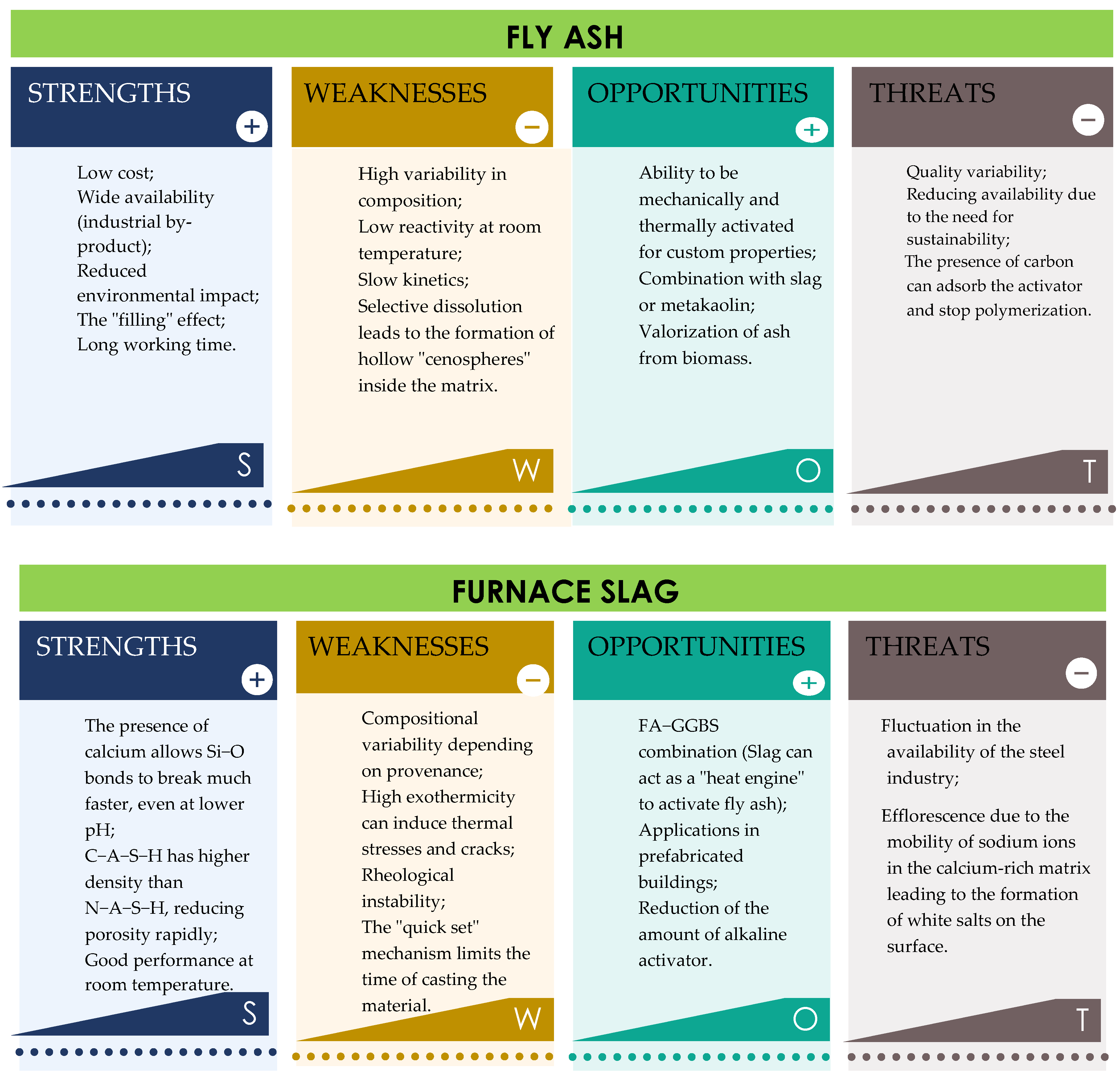
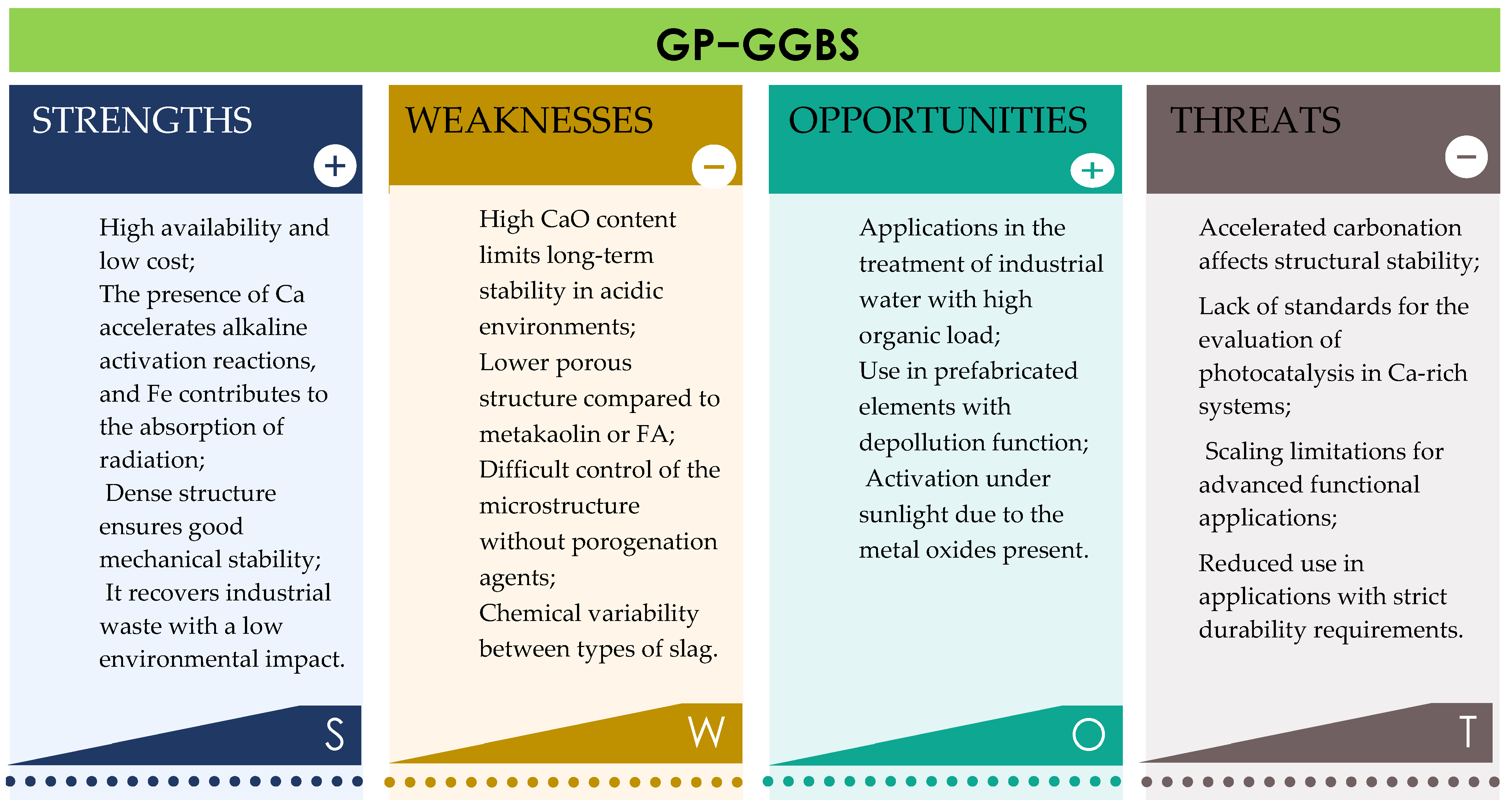
The SWOT analysis of the use of metakaolin, fly ash, and slag geopolymers is presented in Figure 4.
SWOT analyses indicate that geopolymers used in photocatalysis do not function as active materials through the base matrix, but as a functional support for semiconductor phases. Functionalized metakaolin-based geopolymers typically exhibit specific surface areas in the range of 50–150 m2·g−1 and dominant mesoporosity (2–50 nm), which enables effective dispersion and anchoring of semiconductor particles [28]. Mechanical strength retention after functionalization commonly exceeds 80–95%, confirming the structural stability of the matrix [45]. In photocatalytic systems, pollutant degradation efficiencies of 60–95% within 60–120 min have been reported [35,40]. The performance results from the interaction between the composition of the precursor, the microstructure, and the type of additive.
Metakaolin-based geopolymers offer good chemical control, adjustable porosity, and high reproducibility. These factors support the uniform dispersion of photocatalysts and stability in repeated cycles. The major limitation remains the lack of intrinsic activity, which requires mandatory functionalization.
Geopolymers based on fly ash and slag harness secondary resources and reduce environmental impact. The presence of iron oxides favors photo-redox processes and activation under sunlight. Chemical variability and low microstructure control limit the reproducibility and predictability of photocatalytic performance.
In all systems analyzed, photocatalytic efficiency depends on the controlled integration of semiconductor particles, the development of a mesoporous lattice, and the stability of the matrix–additive interface. Without these conditions, geopolymers remain passive materials with a predominantly structural role.

4.4. Antibacterial Properties

The antibacterial properties of geopolymers have been increasingly studied in the context of their use in sanitary environments, water treatment applications, and building materials with a self-decontaminating effect. They can inhibit growth or destroy pathogenic bacteria through multiple physicochemical mechanisms if impregnated with additive particles of metal oxides (e.g., CaO, ZnO, CuO, SiO2) or metal particles (e.g., Ag, Cu, Zn) [27,34,43,70,71]. They do not participate directly in the geopolymerization reaction (they do not become part of the aluminosilicate network). Fixing additives reduces the risk of leaching into water. Antibacterial activity becomes controllable and repeatable. The risk of secondary contamination, commonly associated with systems based on free biocides, is substantially reduced when active agents are immobilized within the geopolymer matrix [43,71,72,73].
The antimicrobial properties of impregnated geopolymers are attributed to several simultaneous mechanisms:
  • Alkalinization of the environment. Due to the alkaline activation process (use of NaOH or KOH), the geopolymer matrix maintains a high pH (≥12). This strongly alkaline medium causes osmotic stress and destabilizes the integrity of the cell wall, leading to bacterial lysis [74].
  • Controlled release of metal ions (ion leaching). Ions such as Zn2+, Ag+, or Cu2+ are slowly released from the matrix. They penetrate the cell membrane, distort enzymatic proteins, and block bacterial DNA replication [73].
  • Oxidative stress mediated by ROS. In the presence of moisture and light radiation, doped semiconductors generate reactive oxygen species (ROS), •OH and •O2, which affect the membranes and internal structure of bacteria [72].
  • Adsorption and physical capture. The rough surface and open porosity of the geopolymer act as a physical “trap”, immobilizing bacteria and maximizing contact time with the biocide’s active sites [74].
The porous structure plays a central role. Mesopores promote the adsorption of bacteria and organic compounds. The large active surface area increases the contact between microorganisms and the active phases. This mechanism reduces the bacterial concentration even before the activation of chemical or photo-induced processes [42].
The antibacterial performance is directly influenced by the structural architecture and chemical composition of the particle-impregnated geopolymer composite, as shown in Table 7.
The choice of the basic precursor (metakaolin, fly ash, or slag) does not only influence the mechanical properties, as we presented in the previous section, but directly determines how the material interacts with microorganisms. Due to their predominantly mesoporous structure, geopolymers allow for superior biokinetics. The additive nanoparticles are evenly distributed over a large specific surface, which means that a bacterium adhering to the surface has a much higher probability of coming into direct contact with an active center. Thus, they become ideal for hospital surfaces or high-performance water filters. A detailed comparative analysis of antibacterial performance by precursor is presented in Table 8.
While metakaolin provides the optimal platform for a rapid and intense antibacterial response by maximizing contact between the biocidal agent and the microorganism, slag and fly ash are viable alternatives for structural applications where high pH durability compensates for reduced mobility of additive particles. Thus, the applications of particle geopolymers are becoming increasingly useful for applications in construction: walls, floors, prefabricated elements, wastewater treatment plants and water infrastructure, food, and industrial spaces.

5. Conclusions

A comparative analysis of metakaolin, fly ash, and slag-based systems highlights the fact that the geopolymer matrix has a predominant role as an active support, and the performance is determined by the controlled integration of additive particles. When properly formulated, metakaolin- and slag-based geopolymers can achieve mechanical performance ranges comparable to, and in some cases exceeding, those of conventional OPC systems, as reported in the referenced literature. However, this equivalence is formulation- and application-dependent and cannot be generalized to all geopolymer systems. Functionalized geopolymers should not be seen as a simple substitute for cement, but as intelligent hybrid material through the integration of additive particles that give it an active role, transforming a passive structure into a depollution and disinfection agent.
Metakaolin-based geopolymers offer reproducibility, microstructural control, and superior compatibility with photocatalytic additives, being suitable for applications that impose strict performance and stability requirements. Fly ash and slag systems harness secondary resources and support the development of sustainable materials for large-scale environmental applications, although chemical variability requires optimization and standardization strategies. Although studies have validated the outstanding technical performance and durability of MK–GP, widespread commercial adoption is significantly hampered by a non-technical factor: the lack of a uniform standard for the processing and testing of geopolymer composites, like those used for OPCs. One of the major barriers to the large-scale implementation of geopolymer materials remains the intrinsic variability of raw materials, particularly industrial by-products such as fly ash and slag. Overcoming this limitation requires a shift from prescriptive formulations toward chemistry-based and performance-oriented standardization pathways. A first step involves the systematic classification of precursors according to oxide composition, amorphous content, and dissolution kinetics, enabling grouping into reactivity classes rather than treating all sources as equivalent.
Secondly, formulation normalization based on molar ratios (e.g., Si–Al, alkali–Al, Ca–(Si + Al)) instead of mass proportions can significantly reduce sensitivity to raw material variability. The use of benchmark reference systems, such as metakaolin-based geopolymers, provides a controlled baseline for inter-laboratory comparison and validation of processing protocols. Additionally, pre-processing strategies, including grinding, the blending of multiple sources, or partial substitution with well-characterized precursors, offer practical routes to homogenize variable feedstocks. For mixtures incorporating high RAP (reclaimed asphalt pavement) contents, improving mixture homogeneity can be achieved by extending the mixing time to approximately 120–180 s and/or increasing RAP preheating temperatures to the range of 65–75 °C.
Collectively, these approaches support the development of performance-based standards for geopolymer materials, in which compliance is defined by mechanical, durability, and functional metrics rather than by strict compositional prescriptions, thereby facilitating industrial adoption while preserving material flexibility.
Geopolymers can be multifunctional systems for applied photocatalysis, with clear differentiation of areas of use. Metakaolin is suitable for applications with strict control and durability requirements. Fly ash and slag are suitable for large-scale environmental applications where cost and sustainability take priority. MK-based geopolymers are ideal due to their purity, allowing photocatalytic composites to be obtained with greater efficiency and reproducibility in the laboratory.
In antibacterial applications, geopolymers allow for the stable anchoring of active agents and reduce the risk of leaching, ensuring long-term functionality. In water purification, the combination of adsorption, photocatalysis, and antimicrobial activity in a single material constitutes a major functional advantage, with a direct impact on the efficiency and sustainability of treatment processes. In the field of construction, the integration of the antibacterial function into the mass of the material opens prospects for the development of sustainable surfaces with high hygiene requirements without additional treatments.
Future research needs to focus on removing the remaining limitations and facilitating an industrial transition:
  • Improving Freeze–Thaw Resistance: There is a need to develop methods to improve durability in freeze–thaw cycles, where MK–GP has lagged traditional cement-based systems.
  • Nano-MK synergy: Systematic investigation of the synergy of nano-MK with other SCMs is needed to capitalize on the large surface area and create an even denser geopolymeric structure with increased mechanical properties.
  • Long-Term Durability: Research into the very long-term durability (over 10–20 years) of MK–GP hardened at room temperature is needed to enhance confidence in structural applications.
  • Process Standardization: Investments in the development and implementation of uniform testing and processing standards is needed to facilitate the creation of a globally reliable data bank and support industrial certification.

Author Contributions

Conceptualization, A.-G.S. and M.O.; methodology, Ș.M.; software, Ș.M.; validation, M.O. formal analysis, E.M.M.; investigation, A.-G.S.; resources, A.-G.S.; data curation, Ș.M.; writing—original draft preparation, A.-G.S.; writing—review and editing, M.O.; visualization, E.M.M.; supervision, M.O.; project administration, A.-G.S.; funding acquisition, A.-G.S. All authors have read and agreed to the published version of the manuscript.

Funding

This research received no external funding.

Institutional Review Board Statement

Not applicable.

Informed Consent Statement

Not applicable.

Data Availability Statement

Data are contained within the article.

Conflicts of Interest

The authors declare no conflicts of interest.

References

  1. Almutairi, A.L.; Tayeh, B.A.; Adesina, A.; Isleem, H.F.; Zeyad, A.M. Potential applications of geopolymer concrete in construction. Case Stud. Constr. Mater. 2021, 15, e00733. [Google Scholar] [CrossRef]
  2. Singh, N.B.; Middendorf, B. Geopolymers as an alternative to Portland cement. Constr. Build. Mater. 2020, 237, 117455. [Google Scholar] [CrossRef]
  3. Alghamdi, H.; Neithalath, N. Novel synthesis of lightweight geopolymer matrices from fly ash through carbonate-based activation. Mater. Today Commun. 2018, 17, 266–277. [Google Scholar] [CrossRef]
  4. Kalinkin, A.M.; Kalinkina, E.V.; Kruglyak, E.A.; Ivanova, A.G. Synthesis of geopolymers incorporating mechanically activated fly ash blended with alkaline earth carbonates. Minerals 2024, 14, 726. [Google Scholar] [CrossRef]
  5. Liu, M.; Liu, H.; Hua, M.; Chen, C.; Wang, X.; Guo, X.; Ma, T. Potential for recycling metakaolin/slag-based geopolymer concrete under freeze–thaw conditions. Materials 2024, 17, 1944. [Google Scholar] [CrossRef]
  6. Amran, M.; Al-Fakih, A.; Chu, S.H.; Fediuk, R.; Haruna, S.; Azevedo, A.; Vatin, N. Long-term durability properties of geopolymer concrete: An in-depth review. Case Stud. Constr. Mater. 2021, 15, e00661. [Google Scholar] [CrossRef]
  7. Zhao, J.; Tong, L.; Li, B.; Chen, T.; Wang, C.; Yang, G.; Zheng, Y. Eco-friendly geopolymer materials. J. Clean. Prod. 2021, 307, 127085. [Google Scholar] [CrossRef]
  8. Farooq, F.; Jin, X.; Javed, M.F.; Akbar, A.; Shah, M.I.; Aslam, F.; Alyousef, R. Geopolymer concrete as sustainable material: A state of the art review. Constr. Build. Mater. 2021, 306, 124762. [Google Scholar] [CrossRef]
  9. Panizza, M.; Natali, M.; Garbin, E.; Tamburini, S.; Secco, M. Assessment of geopolymers with Construction and Demolition Waste (CDW) aggregates as a building material. Constr. Build. Mater. 2018, 181, 119–133. [Google Scholar] [CrossRef]
  10. Hassan, A.; Arif, M.; Shariq, M. Use of geopolymer concrete for a cleaner and sustainable environment—A review of mechanical properties and microstructure. J. Clean. Prod. 2019, 223, 704–728. [Google Scholar] [CrossRef]
  11. Shehata, N.; Mohamed, O.A.; Sayed, E.T.; Abdelkareem, M.A.; Olabi, A.G. Geopolymer concrete as green building materials: Recent applications, sustainable development and circular economy potentials. Sci. Total Environ. 2022, 836, 155577. [Google Scholar] [CrossRef] [PubMed]
  12. Lin, J.; Zhang, Y.; Yang, Z. A Review of recent advances in alkali-activated materials from silica-rich wastes derived sodium silicate activators. J. Adv. Concr. Technol. 2023, 21, 189–203. [Google Scholar] [CrossRef]
  13. Shilar, F.A.; Ganachari, S.V.; Patil, V.B.; Khan, T.M.Y.; Javed, S.; Baig, R.U. Optimization of Alkaline Activator on the Strength Properties of Geopolymer Concrete. Polymers 2022, 14, 2434. [Google Scholar] [CrossRef] [PubMed]
  14. Li, C.; Sun, H.; Li, L. A review: The comparison between alkali-activated slag (Si + Ca) and metakaolin (Si + Al) cements. Cem. Concr. Res. 2010, 40, 1341–1349. [Google Scholar] [CrossRef]
  15. Işıkdağ, B.; Yalghuz, M.R. Strength Development and Durability of Metakaolin Geopolymer Mortars Containing Pozzolans under Different Curing Conditions. Minerals 2023, 13, 857. [Google Scholar] [CrossRef]
  16. El Fadili, H.; Ait-Khouia, Y.; Ouffa, N.; Taha, Y.; Moukannaa, S.; Benzaazoua, M. Comprehensive review on alkaline dissolution of aluminosilicates and its role in the mechanisms and properties of geopolymers and alkali-activated materials. Case Stud. Constr. Mater. 2025, 23, e05330. [Google Scholar] [CrossRef]
  17. El Alouani, M.; Saufi, H.; Aouan, B.; Bassam, R.; Alehyen, S.; Rachdi, Y.; El Hadki, H.; El Hadki, A.; Mabrouki, J.; Belaaouad, S.; et al. A comprehensive review of synthesis, characterization, and applications of aluminosilicate materials-based geopolymers. Environ. Adv. 2024, 16, 100524. [Google Scholar] [CrossRef]
  18. Trajković, D.V.; Milojković, N.D.; Mijatović, N.N.; Popović, A.S.; Veljović, Đ.N.; Grujić, A.A.P.; Živojinović, D.Z. Design and Development of Sustainable Geopolymers Based on Fly Ash, Slag, and Diatomaceous Earth: A Chemometric Approach. Sustain. Chem. 2025, 6, 45. [Google Scholar] [CrossRef]
  19. Kumar, S.; Kumar, R.; Mehrotra, S.P. Influence of granulated blast furnace slag on the reaction, structure and properties of fly ash based geopolymer. J. Mater. Sci. 2010, 45, 607–615. [Google Scholar] [CrossRef]
  20. Taborda-Barraza, M.; Tambara, L.U.D.; Vieira, C.M.; de Azevedo, A.R.G.; Gleize, P.J.P. Parametrization of Geopolymer Compressive Strength Obtained from Metakaolin Properties. Minerals 2024, 14, 974. [Google Scholar] [CrossRef]
  21. Qader, D.N.; Jamil, A.S.; Bahrami, A.; Ali, M.; Arunachalam, K.P. A systematic review of metakaolin-based alkali-activated and geopolymer concrete: A step toward green concrete. Rev. Adv. Mater. Sci. 2025, 64, 20240076. [Google Scholar] [CrossRef]
  22. Kumar, S.G.K.M.; Kinuthia, J.M.; Oti, J.; Adeleke, B.O. Geopolymer Chemistry and Composition: A Comprehensive Review of Synthesis, Reaction Mechanisms, and Material Properties—Oriented with Sustainable Construction. Materials 2025, 18, 3823. [Google Scholar] [CrossRef] [PubMed]
  23. Huang, Z.; Wang, Q. The effect of temperature on dissolution activity of fly ash and metakaolin in alkaline conditions. Cem. Concr. Compos. 2024, 146, 105363. [Google Scholar] [CrossRef]
  24. Davidovits, J. Geopolymer: Chemistry and Applications; Institut Géopolymère: Saint-Quentin, France, 2020; p. 24. [Google Scholar]
  25. Dai, S.; Wang, H.; An, S.; Yuan, L. Mechanical properties and microstructural characterization of metakaolin geopolymers based on orthogonal tests. Materials 2022, 15, 2957. [Google Scholar] [CrossRef]
  26. Cheng, Y.; Wang, K.; Li, P.; Guo, H.; Yan, B.; Chen, D.; Zhao, W. A Porous Geopolymer Containing Ti-Bearing Blast Furnace Slag: Synthesis, Characterization, and Adsorption-Photodegradation Studies towards Methylene Blue Removal under Visible Light Condition. Molecules 2023, 28, 3673. [Google Scholar] [CrossRef]
  27. Shilar, F.A.; Ganachari, S.V.; Patil, V.B.; Nisar, K.S. Evaluation of structural performances of metakaolin based geopolymer concrete. J. Mater. Res. Technol. 2022, 20, 3208–3228. [Google Scholar] [CrossRef]
  28. Zailan, S.N.; Bouaissi, A.; Mahmed, N.; Abdullah, M.M.A.B. Influence of ZnO nanoparticles on mechanical properties and photocatalytic activity of self-cleaning ZnO-based geopolymer paste. J. Inorg. Organomet. Polym. Mater. 2020, 30, 2007–2016. [Google Scholar] [CrossRef]
  29. Sarkar, M.; Maiti, M.; Malik, M.A.; Xu, S. Development of anti-bio deteriorate sustainable geopolymer by SiO2 NPs decorated ZnO NRs. Adv. Mater. Lett. 2019, 10, 128–131. [Google Scholar] [CrossRef]
  30. Drabczyk, A.; Kudłacik-Kramarczyk, S.; Korniejenko, K.; Figiela, B.; Furtos, G. Review of geopolymer nanocomposites for sustainable development. Materials 2023, 16, 3478. [Google Scholar] [CrossRef]
  31. Zhao, C.; Li, Z.; Peng, S.; Liu, J.; Wu, Q.; Xu, X. State-of-the-art review of geopolymer concrete carbonation: From impact analysis to model establishment. Case Stud. Constr. Mater. 2024, 20, e03124. [Google Scholar] [CrossRef]
  32. Page, M.J.; McKenzie, J.E.; Bossuyt, P.M.; Boutron, I.; Hoffmann, T.C.; Mulrow, C.D.; Shamseer, L.; Tetzlaff, J.M.; Akl, E.A.; Brennan, S.E.; et al. The PRISMA 2020 statement. BMJ 2021, 372, n71. [Google Scholar] [CrossRef]
  33. Caballero, L.R.; Paiva, M.d.D.M.; Fairbairn, E.d.M.R.; Filho, R.D.T. Thermal, mechanical and microstructural analysis of metakaolin based geopolymers. Mater. Res. 2019, 22, e20180716. [Google Scholar] [CrossRef]
  34. Modan, E.M.; Schiopu, A.-G.; Moga, S.G.; Negrea, D.A.; Istrate, D.; Ciuca, I.; Oproescu, M. Advanced Copper Oxide Chemical and Green Synthesis: Characterization and Antibacterial Evaluation. Crystals 2025, 15, 7. [Google Scholar] [CrossRef]
  35. Schiopu, A.-G.; Popescu, M.-I.; Assamadi, C.; Modan, E.M.; Moga, S.G.; Negrea, D.A.; Oproescu, M.; Aboulhrouz, S.; Aouad, H.; Ioța, M.-A. Barium Carbonate Synthesized via Hydrolysis: Morphostructural Analysis and Photocatalytic Performance in Polymer and Geopolymer Matrices. Crystals 2025, 15, 890. [Google Scholar] [CrossRef]
  36. Yan, D.; Shi, Y.; Zhang, Y.; Wang, W.; Qian, H.; Chen, S.; Liu, Y.; Ruan, S. A comparative study of porous geopolymers synthesized by pre-foaming and H2O2 foaming methods: Strength and pore structure characteristics. Ceram. Int. 2024, 50, 17807–17817. [Google Scholar] [CrossRef]
  37. Seyrek, Y.; Rudic, O.; Mittermayr, F.; Grengg, C.; Freytag, B.; Juhart, J. Impact of humidity and vegetable oil addition on mechanical properties and porosity of geopolymers. Cem. Concr. Compos. 2023, 140, 105083. [Google Scholar] [CrossRef]
  38. Yatsenko, E.A.; Goltsman, B.M.; Izvarin, A.I.; Kurdashov, V.M.; Ryabova, A.V. Influence of foaming additives on the porous structure and properties of lightweight geopolymers based on ash–slag waste. Constr. Build. Mater. 2024, 443, 137629. [Google Scholar] [CrossRef]
  39. Sarbapalli, D.; Mondal, P. Effect of TiO2 and ZnO nanopowders on metakaolin–sodium hydroxide geopolymers. In Ceramic Engineering and Science Proceedings; American Ceramic Society: Hoboken, NJ, USA, 2018; pp. 251–262. [Google Scholar] [CrossRef]
  40. Hegyi, A.; Lăzărescu, A.-V.; Ciobanu, A.A.; Ionescu, B.A.; Grebenişan, E.; Chira, M.; Florean, C.; Vermeşan, H.; Stoian, V. Study on the Possibilities of Developing Cementitious or Geopolymer Composite Materials with Specific Performances by Exploiting the Photocatalytic Properties of TiO2 Nanoparticles. Materials 2023, 16, 3741. [Google Scholar] [CrossRef]
  41. Furtos, G.; Prodan, D.; Sarosi, C.; Moldovan, M.; Łach, M.; Melnychuk, M.; Korniejenko, K. Advanced geopolymer-based composites for antimicrobial application. Materials 2023, 16, 7414. [Google Scholar] [CrossRef]
  42. Kırgız, M.S.; Mirza, J.; Cuc, S.; Prodan, D.; Saroşi, C.; Perhaiţă, I.; Carpa, R.; Moldovan, M.; Popa, D.; Varvara, S.; et al. Physico-antibacterial features and SEM morphology of bio-hydraulic lime mortars incorporating nano-graphene oxide and binary combination of nano-graphene oxide with nano silver, fly ash, zinc, and titanium powders. Buildings 2023, 13, 172. [Google Scholar] [CrossRef]
  43. Kudłacik-Kramarczyk, S.; Drabczyk, A.; Figiela, B.; Korniejenko, K. Geopolymers: Advanced Materials in Medicine, Energy, Anticorrosion and Environmental Protection. Materials 2023, 16, 7416. [Google Scholar] [CrossRef]
  44. Rasaki, S.A.; Bingxue, Z.; Guarecuco, R.; Thomas, T.; Minghui, Y. Geopolymers for heavy metals adsorption and advanced oxidative processes. J. Clean. Prod. 2019, 213, 42–58. [Google Scholar] [CrossRef]
  45. Nadi, M.; Allaoui, D.; Majdoubi, H.; Hamdane, H.; Haddaji, Y.; Mansouri, S.; Tamraoui, Y.; Manoun, B.; Hannache, H.; Oumam, M. Effect of natural graphite additions on the microstructural and mechanical behavior of metakaolin-based geopolymer materials. J. Build. Eng. 2023, 78, 107562. [Google Scholar] [CrossRef]
  46. Cempa, M.; Korol, J.; Klupa, A. Assessment of the potential for producing geopolymer-based granulates as a substitute for natural aggregates. Materials 2025, 18, 5275. [Google Scholar] [CrossRef] [PubMed]
  47. Luukkonen, T.; Yliniemi, J.; Sreenivasan, H.; Ohenoja, K.; Finnilä, M.; Franchin, G.; Colombo, P. Ag- or Cu-modified geopolymer filters for water treatment manufactured by 3D printing, direct foaming, or granulation. Sci. Rep. 2020, 10, 64228. [Google Scholar] [CrossRef]
  48. Yip, C.K.; Lukey, G.C.; Provis, J.L.; van Deventer, J.S.J. Effect of calcium silicate sources on geopolymerisation. Cem. Concr. Res. 2008, 38, 554–564. [Google Scholar] [CrossRef]
  49. Hajimohammadi, A.; Ngo, T.; Mendis, P. How does aluminium foaming agent impact the geopolymer formation mechanism? Cem. Concr. Compos. 2017, 80, 277–286. [Google Scholar] [CrossRef]
  50. Lu, M.; Xie, H.; Wang, H.; Ma, Y. Self-sensing properties of steel fiber-reinforced alkali-activated fly ash/slag mortar. Constr. Build. Mater. 2025, 458, 139580. [Google Scholar] [CrossRef]
  51. Islam, M.T.; Kafle, B.; Al-Ameri, R. Natural clay in geopolymer concrete as alternative pozzolanic material. Sustainability 2025, 17, 10180. [Google Scholar] [CrossRef]
  52. Kishore, K.; Sheikh, M.N.; Hadi, M.N.S. Doped multi-walled carbon nanotubes and nanoclay based-geopolymer concrete: An overview of current knowledge and future research challenges. Cem. Concr. Compos. 2024, 154, 105774. [Google Scholar] [CrossRef]
  53. Xu, Z.; Long, H.; Liu, Q.; Yu, H.; Zhang, X.; Hui, D. Mechanical properties and durability of geopolymer concrete based on fly ash and coal gangue under different dosage and particle size of nano silica. Constr. Build. Mater. 2023, 387, 131622. [Google Scholar] [CrossRef]
  54. Rahmawati, C.; Aprilia, S.; Saidi, T.; Aulia, T.B.; Hadi, A.E. The effects of nanosilica on mechanical properties and fracture toughness of geopolymer cement. Polymers 2021, 13, 2178. [Google Scholar] [CrossRef] [PubMed]
  55. Shilar, F.A.; Ganachari, S.V.; Patil, V.B.; Khan, T.M.Y.; Almakayeel, N.M.; Alghamdi, S. Review on the relationship between nano modifications of geopolymer concrete and their structural characteristics. Polymers 2022, 14, 1421. [Google Scholar] [CrossRef] [PubMed]
  56. Mohmmad, S.H.; Shakor, P.; Muhammad, J.H.; Hasan, M.F.; Karakouzian, M. Sustainable Alternatives to Cement: Synthesizing Metakaolin-Based Geopolymer Concrete Using Nano-Silica. Constr. Mater. 2023, 3, 276–286. [Google Scholar] [CrossRef]
  57. Beltrame, N.A.M.; Dias, R.L.; Witzke, F.B.; Medeiros-Junior, R.A. Effect of carbonation curing on the physical, mechanical, and microstructural properties of metakaolin-based geopolymer concrete. Constr. Build. Mater. 2023, 406, 133403. [Google Scholar] [CrossRef]
  58. El Inaty, F.; Nasreddine, H.; Djerbi, A.; Gautron, L.; Marchetti, M.; Quiertant, M.; Metalssi, O.O. Mechanical and durability performance of metakaolin- and fly ash-based geopolymers versus cement systems. Results Eng. 2025, 27, 105788. [Google Scholar] [CrossRef]
  59. Samuvel Raj, R.; Prince Arulraj, G.; Anand, N.; Kanagaraj, B.; Lubloy, E.; Naser, M.Z. Nanomaterials in geopolymer composites: A review. Dev. Built Environ. 2023, 13, 100114. [Google Scholar] [CrossRef]
  60. Zhang, H.Y.; Qiu, G.H.; Kodur, V.; Yuan, Z.S. Spalling behavior of metakaolin-fly ash based geopolymer concrete under elevated temperature exposure. Cem. Concr. Compos. 2020, 106, 103483. [Google Scholar] [CrossRef]
  61. Luhar, S.; Nicolaides, D.; Luhar, I. Fire resistance behaviour of geopolymer concrete: An overview. Buildings 2021, 11, 82. [Google Scholar] [CrossRef]
  62. Abd Razak, S.N.; Shafiq, N.; Guillaumat, L.; Farhan, S.A.; Lohana, V.K. Fire-Exposed fly-ash-based geopolymer concrete: Effects of burning temperature on mechanical and microstructural properties. Materials 2022, 15, 1884. [Google Scholar] [CrossRef]
  63. Sarazin, J.; Davy, C.A.; Bourbigot, S.; Tricot, G.; Hosdez, J.; Lambertin, D.; Fontaine, G. Flame resistance of geopolymer foam coatings for the fire protection of steel. Compos. B Eng. 2021, 222, 109045. [Google Scholar] [CrossRef]
  64. Mohamed, R.; Abdullah, M.M.A.B.; Razak, R.A.; Lee, T.L.; Imjai, T.; Mydin, A.O.; Yahya, Z.; Arokiasamy, P.; Hao, D.L.C. Review: Geopolymers for fire protection applications. J. Mater. Sci. 2025, 60, 18678–18709. [Google Scholar] [CrossRef]
  65. Sarkar, C.; Basu, J.K.; Samanta, A.N. Synthesis of novel ZnO/Geopolymer nanocomposite photocatalyst for degradation of congo red dye under visible light. Nanotechnol. Monit. Manag. 2021, 16, 100521. [Google Scholar] [CrossRef]
  66. Saufi, H.; El Alouani, M.; Alehyen, S.; El Achouri, M.; Aride, J.; Taibi, M. Photocatalytic Degradation of Methylene Blue from Aqueous Medium onto Perlite-Based Geopolymer. Int. J. Chem. Eng. 2020, 2020, 9498349. [Google Scholar] [CrossRef]
  67. Gomes, L.d.S.S.; Almeida, M.P.B.; da Silva, A.R.; Silva, L.H.P.; Magdalena, A.G.; Baffa, O.; Kinoshita, A. Green Synthesis of Magnetic ZnO Nanocomposites and Potential Applications—A Systematic Literature Review. Powders 2025, 4, 30. [Google Scholar] [CrossRef]
  68. Duan, P.; Yan, C.; Luo, W.; Zhou, W. Effects of adding nano-TiO2 on compressive strength, drying shrinkage, carbonation and microstructure of fluidized bed fly ash based geopolymer paste. Constr. Build. Mater. 2016, 106, 115–125. [Google Scholar] [CrossRef]
  69. Kaya-Özkiper, K.; Uzun, A.; Soyer-Uzun, S. Red mud- and metakaolin-based geopolymers for adsorption and photocatalytic degradation of methylene blue. J. Clean. Prod. 2021, 288, 125120. [Google Scholar] [CrossRef]
  70. Popovich, J.; Chen, S.; Iannuzzo, N.; Ganser, C.; Seo, D.K.; Haydel, S.E. Synthesized geopolymers adsorb bacterial proteins, toxins, and cells. Front. Bioeng. Biotechnol. 2020, 8, 527. [Google Scholar] [CrossRef]
  71. Nur, Q.A.; Sari, N.U.; Harianti; Subaer. Development of geopolymers composite based on metakaolin-nano ZnO for antibacterial application. IOP Conf. Ser. Mater. Sci. Eng. 2017, 180, 012289. [Google Scholar] [CrossRef]
  72. Růžek, V.; Novosád, J.; Buczkowska, K.E. Geopolymer Antimicrobial and Hydrophobic Modifications: A Review. Ceramics 2023, 6, 1749–1764. [Google Scholar] [CrossRef]
  73. Růžek, V.; Svobodová, L.; Bakalova, T.; Ryvolová, M. Antimicrobial activity of geopolymers with metal microparticle additive. In Proceedings of the NANOCON Conference Proceedings, Brno, Czech Republic, 19–21 October 2022; TANGER Ltd.: Brno, Czech Republic, 2023; pp. 97–102. [Google Scholar] [CrossRef]
  74. Iyigundogdu, Z.; Ürünveren, H.; Beycioğlu, A.; Ibadov, N. Antimicrobial activity of eco-Friendly fly-ash-based geopolymer mortar. Materials 2025, 18, 1735. [Google Scholar] [CrossRef]
Figure 1. Evolution of geopolymer research.
Applsci 16 01513 g001
Figure 2. PRISMA 2020 flowchart illustrating the identification, screening, eligibility assessment, and final inclusion of the studies considered.
Applsci 16 01513 g002
Figure 3. SWOT analysis of the use of metakaolin, fly ash, and slag used in the synthesis of geopolymers.
Applsci 16 01513 g003aApplsci 16 01513 g003b
Figure 4. SWOT analysis of the use of metakaolin, fly ash and slag geopolymers in photocatalytic applications.
Applsci 16 01513 g004aApplsci 16 01513 g004b
Table 1. Positioning of the present review relative to previously published reviews on geopolymers.
FocusLimitations of Previous ReviewContribution of the Present ReviewReference
Geopolymers as OPC alternatives; reaction mechanisms; mechanical propertiesFunctionalization marginally mentioned
Geopolymers treated primarily as passive binders
Presents geopolymers as multifunctional support matrices[2]
Long-term durability of geopolymer concreteFunctional properties not considered
Focus limited to structural durability
Extends analysis toward functionalized geopolymer systems[6]
Sustainability and mechanical performance of geopolymer concretePhotocatalytic and antibacterial aspects not systematically addressed
Lack of integrated structure–function analysis
Integrates mechanical stability with functional performance[8]
Metakaolin-based geopolymer optimizationFunctionalization is discussed only indirectly
No comparative analysis of functional efficiency
Provides comparative precursor-dependent functional assessment[21]
Geopolymer nanocompositesFunctional roles treated fragmentarilyCorrelates additive–matrix interaction with photocatalytic and antibacterial efficiency[30]
Table 2. Comparison of the characteristics of precursors in an alkaline environment.
FeatureMKFAGGBFS
Si–Al release behavior in alkaline mediaRapid dissolution with high initial Si–Al availabilityGradual dissolution; Si–Al release comparable to GGBFSGradual dissolution; Si–Al release comparable to FA
Sensitivity to curing temperatureModerate sensitivity; enhanced reactivity above ambient curingStrong sensitivity; reactivity markedly increases with temperatureModerate sensitivity; temperature enhances Ca-driven reactions
Influence of grindingLimited benefit; excessive grinding may promote particle agglomerationStrong influence; fineness significantly enhances reactivityModerate influence; finer particles improve early-age reactions
Table 3. Correlation between activator type and mechanical performance (after 28 days).
Activator
System
Activators
Used
Optimum
Compressive Strength (MPa)
Optimum
Flexural Strength (MPa)
Key
Microstructural Observations
K-basedNa2SiO3 + KOH73.939.37More compact matrix, amorphous gel formation favored.
Na-basedNa2SiO3 + NaOH65.798.71Higher zeolite capacity (Na2+), resulting in zeolytic products that reduce strength.
Table 4. Polymer structures, by J. Davidovits [24].
NameSi–Al ReportStructure
Poly(sialate)1:1(-Si-O-Al-O-)
Poly(sialate-siloxo)2:1(-Si-O-Al-O-Si-O-)
Table 5. Correlation between the Si–Al ratio and structural characteristics.
Si–Al RatioDominant PhaseStructural Characteristics
1:1Zeolite AHigh formation of zeolytic nuclei
2:1N–A–S–H AmorphousBalanced Si–Al dissolution, optimal polymer matrix
4:1Micropores Low Al dissolution, porous structure
Table 6. Correlations between additive particles and their influence on geopolymers properties.
No.Embedded ParticlesInfluenced PropertiesDominant MechanismReferences
1Nano-SiO2, TiO2, CNT, GO, clay [46]↑ mechanical strength, microstructure, ↑ durabilityPore filling and gel nucleation N–A–S–H[30,51,52,53]
2Nano-SiO2↑ compression, ↑ fracture,
↓ traction
Densification and C–A–S–H side reactions[54,55]
3Nano-Al2O3↑ global structural propertiesMicrostructural refining[52]
4Nano-SiO2↑ compression, ↑ bending,
↓ workability
Pore filling + accelerated reaction[56]
5Nano-BaCO3↑ photocatalysis Active band gap [35]
6CNT↑ ductilityMicrostructural refining[45]
↑—increase; ↓—decrease.
Table 7. Factors and influences on antibacterial performance.
No.FactorInfluence on ActivityObservations
1Porosity and specific surface areaIncreased ion diffusion and contact.A specific area >100 m2/g accelerates performance
2Particle concentrationOptimal efficiency thresholdOptimal: 3–10% for oxides; 0.5–2% for Ag nanoparticles
3Type of bacteriaDifferentiated sensitivityGram-negative bacteria are more vulnerable than Gram-positive ones
4Contact timeInactivation kineticsMost systems achieve a significant logarithmic reduction in 30–60 min
Table 8. Analysis of the antibacterial performance of geopolymers, depending on the precursor.
CriterionMKFAGGSB
Purity Ideal for precise studies; it does not contain phases that inhibit doping.It contains unreacted carbon and Fe oxides that can “bury” active sites.It contains a lot of calcium (Ca), which alters the chemistry of the gel formed.
Porosity and diffusion Allows for the best diffusion of ions (Ag+, Zn2+) to bacteria. Porosity is dependent on particle size; slower diffusion.The compact structure (C–A–S–H gel) leads to the very slow release of biocidal agents.
Alkalinity (pH)Stable, strictly dependent on the alkaline activator.Variable, which may decrease over time due to impurities.The highest/longest-lasting due to the high content of secondary generated Ca(OH)2.
Antibacterial EfficiencyExcellent due to fast and reproducible response.Moderate/inconsistent. It depends on the source of the ash.Good in the long run by maintaining a high pH.
Disclaimer/Publisher’s Note: The statements, opinions and data contained in all publications are solely those of the individual author(s) and contributor(s) and not of MDPI and/or the editor(s). MDPI and/or the editor(s) disclaim responsibility for any injury to people or property resulting from any ideas, methods, instructions or products referred to in the content.