


Featured Application
Radiative cooling (RC) coatings are increasingly proposed as passive, maintenance-free means to manage temperature of urban infrastructure and low-power electronics. This work explores their practical applicability in two scenarios: street luminaires and small photovoltaic and thermoelectric generators powering IoT nodes. By applying simple RC overlays retrofitted onto off-the-shelf market devices, we evaluate whether measurable gains in temperature, efficiency or harvested power could be obtained. The effect of using compound parabolic concentrators as optical systems combined with RC coatings is also presented, increasing optical aperture without the need of tracking.
Abstract
This work presents an experimental assessment of radiative cooling (RC) films and compound parabolic concentrator (CPC) optics integrated into systems relevant for smart cities: LED street luminaires and small photovoltaic (PV) and thermoelectric (TE) modules used as energy-harvesting (EH) sources for IoT devices. Using commercial RC film and simple 2D/3D CPC geometries, we conducted outdoor measurements under realistic conditions. For a commercial LED luminaire, several configurations were compared (painted aluminum reference, full RC coverage of the head, partial RC strips above the LED and driver, and RC combined with CPCs), recording surface temperatures during daytime and nighttime operation. In parallel, single-junction PV cells and Peltier-type TE generators were mounted on aluminum plates in three configurations: reference, RC-coated, RC + 3D-CPC. Their surface temperatures and open-circuit (OC) voltages were monitored in daylight. Across all campaigns, RC consistently reduced device or surface temperatures by a few degrees Celsius compared to the reference, with larger reductions under higher irradiance. For PV and TE modules, thermal differences produced small but measurable increases in OC voltage—percent-level for PV, millivolt-level for TE. CPCs generally preserved or slightly enhanced the cooling effect in some configurations, acting as incremental modifiers rather than primary drivers. The experiments are deliberately exploratory and provide initial experimental evidence that RC integration can be beneficial in real devices. They establish an empirical baseline for future work on long-term, multi-season campaigns, electrical characterization, optimized materials/optics, and system-level prototypes in smart-city lighting and IoT EH applications.
1. Introduction
Radiative cooling (RC) exploits the atmospheric transparency window in the 8–13 µm wavelength range to passively reject heat from a terrestrial surface into cold outer space [1,2]. By combining high solar reflectance with strong thermal emissivity in the mid-infrared (IR), suitably engineered photonic structures can achieve daytime sub-ambient cooling without any electrical power input [3,4,5,6]. Since the first experimental demonstration of below-ambient radiative cooling under direct sunlight [1], there has been rapid development of scalable RC films, coatings, and paints aimed at real-world deployment [7,8,9].
A key motivation for RC in energy systems is temperature sensitivity. For photovoltaic modules, elevated operating temperature degrades conversion efficiency and accelerates aging. Typically, a 1 °C rise in cell’s temperature reduces around 0.5% efficiency in silicon modules, which has motivated an entire body of work on radiative-cooling-based photovoltaic (PV) thermal management [10,11].
Recent reviews specifically focused on the integration of RC with PV systems emphasize coatings, photonic structures, and techno-economic constraints [12]. In fact, a broad range of passive PV cooling strategies has been explored, including fins, phase-change materials, and RC surfaces that can reduce module temperatures by several degrees and yield small but measurable efficiency gains [13,14,15,16]. Radiative cooling tailored to PV modules has demonstrated daytime performance improvements by reducing cell temperature [14,17].
Similar arguments apply to solid-state lighting, particularly light emitting didoes (LED) streetlights that now dominate urban lighting infrastructure. LED junction temperature must be tightly controlled to avoid efficiency droop, color shift, and accelerated lumen depreciation [18,19]. Conventional thermal management relies on conduction to heat sinks and convection to ambient air, sometimes with active airflow.
More recently, both sky-facing and ground-facing RC architectures have been proposed for LED systems: nano-structured polyethylene covers enabling chips to radiate directly to the sky, and RC panels thermally coupled to LED modules, have shown chip-level temperature reductions of several degrees and luminous-efficiency gains at the few-percent level under outdoor conditions [20,21].
Beyond large-scale infrastructure, there is growing interest in using combinations of PV and thermoelectric (TE) generators to power low-power Internet of Things (IoT) devices, i.e., as energy harvesting (EH) sources. RC has been proposed as a passive means to cool the cold side of TE devices or to maintain a nighttime temperature gradient [22,23,24,25].
This manner, RC-driven TE devices are enabled, providing as fully passive power sources for IoT nodes [26]. Now, compact demonstrators combining solar heating and radiative cooling have been proved [27]. Hybrid solar–RC–TE architectures can exploit daytime solar heating and nighttime RC to maximize the thermal gradient across the TE module [15,22,25].
Despite these encouraging results, the performance of RC systems is highly sensitive to practical constraints: sky-view factor, atmospheric humidity, cloud cover, and parasitic non-radiative heat transfer can all strongly degrade sub-ambient cooling [5,6,8]. Critically, the fundamental mechanism of RC presupposes radiative exchange with a cold sink—the clear sky.
Beyond material design, non-imaging optics offers a complementary route to improve RC performance by controlling the angular distribution of thermal emission. Compound parabolic concentrators (CPCs) can be coupled to radiative-cooling surfaces to redirect mid-infrared radiation preferentially toward the coldest regions of the sky while blocking parasitic exchange with nearby warm surfaces [28,29].
Most of the literature focus on materials, ideal boundary conditions and standalone prototypes [30], whereas very few works look for an actual, useful ‘add-on’ deployment on commercially available luminaires, PV panels, or TE modules under controlled but non-ideal, real use case conditions, which is the gap addressed in this work, where we take a deliberately pragmatic perspective.
Thus, instead of designing highly optimized, bespoke RC devices, we investigate whether a commercially available RC envelope, simply laminated onto existing hardware, can deliver measurable performance improvements in two representative application domains:
- Urban Lighting: LED street luminaires, where reduced LED and driver temperatures could translate into higher efficacy and longer lifetime.For the experimental measurement of cooling, three configurations have been used: (i) full coverage of the luminaire head with RC film, (ii) partial coverage with two strips of RC film, and (iii) partial coverage with two strips of RC film combined with a 2D (linear) CPC optical system.
- IoT-EH: small commercial PV and Peltier-type TE modules, representative of auxiliary power sources for sensor nodes.For these IoT oriented tests, three configurations are compared for the PV and TE modules: (i) a metallic reference aluminum (Al) plate, (ii) the same plate covered by an RC film and (iii) a variant including a 3D CPC optical system.
The objective of this work is exploratory: to perform initial experimental measurements that quantify the thermal and electrical impact of combining RC materials and CPC optics with EH sources (PV and TE), under realistic outdoor conditions. Specifically, we aim to achieve the following:
- Quantify the temperature gradient and the corresponding electrical performance differences due to cooling produced using RC materials.
- Assess, in first approximation, whether these differences are potentially meaningful for urban lighting and IoT energy harvesting applications.
- Discuss the limitations of the testing methods carried out and the design implications for deploying these kinds of enhancers using RC materials in actual smart city infrastructures.
Under the specific conditions and time windows considered, RC materials provide a few degrees of cooling. These results should be regarded as foundational: they show that RC helps reducing the temperature confirm the feasibility of RC + CPC concepts for LED streetlights and autonomous IoT devices, but they also highlight the need for longer campaigns, multi-day measurements and detailed electrical characterization before any definitive conclusions or design rules can be drawn.
2. Materials and Methods
2.1. Radiative Cooling Material
The RC material used is Radi-Cool Reflective film-silver [31]. This is a commercial RC film—white, spectrally selective in the mid-infrared—used as a passive cooling envelope.
The manufacturer-provided data (see Table 1) indicate high solar reflectance in the visible and near-infrared and high hemispherical emissivity in the 8–13 µm atmospheric window, typical of recent polymer-based RC materials [3,4,9]. The film was laminated onto metallic substrates using a thermally conductive adhesive.
Table 1.
Characteristic parameters of the RC material from ColdRays, Inc., Tucson, AZ, USA (Origin: China).
2.2. CPC Optical Systems
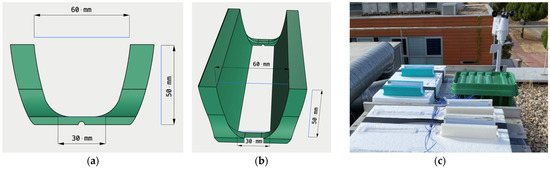
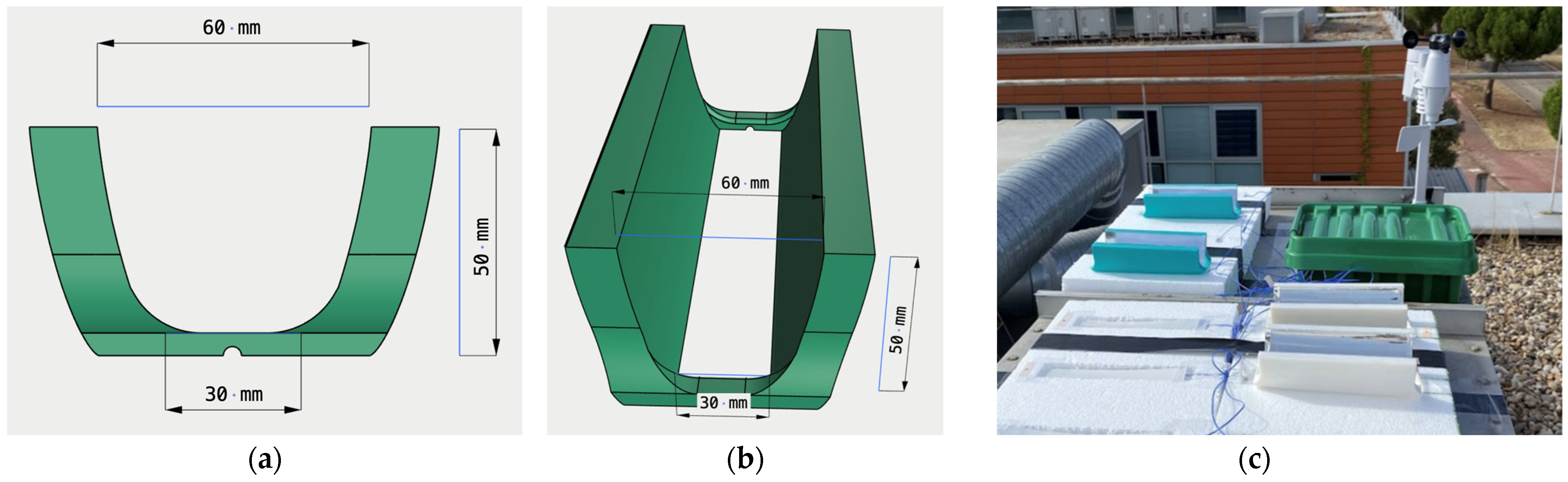
CPC optical systems are used to direct IR radiation toward zenith, increasing the sky-view factor. CPCs are manufactured by 3D printing with both Polylactic Acid (PLA) and Polyethylene Terephthalate Glycol (PETG) with aluminum-film metallization. CPCs used for the urban lighting experiment are 2D (linear) designs with a base of 30 × 200 mm2, aperture of 60 × 200 mm2, height = 50 mm, and a half-angle of 15° (see Figure 1).
Figure 1.
2D-CPC system for urban lighting experiment: (a) CAD design of the 2D-CPC; (b) 3D rendering thereof; (c) Picture of the actual setup.
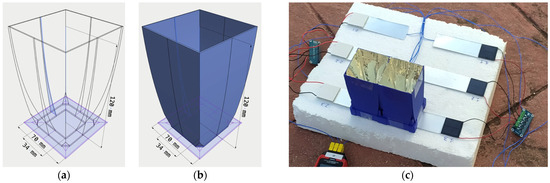
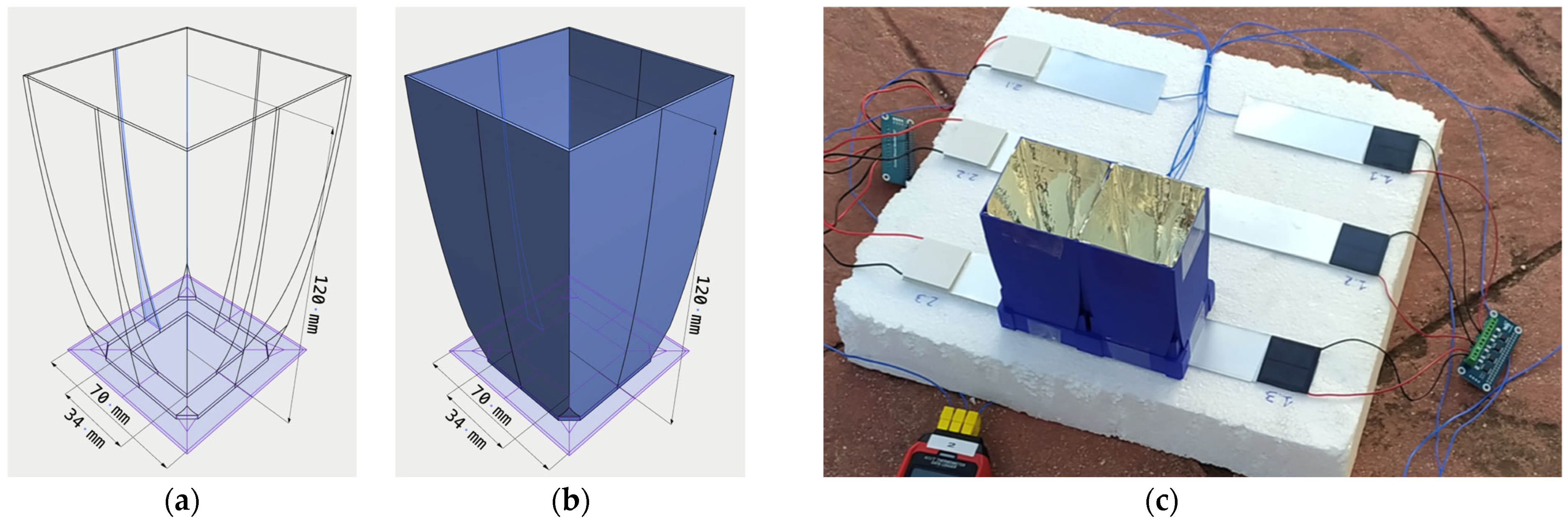
For the IoT-EH experiment 3D-CPCs have been used with base of 34 × 34 mm2, aperture of 70 × 70 mm2, height = 120 mm, and a half-angle of ~4.5° (see Figure 2). The CPC geometry follows standard non-imaging optics design principles, which maximize etendue-limited collection rather than image quality [32,33]. The designated 3D-CPC geometry was selected as a standard, well-established non-imaging optical system that combines high angular acceptance, uniform irradiance at the exit aperture and straightforward manufacturability.
Figure 2.
3D-CPC system for IoT-EH experiment: (a) CAD design of the 3D-CPC; (b) 3D rendering thereof; (c) Picture of the actual setup.
CPCs can be readily fabricated using common, off-the-shelf 3D-printing machinery and fairly accessible reflective coatings. In contrast, Fresnel lenses or other imaging optical systems would require tighter fabrication tolerances and materials with strictly controlled optical properties (emissivity, reflectivity, transmissivity), which become increasingly challenging in the thermal infrared range. Hence, CPCs are especially suitable for rapid prototyping and iterative experimentation.
CPC’s dimensions were chosen so as to match the characteristic size of the energy harvesters used within this work. Specifically, the exit aperture was selected to be comparable to the active area of both EH generators, while its relation to the entrance aperture provides a moderate concentration ratio and acceptance angles within the common range for standard RC use cases.
Although the optical systems were ultimately mounted on aluminum plates bonded to the generators rather than directly on top of them, the optical design and system performance remain representative of a practical, deployable configuration.
2.3. Devices for Empirical Characterization and Measurement
- Urban Lighting: Schreder’s LED luminaire model Izylum [34], in which we installed temperature sensors. LED luminaires have been retrofitted by covering its upper housing with RC film and CPCs, leaving the optical aperture unobstructed so as not to change the illumination delivery pattern. Reference luminaires without any RC add-on have been used as reference.
Regarding IoT-EH, we used two off-the-shelf harvesters that are easily accessible, available to purchase, and well documented/tested online:
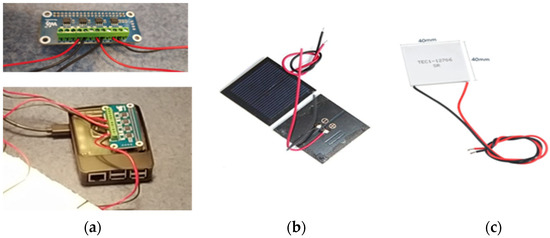
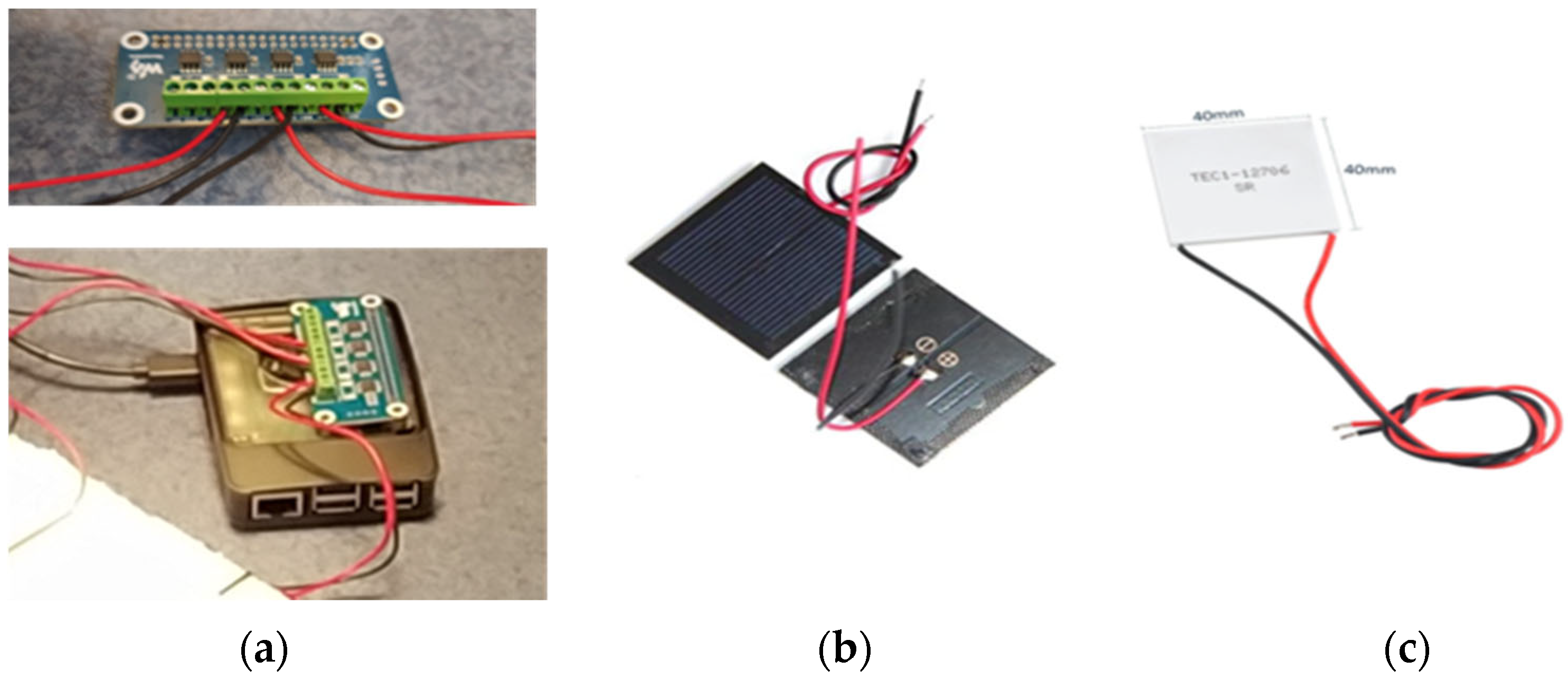
- PV: a small, single-junction commercial PV cell2, 40 × 40 mm, working in open-circuit (OC) conditions during testing [35]. Open-circuit voltage (VOC) has been selected as the primary electrical indicator because it exhibits a strong and repeatable temperature dependence while being minimally affected by series-resistance losses and load/MPPT operation. This makes VOC well suited for outdoor, side-by-side comparison of the reference PV module and the radiatively cooled configurations. To mitigate irradiance-related effects, particularly relevant for the CPC configuration, VOC data have been recorded simultaneously and under identical irradiance conditions.
- TE: a commercial Peltier-type thermoelectric generator [36], 40 × 40 mm2, operating with its output connected to a high-impedance voltage measurement channel.
To measure the electrical variables described above, a four-channel data acquisition system connected to a Raspberry Pi 5 single board computer (Raspberry Pi Foundation, Cambridge, UK) was employed [37]. This setup (Figure 3) enables simultaneous voltage measurements on all devices under test, ensuring that EH generators are evaluated under identical irradiance and environmental conditions.
Figure 3.
IoT EH devices used for experimental work: (a) High-impedance voltage measurement system; (b) PV cell; (c) TE module.
In this study, the choice of VOC instead of maximum power point tracking (MPPT) or matched-load operation, is supported by the well-established behavior of PV cells, for which the short-circuit current is predominantly governed by incident irradiance and might exhibit only a weak dependence on temperature, whilst the voltage at the maximum power point closely follows the evolution of the open-circuit voltage. As a result, VOC provides a reliable proxy for tracking relative performance changes when comparing geometrically similar devices operating under the same illumination conditions.
Similarly, maximum power extraction in TE devices requires dynamic load matching due to temperature-dependent internal impedance, VOC remains directly proportional to the temperature gradient across the device and is independent of the external electrical load. Consequently, VOC offers a consistent, load-independent metric for comparing different experimental configurations and identifying performance trends.
Temperatures of LEDs luminaries and IoT harvesters have been monitored using multichannel thermocouples data loggers [38]. Temperatures samples are recorded every 60 s. Meteorological parameters (ambient temperature, relative humidity, solar irradiance and wind speed) are monitored using a commercial weather station [39] located at the building rooftop (7 m high above the experimental setups locations). Samples are recorded every 5 min.
2.4. Experimentation Methodology
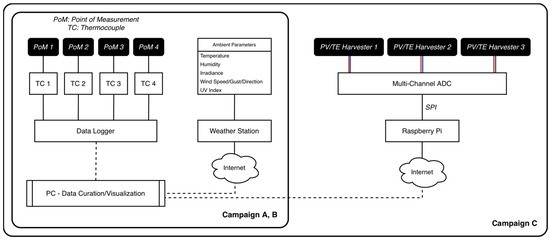
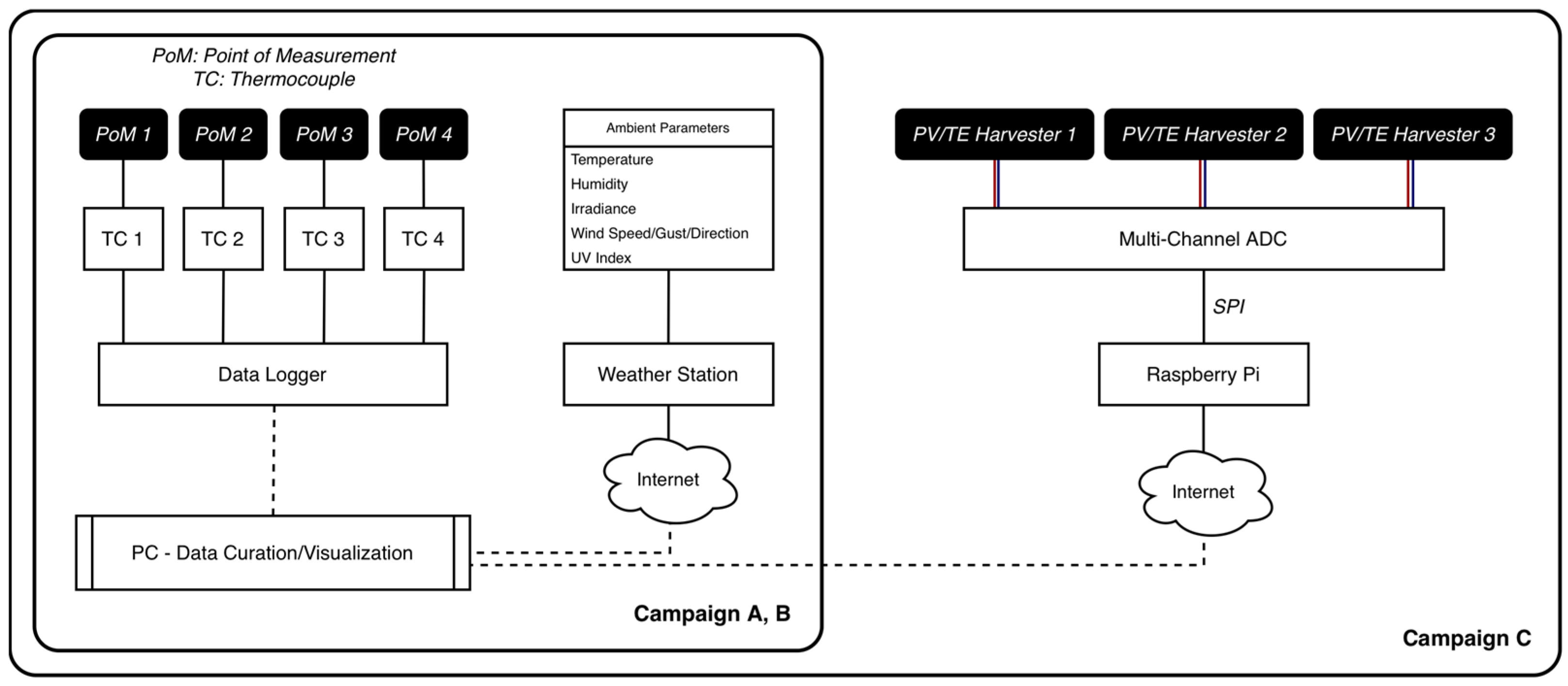
The work is structured into three testing campaigns, being all of them located at the outdoor facilities of CeDInt-UPM (Pozuelo de Alarcón, Madrid, Spain). Recorded data were imported and analyzed using standard numerical tools. Figure 4 depicts the experimental setup used on all campaigns. For each configuration and campaign, we computed:
Figure 4.
Experimental setup architecture for Campaign A and Campaign B, plus the extended voltage metering setup required for Campaign C. Dotted lines indicate temporary interfaces to retrieve experiments’ measurements after they are done.
- Average, maximum, and minimum temperatures (and voltages for the PV and TE modules) over the acquisition windows.
- Pairwise differences in average temperature () and average voltage () for RC vs. Al reference and RC + CPC vs. Al reference.
- A.
- Campaign A (27–28 October 2025):
Objective: Analyzing the cooling effect of RC materials on the luminaire under real outdoor conditions, daytime, and nighttime.
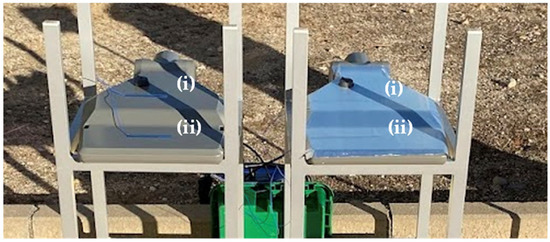
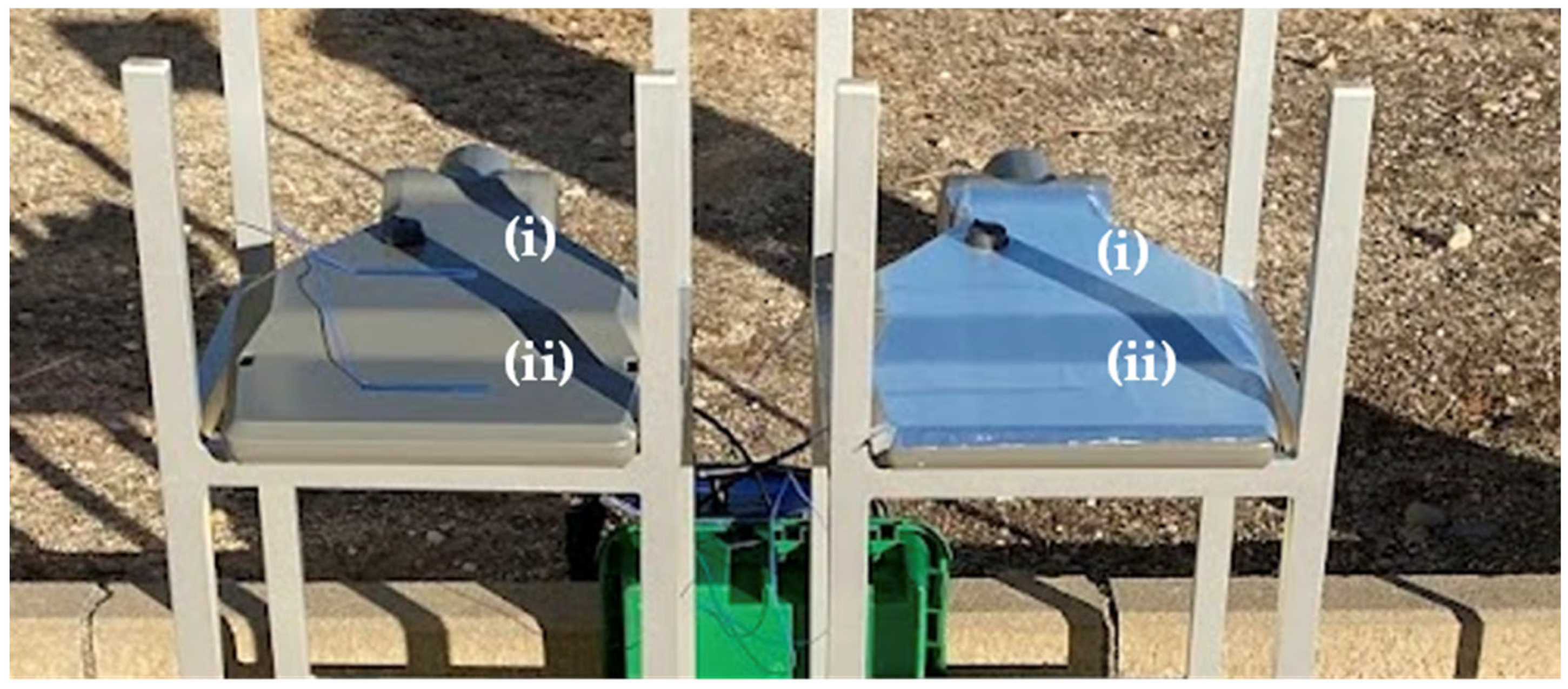
Temperature measurements have been performed on an LED luminaire (reference) and on an LED luminaire whose head has been completely covered with RC film (see Figure 5). The temperature has been measured at two points: (i) electronic driver case and (ii) LED PCB case; sampled every 60 s from 17:33 (27 October) to 17:22 (28 October) local time, resulting in 1430 temperature samples per channel.
Figure 5.
Experimental setup for Campaign A: reference LED luminaire (left) and RC film covered LED luminaire (right). Two points of measurement at (i) Electronic driver case and (ii) LED PCB case.
- B.
- Campaign B (29–30 September 2025):
Objective: Determining the effect of using CPCs as enhancers in radiative cooling systems for urban lighting, under real outdoor daytime and nighttime conditions.
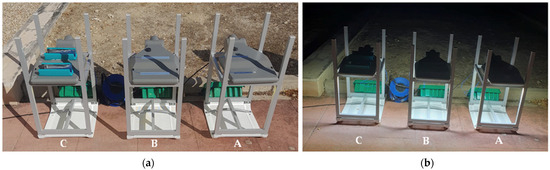
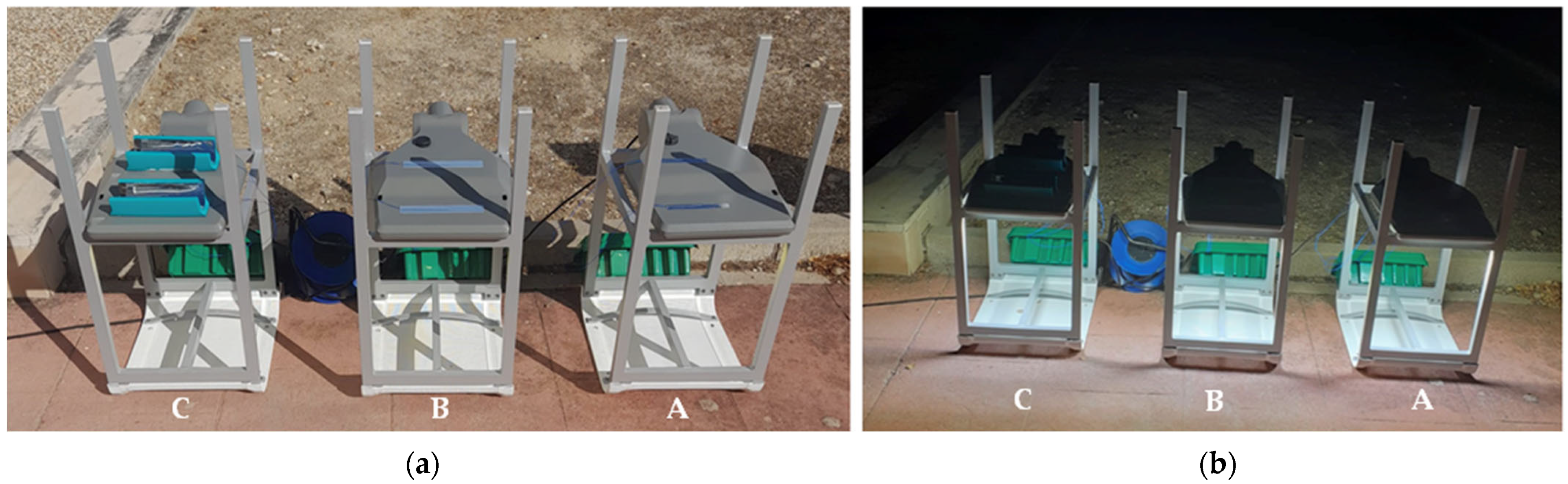
Temperature measurements are performed on a plain LED luminaire as reference, plus on an LED luminaire equipped with two 3 × 20 cm RC film strips placed over the LED PCB case and the electronic driver case each, and on another unit to which two linear CPCs (Figure 1) have been attached (see Figure 6). The temperature measurements have been carried out at two points: (i) electronic driver case, and (ii) LED PCB case; sampled every 60 s from 16:52 h (29 September) to 12:07 h (30 September) local time, resulting in 1157 temperature samples per channel.
Figure 6.
Experimental setup for Campaign B: (a) Daytime; (b) Nighttime. Three configurations are compared: (A) reference luminaire; (B) luminaire with RC film strips; (C) luminaire with RC film strips + CPCs.
- C.
- Campaign C (15 October 2025):
Objective: Obtaining a first experimental indication of the cooling effect on PV and TE modules under real outdoor daytime conditions, and to explore its potential impact on power generation.
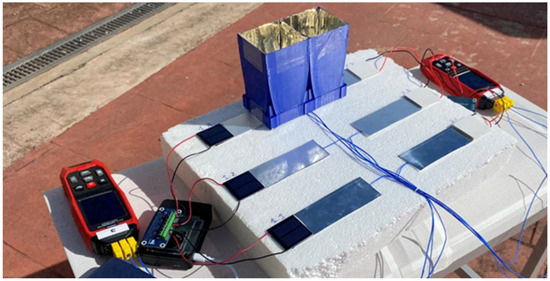
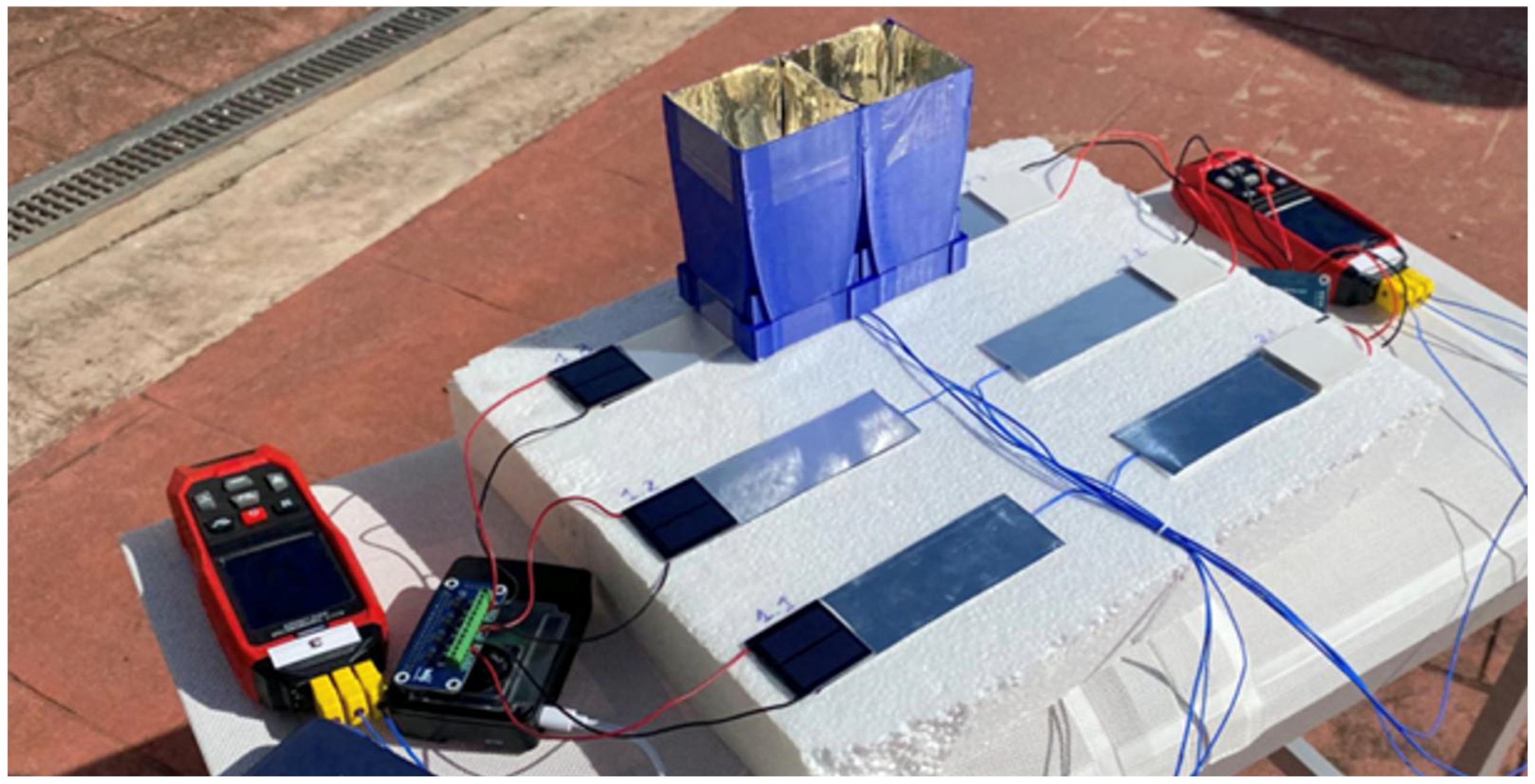
For this initial study of the radiative-cooling effect on IoT-oriented EH systems, we used three single-junction commercial PV cells and three Peltier-type TE modules, as presented in Section 2.3. Each module was prepared with a different radiative configuration (see Figure 7):
Figure 7.
Experimental setup for Campaign C: configurations used for PV and TE characterization: Al, RC, RC + 3D-CPC for both PV (left side) and TE (right side).
- Al (reference): module mounted on an aluminum plate without additional coating.
- RC: same mechanical configuration, with the RC film laminated onto the plate.
- RC + 3D-CPC: RC-coated configuration with an additional 3D CPC optical system (Figure 2) mounted above the active area. Its presence modifies both the optical field of view and the convective environment around the module.
Six contact temperature sensors (K-type thermocouples) were attached directly to the rear surfaces of the PV and TE modules. All modules were mounted on a common support made of temperature-insulating expanded polystyrene (EPS) to ensure comparable irradiance conditions, convection, and conduction paths.
These tests were intentionally limited in duration and carried out on a single day. As such, they are intended as a proof-of-concept campaign, to identify observable trends and guide the design of more extensive multi-day measurement campaigns and in-depth electrical characterization in future work. Temperatures and voltages were sampled every 60 s from 12:33 h to 13:55 h local time, resulting in 80 samples per channel.
3. Results
3.1. Campaign A: Effect of RC Film in Lighting Systems
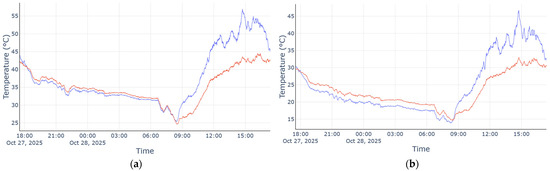
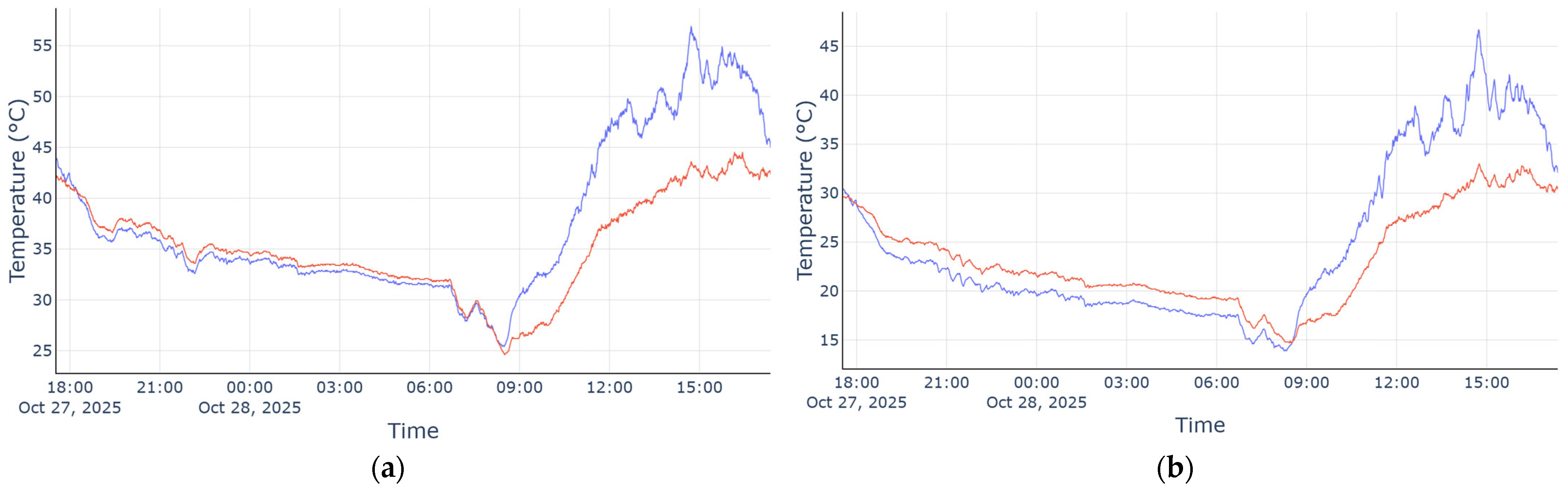
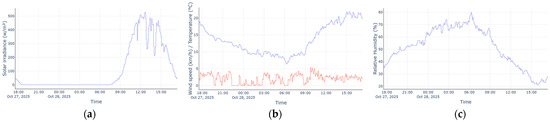
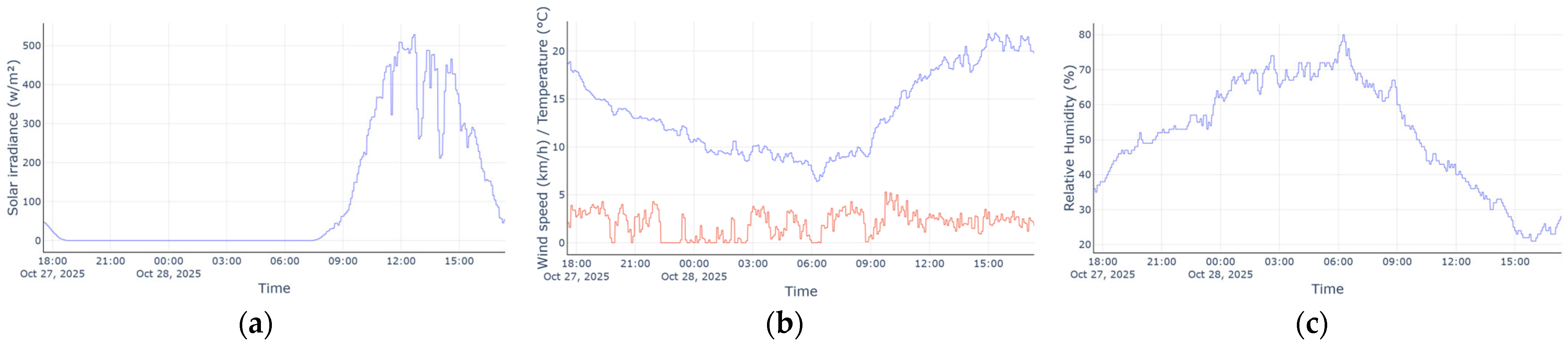
In Campaign A, a luminaire head fully covered with the RC film is compared with a standard luminaire. Measurements are shown in Figure 8 while Figure 9 summarizes the ambient conditions: temperature, relative humidity, wind speed, and solar irradiance throughout the measurement campaign.
Figure 8.
Case temperature with (red) and without (blue) RC film: (a) LED drivers; (b) LED PCBs.
Figure 9.
Ambient conditions during Campaign A: (a) Solar irradiance (W/m2); (b) Ambient temperature (blue) and wind speed (red); (c) Relative humidity.
The measurements reveal that the impact of the RC film depends strongly on solar irradiance. Under daytime conditions, the RC film provides a clear and significant cooling effect. In contrast, during nighttime, its effect is negligible and, in some cases, it even leads to higher temperatures than the reference configuration. Section 4 discusses the underlying mechanisms behind this observed behavior.
Since solar irradiance strongly affects the thermal balance, the measurements have been analyzed in two separate regimes: nighttime, defined as periods with negligible solar irradiance (Global Horizontal Irradiance GHI ≈ 0 W/m2), and daytime, defined as periods with sufficiently high irradiance (GHI > 50 W/m2). Data points with intermediate irradiance levels (0 < GHI < 50 W/m2) have been excluded, as they correspond to transitional conditions during sunrise and sunset [40].
Using this criterion, nighttime measurements span from 18:48 h on 27 October and 7:28 h on 28 October. Temperature is recorded at 1 min intervals, yielding 761 samples per channel. Daytime measurements have been collected from 08:54 to 17:22 on 28 October, yielding 509 temperature samples per channel.
Table 2 and Table 3 show the average, maximum, and minimum values of the temperature increases for nighttime and daytime calculated as in Equation (1), where represents the temperature recorded with the radiative cooling enhancer on, and the plain device with no radiative cooling enhancer—film envelope in this case:
Table 2.
LED luminaire temperature increases by RC film during nighttime period.
Table 3.
LED luminaire temperature increases by RC film during daytime period.
For the statistical analysis of temperature increases in the electronic driver case and the LED PCB case, a set of descriptive metrics have been computed, including the average, minimum, maximum, median, standard deviation (σ), and the first (25th percentile) and third quartiles (75th percentile).
The results are presented as a comparative exploratory analysis using box-and-whisker plots, with an overlay of error bars indicating the average ± σ. The boxplot summarizes central tendency (median), variability through the interquartile range (IQR = Q3 − Q1), and the overall spread through the whiskers (from the lower to the upper whisker). Outliers would appear as individual markers, but none were observed in the analyzed data.
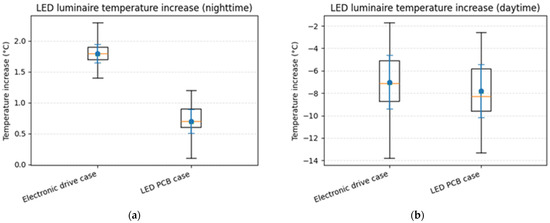
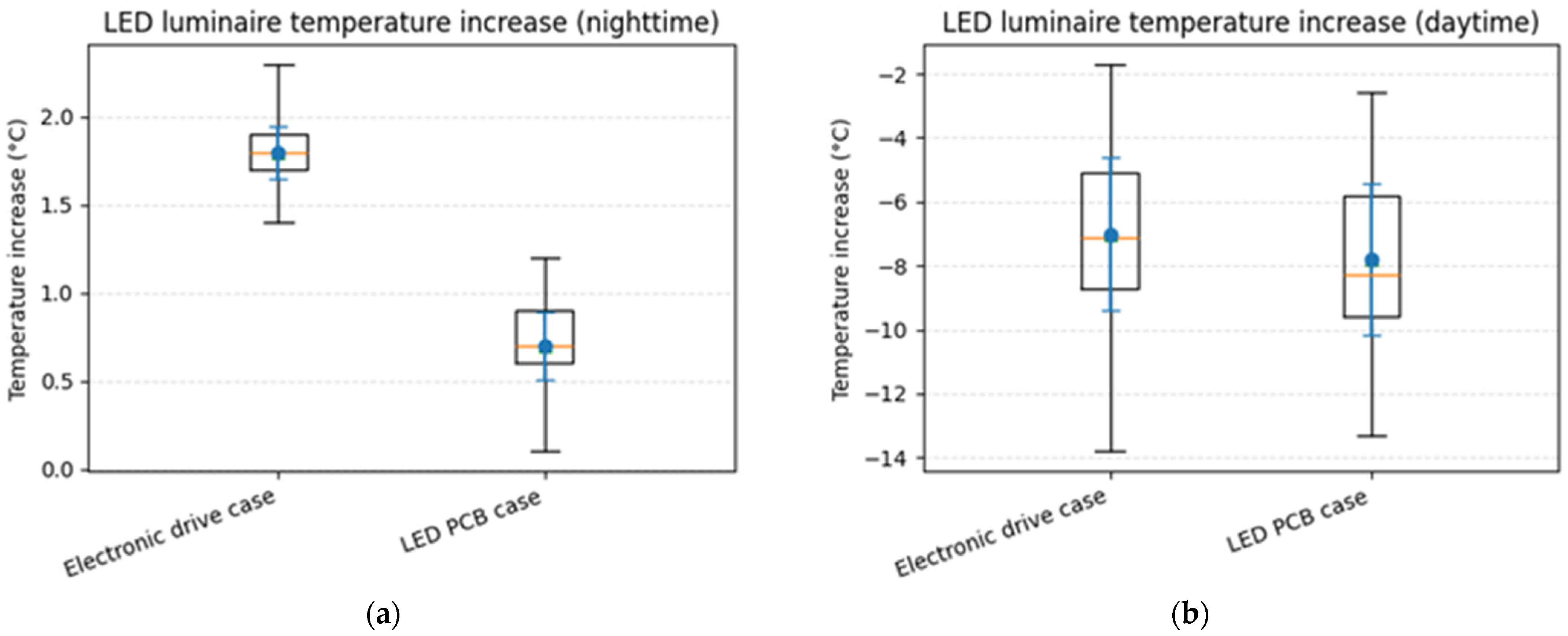
Error bars are superimposed on each boxplot to represent ±σ around the average, providing a complementary description of dispersion. This combined representation allows a robust analysis, since median and IQR are less sensitive to skewness or extreme values than the average and σ. Figure 10 shows the boxplots and error bars representing statistical analysis of temperature increases for nighttime and daytime for the two measurement points.
Figure 10.
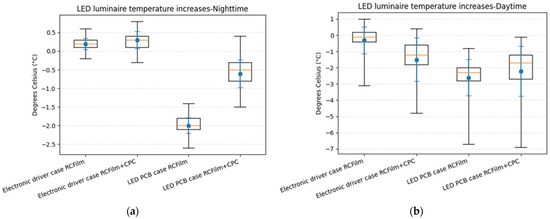
Campaign A—distribution and variability of temperature increase (°C) for two measurement points. Box-and-whisker plots summarize the median, interquartile range, and overall spread, while overlaid error bars represent the mean ± σ at: (a) Nighttime; (b) Daytime.
For each boxplot, the orange horizontal line inside the box represents the median. The box represents the interquartile range (Q1–Q3). The whiskers represent the overall data range (excluding outliers). The error bars are shown as a blue circular marker located at the average value and vertical blue lines extending above and below that marker with short horizontal caps at the upper and lower ends. The upper cap corresponds to average +σ. The lower cap corresponds to average −σ.
Thus, the total height of each error bar represents a range of ±1σ around the average, providing a moment-based measure of dispersion that complements the boxplot. The blue error bars are independent of the quartiles and whiskers and strictly reflect average-based variability. This combined visualization allows us to assess robust statistics (median and IQR) alongside average-based dispersion, improving the interpretability of temperature increases.
The quality of the dataset of Campaign A is supported by the long acquisition windows and the high temporal resolution. Nighttime measurements (18:48 on 27 October to 07:28 on 28 October) and daytime measurements (08:54 to 17:22 on 28 October) are recorded at 1 min intervals, yielding 761 and 509 samples per channel, respectively, and ensuring good coverage of the corresponding operating regimes.
The distributions are well behaved, with average and median values in close agreement for both measurement points, indicating limited skewness. Nighttime results exhibit low dispersion (σ ≈ 0.15–0.19 °C and IQR ≈ 0.2–0.3 °C), consistent with stable ambient conditions and confirming good repeatability. In contrast, daytime results show substantially larger variability (σ ≈ 2.35–2.38 °C and IQR ≈ 3.6–3.8 °C), which is expected for outdoor measurements under changing irradiance.
Nevertheless, the sample size and the narrow agreement between average and median support the robustness of the reported averages. Since temperature time series are inherently autocorrelated at 1 min sampling, statistical uncertainty should be interpreted in terms of an effective number of independent samples rather than the raw sample count. Section 4 presents the discussion of the obtained results.
3.2. Campaign B: Effect of CPC in Urban Lighting Systems
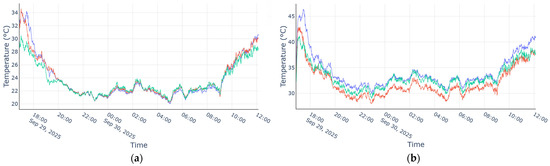
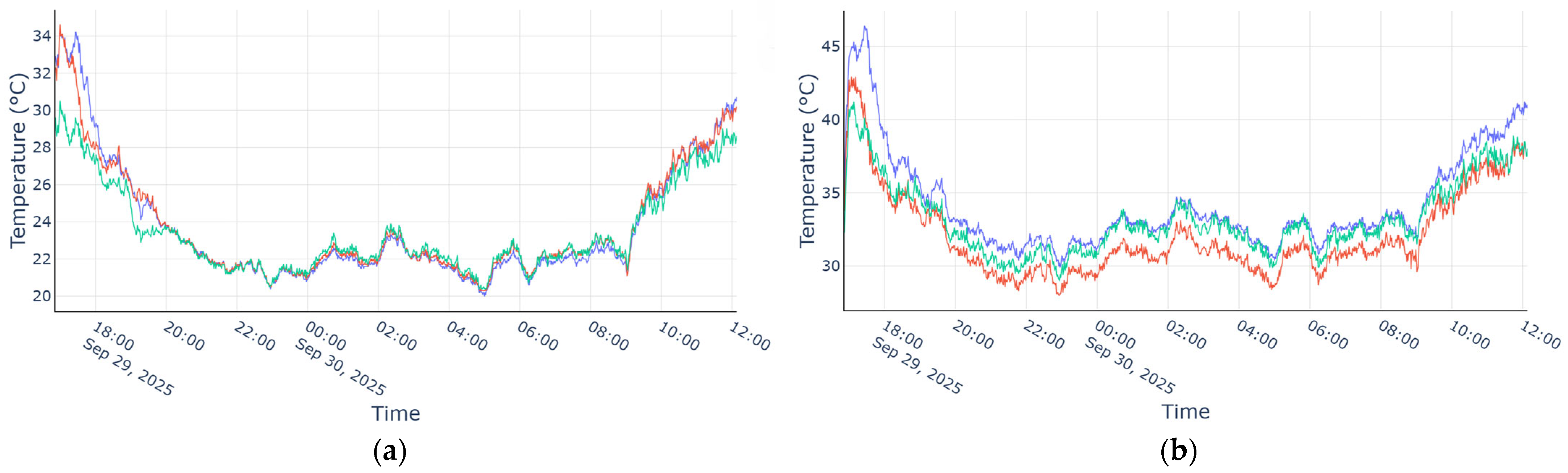
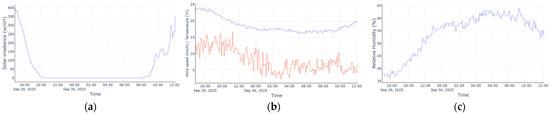
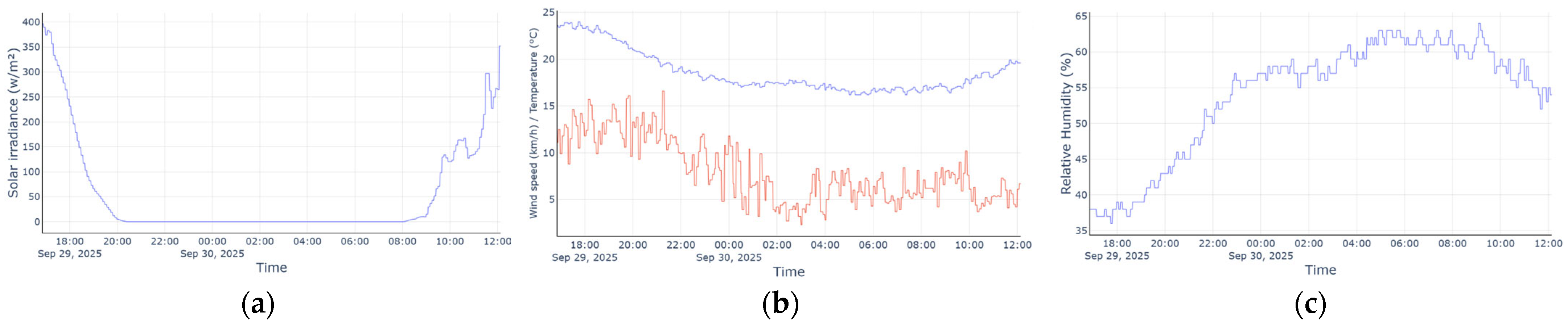
In Campaign B, a standard luminaire (reference) is compared with one in which two RC film strips have been installed and with another configuration with two RC-film strip each coupled to a linear CPC. Measurements are shown in Figure 11 while Figure 12 summarizes the ambient conditions: temperature, relative humidity, wind speed, and solar irradiance throughout the measurement campaign.
Figure 11.
Reference temperature (blue), RC film temp. (red) and RC film + CPC temp. (green): (a) LED driver cases; (b): LED PCB cases.
Figure 12.
Ambient conditions during Campaign B: (a) Solar irradiance (W/m2); (b) Ambient temperature (blue) and wind speed (red); (c) Relative humidity.
To account for the effect of solar irradiance on the thermal balance, the measurements are analyzed over two periods, nighttime and daytime, in a manner similar to that adopted in Campaign A.
Nighttime measurements (GHI = 0W/m2) span from 20:23 on 29 September and 8:03 on 30 September. Temperature is recorded at 1 min intervals, yielding 701 samples per channel. Daytime measurements (GHI ≥ 50W/m2) have been collected from 16:52 to 19:17 on 29 September and from 9:19 to 12:07 on 30 September, yielding 316 temperature samples per channel. Table 4 and Table 5 show the average, maximum and minimum values of the temperature increase for nighttime and daytime calculated as in Equation (1).
Table 4.
LED luminaire temperature increases by RC film with and without CPC—Nighttime.
Table 5.
LED luminaire temperature increases by RC film with and without CPC—Daytime.
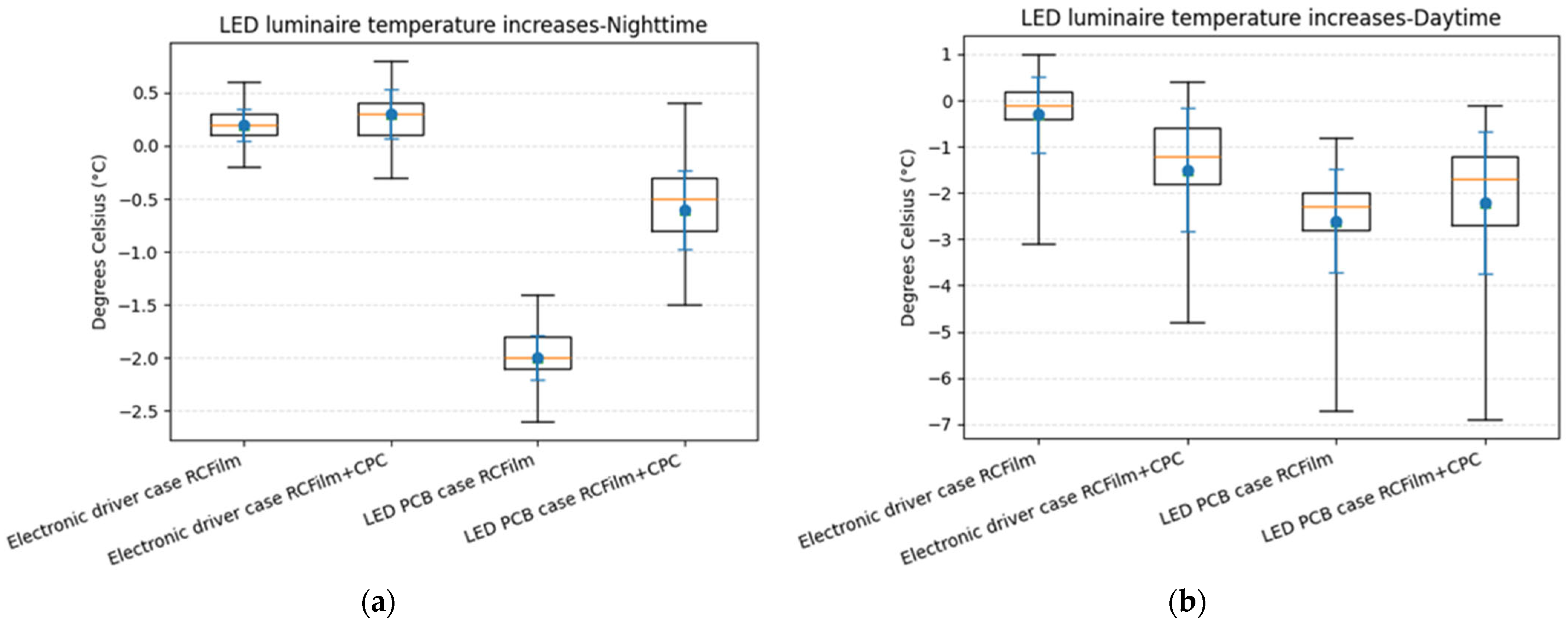
Figure 13 shows the boxplots and error bars representing statistical analysis of temperature increases for nighttime and daytime for the measurement points, similarly to Figure 9.
Figure 13.
Campaign B—Distribution and variability of temperature increase (°C) for measurement points. Box-and-whisker plots summarize the median, interquartile range, and overall spread, while overlaid error bars represent the mean ± σ at: (a) Nighttime; (b) Daytime.
Campaign B measurements provide a solid basis for comparing the thermal behavior of a reference luminaire against two radiative-cooling configurations (two RC film strips and two RC film strips + CPC) under real outdoor conditions. To isolate the influence of solar loading on the heat balance, the dataset is consistently split into nighttime (GHI = 0 W/m2; 701 one-minute samples per channel) and daytime (GHI ≥ 50 W/m2; 316 one-minute samples per channel), following the same approach used in Campaign A.
The relatively large sample counts and the 1 min logging resolution improve statistical confidence and allow robust descriptive metrics (quartiles, median, average, and standard deviation) to be computed for each configuration. At night, variability is low, particularly at the electronic driver case (σ ≈ 0.15–0.23 °C) and at the LED PCB case for RC-film (σ ≈ 0.21 °C), indicating stable conditions and good repeatability of the temperature differences, with RC-film yielding a consistent cooling effect on the LED PCB case (median ≈ −2.0 °C). During daytime, dispersion increases markedly (driver σ ≈ 0.82–1.33 °C; LED PCB σ ≈ 1.11–1.54 °C), as expected due to rapidly changing irradiance and ambient boundary conditions.
Nonetheless, central tendencies still indicate cooling in most channels, e.g., average ΔT ≈ −0.3 °C for the driver with RC film and ≈ −1.5 °C with RC film + CPC, and average ΔT ≈ −2.6 °C and −2.2 °C at the LED PCB case, respectively. Overall, the combination of clear irradiance-based segmentation, high-frequency logging, and coherent distributions (quartiles aligned with the averages/medians) supports good measurement quality, while the larger daytime spread appropriately reflects the greater environmental variability rather than instrumental noise.
3.3. IoT-EH with PV and TE
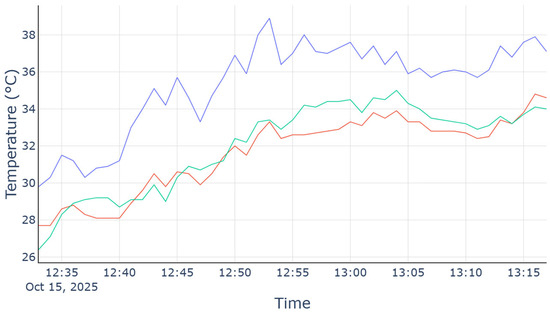
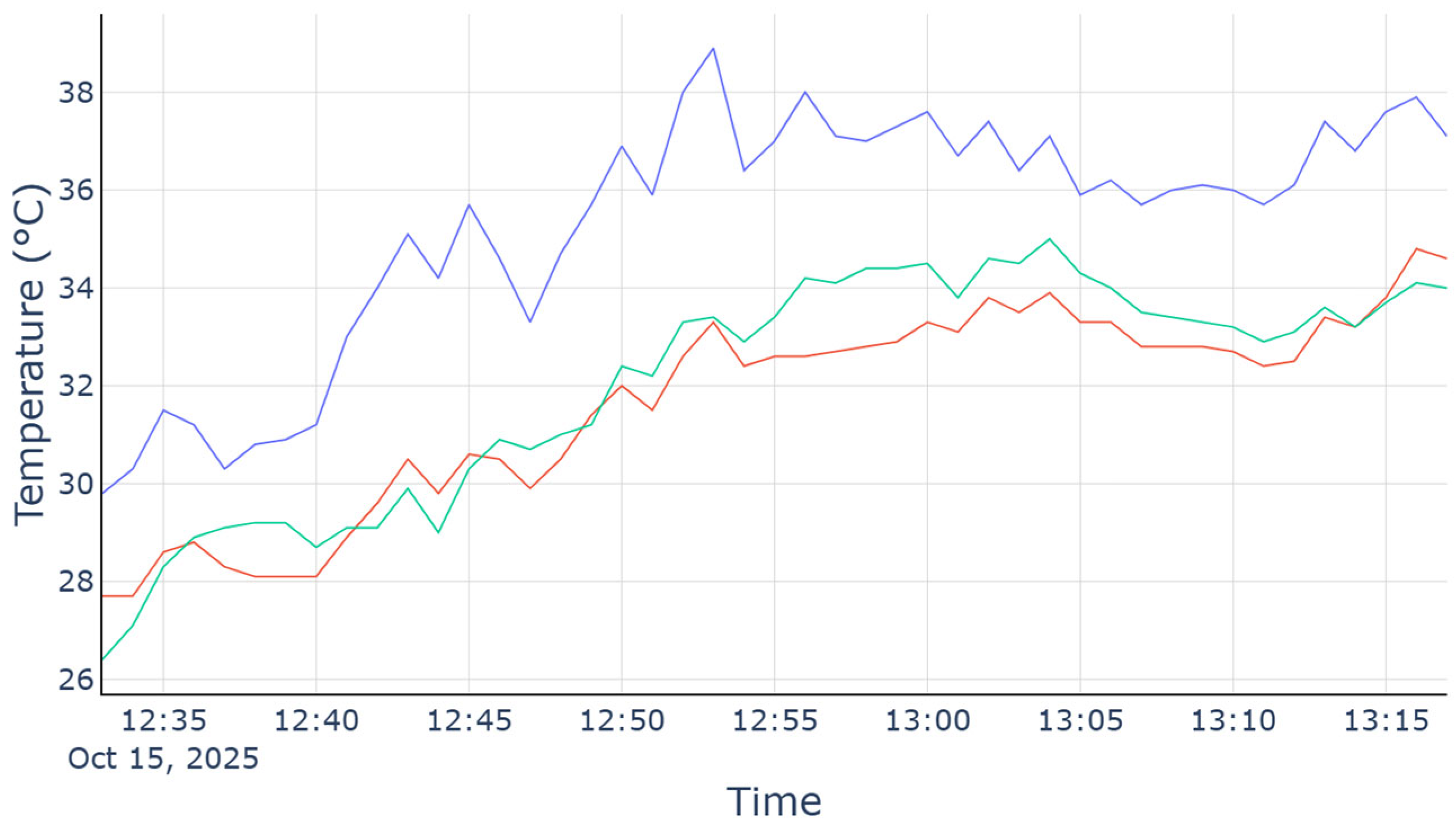
Regarding PV characterization, Figure 14 shows temperature records from 12:33 h to 13:17 h. Table 6 shows the comparison of the cooling achieved with the RC film alone and combined with the 3D-CPC in terms of measured temperature, expressed as relative to the aluminum plate. Table 7 reports the corresponding changes in open-circuit voltage .
Figure 14.
Campaign C—Temperature measurements of PV modules during the 12:33–13:17 interval: Al plate (blue), RC film (red), and RC + 3D-CPC (green).
Table 6.
PV cell temperature increases by RC film with and without 3D-CPC.
Table 7.
PV cell VOC increases by RC film with and without 3D-CPC.
For the PV modules, the RC configuration was on average 3.7 °C cooler than the aluminum plate, while the RC + 3D-CPC configuration showed an average reduction of 3.3 °C (Table 5). These thermal differences produced small but measurable changes in PV open-circuit voltage: the RC configuration exhibited an average of 15 mV (12–20 mV), whereas RC + 3D-CPC yielded a much smaller average increase of about 2 mV (0–8 mV) (Table 6).
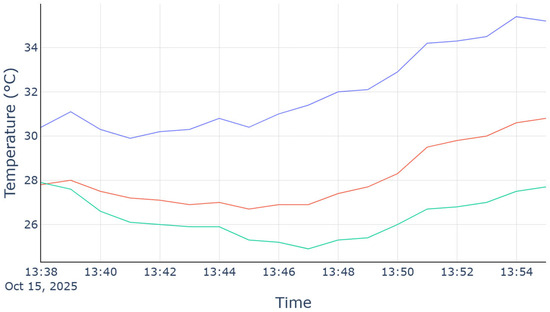
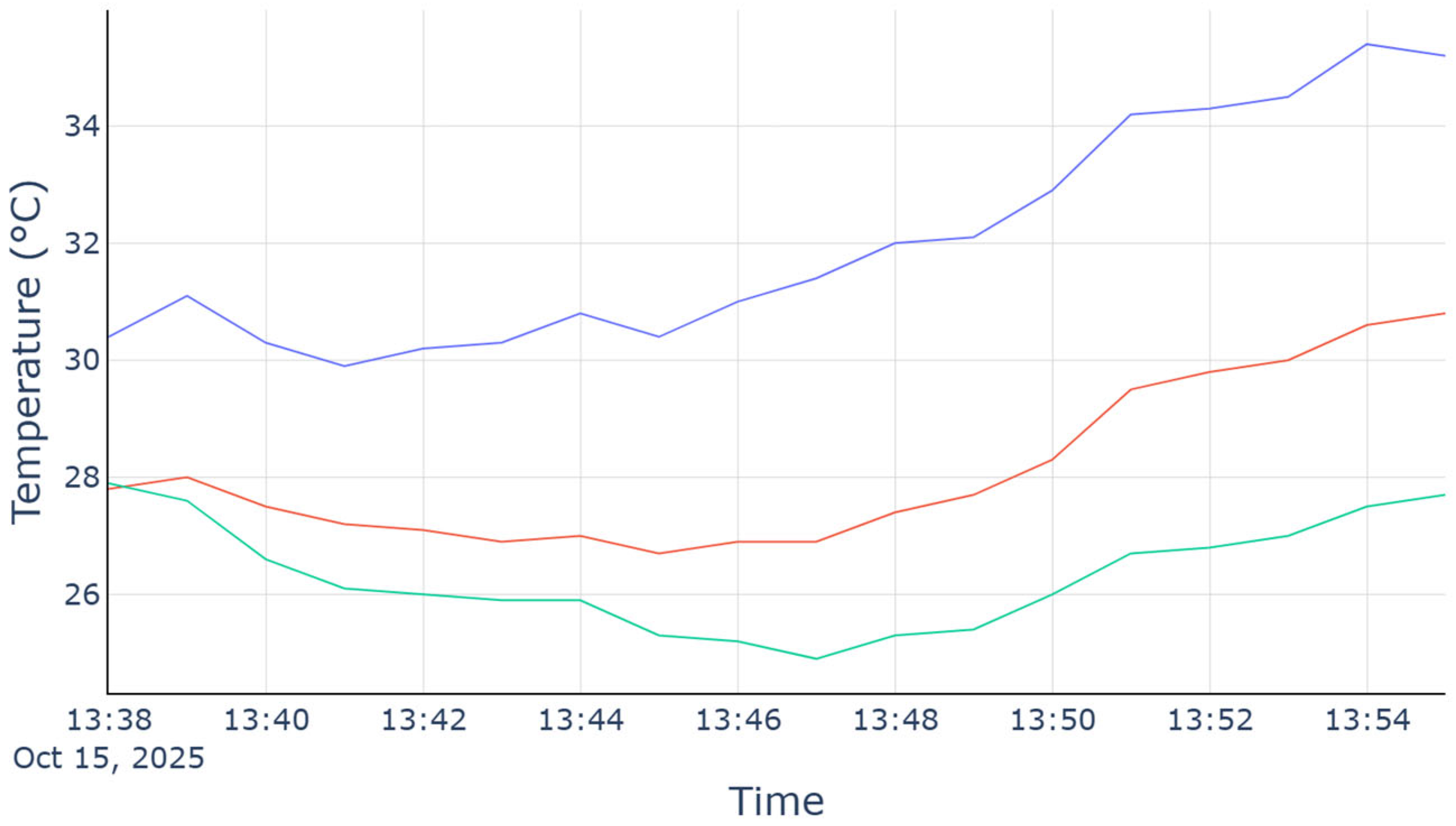
Figure 15 shows the temperature records from the TE modules in the interval 13:38–13:55 h. Table 8 shows the comparison of the cooling achieved with the RC film alone and combined with the 3D-CPC in terms of measured temperature. values have been calculated with respect to the of the reference (Al plate). Table 9 shows the increase in measured in each Peltier-type TE generator.
Figure 15.
Campaign C—Temperature measurements of TE modules during the 13:38–13:55 interval: Al plate (blue), RC film (red) and RC + 3D-CPC (green).
Table 8.
TE temperature increases by RC film with and without 3D-CPC.
Table 9.
Peltier-type TE generator VOC increases by RC film with and without 3D-CPC.
For the TE modules, the RC configuration was on average 3.9 °C cooler than the aluminum plate, while the RC + 3D-CPC configuration showed an average reduction of 5.7 °C (Table 8). The associated values for the TE generators remain modest but systematic: average increases of 12.0 mV for RC and 10.7 mV for RC + 3D-CPC (Table 9), with the spread in individual values reflecting the sensitivity to small variations in thermal gradient and contact conditions.
Given the relatively slow thermal dynamics of the modules and the limited length of the acquisition windows, campaign-averaged values provide a useful first indicator of performance differences. All voltages are interpreted as near open-circuit values, since the measurement instruments had a much higher input impedance than the internal resistance of the PV and TE modules.
4. Discussion
4.1. Main Findings and Relevance
Campaign A aims to analyze the cooling effect of RC film on the luminaire under real outdoor conditions, daytime, and nighttime. Measurements have been collected from 27 October 2025 17:33 to 28 October 2025 17:22 at 1 min resolution. Ambient conditions during the test ranged from 6.4 to 21.9 °C (air temperature), 21% to 80% (relative humidity), 0 to 5.3 km/h (wind speed), with a maximum solar irradiance of 528 W/m2. Temperature differences are defined so that negative ∆T indicates the RC-film luminaire is cooler than the reference.
The key outcome is that the RC-film benefit is primarily observed during daytime, when solar loading is present. Average daytime reductions were −7.0 °C at the electronic driver case (minimum observed −13.8 °C) and −7.8 °C at the LED PCB case (minimum observed −13.3 °C). At night, differences were small and slightly positive (+1.8 °C at the electronic driver case, +0.7 °C at the LED PCB case). Overall, these results indicate that under real outdoor conditions, the measured advantage of the RC film is dominated by reduced daytime heat gain rather than a strong net nighttime radiative-cooling effect at the monitored points.
Campaign B evaluates whether CPC elements enhance radiative cooling in street-lighting conditions by measuring three luminaires simultaneously (reference, RC film strips, RC film strips + CPC), which helps suppress shared environmental variability. Sampling was dense: 1 min resolution, with 701 samples/channel at night (20:23–08:03) and 316 samples/channel during daytime (16:52–19:17 and 09:19–12:07). Daytime irradiance was moderate (up to ~397 W/m2), so conclusions should be interpreted within that range.
During nighttime, at the LED PCB case, RC-film strips alone show a stable cooling effect (average/median ~−2.0 °C, with a tight IQR around −2.1 to −1.8 °C). Adding CPC reduces this nighttime cooling at the LED PCB case (average ~−0.6 °C), consistent with a potential penalty from reduced sky view and/or modified local convection around the strip assembly.
During daytime variability increases as expected, but trends remain clear. At the LED PCB case, both configurations provide cooling, with RC film strips alone slightly better (average ~−2.6 °C, median ~−2.3 °C) than RC film strips + CPC (average ~−2.2 °C, median ~−1.7 °C). At the electronic driver case, the CPC produces the most meaningful improvement: RC film strips alone is close to neutral (average ~−0.3 °C, median ~−0.1 °C), whereas RC film strips + CPC achieves clear daytime driver-case cooling (average ~−1.5 °C, median ~−1.2 °C, with ~95% of samples indicating cooling). In short, CPCs improve driver-case daytime performance, while they do not enhance—and may slightly reduce—LED PCB-case cooling compared with RC film strips alone.
Relevance for deployment: together, these campaigns show that a commercial RC film can yield measurable temperature reductions on off-the-shelf luminaires under realistic outdoor exposure—without product redesign. Full-coverage application (Campaign A) delivers the largest daytime reductions at critical components (order 7–8 °C, with peaks near 13–14 °C), highlighting its potential as a simple retrofit for solar heat-gain mitigation. The strip-based approach (Campaign B) confirms that meaningful cooling can also be achieved with partial coverage, and it clarifies the trade-off introduced by CPC add-ons: improved cooling in daytime at the cost of reduced nighttime cooling under the conditions tested.
4.2. Dependence on Irradiance: Evidence of Mechanism
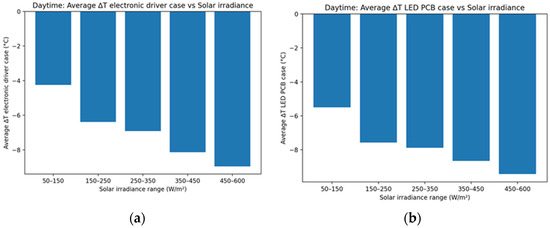
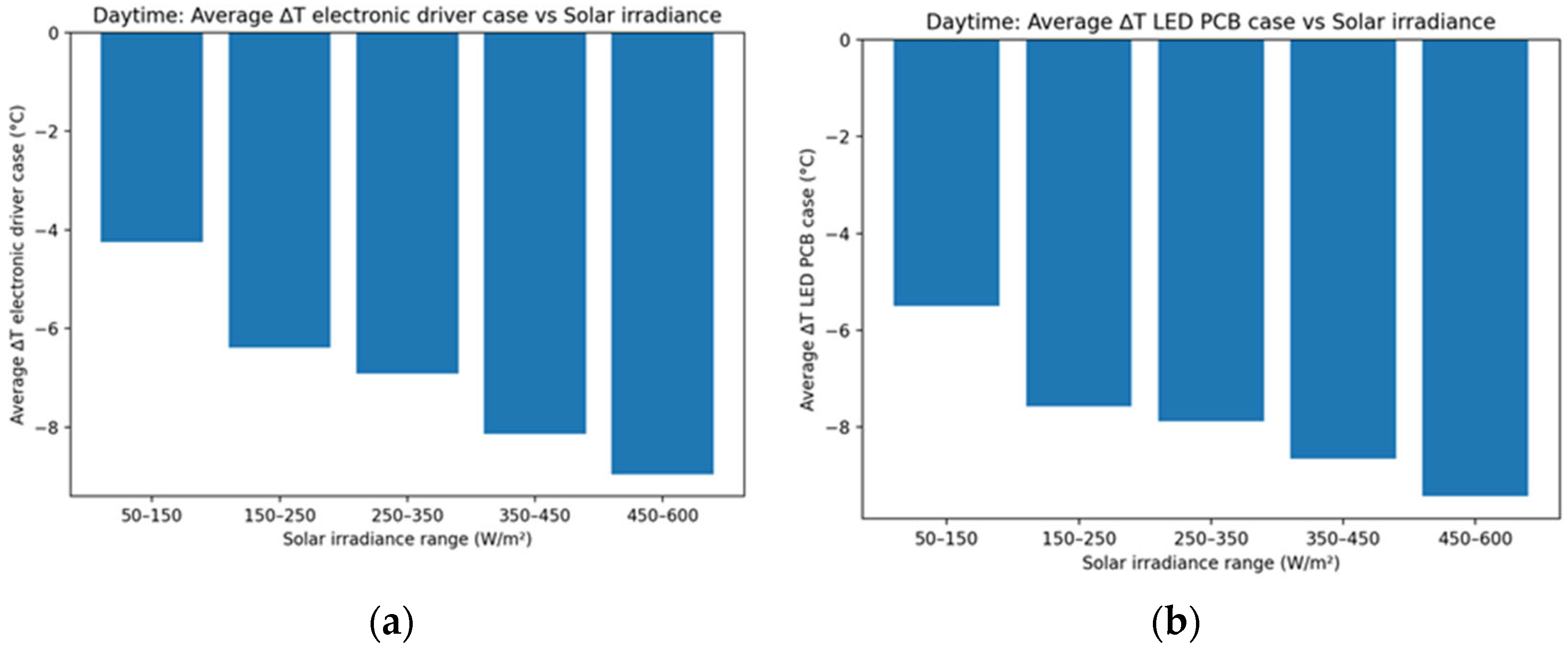
Regarding Campaign A, during daytime, the thermal benefit increases with irradiance—the stronger the sun, the larger the avoided heating. If the data are grouped by irradiance (W/m2), the average ∆T at LED PCB case and ∆T at electronic driver case evolves as depicted in Table 10 and Figure 16:
Table 10.
Temperature outcomes summary—Dependance on irradiance.
Figure 16.
Daytime: (a) Average ∆T at monitored points; (b) Solar irradiance.
In addition, during daytime the correlation between ∆T and irradiance is negative (the higher the irradiance, the higher the absolute value of ∆T), consistent with a film that reflects solar load and reduces overheating of the luminaire body.
4.3. Daytime vs. Nighttime Behavior of RC-Coated Luminaires
Campaigns A and B reveal a pronounced day–night asymmetry in the thermal response of RC-coated luminaires. During daytime, when solar loading is present, the RC film delivers its intended benefit: high solar reflectance reduces absorbed short-wave heat gains, whilst high mid-IR emissivity supports radiative heat rejection. The resulting temperature reductions are observed at the two measurement points: LED PCB case and electronic driver case.
At night, in contrast, the measured temperature differences are small and may become slightly positive (RC-coated luminaire marginally warmer than the reference). This behavior is consistent with real streetlight geometries and outdoor boundary conditions.
First, the effective radiative exchange with the sky is often limited by a low sky view factor: relevant surfaces see surrounding structures (housing, pole, diffuser, nearby obstacles) rather than the cold sky, which reduces the achievable net radiative cooling. Second, under the low-wind conditions of these measurements, convection can dominate the heat balance. The presence of an additional adhesive film layer can slightly hinder convective heat transfer and alter conduction paths from internal heat sources.
Overall, the data indicate that, for these luminaires and conditions, the main value of RC films is daytime thermal relief driven by solar heat-gain control, whereas nighttime benefits are limited and can be neutral or mildly adverse when convection dominates.
This has practical implications: the coating is expected to be most impactful in hot seasons and high-insolation environments, and deployment should consider strategies such as selective placement on sun-exposed housing areas or integration with heat-sink geometries to preserve daytime gains without penalizing nighttime convective cooling.
4.4. The Role of CPCs in Urban Lighting and IoT Harvesters
The CPC structures were introduced to explore whether directional control of thermal emission can complement spectral selectivity. For the luminaire, 2-D CPCs placed above RC-coated driver regions provided modest additional cooling (typically 1–2 °C) under daytime conditions, consistent with an increased effective sky-view factor and reduced exchange with nearby warm surfaces. In lighting applications where the sky view is partially obstructed by buildings or canopy, such optical steering could be more relevant, although this was not systematically explored here.
For the PV and TE modules, the 3-D CPC design mounted above the RC-coated plates influenced both the radiative and convective environment. The experiments showed that RC + 3D-CPC configurations generally maintained or slightly improved the cooling achieved by RC alone. For PV, the CPC’s additional electrical benefit in the present configuration was limited, indicating that CPC designs must be carefully adapted to the use case (acceptance angle, geometry, orientation, and interaction with convection).
Overall, the results indicate that CPCs can act as incremental enhancers rather than primary drivers of performance. Their value will likely be greatest in situations with constrained sky view or where shielding from direct solar gains and lateral radiative exchange is critical, but their added complexity and volume must be justified by the expected incremental gains.
4.5. Impact on LED Performance and Lifetime
For LED street luminaires, even moderate reductions in operating temperature are of interest. Lower head temperatures, if translated into reduced LED junction and driver temperatures, can help
- To mitigate efficiency droop,
- To stabilize chromatic properties, and
- To extend useful lifetime and maintenance intervals.
Typical reliability models suggest that a 10 °C reduction in junction temperature can significantly increase lifetime or allow higher drive currents for the same reliability target. In this context, the measured daytime cooling of several degrees (~7–8 °C) at the luminaire surface is potentially meaningful, especially for applications subject to high irradiance or daytime operation.
Considering typical thermal coefficients of LED efficacy (on the order of a few tenths of a percent per °C), a 7–8 °C reduction in junction temperature could reasonably correspond to 2–3% improvements in luminous efficacy. In practice, this can be interpreted as either a small reduction in electrical power for the same lighting level or as an extra safety margin that helps to keep the LEDs within their optimal operating range during warm periods.
However, the experiments in this study did not directly measure LED junction temperature, nor did they track long-term degradation. For that reason, the observed cooling should be interpreted as a positive indicator rather than a quantitative prediction of lifetime extension or exact energy savings. More detailed electrothermal modeling and long-term field trials are required to translate these surface-level measurements into robust lifetime and performance estimates.
4.6. Implications for IoT Energy Harvesting
For IoT devices, where energy budgets are often extremely constrained, the potential contribution of RC and CPC-assisted EH is of particular interest. The experiments with PV and TE modules show that the following:
- RC films lower device temperatures by ~3–6 °C relative to a bare aluminum reference, under the measured conditions.
- These reductions produce small but consistent gains in open-circuit voltage (percent-level for PV, millivolt-level for TE).
Under typical temperature coefficients for crystalline silicon PV devices (0.3% to 0.5% per °C in power or efficiency), a 3–6 °C reduction in cell temperature would translate into 1–3% increase in available electrical power, assuming operation near maximum power point. For thermoelectric harvesters, whose open-circuit voltage scales approximately with the temperature gradient, the extra degrees of cooling observed in our measurements correspond to a proportional increase in the effective ΔT that drives generation, and thus to a small but tangible gain in harvested power.
These findings indicate that RC can modestly improve the operating conditions of EH sources that might power IoT nodes. In scenarios where every milliwatt counts—such as low-irradiance locations, deeply duty-cycled sensor nodes, or combined solar/RC/TE architectures—even such modest gains could contribute to enabling fully autonomous operation or reducing the need for battery replacements.
At the same time, it is important to underline that the present work provides only initial experimental measurements aimed at settling the ground for the use of RC (and CPCs) with EH sources in IoT applications. The electrical characterization here was limited to open-circuit voltage, while the direct impact on harvested energy and on actual IoT duty cycles remains to be quantified.
4.7. Limitations
Several limitations of the present study should be acknowledged when interpreting the results and their applicability:
- Temporal and climatic scope. Measurements were performed over short time windows and a small number of days. Seasonal effects, cloud cover variability, humidity, and wind regimes were not systematically analyzed, even though they can have a significant influence on RC performance and on the net cooling achievable.
- Restricted electrical characterization of EH devices. For PV and TE modules, the analysis focused on near open-circuit voltages. No full I–V curves, maximum power point evaluations or long-term energy yield measurements were performed. Hence, the impact of RC and RC + CPC on actual harvested energy and on the operating profiles of IoT nodes is only indirectly inferred.
- Limited diversity of materials and optical designs. The study used one commercial RC film and a small set of CPC geometries chosen for practicality and ease of prototyping. Other RC coatings (e.g., paints, multilayer structures) and alternative CPC shapes (acceptance angles, heights, materials) may offer better trade-offs between cooling performance, cost, and integrability, but were not explored.
- Aging, durability and soiling. Long-term outdoor exposure of RC surfaces and CPC structures was not evaluated. UV radiation, thermal cycling, mechanical stress, dust, and pollution can degrade spectral properties, reduce adhesion, or modify surface roughness, ultimately affecting cooling performance and increasing maintenance needs. These aspects are critical for real smart-city deployments.
- Integration constraints in luminaires. Applying RC films or adding CPC structures to luminaires may influence weight, wind loading, robustness, ingress protection and aesthetics. Photometric performance (light distribution, uniformity, glare control) was not assessed here and may constrain where and how RC/CPC elements can be integrated in certified luminaires.
- System-level impact on IoT devices. Complete IoT nodes (including power-management ICs, storage and communication stacks) were not tested. As a result, the relationship between millivolt-level gains in PV/TE output and high-level metrics (number of transmissions per day, sensing frequency, battery lifetime) has not yet been established.
These limitations do not invalidate the observed trends, but they clearly delimit the scope of the conclusions. The present work should be regarded as a first experimental step towards understanding how RC and CPC technologies can be combined with street lighting and IoT energy-harvesting systems in smart-city environments.
Addressing the identified limitations in future work—through longer and more diverse field campaigns, richer electrical and photometric measurements and tests on fully integrated systems—will be essential to move from proof-of-concept to robust, deployable solutions.
5. Conclusions
This work reports a set of experimental campaigns aimed at exploring the practical use of radiative cooling (RC) films and CPC-based non-imaging optics in two families of applications relevant to smart cities: LED street luminaires, and small PV and Peltier-type TE modules as representative energy-harvesting (EH) sources for IoT devices. Three complementary measurement campaigns were carried out:
- Characterization of RC effect for LED streetlights. Luminaire experiments on a commercial LED streetlight, comparing a painted aluminum reference head with a full coverage of the head with an RC film. Daytime and nighttime operation were both tested, with surface temperatures logged together with ambient data.
- Characterization of CPC effect for LED streetlights. Experiments with partial RC strips located over critical areas (LED and driver), and variants including 2D (linear) CPCs mounted above RC-coated regions. These tests provided a simple reference framework to understand how RC and RC + CPC influence temperature evolution on surfaces thermally similar to luminaire housing.
- Initial exploration of the use of RC and CPC for EH IoT devices. Experiments (Campaign C) with small single-junction PV cells and Peltier-type TE generators mounted on a common support, in three configurations: bare aluminum plate, RC-coated plate, and RC-coated plate with a 3D CPC above the active area. For each configuration, rear-surface temperatures and near open-circuit voltages were recorded over selected daytime windows under real outdoor conditions.
Through these campaigns, the RC film consistently reduced device or surface temperature relative to the reference configurations, with the exact magnitude depending on geometry and operating conditions.
The luminaire tests showed that RC integration is feasible on real products and can lead to noticeable daytime cooling without modifying the internal electronics. The IoT-oriented tests demonstrated that, even at the small scales relevant for EH, RC can produce a few degrees of cooling in PV and TE modules and that this thermal effect is reflected in small but measurable changes in open-circuit voltage.
The CPC structures, implemented as simple linear elements for luminaires and 3D concentrators for EH modules, behaved as incremental modifiers of the RC effect: they altered the angular exchange with the sky and the local convective environment, preserving or slightly enhancing the cooling provided by the RC film in some configurations, especially for TE. At the same time, the added complexity and modest incremental gains underscore that CPCs must be carefully tailored to specific applications and constraints.
Overall, the experiments do not aim to provide final performance figures, but rather they aim to establish an empirical baseline: under realistic outdoor conditions, RC materials and RC + CPC combinations can be integrated into street luminaires and small EH devices and consistently produce measurable thermal and electrical effects. This baseline is intended to support more detailed design, optimization, and modeling work on RC-assisted lighting and IoT energy harvesting in smart-city environments.
Future Work
Building on these initial results, several lines of work are planned:
- Extended and multi-season campaigns, repeating the luminaire and EH tests over longer periods and in different seasons, to capture variability due to weather, sky conditions, and ambient temperature.
- Richer electrical characterization of EH sources, including full I–V curves, maximum-power-point measurements, operation under realistic loads and long-term stability, so that temperature reductions can be directly translated into energy gains and IoT duty-cycle improvements.
- Optimization of materials and optical designs, testing alternative RC coatings and a broader set of CPC geometries to find practical trade-offs between performance, cost, size, and integrability in luminaires and IoT form factors. This optimization should be supported by detailed thermal analysis and modeling of the devices and systems, which can serve as a quantitative design basis, following methodologies similar to those described in [41].
- System-level prototypes, in which RC and RC + CPC are integrated into complete LED luminaires (with photometric validation) and fully functional IoT nodes (sensing, communication, power management), enabling evaluation of real impacts on maintenance, energy consumption, and service quality.
- Durability and maintenance studies, assessing aging, soiling, mechanical robustness and cleaning requirements of RC surfaces and CPCs under prolonged outdoor exposure, and quantifying their effect on cooling performance over time.
By addressing these aspects, future work will move from the exploratory experiments reported here to a more complete understanding of the role that RC and non-imaging optics can realistically play in smart-city lighting and IoT energy-harvesting solutions.
Author Contributions
Conceptualization, methodology, validation, writing—review and editing, E.S., G.d.C. and A.S.; software, E.S. and J.C.; laboratory work, E.S., I.G. and J.C.; formal analysis, visualization, J.C.; investigation, E.S., I.G. and G.d.C.; data curation, J.C. and I.G.; writing—original draft preparation, E.S.; supervision, project administration, funding acquisition, G.d.C. and A.S. All authors have read and agreed to the published version of the manuscript.
Funding
This work has been funded by the Spanish State Research Agency (Agencia Estatal de Investigación), Ministry of Science, Innovation and Universities (Ministerio de Ciencia, Innovación y Universidades): Projects OPERA (grant no. TED2021-132660B-I00) and OSLO (grant no. PID2021-127807OB-I00); and by the European Commission: Horizon Europe Project MOBILITIESforEU (grant no. 101139666-MOBILITIES).
Institutional Review Board Statement
Not applicable.
Informed Consent Statement
Not applicable.
Data Availability Statement
The original contributions presented in this study are included within the article’s text, figures and tables. Further inquiries can be directed to the corresponding author.
Conflicts of Interest
The authors declare no conflicts of interest.
References
- Raman, A.P.; Abou Anoma, M.; Zhu, L.; Rephaeli, E.; Fan, S. Passive Radiative Cooling below Ambient Air Temperature under Direct Sunlight. Nature 2014, 515, 540–544. [Google Scholar] [CrossRef] [Scilit]
- Sun, X.; Sun, Y.; Zhou, Z.; Alam, M.A.; Bermel, P. Radiative Sky Cooling: Fundamental Physics, Materials, Structures, and Applications. Nanophotonics 2017, 6, 997–1015. [Google Scholar] [CrossRef] [Scilit]
- Zhai, Y.; Ma, Y.; David, S.N.; Zhao, D.; Lou, R.; Tan, G.; Yang, R.; Yin, X. Scalable-Manufactured Randomized Glass-Polymer Hybrid Metamaterial for Daytime Radiative Cooling. Science 2017, 355, 1062–1066. [Google Scholar] [CrossRef] [Scilit]
- Mandal, J.; Fu, Y.; Overvig, A.C.; Jia, M.; Sun, K.; Shi, N.N.; Zhou, H.; Xiao, X.; Yu, N.; Yang, Y. Hierarchically Porous Polymer Coatings for Highly Efficient Passive Daytime Radiative Cooling. Science 2018, 362, 315–319. [Google Scholar] [CrossRef] [Scilit] [PubMed]
- Zhao, B.; Hu, M.; Ao, X.; Chen, N.; Pei, G. Radiative Cooling: A Review of Fundamentals, Materials, Applications, and Prospects. Appl. Energy 2019, 236, 489–513. [Google Scholar] [CrossRef] [Scilit]
- Lin, K.-T.; Han, J.; Li, K.; Guo, C.; Lin, H.; Jia, B. Radiative Cooling: Fundamental Physics, Atmospheric Influences, Materials and Structural Engineering, Applications and Beyond. Nano Energy 2021, 80, 105517. [Google Scholar] [CrossRef] [Scilit]
- Zhou, L.; Rada, J.; Tian, Y.; Han, Y.; Lai, Z.; McCabe, M.F.; Gan, Q. Radiative Cooling for Energy Sustainability: Materials, Systems, and Applications. Phys. Rev. Mater. 2022, 6, 090201. [Google Scholar] [CrossRef] [Scilit]
- Yang, K.; Wu, X.; Zhou, L.; Wu, P.; Gereige, I.; Gan, Q. Towards Practical Applications of Radiative Cooling. Nat. Rev. Clean Technol. 2025, 1, 235–254. [Google Scholar] [CrossRef] [Scilit]
- Chen, J.; Xue, Y.; Wang, C.; Li, J.; Chen, Y. Recent Advances in Polymer-Based Materials by Structure and Fabrication for Efficient Passive Daytime Radiative Cooling. Adv. Compos. Hybrid Mater. 2025, 8, 371. [Google Scholar] [CrossRef] [Scilit]
- Dumoulin, J.; Drouard, E.; Amara, M. Radiative Sky Cooling of Solar Cells: Fundamental Modelling and Cooling Potential of Single-Junction Devices. Sustain. Energy Fuels 2021, 5, 2085–2096. [Google Scholar] [CrossRef] [Scilit]
- An, Y.; Sheng, C.; Li, X. Radiative Cooling of Solar Cells: Opto-Electro-Thermal Physics and Modeling. Nanoscale 2019, 11, 17073–17083. [Google Scholar] [CrossRef] [Scilit]
- Alao, K.T.; Gilani, S.I.U.H.; Sopian, K.; Alao, T.O.; Aslam, Z. A Comprehensive Review of Radiative Cooling Technologies and Their Integration with Photovoltaic (PV) Systems: Challenges, Opportunities, and Future Directions. Sol. Energy 2025, 292, 113445. [Google Scholar] [CrossRef] [Scilit]
- Sato, D.; Yamada, N. Review of Photovoltaic Module Cooling Methods and Performance Evaluation of the Radiative Cooling Method. Renew. Sustain. Energy Rev. 2019, 104, 151–166. [Google Scholar] [CrossRef] [Scilit]
- Zhu, L.; Raman, A.; Wang, K.X.; Abou Anoma, M.; Fan, S. Radiative Cooling of Solar Cells. Optica 2014, 1, 32–38. [Google Scholar] [CrossRef] [Scilit]
- Hu, M.; Zhao, B.; Suhendri, S.; Ao, X.; Cao, J.; Wang, Q.; Riffat, S.; Su, Y.; Pei, G. Applications of Radiative Sky Cooling in Solar Energy Systems: Progress, Challenges and Prospects. Renew. Sustain. Energy Rev. 2022, 162, 112304. [Google Scholar] [CrossRef] [Scilit]
- Wei, J.; Chen, H.; Liu, J.; Wang, F.; Wang, C. Radiative Cooling Technologies toward Enhanced Energy Efficiency of Solar Cells: Materials, Systems, and Perspectives. Nano Energy 2025, 136, 110680. [Google Scholar] [CrossRef] [Scilit]
- Assawaworrarit, S.; Omair, Z.; Fan, S. Nighttime Electric Power Generation at a Density of 50 mW/M2 via Radiative Cooling of a Photovoltaic Cell. Appl. Phys. Lett. 2022, 120, 143901. [Google Scholar] [CrossRef] [Scilit]
- Li, Z.; Tan, J.; Li, J.; Ding, X.; Tang, Y. A Review on Thermal Management of Light-Emitting Diodes: From Package-Level to System-Level. Appl. Therm. Eng. 2024, 257, 124145. [Google Scholar] [CrossRef] [Scilit]
- Zhao, X.; Gong, H.; Zhu, L.; Zheng, Z.; Lu, Y. LED Junction Temperature Measurement: From Steady State to Transient State. Sensors 2024, 24, 2974. [Google Scholar] [CrossRef] [Scilit]
- Dang, S.; Almahfoudh, H.H.; Alajlan, A.M.; Qasem, H.; Wang, J.; Zhu, Y.; Bakr, O.M.; Ooi, B.S.; Gan, Q. Sky Cooling for LED Streetlights. Light: Sci. Appl. 2025, 14, 100. [Google Scholar] [CrossRef] [Scilit]
- Dang, S.; Tian, Y.; Almahfoudh, H.H.; Song, H.; Bakr, O.M.; Ooi, B.S.; Gan, Q. Ground-Facing Radiative Cooling for High Power LED Lights. Next Energy 2023, 1, 100069. [Google Scholar] [CrossRef] [Scilit]
- Raman, A.P.; Li, W.; Fan, S. Generating Light from Darkness. Joule 2019, 3, 2679–2686. [Google Scholar] [CrossRef] [Scilit]
- Zhao, B.; Pei, G.; Raman, A.P. Modeling and Optimization of Radiative Cooling Based Thermoelectric Generators. Appl. Phys. Lett. 2020, 117, 163903. [Google Scholar] [CrossRef] [Scilit]
- Khan, S.; Kim, J.; Roh, K.; Park, G.; Kim, W. High Power Density of Radiative-Cooled Compact Thermoelectric Generator Based on Body Heat Harvesting. Nano Energy 2021, 87, 106180. [Google Scholar] [CrossRef] [Scilit]
- Wang, J.; Lu, L.; Jiao, K. Solar- and/or Radiative Cooling-Driven Thermoelectric Generators: A Critical Review. Energy Eng. 2024, 121, 2681–2718. [Google Scholar] [CrossRef] [Scilit]
- Wang, C. Radiative-Cooling-Driven Passive Thermoelectric Devices. Device 2024, 2, 100424. [Google Scholar] [CrossRef] [Scilit]
- Liu, Y.; Xie, Y.; Chen, H.; Liao, J.; Lu, Y.; Lan, D.; Wang, C. Design and Experimental Study of a Compact Thermoelectric Device Driven by Solar Heating and Radiative Cooling. Next Energy 2024, 4, 100146. [Google Scholar] [CrossRef] [Scilit]
- Dan, Y.; Hu, M.; Suhendri, S.; Su, Y.; Riffat, S. Harnessing the Characteristic of Compound Parabolic Concentrators for Directional Concentration of Emitted Thermal Radiation and Solar Shielding in Building-Integrated Radiative Cooling. Energy Build. 2024, 307, 113922. [Google Scholar] [CrossRef] [Scilit]
- Dan, Y.; Hu, M.; Wang, Q.; Su, Y.; Riffat, S. Enhancing Radiative Sky Cooling Performance by Employing Crossed Compound Parabolic Concentrating Configurations. Renew. Energy 2025, 239, 121979. [Google Scholar] [CrossRef] [Scilit]
- Lei, L.; Wu, T.; Shi, S.; Si, Y.; Zhi, C.; Huang, K.; Yang, J.; Liang, X.; Zhu, S.; Qu, J.; et al. Engineered Radiative Cooling Systems for Thermal-Regulating and Energy-Saving Applications. Nano-Micro Lett. 2026, 18, 21. [Google Scholar] [CrossRef] [Scilit]
- ColdRays Inc. Reflective Radi-Cool Film (Glossy Silver). Available online: https://coldrays.com/product/reflective-radi-cool-film-glossy-silver/ (accessed on 11 December 2025).
- Winston, R.; Miñano, J.C.; Benítez, P. Nonimaging Optics; Academic Press: Cambridge, MA, USA, 2004. [Google Scholar]
- Chaves, J. Introduction to Nonimaging Optics, 2nd ed.; CRC Press: Boca Raton, FL, USA, 2017. [Google Scholar]
- Schreder Izylum Street Luminaire. Available online: https://www.schreder.com/en/products/izylum-outdoor-led-lighting (accessed on 11 December 2025).
- PV Cell. Available online: https://www.amazon.es/-/en/NUZAMAS-1V-Wiring-Scientific-Projects/dp/B08GQ6BT28 (accessed on 11 December 2025).
- TE Module. Available online: https://www.diymore.cc/products/2pcs-tec1-12706-heatsink-thermoelectric-cooler-cooling-peltier-plate-module-12v-6a-60w (accessed on 11 December 2025).
- Voltage Meter. Available online: https://www.waveshare.com/wiki/Current/Power_Monitor_HAT (accessed on 11 December 2025).
- Thermometer. Available online: https://cd50.net/wp-content/uploads/2025/10/37_E.pdf (accessed on 11 December 2025).
- Weather Station. Available online: https://shop.ecowitt.com/en-es/products/wittboy-pro?_pos=1&_psq=HP25&_ss=e&_v=1.0 (accessed on 11 December 2025).
- Manni, M.; Nocente, A.; Skeie, K.; Bellmann, M.; Lobaccaro, G. Validation of Decomposition Models for Solar Irradiance at High Latitudes: A Preliminary Study. J. Phys. Conf. Ser. 2023, 2654, 012149. [Google Scholar] [CrossRef] [Scilit]
- Niu, S.; Zhao, Q.; Niu, S.; Jian, L. A Comprehensive Investigation of Thermal Risks in Wireless EV Chargers Considering Spatial Misalignment from a Dynamic Perspective. IEEE J. Emerg. Sel. Top. Ind. Electron. 2024, 5, 1560–1571. [Google Scholar] [CrossRef] [Scilit]

Disclaimer/Publisher’s Note: The statements, opinions and data contained in all publications are solely those of the individual author(s) and contributor(s) and not of MDPI and/or the editor(s). MDPI and/or the editor(s) disclaim responsibility for any injury to people or property resulting from any ideas, methods, instructions or products referred to in the content. |
© 2026 by the authors. Licensee MDPI, Basel, Switzerland. This article is an open access article distributed under the terms and conditions of the Creative Commons Attribution (CC BY) license.