


Abstract
This study aimed to determine the effect of enzymatic pre-treatment on the selected physical properties and freeze-drying kinetics of blueberries. Fresh fruits were treated with commercial pectinolytic and cellulolytic enzyme preparations for different durations (20–60 min). The influence of enzyme type and treatment time on water content, water activity, colour, mechanical properties, and drying kinetics was evaluated. The enzymatic treatment decreased the mechanical resistance of the fruits, but the colour changes were generally minor. The freeze-drying time for fresh fruits was significantly reduced from 2855 min to 845–1190 min with enzymatic pre-treatment. The extent of this reduction depended on the enzyme type used and the duration of the treatment. Pectinolytic enzymes were found to be more effective than cellulolytic enzymes in reducing drying time. It can be concluded that using pectinolytic enzymes for 30 min significantly reduced the drying time by a factor of three. Additionally, this process improved the fruit’s physical properties compared to fresh-dried blueberries.
1. Introduction
A variety of dietary guidelines underscore the importance of incorporating photogenic foods into one’s diet. Blueberries (Vaccinium spp.) are classified as a superfruit, recognised for their exceptional nutritional profile and health benefits, which are attributed to their elevated levels of antioxidant phytochemicals [1,2]. Blueberries are an excellent source of organic acids (citric, ascorbic, and phenolic acids), various polyphenols (including stilbenoids, tannins, anthocyanins, flavanones, flavanols, and quercetins), essential minerals, vitamins, pectin, fibres, and other biologically active compounds [1,3]. The distinct and nutritionally advantageous composition of blueberries designates them as a nutraceutical entity and positions them among the most healthful food products [4]. Numerous studies have demonstrated that blueberries possess not only significant antioxidant properties but also exhibit potential benefits, including anti-diabetic, anti-obesity, anticancer, anti-inflammatory, osteoprotective, hepatoprotective, and neuroprotective effects [2,5,6]. However, the health-promoting potential of berries is significantly influenced by the specific cultivar employed [7].
Fresh berries are highly perishable, typically lasting only a few days even under refrigeration, limiting their ability to withstand long-distance transportation and hindering market expansion [8]. Additionally, the global geography of blueberry cultivation continues to broaden significantly. Between 2016 and 2020, the overall blueberry yield increased from 622,900 to 850,900 tons, indicating significant growth in production [2]. To utilise the vast fruit production and ensure its year-round availability, processing and preservation are essential. Processing blueberries not only extends their shelf life but also increases their versatility in culinary applications and food production. Blueberries serve as a significant raw material in the production of various processed products, including juices, wines, jams, jellies, vinegars, food colourants, and dried fruits [2,8].
Drying of blueberries reduces moisture content and metabolic activity, inhibiting microorganism growth and adverse biochemical processes, thus prolonging shelf life [9,10].
Dried fruits, particularly varieties such as berries, are characterised by their high concentration of biologically active compounds, which are retained in their natural ratios through the drying process. Consequently, these foods serve as valuable dietary supplements, providing essential nutrients and bioactive compounds [11]. The dehydration techniques used for berries critically influence their post-drying characteristics. The choice of drying method significantly affects bioactive compound retention, with traditional methods such as air-drying and fluidised-bed drying often favoured for their cost-effectiveness. However, these methods can expose the fruit to high temperatures, potentially compromising its nutritional properties. Thus, careful selection of drying techniques is essential to optimise the quality of dried berries [8,9,10]. Freeze-drying is a highly effective method for preserving the nutritional value of raw materials. It gently dehydrates fruits, retaining many volatile and bioactive compounds. This method requires significant energy, substantial equipment costs, and pre-treatment that involves initial freezing. Additionally, the long freeze-drying duration is important, as it contributes to the overall high process costs [10,12]. Recent studies have employed various pre-treatment methods to reduce berry drying time, including chemical [13,14] and mechanical approaches [11]. Advanced techniques such as freezing and thawing [15], cold plasma [16], ultrasound [14,16], and pulsed electric field [17] have also been utilised. Although the impact on certain quality attributes of the dried materials was not consistently beneficial, these methods typically reduced drying duration.
The pre-treatment process primarily aims to disrupt the structural integrity of the wax layer that envelops blueberry fruits [9]. This intervention not only compromises skin integrity but also increases cell membrane permeability. Consequently, these modifications improve water-removal efficiency during the drying process [8]. The outer layer of blueberry fruits is covered by a hydrophobic substance known as cuticle, which primarily comprises cutin and wax [18]. Cuticular wax of blueberries is rich in triterpenoids, particularly ursolic acid and oleanolic acid. Other components include alkanes, fatty acids, alcohols, esters, and phenolic acids [19]. The cuticular wax present in blueberries has been shown to significantly reduce the activity of cell wall-degrading enzymes, specifically pectinase and cellulase. The presence of wax in berries slows down the depolymerisation of pectin and cellulose, preserving the structural integrity of fruits and delaying softening during storage [20,21]. The application of enzymatic methods for dewaxing represents a highly efficient pre-treatment in the processing of wolfberries. This approach significantly reduces energy consumption and mitigates chemical pollution associated with traditional methods. The use of enzymes, specifically pectinase and cutinase, facilitates the degradation of cuticular components, thereby generating micropores within the fruit’s cuticle. Such modifications enhance subsequent processing steps by improving the permeability of the fruit skin, potentially resulting in higher extraction yields and better overall product quality. This process reduced vacuum-drying time while preserving bioactive compounds, such as polyphenols and flavonoids [22]. The mixed enzymes, including cutinase, cellulase, and pectinase, were also utilised to enhance the pericarp permeability of cherry tomatoes by degrading the cuticle. This approach, which is moderately controllable and environmentally sustainable, might also be employed in the processing of dried tomatoes [23]. Enzymes can recognise specific target substrates, and various enzyme classes exhibit distinct substrate specificities, particularly for wax molecules. This specificity is critical for biochemical processes, as each enzyme’s unique active site is tailored to accommodate certain structural features of its substrates. The enzymatic pre-treatments of plant tissue mainly included the use of pectinases (degrading pectin in the middle lamella), cellulases (acting on cellulose in the cell walls) and chitinases (degrading cuticle-like components) [22]. Cutinase creates pores in the cuticle, while pectinase effectively removes pectin from it. Additionally, cellulase can facilitate the breakdown of cellulose-based structural components adjacent to the cuticle, thereby increasing pectinase accessibility [24,25]. Some studies suggested that pectinase and cellulase can degrade the cuticle and underlying layers, facilitating the removal of waxes and pectin from cotton fibres [25]. A similar mechanism might apply to blueberries.
The application of enzymes in juice production has been well documented; however, instances of enzymatic pre-treatment before drying remain sparse in the existing literature. The main objective of this study was to investigate the influence of different enzyme preparations and their timing of application on the selected physical quality attributes of blueberries and their subsequent freeze-drying process.
2. Materials and Methods
2.1. Materials
The highbush blueberry fruits (Vaccinum corymbosum L. cv. Lateblue) were sourced from the Experimental Field of Warsaw University of Life Sciences (Prażmów, Poland).
2.2. Enzymatic Pre-Treatment
The fruits were subjected to enzymatic pre-treatment before freeze-drying. The different commercial enzyme preparations provided by Brenntag (Kędzierzyn-Koźle, Poland) were used: the pectinolytic enzymes BrenPect Berry Fruit (Pect-B) and BrenPect Ultra Colour (Pect-C), the enzymatic complex of cellulase-xylanase, BrennZyme VR (Cel-VR). According to producer information, the pectinolytic preparations were produced by controlled fermentation of a selected strain of Aspergillus niger. However, the cellulolytic enzyme was obtained using a selected strain of Trichoderma reesei. According to the producer’s specifications, the pectinase activity of BrenPect Berry Fruit was 170,000–230,000 PBU (Pectinase Bio-unit)/g. The BrenPect UltraColor preparation contained pectin lyase at activity of ≥110 U/g, polygalacturonase at ≥2200 U/g, and pectin methylesterase at ≥550 U/g. BrennZyme (cellulase) had an activity of 100,000 U/mL.
The glass beaker containing acidified water with 1M HCl (pH 4, 130 mL) was heated to 45 °C in a water bath with an appropriate dose of enzyme (5 g of pectolytic enzyme or 15 g of cellulolytic enzyme). The enzyme concentration in the solution was determined through preliminary studies using various doses of preparations. The observed changes in fruit texture and fruit skin structure were then analysed. The temperature, pH, and fruit-to-solution ratio were selected based on the manufacturer’s recommendations for use of these preparations. Enzymatic treatment times were pre-selected using a trial-and-error method. Initial analyses showed that the minimum time required for the enzymatic treatment of blueberries was 20 min. The fruits (130 g) were added to the solution and heated at 45 °C for 20, 30, 40, 50, and 60 min. After enzymatic treatment, blueberries were immersed in cold water for 30 s and then dried on tissue paper. In the description of the results, raw fruits after enzymatic treatment were marked as F, including the code of the enzyme and the time of its application (e.g., F-Pect-B-20—fresh blueberries treated with BrenPect Berry Fruit enzyme preparation for 20 min). Additionally, a control sample was prepared by immersing the fresh fruits in water (without added enzymes) at 45 °C for a time similar to that in enzymatic processing (e.g., F-control-20—fresh berries soaked in water at 45 °C for 20 min).
2.3. Freeze-Drying and Kinetics of the Process
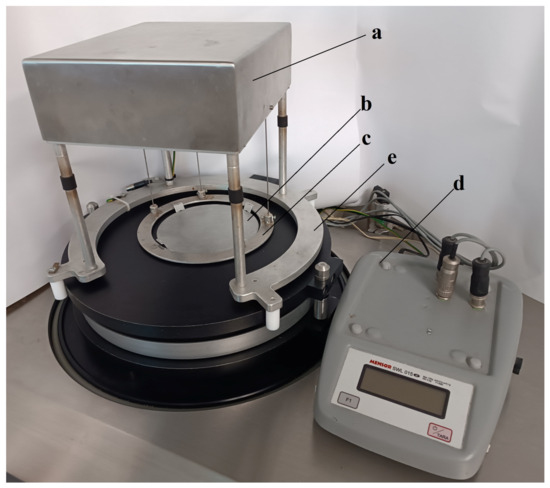
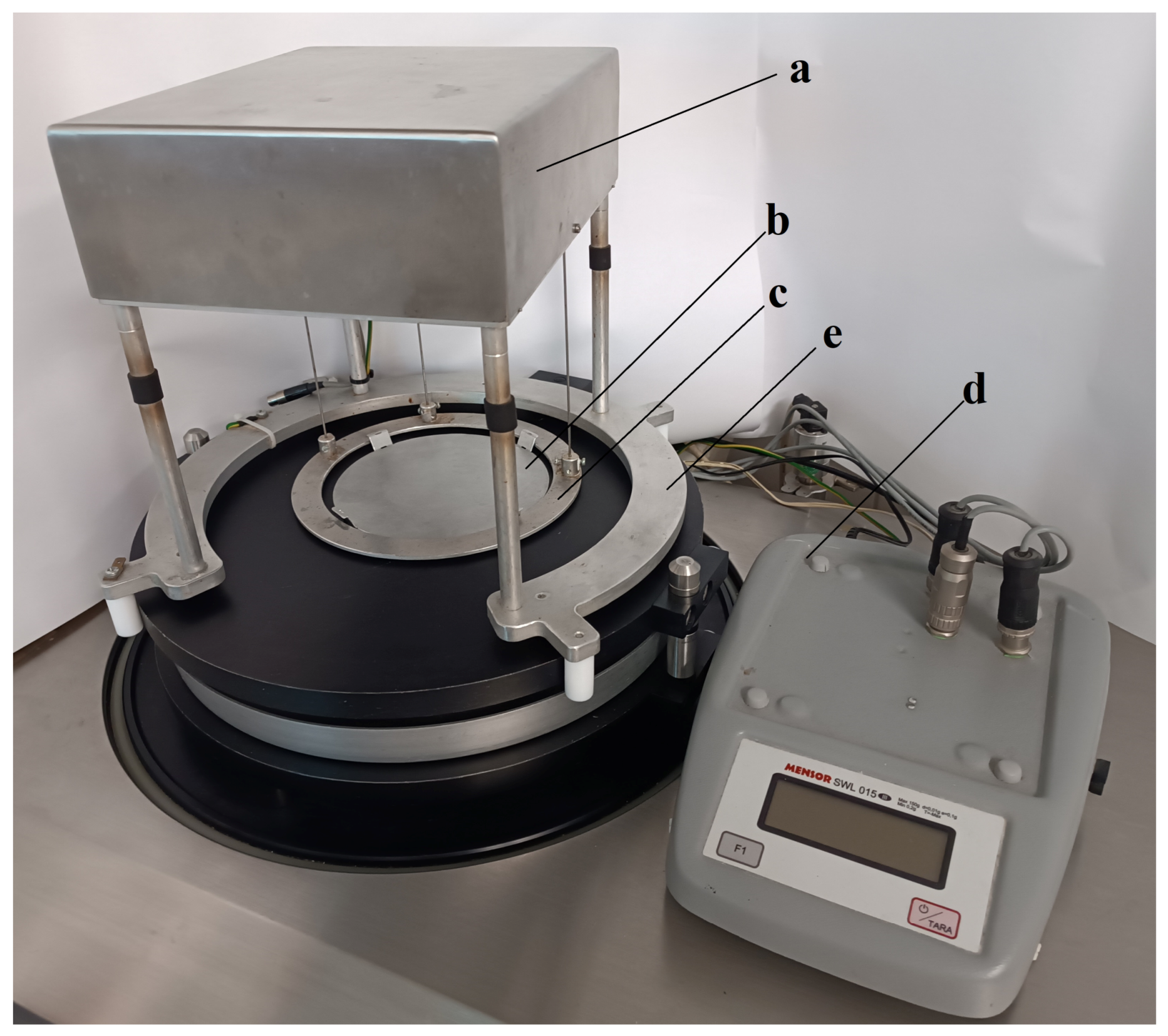
The fruits, with and without enzymatic treatment, were frozen at −40 °C in an Inrinox freezer (Corbanese, Italy). The blueberries were freeze-dried after 0, 30 and 60 min of enzymatic treatment. Freeze-drying was carried out in a Martin Christ LCG Gamma 1-16 LSC dryer (Osterode am Harz, Germany). The process employed a pressure of 63 Pa and a shelf temperature of 25 °C. In preliminary investigations, the samples were dried for 72 h. To determine the precise drying time, a vacuum-weighing system (Mensor, Warsaw, Poland) was placed within the drying chamber (Scheme 1). This setup enabled continuous monitoring of sample mass at 5 min intervals for the first 120 min, then at 15 min intervals for the remainder of the drying process. The samples were dried until equilibrium was reached, as indicated by a constant sample mass over 15 min intervals. The same procedure, fruit mass, and process parameters were used in each drying cycle.
Scheme 1.
Measuring system for determining mass loss during drying in real time, installed in the freeze-dryer: a—measuring transducer; b—measuring pan; c—sample lifting system for weighing; d—control and monitoring system; e—support base.
During drying, the sample mass was recorded using the software of a vacuum-weighing system (Mensor, Warsaw, Poland). The measurement of mass loss during freeze-drying and the initial water content allowed the determination of the moisture ratio.
where MR—moisture ratio, dimensionless; u—water content at the time; uo—initial water content; ue—the equilibrium water content. Water content was expressed as kilograms of water per kilogram of dried material (kg/kg).
Changes in the moisture ratio during the drying process enabled plotting the drying curves (MR vs. drying time). The detailed procedure of drying kinetics measurement was described by Nowak and Jakubczyk [26]. The regression analysis was conducted using Table Curve 5.01 (Systat Software Inc., Palo Alto, CA, USA), which enabled the description of the drying curves using five kinetic models (Table 1). To evaluate the goodness-of-fit of these models against the experimental data, the determination coefficient (R2) and the root mean square error (RMSE) were calculated.
where MRi,p—the predicted moisture ratio, MRi,e—the experimental moisture ratio, N—number of experimental points.
Table 1.
The mathematical models for freeze-drying of blueberries.
The freeze-dried material was packed in barrier packaging made of a polyester layer and an aluminium layer. Dried samples were marked as D, along with the enzyme code and enzymatic treatment time (e.g., D-Pect-B-30—freeze-dried blueberries with pre-treatment of BrenPect Berry Fruit enzyme for 30 min).
2.4. Selected Physical Properties of Blueberries After Enzymatic Treatment and Freeze-Drying
The selected properties of the fruits from two independent batches were analysed after enzymatic treatment and freeze-drying: water content, water activity, colour changes, and mechanical parameters. The number of repetitions was given per batch.
2.4.1. Water Content
Water content (%) of fresh, enzymatically treated, and dried blueberries was measured according to the procedure used by Jakubczyk and Jaskulska [33]. The grounded blueberries with anhydrous sea sand were dried in a cabinet dryer (Wamed, SUP 65 W, Warsaw, Poland) at 70 °C for 24 h in four repetitions.
2.4.2. Water Activity
The water activity of all samples was quantified at 25 °C using the Hydrolab C1 instrument (Rotronic AG, Bassersdorf, Switzerland), with a measurement accuracy of ±0.001. The measurement was repeated four times.
2.4.3. Total Colour Change
The colour attributes of all variants were quantitatively assessed using the CIE L*a*b* colour space system. This measurement was conducted with a chromameter CM-5 (Minolta, Osaka, Japan), employing illuminant D65 and a 10° observer angle. The measurements were done in 15 repetitions. The measured values of L* (lightness) and the colour attributes (a*, b*) were subsequently used to compute the total colour change ΔE after enzymatic treatment and drying, compared with fresh fruits. The measured values of L* (lightness) and the chromatic attributes a* (red-green balance) and b* (yellow-blue balance) were analysed to determine the total colour change, represented as ΔE. This assessment was conducted after the fruits were subjected to enzymatic treatment and subsequent drying, enabling a comparison with the characteristics of fresh fruits.
where , , —colour attributes of fresh blueberries, L*, a*, b—colour attributes after enzymatic treatment or drying of blueberries.
2.4.4. Mechanical Properties
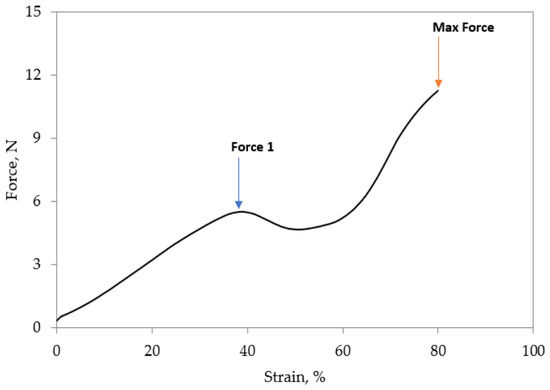
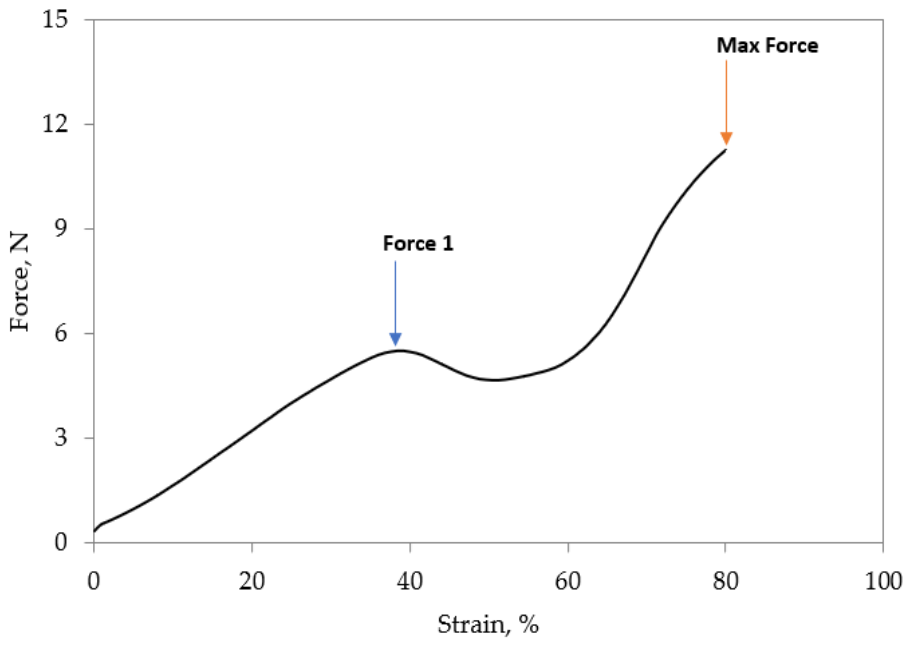
The mechanical characteristics of the fresh and dried blueberries were obtained using a TA-HD Plus texture analyser (Stable Micro Systems, Surrey, UK). A compression test was applied to the samples until a strain of 80% was reached, conducted at a speed of 1 mm/s. The test was carried out in 20 repetitions for all sample types. The maximum force observed at the final strain (referred to as Max Force) and the force measured at the inflexion point (designated as Force 1) were subjected to analysis for both fresh blueberries and those treated with enzymes (Figure 1). For the dried fruits, the analysis was limited to Force 1.
Figure 1.
Example of compression curves of blueberry after enzymatic treatment: Force 1—inflexion point N; Max Force—maximal force at strain of 80%, N.
2.5. Statistical Analysis
The investigation was conducted on blueberries harvested during the same period to ensure consistency among the samples. Two distinct freeze-drying cycles were performed, and samples were extracted from each batch for assessment of their physical properties. Given the inherent variability in the biological material, certain measurements necessitated multiple assessments, particularly concerning mechanical properties and colour characteristics. The selection of the number of repetitions was guided by established protocols from prior research studies.
The measurements were analysed statistically using Statistica software (version 13.3 by StatSoft Inc., Tulsa, OK, USA). A one-way ANOVA was conducted to assess significant differences in the values obtained. To evaluate the impact of enzymatic treatment and drying processes on blueberry properties, Tukey’s Honest Significant Difference method was applied at a 95% significance level. The results are expressed as means accompanied by their respective standard deviations.
3. Results and Discussion
3.1. The Selected Properties of Blueberries
3.1.1. Fresh and Enzymatically Treated Blueberries
The average water content of fresh blueberries was 85.13% (Table 2). Upon exposure to water at a temperature of 45 °C for a duration of 20 min, the water content of the fruit remained unchanged. However, with an extended 60 min soaking period, a slight increase in water content to 87.77% was observed. This increase may be attributed to the diffusion of dry-matter components, such as carbohydrates and minerals, from blueberry tissue into the surrounding water. A similar phenomenon was observed when blueberries were pre-treated with a pectolytic enzyme (Pect-C), resulting in a water content increase of up to 88.07%. Conversely, the application of alternative enzymatic preparations at different processing times (Pect-B, Cel-VR) did not yield a statistically significant difference in water content when compared to that of the fresh fruit. The use of enzymes had only a slight effect on water content in fresh blueberries, and only after prolonged exposure. In this study, the water content of fresh blueberry fruits (v. ‘Lateblue’) was found to be similar to that of Aurora variety fruits (85.40%) sourced from a different plantation [9]. The moisture content of blueberries is influenced by cultivar, ripening stage, and environmental conditions. Lin et al. [34] reported significant variations in water content, noting that Bluecrop blueberries exhibited a decrease from 93.19 to 75.23% throughout the ripening process, while Northblue samples decreased from 91.74 to 81.94%.
Table 2.
The water content, water activity, and total colour change after pre-treatment of fresh blueberries.
The water activity (aw) of fresh blueberries and those soaked in water did not differ significantly. However, fruits treated with enzymes for 60 min showed slightly higher water activity than fresh blueberries without pre-treatment (Table 2). It can be posited that prolonged enzymatic treatment may alter membrane permeability and increase water accessibility, thereby elevating water activity.
The colour of blueberries primarily depends on the concentrations of bioactive compounds, particularly flavonoids like anthocyanins, which influence the colouration of the fruit’s surface skin [35]. Cuticular waxes, which are found on the surface of blueberries, play a critical role in modulating the spectral characteristics of fruit lightness [36]. The complete or partial removal of the epicuticular wax layer can significantly influence the chromatic attributes of blueberries. This phenomenon is attributable to oxidative and enzymatic reactions that occur during processing, as well as the effects of thermal treatments. Such reactions contribute to the degradation of bioactive pigments, leading to observable alterations in blueberry colouration [5,37]. Table 2 presents the total colour difference between blueberries at various times of enzymatic treatment compared to fresh fruit. A colour difference of 0.5–1.5 is slightly noticeable; a difference of 1.5–3.0 is just noticeable but still acceptable [38,39]. After soaking in water, a slight colour difference ΔE was observed only at 50 and 60 min of treatment. After enzyme application, with longer treatment, the colour change increases from 1.45 to 2.91 for the pectinolytic enzyme (Pect-B). Similar changes were also observed in blueberries treated with the pectinolytic enzyme (Pect-C). However, the enzymatic complex of cellulase-xylanase (Cel-VR) caused a less intensive change in the colour of blueberries (ΔE from 1.07 to 1.98). The time of enzymatic treatment and the type of enzymes or enzymatic preparation can affect the degree of colour change in blueberries.
The mechanical properties are essential features of fruits for evaluating overall quality, predicting softening [40]. Figure 1 shows the typical behaviour of berries during compression. A gradual linear increase in force was observed when loading was applied at the inflexion point (Force 1), followed by an initial significant peak and a subsequent decline. This part of the compression curve for strawberries, as described by An et al. [41], corresponds to elastic and local plastic deformation.
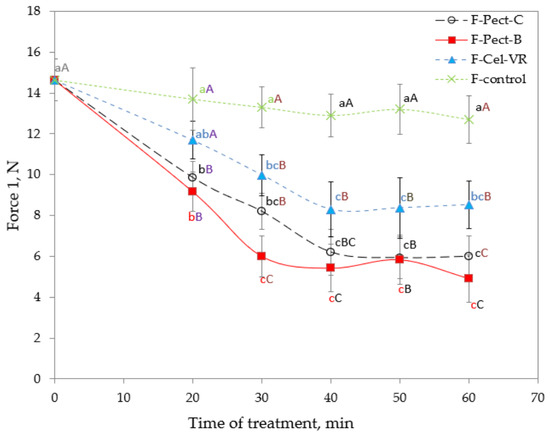
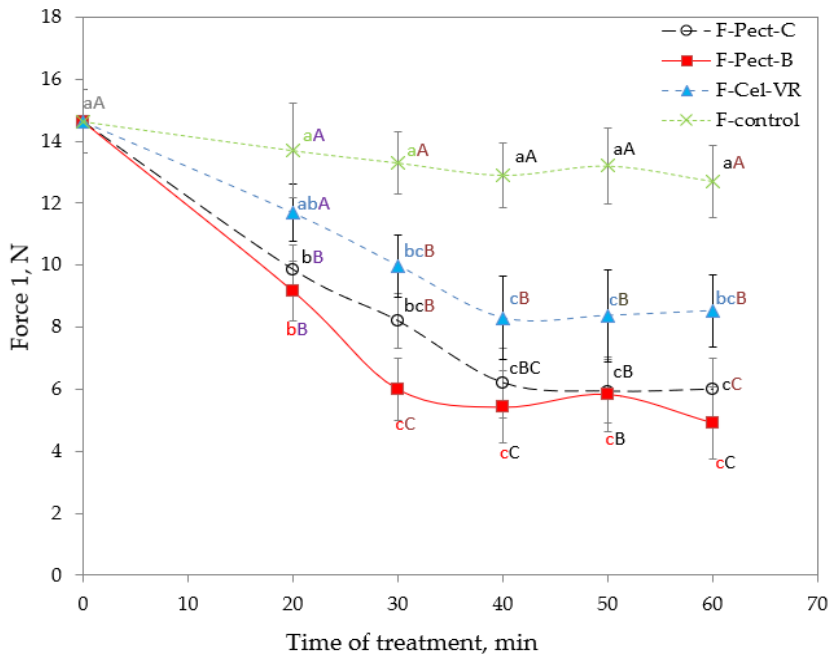
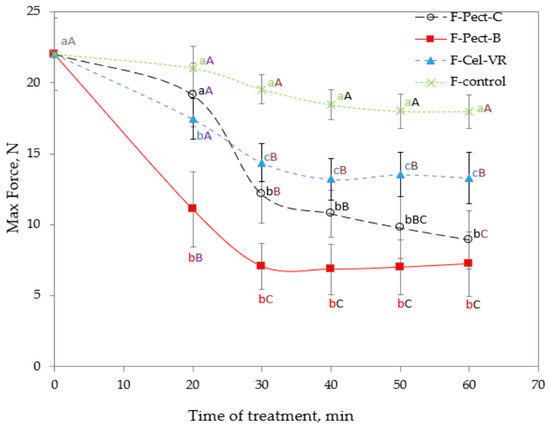
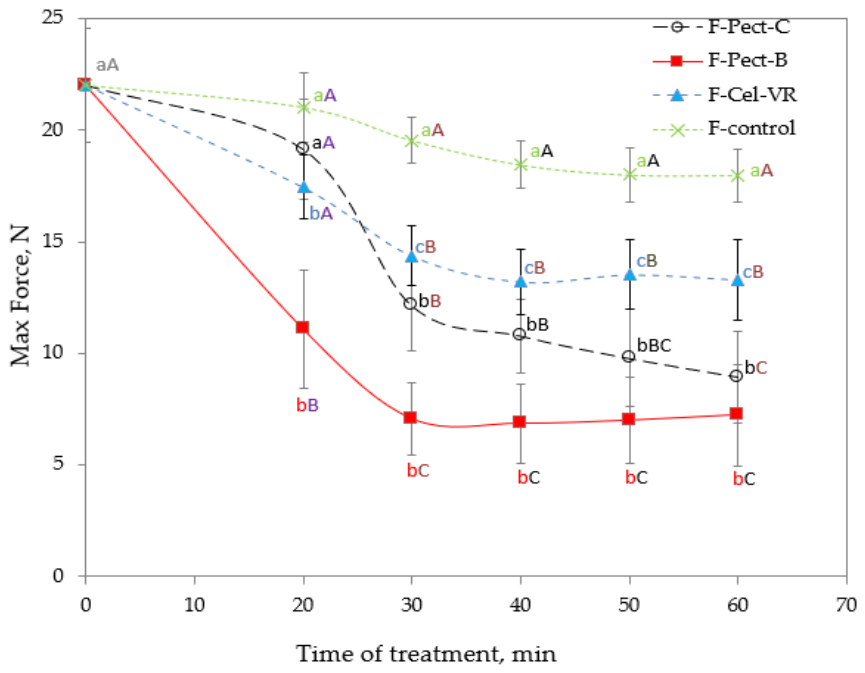
Figure 2 and Figure 3 show the changes in Force 1 and Max Force during treatment with different enzymatic preparations. The force recorded at the inflexion point for fresh fruits and for blueberries soaked in water for up to 60 min did not differ significantly (Figure 2). The same tendency was observed for force at a strain of 80% (Figure 3). Force 1 primarily represents the mechanical resistance of the fruit skin. Observations indicated that after a 20 min enzymatic treatment with cellulase (Cel-Vr), there were no significant differences in force values at the inflexion point compared with the fresh fruit (Figure 2). Conversely, the application of pectinolytic preparations (Pect-B and Pect-C) resulted in a significant reduction in this parameter, suggesting a differential effect of the enzymatic treatments on the fruit skin’s structural integrity. After 30 min of enzymatic treatment, Force 1 decreased by more than twofold. Prolonging the enzymatic treatment did not significantly alter the Force 1 for most enzyme preparations. The force measured at the final strain (Max Force) exceeded the values observed at the inflexion point (Figure 3). During the loading process of blueberries, both the skin and parenchyma tissues deform, which increases the value of force. Similarly to Force 1, the greatest Max Force drop was observed at 30 min of enzymatic treatment, and longer processing did not significantly change the mechanical resistance of the fruits. Differential activity between the two pectinolytic enzymes was noted in the experimental observations. Specifically, blueberries subjected to treatment with Pect-B exhibited lower force values relative to those treated with Pect-C. Commercial pectinolytic preparations typically encompass a combination of enzymes, including pectin methylesterase, pectin lyase, and endo-polygalacturonase. The synergistic activity observed in these enzyme preparations facilitates pectin degradation. However, it should be noted that the Pect-B preparation has inactivated anthocyanase activity. This aspect is a significant consideration in evaluating the overall influence on fruit phenolic compounds, as anthocyanase (β-glucosidase) degrades anthocyanins [42]. Treatment with those enzymes results in softening and structural degradation, as pectin methyl esterase demethylates pectins, which are then further degraded by polygalacturonase [43]. Both pectinases and cellulases are used to enhance juice extraction or fruit pulp production [44]. The results indicated that the use of pectinolytic enzymes may alter the structure of the fruit skin, loosening it and potentially improving subsequent fruit processing. Konopacka et al. [40] found that treating carrot slices with pectin lyase altered the diluted alkali-soluble pectin fraction, specifically reducing its structural length. This led to increased carotenoid retention in dried carrot chips.
Figure 2.
Changes in Force 1 with time of enzymatic treatment of blueberry: effect of treatment time for a given enzyme—the same lowercase letter means no statistical difference, effect of enzyme type for the same treatment time—the same capital letter indicates no statistical difference (p < 0.05).
Figure 3.
Changes in maximal force with time of enzymatic treatment of blueberry: effect of treatment time for a given enzyme—the same lowercase letter means no statistical difference, effect of enzyme type for the same treatment time—the same capital letter indicates no statistical difference (p < 0.05).
Comparing the force values recorded at the inflexion point (Figure 2) and at 80% deformation of blueberries (Figure 3) shows that the smallest differences between these parameters occur with the Pect-B preparation. This suggests that Pect-B had a more pronounced effect on skin structure and pectin degradation. Yuan et al. [22] reported that enzymatic treatments, specifically pectinase and cutinase, disrupted the wax layer of wolfberry, facilitating dehydration. The application of these enzymes led to the breakdown of the cell wall’s structural matrix and the formation of pores with higher connectivity.
3.1.2. Freeze-Dried Blueberries
A study on fresh blueberries subjected to various enzymatic treatments found no significant differences in the fruit’s properties after treatment durations of 40, 50, or 60 min. However, the type of enzymatic preparation used did affect the properties of the blueberries. The fruit was also freeze-dried, with three different enzymes applied for 30 and 60 min. Additionally, fresh blueberries were included as a control group with no enzymatic treatment.
Table 3 presents the water content values obtained from the freeze-drying of blueberries, both with and without enzymatic treatment. The water content of the dried fruits ranged from 4.97 to 6.69%. Notably, the majority of the dried blueberries subjected to enzymatic treatment exhibited either slightly higher or comparable water content to that of the fresh-dried samples. The increased water content in these dried blueberries is not inherently negative, but it may affect the fruit’s textural properties. The water activity of the dehydrated samples ranged from 0.230 to 0.354. Some studies on freeze-dried blueberries have reported the following findings: the water activity and moisture content for various Bluegold blueberries were measured at 0.190 and 10.7%, respectively [45]. In contrast, the V. Aurora cultivar displayed a moisture content of 4.80% and a higher water activity of 0.267 [9]. Water content and water activity can exhibit significant variability depending on the cultivar used and the specific pre-treatment methods employed. Nonetheless, the values obtained for these parameters are critical, as they contribute to the formulation of stable and safe dried products. Some studies showed that blueberries with a moisture content reduced to below 10–13% exhibit enhanced stability and microbial safety, making them suitable for prolonged storage [46,47]. The application of enzymatic pre-treatment with pectinase, cellulase, and chitinase reduced the water activity (aw) of vacuum-dried wolfberry from approximately 0.5 to 0.4 [22]. However, this degree of water activity remains significantly higher than that observed in freeze-dried blueberries.
Table 3.
The selected physical properties of dried blueberries with different enzymatic pre-treatments.
Colour is one of the physical properties crucial to the quality evaluation of dried materials [33]. The total colour change (ΔE) demonstrated no significant difference between dried fresh blueberries and the majority of fruits subjected to enzymatic pre-treatment, except D-Pect-B-60. Furthermore, prolonged pre-treatment with pectolytic enzymes, specifically Pect-C and Pect-B, resulted in a more pronounced colour difference when compared to fresh fruit samples. Díaz-Álvarez et al. [48] noted that applying high voltage electrical discharge pre-treatments before freeze-drying led to only slight variations in colour (ΔE = 1.91–3.60) when compared to untreated freeze-dried blueberries, indicating that freeze-dried fruits generally maintained good colour quality. The application of hot-air drying to berries resulted in a significant increase in colour differences, with values ranging from 7.90 to 8.21 [49]. The drying method and pre-treatment can significantly influence colour change. The colour difference value for freeze-dried wolfberry with various enzymatic pre-treatments ranged from 8.24 to 15.86 [22], which was notably higher than observed for freeze-dried blueberries.
Analysis of mechanical properties enables evaluation of texture and provides information on the level of structural changes. To enhance the analysis of mechanical characteristics, we focused solely on a single parameter: Force 1 (Table 3). The lowest value of this parameter was obtained for fresh-dried fruits. The inflexion point recorded for the freeze-dried blueberries treated with pectolytic enzymes (Pect-B and Pect-C) showed no significant differences. Furthermore, increasing the treatment duration did not have a notable effect on the Force 1 values of the dried samples treated with the various enzymes. Among enzyme-treated fruits, the lowest value for this mechanical attribute was found in freeze-dried blueberries treated with a cellulase-xylanase preparation for 30 min (Cel-VR-30). Notably, the values recorded for the treatment with cellulase (Cel-VR) were comparable to those of the fresh-dried samples, suggesting that the impact of this enzyme preparation on the mechanical properties of the dried blueberries was minimal. This finding highlights the limited effectiveness of this treatment on the texture of dried fruit. Research on freeze-dried Aurora blueberries found that using a pectolytic enzyme preparation resulted in a rigid solid matrix with significantly more small pores. In contrast, the fresh-dried fruits showed lower mechanical resistance because some of the internal contents of the blueberries had leaked out. This leakage led to larger holes and cavities within the structure, reducing the material’s hardness [9].
3.2. Characteristic of Freeze-Drying Kinetics
A mathematical model for drying is a valuable tool for understanding how various materials behave during the drying process [11]. The five models were applied to characterise the blueberry drying kinetics (Table 4).
Table 4.
Assessment of the fit of selected drying kinetics models (R2 and RMSE).
The degree of fit between the experimental data and the model was evaluated using two parameters: the root mean square error (RMSE) and the coefficient of determination (R2) (Table 4). The optimal model should be identified as the one with the lowest RMSE and the highest R2 [50]. The Milidi et al. model demonstrated a strong fit to the data, yielding an R2 of 0.999 across all freeze-dried blueberry samples. Additionally, the root mean square errors (RMSE) ranged from 0.0100 to 0.0121, indicating high predictive precision.
The parameters of the Milidi et al. model for freeze-dried berries are shown in Table 5. This model is semi-empirical and is based on Fick’s law of diffusion [51]. The parameter k relates to the drying rate, while the parameter n can be influenced by the initial water content or any pre-treatment applied [52,53]. Values of n greater than 1 indicate that the drying curve follows a sigmoidal shape. The drying curves were defined by n values ranging from 1.29 to 1.42. Only freeze-dried blueberries treated with the enzymatic preparation Cel-VR for 30 min showed a significantly different parameter, yielding values markedly higher than those recorded for other dried materials. Furthermore, the k parameter was observed to have the lowest value for this sample (Table 5). This decrease in the k parameter may serve as a compensatory mechanism for an increase in the n parameter [53]. Elevated values of the parameter k may suggest an increased drying rate. In enzyme-treated dried samples, this parameter consistently showed higher values than those recorded for fresh blueberries. The extended duration of enzymatic treatment before drying increased this kinetic parameter.
Table 5.
Parameters of the Milidi et al. kinetics model and drying time of fresh and enzymatically treated blueberries.
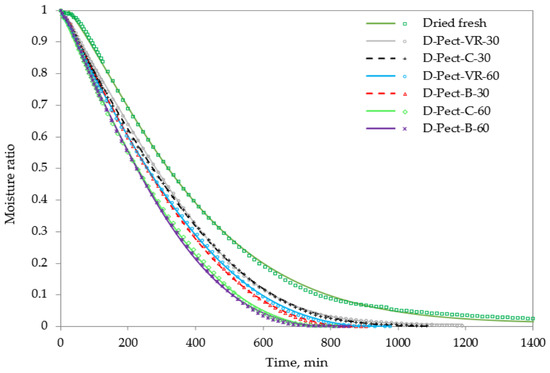
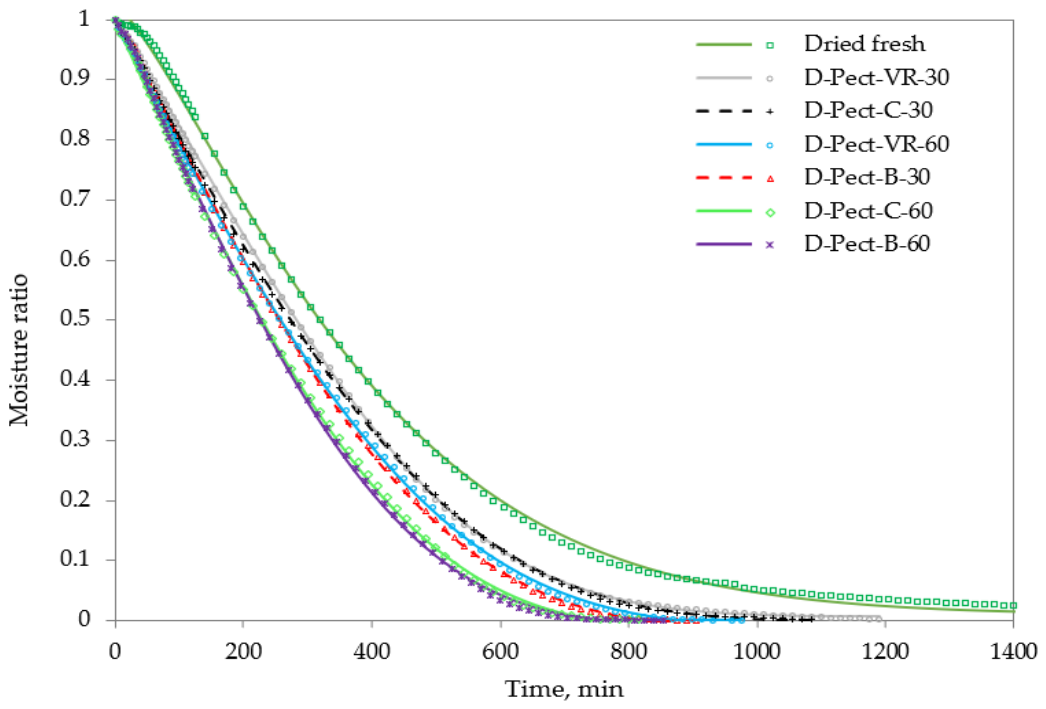
The comparison of final drying time and drying curves (Figure 4) indicates that enzymatic treatment increased the process rate and reduced the drying time compared with fresh samples (Table 5). The most significant differences in the drying curve between fresh fruit and enzyme-treated fruit were observed during the first hour of freeze-drying. The sublimation process for the untreated fruit was slower. The application of enzymatic treatments may significantly modify the structural characteristics of blueberries, particularly by enhancing the integrity of the pericarp, thereby facilitating improved vapour diffusion through cellular membranes. Specifically, the freeze-drying duration for fresh fruit was markedly reduced from 2855 min to 845 min when treated with a pectinolytic enzyme for 60 min (designated as Pect-B-60). This reduction indicated a significant impact of enzymatic pre-treatment on the moisture-removal rate during freeze-drying (Figure 4). Vega-Gálvez et al. [54] observed that using a solution of the commercial enzymatic preparation Pectinex 3XL for 30 min, the drying rate increased by enhancing the permeability of blueberry cell membranes, thereby improving water diffusion during air-drying. The type of enzymatic preparation significantly reduced drying time. The use of pectolytic enzymes decreased the drying time of blueberries more effectively than cellulase enzyme (Table 5). The application of different enzymes before vacuum dehydration of wolfberries resulted in a notable reduction in drying time by up to 57.29%. The enzymatic treatment played a critical role in degrading the fruit’s waxy cuticle, thereby enhancing evaporative surface area through the established pores. Pectinase showed significantly greater efficacy than cellulase, highlighting its potential to enhance vacuum drying [19]. This is consistent with our results. Increasing the enzymatic treatment from 30 to 60 min decreased drying time by 10–20%, depending on the type of enzyme (Table 5, Figure 4). An et al. [55] applied ethyl oleate solution pre-treatment of blueberries and observed a decrease in drying time of 17.78–43.02% relative to air temperature and treatment time. A greater reduction in drying time occurred with longer dipping.
Figure 4.
Drying curves of the freeze-dried blueberries with and without enzymatic treatment; symbols—experimental data, lines—predicted data from kinetic model.
4. Conclusions
Enzymatic pre-treatment affected both the selected physical properties of blueberries. However, enzyme application resulted in slight changes in water content, water activity, and colour compared with fresh fruits. A reduction in mechanical resistance after the application of enzymes (especially, pectinolytic Pect-B and Pect-C) was observed. The most pronounced changes in fruit texture were observed after 30 min of treatment, indicating that this duration was sufficient to disrupt the integrity of the skin and cell wall components. The enzymatic treatment led to a substantial reduction in freeze-drying time. The process duration decreased by more than threefold compared to untreated samples, likely due to structural modifications in the fruit. This led to improved transport of water vapour during the freeze-drying process. Among the tested preparations, pectinolytic enzymes proved to be more effective than the cellulolytic complex, confirming the critical role of pectin degradation. Extended pre-treatment with pectolytic enzymes resulted in a more pronounced colour difference in dried blueberries when compared to fresh fruit samples. The total change in colour of dried blueberries with enzymatic treatment was no greater than 4.03 for a 30 min treatment. The observed changes may indicate that the fruit colour changed slightly during drying, which is crucial in the preservation process and obtaining a high-quality product. Enzyme treatment effectively reduced the structural damage to blueberries that typically occurs during drying. Considering the freeze-drying duration and the corresponding alterations in the physical properties of fruits, it can be concluded that the optimal pre-treatment condition for blueberries is the application of pectinolytic enzymes for a duration of 30 min. This approach significantly enhances the quality and preservation of blueberries during freeze-drying. However, it is important to note that results may vary based on the specific composition of the commercial enzyme preparations utilised.
Author Contributions
Conceptualization. E.J.; methodology. E.J.; software. E.J.; validation. E.J. and A.K.-D.; formal analysis. E.J. and D.W.-R.; investigation. E.J.; data curation. E.J.; writing—original draft preparation. E.J.; writing—review and editing. E.J. and M.N.; visualisation E.J. and Z.D.; supervision. E.J., D.W.-R. and M.N. All authors have read and agreed to the published version of the manuscript.
Funding
This research received no external funding.
Institutional Review Board Statement
Not applicable.
Informed Consent Statement
Not applicable.
Data Availability Statement
The original contributions presented in the study are included in the article material. Further inquiries can be directed to the corresponding authors.
Acknowledgments
The authors thank student Żaneta Brzozowska for her help with the preliminary enzymatic studies.
Conflicts of Interest
The authors declare no conflicts of interest.
References
- Kristo, A.S.; Klimis-Zacas, D.; Sikalidis, A.K. Protective role of dietary berries in cancer. Antioxidants 2016, 5, 37. [Google Scholar] [CrossRef] [Scilit] [PubMed]
- Duan, Y.; Tarafdar, A.; Chaurasia, D.; Singh, A.; Bhargava, P.C.; Yang, J.; Li, Z.; Ni, X.; Tian, Y.; Li, H.; et al. Blueberry fruit valorization and valuable constituents: A review. Int. J. Food Microbiol. 2022, 381, 109890. [Google Scholar] [CrossRef] [Scilit] [PubMed]
- Martín-Gómez, J.; García-Martínez, T.; Varo, M.Á.; Mérida, J.; Serratosa, M.P. Phenolic compounds, antioxidant activity and color in the fermentation of mixed blueberry and grape juice with different yeasts. LWT 2021, 146, 111661. [Google Scholar] [CrossRef] [Scilit]
- Li, X.; Zhang, L.; Peng, Z.; Zhao, Y.; Wu, K.; Zhou, N.; Yan, Y.; Ramaswamy, H.S.; Sun, J.; Bai, W. The impact of ultrasonic treatment on blueberry wine anthocyanin color and its In-vitro anti-oxidant capacity. Food Chem. X 2020, 333, 127455. [Google Scholar] [CrossRef] [Scilit] [PubMed]
- Kalt, W.; Cassidy, A.; Howard, L.R.; Krikorian, R.; Stull, A.J.; Tremblay, F.; Zamora-Ros, R. Recent research on the health benefits of blueberries and their anthocyanins. Adv. Nutr. 2020, 11, 224–236. [Google Scholar] [CrossRef] [Scilit] [PubMed]
- Ashique, S.; Mukherjee, T.; Mohanty, S.; Garg, A.; Mishra, N.; Kaushik, M.; Bhowmick, M.; Chattaraj, B.; Mohanto, S.; Srivastava, S.; et al. Blueberries in focus: Exploring the phytochemical potentials and therapeutic applications. J. Agric. Food Res. 2024, 18, 101300. [Google Scholar] [CrossRef] [Scilit]
- Akbari, A.; Xu, Y.; Wei, X.; Liu, Z.; Ergün, D.; Akgöl, C.; Dong, F.; Ercişli, S.; Kafkas, S.; Liu, C.; et al. Bioactive and antioxidant properties in highbush blueberry cultivars: Identifying superior cultivars for nutritional biofortification. Front. Plant Sci. 2026, 16, 1750179. [Google Scholar] [CrossRef] [Scilit] [PubMed]
- Ge, Y.; Ma, Q.-Y.; Wang, S.-Y.; Mujumdar, A.S.; Huang, X.; Xiao, H.-W.; Liu, Z.-L.; Nie, S. Recent advances of pretreatments and drying technologies in processing small berries: A comprehensive review. Trends Food Sci. Technol. 2026, 169, 105553. [Google Scholar] [CrossRef] [Scilit]
- Jakubczyk, E.; Tryzno-Gendek, E.; Kot, A.; Kamińska-Dwórznicka, A.; Nowak, D. Pre-treatment impact on freeze-drying process and properties of dried blueberries. Processes 2025, 13, 537. [Google Scholar] [CrossRef] [Scilit]
- Pateiro, M.; Vargas-Ramella, M.; Franco, D.; Gomes da Cruz, A.; Zengin, G.; Kumar, M.; Dhama, K.; Lorenzo, J.M. The role of emerging technologies in the dehydration of berries: Quality, bioactive compounds, and shelf life. Food Chem. X 2022, 16, 100465. [Google Scholar] [CrossRef] [Scilit] [PubMed]
- Sun, Y.; Zhang, M.; Mujumdar, A. Berry drying: Mechanism, pretreatment, drying technology, nutrient preservation, and mathematical models. Food Eng. Rev. 2019, 11, 61–77. [Google Scholar] [CrossRef] [Scilit]
- Nowak, D.; Jakubczyk, E. The freeze-drying of foods-the characteristic of the process course and the effect of its parameters on the physical properties of food materials. Foods 2020, 9, 1488. [Google Scholar] [CrossRef] [Scilit] [PubMed]
- Shi, J.; Pan, Z.; McHugh, T.; Wood, D.; Zhu, Y.; Avena-Bustillos, R.; Hirschberg, E. Effect of berry size and sodium hydroxide pretreatment on the drying characteristics of blueberries under infrared radiation heating. J. Food Sci. 2008, 73, E259–E265. [Google Scholar] [CrossRef] [Scilit] [PubMed]
- Liu, W.; Zhang, M.; Mujumdar, A.S.; Chitrakar, B.; Yu, D. Effects of chitosan coating on freeze-drying of blueberry enhanced by ultrasound pre-treatment in sodium bicarbonate medium. Int. J. Biol. Macromol. 2021, 181, 631–643. [Google Scholar] [CrossRef] [Scilit] [PubMed]
- Zielinska, M.; Sadowski, P.; Błaszczak, W. Freezing/thawing and microwave-assisted drying of blueberries (Vaccinium corymbosum L.). LWT 2015, 62, 555–563. [Google Scholar] [CrossRef] [Scilit]
- Miraei Ashtiani, S.-H.; Rafiee, M.; Mohebi Morad, M.; Martynenko, A. Cold plasma pretreatment improves the quality and nutritional value of ultrasound-assisted convective drying: The case of goldenberry. Dry. Technol. 2022, 40, 1639–1657. [Google Scholar] [CrossRef] [Scilit]
- Yu, Y.; Jin, T.Z.; Xiao, G. Effects of pulsed electric fields pretreatment and drying method on drying characteristics and nutritive quality of blueberries. J. Food Process. Preserv. 2017, 41, e13303. [Google Scholar] [CrossRef] [Scilit]
- Lara, I.; Heredia, A.; Domínguez, E. Shelf life potential and the fruit cuticle: The unexpected player. Front. Plant Sci. 2019, 10, 770. [Google Scholar] [CrossRef] [Scilit] [PubMed]
- Klavins, L.; Klavins, M. Cuticular wax composition of wild and cultivated northern berries. Foods 2020, 9, 587. [Google Scholar] [CrossRef] [Scilit] [PubMed]
- Chu, W.; Gao, H.; Chen, H.; Fang, X.; Zheng, Y. Effects of cuticular wax on the postharvest quality of blueberry fruit. Food Chem. 2018, 239, 68–74. [Google Scholar] [CrossRef] [Scilit] [PubMed]
- Gao, H.; Yang, S.; Chen, H.; Chu, W.; Mu, H.; Ge, L. Epicuticular wax’s effect on fruit softening of blueberry. J. Chin. Inst. Food Sci. Technol. 2014, 14, 103–108. [Google Scholar]
- Yuan, T.; Zhang, D.; Li, X.; Xu, P.; Zhang, Z.; Yang, Y.; Yang, J.; He, Y.; ElGamal, R. Effect of biological enzyme pretreatment on the kinetics, microstructure, and quality of vacuum drying of wolfberry. LWT 2025, 217, 117455. [Google Scholar] [CrossRef] [Scilit]
- Sun, R.; Chen, S.; Chen, X.; Liu, X.; Zhang, F.; Wu, J.; Su, L. Enzymatic treatment to improve permeability and quality of cherry tomatoes for production of dried products. J. Sci. Food Agric. 2024, 104, 2718–2727. [Google Scholar] [CrossRef] [Scilit] [PubMed]
- Marinho, C.R.; Teixeira, S.P. Cellulases and pectinases act together on the development of articulated laticifers in Ficus montana and Maclura tinctoria (Moraceae). Protoplasma 2019, 256, 1093–1107. [Google Scholar] [CrossRef] [Scilit] [PubMed]
- Degani, O. Synergism between cutinase and pectinase in the hydrolysis of cotton fibers’ cuticle. Catalysts 2021, 11, 84. [Google Scholar] [CrossRef] [Scilit]
- Nowak, D.; Jakubczyk, E. Effect of pulsed electric field pre-treatment and the freezing methods on the kinetics of the freeze-drying process of apple and its selected physical properties. Foods 2022, 11, 2407. [Google Scholar] [CrossRef] [Scilit] [PubMed]
- Page, G.E. Factors Influencing the Maximum Rates of Air Drying Shelled Corn in Thin Layers. Master’s Thesis, Department of Mechanical Engineering, Purdue University, Purdue, IN, USA, 1949. [Google Scholar]
- Lewis, W.K. The rate of drying of solid materials. J. Ind. Eng. Chem. 1921, 13, 427–432. [Google Scholar] [CrossRef] [Scilit]
- Yaldýz, O.; Ertekýn, C. Drying of eggplant and selection of a suitable thin layer drying model. J. Food Eng. 2004, 63, 349–359. [Google Scholar] [CrossRef] [Scilit]
- Henderson, S.; Pabis, S. Grain drying theory. 1. Temperature effect on drying coefficient. J. Agric. Eng. Res. 1961, 6, 169–174. [Google Scholar]
- Midilli, A.; Kucuk, H.; Yapar, Z. A new model for single-layer drying. Dry. Technol. 2002, 20, 1503–1513. [Google Scholar] [CrossRef] [Scilit]
- Henderson, S. Progress in developing the thin layer drying equation. Trans. ASAE 1974, 17, 1167–1168. [Google Scholar] [CrossRef] [Scilit]
- Jakubczyk, E.; Jaskulska, A. The Effect of freeze-drying on the properties of Polish vegetable soups. Appl. Sci. 2021, 11, 654. [Google Scholar] [CrossRef] [Scilit]
- Lin, Y.; Huang, G.; Zhang, Q.; Wang, Y.; Dia, V.P.; Meng, X. Ripening affects the physicochemical properties, phytochemicals and antioxidant capacities of two blueberry cultivars. Postharvest Biol. Technol. 2020, 162, 111097. [Google Scholar] [CrossRef] [Scilit]
- Chu, L.; Du, Q.; Li, A.; Liu, G.; Wang, H.; Cui, Q.; Liu, Z.; Liu, H.; Lu, Y.; Deng, Y.; et al. Integrative transcriptomic and metabolomic analyses of the mechanism of anthocyanin accumulation and fruit coloring in three blueberry varieties of different colors. Horticulturae 2024, 10, 105. [Google Scholar] [CrossRef] [Scilit]
- Yan, Y.; Dossett, M.; Castellarin, S.D. Cuticular waxes affect fruit surface color in blueberries. Plants People Planet 2023, 5, 736–751. [Google Scholar] [CrossRef] [Scilit]
- Jiang, Q.-X.; Ning, K.-L.; Yu, D.-W.; Xu, Y.-S.; Wang, B.; Yang, F.; Gao, P.; Xia, W.-S. Effects of blanching on extraction and stability of anthocyanins from blueberry peel. J. Food Meas. Charact. 2020, 14, 2854–2861. [Google Scholar] [CrossRef] [Scilit]
- Alamu, A.E.; Ade-Omowaye, B.I.O.; Akinwande, B.A.; Dudu, O.E.; Obori, F.O. Pigments and colour characteristics: Influence of drying methods on Nigerian pepper (Capsicum frutescence). J. Agric. Food Res. 2023, 14, 100760. [Google Scholar] [CrossRef] [Scilit]
- M’hiri, N.; Ghali, R.; Ben Nasr, I.; Boudhrioua, N. Effect of different drying processes on functional properties of industrial lemon byproduct. Process Saf. Environ. Prot. 2018, 116, 450–460. [Google Scholar] [CrossRef] [Scilit]
- Lee, D.; Gwon, J.; Huang, R.; Picha, D.H.; Wu, Q. Bio-based nanomaterial suspensions as sprayable coatings for maintaining blueberry postharvest quality. Food Hydrocoll. 2024, 150, 109743. [Google Scholar] [CrossRef] [Scilit]
- An, X.; Li, Z.; Zude-Sasse, M.; Tchuenbou-Magaia, F.; Yang, Y. Characterization of textural failure mechanics of strawberry fruit. J. Food Eng. 2020, 282, 110016. [Google Scholar] [CrossRef] [Scilit]
- Araya, V.; Gatica, M.; Uribe, E.; Román, J. In silico analysis of the molecular interaction between anthocyanase, Peroxidase and polyphenol oxidase with anthocyanins found in cranberries. Int. J. Mol. Sci. 2024, 25, 10437. [Google Scholar] [CrossRef] [Scilit] [PubMed]
- Liu, R.; Fanzhen, S.; Niu, B.; Wu, W.; Han, Y.; Chen, H.; Gao, H. Melatonin treatment delays the softening of blueberry fruit by modulating cuticular wax metabolism and reducing cell wall degradation. Food Res. Int. 2023, 173, 113357. [Google Scholar] [CrossRef] [Scilit] [PubMed]
- Maharramova, S.; Nasrullayeva, G.; Qadimova, N.; Maharramova, M.; Maharramov, M. The influence of pre-treatment of grape, cherry, and strawberry pulp with enzyme preparations of pectinase and cellulase on some organic compounds amount in their extracts. Methods Object Chem. Anal. 2024, 19, 151–159. [Google Scholar] [CrossRef] [Scilit]
- Antal, T. The effect of refrigeration and room temperature storage conditions on the physico-chemical characteristics of hybrid and freeze-dried blueberries. J. Agric. Food Res. 2024, 16, 101083. [Google Scholar] [CrossRef] [Scilit]
- Zia, M.P.; Alibas, I. Influence of the drying methods on color, vitamin C, anthocyanin, phenolic compounds, antioxidant activity, and in vitro bioaccessibility of blueberry fruits. Food Biosci. 2021, 42, 101179. [Google Scholar] [CrossRef] [Scilit]
- Farias, C.A.A.; Camponogara, J.A.; dos Reis, A.R.; Schlesner, S.K.; Zabot, G.L.; de Moraes, D.P.; Bettio, L.; Schmiele, M.; Barin, J.S.; Ballus, C.A.; et al. Combined use of microwaves in the simultaneous production of dehydrated blueberries and aqueous extract. Food Chem. 2025, 486, 144606. [Google Scholar] [CrossRef] [Scilit] [PubMed]
- Díaz-Álvarez, R.; Carpentieri, S.; Ferrari, G.; Pataro, G.; Segura-Ponce, L. Effect of high-voltage electrical discharge (HVED) at high frequency on vacuum freeze-drying time and physicochemical properties of blueberries. J. Food Eng. 2024, 365, 111815. [Google Scholar] [CrossRef] [Scilit]
- Zielinska, M.; Sadowski, P.; Błaszczak, W. Combined hot air convective drying and microwave-vacuum drying of blueberries (Vaccinium corymbosum L.): Drying kinetics and quality characteristics. Dry. Technol. 2016, 34, 665–684. [Google Scholar] [CrossRef] [Scilit]
- Calín-Sánchez, Á.; Kharaghani, A.; Lech, K.; Figiel, A.; Carbonell-Barrachina, Á.A.; Tsotsas, E. Drying kinetics and microstructural and sensory properties of black chokeberry (Aronia melanocarpa) as affected by drying method. Food Bioproc. Technol. 2015, 8, 63–74. [Google Scholar] [CrossRef] [Scilit]
- Castro, L.M.M.N.; Coelho Pinheiro, M.N. A simple data processing approach for drying kinetics experiments. Chem. Eng. Commun. 2016, 203, 258–269. [Google Scholar] [CrossRef] [Scilit]
- Simal, S.; Femenia, A.; Garau, M.C.; Rosselló, C. Use of exponential, Page’s and diffusional models to simulate the drying kinetics of kiwi fruit. J. Food Eng. 2005, 66, 323–328. [Google Scholar] [CrossRef]
- Jakubczyk, E.; Nowak, D. Process parameters as tools to intensify the freeze-drying process and modify the sorption properties of the obtained freeze-dried products. Processes 2024, 12, 1932. [Google Scholar] [CrossRef] [Scilit]
- Vega-Gálvez, A.; Lara, E.; Flores, V.; Di Scala, K.; Lemus-Mondaca, R. Effect of selected pretreatments on convective drying process of blueberries (var. O’neil). Food Bioprocess Technol. 2012, 5, 2797–2804. [Google Scholar] [CrossRef] [Scilit]
- An, K.; Fu, M.; Zhang, H.; Tang, D.; Xu, Y.; Xiao, G. Effect of ethyl oleate pretreatment on blueberry (Vaccinium corymbosum L.): Drying kinetics, antioxidant activity, and structure of wax layer. J. Food Sci. Technol. 2019, 56, 783–791. [Google Scholar] [CrossRef] [Scilit] [PubMed]

Disclaimer/Publisher’s Note: The statements, opinions and data contained in all publications are solely those of the individual author(s) and contributor(s) and not of MDPI and/or the editor(s). MDPI and/or the editor(s) disclaim responsibility for any injury to people or property resulting from any ideas, methods, instructions or products referred to in the content. |
© 2026 by the authors. Licensee MDPI, Basel, Switzerland. This article is an open access article distributed under the terms and conditions of the Creative Commons Attribution (CC BY) license.