


Abstract
Dysarthria is a speech disorder characterized by difficulties in articulation and vocalization due to impaired control of the articulatory system. Around 30% of individuals with speech disorders have dysarthria, facing significant communication challenges. Existing assistive tools for dysarthria either require additional manipulation or only provide word-level speech support, limiting their ability to support effective communication in real-world situations. Thus, this paper proposes a real-time communication aid system that converts sentence-level Korean dysarthric speech to non-dysarthric normal speech. The proposed system consists of two main parts in cascading form. Specifically, a Korean Automatic Speech Recognition (ASR) model is trained with dysarthric utterances using a conformer-based architecture and the graph transducer network–connectionist temporal classification algorithm, significantly enhancing recognition performance over previous models. Subsequently, a Korean Text-To-Speech (TTS) model based on Jointly Training FastSpeech2 and HiFi-GAN for end-to-end Text-to-Speech (JETS) is pipelined to synthesize high-quality non-dysarthric normal speech. These models are integrated into a single system on an app server, which receives 5–10 s of dysarthric speech and converts it to normal speech after 2–3 s. This can provide a practical communication aid for people with dysarthria.
1. Introduction
Dysarthria is a type of speech disorder caused by abnormalities in the motor neurons, which impair the control of the articulatory organs necessary for speech production [1]. It is classified as a type of language disorder along with language comprehension and expression disorders, as well as voice disorders. Although there is no universally accepted objective classification system for dysarthria, it is estimated to account for approximately 30% of all speech disorders [2,3]. There are many factors that contribute to the development of dysarthria, including brain function problems, speech problems, hearing problems, and laryngeal problems [4], and many people have difficulty communicating socially due to dysarthria [4,5].
Unlike aphasia, which is caused by damage to the language centers of the brain and results in an inability to speak fluently, dysarthria occurs when motor control of the speech organs is impaired due to neurological problems, leading to difficulties in articulation and phonation while retaining the ability to generate speech. In contrast to aphasia, which prevents speech production entirely, dysarthria is caused by neurological disorders and can still produce speech. However, the pathological intelligibility of the speech is significantly reduced [6,7]. Therefore, effective treatment for dysarthria often involves the use of various communication aids along with speech therapy to improve the clarity of speech.
Studies to develop various assistive tools for treating dysarthria have been continuously conducted over the years [8,9,10]. Among the various assistive tools for treating dysarthria, one of the most prominent assistive tools is Augmentative and Alternative Communication (AAC). AAC is an augmentative and alternative form of communication that helps people with speech or vocalization difficulties to communicate effectively. It can be implemented through diverse means such as pictures, symbols, boards, or electronic devices, and is widely used for people with different speech disorders, including cerebral palsy, developmental disabilities, and dysarthria [8]. In particular, Voice Output Communication Aids (VOCAs), which convey a user’s intended message through speech output, is based on inputs like text entry or the selection of pictures or symbols. VOCAs have been shown to be effective in improving communication for individuals with speech impairments [9]. A notable example of VOCAs research is the Voice-Input Voice-Output Communication Aid (VIVOCA), which takes simple speech inputs from individuals with dysarthria in specific situations, recombines them, and produces speech output through voice synthesis [10].
In addition to AAC, a prominent method for aiding communication in individuals with dysarthria is Automatic Speech Recognition (ASR) technology. If ASR can accurately recognize speech from individuals with dysarthria, it could be used in various ways to support their communication needs [11]. Research trends in ASR technology for dysarthria suggest that ASR studies based on early machine learning methods began in the mid-1990s [12,13,14]. From the 2010s onward, research focused on developing ASR models using deep learning technologies and exploring ways to augment the limited speech data available for dysarthria [15,16]. Subsequently, to enhance model performance, studies on Audio-Visual Speech Recognition (AVSR) were introduced, which involved learning both the speech sounds of dysarthria and the speaker’s lip movements during speech [17,18,19]. Furthermore, Speak Vision, which interprets speech data visually, has been introduced, and ongoing research continues to improve ASR for individuals with dysarthria [20,21].
Recently, ASR performance for elderly individuals and those with dysarthria have been significantly advanced [22,23,24]. Hussain Albaqshi and Alaa Sagheer (2020) [22] developed the necessity for a tailored dysarthric ASR system based on a hybrid model combining Convolutional Neural Networks (CNNs) and Recurrent Neural Networks (RNNs), because ASR systems trained on normal speech are not effective for dysarthric language. In [23], Soleymanpour et al. (2022) used a multi-speaker end-to-end Text-to-Speech (TTS) system, capable of synthesizing high-quality speech with diverse prosodies, to generate realistic dysarthric speech for data augmentation. This allowed the inclusion of speech reflecting varying degrees of dysarthria, thus improving the performance of the ASR system. Baali et al. (2023) proposed dysarthric ASR for Arabic speech [24]. Despite advancements in ASR, especially for Arabic, it is difficult to obtain dysarthric speech data. In [24], the first ASR model for Arabic dysarthric speech was developed with simulated dysarthric speech artificially modified from healthy Arabic speech, which contributes significantly to the Arabic ASR field.
Table 1 summarizes previous studies on assistive tools for the treatment of dysarthria, focusing exclusively on software-related research, excluding those utilizing physical devices. These prior studies exhibit several limitations in terms of practical communication support for individuals with dysarthria. First, except for VIVOCA [10], none of the other studies provide a framework for real-life communication assistance for dysarthric speakers. As a result, additional efforts are required to apply these research outputs to real-world scenarios, which poses a significant limitation. Moreover, all of the above studies rely on English datasets, such as UA-Speech [25] and Torgo [26]. This presents a major challenge for other languages, particularly those with sparse resources like [25], where research on ASR models for dysarthria remains scarce. Additionally, most studies report speech recognition performance below 70%. While the AAC system achieved the highest performance, this result was derived from a combination of specific word-level speech recognition and message reconstruction processes, making it incomparable to other studies under the same evaluation criteria. Furthermore, for ASR models to be effectively utilized in real-life communication assistance, sentence-level speech recognition is essential. Therefore, studies conducted at the word level face clear limitations in supporting real-time communication across diverse scenarios.

Table 1.
Chronological summary of research on communication aid systems for dysarthria.
Individuals with dysarthria often experience unpredictable variations in specific pronunciations, and these speech patterns exhibit distinct characteristics unique to each person. Moreover, there is a higher uncertainty at phoneme boundaries compared to standard speech. These peculiar speech patterns and the increased phoneme uncertainty are more pronounced depending on the language, indicating that dysarthric ASR systems must be custom-trained for each language. However, the majority of ongoing research is conducted using English datasets, with very little research on dysarthric ASR for minority languages, including Korean.
The ultimate goal of this paper is to develop a communication aid system that combines a dysarthric ASR model and a Korean TTS model to transform the speech of individuals with dysarthria in real-time and output it as normal speech in their daily lives. By providing a framework for real-life communication assistance based on a high-performance dysarthric ASR model, we address the limitations of previous studies and provide real-time support for dysarthria. The proposed dysarthric ASR model efficiently learns the phonetic and visual features of dysarthric speech through a conformer encoding structure, and its performance is validated by comparing it with existing transformer-based ASR models. For integration with the developed dysarthric ASR model, various existing TTS models with universal and excellent performance were compared, and JETS, which demonstrated the highest performance in Korean speech synthesis, was selected. This enables individuals with dysarthria to freely produce normal speech in real-time across diverse situations, significantly enhancing their communication capabilities.
2. Related Works
In this section, we briefly describe two prior studies that are highly relevant to this research: VIVOCA, proposed in [10], is a study on a communication aid system for dysarthria, which is closely related to this research in that it performs the process of speech output through speech input; and Korean dysarthric speech recognition is studied in [27], which is highly relevant in that it implements a dysarthric ASR model using the same dataset as the one used in this research.
2.1. AAC: VIVOCA
VIVOCA is one of the representative AAC systems developed for individuals with severe dysarthria. It works by receiving simple spoken commands from the user, which are then reassembled into messages and output as speech. The traditional input methods used in VOCAs, i.e., switches or keyboards, have been found to be cumbersome and tiring, which hinders natural communication. To address this problem, VIVOCA proposes using speech input instead of switches or keyboards. The system allows the user to read words from a pre-configured list, and it recognizes the spoken word to generate possible following words. By repeating this process, the user’s intent is gradually refined, and the final sentence that the user intends to convey is generated, which is then output as speech using TTS. The model for dysarthric speech recognition in VIVOCA is based on a statistical model, the Hidden Markov Model, and the results of validating the word reassembly process showed high recognition accuracy. Therefore, VIVOCA can be highly useful for individuals with severe dysarthria in performing basic communication tasks. However, a limitation of VIVOCA is that users cannot manipulate their speech with fine control, which means it can only be used in specific situations. Subsequently, the system operates based on specific words or phrases, making it insufficient for processing all of the user’s speech in real-time.
2.2. Korean Dysarthric Speech Recognition
In [27], an ASR model developed for Korean dysarthric speech recognition is provided along with the dataset. The AI-Hub mentioned in [27] is a public data platform operated by the Korean government, offering highly reliable data with detailed descriptions. The collection of the data and the development of the dysarthric ASR model were carried out by Prof. Lee at Hallym University. The model structure is based on a hybrid of connectionist temporal classification (CTC) and attention (CTC/attention) [28], utilizing a transformer encoder and decoder. The development and training of the model were conducted using ESPnet [29], referencing the transformer ASR model architectures from [30,31].
The overall construction and training process of the model is outlined in Figure 1. The model first extracts features from the input data through a Visual Geometry Group (VGG) with multiple CNN layers. The extracted feature vectors are then used to perform sequence modelling using a transformer. Through this process, the visual patterns of the speech data used as input can be reflected in the learning. However, this structure has the disadvantage that each process is performed independently, resulting in low computational efficiency and difficulty in handling long sequence inputs. It is also classified as a rather classical model because it consists of separate modules, which can lead to a lack of integration of local patterns obtained from the VGG into global patterns, and scaling problems often occur in the connection between the two modules.
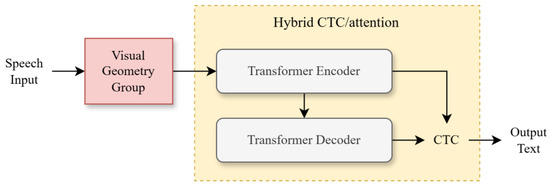
Figure 1.
Flowchart of the existing state-of-the-art Korean dysarthric ASR model.
3. Proposed Real-Time Communication Aid System for Korean Dysarthric Speech
In order to overcome the shortcomings of [10], which lacks real-time processing of various speech, this study proposes a system that can recognize the user’s speech as a whole sentence and process it in real-time. By doing so, we aim to expand the communication range of dysarthria and create an environment where natural dialogue is possible in real-time. In addition, to overcome the low computational efficiency of the model structure used in [27] and the processing problem for long sequences, we use the conformer structure. The conformer is optimized for processing temporal sequences such as speech data, and it improves computational efficiency and enhances the learning of local (short-range) patterns in the input speech data. By doing so, we aim to improve the performance of the improved model on the same dataset compared to the existing model.
Figure 2 illustrates the overall architecture of the real-time communication aid system proposed in this study. The core components of the proposed system include the following:
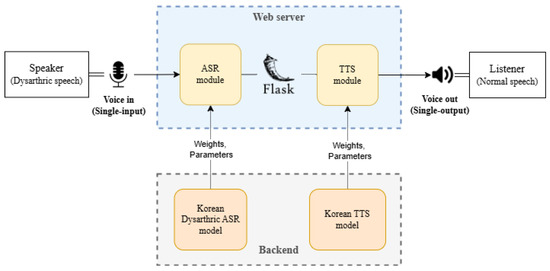
Figure 2.
Structural diagram of our proposed real-time dysarthria communication aid system.
- ASR model for Korean dysarthric speech recognition: this model processes speech input from individuals with dysarthria, identifying and converting it into textual information.
- TTS model for normal speech synthesis: based on the recognized text, this model generates high-quality non-dysarthric speech, making the output more natural and intelligible for effective communication.
The developed ASR and TTS models are integrated through a web server to ensure seamless operation. The system processes a single speech input and produces a single speech output in real-time, aiming to provide a practical and efficient solution for assisting individuals with dysarthria in various communication scenarios.
The flow of the entire system starts with the dysarthric speech input captured via a microphone. To process the input speech signal, the ASR and TTS models are modularized by loading the weights and parameters of each model, enabling them to make predictions for a single input on the web server. The ASR and TTS modules are integrated into the web server using the Flask framework of Python3.9. The ASR model processes the captured speech to generate a text output, which is then immediately passed as input to the TTS model. Through this integration, the input dysarthric speech is directly transformed into clear non-dysarthric speech on the web server. As a result, users can interact more smoothly with others in social communication situations using the synthesized non-dysarthric normal speech.
3.1. Conformer-Based Korean Dysarthric ASR
This section discusses the Korean dysarthric ASR model for a real-time communication aid system. The goal is to develop a highly accurate model to ensure the system can be effectively applied in real-world social communication scenarios involving dysarthria. To achieve this, we aim to enhance and develop the existing state-of-the-art Korean dysarthric speech recognition model and demonstrate its superiority through performance comparisons with the improved model.
The ASR model training is based on the hybrid CTC/attention model [28]. It has a similar structure to the model built in [27], but uses a conformer structure [32], which is a combination of a convolution and transformer structure, rather than only a transformer structure, as the hierarchy for modelling the attention mechanism. The conventional transformer structure, which uses VGG to extract feature vectors for the input sequence, suffers from low computational efficiency and difficulty in processing long sequences. In addition, since VGG and the transformer operate independently, there is a lack of integration between local and global information at the encoder level. The conformer encoder, on the other hand, combines self-attention and convolution in parallel, which solves computational efficiency and memory issues and captures both global and local patterns within the input sequence, enabling it to effectively learn the temporal dynamics of dysarthric speech and visual features of the speech structure. In particular, Korean is a language where investigation is highly important and word order is relatively free, and it is important to learn a long range of dependencies to understand the context. Therefore, through the dual features of self-attention and convolution, the conformer can effectively model long contextual dependencies while learning phoneme and syllable-level features, which is advantageous for distinguishing subtle differences in Korean pronunciation. Dysarthric speech has highly irregular temporal patterns between pronunciations, with large variability in stress, rhythm, and pitch. The conformer effectively captures these temporal variations, and its local–global learning structure provides an environment in which the complexity of dysarthric speech can be better understood and modeled.
Figure 3 illustrates the entire training process of the ASR model. The process begins with inputting speech data in wav format, which is then transformed into a log-Mel spectrogram, as described in Equations (1)–(3). In Equation (1), represents the window function, τ denotes the time index, and corresponds to the frequency index:
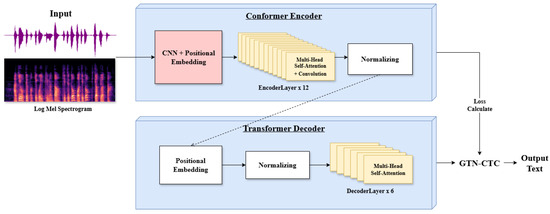
Figure 3.
Flowchart of the entire learning process for the Korean dysarthric ASR model.
The resulting spectrogram is passed through a Mel filterbank H to generate the Mel spectrogram :
Subsequently, the log transformation is applied to compress the dynamic range, yielding the log-Mel spectrogram :
Here, is a small positive constant added to prevent numerical instability and ensure that the logarithm operation does not encounter undefined values when approaches zero. This log-Mel spectrogram serves as the input to the conformer encoder. Both the encoder and decoder perform positional embedding at the early stages of the model, which vectorizes the word order and the order of acoustic features to use as positional information. In particular, during the positional embedding process in the conformer encoder, a CNN is incorporated to more finely learn the local patterns present in the positional information of the dysarthric speech sequence. The CNN generates feature maps reflecting local patterns, which better capture local information and structural relationships at each position.
The vectors converted through embedding are then passed through the encoder layer, which consists of 12 layers in total. The learning process for each layer block is shown in Figure 4.
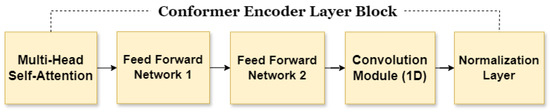
Figure 4.
Flowchart of the learning process for conformer encoder layer block.
In the first step of the layer block, multi-head self-attention (MHSA) [33] is applied. For the given input , query (Q), key (K), and value (V) vectors are generated for each word in the input vector sequence. These vectors are then processed using the attention mechanism defined in Equation (4):
Here, represents the dimension of the key vector. The attention mechanism computes a weighted sum of the value vectors, where the weights are determined by the similarity between the query and key vectors. This enables the model to selectively emphasize relevant features in the input sequence.
Following MHSA, the output is passed through two Feed-Forward Network (FFN) layers [34], which apply nonlinear transformations to further refine the extracted features. The computation in each FFN layer, and , is described by Equation (5):
Here, represents the input, and are the weight matrices of the linear layers, and and are the bias vectors. The activation function used in this model is Swish [35], which has been shown to improve model performance in various deep learning tasks.
The next component, the convolution module, is designed to capture local patterns within the input sequence. This module uses a pointwise convolution and a depthwise convolution for each kernel. These operations are followed by batch normalization and activation functions to stabilize and enhance learning. The resulting features are passed through a normalization layer.
The normalization layer integrates multiple operations, including layer normalization, residual connections, and dropout, to produce the final output of the block. The overall process is summarized in Equation (6):
Here, encompasses all preceding operations, such as MHSA, FFN, and the convolution module. The residual connection ensures stable gradient flow, while layer normalization mitigates internal covariate shifts, and dropout reduces overfitting.
Based on the output obtained through the conformer encoder, the decoder generates the output text sequence. Using the MHSA mechanism, the decoder selectively emphasizes important information from the speech sequence during text generation. In this process, CTC learns the alignment between the output of the encoder and the text sequence, ultimately generating the final output text.
As a CTC algorithm, we utilize the graph transformer network-based CTC (GTN-CTC) [36] algorithm. Compared to traditional CTC approaches, GTN-CTC is effective in handling long input sequences and large datasets, and its graph structure enables it to manage complex dependencies, resulting in faster computation and better memory efficiency. In addition, Korean has a very diverse morphology with a combination of endings and articles, which are often semantically analyzed on a syllable-by-syllable basis. While the simple linear sequence matching approach of the traditional CTC can handle speech data at the phoneme or syllable level, it is less efficient in a language like Korean, where the number of possible combinations due to phonological variations (alliteration, allophones, contractions, elision) is high. GTN-CTC uses a graph structure to more flexibly and efficiently represent the relationship between pronunciation models and word sequences under these variations and can cope well with the complex syllable structures and word order variations in Korean. Therefore, GTN-CTC can better model the complex syllable structure, context dependency, and phonological variations in Korean along with the nonlinear speech flow of dysarthric speech through a graph-based approach.
Figure 5 illustrates the learning process of GTN-CTC. When an input is provided, the total CTC loss function is defined as follows:
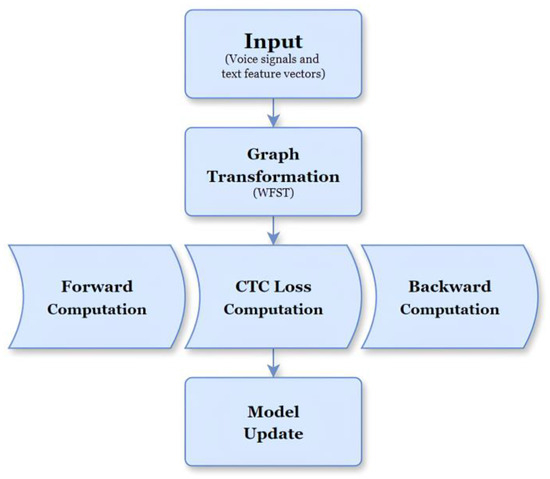
Figure 5.
Flowchart of the learning process in GTN-CTC.
Here, represents the input feature vector, and y denotes the target label sequence. refers to the probability that includes alignment likelihoods calculated through the GTN. The GTN represents all possible alignments between the input sequence and the target labels y in the form of a graph.
In Equation (8), denotes the set of all possible alignments between and , and represents the probability of a specific alignment . This probability is computed using the GTN graph, which efficiently calculates the probabilities of state transitions. Subsequently, the overall probability is computed by summing the paths in the graph. The model is trained by backpropagating the calculated loss and updating the weights.
3.2. Korean TTS Model
Based on the recognition results from the ASR model, we construct a TTS model to generate Korean non-dysarthric speech. For the TTS model architecture, we use Jointly Training FastSpeech2 and HiFi-GAN for end-to-end Text-to-Speech (JETS) [37]. JETS combines the popular TTS architecture FastSpeech2 [38] and the GAN-based speech synthesis model HiFi-GAN [39] for joint training. This approach simplifies the traditional two-stage TTS training process into a single unified training process, allowing for high-quality speech synthesis results. The joint training structure is advantageous for better connecting text and speech with complex phonological rules in Korean. Unlike other TTS models, it additionally utilizes a GAN-based generation structure to regenerate speech, which reduces the noise in the speech output and produces a more natural and high-quality speech. Furthermore, it utilizes additional prediction mechanisms such as a pitch predictor to further fine-tune the intonation and more naturally represent the various contextual variations and intonation patterns of Korean endings (question, plain, etc.). This provides an advantage for Korean speech synthesis where intonation is important. The overall learning process of JETS is shown in Figure 6.
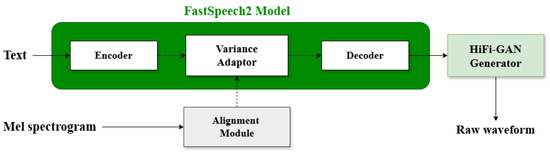
Figure 6.
Flowchart of the learning process in JETS.
The components of JETS can be broadly divided into three parts: FastSpeech2, HiFi-GAN, and the alignment module. In the first stage, FastSpeech2 takes text input and learns the duration , pitch , and energy for each text token through a variance adaptor. The corresponding loss function, , is defined in Equation (9) and is based on the predicted values of the feature sequences and :
FastSpeech2 combines the text embeddings and the variance features predicted by the variance adaptor to generate the Mel spectrogram M.
Then, in the alignment module, the alignment between the Mel spectrogram M and the text embedding E is learned. The objective function for alignment learning can be simplified as shown in Equation (10), and it is computed as shown in Equation (11):
Here, represents the number of frames in the Mel spectrogram. This alignment process ensures that the temporal structure of the Mel spectrogram matches the sequence of text embeddings.
Finally, HiFi-GAN takes the output of the decoder as input and synthesizes the raw waveform. During this process, the adversarial learning between the generator and the discriminator results in the GAN loss function, denoted as . The overall loss function L for JETS integrates the contributions from the variance adaptor, alignment module, and HiFi-GAN, as defined in Equation (12):
Here, , , and represents the weight of each loss function. Therefore, based on the overall loss function L defined as in Equation (12), JETS converts text to Mel spectrograms through FastSpeech2, learns the alignment between text and Mel spectrograms through the alignment module, and finally generates high-quality raw audio through HiFi-GAN, implementing an efficient and integrated TTS model.
4. Experiments
4.1. Experimental Setup
For the development of a Korean ASR model for dysarthria, we use the dysarthric speech recognition data provided by AI-hub [27], which were collected from hospitals in Korea. This dataset contains over 5000 h of speech data collected from approximately 1200 dysarthric patients, covering various ages, regions, genders, and diseases. The total size of the data is about 430 GB, and it includes the voices of patients with various levels of severity without any classification. The data were collected continuously in a format in which patients with dysarthria spoke for less than 10 s, followed by a period of silence of about 30 s. Voice Activity Detection (VAD) was used to remove the silent period and segment it into single sentences or words. To apply VAD, the average energy of the corresponding audio file is calculated and set as the threshold for classifying silence and speech. After that, if a single voice file has a value lower than the threshold for more than five seconds, it is classified as a silent section based on the set threshold, and the section until the voice is detected again is measured and the section is deleted from the entire voice data. The audio segments that are divided into before and after the deleted segment are saved as separate wav files, and the labels are also classified as txt files and saved with the same name as the wav files. This process is applied to all voice data to perform pre-processing. As a result of pre-processing, 17,205 short sentences with fewer than three words, 35,681 medium-length sentences containing four to nine words, and 6511 long sentences with more than ten words were generated. Training was performed using approximately 100 h of pure dysarthric speech data.
For the development of the Korean TTS model, we use the KSS dataset [40]. This dataset consists of approximately 12 h of clean speech data from a female announcer and is commonly used for Korean TTS model development. The total size of the data is about 3 GB, and it does not include words or short sentences. It contains a total of 12,853 medium-length sentences, all of which were used for training without any additional pre-processing.
The hardware environment for the experiments was identical across all tests and consisted of a server computer with an NVIDIA RTX A6000 GPU (manufactured by NVIDIA corporation, produced in China, and supplied in South Korea), a 64-core 2.7 GHz CPU, and 400 GB of RAM. Additionally, both the TTS and ASR model training were conducted using the ESPnet toolkit [29].
4.2. Experimental Results
We conduct training results and performance evaluation for both the ASR model and the TTS model. Additionally, we visualize the input and output speech data of the entire system and present comparisons.
4.2.1. ASR Model
The Korean dysarthric ASR model was trained for a total of 35 epochs, with a batch size of 20, and 23,450 training steps. It was performed based on 2309 byte-pair encodings. The training took approximately 20 h, and the results presented an accuracy of 98.1% for the training data and 94.4% for the validation data.
To evaluate the performance of the proposed model, we conduct a performance evaluation by comparing it with the state-of-the-art Korean dysarthric ASR model based on the hybrid CTC/attention transformer encoder–decoder structure in [27]. The hybrid CTC/attention learning method, which incorporates both CTC and attention losses, is the same as the proposed model. However, in this existing model, VGG for local pattern learning of input data is performed independently from the transformer, and the CTC algorithm follows the conventional approach. For evaluation, a dataset of approximately 2500 sentences not used in training was employed. The evaluation metrics included the Character Error Rate (CER) and Word Error Rate (WER), which are the most commonly used metrics for assessing ASR model performance. These metrics are particularly suitable for evaluating Korean, as meaning is constructed at the syllable and word levels. Additionally, to measure the performance improvement over the baseline model for each error rate, the Error Reduction Rate (ERR) was also evaluated.
Table 2 shows the performance evaluation results. The results show that the performance improvement is about 42% for CER and about 38% for WER compared to the existing model. Consequently, this indicates the superiority of the proposed conformer-based GTN-CTC application model for Korean dysarthric speech over the existing ASR model.
Table 2.
Performance evaluation results of the proposed ASR model.
4.2.2. TTS Model
The TTS model was trained by using the KSS dataset for a total of 150 epochs over the course of 7 days. To evaluate the performance of JETS to be used in the proposed system, we used the Tacotron2 [41] and Transformer TTS [42] models provided by ESPnet-TTS [43] to measure and compare their performance. All of these models were trained using the same dataset in the environment mentioned in Section 4.1. The evaluation metric used for performance measurement was the subjective Mean Opinion Score (MOS) [44]. The MOS is a widely used evaluation metric for TTS performance, assessing the quality of generated speech by subjectively comparing it to the original speech.
For the MOS measurement, 10 participants from schools in Korea were asked to evaluate 20 different audio samples generated by each model. The evaluation was based on a scale of 1 (poor), 2 (fair), 3 (average), 4 (good), and 5 (excellent), and was assessed based on how natural the synthesized speech was compared to the original, unprocessed Korean speech.
Table 3 shows the MOS results for the three TTS models. The evaluation results indicate that JETS achieved the highest score of 4.64, while Tacotron2 scored 3.03, and Transformer TSS scored the lowest at 2.51. The overall tendency in the evaluation of the synthesized speech is that the speech generated by JETS was considered natural both in terms of intonation and voice quality, whereas the speech synthesized by Tacotron2 and Transformer TTS has natural intonation but was dominated by mechanical-sounding voices.
Table 3.
Evaluate MOS comparisons for different TTS models.
4.3. Integrated Communication Aid Systems
Finally, the trained ASR and TTS models are combined to build the entire communication system. The entire system operates as a single program, and during execution, it receives speech input from the user via the user interface. As the length of the input increases, the time to obtain the final output also increases. However, if the user provides speech input lasting 5–10 s, the final output is obtained approximately 2–3 s after input. This means that the conversion and output are completed within 1–2 s after voice input, assuming that the utterances used in daily life are generally short utterances of 3–5 s. Therefore, this system has the problem of a long delay time in the case of a long voice input of 10 s or more, but the delay time is reduced to around 1 s for short utterances used for simple communication in daily life, indicating that it is not unreasonable to be applied in real-time in real life.
Figure 7 shows a visualization of the Korean dysarthric speech used as input and the synthetic utterance generated by the entire system. In Figure 7a, corresponding to the dysarthric speech, we can see that there are frequent silences in the middle of the utterance. This is due to the nature of dysarthria, which is a speech blockage caused by the dysregulation of the articulatory system during speech, which causes great confusion for the listener in understanding the speech. When such dysarthric speech is fed into a communication aid system, all the silent intervals caused by speech blockages are removed and resynthesized into a natural rhyming utterance, Figure 7b.
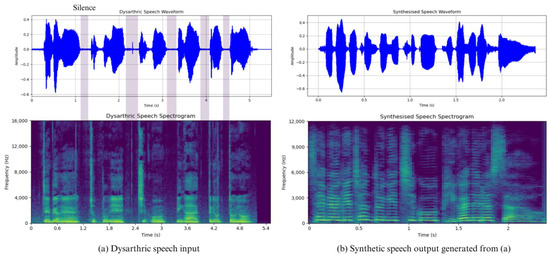
Figure 7.
Visualization of the system output for the Korean dysarthric speech input: (Meaning: “At dawn, it thundered and rained”) and (English phonetic transcription: “saebyeoge cheondungi chigo biga naeryeosseoyo”). The gray areas in the graph indicate silent segments within the speech, which were caused by dysarthric speech disfluencies.
Figure 8 shows the input and output results for a similar case to Figure 7, but for a slightly longer speech: a dysarthric speech of about 9.5 s has been significantly shortened to about 3.5, and the long pauses in the middle of the speech have been eliminated. This process of speech recognition and synthesis makes the relatively long speech shorter and clearer, allowing the user to produce natural speech.
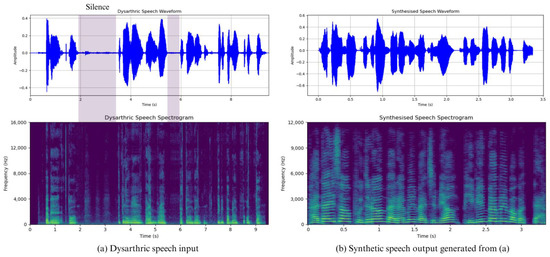
Figure 8.
Visualization of the system output for the Korean dysarthric speech input: (Meaning: “I ate bibimbap with a gentle breeze from the sea”) and (English phonetic transcription: “badaeseo budeureoun barameul majeumyeo bibimbabeul meogeossda”). The gray areas in the graph indicate silent segments within the speech, which were caused by dysarthric speech disfluencies.
Since the system is provided to users through a web server, the performance of the system is dependent on the performance of the server computer that deploys the system on the web server. Therefore, the device for running the system has the advantage of not having any problems with system performance even on a device with limited resources, as long as it is provided with an Internet network that can reliably connect to the web server. In addition, the recognition speed, which accounts for a large part of the performance of this system, has been measured based on CPU, and if it is converted to a GPU-based recognition method or optimized as a cloud-based service in the future, performance improvement and a more efficient system deployment can be expected.
5. Conclusions
This paper proposes a real-time communication aid system for Korean dysarthria using ASR and TTS models. The dysarthric ASR model, the core component of the system, is designed using a conformer-based encoder and GTN-CTC, and is targeted at Korean, a language that has rarely been applied to previous dysarthric ASR research. The proposed dysarthric ASR model achieves a performance improvement of about 42% in terms of CER and 38% in terms of WER compared to the conventional transformer-based model. The TTS model for Korean speech synthesis was developed based on JETS, resulting in high-quality Korean speech synthesis. It also showed the highest MOS score of 4.64, outperforming existing Tacotron2 and transformer-based TTS models. The developed ASR and TTS models are integrated via a web server, converting approximately 5–10 s of input dysarthric speech into clear non-dysarthric speech within 2–3 s. By achieving the real-time transformation of dysarthric speech, this research fulfills its ultimate goal of significantly aiding communication for individuals with dysarthria.
However, this system has some limitations. First, although real-time results are guaranteed for short voice inputs, long voice inputs of 10 s or more have a long delay. To solve this problem, research can be conducted on how to ensure real-time results for speech recognition and synthesis through streaming processing for long speech inputs. Also, the process of real-world usability verification has not been sufficiently studied in this research. For ethical considerations such as data privacy and user acceptance for vulnerable groups, it is essential to investigate various user feedback from real-world vulnerable groups. Therefore, future verification is needed to discuss the user-friendliness, convenience, accessibility, and functionality of the system according to user feedback, and to ensure fair and equitable performance across various user groups. Finally, a separate stand-alone device is required for a communication aid with even higher usability. The proposed system can be used by using a computing device such as a smartphone via a web server, but a separate stand-alone device is required for immediate and continuous use in the daily lives of people with dysarthria. To this end, we can design and manufacture a user-friendly hardware structure and optimize and embed the system to create a stand-alone device for dysarthria. In future research based on the device, we will investigate various user feedback from the aforementioned actual vulnerable groups and aim to develop a more effective communication aid by reflecting ethical considerations such as data privacy and user acceptance.
Author Contributions
Conceptualization, K.P. and J.H.; methodology, K.P. and J.H.; software, K.P.; validation, J.H.; formal analysis, K.P.; investigation, K.P.; resources, J.H.; data curation, K.P.; writing—original draft preparation, K.P.; writing—review and editing, K.P. and J.H.; visualization, K.P.; supervision, J.H.; project administration, K.P. and J.H.; funding acquisition, K.P. All authors have read and agreed to the published version of the manuscript.
Funding
This research was funded by the ‘Student-Initiated Creative Research Project’ at Changwon National University in 2024.
Data Availability Statement
This research (paper) used datasets from ‘Dysarthric speech recognition data (AI-Hub, S. Korea)’. All data information can be accessed through ’AI-Hub (www.aihub.or.kr)’, accessed on 27 January 2025.
Conflicts of Interest
The authors declare no conflicts of interest.
References
- Enderby, P. Disorders of communication: Dysarthria. Handb. Clin. Neurol. 2013, 110, 273–281. [Google Scholar] [PubMed]
- Kim, S.-J.; Lee, H.-J.; Park, K.-Y.; Lee, J.-S. A survey of speech sound disorders in clinical settings. Commun. Sci. Disord. 2015, 20, 133–144. [Google Scholar] [CrossRef]
- Preston, J.L.; Hull, M.; Edwards, M.L. Preschool Speech Error Patterns Predict Articulation and Phonological Awareness Outcomes in Children With Histories Of Speech Sound Disorders. Am. J. Speech-Lang. Pathol. 2013, 22, 173–184. [Google Scholar] [CrossRef] [PubMed]
- Rampello, L.; D’Anna, G.; Rifici, C.; Scalisi, L.; Vecchio, I.; Bruno, E.; Tortorella, G. When the word doesn’t come out: A synthetic overview of dysarthria. J. Neurol. Sci. 2016, 369, 354–360. [Google Scholar] [CrossRef] [PubMed]
- Page, A.D.; Yorkston, K.M. Communicative participation in dysarthria: Perspectives for management. Brain Sci. 2022, 12, 420. [Google Scholar] [CrossRef] [PubMed]
- Jordan, L.C.; Hillis, A.E. Disorders of speech and language: Aphasia, apraxia and dysarthria. Curr. Opin. Neurol. 2006, 19, 580–585. [Google Scholar] [CrossRef]
- Selouani, S.-A.; Sidi Yakoub, M.; O’Shaughnessy, D. Alternative speech communication system for persons with severe speech disorders. EURASIP J. Adv. Signal Process. 2009, 2009, 540409. [Google Scholar] [CrossRef]
- Light, J.; McNaughton, D. Supporting the communication, language, and literacy development of children with complex communication needs: State of the science and future research priorities. Assist. Technol. 2012, 24, 34–44. [Google Scholar] [CrossRef] [PubMed]
- Judge, S. The Design of Voice Output Communication Aids. Ph.D. Thesis, University of Sheffield, Sheffield, UK, 2023. [Google Scholar]
- Hawley, M.S.; Cunningham, S.P.; Green, P.D.; Enderby, P.; Palmer, R.; Sehgal, S.; O’Neill, P. A voice-input voice-output communication aid for people with severe speech impairment. IEEE Trans. Neural Syst. Rehabil. Eng. 2012, 21, 23–31. [Google Scholar] [CrossRef]
- Tu, M.; Singh, A.; Tang, H. The relationship between perceptual disturbances in dysarthric speech and ASR performance. J. Acoust. Soc. Am. 2016, 140, EL416–EL422. [Google Scholar] [CrossRef]
- Qian, Z.; Xiao, K. A survey of automatic speech recognition for dysarthric speech. Electronics 2023, 12, 4278. [Google Scholar] [CrossRef]
- Bharti, K.; Das, P.K. A survey on ASR systems for dysarthric speech. In Proceedings of the 2022 4th International Conference on Artificial Intelligence and Speech Technology (AIST), Bhubaneswar, India, 9–11 December 2022; pp. 1–6. [Google Scholar]
- Jayaram, G.; Abdelhamied, K. Experiments in dysarthric speech recognition using artificial neural networks. J. Rehabil. Res. Dev. 1995, 32, 162. [Google Scholar] [PubMed]
- Vachhani, B.; Bhat, C.; Kopparapu, S.K. Data augmentation using healthy speech for dysarthric speech recognition. In Proceedings of the Interspeech 2018, Hyderabad, India, 2–6 September 2018; pp. 471–475. [Google Scholar]
- Harvill, J.; Bejleri, A.; Arfath, M.; Das, D.; Thomas, S. Synthesis of new words for improved dysarthric speech recognition on an expanded vocabulary. In Proceedings of the ICASSP 2021–2021 IEEE International Conference on Acoustics, Speech and Signal Processing (ICASSP), Toronto, ON, Canada, 6–11 June 2021; pp. 6428–6432. [Google Scholar]
- Liu, S.; Liu, J.; Zhao, J.; Zhang, H.; Li, P.; Meng, H. Exploiting visual features using Bayesian gated neural networks for disordered speech recognition. In Proceedings of the Interspeech 2019, Graz, Austria, 15–19 September 2019; pp. 4120–4124. [Google Scholar]
- Zhang, S.; Du, J.; Dai, L.; Lee, C.-H. Robust audio-visual speech recognition using bimodal DFSMN with multi-condition training and dropout regularization. In Proceedings of the ICASSP 2019–2019 IEEE International Conference on Acoustics, Speech and Signal Processing (ICASSP), Brighton, UK, 12–17 May 2019; pp. 6570–6574. [Google Scholar]
- Yu, C.; Su, X.; Qian, Z. Multi-stage audio-visual fusion for dysarthric speech recognition with pre-trained models. IEEE Trans. Neural Syst. Rehabil. Eng. 2023, 31, 1912–1921. [Google Scholar] [CrossRef] [PubMed]
- Shahamiri, S.R. Speech vision: An end-to-end deep learning-based dysarthric ASR system. IEEE Trans. Neural Syst. Rehabil. Eng. 2021, 29, 852–861. [Google Scholar] [CrossRef] [PubMed]
- Almadhor, A.; Qaddoumi, A.; Al-Obaidi, S.; Al-Ali, K. E2E-DASR: End-to-end deep learning-based dysarthric ASR. Expert Syst. Appl. 2023, 222, 119797. [Google Scholar] [CrossRef]
- Albaqshi, H.; Sagheer, A. Dysarthric speech recognition using convolutional recurrent neural networks. Int. J. Intell. Eng. Syst. 2020, 13, 1–10. [Google Scholar] [CrossRef]
- Soleymanpour, M.; Karuppiah, S.; Narayanasamy, T. Synthesizing dysarthric speech using multi-speaker TTS for dysarthric speech recognition. In Proceedings of the ICASSP 2022–2022 IEEE International Conference on Acoustics, Speech and Signal Processing (ICASSP), Singapore, 22–27 May 2022; pp. 7382–7386. [Google Scholar]
- Baali, M.; Alami, M.; Amar, M.; Merzouk, R. Arabic dysarthric speech recognition using adversarial and signal-based augmentation. arXiv 2023, arXiv:2306.04368. [Google Scholar]
- Kim, H.; Chang, J.; Yun, S.; Kim, Y. Dysarthric speech database for universal access research. In Proceedings of the Interspeech 2008, Brisbane, Australia, 22–26 September 2008; pp. 1741–1744. [Google Scholar]
- Rudzicz, F.; Namasivayam, A.K.; Wolff, T. The TORGO database of acoustic and articulatory speech from speakers with dysarthria. Lang. Resour. Eval. 2012, 46, 523–541. [Google Scholar] [CrossRef]
- Dysarthric Speech Recognition Data. Available online: https://aihub.or.kr/aihubdata/data/view.do?currMenu=115&topMenu=100&dataSetSn=608 (accessed on 30 November 2024).
- Xiao, Z.; Liu, W.; Huang, L. Hybrid CTC-attention based end-to-end speech recognition using subword units. In Proceedings of the 2018 11th International Symposium on Chinese Spoken Language Processing (ISCSLP), Taipei, Taiwan, 26–29 November 2018; pp. 146–150. [Google Scholar]
- Watanabe, S.; Hori, T.; Karita, S.; Hayashi, T.; Nishitoba, S.; Unno, Y.; Morita, K.; Kawakami, K.; Baskar, M.A.; Fujita, Y. ESPnet: End-to-end speech processing toolkit. arXiv 2018, arXiv:1804.00015. [Google Scholar]
- Bang, J.-U.; Kim, J.-S.; Yoon, J.-H.; Joo, S.-Y.; Lee, S.-M.; Cho, S.-K. Ksponspeech: Korean spontaneous speech corpus for automatic speech recognition. Appl. Sci. 2020, 10, 6936. [Google Scholar] [CrossRef]
- Karita, S.; Watanabe, S.; Chen, Z.; Hayashi, T.; Hori, T.; Inaguma, H.; Jiang, Z.; Someki, M.; Soplin, N.E.Y.; Yamamoto, R. A comparative study on transformer vs. In RNN in speech applications. In Proceedings of the 2019 IEEE Automatic Speech Recognition and Understanding Workshop (ASRU), Sentosa, Singapore, 14–18 December 2019; pp. 449–456. [Google Scholar]
- Guo, P.; Watanabe, S.; Kawahara, T.; Takeda, K. Recent developments on ESPnet toolkit boosted by conformer. In Proceedings of the ICASSP 2021–2021 IEEE International Conference on Acoustics, Speech and Signal Processing (ICASSP), Toronto, ON, Canada, 6–11 June 2021; pp. 5874–5878. [Google Scholar]
- Voita, E.; Talbot, D.; Moiseev, F.; Sennrich, R.; Titov, I. Analyzing multi-head self-attention: Specialized heads do the heavy lifting, the rest can be pruned. arXiv 2019, arXiv:1905.09418. [Google Scholar]
- Bebis, G.; Georgiopoulos, M. Feed-forward neural networks. IEEE Potentials 1994, 13, 27–31. [Google Scholar] [CrossRef]
- Ramachandran, P.; Zoph, B.; Le, Q.V. Searching for activation functions. arXiv 2017, arXiv:1710.05941. [Google Scholar]
- Hannun, A.; Case, C.; Casper, J.; Catanzaro, B.; Cong, Y.; Fougner, C.; Han, T.; Kang, Y.; Krishnan, P.; Prenger, R.; et al. Differentiable weighted finite-state transducers. arXiv 2020, arXiv:2010.01003. [Google Scholar]
- Lim, D.; Jung, S.; Kim, E. JETS: Jointly training FastSpeech2 and HiFi-GAN for end-to-end text-to-speech. arXiv 2022, arXiv:2203.16852. [Google Scholar]
- Ren, Y.; Hu, C.; Tan, X.; Qin, T.; Zhao, S.; Zhao, Z.; Liu, T.-Y. FastSpeech 2: Fast and high-quality end-to-end text-to-speech. arXiv 2020, arXiv:2006.04558. [Google Scholar]
- Kong, J.; Kim, J.; Bae, J. HiFi-GAN: Generative adversarial networks for efficient and high fidelity speech synthesis. Adv. Neural Inf. Process. Syst. 2020, 33, 17022–17033. [Google Scholar]
- KSS Dataset: Korean Single Speaker Speech Dataset. Available online: https://www.kaggle.com/datasets/bryanpark/korean-single-speaker-speech-dataset (accessed on 27 January 2025).
- Shen, J.; Pang, R.; Weiss, R.J.; Schuster, M.; Jaitly, N.; Yang, Z.; Chen, Z.; Zhang, Y.; Wang, Y.; Skerrv-Ryan, R. Natural TTS synthesis by conditioning WaveNet on mel spectrogram predictions. In Proceedings of the 2018 IEEE International Conference on Acoustics, Speech and Signal Processing (ICASSP), Calgary, AB, Canada, 15–20 April 2018; pp. 4779–4783. [Google Scholar]
- Li, N.; Liu, S.; Liu, Y.; Zhao, M.; Liu, M.; Zhou, L. Neural speech synthesis with transformer network. In Proceedings of the AAAI Conference on Artificial Intelligence, Honolulu, HI, USA, 27 January–1 February 2019; pp. 6706–6713. [Google Scholar]
- Hayashi, T.; Yasuda, K.; Watanabe, S.; Higuchi, Y.; Takeda, K.; Kawahara, T. ESPnet-TTS: Unified, reproducible, and integratable open source end-to-end text-to-speech toolkit. In Proceedings of the ICASSP 2020–2020 IEEE International Conference on Acoustics, Speech and Signal Processing (ICASSP), Barcelona, Spain, 4–8 May 2020; pp. 7654–7658. [Google Scholar]
- ITU-T. Mean Opinion Score (MOS) Terminology; ITU-T Recommendation P.800.1; International Telecommunication Union: Geneva, Switzerland, 2006. [Google Scholar]
Disclaimer/Publisher’s Note: The statements, opinions and data contained in all publications are solely those of the individual author(s) and contributor(s) and not of MDPI and/or the editor(s). MDPI and/or the editor(s) disclaim responsibility for any injury to people or property resulting from any ideas, methods, instructions or products referred to in the content. |
© 2025 by the authors. Licensee MDPI, Basel, Switzerland. This article is an open access article distributed under the terms and conditions of the Creative Commons Attribution (CC BY) license (https://creativecommons.org/licenses/by/4.0/).