Abstract
Induction motors require effective speed controllers to handle challenging conditions such as indirect vector control, nonlinear dynamics, load-disturbances, and changes in rotor resistance. Although proportional–integral (PI) controllers and type-1 fuzzy logic controllers (T1-FLC) are relatively straightforward to implement, they can produce significant overshoot and slow recovery; type-2 fuzzy logic controllers (T2-FLC), on the other hand, improve uncertainty management at the cost of higher computational complexity. This study proposes a type-3 fuzzy logic controller (T3-FLC) that balances robustness with a single -slice using two inputs and seven membership functions per input (49 rules). In six comparison scenarios, the type-3 FLC (T3-FLC) consistently offers a lower overshoot percentage and shorter recovery/settling times than the PI controller and type-1 FLC (T1-FLC). Overshoot drops to with T3-FLC during a high-speed positive step, while this value for the PI controller is . During a low-amplitude positive step, T3-FLC reaches , while the PI controller reaches and T1-FLC reaches . After load torque is removed, the recovery time under T3-FLC is s at high speed and s at low speed, while for PI, these values are s and s, respectively. Under variations in rotor resistance, T3-FLC maintains a significantly smaller overshoot value: with a change (3–6 s window), the values are (T3-FLC) versus (PI) and (T1-FLC); with a change (3–6 s), the values are (T3-FLC) versus (PI) and (T1-FLC). Although there are isolated cases in which PI or T1-FLC shows a marginal advantage in a single metric (e.g., slightly smaller overshoot during transition or lower peak error during disturbance), T3-FLC generally provides the best balance, combining low overshoot with short settling/recovery time while keeping steady-state error at zero in all scenarios.
1. Introduction
Modern alternative current (AC) motor drives achieve high efficiency and reach performance targets thanks to advances in power semiconductors and digital control [1,2]. Induction motors (IM) are widely used in industrial environments due to their robustness and cost-effectiveness [2,3]. However, in indirect vector control (IVC), the speed-control loop is particularly sensitive to nonlinear dynamics and parameter variations—especially under conditions of low speeds, perturbing load-torque changes, and temperature-dependent variations in rotor resistance [4,5]. Such effects degrade transient performance and complicate controller tuning. Classical proportional–integral (PI) and type-1 fuzzy logic controllers (T1-FLC) are attractive due to their simplicity [6,7]. However, they can exhibit significant overshoot, long settling times, and sensitivity to parameter mismatch when operating away from nominal conditions [2,3]. The type-2 fuzzy logic controller (T2-FLC) improves uncertainty handling [8,9]; however, the associated modeling effort and computational load could hinder embedded real-time deployment [10,11,12].
1.1. Motivation
The speed-control loop in the IVC is particularly sensitive to nonlinear conditions under conditions of low speeds, sharp load-torque events, and temperature-induced changes in rotor resistance [2,4,5,13]. The classic PI controller and T1–FLC may perform well near nominal conditions; however, they tend to exhibit higher overshoot, longer settling times, and sensitivity to parameter mismatch in the motor response [2,3]. Balancing accuracy and efficiency, a Type-3 fuzzy logic controller (T3–FLC) accepts asymmetric shapes of membership functions with matched upper/lower surfaces, which thus represent uncertainty at the rule level without excessive structural growth [14,15]. Complexity is purposely limited by using two inputs and seven memberships per input (yielding a rule base with R = 49) and a single -slice (), which preserves interpretability and limits inference and type-reduction costs [16,17]. This configuration aims for predictable closed-loop behavior under the aforementioned operating conditions: lower overshoot, shorter settling and recovery times, and negligible steady-state error.
1.2. Methodology
A compact T3-FLC was used as a controller for the speed-control loop of the IVC-IM driver. The T3-FLC was configured using two inputs, speed error and its derivative, with a seven-member function (49 rules) for each input. The membership functions’ parameters are selected through a structured, manual tuning protocol guided by closed-loop criteria (overshoot, rise time, settling time, recovery) without numerical optimization. A comparative analysis encompassed six distinct scenarios, utilizing a simulation model implemented within the MATLAB 2023a/Simulink environment. The study encompassed no-load scenarios with a range of speeds, specifically and , in addition to short-term load applications at and . The analysis also encompassed a change in rotor resistance. The comparison is presented using standard time-domain performance metrics and graphs, employing a PI controller and a T1–FLC within the same simulation model and sampling settings.
1.3. Organization of Paper
In Section 2 the paper provides a detailed and systematic review of the relevant literature. Section 3 sets out the IM model in the stator frame. Section 4 sets out the proposed T3–FLC (membership parameterization, rule base, inference with type reduction). The closed-loop configuration, tuning workflow, evaluation protocol, performance metrics, simulation, and controller settings are described in Section 5. In Section 6, a comparison of the six cases is presented, and the paper concludes with a discussion of the paper’s findings and limitations and a brief outline of a future study.
2. Literature Review
In the automation field, induction motors (IMs) have become prevalent due to their durability and cost-effectiveness. However, when it comes to achieving high performance in speed control, these motors face challenges arising from their inherent nonlinear dynamics and parameter variations, which differ from the characteristics of direct current (DC) drives [18,19]. Scalar volts-per-hertz (V/f) control is straightforward in concept; however, its transient performance is limited [2]. Direct torque control (DTC) has been demonstrated to achieve a rapid torque response; however, it is accompanied by torque ripple and a variable switching frequency [20,21,22]. The field-oriented control (FOC) method constitutes a control system developed for utilization in electrical machines. It has two main features. Firstly, it decouples flux and torque. Secondly, it enables accurate and fast transients [3,4,23].
In the context of DTC and associated drive schemes, variants that employ optimization and learning methodologies have yielded quantifiable enhancements. These include ACO-based DTC, validated experimentally on doubly fed induction motor (DFIM) benches; DTC augmented with artificial neural networks (ANNs); and neuro-fuzzy hybrid architectures employed for condition monitoring and fault diagnostics [24,25,26]. In addition, complementary sensorless strategies that integrate fuzzy logic with model-reference adaptive system (MRAS) observers have also been explored [27].
Due to its simplicity, the PI controller continues to be a prevalent component of vector-controlled drives. However, it is essential to note that nonlinearities and parameter variations can compromise the controller’s robustness. Meta-heuristics such as particle swarm optimization (PSO) and artificial bee colony (ABC) have been utilized to tune PI controller parameters. Sliding-mode control (SMC) has been demonstrated to be disturbance-resilient; however, it is also prone to chattering [28,29,30,31,32,33,34]. Super-twisting and the use of adaptive variants have been shown to mitigate this issue. Back-stepping provides Lyapunov-based stability guarantees and has been employed in IM speed regulation. Adaptive forms of back-stepping have been shown to reduce steady-state error in the presence of uncertainties, as evidenced by research [35,36]. Model predictive control (MPC), including finite-control-set (FCS) MPC, explicitly handles multivariable constraints, and its use has been demonstrated in vector-controlled IMs. FPGA-friendly fuzzy integration has been used to reduce computational load [37,38,39,40]. Robust () and linear–matrix inequality (LMI) formulations have been reported, including hybrid designs for improved sensitivity to parameter changes [41].
Intelligence-based speed controllers address several shortcomings of conventional schemes. T1-FLC and adaptive neuro-fuzzy inference system (ANFIS) variants frequently demonstrate superior performance in scenarios with parameter uncertainty, a finding substantiated through real-time validation [42,43,44,45]. T2-FLC enhances robustness by modeling membership-function uncertainty; its applications include direct torque control-support vector machine (DTC-SVM), MRAS observers, and hybrid MPC–type-2 fuzzy neural network (T2-FNN) frameworks for sensorless drives [46,47,48]. However, the associated computational burden and design effort can limit their suitability for real-time embedded implementation.
More recently, T3-FLC has been reported to improve stability margins and steady-state accuracy in nonlinear industrial drive settings by leveraging three-dimensional membership representations and interval-based type-reduction [49,50,51,52]. This study presents a T3-FLC with two inputs with seven memberships for each input (49 rules) and a single -slice, coupled with a structured manual tuning protocol and benchmarking against the PI controller and T1-FLC under matched conditions.
Problem Statement and Contributions
The speed-control loop in IVC-IM drives is characterized by three primary challenges. The system demonstrates sensitivity to parameter variations, notably temperature-driven rotor-resistance variation. Furthermore, the system has a reduced capacity to reject disturbances when it is subjected to sudden variations in load torque. Finally, increased overshoot or prolonged settling across low/high-speed regimes under fixed-structure controllers is also observed. It is evident that conventional PI and T1–FLC solutions offer simplicity; however, it is essential to note that they can exhibit increased overshoot and longer transient times under these conditions.
This work addresses the above issues by designing a compact T3-FLC that (a) models uncertainty at the rule level while retaining a small rule base and (b) is tuned with a transparent, repeatable protocol. The main contributions are as follows.
- The architecture under consideration is a compact T3-FLC architecture comprising two inputs, seven sets per input (yielding 49 rules), a single -slice, and balanced input scaling, which preserves interpretability.
- A documented tuning protocol comprising minor guided adjustments across reference steps, load-torque impulses, and rotor-resistance variations is utilized without a global optimizer, thereby facilitating reproducibility.
- The present study has demonstrated that a six-case benchmark shows lower overshoot and shorter settling/recovery times compared to the PI controller and T1–FLC across operating conditions, with zero steady-state error.
3. Mathematical Model of Induction Motor
In order to obtain the stator (stationary) reference frame, it is first necessary to map three-phase stator currents to the coordinates by means of the Clarke transformation, as follows [1]:
where are phase currents; are the stationary and –axis currents; and is the zero–sequence current.
In the stationary frame, stator voltage equations take the form [1,53]
where are the and –axis stator voltages; is the stator resistance; are stator flux linkages along the – and –axes; and are the corresponding stator currents.
Rotor circuits are short–circuited and written in the same stationary frame, as follows:
where is the rotor resistance; are rotor currents in the and –axes; are rotor flux linkages; and is the rotor speed.
Flux linkages follow linear magnetics with mutual coupling, as follows:
where are stator and rotor self–inductances; is the mutual inductance; are stator currents; are rotor currents; and are stator and rotor flux linkages.
Electromagnetic torque in the stationary frame is expressed by the cross–product as follows:
where is the electromagnetic torque; P is the number of poles; are stator flux linkages; and are stator currents.
Mechanical dynamics are represented by a single-inertia balance as follows:
where J is the lumped inertia; B is the viscous friction coefficient; is the mechanical rotor speed; is the load torque; and is the electromagnetic torque.
Balanced operation implies in (1), and all relations (2)–(7) are used throughout the simulations under the linear–magnetic, three-phase-balanced assumptions stated in Section 5.5.
4. Type-3 Fuzzy Logic System
This section examines the fundamental structure of T3-FLC in detail, primarily focusing on the definitions of input–output configuration and membership functions. In the final subsection, the integration of T3-FLC into the speed control of an IVC-IM is systematically and comprehensively discussed. The recent literature indicates that T3-FLC approaches provide an effective alternative for modeling and controlling high-uncertainty and nonlinear systems [49,51,54,55,56,57]. It is evident that among the prominent works, there exist comprehensive reviews that offer a general overview of T3-FLC approaches [49,58]. Furthermore, T3-FLC-based methods offer flexibility and adaptability advantages in applications such as current sharing and voltage balancing in DC microgrids [57], energy management in PV/battery systems [56], and chaotic system control [51]. Significant benefits have been recently reported in dynamic system control using T3-FNN structures, where type reduction and learning techniques based on uncertainty bands have been developed [59,60].
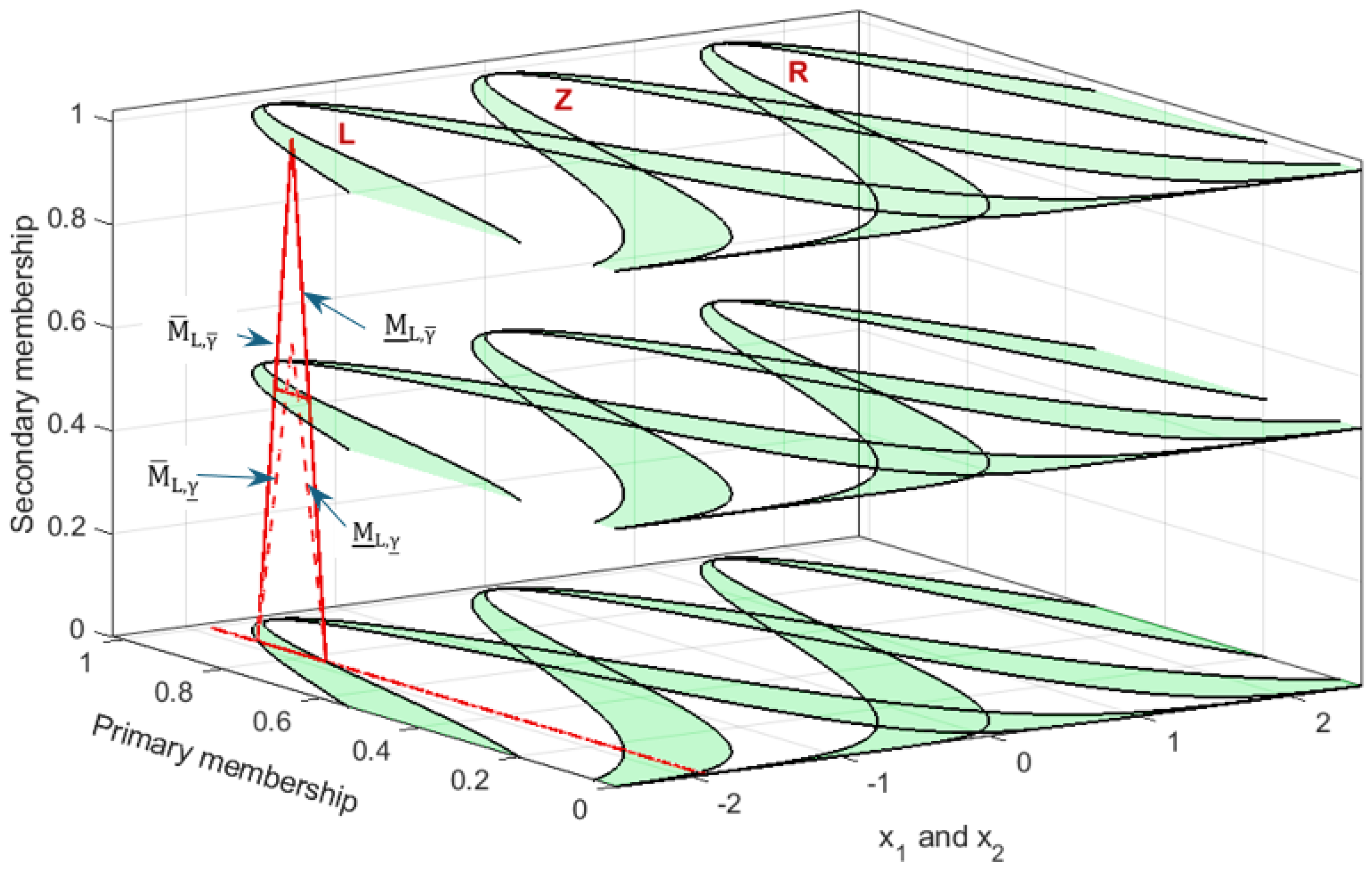
This section details the T3-FLC employed in the speed-control loop. The design incorporates two inputs, namely the speed error e and its difference , with a single output. Each input is described by seven Type-3 membership functions (MFs), yielding a rule base with 49 rules. The approach adopted involves the utilization of a single -slice () with the objective of maintaining the bounds of the inference and type-reduction efforts [14,16]. As illustrated in Figure 1, the upper and lower surfaces, as well as the asymmetric left and right spreads, are employed throughout this section [15,17].
Figure 1.
Type-3 membership function examples (Adapted from [61]).
4.1. Membership-Function Parameterization
Let and . For each input (), define seven Type-3 fuzzy sets with centers , left/right spreads , and exponents governing the upper (U) and lower (L) membership surfaces.
For a given set , the upper and lower membership responses at are defined piecewise over the left and right flanks [61]:
It is important to note that alternative Type-3 parameterizations are possible; however, the above form matches our implementation and produces asymmetric, three-dimensional MF profiles with adjustable sharpness near the center and smooth tails, consistent with the examples illustrated in Figure 1 [15,17,61].
4.2. Rule Base
Let and be the MF indices for and . The rule base enumerates all pairs in a fixed order, which yields rules. The r-th rule is
where is the (rule-dependent) consequent parameter. In the Type-3 setting, four consequent vectors are maintained to track the combinations of upper/lower MFs, , in line with the implementation (upper/upper, lower/lower, upper/lower, lower/upper) [14].
4.3. Inference, Type-Reduction, and Control Law
For an input pair and rule , define the upper/lower firing levels as follows:
Stacking over yields non-negative vectors .
Let
The type-reduced endpoints are presented as follows:
With a single -slice (), the controller output is taken as the midpoint of the type-reduced interval and is computed as follows:
This expression is algebraically equivalent to the expression used in our implementation, namely with [14,16].
With rules and slice, the per-sample cost for rule evaluation and type-reduction is . On a desktop reference (MATLAB R2024a, Intel i7-10700), the per-sample evaluation of 49 rules with a single -slice averages X μs . For an embedded STM32F4-class MCU at 168 MHz, a fixed-point implementation requires Y cycles per sample (< μs), indicating feasibility for the sampling rates used here.
5. Material and Methods
This section outlines the closed-loop control architecture and workflow for generating and evaluating responses. The T3-FLC structure can be summarized as follows: signal routing in the speed-control loop; fuzzification/aggregation; type reduction; and output mapping. Section 5.3 outlines the parameterization and tuning strategy. The evaluation protocol is specified in Section 3, and the time-domain performance indices with their computation rules are detailed in Section 5.4. The subsequent subsection provides a comprehensive overview of the controller design.
5.1. Controller Design Overview
The proposed controller is designed to function within the speed-control loop of an IVC-IM. The Type-3 fuzzy architecture under consideration is notable for its compact nature. The model incorporates two inputs: speed error and its discrete-time derivative and a single control output. The totality of the input is segmented into seven linguistic regions. These constitute a rule base (49 rules), which is evaluated with a single –slice and midpoint defuzzification. Initially, both inputs are scaled to a standardized, normalized range, ensuring neither channel dominates the inference process. The membership tiling ensures that the operating domain is covered with purposeful overlap, thereby ensuring smooth blending between adjacent regions; left/right asymmetry is permitted where acceleration differs.
5.2. T3-FLC Parameterization and Tuning
The controller is first defined using a basic template and then gradually refined through small, systematic adjustments. The input scaling factors are chosen so that the expected ranges of the speed error and the error derivative lie comfortably within the normalized universe of discourse; this supports balanced activation of the fuzzy rules. The controller parameters were tuned only under the load-disturbance scenario. During this process, the gains were iteratively adjusted in small steps to suppress overshoot, shorten the recovery time after load application/removal, and keep the steady-state speed error negligible. The final parameter set obtained in this scenario was then used unchanged in all other test cases.
5.3. Evaluation Methodology
Six scenarios are considered for simulation studies: high/low reference steps (Cases 1–2), varying load disturbances at high/low speeds (Cases 3–4), and rotor-resistance variation at high/low speeds (Cases 5–6). In addition, all simulations are carried out using the same motor and inverter parameters, as well as identical solver settings. The computation of time-domain metrics is conducted within the MATLAB environment. The standard settling time is evaluated by employing a settling band. In contrast, the disturbance-recovery time is defined as the initial moment the trajectory re-enters and persists within the band following a disturbance. Peak error magnitude is the maximum absolute deviation within the same window. The PI and T1–FLC baselines are executed under identical conditions and sampling as the T3–FLC.
5.4. Performance Metrics
This study uses the following indices for the controller’s performance evaluation.
- Rise time (): The rise time is defined as the time interval required for the system response to increase from 10% to 90% of the final commanded value.
- Settling time (): The settling time is the earliest time after which the response stays within of the final value without leaving the band.
- Overshoot : Percent overshoot is defined as the maximum excursion of the output above its final (steady-state) value, normalized by the final value:
- Recovery time (): In this study, a more rigorous recovery criterion is employed to differentiate controller performance more effectively than the conventional band does. Specifically, the recovery time is defined as the elapsed time from the disturbance instant until the speed trajectory first enters a tolerance band (approximately around the reference) and remains within that band for at least . This choice prevents metric saturation in cases where the band is never violated, thereby capturing the dynamic response with higher sensitivity. Consequently, cross-controller comparisons become more informative.
- Peak error magnitude (): maximum absolute speed error over the evaluated transient window.
- Steady–state error (): the absolute speed error once the response has settled within the specified band.
In operating conditions under which the transient is near-monotonic and overshoot is below the percent level, the peak time becomes poorly informative and is noise-sensitive. Consequently, this study does not utilize peak time as a performance metric.
5.5. Simulation Model and Controller Parameters
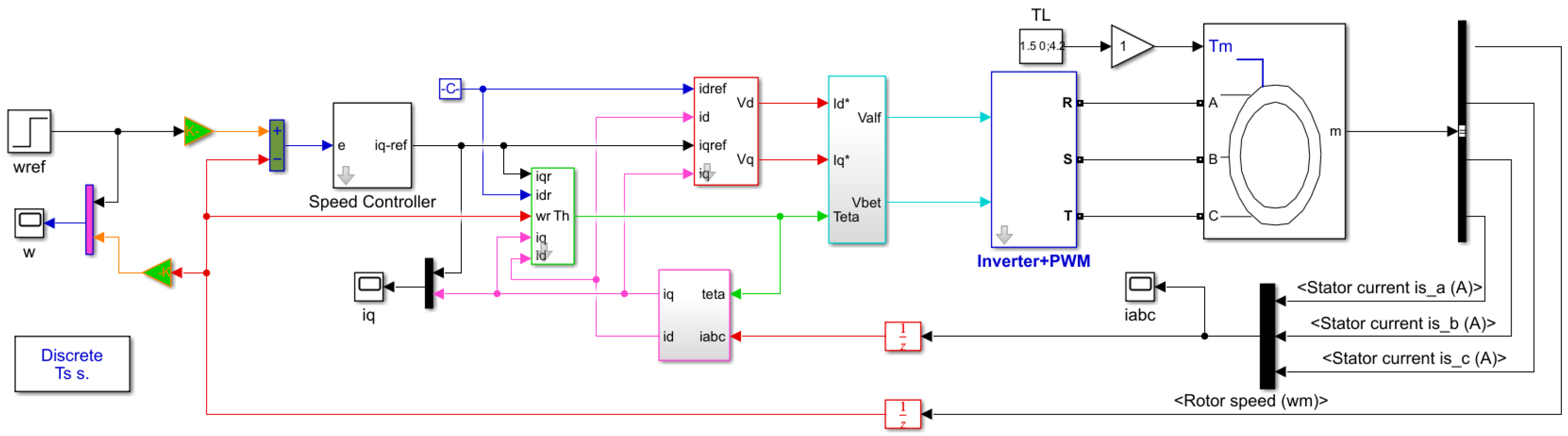
In this study, all analyses were carried out in the MATLAB/Simulink environment, and the model thus built is depicted in Figure 2. The same closed-loop test platform was used for every scenario. In particular, the motor model, the inverter and its modulation stage, and the speed-control structure were kept identical throughout. The parameters varied for each case design were the reference speed, load torque, and rotor resistance. The speed controller (PI/T1-FLC/T3-FLC) receives the measured mechanical speed , forms the speed error equation , and outputs the q-axis current reference . The flux reference, designated as , has been established at its nominal value. As demonstrated in references , the current control loops are responsible for computing the decoupled stator-voltage commands. .
Figure 2.
Simulink model used in all scenarios.
All control loops execute synchronously with the sampling interval , which is equivalent to the pulse width modulation (PWM) period for . It is important to note that each control update introduces a compute-and-hold latency, which is represented in the power stage as an effective voltage-application delay of . The present control loops are implemented via PI controllers with anti-windup, and their bandwidth is set approximately one decade higher than that of the speed control loop. The decoupled voltage commands are as follows:
where and .
The pair is mapped to the stationary frame via the inverse Park transformation, , and normalized by the DC link to form duty ratios under carrier-based PWM. The voltage-source inverter (VSI) is treated as ideal (no dead-time or device drops), with a stiff DC link. The electrical angle is obtained by numerical integration of . A zero-order hold is used between controller updates and over each switching period, and measurement noise and quantization are neglected in this study.
Table 1 provides a comprehensive list of all the simulation parameters utilized in the scenario. PI, T1–FLC, and the proposed T3–FLC were run with the same sampling times and power-stage parameters to ensure a fair comparison. T3–FLC design parameters are given in Appendix A.
Table 1.
Induction motor and controller parameters used in simulation.
6. Results and Discussion
This section presents the results obtained using the closed-loop control system created in MATLAB/Simulink, as shown in Figure 2. In addition to speed performance, the criteria defined (, , M, , , ) in Section 5.4 are analyzed for each scenario. The solution parameters for each scenario affecting the system are preserved to ensure consistency among the controllers. The results obtained for each scenario are presented and analyzed with relevant figures and tables.
6.1. Case Studies
Simulation studies were designed to represent the most critical operating scenarios encountered in IVC-IMs and were conducted under six conditions. The initial two scenarios examined the system’s dynamic response to changes of varying magnitudes in the reference speed. High-amplitude speed transients, in particular, generated varying dynamic demands, while low-speed changes were used to evaluate the controllers’ sensitivity and small-signal behavior. The third and fourth scenarios investigated the controllers’ recovery performance and stability characteristics under varying load disturbances applied to the system. These scenarios are critical for measuring the motor drives’ capability for disturbance rejection. The fifth and sixth scenarios focused on parameter uncertainties and evaluated the controllers’ robustness under increasing and decreasing rotor resistance. The ensuing subsections present the simulation results for each scenario, with a comparison of PI, T1-FLC, and T3-FLC and key performance metrics such as , , , , and taken into account.
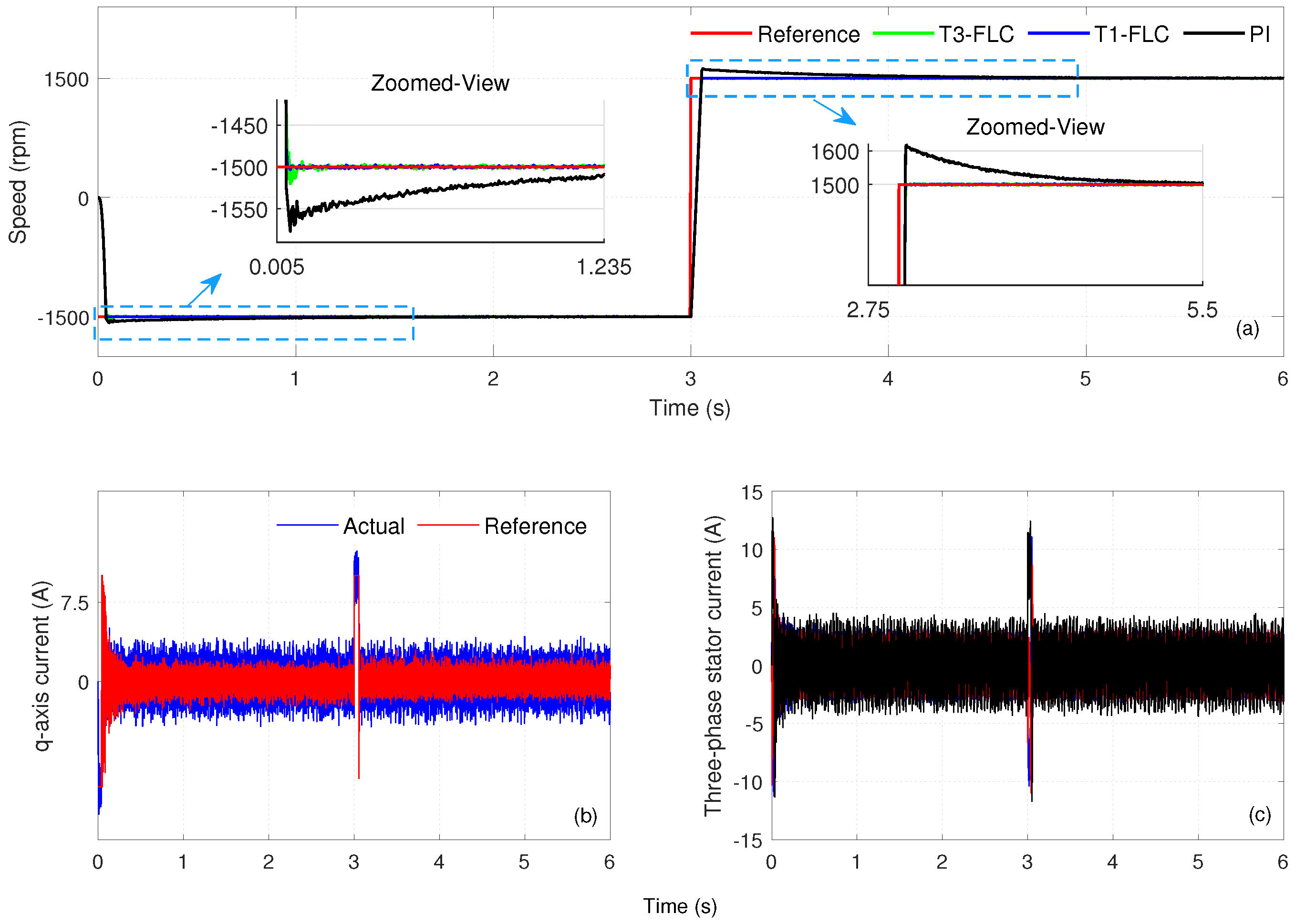
6.1.1. Case Study 1: High-Speed Reference Change
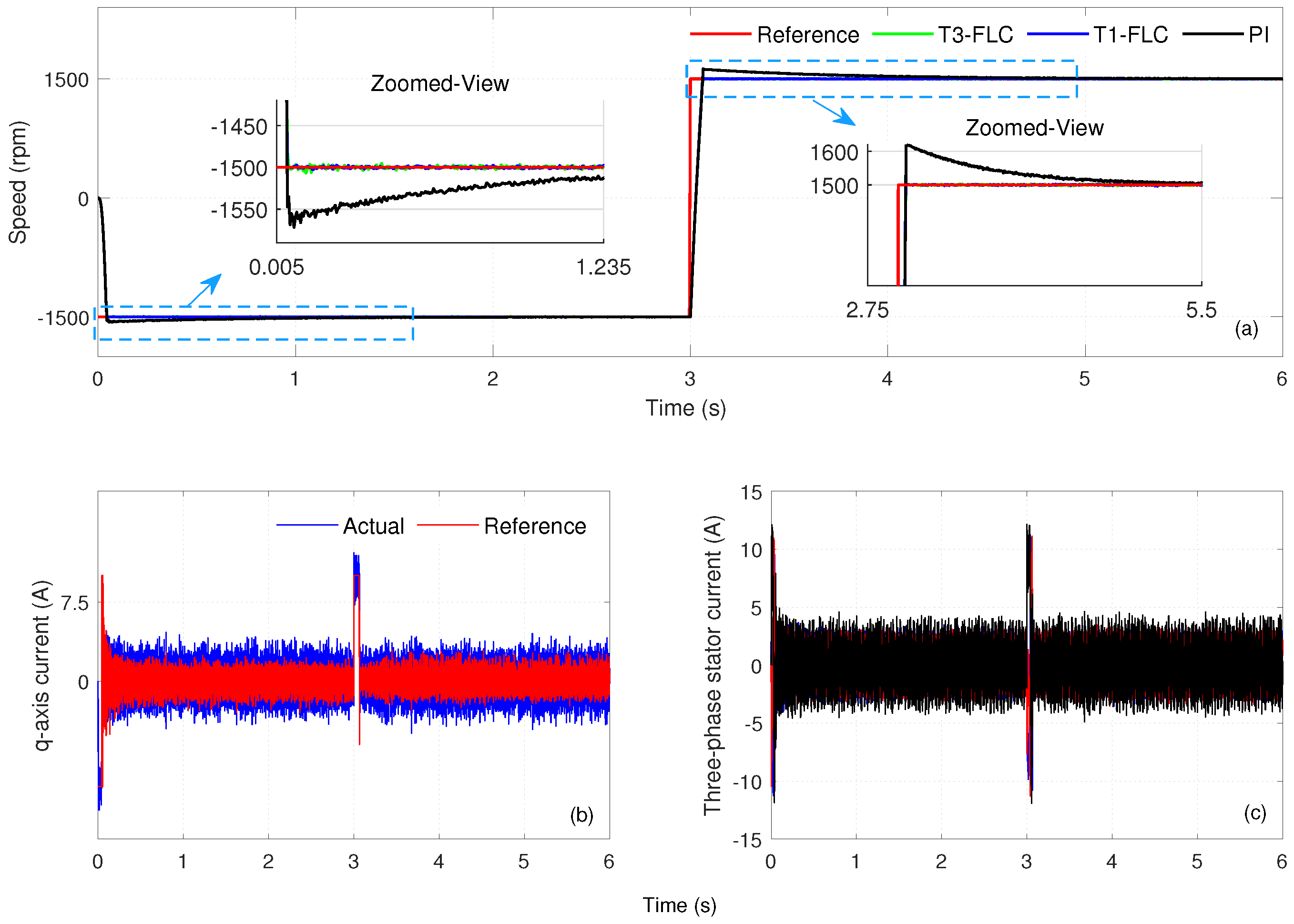
Under this operating condition, the reference speed was initially set to and was changed to at . Simulation results obtained within Case Study 1 are presented in Figure 3. Figure 3a compares the motor speed responses obtained under the PI, T1-FLC, and T3-FLC controllers. The q-axis current and three-phase currents for the T3-FLC alone are presented in Figure 3b,c, respectively. The numerical performance metrics of the controllers, namely , , and , are summarized in Table 2.
Figure 3.
Simulation results for Case Study 1.
Table 2.
Performance metrics for Case Study 1.
In the 0–3 s range, T3-FLC responded quickly, with s and s, and the overshoot rate was recorded as . T1-FLC showed similar performance, with s and s, keeping the overshoot at . The PI controller, on the other hand, exhibited a longer transient regime, with s but with s and overshoot at .
In the 3–6 s range, T3-FLC produced s, s, and an overshoot of . T1-FLC produced s, s, and an overshoot of . The PI controller showed the longest settling time and the highest overshoot, with s, s, and overshoot . T3-FLC demonstrated balanced performance, with low overshoot and a short settling time. T1-FLC achieved a smaller overshoot in the low-speed range, but overshoot increased at high-speed transitions. The PI controller was limited by high overshoot and long settling times in both cases. All three controllers achieved zero steady-state error.
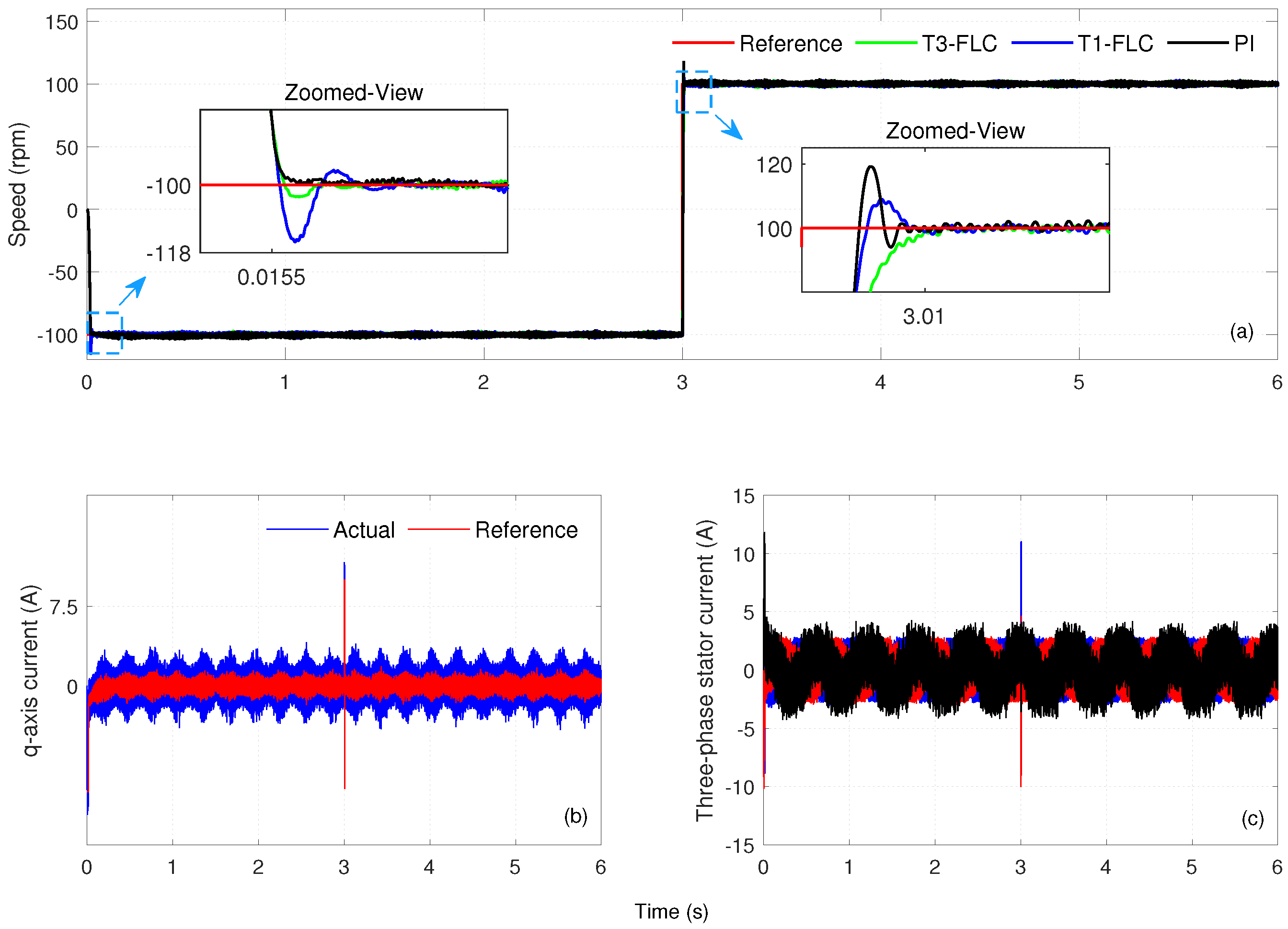
6.1.2. Case Study 2: Low-Speed Reference Change
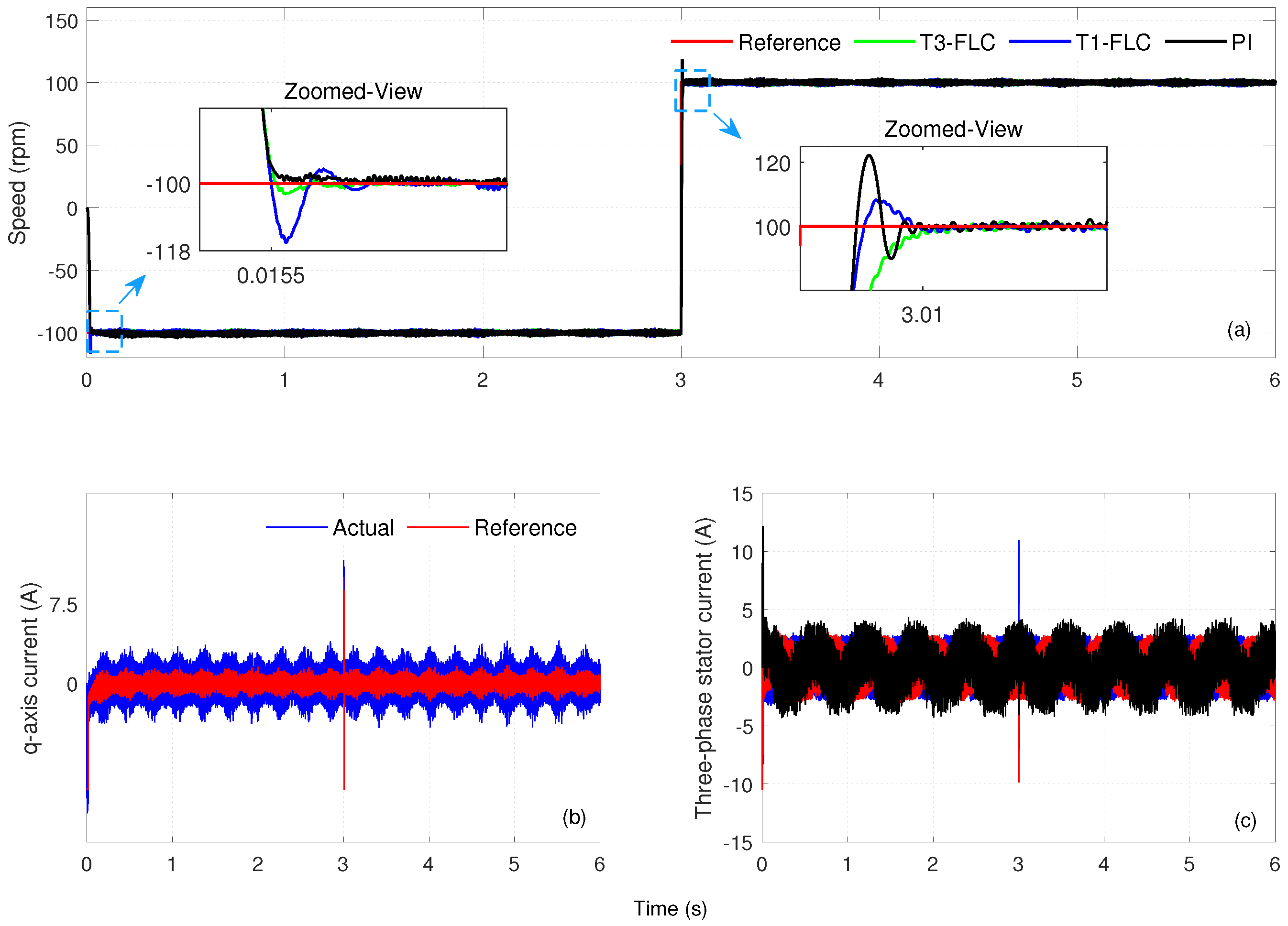
Under this operating condition, the speed reference was set to in the range 0–3 s and was abruptly changed to at time s. Simulation results obtained from Case Study 2 are presented in Figure 4. Figure 4a compares the speed responses obtained under the PI, T1-FLC, and T3-FLC controllers. The q-axis current and motor three-phase currents for the T3-FLC alone are presented in Figure 4b,c, respectively. Numerical performance metrics for the controllers , , and are summarized in Table 3.
Figure 4.
Simulation results for Case Study 2.
Table 3.
Performance metrics for Case Study 2.
In the 0–3 s range, T3-FLC produced a fast response with s and s, with an overshoot of . T1-FLC responded similarly quickly, with s and s, but its overshoot reached the highest value with . The PI controller exhibited similar times, with s and s, but its overshoot was . These results show that in the low-speed range, T3-FLC exhibited stable behavior by limiting the overshoot.
In the 3-to-6 s range, T3-FLC operated with values of s and s, with the overshoot remaining at a minimum of . T1-FLC responded with similar response times, with s and s, but overshoot occurred at . The PI controller operated with s and s, and its overshoot was greatest at . The results reveal that T3-FLC provided the smallest overshoot at low-amplitude reference changes, while the PI controller exhibited limited stability due to the high overshoot. The results of Case Study 2 demonstrate that T3–FLC provides balanced performance at low-speed reference changes by limiting overshoot while maintaining comparable and . T1–FLC responds quickly but incurs a higher overshoot, whereas the PI controller suffers a stability disadvantage due to markedly higher overshoot in the positive step.
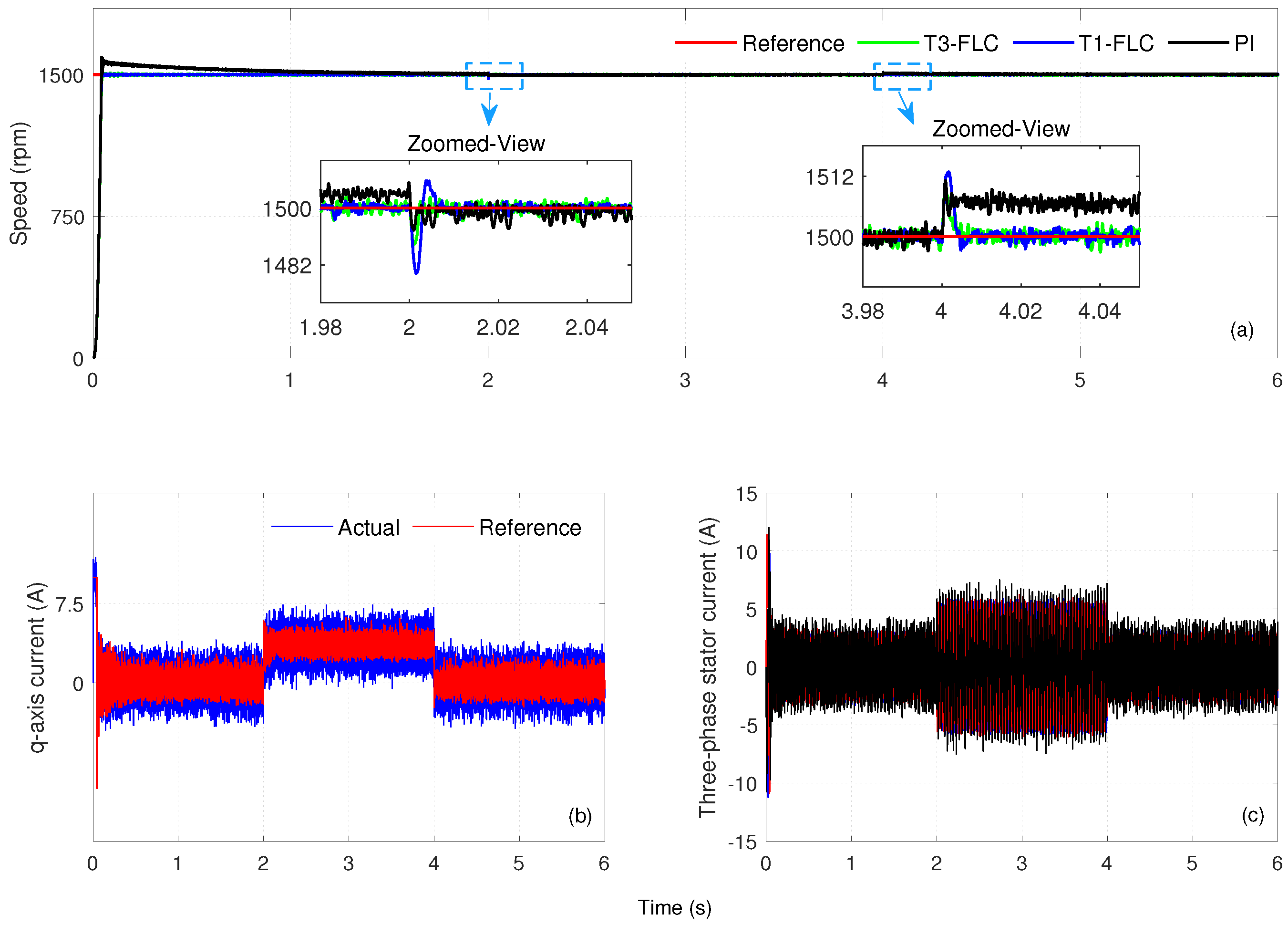
6.1.3. Case Study 3: Loaded Operation at High Speeds
Under these operating conditions, the reference speed was set as and a load torque of Nm was applied in the –4 s range. Thus, the disturbance-rejection capability of the external speed-control loop in the high-speed regime was investigated. The simulation results obtained within the scope of Case Study 3 are presented in Figure 5. The motor-speed responses obtained from the PI controller, T1-FLC, and T3-FLC are given comparatively in Figure 5a, while the q-axis current and three-phase currents for T3-FLC are shown in Figure 5b,c, respectively. The numerical performance metrics for the controllers, such as , , and , are summarized in Table 4.
Figure 5.
Simulation results for Case Study 3.
Table 4.
Performance metrics for Case Study 3.
At s, when the load torque was applied, T3-FLC reduced the recovery time to s, with a peak error of and equal to zero. T1-FLC produced a longer recovery time and a higher peak error with values of s and , while the steady-state error remained zero. The PI controller reached a value of s, with the peak error recorded as at s and . These results show that T3-FLC provided the shortest recovery time at the moment of load application, while the PI controller offers a certain advantage by producing a lower peak error. When the load torque was removed at s, T3-FLC operated with a recovery time of s, a peak error measured at at s, and a steady-state error remaining at zero. Although T1-FLC achieved the same recovery time ( s), the peak error reached at s. The PI controller exhibited the longest recovery time ( s), with the peak error recorded as at s and the steady-state error remaining at zero. These findings reveal that T3-FLC provides a balanced response in terms of both recovery time and error magnitude during load removal. At high speeds and under load, T3-FLC stands out for its short recovery time and low error values. While T1-FLC kept the steady-state error at zero, it fell behind T3-FLC in terms of recovery time and peak error. Although the PI controller can produce lower peak error at some moments, the long recovery time limits the ability to detect disturbance rejection.
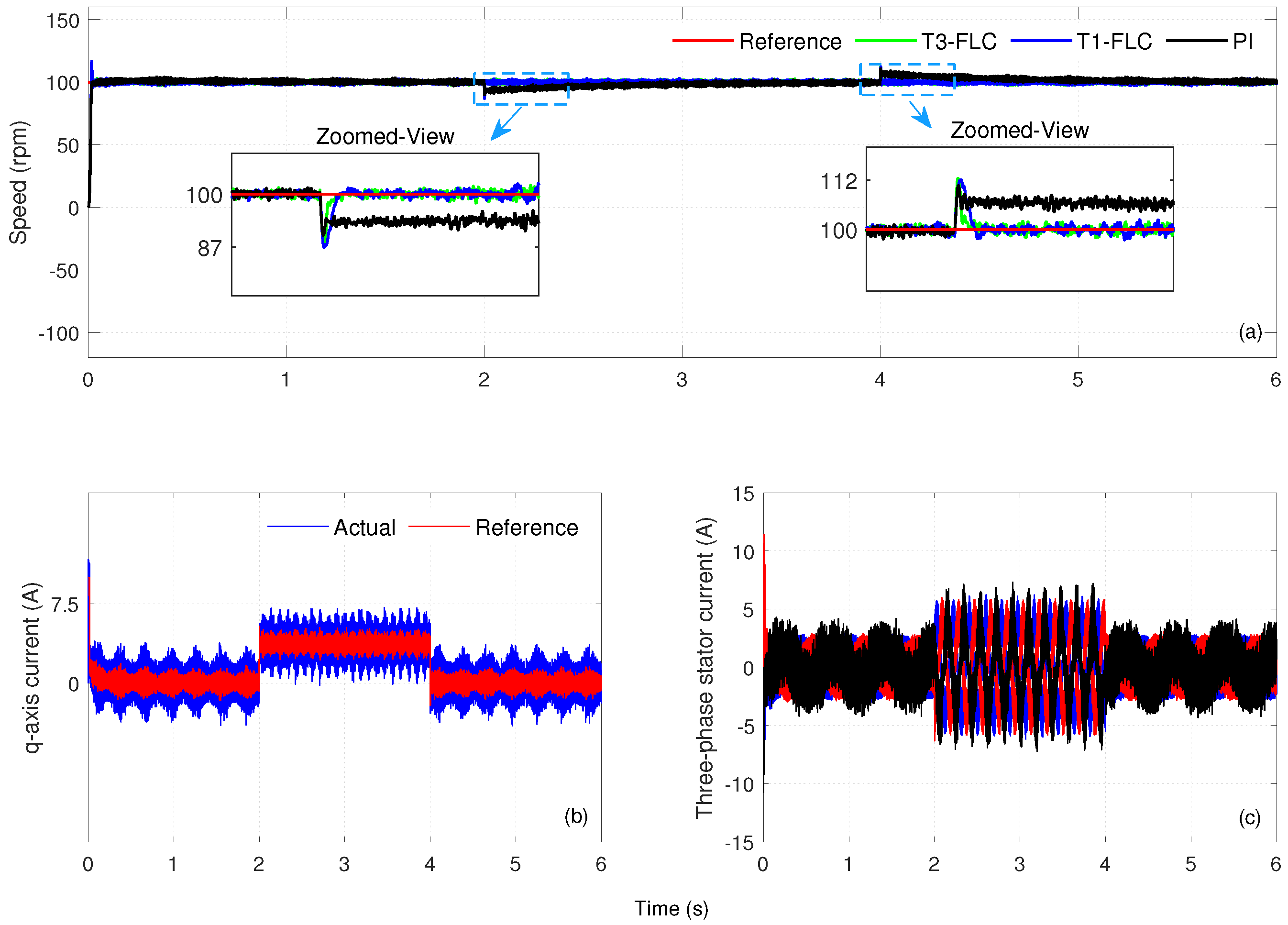
6.1.4. Case Study 4: Loaded Operation at Low Speed
Under these operating conditions, the reference speed was set as and a load torque of Nm was applied in the –4 s range. Thus, the disturbance-rejection capability of the external speed-control loop in the low-speed regime was investigated. The simulation results obtained within the scope of Case Study 4 are presented in Figure 6. The motor-speed responses obtained with the PI, T1-FLC, and T3-FLC controllers are given comparatively in Figure 6a, while the q-axis current and three-phase currents for T3-FLC are shown in Figure 6b,c, respectively. The numerical performance metrics of the controllers, , and , are summarized in Table 5.
Figure 6.
Simulation results for Case Study 4.
Table 5.
Performance metrics for Case Study 4.
When the load torque was applied at s, T3-FLC kept the recovery time at s, the peak error at , and the steady-state error at zero. T1-FLC achieved a shorter recovery time ( s), but the peak error was higher than that of T3-FLC, at . The PI controller had a significantly longer recovery time ( s), a peak error recorded as , and a steady-state error of zero. These findings show that although the PI controller produces low peak error during load application, its recovery speed is poor, while T3-FLC and T1-FLC offer faster recovery. When the load moment is removed at s, T3-FLC provides a stable response, with a recovery time of s and a peak error of , while the steady-state error remains zero. T1-FLC exhibited similar performance, with s and . The PI controller exhibited the longest recovery time, with s, and yielded a peak error of and a steady-state error of zero. These results demonstrate that T3-FLC and T1-FLC recover faster than PI during load removal. At the same time, the PI controller suffers from a disadvantage due to its slow recovery time, despite its low peak error. The results of Case Study 4 show that in the low-speed regime, T3-FLC offers balanced performance, with its short recovery time and low error magnitude. Despite operating with similar recovery times, T1-FLC yielded a higher peak error than did T3-FLC. While the PI controller produced the lowest peak errors in both cases, its long recovery times limited its disturbance-rejection ability.
6.1.5. Case Study 5: Parameter Change at High Speed
In this scenario, the rotor resistance is increased by and the speed reference is set to at and abruptly changed to at s. Figure 7 presents the speed responses obtained with the PI, T1-FLC, and T3-FLC controllers are given comparatively in Figure 7a, while the q-axis current and three-phase currents for T3-FLC are shown in Figure 7b,c, respectively. The Table 6 summarizes performance metrics such as , , and .
Figure 7.
Simulation results for Case Study 5.
Table 6.
Performance metrics for Case Study 5.
In the range of 0–3 s, T3-FLC produced a fast response, with s and s, and its overshoot was . T1-FLC operated at similar speeds, with s and s, and its overshoot was recorded as . The PI controller, on the other hand, stabilized significantly later, with s and s, and produced an overshoot of . In the 3–6 s range, T3-FLC exhibited a low overshoot of , with s and s, providing a stable response. T1-FLC performed similarly, with s and s, with overshoot remaining at . The PI controller had the longest settling time, with s and s, and its overshoot reached the highest value (). Under a 20% increase in rotor resistance, T3-FLC showed the most balanced performance against parameter uncertainties, with both low overshoot rates and short settling times. T1-FLC achieved a similar rise in settling times, but its overshoot value was higher than that of T3-FLC. The PI controller, on the other hand, exhibited limited tolerance to parameter changes due to longer settling times and higher overshoot values in both ranges.
6.1.6. Case Study 6: Parameter Change at Low Speed
In this scenario, the rotor resistance is reduced by and the speed reference is set to at and abruptly changed to at s. Figure 8 presents the speed responses obtained with the PI, T1-FLC, and T3-FLC controllers are given comparatively in Figure 8a, while the q-axis current and three-phase currents for T3-FLC are shown in Figure 8b,c, respectively. The Table 7 summarizes the quantitative performance metrics such as , , and .
Figure 8.
Simulation results for Case Study 6.
Table 7.
Performance metrics for Case Study 6.
In the range of 0–3 s, T3-FLC responded quickly, with values of s and s, and its overshoot was recorded as . T1-FLC operated at a similar speed, with values of s and s, but its overshoot reached the highest value (). The PI controller operated with values of s and s, and its overshoot was recorded as . In the 3–6 s range, T3-FLC produced low overshoot (), with s and s. T1-FLC exhibited a shorter rise time ( s and s), but its overshoot reached . The PI controller operated with the values of s and s, and its overshoot was the highest (). Under the condition of a decrease in rotor resistance, T3-FLC stood out, with low overshoot and stable transition properties. Although T1-FLC provided similar rise and settling times in some cases, overshoot values remained high. The PI controller produced acceptable results in terms of settling times but exhibited limited resistance to parameter uncertainties due to high overshoot rates in low- and high-speed regions.

7. Conclusions
The study presented a compact T3-FLC for the speed-control loop of an IVC-IM and benchmarked it against a conventional PI controller and a T1-FLC across six MATLAB/Simulink scenarios. Under the various operating conditions, the T3-FLC exhibited a consistent capacity to reduce overshoot and shorten settling and recovery times while maintaining zero steady-state error.
The main comparative outcomes are summarized below to highlight the controller’s behavior across the tested scenarios.
- Case 1 (high-amplitude reversal, 3–6 s): percent overshoot M drops from 4.43% (PI) to 0.13% (T3-FLC), an ≈97% reduction.
- Case 2 (low-amplitude step, 3–6 s): M is 11.12% (PI) and 4.13% (T1-FLC) versus 1.37% (T3-FLC), i.e., ≈88% lower than PI and ≈67% lower than T1-FLC.
- Case 3 (high-speed load removal): recovery time shortens from 0.400 s (PI) to 0.064 s (T3-FLC), ≈84% faster.
- Case 4 (low-speed load removal): falls from 1.975 s (PI) to 0.158 s (T3-FLC), ≈92% faster.
- Case 5 (+20% rotor resistance, 0–3 s): M decreases from 5.31% (PI) to 1.96% (T3-FLC), ≈63% lower.
- Case 6 (−20% rotor resistance, 3–6 s): M decreases from 9.59% (PI) to 1.45% (T3-FLC), ≈85% lower.
In all investigated cases, the proposed T3-FLC eliminated steady-state speed error while following the commanded reference and also provided a dynamic response that remained within acceptable transient-performance bounds and was comparable to that of the T1-FLC and classical PI control.
7.1. Limitations
Despite the positive simulation results, several limitations should be considered. First, the evaluation is limited to the MATLAB/Simulink environment. These non-ideal conditions, such as sensor quantization and delays, inverter dead time, and voltage drops or changes in rotor resistance caused by temperature, have not been examined within the current simulation framework, and the question of how they could compromise the robustness of T3-FLC in real-time applications remains open. Second, a structured yet intuitive protocol manually adjusts the controller parameters, including membership functions and the rule base. Although this ensures consistent performance in the reported scenarios, it introduces subjectivity and may not transfer smoothly to different operating environments; automatic search strategies could reduce bias and increase repeatability. These limitations highlight the necessity of empirical validation and computational profiling to bridge the gap from simulation insights to applicable control solutions.
7.2. Future Study
The results presented in this study were obtained from a simulation model. In future work, we will perform experimental verification and further improve the performance–robustness balance by applying optimization-based tuning of the T3-FLC parameters.
Funding
This research was funded by Firat University Scientific Research Projects Coordination Unit grant number TEKF.25.35.
Data Availability Statement
Data are contained within the article.
Conflicts of Interest
The authors declare no conflicts of interest.
Abbreviations
The following abbreviations are used in this manuscript:
| T3-FLC | Type-3 Fuzzy Logic Controller |
| T1-FLC | Type-1 Fuzzy Logic Controller |
| PI | Proportional+Integral |
| IM | Induction motor |
| DTC | Direct Torque Control |
| FOC | Field Oriented Control |
| PSO | Particle Swarm Optimization |
| ABC | Artificial Bee Colony |
| SMC | Sliding Mode Controller |
| MPC | Model Predictive Control |
| LQR | Linear Quadratic Regulator |
| MRAS | Model Reference Adaptive System |
Appendix A
Table A1.
Type-3 MF centers and spreads and for input e.
Table A1.
Type-3 MF centers and spreads and for input e.
| MF (for e) | |||
|---|---|---|---|
Table A2.
Type-3 MF centers and spreads and for input .
Table A2.
Type-3 MF centers and spreads and for input .
| MF (for ) | |||
|---|---|---|---|
Table A3.
Type-3 MF exponent/shape parameters (upper/lower) for both inputs.
Table A3.
Type-3 MF exponent/shape parameters (upper/lower) for both inputs.
| MF | Input | ||
|---|---|---|---|
| 3 | 2 | e | |
| 3 | 2 | e | |
| 3 | 2 | e | |
| 3 | 2 | e | |
| 3 | 2 | e | |
| 3 | 2 | e | |
| 3 | 2 | e | |
| 3 | 2 | ||
| 3 | 2 | ||
| 3 | 2 | ||
| 3 | 2 | ||
| 3 | 2 | ||
| 3 | 2 | ||
| 3 | 2 |
Table A4.
T3-FLC rule base.
Table A4.
T3-FLC rule base.
| 1 | 8 | 15 | 22 | 29 | 36 | 43 | |
| 2 | 9 | 16 | 23 | 30 | 37 | 44 | |
| 3 | 10 | 17 | 24 | 31 | 38 | 45 | |
| 4 | 11 | 18 | 25 | 32 | 39 | 46 | |
| 5 | 12 | 19 | 26 | 33 | 40 | 47 | |
| 6 | 13 | 20 | 27 | 34 | 41 | 48 | |
| 7 | 14 | 21 | 28 | 35 | 42 | 49 |
References
- Bose, B.K. Modern Power Electronics and AC Drives; Prentice Hall: Hoboken, NJ, USA, 2002. [Google Scholar]
- Leonhard, W. Control of Electrical Drives, 3rd ed.; Springer: Berlin/Heidelberg, Germany, 2001. [Google Scholar]
- Santisteban, J.; Stephan, R. Vector control methods for induction machines: An overview. IEEE Trans. Educ. 2001, 44, 170–175. [Google Scholar] [CrossRef]
- Novotny, D.W.; Lipo, T.A. Vector Control and Dynamics of AC Drives; Oxford University Press: Oxford, UK, 1996; Volume 41. [Google Scholar]
- Holtz, J. Sensorless Control of Induction Machines—With or Without Signal Injection? IEEE Trans. Ind. Electron. 2006, 53, 7–30. [Google Scholar] [CrossRef]
- Koca, G.Ö.; Akpolat, Z.H.; Özdemir, M. Dört-Kol Mekanizması için Tip-2 Bulanık Mantık Tabanlı bir Kontrolör Tasarımı. Firat Univ. J. Eng. Sci./Firat Univ. Muhendis. Bilim. Derg. 2010, 22, 187–195. [Google Scholar]
- Dandıl, B.; Coteli, R.; Açıkgöz, H. Adaptive DC-Voltage control based on Type-2 neuro-fuzzy controller in a hybrid stand-alone power network with hydrogen fuel cell and battery. Int. J. Hydrogen Energy 2024, 75, 303–313. [Google Scholar] [CrossRef]
- Koca, G.O.; Akpolat, Z.; Ozdemir, M. Development of robust fuzzy control methods and their applications to a mechanical system. Turk. J. Sci. Technol 2014, 9, 47–56. [Google Scholar]
- Acikgoz, H.; Coteli, R.; Ustundag, M.; Dandil, B. Robust control of current controlled PWM rectifiers using type-2 fuzzy neural networks for unity power factor operation. J. Electr. Eng. Technol. 2018, 13, 822–828. [Google Scholar]
- Mendel, J.M. Uncertain Rule-Based Fuzzy Logic Systems: Introduction and New Directions; Prentice-Hall: Hoboken, NJ, USA, 2001. [Google Scholar]
- Mendel, J.; John, R. Type-2 fuzzy sets made simple. IEEE Trans. Fuzzy Syst. 2002, 10, 117–127. [Google Scholar] [CrossRef]
- Karnik, N.N.; Mendel, J.M. Centroid of a type-2 fuzzy set. Inf. Sci. 2001, 132, 195–220. [Google Scholar] [CrossRef]
- Kubota, H.; Matsuse, K.; Nakano, T. DSP-based speed adaptive flux observer of induction motor. IEEE Trans. Ind. Appl. 1993, 29, 344–348. [Google Scholar] [CrossRef]
- Castillo, O.; Melin, P. Type-3 Fuzzy Logic in Intelligent Control; Springer: Berlin/Heidelberg, Germany, 2023. [Google Scholar] [CrossRef]
- Castillo, O.; Melin, P. Type-3 Fuzzy Logic in Time Series Prediction; Springer: Berlin/Heidelberg, Germany, 2024. [Google Scholar] [CrossRef]
- Ochoa, P.; Peraza, C.; Melin, P.; Castillo, O.; Park, S.; Geem, Z.W. Enhancing Control Systems through Type-3 Fuzzy Logic Optimization. Mathematics 2024, 12, 1792. [Google Scholar] [CrossRef]
- Aliev, R.A.; Abizada, S.R.; Abiyev, R. Type-3 Fuzzy System for Dynamic System Control. Iran. J. Fuzzy Syst. 2024, 21, 65–76. [Google Scholar] [CrossRef]
- Rafa, S.; Larabi, A.; Barazane, L.; Manceur, M.; Essounbouli, N.; Hamzaoui, A. Implementation of a new fuzzy vector control of induction motor. ISA Trans. 2014, 53, 744–754. [Google Scholar] [CrossRef] [PubMed]
- Nurettin, A.; İnanç, N. Sensorless vector control for induction motor drive at very low and zero speeds based on an adaptive-gain super-twisting sliding mode observer. IEEE J. Emerg. Sel. Top. Power Electron. 2023, 11, 4332–4339. [Google Scholar] [CrossRef]
- Takahashi, I.; Noguchi, T. A New Quick-Response and High-Efficiency Control Strategy of an Induction Motor. IEEE Trans. Ind. Appl. 1986, IA-22, 820–827. [Google Scholar] [CrossRef]
- Depenbrock, M. Direct self-control (DSC) of inverter-fed induction machine. IEEE Trans. Power Electron. 1988, 3, 420–429. [Google Scholar] [CrossRef]
- Casadei, D.; Profumo, F.; Serra, G.; Tani, A. FOC and DTC: Two viable schemes for induction motors torque control. IEEE Trans. Power Electron. 2002, 17, 779–787. [Google Scholar] [CrossRef]
- Blaschke, F. The principle of field orientation as applied to the new transvector closed-loop control system for rotating-field machines. Siemens Rev. 1972, 34, 217–220. [Google Scholar]
- Mahfoud, S.; Derouich, A.; Iqbal, A.; El Ouanjli, N. ANT-colony optimization-direct torque control for a doubly fed induction motor: An experimental validation. Energy Rep. 2022, 8, 81–98. [Google Scholar] [CrossRef]
- Mahfoud, S.; Derouich, A.; El Ouanjli, N.; el Mahfoud, M. Enhancement of the direct torque control by using artificial neuron network for a doubly fed induction motor. Intell. Syst. Appl. 2022, 13, 200060. [Google Scholar] [CrossRef]
- El Idrissi, A.; Derouich, A.; Mahfoud, S.; El Ouanjli, N.; Chojaa, H.; Chantoufi, A. Bearing faults diagnosis by current envelope analysis under direct torque control based on neural networks and fuzzy logic—A comparative study. Electronics 2024, 13, 3195. [Google Scholar] [CrossRef]
- El Ouanjli, N.; Mahfoud, S.; Derouich, A.; El Daoudi, S.; El Mahfoud, M. Speed sensorless fuzzy direct torque control of induction motor based MRAS method. In Proceedings of the International Conference on Digital Technologies and Applications, Online, 28–29 January 2022; Springer: Berlin/Heidelberg, Germany, 2022; pp. 779–790. [Google Scholar]
- Utkin, V.I. Sliding Modes in Control and Optimization; Springer: Berlin/Heidelberg, Germany, 1992. [Google Scholar] [CrossRef]
- Young, K.D.; Utkin, V.I.; Ozguner, U. A control engineer’s guide to sliding mode control. IEEE Trans. Control Syst. Technol. 1999, 7, 328–342. [Google Scholar] [CrossRef]
- Levant, A. Higher-order sliding modes, differentiation and output-feedback control. Int. J. Control 2003, 76, 924–941. [Google Scholar] [CrossRef]
- El-Sousy, F.F.; Amin, M.M.; Mohammed, O.A. Robust adaptive neural network tracking control with optimized super-twisting sliding-mode technique for induction motor drive system. IEEE Trans. Ind. Appl. 2022, 58, 4134–4157. [Google Scholar] [CrossRef]
- Wu, L.; Liu, J.; Vazquez, S.; Mazumder, S.K. Sliding mode control in power converters and drives: A review. IEEE/CAA J. Autom. Sin. 2022, 9, 392–406. [Google Scholar] [CrossRef]
- Krim, S.; Mimouni, M.F. Design of improved direct torque control based on a five-level torque controller and a new Sugeno-Takagi fuzzy super-twisting controller applied to an induction machine. Eng. Appl. Artif. Intell. 2023, 126, 106900. [Google Scholar] [CrossRef]
- Koca, G.O.; Akpolat, Z.H.; Özdemir, M. Type-2 fuzzy sliding mode control of a four-bar mechanism. Int. J. Model. Simul. 2011, 31, 60–68. [Google Scholar] [CrossRef]
- Lee, H.T.; Fu, L.C.; Lian, F.L. Sensorless adaptive backstepping speed control of induction motor. In Proceedings of the 45th IEEE Conference on Decision and Control, San Diego, CA, USA, 13–15 December 2006; IEEE: New York, NY, USA, 2006; pp. 1252–1257. [Google Scholar] [CrossRef]
- Lin, F.J.; Lee, C.C. Adaptive backstepping control for linear induction motor drive to track periodic references. IEE Proc.-Electr. Power Appl. 2000, 147, 449–458. [Google Scholar] [CrossRef]
- Rodriguez, J.; Kazmierkowski, M.P.; Espinoza, J.R.; Zanchetta, P.; Abu-Rub, H.; Young, H.A.; Rojas, C.A. State of the art of finite control set model predictive control in power electronics. IEEE Trans. Ind. Inform. 2013, 9, 1003–1016. [Google Scholar] [CrossRef]
- Karamanakos, P.; Geyer, T.; Oikonomou, N.; Kieferndorf, F.D.; Manias, S. Direct model predictive control: A review of strategies that achieve long prediction intervals for power electronics. IEEE Ind. Electron. Mag. 2014, 8, 32–43. [Google Scholar] [CrossRef]
- Cortés, P.; Kazmierkowski, M.P.; Kennel, R.M.; Quevedo, D.E.; Rodríguez, J. Predictive control in power electronics and drives. IEEE Trans. Ind. Electron. 2008, 55, 4312–4324. [Google Scholar] [CrossRef]
- Joshal, K.S.; Gupta, N. Microgrids with model predictive control: A critical review. Energies 2023, 16, 4851. [Google Scholar] [CrossRef]
- Oudjama, F.; Boumediene, A.; Saidi, K.; Boubekeur, D. Robust speed control in nonlinear electric vehicles using H-infinity control and the LMI approach. J. Intell. Syst. Control 2023, 2, 170–182. [Google Scholar] [CrossRef]
- Lokriti, A.; Salhi, I.; Doubabi, S.; Zidani, Y. Induction motor speed drive improvement using fuzzy IP-self-tuning controller. A real-time implementation. ISA Trans. 2013, 52, 406–417. [Google Scholar] [CrossRef] [PubMed]
- Dandil, B. Fuzzy neural network IP controller for robust position control of induction motor drive. Expert Syst. Appl. 2009, 36, 4528–4534. [Google Scholar] [CrossRef]
- Gündoğdu, A.; Ata, F.; Dandıl, B. Design of Neuro-Fuzzy Based Torque Controller for Torque Ripple Reduction of Asynchronous Motor. Balk. J. Electr. Comput. Eng. 2020, 8, 225–234. [Google Scholar] [CrossRef]
- Coteli, R.; Acikgoz, H.; Ucar, F.; Dandil, B. Design and implementation of Type-2 fuzzy neural system controller for PWM rectifiers. Int. J. Hydrogen Energy 2017, 42, 20759–20771. [Google Scholar] [CrossRef]
- Naik N., V.; Singh, S.P. A Novel Interval Type-2 Fuzzy-Based Direct Torque Control of Induction Motor Drive Using Five-Level Diode-Clamped Inverter. IEEE Trans. Ind. Electron. 2021, 68, 149–159. [Google Scholar] [CrossRef]
- Demir, R.; Yildiz, R.; Gani, A. Model Predictive Controlled IM Drive based on IT2FNN Controller. Power Electron. Drives 2023, 8, 368–379. [Google Scholar] [CrossRef]
- Acikgoz, H. Real-time adaptive speed control of vector-controlled induction motor drive based on online-trained Type-2 Fuzzy Neural Network Controller. Int. Trans. Electr. Energy Syst. 2020, 30, e12678. [Google Scholar] [CrossRef]
- Castillo, O.; Melin, P.; Valdez, F.; Ding, W. A Survey on Type-3 Fuzzy Logic Systems and Their Control Applications. IEEE/CAA J. Autom. Sin. 2024, 11, 1744–1756. [Google Scholar] [CrossRef]
- Adnan, A.Q.; Hussain, M.K.; Mohammadzadeh, A.; Sabahi, K. Optimal hybrid type-3 fuzzy controller for horizontal axis wind turbines: Comparative study. ISA Trans. 2025, 161, 200–215. [Google Scholar] [CrossRef]
- Tian, M.W.; Yan, S.R.; Liu, J.; Alattas, K.A.; Mohammadzadeh, A.; Vu, M.T. A new type-3 fuzzy logic approach for chaotic systems: Robust learning algorithm. Mathematics 2022, 10, 2594. [Google Scholar] [CrossRef]
- Huang, H.; Xu, H.; Chen, F.; Zhang, C.; Mohammadzadeh, A. An applied type-3 fuzzy logic system: Practical Matlab Simulink and M-files for robotic, control, and modeling applications. Symmetry 2023, 15, 475. [Google Scholar] [CrossRef]
- Boldea, I.; Nasar, S.A. Vector Control of AC Drives; CRC Press: Boca Raton, FL, USA, 1992. [Google Scholar]
- Xu, S.; Zhang, C.; Mohammadzadeh, A. Type-3 fuzzy control of robotic manipulators. Symmetry 2023, 15, 483. [Google Scholar] [CrossRef]
- Mohammadzadeh, A.; Sabzalian, M.H.; Zhang, W. An interval type-3 fuzzy system and a new online fractional-order learning algorithm: Theory and practice. IEEE Trans. Fuzzy Syst. 2019, 28, 1940–1950. [Google Scholar] [CrossRef]
- Liu, Z.; Mohammadzadeh, A.; Turabieh, H.; Mafarja, M.; Band, S.S.; Mosavi, A. A New Online Learned Interval Type-3 Fuzzy Control System for Solar Energy Management Systems. IEEE Access 2021, 9, 10498–10508. [Google Scholar] [CrossRef]
- Taghieh, A.; Mohammadzadeh, A.; Zhang, C.; Kausar, N.; Castillo, O. A Type-3 Fuzzy Control for Current Sharing and Voltage Balancing in Microgrids. Appl. Soft Comput. 2022, 129, 109636. [Google Scholar] [CrossRef]
- Valdez, F.; Castillo, O.; Melin, P. A Bibliometric Review of Type-3 Fuzzy Logic Applications. Mathematics 2025, 13, 375. [Google Scholar] [CrossRef]
- Mohammadzadeh, A.; Vu, M.T.; Taghavifar, H.; Alattas, K.A.; Sakthivel, R.; Zhang, C. A Type-3 Fuzzy Logic System with Uncertainty Bound Type-Reduction and Optimized Secondary Memberships and Level of Alpha-Cuts. Int. J. Fuzzy Syst. 2025, 1–12. [Google Scholar] [CrossRef]
- Aliev, R.; Abiyev, R.; Abizada, S. Type-3 fuzzy neural networks for dynamic system control. Inf. Sci. 2025, 690, 121454. [Google Scholar] [CrossRef]
- Sabahi, K.; Panahi, S.; Shokri Kalandaragh, Y.; Mohammadzadeh, A. Deep reinforcement learning tuned type-3 fuzzy PID controller: AC microgrid case study. Electr. Eng. 2025, 107, 8115–8128. [Google Scholar] [CrossRef]
Disclaimer/Publisher’s Note: The statements, opinions and data contained in all publications are solely those of the individual author(s) and contributor(s) and not of MDPI and/or the editor(s). MDPI and/or the editor(s) disclaim responsibility for any injury to people or property resulting from any ideas, methods, instructions or products referred to in the content. |
© 2025 by the author. Licensee MDPI, Basel, Switzerland. This article is an open access article distributed under the terms and conditions of the Creative Commons Attribution (CC BY) license (https://creativecommons.org/licenses/by/4.0/).