


Comparative Evaluation of the Microleakage of Glass Ionomers as Restorative Materials: A Systematic Review of In Vitro Studies


Abstract
Featured Application
Abstract
1. Introduction
2. Materials and Methods
2.1. Eligibility Criteria
2.2. Search Strategy
2.3. Study Selection Process
2.4. Data Extraction
2.5. Risk of Bias Assessment
3. Results
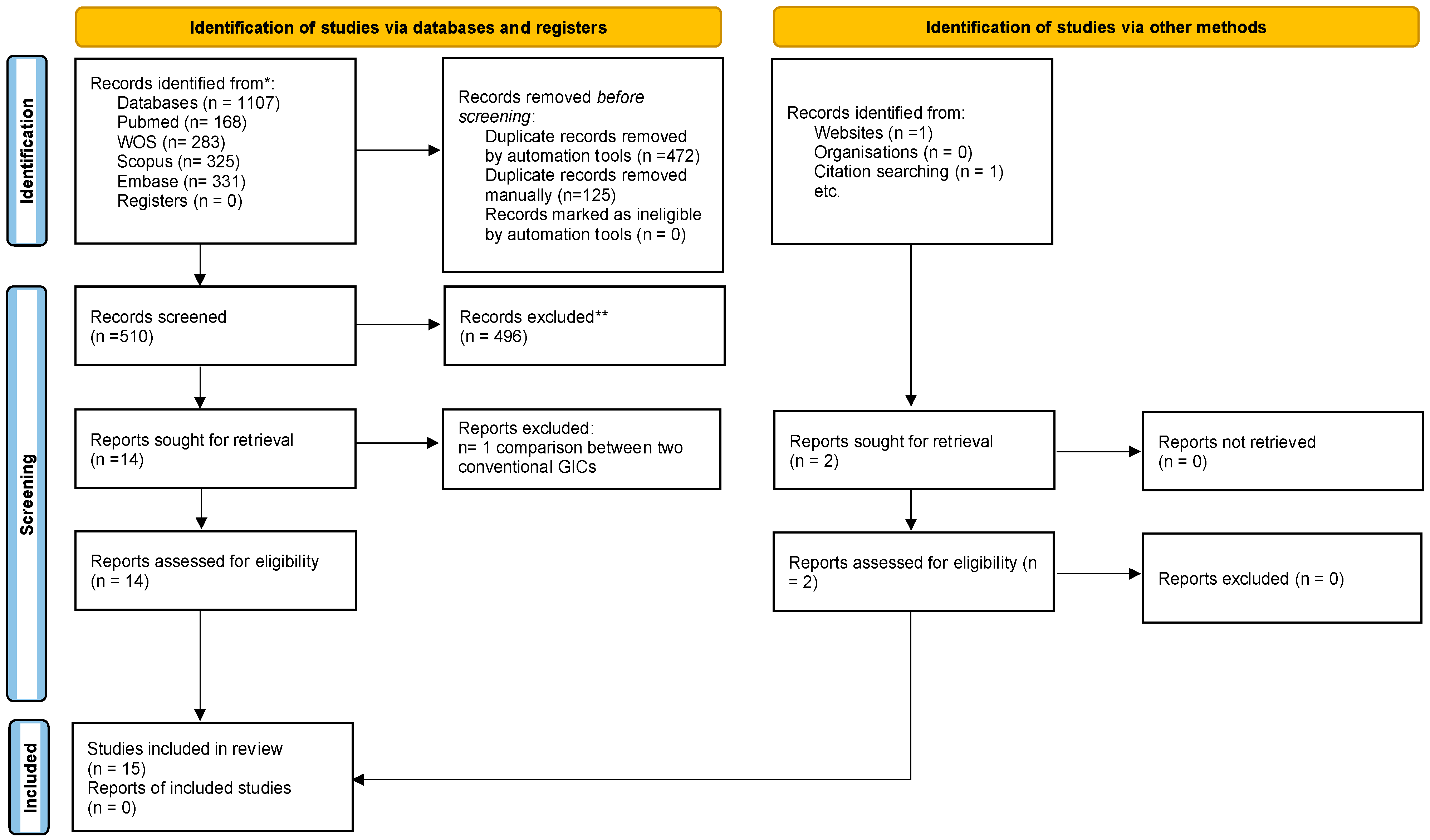
3.1. Study Selection
3.2. Study Characteristics
3.3. Results of Individual Studies
3.4. Quality Assessment (Risk of Bias)
4. Discussion
4.1. Study Methodology
4.2. Study Results
4.3. Factors Influencing Microleakage
4.4. Limitations and Future Perspectives
5. Conclusions
Supplementary Materials
Author Contributions
Funding
Institutional Review Board Statement
Informed Consent Statement
Data Availability Statement
Conflicts of Interest
References
- Towler, M.R.; Bushby, A.J.; Billington, R.W.; Hill, R.G. A preliminary comparison of the mechanical properties of chemically cured and ultrasonically cured glass ionomer cements, using nano-indentation techniques. Biomaterials 2001, 22, 1401–1406. [Google Scholar] [CrossRef]
- Davidson, C.L. Advances in glass-ionomer cements. J. Appl. Oral Sci. 2006, 14, 3–9. [Google Scholar] [CrossRef]
- Van Duinen, R.N.; Davidson, C.L.; De Gee, A.J.; Feilzer, A.J. In situ transformation of glass-ionomer into an enamel-like material. Am. J. Dent. 2004, 17, 223–227. [Google Scholar]
- Rodrigues, D.S.; Buciumeanu, M.; Martinelli, A.E.; Nascimento, R.M.; Henriques, B.; Silva, F.S.; Souza, J.C.M. Mechanical strength and wear of dental glass-ionomer and resin composites affected by porosity and chemical composition. J. Bio- Tribo-Corros. 2015, 1, 24. [Google Scholar] [CrossRef]
- Menezes-Silva, R.; Cabral, R.N.; Pascotto, R.C.; Borges, A.F.S.; Martins, C.C.; Navarro, M.F.L.; Sidhu, S.K.; Leal, S.C. Mechanical and optical properties of conventional restorative glass-ionomer cements—A systematic review. J. Appl. Oral Sci. 2019, 27, e2018357. [Google Scholar] [CrossRef] [PubMed]
- Berg, J.H.; Croll, T.P. Glass ionomer restorative cement systems: An update. Pediatr. Dent. 2015, 37, 116–124. [Google Scholar] [PubMed]
- Nicholson, J.W.; Sidhu, S.K.; Czarnecka, B. Enhancing the Mechanical Properties of Glass-Ionomer Dental Cements: A Review. Materials 2020, 13, 2510. [Google Scholar] [CrossRef] [PubMed]
- Beriat, N.C.; Nalbant, D. Water Absorption and HEMA Release of Resin-Modified Glass-Ionomers. Eur. J. Dent. 2009, 3, 267–272. [Google Scholar] [CrossRef] [PubMed][Green Version]
- Simmons, J.J. Silver-alloy powder and glass ionomer cement. J. Am. Dent. Assoc. 1990, 120, 49–52. [Google Scholar] [CrossRef] [PubMed]
- Lohbauer, U.; Walker, J.; Nikolaenko, S.; Werner, J.; Clare, A.; Petschelt, A.; Griel, P. Reactive fibre reinforced glass ionomer cements. Biomaterials 2003, 17, 2901–2907. [Google Scholar] [CrossRef]
- Dowling, A.H.; Schmitt, W.S.; Fleming, G.J.P. Modification of titanium dioxide particles to reinforce glass-ionomer restoratives. Dent. Mater 2014, 30, e159–e160. [Google Scholar] [CrossRef]
- Khademolhosseini, M.R.; Barounian, M.H.; Eskandari, A.; Aminzare, M.; Zahedi, A.M.; Ghahremani, D. Development of new Al2O3/TiO2 reinforced glass-ionomer cements (GICs) nanocomposites. J. Basic Appl. Sci. Res. 2012, 2, 7526–7529. [Google Scholar]
- Cibim, D.D.; Saito, M.T.; Giovani, P.A.; Borges, A.F.S.; Pecorari, V.G.A.; Gomes, O.P.; Lisboa-Filho, P.N.; Niciti-Junior, F.H.; Puppin-Rontani, R.M.; Kantovitz, K.R. Novel nanotechnology of TiO2 improves physical-chemical and biological properties of glass ionomer cement. Int. J. Biomater. 2017, 2017, 7123919. [Google Scholar] [CrossRef] [PubMed]
- Moshaverinia, A.; Ansari, S.; Moshaverinia, M.; Roohpour, N.; Darr, J.; Rehman, A. Effects of incorporation of hydroxyapatite and fluorapatite nanobioceramics into conventional glass-ionomer cements (GIC). Acta Biomater. 2008, 4, 432–440. [Google Scholar] [CrossRef]
- Yli-Urpo, H.; Lassila, L.V.J.; Narhi, T.; Vallittu, P.K. Compressive strength and surface characterisation of glass-ionomer cements modified by particles of bioactive glass. Dent. Mater. 2005, 21, 201–209. [Google Scholar] [CrossRef] [PubMed]
- Gunay, A.; Celenk, S.; Adiguzel, O.; Cangul, S.; Ozcan, N.; Eroglu Cakmakoglu, E. Comparison of Antibacterial Activity, Cytotoxicity, and Fluoride Release of Glass Ionomer Restorative Dental Cements in Dentistry. Med. Sci. Monit. Int. Med. J. Exp. Clin. Res. 2023, 29, e939065. [Google Scholar] [CrossRef]
- Berzins, D.W.; Abey, S.; Costache, M.C.; Wilkie, C.A.; Roberts, H.W. Resin-modified Glass-ionomer Setting Reaction Competition. J. Dent. Res. 2010, 89, 82–86. [Google Scholar] [CrossRef]
- Sadeghian, A.; Kharaziha, M.; Khoroushi, M. Dentin extracellular matrix loaded bioactive glass/GelMA support rapid bone mineralization for potential pulp regeneration. Int. J. Biol. Macromol. 2023, 234, 123771. [Google Scholar] [CrossRef]
- Nicholson, J.W.; Czarnecka, B.; Limanowska-Shaw, H. The long-term interaction of dental cements with lactic acid solutions. J. Mater. Sci. Mater. Med. 1999, 10, 449–452. [Google Scholar] [CrossRef]
- Lucas, M.E.; Arita, K.; Nishino, M. Toughness, bonding and fluoride-release properties of hydroxyapatite-added glass ionomer cement. Biomaterials 2003, 24, 3787–3794. [Google Scholar] [CrossRef]
- van Dijken, J.W.V.; Pallesen, U.; Benetti, A. A randomized controlled evaluation of posterior resin restorations of an altered resin modified glass-ionomer cement with claimed bioactivity. Dent. Mater. 2019, 35, 335–343. [Google Scholar] [CrossRef] [PubMed]
- Hasan, A.M.H.R.; Sidhu, S.K.; Nicholson, J.W. Fluoride release and uptake in enhanced bioactivity glass ionomer cement (“glass carbomerTM”) compared with conventional and resin-modified glass ionomer cements. J. Appl. Oral Sci. 2019, 27, e20180230. [Google Scholar] [CrossRef] [PubMed]
- Di Lauro, A.; Di Duca, F.; Montuori, P.; Dal Piva, A.M.O.; Tribst, J.P.M.; Borges, A.L.S.; Ausiello, P. Fluoride and Calcium Release from Alkasite and Glass Ionomer Restorative Dental Materials: In Vitro Study. J. Funct. Biomater. 2023, 14, 109. [Google Scholar] [CrossRef]
- Sidhu, S.K.; Nicholson, J.W. A Review of Glass-Ionomer Cements for Clinical Dentistry. J. Funct. Biomater. 2016, 7, 16. [Google Scholar] [CrossRef] [PubMed]
- Albeshti, R.; Shahid, S. Evaluation of Microleakage in Zirconomer (R): A Zirconia Reinforced Glass Ionomer Cement. Acta Stomatol. Croat. 2018, 52, 97–104. [Google Scholar] [CrossRef] [PubMed]
- Sharafeddin, F.; Feizi, N. Evaluation of the effect of adding micro-hydroxyapatite and nano-hydroxyapatite on the microleakage of conventional and resin-modified Glass-ionomer Cl V restorations. J. Clin. Exp. Dent. 2017, 9, e242–e248. [Google Scholar] [CrossRef] [PubMed]
- Ebaya, M.M.; Ali, A.I.; Mahmoud, S.H. Evaluation of Marginal Adaptation and Microleakage of Three Glass Ionomer-Based Class V Restorations: In Vitro Study. Eur. J. Dent. 2019, 13, 599–606. [Google Scholar] [CrossRef] [PubMed]
- Figundio, N.; Lopes, P.; Tedesco, T.K.; Fernandes, J.C.H.; Fernandes, G.V.O.; Mello-Moura, A.C.V. Deep Carious Lesions Management with Stepwise, Selective, or Non-Selective Removal in Permanent Dentition: A Systematic Review of Randomized Clinical Trials. Healthcare 2023, 11, 2338. [Google Scholar] [CrossRef]
- Alvarenga, F.A.; Andrade, M.F.; Pinelli, C.; Rastelli, A.; Victorino, K.R.; Loffredo, L.D. Accuracy of digital images in the detection of marginal microleakage: An in vitro study. J. Adhes. Dent. 2012, 14, 335–338. [Google Scholar]
- Ausiello, P.; de Oliveira Dal Piva, A.M.; Souto Borges, A.L.; Lanzotti, A.; Zamparini, F.; Epifania, E.; Mendes Tribst, J.P. Effect of Shrinking and No Shrinking Dentine and Enamel Replacing Materials in Posterior Restoration: A 3D-FEA Study. Appl. Sci. 2021, 11, 2215. [Google Scholar] [CrossRef]
- Pawar, M.; Saleem Agwan, M.A.; Ghani, B.; Khatri, M.; Bopache, P.; Aziz, M.S. Evaluation of Class II Restoration Microleakage with Various Restorative Materials: A Comparative In vitro Study. J. Pharm. Bioallied Sci. 2021, 13 (Suppl. S2), S1210–S1214. [Google Scholar] [CrossRef] [PubMed]
- Hirschberg, C.S.; Galicia, J.C.; Ruparel, N.B. AAE Position Statement on Vital Pulp Therapy. J. Endod. 2021, 47, 1340–1344. [Google Scholar]
- Gao, W.; Smales, R.J.; Yip, H.K. Demineralisation and remineralisation of dentine caries, and the role of glass-ionomer cements. Int. Dent. J. 2000, 50, 51–56. [Google Scholar] [CrossRef]
- He, L.; Hao, Y.; Zhen, L.; Liu, H.; Shao, M.; Xu, X.; Liang, K.; Gao, Y.; Yuan, H.; Li, J.; et al. Biomineralization of dentin. J. Struct. Biol. 2019, 207, 115–122. [Google Scholar] [CrossRef] [PubMed]
- Ghilotti, J.; Fernández, I.; Sanz, J.L.; Melo, M.; Llena, C. Remineralization Potential of Three Restorative Glass Ionomer Cements: An In Vitro Study. J. Clin. Med. 2023, 12, 2434. [Google Scholar] [CrossRef]
- Page, M.J.; McKenzie, J.E.; Bossuyt, P.M.; Boutron, I.; Hoffmann, T.C.; Mulrow, C.D.; Shamseer, L.; Tetzlaff, J.M.; Akl, E.A.; Brennan, S.E.; et al. The PRISMA 2020 statement: An updated guideline for reporting systematic reviews. PLoS Med. 2021, 18, e1003583. [Google Scholar] [CrossRef] [PubMed]
- Brown, P.; Brunnhuber, K.; Chalkidou, K.; Chalmers, I.; Clarke, M.; Fenton, M.; Forbes, C.; Glanville, J.; Hicks, N.J.; Moody, J.; et al. How to formulate research recommendations. BMJ 2006, 333, 804–806. [Google Scholar] [CrossRef] [PubMed]
- Sheth, V.H.; Shah, N.P.; Jain, R.; Bhanushali, N.; Bhatnagar, V. Development and validation of a risk-of-bias tool for assessing in vitro studies conducted in dentistry: The QUIN. J. Prosthet. Dent. 2022, in press. [Google Scholar] [CrossRef]
- Alwan, S.Q.; Al-Waheb, A.M. Effect of nano-coating on microleakage of different capsulated glass ionomer restoration in primary teeth: An in vitro study. Indian J. Forensic Med. Toxicol. 2021, 15, 2674–2684. [Google Scholar] [CrossRef]
- Deshpande, A.; Macwan, C.; Dhillon, S.; Wadhwa, M.; Joshi, N.; Shah, Y. Sealing Ability of Three Different Surface Coating Materials on Conventional and Resin Modified Glass Ion-omer Restoration in Primary Anterior Teeth: An In vitro Study. J. Clin. Diagn. Res. 2021, 15, ZC17–ZC22. [Google Scholar]
- Vishnurekha, C.; Annamalai, S.; Baghkomeh, P.N.; Sharmin, D.D. Effect of protective coating on microleakage of conventional glass ionomer cement and resin-modified glass ionomer cement in primary molars: An in vitro study. Indian J. Dent. Res. 2018, 29, 744–748. [Google Scholar]
- Schmitt Dissenha, R.M.; Lara, J.S.; Shitsuka, C.; Raggio, D.P.; Bonecker, M.; Pires Correa, F.N.; Imparato, J.C.P.; Salete, M.; Corrêa, N.P. Assessment of Glass Ionomer Cements (GIC) Restorations after Acidic Erosive Challenges: An in vitro Study. Pesqui. Bras. Odontopediatria Clínica Integr. 2016, 16, 323–330. [Google Scholar] [CrossRef][Green Version]
- Madyarani, D.; Nuraini, P.; Irmawati, I. Microleakage of conventional, resin-modified, and nano-ionomer glass ionomer cement as primary teeth filling material. Dent. J. Maj. Kedokt. Gigi 2014, 47, 194–197. [Google Scholar] [CrossRef][Green Version]
- Meral, E.; Baseren, N.M. Shear bond strength and microleakage of novel glass-ionomer cements: An In vitro Study. Niger. J. Clin. Pract. 2019, 22, 566–572. [Google Scholar] [CrossRef] [PubMed]
- Diwanji, A.; Dhar, V.; Arora, R.; Madhusudan, A.; Rathore, A.S. Comparative evaluation of microleakage of three restorative glass ionomer cements: An in vitro study. J. Nat. Sci. Biol. Med. 2014, 5, 373–377. [Google Scholar] [CrossRef] [PubMed]
- Pavuluri, C.; Nuvvula, S.; Kamatham, R.L.; Nirmala, S. Comparative Evaluation of Microleakage in Conventional and RMGIC Restorations following Conventional and Chemome-chanical Caries Removal: An in vitro Study. Int. J. Clin. Pediatr. Dent. 2014, 7, 172–175. [Google Scholar] [CrossRef] [PubMed]
- Gupta, J.; Saraswathi, V.; Ballal, N.; Shashirashmi, A.; Gupta, S. Comparative evaluation of microleakage in Class V cavities using various glass ionomer cements: An in vitro study. J. Interdiscip. Dent. 2012, 2, 164–169. [Google Scholar] [CrossRef]
- Delmé, K.I.; Deman, P.J.; De Bruyne, M.A.; De Moor, R.J. Microleakage of Four Different Restorative Glass Ionomer Formulations in Class V Cavities: Er: YAG Laser versus Conventional Preparation. Photomed. Laser Surg. 2008, 26, 541–549. [Google Scholar] [CrossRef] [PubMed]
- Delmé, K.I.M.; Deman, P.J.; De Bruyne, M.A.A.; Nammour, S.; De Moor, R.J.G. Microleakage of glass ionomer formulations after erbium: Yttrium-aluminium-garnet laser preparation. Lasers Med. Sci. 2010, 25, 171–180. [Google Scholar] [CrossRef] [PubMed]
- Mello, A.M.; Mayer, M.P.; Mello, F.A.; Matos, A.B.; Marques, M.M. Effects of Er: YAG laser on the sealing of glass ionomer cement restorations of bacterial artificial root caries. Photomed. Laser Surg. 2006, 24, 467–473. [Google Scholar] [CrossRef] [PubMed]
- Corona, S.A.M.; Borsatto, M.C.; de Sá Rocha, R.A.S.; Palma-Dibb, R.G. Microleakage on Class V glass ionomer restorations after cavity preparation with aluminum oxide air abrasion. Braz. Dent. J. 2005, 16, 35–38. [Google Scholar] [CrossRef][Green Version]
- Hallett, K.B.; Garcia-Godoy, F. Microleakage of resin-modified glass ionomer cement restorations: An in vitro study. Dent. Mater. 1993, 9, 306–311. [Google Scholar] [CrossRef]
- Shruthi, M.; Srinivasan, D.; Eagappan, S.; Louis, J.; Natarajan, D.; Meena, S. A Review of Dental Caries Classification Systems. Res. J. Pharm. Technol. 2022, 15, 4819–4824. [Google Scholar]
- Vilela, H.S.; Resende, M.C.A.; Trinca, R.B.; Scaramucci, T.; Sakae, L.O.; Braga, R.R. Glass ionomer cement with calcium-releasing particles: Effect on dentin mineral content and mechanical properties. Dent. Mater. 2024, 40, 236–243. [Google Scholar] [CrossRef] [PubMed]
- Hübel, S.; Mejàre, I. Conventional versus resin-modified glass-ionomer cement for Class II restorations in primary molars. A 3-year clinical study. Int. J. Paediatr. Dent. 2023, 13, 2–8. [Google Scholar] [CrossRef] [PubMed]
- Koc Vural, U.; Kerimova, L.; Kiremitci, A. Clinical comparison of a micro-hybride resin-based composite and resin modified glass ionomer in the treatment of cervical caries lesions: 36-month, split-mouth, randomized clinical trial. Odontology 2021, 109, 376–384. [Google Scholar] [CrossRef] [PubMed]
- Fragelli, C.M.; Souza, J.F.; Jeremias, F.; Cordeiro Rde, C.; Santos-Pinto, L. Molar incisor hypomineralization (MIH): Conservative treatment management to restore affected teeth. Braz. Oral Res. 2015, 29, 1–7. [Google Scholar] [CrossRef] [PubMed]
- Cribari, L.; Madeira, L.; Roeder, R.B.R.; Macedo, R.M.; Wambier, L.M.; Porto, T.S.; Gonzaga, C.C.; Kaizer, M.R. High-viscosity glass-ionomer cement or composite resin for restorations in posterior permanent teeth? A systematic review and meta-analyses. J. Dent. 2023, 137, 104629. [Google Scholar] [CrossRef] [PubMed]
- AlHabdan, A.A. Review of Microleakage Evaluation Tools. J. Int. Oral Health 2017, 9, 141–147. [Google Scholar] [CrossRef]
- Abuabara, A.; Santos, A.J.S.D.; Aguiar, F.H.B.; Lovadino, J.R. Evaluation of microleakage in human, bovine and swine enamels. Braz. Oral Res. 2004, 18, 312–316. [Google Scholar] [CrossRef]
- Serdar, C.C.; Cihan, M.; Yücel, D.; Serdar, M.A. Sample size, power and effect size revisited: Simplified and practical approaches in pre-clinical, clinical and laboratory studies. Biochem. Medica 2021, 31, 10502. [Google Scholar] [CrossRef]
- Raskin, A.; D’Hoore, W.; Gonthier, S.; Degrange, M.; Déjou, J. Reliability of in vitro microleakage tests: A literature review. J. Adhes. Dent. 2001, 3, 295–308. [Google Scholar]
- ISO/TS 11405:2015; Dental Materials—Testing of Adhesion to Tooth Structure. ISO: Geneva, Switzerland, 2003.
- Alvarenga, F.A.S.; Pinelli, C.; Loffredo, L.C.M. Reliability of marginal microleakage assessment by visual and digital methods. Eur. J. Dent. 2015, 9, 1–5. [Google Scholar] [CrossRef][Green Version]
- Lardani, L.; Derchi, G.; Marchio, V.; Carli, E. One-Year Clinical Performance of ActivaTM Bioactive-Restorative Composite in Primary Molars. Child 2022, 9, 433. [Google Scholar] [CrossRef]
- Amaireh, A.I.; Al-Jundi, S.H.; Alshraideh, H.A. In vitro evaluation of microleakage in primary teeth restored with three adhesive materials: ACTIVATM, composite resin, and res-in-modified glass ionomer. Eur. Arch. Paediatr. Dent. 2019, 20, 359–367. [Google Scholar] [CrossRef] [PubMed]
- Bhadra, D.; Shah, N.C.; Rao, A.S.; Dedania, M.S.; Bajpai, N. A 1-year comparative evaluation of clinical performance of nanohybrid composite with ActivaTM bioactive composite in Class II carious lesion: A randomized control study. J. Conserv. Dent. 2019, 22, 92–96. [Google Scholar] [PubMed]
- Benetti, A.R.; Michou, S.; Larsen, L.; Peutzfeldt, A.; Pallesen, U.; van Dijken, J.W.V. Adhesion and marginal adaptation of a claimed bioactive, restorative material. Biomater. Investig. Dent. 2019, 6, 90–98. [Google Scholar] [CrossRef] [PubMed]
- Brkanović, S.; Ivanišević, A.; Miletić, I.; Mezdić, D.; Jukić Krmek, S. Effect of Nano-Filled Protective Coating and Different pH Enviroment on Wear Resistance of New Glass Hybrid Restorative Material. Materials 2021, 14, 755. [Google Scholar] [CrossRef] [PubMed]
- Colombo, M.; Gallo, S.; Poggio, C.; Ricaldone, V.; Arciola, C.R.; Scribante, A. New Resin-Based Bulk-Fill Composites: In vitro Evaluation of Micro-Hardness and Depth of Cure as Infection Risk Indexes. Materials 2020, 13, 1308. [Google Scholar] [CrossRef] [PubMed]
- Andrade, A.C.M.; Borges, A.B.; Kukulka, E.C.; Moecke, S.E.; Scotti, N.; Comba, A.; Pucci, C.R.; Torres, C.R.G. Optical Property Stability of Light-Cured versus Precured CAD-CAM Composites. Int. J. Dent. 2022, 2022, 2011864. [Google Scholar] [CrossRef]
- Cacciafesta, V.; Sfondrini, M.F.; Scribante, A.; De Angelis, M.; Klersy, C. Effects of blood contamination on the shear bond strengths of conventional and hydrophilic primers. Am. J. Orthod. Dentofac. Orthop. 2004, 126, 207–212. [Google Scholar] [CrossRef] [PubMed]

| Database | Search String | Findings |
|---|---|---|
| PubMed | #1 “glass ionomer cement” OR GIC | 4712 |
| #2 Microleakage | 3327 | |
| #3 “in vitro” OR laboratory | 4,608,981 | |
| #1 AND #2 AND #3 | 168 | |
| Embase | #1 ‘glass ionomer cement’/exp OR ‘glass ionomer cement’ OR ‘gic’ | 10,662 |
| #2 ‘microleakage’/exp OR microleakage | 3090 | |
| #3 ‘in vitro’/exp OR ‘in vitro’ OR ‘laboratory’/exp OR laboratory | 10,476,800 | |
| #1 AND #2 AND #3 | 331 | |
| Scopus | #1 “glass ionomer cement” OR GIC | 13,689 |
| #2 microleakage | 3712 | |
| #3 “in vitro” OR “laboratory” | 4,279,048 | |
| #1 AND #2 AND #3 | 325 | |
| Web of Science | #1 “glass ionomer cement” OR GIC (Topic) | 9484 |
| #2 microleakage (Topic) | 6432 | |
| #3 “in vitro” OR laboratory (Topic) | 9,237,722 | |
| #1 AND #2 AND #3 | 283 |
| (a) | |||||
| Author/Year | Glass Ionomer/Other Materials | Sample Characteristics and Cavity Size | Groups | Microleakage Technique and Values | Main Outcome |
| Alwan and Al-Waheb 2021 Iraq [39] | RMGIC: Fuji II LC GIC: Fuji IX Hybrid GI: Equia Forte | 36 sound primary molars 3 groups (n = 12) Class V buccal surface (2 × 4 × 2 mm depth) | G1. Fuji II LC G2. Fuji IX + G-Coat Plus G3. Equia Forte + Equia Coat | 2% methylene blue (score 0–4) Mean/SD G1. 0.9487/0.5393 G2. 1.0718/0.4502 G3. 0.2318/0.2522 p value = 0.000 | Equia Forte showed significantly less microleakage than the other groups. |
| 20% acrylic acid conditioner G-Coat Plus Equia Coat | |||||
| Deshpande et al., 2021 India [40] | GIC: Fuji II RMGIC: Fuji II LC | 40 anterior primary teeth 2 groups (n = 20) 8 subgroups (n = 5) Class V labial surface (3 × 2 × 2 mm depth with the incisal margin in enamel and the gingival margin in dentin) | G1a. Fuji II G2a. Fuji II LC G1b. Fuji II + Fuji Varnish G2b. Fuji II LC + Fuji Varnish G1c. Fuji II + G-Coat G2c. Fuji II LC + G-Coat G1d. Fuji II + Icon DMG G2d. Fuji II LC + Icon DMG | Methylene blue (score 0–3) Mean/SD G1a. 2.8/0.44/G2a. 2.6/0.54/p = 0.25 G1b. 2/0.0/G2b. 1.8/0.44/p = 0.02 G1c. 0.4/0.54 G2c. 0.2/0.44/p = 0.25 G1d. 1.2/0.44 G2d. 1/0.70/p = 0.78 | No significant differences were found between Fuji II and Fuji II LC. Subgroups G1b and G2b showed significant differences between them. |
| GC Dentine Conditioner Fuji Varnish G-Coat Plus Icon DMG | |||||
| Arthilakshmi et al., 2018 India [41] | GIC: Fuji IX RMGIC: Fuji II LC | 120 caries/exfoliated primary molars 4 groups (n = 30) Class V buccal surface (4 × 2 × 1.5 mm depth) | G1. Fuji IX G2. Fuji IX + G-Coat Plus G3. Fuji II LC G4. Fuji II LC + G-Coat Plus | 2% basic fuchsin dye (score 0–3) Microleakage % G1. 100% G2. 13.3% G3. 26.6% G4. 0% p = 0.040 | RMGIC showed less microleakage than GIC with and without G-Coat Plus. |
| G-Coat Plus | |||||
| Dissenha et al., 2016 Brazil [42] | GIC: Ketac Molar Easymix Nano-filled RMGIC: Ketac N100 | 60 sound primary canines 6 groups (n = 10) Class V buccal surface with margins only in enamel (2 × 3 × 1.5 mm depth) | G1. Ketac N100 + water G2. Ketac N100 + orange juice G3. Ketac N100 + Coca-Cola G4. Easymix + water G5. Easymix + orange juice G6. Easymix + Coca-Cola | 0.5% methylene blue (score 0–4) Microleakage % G1. 40% G2. 100% G3. 100% G4. 50% G5. 90% G6. 100% | Ketac N100 showed less microleakage than Ketac Molar Easymix, but it was non-significant. Erosive challenges with orange juice and Coca-Cola could affect the marginal adaptation of the tested GIC. |
| Orange juice Coca-Cola | |||||
| Madyarani et al., 2014 Indonesia [43] | GIC: Fuji IX RMGIC: Fuji II LC Nano-filled RMGIC: Ketac N100 | 21 sound primary canines 3 groups (n = 7) Class V (3 × 2 × 2 mm depth) on the labiocervical surface | G1. Fuji IX G2. Fuji II LC G3. Ketac N100 | 2% methylene blue (score 0–4) Mean/SD G1. 1.29/0.488 G2. 1.57/1.134 G3. 2.57/1.397 p = 0.119 | No significant differences were found between the groups. |
| (b) | |||||
| Author/Year | Glass Ionomer/Other Materials | Sample Characteristics and Cavity Size | Groups | Microleakage Technique and Values | Main Outcome Measures |
| Ebaya et al., 2019 Egypt [27] | GIC: Equia Fil + G-Coat Plus RMGI: Fuji II LC + G-Coat Plus BIR: Activa Bioactive Restorative | 60 sound third molars 3 groups (n = 20) 3 subgroups (n = 10) Class V buccal surfaces (4 × 3 × 2 mm depth) | G1a. Equia Fil + G-Coat Plus (Immediately) G2a. Fuji II LC + G-Coat Plus (Immediately) G3a. Activa Bioactive Restorative (Immediately) G1b. Equia Fil + G-Coat Plus (6 months + thermocycling) G2b. Fuji II LC + G-Coat Plus (6 months + thermocycling) G3b. Activa Bioactive Restorative (6 months + thermocycling) | 2% methylene blue (score 1–4) Median (IQR) G1a. enamel 0.0 (0.00–0.0)/dentin 0.5 (0.0–3.0) G2a. enamel 0.0 (0.00–0.0)/dentin 0.5 (0.0–1.0) G3a. enamel 0.00 (0.00–0.00)/dentin 3.0 (0.0–3.0) G1b. dnamel 0.50 (0.0–1.0)/dentin 2.5 (0.0–3.0) G2b. enamel 0.0 (0.0–3.0)/dentin 2.5 (1.0–3.0) G3b. enamel 0.0 (0.0–0.0)/dentin 3.0 (3.0–3.0) | No significant differences were found between the materials. The dentin substrate revealed greater microleakage than enamel, especially with BIR material. Water aging had a negative effect on RMGI. |
| Meral and Baseren 2019 Turkey [44] | GIC: Equia Fil + Equia Fil Coat Glass carbomer: Glass Fill + GCP Gloss ZRGIC: Zirconomer GIC: Riva Self Cure + Riva Coat | 32 sound third molars 4 groups (n = 16) Class V buccal and lingual surfaces (4 × 3 × 2 mm depth) | G1. Equia Fil G2. Carbomer Glass Fill G3. Zirconomer G4. Riva Self Cure | 0.5% basic fuchsin (score 0–4) Microleakage % G1.enamel 87.5%/dentin 43.75% G2.enamel 75%/dentin 87.5% G3.enamel 68.75%/dentin 50% G4.enamel. 56.25%/dentin 62.5% | No significant differences were allowed at the enamel margins. Carbomer Glass Fill showed significantly more microleakage than Equia Fil and Zirconomer. |
| Diwanji, A. et al., 2014 India [45] | GIC: Fuji IX RMGIC: Fuji II LC Nano-filled RMGIC: Ketac N100 | 120 sound young maxillary permanent first premolars Class I (n = 60) 3 groups (n = 20) Class V (n = 60) 3 groups (n = 20) | Class I G1. Fuji IX G2. Fuji II LC G3. Ketac N Class V: G4. Fuji IX G5. Fuji II LC G.6 Ketac N 100 | Acridine dye (score 0–4) Microleakage % G1.70%/G2. 40%/G3.50% p ≤ 0.05 between G1 and G2/G1 and G3 G4. 80%/G5.60%/G6. 50% p < 0.05 between G4 and G6/G5 and G6 | In Class I restorations, Fuji IX showed significantly more microleakage than the other glass ionomers. In Class V restorations, Fuji IX and Ketac N100 and Fuji LC II showed significant differences. |
| Pavuluri et al., 2014 India [46] | GIC: Fuji IX Nano-filled RMGIC: Ketac N100 | 100 carious mandibular first molars Conventional caries removal (CCR) (n = 50) 2 subgroups (n = 25) Chemomechanical Carisolv removal (CMR) (n = 50) 2 subgroups (n = 25) Class I | G1. CCR +Fuji IX G2. CCR +Ketac N100 G3. CMR +Fuji IX G4. CMR + Ketac N100 | 0.5% basic fuchsine solution (score 0–3) Mean/±SD (%) G1. 0.04/±0.2 (4%) G2. 0.16/±0.4 (12%) G3. 0.08/±0.2 (8%) G4. 0.2/±0.5 (16%) | No significant differences between groups. |
| Gupta et al., 2012 India [47] | GIC: Fuji II + Fuji Varnish RMGI: Fuji II LC + Fuji Varnish Nano-filled RMGIC: Ketac N100 | 45 sound molars 3 groups (n = 15) Class V (5 × 3 × 2 mm depth) on the buccal surface | G1. Fuji II + GC Fuji Varnish G2. Fuji II LC + GC Fuji Varnish G3. Ketac N100 | 2% rhodamine-B (score 0–3) Microleakage % Occlusal margins: G1. 20%/G2. 13.3%/G3. 33.3%/p = 0.464 Gingival margins: G1. 100%/G2. 93.3%/G3. 60%/p ≤ 0.05 | KN 100 showed less microleakage than the other two cements at gingival margins. |
| Delme et al., 2008 Belgium [48] | GIC: Fuji II GIC: Fuji IX RMGIC: Fuji II LC RMGIC: Fuji VIII | 160 sound permanent molars 320 cavities Er:YAG laser caries remotion (n = 160) 8 subgroups (n = 20) Conventional caries removal (CCR) (n = 160) 8 subgroups (n = 20) Class V (4 × 3 × 1.5 depth) on buccal and lingual surfaces with the occlusal margins in enamel and the cervical margins 1.5 mm apical to the cementoenamel junction | Er:YAG laser caries remotion G1a. Fuji II G2a. Fuji IX G3a. Fuji II LC G4a. Fuji VIII Er:YAG laser caries remotion + Ketac conditioner G1b. Fuji II G2b. Fuji IX G3b. Fuji II LC G4b. Fuji VIII CCR G5a. Fuji II G6a. Fuji IX G7a. Fuji II LC G8a. Fuji VIII CCR + Ketac conditioner G5b. Fuji II G6b. Fuji IX G7b. Fuji II LC G8b. Fuji VIII | 2% methylene blue Median (IQR) %microleakage Er:YAG laser caries remotion Occlusal G1a. 1.5 (0.0–18.0) G2a. 0.0 (0.0–20.0) G3a. 0.0 (0.0–0.0) G4a. 5.0 (0.0–22.0) Gingival G1a. 20.0 (8.0–45.0) G2a. 18.0 (0.0–35.0) G3a. 7.5 (0.0–12.0) G4a. 11.0 (0.0–25.0) Er:YAG laser caries remotion + Ketac conditioner Occlusal G1b. 1.0 (0.0–33.0) G2b. 7.5 (0.0–50.0) G3b. 0.0 (0.0–12.0) G4b. 2.0 (0.0–25.0) Gingival G1b. 21.0 (0.0–50.0) G2b. 15,5 (0.0–50.0) G3b. 2.0 (0.0–30.0) G4b. 5.0 (0.0–25.0) CCR Occlusal G5a. 12.0 (0.0–25.0) G6a. 5.5 (0.0–50.0) G7a. 5.0 (0.0–13.0) G8a. 5.0 (0.0–15.0) Gingival G5a. 22.5 (10.0–50.0) G6a. 12.4 (4.0–20.0) G7a. 15.0 (0.0–43.0) G8a. 18.5.0 (8.0–26.0) CCR + Ketac conditioner Occlusal G5b. 0.0 (0.0–9.0) G6b. 0.0 (0.0–3.0) G7b. 0.0 (0.0–10.0) G8b. 0.0 (0.0–33.0) Gingival G5b. 12.0 (0.0–31.0) G6b. 10.5 (0.0–30.0) G7b. 1.0 (0.0–35.0) /G8b. 1.0 (0.0–17.0) | RMGICs allowed less microleakage than GICs. Dentin conditioning or Er:YAG laser reduced microleakage in both gingival and occlusal margins. |
| Ketac conditioner | |||||
| Delme et al., 2010 Belgium [49] | GIC: Ketac Fil Plus GIC: Ketac Molar GIC: Ionofil Molar GIC: Ionofil Molar Quick RMGIC: Photac Fil Quick | 200 sound permanent molars 400 cavities Er:YAG laser caries remotion (n = 200) 10 subgroups (n = 20) Conventional caries removal (CCR) (n = 200) 10 subgroups (n = 20) Class V (4 × 3 × 1.5 depth) on buccal and lingual surfaces with the occlusal margins in enamel and the cervical margins 1.5 mm apical to the cementoenamel junction | Er:YAG laser caries remotion G1a. Ketac Fil Plus G2a. Ketac Molar G3a. Ionofil Molar G4a. Ionofil Molar Quick G5a. Photac Fil Quick Er:YAG laser caries remotion + Ketac conditioner G1b. Ketac Fil Plus G2b. Ketac Molar G3b. Ionofil Molar G4b. Ionofil Molar Quick G5b. Photac Fil Quick CCR G6a. Ketac Fil Plus G7a. Ketac Molar G8a. Ionofil Molar G9a. Ionofil Molar Quick G10a. Photac Fil Quick CCR + Ketac conditioner G6b. Ketac Fil Plus G7b. Ketac Molar G8b. Ionofil Molar G9b. Ionofil Molar Quick G10b. Photac Fil Quick | 2% methylene blue Median (IQR) %microleakage Er:YAG laser caries remotion Occlusal G1a. 0.0 (0.0–22.0) G2a. 0.0 (0.0–17.0) G3a. 4.5 (0.0–24.0) G4a. 8.0 (2.0–60.0) G5a. 0.0 (0.0–8.0) Gingival G1a. 29.5 (0.0–52.0) G2a. 9.0 (0.0–30.0) G3a. 14.0 (2.0–30.0) G4a. 14.0 (8.0–34.00) G5a. 6.0 (0.0–14.0) Er:YAG laser caries remotion + Ketac conditioner Occlusal G1b. 0.0 (0.0–13.0) G2b. 0.0 (0.0–15.0) G3b. 7.0 (0.0–11.0) G4b. 6.0 (0.0–12.0) G5b. 0.0 (0.0–14.0) Gingival G1b. 19.5 (0.0–33.0) G2b. 10. (0.0–33.0) G3b. 22.0 (4.0–26.0) G4b. 21.0 (10.0–27.0) G5b. 4.5 (0.0–12.0) CCR Occlusal G6a. 8.0 (2.0–13.0) G7a. 18.0 (8.0–36.0) G8a. 5.0 (0.0–17.0) G9a. 9.0 (0.0–33.0) G10a. 6.0 (0.0–10.0) Gingival G6a. 22.5 (10.0–50.0) G7a. 12.4 (4.0–20.0) G8a. 15.0 (0.0–43.0) G9a. 18.5. (8.0–26.0) G10a. 6.0 (5.0–22.0) CCR + Ketac conditioner Occlusal G6b. 0.0 (0.0–12.0) G7b. 0.0 (0.0–25.0) G8b. 8.0 (0.0–15.0) G9b. 5.0 (0.0–30.0) G10b. 0.0 (0.0–8.0) Gingival G6b. 16.0 (0.0–33.0) G7b. 9.5 (0.0–33.0) G8b. 16.5 (0.0–26.0) G9b. 15.0 (9.0–28.0) G10b. 2.0 (0.0–10.0) | RMGIC showed less microleakage than GICs at both occlusal and gingival margins, irrespective of the preparation method used. Conventionally prepared cavities should be conditioned before being filled, except for Ionofil Molar and Ionofil Molar Quick. |
| Ketac conditioner | |||||
| Mello et al., 2006 Brazi [50] | GIC: Ketac Fil Plus RMGIC: Vitremer | 45 molars and premolars Conventional caries removal (CCR) (n = 15) Er:YAG caries removal (n = 15) Er:YAG caries removal + dentin conditioner (n = 15) n = 3 for SEM n = 12 microleakage | CCR G1. Ketac Fil Plus G2. Vitremer Er:YAG laser G3. Ketac Fil Plus G4. Vitremer Er:YAG caries removal + dentin conditioner G5. Ketac Fil Plus G6. Vitremer | 2% methylene blue (score 0–3) Mean scores: G1. 2.5 G2. 3 G3. 3 G4. 0.7 G5. 2.7 G6. 1.5 p < 0.05 | RMGIC showed less microleakage than GIC, independently of the caries removal technique used. Lower microleakage scores were observed in cavities prepared with a laser when combined with restoration by RMGIC. |
| Artificial root caries were induced using a microbiological model (Streptococcus mutans) | |||||
| Corona et al., 2005 Brazil [51] | GIC: Ketac Fil RMGIC: Vitremer RMGIC: Fuji II LC Aluminum oxide air-abrasion device for cavity preparation | 15 sound third molars 30 cavities (n = 10) Class V (3 × 3 × 1.5 mm depth) the occlusal margin in enamel and the cervical margin located 1 mm below the amelocemental junction | G1. Ketac Fil G2. Vitremer G3. Fuji II LC | Rhodamine-B (%) Mean mm/SD: Occlusal margin G1. 25.76/34.35 G2. 20.00/42.16 G3. 28.25/41.67 Cervical margin G1. 23.72/41.84 G2.44.22/49.69 G3. 39.27/50.74 p > 0.05 | No statistically significant differences were assessed between groups or margins. |
| Hallett and Garcia-Godoy 1993 USA [52] | GIC: Fuji II GIC: Ketac Fil RMGIC: Fuji II LC RMGIC: Photac Fil | 45 sound molars 3 groups (n = 15 cavities in buccal and n = 15 cavities in lingual) Class V (5 × 3 × 2 mm depth) on buccal and lingual surfaces, the occlusal margin in the enamel, and the cervical margin in dentin at the cementoenamel junction | G1a. buccal Fuji II LC G1b. buccal Photac Fil G2a. buccal Fuji II G2b. lingual Ketac Fil G3a. buccal Fuji II LC G3b. lingual Photac Fil | 2% basic fuchsin (score 0–3) Values not available | RMGICs showed less microleakage than GICs. Photac Fil had a significantly more reliable seal than Ketac Fil both against enamel and dentin cementum. Fuji LC II performed worse than Fuji II in enamel but comparable at the dentin cementum. |
| CGIC | Manufacturer | Composition | Studies |
|---|---|---|---|
| Fuji II | GC Corporation | Powder: calcium fluoroalumino silicate (FAS) glass. Liquid: polyacrylic acid, itaconic acid, maleic acid, tartaric acid, and water. | Diwanji et al., 2014 [45]; Arthilakshmi et al., 2018 [41]; Alwan and Al-Waheb 2021 [39] |
| Fuji IX GP | GC Corporation | Powder: fluoroaluminosilicate glass and polyacrylic acid. Liquid: polyacrylic acid and polybasic carboxylic acid. | Delme et al., 2008 [48]; Madyarani et al., 2014 [43]; Pavuluri et al., 2014 [46]; Diwanji et al., 2014 [45]; Vishnurekha et al., 2018 [41]; Alwan and Al-Waheb 2021 [39] |
| EQUIA Fil | GC Corporation | Powder: 95% strontium fluoroalumino silicate (FAS) glass and 5% polyacrylic acid. Liquid: 40% aqueous polyacrylic acid liquid. | Ebaya et al., 2019 [27]; Meral and Baseren. 2019 [44] |
| Riva Self Cure | SDI Ltd. | Powder: strontium fluoroaluminosilicate glass, polyacrylic acid copolymer powders, and pigment. | Meral and Baseren 2019 [44] |
| Ketac Fil | 3M ESPE | Power: calcium aluminum lanthan fluorosilicate glass and strontium. Liquid: water, acrylic and maleic acid copolymer, tartaric acid, and benzoic acid. | Hallett and Garcia-Godoy 1993 [52]; Corona et al., 2005 [51]; Mello et al., 2006 [50]; Delme et al., 2010 [49] |
| Ketac Molar Easymix | 3M ESPE | Ketac Conditioner: polyacrylic acid (25%). Powder: calcium aluminum–lanthanumfluorosilicate glass, acrylic acid, maleic acid copolymer, and pigments. Liquid: water, acrylic acid, maleic acid copolymer, and tartaric acid. | Dissenha et al., 2016 [42]; Delme et al., 2010 [49] |
| Ionofil Molar AC | VOCO | Fluoroaluminosilicate glass, polyacrylic acid, and tartaric acid. | Delme et al., 2010 [49] |
| GI | Manufacturer | Composition | Studies |
|---|---|---|---|
| RMGIC Fuji II LC | GC Corporation | Powder: FAS glass. Liquid: polyacrylic acid, 2-HEMA (hydroxylethyl methacrylate; 30–35%), bicarbonate, and proprietary ingredient. | Alwan and Al-Waheb 2021 [39]; Deshpande et al., 2021 [40]; Ebaya et al., 2019 [27]; Arthilakshmi et al., 2018 [41]; Diwanji, et al., 2014 [45]; Madyarani et al., 2014 [43]; Delme et al., 2008 [48]; Corona et al., 2005 [51]; Hallett and Garcia-Godoy 1993 [52] |
| Hybrid glass ionomer Equia Forte | GC Corporation | Powder: 95% strontium fluoroaluminosilicate glass, highly reactive small particles, and 5% polyacrylic acid. Liquid: 40% aqueous polyacrylic acid. | Alwan and Al-Waheb 2021 [39] |
| RMGIC Fuji VIII GP | GC Corporation | 2-HEMA (25–50%); tartaric acid (5–10%); 7,7,9(or 7,9,9)-trimethyl-4,13-dioxo-3,14-dioxa-5,12-diazahexadecane-1,16-diyl bismethacrylate 1–5%; and 2-hydroxy-1,3 dimethacryloxypropane (1–5%). | Delme et al., 2008 [48] |
| RMGIC Vitremer | 3M ESPE | Powder: fluoroaluminosilcate powder. Contains pigments. Liquid: polycarboxylic acid modified with a methacrylate group. | Corona et al., 2005 [51]; Mello et al., 2006 [50] |
| RMGIC Photac Fil | 3M ESPE | Polyethylene polycarbonic acid, 2-hydroxyethyl methacrylate, water, and diurethane dimetharylate. | Delme et al., 2010 [49]; Hallett and Garcia-Godoy 1993 [52] |
| Ketac N100 Nano RMGIC | 3M ESPE | Primer: water (40–50%); HEMA (35–45%), acrylic/itaconic acid copolymer (10–15%), and photo-iniciators. Ketac™ N100: de-ionized water, HEMA, vitrebond copolymer/methacrylate-modified polyalkenoic acid, fluoraluminosilicate glass, nanomers, and nanoclusters. | Dissenha et al., 2016 [42]; Diwanji et al., 2014 [45]; Madyarani et al., 2014 [43]; Pavuluri et al., 2014 [46]; Gupta et al., 2012 [47] |
| Activa Bioactive Restorative RMGIC | Pulpdent | Powder: diurethane dimethacrylate, bis (2-(methacryloyloxy) ethyl) phosphate, barium glass, ionomer glass, sodium fluoride, and colorants. Liquid: polyacrylic acid/maleic acid copolymer. | Ebaya et al., 2019 [27] |
| Glass carbomer: Glass Fill | GCP Dental | Powder: fluoroaluminosilicate glass and apatite. Liquid: polyacrylic acids and silica. | Meral and Baseren 2019 [44] |
| Zirconia GIC: Zirconomer Improved | SHOFU Dental | Powder: fluoroaluminosilicate glass, zirconium oxide, pigment, etc. Liquid: polyacrylic acid and tartaric acid. | Meral and Baseren 2019 [44] |
| Coat | Manufacturer | Studies |
|---|---|---|
| Vitremer finishing gloss | 3M ESPE | Corona et al., 2005 [51] |
| GC Fuji Coat LC | GC Corporation | Delme et al., 2008 [48] |
| Ketac Primer | 3M ESPE | Madyarani et al., 2014 [43] |
| Icon | DMG Dental Milestones Guaranteed | Deshpande et al., 2021 [40] |
| GC Fuji Varnish II | GC Corporation | Deshpande et al., 2021 [40]; Gupta et al., 2012 [47] |
| Carisolv system | Swedish Medi Team | Pavuluri et al., 2014 [46] |
| Study [Ref.] | Country/Date | 1 | 2 | 3 | 4 | 5 | 6 | 7 | 8 | 9 | 10 | 11 | 12 | Score | % |
|---|---|---|---|---|---|---|---|---|---|---|---|---|---|---|---|
| Ebaya et al. [27] | Egypt 2019 |  |  | |  | | | | | | | | | 15 (100)/24 | 62.5 |
| Meral and Baseren [44] | Turkey 2019 | | | | | | | | | | | | | 14 (100)/24 | 58.3 |
| Hallett and Garcia-Godoy [52] | USA 1993 | | | | | | | | | | | | | 15 (100)/24 | 62.5 |
| Alwan and Al-Waheb [39] | Iraq 2021 | | | | | | | | | | | | | 16 (100)/24 | 66.67 |
| Madyarani et al. [43] | Indonesia 2014 | | | | | | | | | | | | | 16 (100)/24 | 66.67 |
| Delme et al. [48] | Belgium 2008 | | | | | | | | | | | | | 17 (100)/24 | 70.83 |
| Delme et al. [49] | Belgium 2010 | | | | | | | | | | | | | 16 (100)/24 | 66.67 |
| Corona et al. [51] | Brazil 2005 | | | | | | | | | | | | | 13 (100)/24 | 54.1 |
| Dissenha et al. [42] | Brazil 2016 | | | | | | | | | | | | | 16 (100)/24 | 66.67 |
| Mello et al. [50] | Brazil 2006 | | | | | | | | | | | | | 13 (100)/24 | 54.1 |
| Deshpande et al. [40] | India 2021 | | | | | | | | | | | | | 17 (100)/24 | 70.83 |
| Gupta et al. [47] | India 2012 | | | | | | | | | | | | | 15 (100)/24 | 62.5 |
| Arthilakshmi et al. [41] | India 2018 | | | | | | | | | | | | | 16 (100)/24 | 66.67 |
| Diwanji et al. [45] | India 2014 | | | | | | | | | | | | | 15 (100)/24 | 62.5 |
| Pavuluri et al. [46] | India 2014 | | | | | | | | | | | | | 12 (100)/24 | 50.0 |
Disclaimer/Publisher’s Note: The statements, opinions and data contained in all publications are solely those of the individual author(s) and contributor(s) and not of MDPI and/or the editor(s). MDPI and/or the editor(s) disclaim responsibility for any injury to people or property resulting from any ideas, methods, instructions or products referred to in the content. |
© 2024 by the authors. Licensee MDPI, Basel, Switzerland. This article is an open access article distributed under the terms and conditions of the Creative Commons Attribution (CC BY) license (https://creativecommons.org/licenses/by/4.0/).
Share and Cite
Alsari, A.; Ghilotti, J.; Sanz, J.L.; Llena, C.; Folguera, S.; Melo, M. Comparative Evaluation of the Microleakage of Glass Ionomers as Restorative Materials: A Systematic Review of In Vitro Studies. Appl. Sci. 2024, 14, 1729. https://doi.org/10.3390/app14051729
Alsari A, Ghilotti J, Sanz JL, Llena C, Folguera S, Melo M. Comparative Evaluation of the Microleakage of Glass Ionomers as Restorative Materials: A Systematic Review of In Vitro Studies. Applied Sciences. 2024; 14(5):1729. https://doi.org/10.3390/app14051729
Chicago/Turabian StyleAlsari, Abtihal, James Ghilotti, José Luis Sanz, Carmen Llena, Sofía Folguera, and María Melo. 2024. "Comparative Evaluation of the Microleakage of Glass Ionomers as Restorative Materials: A Systematic Review of In Vitro Studies" Applied Sciences 14, no. 5: 1729. https://doi.org/10.3390/app14051729
APA StyleAlsari, A., Ghilotti, J., Sanz, J. L., Llena, C., Folguera, S., & Melo, M. (2024). Comparative Evaluation of the Microleakage of Glass Ionomers as Restorative Materials: A Systematic Review of In Vitro Studies. Applied Sciences, 14(5), 1729. https://doi.org/10.3390/app14051729

