



Exploring the Impact of Artificial Intelligence on Healthcare Management: A Combined Systematic Review and Machine-Learning Approach

 ,
,  ,
,  and
and 
Abstract
1. Introduction
2. Materials and Methods
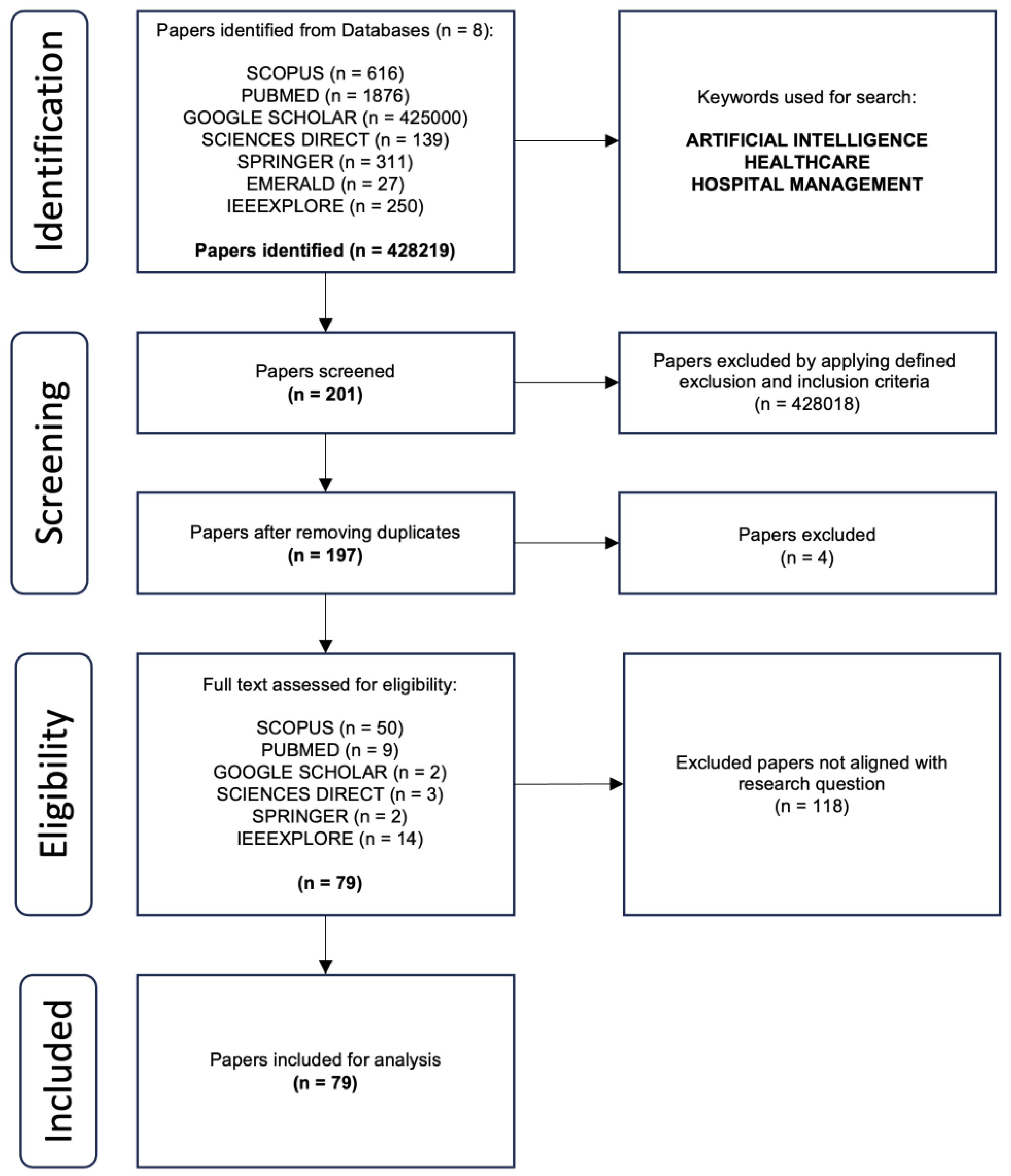
2.1. Search Strategy
2.2. Inclusion and Exclusion Criteria
- Were written in English, as it is the predominant means of communication in the scientific field, selecting works for a detailed analysis that could adequately cover the themes of AI adoption. Both open-access publications and those accessible through subscription or academic libraries were considered, with an emphasis on open-access sources to facilitate broader accessibility.
- Presented empirical studies on factors driving AI adoption in the healthcare sector, with the aim of focusing on research offering significant contributions and insights. This criterion was aimed at identifying studies that provide a deep understanding of the drivers behind AI integration in healthcare contexts.
- Were published in scientific journals or recognized conference proceedings, to encompass a broad spectrum of research contributions. This inclusion was further refined to articles published between 2019 and 2023, and limited to works available in scientific journals or conference proceedings, ensuring the inclusion of the most current and high-quality information.
- Fell within the subject areas of computer sciences, social sciences, business management and accounting, and economics, econometrics, and finance, reflecting a multidisciplinary approach to understanding the multifaceted impact of AI on healthcare management.
2.3. Screening and Selection
2.4. Data Extraction and Analysis
3. Results
3.1. Artificial Intelligence for Quality Assurance and Stakeholders Engagement
3.2. AI in the Healthcare Response to the COVID-19 Pandemic
3.3. Technological Innovation and AI in Enhancing Healthcare
3.4. Security and Intelligent Platfroms: AI as a Driver or Change in Healthcare
3.5. Artificial Intelligence and Resource Management in Healthcare: Towards a Smart and Sustainable Future
4. Discussion
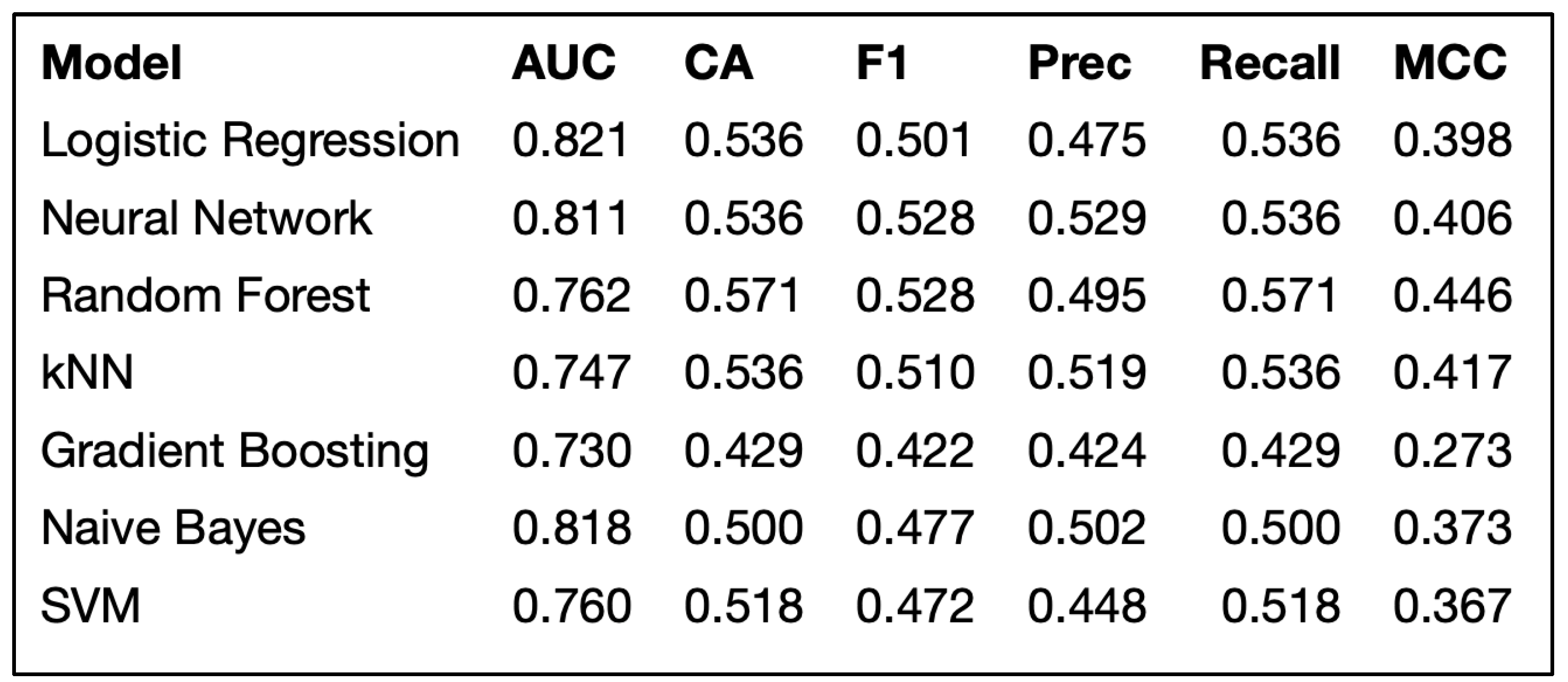
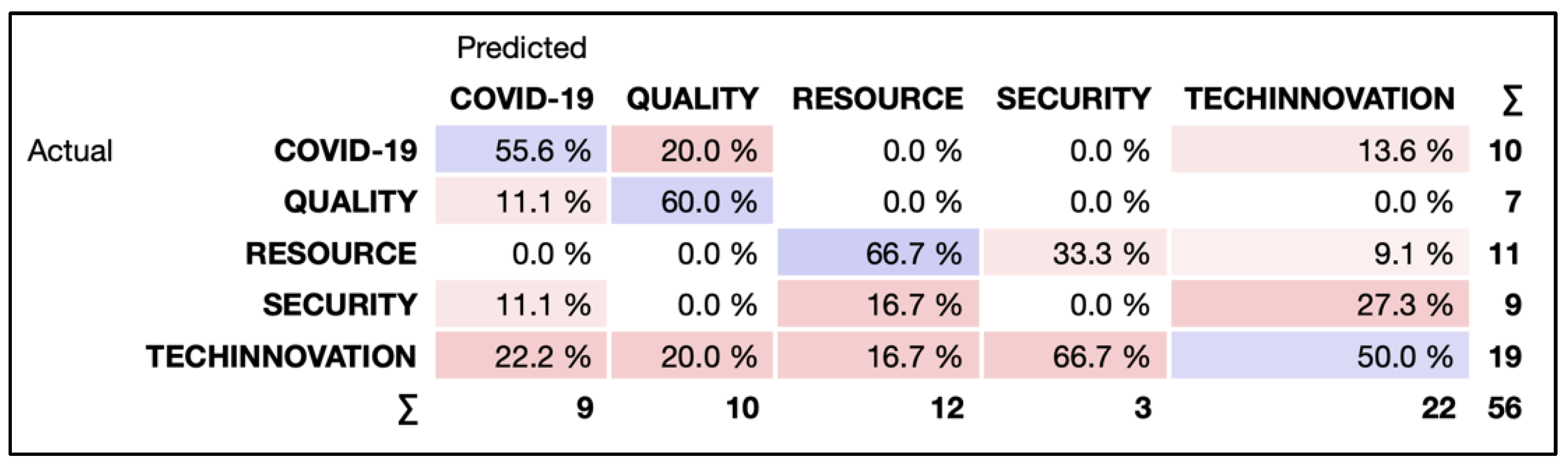
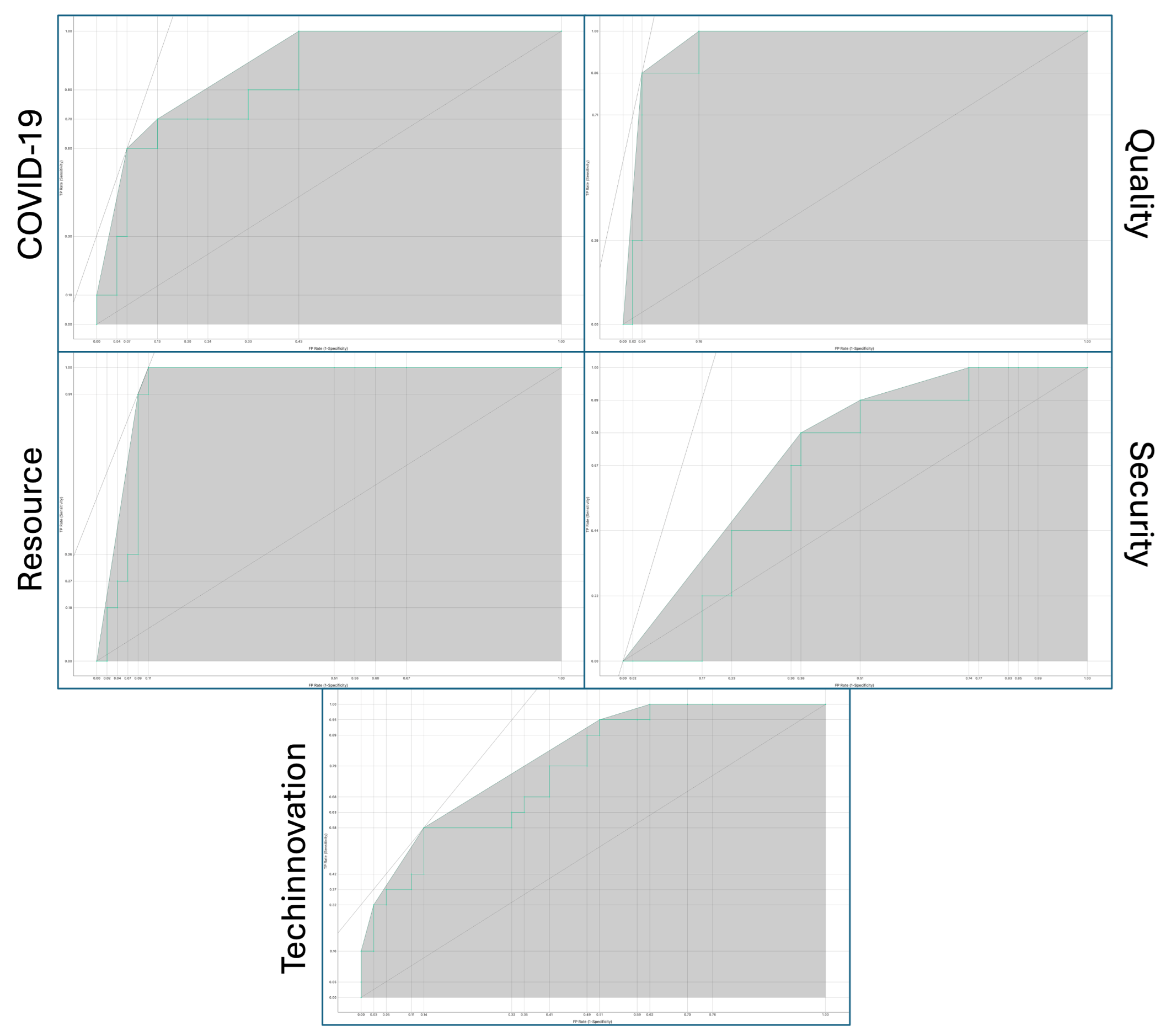
4.1. Experiments
4.2. Application of the Predictive Model
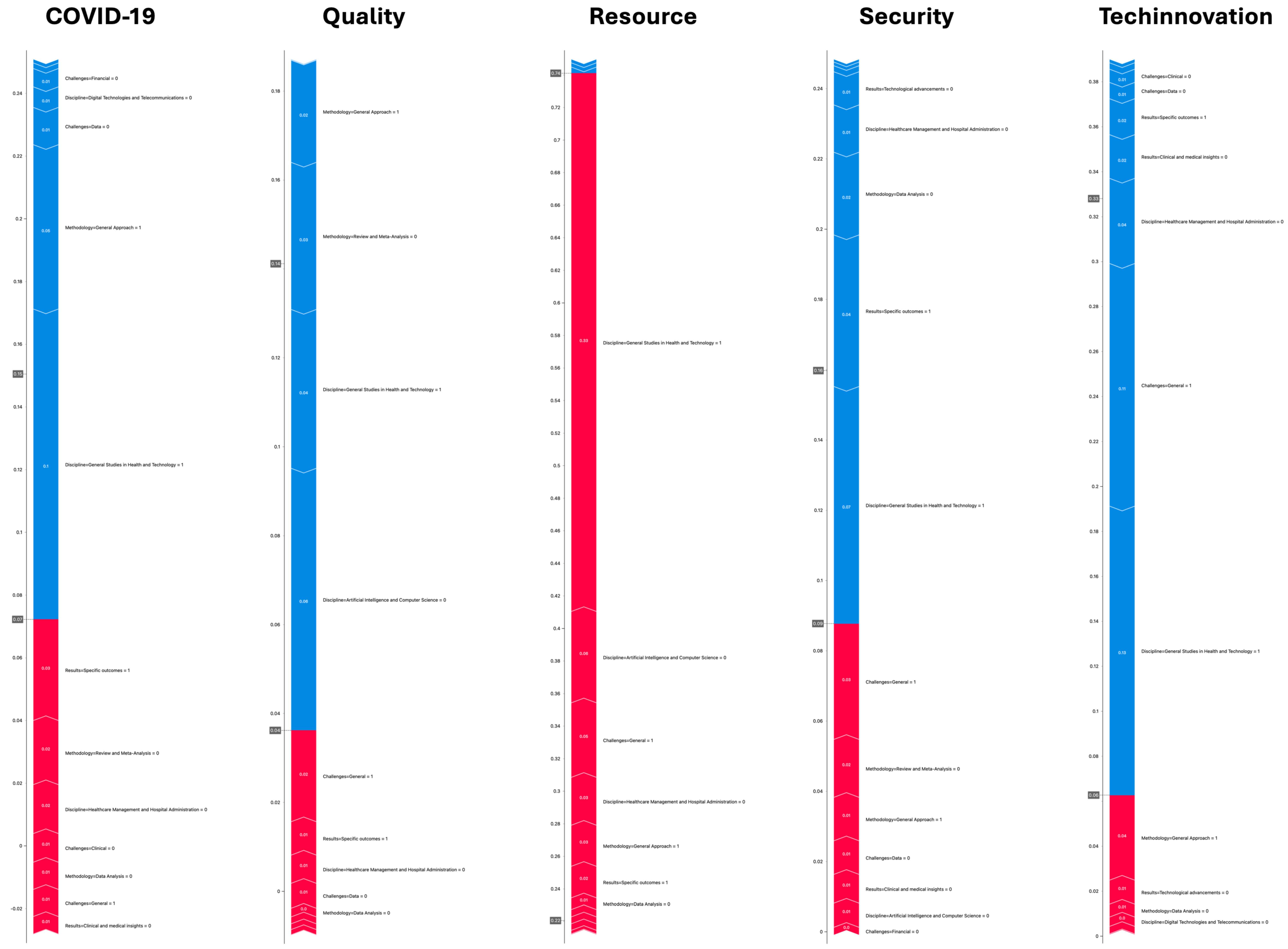
- Clinical and Medical Insights: These have a moderate positive impact on COVID-19, Quality, and Resource, with SHAP values of 0.00558636, 0.00117473, and 0.00446783, respectively. This suggests that clinical insights are slightly more influential in research related to COVID-19 and resource management. However, they have a significant negative impact on Techinnovation (−0.0194271), indicating that for technological innovations, other factors may be more relevant.
- Specific Outcomes: They show a significant positive impact on COVID-19 (0.0322289) and on Quality and Resource with smaller values, but a very negative impact on Security (−0.0431382). This could reflect the importance of specific outcomes in COVID-19 research and their lesser relevance for security studies.
- Clinical Challenges: Clinical challenges have a small positive impact on COVID-19 (0.00912065) and Quality (0.00155511), suggesting that clinical issues are relevant but not dominant in these fields. It is interesting to note the slight negative impact on Resources (−0.00374929), perhaps indicating that clinical challenges are less central in resource management.
- Data Challenges: These challenges show a negative impact on COVID-19 (−0.0119134) but a positive, albeit smaller, impact on Quality (0.00559921). This may indicate that while data-related challenges are perceived as problematic in COVID-19 research, they may provide opportunities for improvement in quality.
- General: A significant variation in the impact of general challenges, with a strong positive impact on Resource (0.0458024) and a very negative impact on Techinnovation (−0.107902), highlights how general challenges are seen as crucial in resource management but hinder technological innovation.
- Methodology—General Approach: This has a strong negative impact on COVID-19 (−0.0524088) and Quality (−0.0229678) but a positive impact on Techinnovation (0.0377616), suggesting that a nonspecific methodological approach is less useful for direct studies but advantageous for technological innovation.
- Discipline—General Studies in Health and Technology: These studies have an extremely positive impact on Resources (0.330612) but a negative impact on Techinnovation (−0.128479), highlighting the importance of general research in resource management and its limiting impact on technological innovation.
- Model Predictions: The model predictions show the highest confidence in the Resource category (0.74) compared to others, suggesting that the analyzed features are particularly indicative of studies focused on resource management.
4.3. Analysis of Topics by Years and Geographical Area
5. Conclusions
Author Contributions
Funding
Institutional Review Board Statement
Informed Consent Statement
Data Availability Statement
Conflicts of Interest
References
- Marengo, A.; Pagano, A.; Ladisa, L. Towards a mobile augmented reality prototype for corporate training. In Proceedings of the 16th European Conference on e-Learning (ECEL), Porto, Portugal, 26–27 October 2017; pp. 362–366. [Google Scholar]
- Johnson, J.; Simms-Ellis, R.; Janes, G.; Mills, T.; Budworth, L.; Atkinson, L.; Harrison, R. Can we prepare healthcare professionals and students for involvement in stressful healthcare events? A mixed-methods evaluation of a resilience training intervention. BMC Health Serv. Res. 2020, 20, 1094. [Google Scholar] [CrossRef] [Scilit] [PubMed]
- Dave, M.; Patel, N. Artificial intelligence in healthcare and education. Br. Dent. J. 2023, 234, 761–764. [Google Scholar] [CrossRef] [Scilit] [PubMed]
- Brambilla, A.; Sun, T.-Z.; Elshazly, W.; Ghazy, A.; Barach, P.; Lindahl, G.; Capolongo, S. Flexibility during the COVID-19 Pandemic Response: Healthcare Facility Assessment Tools for Resilient Evaluation. Int. J. Environ. Res. Public Health 2021, 18, 11478. [Google Scholar] [CrossRef] [Scilit]
- Prakash, S.; Balaji, J.N.; Joshi, A.; Surapaneni, K.M. Ethical Conundrums in the Application of Artificial Intelligence (AI) in Healthcare-A Scoping Review of Reviews. J. Pers. Med. 2022, 12, 1914. [Google Scholar] [CrossRef] [Scilit] [PubMed]
- Cacciamani, G.E.; Chu, T.N.; Sanford, D.I.; Abreu, A.; Duddalwar, V.; Oberai, A.; Kuo, C.-C.J.; Liu, X.; Denniston, A.K.; Vasey, B.; et al. PRISMA AI reporting guidelines for systematic reviews and meta-analyses on AI in healthcare. Nat. Med. 2023, 29, 14–15. [Google Scholar] [CrossRef] [Scilit]
- Joshi, G.; Jain, A.; Araveeti, S.R.; Adhikari, S.; Garg, H.; Bhandari, M. FDA-Approved Artificial Intelligence and Machine Learning (AI/ML)-Enabled Medical Devices: An Updated Landscape. Electronics 2024, 13, 498. [Google Scholar] [CrossRef] [Scilit]
- Pisapia, A.; Banfi, G.; Tomaiuolo, R. The novelties of the regulation on health technology assessment, a key achievement for the European union health policies. Clin. Chem. Lab. Med. CCLM 2022, 60, 1160–1163. [Google Scholar] [CrossRef] [Scilit]
- Wang, C.; Zhang, J.; Lassi, N.; Zhang, X. Privacy Protection in Using Artificial Intelligence for Healthcare: Chinese Regulation in Comparative Perspective. Healthcare 2022, 10, 1878. [Google Scholar] [CrossRef] [Scilit] [PubMed]
- Townsend, B.A.; Sihlahla, I.; Naidoo, M.; Naidoo, S.; Donnelly, D.-L.; Thaldar, D.W. Mapping the regulatory landscape of AI in healthcare in Africa. Front. Pharmacol. 2023, 14, 1214422. [Google Scholar] [CrossRef] [Scilit]
- Marengo, A.; Pagano, A. Investigating the Factors Influencing the Adoption of Blockchain Technology across Different Countries and Industries: A Systematic Literature Review. Electronics 2023, 12, 3006. [Google Scholar] [CrossRef] [Scilit]
- Moldt, J.-A.; Festl-Wietek, T.; Madany Mamlouk, A.; Nieselt, K.; Fuhl, W.; Herrmann-Werner, A. Chatbots for future docs: Exploring medical students’ attitudes and knowledge towards artificial intelligence and medical chatbots. Med. Educ. Online 2023, 28, 2182659. [Google Scholar] [CrossRef] [Scilit] [PubMed]
- Bartels, R.; Dudink, J.; Haitjema, S.; Oberski, D.; van ‘t Veen, A. A Perspective on a Quality Management System for AI/ML-Based Clinical Decision Support in Hospital Care. Front. Digit. Health 2022, 4, 942588. [Google Scholar] [CrossRef] [Scilit] [PubMed]
- Shams, R.A.; Zowghi, D.; Bano, M. AI and the quest for diversity and inclusion: A systematic literature review. AI Ethics 2023. [Google Scholar] [CrossRef] [Scilit]
- Thomassin-Naggara, I.; Balleyguier, C.; Ceugnart, L.; Heid, P.; Lenczner, G.; Maire, A.; Séradour, B.; Verzaux, L.; Taourel, P.; Conseil, national professionnel de la radiologie et imagerie medicale (G4). Artificial intelligence and breast screening: French Radiology Community position paper. Diagn. Interv. Imaging 2019, 100, 553–566. [Google Scholar] [CrossRef] [Scilit]
- Feng, J.; Phillips, R.V.; Malenica, I.; Bishara, A.; Hubbard, A.E.; Celi, L.A.; Pirracchio, R. Clinical artificial intelligence quality improvement: Towards continual monitoring and updating of AI algorithms in healthcare. npj Digit. Med. 2022, 5, 66. [Google Scholar] [CrossRef] [Scilit]
- Boonstra, A.; Laven, M. Influence of artificial intelligence on the work design of emergency department clinicians a systematic literature review. BMC Health Serv. Res. 2022, 22, 669. [Google Scholar] [CrossRef] [Scilit] [PubMed]
- Lorenzon, M.; Spina, E.; Franco, F.T.D.; Giovannini, I.; Vita, S.D.; Zabotti, A. Salivary Gland Ultrasound in Primary Sjögren’s Syndrome: Current and Future Perspectives. Open Access Rheumatol. Res. Rev. 2022, 14, 147–160. [Google Scholar] [CrossRef] [Scilit]
- Hogg, H.D.J.; Al-Zubaidy, M.; Talks, J.; Denniston, A.K.; Kelly, C.J.; Malawana, J.; Papoutsi, C.; Teare, M.D.; Keane, P.A.; Beyer, F.R.; et al. Stakeholder Perspectives of Clinical Artificial Intelligence Implementation: Systematic Review of Qualitative Evidence. J. Med. Internet Res. 2023, 25, 39742. [Google Scholar] [CrossRef] [Scilit]
- Miller, G.J. Stakeholder roles in artificial intelligence projects. Proj. Leadersh. Soc. 2022, 3, 100068. [Google Scholar] [CrossRef] [Scilit]
- Kordi, M.; Dehghan, M.J.; Shayesteh, A.A.; Azizi, A. The impact of artificial intelligence algorithms on management of patients with irritable bowel syndrome: A systematic review. Inform. Med. Unlocked 2022, 29, 100891. [Google Scholar] [CrossRef] [Scilit]
- Alcocer Alkureishi, M.; Lenti, G.; Choo, Z.-Y.; Castaneda, J.; Weyer, G.; Oyler, J.; Lee, W.W. Teaching Telemedicine: The Next Frontier for Medical Educators. JMIR Med. Educ. 2021, 7, e29099. [Google Scholar] [CrossRef] [Scilit] [PubMed]
- Ponce, B.A.; Brabston, E.W.; Zu, S.; Watson, S.L.; Baker, D.; Winn, D.; Guthrie, B.L.; Shenai, M.B. Telemedicine with mobile devices and augmented reality for early postoperative care. In Proceedings of the 2016 38th Annual International Conference of the IEEE Engineering in Medicine and Biology Society (EMBC), Orlando, FL, USA, 16–20 August 2016; pp. 4411–4414. [Google Scholar] [CrossRef] [Scilit]
- Murri, R.; Masciocchi, C.; Lenkowicz, J.; Fantoni, M.; Damiani, A.; Marchetti, A.; Sergi, P.D.A.; Arcuri, G.; Cesario, A.; Patarnello, S.; et al. A real-time integrated framework to support clinical decision making for COVID-19 patients. Comput. Methods Programs Biomed. 2022, 217, 106655. [Google Scholar] [CrossRef] [Scilit] [PubMed]
- Enughwure, A.A.; Febaide, I.C. Applications of Artificial Intelligence in Combating COVID-19: A Systematic Review. Open Access Libr. J. 2020, 7, 8. [Google Scholar] [CrossRef]
- Ortiz-Barrios, M.; Arias-Fonseca, S.; Ishizaka, A.; Barbati, M.; Avendaño-Collante, B.; Navarro-Jiménez, E. Artificial intelligence and discrete-event simulation for capacity management of intensive care units during the COVID-19 pandemic: A case study. J. Bus. Res. 2023, 160, 113806. [Google Scholar] [CrossRef] [Scilit]
- Chee, M.L.; Ong, M.E.H.; Siddiqui, F.J.; Zhang, Z.; Lim, S.L.; Ho, A.F.W.; Liu, N. Artificial intelligence applications for COVID-19 in intensive care and emergency settings: A systematic review. Int. J. Environ. Res. Public Health 2021, 18, 4749. [Google Scholar] [CrossRef] [Scilit]
- Xu, Z.; Su, C.; Xiao, Y.; Wang, F. Artificial intelligence for COVID-19: Battling the pandemic with computational intelligence. Intell. Med. 2022, 2, 13–29. [Google Scholar] [CrossRef] [Scilit] [PubMed]
- Zaman, T.U.; Alharbi, E.K.; Bawazeer, A.S.; Algethami, G.A.; Almehmadi, L.A.; Alshareef, T.M.; Alotaibi, Y.A.; Karar, H.M.O. Artificial intelligence: The major role it played in the management of healthcare during COVID-19 pandemic. IAES Int. J. Artif. Intell. 2023, 12, 505–513. [Google Scholar] [CrossRef] [Scilit]
- Ismail, L.; Materwala, H. Blockchain paradigm for healthcare: Performance evaluation. Symmetry 2020, 12, 1200. [Google Scholar] [CrossRef] [Scilit]
- Aravazhi, A.; Helgheim, B.I.; Aadahl, P. Decision-Making Based on Predictive Process Monitoring of Patient Treatment Processes: A Case Study of Emergency Patients. Adv. Oper. Res. 2023, 2023, 8867057. [Google Scholar] [CrossRef] [Scilit]
- Văduva, L.L.; Nedelcu, A.-M.; Stancu, D.; Bălan, C.; Purcărea, I.-M.; Gurău, M.; Cristian, D.A. Digital Technologies for Public Health Services after the COVID-19 Pandemic: A Risk Management Analysis. Sustainability 2023, 15, 3146. [Google Scholar] [CrossRef] [Scilit]
- Ho, C.W.-L.; Caals, K.; Zhang, H. Heralding the Digitalization of Life in Post-Pandemic East Asian Societies. J. Bioethical Inq. 2020, 17, 657–661. [Google Scholar] [CrossRef] [Scilit] [PubMed]
- Chen, Y.J.; Lin, L.-C.; Yang, S.-T.; Hwang, K.-S.; Liao, C.-T.; Ho, W.-H. High-Reliability Non-Contact Photoplethysmography Imaging for Newborn Care by a Generative Artificial Intelligence. IEEE Access 2023, 11, 90801–90810. [Google Scholar] [CrossRef] [Scilit]
- Suhaimy, A.M.B.; Anwar, T. Intelligent healthcare on hydrocephalus management using artificial neural network algorithm. Int. J. Eng. Adv. Technol. 2019, 9, 6108–6115. [Google Scholar] [CrossRef] [Scilit]
- Ortíz-Barrios, M.A.; Coba-Blanco, D.M.; Alfaro-Saíz, J.-J.; Stand-González, D. Process improvement approaches for increasing the response of emergency departments against the COVID-19 pandemic: A systematic review. Int. J. Environ. Res. Public Health 2021, 18, 8814. [Google Scholar] [CrossRef] [Scilit]
- Zemmar, A.; Lozano, A.M.; Nelson, B.J. The rise of robots in surgical environments during COVID-19. Nat. Mach. Intell. 2020, 2, 566–572. [Google Scholar] [CrossRef] [Scilit]
- Nti, I.K.; Adekoya, A.F.; Weyori, B.A.; Keyeremeh, F. A bibliometric analysis of technology in sustainable healthcare: Emerging trends and future directions. Decis. Anal. J. 2023, 8, 100292. [Google Scholar] [CrossRef] [Scilit]
- Free, R.C.; Lozano Rojas, D.; Richardson, M.; Skeemer, J.; Small, L.; Haldar, P.; Woltmann, G. A data-driven framework for clinical decision support applied to pneumonia management. Front. Digit. Health 2023, 5, 1237146. [Google Scholar] [CrossRef] [Scilit] [PubMed]
- Khalique, F.; Khan, S.A.; Nosheen, I. A Framework for Public Health Monitoring, Analytics and Research. IEEE Access 2019, 7, 101309–101326. [Google Scholar] [CrossRef] [Scilit]
- Atek, S.; Bianchini, F.; De Vito, C.; Cardinale, V.; Novelli, S.; Pesaresi, C.; Eugeni, M.; Mecella, M.; Rescio, A.; Petronzio, L.; et al. A predictive decision support system for coronavirus disease 2019 response management and medical logistic planning. Digital Health 2023, 9, 20552076231185475. [Google Scholar] [CrossRef] [Scilit]
- Sulis, E.; Terna, P.; Di Leva, A.; Boella, G.; Boccuzzi, A. Agent-oriented Decision Support System for Business Processes Management with Genetic Algorithm Optimization: An Application in Healthcare. J. Med. Syst. 2020, 44, 157. [Google Scholar] [CrossRef] [Scilit]
- Cho, M.; Song, M.; Yoo, S.; Reijers, H.A. An Evidence-Based Decision Support Framework for Clinician Medical Scheduling. IEEE Access 2019, 7, 15239–15249. [Google Scholar] [CrossRef] [Scilit]
- Tam, W.; Alajlani, M.; Abd-Alrazaq, A. An Exploration of Wearable Device Features Used in UK Hospital Parkinson Disease Care: Scoping Review. J. Med. Internet Res. 2023, 25, 42950. [Google Scholar] [CrossRef] [Scilit] [PubMed]
- Huang, H.; Shih, P.-C.; Zhu, Y.; Gao, W. An integrated model for medical expense system optimization during diagnosis process based on artificial intelligence algorithm. J. Comb. Optim. 2022, 44, 2515–2532. [Google Scholar] [CrossRef] [Scilit] [PubMed]
- Alruwaili, F.F. Artificial intelligence and multi agent based distributed ledger system for better privacy and security of electronic healthcare records. PeerJ Comput. Sci. 2020, 6, e323. [Google Scholar] [CrossRef] [Scilit]
- Iadanza, E.; Benincasa, G.; Ventisette, I.; Gherardelli, M. Automatic Classification of Hospital Settings through Artificial Intelligence. Electronics 2022, 11, 1697. [Google Scholar] [CrossRef] [Scilit]
- Fatoum, H.; Hanna, S.; Halamka, J.D.; Sicker, D.C.; Spangenberg, P.; Hashmi, S.K. Blockchain integration with digital technology and the future of health care ecosystems: Systematic review. J. Med. Internet Res. 2021, 23, 19846. [Google Scholar] [CrossRef] [Scilit]
- Chen, I.Y.; Szolovits, P.; Ghassemi, M. Can AI help reduce disparities in general medical and mental health care? AMA J. Ethics 2019, 21, 167–179. [Google Scholar] [CrossRef] [Scilit]
- Anudjo, M.N.K.; Vitale, C.; Elshami, W.; Hancock, A.; Adeleke, S.; Franklin, J.M.; Akudjedu, T.N. Considerations for environmental sustainability in clinical radiology and radiotherapy practice: A systematic literature review and recommendations for a greener practice. Radiography 2023, 29, 1077–1092. [Google Scholar] [CrossRef] [Scilit]
- Raja, B.S.; Asghar, S. Disease classification in health care systems with game theory approach. IEEE Access 2020, 8, 83298–83311. [Google Scholar] [CrossRef] [Scilit]
- Shang, Y.; Tian, Y.; Zhou, M.; Zhou, T.; Lyu, K.; Wang, Z.; Xin, R.; Liang, T.; Zhu, S.; Li, J. EHR-Oriented Knowledge Graph System: Toward Efficient Utilization of Non-Used Information Buried in Routine Clinical Practice. IEEE J. Biomed. Health Inform. 2021, 25, 2463–2475. [Google Scholar] [CrossRef] [Scilit]
- García-Ponsoda, S.; García-Carrasco, J.; Teruel, M.A.; Maté, A.; Trujillo, J. Feature engineering of EEG applied to mental disorders: A systematic mapping study. Appl. Intell. 2023, 53, 23203–23243. [Google Scholar] [CrossRef] [Scilit]
- Celesti, A.; De Falco, I.; Pecchia, L.; Sannino, G. Guest Editorial Enabling Technologies for Next Generation Telehealthcare. IEEE J. Biomed. Health Inform. 2021, 25, 4240–4242. [Google Scholar] [CrossRef] [Scilit]
- Zhai, K.; Masoodi, N.A.; Zhang, L.; Yousef, M.S.; Qoronfleh, M.W. Healthcare Fusion: An Innovative Framework for Health Information Management. Electron. J. Knowl. Manag. 2022, 20, 179–192. [Google Scholar] [CrossRef] [Scilit]
- Nisar, D.-E.-M.; Amin, R.; Shah, N.-U.-H.; Ghamdi, M.A.A.; Almotiri, S.H.; Alruily, M. Healthcare Techniques through Deep Learning: Issues, Challenges and Opportunities. IEEE Access 2021, 9, 98523–98541. [Google Scholar] [CrossRef] [Scilit]
- Yu, G.; Tabatabaei, M.; Mezei, J.; Zhong, Q.; Chen, S.; Li, Z.; Li, J.; Shu, L.; Shu, Q. Improving chronic disease management for children with knowledge graphs and artificial intelligence. Expert Syst. Appl. 2022, 201, 117026. [Google Scholar] [CrossRef] [Scilit]
- Vargas, V.B.; De Oliveira Gomes, J.; Fernandes, P.C.; Vallejos, R.V.; De Carvalho, J.V. Influential Factors for Hospital Management Maturity Models in a post-COVID-19 scenario—Systematic Literature Review. J. Inf. Syst. Eng. Manag. 2023, 8, 12868. [Google Scholar] [CrossRef] [Scilit]
- Murala, D.K.; Panda, S.K.; Dash, S.P. MedMetaverse: Medical Care of Chronic Disease Patients and Managing Data Using Artificial Intelligence, Blockchain, and Wearable Devices State-of-the-Art Methodology. IEEE Access 2023, 11, 138954–138985. [Google Scholar] [CrossRef] [Scilit]
- Soellner, M.; Koenigstorfer, J. Motive perception pathways to the release of personal information to healthcare organizations. BMC Med. Inform. Decis. Mak. 2022, 22, 240. [Google Scholar] [CrossRef] [Scilit]
- Alanazi, F.; Gay, V.; Alturki, R. Poor Compliance of Diabetic,Pa.tients with AI-Enabled E-Health Self-Care Management in Saudi Arabia. Information 2022, 13, 509. [Google Scholar] [CrossRef] [Scilit]
- Ramchand, S.; Tsang, G.; Cole, D.; Xie, X. RetainEXT: Enhancing Rare Event Detection and Improving Interpretability of Health Records using Temporal Neural Networks. In Proceedings of the 2022 IEEE-EMBS International Conference on Biomedical and Health Informatics (BHI), Ioannina, Greece, 27–30 September 2022. [Google Scholar] [CrossRef] [Scilit]
- Yang, N. Financial Big Data Management and Control and Artificial Intelligence Analysis Method Based on Data Mining Technology. Wirel. Commun. Mob. Comput. 2022, 2022, 7596094. [Google Scholar] [CrossRef] [Scilit]
- Chen, Y.; Huang, W.; Jiang, X.; Zhang, T.; Wang, Y.; Yan, B.; Wang, Z.; Chen, Q.; Xing, Y.; Li, D.; et al. UbiMeta: A Ubiquitous Operating System Model for Metaverse. Int. J. Crowd Sci. 2023, 7, 180–189. [Google Scholar] [CrossRef] [Scilit]
- Huang, J.-D.; Wang, J.; Ramsey, E.; Leavey, G.; Chico, T.J.A.; Condell, J. Applying Artificial Intelligence to Wearable Sensor Data to Diagnose and Predict Cardiovascular Disease: A Review. Sensors 2022, 22, 8002. [Google Scholar] [CrossRef] [Scilit] [PubMed]
- Shumba, A.-T.; Montanaro, T.; Sergi, I.; Bramanti, A.; Ciccarelli, M.; Rispoli, A.; Carrizzo, A.; De Vittorio, M.; Patrono, L. Wearable Technologies and AI at the Far Edge for Chronic Heart Failure Prevention and Management: A Systematic Review and Prospects. Sensors 2023, 23, 6896. [Google Scholar] [CrossRef] [Scilit]
- Hughes, A.; Shandhi, M.M.H.; Master, H.; Dunn, J.; Brittain, E. Wearable Devices in Cardiovascular Medicine. Circ. Res. 2023, 132, 652–670. [Google Scholar] [CrossRef] [Scilit]
- Yu, S.; Chen, Z.; Wu, X. The Impact of Wearable Devices on Physical Activity for Chronic Disease Patients: Findings from the 2019 Health Information National Trends Survey. Int. J. Environ. Res. Public Health 2023, 20, 887. [Google Scholar] [CrossRef] [Scilit]
- Bhaskar, S.; Bradley, S.; Sakhamuri, S.; Moguilner, S.; Chattu, V.K.; Pandya, S.; Schroeder, S.; Ray, D.; Banach, M. Designing Futuristic Telemedicine Using Artificial Intelligence and Robotics in the COVID-19 Era. Front. Public Health 2020, 8, 556789. [Google Scholar] [CrossRef] [Scilit]
- Burrell, D.N. Dynamic Evaluation Approaches to Telehealth Technologies and Artificial Intelligence (AI) Telemedicine Applications in Healthcare and Biotechnology Organizations. Merits 2023, 3, 700–721. [Google Scholar] [CrossRef] [Scilit]
- Christopoulou, S.C. Machine Learning Models and Technologies for Evidence-Based Telehealth and Smart Care: A Review. BioMedInformatics 2024, 4, 754–779. [Google Scholar] [CrossRef] [Scilit]
- Senthilkumaran, R.K.; Prashanth, M.; Viswanath, H.; Kotha, S.; Tiwari, K.; Bera, A. ARTEMIS: AI-driven robotic triage labeling and emergency medical information system. arXiv 2023, arXiv:2309.08865. [Google Scholar]
- Tyler, S.; Olis, M.; Aust, N.; Patel, L.; Simon, L.; Triantafyllidis, C.; Patel, V.; Lee, D.W.; Ginsberg, B.; Ahmad, H. Use of Artificial Intelligence in Triage in Hospital Emergency Departments: A Scoping Recview. Cureus 2024, 16, e59906. [Google Scholar] [CrossRef] [Scilit]
- Antonini, A.; Reichmann, H.; Gentile, G.; Garon, M.; Tedesco, C.; Frank, A.; Falkenburger, B.; Konitsiotis, S.; Tsamis, K.; Rigas, G.; et al. Toward objective monitoring of Parkinson’s disease motor symptoms using a wearable device: Wearability and performance evaluation of PDMonitor®. Front. Neurol. 2023, 14, 1080752. [Google Scholar] [CrossRef] [Scilit] [PubMed]
- Badidi, E. Edge AI for Early Detection of Chronic Diseases and the Spread of Infectious Diseases: Opportunities, Challenges, and Future Directions. Future Internet 2023, 15, 370. [Google Scholar] [CrossRef] [Scilit]
- Lu, L.; Zhang, J.; Xie, Y.; Gao, F.; Xu, S.; Wu, X.; Ye, Z. Wearable Health Devices in Health Care: Narrative Systematic Review. JMIR Mhealth Uhealth 2020, 8, e18907. [Google Scholar] [CrossRef] [Scilit] [PubMed]
- Huang, Y.; Yang, B.; Wong, T.W.-L.; Ng, S.S.M.; Hu, X. Personalized robots for long-term telerehabilitation after stroke: A perspective on technological readiness and clinical translation. Front. Rehabil. Sci. 2024, 4, 1329927. [Google Scholar] [CrossRef] [Scilit]
- Monge, J.; Ribeiro, G.; Raimundo, A.; Postolache, O.; Santos, J. AI-Based Smart Sensing and AR for Gait Rehabilitation Assessment. Information 2023, 14, 355. [Google Scholar] [CrossRef] [Scilit]
- Neo, J.R.E.; Ser, J.S.; Tay, S.S. Use of large language model-based chatbots in managing the rehabilitation concerns and education needs of outpatient stroke survivors and caregivers. Front. Digit. Health 2024, 6, 1395501. [Google Scholar] [CrossRef] [Scilit]
- López-Martínez, F.; Núñez-Valdez, E.R.; García-Díaz, V.; Bursac, Z. A case study for a big data and machine learning platform to improve medical decision support in population health management. Algorithms 2020, 13, 102. [Google Scholar] [CrossRef] [Scilit]
- Phan, A.-C.; Phan, T.-C.; Trieu, T.-N. A Systematic Approach to Healthcare Knowledge Management Systems in the Era of Big Data and Artificial Intelligence. Appl. Sci. 2022, 12, 4455. [Google Scholar] [CrossRef] [Scilit]
- Liu, K.; Chen, Z.; Wu, J.; Tan, Y.; Wang, L.; Yan, Y.; Zhang, H.; Long, J. Big Medical Data Decision-Making Intelligent System Exploiting Fuzzy Inference Logic for Prostate Cancer in Developing Countries. IEEE Access 2019, 7, 2348–2363. [Google Scholar] [CrossRef] [Scilit]
- Rana, S.K.; Rana, S.K.; Nisar, K.; Ag Ibrahim, A.A.; Rana, A.K.; Goyal, N.; Chawla, P. Blockchain Technology and Artificial Intelligence Based Decentralized Access Control Model to Enable Secure Interoperability for Healthcare. Sustainability 2022, 14, 9471. [Google Scholar] [CrossRef] [Scilit]
- Kedra, J.; Radstake, T.; Pandit, A.; Baraliakos, X.; Berenbaum, F.; Finckh, A.; Fautrel, B.; Stamm, T.A.; Gomez-Cabrero, D.; Pristipino, C.; et al. Current status of use of big data and artificial intelligence in RMDs: A systematic literature review informing EULAR recommendations. RMD Open 2019, 5, e001004. [Google Scholar] [CrossRef] [Scilit] [PubMed]
- Hermawan, D.; Kansa Putri, N.M.D.; Kartanto, L. Cyber Physical System Based Smart Healthcare System with Federated Deep Learning Architectures with Data Analytics. Int. J. Commun. Netw. Inf. Secur. 2022, 14, 222–233. [Google Scholar] [CrossRef] [Scilit]
- Camajori Tedeschini, B.; Savazzi, S.; Stoklasa, R.; Barbieri, L.; Stathopoulos, I.; Nicoli, M.; Serio, L. Decentralized Federated Learning for Healthcare Networks: A Case Study on Tumor Segmentation. IEEE Access 2022, 10, 8693–8708. [Google Scholar] [CrossRef] [Scilit]
- Ahmad, S.; Khan, S.; AlAjmi, M.F.; Dutta, A.K.; Dang, L.M.; Joshi, G.P.; Moon, H. Deep Learning Enabled Disease Diagnosis for Secure Internet of Medical Things. Comput. Mater. Contin. 2022, 73, 965–979. [Google Scholar] [CrossRef] [Scilit]
- Kim, J.; Kim, M. Deepblockshield: Blockchain agent-based secured clinical data management model from the deep web environment. Mathematics 2021, 9, 1069. [Google Scholar] [CrossRef] [Scilit]
- Almalawi, A.; Khan, A.I.; Alsolami, F.; Abushark, Y.B.; Alfakeeh, A.S. Managing Security of Healthcare Data for a Modern Healthcare System. Sensors 2023, 23, 3612. [Google Scholar] [CrossRef] [Scilit]
- Zhai, Y.; Li, R.; Yan, Z. Research on Application of Meticulous Nursing Scheduling Management Based on Data-Driven Intelligent Optimization Technology. Comput. Intell. Neurosci. 2022, 2022, 3293806. [Google Scholar] [CrossRef] [Scilit]
- Mehta, N.; Pandit, A.; Shukla, S. Transforming healthcare with big data analytics and artificial intelligence: A systematic mapping study. J. Biomed. Inform. 2019, 100, 103311. [Google Scholar] [CrossRef] [Scilit]
- Cai, Q.; Wang, H.; Li, Z.; Liu, X. A Survey on Multimodal Data-Driven Smart Healthcare Systems: Approaches and Applications. IEEE Access 2019, 7, 133583–133599. [Google Scholar] [CrossRef] [Scilit]
- Almalawi, A.; Khan, A.I.; Alsolami, F.; Abushark, Y.B.; Alfakeeh, A.S.; Mekuriyaw, W.D. Analysis of the Exploration of Security and Privacy for Healthcare Management Using Artificial Intelligence: Saudi Hospitals. Comput. Intell. Neurosci. 2022, 2022, 4048197. [Google Scholar] [CrossRef] [Scilit]
- Loh, H.W.; Ooi, C.P.; Seoni, S.; Barua, P.D.; Molinari, F.; Acharya, U.R. Application of explainable artificial intelligence for healthcare: A systematic review of the last decade (2011–2022). Comput. Methods Programs Biomed. 2022, 226, 107161. [Google Scholar] [CrossRef] [Scilit] [PubMed]
- Wu, J.-S. Applying frontier approach to measure the financial efficiency of hospitals. Digit. Health 2023, 9, 20552076231162987. [Google Scholar] [CrossRef] [Scilit]
- Nazir, T.; Mushhood Ur Rehman, M.; Asghar, M.R.; Kalia, J.S. Artificial intelligence assisted acute patient journey. Front. Artif. Intell. 2022, 5, 962165. [Google Scholar] [CrossRef] [Scilit]
- Yang, J.; Luo, B.; Zhao, C.; Zhang, H. Artificial intelligence healthcare service resources adoption by medical institutions based on TOE framework. Digit. Health 2022, 8, 20552076221126034. [Google Scholar] [CrossRef] [Scilit] [PubMed]
- Mengash, H.A.; Alharbi, L.A.; Alotaibi, S.S.; AlMuhaideb, S.; Nemri, N.; Alnfiai, M.M.; Marzouk, R.; Salama, A.S.; Duhayyim, M.A. Deep Learning Enabled Intelligent Healthcare Management System in Smart Cities Environment. Comput. Mater. Contin. 2023, 74, 4483–4500. [Google Scholar] [CrossRef] [Scilit]
- Maki, O.; Alshaikhli, M.; Gunduz, M.; Naji, K.K.; Abdulwahed, M. Development of Digitalization Road Map for Healthcare Facility Management. IEEE Access 2022, 10, 14450–14462. [Google Scholar] [CrossRef] [Scilit]
- Wan, H.C.; Chin, K.S. Exploring internet of healthcare things for establishing an integrated care link system in the healthcare industry. Int. J. Eng. Bus. Manag. 2021, 13, 18479790211019526. [Google Scholar] [CrossRef] [Scilit]
- Nguyen, D.C.; Pham, Q.-V.; Pathirana, P.N.; Ding, M.; Seneviratne, A.; Lin, Z.; Dobre, O.; Hwang, W.-J. Federated learning for smart healthcare: A survey. ACM Comput. Surv. (Csur) 2022, 55, 1–37. [Google Scholar] [CrossRef] [Scilit]
- Wazid, M.; Das, A.K.; Mohd, N.; Park, Y. Healthcare 5.0 Security Framework: Applications, Issues and Future Research Directions. IEEE Access 2022, 10, 129429–129442. [Google Scholar] [CrossRef] [Scilit]
- Cavanagh, J.; Pariona-Cabrera, P.; Halvorsen, B. In what ways are HR analytics and artificial intelligence transforming the healthcare sector? Asia Pac. J. Hum. Resour. 2023, 61, 785–793. [Google Scholar] [CrossRef] [Scilit]
- Huang, C.-H.; Batarseh, F.A. Measuring Outcomes in Healthcare Economics using Artificial Intelligence: With Application to Resource Allocation. In Proceedings of the International Florida Artificial Intelligence Research Society Conference (FLAIRS), Miami, FL, USA, 16–19 May 2021; Volume 34. [Google Scholar] [CrossRef] [Scilit]
- Katirai, A.; Yamamoto, B.A.; Kogetsu, A.; Kato, K. Perspectives on artificial intelligence in healthcare from a Patient and Public Involvement Panel in Japan: An exploratory study. Front. Digit. Health 2023, 5, 1229308. [Google Scholar] [CrossRef] [Scilit] [PubMed]
- Luschi, A.; Petraccone, C.; Fico, G.; Pecchia, L.; Iadanza, E. Semantic Ontologies for Complex Healthcare Structures: A Scoping Review. IEEE Access 2023, 11, 19228–19246. [Google Scholar] [CrossRef] [Scilit]
- Jordon, K.; Dossou, P.-E.; Junior, J.C. Using lean manufacturing and machine learning for improving medicines procurement and dispatching in a hospital. Procedia Manuf. 2019, 38, 1034–1041. [Google Scholar] [CrossRef] [Scilit]
- Toki, E.I.; Tsoulos, I.G.; Santamato, V.; Pange, J. Machine Learning for Predicting Neurodevelopmental Disorders in Children. Appl. Sci. 2024, 14, 837. [Google Scholar] [CrossRef] [Scilit]
- Santamato, V.; Esposito, D.; Tricase, C.; Faccilongo, N.; Marengo, A.; Pange, J. Assessment of Public Health Performance in Relation to Hospital Energy Demand, Socio-Economic Efficiency and Quality of Services: An Italian Case Study. In Computational Science and Its Applications—ICCSA 2023 Workshops; Gervasi, O., Murgante, B., Rocha, A.M.A.C., Garau, C., Scorza, F., Karaca, Y., Torre, C.M., Eds.; Springer Nature: Cham, Switzerland, 2023; pp. 505–522. [Google Scholar] [CrossRef] [Scilit]
- Santamato, V.; Tricase, C.; Faccilongo, N.; Iacoviello, M.; Pange, J.; Marengo, A. Machine Learning for Evaluating Hospital Mobility: An Italian Case Study. Appl. Sci. 2024, 14, 6016. [Google Scholar] [CrossRef] [Scilit]
- Santamato, V.; Tricase, C.; Faccilongo, N.; Marengo, A.; Pange, J. Healthcare performance analytics based on the novel PDA methodology for assessment of efficiency and perceived quality outcomes: A machine learning approach. Expert Syst. Appl. 2024, 252, 124020. [Google Scholar] [CrossRef] [Scilit]

| TOPIC | FOCUS | KEYWORD |
|---|---|---|
| 1. | AI FOR QUALITY ASSURANCE AND STAKEHOLDER ENGAGEMENT | QUALITY |
| 2. | AI IN THE HEALTHCARE RESPONSE TO THE COVID-19 PANDEMIC | COVID-19 |
| 3. | TECHNOLOGICAL INNOVATIONS AND AI IN ENHANCING HEALTHCARE | TECHINNOVATION |
| 4. | SECURITY AND SMART PLATFORMS: AI AS A DRIVER OF CHANGE IN HEALTHCARE | SECURITY |
| 5. | AI AND RESOURCE MANAGEMENT IN HEALTHCARE: TOWARDS A SMART AND SUSTAINABLE FUTURE | RESOURCE |
| Ref. No. | Year | Country | Focus | Methodology | Results | Challenges |
|---|---|---|---|---|---|---|
| [12] | 2023 | Germany | Medical students’ attitudes towards AI and medical chatbots | Questionnaires and qualitative analysis | Positive attitude towards AI, concerns about data and personal contact | Concerns about privacy and impact on doctor-patient relationship |
| [13] | 2022 | The Netherlands | Quality management for AI-based clinical decision support in hospitals | Literature review and consensus meeting | Importance of quality control measures and accountability | Challenges in implementation and maintaining quality |
| [14] | 2023 | Australia | Diversity and inclusion in AI | Systematic literature review | Challenges and solutions for diversity and inclusion in AI | Issues of diversity and inclusion in design and development |
| [15] | 2019 | France | Use of AI in mammographic screening | Literature review | Potential of AI to improve diagnostic precision | Ethical and practical issues in integrating AI |
| [16] | 2022 | United States | Improvement of quality in clinical AI | Systematic literature review | Importance of continuous monitoring of AI algorithms | Challenges in monitoring and updating algorithms |
| [17] | 2022 | The Netherlands | Impact of AI on work design in emergency departments | Systematic literature review | AI as a support tool in clinical decisions | Need to consider multiple perspectives |
| [18] | 2022 | Italy | Use of salivary gland ultrasound in the analysis of Sjögren’s syndrome | Literature analysis and discussion | Effectiveness of SGUS in diagnosis and monitoring of Sjögren’s syndrome | Importance of adding AI to improve accuracy |
| [19] | 2023 | International | Stakeholder perspectives on the implementation of clinical AI | Qualitative systematic review | Factors influencing the implementation of AI in clinical settings | Need to consider different perspectives |
| [20] | 2022 | Germany | Stakeholder roles in AI projects | Stakeholder theory and systematic literature review | Need for involvement of various stakeholders | Importance of an ethical and sustainable approach |
| [21] | 2022 | Iran | Impact of AI algorithms on the management of irritable bowel syndrome | Systematic review | AI assists in the diagnosis and management of IBS | Specificity and accuracy of certain algorithms |
| Ref. No. | Year | Country | Focus | Methodology | Results | Challenges |
|---|---|---|---|---|---|---|
| [24] | 2022 | USA | Predictive monitoring in emergencies | AI algorithms | Workflow optimization | Integration with existing practices |
| [25] | 2020 | Italy | Post-COVID digital technologies | Questionnaire | Risk management awareness | Data privacy and security |
| [26] | 2023 | Japan | Post-pandemic digitalization | Qualitative analysis | Technology adoption in various sectors | Access equity |
| [27] | 2021 | Germany | Surgical robotics during COVID-19 | Case study | Reduction of contamination risk | Economic and psychological considerations |
| [28] | 2022 | France | AI in medical diagnostics | Experimental research | Improved diagnostic precision | Technical and ethical limits |
| [29] | 2023 | Canada | AI in pharmacology | Meta-analysis | Innovations in pharmacological therapies | Data complexity and interpretation |
| [30] | 2020 | Australia | Mobile technologies for mental health | Literature review | Potential in mental health management | Accessibility and privacy |
| [31] | 2023 | India | AI in healthcare management | Statistical analysis | Operational efficiency | Integration with existing systems |
| [32] | 2023 | South Africa | Digital technologies in public health services | Qualitative analysis | Improved technological awareness | Risk classification |
| [33] | 2020 | China | Digitalization in post-pandemic life | Qualitative analysis | Acceleration of technology adoption | Ethical and legal implications |
| [34] | 2023 | USA | AI in radiology | Comparative study | Improved diagnostic accuracy | Data privacy issues |
| [35] | 2019 | UK | AI and telemedicine | Longitudinal research | Improved efficiency in remote care | Connectivity and access issues |
| [36] | 2021 | Brazil | AI for COVID-19 tracking | Data analysis | Effective epidemic monitoring | Data security issues |
| [37] | 2020 | Japan | Robots in surgical environments during COVID-19 | Qualitative analysis | Efficiency in surgical procedures | Economic and psychological considerations |
| Ref. No. | Year | Country | Focus | Methodology | Results | Challenges |
|---|---|---|---|---|---|---|
| [38] | 2023 | Australia | Improving physician performance in emergency situations through VR training | Use of virtual reality (VR) | Improvement of physician skills and performance through VR training | Integration of VR technologies into current medical training procedures |
| [39] | 2023 | Canada | Development of a framework for assessing physician competencies through simulations | Use of simulations and assessments | Creation of a framework for assessing medical competencies through simulations | Challenges in validating the framework and integrating it into medical institutions |
| [40] | 2019 | Pakistan | Development of a clinical decision support framework in pneumonia management | Use of the EASUL approach and clinical data | Demonstration of the framework’s potential in assisting patient prioritization | Specific challenges not provided in the document |
| [41] | 2023 | Italy | Development of a predictive clinical decision support system for medical logistics planning | Use of artificial intelligence, social media and geospatial analysis | Creation of an integrated system to enhance the response to the COVID-19 pandemic | Managing data interoperability and data anonymization for privacy |
| [42] | 2020 | Pakistan | Development of a Public Health Framework (PHF) for managing public health data | Use of electronic health records (EHR) data | Creation of an integrated framework to improve the management of public health data | Managing interoperability between EHR systems and data anonymization |
| [43] | 2019 | South Korea and The Netherlands | Optimization of medical clinician scheduling through simulation | Combination of discrete event simulation and process mining | Development of a simulation model that enhances medical scheduling efficiency | Integration of process mining techniques in clinical settings and process optimization |
| [44] | 2023 | United Kingdom | Use of wearable devices in Parkinson’s disease (PD) care in hospitals | Scope review using PRISMA-ScR guidelines | Identification of features of wearable devices used in PD care | Clear documentation lacking on the types of wearable devices used and medical regulation |
| [45] | 2022 | China | Optimization of medical expenses during the diagnostic process, with a focus on coronary disease | Use of artificial intelligence algorithms | Development of a model allowing for more accurate prediction and analysis of medical expenses | Integration of complex AI techniques into existing healthcare systems |
| [46] | 2020 | Saudi Arabia | Enhancement of privacy and security of electronic health records (EHR) through blockchain technology | Use of distributed ledger technology (DLT) | Proposal of a platform to ensure the integrity, privacy, and security of EHR data | Addressing security and privacy challenges of EHR data in a distributed digital environment |
| [47] | 2022 | Italy | Automatic classification of hospital environments using artificial intelligence | Use of artificial intelligence models | Development of a model for efficient classification of hospital environments | Challenges related to the accuracy of automatic classification and integration into hospital systems |
| [48] | 2021 | Saudi Arabia, United States and China | Role of blockchain technology in healthcare | Systematic literature review | Identification of applications and design frameworks of blockchain in healthcare | Integration of blockchain technology into complex healthcare systems and data security management |
| [49] | 2019 | United States | Reducing disparities in general medical care and mental health using artificial intelligence | Analysis of clinical notes using machine learning | Highlighting differences in prediction error rates among demographic groups, suggesting algorithmic bias | Mitigating bias in AI models in healthcare, especially in mental health and critical care |
| [50] | 2023 | United Kingdom | Environmental sustainability in clinical radiology and radiotherapy | Systematic literature review | Identification of key themes such as energy consumption and waste management in radiology and radiotherapy | Addressing environmental sustainability in a high-energy-intensive sector |
| [51] | 2020 | Pakistan | Optimization of clinical decision support systems through game theory and multi-objective evolutionary algorithms | Use of game theory and evolutionary algorithms | Development of a model to improve clinical decision effectiveness and reduce computational costs | Integration of game theory and evolutionary algorithms in clinical settings and balancing accuracy, interpretability, and computational costs |
| [52] | 2021 | China | Utilization of non-used EHR information for identifying unconsidered CKD in non-nephrology patients | Transformation of EHR data into a semantic, patient-centralized model using a knowledge graph, with reasoning through semantic rules | Identified 2774 patients with CKD and 10,377 requiring attentions; 82.1% of diagnosed and 61.4% of attention-required patients confirmed CKD positive in follow-up | Limited cross-departmental disease knowledge, heavy workloads, and the complexity of integrating and interpreting extensive clinical data |
| [53] | 2023 | Spain | Feature engineering in EEG for mental disorders | Systematic mapping study | Importance of FE in mental disorder diagnosis | Selecting appropriate FE techniques |
| [54] | 2021 | Italy, United Kingdom and China | Telemedicine technologies | Various (incl. handwriting analysis, auscultation, etc.) | Advances in telemedicine methods | Specific challenges per technology |
| [55] | 2022 | Qatar | Healthcare data management | Cloud-based system | Improvements in clinical management | Stakeholder collaboration and data integration |
| [56] | 2021 | Pakistan and Saudi Arabia | Deep learning in healthcare | Literature review | Efficiency in disease diagnosis/treatment | Data complexity, model training |
| [57] | 2022 | China | Chronic disease management | AI, Big Data, IoT, knowledge graphs | Improvements in disease management | Integrating technologies, data privacy |
| [58] | 2023 | Brazil and Portugal | Hospital management maturity models | Literature review | Identifying gaps in current models | Post-COVID-19 challenges |
| [59] | 2023 | India | Chronic disease management | Metaverse, AI, BC, WT | Improvements in disease management | Data security, AI reliability |
| [60] | 2022 | Germany | Perception of motives for releasing health data | Experimental studies | Influence of organization type on data disclosure | Addressing data privacy concerns and ensuring ethical AI use |
| [61] | 2022 | Saudi Arabia | Diabetic self-care management | Survey | Low compliance with e-health systems | Challenges in e-health implementation in Saudi Arabia. |
| [62] | 2022 | United Kingdom | Rare event detection in health records | Temporal neural networks | Improved detection of rare events | Data complexity, interpretability |
| [63] | 2022 | China | Big data and AI in finance | Data analysis, AI models | Financial risk warning system | Limited data, small study sample |
| [64] | 2023 | China | OS model for Metaverse | Integration of technologies | Potential revolution in various sectors | Data security, technology integration |
| Ref. No. | Year | Country | Focus | Methodology | Results | Challenges |
|---|---|---|---|---|---|---|
| [80] | 2020 | Colombia | A case study for a big data and machine-learning platform to improve medical decision support in population health management | Big data and ML platform in healthcare | Design and construction of digital health platform | Improved healthcare outcomes and decision making |
| [81] | 2022 | Vietnam | A systematic approach to healthcare knowledge management systems in the era of big data and artificial intelligence | Healthcare knowledge management using big data and AI | Design of a healthcare knowledge management system | Effective management of large-scale healthcare data |
| [82] | 2019 | China | Big medical data decision-making intelligent system exploiting fuzzy inference logic for prostate cancer in developing countries | Decision-making system for prostate cancer using big data | Mamdani fuzzy inference model | Improved diagnosis efficiency for prostate cancer |
| [83] | 2022 | Global | Blockchain technology and artificial intelligence-based decentralized access control model to enable secure interoperability for healthcare | Decentralized access control in healthcare using blockchain and AI | Blockchain-supported system design | Improved data security and interoperability |
| [84] | 2019 | European Union | Current status of use of big data and artificial intelligence in RMDs: a systematic literature review informing EULAR recommendations | Use of big data and AI in RMDs | Systematic literature review | Identification of big data sources and analysis methods |
| [85] | 2022 | Indonesia | Cyber-physical system-based smart healthcare system with federated deep-learning architectures with data analytics | Smart healthcare system with federated deep learning | Cyber-physical system development | Improved healthcare system efficiency and security |
| [86] | 2022 | Italy | Decentralized federated learning for healthcare networks: a case study on tumor segmentation | Decentralized federated learning in healthcare for tumor segmentation | MQTT-based architecture | Improved brain tumor segmentation |
| [87] | 2022 | Saudi Arabia/South Korea | Deep-learning-enabled disease diagnosis for secure internet of medical things | Disease diagnosis in IoMT using deep learning | Privacy-preserving deep-learning model for IoMT | Enhanced privacy and effective disease diagnosis |
| [88] | 2021 | South Korea | DeepBlockShield: blockchain agent-based secured clinical data management model from the deep web environment | Securing clinical data in deep web using blockchain | Blockchain-based model for data security | Enhanced security for clinical data |
| [89] | 2023 | Saudi Arabia | Managing security of healthcare data for a modern healthcare system | Healthcare data security using encryption | Hybrid metaheuristic optimization with encryption | Efficient encryption-decryption process |
| [90] | 2022 | China | Research on application of meticulous nursing scheduling management based on data-driven intelligent optimization technology | Nursing scheduling optimization using data-driven technology | Data analytics and intelligent optimization | Improved efficiency in nursing schedules |
| [91] | 2019 | India | Transforming healthcare with big data analytics and artificial intelligence: a systematic mapping study | Review of big data analytics and AI in healthcare | Systematic mapping of existing research | Evolution of research, focus, and techniques in healthcare AI |
| Ref. No. | Year | Country | Focus | Methodology | Results | Challenges |
|---|---|---|---|---|---|---|
| [92] | 2019 | International | Smart data-driven healthcare | Various data analysis methods to develop intelligent decision-making systems in healthcare | Intelligent decision-making systems developed | Inconsistency of healthcare needs and resources |
| [93] | 2022 | International | Safety and privacy in healthcare | Multivariate analysis and structural equation models to examine safety and privacy in healthcare | Provider performance, social influences | Provider support, AI infrastructure |
| [94] | 2022 | International | Explainable AI in healthcare | Systematic review following PRISMA guidelines to explore explainable AI in healthcare | Use of XAI methods in various healthcare contexts | Diversity of applications and datasets, interpretation of XAI results |
| [95] | 2023 | Taiwan | Financial efficiency of hospitals | Use of data envelopment analysis (DEA) and stochastic frontier analysis (SFA) to assess financial efficiency of hospitals | Technical efficiency assessment | Balancing cost-efficiency, AI integration, and efficient resource management in healthcare |
| [96] | 2022 | United States | AI in acute healthcare settings | Multidisciplinary analysis of healthcare data, alert systems, and wearable devices in acute healthcare | Improved efficiency and patient outcomes | AI integration, privacy, ethics |
| [97] | 2022 | International | Adoption of AI in healthcare | Multivariate analysis and application of the TOE framework to study AI adoption in healthcare. | Performance projections, provider attitudes | Provider support, complexity of services |
| [98] | 2023 | Saudi Arabia | AIDSS-CDDC in healthcare context | Development of a deep-learning model (AIDSS-CDDC) for pattern analysis in healthcare | Pattern recognition in presence and absence classes | Enhancing CVD detection using the AIDSS-CDDC model in smart healthcare settings |
| [99] | 2022 | Qatar | Digitalization in healthcare management | Literature review and cross-sectional surveys to develop a digitalization roadmap in healthcare. | Digitalization plan proposal | Adoption and integration of new technologies |
| [100] | 2021 | China | IoHT for integrated care | Theoretical analysis and framework for integrating the Internet of Healthcare Things in elderly care | IoHT-CLS system for elderly care management | Integration of IoHT technologies |
| [101] | 2022 | International | Federated learning in healthcare | Detailed analysis of federated learning innovations applied to healthcare | FL approaches improving privacy and security | Communication, standardization for FL implementation |
| [102] | 2022 | International | Security in Healthcare 5.0 | Literature review and comparative analysis for a security framework in Healthcare 5.0 | Healthcare 5.0 security framework proposed | Data management, standards, security threats |
| [103] | 2023 | Malaysia | AI and HR analytics in healthcare | Various methodologies to study the impact of AI and HR analytics in healthcare | Positive impact on productivity and HR functions | Further research and technological integration |
| [104] | 2021 | United States | AI resource management in healthcare economy | Data-driven methods such as reinforcement learning, genetic algorithms, and traveling salesman problem for resource management in healthcare economics | Data-based decision making for resource management | Implementation in complex healthcare contexts |
| [105] | 2023 | Japan | AI in healthcare from patients’ perspectives | Exploratory workshop and thematic analysis on perceptions of AI in healthcare | Positive AI expectations, concerns | Involvement and consideration of patient and public opinions |
| [106] | 2023 | International | Semantic ontologies in healthcare | Scope review on Scopus using PRISMA extension for semantic ontologies in healthcare | Development of a common integrated ontology | Integration in complex healthcare contexts |
| [107] | 2019 | International | Digitalization in healthcare management | Combination of lean manufacturing and AI to optimize inventory management in healthcare | AI-based decision-making tool proposal | Implementation and integration of AI tools |
| TARGET | Topic COVID-19: Studies and research related to the COVID-19 pandemic. Techinnovation: Research related to technological innovation. Quality: Studies focusing on quality, both in terms of services and products. Security: Research related to security, both physical and cybersecurity. Resource: Studies concerning resource management and optimization. |
| FEATURES | Discipline Epidemiology and Public Health: Studies related to public health and disease prevention. Digital Technologies and Telecommunications: Research in the field of digital technologies and telecommunications. Biomedical Engineering and Robotics: Studies concerning biomedical engineering, robotics, and their applications in healthcare. Artificial Intelligence and Computer Science: Research focused on artificial intelligence and computer science. Healthcare Management and Hospital Administration: Studies related to the management and administration of healthcare facilities. General Studies in Health and Technology: Research encompassing general aspects of health and technology. |
| Methodology General Approach: Methodologies that do not fit into specific categories or adopt a broader, non-specialized approach. This category is used for studies that do not clearly align with standardized or well-defined methods. Quantitative Research: Research methods that involve the collection and analysis of numerical data, often through structured surveys, experiments, or observations. Qualitative Research: Research methods that gather non-quantitative data, such as interviews, observations, and discourse analysis. These approaches are often used to explore phenomena in a deeper and more contextualized manner. Experimental Research: Research approaches involving the conduct of experiments to test hypotheses and observe effects. These methods are typical in scientific and clinical studies where controlling variables is crucial. Data Analysis: Research methods focused on the analysis of quantitative data, often using statistical or data mining techniques. This category is relevant in studies requiring processing and interpretation of large amounts of data. Review and Meta-Analysis: Studies that synthesize and critically analyze existing literature, often to aggregate results from various research. These studies are useful for providing an overview of a particular topic or research field. Case Study: In-depth investigations of a single instance or phenomenon within its real-life context. Case studies are valuable for understanding complex issues and exploring how and why certain outcomes occur. | |
| Challenges Clinical: Addressing the complexity and variability of clinical conditions while ensuring patient safety and treatment efficacy. Data: Managing large volumes of heterogeneous data, ensuring integrity, privacy, and protection. Financial: Overcoming budget limitations, maximizing the efficiency of available resources for research and development. Technology: Keeping pace with the rapid evolution of technologies and the integration of new tools and platforms into the research process. General: Addressing ethical and regulatory challenges, ensuring research is conducted responsibly and in compliance with global standards. Regulation: Ensuring adherence to regulatory requirements and standards governing research practices, including data protection laws, ethical guidelines, and industry regulations. | |
| Results Progress in data management: Implementation of new methods and technologies to optimize data collection, analysis, and storage. Clinical and medical insights: Generation of new knowledge and understandings that can guide improvements in clinical and medical practices. Technological advancements: Development of new technologies or enhancement of existing ones to address specific research or practical needs. Specific outcomes: Delivery of discoveries or results that address specific research questions, contributing to the body of knowledge in a particular field. Advancements in security: Strengthening security measures, both in terms of data and operational practices, to protect against risks and vulnerabilities. |
| Features | Target Class | |||||
|---|---|---|---|---|---|---|
| COVID-19 | Quality | Resource | Security | Techinnovation | ||
| Results | Progress in data management | 0 | 0 | 0 | 0 | 0 |
| Clinical and medical insights | 0.00558636 | 0.00117473 | 0.00446783 | 0.00819819 | −0.0194271 | |
| Technological advancements | 7.21863 | 0.00129731 | −0.00260619 | −0.00944916 | 0.0106858 | |
| Specific outcomes | 0.0322289 | 0.00750072 | 0.0193839 | −0.0431382 | −0.0159753 | |
| Advancements in security | 0 | 0 | 0 | 0 | 0 | |
| Challenges | Clinical | 0.00912065 | 0.00155511 | −0.00374929 | −0.00103583 | −0.00589064 |
| Data | −0.0119134 | 0.00559921 | 0.00402851 | 0.00955029 | −0.00726464 | |
| Financial | −0.00584617 | −7.04298 × 10−05 | 0.000463316 | 0.00218184 | 0.00327144 | |
| General | 0.00863243 | 0.0205111 | 0.0458024 | 0.0329556 | −0.107902 | |
| Regulation | 0 | 0 | 0 | 0 | 0 | |
| Technology | 0 | 0 | 0 | 0 | 0 | |
| Methodology | Data Analysis | 0.00868062 | 0.00194111 | 0.00720522 | −0.0235328 | 0.00570588 |
| General Approach | −0.0524088 | −0.0229678 | 0.0252449 | 0.0123701 | 0.0377616 | |
| Review and Meta-Analysis | 0.0204555 | −0.0331051 | −0.00222647 | 0.0164856 | −0.00160965 | |
| Qualitative Research | 0 | 0 | 0 | 0 | 0 | |
| Quantitative Research | 0 | 0 | 0 | 0 | 0 | |
| Experimental Research | 0 | 0 | 0 | 0 | 0 | |
| Case Study | 0 | 0 | 0 | 0 | 0 | |
| Discipline | Epidemiology and Public Health | 0 | 0 | 0 | 0 | 0 |
| Healthcare Management and Hospital Administration | 0.0156003 | 0.00635781 | 0.029401 | −0.0134632 | −0.037896 | |
| Biomedical Engineering and Robotics | −0.0017734 | 4.77045 × 10−05 | 0.00216109 | −0.00081557 | 0.00038018 | |
| Artificial Intelligence and Computer Science | −0.00120327 | −0.0589238 | 0.0560993 | 0.00686849 | −0.00284068 | |
| General Studies in Health and Technology | −0.0989511 | −0.0357179 | 0.330612 | −0.0674638 | −0.128479 | |
| Digital Technologies and Telecommunications | −0.00654314 | −0.000158302 | 0.004248 | −0.00172286 | 0.00417631 | |
| Prediction info | MODEL PREDICTION | 0.07 | 0.04 | 0.74 | 0.09 | 0.06 |
| BASE VALUE | 0.15 | 0.14 | 0.22 | 0.16 | 0.33 | |
| Topic | |||||||
|---|---|---|---|---|---|---|---|
| Year | Geographical Area | COVID-19 | Quality | Resource | Security | Techinnovation | Total |
| 2019 | Africa | 0.0% | 0.0% | 0.0% | 0.0% | 0.0% | 0.0% |
| Latin America | 0.0% | 0.0% | 0.0% | 0.0% | 0.0% | 0.0% | |
| Asia Pacific | 0.0% | 0.0% | 0.0% | 22.2% | 0.0% | 22.2% | |
| Europe | 0.0% | 11.1% | 0.0% | 11.1% | 0.0% | 22.2% | |
| International | 0.0% | 0.0% | 22.2% | 0.0% | 33.3% | 55.6% | |
| Middle East | 0.0% | 0.0% | 0.0% | 0.0% | 0.0% | 0.0% | |
| North America | 0.0% | 0.0% | 0.0% | 0.0% | 0.0% | 0.0% | |
| Total | 0.0% | 11.1% | 22.2% | 33.3% | 33.3% | 100.0% | |
| 2020 | Africa | 0.0% | 0.0% | 0.0% | 0.0% | 0.0% | 0.0% |
| Latin America | 0.0% | 0.0% | 0.0% | 20.0% | 0.0% | 20.0% | |
| Asia Pacific | 0.0% | 0.0% | 0.0% | 0.0% | 0.0% | 0.0% | |
| Europe | 0.0% | 0.0% | 0.0% | 0.0% | 0.0% | 0.0% | |
| International | 0.0% | 0.0% | 0.0% | 0.0% | 40.0% | 40.0% | |
| Middle East | 0.0% | 0.0% | 0.0% | 0.0% | 20.0% | 20.0% | |
| North America | 20.0% | 0.0% | 0.0% | 0.0% | 0.0% | 20.0% | |
| Total | 20.0% | 0.0% | 0.0% | 20.0% | 60.0% | 100.0% | |
| 2021 | Africa | 0.0% | 0.0% | 0.0% | 0.0% | 0.0% | 0.0% |
| Latin America | 0.0% | 0.0% | 0.0% | 0.0% | 0.0% | 0.0% | |
| Asia Pacific | 10.0% | 0.0% | 10.0% | 10.0% | 10.0% | 40.0% | |
| Europe | 20.0% | 0.0% | 0.0% | 0.0% | 0.0% | 20.0% | |
| International | 0.0% | 0.0% | 10.0% | 0.0% | 30.0% | 40.0% | |
| Middle East | 0.0% | 0.0% | 0.0% | 0.0% | 0.0% | 0.0% | |
| North America | 0.0% | 0.0% | 0.0% | 0.0% | 0.0% | 0.0% | |
| Total | 30.0% | 0.0% | 20.0% | 10.0% | 40.0% | 100.0% | |
| 2022 | Africa | 3.0% | 0.0% | 0.0% | 0.0% | 0.0% | 3.0% |
| Latin America | 0.0% | 0.0% | 0.0% | 0.0% | 0.0% | 0.0% | |
| Asia Pacific | 9.1% | 0.0% | 0.0% | 9.1% | 9.1% | 27.3% | |
| Europe | 3.0% | 12.1% | 0.0% | 3.0% | 9.1% | 27.3% | |
| International | 0.0% | 3.0% | 18.2% | 6.1% | 0.0% | 27.3% | |
| Middle East | 0.0% | 3.0% | 3.0% | 0.0% | 6.1% | 12.1% | |
| North America | 3.0% | 0.0% | 0.0% | 0.0% | 0.0% | 3.0% | |
| Total | 18.2% | 18.2% | 21.2% | 18.2% | 24.2% | 100.0% | |
| 2023 | Africa | 0.0% | 0.0% | 0.0% | 0.0% | 0.0% | 0.0% |
| Latin America | 4.5% | 0.0% | 0.0% | 0.0% | 0.0% | 4.5% | |
| Asia Pacific | 4.5% | 4.5% | 9.1% | 0.0% | 13.6% | 31.8% | |
| Europe | 0.0% | 4.5% | 0.0% | 0.0% | 18.2% | 22.7% | |
| International | 4.5% | 4.5% | 9.1% | 0.0% | 4.5% | 22.7% | |
| Middle East | 0.0% | 0.0% | 4.5% | 4.5% | 0.0% | 9.1% | |
| North America | 4.5% | 0.0% | 0.0% | 0.0% | 4.5% | 9.1% | |
| Total | 18.2% | 13.6% | 22.7% | 4.5% | 40.9% | 100.0% | |
| Total | Africa | 1.3% | 0.0% | 0.0% | 0.0% | 0.0% | 1.3% |
| Latin America | 1.3% | 0.0% | 0.0% | 1.3% | 0.0% | 2.5% | |
| Asia Pacific | 6.3% | 1.3% | 3.8% | 7.6% | 8.9% | 27.8% | |
| Europe | 3.8% | 7.6% | 0.0% | 2.5% | 8.9% | 22.8% | |
| International | 1.3% | 2.5% | 13.9% | 2.5% | 11.4% | 31.6% | |
| Middle East | 0.0% | 1.3% | 2.5% | 1.3% | 3.8% | 8.9% | |
| North America | 3.8% | 0.0% | 0.0% | 0.0% | 1.3% | 5.1% | |
| Total | 17.7% | 12.7% | 20.3% | 15.2% | 34.2% | 100.0% | |
Disclaimer/Publisher’s Note: The statements, opinions and data contained in all publications are solely those of the individual author(s) and contributor(s) and not of MDPI and/or the editor(s). MDPI and/or the editor(s) disclaim responsibility for any injury to people or property resulting from any ideas, methods, instructions or products referred to in the content. |
© 2024 by the authors. Licensee MDPI, Basel, Switzerland. This article is an open access article distributed under the terms and conditions of the Creative Commons Attribution (CC BY) license (https://creativecommons.org/licenses/by/4.0/).
Share and Cite
Santamato, V.; Tricase, C.; Faccilongo, N.; Iacoviello, M.; Marengo, A. Exploring the Impact of Artificial Intelligence on Healthcare Management: A Combined Systematic Review and Machine-Learning Approach. Appl. Sci. 2024, 14, 10144. https://doi.org/10.3390/app142210144
Santamato V, Tricase C, Faccilongo N, Iacoviello M, Marengo A. Exploring the Impact of Artificial Intelligence on Healthcare Management: A Combined Systematic Review and Machine-Learning Approach. Applied Sciences. 2024; 14(22):10144. https://doi.org/10.3390/app142210144
Chicago/Turabian StyleSantamato, Vito, Caterina Tricase, Nicola Faccilongo, Massimo Iacoviello, and Agostino Marengo. 2024. "Exploring the Impact of Artificial Intelligence on Healthcare Management: A Combined Systematic Review and Machine-Learning Approach" Applied Sciences 14, no. 22: 10144. https://doi.org/10.3390/app142210144
APA StyleSantamato, V., Tricase, C., Faccilongo, N., Iacoviello, M., & Marengo, A. (2024). Exploring the Impact of Artificial Intelligence on Healthcare Management: A Combined Systematic Review and Machine-Learning Approach. Applied Sciences, 14(22), 10144. https://doi.org/10.3390/app142210144

