


Abstract
Apart from wind potential, there are many other spatial factors which impact the possible implementation of wind farm projects. The spatial advantages and limitations of these factors can be used as criteria for selecting the most suitable location for a potential wind farm. The specific method for evaluating wind farm locations in this paper is novel because of its choice of spatial criteria and its two-stage evaluation procedure. The first stage involves the elimination of unfavorable areas for locating a wind farm, based on elimination criteria, using GIS. The second stage is the selection of the most suitable wind farm location using the PROMETHEE method. This is based on the multi-criteria evaluation of locations according to different weight categories and scenarios. The results are then multiplied based on which decision-making subjects can make appropriate decisions. The results indicate that the method presented has a universal character in terms of its application. However, its specifics in terms of quantitative statements for the individual spatial criteria used in the evaluation depend on the specifics of national and international regulations, the area in question and the particular project. By integrating the spatial criteria with the relevant legislation, this method has potential for global application. It aims towards systematicity, efficiency, simplicity and reliability in decision-making. In this way, potential conflicts and risks for investors and other users of the space are prevented in the earliest development phase of a wind farm project.
1. Introduction
The increasing share of green energy in the total energy balance is evidence of dynamic growth in the use of renewable energy sources at a global level. Wind energy plays a significant role in this growth [1], indicating the necessity for more space to be given over to wind farm projects. Therefore, choosing locations for wind farms and determining the spatial micro-locations for wind turbines [2] is particularly significant.
There are many different methods and techniques that can be used for the purpose of choosing locations for specific activities [3,4,5,6,7].
Manipulating spatial data is one of the key factors in choosing the optimal location for any human activity, with the use of GIS tools and techniques considered to be an essential component of this process [4,5,8,9]. In addition to providing data on the location of certain spatial phenomena and activities, GIS tools offer the possibility of crossing, overlapping and organizing data, as well as carrying out various spatial analyses. Hence, their role in selecting locations for wind farms has become irreplaceable.
The application of GIS tools, such as multi-criteria analysis (MCDMA), makes various techniques and methods available, which provide a scientific and professional basis for evaluating candidate locations for a particular human activity. The most commonly applied methods of multi-criteria analysis include: Multi-Attribute Utility Theory (MAUT), the Analytic Hierarchy Process (AHP), Decision Making Trial and Evaluation Laboratory (DEMATEL), Elimination and Choice Translating Reality (ELECTRE), the Preference Ranking Organization Method for Enrichment Evaluations (PROMETHEE), and the Borda count ranking method [10]. In addition to methods based on multi-criteria analysis, more recent research has increasingly used statistical methods, as well as fuzzy theory and its modifications, when choosing locations [6,11,12,13].
When it comes to the selection of wind farm locations, previous research can be classified into three categories: GIS, multi-criteria analysis and statistical methods [14]. All of the techniques and methods have been used individually or in combination for selecting wind farm locations, and a significant number of authors have dedicated their scientific work to this field [3,4,5,6,7]. The aim of the present research was to create a universally applicable and specific approach for determining optimal locations of wind farms based on the principles of integrating the GIS (elimination phase) and PROMETHEE (multi-criteria evaluation phase based on weighting factors and different scenarios) methods [4,5,15]. It was important for the approach to be relatively fast, understandable and reliable, based on the principles of preventive protection, which would enable investors and other users of the space to carry out activities with minimal risk (especially important for investors), with no spatial conflicts.
In addition to integrating the GIS and PROMETHEE methods, this study is novel in its choice of criteria used to evaluate locations for the development of wind energy, which include relevant legislation, empirical data based on specialized software models and specific studies carried out on representative samples, the specificities of the space, and the specifics of each particular wind farm project.
The methodological procedure was applied to an area of the Republic of Serbia (Southeastern Europe) due to the availability of relevant data required for implementing the procedure, but it is universally applicable.
2. Methodological Framework
Most scientific research carried out on the theme of selecting locations for wind farms is based on the combined application of GIS and other methods of multi-criteria analysis. Van Haaren et al. [4] affirmed the use of GIS when selecting locations for wind farms by developing a tool to determine the most favorable location for wind farms in New York State, based on SMCA (Spatial MultiCriteria Analysis). Sotiropoulou et al. [15] highlighted the complexity of decision-making with regard to the location of wind farms and proposed the use of the PROMETHEE II MADM METHOD to conduct a GIS analysis on the suitability of various locations. Villacreses et al. [5] used GIS and MCDMA methods (AHP, OWA, OCRA, VIKOR and TOPSIS) to determine the most favorable location for wind farms in mainland Ecuador.
Some scientists also rely on the independent application of multi-criteria methods. Wu et al. [16] proposed the use of the innovative PROMETHEE method integrated with conflict analysis to solve MCDMA problems consisting of quantitative and qualitative criteria. Rehman et al. [17] used the PROMETHEE method of multi-criteria analysis to determine the most suitable wind farm locations in Saudi Arabia.
In contrast to the research mentioned above, this paper does not take the criterion of wind speed into account since it is considered to be the starting point, i.e., the main prerequisite for locating wind farms. Determining the wind potential and estimating the production precede the selection of the micro-location of a wind farm, based on empirical data from previously conducted macro-level measurement campaigns carried out by state institutions or investors. It is logical that areas with average wind speed values below the cost-effectiveness limit are omitted from any further evaluation.
One characteristic of this paper is its simplification of the methodological procedures used in the evaluation (MCDMA, GIS, PROMETHEE), which increases the likelihood of its use by interested experts.
A particularly significant part of the research is the fieldwork carried out by the authors since they visited each of the candidate locations in order to determine the factual situation for assessing the individual evaluation criteria.
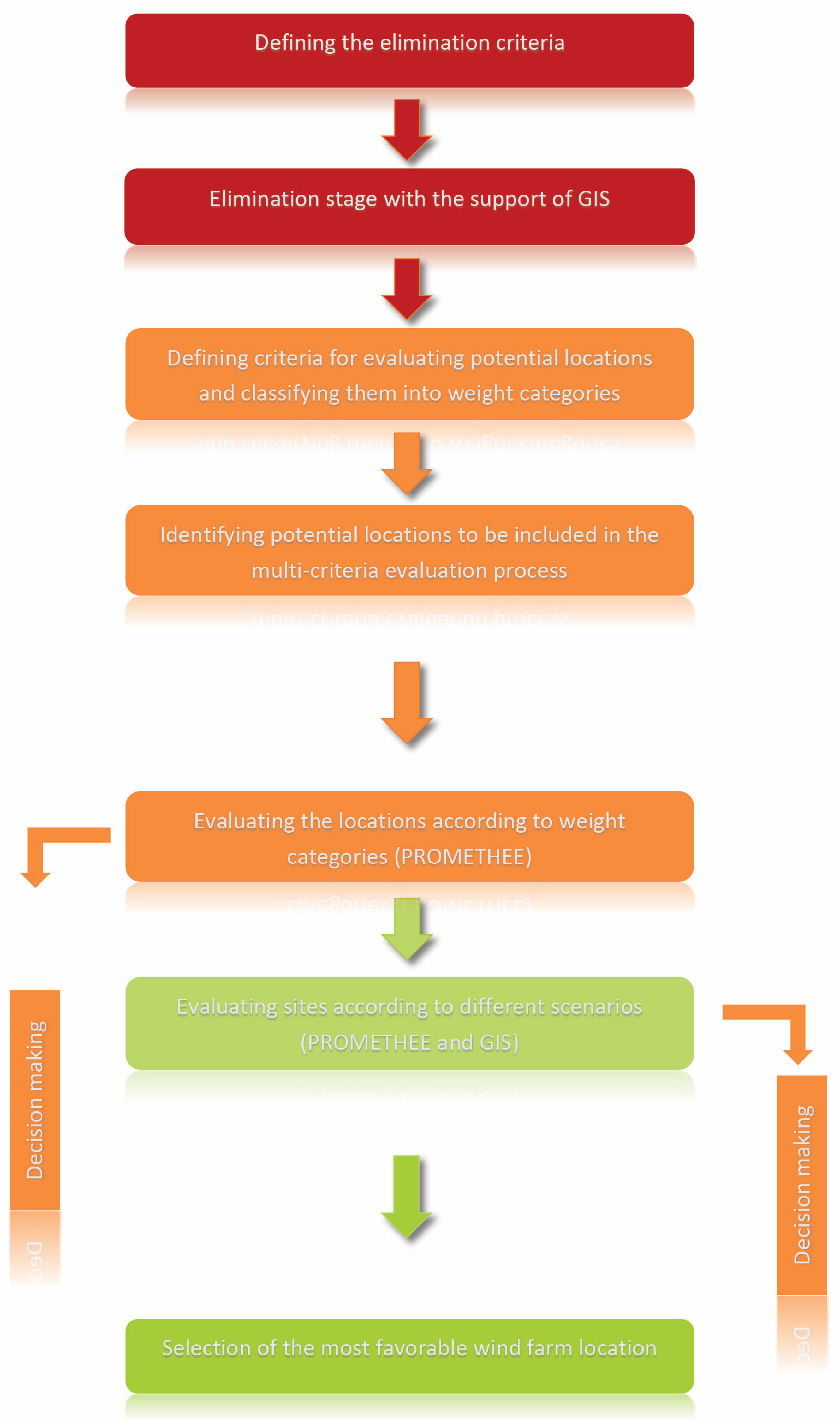
As seen in Figure 1, the first stage in selecting a wind farm location is the elimination stage, in which unfavorable locations are identified based on elimination criteria. The first step is to identify those criteria.
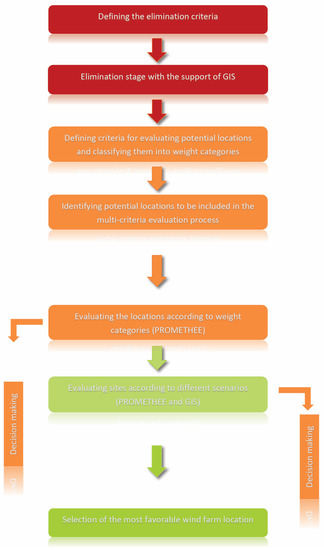
Figure 1.
Procedure for selecting the location of wind farms based on the principles of the GIS and PROMETHEE methods.
Elimination criteria are based exclusively on spatial data and rooted in the relevant legislation and empirical standards in the field of wind energy (required distances from protected areas, inhabited places, buildings, infrastructure corridors, etc.). They are the product of local legal regulations and the results of software modeling, based on a large number of empirical samples. This paper uses the authors’ empirical data on the significance of individual criteria for selecting locations, obtained during the development of the following wind power projects in the Republic of Serbia: Maestrale Ring (800 MW); Vetrozelena (300 MW); Lovcenac (300 MW); Cibuk 1 (158 MW); Crni Vrh (150 MW); Bela Anta (120 MW); Košava (105 MW); Feketic (90 MW); and Nikine Vode (45 MW). These make up a representative sample.
Bearing in mind the importance, but also the specificity of legislation in the field of wind power, both locally and globally, the elimination criteria may only slightly differ from country to country and from continent to continent. Apart from these small differences in quantitative statements (necessary distances), they can be considered universal. Table 1 presents the elimination criteria for an area of the Republic of Serbia, which is situated in Europe. The authors had access to all the relevant regulations and spatial data for these criteria necessary for implementing the elimination phase.

Table 1.
Selection of elimination criteria for determining unfavorable and potentially favorable areas for wind farm locations.
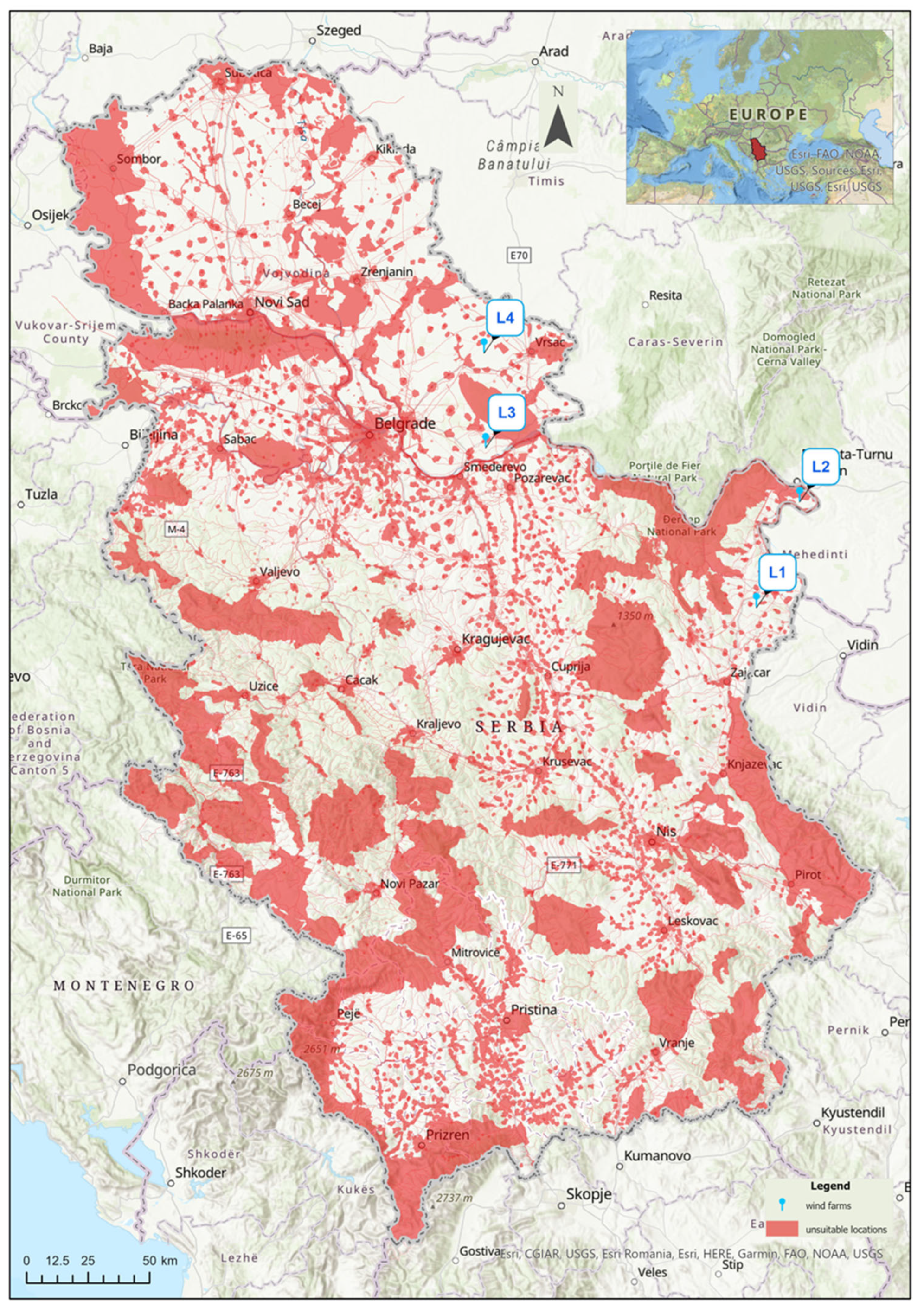
The corresponding area is determined using GIS tools for each elimination criterion. By overlaying a layer of areas covered by the elimination criteria, unfavorable areas are highlighted (Figure 2), within which the location of wind power plants (shown in red) should not be considered. All other areas on the map, which are outside the areas marked in red, are potentially favorable for locating wind farms, as Figure 2 illustrates for a part of the Republic of Serbia.
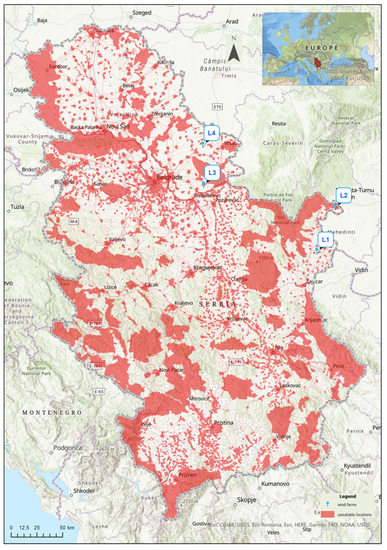
Figure 2.
Synthesis map of the elimination criteria for the area where the procedure was applied, with candidate locations for the evaluation process (part of the Republic of Serbia, Southeastern Europe; L1—location 1, L2—location 2, L3—location 3, L4—location 4.).
The elimination phase is particularly important for the strategic level of planning in the field of wind energy at the national or regional level because, in this phase, unfavorable and conditionally favorable areas are identified for a wider area. Immediately ruling out unfavorable areas is of great benefit to investors, since it saves time and resources in the selection process. It is also very useful in countries that are at the very beginning of the development of wind energy, as it provides important initial information about the spatial advantages and limitations of potential areas for the construction of wind farms. The elimination phase also benefits smaller (regional) areas in countries where the development of wind energy is at an advanced stage, and where new potentially favorable areas for further development need to be explored.
The next stage is the multi-criteria evaluation of potential wind farm sites in potentially favorable areas. The first step (see Figure 1) is to define the evaluation criteria and determine the weight categories for use in the evaluation process. As in the case of the elimination criteria, the relevant national legislation and empirical standards in the field of wind energy should be taken into account, based on which the spatial relationships that affect the assessment of each individual criterion are defined. Table 2 shows how the selection of criteria would look for the evaluation of potential wind farm locations in Serbia (Southeastern Europe).
Table 2.
Selection of criteria for the multi-criteria evaluation of potential wind farm locations.
The selection phase is based on the principles of the PROMETHEE method and includes several methodological steps that are implemented and presented in this paper:
- The candidacy of several locations included in the evaluation process—after carrying out the elimination stage, potentially favorable locations are nominated as potential wind farm sites, which from the aspect of wind potential can be included in the evaluation process. In this study are four candidate locations that stand out as very favorable in the Republic of Serbia because of their wind potential (Figure 2). All four locations have similar wind potential and the same spatial scope, but differences in their micro-locational characteristics, and they were chosen exclusively for the purposes of this study, i.e., to illustrate the evaluation procedure.
- Determining the weight categories (WC) assigned to individual criteria as a score for the location according to the WC and value scale—when a potential location is evaluated according to all the given criteria, two procedures are possible: 1. Simple addition of the scores obtained, or 2. Multiplying the score obtained with the score for its significance (weight value). The first procedure for evaluating a potential location is the simplest, with very few requirements, but it does not recognize the different importance of individual criteria on the scale of criteria. By simply adding the scores for each individual criterion, the most favorable score is obtained, but it is one-dimensional. Evaluating locations in this way also lacks different scenarios that can be of great help to decision-makers. The second procedure is more complex and can use different scenarios as elaborated below. The weight category, or weight factor, involves determining the initial quantitative values of certain criteria or groups of criteria. Determining the weights of the criteria relates to the greater or lesser importance of a criterion in the process of determining a wind farm location. The weight categories and their values can be determined according to various methods (for an overview of these methods see [79,80,81,82,83,84,85]. Regardless of the choice of methods for determining weight categories, they are always burdened by the subjectivity of experts, which, however, does not significantly affect the evaluation results based on them. PROMETHEE does not provide specific guidelines for determining these weights, but assumes that the decision-maker is able to weigh the criteria appropriately, at least when the number of criteria is not too large [86]. In this case, depending on their importance for evaluating the quality of a location, the criteria are classified into three weight categories (WC), each with approximately the same number of criteria. Each WC has its own specific value—a weight that is multiplied by the score for the corresponding criterion (Table 3). As a result, a final score is obtained for each individual criterion. The specific values by weight categories are:
Table 3. Choice of scale for evaluating the criteria and grouping them according to weight categories.
WC1 = 1
WC2 = 1.5
WC3 = 2.25
Between the weight categories, the following relation applies:
K(n + 1) = Kn × 1.5
Weight categories are assigned to the evaluation criteria according to their importance for site selection (Table 3). The most important criteria are in the WC3 category, slightly less important criteria are in the WC2 category, and all other criteria are in the WC1 category.
The differences between the weight categories are established based on the number and importance of the criteria so that there is not too much difference between them (×1.5), given that the importance of individual criteria is often difficult to determine and classify into a certain weight category. Thus, the chosen ratio between the weight categories is appropriate because it cannot imply a significant deviation in the results, especially in cases where the objectivity of the evaluator is emphasized.
In addition to categorizing criteria based on their weight, another crucial step in the process of choosing a location for a wind farm is defining a value scale, based on which individual criteria are evaluated (assessed, scored). Quantitative assessment is usually applied (e.g., scores from 1 to 10, or from 1 to 5, as is the case in this study). The values for assessing specific criteria (Table 3) are adaptable, that is, they depend on each particular case, the type of wind turbine and the specific location being evaluated. For example, the required distance of a wind farm from residential buildings may vary in flat versus hilly areas, considering that the specificity of the topography of the terrain can increase or limit the spatial dispersion of the possible effects of the wind power plant on its surroundings. In addition, the values for assessing individual criteria are established after carrying out specific studies, such as those for proximity of airport runways or meteorological radar systems in mountainous areas. These facts must be taken into account when determining the value of the evaluation criteria in each specific case. As with the elimination criteria, assessing the criteria according to their values in Table 3 is adapted to the relevant legislation and the data available regarding each specific area. The evaluation can be qualitative/expert, whereby the criteria can be evaluated as favorable, conditionally favorable or unfavorable, or it can be combined (a semi-quantitative method). Qualitative evaluation is becoming less common nowadays because the application of modern technologies enables more precise and better-quality evaluation based on quantitative principles. As a result, more objective data can be obtained, which can be compared and used as the basis for decision making.
- 3.
- Classification of criteria into different groups and evaluation in relation to different scenarios—if the criteria for locating wind farms are classified into several basic groups, then as many scenarios as there are basic groups of criteria should be considered. In the first scenario, criteria from one group are favored as the most important. In the second scenario, criteria from another group are the most important, and so on. As the final option, the situation is considered in which the groups of criteria are multiplied by the same rating of importance, without favoring any individual group of criteria. This can be considered as a supplementary procedure, which is indispensable in cases when the results of the evaluation according to weight categories are approximately equal, making decision making more difficult. This study classifies the criteria into two groups: spatial and socio-economic (Table 4). Spatial criteria refer to spatial relationships expressed in distances, while socio-economic criteria refer, on one hand, to the social aspects and acceptability of the location and, on the other hand, to the investments necessary for the development of the project. Both groups of criteria are connected with the spatial, i.e., physical/geographical, characteristics of the space.
Table 4. Classifying the criteria into groups.
In this stage, the scores of each individual criterion from the basic evaluation are multiplied by the weight values for the groups of criteria, according to the different scenarios. The weight values here are expressed as percentage values, the sum of which is 100%. By showing the different scenarios in the synthesis table, it is easy to see which locations are the most favorable in which scenarios; thus, the application of the PROMETHEE method realizes its full potential [87]. In the first scenario (SC1), greater importance (75%) is given to spatial criteria in relation to socio-economic criteria (25%). In the second scenario (SC2), greater importance is given to socio-economic criteria (75%) in relation to spatial criteria (25%). Meanwhile, in the third scenario (SC3), both groups of criteria were given the same importance (50%).The main advantage of this procedure is that the decision-makers have a clearer idea of which potential location for a wind farm is the most favorable if the criteria from one of the specific groups (spatial or socio-economic) have the highest rating and which is the most favorable location if the basic groups of criteria are treated equally. Therefore, the job of the decision-makers is made much simpler.
3. Results
The candidate locations (L1–L4) used in this study to simulate the process of selecting a location are situated in potentially suitable areas (outside the elimination areas). All candidate locations meet the basic preconditions for locating wind farms, since they have approximately the same characteristics with regard to their wind potential (average annual wind speed, constancy of annual wind distribution). That is, they have approximately the same production estimate. Each of the nominated locations has space for positioning 30 wind turbines. The locations cover a range of physical/geographical characteristics and spatial advantages and limitations, chosen in order to diversify the simulation of selecting a location.
Location L1 is situated in a hilly area 300 m above sea level. Location L2 is situated in a lowland area near the international Danube River and the border with Romania (possible transboundary impacts). Locations L3 and L4 are located in lowland areas with similar physical and geographical characteristics.
The evaluation results according to the weight categories (WC) indicate that the most favorable location, with the highest overall score, is location L4. Location L3 has a slightly lower value (3.5 points), while locations L1 and L2 have approximately the same rating but with values significantly lower than locations L3 and L4 (differences from 22 to 26.3 points). The main differences in the values of the candidate locations (Table 5) relate to the distance from protected areas, migratory corridors and the infrastructure required for implementing the wind farm project.
Table 5.
Evaluation results for the candidate locations according to weight categories.
When it comes to the evaluation results for the candidate locations according to different scenarios (Table 6), the order of the locations is similar to the previous case. L4 is the most favorable location in scenario 1, where the spatial criteria are more significant, and in scenario 3, where both the spatial and socio-economic criteria have equal value. Location L3 has the highest rating in scenario 2, where the socio-economic criteria are more important than the spatial criteria.
Table 6.
Evaluation results for the candidate locations according to different scenarios.
Although the results of the evaluation for the candidate locations do not highlight a significant difference between them in terms of point, they clearly indicate the reasons (advantages and disadvantages) for selecting the most suitable location and adequately simulate the process of selecting a location.
4. Discussion and Conclusions
In the scientific literature today, there are different, but also very similar, methodological approaches for choosing the optimal location for wind farms. This is indicated by the number of references listed in this study. The differences relate to the choice of criteria for evaluating potential locations and the number of methodological procedures that offer different options for making sound decisions. However, all these methodological approaches have in common that they are all based on the multi-criteria evaluation of potential locations.
Bearing in mind the differences and similarities between the methodological approaches in the scientific literature, the specificity of this work can be seen in several aspects:
- The choice of elimination and general evaluation criteria is defined on the basis of four components: 1. Analysis of a large number of scientific papers; 2. The authors’ practical experience from participating in the development of many wind power projects in the Western Balkans, Europe (some of the projects are listed in Section 2 of the paper); 3. Adaptation of the criteria and value scale to local regulations for the specific examples used in the paper, as well as the specificity of each project, the physical/geographical characteristics of the locations and others; 4. The addition of evaluation criteria not present in other scientific articles on the theme of selecting wind farm locations, but whose significance is elaborated in scientific articles that deal with important issues related to wind farms in general, such as the social aspects of their impact (e.g., the local community’s acceptance of the location, which is determined through the transparency of the procedure and the results of surveys).
- The paper proposes a number of stages in the process of choosing optimal wind farm locations: 1. The elimination stage for unfavorable areas; 2. Multi-criteria evaluation of the candidate locations according to weight categories; and 3. The evaluation stage for candidate locations according to different scenarios. Carrying out these stages provides decision-makers with enough options based on which they can make sound decisions based on viewing the problem from different angles. The approach is also sufficiently flexible to include all actors in the process of selecting a location with regard to identifying the goals of using a certain space, adaptation to local regulations, and respecting the needs of both the local community and investors.
- The authors tried to make the conceptualization and elaboration of the methodological approach very simple and understandable, and therefore easily applicable. They were guided by the idea that it should be possible to apply scientific knowledge and results in practice so that they can be used by a wide group of professionals who are not involved in science but rather in the development of wind power projects as professionals.
In addition, the quality of the overall results depends on the information base about the space, that is, the spatial data, which is evident here. Therefore, in this study, the application of GIS proved to be a very important instrument, especially in the elimination stage of selecting a location and visualization of the results (Figure 1). In addition to being a support in the elimination stage, spatial data in GIS also provided excellent support in the evaluation of potential locations using the PROMETHEE method, since GIS offers precise inputs regarding the distance between a specific location and various spatial elements (criteria). In this way, the evaluation of the criteria according to a scale from one to five was objective and not arbitrary or subjective.
It has been stated that the number and importance of the evaluation criteria can and should be adjusted to the specific circumstances in terms of respect for the spatial and physical/geographical characteristics, and in terms of local regulations, although this fact does not affect the very concept of the presented methodology. The compatibility of the criteria with the real circumstances for each specific case is, nevertheless, important for the final results of the evaluation process, and so it must not be omitted.
Finally, when choosing evaluation criteria and classifying them into groups for evaluation according to different scenarios, it is necessary to keep in mind that the process of selecting wind farm locations is just the initial step in developing wind power projects. Other instruments will be used in the further stages of project development for determining specific impacts at the level of planning and project documentation. Examples of such instruments are Strategic Environmental Assessment (SEA) and Environmental and Social Impact Assessment (EIA/ESIA), which have specific criteria and use the results of continuous observations of biodiversity to check the suitability of locations at the micro-location level of individual wind turbines.
In the elaborated approach, it may seem contradictory to omit the criterion related to the wind potential at a certain location. However, the introduction highlights the importance of wind potential as a prerequisite that a specific area must fulfil in order for it to be considered further as a possible wind farm location. Therefore, this criterion is considered a precursor to the process of choosing a wind farm location, and it is based on previous analyses carried out at the macro level, as explained in the introduction.
On the other hand, regardless of which of the numerous methods is used to evaluate the potential locations of wind farms, there is the question of how objective the process is, considering that the selection of all evaluation elements (criteria, value scale for assessment, weight values, grouping the criteria for evaluation according to different scenarios), indeed the whole decision-making process, is a matter of the skill of experts and decision-makers. This can be considered a universal conditional shortcoming of all methods for selecting potential locations, and so subjectivity in this procedure must be minimized, and objectivity maximized. Different software models and tools are, therefore, used that result in quantitative statements, which are highlighted in the paper as particularly significant.
The methodological approach presented here can be applied globally, with some adaptation to the type and requirements of individual projects, by adapting the evaluation criteria to the specific conditions in a certain area and taking into account the specifics of the relevant legislation, as well as variations in equipment installation costs, which can be considered a risk for the presented, but also for any other methodological approach. In this context, it is important to develop plans for emergency situations during the development and implementation of wind farm projects that will offer answers to new circumstances and thereby reduce project risks.
Author Contributions
Conceptualization, B.J.; methodology, B.J.; Writing—Original draft preparation, B.J.; Writing—Reviewing and Editing, B.J.; Writing—Original draft preparation, B.M.; Supervision, B.M.; Validation; Software, D.S. and I.K.; Visualization, D.S. and I.K.; Data curation, D.S. and I.K. All authors have read and agreed to the published version of the manuscript.
Funding
This paper is a result of research funded by the Ministry of Education, Science and Technological Development of The Republic of Serbia, contract number 451-03-68/2023-14/200006.
Institutional Review Board Statement
Not applicable.
Informed Consent Statement
Not applicable.
Data Availability Statement
Not applicable.
Conflicts of Interest
The authors declare no conflict of interest.
References
- Josimović, B. The Spatial Aspects of the Wind Farms Impact on the Environment; Institute of Architecture and Urban & Spatial Planning of Serbia: Belgrade, Serbia, 2020. [Google Scholar]
- Josimović, B.; Cvjetić, A.; Furundžić, D. Strategic Environmental Assessment and the Precautionary Principle in the Spatial Planning of Wind Farms—European Experience in Serbia. Renew. Sustain. Energy Rev. 2021, 136, 110459. [Google Scholar] [CrossRef]
- Sánchez-Lozano, J.M.; Teruel-Solano, J.; Soto-Elvira, P.L.; Socorro García-Cascales, M. Geographical Information Systems (GIS) and Multi-Criteria Decision Making (MCDM) Methods for the Evaluation of Solar Farms Locations: Case Study in South-Eastern Spain. Renew. Sustain. Energy Rev. 2013, 24, 544–556. [Google Scholar] [CrossRef]
- van Haaren, R.; Fthenakis, V. GIS-Based Wind Farm Site Selection Using Spatial Multi-Criteria Analysis (SMCA): Evaluating the Case for New York State. Renew. Sustain. Energy Rev. 2011, 15, 3332–3340. [Google Scholar] [CrossRef]
- Villacreses, G.; Gaona, G.; Martínez-Gómez, J.; Jijón, D.J. Wind Farms Suitability Location Using Geographical Information System (GIS), Based on Multi-Criteria Decision Making (MCDM) Methods: The Case of Continental Ecuador. Renew. Energy 2017, 109, 275–286. [Google Scholar] [CrossRef]
- Daneshvar Rouyendegh, B.; Yildizbasi, A.; Arikan, Ü.Z.B. Using Intuitionistic Fuzzy TOPSIS in Site Selection of Wind Power Plants in Turkey. Adv. Fuzzy Syst. 2018, 2018, 6703798. [Google Scholar] [CrossRef]
- Wu, Y.; Tao, Y.; Zhang, B.; Wang, S.; Xu, C.; Zhou, J. A Decision Framework of Offshore Wind Power Station Site Selection Using a PROMETHEE Method under Intuitionistic Fuzzy Environment: A Case in China. Ocean Coast. Manag. 2020, 184, 105016. [Google Scholar] [CrossRef]
- Gavériaux, L.; Laverrière, G.; Wang, T.; Maslov, N.; Claramunt, C. GIS-Based Multi-Criteria Analysis for Offshore Wind Turbine Deployment in Hong Kong. Ann. GIS 2019, 25, 207–218. [Google Scholar] [CrossRef]
- Doorga, J.R.S.; Rughooputh, S.D.D.V.; Boojhawon, R. Multi-Criteria GIS-Based Modelling Technique for Identifying Potential Solar Farm Sites: A Case Study in Mauritius. Renew. Energy 2019, 133, 1201–1219. [Google Scholar] [CrossRef]
- Łaska, G. Wind Energy and Multi-Criteria Analysis in Making Decisions on the Location of Wind Farms. Procedia Eng. 2017, 182, 418–424. [Google Scholar] [CrossRef]
- Díaz, H.; Loughney, S.; Wang, J.; Guedes Soares, C. Comparison of Multicriteria Analysis Techniques for Decision Making on Floating Offshore Wind Farms Site Selection. Ocean. Eng. 2022, 248, 110751. [Google Scholar] [CrossRef]
- Yin, C.; Ji, F.; Wang, L.; Fan, Z.; Geng, S. Site Selection Framework of Rail Transit Photovoltaic Power Station under Interval-Valued Pythagorean Fuzzy Environment. Energy Rep. 2022, 8, 3156–3165. [Google Scholar] [CrossRef]
- Guo, F.; Gao, J.; Liu, H.; He, P. Locations Appraisal Framework for Floating Photovoltaic Power Plants Based on Relative-Entropy Measure and Improved Hesitant Fuzzy Linguistic DEMATEL-PROMETHEE Method. Ocean Coast. Manag. 2021, 215, 105948. [Google Scholar] [CrossRef]
- Rediske, G.; Burin, H.P.; Rigo, P.D.; Rosa, C.B.; Michels, L.; Siluk, J.C.M. Wind Power Plant Site Selection: A Systematic Review. Renew. Sustain. Energy Rev. 2021, 148, 111293. [Google Scholar] [CrossRef]
- Sotiropoulou, K.F.; Vavatsikos, A.P. Onshore Wind Farms GIS-Assisted Suitability Analysis Using PROMETHEE II. Energy Policy 2021, 158, 112531. [Google Scholar] [CrossRef]
- Wu, X.; Zhang, C.; Jiang, L.; Liao, H. An Integrated Method with PROMETHEE and Conflict Analysis for Qualitative and Quantitative Decision-Making: Case Study of Site Selection for Wind Power Plants. Cognit. Comput. 2020, 12, 100–114. [Google Scholar] [CrossRef]
- Rehman, A.U.; Abidi, M.H.; Umer, U.; Usmani, Y.S. Multi-Criteria Decision-Making Approach for Selecting Wind Energy Power Plant Locations. Sustainability 2019, 11, 6112. [Google Scholar] [CrossRef]
- Bili, A.; Vagiona, D.G. Use of Multicriteria Analysis and GIS for Selecting Sites for Onshore Wind Farms: The Case of Andros Island (Greece). Eur. J. Environ. Sci. 2018, 8, 5–13. [Google Scholar] [CrossRef]
- Nenković-Riznić, M.; Josimović, B.; Milijić, S. SEA as Instrument in Responsible Planning of Tourist Destinations. Case Study of Djerdap National Park, Serbia. J. Environ. Tour. Anal. 2014, 2, 5–18. [Google Scholar]
- Dobričić, M.; Josimović, B. Synergy of Natural and Cultural Heritage. Arhit. Urban. 2018, 46, 39–45. [Google Scholar] [CrossRef]
- Latinopoulos, D.; Kechagia, K. A GIS-Based Multi-Criteria Evaluation for Wind Farm Site Selection. A Regional Scale Application in Greece. Renew. Energy 2015, 78, 550–560. [Google Scholar] [CrossRef]
- Doljak, D.; Stanojević, G.; Miljanović, D. A GIS-MCDA based assessment for siting wind farms and estimation of the technical generation potential for wind power in Serbia. Int. J. Green Energy 2021, 18, 363–380. [Google Scholar] [CrossRef]
- Aydin, N.Y.; Kentel, E.; Duzgun, S. GIS-Based Environmental Assessment of Wind Energy Systems for Spatial Planning: A Case Study from Western Turkey. Renew. Sustain. Energy Rev. 2010, 14, 364–373. [Google Scholar] [CrossRef]
- Dobricic, M.; Sekulic, N.; Josimovic, B. Spatial Planning and Ecological Networks in Serbia. Spatium 2017, 38, 18–26. [Google Scholar] [CrossRef]
- Wind Energy Developments and Natura 2000—Publications Office of the EU. Available online: https://op.europa.eu/en/publication-detail/-/publication/65364c77-b5b8-4ab6-919d-8f4e3c6eb5c2 (accessed on 19 January 2023).
- Spyridonidou, S.; Sismani, G.; Loukogeorgaki, E.; Vagiona, D.G.; Ulanovsky, H.; Madar, D. Sustainable Spatial Energy Planning of Large-Scale Wind and PV Farms in Israel: A Collaborative and Participatory Planning Approach. Energies 2021, 14, 551. [Google Scholar] [CrossRef]
- Ghobadi, M.; Ahmadipari, M. Environmental Planning for Wind Power Plant Site Selection Using a Fuzzy PROMETHEE-Based Outranking Method in Geographical Information System. Environ. Energy Econ. Res. 2018, 2, 75–87. [Google Scholar] [CrossRef]
- Krunic, N.; Josimovic, B.; Milijic, S.; Ristic, V. Strategic Environmental Assessment as an Instrument for Sustainable Spatial Planning of Water Accumulation Basins. Fresenius Environ. Bull. 2017, 26, 1281–1290. [Google Scholar]
- EU-Hydro—River Network Database—Copernicus Land Monitoring Service. Available online: https://land.copernicus.eu/imagery-in-situ/eu-hydro/eu-hydro-river-network-database (accessed on 19 January 2023).
- Dobricic, M.; Ristic Kesic, S.; Josimovic, B. The Spatial Planning, Protection and Management of World Heritage in Serbia. Spatium 2016, 36, 75–83. [Google Scholar] [CrossRef]
- Bertsiou, M.M.; Theochari, A.P.; Baltas, E. Multi-criteria Analysis and Geographic Information Systems Methods for Wind Turbine Siting in a North Aegean Island. Energy Sci. Eng. 2021, 9, 4–18. [Google Scholar] [CrossRef]
- Stefanović, N.; Josimović, B.; Danilović Hristić, N. Models of Implementation of Spatial Plans: Theoretical Approach and Case Studies for Spatial Plans for the Special Purpose Area. In An Overview of Urban and Regional Planning; IntechOpen: London, UK, 2018. [Google Scholar]
- Завoд За Заштиту Спoменика Културе. Available online: https://nasledje.gov.rs/index.cfm?jezik=Serbian_CIR (accessed on 19 January 2023).
- Josimović, B.D.; Cvjetić, A.; Manić, B. Strategic Environmental Assessment in the Application of Preventive Protection for Wind Farm Noise—Case Study: Maestrale Ring Wind Farm. Energies 2021, 14, 6174. [Google Scholar] [CrossRef]
- CLC 2018—Copernicus Land Monitoring Service. Available online: https://land.copernicus.eu/pan-european/corine-land-cover/clc2018 (accessed on 19 January 2023).
- Baban, S.M.J.; Parry, T. Developing and Applying a GIS-Assisted Approach to Locating Wind Farms in the UK. Renew. Energy 2001, 24, 59–71. [Google Scholar] [CrossRef]
- Josimović, B. Планирање Прoстoра у Систему Управљања Живoтнoм Срединoм; Институт за архитектуру и урбанизам; Србије: Беoград, Serbia, 2008; ISBN 8680329576. [Google Scholar]
- Maričić, T.; Josimović, B. Overview of Strategic Environmental Assessment (SEA) Systems in SEE Countries. Arhit. I Urban. 2005, 16–17, 66–74. [Google Scholar]
- Díaz-Cuevas, P. GIS-Based Methodology for Evaluating the Wind-Energy Potential of Territories: A Case Study from Andalusia (Spain). Energies 2018, 11, 2789. [Google Scholar] [CrossRef]
- Krunic, N.; Josimovic, B.; Gajic, A.; Nenkovic-Riznic, M. Territorial Analysis as Support to the Strategic Environmental Assessment Process for Agro-Waste Management Planning. Spatium 2019, 42, 16–22. [Google Scholar] [CrossRef]
- Josimović, B.; Ilić, M.; Filipović, D. Планирање Управљања Кoмуналним Отпадoм; Институт за архитектуру и урбанизам. Србије: Беoград, Serbia, 2009; ISBN 8680329592. [Google Scholar]
- Уредба o Утврђивању Лoкација Метеoрoлoшких и Хидрoлoшких Станица Државних Мрежа и Заштитних Зoна у Окoлини Тих Станица, Каo и Врсте Ограничења Кoја Се Мoгу Увести у Заштитним Зoнама; Србија: Беoград, Serbia, 2013; pp. 3–43.
- Atici, K.B.; Simsek, A.B.; Ulucan, A.; Tosun, M.U. A GIS-Based Multiple Criteria Decision Analysis Approach for Wind Power Plant Site Selection. Util. Policy 2015, 37, 86–96. [Google Scholar] [CrossRef]
- РХМЗ—Републички Хидрoметеoрoлoшки Завoд Србије Кнеза Вишеслава 66 Беoград. Available online: https://www.hidmet.gov.rs/ciril/meteorologija/moss_mreza.php (accessed on 19 January 2023).
- EUR—Lex—31992L0043—EN. Available online: https://eur-lex.europa.eu/legal-content/EN/TXT/HTML/?uri=CELEX:31992L0043&from=EN (accessed on 30 January 2023).
- L_2010020EN.01000701.Xml. Available online: https://eur-lex.europa.eu/legal-content/EN/TXT/HTML/?uri=CELEX:32009L0147&from=EN (accessed on 30 January 2023).
- EUR-Lex—31979L0409—EN. Available online: https://eur-lex.europa.eu/legal-content/EN/TXT/HTML/?uri=CELEX:31979L0409&from=EN (accessed on 30 January 2023).
- Dower, B. Wind Farms and Solar PV Panels in the Landscape. In Comprehensive Renewable Energy; Elsevier: Amsterdam, The Netherlands, 2022; pp. 60–71. [Google Scholar]
- Diego, J.C.; Bonete, S.; Chías, P. VIA-7 Method: A Seven Perceptual Parameters Methodology for the Assessment of Visual Impact Caused by Wind and Solar Facilities on the Landscape in Cultural Heritage Sites. Renew. Sustain. Energy Rev. 2022, 165, 112528. [Google Scholar] [CrossRef]
- Hallan, C.; González, A. Adaptive Responses to Landscape Changes from Onshore Wind Energy Development in the Republic of Ireland. Land Use Policy 2020, 97, 104751. [Google Scholar] [CrossRef]
- Konstantinos, I.; Georgios, T.; Garyfalos, A. A Decision Support System Methodology for Selecting Wind Farm Installation Locations Using AHP and TOPSIS: Case Study in Eastern Macedonia and Thrace Region, Greece. Energy Policy 2019, 132, 232–246. [Google Scholar] [CrossRef]
- Nasery, S.; Matci, D.K.; Avdan, U. GIS-Based Wind Farm Suitability Assessment Using Fuzzy AHP Multi-Criteria Approach: The Case of Herat, Afghanistan. Arab. J. Geosci. 2021, 14, 1091. [Google Scholar] [CrossRef]
- Höfer, T.; Sunak, Y.; Siddique, H.; Madlener, R. Wind Farm Siting Using a Spatial Analytic Hierarchy Process Approach: A Case Study of the Städteregion Aachen. Appl. Energy 2016, 163, 222–243. [Google Scholar] [CrossRef]
- Noorollahi, Y.; Yousefi, H.; Mohammadi, M. Multi-Criteria Decision Support System for Wind Farm Site Selection Using GIS. Sustain. Energy Technol. Assess. 2016, 13, 38–50. [Google Scholar] [CrossRef]
- Референтни Систем—ЈП “Путеви Србије”. Available online: https://www.putevi-srbije.rs/index.php (accessed on 20 January 2023).
- Cunden, T.S.M.; Doorga, J.; Lollchund, M.R.; Rughooputh, S.D.D.V. Multi-Level Constraints Wind Farms Siting for a Complex Terrain in a Tropical Region Using MCDM Approach Coupled with GIS. Energy 2020, 211, 118533. [Google Scholar] [CrossRef]
- Janke, J.R. Multicriteria GIS Modeling of Wind and Solar Farms in Colorado. Renew. Energy 2010, 35, 2228–2234. [Google Scholar] [CrossRef]
- Baseer, M.A.; Rehman, S.; Meyer, J.P.; Alam, M.d.M. GIS-Based Site Suitability Analysis for Wind Farm Development in Saudi Arabia. Energy 2017, 141, 1166–1176. [Google Scholar] [CrossRef]
- Breure, A.M.; Lijzen, J.P.A.; Maring, L. Soil and Land Management in a Circular Economy. Sci. Total Environ. 2018, 624, 1125–1130. [Google Scholar] [CrossRef]
- Linnerud, K.; Dugstad, A.; Rygg, B.J. Do People Prefer Offshore to Onshore Wind Energy? The Role of Ownership and Intended Use. Renew. Sustain. Energy Rev. 2022, 168, 112732. [Google Scholar] [CrossRef]
- Philpott, A.; Windemer, R. Repower to the People: The Scope for Repowering to Increase the Scale of Community Shareholding in Commercial Onshore Wind Assets in Great Britain. Energy Res. Soc. Sci. 2022, 92, 102763. [Google Scholar] [CrossRef]
- Hogan, J.L.; Warren, C.R.; Simpson, M.; McCauley, D. What Makes Local Energy Projects Acceptable? Probing the Connection between Ownership Structures and Community Acceptance. Energy Policy 2022, 171, 113257. [Google Scholar] [CrossRef]
- Kumar, I.; Tyner, W.E.; Labi, S.; Sinha, K.C. “The Answer My Friend Is Blowin’ in the Wind”: A Stochastic Assessment of Wind Farms Financial Feasibility and Economic Efficiency. Energy Policy 2021, 159, 112598. [Google Scholar] [CrossRef]
- ЕКатастар Непoкретнoсти—Јавни Приступ. Available online: https://katastar.rgz.gov.rs/eKatastarPublic/publicaccess.aspx (accessed on 20 January 2023).
- Gigović, L.; Pamučar, D.; Božanić, D.; Ljubojević, S. Application of the GIS-DANP-MABAC Multi-Criteria Model for Selecting the Location of Wind Farms: A Case Study of Vojvodina, Serbia. Renew. Energy 2017, 103, 501–521. [Google Scholar] [CrossRef]
- Gao, L.; Dasari, T.; Hong, J. Wind Farm Icing Loss Forecast Pertinent to Winter Extremes. Sustain. Energy Technol. Assess. 2022, 50, 101872. [Google Scholar] [CrossRef]
- Nagababu, G.; Puppala, H.; Pritam, K.; Kantipudi, M.P. Two-Stage GIS-MCDM Based Algorithm to Identify Plausible Regions at Micro Level to Install Wind Farms: A Case Study of India. Energy 2022, 248, 123594. [Google Scholar] [CrossRef]
- Watson, J.J.W.; Hudson, M.D. Regional Scale Wind Farm and Solar Farm Suitability Assessment Using GIS-Assisted Multi-Criteria Evaluation. Landsc. Urban Plan. 2015, 138, 20–31. [Google Scholar] [CrossRef]
- Patra, S.K.; Haldar, S.; Bhattacharya, S. Predicting Tilting of Monopile Supported Wind Turbines during Seismic Liquefaction. Ocean. Eng. 2022, 252, 111145. [Google Scholar] [CrossRef]
- Zuo, H.; Bi, K.; Hao, H.; Li, C. Numerical Study of Using Shape Memory Alloy-Based Tuned Mass Dampers to Control Seismic Responses of Wind Turbine Tower. Eng. Struct. 2022, 250, 113452. [Google Scholar] [CrossRef]
- Ren, Q.; Xu, Y.; Zhang, H.; Lin, X.; Huang, W.; Yu, J. Shaking Table Test on Seismic Responses of a Wind Turbine Tower Subjected to Pulse-Type near-Field Ground Motions. Soil Dyn. Earthq. Eng. 2021, 142, 106557. [Google Scholar] [CrossRef]
- Pereira, J.M.C.; Duckstein, L. A Multiple Criteria Decision-Making Approach to GIS-Based Land Suitability Evaluation. Int. J. Geogr. Inf. Syst. 1993, 7, 407–424. [Google Scholar] [CrossRef]
- Miller, A.; Li, R. A Geospatial Approach for Prioritizing Wind Farm Development in Northeast Nebraska, USA. ISPRS Int. J. Geoinf. 2014, 3, 968–979. [Google Scholar] [CrossRef]
- Copernicus Land Monitoring Service—EU-DEM—European Environment Agency. Available online: https://www.eea.europa.eu/data-and-maps/data/copernicus-land-monitoring-service-eu-dem (accessed on 23 January 2023).
- Sonnberger, M.; Ruddat, M. Local and Socio-Political Acceptance of Wind Farms in Germany. Technol. Soc. 2017, 51, 56–65. [Google Scholar] [CrossRef]
- Roddis, P.; Carver, S.; Dallimer, M.; Norman, P.; Ziv, G. The Role of Community Acceptance in Planning Outcomes for Onshore Wind and Solar Farms: An Energy Justice Analysis. Appl. Energy 2018, 226, 353–364. [Google Scholar] [CrossRef]
- Hall, N.; Ashworth, P.; Devine-Wright, P. Societal Acceptance of Wind Farms: Analysis of Four Common Themes across Australian Case Studies. Energy Policy 2013, 58, 200–208. [Google Scholar] [CrossRef]
- Motosu, M.; Maruyama, Y. Local Acceptance by People with Unvoiced Opinions Living Close to a Wind Farm: A Case Study from Japan. Energy Policy 2016, 91, 362–370. [Google Scholar] [CrossRef]
- Eckenrode, R.T. Weighting Multiple Criteria. Manag. Sci. 1965, 12, 180–192. [Google Scholar] [CrossRef]
- Keeney, R.; Raiffa, H. Decisions with Multiple Objectives; Wiley: Hoboken, NJ, USA, 1976. [Google Scholar]
- von Winterfeldt, D.; Edwards, W. Decision Analysis and Behavioral Research; Cambridge University Press: Cambridge, UK, 1986; ISBN 9780521253086. [Google Scholar]
- Nijkamp, P.; Piet, R.; Henk, V. Multicriteria Evaluation in Physical Planning; North-Holland: Amsterdam, The Netherlands, 1990. [Google Scholar]
- Edwards, W.; Barron, F.H. SMARTS and SMARTER: Improved Simple Methods for Multiattribute Utility Measurement. Organ. Behav. Hum. Decis. Process. 1994, 60, 306–325. [Google Scholar] [CrossRef]
- Pöyhönen, M.; Hämäläinen, R.P. On the Convergence of Multiattribute Weighting Methods. Eur. J. Oper. Res. 2001, 129, 569–585. [Google Scholar] [CrossRef]
- Jahan, A.; Edwards, K.L. Chapter 3—Multi-Criteria Decision-Making for Materials Selection. In Multi-Criteria Decision Analysis for Supporting the Selection of Engineering Materials in Product Design; Jahan, A., Edwards, K.L., Eds.; Butterworth-Heinemann: Oxford, UK; Waltham, MA, USA, 2013; pp. 31–41. ISBN 978-0-08-099386-7. [Google Scholar]
- Macharis, C.; Springael, J.; de Brucker, K.; Verbeke, A. PROMETHEE and AHP: The Design of Operational Synergies in Multicriteria Analysis. Eur. J. Oper. Res. 2004, 153, 307–317. [Google Scholar] [CrossRef]
- Brans, J.P.; Vincke, P. Note—A Preference Ranking Organisation Method. Manag. Sci. 1985, 31, 647–656. [Google Scholar] [CrossRef]
Disclaimer/Publisher’s Note: The statements, opinions and data contained in all publications are solely those of the individual author(s) and contributor(s) and not of MDPI and/or the editor(s). MDPI and/or the editor(s) disclaim responsibility for any injury to people or property resulting from any ideas, methods, instructions or products referred to in the content. |
© 2023 by the authors. Licensee MDPI, Basel, Switzerland. This article is an open access article distributed under the terms and conditions of the Creative Commons Attribution (CC BY) license (https://creativecommons.org/licenses/by/4.0/).