You are currently viewing a new version of our website. To view the old version click .
Applied Sciences
  • Article
  • Open Access

20 April 2023

Deep Learning-Assisted Transmit Antenna Classifiers for Fully Generalized Spatial Modulation: Online Efficiency Replaces Offline Complexity


and
Department of Communication Engineering, School of Electronics Engineering, Vellore Institute of Technology, Vellore 632014, Tamil Nadu, India
*
Author to whom correspondence should be addressed.
This article belongs to the Special Issue Recent Challenges and Solutions in Wireless Communication Engineering

Abstract

In this work, deep learning (DL)-based transmit antenna selection (TAS) strategies are employed to enhance the average bit error rate (ABER) and energy efficiency (EE) performance of a spectrally efficient fully generalized spatial modulation (FGSM) scheme. The Euclidean distance-based antenna selection (EDAS), a frequently employed TAS technique, has a high search complexity but offers optimal ABER performance. To address TAS with minimal complexity, we present DL-based approaches that reframe the traditional TAS problem as a classification learning problem. To reduce the energy consumption and latency of the system, we presented three DL architectures in this study, namely a feed-forward neural network (FNN), a recurrent neural network (RNN), and a 1D convolutional neural network (CNN). The proposed system can efficiently process and make predictions based on the new data with minimal latency, as DL-based modeling is a one-time procedure. In addition, the performance of the proposed DL strategies is compared to two other popular machine learning methods: support vector machine (SVM) and K-nearest neighbor (KNN). While comparing DL architectures with SVM on the same dataset, it is seen that the proposed FNN architecture offers a ~3.15% accuracy boost. The proposed FNN architecture achieves an improved signal-to-noise ratio (SNR) gain of ~2.2 dB over FGSM without TAS (FGSM-WTAS). All proposed DL techniques outperform FGSM-WTAS.

1. Introduction

The sixth-generation (6G) mobile communication system will be launched to fulfill unprecedented spectral efficiency (SE), energy efficiency (EE), massive connectivity, and latency demands that previous generations of networks could not meet [1,2,3]. These include a rise in connection density to 10 million devices per square kilometer, a doubling of SE to 100 b/s/Hz, and a notable decrease in latency to 0.1 ms.
In the past few years, several cutting-edge wireless communication technologies have been proposed, including index modulation (IM), intelligent reflecting surfaces (IRS), cognitive radio, multi-carrier modulation, and next-generation multiple access (NGMA). These technologies will eventually enable an increase in SE, improving quality of service (QoS), regardless of the wireless system used [4].
Wireless power transfer and simultaneous wireless information and power transfer are other effective ways to deliver energy to wireless receivers [5]. Cooperative and distributed multi-point transmissions can reduce the power requirement for dense cell-based communications. On the other hand, at the expense of increased latencies, relays and multi-hop transmissions can reduce power for long-distance communications. IRS configurations are presented and implemented in [6], where the results demonstrate that IRS improves the EE of the network. IM techniques can be incorporated to boost the network’s EE [1,5,7].
Massive multiple-input multiple-output (MIMO) is one of the methods used to enhance the SE in fifth-generation (5G) systems. A multi-antenna system leads to inter-antenna synchronization (IAS) and inter-channel interference (ICI) problems [7,8]. As the number of radio frequency (RF) chains grows, the hardware complexity of the system rises, leading to decreased EE. To address this issue, the idea of spatial modulation (SM) is presented [7]. In SM, a single antenna is operational at a time, which alleviates the burden on the RF chain. The SE of conventional SM is given as
ξ SM = log 2 N t + log 2 M ,
Here, N t and M are used to represent the number of transmitting antennas and the order of the modulation, respectively. SE is limited in the SM system since it grows logarithmically with the number of transmitting antennas utilized. Therefore, more transmit antennas are needed to improve SE. Future-generation networks necessitate advanced SM variants to achieve the target SE requirements [8,9,10,11,12]. Based on their operational concept, advanced SM variants can transmit the same or different symbols over many antennas. Fully generalized spatial modulation (FGSM) and fully quadrature spatial modulation (FQSM) are two novel variants of SM in which the number of antennas employed at the transmitter is altered from one to multiple or all. Thus, the theoretical SE grows linearly with transmit antennas [12].
Additionally, as SM only uses a single antenna, it cannot accomplish transmit diversity [13,14,15]. In order to increase the signal-to-noise ratio (SNR) gains, transmit antenna selection (TAS) techniques are employed in the SM [13,14,15]. The receiver chooses the transmitter antenna subsets according to the channel quality information (CQI). In recent years, deep learning (DL), a new artificial intelligence (AI) method, has demonstrated its potential benefits in multiple areas, including speech processing, natural language processing, and image processing. A wide range of DL applications are being explored in physical-layer communications, including channel estimation, signal detection, beam prediction, etc. [16]. In this work, TAS is performed on FGSM using distinct machine learning (ML) and deep learning (DL) algorithms, whose efficacy is evaluated through classification accuracy and average bit error rate (ABER).
The manuscript is structured as follows: Section 2 examines related works and research gaps. Section 3 discusses the paradigms of FGSM and the Euclidean distance-based antenna selection (EDAS) scheme. Section 4 addresses the numerous DL algorithms employed in this study to implement FGSM-TAS as well as the complexity analysis of all proposed and traditional EDAS approaches. Section 5 compares the ABER performance of FGSM without TAS (FGSM-WTAS) and EDAS with all other suggested ML and DL algorithms using Monte–Carlo simulations. Lastly, Section 6 summarizes the work and proposes some areas for further investigation.

3. System Model of FGSM and Traditional EDAS

3.1. FGSM

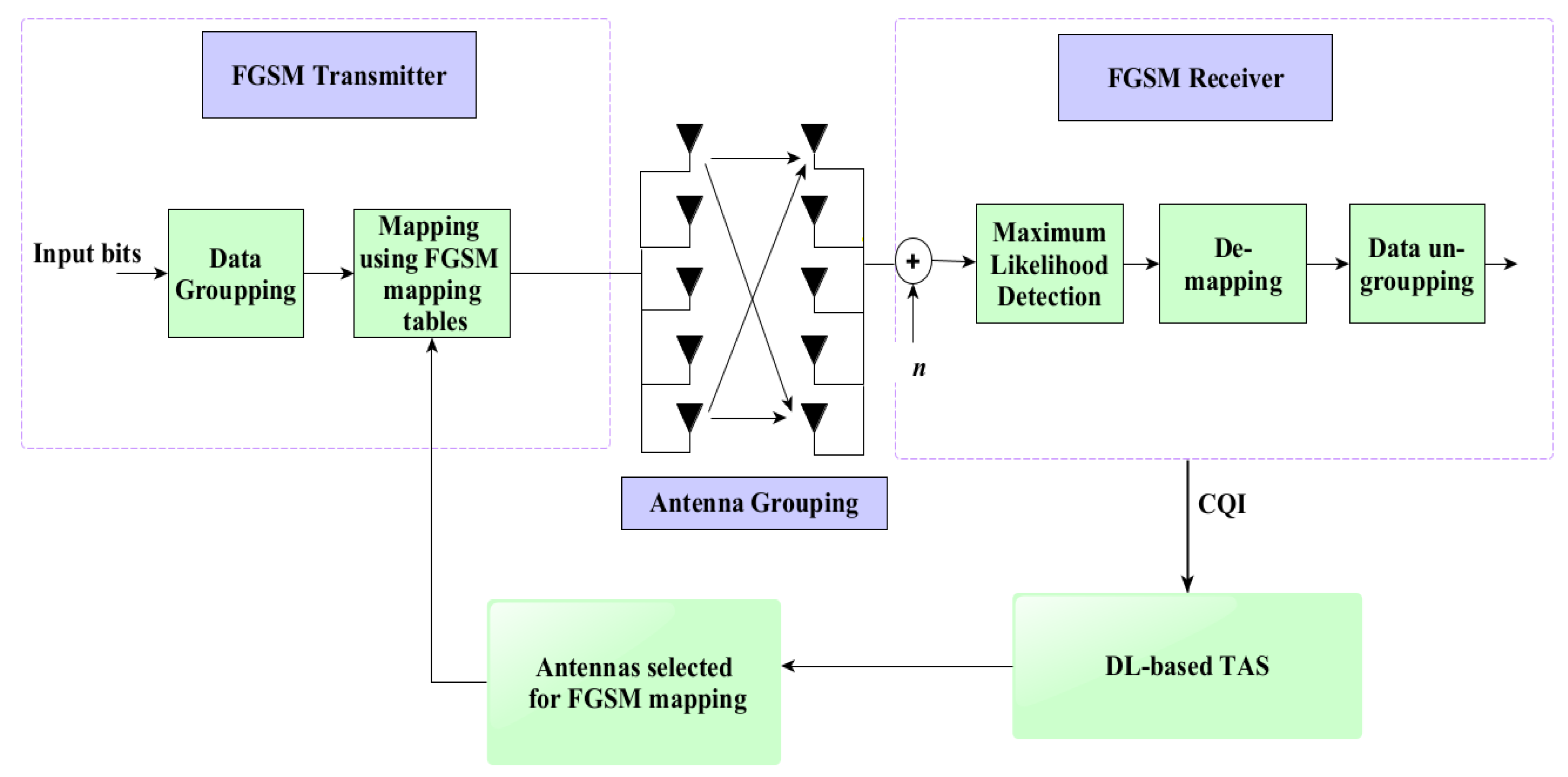
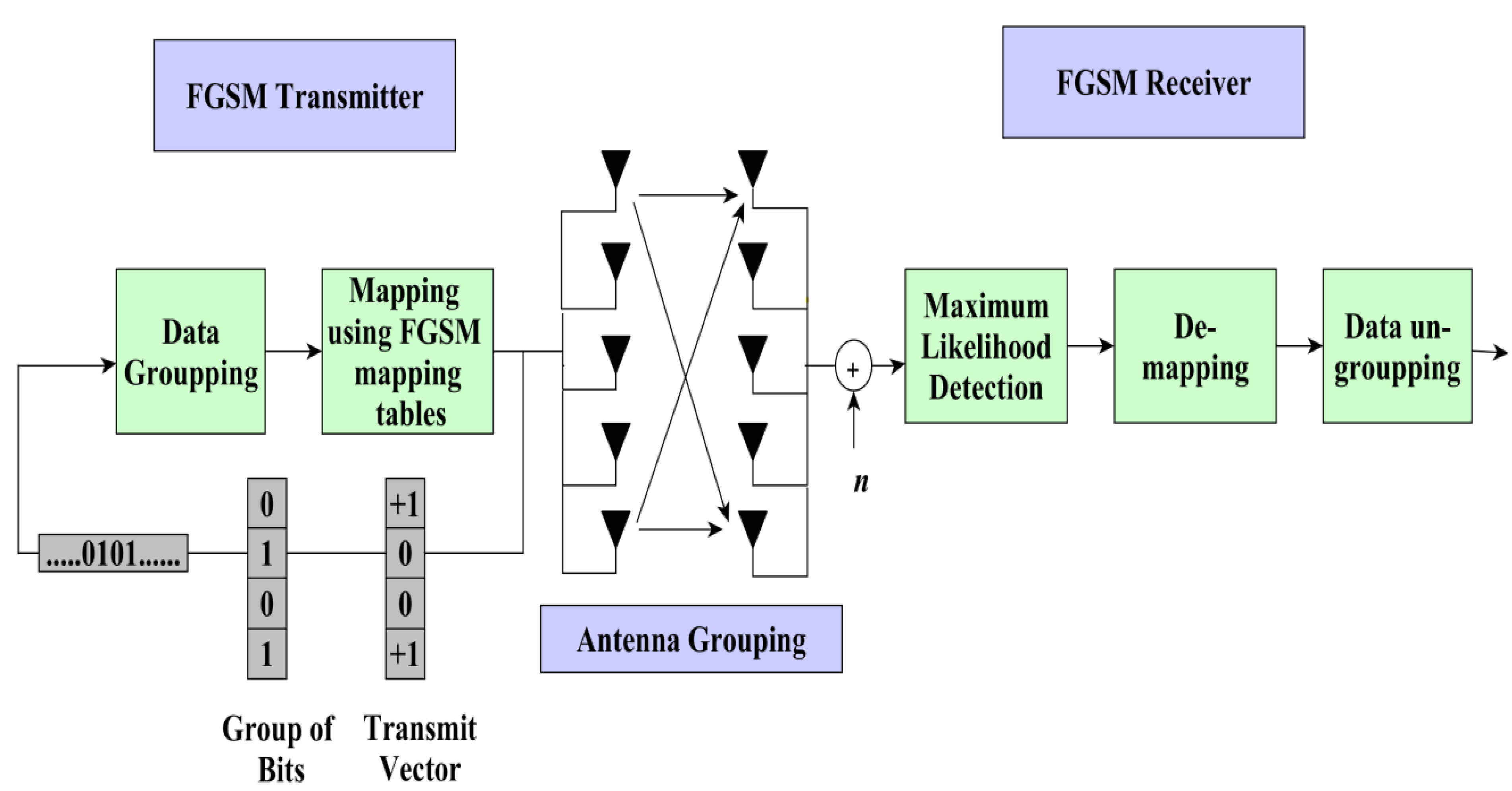
An advanced variant of SM called FGSM enables the simultaneous transmission of the same symbol by one, many, or all antennas. Figure 1 depicts a simplified block diagram of the FGSM system. The index for the active antenna subset and the associated symbol to be transmitted are chosen in response to the incoming group of bits. Later, the maximum likelihood detector is applied to the received signal vector. The transmitted group of bits are reconstructed by demapping the detected transmit antenna indices and their associated transmitted symbol.
Figure 1. Block diagram of FGSM system.
In comparison to the SM, the SE is linearly proportional to the number of transmitting antennas, which enhances the SE. The SE of the FGSM is estimated as follows [12]:
ξ F G S M = N t 1 + log 2 M
A sample FGSM mapping for N t = 4 and M = 2 is displayed in Table 1. Let the grouped bits be [0 1 0 1], where the first N t 1 bit, i.e., [0 1 0] refers to the antenna combination (1, 4) and the last log 2 M bit, i.e., [1], corresponds to the transmitted symbol +1. The accompanying transmit vector is given by 𝟆 = [1, 0, 0, 1].
Table 1. FGSM mapping for N t = 4 and M = 2.
Additive white Gaussian noise (AWGN) n and multipath channel H have an effect on the transmit vector 𝟆. The FGSM receiver employing maximum likelihood detection is elaborated in [12].

3.2. EDAS

TAS improves the transmit diversity of traditional MIMO and SM systems, as described in Section 2. EDAS is the most popular and optimal TAS technique, with the objective of choosing antenna combinations that enhance the minimum ED of received constellations. It is shown that EDAS has superior EE and ABER compared to other conventional methods [12,15]. The channel matrix H is derived from HT when TAS is incorporated in FGSM. The important steps in the EDAS process are listed below:
(1)
Determine the total number of distinct feasible subsets N p = N T N t .
(2)
Find all of the possible transmit vectors 2 ξ F G S M for each antenna subset.
(3)
For each antenna subset, calculate their least possible ED using:
λ = m i n ϰ j ϰ k X H T ϰ j ϰ k 2
In (3), X represents the set of all possible transmit vectors.
(4)
Determine the subset of antennas with the maximum ED.
c ^ = arg max c 1,2     N p λ ,
here λ = λ 1 , λ 2     λ N p .
On the basis of the antenna subset index acquired in step 4, the antenna indices and their corresponding N r x N t channel matrix H are computed.

4. Design and Complexity of Proposed DL Architectures

4.1. DL-Based TAS Schemes for FGSM

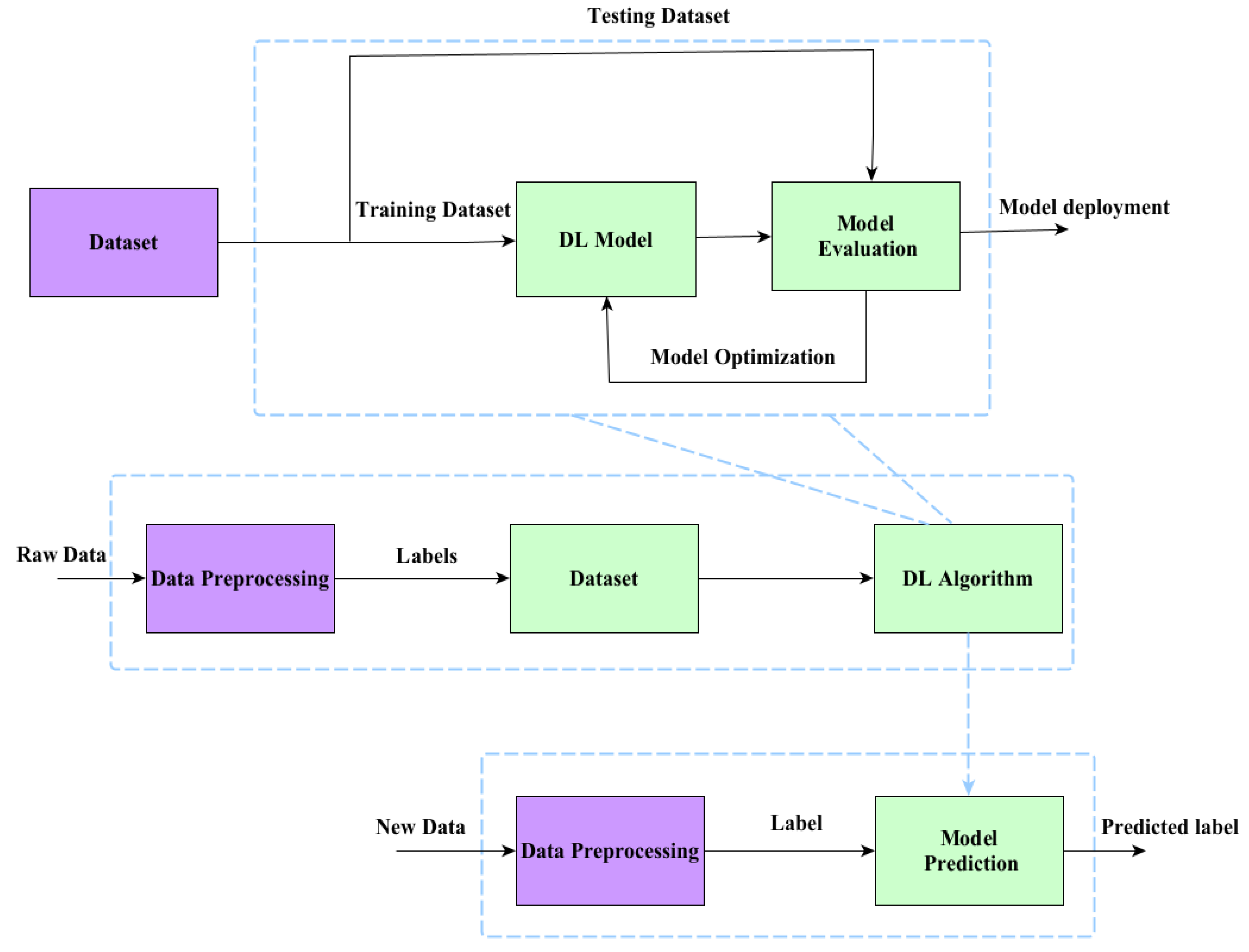
In this study, DL-based techniques are used to perform TAS in FGSM. Figure 2 shows the DL-based classification learning architecture for TAS. The primary steps followed by these DL architectures are shown in Figure 3. First, the data is pre-processed using the mean normalization technique. DL-based systems require real-valued training datasets, while MIMO channel coefficients are complex in nature. From the pre-processed data, real-valued features are retrieved. Lastly, different DL techniques are used to train the model based on the specified features and class labels. The trained networks are used to make predictions about the classes based on the new data. N t antennas are selected from N T based on the class labels obtained from DL algorithms if CQI is present at the target device.
Figure 2. DL-based classification learning for TAS in FGSM.
Figure 3. Learning procedure of proposed DL architectures.
An input vector is required to represent the channel coefficients since antenna combinations are classified against an input array. Following is a brief summary of the steps involved in the acquisition of datasets:
i.
Dataset generation: N c random channel matrices H q ϵ C N r × N T , q 1   N c are generated to create the dataset.
= [ H 1 , H 2 , , H N c ] T
consists of all these N c records or channel matrices.
ii.
Feature vector extraction: This work utilized the absolute values of every element of the channel matrix as an input feature with size N f = N r × N T . The resulting feature vector is given by:
f q = [ h 1,1 q , , h 1 , N T q , , h j , k q , , h N r , N T q ] T
here h j , k q is the (j, k)th element of H q , its absolute value is given as:
h j , k q = R h j , k q 2 + I h j , k q 2
The mean normalization is performed to avoid the effect of bias [21].
v q n = ( f q ( n ) mean ( f ( n ) ) ) ( max ( f ( n ) ) min ( f ( n ) ) )   ,   n 1 N f ,   q 1 N c
iii.
Calculation of KPI: (3) is used to evaluate ED, which is considered the key performance indicator (KPI) in this study. The KPI is utilized to label the dataset.
iv.
Class labeling: There is a unique label associated with every antenna subset. Antenna subset and class label mapping examples for the configurations N r = 4 , N t = 3, and N T = 4 is given in Table 2.
Table 2. Antenna subset-class label mapping for N r = 4 , N t = 3, and N T = 4 .

4.2. DL Architecture

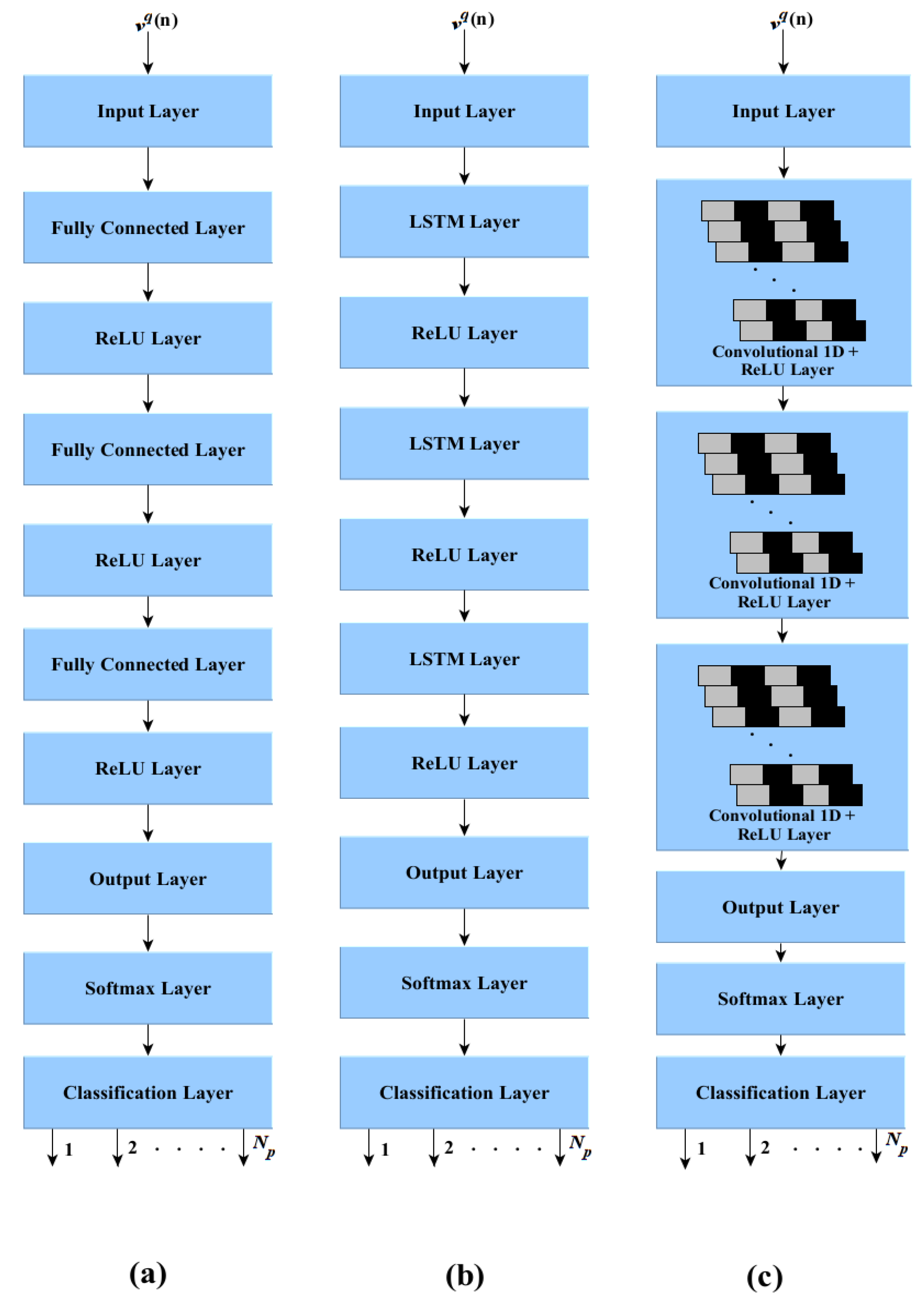
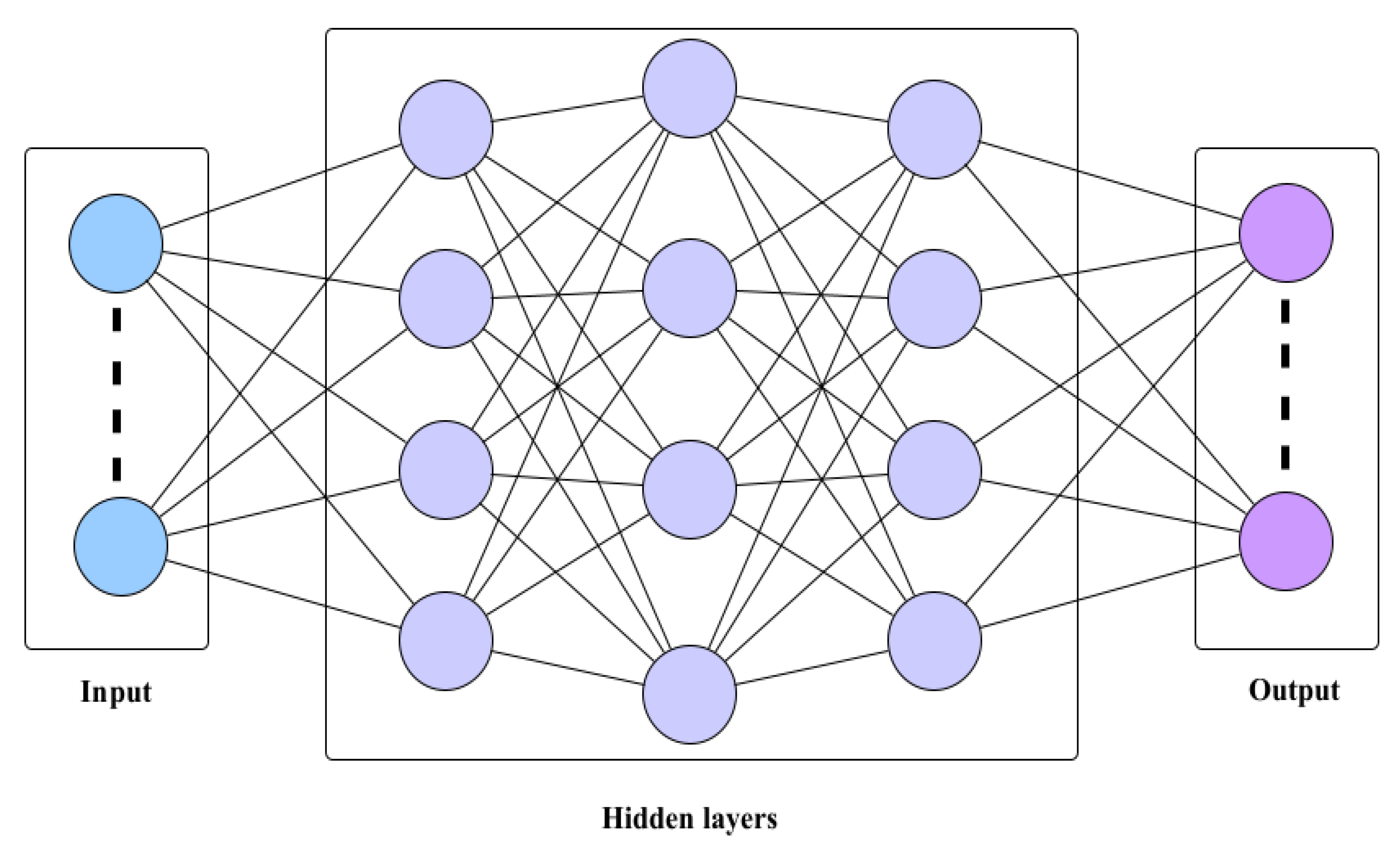
Figure 4 shows the proposed DL architecture. First, the FNN is utilized so that any nonlinear function can be learned. RNN is also included because FNN was incapable of identifying sequential information in the input data. In contrast, CNN is investigated because it reveals the spatial features of the input data more effectively.
Figure 4. Proposed DL architecture.
All proposed DL networks have L layers: an input layer, L-2 hidden layers, and an output layer. Full-connected (FC) layers are chosen as the hidden layers for FNN. Let r ^ q be the output vector at the last layer. The number of neurons utilized at every layer is denoted by N l ,   l 0 L 1 . A normalized feature vector v q of size N f is sent from the input layer to the first hidden layer for further processing, which is processed as [26].
r ^ 1 q = m a x ( W 1 v q + b 1 , 0 )
where the output vector of the first hidden layer is represented by r 1 q . Both the weight matrix and the bias vector associated with the first hidden layer are denoted by W 1 and b 1 , respectively. The rectified linear unit (ReLU) activation function is utilized at the hidden layers. The output of the ReLU activation function is given by:
f R e L U ( s ) = m a x ( 0 , s )
The output vector of the l th hidden layer is given as [26]
r ^ l q = m a x ( W l r ^ l 1 q + b l , 0 )
where the weight matrix and the bias vector associated with the l th hidden layer are denoted by W l and b l .
The FC layer is used as an output layer for all proposed networks. The number of neurons utilized at the output layer corresponds to the number of class labels (Np). The Softmax activation function ( δ ) is employed at the output layer to perform the multiclass classification task. The output vector of the L 1 layer is given by [26]
r ^ L 1 q = δ ( W L 1 r ^ L 2 q + b L 1 , 0 )
where the weight matrix and the bias vector associated with the output layer are denoted by W L 1 and b L 1 .
On the basis of the procedure described above, the entire training mapping rule is given as [26]
r ^ q = δ ( W L 1 ( m a x ( W L 2 ( W 1 v 1 q + b 1 , 0 ) + b L 2 , 0 ) ) + b L 1 )
We use (8) to acquire the feature vector f N for a new observation H N and the label is retrieved from (13). According to Figure 5a, the classification layer receives its inputs from the output layer via the Softmax layer.
Figure 5. Proposed DL architecture (a) FNN (b) RNN (c) 1D CNN.
Long short-term memory (LSTM) is employed as the hidden layer in the RNN architecture. There are three multiplicative units (input gate, forget gate, and output gate) that make up the memory module of a RNN using the LSTM architecture. For any LSTM unit, given its input and output values ( x l 1 and x l , respectively), the relationship between them at time step t is stated as [27].
f l t = f R e L U ( W f x l t 1 + Z f x l t + b f )
i l t = f R e L U ( W i x l t 1 + Z i x l t + b i )
o l t = f R e L U ( W o x l t 1 + Z o x l t + b o )
c l t = f l t c l t 1 + i l t σ c ( W c x l t 1 + Z c x l t + b c )
x L t = o l t σ z c l t
where f l t , i l t , and o l t represent, input and output gate vectors. Parameter matrices and vectors associated with these gates are denoted by W , Z , and b , respectively. The unit state of LSTM is denoted by c l t . Both σ c and σ z are hyperbolic tangents, and the Hadamard product is denoted by the operator. In both FNN and RNN architectures, three hidden layers are utilized. In these three hidden layers, there are 256, 128, and 128 neurons, respectively. The proposed RNN architecture is depicted in Figure 5b. All of the proposed DL architectures are trained with the help of the adaptive moment optimizer (Adam).
Similarly, a 1D convolution layer is selected as the hidden layer for CNN architecture. The output at the l th hidden layer in 1D CNN is given as [28]
r ^ L q = f R e L U b l i + j = 1 N l c o n v 1 D W l i j , s l j
where the kernel and the bias associated with the l th hidden layer for its ith neuron are denoted by W l i j and b l i . Output of the jth neuron is represented by s l j . The proposed architecture of 1D CNN is shown in Figure 5c, and its parameters are listed in Table 3.
Table 3. List of parameters of the proposed CNN architecture.

4.3. Complexity of Proposed DL-Based TAS Schemes

Table 4 presents the computational complexity analysis of the proposed DL-based systems and traditional EDAS for FGSM. The computational complexity of traditional EDAS is given in [12], while the computational complexity of the proposed DL-based systems is presented in [23]. Both measures are expressed in terms of real valued multiplication. In general, the order of complexity of an RNN or FNN is determined by the number of neurons present in each layer ( N l ,   l 0 L 1 ) and number of hidden layers ( L ); whereas, the order of complexity of a CNN is determined by the number of filters and filter size present ( F S l = (No. of filters × filter size) for lth layer) [23]. As can be seen from Table 3, the computational complexity of traditional EDAS grows in proportion to the modulation order and the number of transmit and receive antennas. On the other hand, the complexity of the proposed DL algorithms is unaffected by the different configurations of the system and remains the same throughout. Every random channel matrix sample is processed using the traditional EDAS, and the corresponding antenna indices are saved. During offline training, the features are extracted from the random channel matrix, and the label associated with the antenna index recorded utilizing EDAS is used to train the model. Training requires these computations, and this is a one-time task. Once the model has been trained for the unseen data sample, it will use its prior knowledge to make a prediction about the class label. This simplifies things online and reduces the system’s complexity. With an increasing number of these components, traditional EDAS becomes more complex; therefore, DL approaches for TAS are needed to simplify it.
Table 4. Comparison of several TAS techniques in terms of order of complexity.

5. Discussion on Simulation Results

The proposed DL architectures have been implemented and evaluated in MATLAB R2022b using the deep network designer application. Table 5 outlines all of the important simulation settings. There is no dataset in any of the repositories for TAS-assisted FGSM. As the use of SE increases, so does the computing complexity of traditional EDAS. As a result, we planned to employ DL architectures by benchmarking the optimal EDAS method and creating datasets with it. The EDAS algorithm is repeatedly executed for each of the configurations listed in Table 6 to generate two different datasets of size 25,000. The label is provided by the EDAS antenna indices, and the inputs (features) are derived from the random channel matrix. This is a one-time process, and the computations are required during the offline training phase. The features such as R ( h i j ), ℑ( h i j ), ∡( h i j ), h i j 2 , and the squared element norm of (HHH) are ignored due to their poor accuracy. As discussed in Section 4.1, h i j is used to train the model because of its higher accuracy. The classification accuracy of these proposed algorithms has been tested on 80% of holdouts. Because increasing the batch size reduces accuracy, we set the batch size at 32.
Table 5. List of parameters used for system implementation.
Table 6. Configurations of generated datasets.
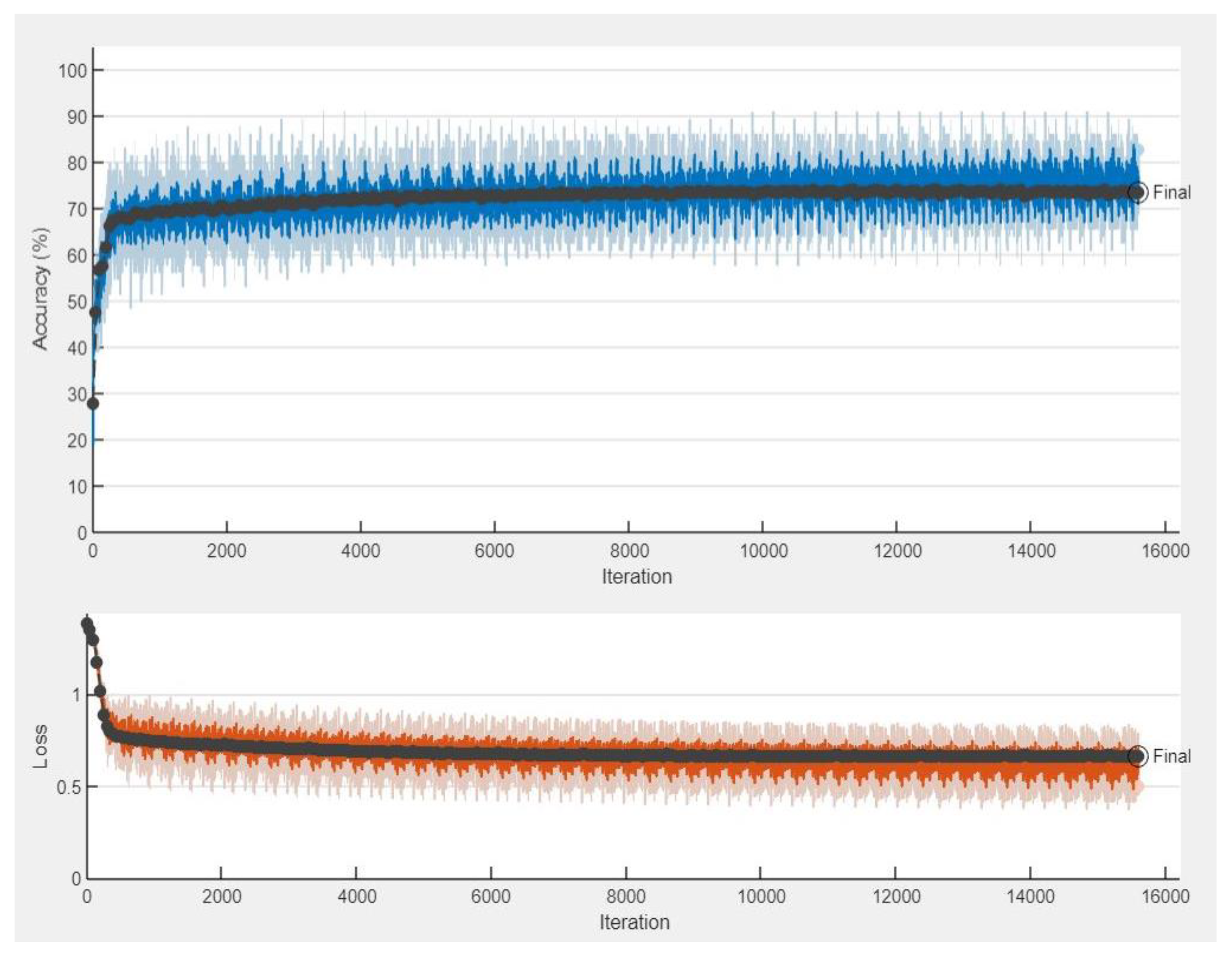
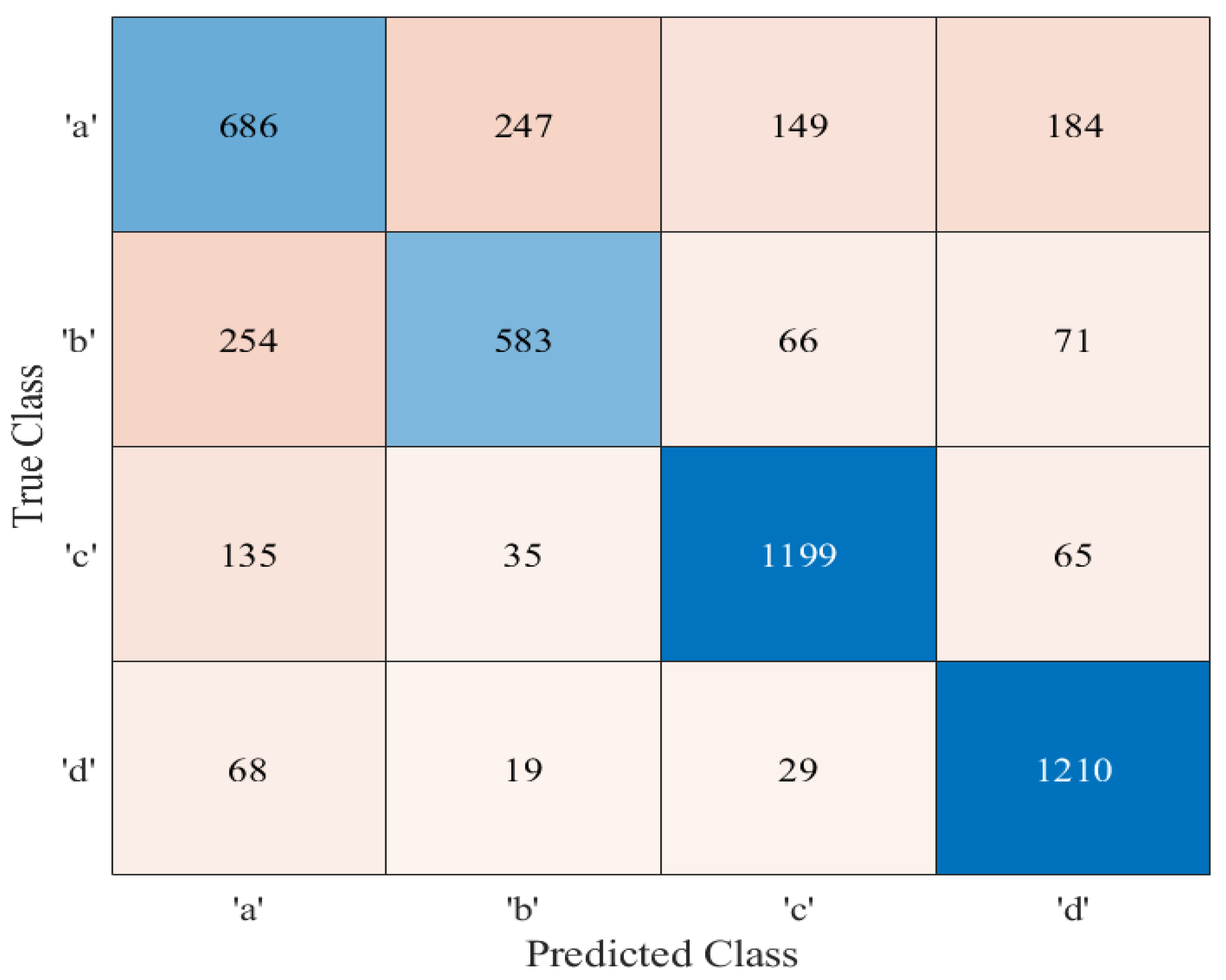
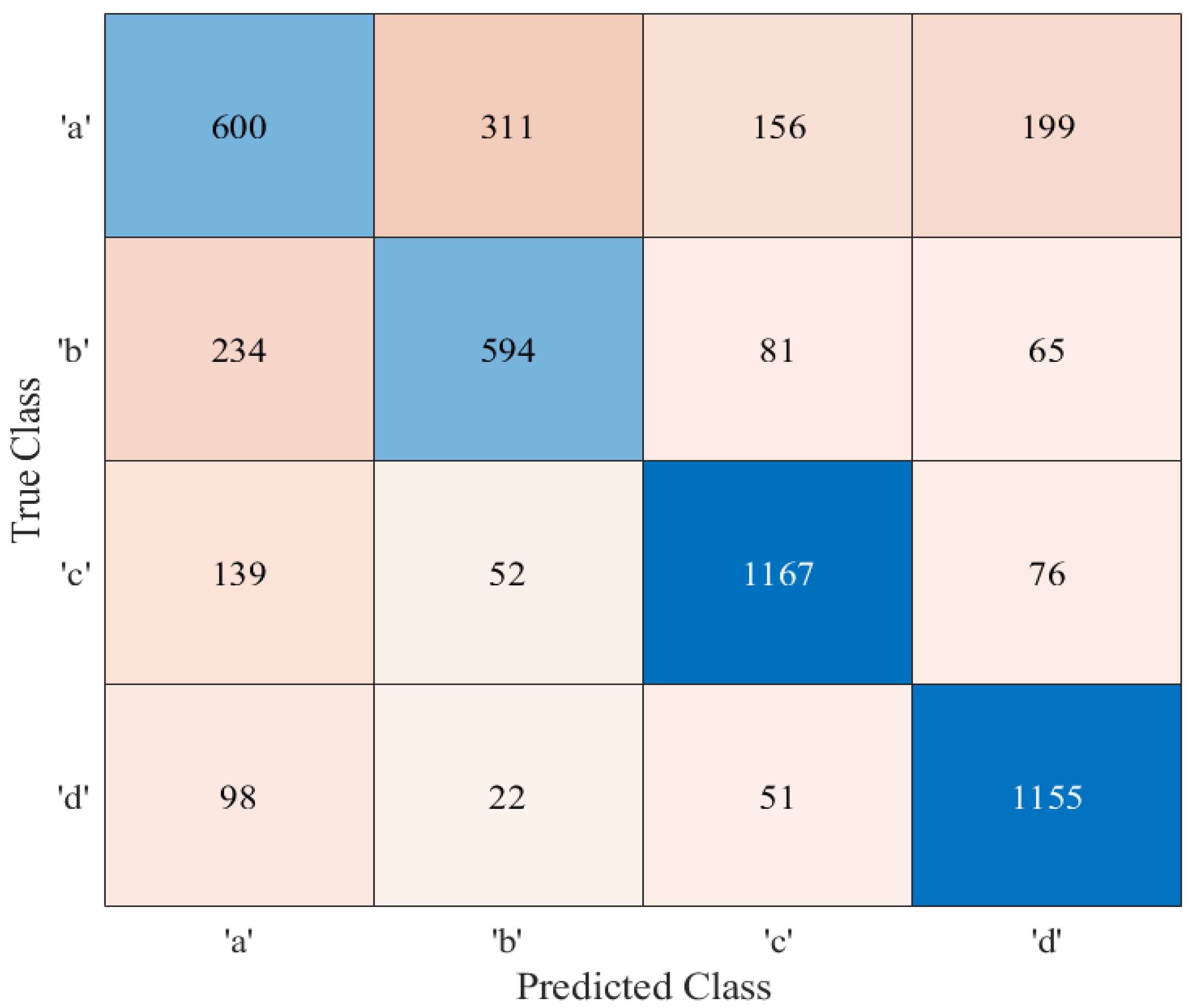
The training process associated with FNN is displayed in Figure 6. This figure shows that the network converges after 50 epochs with an average accuracy of 73.56%. This implies that ~73% of the channels were accurately predicted, providing the same predictions as conventional EDAS. As training progresses, the training loss decreases or stabilizes, proving the convergence of the models. At the end of training, the training and validation losses are almost identical. There are 312 batches for every epoch (20,000/64 = 312) [29,30]. The algorithm will run through 312 cycles every epoch, passing each batch in turn. Since, the total number of epochs is set to 50, there are a total of 15,600 iterations (312 × 50 = 15,600). A similar decreasing trend can be observed in both, and once the minimum has been reached, they do not rise again. One of the criteria that is utilized in the assessment of a classification model is its accuracy. This refers to the trained model’s percentage of accurate classifications. To determine the accuracy of the proposed DL architecture, a confusion matrix is used. The confusion matrix of the proposed FNN architecture is depicted in Figure 7. The entries on the diagonal are the correct values identified by the FNN architecture. The other entries correspond to the number of incorrect predictions. Figure 7 shows that when the trained FNN architecture is tested on a dataset of 5000 samples, it correctly predicts 3678 of them.
Figure 6. Training process of the proposed FNN architecture.
Figure 7. Confusion matrix of the proposed FNN architecture.
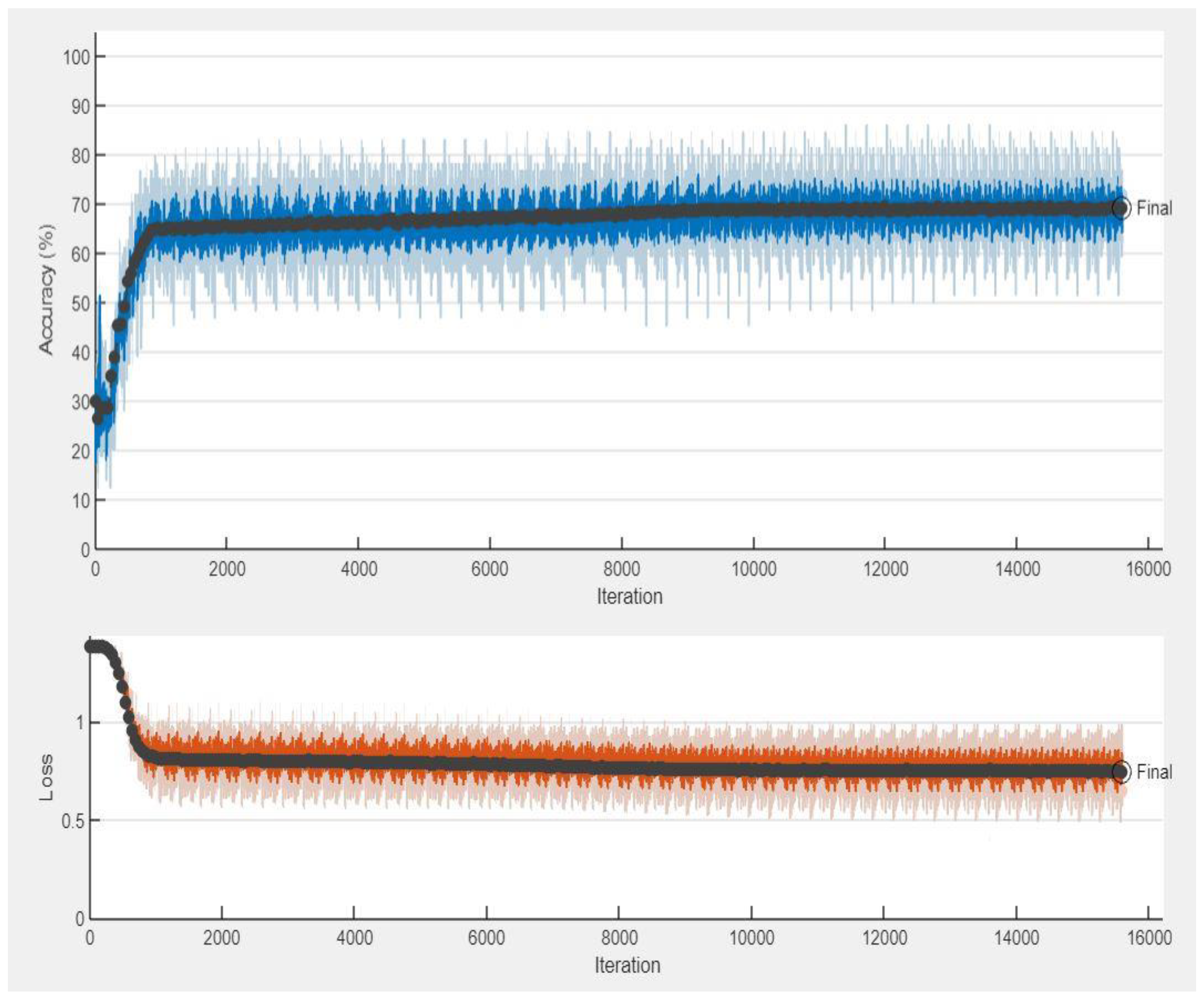
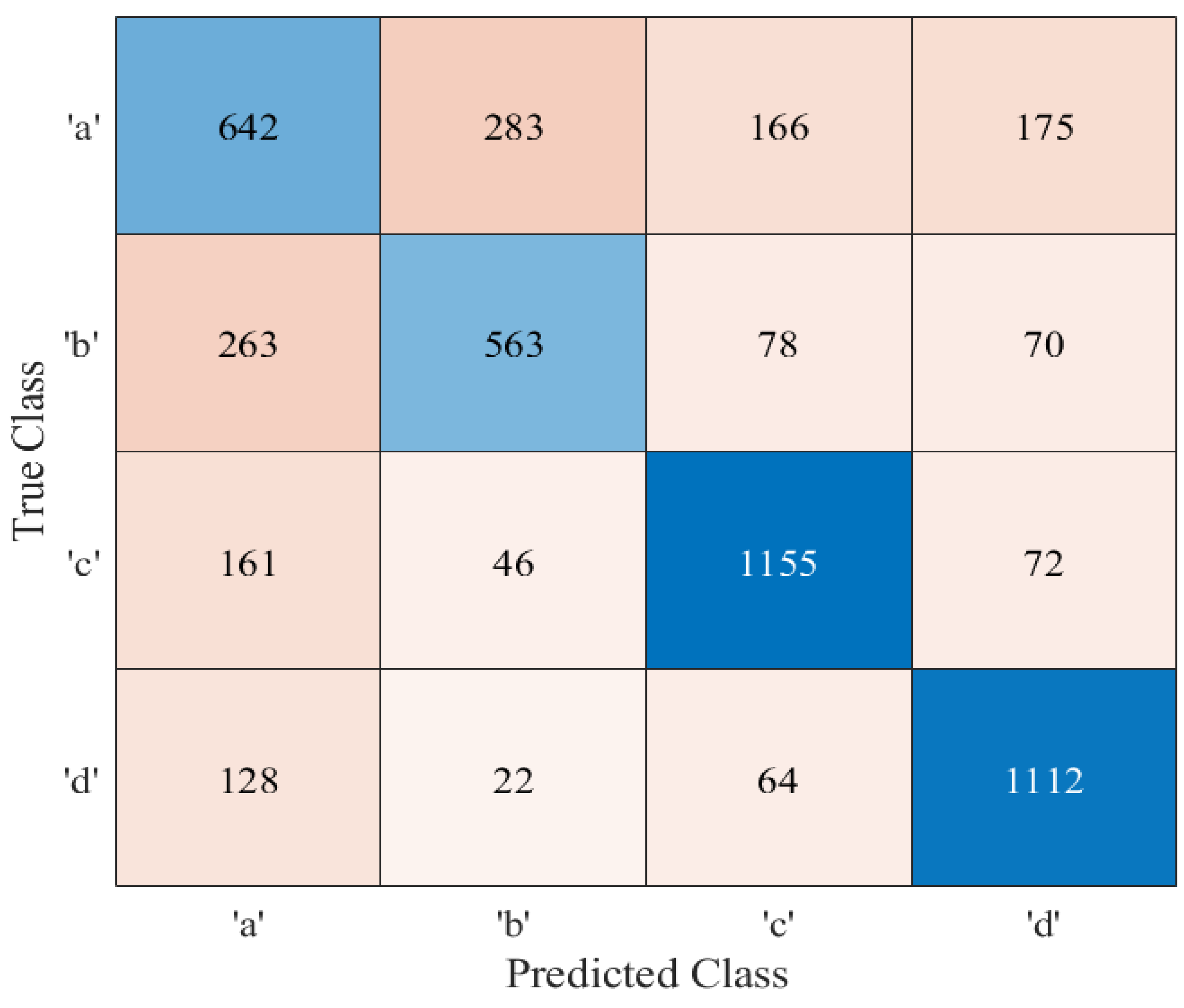
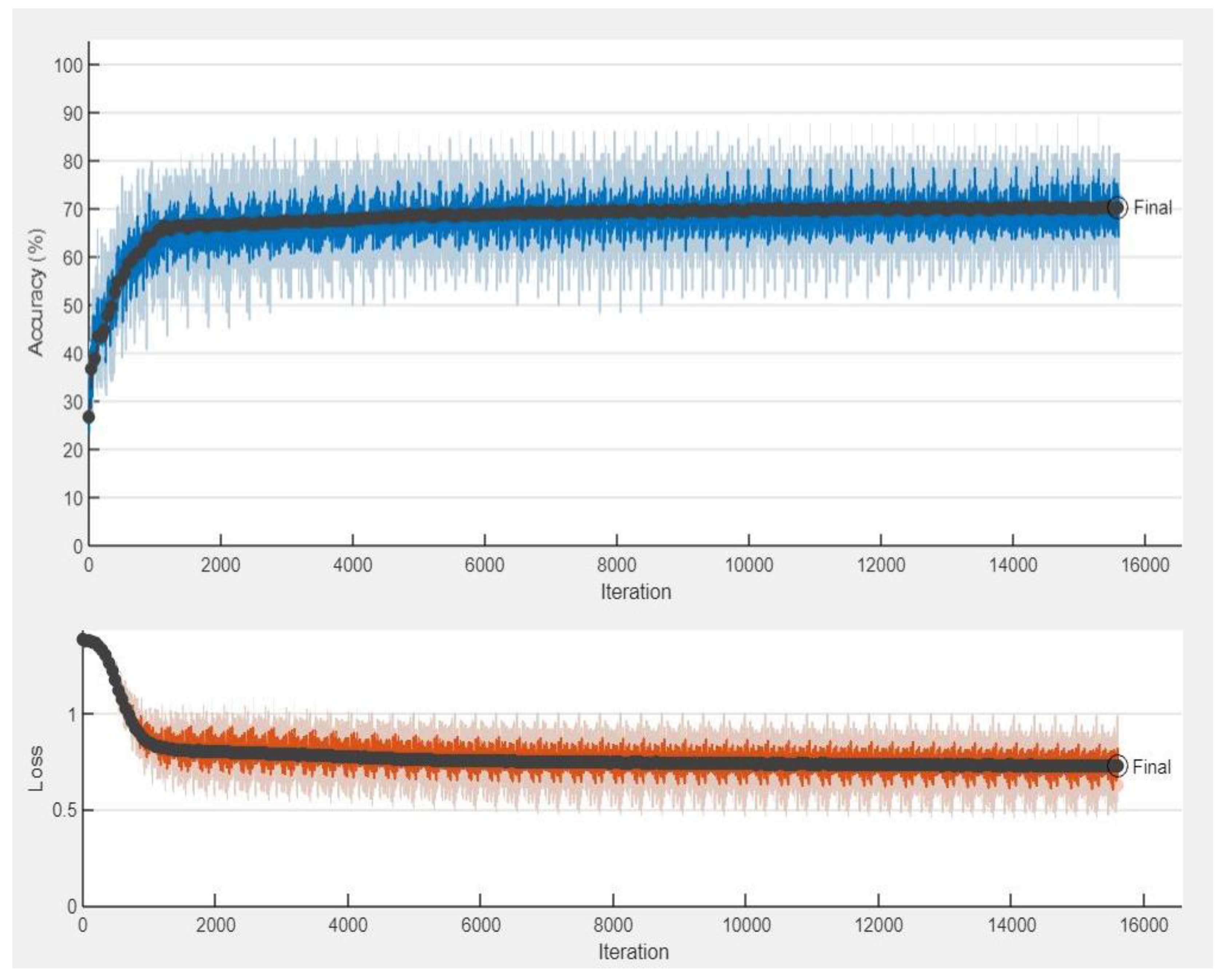
Figure 8 and Figure 9 represent the training process and confusion matrix for the proposed RNN architecture. According to Figure 8, after 50 epochs, the network achieves an average accuracy of 69.44%. Similarly, the training process and confusion matrix of 1D CNN are displayed in Figure 10 and Figure 11. From Figure 10, it is evident that after 50 epochs, the network is able to reach an average accuracy of 70.32%.
Figure 8. Training process of the proposed RNN architecture.
Figure 9. Confusion matrix of the proposed RNN architecture.
Figure 10. Training process of the proposed 1D CNN architecture.
Figure 11. Confusion matrix of the proposed 1D CNN architecture.
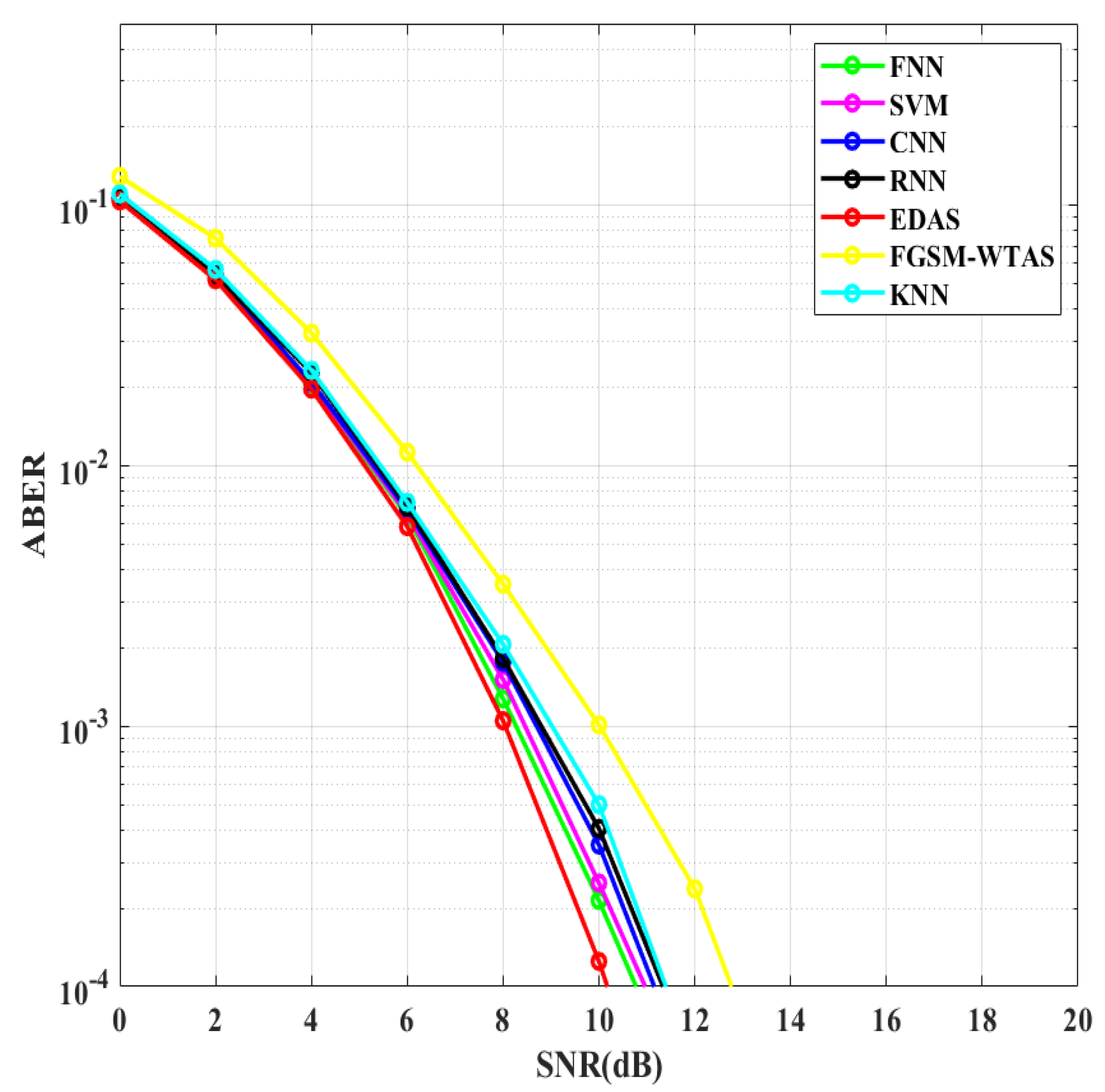
In Figure 12, the ABER performance of proposed DL-based schemes is examined with WTAS, traditional EDAS, and two widely used ML algorithms, SVM and KNN, for N T = 4, N t = 3, N r = 4, and M = 4. It is observed that, after the traditional EDAS, the proposed FNN-based TAS scheme outperforms SVM, KNN, and other DL-based systems. When compared to the FGSM-WTAS method, the FNN-based TAS scheme reduces the SNR requirement by ~2 dB. Due to its higher classification accuracy, the ABER performance of FNN-based TAS is superior to other DL-based TAS schemes. When compared to [19], the disparity between the traditional EDAS scheme and the proposed method using SVM to achieve an ABER of 10 4 is ~7 dB, which is very large. In our case, the margin between the proposed FNN scheme and traditional EDAS scheme is smaller (~0.6 dB), indicating a significant improvement in the system’s overall performance. Using the proposed FNN DL architecture, we obtained a ~3.2% enhancement compared to the SVM proposed in [21].
Figure 12. Comparison of ABER vs. SNR between different TAS schemes for FGSM ( N T = 4, N t = 3, N r = 4, and M = 4).
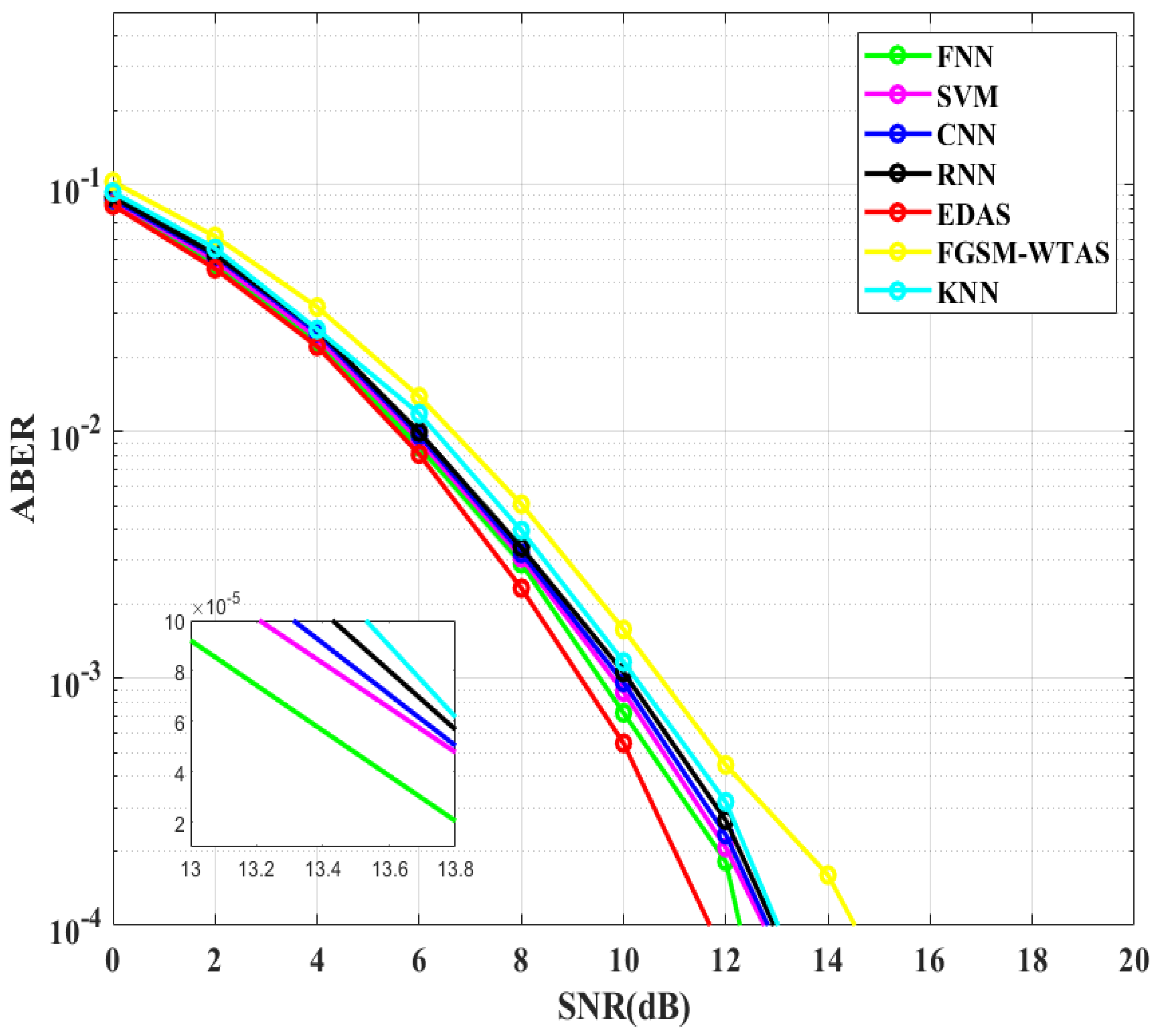
This performance is re-evaluated in Figure 13 by varying the constellation order to 16. All DL-based methods as well as SVM and KNN require higher SNRs for larger values of M. Both FGSM-WTAS and conventional EDAS require greater SNR than the previous configuration. The SNR demand is increased by ~1.53 dB for FGSM-WTAS and ~1.74 dB for standard EDAS. In this case as well, FNN outperforms FGSM-WTAS by ~2.2 dB.
Figure 13. Comparison of ABER vs. SNR between different TAS schemes for FGSM ( N T = 4, N t = 3, N r = 4, and M = 16).

6. Conclusions

In this work, three different DL-based TAS techniques for FGSM are proposed and implemented. The ABER performance of the recommended algorithms is compared to that of EDAS and WTAS for different configurations of N T , N t , and M. The percentage of classification accuracy and simulations show that the FNN-based TAS scheme outperforms the other DL-based TAS methods and SVM and KNN as well. If the number of features and dataset size are larger, then 1D CNN and RNN may perform better than FNN. EDAS has better ABER performance than FNN; however, FNN-based TAS schemes are more efficient computationally. This makes it a potential option for next-generation networks. In the future, IRS could be integrated into communication systems. The proposed DL architectures can be employed for TAS in high-rate SM variants such as FQSM.

Author Contributions

Methodology, H.K.J.; Project administration, V.B.K.; Resources, V.B.K.; Software, H.K.J.; Supervision, V.B.K.; Validation, H.K.J. and V.B.K.; Visualization, H.K.J.; Writing—original draft, H.K.J.; Writing—review and editing, V.B.K. All authors have read and agreed to the published version of the manuscript.

Funding

This research received no external funding.

Institutional Review Board Statement

Not applicable.

Data Availability Statement

The data that support the findings of this paper are available from the corresponding author upon reasonable request.

Conflicts of Interest

The authors declare no conflict of interest.

References

  1. Hong, E.-K.; Lee, I.; Shim, B.; Ko, Y.-C.; Kim, S.-H.; Pack, S.; Lee, K.; Kim, S.; Kim, J.-H.; Shin, Y.; et al. 6G R&D vision: Requirements and candidate technologies. J. Commun. Netw. 2022, 24, 232–245. [Google Scholar]
  2. Dang, S.; Amin, O.; Shihada, B.; Alouini, M.-S. What should 6G be? Nat. Electron. 2020, 3, 20–29. [Google Scholar] [CrossRef]
  3. Rekkas, V.P.; Sotiroudis, S.; Sarigiannidis, P.; Wan, S.; Karagiannidis, G.K.; Goudos, S.K. Machine learning in beyond 5G/6G networks—State-of-the-art and future trends. Electronics 2021, 10, 2786. [Google Scholar] [CrossRef]
  4. Liu, Y.; Zhang, S.; Mu, X.; Ding, Z.; Schober, R.; Al-Dhahir, N.; Hossain, E.; Shen, X. Evolution of NOMA toward next generation multiple access (NGMA) for 6G. IEEE J. Sel. Areas Commun. 2022, 40, 1037–1071. [Google Scholar] [CrossRef]
  5. Guan, G.; Liu, M.; Tang, F.; Kato, N.; Adachi, F. 6G: Opening new horizons for integration of comfort, security, and intelligence. IEEE Wirel. Commun. 2020, 27, 126–132. [Google Scholar]
  6. Basar, E. Transmission through large intelligent surfaces: A new frontier in wireless communications. In Proceedings of the 2019 European Conference on Networks and Communications (EuCNC), Valencia, Spain, 18–21 June 2019; IEEE: Piscataway, NJ, USA, 2019; pp. 112–117. [Google Scholar]
  7. Ertugrul, B.; Wen, M.; Mesleh, R.; Di Renzo, M.; Xiao, Y.; Haas, H. Index modulation techniques for next-generation wireless networks. IEEE Access 2017, 5, 16693–16746. [Google Scholar]
  8. Chien-Chun, C.; Sari, H.; Sezginer, S.; Su, T.Y. Enhanced spatial modulation with multiple signal constellations. IEEE Trans. Commun. 2015, 63, 2237–2248. [Google Scholar]
  9. Abdelhamid, Y.; Mesleh, R.; Di Renzo, M.; Haas, H. Generalised spatial modulation for large-scale MIMO. In Proceedings of the 2014 22nd European Signal Processing Conference (EUSIPCO), Lisbon, Portugal, 1–5 September 2014; IEEE: Piscataway, NJ, USA, 2014; pp. 346–350. [Google Scholar]
  10. Gaurav, J.; Gudla, V.V.; Kumaravelu, V.B.; Reddy, G.R.; Murugadass, A. Modified spatial modulation and low complexity signal vector based minimum mean square error detection for MIMO systems under spatially correlated channels. Wirel. Pers. Commun. 2020, 110, 999–1020. [Google Scholar]
  11. Raed, M.; Ikki, S.S.; Aggoune, H.M. Quadrature spatial modulation. IEEE Trans. Veh. Technol. 2014, 64, 2738–2742. [Google Scholar]
  12. Vardhan, G.V.; Kumaravelu, V.B.; Murugadass, A. Transmit antenna selection strategies for spectrally efficient spatial modulation techniques. Int. J. Commun. Syst. 2022, 35, e5099. [Google Scholar]
  13. Rakshith, R.; Hari, K.V.S.; Hanzo, L. Antenna selection in spatial modulation systems. IEEE Commun. Lett. 2013, 17, 521–524. [Google Scholar]
  14. Narushan, P.; Xu, H. “Comments on” antenna selection in spatial modulation systems. IEEE Commun. Lett. 2013, 17, 1681–1683. [Google Scholar]
  15. Hindavi, J.; Kumaravelu, V.B. Transmit Antenna Selection Assisted Spatial Modulation for Energy Efficient Communication. In Proceedings of the 2021 Innovations in Power and Advanced Computing Technologies (i-PACT), Kuala Lumpur, Malaysia, 27–29 November 2021; IEEE: Piscataway, NJ, USA, 2021; pp. 1–5. [Google Scholar]
  16. Bo, L.; Gao, F.; Zhang, S.; Zhou, T.; Alkhateeb, A. Deep learning-based antenna selection and CSI extrapolation in massive MIMO systems. IEEE Trans. Wirel. Commun. 2021, 20, 7669–7681. [Google Scholar]
  17. Narushan, P.; Xu, H. Low-complexity transmit antenna selection schemes for spatial modulation. IET Commun. 2015, 9, 239–248. [Google Scholar]
  18. Ping, Y.; Xiao, Y.; Li, L.; Tang, Q.; Yu, Y.; Li, S. Link adaptation for spatial modulation with limited feedback. IEEE Trans. Veh. Technol. 2012, 61, 3808–3813. [Google Scholar]
  19. Ping, Y.; Zhu, J.; Xiao, Y.; Chen, Z. Antenna selection for MIMO system based on pattern recognition. Digit. Commun. Netw. 2019, 5, 34–39. [Google Scholar]
  20. Ping, Y.; Xiao, Y.; Xiao, M.; Guan, Y.L.; Li, S.; Xiang, W. Adaptive spatial modulation MIMO based on machine learning. IEEE J. Sel. Areas Commun. 2019, 37, 2117–2131. [Google Scholar]
  21. Kishor, J.H.; Kumaravelu, V.B. Transmit antenna selection for spatial modulation based on machine learning. Phys. Commun. 2022, 55, 101904. [Google Scholar]
  22. Meenu, K. Deep learning based low complexity joint antenna selection scheme for MIMO vehicular adhoc networks. Expert Syst. Appl. 2023, 219, 119637. [Google Scholar]
  23. Gökhan, A.; Arslan, İ.A. Joint transmit and receive antenna selection for spatial modulation systems using deep learning. IEEE Commun. Lett. 2022, 26, 2077–2080. [Google Scholar]
  24. Ahmet, A.İ.; Altin, G. A novel deep neural network based antenna selection architecture for spatial modulation systems. In Proceedings of the 2021 56th International Scientific Conference on Information, Communication and Energy Systems and Technologies (ICEST), Sozopol, Bulgaria, 16–18 June 2021; IEEE: Piscataway, NJ, USA, 2021; pp. 141–144. [Google Scholar]
  25. Shilian, Z.; Chen, S.; Yang, X. DeepReceiver: A deep learning-based intelligent receiver for wireless communications in the physical layer. IEEE Trans. Cogn. Commun. Netw. 2020, 7, 5–20. [Google Scholar]
  26. Abeer, M.; Bai, Z.; Oloruntomilayo, F.-P.; Pang, K.; Yang, Y.; Zhou, D.; Kwak, K.S. Low complexity deep neural network based transmit antenna selection and signal detection in SM-MIMO system. Digit. Signal Process. 2022, 130, 103708. [Google Scholar]
  27. Jianfeng, Z.; Mao, X.; Chen, L. Speech emotion recognition using deep 1D & 2D CNN LSTM networks. Biomed. Signal Process. Control. 2019, 47, 312–323. [Google Scholar]
  28. Serkan, K.; Avci, O.; Abdeljaber, O.; Ince, T.; Gabbouj, M.; Inman, D.J. 1D convolutional neural networks and applications: A survey. Mech. Syst. Signal Process. 2021, 151, 107398. [Google Scholar]
  29. Yanzhao, W.; Liu, L.; Pu, C.; Cao, W.; Sahin, S.; Wei, W.; Zhang, Q. A comparative measurement study of deep learning as a service framework. IEEE Trans. Serv. Comput. 2019, 15, 551–566. [Google Scholar]
  30. Synho, D.; Song, K.D.; Chung, J.W. Basics of deep learning: A radiologist's guide to understanding published radiology articles on deep learning. Korean J. Radiol. 2020, 21, 33–41. [Google Scholar]
Disclaimer/Publisher’s Note: The statements, opinions and data contained in all publications are solely those of the individual author(s) and contributor(s) and not of MDPI and/or the editor(s). MDPI and/or the editor(s) disclaim responsibility for any injury to people or property resulting from any ideas, methods, instructions or products referred to in the content.

Article Metrics

Citations

Article Access Statistics

Multiple requests from the same IP address are counted as one view.