You are currently viewing a new version of our website. To view the old version click .
Applied Sciences
  • Article
  • Open Access

22 March 2023

Recovering Microscopic Images in Material Science Documents by Image Inpainting

and
Department of Energy Resources Engineering, Pukyong National University, Busan 48513, Republic of Korea
*
Author to whom correspondence should be addressed.

Abstract

Microscopic images in material science documents have increased in number due to the growth and common use of electron microscopy instruments. Through the use of data mining techniques, they are easily accessible and can be obtained from documents published online. As data-driven approaches are becoming increasingly common in the material science field, massively acquired experimental images through microscopy play important roles in terms of developing an artificial intelligence (AI) model for the purposes of automatically diagnosing crucial material structures. However, irrelevant objects (e.g., letters, scale bars, and arrows) that are often present inside original microscopic photos should be removed for the purposes of improving the AI models. To avoid the issue above, we applied four image inpainting algorithms (i.e., shift-net, global and local, contextual attention, and gated convolution) to a learning approach, with the aim of recovering microscopic images in journal papers. We estimated the structural similarity index measure (SSIM) and 1 / 2 errors, which are often used as measures of image quality. Lastly, we observed that gated convolution possessed the best performance for inpainting the microscopic images.

1. Introduction

Microscopic images in material science documents (e.g., books, articles, and reports) are generally used to display key structures in a target material [1]. The images are produced by various types of microscopic imaging tools, such as optical microscopy, transmission electron microscopy (TEM), scanning TEM (STEM), scanning electron microscopy (SEM), etc. [2,3,4,5,6]. Due to the advancement and widespread use of such microscopy instruments, micro-/nano-scale material images have become more sophisticated and prevalent in material science documents.
In the material science field, there is a massive volume of online documents that have been published. In addition, digitalized material datasets, e.g., texts, graphs, and images, are included within them. Due to open access movements with respect to scientific publishing, a huge number of digitized material images are freely available to be downloaded via the processes of web crawling or scraping, which are data mining techniques [7]. If one learns even a small degree of python programming regarding the processes of data scraping, then the material images through microscopy are easily obtained and utilized.
Since the advent of the data-driven approach, these material datasets are useful in terms of feeding artificial intelligence (AI) models that enable them to efficiently find explicit material properties [8]. In particular, AI-driven analysis on such material images can accelerate the process of diagnosing real space geometrical information with a higher accuracy instead of the analysis conducted by humans [9,10]. To guarantee a high-quality AI model, it is necessary that the training dataset consists of abundant and actual microscopic images [11]. Following this, the diverse experimental images obtained via microscopy and which are stored in the material science documents are applicable to the training dataset. However, it gives rise to two main issues.
Firstly, when we inspect the microscopic images acquired in the documents, several marks, such as letters, scale bars, and lines/arrows, are added into the raw microscopic photos for the purposes of either expressing image information or for highlighting sections [12,13,14]. For example, letters explain ordering in the figure set, the scale bar shows imaging resolution, and lines/arrows indicate remarkable objects. Therefore, one needs to remake the published images to remove the marks.
Indeed, image inpainting techniques have been developed in the computer vision field for the purposes of filling in the adequate information required in the missing parts of target images [15]. Moreover, in recent years, they were designed by not only rule-based models but also deep learning-related models in order to achieve a good performance in terms of accuracy and speed, albeit these models were focused only on retrieving original figures regarding people and landscapes [16,17,18,19,20,21,22,23,24,25,26]. Thus, we applied various image inpainting models with the aim of recovering microscopic images in material science documents, specifically in regard to solving the problem detailed above.
In this study, we contribute the main things, as follows: (1) we proposed new methods regarding the preprocessing of inputs with statistical and threshold-based masks, specifically with respect to the latest image inpainting methods for recovering microscopic images in material science documents; and (2) we compared the performances of the various image inpainting models in terms of their restorative performance factors, which were related to the similarity with the ground truth of the images.
The remainder of this paper is organized as follows: Section 2 introduces the related work and backgrounds of the microscopic images in material science documents and the image inpainting techniques that were utilized in the computer vision field. In Section 3, we describe the important details in our works of statistical and threshold-based masking, as well as detail a comparison of the image similarity performances between the various models. Finally, in Section 4, we conclude our research work and discuss the implications of our model.

3. Results

3.1. Data Preparation

In order to train all the deep learning-based methods for image inpainting, we required a large dataset of the microscopy images in the material science documents, as well as the corresponding originals. We can utilize text mining and natural language processing in the material science field, and many material images in their respective journals can be obtained for oneself. Therefore, we extracted 1100 microscopy images from 129 material science papers, which were downloaded from Elsevier journals. Then, we obtained the original images by using, by hand, the content-aware fill technique in Photoshop [39]. Furthermore, in this paper, we considered that the original image obtained via microscopy corresponds to a ground truth. Moreover, the training and testing images of the whole dataset came to a total of 880 images (80%) and 220 images (20%), respectively. The input images were used at a size of 256-by-256. Additionally, the hardware specification to run the image inpainting methods was an Intel(R) Xeon(R) Silver 4214R CPU @ 2.40 GHz (Intel Corporation, Santa Clara, CA, USA) and an NVIDIA GeForce RTX 3090 GPU (Nvidia Corporation, Santa Clara, CA, USA).

3.2. Generating Inputs Using Masks

When we applied the image inpainting methods, the inputs should have been preprocessed as the microscopic images in the material science documents were convolved with a mask. Then, the mask was filled in either black or white colored pixel values for specifying normal or undesired areas. Generally, this would be a binary image and should have the same size as the input image [24,26]. In the mask image, the pixels that should be preserved are those which are black, and the pixels in the undesired areas are in white [15]. For training the model, we used a random mask [23]. Next, we used the mask that covers the two additives, i.e., the alphabet characters and scale bars, on the images for testing the model. There was, initially, a lack of information (e.g., type, location, and length) for the additives. However, the masks were then generated by two ways: statistical masking and threshold-based masking.
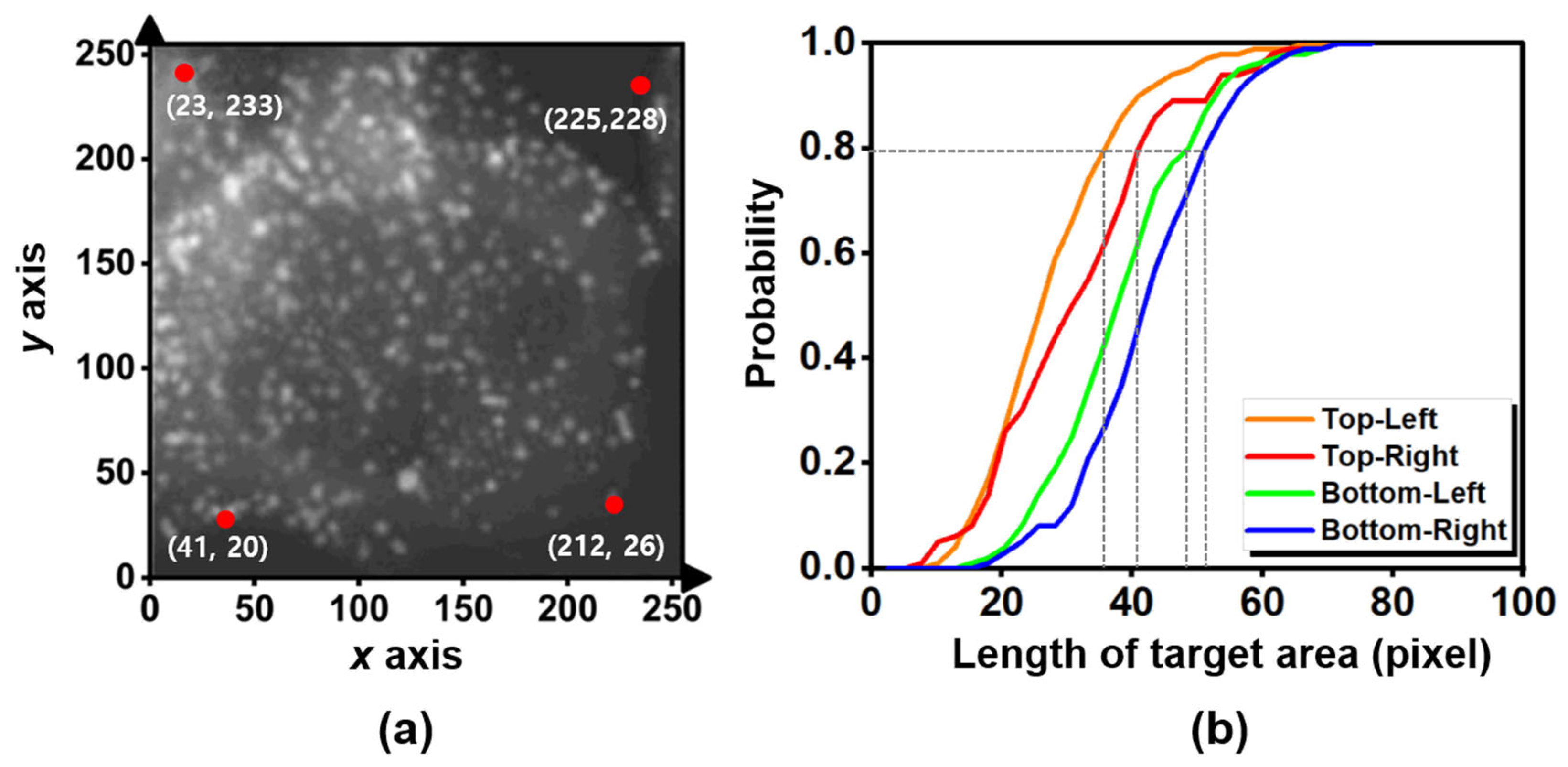
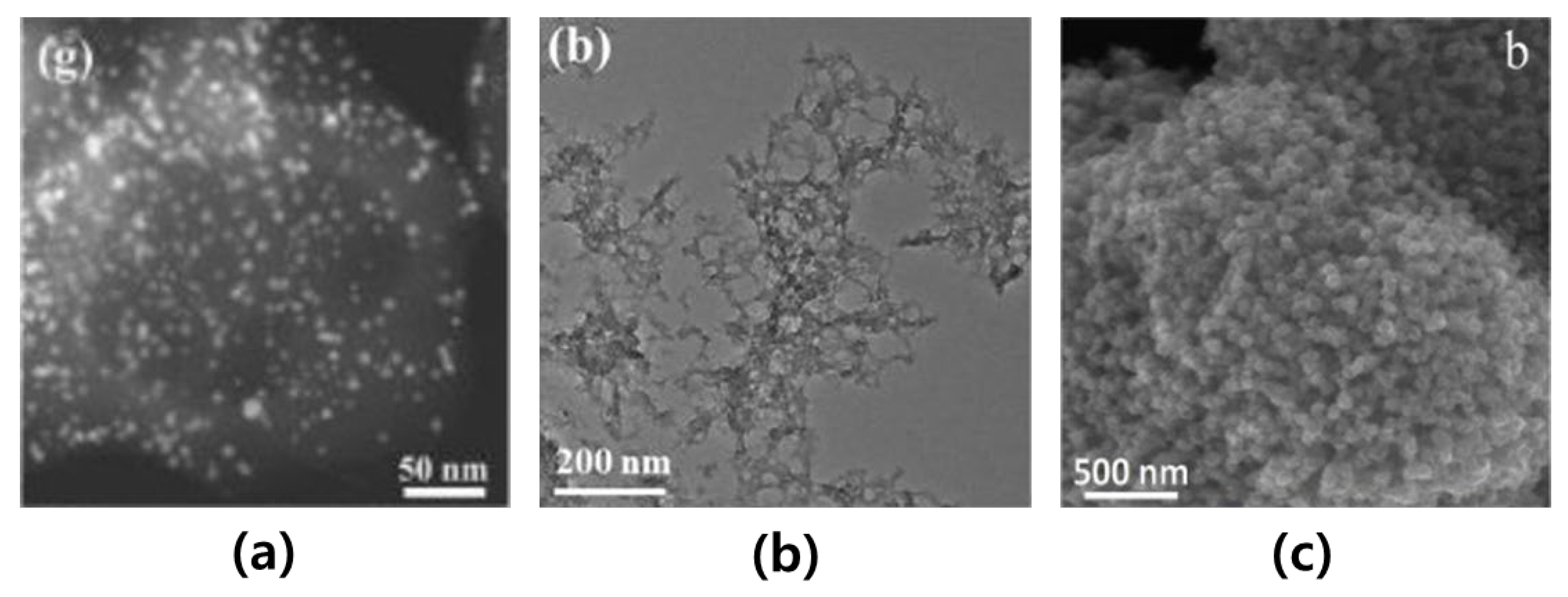
Firstly, we investigated the statistical positions and sizes of the two additives (the alphabet characters and scale bars) on the four corners in the 1100 given images. In Figure 3a, we observed that the averaged positions of the alphabet characters in the top-left and top-right were (23, 233) and (225, 228), respectively, whereas the averaged positions of the scale bars in the bottom-left and bottom-right were (41, 20) and (212, 26), respectively. In order to measure the average size of the alphabet characters and the scale bars, we estimated a cumulative distribution function (CDF) with respect to the ratio of their sizes and their probabilities, as shown in Figure 3b. Although all the additives in the four regions were only the characters and the scale bars, the different average sizes of the additives in the four regions were observed. The characters appeared at the top, but the scale bars appeared at the bottom. Since the sizes of characters and scale bars were different, the average sizes of the additives between the top and bottom were different. Furthermore, the average sizes of the additives among the four regions can be different because of the personal preference of the authors. For instance, one used the additive with parenthesis as like “(b)” (see Figure 1b), and the other one used the additive without parenthesis as like “b” (see Figure 1c). Then, we observed that the maximum sizes of the 80% majority additives in the top-left, top-right, bottom-left, and bottom-right were 36 (pixels) × 36 (pixels), 41 (pixels) × 41 (pixels), 49 (pixels) × 49 (pixels), and 51 (pixels) × 51 (pixels), respectively. Therefore, we decided on the statistical mask that covers the four squares at (23, 233), (225, 228), (41, 20), and (212, 26), respectively.
Figure 3. Statistical results of the two additives: (a) represents the averaged positions (red dots) of the alphabet characters and scale bars regarding the example of the microscopic images (reprinted with permission from Ref. [12]. Copyright (2020) Elsevier) and (b) represents the cumulative probability distribution function, according to the length of the target area (pixel) of the target regions comprising the additives.
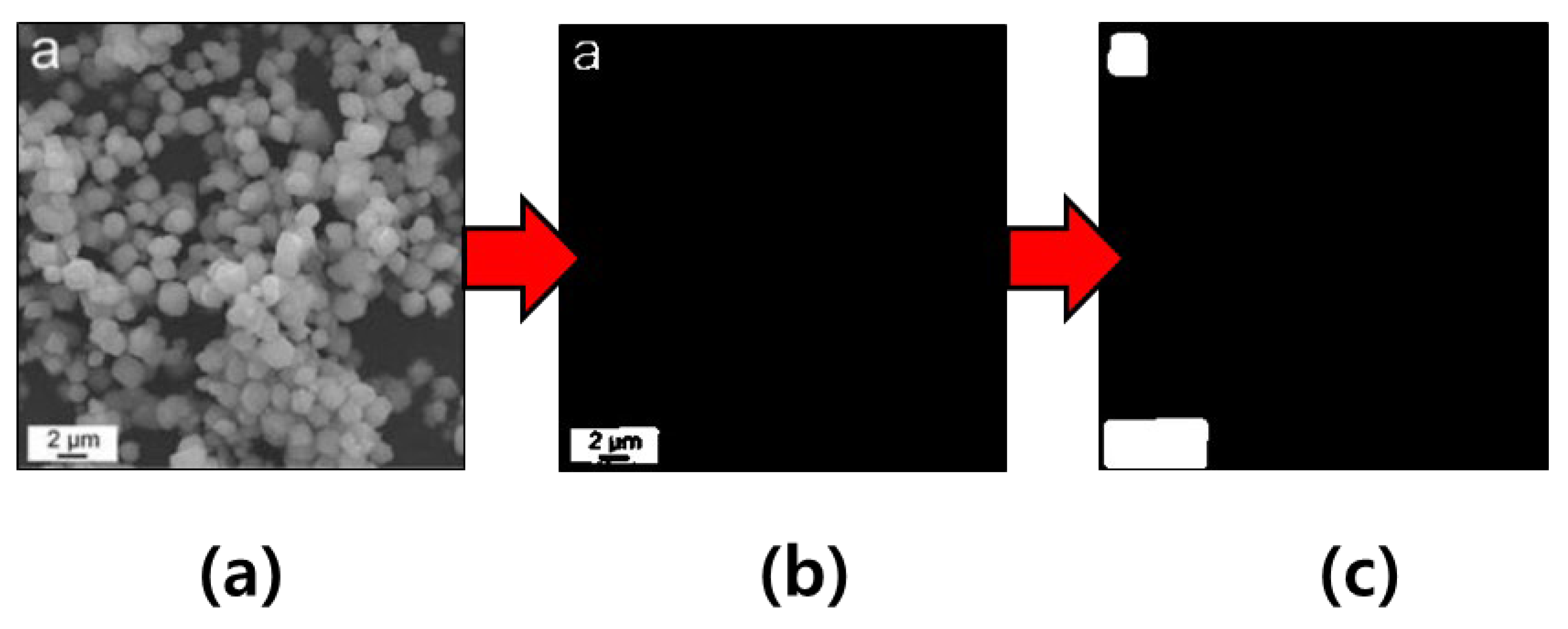
Next, we designed an algorithm that generates a threshold-based mask. When we investigated 1100 images, we checked that the microscopic images mostly took on extremely white-colored additives against a dark background. Therefore, we defined the threshold-based mask to include white pixels of a higher threshold as the additives, as well as black pixels of a lower threshold for the others. For distinguishing the pixels of the additives, as well as the others, we used a threshold value of 200 in gray scale. In Figure 4a, this can be black on the additive, but white around the additive. When we used only a threshold value in order to distinguish the pixels of these, the additive filled the black pixels remains as a non-removable object, as can be seen in Figure 4b. Therefore, we added the function that the pixels close to the white pixels possess a white color in the algorithm. We observed that the regions of the additives can possess white, and the regions of the others can possess black with respect to the result of the algorithm (see Figure 4c). The threshold-based mask code that we implemented is available at https://github.com/hmnd1257/threshold-mask (accessed on 16 February 2023).
Figure 4. Processing sequence in regard to generating a threshold-based mask from the example of a microscopic image (reprinted with permission from Ref. [40]. Copyright (2021) Elsevier): (a) represents the input image; (b) represents the intermediate image in the context of threshold-based masking; and (c) represents the final image.

3.3. Comparisons of Masks and Models

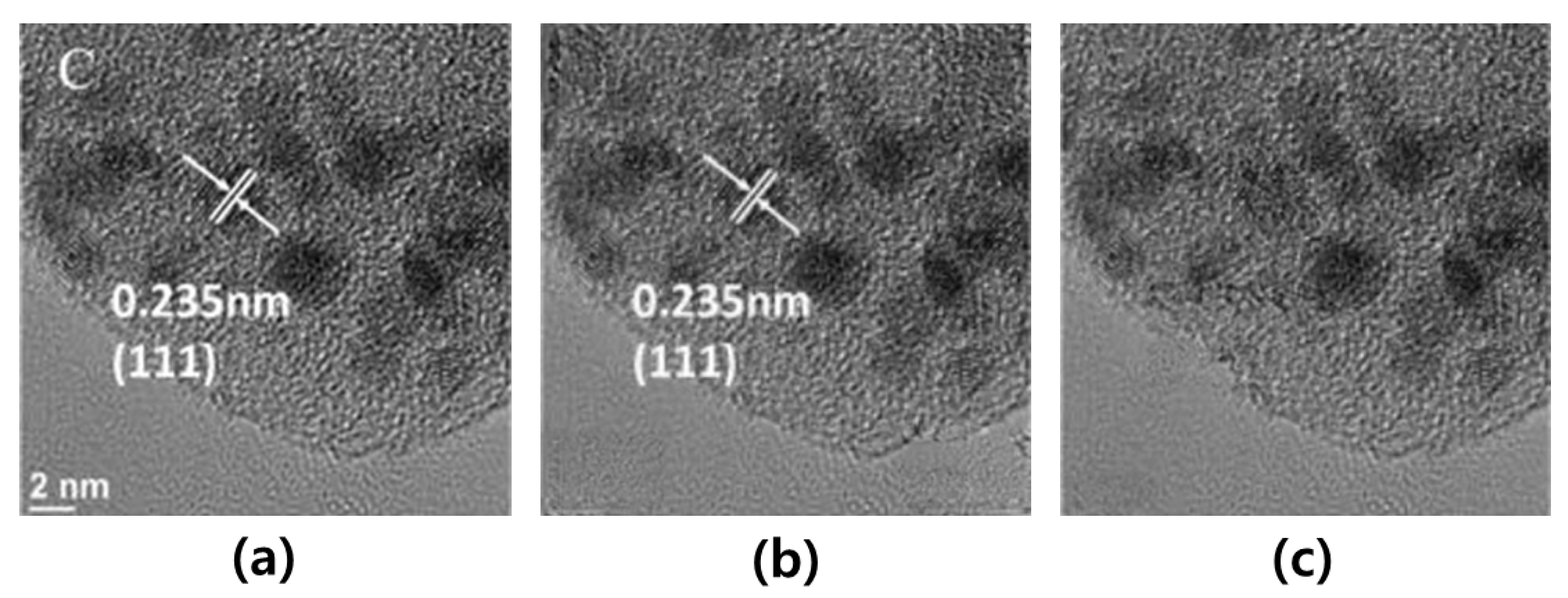
In the first experiment, we confirmed the effects of two masks with respect to the statistical mask and the threshold-based mask. We tested whether the input that is used by the statistical masks via the use of shift-net was the most popular deep learning method. The additives of the microscopic images in the material science documents appeared mainly in the four corners (i.e., top-left, bottom-left, top-right, and bottom-right), but they often appear in other areas (i.e., the center). Since the statistical mask has fixed four corner areas, it is difficult to become flexible masking. In Figure 5b, in the case of the statistical mask, we observed good results in all the additive regions that were top-left and bottom-left, but the center region was not restored at all. However, in the case of the threshold-based mask, Figure 5c shows that we observed better results with respect to restoring all the additives inside the image. In particular, the results in the area around the C label in Figure 5b,c look different. The statistical mask used a fixed square mask that includes the area around the C label as well as the C label, but the threshold-based mask contains only pixels belonging to the C label. It means that the statistical mask is relatively larger than the threshold-based masks in the same situation. Then, the statistical mask should restore the area around the C label, and the restoring noise on the area can be inserted. Therefore, the result in the area around the additives by using the threshold-based masks can be better than the result in the area around the C label by using the statistical masks.
Figure 5. Comparison of the results, which was achieved by using a statistical mask and a threshold mask from the example of microscopic image (reprinted with permission from Ref. [41]. Copyright (2019) Elsevier): (a) represents input image; (b) represents output image using a statistical mask; and (c) represents the output image when using a threshold-based mask.
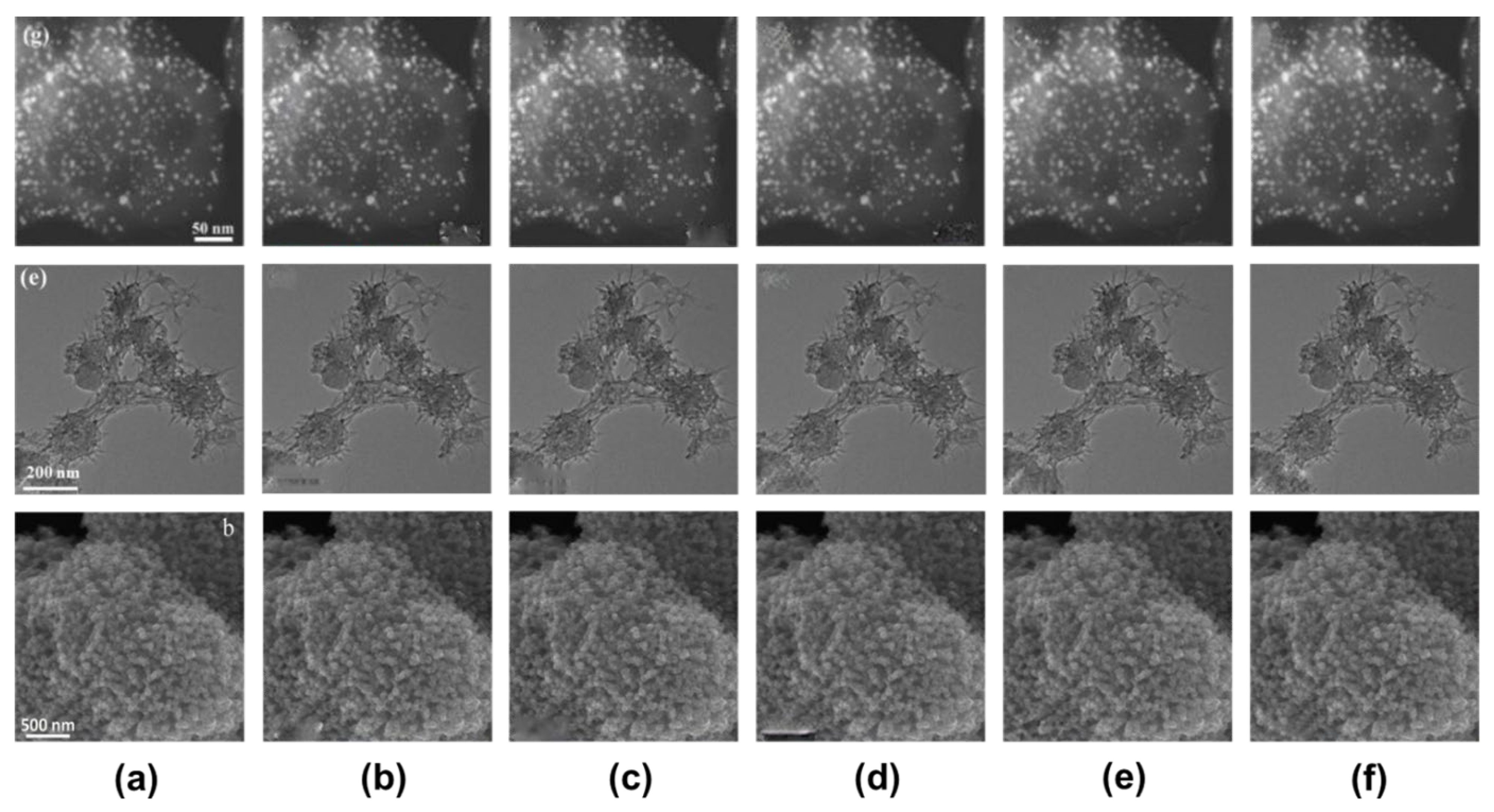
In the second experiment, we confirmed the effects of the four latest deep learning methods (shift-net, global and local, contextual attention, and gated convolution) for the purposes of image inpainting in our datasets of microscopy images. Through the first experiment, we tested the input used by the threshold-based masks via the use of the four latest deep learning methods. Then, we conducted qualitative evaluations of their results. Figure 6 shows three examples of the inputs and outputs that were obtained with the four different methods for qualitative comparison. It was found that the results of shift-net, global and local, and contextual attention were unsatisfactory because of blurriness in relation to the position of the characters and scale bar, as shown in Figure 6b–d. However, the gated convolution achieved better results than the other methods for all the examples, as shown in Figure 6e.
Figure 6. Comparison of the results of various image inpainting methods from the three examples of microscopic images (from top to bottom. reprinted with permission from Ref. [12]. Copyright (2020) Elsevier, from Ref. [13]. Copyright (2021) Elsevier, and from Ref. [14]. Copyright (2019) Elsevier): (a) represents the input image; (b) represents the output image of shift-net; (c) represents the output image of global and local; (d) represents the output image of contextual attention; (e) represents the output image of gated convolution; and (f) represents the ground truth.
Next, we conducted quantitative evaluations of their results. Furthermore, we used three evaluation metrics, the structural similarity index measure (SSIM) and 1 / 2 errors [26,42]. Then, we tested the images in order to measure the three metrics for the four methods and then calculated the averages and standard deviations of each method. Then, the additive’s area in the entire figure is usually small. Since all the pixels except restoring area in the outputs are the same as the ones in the originals, the metrics of the whole images with respect to none or using methods are nearly high score and their difference could be significantly trivial. To show the difference in the results between with and without the methods, we calculated the metrics of local regions where the characters and scale bars are closely packed. In Table 2, we observed that a gate convolution possessed the best performance measures of SSIM and 1 / 2 errors.
Table 2. Averages and standard deviations in parenthesis of performance metrics (SSIM, 1 and 2 errors) for the image similarity results.

4. Conclusions

In this paper, we presented a practical use of image inpainting methods for recovering microscopic images in material science documents. In particular, we proposed and compared new methods of preprocessing the inputs with statistical and threshold-based masks in regard to the image inpainting methods. The image inpainting methods that we used were four models that have appeared in the computer vision field, which are shift-net, global and local, contextual attention, and gated convolution. The gated convolution model showed the best SSIM and 1 / 2 errors, which are the measures of the image similarity between the output and the ground truth. However, this work only shows microscopic images, but it must be said that the figures in the documents are diverse. In future works, we will extend our work to develop an advanced image inpainting method that robustly and efficiently recovers all the images comprising other figures, as well as the material images obtained via microscopy in the documents.

Author Contributions

T.K.: methodology, software, validation, analysis, writing; B.C.Y.: writing-review and editing. All authors have read and agreed to the published version of the manuscript.

Funding

This research was supported by the Nano & Material Technology Development Program through the National Research Foundation of Korea (NRF) funded by the Ministry of Science and ICT (2021M3A7C2090586).

Institutional Review Board Statement

Not applicable.

Data Availability Statement

The data will be shared upon reasonable request.

Conflicts of Interest

The authors declare no conflict of interest.

References

  1. Talebian, S.; Rodrigues, T.; Neves, J.; Sarmento, B.; Langer, R.; Conde, J. Facts and Figures on Materials Science and Nanotechnology Progress and Investment. ACS Nano 2021, 15, 15940–15952. [Google Scholar] [CrossRef] [PubMed]
  2. Williams, D.B.; Carter, C.B. The Transmission Electron Microscope. In Transmission Electron Microscopy; Springer: Boston, MA, USA, 1996; pp. 3–17. [Google Scholar]
  3. Li, J.; Johnson, G.; Zhang, S.; Su, D. In situ transmission electron microscopy for energy applications. Joule 2019, 3, 4–8. [Google Scholar] [CrossRef]
  4. Goldstein, J.I.; Newbury, D.E.; Michael, J.R.; Ritchie, N.W.; Scott, J.H.J.; Joy, D.C. Scanning Electron Microscopy and X-ray Microanalysis; Springer: New York, NY, USA, 2017. [Google Scholar]
  5. Wiesendanger, R.; Roland, W. Scanning Probe Microscopy and Spectroscopy: Methods and Applications; Cambridge University Press: Cambridge, UK, 1994. [Google Scholar]
  6. Crewe, A.V. Scanning transmission electron microscopy. J. Microsc. 1974, 100, 247–259. [Google Scholar] [CrossRef] [PubMed]
  7. Himanen, L.; Geurts, A.; Foster, A.S.; Rinke, P. Data-Driven Materials Science: Status, Challenges, and Perspectives. Adv. Sci. 2019, 6, 1900808. [Google Scholar] [CrossRef]
  8. Zhang, L.; Shao, S. Image-based machine learning for materials science. J. Appl. Phys. 2022, 132, 100701. [Google Scholar] [CrossRef]
  9. Ge, M.; Su, F.; Zhao, Z.; Su, D. Deep learning analysis on microscopic imaging in materials science. Mat. Today Nano 2020, 11, 100087. [Google Scholar] [CrossRef]
  10. Nguyen, T.N.M.; Guo, Y.; Qin, S.; Frew, K.S.; Xu, R.; Agar, J.C. Symmetry-aware recursive image similarity exploration for materials microscopy. Npj Comput. Mater. 2021, 7, 166. [Google Scholar] [CrossRef]
  11. Ma, B.; Wei, X.; Liu, C.; Ban, X.; Huang, H.; Wang, H.; Xue, W.; Wu, S.; Gao, M.; Shen, Q.; et al. Data augmentation in microscopic images for material data mining. Npj Comput. Mater. 2020, 6, 125. [Google Scholar] [CrossRef]
  12. Chen, F.; Lu, Q.; Fan, T.; Fang, R.; Li, Y. Ionic liquid [Bmim][AuCl4] encapsulated in ZIF-8 as precursors to synthesize N-decorated Au catalysts for selective aerobic oxidation of alcohols. Catal. Today 2020, 351, 94–102. [Google Scholar] [CrossRef]
  13. Hou, X.; Han, Z.; Xu, X.; Sarker, D.; Zhou, J.; Wu, M.; Liu, Z.; Huang, M.; Jiang, H. Controllable amorphization engineering on bimetallic metal–organic frameworks for ultrafast oxygen evolution reaction. Chem. Eng. J. 2021, 418, 129330. [Google Scholar] [CrossRef]
  14. Liu, S.; Zhao, T.; Tan, X.; Guo, L.; Wu, J.; Kang, X.; Wang, H.; Sun, L.; Chu, W. 3D pomegranate-like structures of porous carbon microspheres self-assembled by hollow thin-walled highly-graphitized nanoballs as sulfur immobilizers for Li–S batteries. Nano Energy 2019, 63, 103894. [Google Scholar] [CrossRef]
  15. Liu, G.; Reda, F.A.; Shih, K.J.; Wang, T.-C.; Tao, A.; Catanzaro, B. Image inpainting for irregular holes using partial convolutions. In Proceedings of the European Conference on Computer Vision (ECCV), Munich, Germany, 8–14 September 2018; pp. 85–100. [Google Scholar]
  16. Simakov, D.; Caspi, Y.; Shechtman, E.; Irani, M. Summarizing visual data using bidirectional similarity. In Proceedings of the 2008 IEEE Conference on Computer Vision and Pattern Recognition, Anchorage, AK, USA, 24–26 June 2008; pp. 1–8. [Google Scholar]
  17. Bertalmio, M.; Vese, L.; Sapiro, G.; Osher, S. Simultaneous structure and texture image inpainting. IEEE Trans. Image Process. 2003, 12, 882–889. [Google Scholar] [CrossRef]
  18. Criminisi, A.; Perez, P.; Toyama, K. Object removal by exemplar-based inpainting. In Proceedings of the 2003 IEEE Computer Society Conference on Computer Vision and Pattern Recognition, Madison, WI, USA, 18–20 June 2003; pp. 1–8. [Google Scholar]
  19. Barnes, C.; Shechtman, E.; Finkelstein, A.; Goldman, D.B. PatchMatch: A randomized correspondence algorithm for structural image editing. ACM Trans. Graph. 2009, 28, 24. [Google Scholar] [CrossRef]
  20. Bertalmio, M.; Sapiro, G.; Caselles, V.; Ballester, C. Image inpainting. In Proceedings of the 27th Annual Conference on computer Graphics and Interactive Techniques, SIGGRAPH 2000, New Orleans, LA, USA, 23–28 July 2000; pp. 417–424. [Google Scholar]
  21. Ballester, C.; Bertalmio, M.; Caselles, V.; Sapiro, G.; Verdera, J. Filling-in by joint interpolation of vector fields and gray levels. IEEE Trans. Image Process. 2001, 10, 1200–1211. [Google Scholar] [CrossRef]
  22. Levin, A.; Zomet, A.; Weiss, Y. Learning How to Inpaint from Global Image Statistics. In Proceedings of the ICCV, Nice, France, 14–17 October 2003; pp. 305–312. [Google Scholar]
  23. Yan, Z.; Li, X.; Li, M.; Zuo, W.; Shan, S. Shift-net: Image inpainting via deep feature rearrangement. In Proceedings of the European Conference on Computer Vision (ECCV), Munich, Germany, 8–14 September 2018; pp. 1–17. [Google Scholar]
  24. Iizuka, S.; Simo-Serra, E.; Ishikawa, H. Globally and locally consistent image completion. ACM Trans. Graph. 2017, 36, 1–14. [Google Scholar] [CrossRef]
  25. Yu, J.; Lin, Z.; Yang, J.; Shen, X.; Lu, X.; Huang, T.S. Generative image inpainting with contextual attention. In Proceedings of the IEEE Conference on Computer Vision and Pattern Recognition, Salt Lake City, UT, USA, 18–22 June 2018; pp. 5505–5514. [Google Scholar]
  26. Yu, J.; Lin, Z.; Yang, J.; Shen, X.; Lu, X.; Huang, T.S. Free-form image inpainting with gated convolution. In Proceedings of the IEEE/CVF International Conference on Computer Vision, Seoul, Republic of Korea, 27 October–2 November 2019; pp. 4471–4480. [Google Scholar]
  27. Zhou, B.; Lapedriza, A.; Khosla, A.; Oliva, A.; Torralba, A. Places: A 10 million image database for scene recognition. IEEE Trans. Pattern Anal. Mach. Intell. 2017, 40, 1452–1464. [Google Scholar] [CrossRef]
  28. Doersch, C.; Singh, S.; Gupta, A.; Sivic, J.; Efros, A. What makes paris look like paris? ACM Trans. Graph. 2012, 31, 103–110. [Google Scholar] [CrossRef]
  29. Russakovsky, O.; Deng, J.; Su, H.; Krause, J.; Satheesh, S.; Ma, S.; Huang, Z.; Karpathy, A.; Khosla, A.; Bernstein, M. Imagenet large scale visual recognition challenge. J. Comput. Vis. 2015, 115, 211–252. [Google Scholar] [CrossRef]
  30. Tyleček, R.; Šára, R. Spatial pattern templates for recognition of objects with regular structure. In Proceedings of the Pattern Recognition: 35th German Conference (GCPR 2013), Saarbrücken, Germany, 3–6 September 2013; pp. 364–374. [Google Scholar]
  31. Liu, Z.; Luo, P.; Wang, X.; Tang, X. Deep learning face attributes in the wild. In Proceedings of the IEEE International Conference on Computer Vision, Santiago, Chile, 7–13 December 2015; pp. 3730–3738. [Google Scholar]
  32. Karras, T.; Aila, T.; Laine, S.; Lehtinen, J. Progressive growing of gans for improved quality, stability, and variation. arXiv 2017, arXiv:1710.10196. [Google Scholar]
  33. Cimpoi, M.; Maji, S.; Kokkinos, I.; Mohamed, S.; Vedaldi, A. Describing textures in the wild. In Proceedings of the IEEE Conference on Computer Vision and Pattern Recognition, Washington, DC, USA, 23–28 June 2014; pp. 3606–3613. [Google Scholar]
  34. Xie, J.; Xu, L.; Chen, E. Image denoising and inpainting with deep neural networks. In Proceedings of the Advances in Neural Information Processing Systems, Lake Tahoe, NV, USA, 3–6 December 2012; pp. 341–349. [Google Scholar]
  35. Köhler, R.; Schuler, C.; Schölkopf, B.; Harmeling, S. Mask-specific inpainting with deep neural networks. In Proceedings of the Pattern Recognition: 36th German Conference, GCPR 2014, Münster, Germany, 2–5 September 2014; pp. 523–534. [Google Scholar]
  36. Ren, J.S.; Xu, L.; Yan, Q.; Sun, W. Shepard convolutional neural networks. In Proceedings of the Advances in Neural Information Processing Systems, Montreal, QC, Canada, 7–12 December 2015; pp. 901–909. [Google Scholar]
  37. Pathak, D.; Krahenbuhl, P.; Donahue, J.; Darrell, T.; Efros, A.A. Context encoders: Feature learning by inpainting. In Proceedings of the IEEE Conference on Computer Vision and Pattern Recognition, Las Vegas, NV, USA, 27–30 June 2016; pp. 2536–2544. [Google Scholar]
  38. Goodfellow, I.; Pouget-Abadie, J.; Mirza, M.; Xu, B.; Warde-Farley, D.; Ozair, S.; Courville, A.; Bengio, Y. Generative adversarial networks. Commun. ACM 2020, 63, 139–144. [Google Scholar] [CrossRef]
  39. Content-Aware Fill. Available online: https://helpx.adobe.com/photoshop-elements/using/content-aware-fill.html (accessed on 7 June 2022).
  40. Xu, K.; Shen, X.; Ji, Z.; Yuan, A.; Kong, L.; Zhu, G.; Zhu, J. Highly monodispersed Fe2WO6 micro-octahedrons with hierarchical porous structure and oxygen vacancies for lithium storage. Chem. Eng. J. 2021, 413, 127504. [Google Scholar] [CrossRef]
  41. Cao, X.; Cheng, S.; You, Y.; Zhang, S.; Xian, Y. Sensitive monitoring and bioimaging intracellular highly reactive oxygen species based on gold nanoclusters@ nanoscale metal-organic frameworks. Anal. Chim. Acta 2019, 1092, 108–116. [Google Scholar] [CrossRef] [PubMed]
  42. Wang, Z.; Bovik, A.C.; Sheikh, H.R.; Simoncelli, E.P. Image quality assessment: From error visibility to structural similarity. IEEE Trans. Image Process. 2004, 13, 600–612. [Google Scholar] [CrossRef] [PubMed]
Disclaimer/Publisher’s Note: The statements, opinions and data contained in all publications are solely those of the individual author(s) and contributor(s) and not of MDPI and/or the editor(s). MDPI and/or the editor(s) disclaim responsibility for any injury to people or property resulting from any ideas, methods, instructions or products referred to in the content.

Article Metrics

Citations

Article Access Statistics

Multiple requests from the same IP address are counted as one view.