




The Impact of Blenderized Tube Feeding on Gastrointestinal Symptoms, a Scoping Review
 , , , ,
  , ,
, ,  ,
,  ,
,
Abstract
1. Introduction
2. Methods
2.1. Search Strategy
2.2. Study Eligibility
2.3. Data Collection and Assessment
3. Results
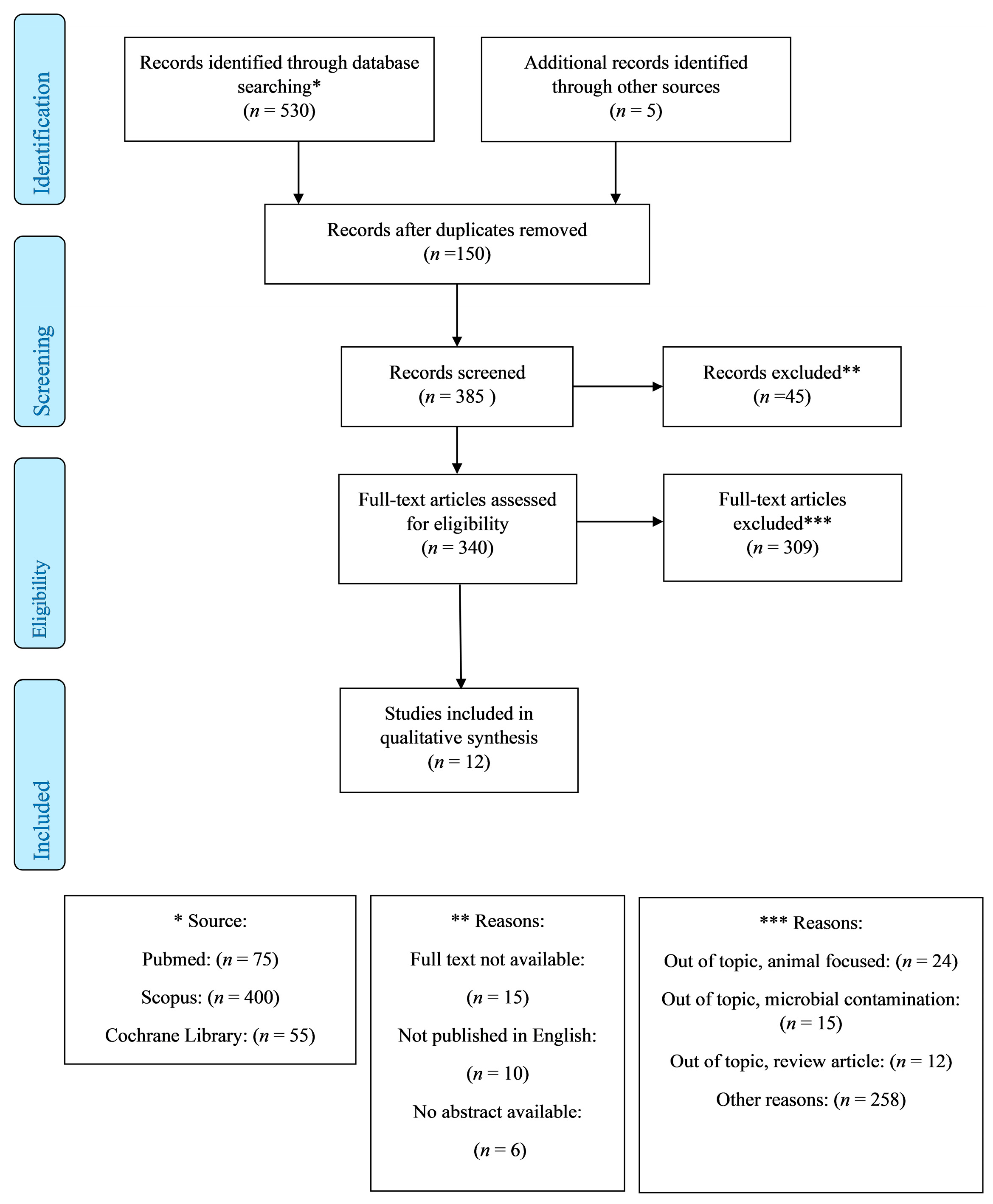
3.1. Studies Included
3.2. Assessment
3.3. Findings in the Pediatric Population
3.4. Findings in the Adult Population
4. Discussion
5. Conclusions
6. Future Directions
Supplementary Materials
Author Contributions
Funding
Institutional Review Board Statement
Informed Consent Statement
Data Availability Statement
Conflicts of Interest
Abbreviations
| BTF | blenderized tube feeding |
| ESPEN | European Society for Clinical Nutrition and Metabolism |
| ETF | enteral tube feeding |
| G-tube | gastrostomy tube |
| HEN | home enteral nutrition |
| SCF | standard commercial formula |
References
- Bischoff, S.C.; Austin, P.; Boeykens, K.; Chourdakis, M.; Cuerda, C.; Jonkers-Schuitema, C.; Lichota, M.; Nyulasi, I.; Schneider, S.M.; Stanga, Z.; et al. ESPEN guideline on home enteral nutrition. Clin. Nutr. 2020, 39, 5–22. [Google Scholar] [CrossRef] [Scilit]
- Gramlich, L.; Hurt, R.T.; Jin, J.; Mundi, M.S. Home Enteral Nutrition: Towards a Standard of Care. Nutrients 2018, 10, 1020. [Google Scholar] [CrossRef] [Scilit]
- Bering, J.; DiBaise, J.K. Home Parenteral and Enteral Nutrition. Nutrients 2022, 14, 2558. [Google Scholar] [CrossRef] [Scilit]
- Doley, J. Enteral Nutrition Overview. Nutrients 2022, 14, 2180. [Google Scholar] [CrossRef] [Scilit]
- Schmidt, S.B.; Kulig, W.; Winter, R.; Vasold, A.S.; Knoll, A.E.; Rollnik, J.D. The effect of a natural food based tube feeding in minimizing diarrhea in critically ill neurological patients. Clin. Nutr. 2019, 38, 332–340. [Google Scholar] [CrossRef] [Scilit]
- Oparaji, J.A.; Sferra, T.; Sankararaman, S. Basics of Blenderized Tube Feeds: A Primer for Pediatric Primary Care Clinicians. Gastroenterol. Res. 2019, 12, 111–114. [Google Scholar] [CrossRef] [Scilit]
- O’Flaherty, T.; Santoro, K.; Pentiuk, S. Calculating and Preparing a Pureed-by-Gastrostomy-Tube (PBGT) Diet for Pediatric Patients with Retching and Gagging Postfundoplication. Infant Child Adolesc. Nutr. 2011, 3, 361–364. [Google Scholar] [CrossRef] [Scilit]
- Bobo, E. Reemergence of Blenderized Tube Feedings: Exploring the Evidence. Nutr. Clin. Pract. 2016, 31, 730–735. [Google Scholar] [CrossRef] [Scilit]
- Epp, L.; Lammert, L.; Vallumsetla, N.; Hurt, R.T.; Mundi, M.S. Use of Blenderized Tube Feeding in Adult and Pediatric Home Enteral Nutrition Patients. Nutr. Clin. Pract. 2017, 32, 201–205. [Google Scholar] [CrossRef] [Scilit]
- Bennett, K.; Hjelmgren, B.; Piazza, J. Blenderized Tube Feeding: Health Outcomes and Review of Homemade and Commercially Prepared Products. Nutr. Clin. Pract. 2020, 35, 417–431. [Google Scholar] [CrossRef] [Scilit]
- Ribeiro-Mourão, F.; Bertaud, S.; Brierley, J.; McCulloch, R.; Köglmeier, J.; Hill, S.M. Use of home parenteral nutrition in severely neurologically impaired children. Arch. Dis. Child 2022, 107, 365–370. [Google Scholar] [CrossRef] [Scilit]
- Tricco, A.C.; Lillie, E.; Zarin, W.; O’Brien, K.K.; Colquhoun, H.; Levac, D.; Moher, D.; Peters, M.D.J.; Horsley, T.; Weeks, L.; et al. PRISMA Extension for Scoping Reviews (PRISMA-ScR): Checklist and Explanation. Ann. Intern. Med. 2018, 169, 467–473. [Google Scholar] [CrossRef] [Scilit]
- NHLBI. Available online: https://www.nhlbi.nih.gov/health-topics/study-quality-assessment-tools (accessed on 1 September 2022).
- Ma, L.-L.; Wang, Y.-Y.; Yang, Z.-H.; Huang, D.; Weng, H.; Zeng, X.-T. Methodological quality (risk of bias) assessment tools for primary and secondary medical studies: What are they and which is better? Mil. Med. Res. 2020, 7, 7. [Google Scholar] [CrossRef] [Scilit]
- Johnson, T.W.; Milton, D.L.; Johnson, K.; Carter, H.; Hurt, R.T.; Mundi, M.S.; Epp, L.; Spurlock, A.L. Comparison of Microbial Growth Between Commercial Formula and Blenderized Food for Tube Feeding. Nutr. Clin. Pract. 2019, 34, 257–263. [Google Scholar] [CrossRef] [Scilit]
- Trollip, A.; Lindeback, R.; Banerjee, K. Parental Perspectives on Blenderized Tube Feeds for Children Requiring Supplemental Nutrition. Nutr. Clin. Pract. 2020, 35, 471–478. [Google Scholar] [CrossRef] [Scilit]
- Hurt, R.T.; Varayil, J.E.; Epp, L.M.; Pattinson, A.K.; Lammert, L.M.; Lintz, J.E.; Mundi, M.S. Blenderized Tube Feeding Use in Adult Home Enteral Nutrition Patients: A Cross-Sectional Study. Nutr. Clin. Pract. 2015, 30, 824–829. [Google Scholar] [CrossRef] [Scilit]
- Batsis, I.D.; Davis, L.; Prichett, L.; Wu, L.; Shores, D.; Yueng, K.A.; Oliva-Hemker, M. Efficacy and Tolerance of Blended Diets in Children Receiving Gastrostomy Feeds. Nutr. Clin. Pract. 2020, 35, 282–288. [Google Scholar] [CrossRef] [Scilit]
- Kernizan, D.; Mintz, D.; Colin, M.; Melanie, L.; Lindsay, Y.; Yen Ping, C.; Elizaveta, I.; Soula, K.; Melissa, W. Outcomes and Safety of Blenderized Tube Feedings in Pediatric Patients: A Single Center’s Experience. J. Pediatr. Gastroenterol. Nutr. 2020, 71, e124–e128. [Google Scholar] [CrossRef] [Scilit]
- Samela, K.; Mokha, J.; Emerick, K.; Davidovics, Z.H. Transition to a Tube Feeding Formula with Real Food Ingredients in Pediatric Patients With Intestinal Failure. Nutr. Clin. Pract. 2017, 32, 277–281. [Google Scholar] [CrossRef] [Scilit]
- Fabiani, A.; Sanson, G.; Bottigliengo, D.; Dreas, L.; Zanetti, M.; Lorenzoni, G.; Gatti, G.; Sacilotto, M.; Pappalardo, A.; Gregori, D. Impact of a natural versus commercial enteral-feeding on the occurrence of diarrhea in critically ill cardiac surgery patients. A retrospective cohort study. Int. J. Nurs. Stud. 2020, 108, 103605. [Google Scholar] [CrossRef] [Scilit]
- Pentiuk, S.; O’Flaherty, T.; Santoro, K.; Willging, P.; Kaul, A. Pureed by gastrostomy tube diet improves gagging and retching in children with fundoplication. J. Parenter. Enteral. Nutr. 2011, 35, 375–379. [Google Scholar] [CrossRef] [Scilit]
- Gallagher, K.; Flint, A.; Mouzaki, M.; Carpenter, A.; Haliburton, B.; Bannister, L.; Norgrove, H.; Hoffman, L.; Mack, D.; Stintzi, A.; et al. Blenderized Enteral Nutrition Diet Study: Feasibility, Clinical, and Microbiome Outcomes of Providing Blenderized Feeds Through a Gastric Tube in a Medically Complex Pediatric Population. J. Parenter. Enteral. Nutr. 2018, 42, 1046–1060. [Google Scholar] [CrossRef] [Scilit]
- Hron, B.; Fishman, E.; Lurie, M.; Clarke, T.; Chin, Z.; Hester, L.; Burch, E.; Rosen, R. Health Outcomes and Quality of Life Indices of Children Receiving Blenderized Feeds via Enteral Tube. J. Pediatr. 2019, 211, 139–145. [Google Scholar] [CrossRef] [Scilit] [PubMed]
- Spurlock, A.Y.; Johnson, T.W.; Pritchett, A.; Pierce, L.; Hussey, J.; Johnson, K.; Carter, H.; Davidson, S.L.; Mundi, M.S.; Epp, L.; et al. Blenderized food tube feeding in patients with head and neck cancer. Nutr. Clin. Pract. 2022, 37, 615–624. [Google Scholar] [CrossRef] [Scilit]
- Howard, L.; Ament, M.; Fleming, C.R.; Shike, M.; Steiger, E. Current use and clinical outcome of home parenteral and enteral nutrition therapies in the United States. Gastroenterology 1995, 109, 355–365. [Google Scholar]
- Diamanti, A.; Di Ciommo, V.M.; Tentolini, A.; Lezo, A.; Spagnuolo, M.I.; Campanozzi, A.; Panetta, F.; Basso, M.S.; Elia, D.; Gambarara, M. Home enteral nutrition in children: A 14-year multicenter survey. Eur. J. Clin. Nutr. 2013, 67, 53–57. [Google Scholar] [CrossRef] [Scilit]
- American Speech-Language-Hearing Association. Pediatric Feeding and Swallowing. (Practice Portal). Available online: https://www.asha.org/practice-portal/clinical-topics/pediatric-feeding-and-swallowing/ (accessed on 1 October 2022).
- Onesimo, R.; Giorgio, V.; Viscogliosi, G.; Sforza, E.; Kuczynska, E.; Margiotta, G.; Iademarco, M.; Proli, F.; Rigante, D.; Zampino, G.; et al. Management of nutritional and gastrointestinal issues in RASopathies: A narrative review. Am. J. Med. Genet. C Semin. Med. Genet. 2022, 190, 478–493. [Google Scholar] [CrossRef] [Scilit]
- Giorgio, V.; Margiotta, G.; Stella, G.; Cicco, F.D.; Leoni, C.; Proli, F.; Zampino, G.; Gasbarrini, A.; Onesimo, R. Intestinal Permeability in Children with Functional Gastrointestinal Disorders: The Effects of Diet. Nutrients 2022, 14, 1578. [Google Scholar] [CrossRef] [Scilit]
- Parma, B.; Cianci, P.; Mariani, M.; Cereda, A.; Panceri, R.; Fossati, C.; Maestri, L.; Macchini, F.; Onesimo, R.; Zampino, G.; et al. Nissen fundoplication in Cornelia de Lange syndrome spectrum: Who are the potential candidates? Am. J. Med. Genet. A 2020, 182, 1697–1703. [Google Scholar] [CrossRef] [Scilit]
- Sforza, E.; Onesimo, R.; Leoni, C.; Giorgio, V.; Proli, F.; Notaro, F.; Kuczynska, E.M.; Cerchiari, A.; Selicorni, A.; Rigante, D.; et al. Drooling outcome measures in paediatric disability: A systematic review. Eur. J. Pediatr. 2022, 181, 2575–2592. [Google Scholar] [CrossRef] [Scilit]
- Johnson, T.W.; Spurlock, A.; Pierce, L. Survey study assessing attitudes and experiences of pediatric registered dietitians regarding blended food by gastrostomy tube feeding. Nutr. Clin. Pract. 2015, 30, 402–405. [Google Scholar] [CrossRef] [Scilit] [PubMed]
- Jazayeri, S.M.H.; Ostadrahimi, A.; Safaiyan, A.; Hashemzadeh, S.; Salehpour, F. Standard Enteral Feeding Improves Nutritional Status Compared with Hospital-Prepared Blended Formula Among Intensive Care Unit (ICU) Patients. Prog. Nutr. 2016, 18, 22–25. Available online: https://mattioli1885journals.com/index.php/progressinnutrition/article/view/4308 (accessed on 1 October 2022).
- Steel, C.; Wile, H.; Li, O.; Yedulla, S.; Hare, I.; Hopkins, B. Understanding the use and tolerance of a pediatric and an adult commercial blenderized enteral formula through real-world data. Nutr. Clin. Pract. 2022, 1–9. [Google Scholar] [CrossRef] [Scilit]
- Chandrasekar, N.; Dehlsen, K.; Leach, S.T.; Krishnan, U. Exploring Clinical Outcomes and Feasibility of Blended Tube Feeds in Children. J. Parenter. Enteral. Nutr. 2021, 45, 685–698. [Google Scholar] [CrossRef] [Scilit]
- Milton, D.L.; Johnson, T.W.; Johnson, K.; Murphy, B.; Carter, H.; Hurt, R.T.; Mundi, M.S.; Epp, L.; Spurlock, A.Y.; Hussey, J. Accepted Safe Food-Handling Procedures Minimizes Microbial Contamination of Home-Prepared Blenderized Tube-Feeding. Nutr. Clin. Pract. 2020, 35, 479–486. [Google Scholar] [CrossRef] [Scilit]
- Galindo, C.O.; Beux, M.R.; da Costa, R.L.; Uniat, K.C.; Leobet, J.; Ferreira, S.M.R.; Medeiros, C.O.; Schieferdecker, M.E.M.; Stangarlin-Fiori, L. Home-Prepared Enteral Tube Feeding: Evaluation of Microbiological Contamination, Hygiene, and the Profile of the Food Handler. Nutr. Clin. Pract. 2021, 36, 704–717. [Google Scholar] [CrossRef] [Scilit]
- Ojo, O.; Adegboye, A.R.A.; Ojo, O.O.; Wang, X.; Brooke, J. The Microbial Quality and Safety of Blenderised Enteral Nutrition Formula: A Systematic Review. Int. J. Environ. Res. Public Health 2020, 17, 9563. [Google Scholar] [CrossRef] [Scilit]
- Brown, T.; Zelig, R.; Radler, D.R. Clinical Outcomes Associated with Commercial and Homemade Blenderized Tube Feedings: A Literature Review. Nutr. Clin. Pract. 2020, 35, 442–453. [Google Scholar] [CrossRef] [Scilit]
- Barrett, J.S.; Shepherd, S.J.; Gibson, P.R. Strategies to manage gastrointestinal symptoms complicating enteral feeding. J. Parenter. Enteral. Nutr. 2009, 33, 21–26. [Google Scholar] [CrossRef] [Scilit]
- Wayne, N.; Solomon, J.; Martinez Moreno, F.J.; Kocinski, M.; Wyk, J.V.; Hubbard, G.P. A review of home enteral tube feeding home care service and product provision, with the aim to improve environmental sustainability. Clin. Nutr. ESPEN 2020, 35, 208–252. [Google Scholar]
- Zettle, S. Deconstructing Pediatric Blenderized Tube Feeding: Getting Started and Problem Solving Common Concerns. Nutr. Clin. Pract. 2016, 31, 773–779. [Google Scholar] [CrossRef] [Scilit] [PubMed]
- Bischoff, S.C.; Austin, P.; Boeykens, K.; Chuordakis, M.; Cuerda, C.; Jonkers-Schuitema, C.; Lichota, M.; Nyulasi, I.; Schneider, S.M.; Stanga, Z.; et al. ESPEN practical guideline: Home enteral nutrition. Clin. Nutr. 2022, 41, 468–488. [Google Scholar] [CrossRef] [Scilit] [PubMed]
- Boullata, J.I.; Carrera, A.L.; Harvey, L.; Escuro, A.A.; Hudson, L.; Mays, A.; McGinnis, C.; Wessel, J.J.; Bajpai, S.; Beebe, M.L.; et al. ASPEN Safe Practices for Enteral Nutrition Therapy [Formula: See text]. J. Parenter. Enteral. Nutr. 2016, 41, 15–103. [Google Scholar] [CrossRef] [Scilit]
- Kozeniecki, M.; Fritzshall, R. Enteral Nutrition for Adults in the Hospital Setting. Nutr. Clin. Pract. 2015, 30, 634–651. [Google Scholar] [CrossRef] [Scilit] [PubMed]
- Giles, K.H.; Kubrak, C.; Baracos, V.E.; Olson, K.; Mazurak, V.C. Recommended European Society of Parenteral and Enteral Nutrition protein and energy intakes and weight loss in patients with head and neck cancer. Head Neck 2016, 38, 1248–1257. [Google Scholar] [CrossRef] [Scilit]

| Study | Q1 | Q2 | Q3 | Q4 | Q5 | Q6 | Q7 | Q8 | Q9 | Q10 | Q11 | Q12 | Q13 | Q14 | Quality (Total Quality Score) |
|---|---|---|---|---|---|---|---|---|---|---|---|---|---|---|---|
| Johnson et al., 2018 * [15] | Y | Y | Y | Y | NR | NO | NO | NO | Y | NA | Y | NO | NA | NO | Fair |
| Trollip et al., 2019 * [16] | Y | Y | Y | Y | NR | NO | NO | NO | Y | NA | Y | NO | NA | NO | Fair |
| Hurt et al., 2015 * [17] | NO | Y | Y | NR | NO | Y | Y | NO | NO | NO | Y | NO | NA | NO | Poor |
| Batsis et al., 2020 [18] | Y | Y | Y | Y | NR | Y | Y | Y | Y | Y | Y | NO | Y | NO | Good |
| Kernizan et al., 2020 [19] | Y | Y | Y | Y | NO | Y | Y | Y | Y | Y | Y | NO | Y | NO | Good |
| Samela et al., 2017 [20] | Y | Y | Y | Y | NO | Y | Y | Y | Y | Y | Y | NO | Y | NO | Good |
| Fabiani et al., 2020 [21] | Y | Y | Y | Y | NO | Y | Y | Y | Y | NO | Y | NO | Y | Y | Good |
| Study | Q1 | Q2 | Q3 | Q4 | Q5 | Q6 | Q7 | Q8 | Q9 | Q10 | Q11 | Q12 | Quality (Total Quality Score) |
|---|---|---|---|---|---|---|---|---|---|---|---|---|---|
| Pentiuk et al., 2011 [22] | Y | Y | Y | Y | NO | Y | Y | NA | Y | NO | Y | NA | Fair |
| Gallagher et al., 2018 [23] | Y | Y | Y | Y | NO | Y | Y | NO | Y | Y | Y | NA | Good |
| Hron et al., 2019 [24] | Y | Y | Y | Y | NO | Y | Y | NO | Y | Y | NO | NA | Fair |
| Spurlock et al., 2022 [25] | Y | Y | Y | Y | NO | Y | Y | NO | NO | Y | Y | NA | Fair |
| Study | Q1 | Q2 | Q3 | Q4 | Q5 | Q6 | Q7 | Q8 | Q9 | Q10 | Q11 | Q12 | Q13 | Q14 | Quality (Total Quality Score) |
|---|---|---|---|---|---|---|---|---|---|---|---|---|---|---|---|
| Schmidt et al., 2018 [5] | Y | Y | Y | NO | NO | Y | NO | Y | Y | Y | Y | NO | Y | Y | Good |
| Study | Population and Sample Size | Outcome Evaluation Method | Blenderized Food—Type | Diet Prescription Guidelines | Follow-Up Period |
|---|---|---|---|---|---|
| Johnson et al., 2018 [15] | 255 children 50.5% (n = 173) using CF and 49.5% (n = 82) using BTF | Questionnaire | Homemade (59%) or commercially available blenderized | NR | NA |
| Trollip et al., 2019 [16] | 12 children | Questionnaire | Homemade (33%) or a combination of homemade and formula (17.5%) | NR | NA |
| Hurt et al., 2015 [17] | 54 adults 50.5% (n = 30) using BTF and 45.5% (n = 24) using CF | Self-designed survey | Homemade | NR | NA |
| Batsis et al., 2020 [18] | 23 children | Clinical documentation provided in the medical records | Homemade (65%) or commercially available blenderized (17.5%) or a combination of both (17.5%) | NR | 3 and 6 months |
| Kernizan et al., 2020 [19] | 34 children | Parent report Clinical documentation provided in the medical records | Homemade | Recipes designed by dietitians | NA |
| Samela et al., 2017 [20] | 10 children All transitioned from an elemental formula to real food ingredients formula (TFRF) | The number of defecations and the consistency of each stool | Commercially available blenderized | NR | NA |
| Fabiani et al., 2020 [21] | 250 adults 103 fed blenderized natural enteral feeding and 112 fed commercial formulas. | The number of defecations and the consistency of each stool according to the Bristol Stool Chart (BSC) | Homemade | Simple weight-based equation (25–30 kcal/kg/day) to calculate daily caloric target (Atasever et al., 2018; Taylor et al., 2016) | 8 days |
| Pentiuk et al., 2011 [22] | 33 children | Survey | Homemade | Food Processor Program (ESHA Research, Salem, OR) | 2 months |
| Gallagher et al., 2018 [23] | 20 children | Questionnaire | Homemade | Canada’s Food Guide for Healthy Eating. VitamixR 7500 G-Series blender | 6 months |
| Hron et al., 2019 [24] | 70 children | Pediatric Gastroesophageal Reflux Disease Symptom and Quality-of-Life Questionnaire (PGSQ); (L) PedsQL Gastrointestinal Symptoms Scale (GI-PedsQL). | Homemade (67%) or commercially available blenderized | Cronometer, a web-based nutrient database (Revelstoke, British Columbia) | 1 year |
| Spurlok et al., 2022 [25] | 14 adults first 2 weeks in CF, next 3 weeks partial BTF, next full BTF | Questionnaire | Commercially available blenderized | NR | 6 weeks |
| Schmidt et al., 2019 [5] | 118 adults 50% using commercially available product based on real foods and 50% using standard tube feed | The number of defecations and the consistency of each stool according to the Bristol Stool Chart (BSC) | Commercially available blenderized | FAO Expert Consultation on Energy and Protein Requirements (1985) | 1 month |
Disclaimer/Publisher’s Note: The statements, opinions and data contained in all publications are solely those of the individual author(s) and contributor(s) and not of MDPI and/or the editor(s). MDPI and/or the editor(s) disclaim responsibility for any injury to people or property resulting from any ideas, methods, instructions or products referred to in the content. |
© 2023 by the authors. Licensee MDPI, Basel, Switzerland. This article is an open access article distributed under the terms and conditions of the Creative Commons Attribution (CC BY) license (https://creativecommons.org/licenses/by/4.0/).
Share and Cite
Sforza, E.; Limongelli, D.; Giorgio, V.; Margiotta, G.; Proli, F.; Kuczynska, E.M.; Leoni, C.; Rigante, D.; Contaldo, I.; Veredice, C.; et al. The Impact of Blenderized Tube Feeding on Gastrointestinal Symptoms, a Scoping Review. Appl. Sci. 2023, 13, 2173. https://doi.org/10.3390/app13042173
Sforza E, Limongelli D, Giorgio V, Margiotta G, Proli F, Kuczynska EM, Leoni C, Rigante D, Contaldo I, Veredice C, et al. The Impact of Blenderized Tube Feeding on Gastrointestinal Symptoms, a Scoping Review. Applied Sciences. 2023; 13(4):2173. https://doi.org/10.3390/app13042173
Chicago/Turabian StyleSforza, Elisabetta, Domenico Limongelli, Valentina Giorgio, Gaia Margiotta, Francesco Proli, Eliza Maria Kuczynska, Chiara Leoni, Donato Rigante, Ilaria Contaldo, Chiara Veredice, and et al. 2023. "The Impact of Blenderized Tube Feeding on Gastrointestinal Symptoms, a Scoping Review" Applied Sciences 13, no. 4: 2173. https://doi.org/10.3390/app13042173
APA StyleSforza, E., Limongelli, D., Giorgio, V., Margiotta, G., Proli, F., Kuczynska, E. M., Leoni, C., Rigante, D., Contaldo, I., Veredice, C., Rinninella, E., Gasbarrini, A., Zampino, G., & Onesimo, R. (2023). The Impact of Blenderized Tube Feeding on Gastrointestinal Symptoms, a Scoping Review. Applied Sciences, 13(4), 2173. https://doi.org/10.3390/app13042173

