Abstract
With the extensive application of data analysis in various parts of the landscape design process, Building Information Modeling (BIM), City Information Modeling (CIM), and Landscape Information Modeling (LIM) all aim to achieve key data sharing and collaboration in the whole cycle and promote the development of smart cities. Landscape element indicators are complex, diverse, and difficult to quantify, which is one of the reasons for the slow development of LIM. However, with the development requirements of LIM, quantifying landscape elements and transforming landscapes into digital landscape information has become a hot spot in the landscape design industry. Landscape parametric design aims to transform the design elements into quantifiable parameters, obtain the design scheme by changing the value of the parameters, and form the design results based on digital information. It is one of the foundations of LIM. Based on the Rhino + Grasshopper (R+G) platform, this study takes Shuixizhuang Park as an example and establishes the parametric design approach for the park entrance. The approach involves several steps: (1) Confirming the boundary and key points of the park to prepare the basic data for parametric design. (2) Utilizing the Physarealm Algorithm Method (PAM) to simulate crowd paths, the Site Slope Algorithm Model (SSAM) to analyze terrain slope, the Road Intersection Algorithm Model (RIAM) to determine the scope of the park entrance area based on the national and local design codes, and the Crowd Density Algorithm Model (CDAM) and Crowd Convenience Algorithm Model (CCAM) to analyze the density and convenience of the crowd to preliminarily confirm the park entrance. (3) Meeting the basic requirements of the crowd and vehicle gathering and spread by using the Square Area Review Algorithm Model (SARAM) and Parking Lot Review Algorithm Model (PLRAM) to recheck the site area of the park entrance square and park lot to optimize the park entrance. This approach constructs several site analysis models based on the R+G platform and introduces PAM to analyze crowd activity paths, proposing a landscape parametric design method that integrates crowd activity and landscape design requirements. Compared with the classical design, the landscape parametric design derived from the comprehensive data analysis reduces human interference, is more scientific and practical, and better meets the requirements of people entering the park. The approach also provides ideas for other landscape parametric site selections. By adjusting the values of element parameters, the approach can also be applied to the site selection and design of other landscapes.
1. Introduction
An urban park serves as a natural oasis in the midst of a city, providing space for relaxation, exercise, socialization, sightseeing, and collective cultural activities for its residents. As such, it plays a crucial role in maintaining urban ecological environments and promoting cultural development. Consequently, the layout and planning of urban parks are highly prioritized in urban construction and management [1].
Of particular importance is the entrance to the park, which serves as the primary means of access for urban residents [2]. Located on the outside of the park, the entrance is linked to urban streets that connect it to various public areas (e.g., residential, business, commercial, and culture and education districts) within its service radius. By doing so, it enables easy accessibility for residents. Within the park, the entrance is designed to connect visitors with the various scenic spots via a network of roads or visual corridors. This ensures that urban residents can quickly reach specific locations of interest upon entering the park. Consequently, the proper placement and layout of the park entrance are crucial in shaping the visitors’ overall experience and satisfaction when engaging in recreational activities within the park [2,3,4]. Therefore, planning and construction efforts must prioritize this aspect to ensure that the entrance remains convenient and functional for urban residents.
The selection of the entrance location in urban park planning is influenced by many factors, necessitating the optimization of the site selection by comprehensively considering the impact of various factors [5,6]. Urban roads, residential areas, business areas, and commercial areas have an impact on the flow of people, which is the most important factor in the site selection of the park entrance. Terrain conditions are a key factor affecting the gathering and dispersal of visitors at the park entrance. The main attractions and public buildings in the park need to gather and disperse a large number of people, which also affect the site selection of the park entrance.
The selection of a suitable site for the entrance to a park is a complex process that requires a comprehensive analysis of various factors to obtain an optimized plan. However, the traditional empirical methods used by designers to analyze factors such as people flow direction and terrain often lead to inconsistent results. With the advancement of computer technology and data analysis, parametric design has become a popular trend in design [7,8,9]. By utilizing data analysis, quantifying indicators, and adjusting parameters, computers can assist in analyzing site functions in various designs, making this approach a research hot spot in the design field [10]. This shift in methodology is changing the traditional approach that relies solely on the designer’s experience to analyze site conditions and determine the design outcomes, making it more efficient and accurate.
In landscape design, parametric design methods are more widely used in mountain landscapes and urban parks. This is due to the fact that mountain landscapes have complex factors such as the topography, vegetation, water, soil, etc. Landscape design based solely on the designer’s experience and perception is prone to large errors. Therefore, mountain landscape design is one of the earlier types utilizing data analysis [11,12]. Parametric design of mountain landscapes is mainly used in two aspects: road line selection and landscape architecture site selection.
There are two methods for parametric road selection in mountain landscape design. One method involves using the comprehensive Cost Shortest Path Algorithm Model in ArcGIS as a reference to build a parametric road selection model of a scenic road [1,13,14]. Another method involves using the Rhino + Grasshopper (R+G) platform to operate the Dijkstra shortest path algorithm, genetic algorithm, and other methods, with road selection influencing factors as parameters, to build an automatic route selection model for the scenic roads [15]. The route selection model takes the standard value of the limit plane curve of the scenic spot as the quantitative index, with the goal of achieving low-impact development and low-cost construction of scenic spots.
Landscape architecture site selection in mountain landscapes is also a focus of parametric design on the ArcGIS platform. The process of site selection includes (1) analyzing the location and scale control of traditional landscape buildings for mountain and waterfront landscapes and constructing the relationship between the landscape buildings and the surrounding environment [16]. (2) Using Landsat TM remote sensing image data and parametric methods such as Model Builder, based on the interaction law of site–environmental ecological factors and the ecological sensitivity of mountain landscapes as the main goal, to analyze the comprehensive factors of the mountain environment [14]. (3) Forming the coupling association between the service building and site and optimizing the site selection of the service building in scenic spots on the GIS platform [17].
The GIS method is applied to large-scale mountain landscapes, and the R+G method is applied to small-scale ones. The advantage of the R+G method is that the road selection results can be shared with software platforms such as Revit.
Compared with mountain landscapes, urban parks lack the complex terrain and ecological diversity. This poses challenges for landscape designers who often make subjective decisions based on experience, leading to low site utilization, green space congestion, inconvenient crowd activities, unresolved evacuation routes, and overcrowding. To address these issues, researchers have proposed analyzing park ecology, function, landscape, and crowd activities and carefully selecting appropriate parameters and rules. By incorporating site characteristics and crowd needs, designers can better understand environmental features and spatial layouts and create parks that cater to visitors’ interests and activities [6,18,19]. This approach can enhance the utilization of urban parks and maximize their benefits for the community.
In terms of urban park planning, the parametric design of small urban parks with a small size and single function is based on the selection of parameters and design rules of the park, such as the function of the park, the needs of the crowd, and the cultural display, and the influence of quantitative indicators such as the distribution of tourists, the time of visiting, the landscape area, the proportion of evergreen leaves of plants, and the greening coverage rate are considered on the R+G platform so as to complete the overall layout of the park [20], which reduce the subjective influence of designers and achieve better practical results. The parametric site selection method of the quiet rest area of the park provides an idea for the site selection of the functional area of the park. The quiet rest area of the park requires a relatively quiet environment, the space is relatively closed, the scenery is beautiful, it is away from the activity area, etc. On the R+G platform, parameterization rules and design models are established based on key influencing factors such as location, terrain, and water body, and a location suitable for quiet rest areas is selected on the park land [9].
The same methodology can be applied when selecting the location of other functional areas such as sports courts, playgrounds, and picnic areas. Each of these areas has specific design requirements that can be parameterized and translated into a selection model [9,14]. For example, a sports court may require a level surface, good drainage, and nearby parking, while a playground may require a safe surface, shaded areas, and proximity to restrooms.
By applying a parametric site selection method, park planners can ensure that each functional area is optimally located to meet its specific design requirements [20]. This can help to maximize the use and enjoyment of the park for its visitors while minimizing the need for costly redesigns or modifications in the future.
In summary, landscape parametric design is still in its early stages, and the primary research direction and content involve the analysis of landscape data to aid in landscape site selection and road selection [21]. Whether it is a large park (such as a mountain park) or an urban park, the use of parametric methods to address location problems in complex environments involves determining parameters based on the influencing elements, establishing the parameter rules based on the relationship between the influencing elements, selecting an appropriate software platform to calculate the appropriate location of the site (Table 1), and developing a site selection design that moves from sensibility to rationality [7,22].
Table 1.
Comparison of technical platforms of parametric design.
However, in landscape parametric design, the determination of parameters and rules primarily relies on the material elements in the landscape, with less consideration given to human factors. This raises questions about the friendliness of the parametric design results to landscape users. People’s behavior and feelings should be one of the primary considerations of landscape design, especially in urban parks. Thus, it is necessary to incorporate people’s behavior and feelings toward the landscape into the parametric design to ensure that the urban landscape is more in line with people’s needs. Therefore, integrating human behavior and feelings into parametric design is another key problem that landscape parametric design needs to address.
2. Materials and Methods
2.1. Introduction of the Study Area
2.1.1. The Situation of Shuixizhuang Park
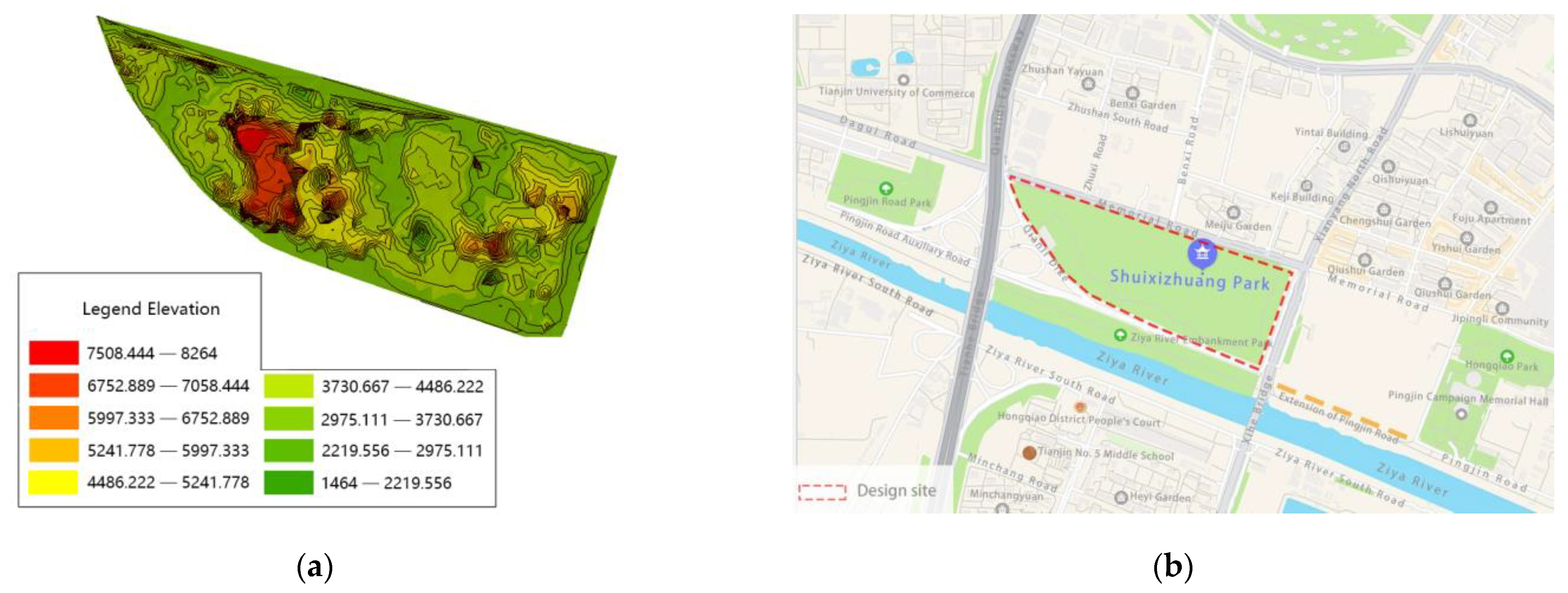
Shuixizhuang Park is a district park to be built in Hongqiao District, Tianjin, China. It is adjacent to Memorial Hall Road to the north, the Ziya River to the south, Xihe Bridge on Xianyang North Road to the east, and Tianhe Bridge on the Northwest-Half-Ring Expressway (Qianli Di Road) to the west, connecting to the plot on the south side across the Ziya River. The east side of the park is land to be developed. Based on the 1:500 topographic map created in 2017 (Figure 1a), the park covers an area of 26.5 hectares. The park site is generally flat, with topographic changes in the southwest and southeast, and a height difference of about 3 m. The slope of the whole park ranges from 0.04% to 35.18%. There is a concave site in the middle of the park with 2 ponds, covering an area of about 1.85 hectares.
Figure 1.
The situation of Shuixizhuang Park: (a) topographic map of Shuixizhuang Park, 2017; (b) surrounding environment of Tianjin Shuixizhuang Park.
2.1.2. The Surrounding of Shuixizhuang Park
Since the west side of the park is adjacent to the Northwest-Half-Ring Expressway (Qianli Di Road) in Tianjin, pedestrians cannot cross it. Therefore, the service population of the park mainly comes from the residential areas, industrial parks, office buildings, schools, etc., on the northern, northeast, and south sides of the park. The service range of the general district-level park is 1 km2, but due to the large area of Shuixizhuang Park, the service range is calculated based on the service radius of 1.5 km. Within the service radius of the park, there are mainly 12 residential areas such as Jinqiao-Meiju Huayuan, Qiushui Huayuan, Benxi Huayuan, and Cuixi Huayuan. The industrial park mainly includes Liufangzi Industrial Zone and Hongqiao District Urban Industrial Park. The office buildings include four commercial office buildings, such as Zhengrong Technology Building, Yintai Building, and Baoneng Entrepreneurship Center. Tianjin University of Commerce is on the northwest across the Northwest-Half-Ring Expressway (Figure 1b).
There are two bus stops near Shuixizhuang Park: Qianli Di Road Bus Stop and North Xianyang Road Bus Stop. There are also three road intersections surrounding the park, including the intersection of Xianyang North Road and Memorial Hall Road, the intersection of Memorial Hall Road and Qianli Di Road, and the intersection of Pingjin Road and Tianhe Bridge Interchange.
2.2. Methods
The park is surrounded by schools, residential areas, initial development of the business district, and industrial parks. The inhabitants of this area are potential visitors to the park, which presents complex challenges for determining crowd flow and direction within the park. Furthermore, there is terrain relief in the park, including a slope along the boundary, resulting in variability in park design. National and local standards require the planning and construction of an evacuation square at the park’s entrance. This area must accommodate the flow of people and meet the standards for entrance and ancillary facilities.
Considering the intricate variables that impact site selection, a parametric approach is employed to comprehensively evaluate pivotal factors pertaining to the positioning of the park entrance. If the entrance of the park is solely determined by the designers’ subjective experience and perceptual cognition of the environment, the omission of landscape design, the requirements for the park entrance square, and external access to the park may impede future planning and design efforts. A parametric approach would offer superior support in meeting visitor needs and enhancing accessibility to the park.
Parametric Site Selection Methods
According to the Park Design Code (2016), park entrance site selection generally considers the convenience, safety, and comfort of people arriving and leaving. In the traditional landscape design, designers will also consider the landscape design inside the park to make it convenient for people to reach the scenic spots of the park and to meet park management needs [4,23,24,25,26,27]. So, the parameters of park entrance site selection in traditional landscape design includes urban transportation direction and traffic, crowd direction and quantity, distance between the main entrances and the intersection of the city road, the per capita area of the gathering and evacuating square of the park entrance, and the landscape site design of the park (Table 2).
Table 2.
The parameters of the park entrances in traditional landscape design.
Therefore, the park entrance site selection is related to crowd activities and site conditions. The parameters considered in this study included the park’s service scope, crowd source, points of interest (POI) in the park, site topography, intersection with urban roads, and requirements for the area of the park entrance auxiliary sites (Table 3).
Table 3.
The parameters of the park entrance site selection.
The method of park entrance site selection in this study was as follows:
- (1)
- Utilizing simulation techniques to track the trajectory of crowd movement towards the park and pinpointing locations where it intersects with the park perimeter, thereby identifying prospective entry points.
- (2)
- Conducting an assessment of the conformity between park entrance site parameters and pertinent standards and specifications in order to ascertain the optimal location for the park entrance.
Figure 2.
Process of parametric site selection of park entrance.
Table 4.
Steps of parameterized park entrance site selection.
- (1)
- Arrangement of boundaries and key points
The boundary is the boundary of the visitor source area within the park service scope (such as community borders and the office district) and the boundary of the park. Key points include inflection points in the design site, intersection of roads, primary sources of visitor traffic (which are determined based on the intended audience of the park), and the POI within the park which are pre-selected according to the geographical features of the park during the park’s design phase.
- (2)
- Parameterized site selection of park entrance
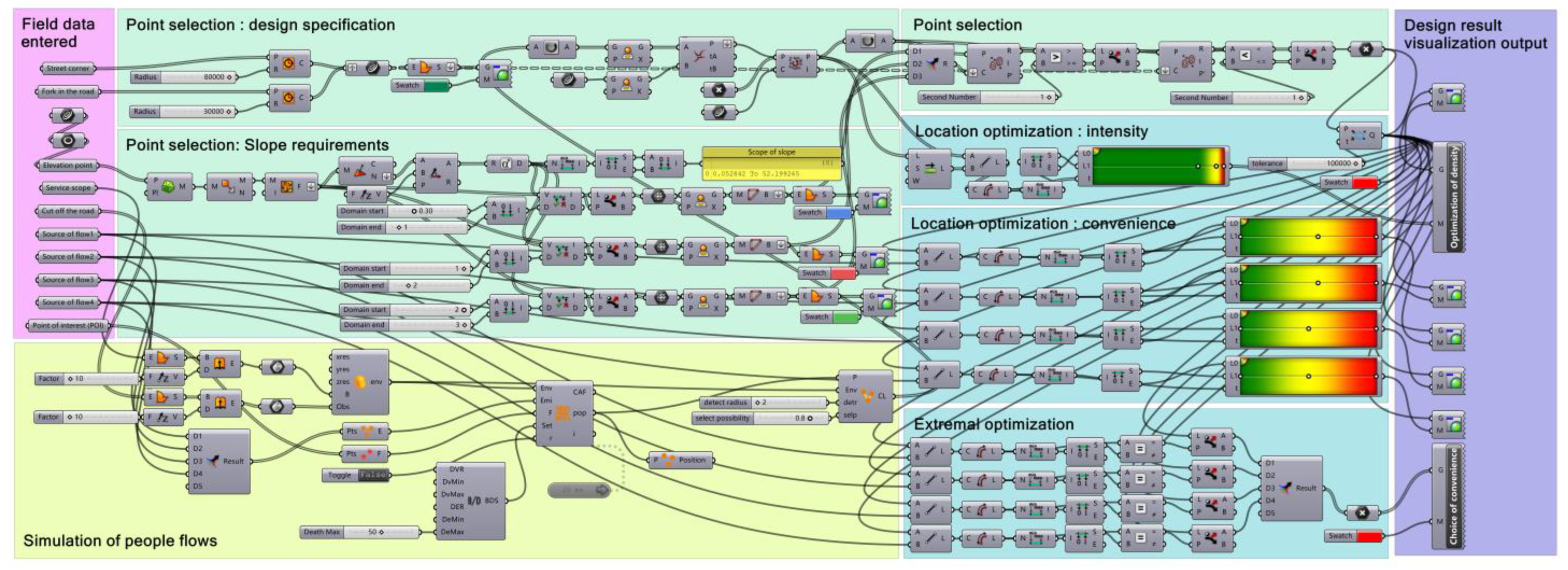
In this study, the Rhino + Grasshopper (R+G) platform was utilized for the parametric site selection of park entrances. The site selection approach consisted of three steps: (A) Simulating the crowd activity path with the Physarealm Algorithm Model (PAM) to identify the cross points of crowd activity paths and park borders. (B) Utilizing the Road Intersection Algorithm Model (RIAM) and Site Slope Algorithm Model (SSAM) to preliminarily screen the range of entrance locations. (C) Determining the location of the park entrance with the Crowd Density Algorithm Model (CDAM) and Crowd Convenience Algorithm Model (CCAM) (Figure 3).
Figure 3.
Algorithm model of parametric site selection of park entrance.
(A) Simulating crowd activity using the PAM to determine the cross points of the crowd activity path and the park borders. The key parameters are the POI in the park and the crowd source points surrounding the park. The POI of the park should be selected based on the park’s geographical features, such as highlands, water locations, flat sites suitable for crowd activities, woodlands, and other places with outstanding landscape characteristics. The crowd source points should be determined based on the surrounding residential areas, business districts, schools, and other areas where the crowd is concentrated. Areas with dense crowds should be given multiple source points to increase the weight of the crowd.
(B) Preliminary screening of the range of entrance locations utilizing the Road Intersection Algorithm Model (RIAM) and the Site Slope Algorithm Model (SSAM). The key parameter of the RIAM is the distance between the entrances and the road intersection, which can be found in the national and local design codes. The SSAM is a model that calculates the slope of the site based on Digital Elevation Model (DEM) data on the R+G platform.
(C) Determining the location of the park entrance utilizing the Crowd Density Algorithm Model (CDAM) and the Crowd Convenience Algorithm Model (CCAM) (Figure 3). The CDAM calculates the density of crowd paths and park boundary intersections by comparing the distance between two adjacent intersections. The CCAM calculates the distance between the densely populated points determined by the CDAM and the crowd source points. In different directions of the crowd source, the nearest point is selected as the entrance to the park.
- (3)
- Determining the primary and secondary entrances
To ensure easy access for park visitors and to provide guidance for the entrance construction, it is important to determine the primary and secondary entrances of the park. The location of the primary and secondary entrances can be determined based on the crowd activities [2,27,28] which are calculated by running the PAM to find the number of cross points between crowd paths and park borders. The entrance with the highest number of cross points is selected as the primary entrance, while the others are designated as secondary entrances.
- (4)
- Rechecking of Park entrance auxiliary sites
To ensure the convenience of park visitors, it is important to consider the site demand of the entrance square and the parking lot after determining the location of the park entrance. Therefore, it is necessary to recheck whether the area of the entrance square is sufficient for the crowd to gather and evacuate, and whether the parking lot can accommodate the number of vehicles.
Calculating the park entrance square area: As the primary passage for park visitors to enter and exit, the functionality of gathering and evacuation must be taken into consideration [27]. Therefore, a specific entrance square area should be planned for people to enter and exit (Formula (1)).
S: Park entrance square area.
Q: Number of visitors = park area/per capita park area (more than 10 hectares of 60 m2/ person, less than 10 hectares of 30 m2/ person [27]).
K: Conversion coefficient between the maximum number of visitors in the park and the maximum number of visitors in the park (0.5 for more than 10 hectares, 1 for less than 10 hectares).
t: Time for visitors to stay in the entrance square (3 min in the paid park, 1 min in the free park).
s: Floor space per capita of the park entrance square (1 m2).
This is the whole of the park entrance area. It is important for each park entrance to have a suitable area that meets people’s requirements for entering the park. The area of each park entrance square can be determined based on the proportion of the crowd (Formula (2)).
S′: Area of each entrance of the park.
S: The total area of the park entrance square.
a: Value of crowd of each entrance square.
A: Sum of value of crowd in the park entrance square.
Calculating the parking lot area: When planning urban comprehensive parks, it is important to consider the parking needs of visitors. According to the specification, “Parking lots should be set up within 50–100 m of the park entrance, and the area of the gather and evacuation square should not be occupied”. Additionally, “The flatness of the parking lot site ground should be between 0.3–3%” [27].
Parking lot area can be calculated based on the park area and parking requirements (Formula (3)).
S: Parking lot area.
s: Park area.
k: Number of parking spaces per 100 square meters (0.05 per 100 square meters in general urban parks).
L: Length of parking space (normally 5 m).
W: Width of parking space (normally 2.5 m).
A: Ratio of aisle area to parking space area (generally calculated according to the ratio of 1:2).
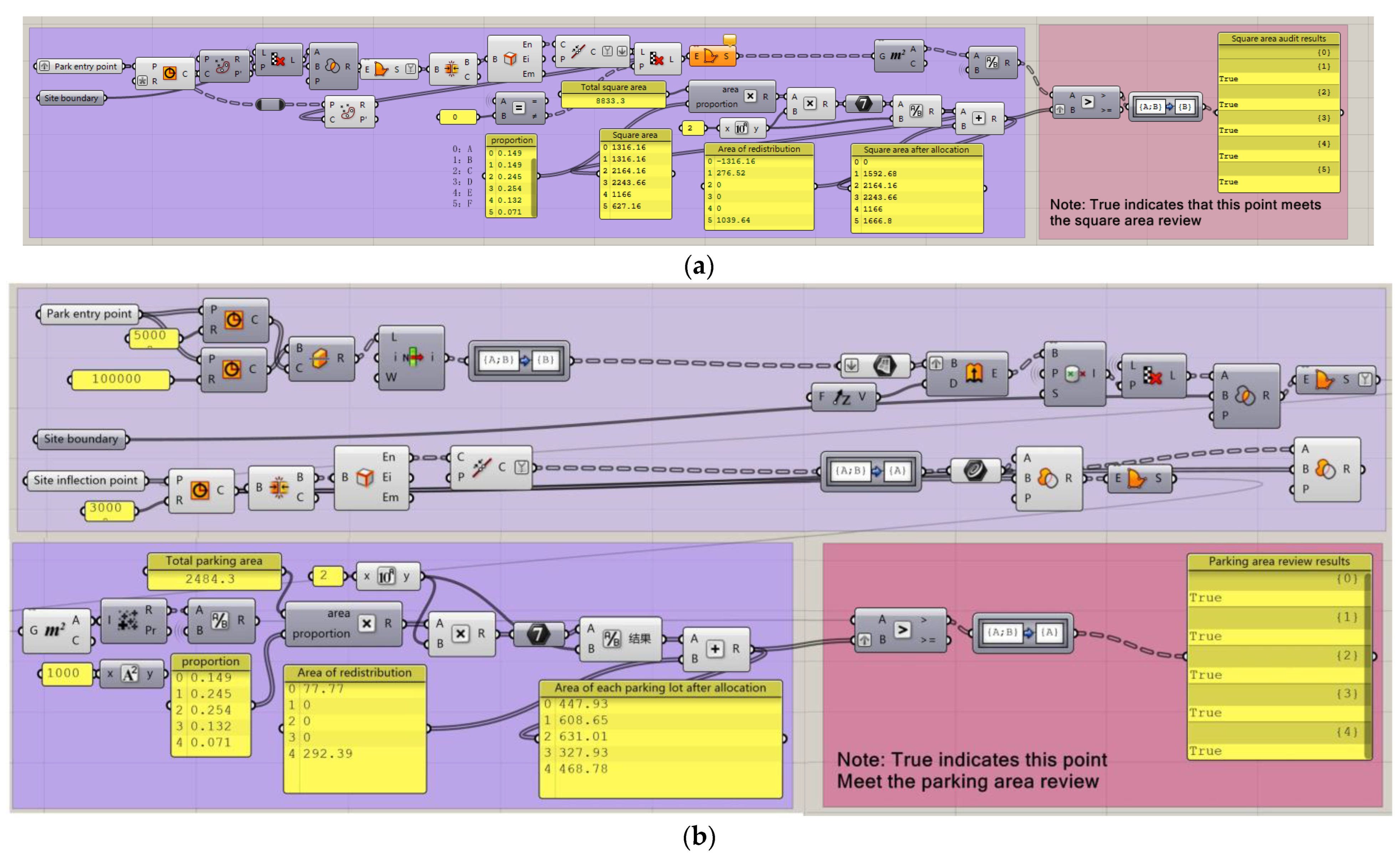
Utilizing the formulas discussed, we constructed the Square Area Review Algorithm Model (SARAM) (Figure 4a) and the Parking Lot Review Algorithm Model (PLRAM) (Figure 4b) on the R+G platform.
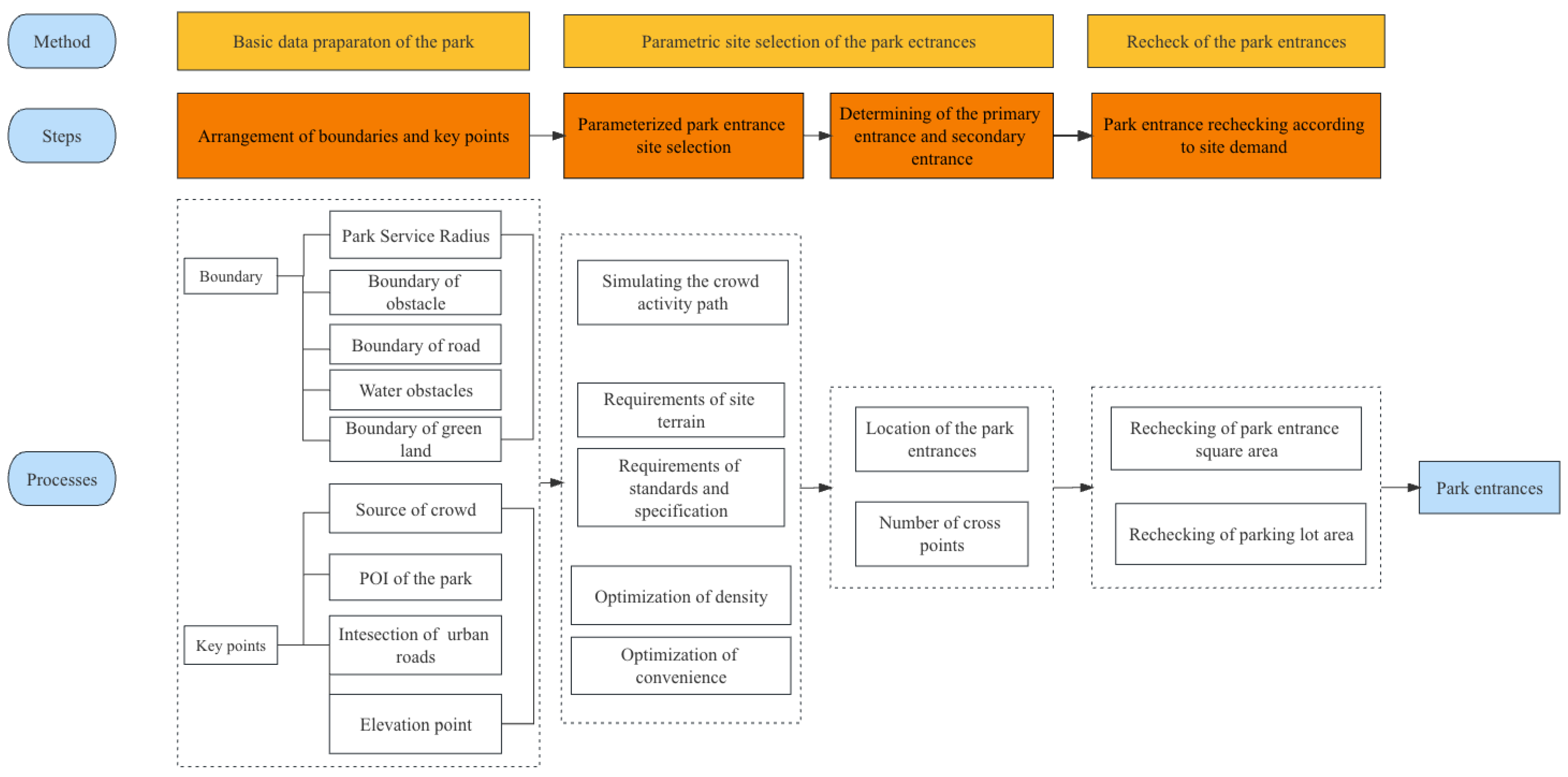
Figure 4.
Algorithm model of rechecking park entrance square area and parking lot area: (a) Square Area Review Algorithm Model (SARAM); (b) Parking Lot Review Algorithm Model (PLRAM).
3. Results
3.1. Key Points of the Parametric Site Selection
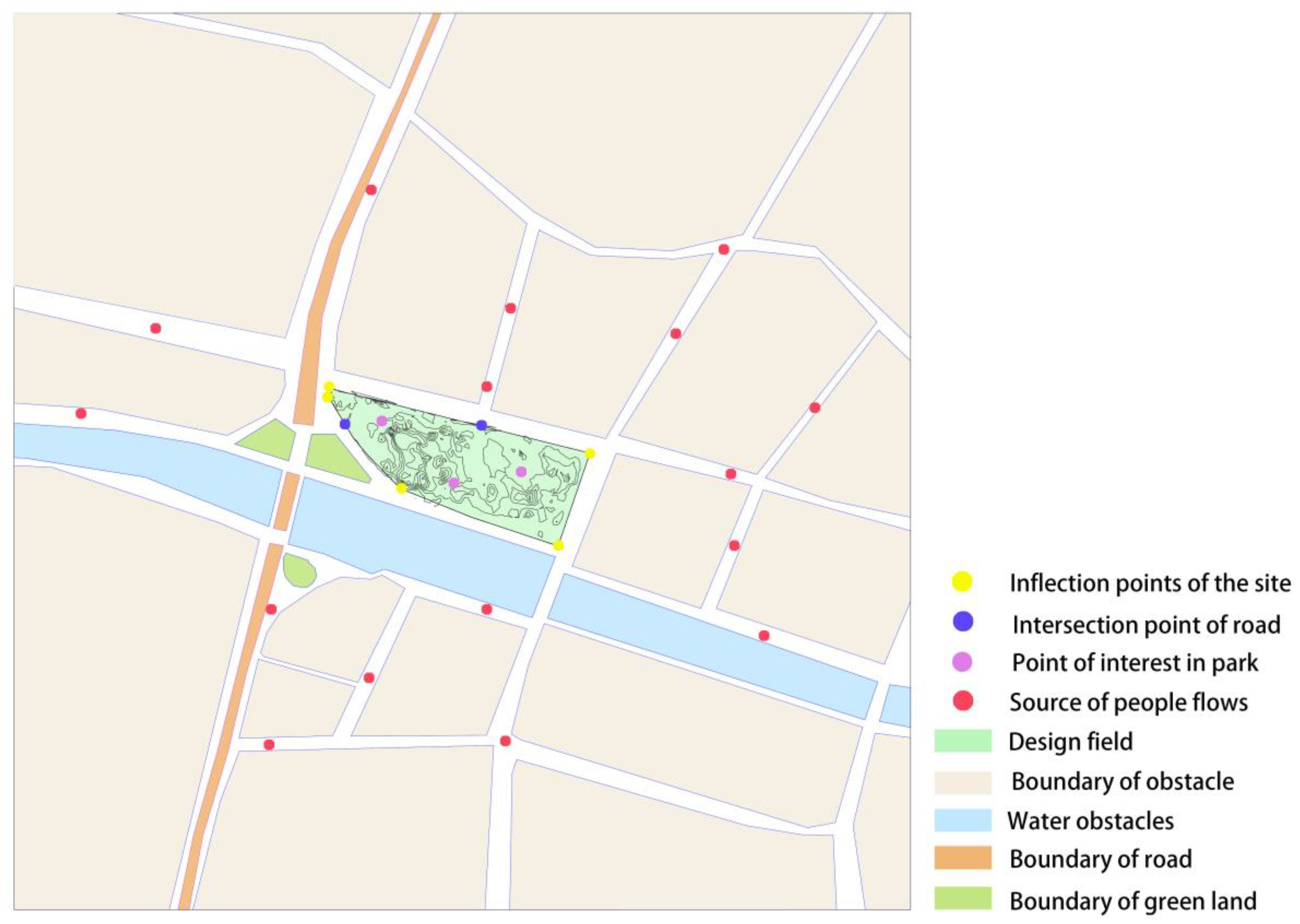
Based on the surrounding environment and current situation of the park site, 15 key points were identified along with 3 points of interests (POI) within the park. The key points were determined based on crowd flow from nearby residential and business districts. The district with higher crowd flow would have 2–3 key points while others would have 1 key point. These key points served as starting points for crowd simulation. The three POI within the park include the highest point of the park which may be designed as a scenic spot, the central pool zone which may be utilized as a water game zone, and the flat area in the northwest which may be planned as an activity zone. These three POI served as terminal points for crowd simulation (Figure 5).
Figure 5.
The key points of park surrounding and the POI the park.
3.2. Crowd Simulation and Determining the Park Entrance Points
3.2.1. Crowd Simulation
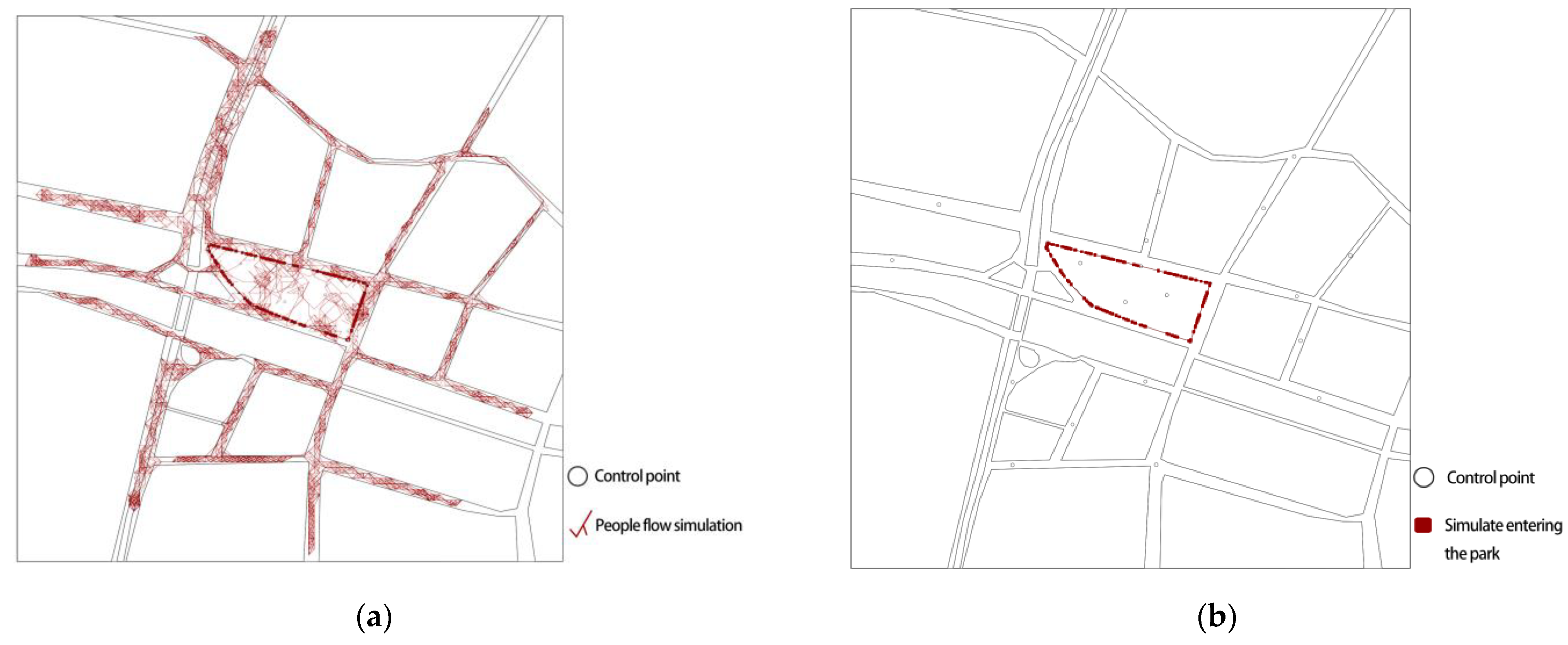
We ran the Physarealm Algorithm Model (PAM) [29,30] until the crowd paths stabilized and simulated the crowd paths from the scattered surrounding areas (the 15 key points) to the park (3 POI within the park) (Figure 6a). The crowd paths intersect with the park borders, creating cross points where visitors can enter and exit the park (Figure 6b).
Figure 6.
Crowd simulation and the cross points of the crowd paths and the park borders: (a) crowd activities simulation with Physarealm Algorithm Model; (b) cross points of crowd paths and the park borders.
3.2.2. Determining Park Entrance Location Based on the Design Specification Requirements
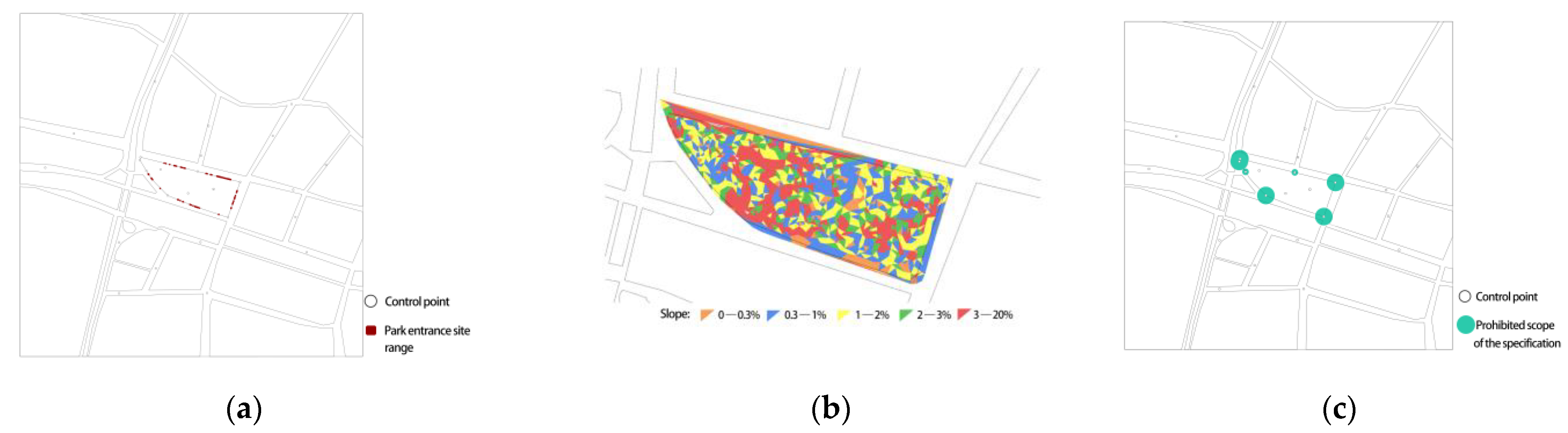
(A) The park entrances serve as the gathering and evacuation spaces of the park and therefore require a relatively flat ground. “The general slope of 1–2% of the site is suitable for the establishment of the slope of the square and platform in the external space, and the minimum is 0.3%, the maximum is 3% [31]”. Accordingly, the park entrance site was set to be 0.3% to 3%. We screened the park entrance district based on the slope requirement utilizing the Slope Algorithm Analysis Model (SAAM) on the R+G platform (Figure 7a).
Figure 7.
Determining the extent of the park entrance site according to the design specification requirements: (a) Park entrance area. (b) Analysis of the site slope. (c) Park entrance area beyond the forbidden area.
(B) The location of the park entrance should also comply with the regulations. According to Regulation [27], “the park entrance on the main road should be no less than 80 m away from the road intersection, and the park entrance on the secondary road should be no less than 30 m away from the road intersection”.
Around the Shuixizhuang park, there are seven road intersections that affect the entrance location, with five being major road intersections and two being general road intersections. We set the minimum distance from the entrances to 80 m for the major road and 30 m for the general road [27], and screened areas where park entrances are prohibited (Figure 7b).
3.2.3. Determining the Park Entrance Points
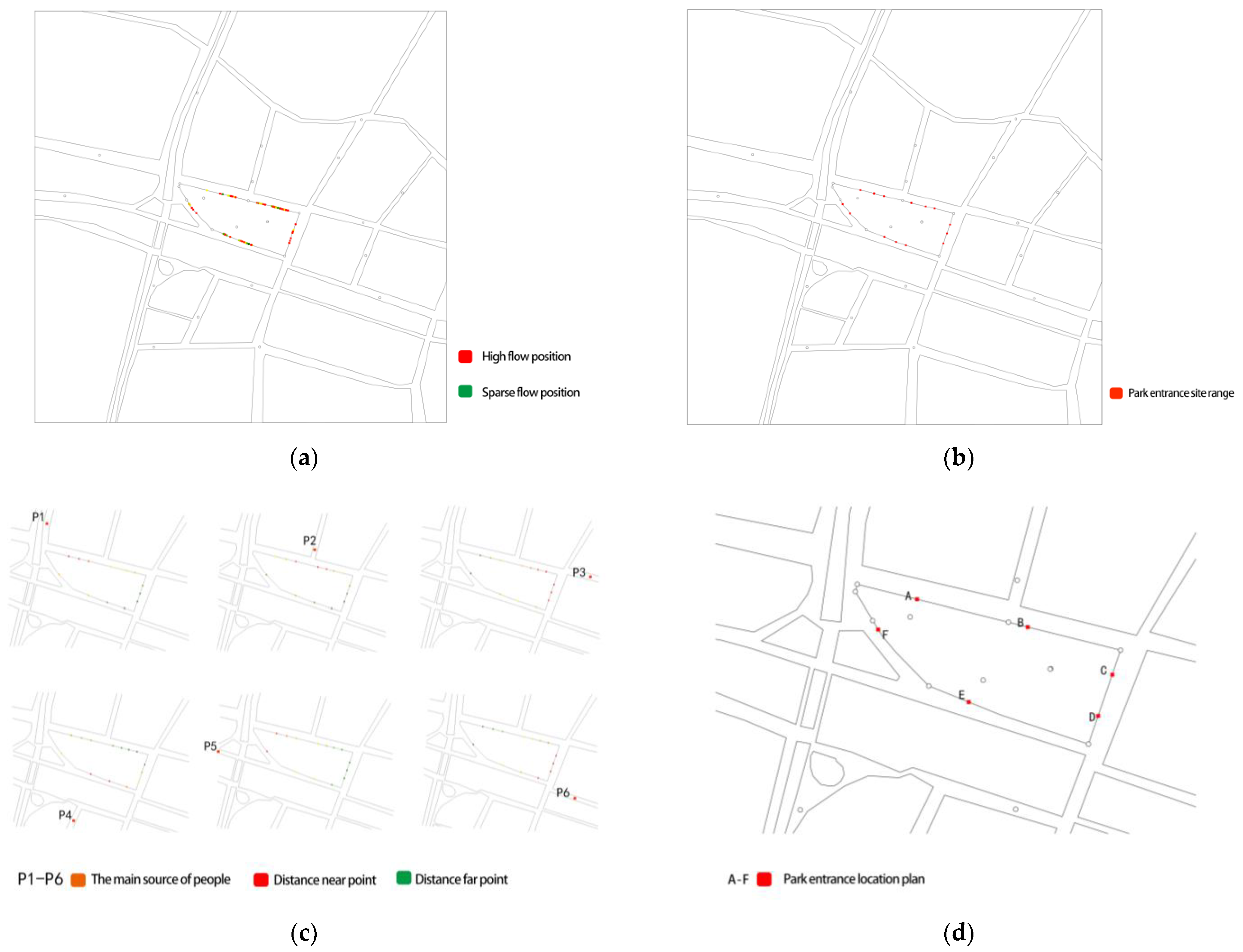
There were numerous cross points located on the park entrance (Figure 7a), which were pivotal in determining park entrances for the planning and design of the park. The approach for optimizing entrance points entailed selecting based on the density of entrance points and the convenience of visitor access into the park.
The Crowd Density Algorithm Model (CDAM) was utilized to gauge the distance between the cross points. Areas with high density are areas with a large influx of visitors into the park and should be considered a preferred location for the park entrance (Figure 8a,b).
Figure 8.
Determining the park entrance: (a) Analysis of cross point density. (b) The range of the park entrance with optimized cross point density. (c) Analysis of crowd flow convenience. (d) Park entrance site selection plan.
The Crowd Convenience Algorithm Model (CCAM) was leveraged to compute the distance between the source points and the cross points and analyze the convenience level for visitors in accessing the park (Figure 8c). Points with a high level of convenience should be prioritized as the preferred park entrance.
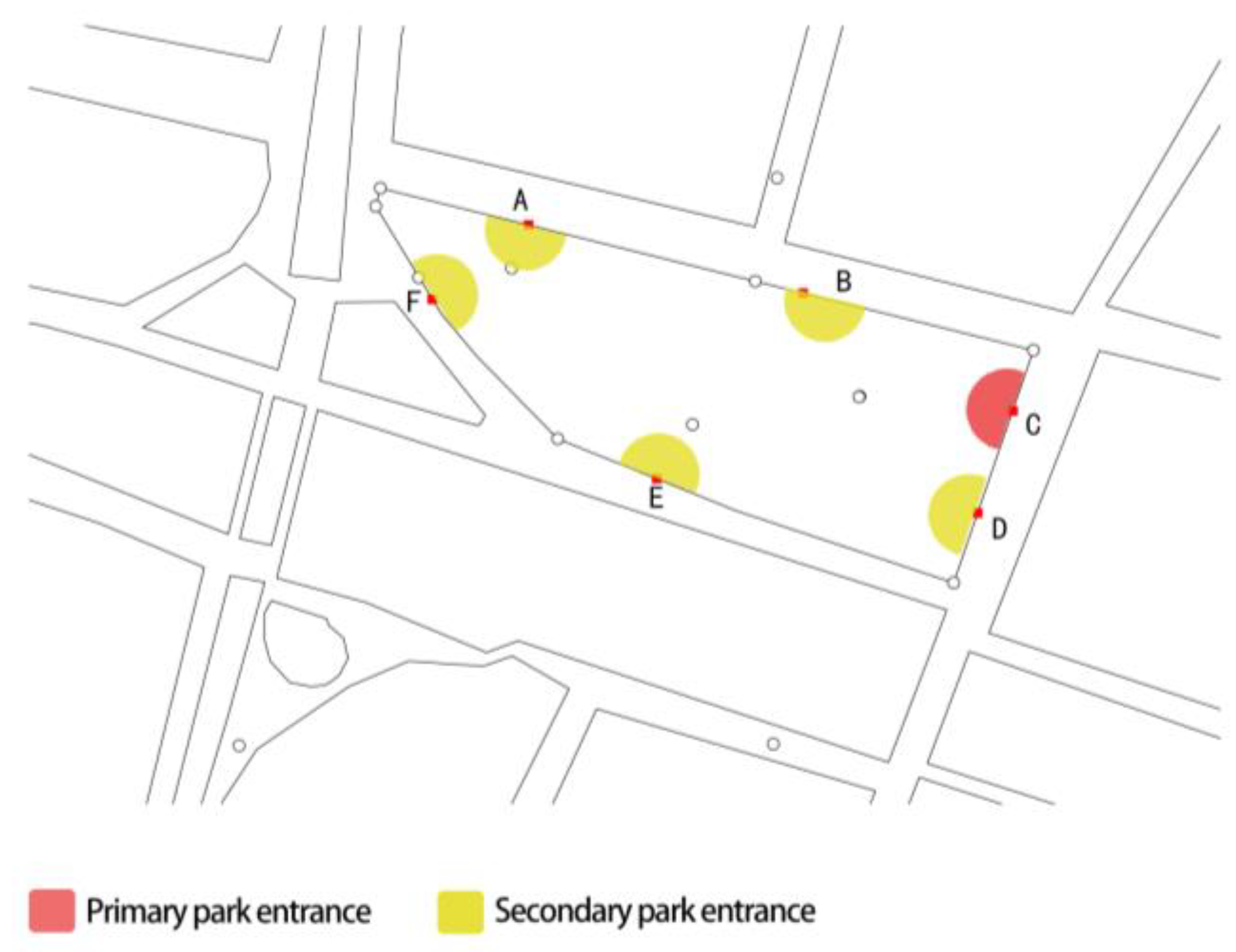
Based on the aforementioned considerations, a total of six park entrance points (A–F) meeting the above requirements were identified through screening (Figure 8d).
3.3. Determining the Primary and Secondary Entrances of the Park
Generally, the primary park entrance is the one that sees more foot traffic, while the secondary entrances are those with less traffic. To determine the primary entrance, a statistical method was employed wherein the number of cross points within 100 m, 150 m, and 200 m along the park’s border (distance data estimated based on the size of the park entrance square and its ancillary site such as the parking lot, etc.) from the 6 park entrances was tallied, and their average values were calculated (Table 5).
Table 5.
Number of cross points of 6 park entrances.
Based on the data in Table 5, entrance D had an average of 29 cross points, while entrance C had an average of 28. These two entrances had more cross points than the others, and thus the primary entrance must be chosen from them. As evident from the map, point C is located near the intersection of Memorial Hall Road and Xianyang Road (the main roads in the district), which is advantageous for crowd gathering and evacuation. Therefore, point C was selected as the primary entrance, while the remaining points were considered as secondary entrances (Figure 9).
Figure 9.
Distribution of primary and secondary park entrances.
3.4. Rechecking of the Park Entrance
3.4.1. Rechecking of the Park Entrance Square Area
As per Formula (1), the total park entrance square area for Shuixizhuang Park should be at least 8833.3 m2.
Additionally, Formula (2) was used to calculate the crowd ratio and square area for the six park entrances based on the cross points in Figure 5, and the results are presented in Table 6.
Table 6.
Proportion of people flow and area of park entrances.
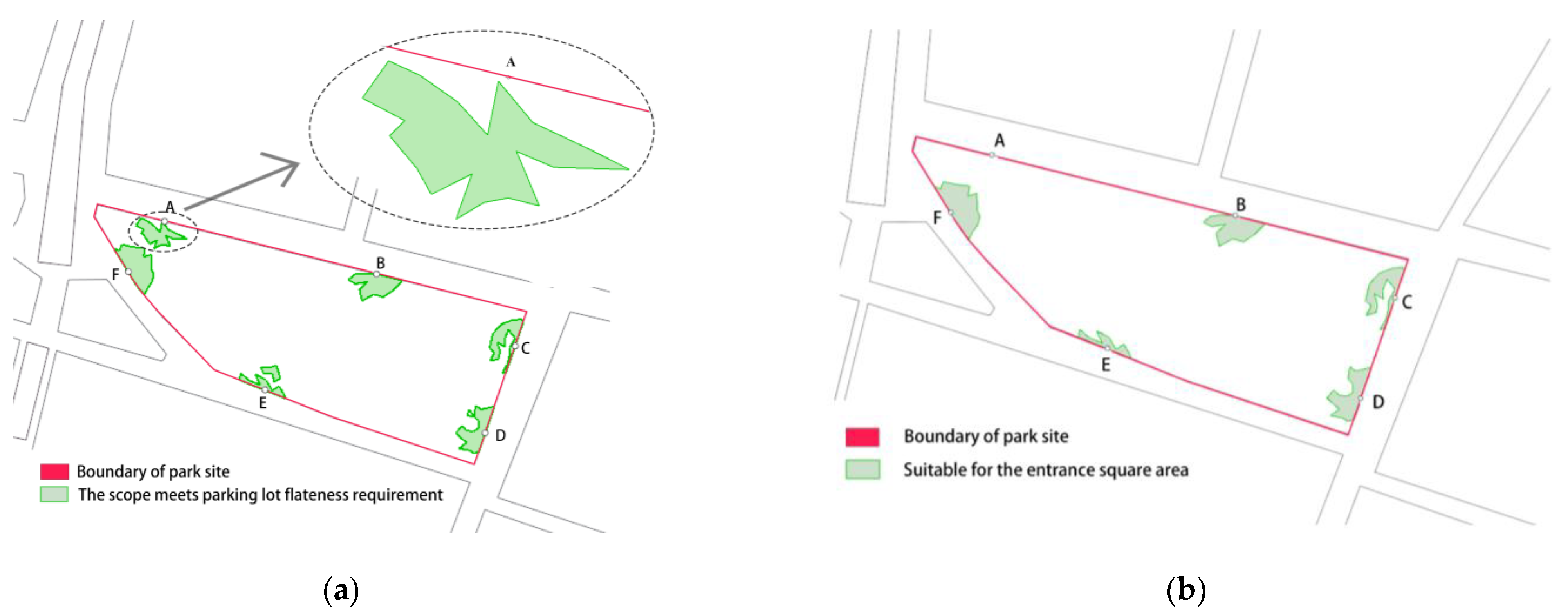
The Square Area Review Algorithm Model (SARAM) was run on the R+G platform, and it was discovered that there was a significant slope between the square and the park boundary at entrance A. Therefore, even though entrance A satisfies the area requirements, it does not meet the square ground flatness requirements and therefore cannot be utilized as a park entrance (Figure 10a).
Figure 10.
Park entrance square area rechecking: (a) Analysis of park entrance square flatness requirement. (b) Result of rechecking of park entrance square area.
To fulfill the park entrance square area requirements, it is necessary to allocate the 1316.16 m2 area of entrance A’s squares to the adjacent points B and F (as people flow must be directed to these points since entrance A cannot be utilized). The allocation method follows the principle of proximity, whereby visitors will choose the closest entrance to enter the park. Based on the distance proportion between points B and F, we determined the likelihood of the crowd going to these points and then determined the area allocation accordingly.
By computing the distance ratio from the northwest corner (i.e., the street corner near point A) to points B and F (which is inversely proportional to the park entrance square area), we calculated the area increase resulting from allocation of the square area at points B and F. Following the allocation, the entrance areas for B and F were 276.52 m2 and 1039.64 m2, respectively, and the resulting total entrance square area for B and F was 1592.68 m2 and 1666.8 m2, respectively.
A rechecking of the square area was conducted, and it was found that entrances B–F all satisfied the requirements (Figure 10b).
3.4.2. Rechecking of the Parking Lot Area
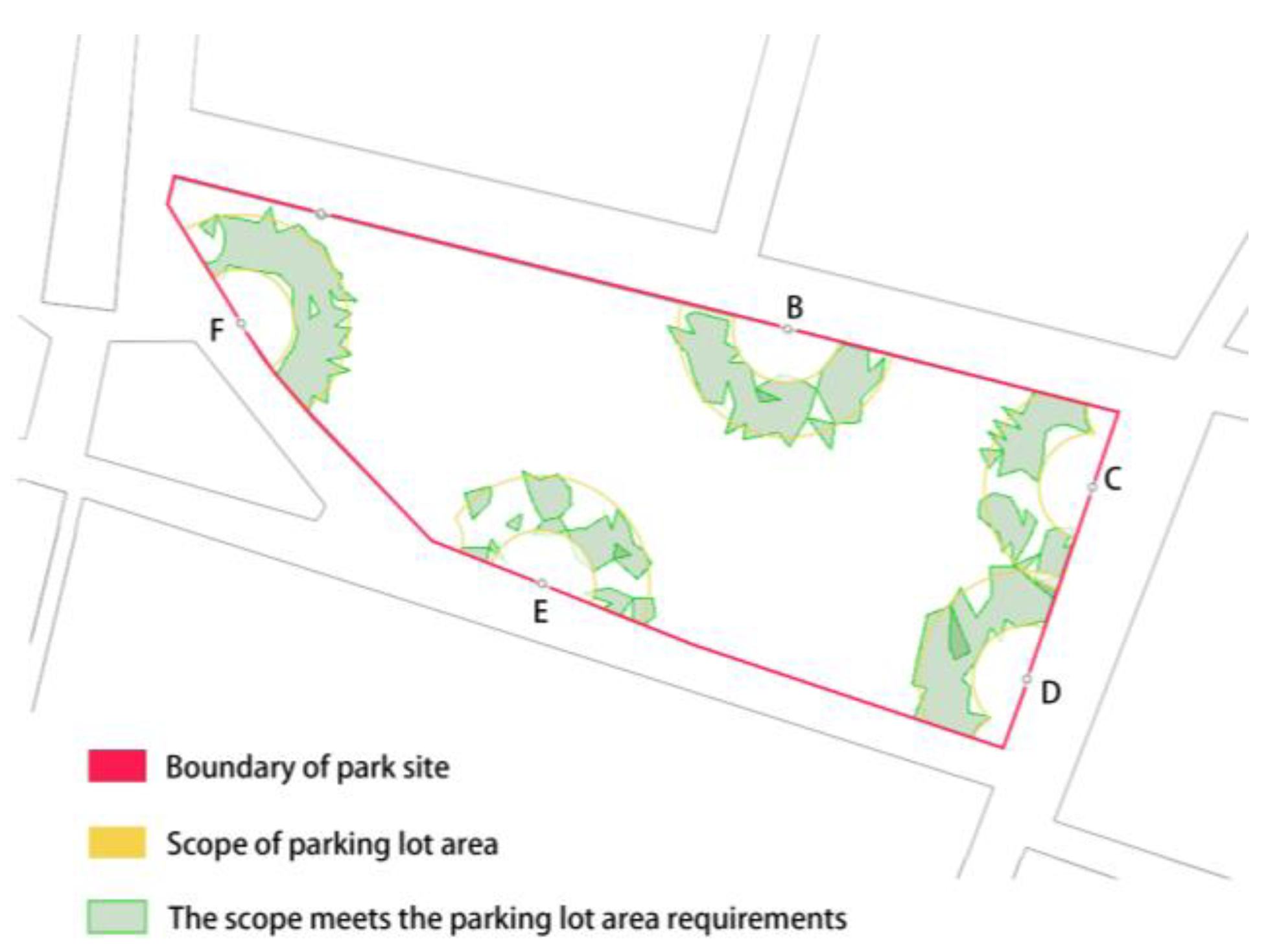
According to Formula (4), the park requires a parking lot area of 2484.3 m2. Considering the positive correlation between the parking lot area and crowd, the parking lot area at each entrance was also calculated based on the proportion of the crowd. As point A could not be used as an entrance, its parking lot area was assigned to adjacent points B and F using the same allocation method. After the redistribution, the parking lot areas at entrances B, C, D, E, and F are 159 m2, 633.5 m2, 665.8 m2, 303.1 m2, and 722.9 m2, respectively.
The Parking Lot Review Algorithm Model (PLRAM) was utilized on the R+G platform to review the parking lot area, and all points B, C, D, E, and F met the area condition requirements (Figure 11).
Figure 11.
Parking lot rechecking: result of rechecking the parking lot flatness.
4. Discussion
4.1. The Method of Parametric Site Selection of Park Entrances
Based on the crowd and terrain data of the park, a site selection approach was established that takes into account ground flatness, crowd activity, gathering and evacuation square area, and parking lot area. This approach combines data selection and analysis and a site area review to provide an objective approach to park entrance site selection parameterization. A key advantage of this approach is that the site selection results are derived from comprehensive data analysis, including geographic data of the site and crowd activities, and national and local design codes and standards that truly reflect site requirements and human needs. This approach removes the influence of the designer’s experience and prior knowledge, resulting in landscape parametric design that is more faithful to the real environment, minimizes human interference, and is scientifically and practically oriented. Ultimately, this approach better serves the people who will enjoy the park.
4.2. The Park Entrance Site Selection Algorithm System Based on R+G Platform Is Established
The park entrance site selection approach involves the use of the R+G parametric design platform to comprehensively simulate and calculate site data and provide real-time feedback on design results. This approach enables designers to determine site selection schemes based on platform calculation results. One of the platform’s key strengths is its openness, allowing designers to organize existing algorithms on the Grasshopper plug-in for parametric calculation or package their algorithm modules into algorithm plug-ins for sharing and utilizing. Additionally, the platform’s output results can be shared with CAD, 3Dmax, Sketchup, GIS, Revit, and other software, significantly enhancing the usability of the design results. In the future, we plan to package the park entrance site selection algorithm into a Grasshopper plug-in and provide instructions on how to utilize it, which can be further developed to support designers.
4.3. Problems and Development
The location of a park entrance is crucial for the easy access and convenient movement of visitors within the park, as well as for reaching landscape nodes. Hence, crowd activities are an essential factor in determining the location of a park entrance. This study focused on the park’s crowd sources and POI as the two main influencing factors because residents should be able to easily get to the park and the POI should be accessible from the entrance for activities. At the beginning of the planning and design of a new park, the entrance location of the park should be considered. It is not only related to the terrain and landscape design of the park but also to the source of the park crowd and the requirements of the entrance square of the park.
However, due to the surrounding area of Shuixizhuang Park being in a developmental stage, the park planning and design is also in its early stages. The public transportation system, residential areas, and public service systems in the surrounding areas are not yet complete. The design parameters of this article only consider the site location, crowd paths, site slope, plaza area, parking lot quantity, and POI in highlighting the park’s characteristics. The study did not investigate public transportation, crowd numbers and composition, crowd travel habits, etc., nor did it consider the impact of detailed park design and entrance plaza landscape design (including gates, management buildings, landscape layout, etc.). With the stability of the surrounding residential environment and the deepening of the park landscape planning and design, these factors should be considered in future designs to adjust the park entrance location. This includes parameters such as tourists’ visual perception, spatial scale, and crowd activities. This can provide a reference for the landscape design of the open space at the park entrance.
4.4. Extension of the Model
The Road Intersection Algorithm Model (RIAM), Site Slope Algorithm Model (SSAM), Crowd Density Algorithm Model (CDAM), Crowd Convenience Algorithm model (CCAM), Square Area Review Algorithm Model (SARAM), Parking Lot Review Algorithm Model (PLRAM), and other models constructed on the R+G platform can be applied to the site selection and design of other sites by changing the standard parameter values according to the specification requirements of different sites. At the same time, this approach can also be used to evaluate and optimize the existing park entrance so as to adjust the park entrance location to meet the needs of the landscape and crowd. This will result in a more thorough and precise approach to determining the park entrance site.
4.5. Traditional Design—Parameterization
Parametric methods can also be suitable for classical art design by quantifying scale and form through distance, angle, quantity, and other parameters to achieve digital human perception and solve art design issues. In the future, parametric design should not only consider the quantification of material elements but also the feelings of people, so that parametric design can fully meet the material and spiritual needs of people.
4.6. Advantage of the Parametric Design Approach of Park Entrance Site Selection
In comparison to traditional landscape design methods, the parametric entrance site selection method utilizes algorithm models to analyze objective multi-source data, resulting in more objective design results and improved design result credibility. By adjusting parameters and parameter values, the method can be applied to similar landscape design entrance selections. This improves the scalability of the design method. Additionally, the design results generated by the R+G design method can share data with other design platforms, which improves design efficiency (Table 7).
Table 7.
Advantage of the parametric design approach in park entrance site selection.
5. Conclusions
This study proposes a parametric approach based on crowd simulation and site situation meeting design requirements and puts forward a parametric design idea for landscape site selection affected by crowds and complex terrain. By analyzing the factors affecting the site selection of a park entrance, the study discusses the design parameters, clarifies the parametric site selection process, constructs an algorithm model, and conducts the parametric site selection practice for the entrance of Tianjin Shuixizhuang Park, which verifies the application of parametric design in landscape design. Based on the data of the design area and its surrounding environment, this approach uses algorithms to calculate the location of the park entrance by analyzing the site data and crowd sources and their activities, which avoids the designer’s subjective will and previous experience to determine the park entrance and can better reflect the site requirements and crowd needs, so that the design results meet the needs of people entering and leaving the park.
The parametric design approach to park entrances can adjust the source of crowd flow surrounding the area, the slope and area of the entrance square and the affiliated site, and other parameter values according to the requirements, so as to adapt to the site selection of different park entrances. The POI of the design site can be changed according to the planning and design process of the park, so the location of the entrance also needs to be adjusted accordingly.
Author Contributions
Conceptualization, J.W., D.W. and P.L.; methodology, J.W., D.W. and X.W.; software, X.W., L.H. and Z.W.; validation, J.W., D.W. and P.L.; formal analysis, J.W., D.W., X.W., L.H. and P.L.; investigation, J.W. and X.W.; resources, J.W. and X.W.; data curation, J.W., X.W. and P.L.; writing—original draft preparation, J.W., X.W., and P.L.; writing—review and editing, J.W., X.W., L.H., Z.W. and P.L.; visualization, D.W., L.H. and Z.W.; supervision, J.W., D.W. and P.L.; project administration, J.W. and P.L.; funding acquisition, P.L. All authors have read and agreed to the published version of the manuscript.
Funding
This research was funded by Tianjin Art Science Planning Project, grant number C18083, and “13th Five-Year Plan” National Key Research and Development Program of China, grant number 2019YFD1100402.
Institutional Review Board Statement
Not applicable.
Informed Consent Statement
Not applicable.
Data Availability Statement
The data presented in this paper may be obtained on request from the corresponding author.
Conflicts of Interest
The authors declare no conflict of interest.
Acronyms
| R+G | Rhino + Grasshopper |
| POI | Points of Interest |
| RIAM | Road Intersection Algorithm Model |
| SSAM | Site Slope Algorithm Model |
| CDAM | Crowd Density Algorithm Model |
| CCAM | Crowd Convenience Algorithm Model |
| SARAM | Square Area Recheck Algorithm Model |
| PLRAM | Parking Lot Recheck Algorithm Model |
References
- Zhao, J.; Zhao, B. Location and layout optimization of urban parks based on accessibility. J. Nanjing For. Univ. (Nat. Sci. Ed. ) 2018, 42, 151–158. [Google Scholar] [CrossRef]
- Jo, T.-D. Visitors’ Satisfaction with Entrance in Soraksan National Park. J. Environ. Sci. Int. 2004, 13, 129–134. [Google Scholar] [CrossRef]
- Gong, C.; Xu, S.; Tong, Z. Study on the Potential Location of Sculptures at Urban Highway Entrances and Exits. In Proceedings of the 26th International Conference on Geoinformatics (Geoinformatics), Kunming, China, 28–30 June 2018. [Google Scholar]
- Zhu, H.; Pei, Y.; Zhang, T.; Liu, Y.; Yu, Q. Research on the site selection model of the theme park entrance and exit based on the internal parking space. Highway 2019, 64, 321–326. [Google Scholar]
- Wu, J.; Shen, N. Walk score method-based evaluation of social service function of urban park green lands in Futian district Shenzhen China. Acta Ecol. Sin. 2017, 37, 7483–7492. [Google Scholar] [CrossRef]
- Liu, R.; Sun, Y. Public Satisfaction of Urban Parks and Influencing Factors Based on Online Comments Data. Areal Res. Dev. 2021, 40, 63–68. [Google Scholar]
- Na, S. Case Analysis and Applicability Review of Parametric Design in Landscape Architectural Design. J. Korean Inst. Landsc. Archit. 2021, 49, 1–16. [Google Scholar] [CrossRef]
- Wang, Y.; Chen, L. Architectural and Landscape Garden Planning Integrated with Artificial Intelligence Parametric Analysis. Secur. Commun. Netw. 2022, 2022, 8577269. [Google Scholar] [CrossRef]
- Wu, J.; Tian, C.; Wuan, D.; Li, P. A parametric design method for siting quiet rest areas in urban parks. Shanxi Archit. 2022, 48, 8–11. [Google Scholar] [CrossRef]
- Hsu, C.-Y.; Ou, S.-J. Innovative Practice of Sustainable Landscape Architecture Education-Parametric-Aided Design and Application. Sustainability 2022, 14, 4627. [Google Scholar] [CrossRef]
- Shi, Y. Research on Parametric Design of landscape Architecture Based on GIS. Ph.D. Thesis, Northwest A&F University, Xianyang, China, 2021. [Google Scholar]
- Ye, T. Landscape Analysis of Mountain Resort Hotel Based on Parametric Design. Ph.D. Thesis, Huazhong University of Science and Technology, Wuhan, China, 2013. [Google Scholar]
- Yuan, Y.; Cheng, Y. Research on Parametric Route Selection in Landscape Environment. Chin. Landsc. Archit. 2015, 31, 36–40. [Google Scholar]
- Li, Z.; Zhuo, B.; Liu, B.; Zheng, Z.; Zhang, Y. Parameter Method Of Site Choice And Analysis. Planner 2016, 32, 128–133. [Google Scholar]
- Zhang, C.; Yang, X. Research on the Algorithm Model of Route Selection Design of Complex Scenic Environment Road Based on Rhino+Grasshopper. Chin. Landsc. Archit. 2021, 37, 77–82. [Google Scholar] [CrossRef]
- An, M. Digital Analysis of the Siting and Scale Control of Landscape Garden Buildings in a Traditional Context. Master’s Thesis, Southeast University, Nanjing, China, 2017. [Google Scholar]
- Yangyang, Y.; Yuning, C.; Zhe, L. Research on the Parameterized Site Selection of Landscape Architecture in Mountainous Park. Chin. Landsc. Archit. 2020, 36, 24–28. [Google Scholar] [CrossRef]
- Li, F.; Zong, P. Research progress on recreation use and planning response of urban parks based on multi-source big data. Landsc. Archit. 2021, 28, 10–16. [Google Scholar] [CrossRef]
- Liu, H. Research on Accessibility of Urban Parks from the Perspective of Tourism Equity. Ph.D. Thesis, Hunan Normal University, Changsha, China, 2019. [Google Scholar]
- Zhang, D.; Chi, Z. Discussion on the Parametric Layout of Garden—Case Study of the Japanese Garden in the 8th China Flower EXPO. Chin. Landsc. Archit. 2014, 30, 87–91. [Google Scholar]
- Scandiffio, A. Parametric Definition of Slow Tourism Itineraries for Experiencing Seasonal Landscapes. Application of Sentinel-2 Imagery to the Rural Paddy-Rice Landscape in Northern Italy. Sustainability 2021, 13, 13155. [Google Scholar] [CrossRef]
- Sędzicki, D.; Cudzik, J.; Bonenberg, W.; Nyka, L. Computer-Aided Automated Greenery Design—Towards a Green BIM. Sustainability 2022, 14, 8927. [Google Scholar] [CrossRef]
- Duan, J.; Zheng, X. Evaluation and analysis of the design scheme of the North entrance of Litchi Park. Constr. Des. Eng. 2014, 6, 61–63+66. [Google Scholar] [CrossRef]
- Peng, A. Present situation and optimization strategy of Fuzhou green entrance. Southeast Hortic. 2017, 5, 32–35. [Google Scholar]
- Chen, X.; Zhang, B.; Shi, W. Post-use evaluation of the Entrance Square of Open Park—A case study of the Entrance square of Wenzhou Qiu Shan Park. Urban. Archit. 2021, 18, 170–173+189. [Google Scholar] [CrossRef]
- Ma, Y.; An, Y. Research on the entrance Space of City Park—A Case Study of Chuzhou Park. Hubei For. Sci. Technol. 2019, 48, 60–64. [Google Scholar]
- Park Design Code. GB 51192-2016; Ministry of Construction of the People’s Republic of China: Beijing, China, 2016.
- Qin, J.; Liu, Y.; Yi, D.; Sun, S.; Zhang, J. Spatial Accessibility Analysis of Parks with Multiple Entrances Based on Real-Time Travel: The Case Study in Beijing. Sustainability 2020, 12, 7618. [Google Scholar] [CrossRef]
- Ma, Y.; Xu, W. PHYSAREALM A Bio-inspired Stigmergic Algorithm Tool for Form-Finding. In Proceedings of the 22nd Annual International Conference on Computer-Aided Architectural Design Research in Asia (CAADRIA), Suzhou, China, 5–8 April 2017; pp. 499–508. [Google Scholar]
- Li, S.; Chen, H.; Wang, M.; Heidari, A.A.; Mirjalili, S. Slime mould algorithm: A new method for stochastic optimization. Future Gener. Comput. Syst. 2020, 111, 300–323. [Google Scholar] [CrossRef]
- CJJ 83-2016; Vertical Planning Specification for Urban and Rural Construction Land. Ministry of Construction of the People’s Republic of China: Beijing, China, 2016.
Disclaimer/Publisher’s Note: The statements, opinions and data contained in all publications are solely those of the individual author(s) and contributor(s) and not of MDPI and/or the editor(s). MDPI and/or the editor(s) disclaim responsibility for any injury to people or property resulting from any ideas, methods, instructions or products referred to in the content. |
© 2023 by the authors. Licensee MDPI, Basel, Switzerland. This article is an open access article distributed under the terms and conditions of the Creative Commons Attribution (CC BY) license (https://creativecommons.org/licenses/by/4.0/).