A Review of Progress and Hydrodynamic Design of Integrated Motor Pump-Jet Propulsion

Abstract
1. Introduction
- (1)
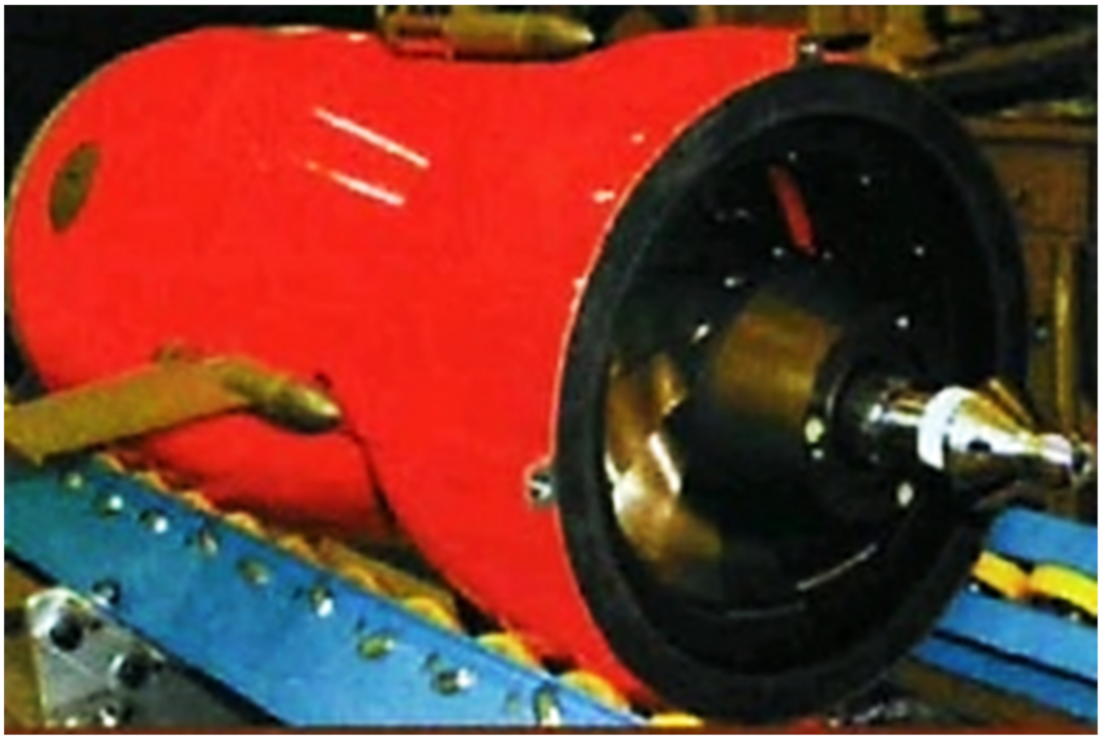
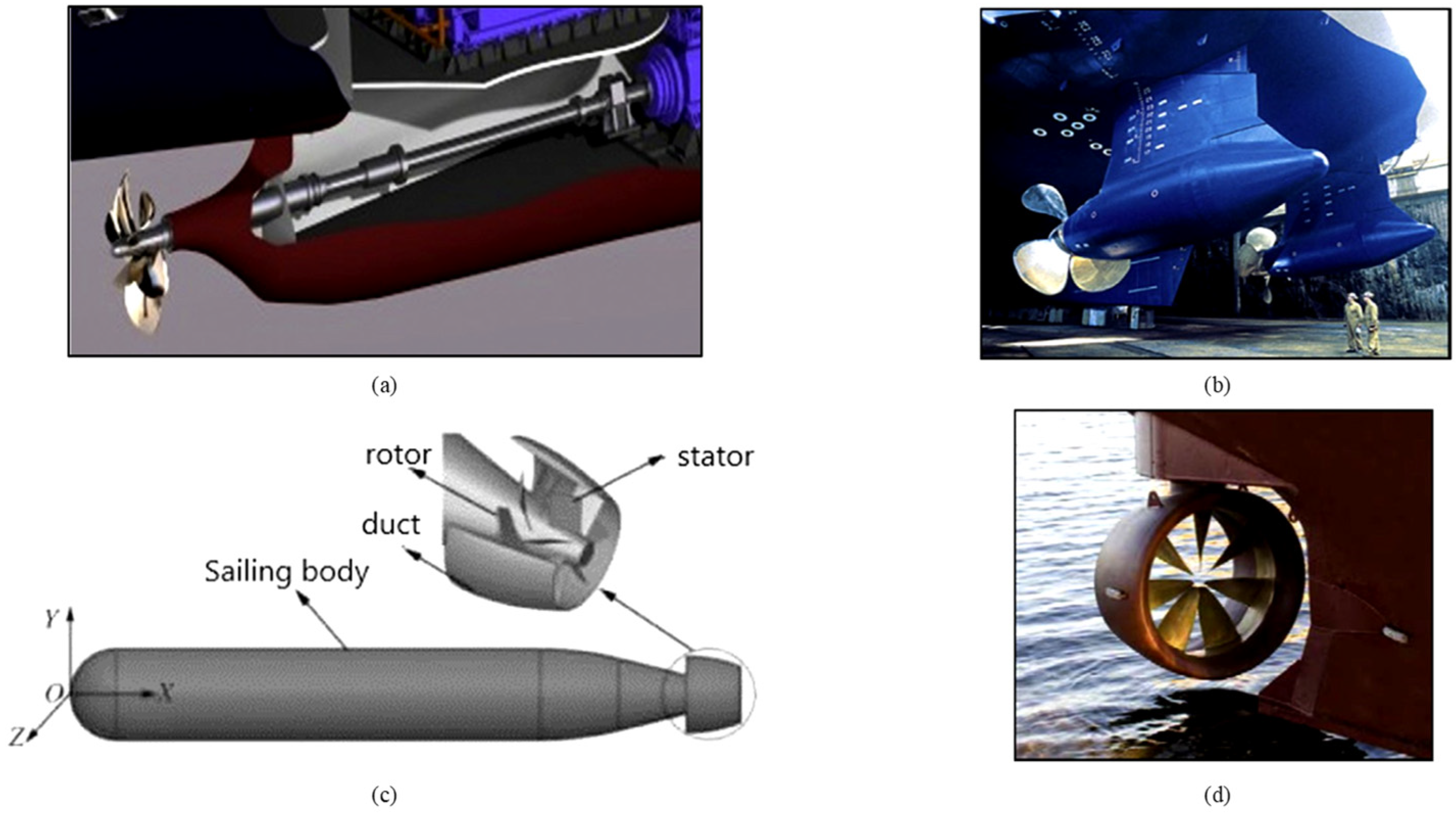
- The IMP thruster has a high degree of integration, and the cabin reduces the complicated propulsion drive shaft system, auxiliary components, propulsion motors, and other equipment into a compact structure with a light weight.
- (2)
- According to previous research, it has a low vibration and noise, since the motor and the propeller are integrated; the motor eliminates the noise in the split propulsion device when driving the propeller, and there is no longer any deceleration between the prime mover and the propeller transmission gear reduction gearbox, which is the main source of underwater radiation noise [7]. The back spiral stator eliminates the rotational movement of the fluid, reduces the flow velocity into the rotor blade, and increases the static pressure around the blade. The back spiral stator also delays the onset of cavitation at the tip of the blade and reduces the vortex cavitation noise, thus improving the invisibility.
- (3)
- It has a high propulsion efficiency, eliminating friction loss at the output shaft and improving the system propulsion efficiency. The back spiral stator can recover the rotational energy of the liquid flow by effectively increasing the propulsion energy. The IMP thruster is energized by the motor stator coil to generate a magnetic field, and the permanent-magnet motor rotor drives the impeller to rotate. Hence, there is no need to provide electricity to the magnetic field, which can eliminate the power loss of the magnetic field.
- (4)
- It has good operability and strong adaptability—due to the lack of intermediate transmission links, the reliability of the propeller transmission is improved. The pump flow does not change much at different speeds when it has already maintained a certain speed.
- (5)
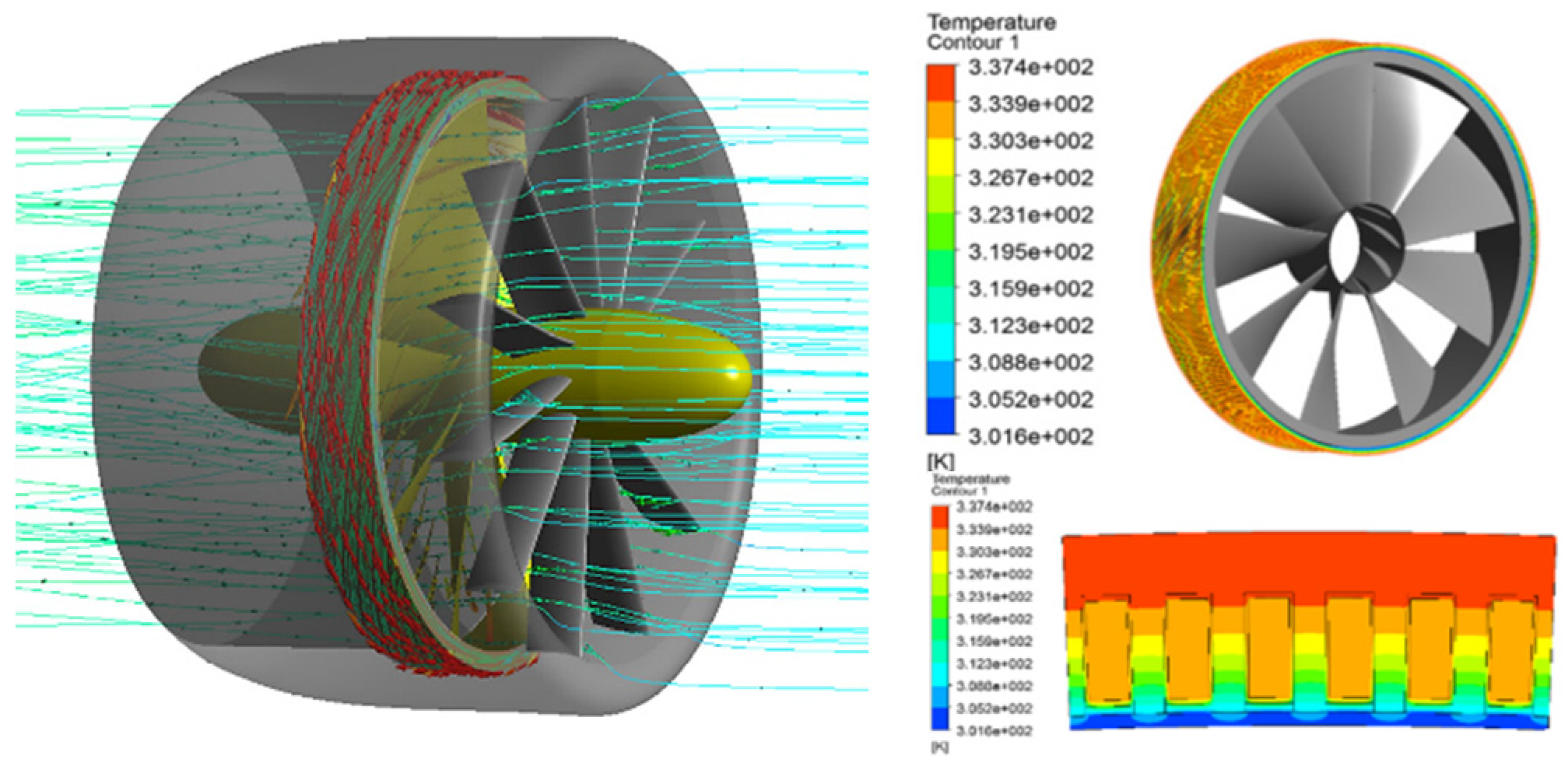
- The entire system works in fluid, which can solve the heat-dissipation problem of the motor by cooling the motor and the bearing. This can also reduce the energy consumed by these cooling systems. Seawater can lubricate the bearings without oil lubrication, which is not only environmentally friendly but also eliminates the energy consumed by the lubrication system.
2. Electric Motor and Control Technology
3. IMP Bearing and Hydrodynamic Design
3.1. Bearings Used in IMPs
3.2. Hydrodynamic Design
3.2.1. Hydrodynamic Performance
3.2.2. Cavitation
3.2.3. Gap Flow
4. Dynamic Coupling Technology
4.1. Dynamic Coupling between IMPs and Ship Hulls
4.2. The Coupling Design Technology of Hydrodynamics, Electromagnetics, and Bearings
5. Discussion
5.1. The Design of the IMP
5.2. Hydrodynamic Performance of IMP Thrusters
5.3. Optimization Technology of IMP Thrusters
6. Conclusions
Author Contributions
Funding
Institutional Review Board Statement
Informed Consent Statement
Data Availability Statement
Acknowledgments
Conflicts of Interest
Nomenclature
| Thrust coefficient | Vorticity | ||
| Torque coefficient | Cavitation number | ||
| Propulsion efficiency, | Pressure coefficient | ||
| Advance coefficient, | Gap moment coefficient | ||
| Inflow velocity | |||
| Rotational speed | |||
| Diameter of propeller |
References
- Shamsi, R.; Ghassemi, H.; Molyneux, D.; Liu, P. Numerical hydrodynamic evaluation of propeller (with hub taper) and podded drive in azimuthing conditions. Ocean. Eng. 2014, 76, 121–135. [Google Scholar] [CrossRef]
- Liu, B.; Vanierschot, M. Numerical Study of the Hydrodynamic Characteristics Comparison between a Ducted Propeller and a Rim-Driven Thruster. Appl. Sci. 2021, 11, 4919. [Google Scholar] [CrossRef]
- Yan, X.; Liang, X.; Ouyang, W.; Liu, Z.; Liu, B.; Lan, J. A review of progress and applications of ship shaft-less rim-driven thrusters. Ocean. Eng. 2017, 144, 142–156. [Google Scholar] [CrossRef]
- Cheng, P.; He, B. Investigate the Application of Integrated Motor Water-Jet Propulsor on ROV. Guangdong Shipbuild. 2014, 33, 50–125. [Google Scholar]
- Othman, N.; Kamarudin, S.; Takriff, M.; Rosli, M.; Engku Chik, E.; Meor Adnan, M. Optimization of a continuous hybrid impeller mixer via computational fluid dynamics. Sci. World J. 2014, 2014, 1–6. [Google Scholar] [CrossRef]
- Amiruddin, H.; Mahmood, W.M.F.W.; Abdullah, S.; Mansor, M.R.A.; Mamat, R.; Alias, A. Application of Taguchi method in optimization of design parameter for turbocharger vaned diffuser. Ind. Lubr. Tribol. 2017, 69, 409–413. [Google Scholar] [CrossRef]
- Wang, H.-G. Study of vibration isolation and noise reduction technology in US nuclear submarine propulsion system. Ship Sci. Technol. 2013, 35, 149–153. [Google Scholar]
- Tenconi, A.; Profumo, F.; Bauer, S.E.; Hennen, M.D. Temperatures evaluation in an integrated motor drive for traction applications. IEEE Trans. Ind. Electron. 2008, 55, 3619–3626. [Google Scholar] [CrossRef]
- Qian, D.; An, B. Permanent magnet motor-pump integrated system: Feasibility study of a novel motor-pump integrated system for underwater carriers. J. Unmanned Undersea Syst. 1997, 5, 35–43. [Google Scholar]
- Lai, S.H. Design Optimisation of a Slotless Brushless Permanent Magnet DC Motor with Helically-Wound Laminations for Underwater Rim-Driven Thrusters. Ph.D. Thesis, University of Southampton, Southampton, UK, 2006. [Google Scholar]
- Batzel, T.D.; Lee, K.Y. Slotless permanent magnet synchronous motor operation without a high resolution rotor angle sensor. IEEE Trans. Energy Convers. 2000, 15, 366–371. [Google Scholar] [CrossRef]
- Batzel, T.D.; Thivierge, D.P.; Lee, K.Y. Application of sensorless electric drive to unmanned undersea vehicle propulsion. IFAC Proc. Vol. 2002, 35, 307–312. [Google Scholar] [CrossRef]
- Zhu, Z.-Q.; Gong, L. Investigation of effectiveness of sensorless operation in carrier-signal-injection-based sensorless-control methods. IEEE Trans. Ind. Electron. 2010, 58, 3431–3439. [Google Scholar] [CrossRef]
- Taylor, O.S.; Repp, J.R.; Brown, D.W. Submersible Electric Propulsion Motor with Propeller Integrated Concentrically with Motor Rotor. U.S. Patent 4831297, 16 May 1989. [Google Scholar]
- Brown, D. Submersible Outboard Electric MotorPropulsor. Nav. Eng. J. 1989, 101, 44–52. [Google Scholar] [CrossRef]
- Tuohy, P.; Smith, A.; Husband, M. Induction rim-drive for a marine propulsor. In Proceedings of the 5th IET International Conference on Power Electronics, Machines and Drives, Brighton, UK, 19–21 April 2010. [Google Scholar]
- Tuohy, P. Development of Canned Line-Start Rim-Driven Electric Machines. Ph.D. Thesis, The University of Manchester, Manchester, UK, 2011. [Google Scholar]
- Tuohy, P.M.; Smith, A.C.; Husband, M.; Hopewell, P. Rim-drive marine thruster using a multiple-can induction motor. IET Electr. Power Appl. 2013, 7, 557–565. [Google Scholar] [CrossRef]
- Richardson, K.; Pollock, C.; Flower, J. Design of a switched reluctance sector motor for an integrated motor/propeller unit. In Proceedings of the 1995 Seventh International Conference on Electrical Machines and Drives, Durham, UK, 11–13 September 1995. [Google Scholar]
- Abu Sharkh, S.; Turnock, S.; Draper, G. Performance of a tip-driven electric thruster for unmanned underwater vehicles. In Proceedings of the Eleventh International Offshore and Polar Engineering Conference, Stavanger, Norway, 17–22 June 2001. [Google Scholar]
- Sharkh, S.A.; Lai, S.H.; Turnock, S. Structurally integrated brushless PM motor for miniature propeller thrusters. IEE Proc. Electr. Power Appl. 2004, 151, 513–519. [Google Scholar] [CrossRef]
- Pashias, C.; Turnock, S. Hydrodynamic Design of a bi-Directional, Rim-Driven Ducted Thruster Suitable for Underwater Vehicles; University of Southampton: Southampton, UK, 2003. [Google Scholar]
- Pashias, C.; Turnock, S.; Abu Sharkh, S. Design optimization of a bi-directional integrated thruster. In Proceedings of the SNAME 10th Propeller and Shafting Symposium, Virginia Beach, VA, USA, 17 September 2003. [Google Scholar]
- Van Dine, P. Manufacture of a prototype advanced permanent magnet motor pod. J. Ship Prod. 2003, 19, 91–97. [Google Scholar] [CrossRef]
- Krøvel, Ø.; Nilssen, R.; Skaar, S.; Løvli, E.; Sandoy, N. Design of an integrated 100 kW permanent magnet synchronous machine in a prototype thruster for ship propulsion. CD Rom Proc. ICEM 2004, 2004, 117–118. [Google Scholar]
- Sharkh, S.; Lai, S. Design optimization of a slotless PM brushless motor with helical edge wound laminations for rim driven thrusters. High Technol. Lett. 2010, 16, 70–79. [Google Scholar]
- Cheng, B.; Pan, G.; Cao, Y. Analytical design of the integrated motor used in a hubless rim-driven propulsor. IET Electr. Power Appl. 2019, 13, 1255–1262. [Google Scholar] [CrossRef]
- Liang, J.; Zhang, X.; Qiao, M.; Zhu, P.; Cai, W.; Xia, Y.; Li, G. Optimal design and multifield coupling analysis of propelling motor used in a novel integrated motor propeller. IEEE Trans. Magn. 2013, 49, 5742–5748. [Google Scholar] [CrossRef]
- Shen, Y.; Hu, P.; Jin, S.; Wei, Y.; Lan, R.; Zhuang, S.; Zhu, H.; Cheng, S.; Chen, J.; Wang, D. Design of novel shaftless pump-jet propulsor for multi-purpose long-range and high-speed autonomous underwater vehicle. IEEE Trans. Magn. 2016, 52, 1–4. [Google Scholar] [CrossRef]
- Hassannia, A.; Darabi, A. Design and performance analysis of superconducting rim-driven synchronous motors for marine propulsion. IEEE Trans. Appl. Supercond. 2013, 24, 40–46. [Google Scholar] [CrossRef]
- Ruusila, V.; Nyyssönen, T.; Kallio, M.; Vuorinen, P.; Lehtovaara, A.; Valtonen, K.; Kuokkala, V. The effect of microstructure and lead content on the tribological properties of bearing alloys. Proc. Inst. Mech. Eng. Part J J. Eng. Tribol. 2013, 227, 878–887. [Google Scholar] [CrossRef]
- Salama, M. The effect of macro-roughness on the performance of parallel thrust bearings. Proc. Inst. Mech. Eng. 1950, 163, 149–161. [Google Scholar] [CrossRef]
- Simmons, J.; Knox, R.; Moss, W. The development of PTFE (polytetrafluoroethylene)-faced hydrodynamic thrust bearings for hydrogenerator application in the United Kingdom. Proc. Inst. Mech. Eng. Part J J. Eng. Tribol. 1998, 212, 345–352. [Google Scholar] [CrossRef]
- Bin, S.; Sun, F.-H.; Zhang, Z.-M.; Shen, H.-S.; Guo, S.-S. Application of ultra-smooth composite diamond film coated WC–Co drawing dies under water-lubricating conditions. Trans. Nonferrous Met. Soc. China 2013, 23, 161–169. [Google Scholar]
- Zhang, X.L. Research on Load-Bearing Characteristics and Structural Design of Water-Lubricated Bearings for Integrated Motor Propulsion. Master’s Thesis, Shanghai Jiaotong University, Shanghai, China, 2017. [Google Scholar]
- Kennedy, G.C.; Holt, J.K. Developing a high efficiency means of propulsion for underwater vehicles. In Proceedings of the Southcon′95, Fort Lauderdale, FL, USA, 7–9 March 1995; pp. 352–356. [Google Scholar]
- Hsieh, M.-F.; Chen, J.-H.; Yeh, Y.-H.; Lee, C.-L.; Chen, P.-H.; Hsu, Y.-C.; Chen, Y.-H. Integrated design and realization of a hubless rim-driven thruster. In Proceedings of the IECON 2007-33rd Annual Conference of the IEEE Industrial Electronics Society, Taipei, Taiwan, 5–8 November 2007; pp. 3033–3038. [Google Scholar]
- Lea, M.; Thompson, D.; Blarcom, B.; Eaton, J.; Friesch, J.; Richards, J. Scale model testing of a commercial rim-driven propulsor pod. J. Ship Prod. 2003, 19, 121–130. [Google Scholar] [CrossRef]
- Othman, N.; Kamarudin, S.; Takriff, M.; Rosli, M.; Engku Chik, E.; Adnan, M. Optimization of integrated impeller mixer via radiotracer experiments. Sci. World J. 2014, 2014, 1–8. [Google Scholar] [CrossRef][Green Version]
- Rolls-Royce. In aspx#Section-Product-Search. 2017. Available online: http://www.rolls-royce.com/products-and-services/marine/productfinder/propulsors/tunnel-thrusters/permanent-magnet-tunnel-thruster (accessed on 17 February 2017).
- Ahmad, S.; Abdullah, S.; Sopian, K. A review on the thermal performance of nanofluid inside circular tube with twisted tape inserts. Adv. Mech. Eng. 2020, 12, 1687814020924893. [Google Scholar] [CrossRef]
- Aljamali, S.; Abdullah, S.; Wan Mahmood, W.M.F.; Ali, Y. Effect of fuel injection timings on performance and emissions of stratified combustion CNGDI engine. Appl. Therm. Eng. 2016, 109, 619–629. [Google Scholar] [CrossRef]
- Liu, Z.L.; Liang, X.G.; Yan, X.P.; Ouyang, W.; Wang, J. Integrated Water-Lubricated Bearings for Hub-Rim. Thrusters. Patent CN105129060A, 9 December 2015. [Google Scholar]
- Liang, X.; Liu, Z.; Yuan, C.; Ouyang, W.; Yan, X. Design and performance analysis of a water lubricated tilting pad thrust bearing. In Proceedings of the 26th International Ocean and Polar Engineering Conference, Rhodes, Greece, 26 June–1 July 2016. [Google Scholar]
- Ouyang, W.; Yang, X.Z.; Duan, Y.X.; Pan, L.F.; Li, Y.H.; Chen, K.; Gao, S.H.; Zhang, C.M.; Yan, X.P. Rim-Driven Semi-Submerged. Thrusters. Patent 202111102339, 12 October 2016. [Google Scholar]
- Lan, R.; Jin, S.; Zhu, H.; Shen, Y.; Liu, T. Maximum Displacement of Rotary Water Lubricated Rubber Bearing for Shipborne Shaftless Propulsor. Mar. Electr. Electron. Eng. 2017, 37, 16–19+23. [Google Scholar]
- Cai, M.; Yang, C.; Wu, S.; Zhu, Y.; Xie, Y. Hydrodynamic analysis of a rim-driven thruster based on RANS method. In Proceedings of the OCEANS 2015-MTS/IEEE Washington, Washington, DC, USA, 19–22 October 2015; pp. 1–5. [Google Scholar]
- Song, B.-W.; Wang, Y.-J.; Tian, W.-L. Open water performance comparison between hub-type and hubless rim driven thrusters based on CFD method. Ocean. Eng. 2015, 103, 55–63. [Google Scholar] [CrossRef]
- Hughes, A.; Turnock, S.; Sharkh, S.A. CFD modelling of a novel electromagnetic tip-driven thruster. In Proceedings of the Tenth International Offshore and Polar Engineering Conference, Sapporo, Japan, 10–15 June 2018. [Google Scholar]
- Wang, C.; Weng, K.; Guo, C.; Gu, L. Prediction of hydrodynamic performance of pump propeller considering the effect of tip vortex. Ocean. Eng. 2019, 171, 259–272. [Google Scholar] [CrossRef]
- Cao, Q.-M.; Hong, F.-W.; Tang, D.-H.; Hu, F.-L.; Lu, L.-Z. Prediction of loading distribution and hydrodynamic measurements for propeller blades in a rim driven thruster. J. Hydrodyn. 2012, 24, 50–57. [Google Scholar] [CrossRef]
- Yu, H.; Duan, N.; Hua, H.; Zhang, Z. Propulsion performance and unsteady forces of a pump-jet propulsor with different pre-swirl stator parameters. Appl. Ocean. Res. 2020, 100, 102184. [Google Scholar] [CrossRef]
- Yakovlev, A.Y.; Sokolov, M.A.; Marinich, N.V. Numerical design and experimental verification of a rim-driven thruster. In Proceedings of the Second International Symposium on Marine Propulsors, Hamburg, Germany, 15–17 June 2011; pp. 396–403. [Google Scholar]
- Shirazi, A.T.; Nazari, M.R.; Manshadi, M.D. Numerical and experimental investigation of the fluid flow on a full-scale pump jet thruster. Ocean. Eng. 2019, 182, 527–539. [Google Scholar] [CrossRef]
- Zhu, H.; Jin, S.; Wang, D.; Wang, G.; Wei, Y.; Hu, P.; Wu, X.; He, S.; Hu, F. Open-water Characteristics of Shaftless Pump-jet Thruster. Acta Armamentarii 2021, 42, 835–841. [Google Scholar]
- Dubas, A.J.; Bressloff, N.; Sharkh, S. Numerical modelling of rotor–stator interaction in rim driven thrusters. Ocean. Eng. 2015, 106, 281–288. [Google Scholar] [CrossRef]
- Peng, Y.; Wang, Y.; Liu, C.; Yi, W. Comparative analysis of the hydrodynamic performance of a mechanical pump-jet and an integrated motor pump-jet. J. Harbin Eng. Univ. 2016, 37, 684–689. [Google Scholar]
- Baltazar, J.M.; Rijpkema, D.; Falcão de Campos, J.; Bosschers, J. Prediction of the open-water performance of ducted propellers with a panel method. J. Mar. Sci. Eng. 2018, 6, 27. [Google Scholar] [CrossRef]
- Sikirica, A.; Čarija, Z.; Kranjčević, L.; Lučin, I. Grid type and turbulence model influence on propeller characteristics prediction. J. Mar. Sci. Eng. 2019, 7, 374. [Google Scholar] [CrossRef]
- Tu, T.N. Numerical simulation of propeller open water characteristics using RANSE method. Alex. Eng. J. 2019, 58, 531–537. [Google Scholar] [CrossRef]
- Andersen, T.P. Design of Rim Driven Waterjet Pump for Small Rescue Vessel. Master’s Thesis, Chalmers University of Technology, Göteborg, Sweden, 2014. [Google Scholar]
- Gaggero, S. Numerical design of a RIM-driven thruster using a RANS-based optimization approach. Appl. Ocean. Res. 2020, 94, 101941. [Google Scholar] [CrossRef]
- Zhou, Y.; Wang, L.; Yuan, J.; Luo, W.; Fu, Y.; Chen, Y.; Wang, Z.; Xu, J.; Lu, R. Comparative Investigation on Hydrodynamic Performance of Pump-Jet Propulsion Designed by Direct and Inverse Design Methods. Mathematics 2021, 9, 343. [Google Scholar] [CrossRef]
- Liu, W.-F.; Hu, Y.-L. Analysis of Construction Principle and Characteristics of Pump-Jet for Underwater Integrated Motor Propulsor. Torpedo Technol. 2007, 6, 5–8. [Google Scholar]
- Zhang, M.; Lin, R.; Wang, Y. 3-D inverse design of pumpjet and comparison with opening water performance of original propeller. J. Harbin Eng. Univ. 2017, 38, 690–696. [Google Scholar]
- Shuanbao, J.; Hao, Z.; Dong, W. Research on the global parameters selection and design of pumpjet of underwater vehicle. J. Harbin Eng. Univ. 2018, 39, 56–61. [Google Scholar]
- Kinnas, S.A.; Chang, S.-H.; He, L.; Johannessen, J.T. Performance prediction of a cavitating RIM driven tunnel thruster. In Proceedings of the First International Symposium on Marine Propulsors, Trondheim, Norway, 22–24 June 2009. [Google Scholar]
- Yuan, J.; Chen, Y.; Wang, L.; Fu, Y.; Zhou, Y.; Xu, J.; Lu, R. Numerical Analysis of Cavitation Characteristics of Pump Jet Pro-peller. J. Shanghai Jiaotong Univ. 2014, 8, 6. [Google Scholar]
- Lin, L.; Guang, P. Numerical Simulation Analysis of Unsteady Cavitation Performance of a Pump-jet Propulsor. J. Shanghai Jiaotong Univ. 2015, 21, 1–7. [Google Scholar]
- Luo, X.-W.; Ji, B.; Tsujimoto, Y. A review of cavitation in hydraulic machinery. J. Hydrodyn. 2016, 28, 335–358. [Google Scholar] [CrossRef]
- Gaggero, S.; Villa, D. Steady cavitating propeller performance by using OpenFOAM, StarCCM+ and a boundary element method. Proc. Inst. Mech. Eng. Part M J. Eng. Marit. Environ. 2017, 231, 411–440. [Google Scholar] [CrossRef]
- Capurso, T.; Lopez, M.; Lorusso, M.; Torresi, M.; Pascazio, G.; Camporeale, S.; Fortunato, B. Numerical investigation of cavitation on a NACA0015 hydrofoil by means of OpenFOAM. Energy Procedia 2017, 126, 794–801. [Google Scholar] [CrossRef]
- Sharkh, S.A.; Harris, M.; Turnock, S.; Crowder, R.; Chappell, P. Prototype Integrated Electric Thrusters for Work-Class UnderwaterVehicles: Design Construction and Test; EPSRC Research Grant Report; University of Southampton: Southampton, UK, 2000. [Google Scholar]
- Cao, Q.; Zhao, W.; Tang, D.; Hong, F. Effect of gap flow on the torque for blades in a rim driven thruster without axial pressure gradient. Procedia Eng. 2015, 126, 680–685. [Google Scholar] [CrossRef]
- Cao, Q.; Wei, X.; Tang, D.; Hong, F. Study of gap flow effects on hydrodynamic performance of rim driver thrusters with/without pressure difference. Chin. J. Hydrodyn. 2015, 30, 485–494. [Google Scholar]
- Jiang, H.; Ouyang, W.; Sheng, C.; Lan, J.; Bucknall, R. Numerical investigation on hydrodynamic performance of a novel shaftless rim-driven counter-rotating thruster considering gap fluid. Appl. Ocean. Res. 2022, 118, 102967. [Google Scholar] [CrossRef]
- Liu, B. Research on the Effect of Multi-Factors in the Clearance Watershed on the Performance and Power Consumption of the Shaftless Rim Drive Thruster. Ph.D. Thesis, Wuhan University of Technology, Wuhan, China, 2018. [Google Scholar]
- Ke, Y.; Ma, C. Prediction method for blade tip clearance flow of rim driven propulsor. Appl. Technol. 2019, 46, 6–10. [Google Scholar]
- Jiang, H.; Ouyang, W.; Sheng, C.; Lan, J.; Bucknall, R. Interstitial flow power consumption and heat dissipation of shaftless rim thrusters. Ship Eng. 2017, 12, 32–37. [Google Scholar]
- Liu, B.; Yan, X.; Ouyang, W.; Lan, J.; Liang, X. Research on regular pattern of gap flow in shaftless rim-driven thruster. In Proceedings of the 2017 4th International Conference on Transportation Information and Safety (ICTIS), Banff, AB, Canada, 8–10 August 2017; pp. 134–138. [Google Scholar]
- Kaiqiang, W.; Chao, W.; Jian, H. Effect of the gap-flow model on the hydrodynamic performance of a pump-jet propulsor. J. Harbin Eng. Univ. 2021, 42, 21–26. [Google Scholar]
- Jian, H.; Weng, K.; Chao, W.; Lang, G.; Guo, C. Prediction of hydrodynamic performance of pump jet propulsor considering the effect of gap flow model. Ocean. Eng. 2021, 233, 109162. [Google Scholar] [CrossRef]
- Lu, X.J.; Zhou, Q.D.; Fang, B. Hydrodynamic performance of distributed pump-jet propulsion system for underwater vehicle. J. Hydrodyn. 2014, 26, 523–530. [Google Scholar] [CrossRef]
- Jawad, L.H.; Abdullah, S.; Zulkifli, R.; Mahmood, W.W. Numerical study on the effect of interaction vaned diffuser with impeller on the performance of a modified centrifugal compressor. J. Mech. 2014, 30, 113–121. [Google Scholar] [CrossRef]
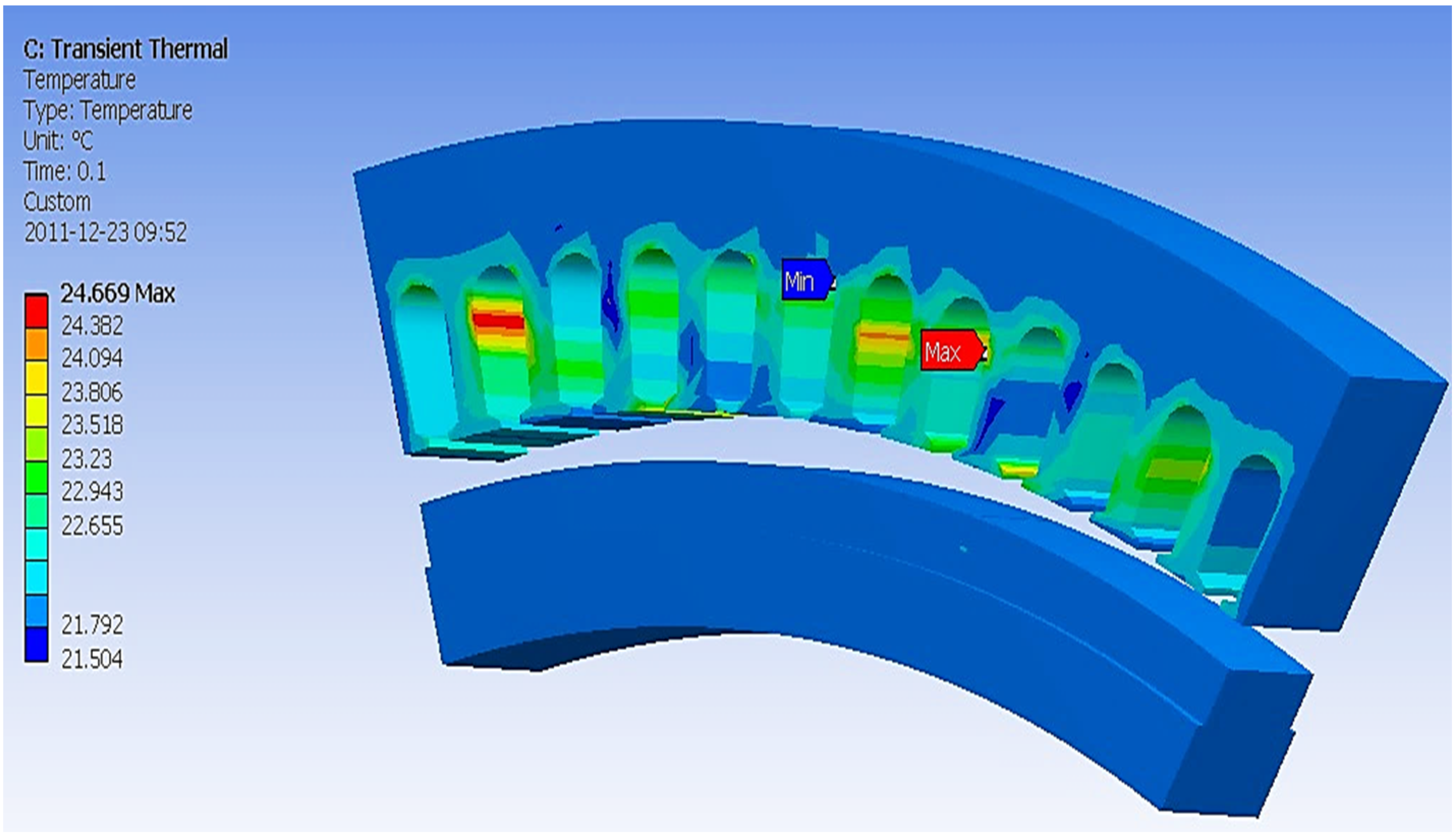
- Hao, Z.; Jin, S.; Dong, W.; Wang, G.; Hu, P. Design and analysis of the integrated motor cooling system for shaftless propeller. IEEE Access 2019, 7, 174573–174582. [Google Scholar] [CrossRef]
- Hu, P.F.; Jin, S.B.; Shen, Y.; Wei, Y.S.; Lan, R.S.; Zhuang, S.J. Cooling scheme design and multi-physics coupling calculation for wheel flange drive shaftless thruster. Ship Electr. Technol. 2016, 3, 4. [Google Scholar]
- Liang, J.; Zhang, X.; Qiao, M.; Li, G. Multifield coupling analysis of integrated motor propulsor. TELKOMNIKA Indones. J. Electr. Eng. 2012, 10, 1897–1903. [Google Scholar]





| Electric Motor Type | Year | Reference | Geometry of the Electric Motor | Performance | Problem |
|---|---|---|---|---|---|
| Iduction motor (IM) | 1989 | [14] |  | A 16-pole 3-phase motor with 48 stator slots and 72 rotor slots, 394 mm in diameter, and with a 1 mm air gap was used in the system. | The prototype test detected the problem of bearing friction loss and the eddy-current loss of the excessive stator sheath. |
| 1989 | [15] | ||||
| 2010, 2011, 2013 | [16,17,18] | 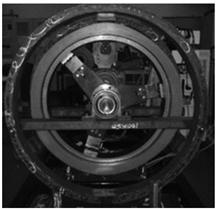 | The motor provided the same full-load torque as a regular industrial IM, while only weighing around 60% as much. | Due to a substantial amount of power lost to friction and eddy currents in the stator, the power factor, power density, and efficiency were all low (less than 50%). | |
| Switched reluctance motor (SRM) | 1995 | [19] | 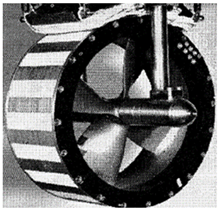 | The motor used a 3-phase 6-pole electromagnetic scheme to complete a 5 kW prototype design. There was anticorrosive paint on the surface, the stator winding was made of insulated cables, and the air gap was 0.6 mm. | The radial thickness of the motor was too large. Hence, this led to the large size of the duct and the low hydrodynamic efficiency of the propeller. The motor structure was to accommodate the stator and rotor sheath in the air gap to prevent corrosion. The protective layer caused the large air-gap size to reduce the electromagnetic performance, which turned out to be a disadvantage in the motor. |
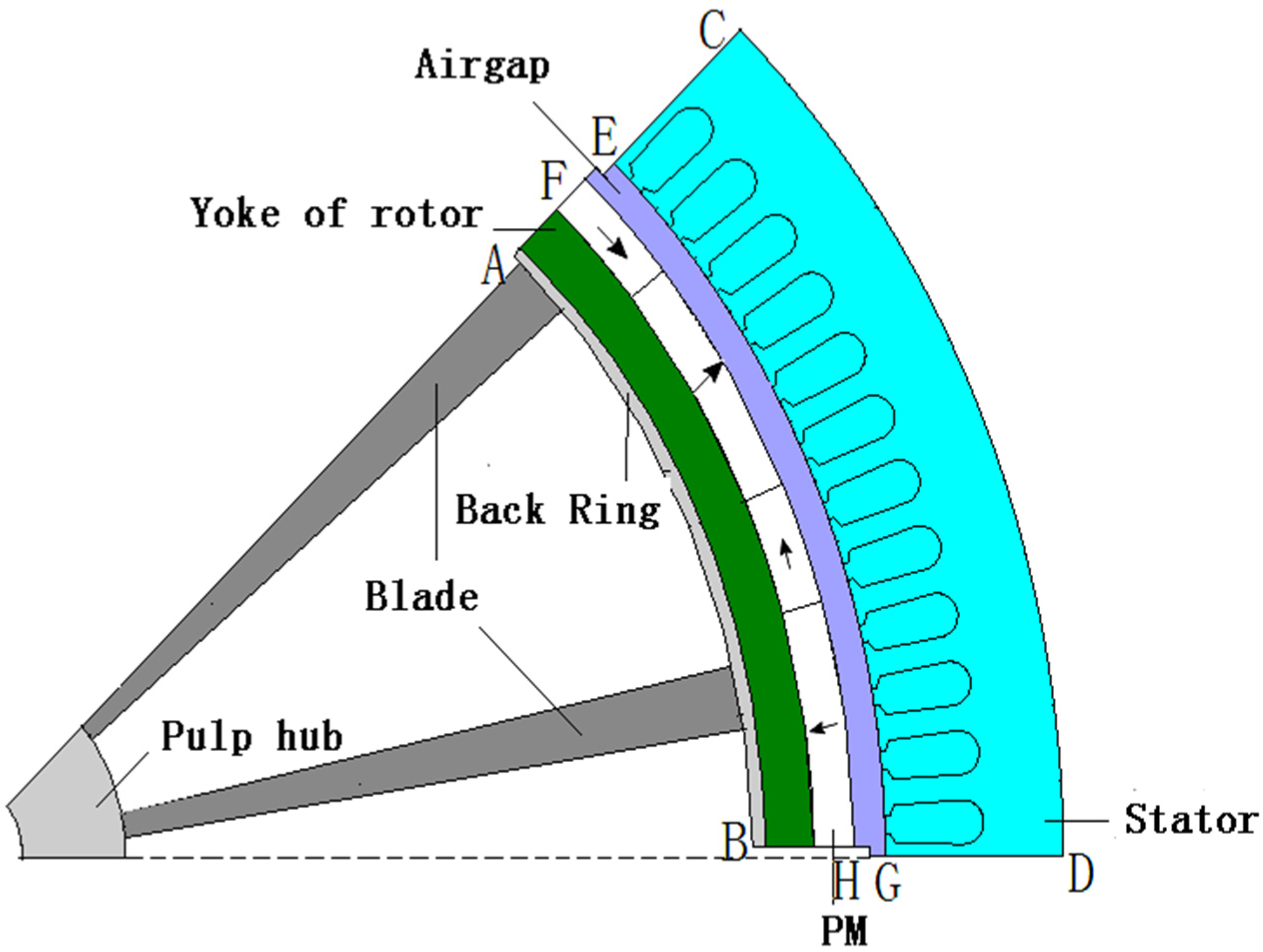
| Permanent-magnet direct-current motor (PM DCM) | 2001, 2004, 2003, 2003 | [20,21,22,23] | 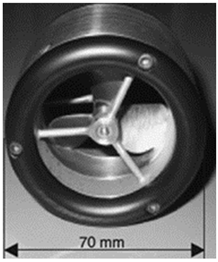 | In this design, the stator and rotor structure were all installed inside the duct, which eliminated the existence of liquid flow air gaps and did not affect the flow area. This reduced the influence of the stator and rotor structure on the propulsion performance of the propeller blades. | The manufacturing cost was high, and the production of slotted brushless PM machines was complex. |
| Permanent magnet direct-current motor (PM DCM) | 2003 | [24] | 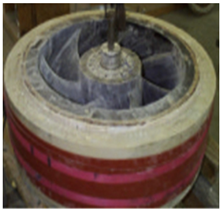 | Low eddy-current losses and cost were achieved with a PM motor that used composite materials for the propeller, housings, structural blading, motor canning, and fairings. | To remove eddy-current losses in the motor, the cost and weight must be lowered. |
| 2004 | [25] | 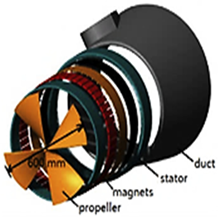 | The PMs were rectangular and were installed on the rotor yoke’s surface, which was made of solid soft iron. The stator lamination had a thickness of 0.5 mm. The magnets used were neodym magnets (NdFeB) with 1.2 T remains. Harmonics and winding overhang were decreased with a two-layer fractional winding. | The RDT was put to the test as an onshore generator, and its average efficiency was far lower than the 0.97 predicted. Losses in parallel circuits and the proximity of the coil ends to the iron case created the difference. | |
| 2006 | [10] | 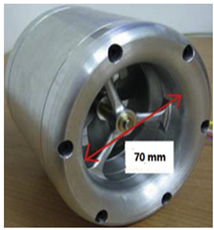 | Because a large magnetic gap was required and slot leakages were absent, the slotless motor design avoided the tooth-ripple component of the cogging, decreased harmonic effects, and had low winding inductance. | The slotless motor, which had a longer active length, longer end windings, and thicker magnets, was found to be less efficient in a set of comparative studies with a slotted motor of the same active radial dimensions. | |
| 2010 | [26] | ||||
| 2019 | [27] | 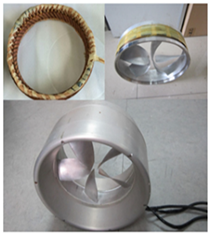 | The IMP motor was shown to have two-segment Halbach-array permanent magnets with unequal segment arcs. The uneven-segment-arc Halbach array was optimized to maximize the electromagnetic torque, according to the optimization and fabrication results, as well as the experimental motor performance results. | Because of the friction loss, the rotational speed and output thrust were lower than expected. | |
| Permanent magnet alternating-current motor (PM ACM) | 2013 | [28] | 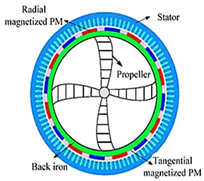 | A narrow rotor and a large air gap characterize the Halbach-array motor. When the PM thickness reached a particular value, the air-gap flux density rose, and thus the Halbach array would have a clear advantage. | The PM brushless motor’s most significant dimensional limitation was the high current density induced by the stator’s thermal condition. |
| 2016 | [29] | A two-segment Halbach array was used to produce good cooling and strength performance in a seawater-cooled high-power-density magnetically slotless PM brushless AC motor. The closed-slot stator tooth body of the magnetically slotless structure was made of stainless steel, which had good thermal conductivity, anticorrosion, compressive strength, and magnetic nonconductivity. | The power loss was high, and the RDT was not so compact. | ||
| High-temperature superconducting motor (HTSM) | 2013 | [30] | 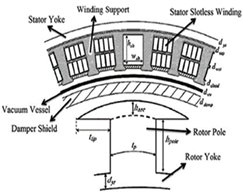 | This type of motor could obtain higher electromagnetic efficiency, and the thinner structure could reduce resistance to a certain extent. This was a big improvement compared to the previous motor type. | The cost was very high. |
| Bearing Type | Year | Reference | Geometry of the Bearing | Performance | Problem |
|---|---|---|---|---|---|
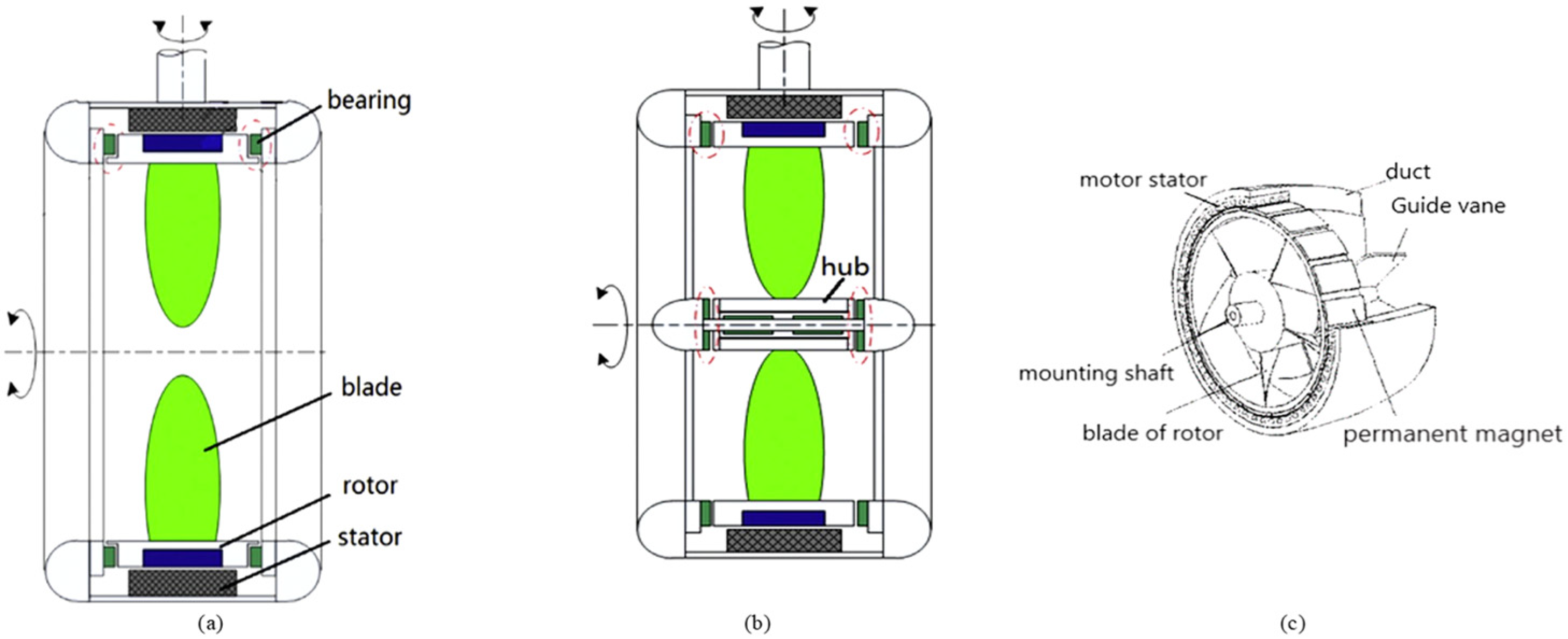
| Rolling bearing structure | 1995 | [36] | 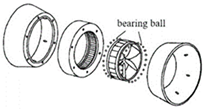 | Hubless RDT with grooved bearing races on both edges of the rotor ring. | The test results of these prototypes were not ideal, mainly due to the low reliability of the ball bearings in the mud and sand environment and the excessive bearing wear; furthermore, due to bearing friction, the rotor could not reach the predetermined speed under rated voltage conditions. In addition, ball bearings also have inherent shortcomings in terms of vibration, noise, and load-carrying capacity. In high-power propellers, large axial thrust is required, and rolling bearings experience excessive strain under high loads. |
| 2007 | [37] |  | The hubless RDT was embed with rolling bearings in the duct. | ||
| Magnetic bearings/sliding bearings | 2003 | [38] | Low noise and high carrying capacity | The difficulty, complexity, and cost of the entire system is increased, and it is likely to cause water pollution. | |
| Oil-lubricated bearings | 2017 | [39] | The bearing capacity and service life of oil-lubricated bearings are higher than those of water-lubricated bearings. | The construction, on the other hand, is complex, with significant machining and installation requirements. Oil-leakage prevention and sealing systems must also be reliable. | |
| 2017 | [40] | ||||
| 2017 | [41] | ||||
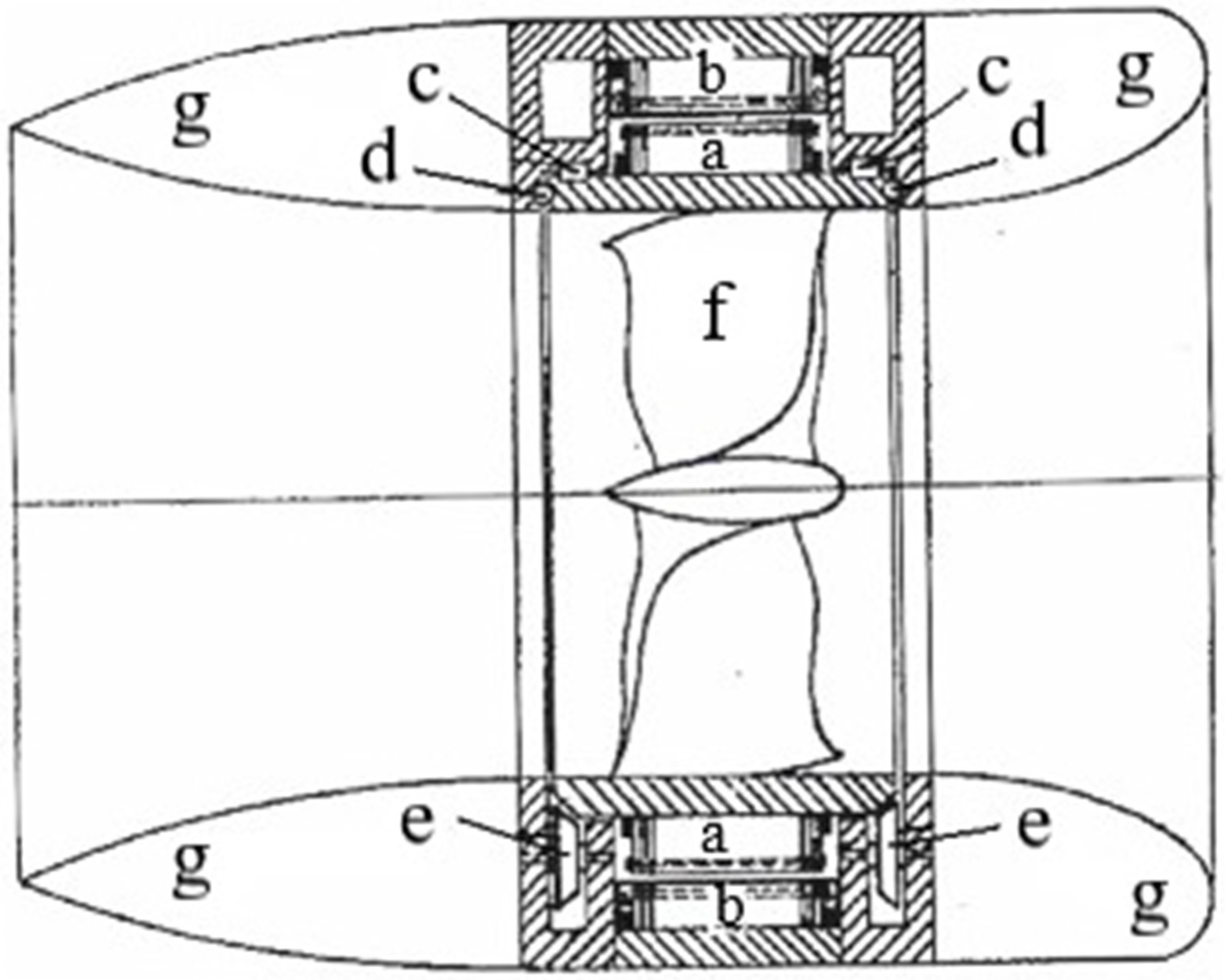
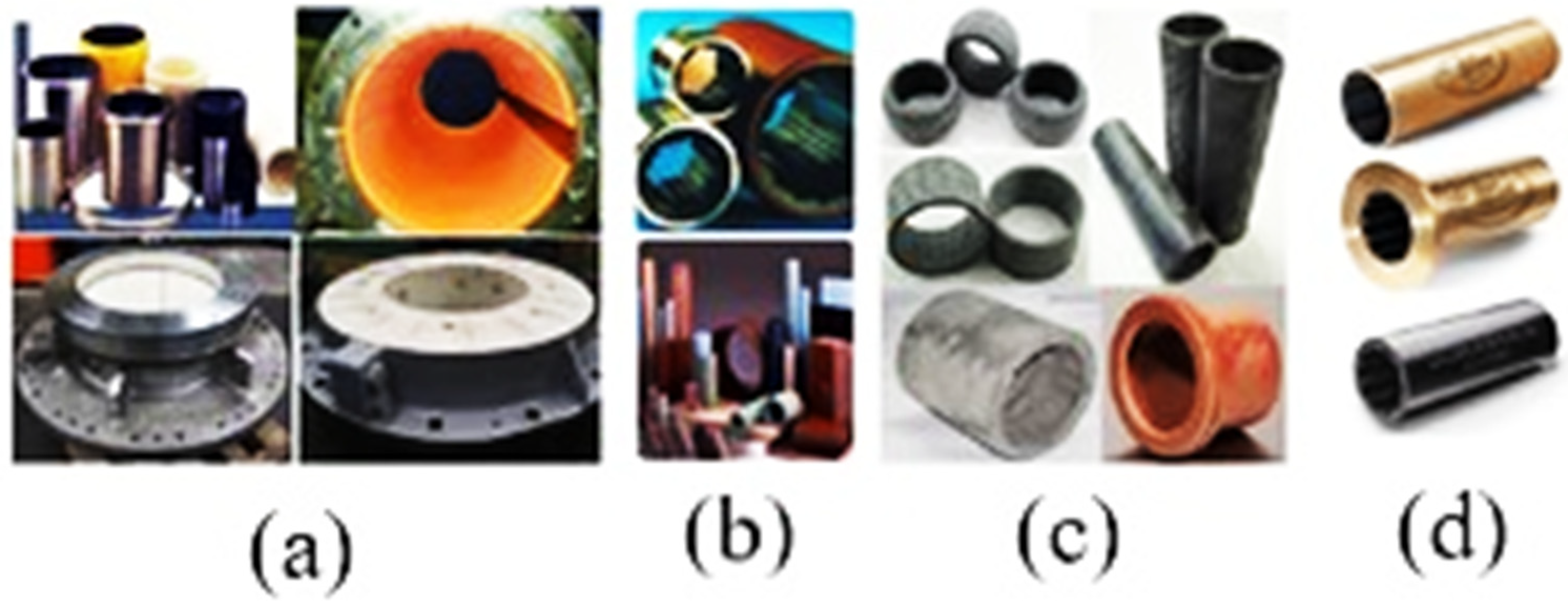
| Water-lubricated thrust bearings | 2015 | [42] | 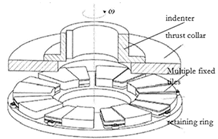 | The thrust bearing supported by rubber pads uses rubber deformation to adjust the inclination of the pad, which has great potential for damping vibration. | To obtain a good hydrodynamic performance from the IMP propeller, the thickness of the duct and the diameter of the hub must be as small as possible, which leads to the complexity of the bearing design. |
| 2016 | [43] | ||||
| 2016 | [44] | ||||
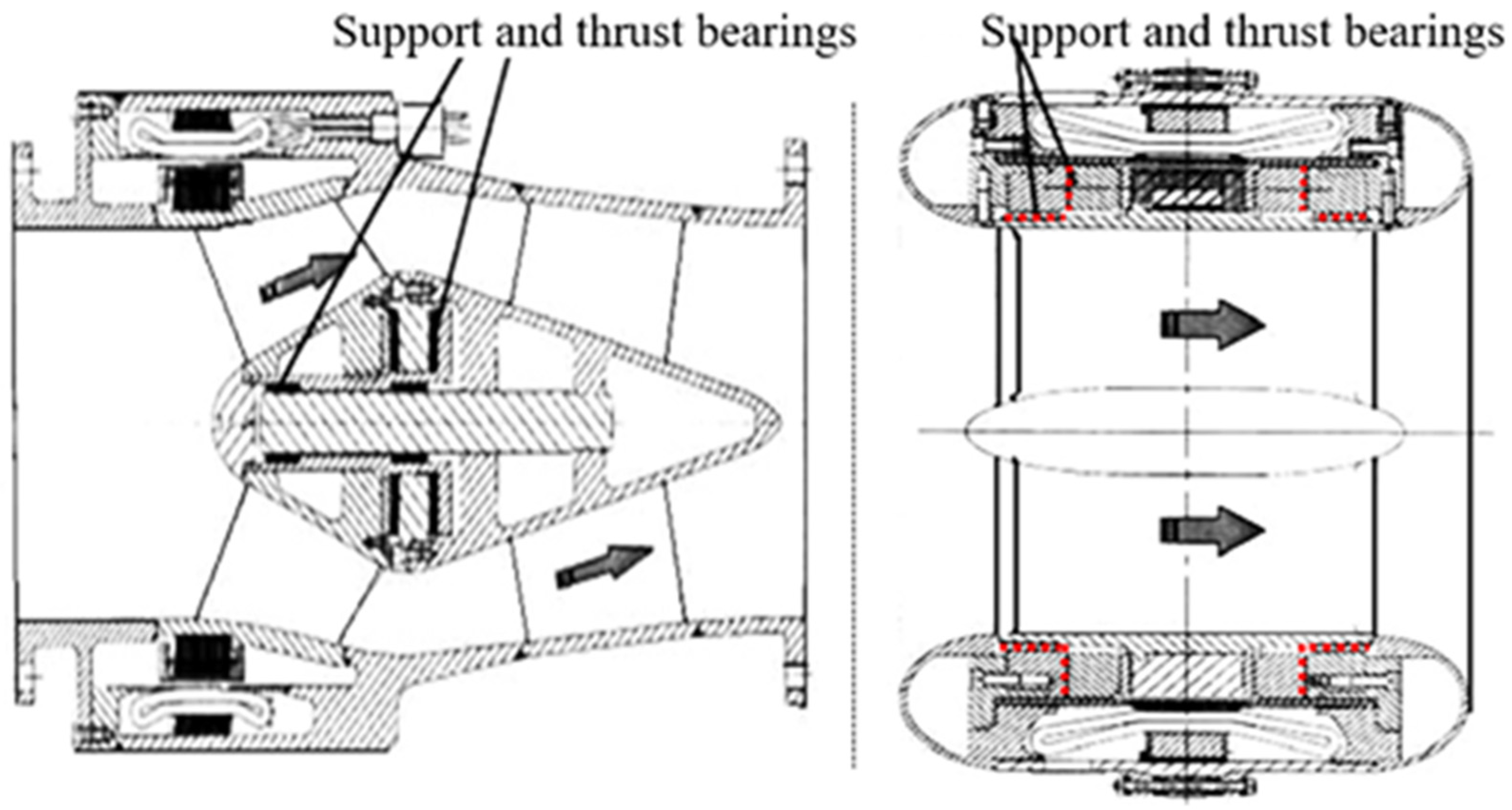
| 2017 | [45] | 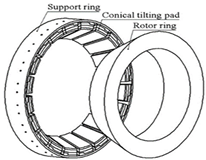 | Many units are also exploring the use of a support/thrust integrated structure which can bear both gravity and thrust loads. | The practicality has yet to be tested by engineering. |
| Parameter | Year | Reference | Model | Method/Experimental Method | Findings | |
|---|---|---|---|---|---|---|
| Propeller pitch ratio | 2003 | [22] | RDT | The interaction velocity-field approach was used in this lifting-surface panel code. |
| |
| 2003 | [23] | |||||
| Shape and size of the rim | 2015 | [46] | Ka-series thruster | Reynolds-averaged using varied-length rims to solve the Navier–Stokes equation. |
| |
| Shape and size of the hub | 2015 | [47] | Open-water performance of hub-type and hubless RDTs (rim-driven thrusters), the propeller Ka4-70 and duct JD7704 | Contrastive analysis, with Reynolds-averaged Navier–Stokes (RANS) equations and a multiple-frames-of-reference (MFR) method |
| |
| Shape and size of the duct | 2000 | [48] | The MARIN Ka4-70 in 37A duct | Comparison between a symmetrical propeller and a standard asymmetric ducted propeller | A symmetrical propeller provided less thrust per unit power, because it had a lower KT value and a greater KQ value. | |
| 2001 | [20] | S2037, S2637, F2637 | Contrastive analysis |
| ||
| 2019 | [49] | 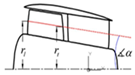 | Low-order surface panel approach based on velocity potentials |
| ||
| Shape and size of the propeller blade | 2012 | [50] | 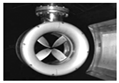 | Contrastive analysis, with Reynolds-averaged Navier–Stokes (RANS) solver | The correct adjustment of blade loading distribution could restrain root- and tip-region vortices. | |
| Shape and size of the propeller stator | 2020 | [51] | Pump-jet propulsor | Contrastive analysis, CFD analysis |
| |
| Experimental study | 2011 | [52] |  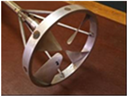 | Deep-water towing tank of the Krylov Shipbuilding Research Institute |
| |
| 2012 | [50] | 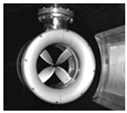 | Integral hydrodynamic measuring method |
| ||
| 2019 | [53] | 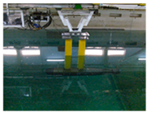 | Bollard pull, self-propulsion point (SPP), and bare-hull resistance tests |
| ||
| 2021 | [54] | 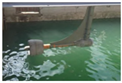 | Computational fluid dynamics (CFD) used to analyze and compare the hydrodynamic performances of a shaftless pump-jet thruster (SPT), a traditional mechanical pump-jet thruster (MPT), and an E779A propeller |
| ||
| Performance predictions | 2015 | [55] | The capture of the unsteady rotor–stator interaction | Frozen-rotor method |
| |
| 2016 | [56] | Mechanical pumping and IMP | Contrastive analysis |
| ||
| 2018 | [57] | Ducted propellers (DPs) | Panel method |
| ||
| 2019 | [58] | Potsdam Propeller Test Case (PPTC) | Hexahedral block-structured grids | In certain ranges of advance ratios, hexa and hybrid grids produced similar results; however, for low and high ratios, structured grids in combination with the realizable model could produce more accurate results. | ||
| 2019 | [59] | The open-water characteristics of the propeller | Contrastive analysis between different mesh types and turbulence models |
| ||
| 2021 | [2] | A detailed comparative study of hydrodynamic performance between a rim-driven thruster (RDT) and a ducted propeller (DP) | Contrastive analysis, CFD analysis |
| ||
| Parameter | Year | Reference | Model | Method | Findings | |
| Structural design | Hub-type and hubless propellers | 2011 | [52] | Hub-type and hubless propellers of RDTs | Contrastive analysis | The efficiency curves were similar, but the hubless propeller had a higher thrust and torque as compared to the hub propeller. |
| 2014 | [60] | A rim-driven water-jet pump of hub-type and hubless guide vanes | A simple steady-state CFD model, contrastive analysis | The results showed that the impeller efficiency of the pump with hubless guide vanes was reduced by about 10%, due to energy losses in the center line. | ||
| 2015 | [47] | Hub-type and hubless propellers of RDTs in open-water performance | Contrastive analysis, CFD analysis |
| ||
| Design optimization of IMP/RDTs | 2011 | [52] | Rim-driven thruster blading system | Direct blade pitch optimization method | The design method presented here for the rim-driven thruster, including the propeller blading system design, made it possible to achieve the required thruster performance. | |
| 2020 | [61] | Rim-driven thrusters |
| The result of the optimizations proved the flexibility and the reliability of the SBDO framework in dealing with unconventional configurations. | ||
| 2021 | [62] | Pump-jet propeller |
|
| ||
| Design of pump-jet propulsion | 2007 | [63] | Pump-jet propulsion aimed at a submarine model | Lifting-line method, surface element method, axial-flow pump lifting method | Calculations for a pump-jet thruster designed for a virtual submarine showed that the pump-jet thruster designed using this method met the design requirements and had high efficiency. | |
| 2017 | [64] | The rotor and stator of a pump-jet propeller | The three-dimensional inverse design method | The designed pump-jet propeller had a higher efficiency and better high-speed adaptability. | ||
| 2018 | [65] | MK48 torpedo | Theoretical analysis with numerical simulation and experiment | The theory of the overall selection of pump-jet propulsion and the design method of a three-dimensional shape was explored, and the accuracy of the pump-jet selection and design method was verified. | ||
| Year | Reference | Geometry of the Model | Type of Cavitation/Vortex | Cavitation Model | Findings |
|---|---|---|---|---|---|
| 2009 | [66] |  | The extent of cavitation and thrust | Vortex lattice (MPUF-3A) and boundary element (PROPCAV) methods |
|
| 2014 | [67] |  | The influence of rotation speed, cavitation number, and inlet velocity on the cavitation characteristics of the pump-jet thruster | The homogeneous multiphase model of the Rayleigh–Plesset equation and the slip grid technology, and the three-dimensional full-channel steady turbulence calculation |
|
| 2015 | [68] | 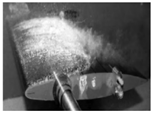 | Research on unsteady-flow cavitation performance, blade pressure distribution, tip vortex, and cavitation | The Zwart–Gerber–Belamri (ZGB) cavitation model |
|
| 2016 | [69] | Turbopumps, hydro turbines, and various other types of machinery | Leading-edge cavitation, inter-blade vortex cavitation, and traveling-bubble cavitation |
| Future research will focus on advanced themes such as a density-based solver for highly compressible cavitating turbulent flows and a virtual cavitation tunnel. |
| 2016 | [70] | 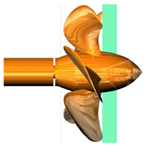 | Experimental observations of Schiffbau-Versuchsanstalt (SVA) Potsdam, OpenFOAM, StarCCM+, and BEM computations | The OpenFOAM native Schnerr–Sauer interphase mass transfer model | The comparison of traditional boundary element methods with available experimental measurements and calculations performed with StarCCM+ and a proprietary boundary element method code in a very demanding test case further validated the reliability of traditional boundary element methods that are still widely used for design and optimization (thanks to their much higher computational efficiency). |
| 2017 | [71] | A symmetric NACA0015 hydrofoil | Sheet and cloud cavitation | The Zwart–Gerber–Belamri (ZGB) cavitation model in OPENFOAM |
|
| Year | Reference | Geometry of the Model | Parameter | Method/Experimental Method | Findings |
|---|---|---|---|---|---|
| 2000 | [72] | Brushless permanent-magnet motor of a rim-driven thruster | The gap size | CFD analysis |
|
| 2015 | [73] |  | The axial and radial gap flow | A new predicted formula to calculate the outer surface’s torque: |
|
| 2015 | [74] | 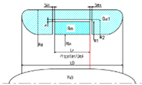 | The pressure difference in the axial and radial gap | The boundary layer theory and semiempirical formulas: the RANS solver and the turbulent model SST k-ω |
|
| 2015 | [55] | Rim-driven thrusters | The axial and radial rim gaps | The Daily and Nece, and Bilgen and Boulos models |
|
| 2017 | [75] | Motor cooling | The different structural parameters and different working conditions | Contrastive analysis, CFD analysis |
|
| 2018 | [76] | L-shaped bearing and tapered bearing | The change in the law of clearance friction power consumption | Contrastive analysis, CFD analysis |
|
| 2019 | [49] | Pump-jet propulsor | The rotor and stator thrust as well as the torque performance | Mesh approach for flat-topped blades based on a circular truncated cone and a tip leakage vortex model |
|
| 2019 | [77] | Rim-driven propulsor | The different speeds of the rotor and the advanced coefficient | Reynolds-averaged equation (RANS), and the rotation of the rotor was simulated by moving reference frame (MRF) | The axial gap flow increases with the increase in the rotation speed. Changes in the fluid pattern within the gap result in changes in the differential pressure within the gap. |
| 2017 | [78,79] |  | The different gap ratios in a radial and axial direction, speed, and pressure | CM = 0.080(s/a)−1/6Re−0.25 CM = 2 M/ρω2a5 |
|
| 2022 | [75] | ||||
| 2021 | [80] |  | The effect of fluid viscosity in the gap zone | Combining the existing tip leakage vortex model and a suitable gap-flow model |
|
| 2021 | [81] |  | The effect of fluid viscosity in the gap zone, as well as the height of the gap | A low-order panel method based on velocity potential combining the existing tip leakage vortex model and a suitable gap-flow model |
|
Publisher’s Note: MDPI stays neutral with regard to jurisdictional claims in published maps and institutional affiliations. |
© 2022 by the authors. Licensee MDPI, Basel, Switzerland. This article is an open access article distributed under the terms and conditions of the Creative Commons Attribution (CC BY) license (https://creativecommons.org/licenses/by/4.0/).
Share and Cite
Li, Q.; Abdullah, S.; Rasani, M.R.M. A Review of Progress and Hydrodynamic Design of Integrated Motor Pump-Jet Propulsion. Appl. Sci. 2022, 12, 3824. https://doi.org/10.3390/app12083824
Li Q, Abdullah S, Rasani MRM. A Review of Progress and Hydrodynamic Design of Integrated Motor Pump-Jet Propulsion. Applied Sciences. 2022; 12(8):3824. https://doi.org/10.3390/app12083824
Chicago/Turabian StyleLi, Qiao, Shahrir Abdullah, and Mohammad Rasidi Mohammad Rasani. 2022. "A Review of Progress and Hydrodynamic Design of Integrated Motor Pump-Jet Propulsion" Applied Sciences 12, no. 8: 3824. https://doi.org/10.3390/app12083824
APA StyleLi, Q., Abdullah, S., & Rasani, M. R. M. (2022). A Review of Progress and Hydrodynamic Design of Integrated Motor Pump-Jet Propulsion. Applied Sciences, 12(8), 3824. https://doi.org/10.3390/app12083824