


Abstract
This paper is devoted to the creation of an information and analytical system (IAS) which is under development to manage the data obtained in experiments and investigations to justify the safety of atomic energy, which the National Nuclear Center of the Republic of Kazakhstan (RSE NNC RK) has been conducting for over 30 years. The main components of the IAS determining its consumer capabilities is an analytical unit that will allow the creation of programs for planned experiments in view of the technical requirements for them and based on the results of previous experiments, generalized and consolidated by processing and comparison tools provided by the IAS. An important component of the IAS is a set of tools for the predictive calculation of the temperature of materials of test sections depending on a given change in the power of energy release in them, predictive calculation of the required power of energy release in materials depending on a given change in their temperature, formation of arrays of experimental information in digital format and graphical form, comparison of experiments and their data among themselves, and the formation of protocols of experiments with the possibility of choosing specific data and methods for their processing. It should be noted that the created IAS greatly simplifies the preparation for experiments.
1. Introduction
The effective management of large flows of various information cannot be organized without the use of computer information and analytical systems (IAS). In scientific and technical applications, IASs are of particular value, providing deep analytical processing of the results of previous studies and the possibility of planning new experiments [1,2,3].
Currently, the National Nuclear Center (RSE NNC RK) conducts a large number of scientific works [4,5,6,7,8,9,10,11]. It should be noted that for more than 30 years, the RSE NNC RK has been conducting the work to justify the safety of atomic energy at the unique experimental test benches “ANGARA” and “VCG-135” [12,13,14,15,16,17]. During this time, a large amount of experimental information has been accumulated on the processes occurring during the development of postulated severe accidents at nuclear reactors. The knowledge gained when studying these processes makes it possible to reasonably solve the problems of choosing the principles of operation of passive safety systems of nuclear power reactors and the formation of technical requirements for the designs of these systems. Experimental test benches of the RSE NNC RK enable the conducting of physical modeling of processes typical for the final stage of an accident in water-cooled reactors caused by an imbalance between an energy release in nuclear fuel and heat removal (accidents of the LOCA, ULOF type). At the same time, the main attention during research is paid to studying the processes of interaction between the melt of materials of the reactor core (corium) with:
- -
- Coolant (water);
- -
- Concrete (melt trap, concrete load-bearing structures);
- -
- Candidate materials for the protection of a trap;
- -
- Material (steel) of a reactor pressure vessel.
The information obtained during the experiments, for the most part, is heterogeneous, however, it has a number of common features that make it possible to link the results of individual experiments and their series into a single whole. Using the methods of qualitative and quantitative analysis aimed at summarizing the results of individual experiments, all the information received was processed in order to bring it to a single format.
The purpose of creating an IAS was to provide access to both individual and generalized research data, as well as to a validated mathematical apparatus designed to process experimental data and carry out predictive calculations. At the same time, the main tasks to be solved are to increase the speed of processing and the reliability of the analysis of experimental data and, ultimately, the convenience of planning future experiments.
The novelty of this research is the creation of an IAS for scientific research, in particular, the research processes of a severe accident with melting of a nuclear reactor core and retention of the melt in the reactor pressure vessel. It is also worth noting that the preservation of scientific data will ensure their continuity for the next generation and open up the possibility of assessing changes in the properties of materials over time.
2. IAS Structure and Characteristics
For the development of an IAS, a categorization of data obtained during experiments over a long period of time was conducted.
The main criteria for data separation were:
- -
- The type of melt retention model under study;
- -
- The scale of the model in relation to the mass of the resulting melt.
According to the type of model under study, all experiments are divided into experiments with the study of the processes of a melt retention inside of the vessel (accident at the Three Mile Island NPP) and experiments with an out-of-vessel melt retention (accidents at the Chernobyl NPP, Fukushima-1).
According to the scale of the model, all the experiments performed can be divided into large-scale and small-scale experiments. This division depends on the amount of material used in the simulation of severe accidents, while large-scale experiments are carried out on the “ANGARA” test bench and small-scale experiments are carried out on the “VCG-135” test bench.
The ANGARA test bench is designed to study the interaction between a nuclear reactor fuel melt and structural materials under conditions simulating an accident with a reactor core melting [9]. At different times, the “SLAVA”, “LAVA”, “LAVA-M” and “LAVA-B” installations were used on the test bench for the experiments. Currently, the Lava-B is one of the most popular installations of the “ANGARA” facility. This installation consists of two main elements: an electric melting furnace (EMF) and a melt receiver (MR). Figure 1 shows the view of the Lava-B installation, and the technical characteristics of the EMF and MR are in Table 1 and Table 2, respectively.
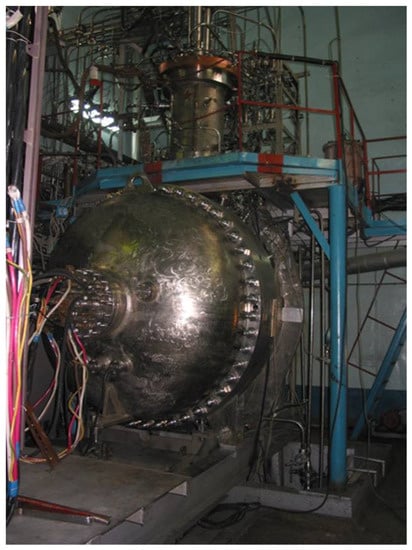
Figure 1.
LAVA-B installation.

Table 1.
Main characteristics of the “LAVA-B” installation.
Table 2.
Technical characteristics of the “VCG-135” test bench.
For collecting, the registration and pre-treatment signals from the primary converters and automation devices located on the “LAVA-B” test bench itself and the technological systems of the test bench, as well as to implement the functions of logical control of the technological parameters of the test bench systems, a specialized information-measuring system (IMS) of the “ANGARA” facility was used.
The information and measuring system provides the following main functions:
- -
- The collection, transformation and registration of measuring analog information from the sensors of the experimental installation and technological systems of the test bench;
- -
- The collection and registration of discrete signals about the state of the test bench automation units;
- -
- The collection and registration of measurement information from high-speed sensors for measuring the pressure impulse according to a set signal from the operator’s console;
- -
- The display of experimental and service information on monitors in the control room of the test bench;
- -
- A warning signal according to the settings of the measuring channels with a response time of no more than 1 s;
- -
- The calculation of indirect technological parameters based on the results of direct measurements;
- -
- A pre-start-up preparation of calibration and other service information.
The “VCG-135” test bench is designed to perform high-temperature material research on small-sized samples and allows for the rapid heating of samples to a high (about 3000 °C) temperature, followed by their cooling due to a heat leakage into a water-cooled inductor with the generator turned off.
The “VCG-135” test bench provides the possibility of video recording the process of heating and cooling a sample through a viewing window in the cover of the working chamber, as well as gas sampling during the experiment. The working chamber of the test bench is equipped with electrical penetrations for the output of communication lines of the primary sensors for measuring the parameters of the experiment. The outer view of the test bench is shown in Figure 2; technical characteristics are shown in Table 2.
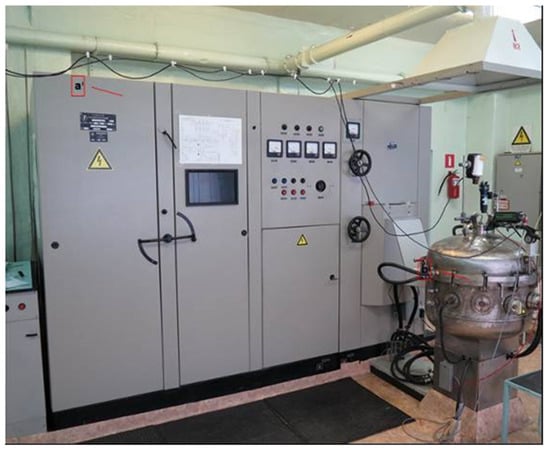
Figure 2.
Outer view of the “VCG-135” test bench.
After the experiment is complete, its results are processed in the format required for loading into the IAS.
3. IAS Capabilities
The functioning of the IAS is based on the principle of the sequential implementation of the following stages of data processing:
- -
- Data creation;
- -
- Data modification;
- -
- The creation of documents and reports.
These functions are implemented within the framework of the analytical block, which provides users with a set of tools for:
- -
- The predictive calculation of the temperature of the materials of the test sections, depending on the specified change in the power of energy release in them;
- -
- The predictive calculation of the required power of energy release in materials depending on a given change in their temperature;
- -
- The formation of arrays of experimental information in digital format and graphical form;
- -
- The comparison of experiments and their data among themselves;
- -
- The formation of protocols of the experiments with the possibility of choosing specific data and methods for their processing.
An image of the structure of the analytical block is shown in Figure 3.
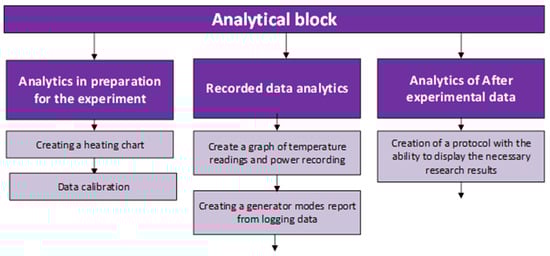
Figure 3.
Analytical block of IAS.
An example of calculating the diagram of the change in the temperature of the materials of the test section depending on the power of energy release in them, performed by means of the developed IAS, is shown in Figure 4.
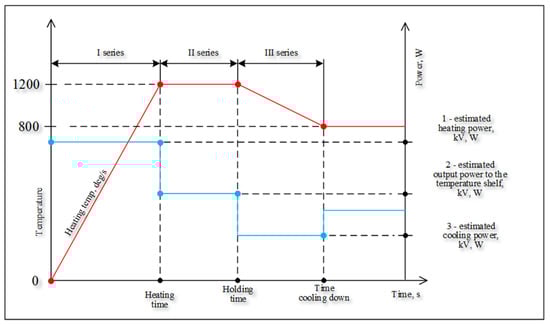
Figure 4.
Heating diagram using IAS.
The regulation of the temperature shown in Figure 4 occurs due to the power, and vice versa, of the IAS, based on the values of the temperature we need, which allows us to accurately determine the power expended.
As part of the procedure for comparing experiments and their data, the analytical block of the IAS provides an opportunity to compare the results of studying the macro- and microstructure of materials, the results of energy-dispersive spectral analysis (EDS), scanning the electron microscope (SEM), and X-ray structural analysis. An example of comparing SEM analysis data is shown in Figure 5.
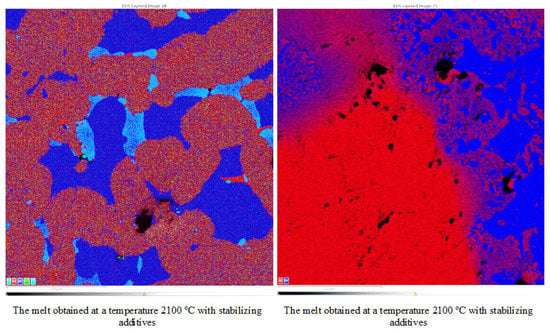
Figure 5.
Results of SEM analysis in IAS.
IAS allows for the displaying of research as the SEM results, as shown in Figure 5, obtained under identical experimental conditions, but with a different corium composition, and for considering the differences that occur in the material.
One of the main functions of the IAS is the “Ready Protocol” function, which allows you to display and print only the data that the user needs.
4. Discussion and Conclusions
During the development and creation of the IAS, the results of experiments performed on the “VCG-135” and “ANGARA” facility were collected and structured according to the main parameters as part of the studies to justify the safety of nuclear energy.
The principles of categorization underlying the formatting of experimental data made it possible to generalize the results of individual experiments and to calculate the parameters of performed and planned experiments using a single mathematical apparatus, resulting in an increase in the speed and volume of data processed when planning experiments, which is directly an advantage of the developed IAS.
Moreover, one of the main advantages of the developed IAS is that it greatly simplifies the preparation for experiments, the processing of the obtained data and the comparative analysis of the available data and the results obtained. In this regard, the developed IAS has a great advantage in contrast to manual data processing.
Author Contributions
Conceptualization: N.M. and Y.B.; methodology: A.V. and A.A.; software: A.S.; formal analysis: N.M. and Y.B.; writing—original draft preparation: N.M.; writing—review and editing: N.M. and A.V.; visualization; Y.B.; project administration: A.V. and Y.B.; funding acquisition: A.V. All authors have read and agreed to the published version of the manuscript.
Funding
The research was carried out within the framework of grant funding of projects for 2021–2023 (Ministry of Education and Science of the Republic of Kazakhstan) AP09260704 on the topic “Information and analytical system of data obtained from experimental simulation of severe accident at a nuclear reactor”.
Institutional Review Board Statement
Approved by the ethics committee of the Institute of Atomic Energy. Expert opinion No. 38-gzgs-09/1277 ext.
Informed Consent Statement
Informed consent was obtained from all subjects involved in the study.
Data Availability Statement
The data used to support the funding of this study are available from the corresponding author upon request.
Conflicts of Interest
The authors declare no conflict of interest. The funders had no role in the design of the study; in the collection, analyses or interpretation of data; in the writing of the manuscript; or in the decision to publish the results.
References
- Pyankov, O.V. Information-analytical system: Purpose, role, properties. Inf. Secur. Reg. 2014, 1, 21–26. [Google Scholar]
- Mikhailov, A.V. Analysis of the fundamental principles of information and analytical systems. Int. J. Humanit. Nat. 2020, 6, 45–48. [Google Scholar] [CrossRef]
- Mamaeva, N.V.; Milyutin, L.B.; Nikolenko, V.N.; Fedoseev, A.I. A Modern approach to the construction of the information-analytical system of status and development of scientific sphere in institutions of higher education. Open Educ. 2014, 6, 34–39. [Google Scholar] [CrossRef]
- Kozhakhmetov, Y.; Skakov, M.; Mukhamedova, N.; Kurbanbekov, S.; Ramankulov, S.; Wieleba, W. Changes in the microstructural state of Ti-Al-Nb-based alloys depending on the temperature cycle during spark plasma sintering. Mater. Test. 2021, 63, 119–123. [Google Scholar] [CrossRef]
- Kozhakhmetov, Y.A.; Skakov, M.K.; Kurbanbekov, S.R.; Mukhamedov, N.M.; Mukhamedov, N.Y. Powder composition structurization of the Ti-25Al-25Nb (At.%) system upon mechanical activation and subsequent spark plasma sintering. Eurasian Chem. Technol. J. 2021, 23, 37–44. [Google Scholar] [CrossRef]
- Mukhamedova, N.M.; Skakov, M.K.; Wieleba, W. Determination of phase composition and mechanical properties of surface of the material obtained on the basis of silicon and carbon by spark-plasma sintering method. AIMS Mater. Sci. 2019, 6, 270–282. [Google Scholar] [CrossRef]
- Mukhamedova, N.; Kozhakhmetov, Y.; Skakov, M.; Kurbanbekov, S.; Mukhamedov, N. Microstructural stability of a two-phase (O + B2) alloy of the Ti–25Al–25Nb system (at.%) during thermal cycling in a hydrogen atmosphere. AIMS Mater. Sci. 2022, 9, 270–283. [Google Scholar] [CrossRef]
- Baklanov, V.; Zhanbolatova, G.; Skakov, M.; Miniyazov, A.; Sokolov, I.; Tulenbergenov, T.; Kozhakhmetov, Y.; Bukina, O.; Orazgaliev, N. Study of the Temperature Dependence of a Carbidized Layer Formation on the Tungsten Surface Under Plasma Irradiation. Mater. Res. Express 2022, 9, 016403. [Google Scholar] [CrossRef]
- Sokolov, I.A.; Skakov, M.K.; Miniyazov, A.Z.; Tulenbergenov, T.R.; Zhanbolatova, G.K. Interaction of plasma with beryllium. J. Phys. Conf. Ser. 2021, 2064, 012070. [Google Scholar] [CrossRef]
- Skakov, M.K.; Mukhamedov, N.; Deryavko, I.; Wieleba, W.; Vurim, A. Research of structural-phase state of a natural corium of a fast power reactors. Vacuum 2017, 141, 216–221. [Google Scholar] [CrossRef]
- Skakov, M.K.; Mukhamedov, N.E.; Deryavko, I.I.; Kukushkin, I.M. Thermal properties and phase composition of full-scale corium of fast energy reactor. Key Eng. Mater. 2017, 736, 58–62. [Google Scholar] [CrossRef]
- Grechanik, A.D.; Kukushkin, I.M.; Baklanov, V.V. Metallographic studies of the corium obtained at severe accident modeling of the fast neutron reactor with sodium coolant. NNC RK Bull. 2014, 1, 40–46. [Google Scholar]
- Toyohara, M.; Kawano, S.; Fujita, T.; Hayashi, T.; Baklanov, V.; Kolodeshnikov, A.A.; Zuev, V. Characterization of fuel debris by large-scale simulated debris examination for Fukushima daiichi nuclear power stations. In Proceedings of the X International Conference Nuclear and Radiation Physics, Beijing, China, 7–13 September 2015; p. 25. [Google Scholar]
- Skakov, M.K.; Baklanov, V.V.; Koyanbayev, Y.T.; Zuev, V.A.; Sapataev, E.E.; Miniyazov, A.Z.; Kukushkin, I.M.; Kozhakhmetov, E.A. Investigation of the interaction of the corium prototype with SUS304 structural steel in the simulation of a severe accident at a NPP. Bull. NNC RK 2016, 3, 120–127. [Google Scholar]
- Skakov, M.K.; Mukhamedov, N.; Vurim, A.D.; Batyrbekov, E.G.; Deryavko, I.I.; Pakhnits, A.V. Studies of possible ways to take out corium from the fast reactor core. Bull. KazNITU 2016, 3, 413–422. [Google Scholar]
- Mukhamedov, N.; Skakov, M.; Deryavko, I.; Kukushkin, I. Thermal properties of prototype corium of fast reactor. Nucl. Eng. Des. 2017, 322, 27–31. [Google Scholar] [CrossRef]
- Imaizumi, Y.; Matsuba, K.-I.; Aoyagi, M.; Ganovichev, D.A.; Kamiyama, K.; Baklanov, V.V. Development of evaluation method for in-place cooling of residual core materials in core disruptive accidents of SFRs. In Proceedings of the 27th International Conference on Nuclear Engineering: Nuclear Power Saves the World (ICONE 2019), Tsukuba, Japan, 19–24 May 2019. [Google Scholar] [CrossRef]
Publisher’s Note: MDPI stays neutral with regard to jurisdictional claims in published maps and institutional affiliations. |
© 2022 by the authors. Licensee MDPI, Basel, Switzerland. This article is an open access article distributed under the terms and conditions of the Creative Commons Attribution (CC BY) license (https://creativecommons.org/licenses/by/4.0/).