Abstract
In this article, the design and implementation of a fault-tolerant controller are proposed for an electro-hydraulic actuator (EHA) in the presence of disturbances and actuator faults. The existence of nonlinearities, uncertainties, and a bias fault (i.e., internal leakage fault) in the system dynamics significantly decreases the desired performance. The nonlinear disturbance observers (NDO) are constructed to handle the adverse influences caused by the above disadvantages. The whole fault-tolerant control (FTC) scheme consists of two design loops: an inner force control loop and an outer position control loop. The inner loop is based on an optimized backstepping framework to achieve the optimal performance, whilst the problem of uncertainties and disturbances is dealt with using a terminal sliding mode directly designed from the position tracking error. It is shown by theoretical analysis that system stability is ensured under faulty conditions. Finally, simulation results and comparison studies are conducted to further verify the effectiveness of the proposed approach.
1. Introduction
Over the past few decades, electro-hydraulic systems have been extensively used in various civilian and industrial applications due to many outstanding achievements [1,2,3,4]. There exist different research studies, and many results have been introduced to obtain the force or position control requirements, including model-based feedback control [5], sliding-mode control [6], backstepping control [7], adaptive robust control [8], and so on. However, in the abovementioned works, many simultaneous problems of EHAs, such as uncertainties, disturbances, faults, and optimal performance, have not been well investigated. It is noted that the uncertainties include parametric uncertainties (i.e., parameter deviation, modeling errors, etc.) and uncertain nonlinearities (i.e., nonlinear friction force, and external load) [5,6,7,8]. Meanwhile, the most popular fault in the EHA is the internal leakage fault that comes from the piston seal and/or internal flow loss [9,10]. Such problems may degrade tracking performance or even cause instability of the whole EHA system if they are not tackled in a timely manner. Thus, the fault-tolerant capability is vital for guaranteeing the reliable control system and obtaining optimal performance of the EHA system.
To overcome the adverse effects of disturbance and uncertainty, the actuator fault issue, many effective FTC methods have been suggested to ensure system stability at an acceptable level [11]. Most notably, observers or an intelligent approximator-based FTC approach are widely adopted to react to faults, i.e., disturbance observer (DO) [12], state-dependent delay (SDD) [13], fixed-time observer [14], extended state observer [15,16], neural networks (NN) [17,18], fuzzy logic system (FLS) [19,20], and so on. It is noted that the effect of fault is significantly larger than lumped disturbance; many works merged the disturbance and bias fault into lumped disturbance. To deal with this issue, a designed compensator is then presented in Refs. [12,13,14,15,16,17,18,19,20]. In Ref. [21], by using the time delay estimation-based FTC control approach, the effects of disturbances and an internal leakage fault are compensated as lumped uncertainties. The authors in Ref. [22] proposed an adaptive NN actuator failure compensation control scheme for the vehicle active suspension systems. In Ref. [23], the fault estimation and FTC scheme were suggested for the hydraulic manipulator in the presence of the internal leakage fault and lumped disturbance, by using two DOs and a control reconfiguration law. In Ref. [24], the combination of an adaptive law and the DO was adopted to cope with the internal leakage fault. However, in the existing literature, the FTC approach based on optimal performance for the nonlinear system has not been well addressed, especially for EHA systems. How to obtain reliable control of the EHA whilst ensuring optimal performance is still challenging in the control field.
In most industrial fields, certain optimal performance of the EHA is required. Thus, the optimal control emerges as an effective method and there has been more attention paid to not only handle the control issue but also guarantee the optimal performance for the nonlinear system. To obtain the optimal control performance, solving the solution of the Hamilton–Jacobi–Bellman (HJB) equation is necessary [25,26,27,28]. Nonetheless, the HJB equation is solved complexity due to the inherent nonlinearity and intractability, which results in reducing its feasibility and applicability. Then, NN-based reinforcement learning (RL) is an effective tool to overcome the above challenge. A typical structure, namely actor–critic architecture, was used to implement the RL algorithm [29,30]. In Ref. [31], the optimal tracking control problems for an unknown unmanned surface vehicle have been investigated via using an actor–critic reinforcement learning framework. In Ref. [32], actor–critic RL has been successfully applied for the EHA. Moreover, a reinforcement learning (RL) control strategy for a flexible two-link manipulator to enable vibration suppression was developed in Ref. [33], while retaining trajectory tracking. Although some published papers applied the RL for control issues, the achievement of FTC to solve tracking control problems using powerful learning algorithms and tackling both disturbance and actuator fault for the EHA systems has not been investigated. Therefore, the development of the FTC scheme with optimal performance for related EHA applications subject to actuator faults and disturbances motivates this paper.
Through the above analysis, it is revealed that most EHA systems have the requirement of optimal performance, while simultaneously suffering from disturbances/uncertainties and the internal leakage fault, which need to be addressed. Inspired by the abovementioned reasons, the proposed FTC scheme in this article for the EHA is investigated by using a cascade control technique, including the two control loops (position and force controls) and two DOs that warrant the system stability and the optimal control performance subject to the above disadvantages. The main contributions of this paper can be summarized in the following.
- Compared with Refs. [34,35], this work firstly investigates the FTC problem for the EHA system to simultaneously solve the lumped disturbances, bias fault, so that the force control of the EHA system is optimized.
- To effectively attenuate the influences of the disturbances and the fault in the EHA system, the combination of DOs, a nonsingular terminal sliding-mode (NTSMC) scheme for the position tracking control loop, and an optimized force control method is developed.
- The system stability and asymptotic tracking error convergence is warranted by Lyapunov theory, and the effectiveness and feasibility of the suggested methodology are verified based on the simulation results.
The rest of this article is arranged as follows: In Section 2, the mathematical model with the actuator fault model of the EHA is described. The proposed cascade FTC comprises of the two loops (position and force controls) and two DOs, which is designed in Section 3. Section 4 presents the numerical simulation and comparison studies, respectively. Finally, the brief conclusions and future works are drawn in Section 5.
2. System Descriptions and Preliminaries
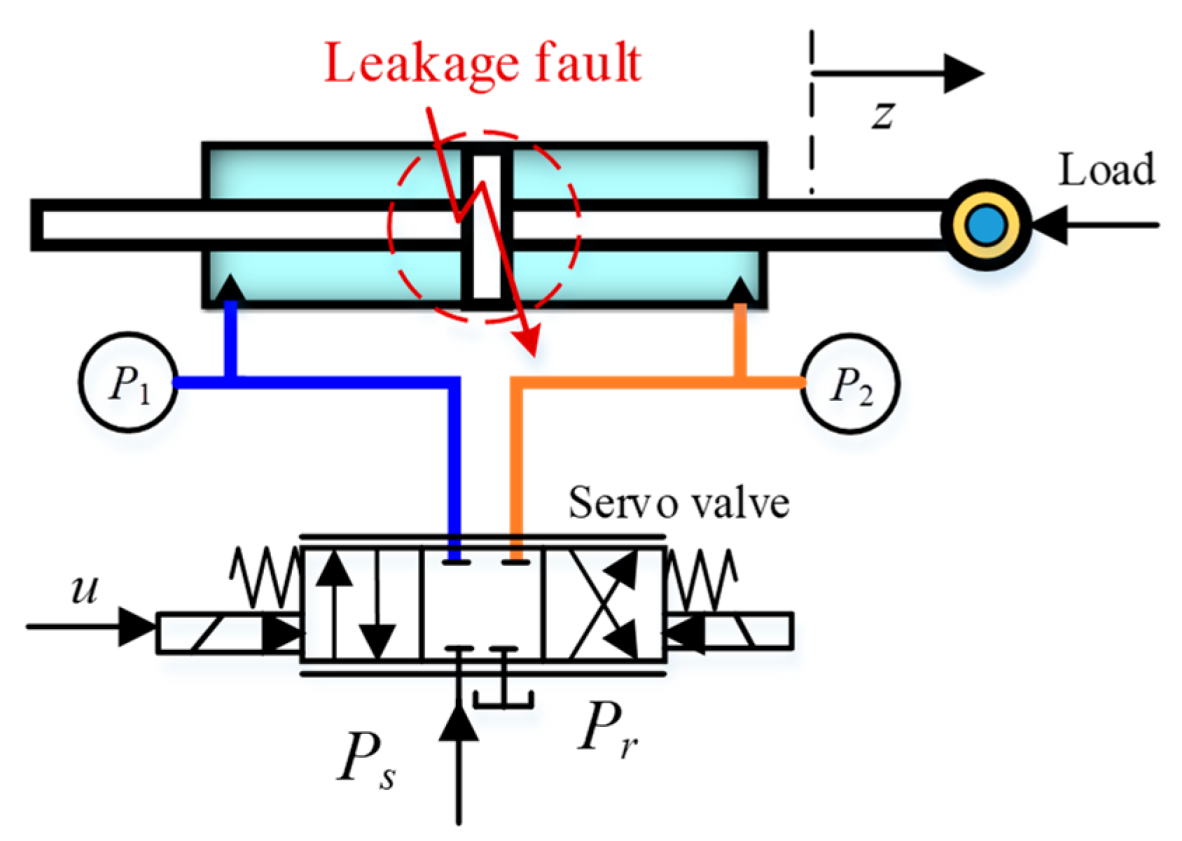
The schematic diagram of the EHA with actuator faults is shown in Figure 1. The internal leakage fault of the hydraulic driven actuator is studied.
Figure 1.
Schematic of hydraulic system with faults.
The dynamics of the actuator’s moving part can be derived by Newton’s second law
where z is the piston’s displacement; represents the disturbance terms, i.e., load’s force, friction; is the load pressure, with being the pressure inside the extend and retract chambers; and m and describe the mass of the moving part and the equivalent viscous damping coefficient.
We suppose that the valve’s voltage input is related to the spool valve displacement by the directly proportional. Then, the load flow rate is related to the control signal u by
where Ps is the supply pressure, is a servo-valve’s proportional gain, and sign(•) is the standard signum function.
The fluid flow distribution into the two chambers of the cylinder is given by Refs. [8,36]:
where are the Bulk modulus, a piston effective area, and is the internal leakage. is a fixed control volume of the cylinder. denotes the time-varying disturbances (i.e., external flow leakage, lumped modeling error).
Considering the system suffering from an internal leakage fault, the can be represented as follows:
where is the nominal coefficient, and the time-varying bias fault signal υ is leakage at the piston seal or internal flow loss. It can be formulated as follows in Refs. [37,38]
where the time-varying internal leakage fault is considered with time profiles modeled by
where denote, in turn, the unknown time that a fault occurs, the unknown fault evolution rate, and the leakage fault coefficient.
Choosing as the state variables, from (3)–(6), the system with actuator faults modeled can then be written as:
where
Assumption 1.
- a.
- The tracking reference signal, its derivative, and all states are bounded.
- b.
- Under normal working conditions, the pressures, andare sufficiently smaller than.
- c.
- There exist upper bounds forand their derivatives, such that they satisfy, where,are positive constants.
Remark 1.
For assumptions 1a and c: These are popular assumptions that have been used in previous works, for instance Refs. [1,7,38],to facilitate validating the stability problem of the closed-loop system. For assumption 1b: The pressuresoriginate from, whilstalso does not exceed. Therefore, Assumption 1 is reasonable and feasible.
Lemma 1
([39]). For a time-varying positive function , ∀t ∈ [0, ∞] and is bounded. If the following inequality holds
where and are two positive constants, then it can be implied that is bounded.
Remark 2.
The control objective is to synthesize a control signalusuch that the output positiontracks the desired trajectoryto a bounded compact set, in the face of the lumped disturbances and actuator faults. Inspired by the combination of NTSMC, NDO, and optimal force control, the proposed FTC is developed to obtain the system stability and have an optimal performance for the nonlinear system (7).
3. Proposed Control Scheme
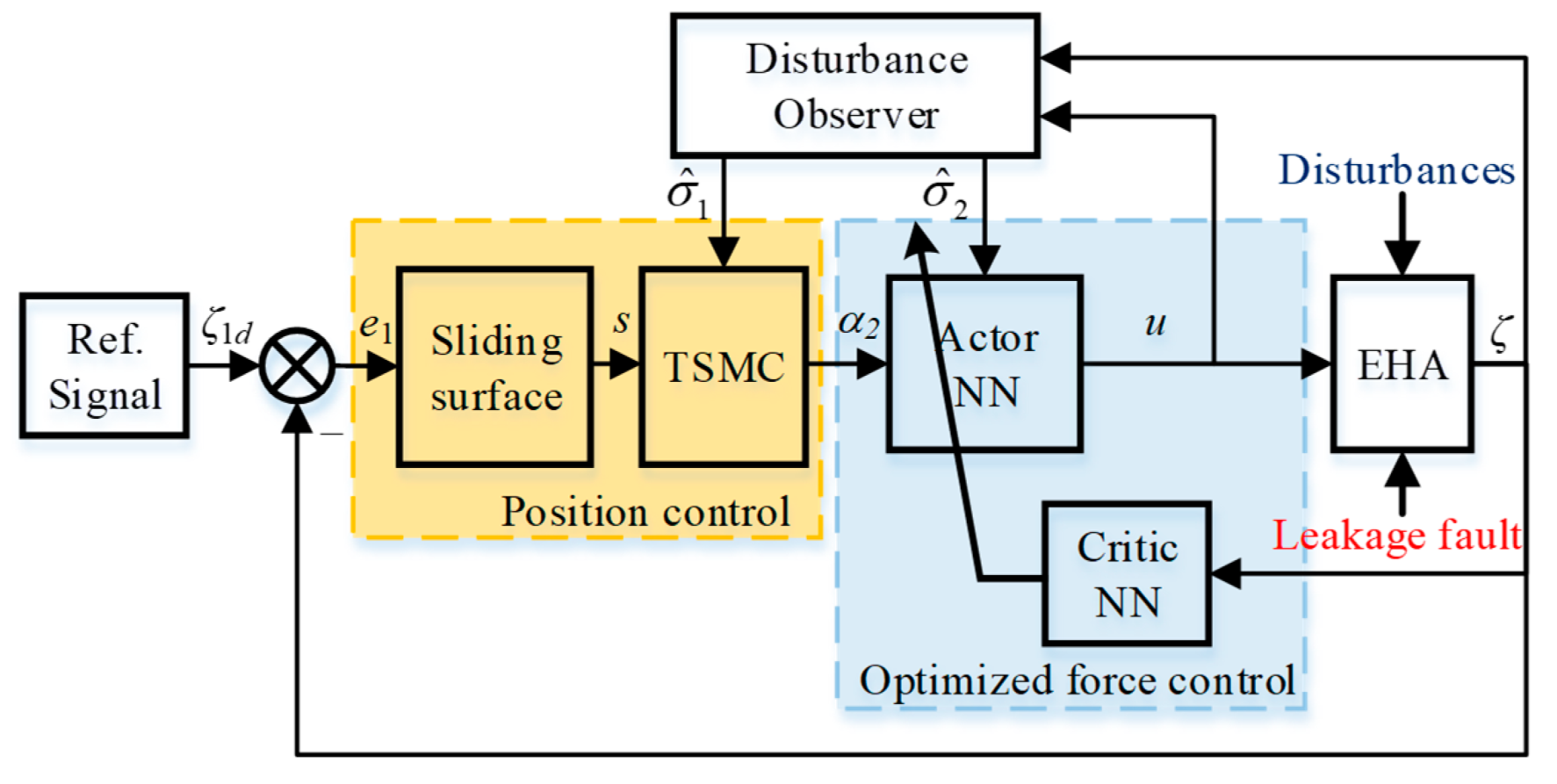
The control structure for the EHA system is illustrated in Figure 2. The cascade FTC control scheme comprises of outer-loop position tracking control and inner-loop force tracking control designs. By considering the lumped disturbances and the bias fault as lumped uncertainties, the two DOs are designed to handle the impacts of them. To obtain a high-accuracy tracking performance, a NTSMC scheme is elaborated for the position tracking control loop. Meanwhile, an optimal force controller is firstly constructed to guarantee the actual torque signals tracking the desired virtual torque signals. Optimization force control is implemented based on the RL strategy of actor–critic architecture. The suggested FTC strategy is proposed by combining the DOs, cascade control scheme including position control and optimal force control, which can not only minimize the selected cost functions to achieve the good tracking performance, but also ensure the boundness of all signal states in the face of the actuator fault and disturbances.
Figure 2.
Sketch of the proposed control approach.
3.1. Disturbance Observer-Based NTSMC Design
The nonlinear system (7) with lumped disturbances and the bias fault is first considered. Consequently, the position control design procedure for the suggested FTC is presented in this subsection.
The error states are defined as follows:
where is the desired signal.
The derivative of e1 can be expressed as
A terminal sliding manifold is given by
where are positive terms, and are positive odd integers satisfying .
The time derivative of (11) is computed as
Let us denote the estimations of the disturbances . The DO for mismatched disturbance is elaborated as
where is internal states, denotes the observer gain of the mismatched DO.
Define the mismatched disturbance error . Taking the derivative of , one yields
The exponential approach rate is used. Hence, the desired force for the mechanical subsystem is constructed as follows:
where are control gains and positive constants, and .
Let the torque error be determined as follows:
The Lyapunov function candidate is adopted as
Taking the derivative of V1 and noting (12), (14), we obtain:
Differentiating e3 with respect to time yields that
The matched DO is constructed to approximate both matched disturbance and the bias fault as
where is internal states, denotes the observer gain of the matched DO.
The matched disturbance error is calculated by . Taking the derivative of , one obtains
Remark 3.
The singular problem in (15) can be overcome by using the modified terminal sliding manifold as Ref. [40]:
where
where, is a positive scalar, and.
3.2. Optimal Force Control Design
In this subsection, the final control law u is constructed to ensure the optimized solutions of inner-loop force tracking control designs. The system stability and acceptable performance of the whole closed-loop system can be preserved. The control design procedure is presented as follows:
Let us introduce the following cost function as
The HJB equation is elaborated as
where denotes the gradient of .
The optimal control u∗ can be calculated if the derivative of the HJB function with respect to u∗ obtains:
The function can be presented as
where , is a positive scalar.
By using NN approximation to construct the critic network, an unknown continuous vector function can be estimated; it follows that:
where is the ideal weight of the NN, is the error of NN approximation, is the basis function. Throughout this paper, for the simplicity of expression, we abbreviate by h. In general, the most popularly used Gaussian radial basis functions are employed as follows:
where is the NN inputs vector, and denote the center of the neural, the Gaussian function’s width, respectively.
Assumption 2.
There exists an ideal weight vectorsuch that |ς| < ς∗ with constant ς∗ > 0 for all ∈ Ωζ ⊂
.
Substituting (27) and (28) to (26), one obtains
Due to the unavailable ideal weight vector ϕ∗, the optimal controller (30) cannot be implemented. Hence, the RL algorithm is introduced by utilizing the following both critic and actor NNs. The critic NN is used to evaluate the controlling performance, whilst the actor NN generates the final control law. The critic NN for evaluating the control performance is further derived as
where is the estimation of NN optimal weight ϕ∗.
The critic NN weight is updated by the following law as
where is a positive constant.
The final control law of the optimal force controller can be constructed as follows:
where is the estimation of actor NN optimal weight ϕ∗, and the adaptive law of the actor NN weight is determined as Ref. [34]:
where is a positive constant.
Applying and to (25), the approximation of the HJB equation yields
Defining the residual error between the HJB and its approximation, we have
and considering the optimized solution is expected to satisfy, the following equality is derived:
Under the premise that (37) is warranted, the RL updating laws are given by the establishment of a non-negative function, as follows:
With the differentiation of (38) with respect to time, one obtains
From (38), (39), it is concluded that can be obtained by using the updating laws (32) and (34), and then (37) can be satisfied as well.
Choose the overall Lyapunov function candidate for the system as
where are the NN weight errors.
The time derivative of V is derived by
Using Young’s inequality, one obtains
Substituting (42) to (41) yields
Applying Young’s inequality and according to the equivalent transformation (i.e., ), one obtains
Combined with (43) and (44), we obtain
If the inequality holds, there exist the upper bounds of the nonlinear function (i.e., ) [25,35], and under Assumption 1. Thus, the time derivative of V can be given as
where
Theorem 1.
With the EHA system (7), if the two DOs are designed as (13), (20), the position control law is presented in (15), the optimal force controller is indicated by (33). The adaptive law of the critic and actor NN weights is determined by (32) and (34). Then, all closed-loop signals, i.e., tracking errors, disturbance errors, and critic and actor NN weight errors are uniformly ultimately bounded (UUB) in the face of actuator failures and lumped disturbances.
Proof.
From (46), we can obtain
From Lemma 1, it is indicated that , which means that the Lyapunov function V in (46) is convergent, all signals are bounded and will tend to a small compact set defined by . □
4. Simulation Results
4.1. Simulation Setup
To verify the improved performance of the proposed FTC, the simulation results are conducted in the EHA system by using MATLAB/Simulink. Two desired trajectories, i.e., the variable frequency sinusoidal (VFS) signals and a ramp signal, are described as
The values of the EHA system parameters are given on the basis of data reported in Ref. [21], as listed in Table 1.
Table 1.
EHA parameters.
For comparison, other control strategies are given to validate the advantages of the proposed FTC method in the simulation.
(1) DBC: This is the direct backstepping controller without two DOs. The control law is designed by Ref. [41]:
where represent the positive gain parameters.
(2) BSMCDO: This is the traditional backstepping sliding-mode controller with two DOs [42]. The control law is described by:
where ki, i = 1, 2, 3 are the positive constant.
(3) Proposed controller: This strategy is a nonsingular terminal sliding-mode optimized backstepping control (NTSMOBC) with two DOs.
The following control gains are carefully regulated and tuned via the trial and error method and chosen as: ; λ1 = 3; λ2 = 5; η = 10. Meanwhile, the parameters of the optimal force controller are chosen as . There exist two RBF NNs in the control EHA system. The critic NN part contains 65 nodes with a width equal to 0.5 and centers μi = 2.5 + 0.4i (i = 1 ÷ 65) evenly spaced in the interval [−2.5, 2.5]. The actor NN part contains 25 nodes with a width equal to 0.5 and centers μi = 2.5 + 0.4i (i = 1 ÷ 25) evenly spaced in the interval [−2.5, 2.5]. The initial conditions of the critic NN, actor NN are selected as = [0.04 … 0.04]T, = [4 … 4]T, respectively. The parameters for the DO gains are set as κ1 = 60; κ2 = 5.5.
In fair comparison, the control parameters of DBC, BSMCDO controller are the same as the corresponding parameters in the proposed controller, e.g., same value of k1; k2 = γ1; k3; η; κ1; κ2.
To assess the qualification of the proposed control algorithm in the face of the actuator fault, the various operational conditions are provided during 30 s. In the first condition, the system operates in normal condition with lumped disturbances. In the second condition, the internal leakage fault occurs after 10 s.
4.2. Evaluation Result
Two case studies were executed to appraise the effectiveness of the suggested FTC scheme. Case study 1 considered only the lumped uncertainty, while both the internal leakage fault and lumped uncertainty were tested in Case study 2. The simulation results are described as follows.
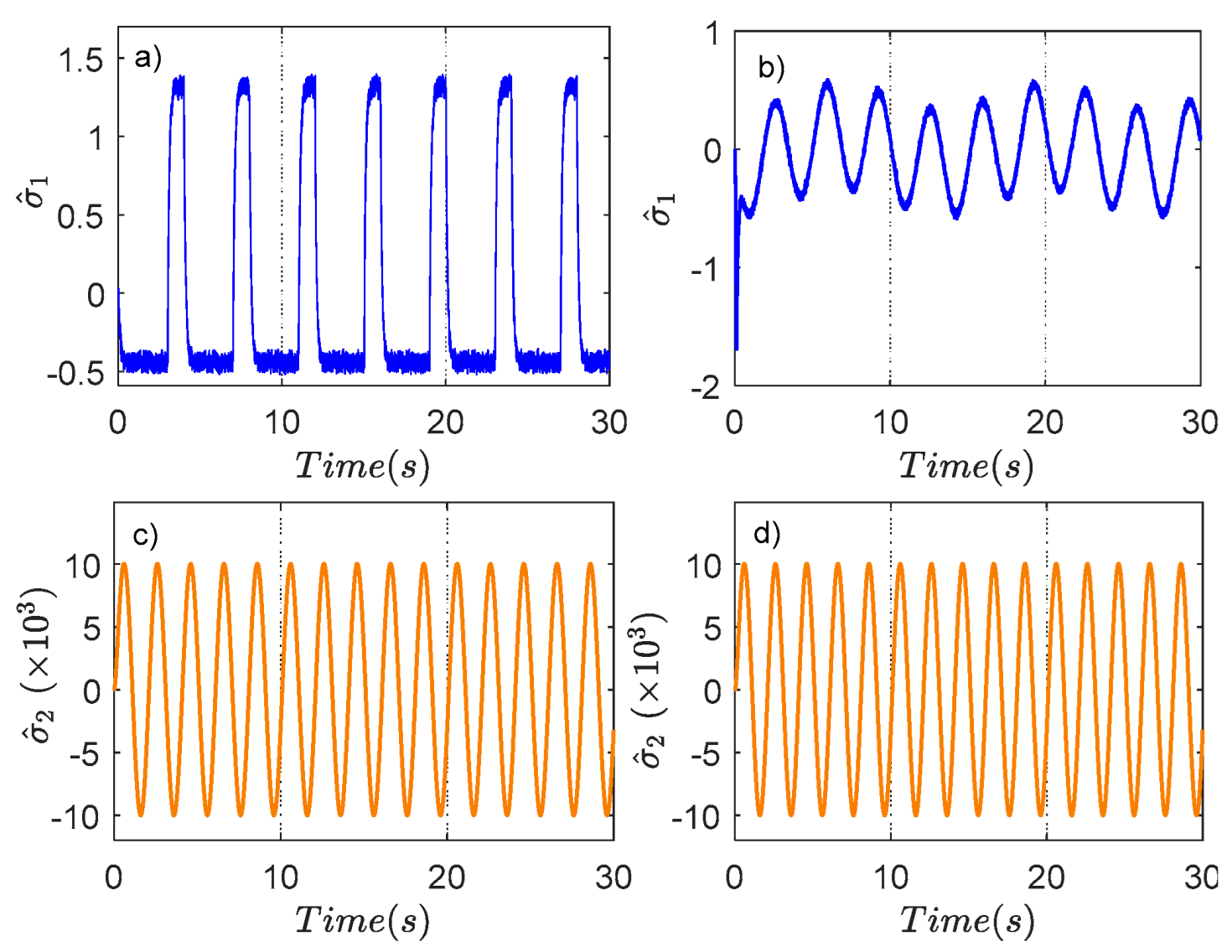
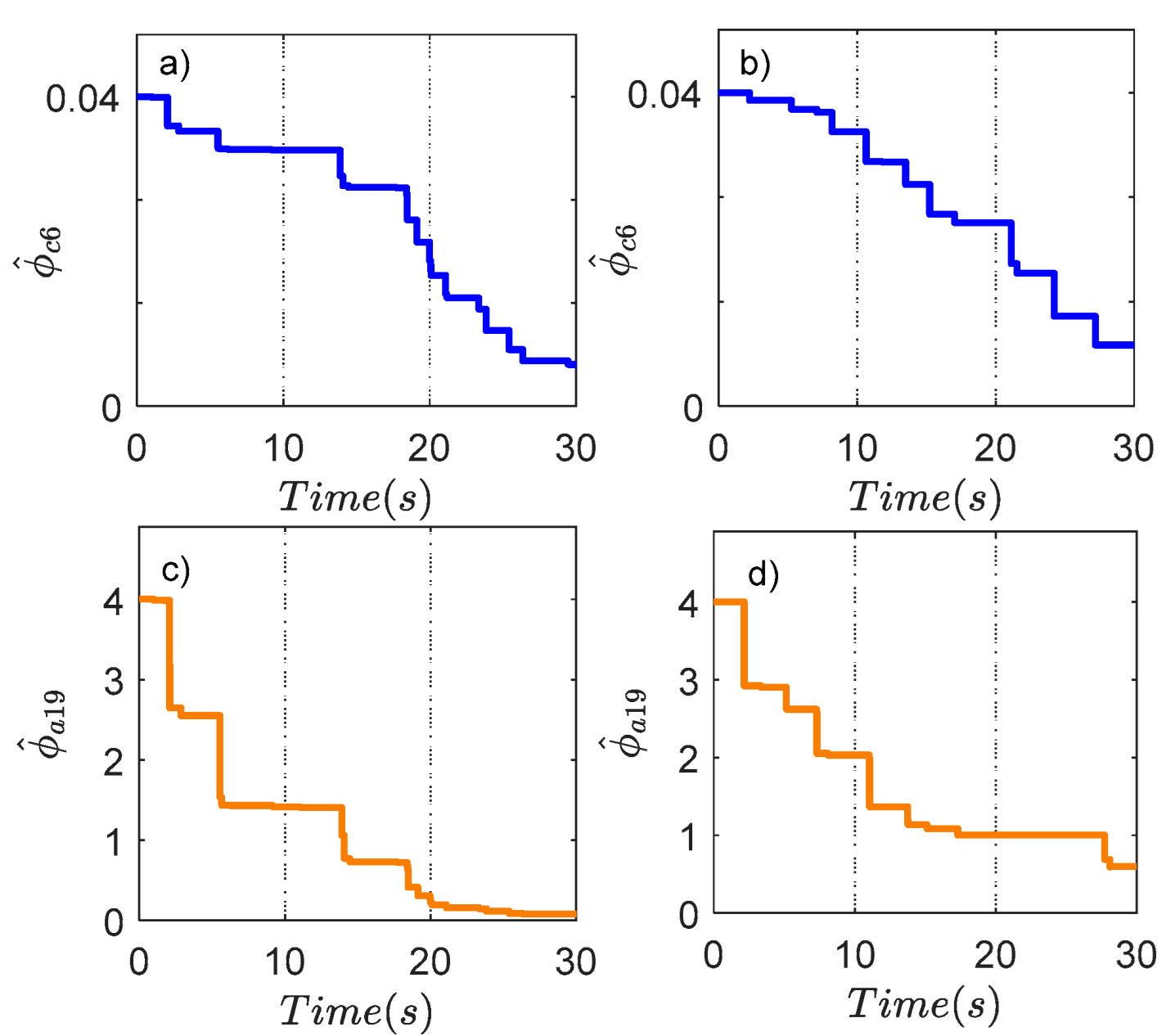
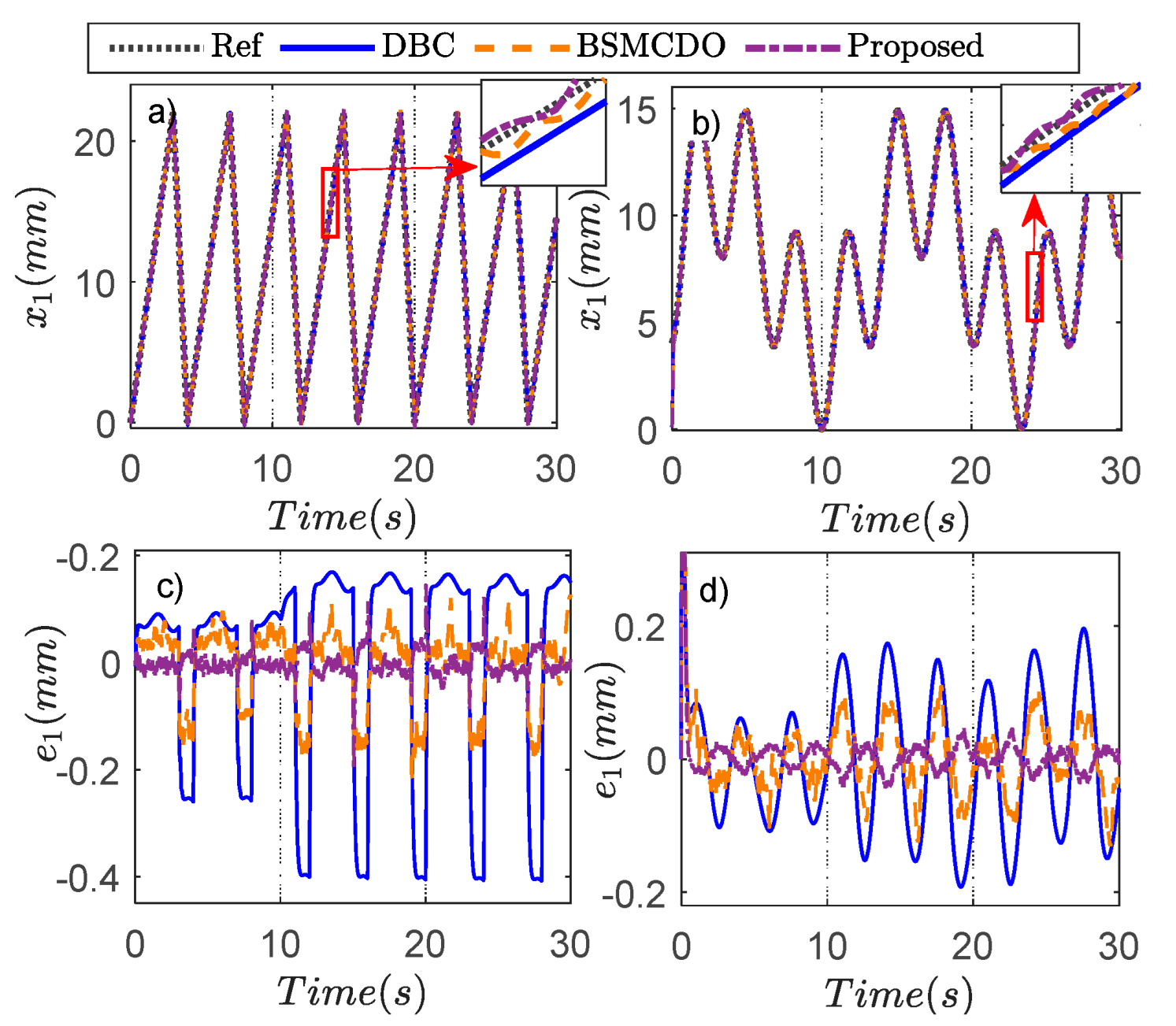
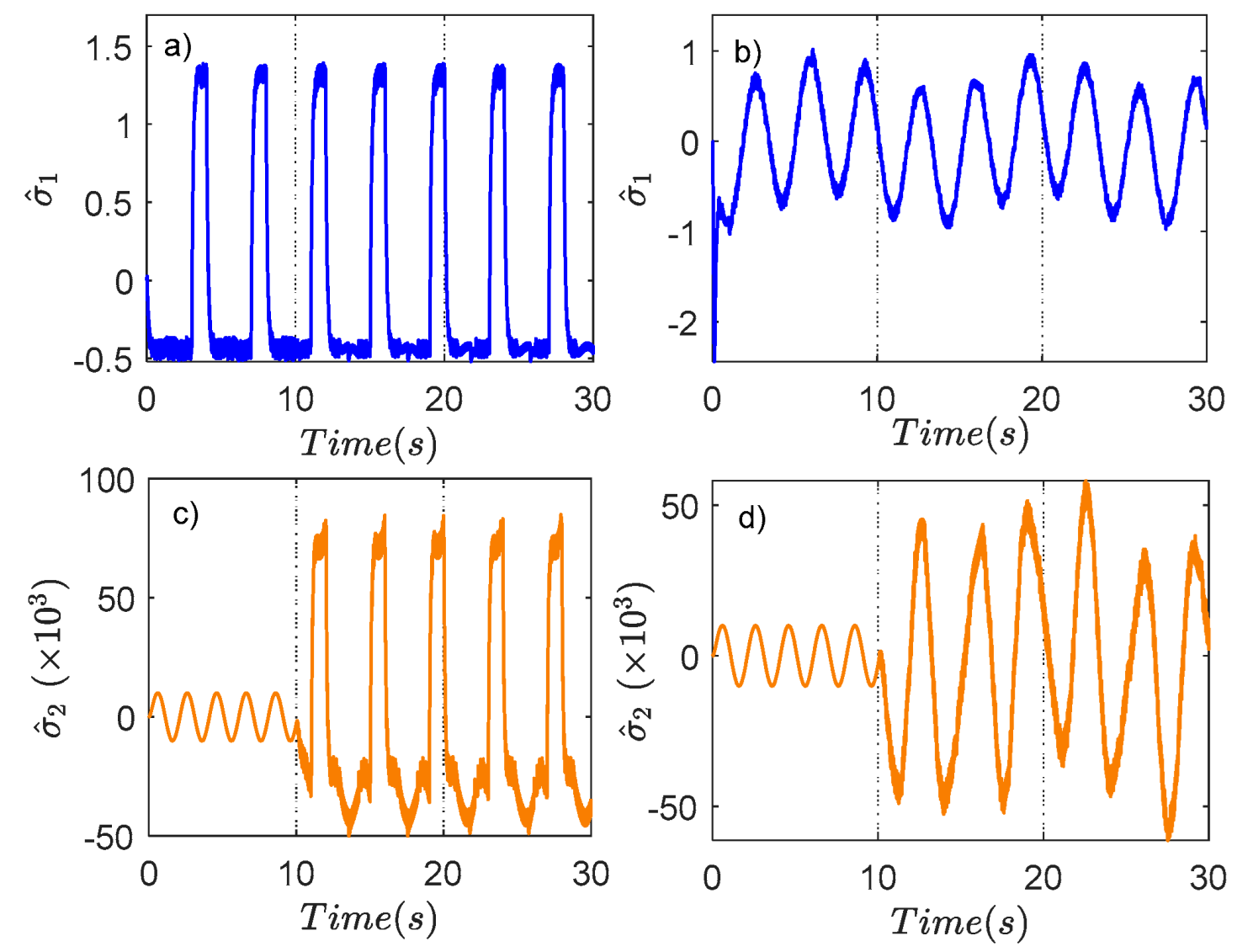
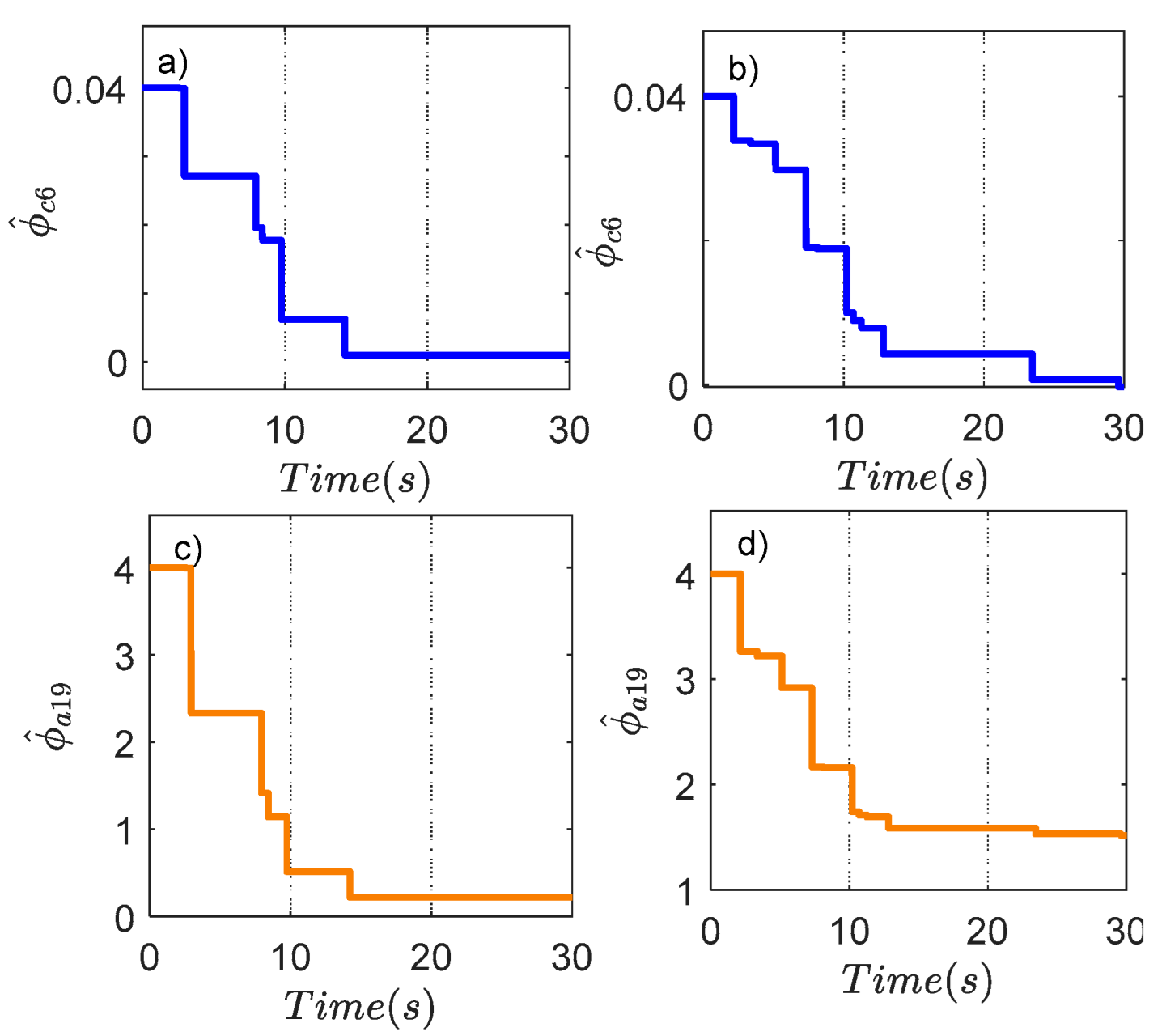
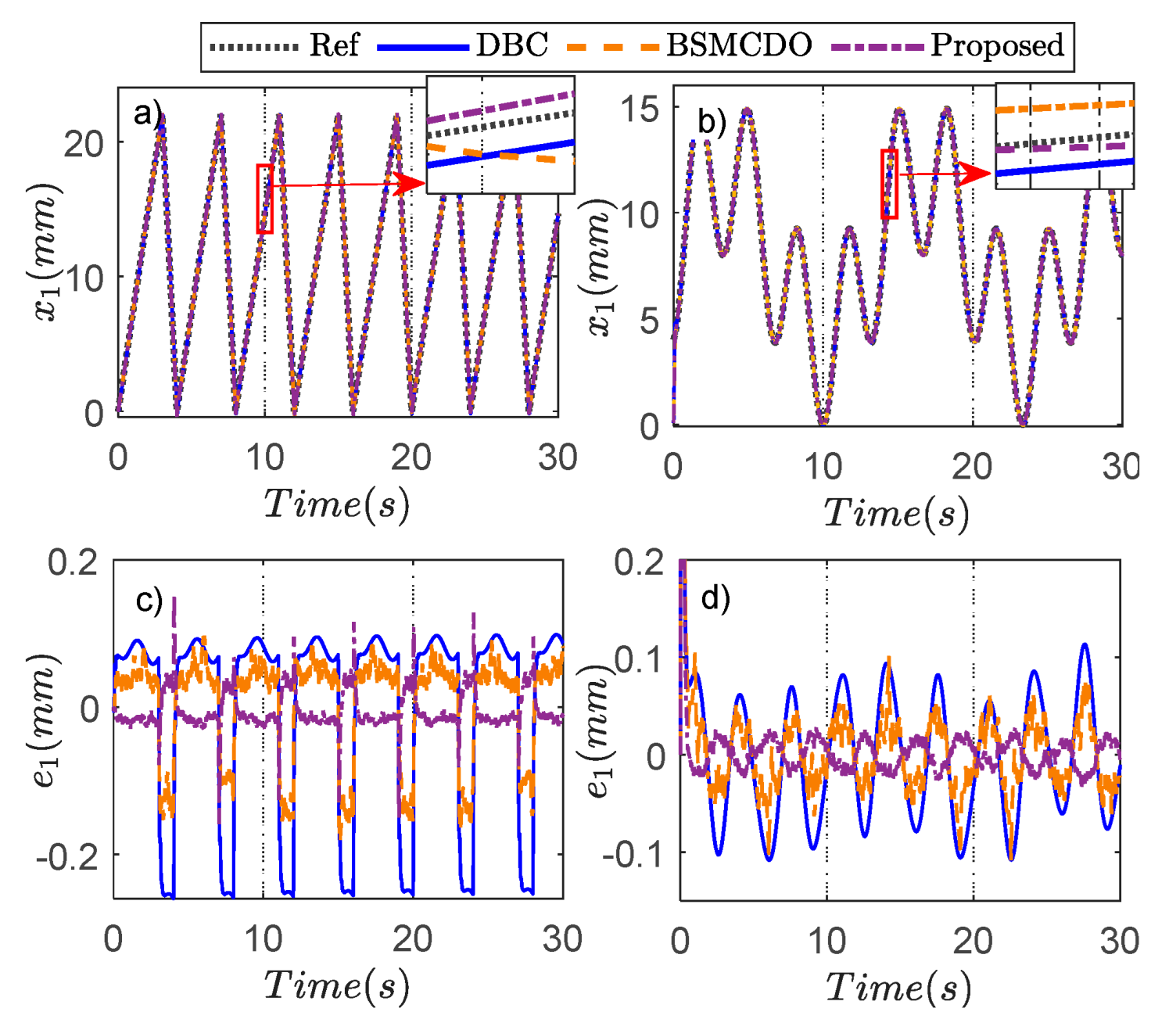
Case study 1: In this case study, the electro-hydraulic system operates in normal condition with inherent lumped disturbances. Figure 3 depicts the simulation results with a ramp and a sinewave response. From Figure 3a,b, the output position of three control algorithms exhibits good tracking capability. Nevertheless, the peak value of the position tracking error using the proposed controller and BSMCDO is smaller than that of usually applied DBC, as seen in Figure 3c,d, because the DOs effectively suppress lumped disturbances, which can be achieved by Figure 4. It can be known that the combination of NTSMC and the optimized-based BC scheme can not only obtain the purpose of optimization, but also guarantee the high-accuracy tracking performance in hydraulic servosystems; then, the suggested controller outperforms the BSMCDO controllers in terms of transient and final tracking errors. To ensure the ORC’s optimal performance, the critic and actor NN weight estimations of the ORC converge to the corresponding steady-state value, as shown in Figure 5. The effectiveness of comparative controllers is assessed through three performance indices and expressed in Table 2. From Table 2, the root mean square error (eRMS), average tracking error (ea), and maximum error (emax) [7,43] of the proposed controller are, in turn, 0.0351, 0.0298, and 0.1954 mm with the desired sinewave signal, and 0.0278, 0.0201, and 0.0980 mm with the desired ramp signal, which is the smallest in comparison with other controllers. This reconfirms the perfect control performance of the proposed FTC strategy.
Figure 3.
Comparison of three control methods in Case study 1: (a) Ramp response. (b) VFS response. (c) Tracking error for ramp demand. (d) Tracking error for VFS demand.
Figure 4.
Lumped disturbances estimation of the proposed method in Case study 1: (a) for ramp demand. (b) for VFS demand. (c) for ramp demand. (d) for VFS demand.
Figure 5.
Critic and actor NN weight estimations of the proposed method in Case study 1: (a) for ramp demand. (b) for VFS demand. (c) for ramp demand. (d) for VFS demand.
Table 2.
Performance indices of three controllers in simulation, Case study 1.
Case study 2: In this scenario, the internal leakage fault in simulation is generated after with internal leakage coefficient , and the fault evolution rate . The simulation results are displayed in Figure 6, which indicates that the position errors of the DBC, BSMCDO, and the FTC proposed method are affected by the appearance of leakage fault. However, in comparison with DBC, the tracking error of the other methods is smaller due to a disturbance compensation system of two DOs. The accurate estimation of the matched, mismatched disturbances, and the bias fault using two Dos, are shown in Figure 7. Meanwhile, compared with the BSMCDO control method, the proposed controller combines the robustness properties of the NTSMC and the optimal performance of the optimized force controller. Therefore, the FTC proposed approach obtained the better performance and stronger robustness even though the bias fault appears. Figure 8 illustrates the norms of critic and actor NN weight estimations, respectively, and the converge eventually. Table 3 presents the results of three performance indices of three controllers. It indicates that the eRMS of the proposed controller is reduced by 73.9%, and 48.4%; the ea of the proposed controller is reduced by 79.8%, and 60.8%, in comparison with DBC, BSMCDO for VFS demand, respectively. The performance indices for ramp demand also reflect similar results in Table 3. This clearly validates the effectiveness of the proposed method.
Figure 6.
Comparison of three control methods in Case study 2: (a) Ramp response. (b) VFS response. (c) Tracking error for ramp demand. (d) Tracking error for VFS demand.
Figure 7.
Lumped disturbances estimation of the proposed method in Case study 2: (a) for ramp demand. (b) for VFS demand. (c) for ramp demand. (d) for VFS demand.
Figure 8.
Critic and actor NN weight estimations of the proposed method in Case study 2: (a) for ramp demand. (b) for VFS demand. (c) for ramp demand. (d) for VFS demand.
Table 3.
Performance indices of three controllers in simulation, Case study 2.
According to the comparative simulation studies in Figure 3 above, it is verified that the proposed FTC can obtain the desired control goal. Moreover, it provides the excellent tracking performance in the face of the matched, mismatched disturbances, the internal leakage fault, among three controllers.
5. Conclusions
The optimal FTC strategy was successfully applied to the EHA system with lumped disturbances and internal leakage faults via the cascade control using NTMSC and a simplified RL algorithm based on the optimized technology. The lumped uncertainties including matched, mismatched disturbances and the internal leakage fault are catered for simultaneously. Two DOs were deployed for estimations of them. A novel controller-based NTSMC, and an optimal force tracking control approach is further constructed for the EHA system, which can not only obtain the purpose of optimization, but also guarantee the high-accuracy tracking performance in hydraulic servosystems. The simulation results were implemented to verify the superior performance and system stability of the suggested strategy, even in faulty conditions.
Nevertheless, the presented strategy still has some disadvantages. First, the loss of effectiveness fault was ignored in this work. Second, verifying the proposed algorithm in actual experiments has not yet been performed. In future works, we will tend to develop the FTC scheme for practical EHAs with some types of actuator faults, including bias fault and loss of effectiveness fault.
Author Contributions
K.K.A. was the supervisor providing funding and administrating the project, and he reviewed and edited the manuscript. V.D.P. carried out the investigation, methodology, analysis, validation, made the MATLAB simulation, and wrote the original manuscript. All authors have read and agreed to the published version of the manuscript.
Funding
This work was supported in part by Basic Science Program through the National Research Foundation of Korea (NRF), funded by the Ministry of Science and ICT, South Korea, under Grant NRF 2020R1A2B5B03001480, and in part by the Regional Innovation Strategy (RIS) through the National Research Foundation of Korea (NRF), funded by the Ministry of Education (MOE) under Grant 2021RIS-003.
Institutional Review Board Statement
Not applicable.
Informed Consent Statement
Not applicable.
Data Availability Statement
Not applicable.
Conflicts of Interest
The authors declare no conflict of interest.
References
- Xu, Z.; Deng, W.; Shen, H.; Yao, J. Extended-State-Observer-Based Adaptive Prescribed Performance Control for Hydraulic Systems With Full-State Constraints. IEEE/ASME Trans. Mechatron. 2022, 1–11. [Google Scholar] [CrossRef]
- Truong, H.V.A.; Tran, D.T.; To, X.D.; Ahn, K.K.; Jin, M. Adaptive Fuzzy Backstepping Sliding Mode Control for a 3-DOF Hydraulic Manipulator with Nonlinear Disturbance Observer for Large Payload Variation. Appl. Sci. 2019, 9, 3290. [Google Scholar] [CrossRef]
- Shen, W.; Liu, X.; Su, X. High-Precision Position Tracking Control of Electro-hydraulic Servo Systems Based on an Improved Structure and Desired Compensation. Int. J. Control Autom. Syst. 2021, 19, 3622–3630. [Google Scholar] [CrossRef]
- Nedić Pršić, N.D.; Fragassa, C.; Stojanović, V.; Pavlovic, A. Simulation of hydraulic check valve for forestry equipment. Int. J. Heavy Veh. Syst. 2017, 24, 260–276. [Google Scholar] [CrossRef]
- Xu, Z.; Qi, G.; Liu, Q.; Yao, J. Output Feedback Disturbance Rejection Control for Full-State Constrained Hydraulic Systems with Guaranteed Tracking Performance. Appl. Math. Model. 2022, 111, 332–348. [Google Scholar] [CrossRef]
- Yang, X.; Yao, J.; Deng, W. Output feedback adaptive super-twisting sliding mode control of hydraulic systems with disturbance compensation. ISA Trans. 2021, 109, 175–185. [Google Scholar] [CrossRef]
- Deng, W.; Yao, J.; Wang, Y.; Yang, X.; Chen, J. Output feedback backstepping control of hydraulic actuators with valve dynamics compensation. Mech. Syst. Signal. Proc. 2021, 158, 107769. [Google Scholar] [CrossRef]
- Yao, Z.; Yao, J.; Sun, W. Adaptive RISE Control of Hydraulic Systems With Multilayer Neural-Networks. IEEE Trans. Ind. Electron. 2019, 66, 8638–8647. [Google Scholar] [CrossRef]
- Shanbhag, V.V.; Meyer, T.J.J.; Caspers, L.W.; Schlanbusch, R. Failure Monitoring and Predictive Maintenance of Hydraulic Cylinder—State-of-the-Art Review. IEEE/ASME Trans. Mechatron. 2021, 26, 3087–3103. [Google Scholar] [CrossRef]
- Phan, V.D.; Ahn, K.K. Observer-based Fault-Tolerant Control of an Electro-Hydraulic Actuator with mismatched disturbance. In Proceedings of the 24th International Conference on Mechatronics Technology (ICMT), Singapore, 18–22 December 2021. [Google Scholar]
- Zhu, F.; Shan, Y.; Tang, Y. Actuator and Sensor Fault Detection and Isolation for Uncertain Switched Nonlinear System Based on Sliding Mode Observers. Int. J. Control Autom. Syst. 2021, 19, 3075–3086. [Google Scholar] [CrossRef]
- Won, D.; Kim, W.; Tomizuka, M. High-Gain-Observer-Based Integral Sliding Mode Control for Position Tracking of Electrohydraulic Servo Systems. IEEE/ASME Trans. Mechatron. 2017, 22, 2695–2704. [Google Scholar] [CrossRef]
- Xu, Z.; Li, X.; Stojanovic, V. Exponential stability of nonlinear state-dependent delayed impulsive systems with applications. Nonlinear Anal. Hybrid Syst. 2021, 42, 101088. [Google Scholar] [CrossRef]
- Liang, X.; Wang, Q.; Xu, B.; Dong, C. Back-stepping Fault-tolerant Control for Morphing Aircraft Based on Fixed-time Observer. Int. J. Control Autom. Syst. 2021, 19, 3924–3936. [Google Scholar] [CrossRef]
- Deng, W.; Yao, J. Extended-State-Observer-Based Adaptive Control of Electrohydraulic Servomechanisms Without Velocity Measurement. IEEE/ASME Trans. Mechatron. 2020, 25, 1151–1161. [Google Scholar] [CrossRef]
- Truong, H.V.A.; Trinh, H.A.; Tran, D.T.; Ahn, K.K. A Robust Observer for Sensor Faults Estimation on n-DOF Manipulator in Constrained Framework Environment. IEEE Access 2021, 9, 88439–88451. [Google Scholar] [CrossRef]
- Phan, V.D.; Vo, C.P.; Dao, H.V.; Ahn, K.K. Robust fault-tolerant control of an electro-hydraulic actuator with a novel nonlinear unknown input observer. IEEE Access 2021, 9, 30750–30760. [Google Scholar] [CrossRef]
- Shi, Z.; Zhou, C.; Guo, J. Neural Network Observer Based Consensus Control of Unknown Nonlinear Multi-agent Systems with Prescribed Performance and Input Quantization. Int. J. Control Autom. Syst. 2021, 19, 1944–1952. [Google Scholar] [CrossRef]
- Li, K.; Li, Y. Adaptive Fuzzy Finite-time Dynamic Surface Control for High-order Nonlinear System with Output Constraints. Int. J. Control Autom. Syst. 2020, 19, 112–123. [Google Scholar] [CrossRef]
- Zhang, X.; Wang, H.; Stojanovic, V.; Cheng, P.; He, S.; Luan, X.; Liu, F. Asynchronous Fault Detection for Interval Type-2 Fuzzy Nonhomogeneous Higher Level Markov Jump Systems with Uncertain Transition Probabilities. IEEE Trans. Fuzzy Syst. 2022, 30, 2487–2499. [Google Scholar] [CrossRef]
- Phan, V.D.; Vo, C.P.; Dao, H.V.; Ahn, K.K. Actuator Fault-Tolerant Control for an Electro-Hydraulic Actuator Using Time Delay Estimation and Feedback Linearization. IEEE Access 2021, 9, 107111–107123. [Google Scholar] [CrossRef]
- Liu, J.Y.; Zeng, Q.; Tong, S.; Chen, C.L.P.; Liu, L. Actuator Failure Compensation-Based Adaptive Control of Active Suspension Systems With Prescribed Performance. IEEE Trans. Ind. Electron. 2020, 67, 7044–7053. [Google Scholar] [CrossRef]
- Dao, H.V.; Tran, D.T.; Ahn, K.K. Active Fault Tolerant Control System Design for Hydraulic Manipulator with Internal Leakage Faults based on Disturbance Observer and Online Adaptive Identification. IEEE Access 2021, 9, 23850–23862. [Google Scholar] [CrossRef]
- Phan, V.D.; Ahn, K.K. Disturbance Observer-based Adaptive Fault-Tolerant Control of an Electro-Hydraulic Actuator with Output Constraint. In Proceedings of the 13th Asian Control Conference, Jeju Island, Korea, 4–7 May 2022. [Google Scholar]
- Yang, X.; Li, B.; Wen, G. Adaptive Neural Network Optimized Control Using Reinforcement Learning of Critic-Actor Architecture for a Class of Non-Affine Nonlinear Systems. IEEE Access 2021, 9, 141758–141765. [Google Scholar] [CrossRef]
- Wen, G.; Chen, C.L.P.; Ge, S.S.; Yang, H.; Liu, X. Optimized Adaptive Nonlinear Tracking Control Using Actor–Critic Reinforcement Learning Strategy. IEEE Trans. Ind. Inform. 2019, 15, 4969–4977. [Google Scholar] [CrossRef]
- Cui, J.; Pan, Y.; Xue, H.; Tan, L. Simplified optimized finite-time containment control for a class of multi-agent systems with actuator faults. Nonlinear Dyn. 2022, 109, 2799–2816. [Google Scholar] [CrossRef]
- Sun, Y.; Yuan, B.; Zhang, Y.; Zheng, W.; Xia, Q.; Tang, B.; Zhou, X. Research on Action Strategies and Simulations of DRL and MCTS-based Intelligent Round Game. Int. J. Control Autom. Syst. 2021, 19, 2984–2998. [Google Scholar] [CrossRef]
- Ouyang, Y.; Sun, C.; Dong, L. Actor-critic learning based coordinated control for a dual-arm robot with prescribed performance and unknown backlash-like hysteresis. ISA Trans. 2022, 126, 1–13. [Google Scholar] [CrossRef]
- Simorgh, A.; Razminia, A.; Mobayen, S.; Baleanu, D. Optimal Control of a MIMO Bioreactor System Using Direct Approach. Int. J. Control Autom. Syst. 2021, 19, 1159–1174. [Google Scholar] [CrossRef]
- Wang, N.; Gao, Y.; Zhao, H.; Ahn, C.K. Reinforcement Learning-Based Optimal Tracking Control of an Unknown Unmanned Surface Vehicle. IEEE Trans. Neural Netw. Learn. Syst. 2021, 32, 3034–3045. [Google Scholar] [CrossRef]
- Guo, Q. Optimal Robust Control of Electro-Hydraulic System Based on Hamilton-Jacobi-Bellman Solution With Backstepping Iteration. IEEE Trans. Control Syst. Technol. 2022, 1–8. [Google Scholar] [CrossRef]
- He, W.; Gao, H.; Zhou, C.; Yang, C.; Li, Z. Reinforcement Learning Control of a Flexible Two-Link Manipulator: An Experimental Investigation. IEEE Trans. Syst. Man Cybern. Syst. 2020, 51, 1–11. [Google Scholar] [CrossRef]
- Wen, G.; Chen, C.L.P.; Ge, S.S. Simplified Optimized Backstepping Control for a Class of Nonlinear Strict-Feedback Systems With Unknown Dynamic Functions. IEEE Trans. Cybern. 2021, 51, 4567–4580. [Google Scholar] [CrossRef] [PubMed]
- Wen, G.; Ge, S.S.; Tu, F. Optimized Backstepping for Tracking Control of Strict-Feedback Systems. IEEE Trans. Neural Netw. Learn. Syst 2018, 29, 3850–3862. [Google Scholar]
- Yang, G.; Yao, J.; Le, G.; Ma, D. Adaptive integral robust control of hydraulic systems with asymptotic tracking. Mechatronics 2016, 40, 78–86. [Google Scholar] [CrossRef]
- Yao, J.; Yang, G.; Ma, D. Internal Leakage Fault Detection and Tolerant Control of Single-Rod Hydraulic Actuators. Math. Probl. Eng. 2014, 2014, 1–14. [Google Scholar] [CrossRef]
- Phan, V.D.; Truong, H.V.A.; Ahn, K.K. Actuator failure compensation-based command filtered control of electro-hydraulic system with position constraint. ISA Trans. 2022. [Google Scholar] [CrossRef]
- Ge, S.S.; Wang, C. Adaptive neural control of uncertain MIMO nonlinear systems. IEEE Trans. Neural Netw. 2004, 15, 674–692. [Google Scholar] [CrossRef]
- Wang, L.; Chai, T.; Zhai, L. Neural-Network-Based Terminal Sliding-Mode Control of Robotic Manipulators Including Actuator Dynamics. IEEE Trans. Ind. Electron. 2009, 56, 3296–3304. [Google Scholar] [CrossRef]
- Won, D.; Kim, W.; Shin, D.; Chung, C.C. High-Gain Disturbance Observer-Based Backstepping Control With Output Tracking Error Constraint for Electro-Hydraulic Systems. IEEE Trans. Control Syst. Technol. 2015, 23, 787–795. [Google Scholar] [CrossRef]
- Ba, D.X.; Dinh, T.Q.; Bae, J.; Ahn, K.K. An Effective Disturbance-Observer-Based Nonlinear Controller for a Pump-Controlled Hydraulic System. IEEE/ASME Trans. Mechatron. 2020, 25, 32–43. [Google Scholar] [CrossRef]
- Yao, J.; Jiao, Z.; Ma, D. Extended-State-Observer-Based Output Feedback Nonlinear Robust Control of Hydraulic Systems With Backstepping. IEEE Trans. Ind. Electron. 2014, 61, 6285–6293. [Google Scholar] [CrossRef]
Publisher’s Note: MDPI stays neutral with regard to jurisdictional claims in published maps and institutional affiliations. |
© 2022 by the authors. Licensee MDPI, Basel, Switzerland. This article is an open access article distributed under the terms and conditions of the Creative Commons Attribution (CC BY) license (https://creativecommons.org/licenses/by/4.0/).