You are currently viewing a new version of our website. To view the old version click .
Applied Sciences
  • Article
  • Open Access

16 August 2022

Multi-Modal Sentiment Analysis Based on Interactive Attention Mechanism

,
,
and
School of Computer Science, Hubei University of Technology, Wuhan 430068, China
*
Author to whom correspondence should be addressed.
This article belongs to the Special Issue Selected Papers from FCPAE2022 and 4th International Conference on Artificial Intelligence and Advanced Manufacturing (AIAM2022)

Abstract

In recent years, multi-modal sentiment analysis has become more and more popular in the field of natural language processing. Multi-modal sentiment analysis mainly concentrates on text, image and audio information. Previous work based on BERT utilizes only text representation to fine-tune BERT, while ignoring the importance of nonverbal information. Most current research methods are fine-tuning models based on BERT that do not optimize BERT’s internal structure. Therefore, in this paper, we propose an optimized BERT model that is composed of three modules: the Hierarchical Multi-head Self Attention module realizes the hierarchical extraction process of the features; the Gate Channel module replaces BERT’s original Feed-Forward layer to realize information filtering; the tensor fusion model based on self-attention mechanism utilized to implement the fusion process of different modal features. In CMU-MOSI, a public mult-imodal sentiment analysis dataset, the accuracy and F1-Score were improved by 0.44% and 0.46% compared with the original BERT model using custom fusion. Compared with traditional models, such as LSTM and Transformer, they are improved to a certain extent.

1. Introduction

In daily life, with the emergence of various social media, more and more users like to express their feelings on weibo, TikTok, Twitter and other platforms. The content of expression is also varied, from text and emoticons at the beginning to voice and video messages later. The complexity of emotional information is increasing, and the valuable information contained in the information is also increasing. Mining this emotional characteristic information can not only improve services for the platform but also carry out customized recommendation services according to the audience’s liking degree. Likewise, it can monitor and manage public opinion for the government. Therefore, how to process and analyze multi-modal emotional information and design a better multi-modal information processing model is very important.
However, most of the later research methods based on multi-modal sentiment analysis are based on fine-tuning the BERT model, and there are few models that directly optimize BERT. Therefore, in this paper, we propose an optimized model based on BERT, LG-BERT. The following innovations are proposed:
(1)
Hierarchical multi-attention mechanism used to realize hierarchical extraction of data features;
(2)
Gate Channel used to replace the Feed Forward layer in the BERT model to realize information filtering;
(3)
Information interaction between different modes realized through tensor fusion model based on self-attention.

3. Interactive Attention Mechanism Based on BERT Model

3.1. Hierarchical Multi-Head Self Attention

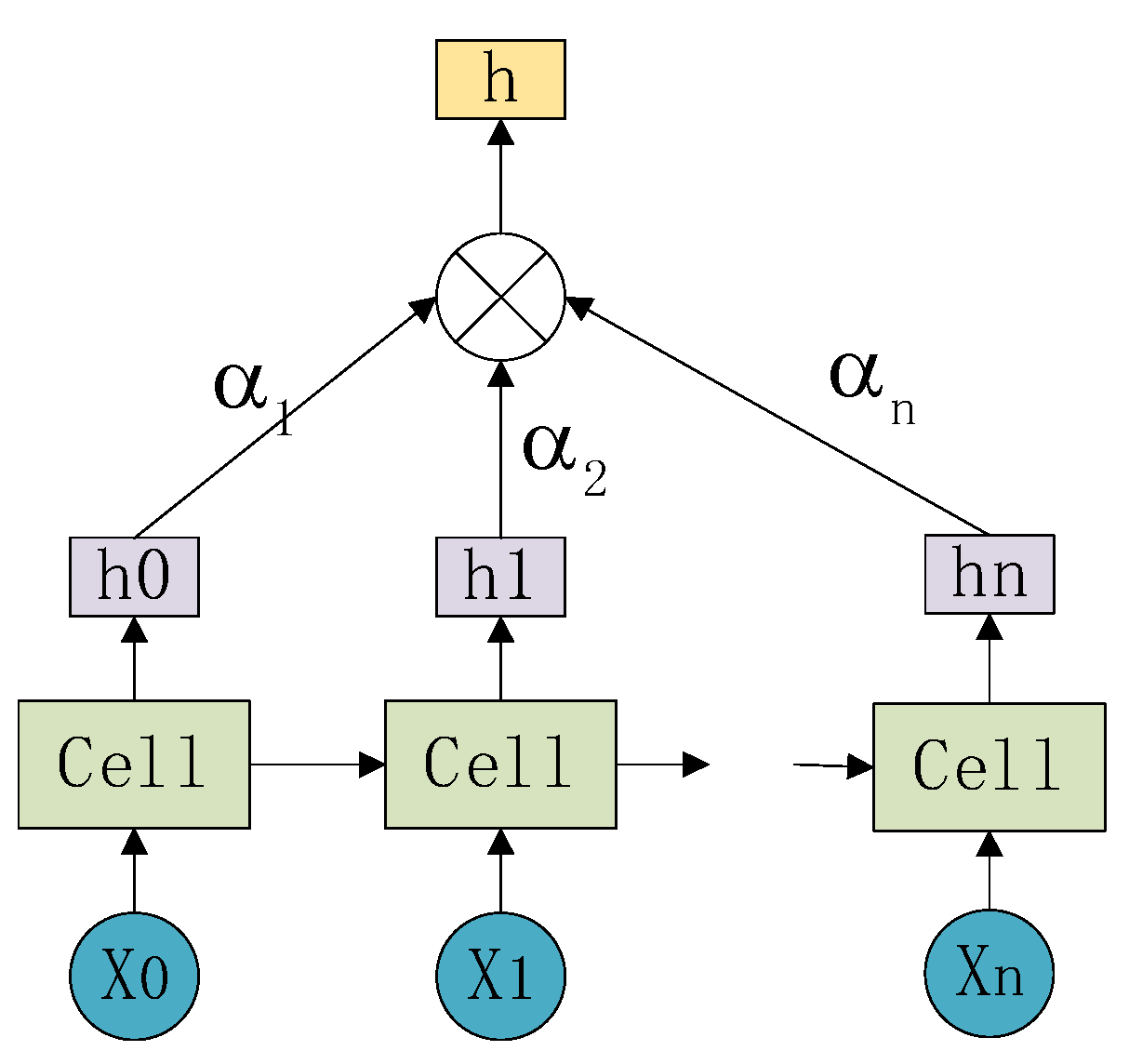
BERT uses a fixed number of heads to process embedded data, and the extraction process of data features is the same. Figure 2 shows the structure of a traditional Attention Mechanism based on LSTM. When processing audio data, in this paper, we use a stacked two-layer LSTM + Full Connection layer (FC) + tanh activation function to extract the audio features. Experiments have found that compared to traditional models, such as GRU, the effect of LSTM is better after obtaining the features, and then the feature fusion method based on TFN is used.
Figure 2. Structure of Attention Mechanism based on LSTM.
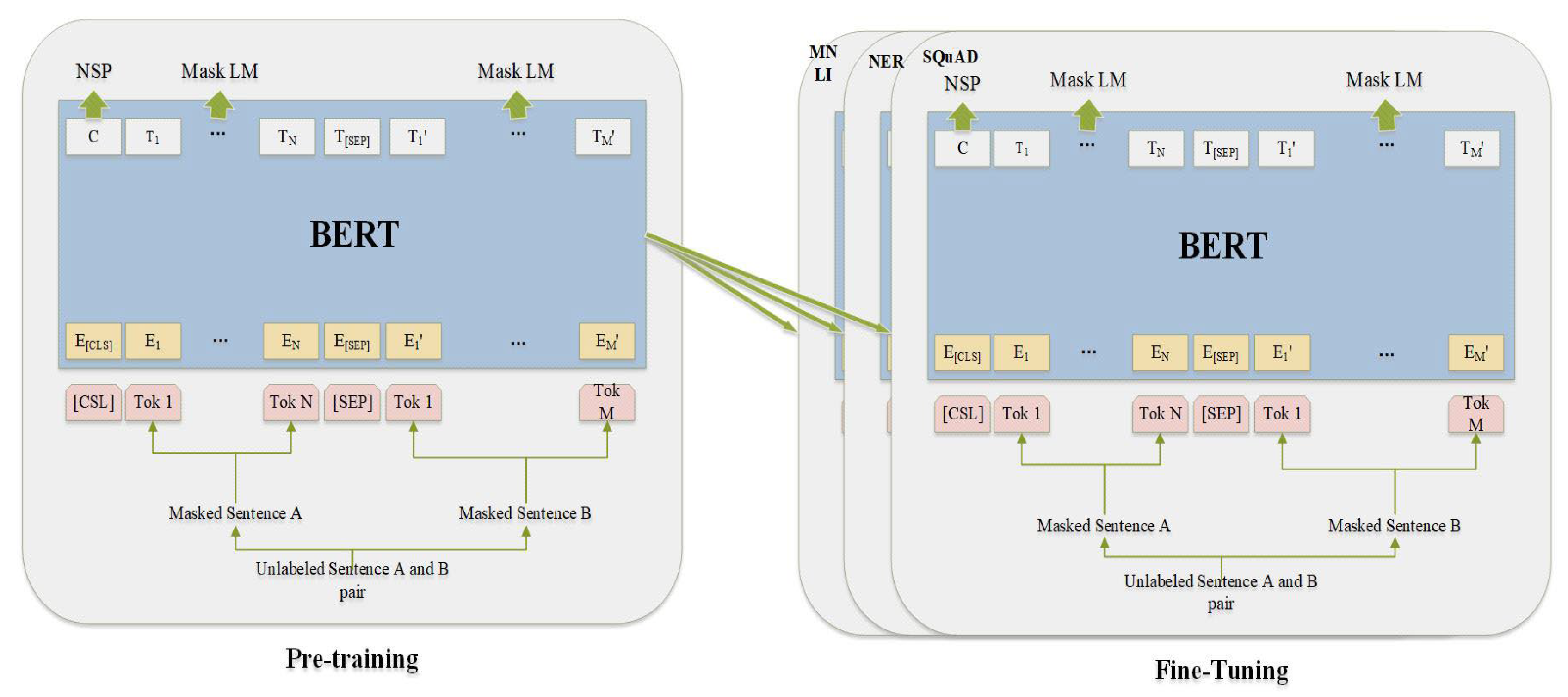
However, similar to the working principle of CNN image processing, different features can be obtained when processing the same data with different head numbers. Dealing with different numbers of heads means that the dimension of data varies during self-attention. The extraction ability of data features is different for different layers. Therefore, a variable number of self-attention headers is proposed, as shown in Figure 3.
Figure 3. Pre-training and Fine-tunning Procedures for BERT Model.

3.2. Gated Information Channel

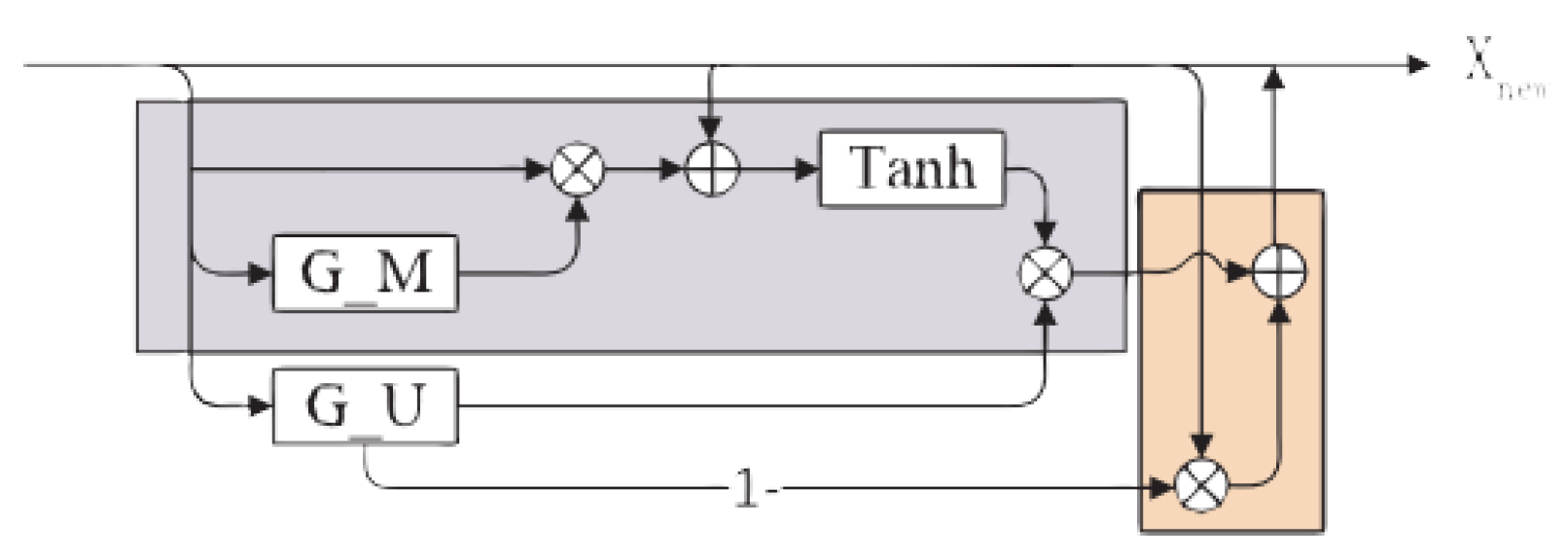
The Feed Forward layer in BERT Encoder is essentially a fully connected layer, which expands the embedded feature dimension four times. This is not specified in the Transformer structure. Conversely, the study shows that the fully connected layer may add noise to the original data features. Therefore, a gated information channel is set up to filter out unnecessary data features. Similar to the network structure of GRU [17], this paper designs a similar gated information mechanism. As shown in Figure 4, the gate information channel consists of two parts; one is a memory gate, and the other is an update gate. Memory gates are used to hold valuable information, while additional channels are added to remember new information. The use of another update gate to implement updates to features fully connected layer may add noise to the original data features.
G_M = σ(X ⊗ M)
G_U = σ(X ⊗ U)
Figure 4. Structure of Gate Channel.
X(X ∊ Rb × len × hn) is the feature after the hierarchical multi-head self-attention mechanism, M and U are the parameter matrices M, U ∊ Rhn × hn. b represents the batch size, len represents the fixed length of text and hn represents the feature dimension.
Memory gates are used to store information and add some new content to features:
X_M = tanh(X ⊗ G_M + X ⊗ M)
Next, use the update gate to realize the updating of the original data:
Xnew = X_M ⊗ G_U + X ⊗ (1 − G_U)
Finally, after the data feature X is obtained, the residual network and BERT Layer Norm are used for the final data update.

3.3. Tensor Fusion Method Based on Self-Attention

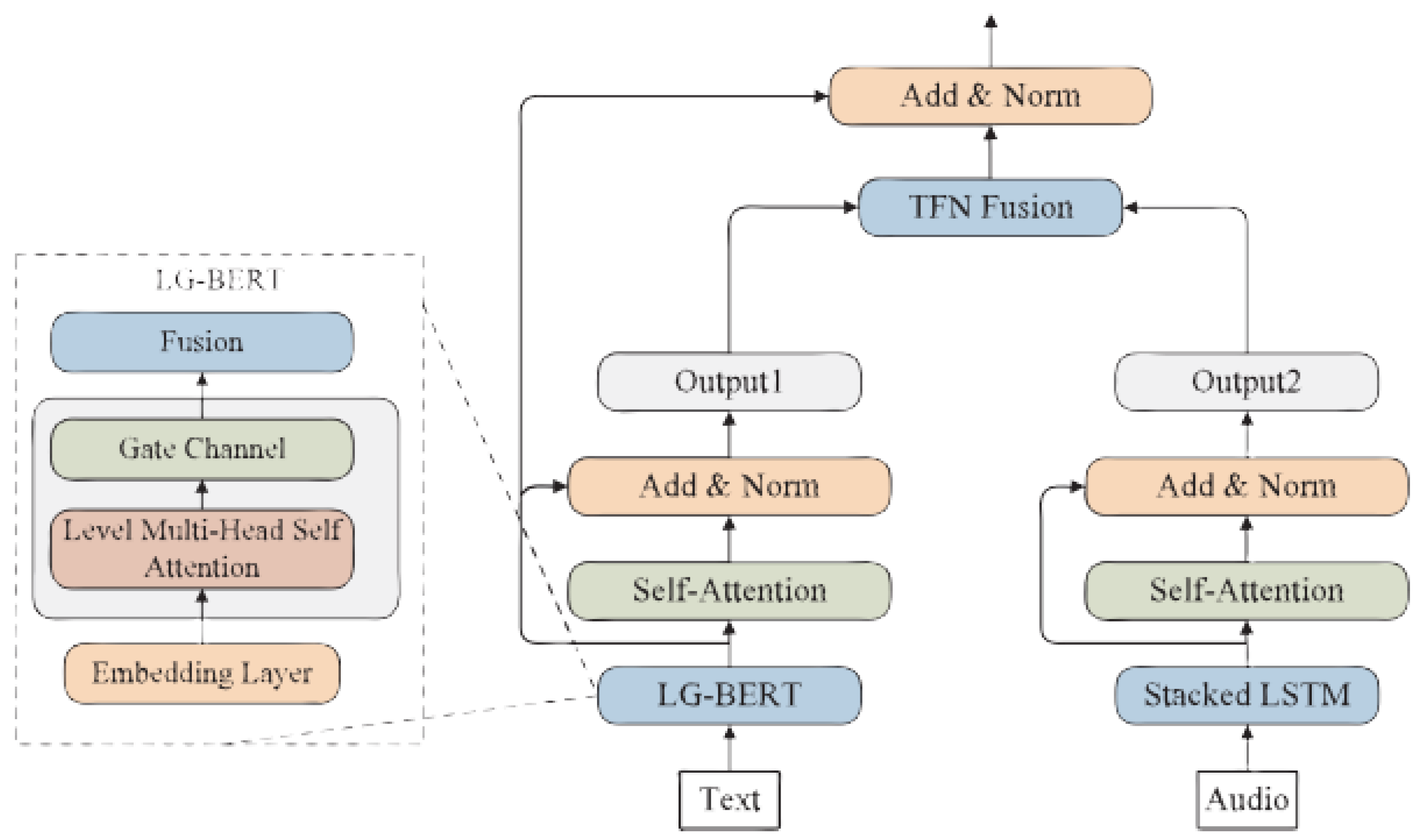
In this part, as shown in Figure 5, the fusion process of multi-modal data will be introduced. The process can be divided into two stages: the first stage is to use the self-attention mechanism to extract data features; the second stage is the data fusion process in Figure 5. The feature extraction process for text data is as follows: First, the improved LG-BERT is used to process text information, a self-attention mechanism is used to find important parts of the data, and a residual network and BERT layer regularization is used to standardize features. The input data type format of BERT in the classification process is: X = [“CLS”, W1, W2, …, Wn, “SEP”].
Figure 5. Modal fusion process of text and audio.
Therefore, in Output1, it uses the first item of the output characteristic, which is the characteristic corresponding to the CLS flag bit.
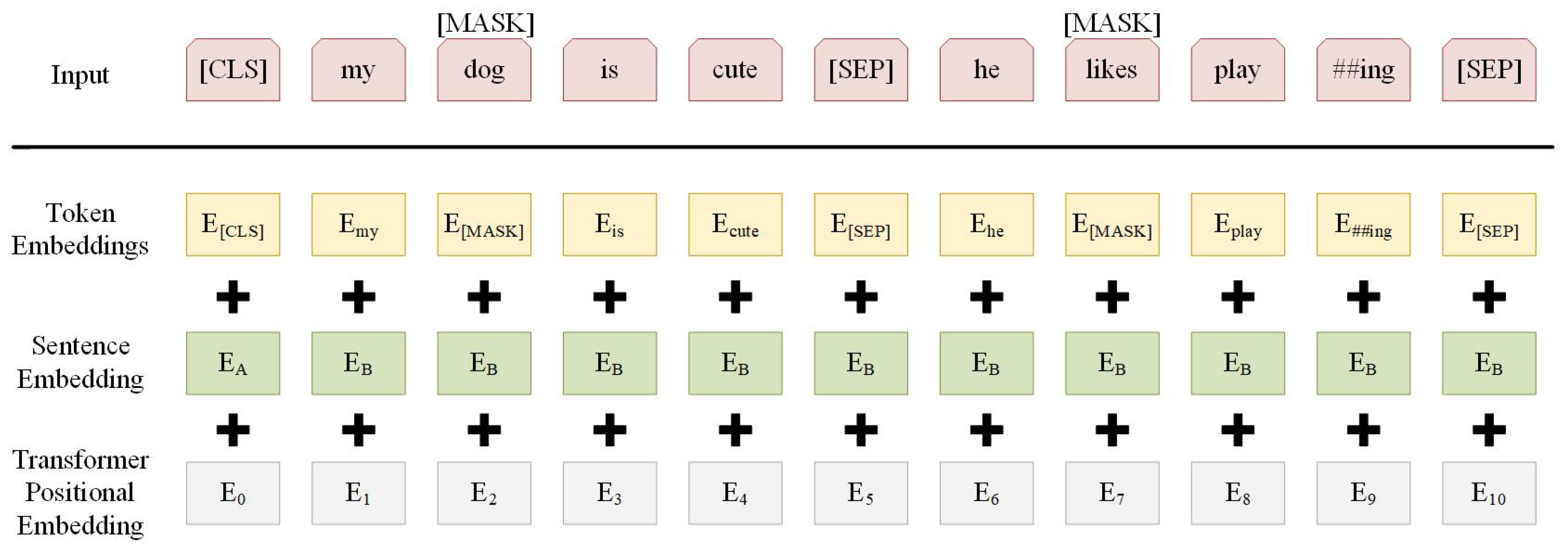
As Figure 6 shows, for feature processing of audio data, we first use a stacked double-layer LSTM to process the audio features. Compared with other traditional models (such as GRU and CNN), LSTM has a better effect.
Figure 6. The processing of the BERT Model.
After the processing of the self-attention mechanism and layer regularization, the last feature vector is used as the representation of audio data in the output obtained. At the tensor fusion, the fused features pass through the full connection layer, which is convenient to combine with the original features again.
In the process of multi-modal data feature processing, the feature vector dimension obtained is one modal feature. By adding an extra dimension to every single modal feature, it is used to store information about other modes. The fusion features not only have the single modal features before the fusion but also have cross-modal information between different modes. Compared with the single mode, it has more information.

4. Experiment

4.1. Experimental Dataset and Prepossessing

In this part, CMU-MOSI [18] was chosen as the dataset for our experiment. CMU-MOSI consists of 93 videos made up of men and women aged 20–30 (41 were male, and 48 were female). The videos were sliced into 2199 video clips, and each clip was thought to be labeled with a polarity value from −3 to +3. The higher the number, the more polar the emotion. Each video contained an average of 23.2 clips; each clip was 4.2 s in length and contained an average of 12 words.
For the pre-training work of the experiment, the dataset is divided into text and audio. The text belongs to the original data and is processed by built-in functions in BERT. Each sentence is filled and truncated and has a fixed length of dimension 50. Audio data uses processed data. CMU-MOSI provides both raw and processed data characteristics. Here, the CMU-MOSI open dataset processed in the CM-Bert paper is used. Next, the operating environment of the experiment used Pytorch as the Deep learning framework and is coded by Python 3.6.

4.2. Experimental Parameter Configuration

The BERT pre-training model used is the uncased BERT-Base version, consisting of 12-layer Transformer blocks with a hidden layer characteristic of 768 dimensions. The learning rate of the model is 1 × 10⁻⁵, and the optimizer and loss function are AdamW and L1Loss, respectively. The maximum length of the experimental text data is 50, and the characteristic dimension is 768. The embedding dimension of audio data is 5. In the hierarchical multi-head self-attention mechanism, the head number distribution is 16-12-8-4.
The experimental evaluation criteria for model performance were Accuracy and F1-Score. F1-Score is the harmonic average of accuracy and recall, with a maximum of 1 and a minimum of 0. In the experiment, the F1-score function in the SK Learn library is used to calculate the F1-score, and the weighting method is adopted.

4.3. Data Processing

The data used in the experiment have been publicly processed, and word embed- ding and alignment about words have been implemented (a word corresponds to a segment of audio and video). The fixed sentence length of a sentence is 50 words. If the sentence length is less than 50, the forward complement 0 is used. If the sentence length exceeds 50, the forward truncation method is used.

5. Analysis of Experimental Results

5.1. Results Analysis of Baseline

The experiment will evaluate the LG-BERT model on the CMU-MOSI dataset; the experimental results are shown in Table 1.
Table 1. The experimental results of different models on the CMU-MOSI dataset, “+” represents the code duplicated by ourselves.
First, in the processing of multi-modality data based on LSTM, TFN uses the form of a tensor cross-product to fuse feature vectors of different modes. Since it is in the form of a cross-product of feature vectors, the amount of feature data resulting from fusion is N3. LMF degrades the tensor matrix on the basis of the TFN model. Both models use the traditional LSTM model, and the innovation lies in the way of feature fusion. As a result, the experimental effect is not good, and its accuracy is 77.1% and 76.4%, respectively. Based on LSTM, GME-LSTM introduces reinforcement learning to update the gated information. Since the decision classification problem, which reinforcement learning is good at, is not introduced, its accuracy is 76.5%. MFM optimizes the joint generation identification model in cross-modal data. Generative factors are shared across channels and contain joint multi-modal characteristics, and discriminant factors contain information about generated data. RMFN divides the fused features into different stages, focusing only on a small number of features in each stage. MCTN is a learning method of joint feature presentation between different modes. These models all bring forward the innovation of feature fusion, but they do not improve the degree of feature extraction.
MulT uses a bidirectional cross-modal attention mechanism that enables learning at each time step. By improving the training model, the accuracy is improved. When using BERT’s model, the results of CM-BERT+, the mask attention mechanism model and BERT-TA+, the two-mode tensor fusion model based on self-attention, reached 82.65% and 83.38%, respectively, which was 3–5% higher than that of LSTM. This shows that the BERT model is powerful for feature extraction. Experiments have found that our model performs better than traditional models. The reason may be that the embedded dimension of audio data is very small, and it is easily affected by noise when passing through the attention module.
Finally, by optimizing the BERT model, the accuracy of the LG-Bert model proposed is improved by 0.44% compared with the BERT model, which provides an idea for further research on the optimization of the BERT model.

5.2. Ablative Study of LG-BERT

Secondly, ablation analysis was conducted for each component in the HG-BERT model. The experimental results are shown in Table 2.
Table 2. Ablation Research of LG-BERT.
First, the BERT model was used, and its accuracy was 83.67% (Group A) and 83.38% (Group B3) when using single mode (Text) and double mode (text and audio), respectively. The single-mode performance of the experiment is about 0.3% higher than that of the dual-mode, indicating that the audio data becomes noise during the fusion, which affects the classification effect of the BERT model.
The reasons may lie in two aspects: first, more noise is mixed in audio data extraction and word-based alignment, which affects the accuracy of the audio data. The other is that the processing of audio data using LSTM is not sufficient. Next, for the comparison of fusion methods, the mask attention fusion method (Group B4, CM-BERT) was used in the study.
Under the condition of ensuring the same parameter configuration as used in the paper, the experimental effect of the tensor fusion method (Group B3) based on self-attention was 1% better than that of B4. At the end of the fusion method of mask attention, the attention coefficient obtained from audio and text is used to score with the original text features, to ignore the audio data features. In this paper, the tensor fusion method is used to preserve not only the information of original modes but also the information on interaction between the modes.

6. Conclusions

In this part, we propose an improved model based on BERT. Aiming at the modules that can be further optimized for BERT network structure, several points worth discussing are proposed. First, a hierarchical multi-head self-attention mechanism is used to extract features by using a progressive number of heads, taking advantage of the difference of feature extraction capability of different BERT network layers. Secondly, for the Feed Forward layer of the BERT structure, it is proposed to use the gate channel to replace it and filter the information. Finally, a tensor fusion model based on a self-attention mechanism is proposed to realize feature extraction between cross-modal information by using the self-attention mechanism and the two-mode tensor fusion model.
In future research, the realization of the gated information channel will be further improved. At the same time, it is hoped that the ALBERT model can be used to achieve a significant reduction in the number of BERT model parameters under the condition of ensuring the model performance.

Author Contributions

Conceptualization, J.W.; Data curation, T.Z.; Formal analysis, C.W.; Methodology, X.Z. All authors have read and agreed to the published version of the manuscript.

Funding

This work is supported by the National Natural Science Foundation of China (Grant No. 61602161, 61772180), Hubei Province Science and Technology Support Project (Grant No: 2020BAB012), The Fundamental Research Funds for the Research Fund of Hubei University of Technology (HBUT: 2021046).

Conflicts of Interest

The authors declare no conflict of interest.

References

  1. Gove, R.; Faytong, J. Machine Learning and Event-Based Software Testing: Classifiers for Identifying Infeasible GUI Event Sequences. Adv. Comput. 2012, 86, 109–135. [Google Scholar]
  2. Chen, R.; Zhou, Y.; Zhang, L.; Duan, X. Word-level sentiment analysis with reinforcement learning. IOP Conf. Series Mater. Sci. Eng. 2019, 490, 062063. [Google Scholar] [CrossRef]
  3. Chen, M.; Wang, S.; Liang, P.P.; Baltrušaitis, T.; Zadeh, A.; Morency, L.-P. Multi-modal sentiment analysis with word-level fusion and reinforcement learning. In Proceedings of the 19th ACM International Conference on Multi-Modal Interaction, Glasgow, UK, 13–17 November 2017; pp. 163–171. [Google Scholar]
  4. Vaswani, A.; Shazeer, N.; Parmar, N.; Uszkoreit, J.; Jones, L.; Gomez, A.N.; Kaiser, Ł.; Polosukhin, I. Attention is all you need. In Proceedings of the Advances in Neural Information Processing Systems, Long Beach, CA, USA, 4–9 December 2017; pp. 5998–6008. [Google Scholar]
  5. Devlin, J.; Chang, M.-W.; Lee, K.; Toutanova, K. Bert: Pretraining of deep bidirectional transformers for language understanding. arXiv 2018, arXiv:1810.04805. [Google Scholar]
  6. Hochreiter, S.; Schmidhuber, J. Long short-term memory. Neural Comput. 1997, 9, 1735–1780. [Google Scholar] [CrossRef] [PubMed]
  7. Zadeh, A.; Chen, M.; Poria, S.; Cambria, E.; Morency, L.-P. Tensor fusion network for multimodal sentiment analysis. arXiv 2017, arXiv:1707.07250. [Google Scholar]
  8. He, J.; Zhao, L.; Yang, H.; Zhang, M.; Li, W. HSI-BERT: Hyperspectral Image Classification Using the Bidirectional Encoder Representation From Transformers. IEEE Trans. Geosci. Remote Sens. 2019, 58, 165–178. [Google Scholar] [CrossRef]
  9. Zail, C.; Huang, K.; Wu, L.; Zhong, Z.; Jiao, Z. Relational Graph Convolutional Network for Text-Mining-Based Accident Causal Classification. Appl. Sci. 2022, 12, 2482. [Google Scholar] [CrossRef]
  10. Zhao, S.; Zhang, T.; Hu, M.; Chang, W.; You, F. AP-BERT: Enhanced pre-trained model through average pooling. Appl. Intell. 2022. [Google Scholar] [CrossRef]
  11. He, J.; Hu, H. MF-BERT: Multimodal Fusion in Pre-Trained BERT for Sentiment Analysis. IEEE Signal Process. Lett. 2021, 29, 454–458. [Google Scholar] [CrossRef]
  12. Zhu, X.; Zhu, Y.; Zhang, L.; Chen, Y. A BERT-based multi-semantic learning model with aspect-aware enhancement for aspect polarity classification. Appl. Intell. 2022. [Google Scholar] [CrossRef]
  13. Morency, L.-P.; Mihalcea, R.; Doshi, P. Towards multi-modal sentiment analysis: Harvesting opinions from the web. In Proceedings of the 13th International Conference on Multi-Modal Interfaces, Alicante, Spain, 14–18 November 2011; pp. 169–176. [Google Scholar]
  14. Wang, H.; Meghawat, A.; Morency, L.-P.; Xing, E.P. Select-additive learning: Improving generalization in multi-modal sentiment analysis. In Proceedings of the 2017 IEEE International Conference on Multimedia and Expo (ICME), Hong Kong, China, 10–14 July 2017; pp. 949–954. [Google Scholar]
  15. Kumar, A.; Vepa, J. Gated mechanism for attention based multi modal sentiment analysis. In Proceedings of the ICASSP 2020-2020 IEEE International Conference on Acoustics, Speech and Signal Processing (ICASSP), Barcelona, Spain, 4–8 May 2020; pp. 4477–4481. [Google Scholar]
  16. Arjmand, M.; Dousti, M.J.; Moradi, H. Teasel: A transformer-based speech-prefixed language model. arXiv 2021, arXiv:2109.05522. [Google Scholar]
  17. Zhang, S.; Xu, X.; Pang, Y.; Han, J. Multi-layer attention based cnn fortarget-dependent sentiment classification. Neural Process. Lett. 2020, 51, 2089–2103. [Google Scholar] [CrossRef]
  18. Zadeh, A.; Liang, P.P.; Mazumder, N.; Poria, S.; Cambria, E.; Morency, L.-P. Memory fusion network for multi-view sequential learning. In Proceedings of the AAAI Conference on Artificial Intelligence, New Orleans, LA, USA, 2–7 February 2018; Volume 32. [Google Scholar]
  19. Wang, A.; Cho, K. BERT has a Mouth, and It Must Speak: BERT as a Markov Random Field Language Model. arXiv 2019, arXiv:1902.04094. [Google Scholar] [CrossRef]
  20. Tsai, Y.-H.H.; Liang, P.P.; Zadeh, A.; Morency, L.-P.; Salakhutdinov, R. Learning factorized multi-modal representations. arXiv 2018, arXiv:1806.06176. [Google Scholar]
  21. Liang, P.P.; Liu, Z.; Zadeh, A.; Morency, L.-P. Multi-modal language analysis with recurrent multistage fusion. arXiv 2018, arXiv:1808.03920. [Google Scholar]
  22. Pham, H.; Liang, P.P.; Manzini, T.; Morency, L.-P.; Póczos, B. Found in translation: Learning robust joint representations by cyclic translations between modalities. In Proceedings of the AAAI Conference on Artificial Intelligence, Honolulu, HI, USA, 27 January–1 February 2019; Volume 33, pp. 6892–6899. [Google Scholar]
  23. Tsai, Y.-H.H.; Bai, S.; Liang, P.P.; Kolter, J.Z.; Morency, L.-P.; Salakhutdinov, R. Multi-modal transformer for unaligned multi-modal language sequences. In Proceedings of the Association for Computational Linguistics Meeting, Florence, Italy, 28 July–2 August 2019; Volume 2019, p. 6558. [Google Scholar]
Publisher’s Note: MDPI stays neutral with regard to jurisdictional claims in published maps and institutional affiliations.

Article Metrics

Citations

Article Access Statistics

Multiple requests from the same IP address are counted as one view.