


Abstract
In this present paper, the dynamic stiffness method (DSM) was formulated to investigate the out-of-plane natural vibration of a thin orthotropic plate using the classical plate theory (CPT). Hamilton’s principle was implemented to derive the governing differential equation of motion for free vibration of the orthotropic plate for Levy-type boundary conditions. The Wittrick–Williams (W–W) algorithm was used as a solution technique to compute the natural frequencies of a thin orthotropic plate for different boundary conditions, aspect ratios, thickness ratios, and modulus ratios. The obtained results are compared with the results by the finite element method using commercial software (ANSYS and those available) in the published literature. The presented results by the dynamic stiffness method can be used as a benchmark solution to compare the natural frequencies of orthotropic plates.
1. Introduction
A rectangular orthotropic plate has many applications in designing different components in the engineering field, such as aerospace, mechanical, and civil. The orthotropic response of a given material is due to the existence of its constitutive relations. Various composite plates have been modeled analytically as orthotropic plates in recent years. So, one should have knowledge of the free vibration of such structures for efficient dynamic structural analyses. Starting from the earlier works on natural vibration of the plate by Rayleigh [1] and Ritz [2], the past few decades have witnessed different numerical and analytical methods, such as the Kantorovich method, the superposition method, the Rayleigh–Ritz method, and the iterative reduction method, for the investigation of natural vibrations of rectangular orthotropic plates [3,4,5,6,7,8,9,10,11,12,13,14,15,16,17,18,19,20]. The usually adopted finite element method (FEM) has also proved its popularity in the dynamic analysis of orthotropic rectangular plates [21,22,23]. However, the main drawback of traditional FEM and other approximate methods is the discretization technique of the given structure, which depends on the number of elements taken. The dynamic stiffness method (DSM) provides accurate results independent of the number of elements implemented in the investigation. The DSM has proven its efficiency in the dynamic analysis of bars, beams, rings, and shells [24,25,26,27,28,29,30,31], and the W–W algorithm [24,25,26,27,28] is implemented as a solution technique to the final dynamic stiffness matrix to find out the natural vibration frequencies of beams. Wittrick and Williams [32] are probably the earliest researchers who developed DSM for isotropic simply supported plates, applying CPT. Boscolo and Banerjee extended the DSM and applied the first-order deformation theory (FSDT) for isotropic [33] and composite plates [34,35]. Fazzolari et al. [36] further formulated the DSM for rectangular anisotropic plates using the higher shear deformation theory (HSDT) with the W–W algorithm. Further, Boscolo and Banerjee [37] developed DSM by applying the sophisticated layer-wise first-order theory to investigate laminated composite plates. Continuing this work, Banerjee et al. [38] developed an exact dynamic stiffness (DS) matrix for an isotropic rectangular plate. Thinh et al. [39] used DSM for free vibration analyses of thick composite plates resting on non-homogeneous foundations. Recently, Danilovic et al. developed DSM for an isotropic rectangular plate with arbitrary boundary conditions undergoing in-plane free vibration [40], which was further exploited for out-of-plane free vibration of the rectangular Mindlin plate element [41] and later on for isotropic plate assemblies [42]. Ghorbel et al. formulated DSM for both out-of-plane [43] and in-plane [44] free vibrations of the rectangular orthotropic plate, taking advantage of the symmetry and Gorman-type decomposition of the free boundary conditions. Kumar et al. [45] developed DSM for analyzing the free vibration response of the functionally-graded material plate using the classical plate theory with the physical neutral surface concept. Chauhan et al. [46] used the classical plate theory to formulate a dynamic stiffness matrix to compute the natural frequencies of the rectangular plate with the considered Levy-type boundary conditions. Moreover, Liu and Banerjee developed an exact spectral–dynamic stiffness method (S–DSM), which combines the spectral method with classical DSM for free vibration analyses of orthotropic composite plates and their assemblies [47,48] and, subsequently, for isotropic rectangular plates [49] with arbitrary boundary conditions.
This work reports the out-of-plane free vibration response of a thin rectangular orthotropic plate for Levy-type boundary conditions based on CPT using the exact DSM method with the Wittrick–Williams algorithm. The explicit terms of the DS matrix and natural frequencies of the orthotropic plate by the Wittrick–Williams algorithm for different boundary conditions, aspect ratios, thickness ratios, and modulus ratios are reported and compared with the available published literature and finite element method. The remaining portion of the present work can be described as follows: After the introduction, Section 2 explains the main contributions of the present study. In Section 3, the mathematical formulation of the orthotropic plate with material property is reported. Here, the fundamental principle of mathematical modeling of DSM and the motion governing equation of the orthotropic plate, formulated using Hamilton’s principle, are highlighted. Along with this, a dynamic stiffness matrix was generated, and the W–W algorithm was used to investigate the natural frequencies of the orthotropic plate. Section 4 described the natural frequency results highlighting the effects of geometric parameters on the natural frequency of the orthotropic plate. Section 5 presents the conclusions of the present study.
2. Contributions and Relevant Scope of Present Work
In the present study, the natural vibration response in the transverse direction of the orthotropic plate was investigated. The classical plate theory explains the plate displacement component or kinematic variables. Hence, the effect of shear deformation of the plate can be neglected, and the present work is mainly focused on thin orthotropic plates. The Levy-type solution was applied where two opposite sides of the plate were simply supported, and the other two sides had arbitrary conditions (free, clamped, and simply supported). In the present study’s relevant scopes and limitations, the paper’s main contributions can be explained as follows:
- The DSM was formulated to investigate the natural vibration response of thin orthotropic plates.
- The W–W algorithm was applied to compute the natural frequency of the orthotropic plate.
- The DSM results were compared with the published literature and the finite element method.
- A new set of DSM results is reported for different aspect ratios, thickness ratios, and modulus ratios, which may be used as benchmark solutions for comparison.
3. Mathematical Formulation
3.1. Description of Geometrical Property
Figure 1 shows the coordinate system of a thin orthotropic plate where the plate length is , with and thickness is The Levy-type solution is applied where two opposite edges are simply supported along the y-axis (i.e., along the edges and ), while the other two edges may be free , simply supported , or clamped , as represented in Figure 2. The material orthotropic axes of the plate are parallel in the directions of x and y.
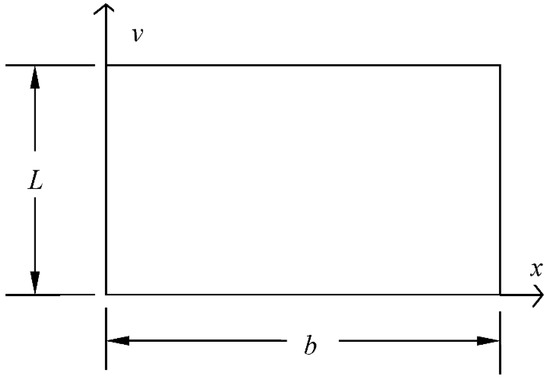
Figure 1.
Levy-type solution boundary conditions with coordinate system convention.
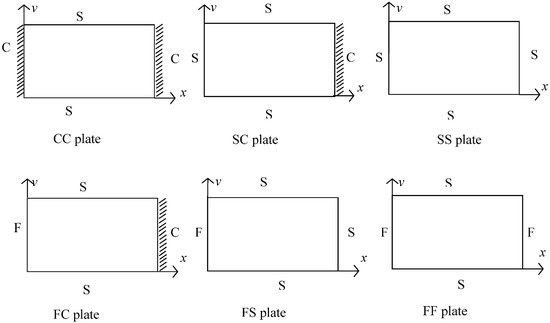
Figure 2.
Levy-type solution boundary conditions of the orthotropic plate.
Applying the CPT assumption, the transverse displacements of an arbitrary point of the plate are expressed by Equation (1).
where the displacement components of the plate are represented by in , , directions, respectively, and , represents the rotational displacements of the and axes at the plate middle surface, respectively. represents the thickness (transverse) displacement in the z-direction.
In the case of orthotropic plates, the orientation of the constitutive material is such that orthotropic axes 1 and 2 are equal to axes x and y, respectively, and the material constants, are given by Equation (2).
where , are Young’s moduli, along with the orthotropic directions 1 and 2, respectively; , are major and minor Poisson’s ratios, and is the shear modulus [43].
3.2. Equations of Motion
The well-known Hamilton’s principle is used to derive the governing differential equation for the natural vibration of the orthotropic plate based upon CPT as given by Equation (3).
where the mass density and thickness of the orthotropic plate are represented by and , respectively.
, , and are flexural rigidities, which are given by Equation (4).
3.3. Boundary Conditions
The natural boundary conditions (BCs) are obtained by applying Hamilton’s principle, given by Equation (5).
where , indicate the shear force and bending moments of the plate.
4. Formulation of Dynamic Stiffness (DS) Matrix with Levy Solution
The generalized differential Equation (3) is solved by applying force and displacement boundary conditions to develop the DS matrix. A Levy solution is implemented to solve Equation (3), and to satisfy the BCs given by Equation (5), it is sought in the given form as presented in Equation (6) [33].
where represents the unknown frequency.
A generalized fourth-order ordinary differential equation is determined by substituting Equation (6) into Equation (3); it can be expressed as
The developed Equation (7) produces the standard four roots; based on its nature, there are only two feasible solutions obtained and given by cases 1 and 2.
Case 1.
In the above case, all roots are real () and can be expressed as
The solution is given by Equation (8).
where are constants.
Case 2.
In the above case are two real roots and two imaginary roots (), and can be expressed as
The solution is given by Equation (9).
For case 1, the formulation of the DS matrix is explained below. A similar pattern is implemented for case 2, but is not explained here for brevity.
By applying Equations (6) and (8), the displacement , bending rotation , shear force , and moment are determined and can be given by Equations (10)–(12).
where .
where .
The BCs for the Levy-type plate are represented in Figure 3.
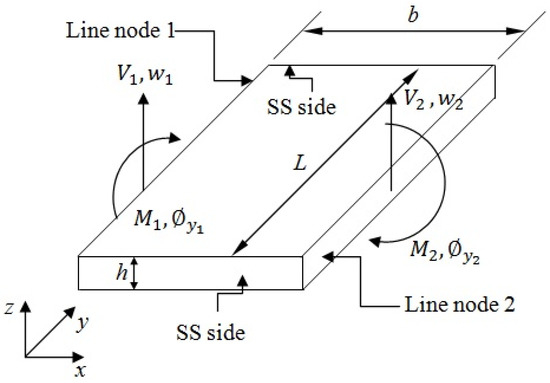
Figure 3.
Displacements and force BCs for a plate element.
The BCs for displacements are:
The BCs for the forces are:
The displacement BCs in Equation (13) are substituting into Equations (8) and (10); the following equations can be obtained as:
where
This expression can be rewritten in the matrix form and expressed by Equation (15).
i.e.,
Similarly, the force BCs are applied; substituting Equation (14) into Equations (11) and (12), the following matrix relationship can be developed and expressed by Equation (17).
i.e.,
where
with i = 1,2.
By excluding the constant vector value of , the following relationship can be formed as
where
Thus, a square 4 × 4 symmetric DS matrix from Equation (20) is developed, including independent terms ). Therefore, the generated DS matrix of the single plate element can be expressed as
The mathematical expressions of Equation (21) are explained in Appendix A.
4.1. Dynamic Stiffness (DS) Matrix Assembly Procedure with Boundary Conditions
The dynamic stiffness matrix given by Equation (21) was developed for a plate element. By obtaining the natural frequencies of a given orthotropic plate assembly, we considered four elements of the given plate geometry. Each element of the plate was connected through nodal lines. Since there were five nodal lines and the degree of freedom was two per element, a 10 × 10 global master stiffness matrix was formulated. The assembly procedure is similar to the finite element method, schematically shown in Figure 4. Boundary conditions can be applied the same way as we applied in the finite element method. The penalty method was applied as boundary conditions to suppress a particular degree of freedom. In this method, a considerable value of stiffness is added to the appropriate term on the leading diagonal of the dynamic stiffness matrix. The procedure for applying the boundary conditions is summarized as follows:
- Displacement is penalized for simply supported (S) boundary conditions.
- Displacement ( and rotation ( are penalized for clamped (C) boundary conditions.
- No penalty is implemented for the free (F) boundary condition.
where represents the suppressed node.
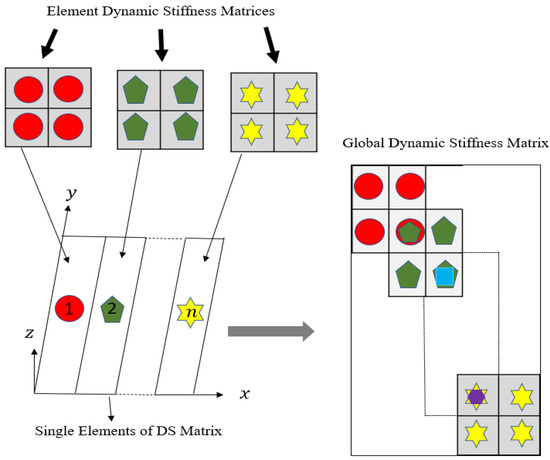
Figure 4.
Assembly procedure of dynamic stiffness matrices.
4.2. Application of the Wittrick and Williams (W–W) Algorithm
One way of determining the natural frequencies is by using the zeros of the global dynamic stiffness matrix of the structure under study. However, this method has its limitations due to the transcendental behavior of the DS elements, which makes the plot of the frequency determinant tedious. Moreover, sometimes this may lead to missing the coincident frequencies. So, to avoid these difficulties, the Wittrick–Williams algorithm [33,50] was used, which ensured that no natural frequencies were missed. The procedure to follow the W–W algorithm can be represented in a flow chart, shown in Figure 5.
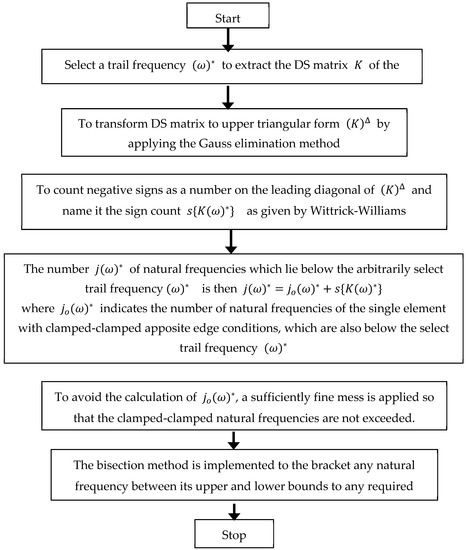
Figure 5.
Flow chart for implementing the W–W algorithm.
5. Results and Discussions
This section presents the non-dimensional fundamental frequencies of an orthotropic rectangular plate with Levy-type BCs, i.e., two simply supported opposite edges and the other two edges having arbitrary boundary conditions. To simplify the problem, a two-letter notation was used to describe the boundary conditions of the remaining edges, as shown in Figure 2. For example, SC signifies that one edge is simply supported (S) and the other is clamped (C). The results obtained by DSM were compared with published results and the FEM using ANSYS. A detailed study and discussion were conducted to analyze the effects of the boundary conditions and the variations of the modulus ratio, aspect ratio, and thickness ratio on the fundamental natural frequency of an orthotropic plate. The following material properties were used for analysis [51]:
The non-dimensional fundamental natural frequency is calculated as [52]:
5.1. Comparative Study
A program in MATLAB was constructed to compute the fundamental natural frequencies of the plate. The natural frequencies obtained by DSM were compared against the results reported by Reddy and Phan [52] using CPT and with those reported by Thai and Kim [15] using the variable refined plate theory (RPT), as shown in Table 1; errors incurred by DSM when compared with Ref. [15] are reported in the brackets. The natural frequency changes for different boundary conditions (due to a change in stiffness) were noticed in Table 1. The maximum value of natural frequencies is reported for the CC boundary condition; the minimum value was obtained for the FF boundary condition. In the CC boundary condition, more constraints were introduced at the edges of the plate, which increased the stiffness of the plate, resulting in a higher natural frequency. On the other hand, in the FF boundary condition, no constraint was applied at the edges of the plate, which decreased the stiffness of the plate, and lowered the natural frequency, as shown in Table 1.

Table 1.
Comparison of fundamental frequency parameters of the Levy-type orthotropic plate (b/h = 100).
It is observed from Table 1 that the maximum error is −1.7436% for the CC boundary condition at b/L = 0.5 and E1/E2 = 40, whereas the minimum error encountered is 0.00% at b/L = 0.5 and E1/E2 = 25 for the FF boundary condition. It can be seen from Table 1 that most of the errors lie within 2%. It is observed that the DSM results of a thin orthotropic plate in Table 1 are in excellent agreement with the published literature and the FEM results.
5.2. Parameter Studies
To study the effects of different boundary conditions, variations of thickness ratio, modulus ratio, and aspect ratio on the non-dimensional fundamental frequencies of thin orthotropic plates, parametric studies were conducted. The DSM results are also compared with the FEM obtained by ANSYS. For the modeling of the plate, shell element 181 was used in ANSYS. To test the accuracy of FEM, the non-dimensional fundamental frequencies were obtained by DSM based on CPT for a simply supported Levy-type orthotropic plate (b/L = 1, b/h = 20) at different modulus ratios, compared to the values obtained by FEM with different mesh sizes, as shown in Table 2. A very good convergence between the FEM and DSM results can be observed. The final choice is a mesh with 20 × 20 plate elements, which is a good compromise between the need for accuracy and limiting the computing time. In Table 3, Table 4, Table 5, Table 6, Table 7 and Table 8, the DSM results are compared against the published results reported by Mukhtar [53] using the differential transform method (DTM) and Taylor collocation method (TCM), and with those reported by authors [15] for different Young’s modulus ratios (E1/E2), aspect ratios (b/L), and thickness ratios (b/h). It could be observed from Table 3, Table 4, Table 5, Table 6, Table 7 and Table 8 that the natural frequencies, in general, decrease with an increase in Young’s modulus, aspect ratio, and thickness ratio for the orthotropic plate. It is observed in Table 3, Table 4, Table 5, Table 6 and Table 7 that with boundary conditions changing from SC to SF, the natural frequencies increase, with the increase in the modulus ratio (E1/E2) from 3 to 50 because of an increase in the stiffness of the plate. Compared with Ref. [15], the relative errors of DSM are reported in brackets in Table 3, Table 4, Table 5, Table 6, Table 7 and Table 8.
Table 2.
Obtained results for the test accuracy of the finite element mesh.
Table 3.
Comparison of the fundamental frequency parameters of the orthotropic plate with the SC boundary conditions.
Table 4.
Comparison of the fundamental frequency parameters of the orthotropic plate with the SS boundary conditions.
Table 5.
Comparison of the fundamental frequency parameters of the orthotropic plate with the SF boundary conditions.
Table 6.
Comparison of the fundamental frequency parameters of an orthotropic plate with the CC boundary conditions.
Table 7.
Comparison of the fundamental frequency parameters of an orthotropic plate with the FC boundary conditions.
Table 8.
Comparison of the fundamental frequency parameters of an orthotropic plate with the FF boundary conditions.
It could be observed from Table 3, Table 4, Table 5, Table 6, Table 7 and Table 8 that the maximum errors encountered in the DSM results when compared with Ref. [15] results are 1.7720% at b/L = 1.0, b/h = 20, and E1/E2 = 3 for the CC plate in Table 6. The next highest percentage of errors is −1.7539 (for the SC plate at b/L = 1, b/h = 20 and E1/E2 = 20) in Table 8. Thus, for all cases reported in Table 3, Table 4, Table 5, Table 6, Table 7 and Table 8, the error is less than 2%.
The effect of Young’s modulus ratio (E1/E2) and the thickness ratio (a/h) on natural frequencies for all boundary conditions are presented in Figure 6 and Figure 7, respectively. The following observations are obtained from Figure 6 and Figure 7, respectively.
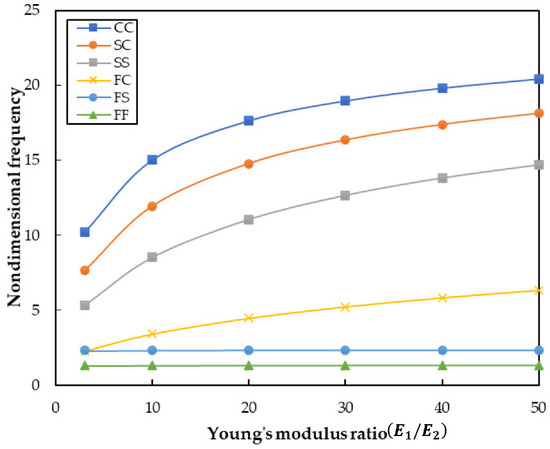
Figure 6.
Effect on the non-dimensional frequency of the orthotropic plate for the Levy-type boundary condition with Young’s modulus ratio and the given value of the side-thickness ratio .
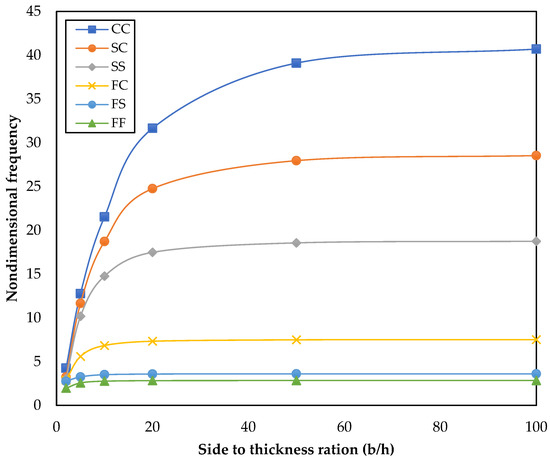
Figure 7.
Effect on the non-dimensional frequency of the square orthotropic plate for the Levy-type boundary condition with a side-thickness ratio and the given value of Young’s modulus ratio .
(a) The natural frequency increases with increases in the modulus ratio for a given value of the side-thickness ratio (b/L = 0.5), as shown in Figure 6 for all boundary conditions, except FF and FS boundary conditions. The natural frequency values are nearly constant for FF and FS boundary conditions.
(b) The fundamental natural frequency values increase with increases in the side to thickness ratio (b/h) for a given Young’s modulus ratio , as shown in Figure 7 for all boundary conditions except FF and FS boundaries.
6. Conclusions
In the present paper, the dynamic stiffness method, as a novel method, was implemented to analyze the out-of-plane free vibration of the rectangular orthotropic plate, where two opposite edges are simply supported. The classical plate theory was used to formulate the dynamic stiffness matrix for the rectangular orthotropic plate. The Wittrick–Williams algorithm was applied to solve the transcendental nature of the global dynamic stiffness matrix to extract the natural frequencies of the overall plate. The complete procedure, starting from developing the dynamic stiffness matrix and calculating natural frequencies, was implemented in a computer program using MATLAB. This enabled computation of any number of exact natural frequencies of the orthotropic plate for the Levy-type boundary conditions. The computed natural frequencies were compared against published results obtained by the finite element method using commercial software ANSYS. A new dataset on the natural frequencies for different aspect ratios, modulus ratios, and thickness ratios was computed and compared with the published literature.
The new results on natural frequency obtained by the DSM method can be implemented as a benchmark solution for future comparison purposes.
Author Contributions
Conceptualization, V.R.; Formal analysis, M.C.; Investigation, M.C.; Methodology, V.R.; Project administration, P.M.; Software, S.D.; Supervision, V.R.; Writing—original draft, M.C.; Writing—review & editing, M.R. and R.B. All authors have read and agreed to the published version of the manuscript.
Funding
This research received no external funding.
Conflicts of Interest
The authors declare no conflict of interest.
Appendix A
Explicit expressions of the elements of the dynamic stiffness matrix are given as follows:
where,
References
- Rayleigh, L. The Theory of Sound; Macmillan: Dover, NY, USA, 1945; Volume I, pp. 35–42. [Google Scholar]
- Ritz, W. On a new method for solving certain variational problems in mathematical physics. Crelle’s J. 1909, 1–61. [Google Scholar] [CrossRef]
- Bhat, R.B. Natural frequencies of rectangular plates using characteristic orthogonal polynomials in the Rayleigh-Ritz method. J. Sound Vib. 1985, 102, 493–499. [Google Scholar] [CrossRef]
- Gorman, D.J. Accurate free vibration analysis of the completely free orthotropic rectangular plate by the superposition method. J. Sound Vib. 1993, 165, 409–420. [Google Scholar] [CrossRef]
- Kshirsagar, S.; Bhaskar, K. Accurate and elegant free vibration and buckling studies of orthotropic rectangular plates using untruncated infinite series. J. Sound Vib. 2008, 314, 837–850. [Google Scholar] [CrossRef]
- Dalaei, M.; Kerr, A.D. Natural vibration analysis of clamped rectangular orthotropic plates. J. Sound Vib. 1996, 189, 399–406. [Google Scholar] [CrossRef]
- Bercin, A.N. Free vibration solution for clamped orthotropic plates using the Kantorovich method. J. Sound Vib. 1996, 196, 243–247. [Google Scholar] [CrossRef]
- Sakata, T.; Takahashi, K.; Bhat, R.B. Natural frequencies of orthotropic rectangular plates obtained by iterative reduction of the partial differential equation. J. Sound Vib. 1996, 189, 89–101. [Google Scholar] [CrossRef]
- Yu, S.D.; Cleghorn, W.L. Generic free vibration of orthotropic rectangular plates with clamped and simply supported edges. J. Sound Vib. 1993, 163, 439–450. [Google Scholar] [CrossRef]
- Timoshenko, S.; Woinowsky-Krieger, S. Theory of Plates and Shells; McGraw-Hill: New York, NY, USA, 1959. [Google Scholar]
- Leissa, A.W. Free vibration of rectangular plates. J. Sound Vib. 1973, 31, 257–293. [Google Scholar] [CrossRef]
- Gorman, D.J. Free Vibration Analysis of Rectangular Plates; Elsevier: Amsterdam, The Netherlands, 1982. [Google Scholar]
- Gorman, D.J. Accurate free vibration analysis of clamped orthotropic plates by the method of superposition. J. Sound Vib. 1990, 140, 391–411. [Google Scholar] [CrossRef]
- Biancolini, M.E.; Brutti, C.; Reccia, L. Approximate solution for free vibrations of thin orthotropic rectangular plates. J. Sound Vib. 2005, 288, 321–344. [Google Scholar] [CrossRef]
- Thai, H.; Kim, S.E. Levy-type solution for free vibration analysis of orthotropic plates based on two variable refined plate theory. Appl. Math. Model. 2012, 36, 3870–3882. [Google Scholar] [CrossRef]
- Xing, Y.F.; Liu, B. New exact solutions for free vibrations of thin orthotropic rectangular plates. Compos. Struct. 2009, 89, 567–574. [Google Scholar] [CrossRef]
- Hearmon, R. The frequency of flexural vibration of rectangular orthotropic plates with clamped or supported edges. J. Appl. Mech. 1959, 26, 537–540. [Google Scholar] [CrossRef]
- Tret’yak, V. Natural vibrations of orthotropic plates. Int. Appl. Mech. 1966, 2, 27–31. [Google Scholar] [CrossRef]
- Sakata, T.; Hosokawa, K. Vibrations of clamped orthotropic rectangular plates. J. Sound Vib. 1988, 125, 429–439. [Google Scholar] [CrossRef]
- Jayaraman, G.; Chen, P.; Snyder, V.W. Free vibrations of rectangular orthotropic plates with a pair of parallel edges simply supported. Comput.Struct. 1990, 34, 203–214. [Google Scholar] [CrossRef]
- Bardell, N.S.; Dunsdon, J.M.; Langley, R.S. Free vibration analysis of thin coplanar rectangular plate assemblies—Part I: Theory and initial results for specially orthotropic plates. Compos. Struct. 1996, 34, 129–143. [Google Scholar] [CrossRef]
- Bardell, N.S.; Dunsdon, J.M.; Langley, R.S. Free vibration analysis of thin coplanar rectangular plate assemblies—Part II: Theory and initial results for specially orthotropic plates. Compos. Struct. 1996, 34, 145–162. [Google Scholar] [CrossRef]
- Tsay, C.S.; Reddy, J.N. Bending, Stability and free vibrations of thin orthotropic plates by simplified mixed finite elements. J. Sound Vib. 1978, 59, 307–311. [Google Scholar] [CrossRef]
- Banerjee, J.R. Dynamic stiffness formulation and free vibration analysis of Timoshenko beams. J. Sound Vib. 2001, 247, 97–115. [Google Scholar] [CrossRef]
- Banerjee, J.R.; Su, H.; Jackson, D.R. Free vibration of rotating tapered beams using the dynamic stiffness method. J. Sound Vib. 2006, 298, 1034–1054. [Google Scholar] [CrossRef]
- Banerjee, J.R. Free vibration of centrifugally stiffened uniform and tapered beams using the dynamic stiffness method. J. Sound Vib. 2000, 233, 857–875. [Google Scholar] [CrossRef]
- Banerjee, J.R. Free vibration of sandwich beams using the dynamic stiffness method. Comput. Struct. 2003, 81, 1915–1922. [Google Scholar] [CrossRef]
- Banerjee, J.R. Free vibration of axially loaded composite Timoshenko beams using the dynamic stiffness matrix method. Comput. Struct 1998, 69, 197–208. [Google Scholar] [CrossRef]
- Tounsi, D.; Casimir, J.B.; Haddar, M. Dynamic stiffness formulation for circular rings. Comput. Struct. 2012, 112–113, 258–265. [Google Scholar] [CrossRef]
- Tounsi, D.; Casimir, J.B.; Abid, S.; Tawfiq, I.; Haddar, M. Dynamic stiffness formulation and response analysis of stiffened shells. Comput. Struct. 2014, 132, 75–83. [Google Scholar] [CrossRef]
- Fazzolari, F. A refined dynamic stiffness element for free vibration analysis of cross-ply laminated composite cylindrical and spherical shallow shells. Compos. Part B Eng. 2014, 62, 143–158. [Google Scholar] [CrossRef]
- Wittrick, W.H.; Williams, F.W. Buckling and vibration of anisotropic or isotropic plate assemblies under combined loadings. Int. J. Mech. Sci. 1974, 16, 209–239. [Google Scholar] [CrossRef]
- Boscolo, M.; Banerjee, J.R. Dynamic stiffness elements and their applications for plates using first order shear deformation theory. Comput. Struct. 2011, 89, 395–410. [Google Scholar] [CrossRef]
- Boscolo, M.; Banerjee, J.R. Dynamic stiffness formulation for composite Mindlin plates for exact modal analysis of structures- PartI: Theory. Comput. Struct. 2012, 96, 61–73. [Google Scholar] [CrossRef]
- Boscolo, M.; Banerjee, J.R. Dynamic stiffness formulation for composite Mindlin plates for exact modal analysis of structures- Part II: Results and applications. Comput. Struct. 2012, 96, 73–84. [Google Scholar] [CrossRef] [Green Version]
- Fazzolari, F.; Boscolo, M.; Banerjee, J.R. An exact dynamic stiffness element using a higher order shear deformation theory for free vibration analysis of composite plate assemblies. Compos. Struct. 2013, 96, 262–278. [Google Scholar] [CrossRef] [Green Version]
- Boscolo, M.; Banerjee, J.R. Layer-wise dynamic stiffness solution for free vibration analysis of laminated composite plates. J. Sound Vib. 2014, 333, 200–227. [Google Scholar] [CrossRef]
- Banerjee, J.R.; Papkov, S.O.; Liu, X.; Kennedy, D. Dynamic stiffness matrix of a rectangular plate for the general case. J. Sound Vib. 2015, 342, 177–199. [Google Scholar] [CrossRef]
- Thinh, T.I.; Nuguen, M.C.; Ninh, D.G. Dynamic stiffness formulation for vibration analysis of thick composite plates resting on non-homogenous foundations. Compos. Struct. 2014, 108, 684–695. [Google Scholar] [CrossRef]
- Nefovska-Danilovic, M.; Petronijevic, M. In-plane free vibration and response analysis of isotropic rectangular plates using dynamic stiffness method. Comput. Struct. 2015, 152, 82–95. [Google Scholar] [CrossRef]
- Kolarevic, N.; Nefovska-Danilovic, M.; Petronijevic, M. Free vibration analysis of rectangular Mindlin plates using dynamic stiffness method. J. Sound Vib. 2015, 359, 84–106. [Google Scholar] [CrossRef]
- Kolarevic, N.; Marjanovic, M.; Nefovska-Danilovic, M.; Petronijevic, M. Free vibration analysis of plate assemblies using the dynamic stiffness method based on the higher order shear deformation theory. J. Sound Vib. 2016, 364, 110–132. [Google Scholar] [CrossRef]
- Ghorbel, O.; Casimir, J.B.; Hammami, L.; Tawfiq, I.; Haddar, M. Dynamic stiffness formulation for free orthotropic plates. J. Sound Vib. 2015, 346, 361–375. [Google Scholar] [CrossRef]
- Ghorbel, O.; Casimir, J.B.; Hammami, L.; Tawfiq, I.; Haddar, M. In-plane dynamic stiffness matrix for a free orthotropic plate. J. Sound Vib. 2016, 364, 234–246. [Google Scholar] [CrossRef]
- Kumar, S.; Ranjan, V.; Jana, P. Free vibration analysis of thin functionally graded rectangular plates using the dynamic stiffness method. Compos. Struct. 2018, 197, 39–53. [Google Scholar] [CrossRef]
- Chauhan, M.; Ranjan, V.; Sathujhoda, P. Dynamic stiffness method for free vibration analysis of thin functionally graded rectangular plates. Vibroengineering Procedia 2019, 29, 76–81. [Google Scholar] [CrossRef]
- Liu, X.; Banerjee, J.R. An exact spectral-dynamic stiffness method for free flexural vibration analysis of orthotropic composite plate assemblies—Part I: Theory. Compos. Struct. 2015, 132, 1274–1287. [Google Scholar] [CrossRef] [Green Version]
- Liu, X.; Banerjee, J.R. An exact spectral-dynamic stiffness method for free flexural vibration analysis of orthotropic composite plate assemblies—Part II: Applications. Compos. Struct. 2015, 132, 1288–1302. [Google Scholar] [CrossRef] [Green Version]
- Liu, X.; Banerjee, J.R. Free vibration analysis for plates with arbitrary boundary conditions using a novel spectral-dynamic stiffness method. Comput. Struct. 2016, 164, 108–126. [Google Scholar] [CrossRef] [Green Version]
- Wittrick, W.H.; Williams, F.W. A general algorithm for computing natural frequencies of elastic structures. Q. J. Mech. Appl. Math. 1970, 24, 263–284. [Google Scholar] [CrossRef]
- Reddy, J. Mechanics of Laminated Composite Plates and Shells: Theory and Analysis; CRC: Boca Raton, FL, USA, 2004. [Google Scholar]
- Reddy, J.N.; Phan, N.D. Stability and vibration of isotropic, orthotropic and laminated plates according to a higher-order shear deformation theory. J. Sound Vib. 1985, 98, 157–170. [Google Scholar] [CrossRef]
- Mukhtar Faisal, M. Free vibration analysis of orthotropic plates by differential transform and Taylor collocation methods based on a refined plate theory. Arch. Appl. Mech. 2017, 87, 15–40. [Google Scholar] [CrossRef]
Publisher’s Note: MDPI stays neutral with regard to jurisdictional claims in published maps and institutional affiliations. |
© 2022 by the authors. Licensee MDPI, Basel, Switzerland. This article is an open access article distributed under the terms and conditions of the Creative Commons Attribution (CC BY) license (https://creativecommons.org/licenses/by/4.0/).