Research on Children’s Customized Furniture Design Based on Group Technology
Abstract
:1. Introduction
2. Materials and Methods
2.1. Test Step
2.2. Test Sample
2.3. Test Methodology
2.3.1. Parts Family Division
2.3.2. Dimensional Optimization
- Break the affiliation of parts and merge similar dimensions without affecting the exterior shape and structural process;
- Use the same width and thickness as much as possible for parts with the same function;
- Choose the smaller size under the premise of satisfying process and function.
3. Results and Discussion
3.1. Part Family Division
- (1)
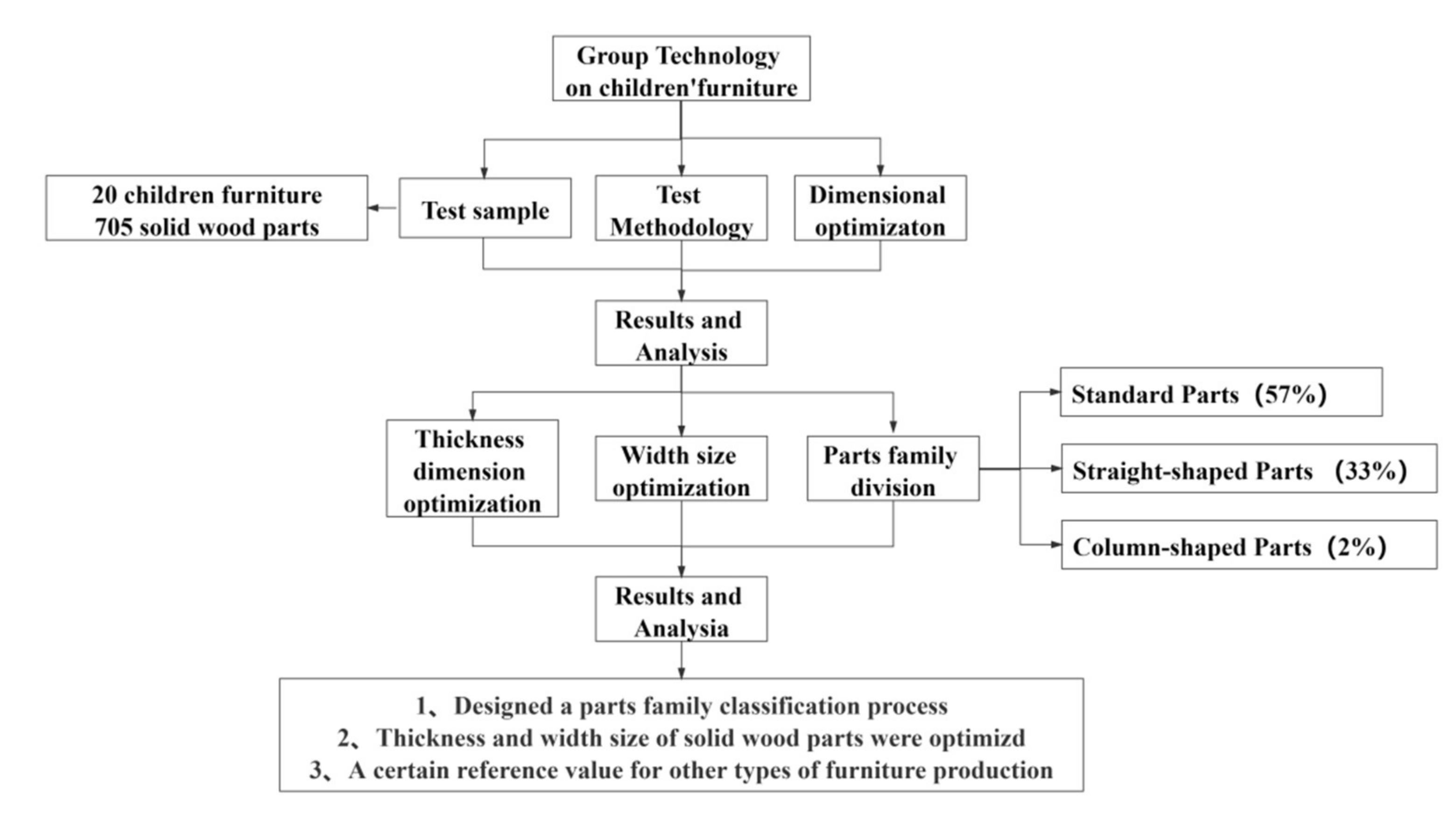
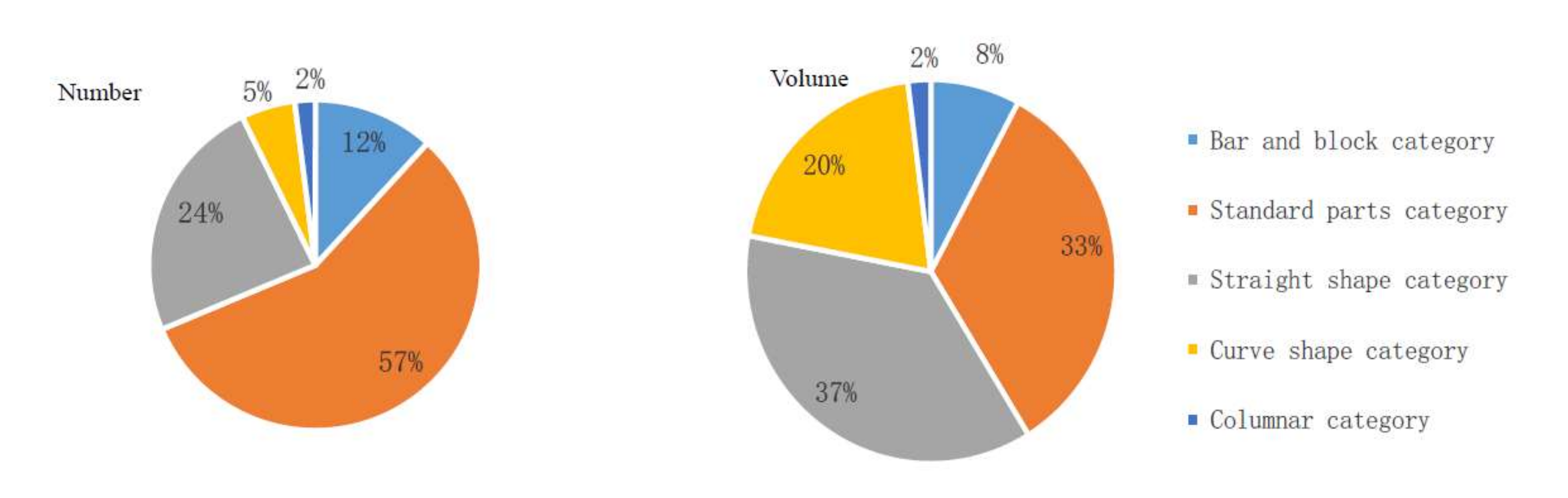
- With regard to the number of parts in parts family, standard parts accounted for the largest proportion (57%), which is followed by linear molding (33%); the two kinds of parts accounted for nearly 90%, and columnar parts accounted for a smaller proportion (2%). It can be observed that this kind of part family division is suitable for the pass-through processing method, which can reduce tool change times, first part confirmation and equipment adjustment time during production.
- (2)
- In terms of the volume of parts family, straight shape category parts had a volume of 0.1742 volume/m3, accounting for 37%, and the standard parts category had a volume of 0.1581 volume/m3, accounting for 33%, and the two kinds of parts accounted for 70%. It is shown that this not only can improve the utilization rate from the perspective of the process of volume consumables but also can explain the reasonableness of this form of parts family division.
3.2. Parts Size Optimization
3.2.1. Thickness Dimension Optimization
3.2.2. Width Size Optimization
4. Conclusions
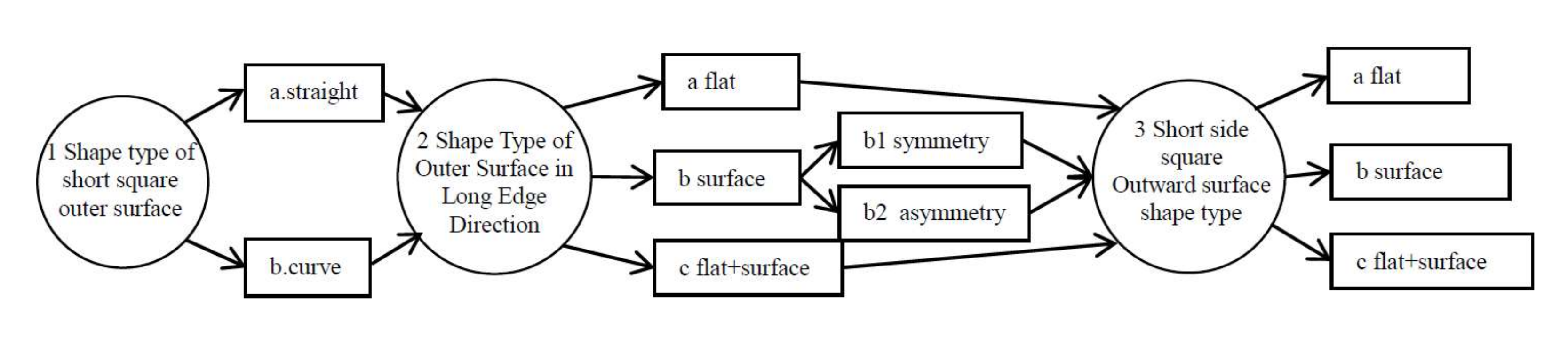
- By using structure and process similarity analysis, a parts family classification process was designed. Moreover, based on the classification process, different types of parts such as strips, standard parts, straight-shaped parts, curved-shaped parts, column-shaped parts and sheet materials (including draw boxes) were summarized, which provided a basis for workshop layout planning and organizing specialized production. Meanwhile, it reduces the waste related to logistic operations of parts in production.
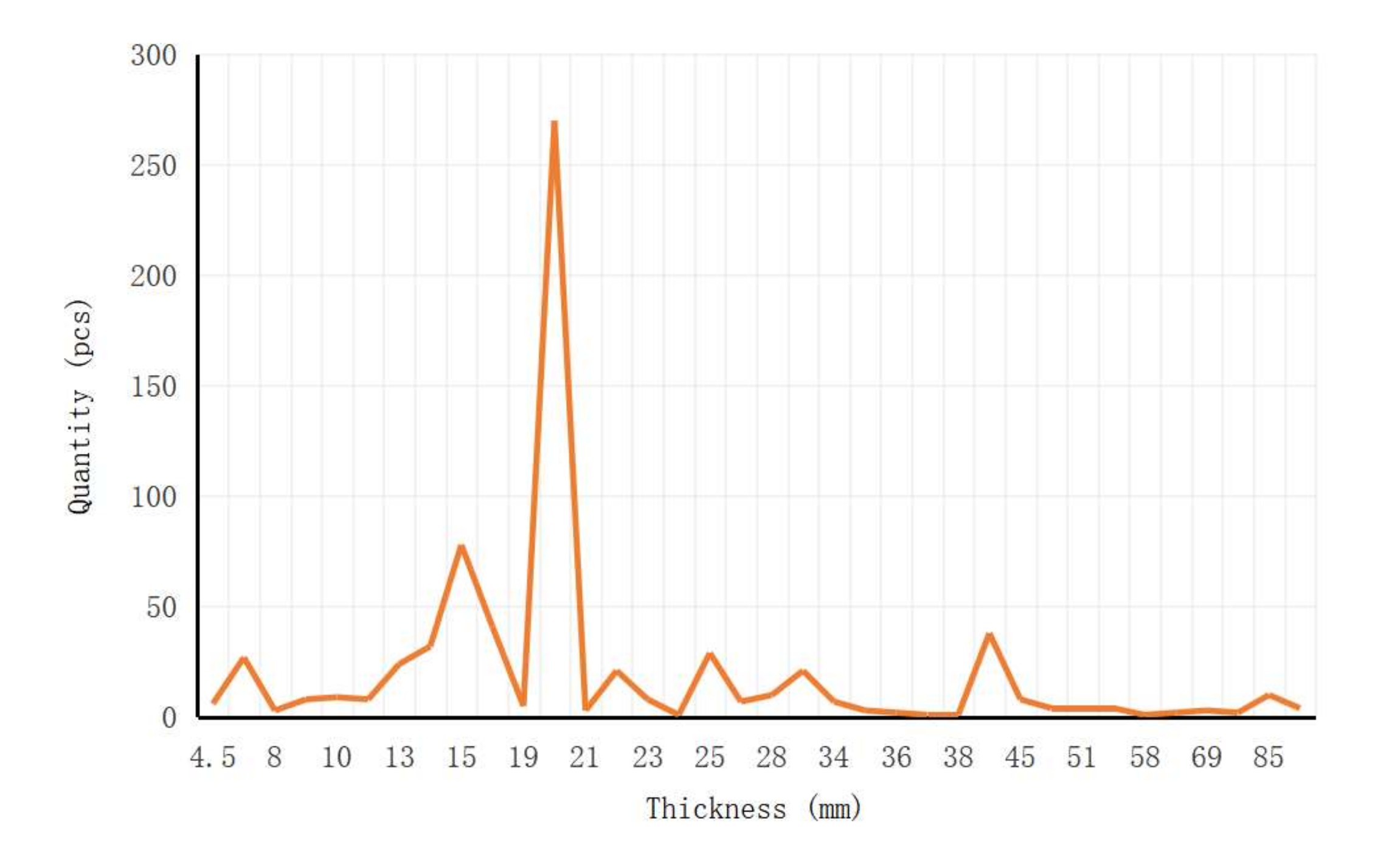
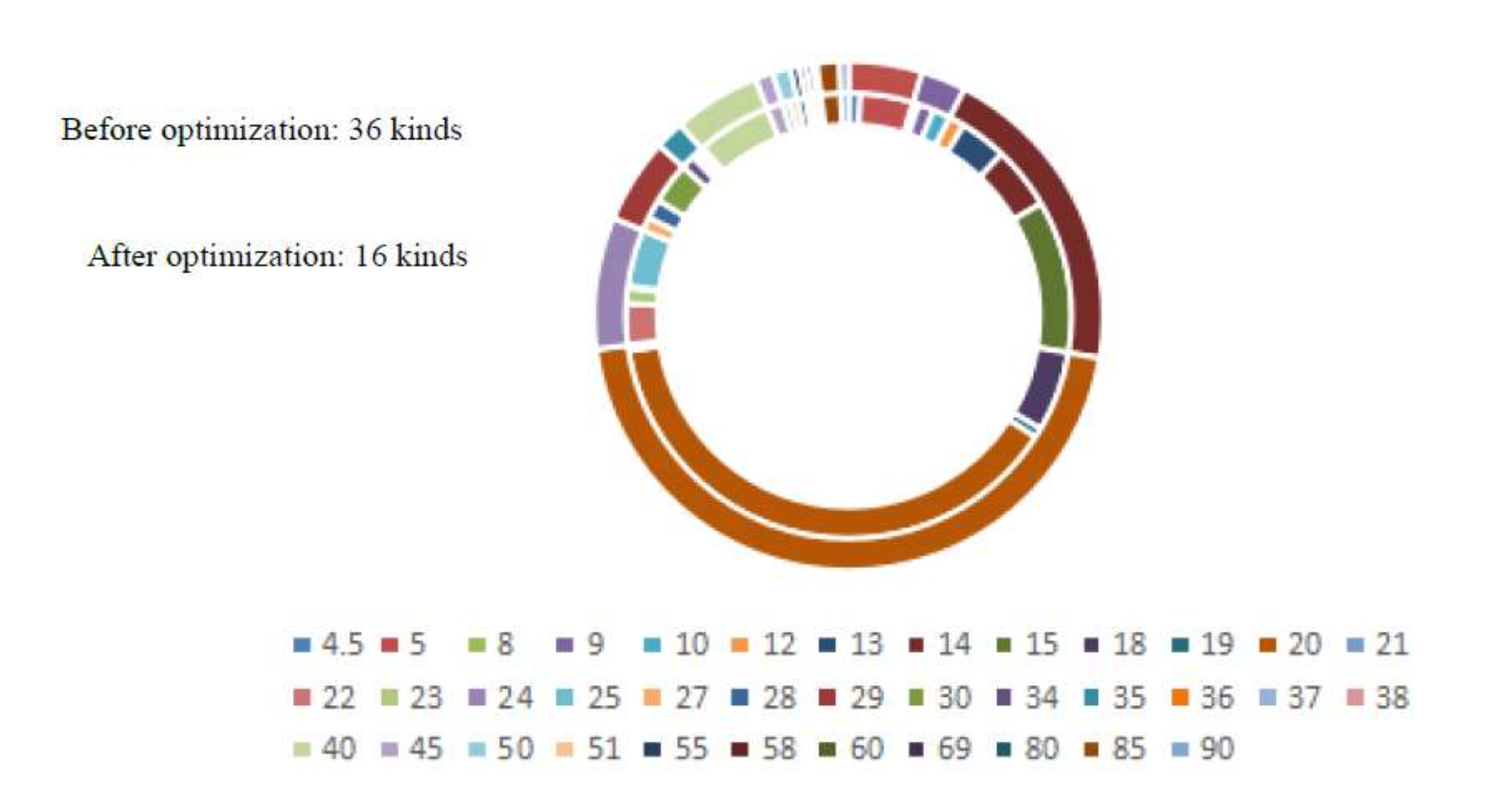
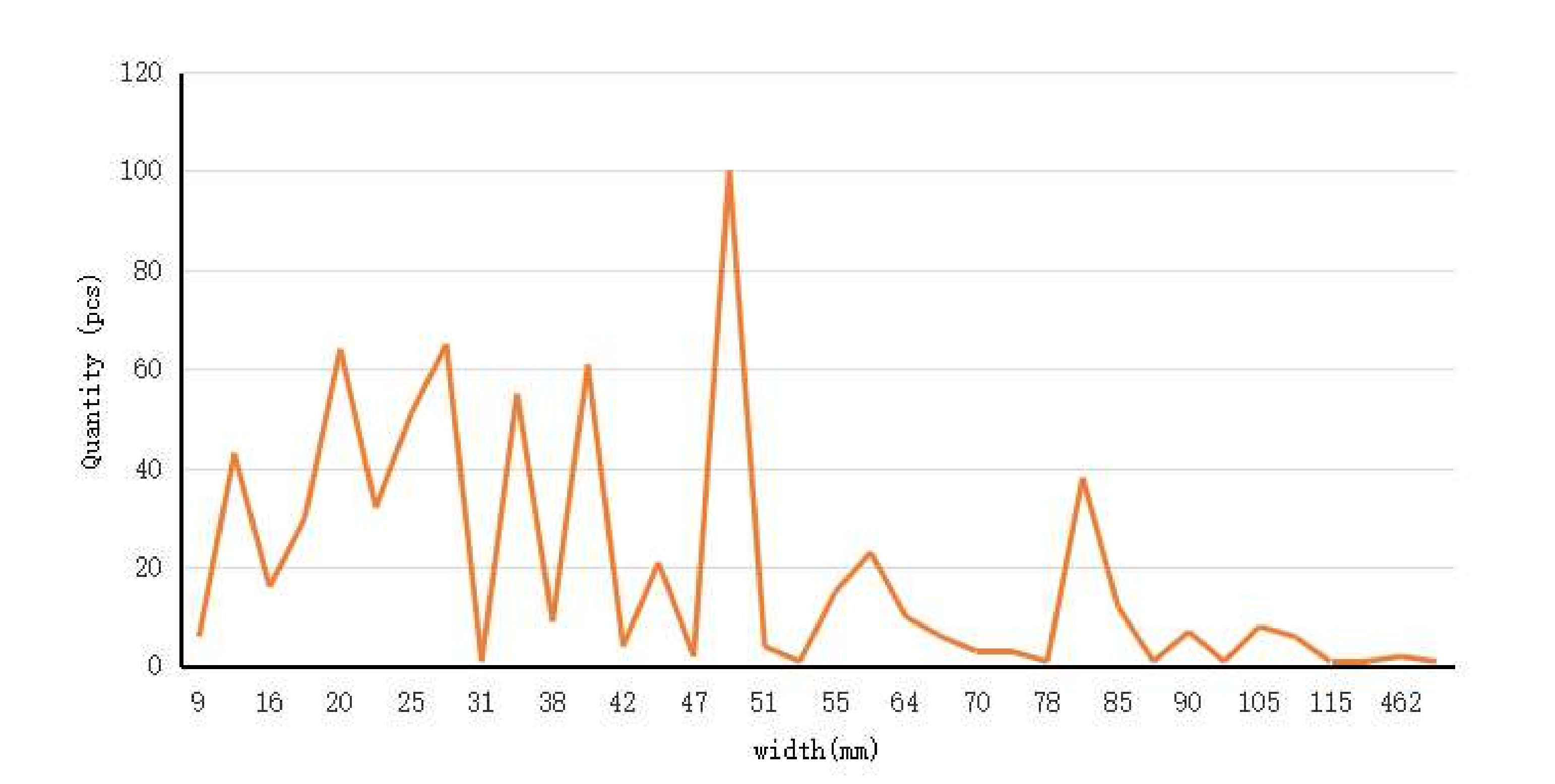
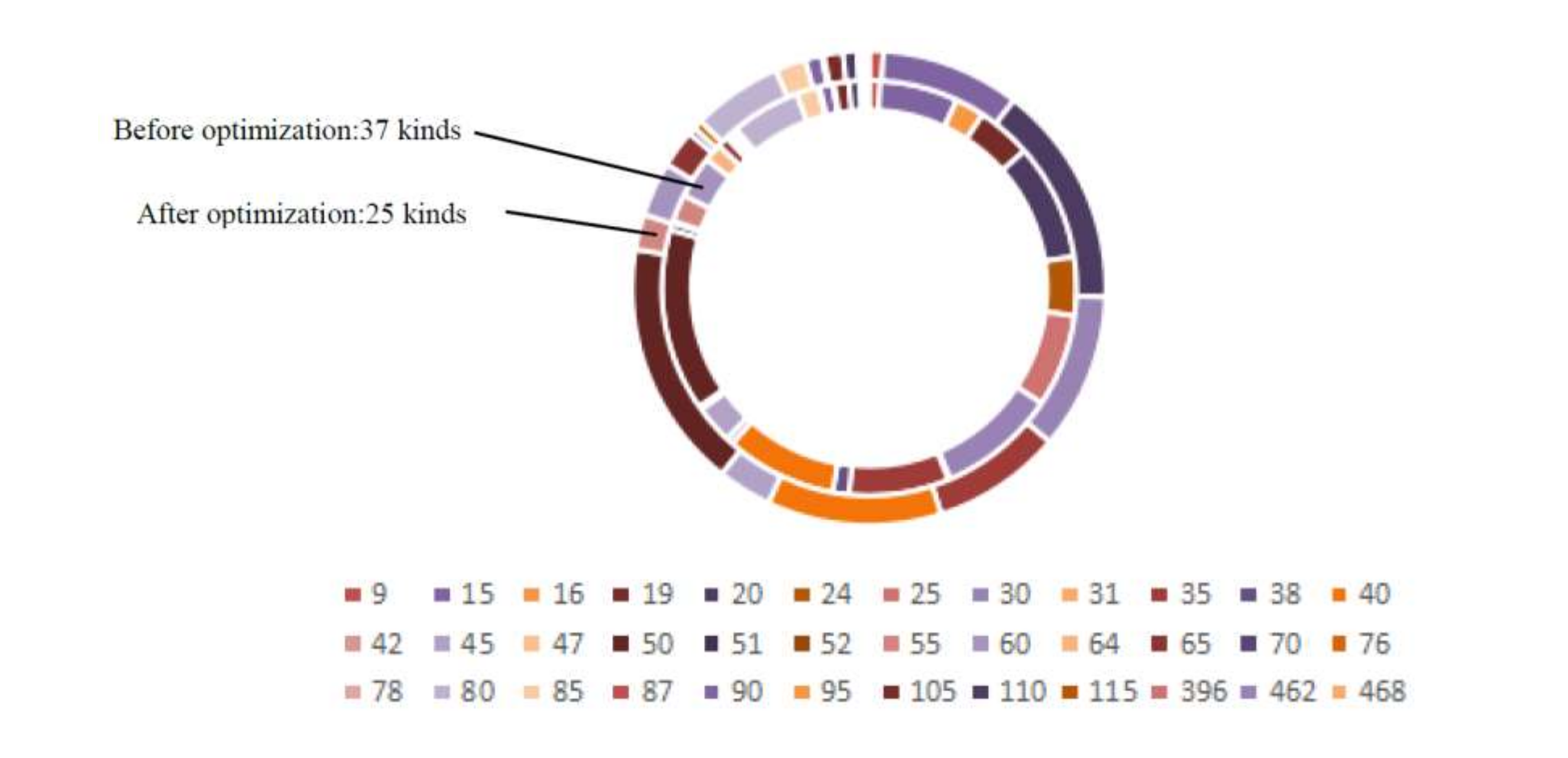
- Based on the principle of group technology, 705 pieces of children’s furniture parts were selected, and the thickness and width sizes of wood parts were optimized. Twenty types of thickness specifications and twelve types of width specifications were reduced, which improved the degree of standardization of parts and helped to reduce the time for cutting tool of the machine, first piece confirmation and processing preparation in production. Moreover, production efficiency improved.
- Standardization of furniture parts is the basis for the implementation of flexible production, lean production, information-based production and other advanced manufacturing technologies. The enhancement of the standardization of furniture parts to a certain extent is equivalent to the realization of batch production of diversified furniture. This application has a certain reference value for other types of furniture production.
Author Contributions
Funding
Institutional Review Board Statement
Informed Consent Statement
Data Availability Statement
Conflicts of Interest
References
- Zhao, H. Present Situation of Forest Products Industry and Development Trend of Wood Industry in China. Heilongjiang Sci. Technol. Inf. 2014, 18, 253. [Google Scholar]
- Sun, Q.; Qi, Y. Analysis on Wood Demand and Consumption in China. For. Sci. Technol. 2015, 40, 60–62. [Google Scholar] [CrossRef]
- Xiong, X.Q.; Yuan, Y.Y.; Fang, L.; Liu, H.; Wu, Z.H. Status and Development Trends of Intelligent Manufacturing in China’s Furnishings Industry. For. Prod. J. 2018, 68, 328–336. [Google Scholar]
- Xiong, X.; Wu, Z. Present situation and development trend of intelligent manufacturing in home furnishing industry. J. For. Eng. 2018, 3, 11–18. [Google Scholar]
- Xu, X.; Cai, J. Group Technology, 2nd ed.; China Machine Press: Beijing, China, 1997; pp. 1–9. ISBN 7-111-05621-3. [Google Scholar]
- Hung, K.T.; Maleki, H. Applying group technology to the forging industry. Prod. Plan. Control 2014, 25, 134–148. [Google Scholar] [CrossRef]
- Li, Y.; Ying-huan, C. Application of Modular Design Methods in Children Furniture Design. Packag. Eng. 2010, 031, 25–28. [Google Scholar]
- Dai, X. Discussion on Design Conception Market of Chinese Children Furniture. China For. Prod. 2002, 29, 3. [Google Scholar]
- Salvador, C.; Vicente, J.; Martins, J.P. Ergonomics in children’s furniture–emotional attachment. In Proceedings of the 5th International Conference AHFE, Kraków, Poland, 19–23 July 2014; pp. 5478–5485. [Google Scholar]
- Du, M.; Shen, L.; Tan, L.; Wang, Y. Research and Analysis of Children’s Dining Chairs Based on Ergonomics. Furnit. Inter. Des. 2021, 1, 16–19. [Google Scholar] [CrossRef]
- Xiao, Y. Research on Children Furniture Design Based on Children’s Psychological and Physiological Characteristics. Master’s Thesis, Central South University of Forestry and Technology, Changsha, China, 2011. [Google Scholar]
- Zeng, G.; Lin, X. Study on the Development and Design of Grown-up Furniture for Children Based on Interest. Furnit. Inter. Des. 2014, 12, 24–25. [Google Scholar]
- Yang, X.; Wen, J. Based on Malleable Children Furniture Design. Design 2018, 13, 68–69. [Google Scholar] [CrossRef]
- Ling, Y. Design of Modular Furniture. Ph.D. Thesis, Northeast Forestry University, Harbin, China, 2007. [Google Scholar]
- Yuan, L. Thw Design Reaearch of Children Furniture Modular. Master’s Thesis, Taiyuan University of Technology, Taiyuan, China, 2013. [Google Scholar]
- Zhang, N.; Guan, H.; Zurlo, F. Research and Innovation of Children Furniture Design. J. Nanjing Arts Inst. Fine Arts Des. 2018, 34, 190–192. [Google Scholar]
- Liu, S. Research on Emotional Design of Children Furniture. Master’s Thesis, Southwest Jiaotong University, Chengdu, China, 2009. [Google Scholar]
- Zhao, H.; Sun, D.; Kong, J.; Li, S. Research on Emotional Design of School-age Children’s Furniture. China For. Prod. 2020, 57, 56–60. [Google Scholar]
- Zhang, L.; Tang, L.; Ren, Y. Research on Interesting Furniture Design of Children’s Ward. Furnit. Inter. Des. 2017, 7, 26–27. [Google Scholar]
- Knight, G.; Noyes, J. Children’s behaviour and the design of school furniture. Ergonomics 1999, 42, 747–760. [Google Scholar] [CrossRef] [PubMed]
- Yanto; Lu, C.W.; Lu, J.M. Evaluation of the Indonesian National Standard for elementary school furniture based on children’s anthropometry. Appl. Ergon. 2017, 62, 168–181. [Google Scholar]
- Ekaterinushkina, A.V.; Zhdanova, N.S.; Mishukovskaya, J.I. Study of Functional Features of Furniture and Equipment in the Design of Recreation of Children’s Polyclinics. IOP Conf. Ser. Mater. Sci. Eng. 2018, 463, 032028. [Google Scholar] [CrossRef] [Green Version]
- Bai, H.; Xiong, X.; Duan, Y. Analysis on The Application of Children’s Growth Needs in Children’s Chair Design. Furniture 2011, 42, 5. [Google Scholar]
- Guo, H.; Miao, Y.; Xiong, X. Research on Chinese Symbol Implanted Design for Children Toys. Furnit. Inter. Des. 2018, 3, 16–19. [Google Scholar]
- Chen, Y.; Peng, X. The Analysis on Children Furniture Industry in China. China For. Prod. Ind. 2015, 42, 10–12. [Google Scholar]
- Wan, M.; Toppinen, A. Effects of perceived product quality and Lifestyles of Health and Sustainability (LOHAS) on consumer price preferences for children’s furniture in China. J. For. Econ. 2016, 22, 52–67. [Google Scholar] [CrossRef]
- Jonsson, O.; Lindberg, S.; Roos, A.; Hugosson, M.; Lindström, M. Consumer perceptions and preferences on solid wood, wood-based panels, and composites: A repertory grid study. Wood Fiber Sci. 2008, 40, 663–678. [Google Scholar]
- Zhang, X.; Wang, X.; Meng, L. Safety Design of Children Furniture. J. Liaoning Inst. Technol. 2008, 10, 78–79. [Google Scholar]
- Sun, Y. Classification and coding of parts based on group technology. Precise Manuf. Autom. 2014, 1, 24. [Google Scholar] [CrossRef]
- Xiong, X.Q.; Guo, W.J.; Fang, L.; Zhang, M.; Wu, Z.H.; Lu, R.; Miyakoshi, T. Current state and development trend of Chinese furniture industry. J. Wood Science. Off. J. Jpn. Wood Res. Soc. 2017, 63, 433–444. [Google Scholar] [CrossRef]
- Sun, Z.; Yin, G. Research on the application of GT (Group Technology) in the modern manufacture. Mech. Res. Appl. 2006, 19, 4–5. [Google Scholar]
- Wan, M.; Chen, J.; Toppinen, A. Consumers’ Environmental Perceptions of Children’s Furniture in China. For. Prod. J. 2015, 65, 395–405. [Google Scholar] [CrossRef]
- Yuan, P. Research on Quality Control Based on Group Technology—Application of SPC in Multivarieties and Small Batch Manufacturing. Master’s Thesis, Nanjing University of Aeronautics and Astronautics, Nanjing, China, 2003. [Google Scholar]
- Wang, J.B.; Wang, J.J. Single machine group scheduling with time dependent processing times and ready times. Inf. Sci. 2014, 275, 226–231. [Google Scholar] [CrossRef]
- Tang, N.; Cai, J.; Li, Y.; Zhang, K. Method of classify identification of group technology base on the diffuse prior distribution. Syst. Eng. Electronics. Syst. Eng. Electron. 2012, 34, 197–202. [Google Scholar]
- Wu, X.; Qiu, X. From GT to Mass-Customization. China Mech. Eng. 2001, 12, 319–321. [Google Scholar]
- Li, G. Application of Group Technology in Furniture Production. Furnit. Inter. Des. 1997, 5, 12–13. [Google Scholar] [CrossRef]
- Fu, Y.; Hai, L. Research on the Feasibility of the Utilization of Group Technology in Panel Type Furniture. Furnit. Inter. Des. 2007, 1, 76–77. [Google Scholar] [CrossRef]
- Li, J. Simplifying Part Size of American Style Furniture to Adopt Group Technology. China For. Prod. Ind. 2004, 2, 40–43. [Google Scholar] [CrossRef]
- Li, X. The Variant Design of Furniture Based Modules with 32 mm System through Group Technology Optimization. Packag. Eng. 2015, 4, 55–59. [Google Scholar] [CrossRef]
- Ye, J.; Jun, L.; Yan, D. Customized cabinet part classifification manufacturing technology based on fuzzy clustering algorithm. J. For. Eng. 2016, 1, 133–138. [Google Scholar]
- Duray, R.; Ward, P.T.; Milligan, G.W.; Berry, W.L. Approaches to mass customization: Configurations and empirical validation. J. Oper. Manag. 2000, 18, 605–625. [Google Scholar] [CrossRef]
- Legleiter, C.J.; Goodchild, M.F. Alternative representations of in-stream habitat: Classification using remote sensing, hydraulic modeling, and fuzzy logic. Int. J. Geogr. Inf. Sci. 2005, 19, 29–50. [Google Scholar] [CrossRef]
- Suzić, N.; Stevanov, B.; Ćosić, I.; Anišić, Z.; Sremčev, N. Customizing products through the application of group technology: A case study of furniture manufacturing. Stroj. Vestn. J. Mech. Eng. 2012, 58, 724–731. [Google Scholar] [CrossRef]
- Tarigan, U.; Tarigan, U.P.P.; Sukirman, V. Integration of Lean Manufacturing and Group Technology Layout to increase productionspeed in the Manufacture of Furniture. IOP Conf. Ser. Mater. Sci. Eng. 2019, 528, 012058. [Google Scholar] [CrossRef]
- Gven, L.; Fuat, M.R. Machine-Part Formation for Cellular Manufacturing in Group Technology: An Application for Furniture Company. Sak. Univ. J. Sci. 2021, 25, 466–483. [Google Scholar] [CrossRef]
- Dianita, O.; Djorgie, T.; Herliansyah, M.K. Improvement of Production Layout in the Furniture Industry in Indonesia with the Concept of Group Technology. Adv. Comput. Methods Knowl. Eng. 2020, 1121, 304–310. [Google Scholar] [CrossRef]
- Han, J.; Wu, Z. Construction and application of manufacturing execution system for panel customized furniture enterprises. J. For. Eng. 2018, 3, 149–155. [Google Scholar]
- Zhu, J.; Wu, Z.; Huang, Q. Constructing technology of enterprise information platform for furniture manufacturing enterprises. J. For. Eng. 2019, 4, 151–157. [Google Scholar]
- Xiong, X.; Ma, Q.; Yuan, Y.; Wu, Z.; Zhang, M. Current situation and key manufacturing considerations of green furniture in China: A review. J. Clean. Prod. 2020, 267, 121957. [Google Scholar] [CrossRef]
- Liu, Y.; Wu, Z.; Xu, W. Review of the Application of Life Cycle Assessment to Furniture Industry. World For. Res. 2019, 32, 56–60. [Google Scholar]
- Yuan, Y.; Liu, W.; Li, G. Research on users’ cognition of different preferences based on ERPs. J. For. Eng. 2019, 004, 152–158. [Google Scholar]





| Processing Method | Paraphrase |
|---|---|
| Sawing | A tool that has a long blade with sharp points along one of its edges. A saw is moved backwards and forwards by hand or driven by electricity and is used for cutting wood or metal. |
| Planing | A tool used for making wooden surfaces smooth, which has a flat bottom with a sharp blade in it. |
| Milling | A special equipment used for cutting wood with a round rotating multi-edge cutter. |
| Sanding | A tool to make wood very smooth by sanding it with sandpaper. |
| Serial Number | Parts Family | Parts Types | Quantity/Piece | Quantity Ratio | Material Volume/m3 | Volume Ratio |
|---|---|---|---|---|---|---|
| 1 | Bar and block category | Bed stall, bed cross stall, sticker strip, vertical strip, chair support strip and table thickening strip | 83 | 12% | 0.0369 | 8% |
| 2 | Standard parts category | Brackets, support feet, edge sealing strips, joint boards, triangular wood, reinforcement strips, infill cores, mattress strips, decorative lines, sheathing cores, track strips, lamellas and reinforcement feet | 401 | 57% | 0.1581 | 33% |
| 3 | Straight shape category | Bed foot, bed foot square, foot square, column, transverse gear, chair foot and foot square | 170 | 24% | 0.1742 | 37% |
| 4 | Curve shape category | Bed top line, bed cover, bed panel, chair brain, back feet, cushion plate, chair cross-file, chair stand and cabinet feet | 37 | 5% | 0.0947 | 20% |
| 5 | Columnar category | Bed-post, bed carriage foot, table carriage foot and cabinet carriage foot | 14 | 2% | 0.0094 | 2% |
| 6 | Wood-based panels | Bed stiffener substrate, bed belly board, bed belly board curved board, bed belly board sticker strip, bed transverse, bed transverse panel, table and cabinet panel combination, side panel, bottom panel, back panel, bottom panel, back panel, side panel (side, middle and side), lower pad panel and draw panelDrawer: draw box combination and keyboard draw combination (draw front, drawback, draw side and draw bottom) | 379 | - | - | - |
| Total | 1084 | |||||
| Thickness grading | 1 | 2 | 3 | 4 | 5 | 6 | 7 | 8 | 9 | 10 | 11 | 12 | Total number of parts /piece | Thickness specification/species | Ratio of total number of parts to thickness specification |
| Size/mm | 4.5 | 5 | 8 | 9 | 10 | 12 | 13 | 14 | 15 | 18 | 19 | 20 | |||
| Quantity/Piece | 6 | 27 | 3 | 8 | 9 | 8 | 24 | 32 | 78 | 41 | 5 | 270 | |||
| Thickness grading | 13 | 14 | 15 | 16 | 17 | 18 | 19 | 20 | 21 | 22 | 23 | 24 | |||
| Size/mm | 21 | 22 | 23 | 24 | 25 | 27 | 28 | 30 | 34 | 35 | 36 | 37 | 705 | 36 | 20 |
| Quantity/Piece | 3 | 21 | 8 | 1 | 29 | 7 | 10 | 21 | 7 | 3 | 2 | 1 | |||
| Thickness grading | 25 | 26 | 27 | 28 | 29 | 30 | 31 | 32 | 33 | 34 | 35 | 36 | |||
| Size/mm | 38 | 40 | 45 | 50 | 51 | 55 | 58 | 60 | 69 | 80 | 85 | 90 | |||
| Quantity/Piece | 1 | 38 | 8 | 4 | 4 | 4 | 1 | 2 | 3 | 2 | 10 | 4 |
| Thickness grading | 1~2 | 3~5 | 6~9 | 10~13 | 14~17 | 18~20 | 21~24 | 25~26 | Total number of parts/piece | Thickness specification/species | Ratio of total number of parts to thickness specification |
| Size/mm | 5 | 9 | 14 | 20 | 24 | 29 | 35 | 40 | |||
| Quantity/Piece | 33 | 20 | 142 | 319 | 59 | 38 | 13 | 39 | |||
| Thickness grading | 27 | 28~29 | 30 | 31~32 | 33 | 34 | 35 | 36 | |||
| Size/mm | 45 | 50 | 55 | 60 | 69 | 80 | 85 | 90 | 705 | 16 | 44 |
| Quantity/Piece | 8 | 8 | 4 | 3 | 3 | 2 | 10 | 4 |
| Width grading | 1 | 2 | 3 | 4 | 5 | 6 | 7 | 8 | 9 | 10 | 11 | 12 | 13 | Total number of parts/piece | Width specification/species | Ratio of total number of parts to width specification |
| Size/mm | 9 | 15 | 16 | 19 | 20 | 24 | 25 | 30 | 31 | 35 | 38 | 40 | 42 | |||
| Quantity/Piece | 6 | 43 | 16 | 30 | 64 | 32 | 51 | 65 | 1 | 55 | 9 | 61 | 4 | |||
| Width grading | 14 | 15 | 16 | 17 | 18 | 19 | 20 | 21 | 22 | 23 | 24 | 25 | 26 | |||
| Size/mm | 45 | 47 | 50 | 51 | 52 | 55 | 60 | 64 | 65 | 70 | 76 | 78 | 80 | 705 | 37 | 19 |
| Quantity/Piece | 21 | 2 | 100 | 4 | 1 | 15 | 23 | 10 | 6 | 3 | 3 | 1 | 38 | |||
| Width grading | 27 | 28 | 29 | 30 | 31 | 32 | 33 | 34 | 35 | 36 | 37 | |||||
| Size/mm | 85 | 87 | 90 | 95 | 105 | 110 | 115 | 396 | 462 | 468 | 845 | |||||
| Quantity/Piece | 12 | 1 | 7 | 1 | 8 | 6 | 1 | 1 | 2 | 1 | 1 |
| Width grading | 1 | 2~3 | 4~5 | 6~7 | 8~9 | 10 | 11~13 | 14~15 | 16~18 | 19 | 20 | 21~22 | 23 | Total number of parts/piece | Width specification/species | Ratio of total number of parts to width specification |
| Size/mm | 9 | 15 | 20 | 25 | 30 | 35 | 40 | 45 | 50 | 55 | 60 | 65 | 70 | |||
| Quantity /Piece | 6 | 59 | 94 | 83 | 66 | 55 | 74 | 23 | 105 | 15 | 23 | 16 | 3 | |||
| Width grading | 24~25 | 26 | 27~28 | 29 | 30 | 31 | 32 | 33 | 34 | 35 | 36 | 37 | ||||
| Size/mm | 76 | 80 | 85 | 90 | 95 | 105 | 110 | 115 | 396 | 462 | 468 | 845 | 705 | 25 | 28 | |
| Quantity/Piece | 4 | 38 | 13 | 7 | 1 | 8 | 6 | 1 | 1 | 2 | 1 | 1 |
Publisher’s Note: MDPI stays neutral with regard to jurisdictional claims in published maps and institutional affiliations. |
© 2021 by the authors. Licensee MDPI, Basel, Switzerland. This article is an open access article distributed under the terms and conditions of the Creative Commons Attribution (CC BY) license (https://creativecommons.org/licenses/by/4.0/).
Share and Cite
Xiong, X.; Lu, G.; Lu, D. Research on Children’s Customized Furniture Design Based on Group Technology. Appl. Sci. 2021, 11, 11371. https://doi.org/10.3390/app112311371
Xiong X, Lu G, Lu D. Research on Children’s Customized Furniture Design Based on Group Technology. Applied Sciences. 2021; 11(23):11371. https://doi.org/10.3390/app112311371
Chicago/Turabian StyleXiong, Xianqing, Guozhen Lu, and Danting Lu. 2021. "Research on Children’s Customized Furniture Design Based on Group Technology" Applied Sciences 11, no. 23: 11371. https://doi.org/10.3390/app112311371
APA StyleXiong, X., Lu, G., & Lu, D. (2021). Research on Children’s Customized Furniture Design Based on Group Technology. Applied Sciences, 11(23), 11371. https://doi.org/10.3390/app112311371