Abstract
To address the control of uncertain multi-agent systems (MAS) with completely unknown system nonlinearities and unknown control coefficients, a global consensus method is proposed by constructing novel filters and barrier function-based distributed controllers. The main contributions are as follows. Firstly, a novel two-order filter is designed for each agent to produce informational estimates from the leader, such that a connectivity matrix is not used in the controller’s design, solving the difficultly caused by the time-varying control coefficients in a MAS with a directed graph. Secondly, combined with the novel filters, barrier functions are used to construct the distributed controller to deal with the completely unknown system nonlinearities, resulting in the global consensus of the MAS. Finally, it is rigorously proved that the consensus of the MAS is achieved while guaranteeing the prescribed tracking-error performance. Two examples are given to verify the effectiveness of the proposed method, in which the simulation results demonstrate the claims.
1. Introduction
The control of uncertain nonlinear systems has been researched for several decades, such that so many remarkable results have been obtained on this topic [1,2,3,4,5,6,7,8,9]. However, most of them are for SISO or MIMO systems, and their methods or techniques cannot be directly applying to multi-agent systems, as the information of each agent or subsystems is only available for part of others. According to the topology of information transformation graph, the graph can be divided into undirected and directed graphs. Generally, the consensus control of a MAS with the directed graph is more difficult than the undirected case, since the methods for the directed case are always applicable for the undirected case, but not vice versa.
Recently, some significant progress has been made in the control of a MAS [10,11,12]. For a linear MAS with undirect graphs, fully distributed adaptive consensus controller is present in [10]. Adaptive asymptotically consensus for an uncertain MAS is achieved in [11], and adaptive asymptotically consensus is achieved in [12] for an uncertain MAS, and so on. However, their methods are only applicable for a MAS with an undirected graph and are in vain for a MAS with a directed graph. For a MAS with a directed graph and constant control coefficients, adaptive consensus for a MAS with system nonlinearities satisfying match conditions is researched in [13] to solve the problem of actuator faults; a fully distributed adaptive consensus control is studied for a MAS with unknown control directions in [14] by using a Nussbaum gain technique; actuator faults in a MAS are considered in [15] with integral chain dynamics; and prescribed performance consensus control for uncertain MAS is investigated in [16]. Though much progress has been made [17,18,19,20], it should be noted that there are still some nonnegligible problems to be solved. Firstly, the existing methods require the control coefficients to be constants, or even known, for a MAS with a directed graph. The main difficulty is that the Laplace matrix for a directed graph is asymmetric and thus the selections of control parameters must always resort to adaptive methods, which falls into trouble when the control coefficients are time-varying and unknown. Secondly, to the best of our knowledge, there is no global consensus control method for a MAS with a directed graph and the systems functions thereof completely unknown, except for [21], wherein the unknown system nonlinearities required to satisfy the Lipschitz conditions and control coefficients are one. Universal approximators such as neural networks (NN) or fuzzy logic systems (FLS) have been attempted to solve the consensus control problem of a MAS with completely unknown system nonlinearities [22,23,24], however, it is well known that these methods are semi-global in the sense that their stabilities depend on the initial conditions of systems and the careful selection of controller parameters. Therefore, NN or FLS-based approaches cannot guarantee the global consensus of the MAS, though they are very favorable to solve the problem of MAS with unknown nonlinearities.
As for the global control of systems with completely unknown nonlinearities, a pioneering work is [25], wherein a low-complexity controller is presented that cannot only achieve global convergence of all the system signals, but which can also guarantee the prescribed performance of tracking error and state errors. In view of the low complexity and strong robustness of this method, much research has been carried on this method for solving different nonlinear control problems [26,27,28,29,30]. By introducing a novel barrier function, a fault-tolerant controller is designed for a class of unknown nonlinear systems in [26]. With consideration to the constraints of system states, a barrier function-based adaptive control method is proposed in [27]. Addressing systems with unknown control direction and system dynamics, a Nussbaum function-based low-complexity control scheme is designed in [28]. As regards asymptotic tracking control for systems with unknown nonlinearities, an universal global low-complexity controller is proposed in [31]. Nevertheless, it is worth mentioning that the global control of a MAS with unknown nonlinearities is still an unsolved problem, since these methods are based on the condition that the desired output for systems are known, but this knowledge cannot be obtained for some agents of a MAS. Moreover, considering the control coefficients of each agent are time-varying functions, these traditional methods will fall into trouble when solving for the consensus control of a MAS with unknown dynamics.
Motived by the above discussion, we investigate the fully distributed control of a MAS with a directed graph, time-varying control coefficients and completely unknown system nonlinearities. The main contributions of this paper are summarized as follows.
- (1)
- To address the time-varying control coefficients of a MAS, a two-order filter is firstly designed for each agent to produce estimates of the signals from the leader, so that an asymmetric Laplace matrix for a directed graph will not be used to design the controller for each agent of the MAS, by which the difficulty of control design is solved.
- (2)
- To address the completely unknown system nonlinearities in MAS, barrier functions are used to propose a fully distributed controller by combining novel filters; barrier functions are well-suited to dealing with the effects of unknown system nonlinearities, such that global results are achieved, for the first time, in a MAS with completely unknown system nonlinearities in this paper.
- (3)
- To guarantee the prescribed tracking performance by the proposed controller, such that the consensus of the controlled MAS is rigorously proved and all the closed signals are globally bounded.
2. Problem Statement and Preliminaries
Consider a class of uncertain MAS as follows
where , , , are the states, the control input and the output of the th subsystem, respectively. The system nonlinearities are unknown continuous functions with respect to . represent the system uncertainties and external disturbances.
The desired trajectory for the outputs of the subsystems is bounded and only known by part of the subsystems, with being bounded and unknown to all subsystems.
Suppose that the information transmission condition among the group of subsystems can be represented by a directed graph , where denotes the set of indexes corresponding to each subsystem. The edge indicates that subsystem could obtain information from subsystem , but not necessarily vice versa. In this case, subsystem is called a neighbor of subsystem , and vice versa. Denoting the set of neighbors for subsystem as . Self-edging is not allowed, thus and . The connectivity matrix of is defined as if and if . An in-degree matrix is introduced, such that with being the th row sum of . Then, the Laplacian matrix of is defined as . Defining , where means the is accessible directly by subsystem , and otherwise, we have . Throughout this paper, the following notations are used. is the Euclidean norm of a vector. Letting and be two vectors, then define the vector operator as . Letting be a matrix, then denotes the minimum eigenvalue of .
Assumption 1.
The directed graphcontains a spanning tree, and the desired trajectoryis accessible to at least one subsystem, i.e.,.
Assumption 2.
There exist unknown local Lipschitz functions such that, for
Assumption 3.
The unknown control coefficients is strictly positive or negative. Without a loss of generality, it is assumed to be strictly positive, namely, for
Lemma 1.
(Ref. [17]) Based on Assumption 1, the matrixis nonsingular. Defining
then for and is definitely positive.
Remark 1.
In contrast to the methods in [13,14,15,16] for a MAS with a directed graph, the control coefficients, , are time-varying and unknown continuous functions in this paper, which makes the control design much more difficult, since the matrixin (4) is always unknown and required to be estimated adaptively while the unknown control coefficientsmakeinestimable. To cope with this problem, a novel two-order filter will be given for each agent (shown later).
Remark 2.
The system nonlinearities, and, are completely unknown functions so that there is little knowledge with which to construct the controller. To deal with this problem, neural networks and fuzzy logic systems have been used to approximate the unknown functions caused by the system nonlinearitiesand in [22,23,24], however, only semi-global results can be obtained by use of these approximators. To construct a distributed controller for a MAS with these unknown system nonlinearities with global consensus is a challenging problem, which is solved by the skillfull cooperation of novel two-order filters and barrier functions in the following.
3. Design of Distributed Controller and Filters
In this section, a distributed asymptotic tracking controller for a multi-agent system (1) will be designed. To facilitate the control design in distributed manner, design a filter for each agent , with .
3.1. Filters Design
Denote
Then, design the filters as
with
where , and , and are design parameters chosen as and . We then have the following lemma.
Lemma 2.
Consider a closed-loop system consisting of filters (6) satisfying Assumption 1 with local controller (7). The asymptotic consensus tracking of all the filter’s outputs tois achieved, i.e.,. Moreover,and are bounded.
Proof (of Lemma 2).
Consider the following Lyapunov function
Using (9) and (10), the time derivative of is
By noting
we have
where , . It is easily verified that and , therefore, it follows from (17) that and hence . From the boundedness of and , the boundedness of and are easily obtained. This completes the proof.
Remark 3.
As is seen, a two-order filter is designed to produce a signal for each agent. Actually,is the estimate of , as seen in Lemma 2, and the agents no longer require estimating the matrix. Cooperating these two-order filters makes the use of traditional adaptive control techniques for MAS be easy, and thus the unknown time-varying control coefficients for a MAS with a directed graph can be dealt with.
3.2. Design of the Distributed Controller
In this section, cooperating with the filter (6), the distributed adaptive controller is designed. The following error variables and change of coordinates are introduced
with
where , and , and can be any positive constant. Let in this paper.
Then, the intermediate control signals and the distributed controller are determined as follows
where are the positive design parameters. It is easy to verify that for all and for . are the constrained functions chosen by the designer and used as prescriptive performance functions, satisfying with , and being positive constants.
Remark 4.
Function is constructed to attenuate the influence of the initial conditions, since it makesand therefore stable results can be achieved under all initial conditions using for transformation (20). It should also be noted that of (20) is continuously differentiable and does not exist in the further design of the controller, which means that the designed intermediate control signals and actual controller are smooth.
4. Stability Analysis
In this section, we will give the main results with the designed fully distributed controller and present the stability analysis. The main results of this article are as follows.
Theorem 1.
Consider the closed-loop system consisting of uncertain agents as (1) satisfying Assumptions 1–3, the intermediate control signals (21) and the distributed controller (22). Then, we have the following properties:
- (1)
- All the signals in the closed-loop system are globally bounded
- (2)
- Prespecified tracking performance can be guaranteed, namely,, for.
- (3)
- The output of each agent ultimately satisfies.
Proof (of Theorem 1).
From (18), (19) and (21), we have
It can be observed from (23) that is continuous function of , and , where and are bounded time-varying functions. Thus, can be rewritten as the form of continuous function of and . Similar analysis can be made for . Therefore, we obtain
where , and are some continuous functions. Defining and in view of (25) and (26), we obtain
Let us define the open set:
It is easily observed that . Additionally, are continuous with respect to all its variables, owing to the fact that are all continuous differentiable functions. Therefore, it follows from [32] that the conditions on ensure the existence and uniqueness of a maximal solution on the time interval , namely, for , which implies
for and .
In the following, we will prove that by seeking a contradiction. Suppose that ; then the related analysis is performed as follows, and all of what follows is based on .
Step 1: Consider the following positive definite functions
Let . It follows from (21), (24), (25) and (30) that the time derivative of is
where and . Note that , and are bounded on because (23) and (29), respectively. Utilizing the fact that are bounded and employing the extreme value theorem, owing to the continuity of , and , we arrive at
where , , and are some unknown positive constants.
Then, substituting (32) and (33) into (31) yields
From (34), it follows that is negative when and subsequently that
which implies
As a result, the control signal is bounded. Moreover, invoking (24), we also can conclude the boundedness of . Therefore, the time derivative of is
where
Noting (36) and using the same analysis as (33), it also easy to conclude the boundedness of , and hence .
Step : Consider the following positive definite functions
Let . In a similar fashion to that in the former step, by noting Assumption 1, it follows from (21), (24), (26) and (39) that the time derivative of is
where and . Noting that are bounded on because the boundedness of , and are bounded on in view of (29). Utilizing the fact that are bounded and employing the extreme value theorem owing to the continuity of , and , we arrive at
with , and being some unknown positive constants.
Then, substituting (41) and (42) into (40) yields
From (43), it follows that is negative when and subsequently that
which implies
As a result, the control signal is bounded. Moreover, we also can conclude the boundedness of by noting (24). Finally, the time derivative of is
where
Noting (45) and using the same analysis as (42), it also easy to conclude the boundedness of and hence .
Step : Consider the following Lyapunov functions
Let . Similar as the former steps, we can have
where and are some unknown positive constants. It follows from (49) that is negative when and subsequently that
which implies
As a result, the control signal is bounded. Moreover, we also can conclude the boundedness of . Notice that (36), (45) and (51) imply that , where the set is nonempty and compact, defined as
Owing to (36), (45) and (51) it is straightforward to verify that . Therefore, assuming dictates the existence of a time instant , such that , which is a clear contradiction. Therefore, . Hence, all closed-loop signals remain bounded and moreover . Furthermore, from (36) we conclude that
Then, for all . In view of Lemma 2 and (52), we have
This completes the proof.
5. Simulation Study
Two examples will be given to demonstrate the effectiveness of the proposed distributed adaptive controller in this section, as follows.
Example 1.
Consider the following multi-agent systems
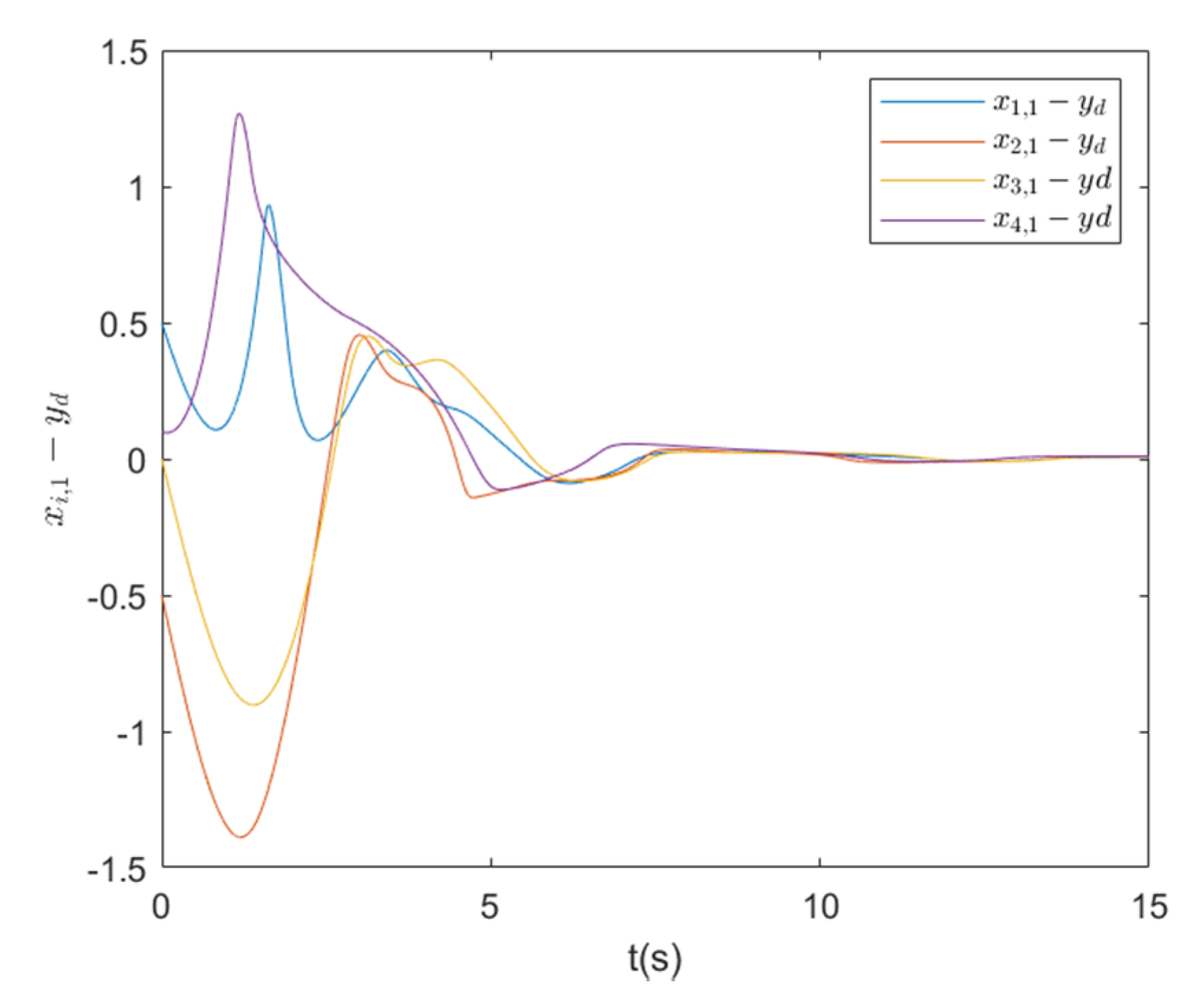
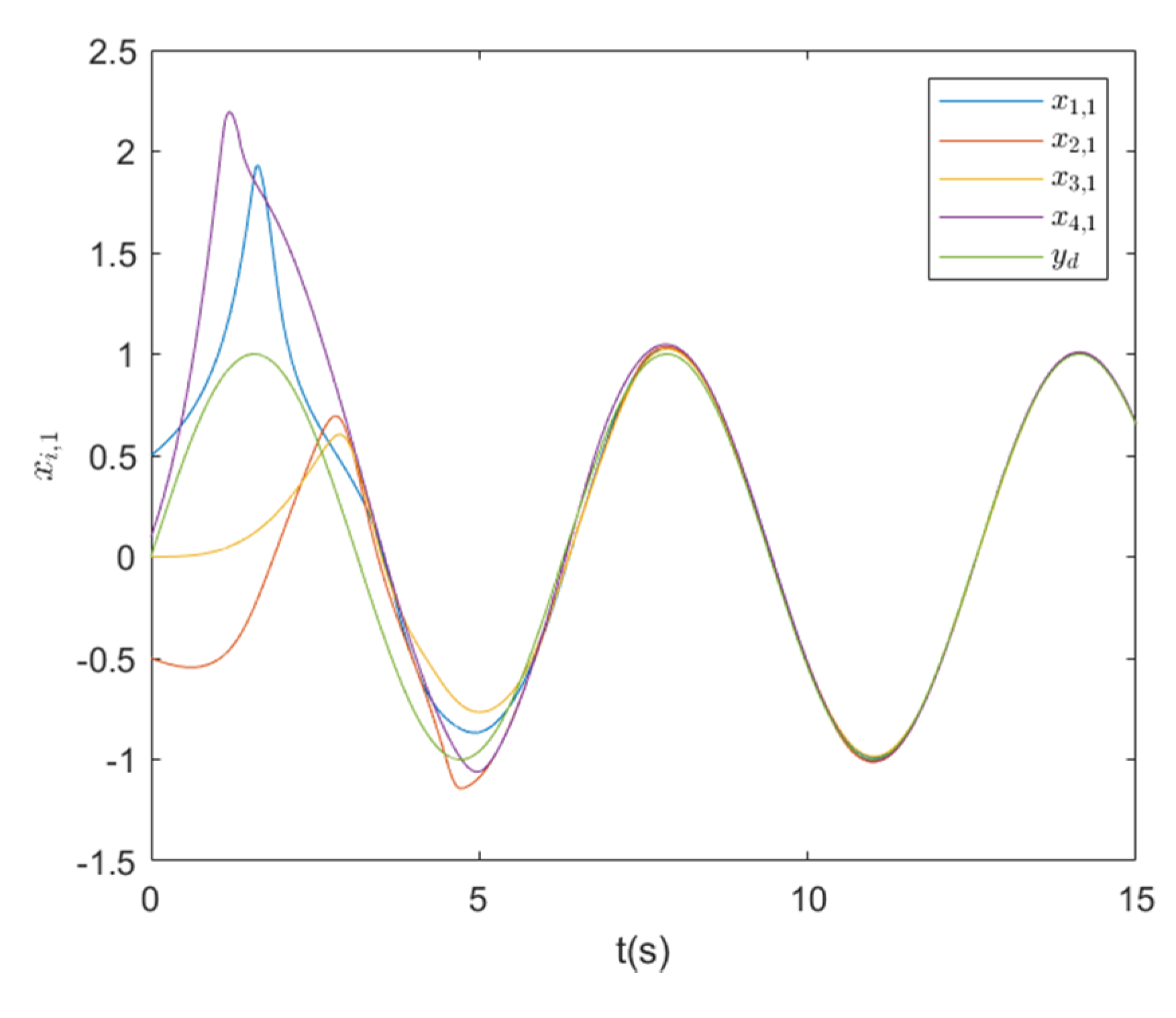
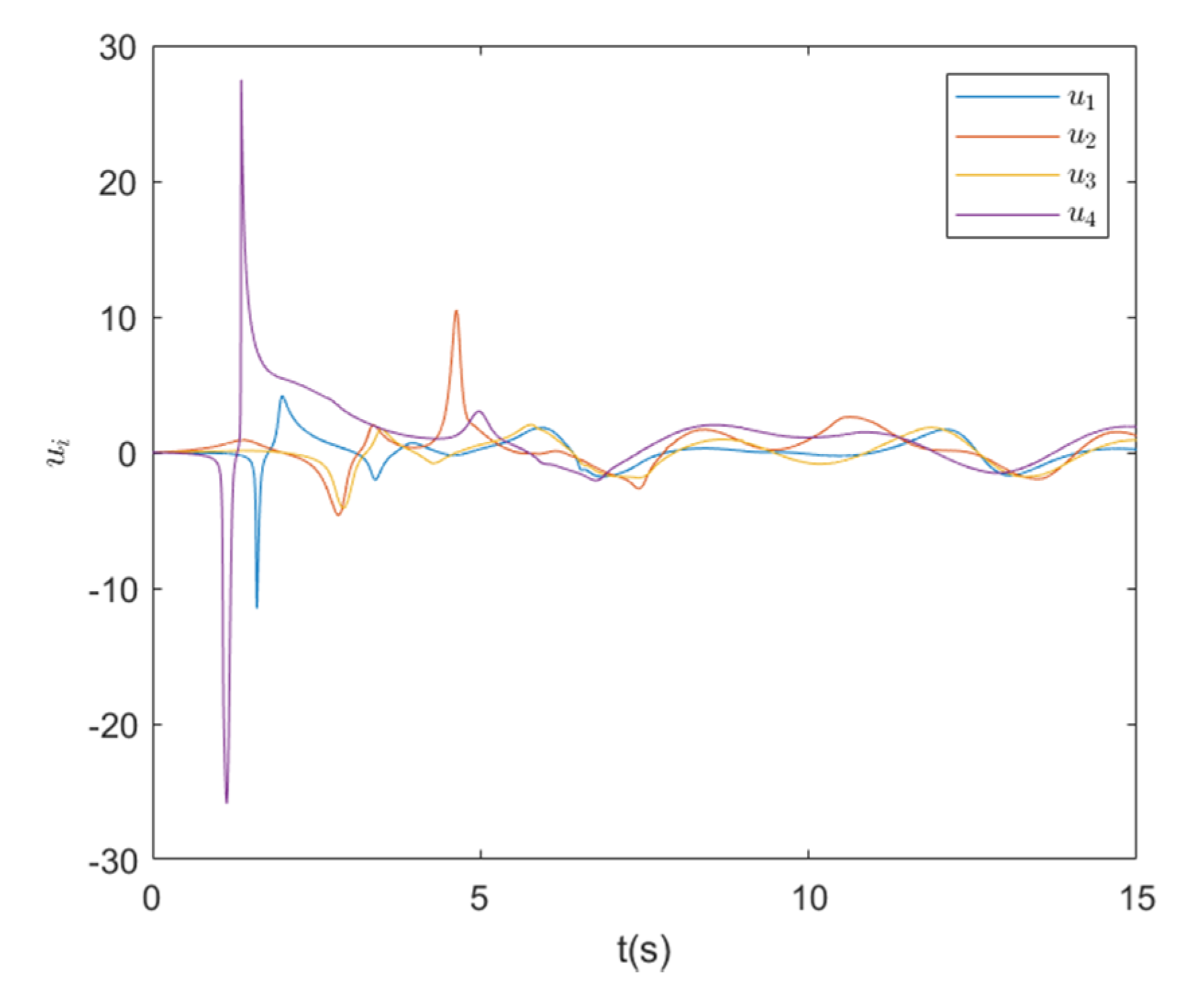
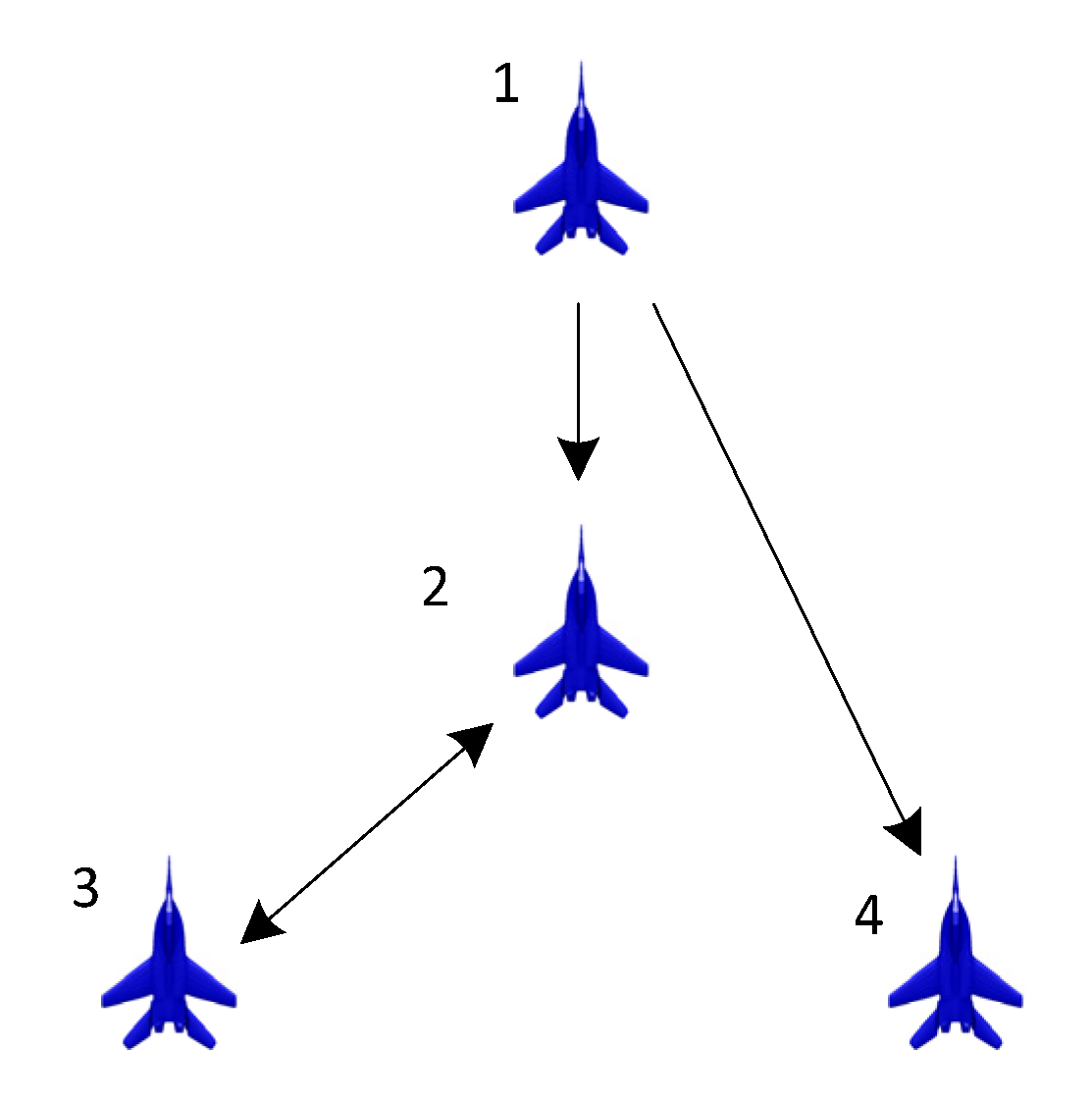
with the system functions chosen as follows: ,, , , , , , , , ,,, , , , . The communication topology for these subsystems are depicted inFigure 1.
Figure 1.
Communication topology for four subsystems.
The desired trajectory for the outputs of each subsystem is . The initial conditions for each subsystems are set as: , , , and . Then, the intermediate control signals are designed and the distributed controllers are designed as follows
where their control parameters and functions are selected as: , , , , , , and , for . For the filters, the parameters are chosen as: and . Then, the simulation results are reported as Figure 2, Figure 3 and Figure 4.
Figure 2.
Tracking errors for .
Figure 3.
Outputs for and .
Figure 4.
Distributed control inputs for .
It can be observed from Figure 2, Figure 3 and Figure 4 that under the designed distributed controllers, the outputs of the subsystems track the desired trajectory very quick, and the tracking performance is satisfactory.
Example 2.
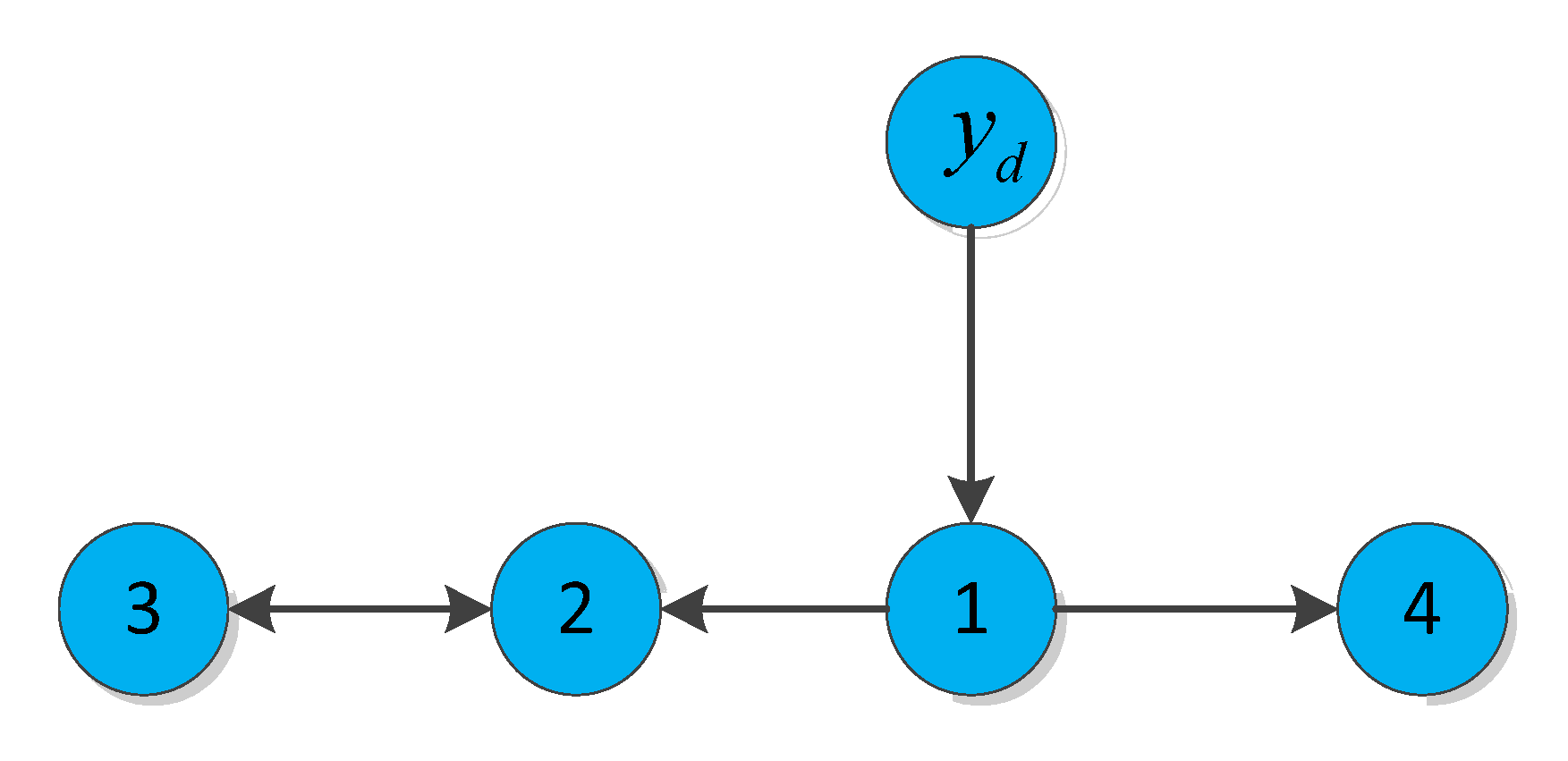
Consider the consensus for four high-maneuver fighters, with communication topologies as in Figure 5 and their flight control systems as follows [33].
with
where are the roll angle, attack angle, sideslip angle, roll angular velocity, pitching angular velocity, yaw angular velocity and pitch angle of fighter, respectively. . are the left and right elevators, left and right ailerons, front and rear flaps, and rudder, respectively. Detailed explanations for the parameters and variables of this model can be found in [26]. Suppose that they are all flying at an altitude of 40,000 feet, at a speed of 0.6 Mach. The desired output for these fighters is. The signal is only available for fighter 1.
Figure 5.
Communication topology for four fighters.
According to Theorem 1, we design the distributed flight controller as follows
with
where , and are the signals produced by filter (6) with being the filter inputs, respectively. and for , and represents the pseudo-inverse for .
For the purposes of comparison, we use the control method of [17] under the same conditions. Following [17], the controller for the distributed flight controller is designed as follows
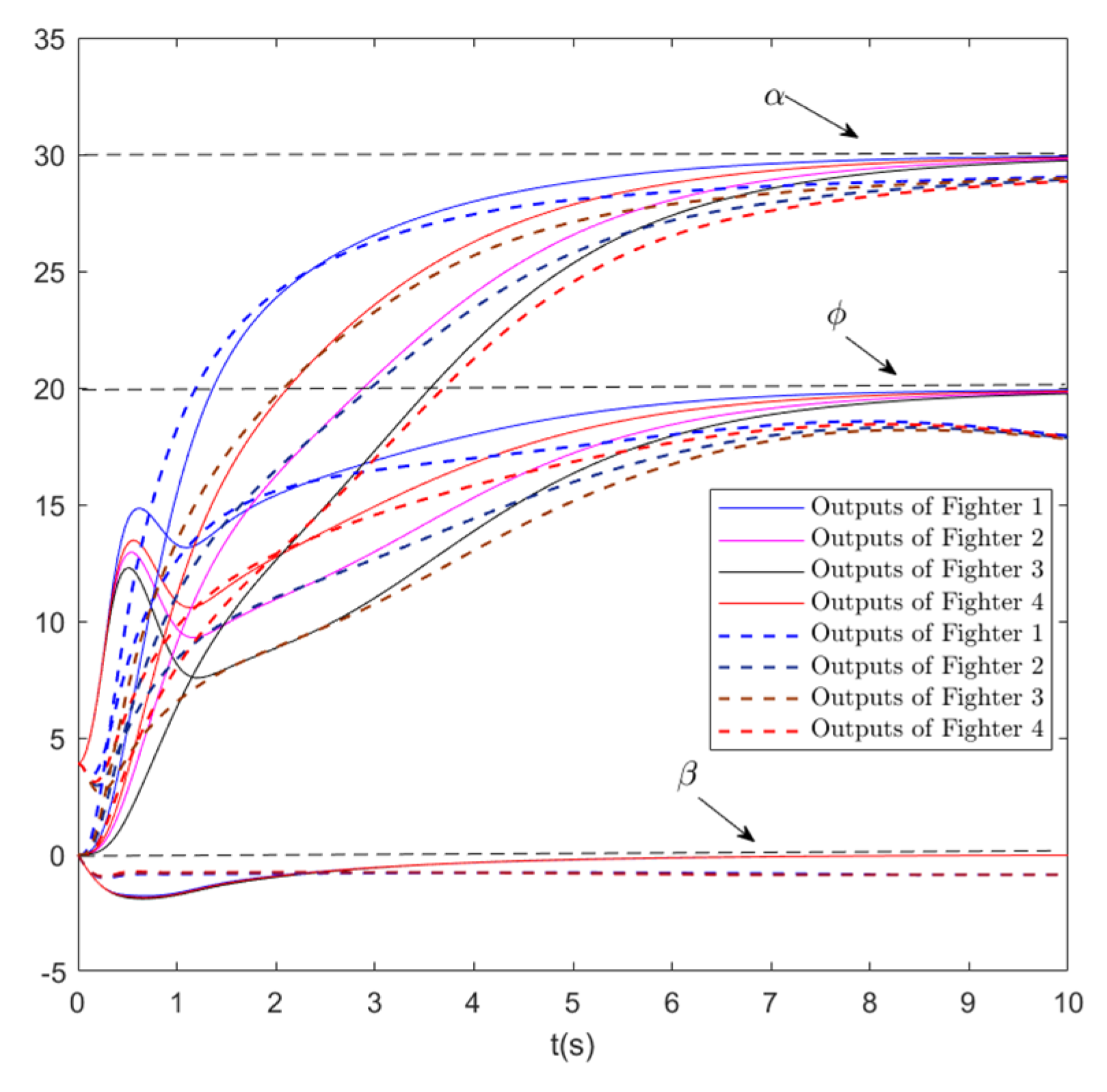
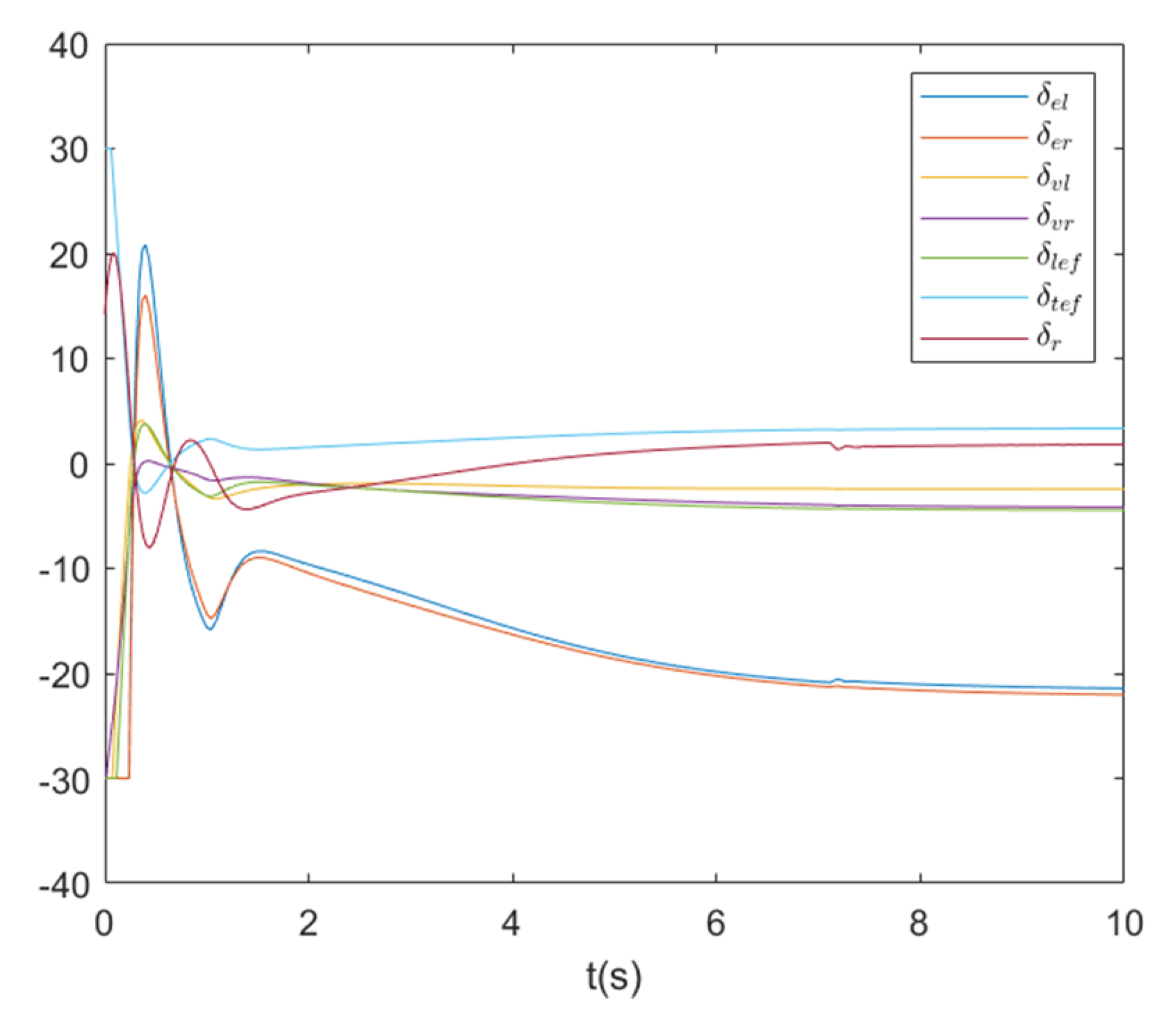
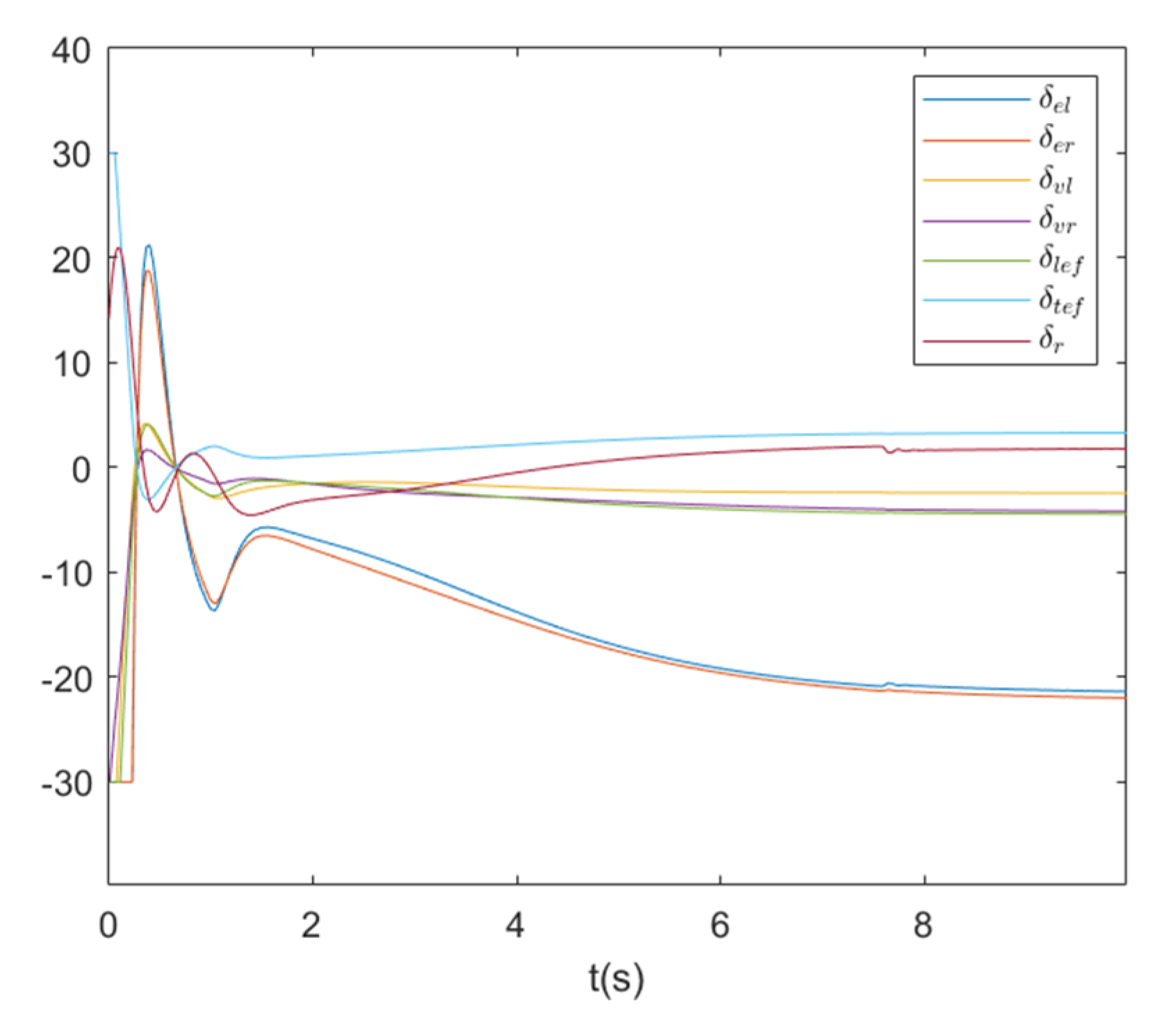
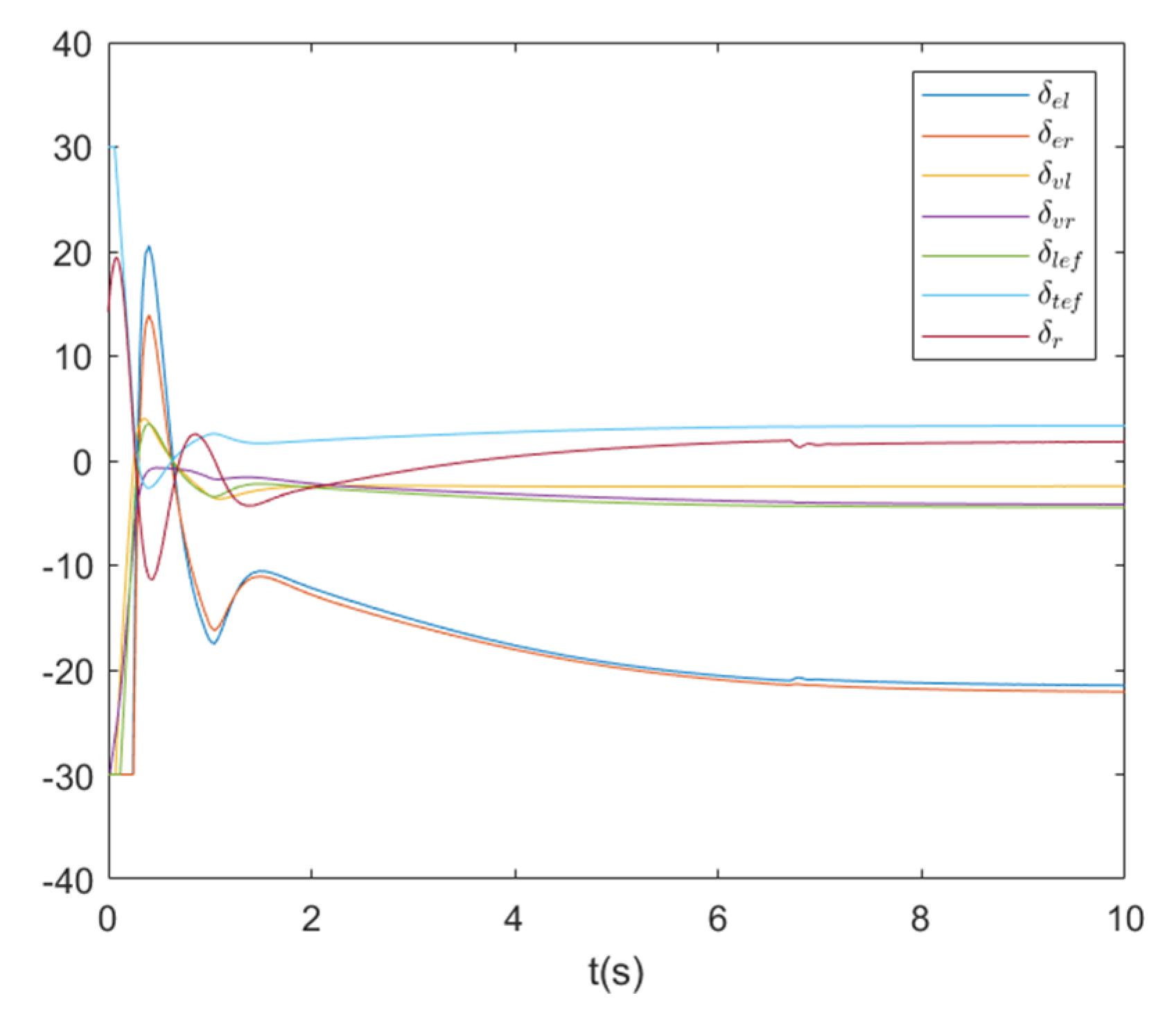
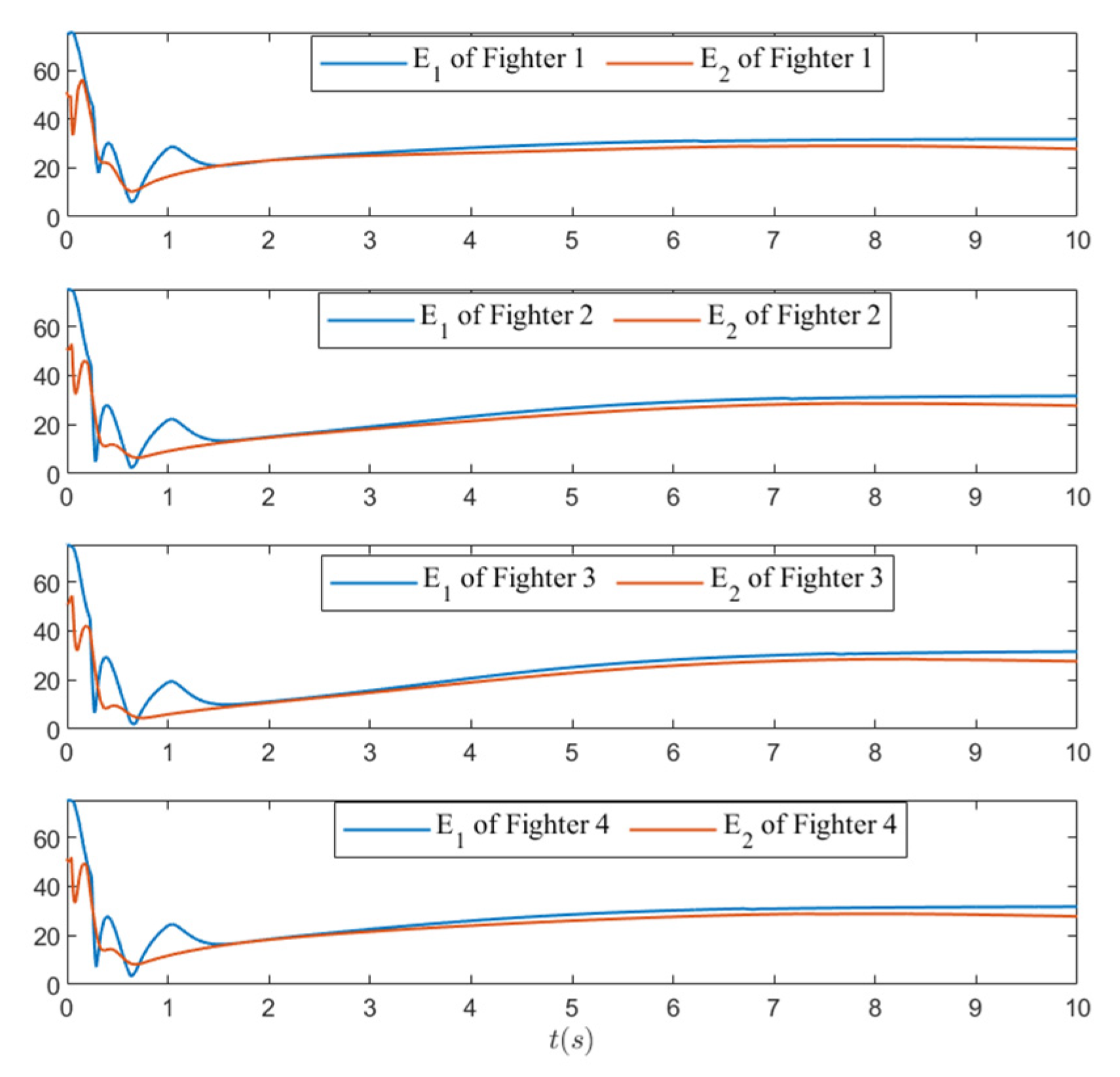
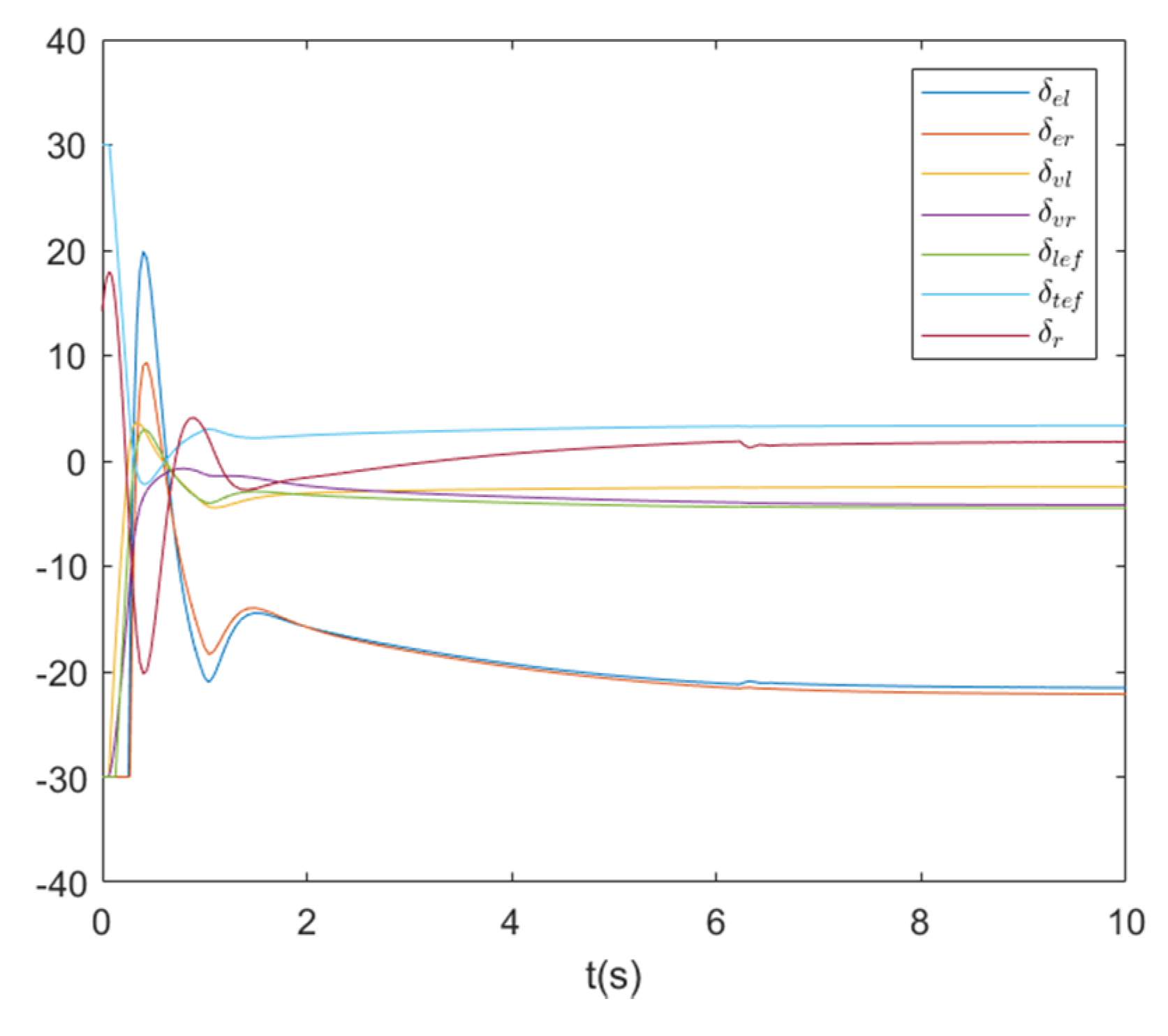
where the variables and controller parameters are the same as in our proposed methods. The simulation results are then reported in Figure 6, Figure 7, Figure 8, Figure 9 and Figure 10. In Figure 6, the dotted curves denote the outputs of fighters under the control of the method in [17], while the solid curves denote the outputs of fighters under the control of method in this paper. It can be seen from Figure 6 that our control performance is better than [17] since the outputs of ours track the desired value more accurately. Figure 7, Figure 8, Figure 9 and Figure 10 show the actions of actuators of four fighters under our method. Figure 11 show the controller performance of our method and that from [17]. In Figure 11, the blue curves denote the control efforts of the fighters with our method, while the red curves denote the control efforts of Fighters in the method from [17], where and are defined as
Figure 6.
Output of four fighters.
Figure 7.
Actuator actions of Fighter 1.
Figure 8.
Actuator actions of Fighter 2.
Figure 9.
Actuator actions of Fighter 3.
Figure 10.
Actuator actions of Fighter 4.
Figure 11.
Control efforts.
It can be seen from Figure 11 that, initially, the control efforts of our method are greater than those in [17], and finally, there is little difference in effort between these methods, which means that the control performance of our method is better under similar control efforts.
It can be seen from these results that the consensus between the four fighters is achieved and the tracking performance is very good, while fairly good control performance is achieved.
6. Conclusions
A novel distributed consensus method was presented for a MAS with completely unknown system nonlinearities and time-varying control coefficients under a directed graph. A two-order filter for each agent was constructed, providing the desired signals and thus avoiding estimating the unknown matrix, which is related on a Laplace matrix. Combined with these filters, a global consensus method was proposed for a MAS with completely unknown system nonlinearities under a directed graph for the first time. The proposed consensus method was applied to two examples. It was shown that four high-maneuver fighters achieved angular consensus and had very good control performances using the proposed method. The two simulation results demonstrated the effectiveness of the proposed method.
Author Contributions
Funding acquisition, W.F.; Investigation, H.H.; Writing—original draft, Z.L.; Writing—review and editing, S.L. and Q.L. All authors have read and agreed to the published version of the manuscript.
Funding
This research was funded by National Natural Science Foundation of China under grant 62106284 and 62176214, and also in partly funded by Nature Science Foundation of Shaanxi Province of China under grant 2021JQ-370 and also in partly funded by Xi’an Youth Talent Promotion Plan under grant 095920201309.
Conflicts of Interest
The authors declare no conflict of interest.
References
- Liu, Z.C.; Dong, X.M.; Xie, W.J.; Chen, Y.; Li, H.B. Adaptive fuzzy control for pure-feedback nonlinear systems with nonaffine functions being semibounded and indifferentiable. IEEE Trans. Fuzzy Syst. 2018, 26, 395–408. [Google Scholar] [CrossRef]
- Liu, Z.C.; Dong, X.M.; Xue, J.P.; Li, H.B.; Chen, Y. Adaptive neural control for a class of pure-feedback nonlinear systems via dynamic surface technique. IEEE Trans. Neural Netw. Learn. Syst. 2016, 27, 1969–1975. [Google Scholar] [CrossRef]
- Liu, Z.C.; Dong, X.M.; Xue, J.P.; Chen, Y. Adaptive neural control for a class of time-delay systems in the presence of backlash or dead-zone non-linearity. IET Control Theory Appl. 2014, 8, 1009–1022. [Google Scholar] [CrossRef]
- Cai, J.P.; Wen, C.Y.; Su, H.Y.; Liu, Z.T.; Xing, L.T. Adaptive backstepping control for a class of nonlinear systems with non-triangular structural uncertainties. IEEE Trans. Autom. Control 2017, 62, 5220–5226. [Google Scholar] [CrossRef]
- Li, Y.M.; Liu, Y.J.; Tong, S.C. Observer-based neuro-adaptive optimized control for a class of strict-feedback nonlinear systems with state constraints. IEEE Trans. Neural Netw. Learn. Syst. 2021, 99, 1–15. [Google Scholar] [CrossRef]
- Chen, L.S. Asymmetric prescribed performance-barrier Lyapunov function for the adaptive dynamic surface control of unknown pure-feedback nonlinear switched systems with output constraints. Int. J. Adapt. Control Signal Process. 2018, 32, 1417–1439. [Google Scholar] [CrossRef]
- Huang, J.; Wang, W.; Wen, C.; Zhou, J. Adaptive control of a class of strict-feedback time-varying nonlinear systems with unknown control coefficients. Automatica 2018, 93, 98–105. [Google Scholar] [CrossRef]
- Li, F.Z.; Liu, Y.G. Control design with prescribed performance for nonlinear systems with unknown control directions and nonparametric uncertainties. IEEE Trans. Autom. Control 2018, 62, 3573–3580. [Google Scholar] [CrossRef]
- Huang, X.C.; Song, Y.D.; Lai, J.F. Neuro-adaptive control with given performance specifications for strict feedback systems under full-state constraints. IEEE Trans. Neural Netw. Learning Syst. 2018, 30, 25–34. [Google Scholar] [CrossRef] [PubMed]
- Li, Z.; Ren, W.; Liu, X.; Fu, M. Consensus of multi-agent systems with general linear and lipschitz nonlinear dynamics using distributed adaptive protocols. IEEE Trans. Autom. Control 2013, 58, 1786–1791. [Google Scholar] [CrossRef] [Green Version]
- Wang, W.; Wen, C.; Huang, J. Distributed adaptive asymptotically consensus tracking control of nonlinear multi-agent systems with unknown parameters and uncertain disturbances. Automatica 2017, 77, 133–142. [Google Scholar] [CrossRef]
- Wang, J. Distributed coordinated tracking control for a class of uncertain multiagent systems. IEEE Trans. Autom. Control 2017, 62, 3423–3429. [Google Scholar] [CrossRef]
- Wang, W.; Wen, C.; Huang, J.; Zhou, J. Adaptive consensus of uncertain nonlinear systems with event triggered communication and intermittent actuator faults. Automatica 2020, 111, 108667. [Google Scholar] [CrossRef]
- Huang, J.; Song, Y.; Wang, W.; Wen, C.; Li, G. Fully distributed adaptive consensus control of a class of high-order nonlinear systems with a directed topology and unknown control directions. IEEE Trans. Cybern. 2018, 48, 2349–2356. [Google Scholar] [CrossRef] [PubMed]
- Wang, C.; Wen, C.; Guo, L. Adaptive consensus control for nonlinear multi-agent systems with unknown control directions and time-varying actuator faults. IEEE Trans. Autom. Control 2021, 66, 4222–4229. [Google Scholar] [CrossRef]
- Bechlioulis, C.P.; Rovithakis, G.A. Decentralized robust synchronization of unknown high order nonlinear multi-agent systems with prescribed transient and steady state performance. IEEE Trans. Autom. Control 2017, 62, 123–134. [Google Scholar] [CrossRef]
- Huang, J.; Wang, W.; Wen, C. Distributed adaptive leader–follower and leaderless consensus control of a class of strict-feedback nonlinear systems: A unified approach. Automatica 2020, 118, 109021. [Google Scholar] [CrossRef]
- Hua, C.; You, X.; Guan, X. Leader-following consensus for a class of high-order nonlinear multi-agent systems. Automatica 2016, 73, 138–144. [Google Scholar] [CrossRef]
- Chen, C.; Wen, C.; Liu, Z.; Xie, K.; Zhang, Y.; Chen, C.L.P. Adaptive consensus of nonlinear multi-agent systems with non-identical partially unknown control directions and bounded modelling errors. IEEE Trans. Autom. Control 2017, 62, 4654–4659. [Google Scholar] [CrossRef]
- Huang, J.; Song, Y.D.; Wang, W.; Wen, C.; Li, G.Q. Smooth control design for adaptive leader-following consensus control of a class of high-order nonlinear systems with time-varying reference. Automatica 2017, 83, 361–367. [Google Scholar] [CrossRef]
- Chen, J.; Li, J.; Yuan, X. Global fuzzy adaptive consensus control of unknown nonlinear multi-agent systems. IEEE Trans. Fuzzy Syst. 2020, 28, 510–522. [Google Scholar] [CrossRef]
- Yang, H.J.; Ye, D. Adaptive fuzzy nonsingular fixed-time control for nonstrict-feedback constrained nonlinear multi-agent systems with input saturation. IEEE Trans. Fuzzy Syst. 2021, 29, 3142–3153. [Google Scholar] [CrossRef]
- Deng, C.; Yang, G. Distributed adaptive fuzzy control for nonlinear multiagent systems under directed graphs. IEEE Trans. Fuzzy Syst. 2018, 26, 1356–1366. [Google Scholar]
- Dong, G.; Li, H.; Ma, H. Finite-time consensus tracking neural network FTC of multi-agent systems. IEEE Trans. Neural Net. Learning Syst. 2021, 32, 653–662. [Google Scholar] [CrossRef] [PubMed]
- Bechlioulis, C.P.; Rovithakis, G.A. A low-complexity global approximation-free control scheme with prescribed performance for unknown pure feedback systems. Automatica 2014, 50, 1217–1226. [Google Scholar] [CrossRef]
- Zhang, J.X.; Yang, G.H. Robust adaptive fault-tolerant control for a class of unknown nonlinear systems. IEEE Trans. Ind. Electron. 2016, 42, 585–594. [Google Scholar] [CrossRef]
- Liu, Y.J.; Tong, S.C. Barrier Lyapunov Functions-based adaptive control for a class of nonlinear pure-feedback systems with full state constraints. Automatica 2016, 64, 70–75. [Google Scholar] [CrossRef]
- Zhang, J.X.; Yang, G.H. Adaptive prescribed performance control of nonlinear output-feedback systems with unknown control direction. Int. J. Robust Nonlinear Control 2018, 28, 4696–4712. [Google Scholar] [CrossRef]
- Zhang, J.X.; Yang, G.H. Prescribed performance fault-tolerant control of uncertain nonlinear systems with unknown control directions. IEEE Trans. Autom. Control 2017, 62, 6529–6535. [Google Scholar] [CrossRef]
- Sun, R.; Na, J.; Zhu, B. Robust approximation-free prescribed performance control for nonlinear systems and its application. Int. J. Syst. Sci. 2018, 49, 511–522. [Google Scholar] [CrossRef]
- Liu, Y.H.; Li, H.Y. Adaptive asymptotic tracking using barrier functions. Automatica 2018, 98, 239–246. [Google Scholar] [CrossRef]
- Sontag, E.D. Mathematical Control Theory; Springer: London, UK, 1998. [Google Scholar]
- Oort, E.V.; Sonneveldt, L.; Chu, Q. Comparison of adaptive nonlinear control designs for an over-actuated fighter aircraft model. In Proceedings of the AIAA Guidance, Navigation & Control Conference & Exhibit, Honolulu, HI, USA, 18–21 August 2008. [Google Scholar]
Publisher’s Note: MDPI stays neutral with regard to jurisdictional claims in published maps and institutional affiliations. |
© 2021 by the authors. Licensee MDPI, Basel, Switzerland. This article is an open access article distributed under the terms and conditions of the Creative Commons Attribution (CC BY) license (https://creativecommons.org/licenses/by/4.0/).