Reliability Analysis of CFRP-Packaged FBG Sensors Using FMEA and FTA Techniques


Abstract
:1. Introduction
2. The principle and structure of CFRP-packaged FBG sensors
2.1. The Principle of the FBG Sensor
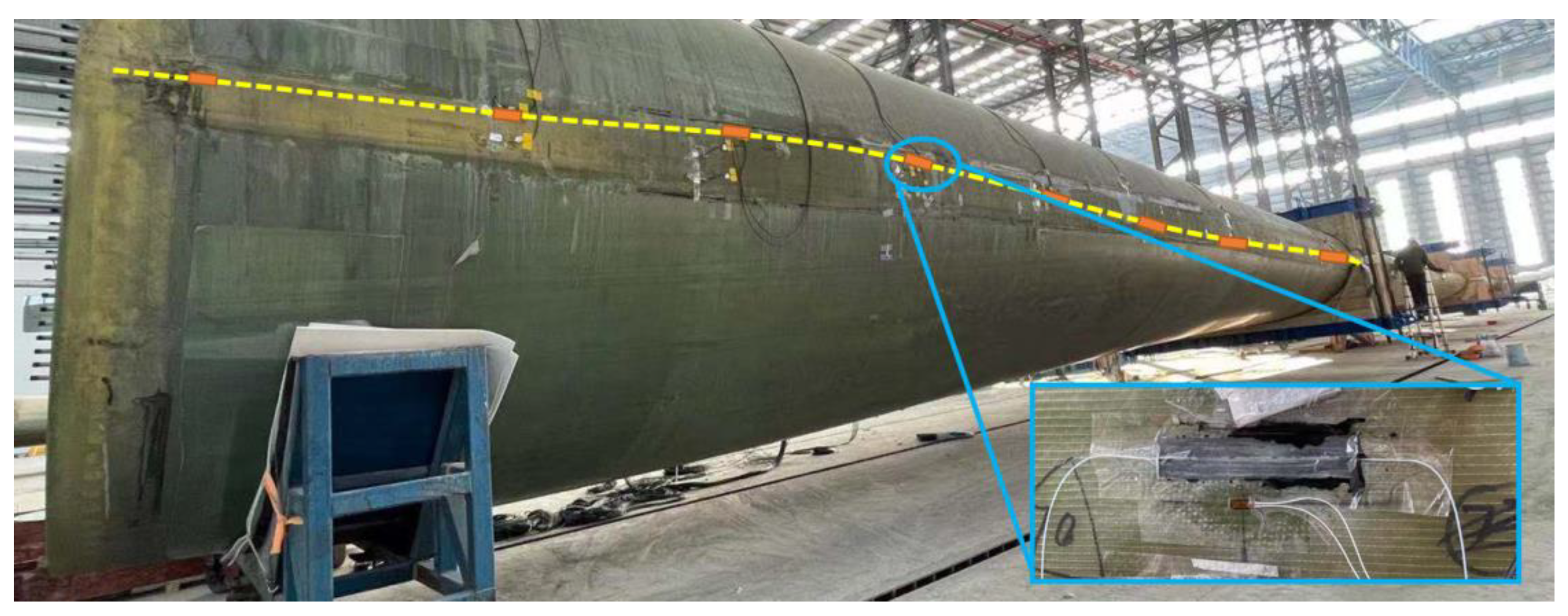
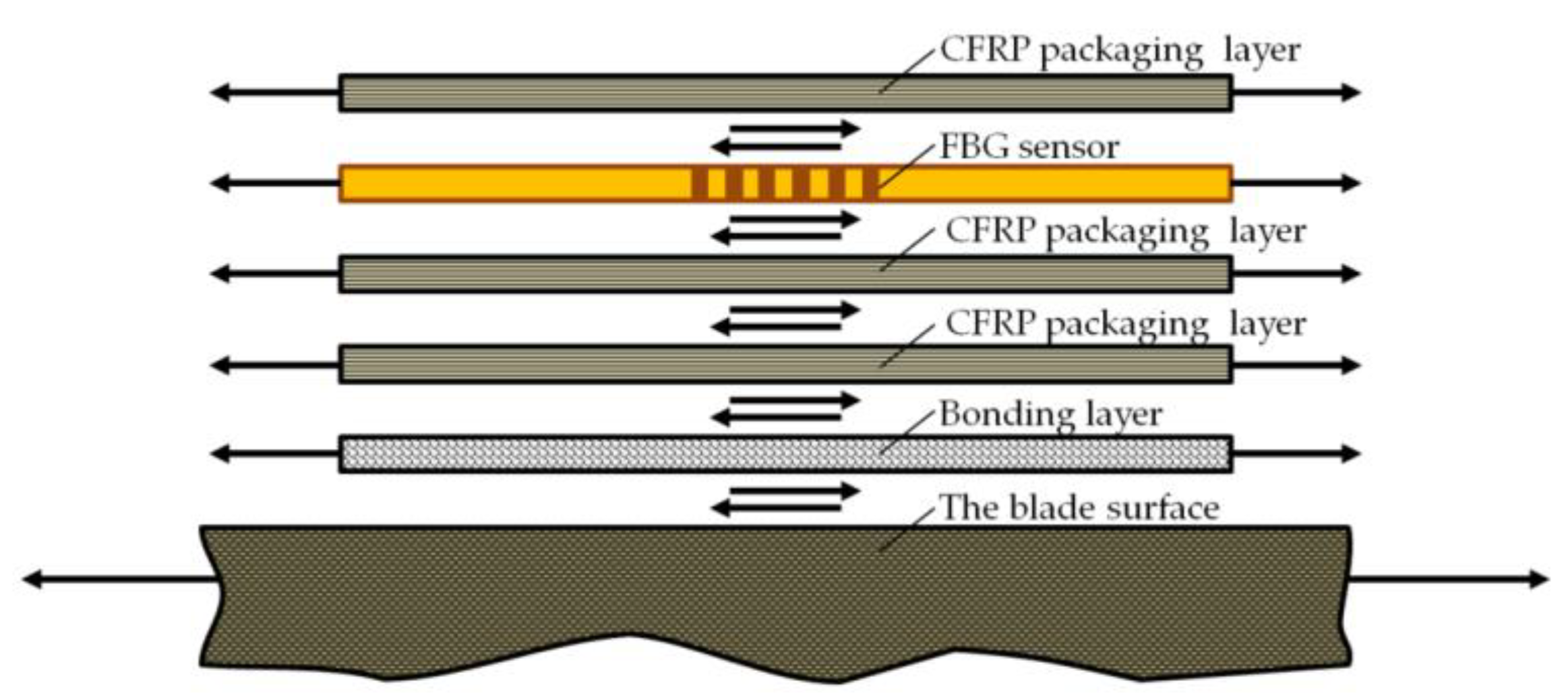
2.2. The Structure of CFRP-packaged FBG Sensors Used in WTB Full-Scale Structural Testing
3. Reliability Analysis of CFRP-Packaged FBG Sensors Using the FMEA Technique
3.1. A Brief Introduction of the FMEA Technique
3.2. FMEA of CFRP-Packaged FBG Sensors
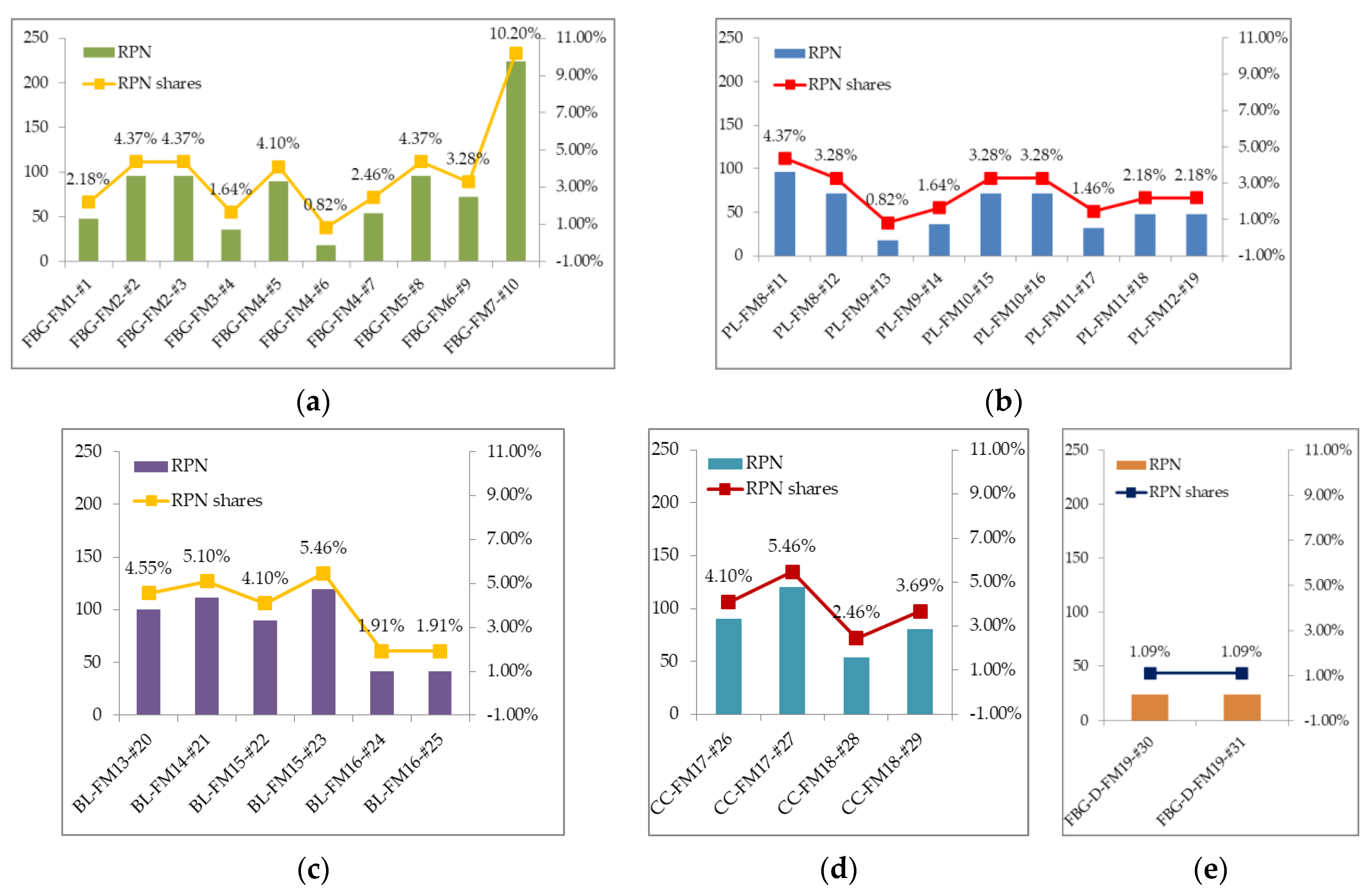
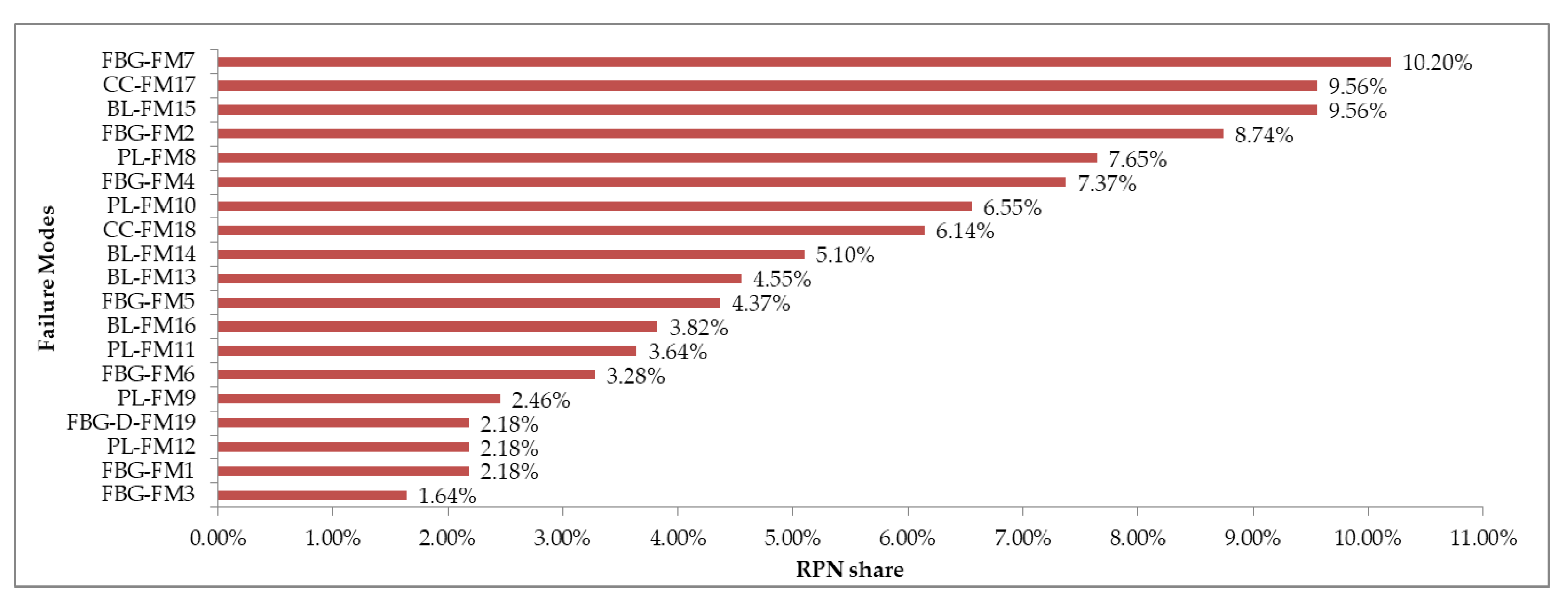
3.3. Results and Discussion
4. Reliability Analysis of CFRP-Packaged FBG Sensors Using the FTA Technique
4.1. A Brief Introduction of the FTA Techique
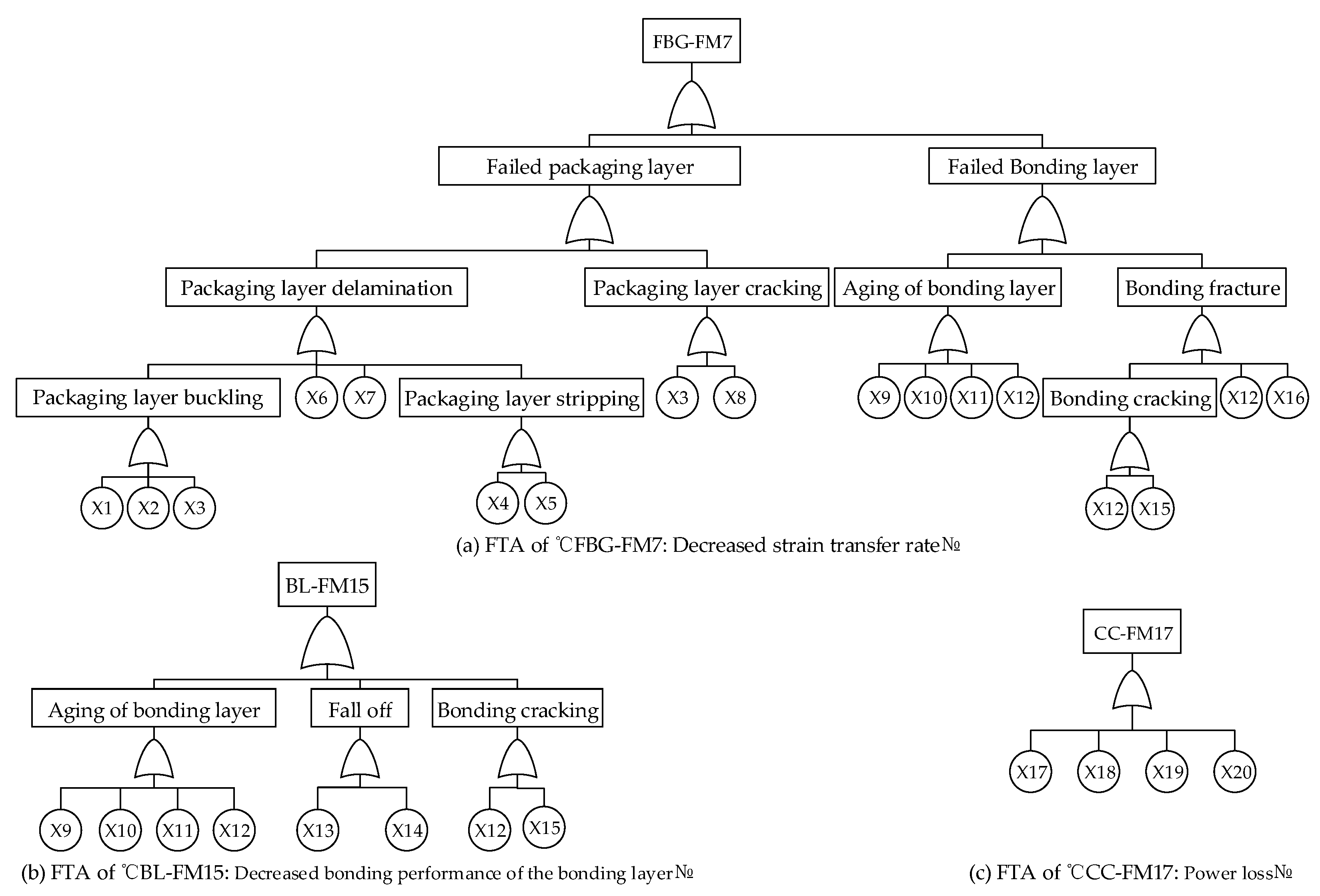
4.2. FTA of CFRP-Packaged FBG Sensors
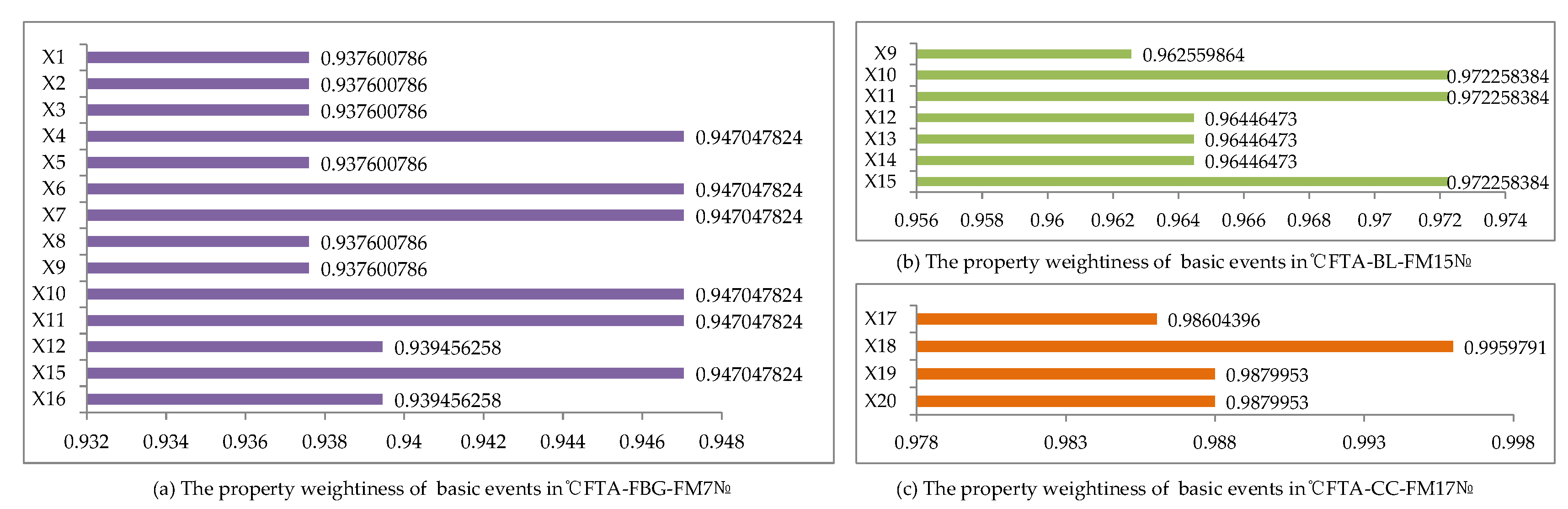
4.3. Results and Discussion
5. Conclusions
Author Contributions
Funding
Acknowledgments
Conflicts of Interest
References
- Zhou, H.F.; Dou, H.Y.; Qin, L.Z.; Chen, Y.; Ni, Y.Q.; Ko, J.M. A review of full-scale structural testing of wind turbine blades. Renew. Sustain. Energy Rev. 2014, 33, 177–187. [Google Scholar] [CrossRef]
- Li, H.; Guedes Soares, C.; Huang, H.Z. Reliability analysis of floating offshore wind turbine using Bayesian Networks. Ocean. Eng. 2020, 217, 107827. [Google Scholar] [CrossRef]
- International Standard IEC61400-23 Wind Turbines-Part 23: Full-Scale Structural Testing of Rotor Blades; International Electrotechnical Commission: Geneva, Switzerland, 2014.
- GB/T 25384-2010: Full Scale Structural Test of Wind Turbine Blade; Standards Press of China: Beijing, China, 2010.
- Arsenault, T.J.; Achuthan, A.; Coppotelli, G.; Grappasonni, C. Development of a FBG based distributed strain sensor system for wind turbine structural health monitoring. Smart Mater. Struct. 2013, 22, 075027. [Google Scholar] [CrossRef]
- Tian, S.; Yang, Z.; Chen, X.; Xie, Y. Damage detection based on static strain responses using FBG in a wind turbine blade. Sensors 2015, 15, 19992–20005. [Google Scholar] [CrossRef] [PubMed] [Green Version]
- Wen, C.J.; Li, Y.L.; Wang, Y.B. High temperature failure and spectral characteristics of metallized fiber grating. Laser Infrared 2016, 46, 481–485. [Google Scholar]
- Liu, H. Study on the Repeatability, Ronsistency and Fatigue Properties of Adhesive Packaged FBG Strain Sensors. Ph.D. Thesis, Wuhan University of Technology, Wuhan, China, 2014. [Google Scholar]
- Zhang, W. Research on Key Technologies of reliability of FBG strain sensing system. Ph.D. Thesis, Chongqing University, Chongqing, China, 2016. [Google Scholar]
- Liu, Z.; Liu, X.; Zhu, S.P.; Zhu, P.; Liu, W.; Correia, J.A.; De Jesus, A.M. Reliability assessment of measurement accuracy for FBG sensors used in structural tests of the wind turbine blades based on strain transfer laws. Eng. Fail. Anal. 2020, 112, 104506. [Google Scholar] [CrossRef]
- IEC. Analysis Techniques for System Reliability—Procedure for Failure Mode and Effects Analysis (FMEA) (IEC 60812); International Electrotechnical Commission: Geneva, Switzerland, 2006. [Google Scholar]
- Li, H.; Teixeira, A.P.; Guedes Soares, C. A two-stage Failure Mode and Effect Analysis of offshore wind turbines. Renew. Energy 2020, 162, 1438–1461. [Google Scholar]
- Xiao, N.; Huang, H.Z.; Li, Y.; He, L.; Jin, T. Multiple failure modes analysis and weighted risk priority number evaluation in FMEA. Eng. Fail. Anal. 2011, 18, 1162–1170. [Google Scholar]
- Yang, J.; Huang, H.Z.; He, L.P.; Zhu, S.P.; Wen, D. Risk evaluation in failure mode and effects analysis of aircraft turbine rotor blades using Dempster-Shafer evidence theory under uncertainty. Eng. Fail. Anal. 2011, 18, 2084–2092. [Google Scholar]
- Kabir, S. An overview of fault tree analysis and its application in model based dependability analysis. Expert Syst. Appl. 2017, 77, 114–135. [Google Scholar] [CrossRef] [Green Version]
- Huang, H.Z.; Zhang, H.; Li, Y.F. A new ordering method of basic events in fault tree analysis. Qual. Reliab. Eng. Int. 2012, 28, 297–305. [Google Scholar] [CrossRef]
- Li, Y.F.; Mi, J.; Liu, Y.U.; Yang, Y.J.; Huang, H.Z. Dynamic fault tree analysis based on continuous-time Bayesian networks under fuzzy numbers. Proc. Inst. Mech. Eng. Part O J. Risk Reliab. 2015, 229, 530–541. [Google Scholar] [CrossRef]
- Li, H.; Díaz, H.; Guedes Soares, C. A failure analysis of floating offshore wind turbines using AHP-FMEA methodology. Ocean. Eng. 2021, 234, 109261. [Google Scholar] [CrossRef]
- Liu, J.; Chen, T.; Zhang, Y.; Wen, G.; Qing, Q.; Wang, H.; Sedaghati, R.; Xie, Y.M. On sound insulation of pyramidal lattice sandwich structure. Compos. Struct. 2019, 208, 385–394. [Google Scholar] [CrossRef] [Green Version]
- Li, H.; Díaz, H.; Guedes Soares, C. A developed failure mode and effect analysis for floating offshore wind turbine support structures. Renew. Energy 2021, 164, 133–145. [Google Scholar] [CrossRef]
- Knežević, V.; Orović, J.; Stazić, L.; Čulin, J. Fault tree analysis and failure diagnosis of marine diesel engine turbocharger system. J. Mar. Sci. Eng. 2020, 8, 1004. [Google Scholar] [CrossRef]
- More, A.S.; Lad, P.S.; Krishnan, S.R.; Bhosale, S.R. Performance analysis of Strain sensor based on Fiber Bragg Grating. ITM Web Conf. 2020, 32, 02006. [Google Scholar] [CrossRef]
- Karatas, C.; Degerliyurt, B.; Yaman, Y.; Sahin, M. Fibre Bragg grating sensor applications for structural health monitoring. Aircr. Eng. Aerosp. Technol. 2019, 92, 355–367. [Google Scholar] [CrossRef]
- Kim, S.W. Characteristics of strain transfer and the reflected spectrum of a metal-coated fiber Bragg grating sensor. Opt. Lasers Eng. 2017, 96, 83–93. [Google Scholar] [CrossRef]
- Huang, H.Z.; Tong, X.; Zuo, M.J. Posbist fault tree analysis of coherent systems. Reliab. Eng. Syst. Saf. 2004, 84, 141–148. [Google Scholar] [CrossRef]
- Li, Y.F.; Huang, H.Z.; Mi, J.; Peng, W.; Han, X. Reliability analysis of multi-state systems with common cause failures based on Bayesian network and fuzzy probability. Ann. Oper. Res. 2019. [Google Scholar] [CrossRef]
- Li, Y.F.; Liu, Y.; Huang, T.; Huang, H.Z.; Mi, J. Reliability assessment for systems suffering common cause failure based on Bayesian networks and proportional hazards model. Qual. Reliab. Eng. Int. 2020, 36, 2509–2520. [Google Scholar] [CrossRef]
- Mi, J.; Li, Y.F.; Peng, W.; Huang, H.Z. Reliability analysis of complex multi-state system with common cause failure based on evidential networks. Reliab. Eng. Syst. Saf. 2018, 174, 71–81. [Google Scholar] [CrossRef]






| Code | Employer | Duty | Working Period |
|---|---|---|---|
| 1 | Wind Energy Company | Quality Engineer | 8 Years |
| 2 | Wind Energy Company | Test engineer | 6 Years |
| 3 | Wind Energy Company | Test engineer | 5 Years |
| 4 | FBG sensor Company | Components Design | 14 Years |
| 5 | FBG sensor Company | Quality Engineer | 5 Years |
| 6 | University | Researcher | 8 Years |
| 7 | University | Researcher | 8 Years |
| 8 | University | Researcher | 4 Years |
| Rating | Severity (S) | Occurrence (O) | Detection (D) |
|---|---|---|---|
| 1 | Effect is not noticed | Extremely less | Certain |
| 2 | Very slight effect | Remote | Very high |
| 3 | Slight effect causing annoyance | Very slight | High |
| 4 | Slight effect causing return of product | Slight | Moderate |
| 5 | Moderate effect causing return of product | Occasional | Medium |
| 6 | Significant effect | Moderate | Low chance |
| 7 | Major effect | Frequent | Slight |
| 8 | Extreme effect, system inoperable | High | Remote |
| 9 | Critical effect, system shutdown | Very high | Very remote |
| 10 | Hazardous, without warning | Extremely high | No inspection |
| Failure Mode Level | Failure Cause Level | RPN Level | |||||||
|---|---|---|---|---|---|---|---|---|---|
| System | Code of FM | Failure Modes | Failure Effects | Code | Failure Causes | A(S) | A(O) | A(D) | RPNs |
| FBG | FM1 | Grating broken | Unusable FBG sensor | #1 | Rough construction | 8 | 2 | 3 | 48 |
| FM2 | Sidelobe interference | Multiple peaks | #2 | Excessive splicing loss | 8 | 3 | 4 | 96 | |
| #3 | Packaging process errors | 8 | 3 | 4 | 96 | ||||
| FM3 | No output | Unusable FBG sensor | #4 | Small turning radius of the ending grating | 9 | 1 | 4 | 36 | |
| FM4 | Misinformation | Inaccurate measurement results | #5 | Unstable supply voltage | 6 | 5 | 3 | 90 | |
| #6 | Dust existing in the transmitter or receiver | 6 | 1 | 3 | 18 | ||||
| #7 | Insufficient transmitter or receiver power | 6 | 3 | 3 | 54 | ||||
| FM5 | Signal drift | Unusable FBG sensors | #8 | Jamming external environment | 8 | 4 | 3 | 96 | |
| FM6 | Discontinuous signals | Unusable FBG sensors | #9 | Jamming external environment | 8 | 3 | 3 | 72 | |
| FM7 | Decreased strain transfer rate | Inaccurate measurement results | #10 | Changed bonding parameters or packaging parameters | 8 | 4 | 7 | 224 | |
| PL | FM8 | Delamination | Decreasing compressive strength and buckling limit | #11 | Under impact force | 6 | 4 | 4 | 96 |
| #12 | Interlamination Stress between resin and prepreg | 6 | 3 | 4 | 72 | ||||
| FM9 | Cracking | Inaccurate strain measurement results and reduced service life | #13 | Single direction of carbon fiber prepreg | 6 | 1 | 3 | 18 | |
| #14 | Stress concentration at the changing section | 6 | 2 | 3 | 36 | ||||
| FM10 | Buckling | Material deformation and inaccurate strain measurement results | #15 | Excessive temperature and pressure during packaging | 6 | 3 | 4 | 72 | |
| #16 | Asymmetric CFRP layers | 6 | 3 | 4 | 72 | ||||
| FM11 | Crack | Damaged packaged layer, or failed FBG sensors | #17 | Excessive transverse shear and eccentric longitudinal stress | 8 | 2 | 2 | 32 | |
| #18 | Uneven stress | 8 | 3 | 2 | 48 | ||||
| FM12 | Stripping | Separated packaged layer, or inaccurate strain measurement results | #19 | Stress concentration and excessive load | 6 | 2 | 4 | 48 | |
| BL | FM13 | Ageing | decreasing bonding strength and mechanical properties | #20 | Temperature–moisture coupling environment, or residual internal stress | 5 | 4 | 5 | 100 |
| FM14 | Fall off | Separated CFRP-packaged FBG sensors and unreliable monitoring information | #21 | Small bonding thickness or poor material properties | 7 | 4 | 4 | 112 | |
| FM15 | Crack | Reduced mechanical properties, service life, and inaccurate strain measurement results | #22 | Unsuitable curing temperature | 6 | 3 | 5 | 90 | |
| #23 | Residual stress and stress concentration | 6 | 4 | 5 | 120 | ||||
| FM16 | Fracture | Bonding failures, easily falling CFRP-packaged FBG sensors, and inaccurate strain measurement results | #24 | Cracks in the bonding layer | 7 | 2 | 3 | 42 | |
| #25 | Stress concentration and excessive load | 7 | 2 | 3 | 42 | ||||
| CC | FM17 | Power loss | Reduced transmission distance, abnormal data transmission, and inaccurate strain measurement results | #26 | Bad welding process, or mismatch structure parameters | 6 | 3 | 5 | 90 |
| #27 | Fiber bending loss, Rayleigh scattering loss, or light wave absorption loss | 6 | 4 | 5 | 120 | ||||
| FM18 | Fiber broken | Unusable FBG sensors | #28 | Over bending of optical fiber | 9 | 2 | 3 | 54 | |
| #29 | Stress concentration and excessive load | 9 | 3 | 3 | 81 | ||||
| FBG-D | FM19 | Work failure | Failed signal and data acquisition | #30 | Abnormal external factors and internal quality defects | 8 | 1 | 3 | 24 |
| #31 | Improper human operation | 8 | 1 | 3 | 24 | ||||
| No. | Basic Event | No. | Basic Event | No. | Basic Event |
|---|---|---|---|---|---|
| X1 | Too high temperature in packaging process | X8 | Stress concentration | X15 | Unsuitable curing temperature |
| X2 | Excessive pressure in packaging process | X9 | Affected by temperature | X16 | Stress concentration in bonding layer |
| X3 | Asymmetric CFRP layers | X10 | Temperature–moisture coupling environment | X17 | Mismatch structure parameters |
| X4 | Stress concentration at the changing section | X11 | Affected by alternating load | X18 | Fiber bending loss |
| X5 | Excessive load in packaging process | X12 | Residual internal stress in bonding layer | X19 | Rayleigh scattering loss |
| X6 | Under impact force | X13 | Small bonding thickness | X20 | light wave absorption loss |
| X7 | Interlamination Stress | X14 | Poor bonding materials |
| Top Events | Minimum Cut Sets |
|---|---|
| FBG-FM7: Decreased strain transfer rate | 14 |
| BL-FM15: Decreased bonding performance of the bonding layer | 7 |
| CC-FM17: Power loss | 4 |
| No. | Failure Probability | No. | Failure Probability | No. | Failure Probability | No. | Failure Probability |
|---|---|---|---|---|---|---|---|
| X1 | 4 × 10⁻⁴ | X6 | 10−2 | X11 | 10−2 | X16 | 2 × 10⁻³ |
| X2 | 4 × 10⁻⁴ | X7 | 10−2 | X12 | 2 × 10⁻³ | X17 | 4 × 10⁻⁴ |
| X3 | 4 × 10⁻⁴ | X8 | 4 × 10⁻⁴ | X13 | 2 × 10⁻³ | X18 | 10−2 |
| X4 | 10−2 | X9 | 4 × 10⁻⁴ | X14 | 2 × 10⁻³ | X19 | 2 × 10⁻³ |
| X5 | 4 × 10⁻⁴ | X10 | 10−2 | X15 | 10−2 | X20 | 2 × 10⁻³ |
Publisher’s Note: MDPI stays neutral with regard to jurisdictional claims in published maps and institutional affiliations. |
© 2021 by the authors. Licensee MDPI, Basel, Switzerland. This article is an open access article distributed under the terms and conditions of the Creative Commons Attribution (CC BY) license (https://creativecommons.org/licenses/by/4.0/).
Share and Cite
Liu, Z.; Li, Y.; Zhang, N.; Liang, Z.; Li, F. Reliability Analysis of CFRP-Packaged FBG Sensors Using FMEA and FTA Techniques. Appl. Sci. 2021, 11, 10859. https://doi.org/10.3390/app112210859
Liu Z, Li Y, Zhang N, Liang Z, Li F. Reliability Analysis of CFRP-Packaged FBG Sensors Using FMEA and FTA Techniques. Applied Sciences. 2021; 11(22):10859. https://doi.org/10.3390/app112210859
Chicago/Turabian StyleLiu, Zheng, Yongjie Li, Nan Zhang, Zhongwei Liang, and Fangyi Li. 2021. "Reliability Analysis of CFRP-Packaged FBG Sensors Using FMEA and FTA Techniques" Applied Sciences 11, no. 22: 10859. https://doi.org/10.3390/app112210859
APA StyleLiu, Z., Li, Y., Zhang, N., Liang, Z., & Li, F. (2021). Reliability Analysis of CFRP-Packaged FBG Sensors Using FMEA and FTA Techniques. Applied Sciences, 11(22), 10859. https://doi.org/10.3390/app112210859