You are currently viewing a new version of our website. To view the old version click .
Applied Sciences
  • Article
  • Open Access

5 March 2020

Gaussian Process Synthesis of Artificial Sounds

Center of Music and Film Informatics, Detmold University of Music, 32756 Detmold, Germany
This article belongs to the Special Issue Sound and Music Computing -- Music and Interaction

Abstract

In this paper, we propose Gaussian Process (GP) sound synthesis. A GP is used to sample random continuous functions, which are then used for wavetable or waveshaping synthesis. The shape of the sampled functions is controlled with the kernel function of the GP. Sampling multiple times from the same GP generates perceptually similar but non-identical sounds. Since there are many ways to choose the kernel function and its parameters, an interface aids the user in sound selection. The interface is based on a two-dimensional visualization of the sounds grouped by their similarity as judged by a t-SNE analysis of their Mel Frequency Cepstral Coefficient (MFCC) representations.

1. Introduction

Audio synthesis has an extensive history that can be traced back to long before the first computer sounds were generated by Max Matthews in 1957 [1] (p. 273). In 1897, Thaddeus Cahill patented the Telharmonium, an electromechanical instrument. It used multiple rotating notched wheels that periodically close an electrical contact with metal brushes. The signals from these mechanical oscillators were added to imitate familiar orchestral instruments [1] (pp. 8–12). The principle of creating a complex sound by adding simple signals later became known as additive sound synthesis. Another way to arrive at interesting sounds is subtractive sound synthesis. Here, one starts with a harmonically rich signal and filters it to remove harmonic content and to change the timbre. The Trautonium [1] (pp. 32–34), invented by Friedrich Trautwein in the late 1920s, is an early instrument that combines subtractive synthesis with an innovative interface. Paul Hindemith and his pupil Oskar Sala have written music for the Trautonium that is still performed today.
Today, a variety of sound synthesis methods are used in many music genres: from experimental electronic music over jazz to rock and pop. A large variety of methods have been invented over the years. Some of the most commonly used sound synthesis methods are described below:
  • In sampling synthesis [2], entire notes of an acoustic instrument are recorded and stored in memory. The samples usually vary in musical parameters, such as pitch, dynamics and articulation. The samples are often transposed and looped during synthesis.
  • In wavetable synthesis [3], only a single period of a sound is stored in a cyclic buffer. Different pitches are then created by reading out the buffer with different increments. By mixing between multiple phase-locked wavetables over time, a more lively sound can be generated.
  • In frequency modulation (FM) synthesis [4], the frequency of a carrier signal is modulated by another oscillator. If the modulation frequency is in the audible range and if the frequency deviation (i.e., the amount by which the carrier frequency changes) is sufficiently large, then a sound with a complex spectrum emerges. FM synthesis was popularized by the Yamaha DX family of synthesizers in the 1980s [1] (p. 333–334).
  • In waveshaping synthesis [5], a signal from an oscillator is passed through a nonlinear shaping function. This distorts the original signal and can create a complex spectrum.
  • In physical modeling [6], the source of a sound is described with a physical model of equations. Physical modeling can be used to imitate acoustic instruments by simulating relevant aspects of their composition and functionality.
  • Granular synthesis [1] (pp. 335–338) is based on short audio “grains“ of up to 50 ms. These grains are superimposed and form a structure with a high density of acoustic events. Because the number of parameters is excessive if each grain is controlled individually, more abstract parameters, such as overall density, are used.
Recently, several approaches have been proposed that use neural networks for musical sound synthesis. Autoencoder-based systems reconstruct the spectrogram and let the user modify the low-dimensional latent representation of the sound in order to control the timbre [7]. NSynth [8] synthesizes musical notes on the basis of a WaveNet-based autoencoder architecture, which allows the user to morph sounds. Other approaches use Generative Adversarial Networks (GAN) [9], Recurrent Neural Networks (RNN) and Conceptors [10].
Gaussian Processes (GP) are used in machine learning for classification and regression. They have applications in various fields. We make use of GPs as a method for sampling continuous functions randomly. The sampled functions are then used in wavetable or waveshaping synthesis. Sampling multiple times from the same GP generates wavetables or shaping functions that sound perceptually similar. However, they are not identical. Since there are many ways to choose the kernel function and its parameters, an interface aids the user in selecting a sound. The interface is based on a two-dimensional visualization of the sounds that are grouped by their sound similarity as judged by t-Distributed Stochastic Neighbor Embedding (t-SNE) [11] on the basis of their Mel Frequency Cepstral Coefficients (MFCC). Sound examples and further material are available here: http://www.cemfi.de/gaussian-process-synthesis.
This paper is structured as follows. Section 2 provides the background of GPs. Section 3 discusses how to use GPs to generate functions that are suited for wavetable and waveshaping synthesis. The interface for selecting sounds and for real-time usage is presented in Section 4. Then, we discuss related work (Section 5) and conclude the paper (Section 6).

2. Background

A Gaussian Process (GP) [12] is a set of random variables ( Z x : x S ) such that for all n N and for all x 1 , , x n S , the vector ( Z x 1 , , Z x n ) forms a multivariate Gaussian. GPs are usually constructed by defining a mean function μ such that E [ Z x ] = μ ( x ) and a covariance function k such that C o v ( Z x 1 , Z x 2 ) = k ( x 1 , x 2 ) . It is sufficient to define the pairwise covariances since this yields the full covariance matrix:
Σ = k ( x 1 , x 1 ) k ( x 1 , x n ) k ( x n , x 1 ) k ( x n , x n )
The mean and covariance function defines a multivariate Gaussian on every finite subset of n points. Given a mean and a covariance function (which is commonly called a kernel), it is possible to sample from the Gaussian process. First, one chooses for which points of the set S to sample. For example, if S = [ 0 , 1 ] , then one could sample 100 equidistant points: 0, 0.01, 0.02 …, 0.99. Then, the covariance matrix is constructed by evaluating the kernel for each pair. In our example, the covariance matrix would be
Σ = k ( 0 , 0 ) k ( 0 , 0.01 ) k ( 0 , 0.99 ) k ( 0.99 , 0 ) k ( 0.99 , 0.01 ) k ( 0.99 , 0.99 )
A mean function also has to be defined. In practice, one often just uses a zero mean. A zero mean function is also used in GP sound synthesis (see Section 3).
With a given mean vector μ and the covariance matrix Σ , it is possible to sample from a multivariate Gaussian N ( μ , Σ ) with the following procedure:
  • Compute the Cholesky decomposition of Σ = A A T . This takes O ( n 3 ) of computation, where n is the size of the square matrix Σ .
  • Create a vector z = ( z 1 , z 2 , , z n ) , where the z i values are drawn independently from a standard normal distribution. This takes O ( n ) of computation.
  • Compute the sample s = μ + A z . This takes O ( n 2 ) of computation because of the matrix-vector multiplication.
Note that step 1 is the most expensive step. When drawing multiple samples from the same multivariate Gaussian distribution, it is possible to reduce computational complexity considerably by computing the matrix A only once and reusing it. The remaining steps have a total computational complexity of only O ( n 2 ) . In GP sound synthesis, this optimization allows for more quickly generating multiple samples from the same GP.
In order to be a valid kernel, the function k has to be positive semidefinite. This means that for all x 1 , x n S , the matrix Σ has to be symmetric and positive semidefinite ( u T Σ u 0 , for all vectors u R n ). Some commonly used kernels are [12] (ch. 4)
  • The squared exponential: k ( r ) = e x p ( r 2 2 ) , with length-scale parameter > 0 . r = | x 1 x 2 | is the distance between x 1 and x 2 .
  • The Matérn: k ( r ) = 2 1 ν Γ ( ν ) ( 2 ν r ) ν K ν ( 2 ν ), with parameter ν . K ν is a modified Bessel function. Γ ( ν ) is the gamma function. The expression simplifies for ν = 1 / 2 , 3 / 2 and 5 / 2 .
  • The Ornstein–Uhlenbeck process, which is a special case of the Matérn class, with ν = 1 / 2 .
  • The gamma-exponential: k ( r ) = e x p ( ( r / ) γ ) , for 0 < γ 2 .
  • The rational quadratic: k ( r ) = ( 1 + r 2 2 α 2 ) α , with parameter α > 0 .
  • The polynomial: k ( x 1 , x 2 ) = ( x 1 x 2 T + σ ) p , with parameters σ 0 and p.
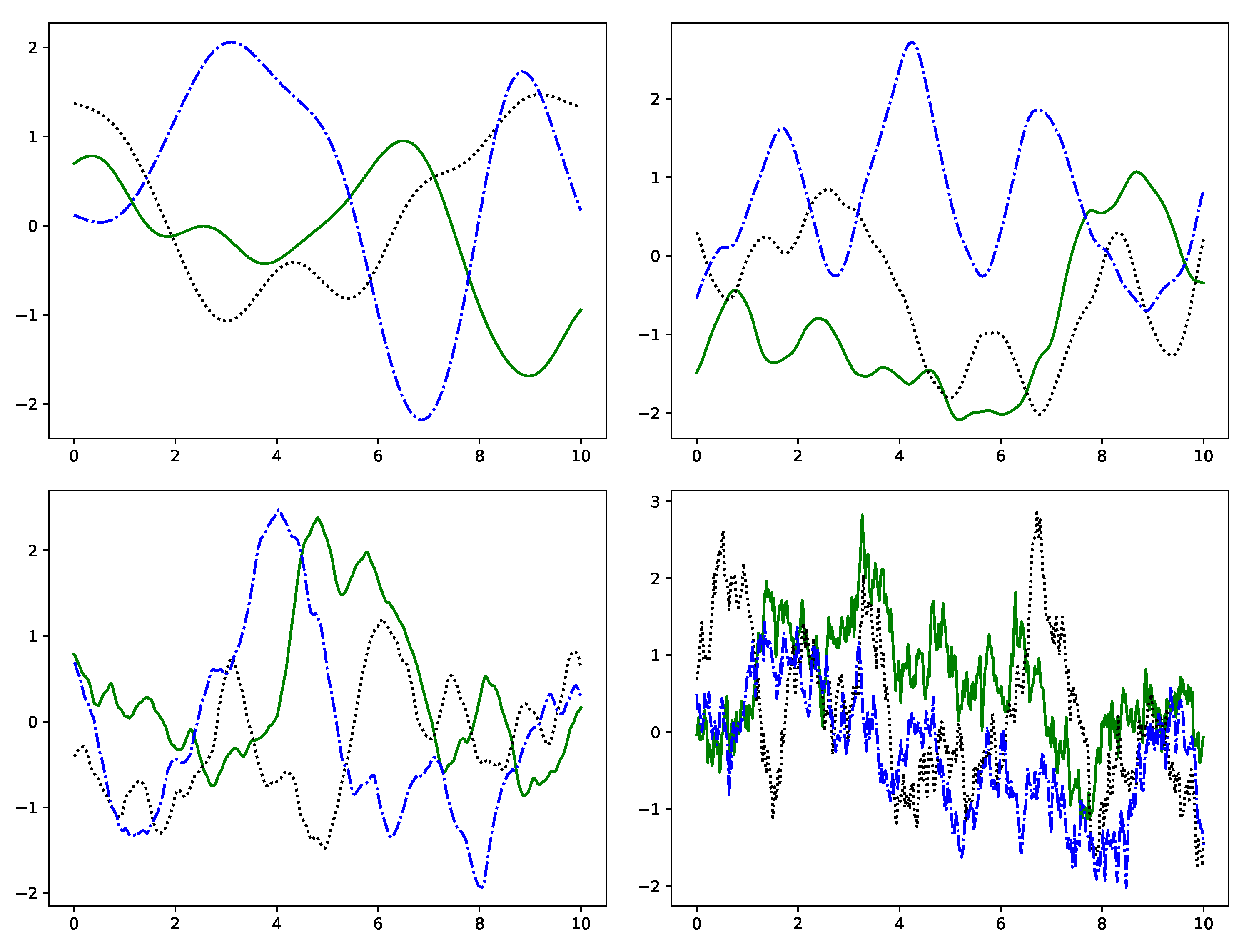
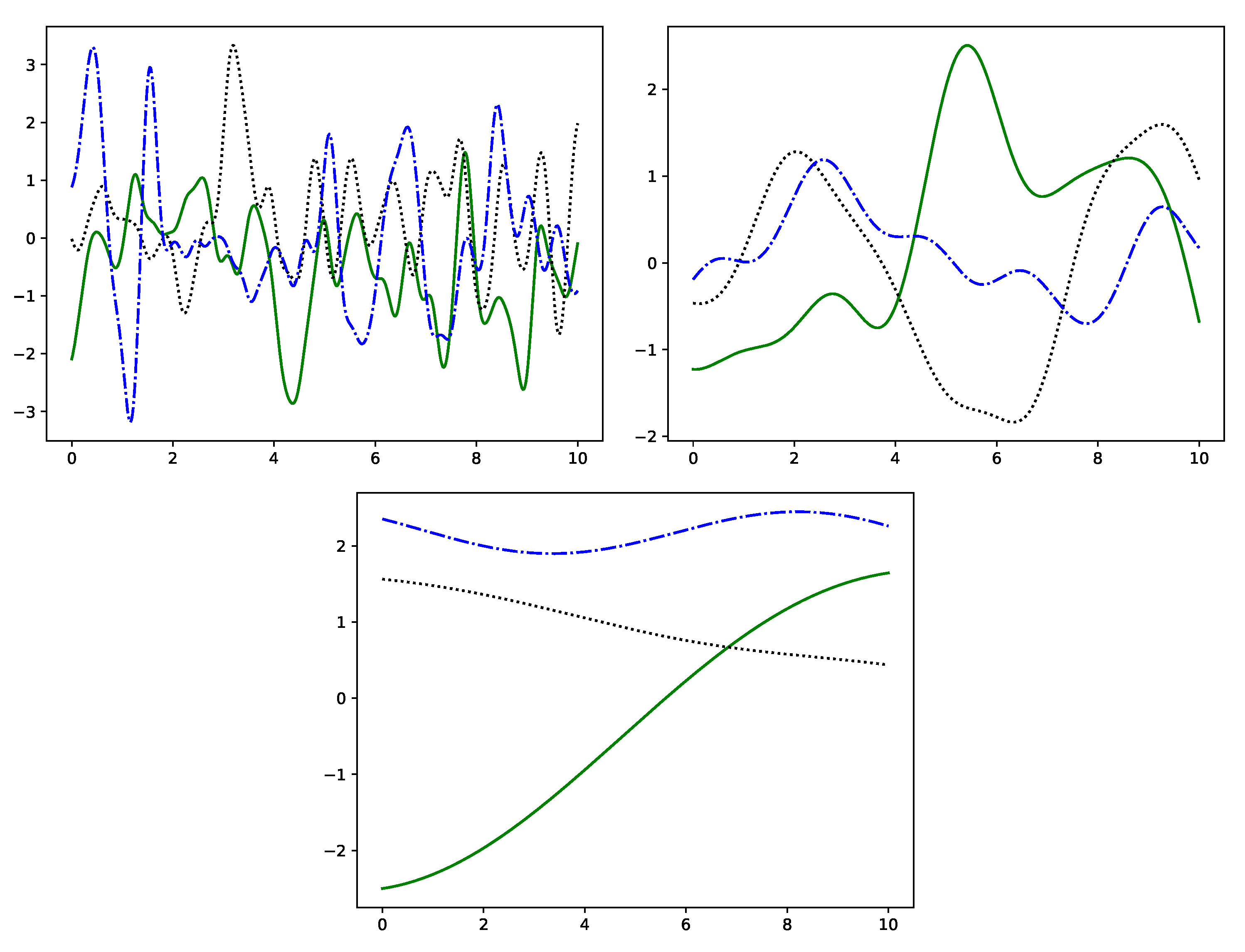
The kernels that we used for sound synthesis (see Section 3) are listed in Table 1. Figure 1 shows samples from GPs defined with different kernel functions. Many kernels have length-scale parameter , as introduced above in the formulas of the kernel functions. It controls how close two points have to be in order to be considered near and thus be highly correlated. The effect of different length-scales is illustrated in Figure 2 for a squared exponential kernel. The graphs fluctuate more rapidly with decreasing length-scale.
Table 1. The kernels from the GPy library that were used to create the wavetables.
Figure 1. Samples from GPs with different kernels: squared exponential (upper left), Matérn 5/2 (upper right), Matérn 3/2 (lower left) and 1-exponential (lower right). All samples have length-scale parameter = 1 .
Figure 2. Samples drawn from a squared exponential kernel GP with length-scale = 0.1 (left), 1.0 (right) and 10.0 (bottom).
There are operations that preserve the semidefiniteness of kernels. Let k, k 1 and k 2 be positive semidefinite kernels; then, the following kernels are also valid:
  • k 1 ( x 1 , x 2 ) + k 2 ( x 1 , x 2 ) [summing kernels],
  • k 1 ( x 1 , x 2 ) k 2 ( x 1 , x 2 ) [multiplying kernels],
  • p ( k ( x 1 , x 2 ) ) , where p ( x ) is a polynomial,
  • f ( x 1 ) k ( x 1 , x 2 ) f ( x 2 ) , for all functions f : S R .
In GP sound synthesis, such combinations of kernels are used.
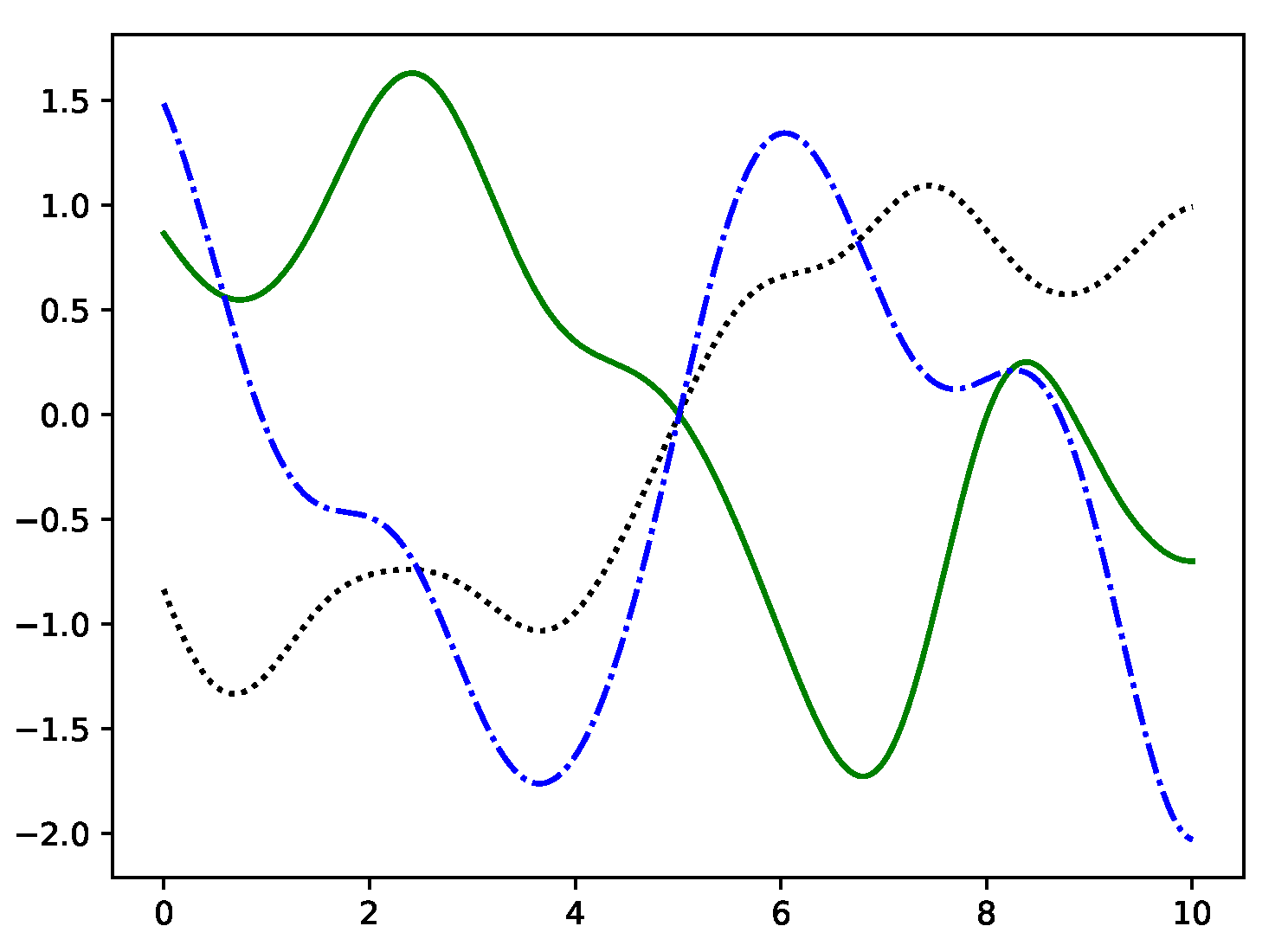
GP regression [12] (ch. 2) can be thought of as computing a posterior distribution of functions that pass through the observations (function-space view). The graphs in Figure 1 and Figure 2 were drawn from the prior distribution. With GP regression, it is possible to specify a posterior distribution with functions that pass through the observations (see Figure 3). Furthermore, it is possible to specify the uncertainty of an observation. By setting the uncertainty to zero, all samples from the posterior distribution pass exactly through the specified point (see Figure 3). We use this later to generate suitable wavetables (see Section 3.1). Computationally, GP regression is dominated by the inversion of the covariance matrix [12] (ch. 2). This has a computational complexity of O ( n 3 ) , where n is the total number of points (observations + points to be sampled).
Figure 3. Five samples drawn from the posterior, conditioned on a noise-free observation at x = 5, y = 0 (squared exponential kernel, length-scale = 1 ). Note that all samples pass through that point.

3. GP Sound Synthesis

In GP sound synthesis, random continuous functions are sampled from a GP. These functions are then used for wavetable or waveshaping synthesis. Both wavetable and waveshaping syntheses produce sounds with harmonic spectra, where the energy is contained in integer multiples of the fundamental frequency. By sampling multiple functions from the same GP, we get individual sounds that are perceptually similar but not identical. To make sure that the generated wavetables are usable for synthesis, the following properties are enforced:
  • The timbre of the synthesized sound should be controllable and depend on the choice of the kernel and its parameters.
  • The perceptual loudness of the synthesized sounds should be similar, i.e., independent of the choice of the kernel and its parameters.

3.1. Generating Wavetables with GPs

In wavetable synthesis [3], a single period of a sound is stored in memory. In order to synthesize the sound at a certain pitch, the wavetable is cyclically read out at the corresponding rate. Here, the wavetable is generated by sampling equidistantly from a GP in the interval [ 0 , 2 π ] at N points p N 2 π for p = 0 N 1 . Often, but not always, there is a distinct jump between the last ( p = N 1 ) and the first sample point ( p = 0 ). This is also visible in Figure 1, where most graphs end at a different value than they started. A wavetable with such a sudden jump produces a sound with a considerable amount of energy throughout all harmonics. By chance, a few of the graphs in Figure 1 are continuous at the boundary: i.e., the last and the first point are close. For such wavetables, the spectrum of the sound contains considerably less energy in the higher harmonics. The energy in the harmonics thus depends on the actual shape of the graph at the boundary. This is not controllable by choosing the kernel and its parameters.
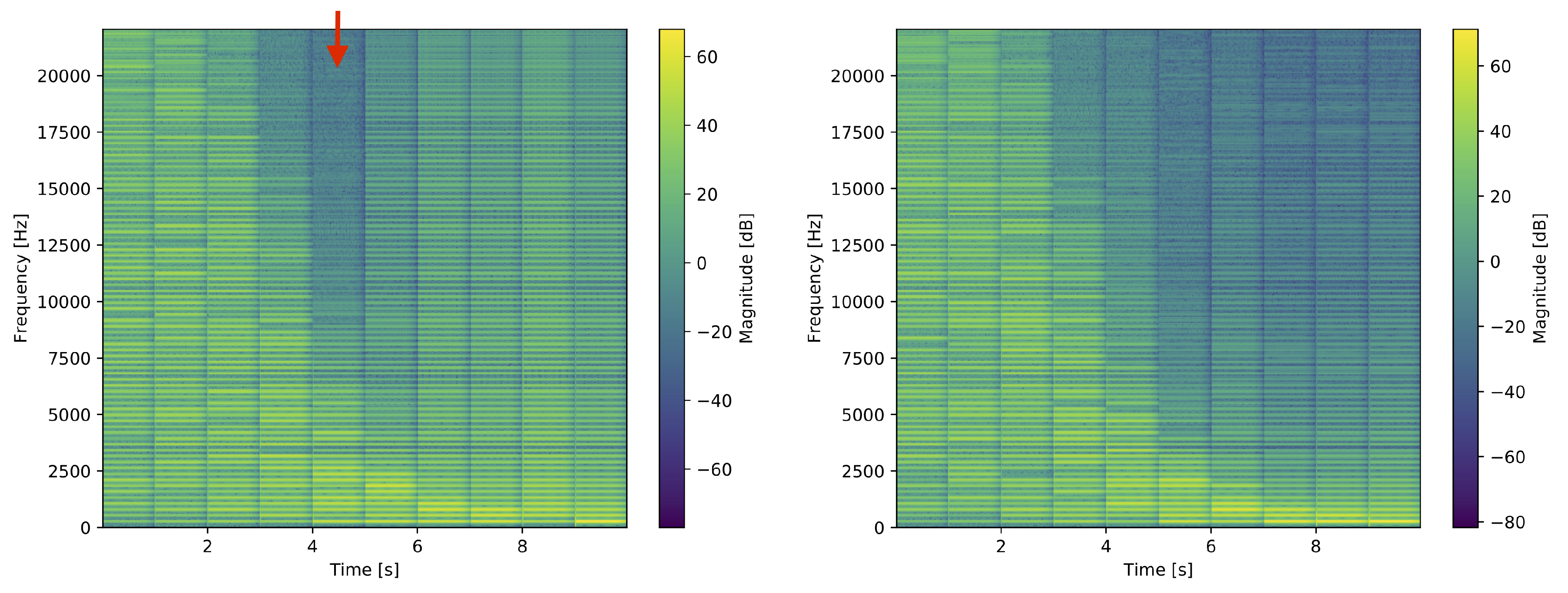
To overcome this problem, GP regression is used to ensure that the graph passes through ( 0 , 0 ) and ( 2 π , 0 ) . As mentioned above, N points p = 0 N 1 are used to construct the wavetable. We add another point and use it to ensure that the graph passes through ( 2 π , 0 ) . This last point is discarded in the wavetable, where only the points p = 0 N 1 are used. Figure 4 illustrates the effect of this approach.
Figure 4. Spectrograms of GP wavetable synthesis with a squared exponential kernel. The length-scale is increased 10 times. (left) Without GP regression, there is usually more energy in the higher harmonics at smaller length-scales. If, by chance, the wavetable is continuous at its boundary, then there is a distinct change in the spectrum with a reduction of energy at the higher harmonics (marked with an arrow). (right) With GP regression, the energy in the harmonics decreases more predictably with increasing length-scale.
Another way to address the continuity at the boundary is to use periodic kernels. An example is the standard periodic kernel [13]
k ( x 1 , x 2 ) = θ 1 exp 1 2 sin ( π λ ( x 1 x 2 ) ) l 2
with periodicity parameter λ and length-scale parameter . By choosing λ appropriately, it is ensured that the generated graph has a period of 2 π so that the wavetable is continuous at the boundary as required. In this case, it is not necessary to resort to GP regression. Other options are the periodic kernels of the Matérn class [14].
Ultimately, we used the kernels listed in Table 1 for sound synthesis. The spectrum of the sound generated with the aforementioned wavetables shows variation. Some kernels generate smoother functions than others: compare, for example, the curves generated from the squared exponential kernel (a kernel that is differentiable infinitely many times) with the ones created with the 1-exponential in Figure 1. The spectrum differs accordingly, with markedly more energy in the higher frequencies for the wavetables created with the 1-exponential as long as the length-scales are similar. As the length-scale controls how rapidly the graph fluctuates, lower length-scales produce wavetables with higher spectral content (see also Figure 4, right). As described in Section 2, new kernels can be created from existing kernels, for example, by adding or multiplying two existing kernels. This adds further variety to the generated sounds.
It is a well-known fact from psychoacoustics that the human perception of loudness depends on the spectral content of the sound [15] (ch. 8). Therefore, the loudness was calculated according to db(B) weighting for a synthesized middle C note. The sound was then normalized to a fixed reference loudness. After normalizing, it can occur that some sample points in the wavetable exceed the admissible range of between −1.0 and +1.0. Consider, for example, a wavetable that is close to zero most of the time and has one distinct peak that exceeds +1. This cannot be completely ruled out because of the random nature of sampling from a GP. If this happens, the wavetable is discarded and sampled from the GP again.
Overall, GP wavetable synthesis can be summarized as follows:
  • Sample the wavetable from GP. Ensure that the wavetable is continuous at the boundary either (a) by using a periodic kernel or (b) by using GP regression to enforce continuity.
  • Zero-center the wavetable.
  • Normalize the loudness of the wavetable according to db(B)
  • If a sample in the wavetable exceeds the range [−1, +1], then repeat from step 1.
  • Use the wavetable for classical wavetable synthesis.

3.2. Generating Shaping Functions with GPs

In waveshaping synthesis, the signal of an oscillator is transformed by the shaping function. The shaping function maps from [−1, +1] to [−1, +1], which corresponds to the full range of audio signals. If the shaping function is nonlinear, then the timbre of the sound is changed. The output is y = f ( a ( t ) x ( t ) ) , where f is the shaping function, a ( t ) is the time-varying amplitude, usually from an envelope, and x ( t ) is the input signal, typically an oscillator with fixed amplitude. Shaping functions can be hand-drawn or defined mathematically, e.g., with Chebyshev polynomials [5]. We used the kernel functions from Table 1 to generate shaping functions. Again, existing kernels can be combined, for example, by adding or multiplying them, to create new kernels and increase sound variety.
A shaping function is generated by sampling from the prior distribution of a GP. In contrast to wavetables, there is no wrap-around, so it is not necessary to use GP regression to enforce continuity at the boundary. The perceptual qualities of the sound depend on the chosen kernel and its parameters. To normalize the loudness across different shaping functions, we synthesize the sound on the basis of a full-scale cosine oscillator at 261.6 Hz (middle C). The loudness of the resulting sound is computed according to db(B) weighting normalized with respect to a reference. This ensures that the perceptual loudness of sounds generated with different shaping functions is similar.

3.3. Computational Aspects

Computing the Cholesky decomposition is the most expensive operation when sampling from a GP (see Section 2). It has a computational complexity of O ( N 3 ) , where N is the number of sampled points. In GP sound synthesis, N corresponds to the size of the wavetable or the size of the table representing the shaping function. Balancing between computation time and sound quality, we chose N = 2205 . The other operations are considerably cheaper (see Section 2). Overall, it takes 0.54 s to compute a wavetable or a shaping function, starting from constructing the covariance matrix. When sampling multiple times from the same kernel with the same parameters, it is possible to compute the Cholesky decomposition only once and reuse it. Then, it takes only 0.041 s to compute a wavetable or a shaping function, a more than 10-fold increase in speed. In our experiments, we used this strategy to sample multiple times from the same GP more efficiently. The time measurements were done using a single core of a PC with an i7-7700K CPU running at 4.2GHz. The results were averaged over 1000 runs.

4. Sound Selection Interface

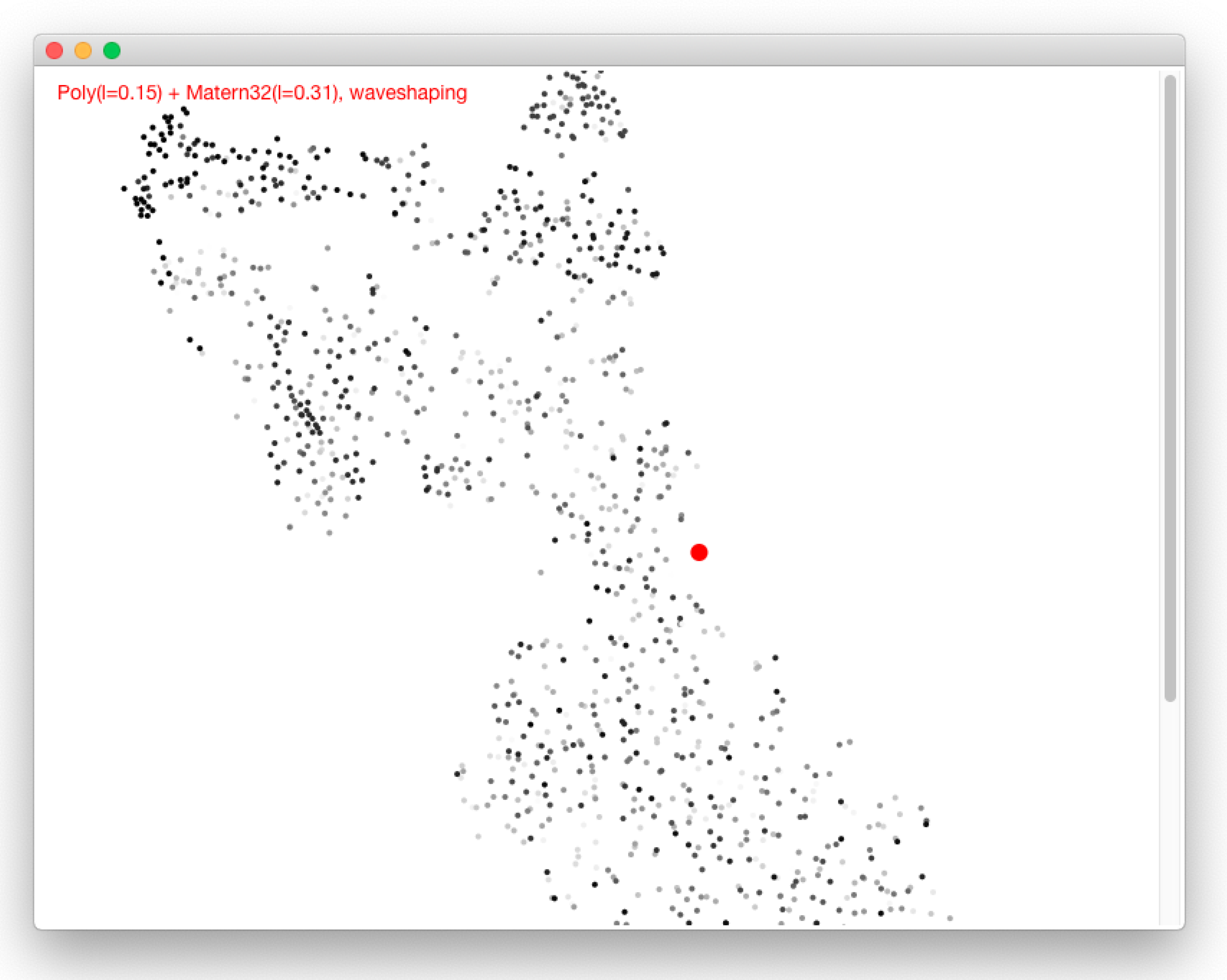
As described in the previous section, there are many different kernels that can be used to generate wavetables and shaping functions. With the length-scale, these kernels have at least one continuous parameter. Discretizing the length-scale yields #kernels × #length-scales relevant settings. If the kernels are composed, for example, by summing or multiplying, even more combinations arise. The number of combinations is so large that it is impractical for the user to enumerate all of them. Therefore, a sound navigation interface helps the user to find interesting sounds (see Figure 5). Each dot represents a short sound sample, which is played when the user clicks on the dot. The two-dimensional layout of the dots is computed by calculating a 2-D t-SNE [11] representation based on the MFCC features of the sounds. This ensures that dots in close proximity sound similar. The interface can be found here: http://www.cemfi.de/gaussian-process-synthesis, see also the Supplementary Video S1.
Figure 5. User interface for GP synthesis sound selection. When the user clicks one of the dots, the dot is marked red, and the corresponding sound is played. In the upper-left corner, the parameters of the sound are shown. In this case, the function is drawn from a GP where the kernel is the sum of a polynomial ( = 0.15 ) and a Matérn 3/2 kernel ( = 0.31 ) . The function is used for waveshaping.
In the interface, t-SNE is used to compute a two-dimensional embedding of the 20-dimensional MFCC feature space. t-SNE [11] uses optimization to place the data points in the low-dimensional space. From their position, t-SNE determines the similarity between points. However, similarity is defined differently in the high- and low-dimensional spaces. Similarity is based on a Gaussian distribution in the high-dimensional space and on a Student t-distribution in the low-dimensional space. This allows the optimizer to place dissimilar points far apart in the low-dimensional space. In our case, similar sounds (as judged by the distance of their MFCC vectors) are placed close to each other, while dissimilar sounds are placed far apart. Other than that, one should be careful when interpreting t-SNE-based visualizations: Wattenberg et al. [16] pointed out that t-SNE visualizations can look different depending on hyperparameter settings, that cluster sizes can be misleading and that it can be misleading to compare distances of points that are relatively far apart. Therefore, it is difficult to analyze the actual shape of the landscape in Figure 5. However, similar sounds are placed close to each other, and the user can thus efficiently explore the sound space.
The kernels listed in Table 1 are all used in the interface. The length-scale parameter is varied from 0.01 to π in 20 equally spaced points on a logarithmic scale. For wavetable and waveshaping synthesis, the tables are computed as follows: For each setting of kernel and length-scale, seven tables are sampled. In total, this gives us 1960 different combinations (14 kernels × 20 length-scales × 7 tables). Furthermore, multiplicative and additive combinations of the kernels are used. To reduce storage, we did not enumerate all combinations of kernels, length-scales and operations (“plus“, “times“) but rather used 500 random combinations. Again, seven tables for each of those combinations were sampled in order to have seven similar but non-identical sounds per combination. To produce sounds for the sound selection interface, the waveshaping synthesis is driven with a full-scale sine oscillator.
Once the wavetables and shaping functions have been generated and stored as audio files, they are usable within any programming environment. To enable such use cases, we developed an application that encapsulates the navigation user interface (Figure 5) and sends an Open Sound Control (OSC) message when the user clicks on one of the dots. Once the OSC message is received in the programming environment (e.g., SuperCollider, pureData or Max/MSP), the corresponding audio file that contains the precomputed wavetable or shaping function is loaded by the user’s program. Audio synthesis can then be performed with the means of the programming environment. A video demonstrating the real-time interaction with the application for fixed MIDI playback can be found here: http://www.cemfi.de/gaussian-process-synthesis. Of course, live input, e.g., from a MIDI keyboard or from another controller, is also possible.

6. Conclusions

In GP sound synthesis, functions are sampled randomly from GPs. The random functions are then used as tables in wavetable synthesis or as shaping functions in waveshaping synthesis. The shape of the function can be controlled by choosing a kernel function and its parameters. Most kernel functions have at least one parameter: the length-scale . It controls how fast the correlation between two points decreases with distance. With lower length-scale, the randomly sampled function oscillates faster, which leads to a spectrum with more high-frequency energy. Furthermore, kernel functions can be combined in multiple ways. We explored additive and multiplicative combinations, but there are more possibilities to be explored in the future, including Deep GPs. Even now, the number of choices (kernels, their parameter(s) and their additive and multiplicative combinations) makes it impractical for a user to explore the possible sounds by enumerating everything. A user interface based on a visual map, where the sounds are grouped according to their similarity, aids the user in sound selection.

Supplementary Materials

The following is available online at https://www.mdpi.com/2076-3417/10/5/1781/s1, Video S1: Sound Selection Interface.

Funding

This research received no external funding.

Conflicts of Interest

The author declares no conflict of interest.

Abbreviations

The following abbreviations are used in this manuscript:
GPGaussian Process
MFCCMel Frequency Cepstral Coefficients
OSCOpen Sound Control
t-SNEt-Distributed Stochastic Neighbor Embedding

References

  1. Holmes, T. Electronic and Experimental Music: Technology, Music, and Culture; Routledge: London, UK, 2012. [Google Scholar]
  2. Davies, H.S. The New Grove Dictionary of Music and Musicians; Sadie, S., Tyrrell, J., Eds.; Grove: New York, NY, USA, 2001; p. 219. [Google Scholar]
  3. Bristow-Johnson, R. Wavetable synthesis 101, a fundamental perspective. In Audio Engineering Society Convention 101; Audio Engineering Society: New York, NY, USA, 1996; pp. 1–27. [Google Scholar]
  4. Chowning, J.M. The synthesis of complex audio spectra by means of frequency modulation. J. Audio Eng. Soc. 1973, 21, 526–534. [Google Scholar]
  5. Roads, C. A tutorial on non-linear distortion or waveshaping synthesis. Comput. Music J. 1979, 3, 29–34. [Google Scholar] [CrossRef]
  6. Smith, J.O. Physical Audio Signal Processing: For Virtual Musical Instruments and Audio Effects; W3K Publishing: Stanford, CA, USA, 2010. [Google Scholar]
  7. Roche, F.; Hueber, T.; Limier, S.; Girin, L. Autoencoders for music sound synthesis: A comparison of linear, shallow, deep and variational models. arXiv 2018, arXiv:1806.04096. [Google Scholar]
  8. Engel, J.; Resnick, C.; Roberts, A.; Dieleman, S.; Norouzi, M.; Eck, D.; Simonyan, K. Neural audio synthesis of musical notes with wavenet autoencoders. In Proceedings of the 34th International Conference on Machine Learning-Volume 70, Sydney, NSW, Australia, 6–11 August 2017; pp. 1068–1077. [Google Scholar]
  9. Donahue, C.; McAuley, J.; Puckette, M. Adversarial audio synthesis. arXiv 2018, arXiv:1802.04208. [Google Scholar]
  10. Kiefer, C. Sample-level sound synthesis with recurrent neural networks and conceptors. PeerJ Comput. Sci. 2019, 5, e205. [Google Scholar] [CrossRef]
  11. Maaten, L.v.d.; Hinton, G. Visualizing data using t-SNE. J. Mach. Learn. Res. 2008, 9, 2579–2605. [Google Scholar]
  12. Rasmussen, C.E. Gaussian processes in machine learning. In Summer School on Machine Learning; Springer: Amsterdam, The Netherlands, 2003; pp. 63–71. [Google Scholar]
  13. MacKay, D.J. Introduction to Gaussian processes. NATO ASI Ser. F Comput. Syst. Sci. 1998, 168, 133–166. [Google Scholar]
  14. Durrande, N.; Hensman, J.; Rattray, M.; Lawrence, N.D. Gaussian process models for periodicity detection. arXiv 2013, arXiv:1303.7090. [Google Scholar]
  15. Zwicker, E.; Fastl, H. Psychoacoustics: Facts and Models; Springer Science & Business Media: Berlin/Heidelberg, Germany, 2013; Volume 22. [Google Scholar]
  16. Wattenberg, M.; Viégas, F.; Johnson, I. How to use t-SNE effectively. Distill 2016, 1, e2. [Google Scholar] [CrossRef]
  17. Wilkinson, W.J.; Reiss, J.D.; Stowell, D. Latent force models for sound: Learning modal synthesis parameters and excitation functions from audio recordings. In Proceedings of the 20th International Conference on Digital Audio Effects, Edinburgh, UK, 5–9 September 2017; pp. 56–63. [Google Scholar]
  18. Cook, P.R. Real Sound Synthesis for Interactive Applications; AK Peters/CRC Press: Boca Raton, FL, USA, 2002. [Google Scholar]
  19. Alvarez, M.; Luengo, D.; Lawrence, N.D. Latent force models. In Proceedings of the 12th International Conference on Artificial Intelligence and Statistics, Clearwater Beach, FL, USA, 16–18 April 2009; pp. 9–16. [Google Scholar]
  20. Wilkinson, W.; Stowell, D.; Reiss, J.D. Performable spectral synthesis via low-dimensional modelling and control mapping. In DMRN+11: Digital Music Research Network: One-Day Workshop; Centre for Digital Music, Queen Mary University of London: London, UK, 2016. [Google Scholar]
  21. Wilkinson, W.J.; Reiss, J.D.; Stowell, D. A generative model for natural sounds based on latent force modelling. In International Conference on Latent Variable Analysis and Signal Separation; Springer: Cham, Switzerland, 2018; pp. 259–269. [Google Scholar]
  22. Koriyama, T.; Kobayashi, T. A comparison of speech synthesis systems based on GPR, HMM, and DNN with a small amount of training data. In Proceedings of the 16th Annual Conference of the International Speech Communication Association, Dresden, Germany, 6–10 December 2015; pp. 3496–3500. [Google Scholar]
  23. Alvarado, P.A.; Stowell, D. Gaussian processes for music audio modelling and content analysis. In Proceedings of the 2016 IEEE 26th International Workshop on Machine Learning for Signal Processing (MLSP), Salerno, Italy, 13–16 September 2016; pp. 1–6. [Google Scholar]
  24. Alvarado, P.A.; Alvarez, M.A.; Stowell, D. Sparse gaussian process audio source separation using spectrum priors in the time-domain. In Proceedings of the ICASSP 2019 IEEE International Conference on Acoustics, Speech and Signal Processing (ICASSP), Brighton, UK, 12–17 May 2019; pp. 995–999. [Google Scholar]
  25. Markov, K.; Matsui, T. Music genre and emotion recognition using Gaussian processes. IEEE Access 2014, 2, 688–697. [Google Scholar] [CrossRef]
  26. Turner, R.E. Statistical Models for Natural Sounds. Ph.D. Thesis, UCL (University College London), London, UK, 2010. [Google Scholar]
  27. Cádiz, R.F.; Ramos, J. Sound synthesis of a Gaussian quantum particle in an infinite square well. Comput. Music J. 2014, 38, 53–67. [Google Scholar] [CrossRef]
  28. Schwarz, D. Corpus-based concatenative synthesis. IEEE Signal Proc. Mag. 2007, 24, 92–104. [Google Scholar] [CrossRef]
  29. Grill, T.; Flexer, A. Visualization of perceptual qualities in textural sounds. In International Computer Music Conference; International Computer Music Association: San Francisco, CA, USA, 2012; pp. 589–596. [Google Scholar]
  30. Grill, T. Constructing high-level perceptual audio descriptors for textural sounds. In Proceedings of the 9th Sound and Music Computing Conference, Copenhagen, Denmark, 12–14 July 2012; pp. 486–493. [Google Scholar]
  31. Pampalk, E.; Rauber, A.; Merkl, D. Content-based organization and visualization of music archives. In Proceedings of the 10th ACM International Conference on Multimedia, Pins, France, 1–6 December 2002; pp. 570–579. [Google Scholar]
  32. Pampalk, E.; Hlavac, P.; Herrera, P. Hierarchical organization and visualization of drum sample libraries. In Proceedings of the 7th International Conference on Digital Audio Effects (DAFx’04), Naples, Italy, 5–8 October 2004; pp. 378–383. [Google Scholar]
  33. Heise, S.; Hlatky, M.; Loviscach, J. Soundtorch: Quick browsing in large audio collections. In Audio Engineering Society Convention 125; Audio Engineering Society: New York, NY, USA, 2008. [Google Scholar]
  34. Frisson, C.; Dupont, S.; Yvart, W.; Riche, N.; Siebert, X.; Dutoit, T. Audiometro: Directing search for sound designers through content-based cues. In Proceedings of the 9th Audio Mostly: A Conference on Interaction With Sound; ACM: New York, NY, USA, 2014; pp. 1–8. [Google Scholar]
  35. Setragno, F.; Zanoni, M.; Sarti, A.; Antonacci, F. Feature-based characterization of violin timbre. In Proceedings of the IEEE 2017 25th European Signal Processing Conference (EUSIPCO), Kos Island, Greece, 28 August–2 September 2017; pp. 1853–1857. [Google Scholar]
Article Metrics

Citations

Article Access Statistics

Multiple requests from the same IP address are counted as one view.