
The Development and Evaluation of a Training Monitoring System for Amateur Rugby Union



Abstract
1. Introduction
2. Methods and Materials
2.1. Current Training Monitoring Practices
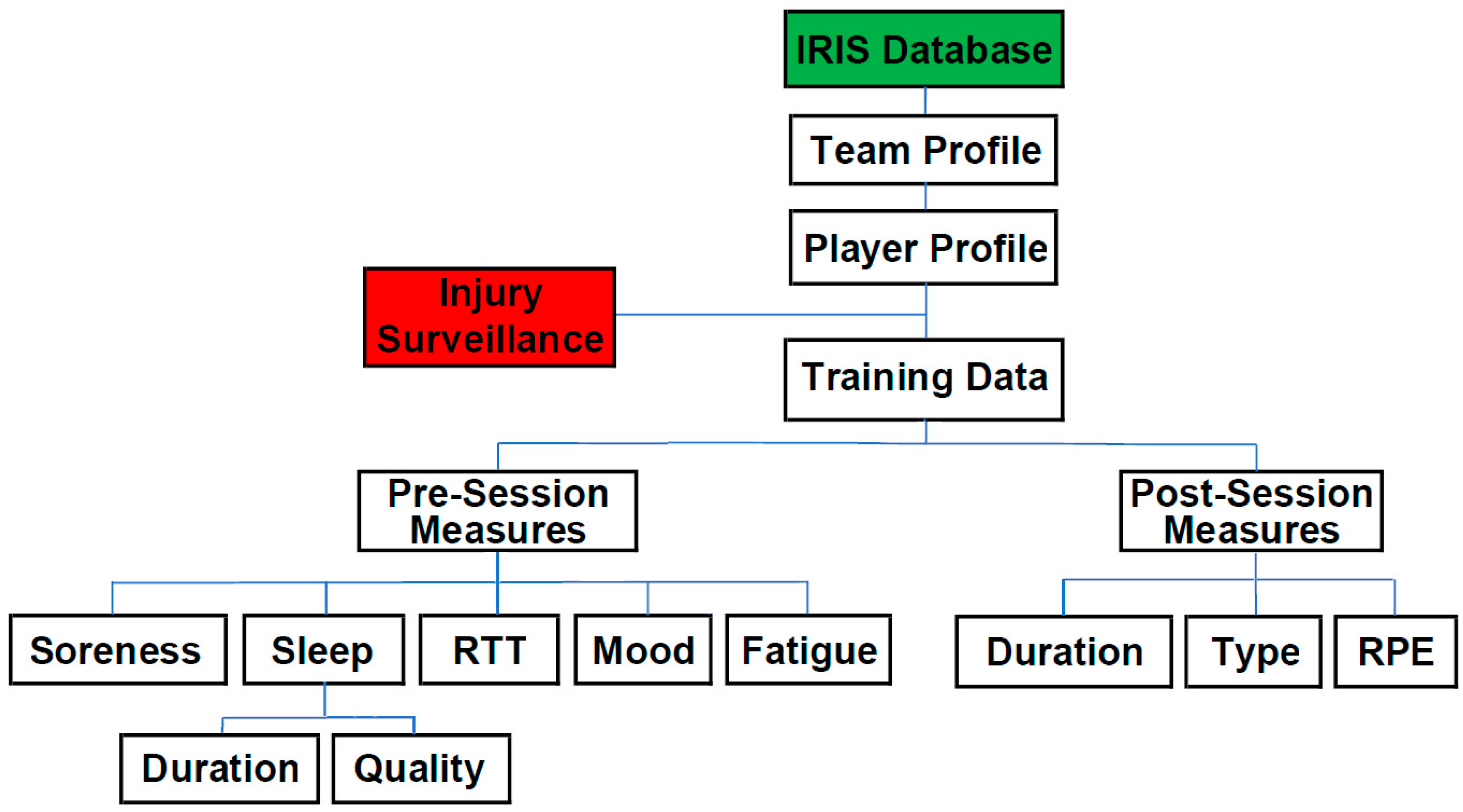
2.2. The Development of Training Monitoring System
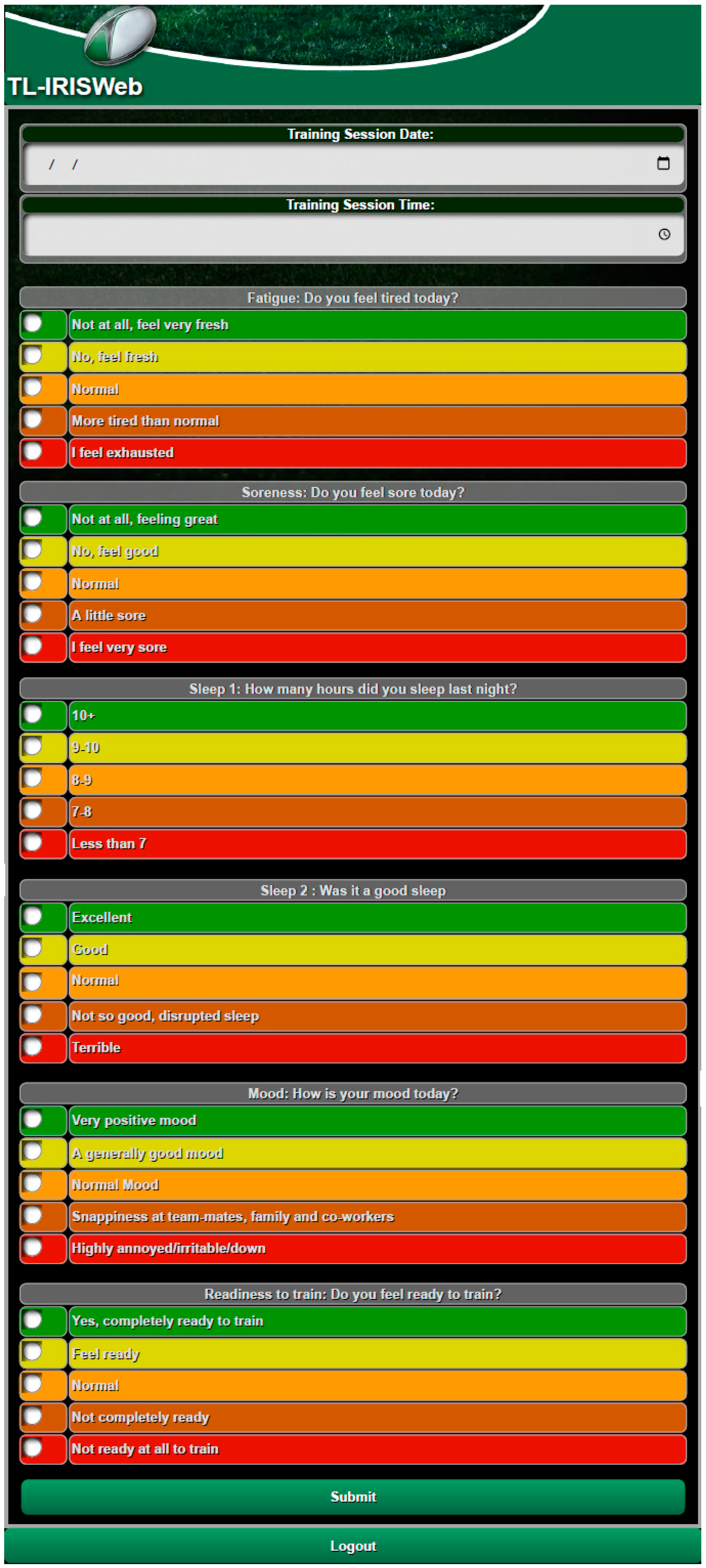
2.2.1. Pre-Session Measures
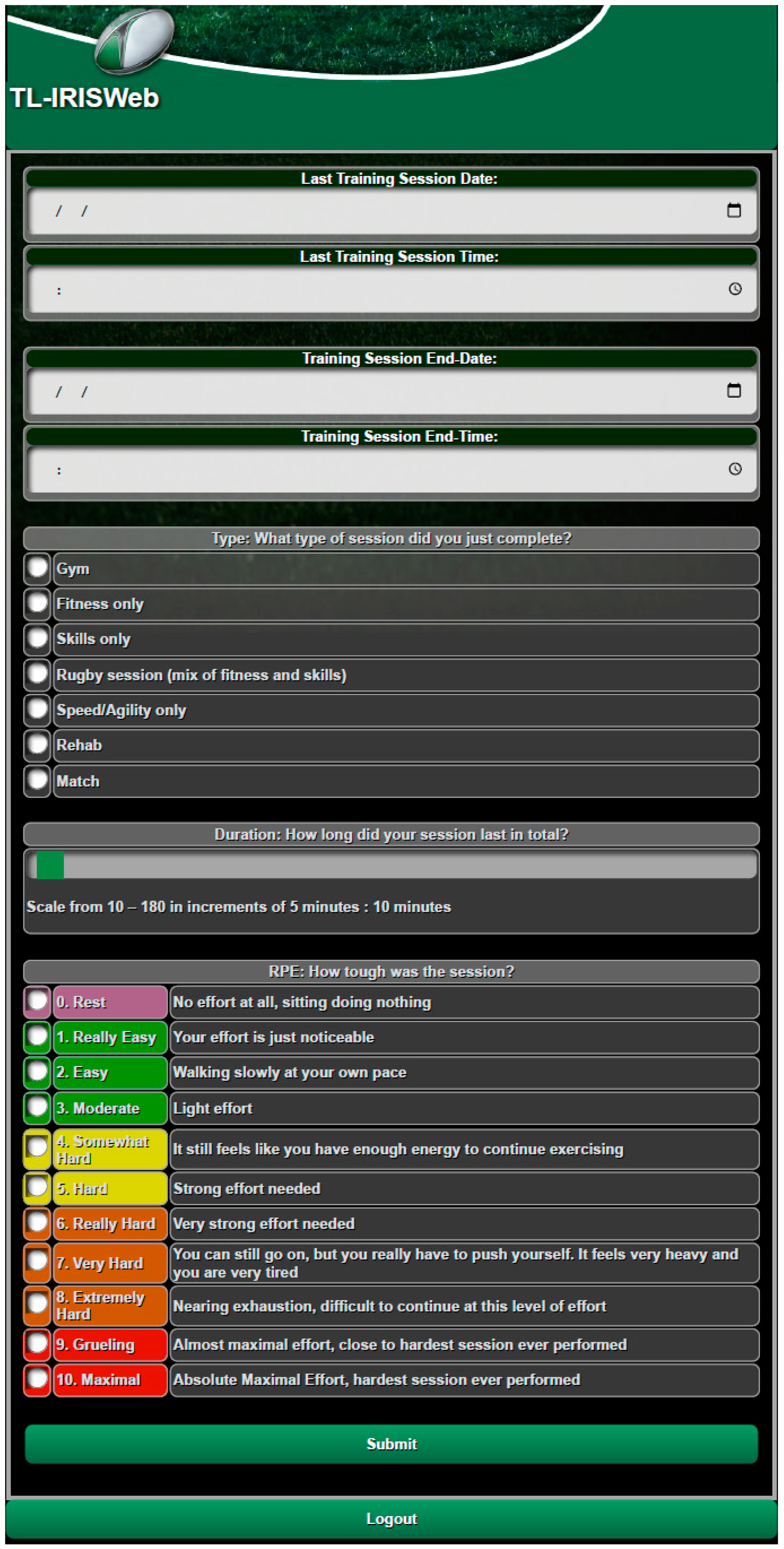
2.2.2. Post-Session Measures
2.3. Recruitment and Introduction to the Training Monitoring System
2.4. Weekly Training Report
2.5. Evaluation of the Training Monitoring System
2.5.1. Coach Interview
2.5.2. Player Survey
3. Results
3.1. Evaluation of the Training Monitoring System
3.1.1. Coach Interview
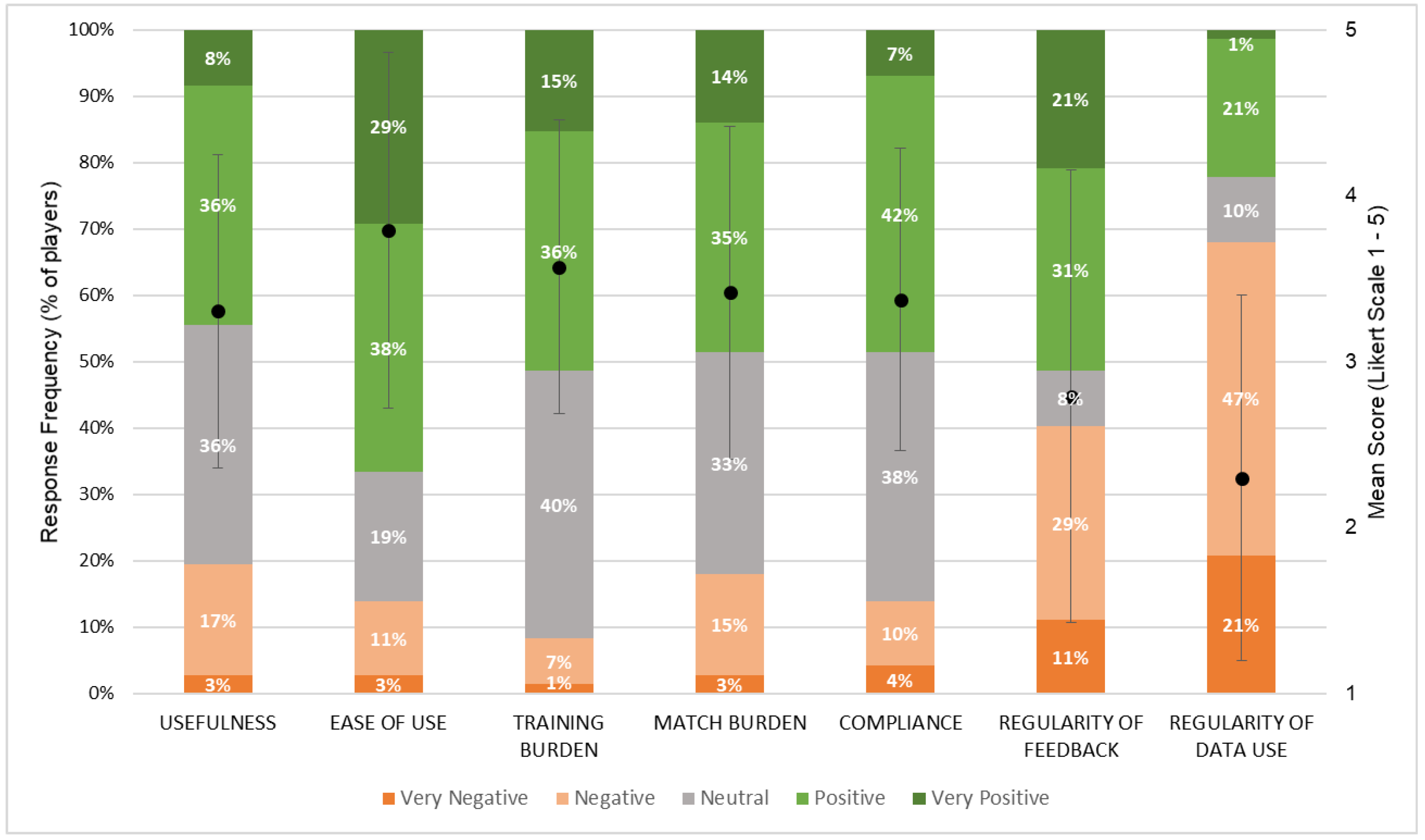
3.1.2. Player Survey
4. Discussion
4.1. Effectiveness of the Training Monitoring System
4.2. Subjective Measures of Monitoring Training
4.3. Lack of Universal Training Monitoring System
4.4. Challenges Associated with Monitoring Training
4.5. The Player Compliance—Coach Feedback Loop
4.6. Support to Strength and Conditioning Coaches
4.7. Training Monitoring System Functionality
4.8. Match-Day Challenges
4.9. Confounders External to Sport
4.10. Study Limitations
5. Conclusions
5.1. What Are the Key Findings?
- Both the strength and conditioning (S&C) coaches and players alike value an online training monitoring system (TMS) but the greatest barriers to its effectiveness are lack of player compliance, data inconsistency, gathering match data, and external confounders outside of the sport.
- Muscle soreness, fatigue, sleep duration and readiness to train (RTT) were highly rated as effective pre-session measures and are particularly useful at signalling red flags that prompt conversations between coaches and players.
- Session rating of perceived exertion (sRPE) was a highly rated metric by S&C coaches and players for aiding training prescription and mitigating injury risk.
5.2. What Are the Key Practical Applications for Coaches?
- This study provides further support to the use of subjective measures as a method of monitoring training. Their ease of use, accessibility and low cost make them practically applicable in the amateur setting.
- For players to engage with a TMS and give consistent data, they need regular feedback and evidence that the data are informing their training. This should aid in achieving consistent data from players and in turn improve the effectiveness of the TMS.
- S&C coaches should be aware that the temporal robustness of sRPE may alleviate the difficulties around collecting post-match sRPE.
- It is important that S&C coaches have the full support and assistance of all members of the coaching staff to ensure player compliance and to share the associated training monitoring and analysis demands.
6. Data Availability
Author Contributions
Funding
Acknowledgments
Conflicts of Interest
Appendix A. Copy of Coach Semi-Structured Interview and Survey

- 1.
- The interviewer explains the purpose and rationale of the study and describes the interview process. The participant is informed that participation is completely voluntary and that all responses are completely confidential and governed by our institutional ethics and GDPR.
- 2.
- Background information
- Pathway to their current position (previous experience, number of seasons with team, etc.)
- Typical weekly schedule with team
- Previous training load (TL) monitoring practices prior to this season
- 3.
- Coaches are asked to reflect on their experiences using the IRISweb training monitoring system. Focus of the conversation will be on the following 4 key areas:
- Use of the system
- ○
- Methods of getting compliance from players (if good compliance was achieved)
- ○
- Reasons for lack of compliance (if poor or no compliance was achieved)
- ○
- Reasons for initial participation
- ○
- Reasons for continual participation
- ○
- Reasons for drop-out (if applicable)
- ➢
- Survey questions 1 and 2 will be asked at this time
- Effectiveness of the system
- ○
- The effectiveness of the TL monitoring in terms of
- (1)
- enhancing player performance
- (2)
- reducing injury risk
- (3)
- TL prescription and training design
- ○
- Usefulness of the weekly TL report delivered by the research team in terms of (1), (2) and (3) above
- ○
- Usefulness of the pre-session measures in terms of (1), (2) and (3) above
- ○
- Usefulness of the post-session measures in terms of (1), (2) and (3) above
- ➢
- Survey questions 3, 4, 5, 6 and 7 will be asked at this time
- Use of the data
- ○
- How they used the data
- ○
- Had the data an influence on their training practice and prescription
- ○
- How did the data influence on training practice and prescription
- ○
- How they fed back information to the players
- ○
- What TL information did they feed back to the players
- ○
- Support from other coaching staff (i.e., did the other coaches take on board the information given)
- ➢
- Survey questions 8 and 9 will be asked at this time
- Changes required going forward
- ○
- Challenges or problems they met using the system
- ○
- Challenges their players met using the system
- ○
- Difference in players’ practices between match and training sessions
- ○
- Extent of burden placed on them and the players
- ○
- Changes needed to the system
- ○
- Ideal TL monitoring practices in terms of (1), (2) and (3)
- ➢
- Survey questions 10 will be asked at this time
- 1.
- Please rate the ease of use of the IRISweb Training Load Monitoring System.
| 1 | 2 | 3 | 4 | 5 |
| Very Poor | Poor | Neutral | Good | Very Good |
- 2.
- Please rate the IRISweb Training Load Monitoring System interface.
| 1 | 2 | 3 | 4 | 5 |
| Very Poor | Poor | Neutral | Good | Very Good |
- 3.
- Please rate how useful you found the IRISweb Training Load Monitoring System as a whole in terms of enhancing player performance.
| 1 | 2 | 3 | 4 | 5 |
| Very Poor | Poor | Neutral | Good | Very Good |
- 4.
- Please rate how useful you found the IRISweb Training Load Monitoring System as a whole in terms of reducing injury risk.
| 1 | 2 | 3 | 4 | 5 |
| Very Poor | Poor | Neutral | Good | Very Good |
- 5.
- Please rate how useful you found the IRISweb Training Load Monitoring System as a whole in terms of TL prescription and training design.
| 1 | 2 | 3 | 4 | 5 |
| Very Poor | Poor | Neutral | Good | Very Good |
- 6.
- Please rank the following measures in order of importance to your training prescription practices throughout the season-1 being the most important to you and 7 the least important to you.
| Measure | Rating (1–7) |
| Muscle soreness | |
| Sleep duration | |
| Sleep quality | |
| Mood | |
| Fatigue | |
| Readiness | |
| Training Load (RPE x duration) |
- 7.
- Please rank the following measures in order of importance to reduction of injury risk throughout the season-1 being the most important to you and 7 the least important to you.
| Measure | Rating (1–7) |
| Muscle soreness | |
| Sleep duration | |
| Sleep quality | |
| Mood | |
| Fatigue | |
| Readiness | |
| Training Load (RPE x duration) |
- 8.
- Did you give feedback on the data gathered to the players?
| 1 | 2 | 3 | 4 | 5 |
| Never | Seldom | Somewhat | Often | Always |
- 9.
- Did you change your usual training/match preparation based on the data gathered?
| 1 | 2 | 3 | 4 | 5 |
| Never | Seldom | Somewhat | Often | Always |
- 10.
- If the IRISweb Training Load Monitoring System had to be streamlined, what 3 measures would you keep?
| Measure | Select 3 |
| Muscle soreness | |
| Sleep duration | |
| Sleep quality | |
| Mood | |
| Fatigue | |
| Readiness | |
| Training Load (RPE x duration) |
Appendix B. Copy of Player Survey

- Please rate how useful the IRISweb Training Load Monitoring System as a whole was to you and your team.
- ○
- Extremely useful (1)
- ○
- Very useful (2)
- ○
- Moderately useful (3)
- ○
- Not very useful (4)
- ○
- Not at all useful (5)
- 2.
- Please rate the ease of use of the IRISweb Training Load Monitoring System.
- ○
- Very easy (1)
- ○
- Easy (2)
- ○
- Neutral (3)
- ○
- Not easy (4)
- ○
- Difficult (5)
- 3.
- How burdensome/demanding did you find using the IRISweb Training Load Monitoring System before and after training sessions?
- ○
- Not at all (1)
- ○
- Not very (2)
- ○
- Somewhat (3)
- ○
- Very (4)
- ○
- Extremely (5)
- 4.
- How burdensome/demanding did you find using the IRISweb Training Load Monitoring System before and after matches?
- ○
- Not at all (1)
- ○
- Not very (2)
- ○
- Somewhat (3)
- ○
- Very (4)
- ○
- Extremely (5)
- 5.
- During the season, how compliant do you feel you were at using the IRISweb Training Load Monitoring System before and after all trainings and matches?
- ○
- Never used it (1)
- ○
- Rarely used it (2)
- ○
- Used it sometimes (3)
- ○
- Used it most of the time (4)
- ○
- Always used it (5)
- 6.
- How often, if at all, did you receive feedback on your data from your Strength and Conditioning Coach?
- ○
- Always (1)
- ○
- Most of the time (2)
- ○
- About half the time (3)
- ○
- Sometimes (4)
- ○
- Never (5)
- 7.
- Please supply detail of how you received this feedback (e.g., what feedback you received and how you received it).
- 8.
- How often, if at all, did you or your coach change your usual training/match preparation based on your use of the IRISweb Training Load Monitoring System?
- ○
- Always (1)
- ○
- Most of the time (2)
- ○
- About half the time (3)
- ○
- Sometimes (4)
- ○
- Never (5)
- 9.
- Please rank the following measures in order of usefulness to your own training/match preparation: 1 being the most useful to you and 7 the least useful to you. Note: drag and drop
- ______ Muscle Soreness (1)
- ______ Readiness to train (2)
- ______ Sleep Duration (3)
- ______ Sleep Quality (4)
- ______ Mood (5)
- ______ Fatigue (6)
- ______ Training Load (RPE x duration) (7)
- 10.
- Please rank the following measures in order of usefulness to reducing your risk of injury: 1 being the most useful to you and 7 the least useful to you. Note: drag and drop
- ______ Muscle Soreness (1)
- ______ Readiness to train (2)
- ______ Sleep Duration (3)
- ______ Sleep Quality (4)
- ______ Mood (5)
- ______ Fatigue (6)
- ______ Training Load (RPE x duration) (7)
- 11.
- If the IRISweb Training Load Monitoring System had to be streamlined, what 3 measures would you keep?
- ▢
- Muscle Soreness (1)
- ▢
- Readiness to train (2)
- ▢
- Sleep Duration (3)
- ▢
- Sleep Quality (4)
- ▢
- Mood (5)
- ▢
- Fatigue (6)
- ▢
- Training Load (RPE x duration) (7)
- 12.
- Did you encounter any problems or difficulties using the IRISweb Training Load Monitoring System? Please give details.
- 13.
- If your club used the IRISweb Training Load Monitoring System again next season, what changes do you think should be made?
References
- Saw, A.E.; Main, L.C.; Gastin, P.B. Monitoring the athlete training response: Subjective self-reported measures trump commonly used objective measures: A systematic review. Br. J. Sports Med. 2016, 50, 281–291. [Google Scholar] [CrossRef] [PubMed]
- Coyne, J.O.C.; Gregory Haff, G.; Coutts, A.J.; Newton, R.U.; Nimphius, S. The current state of subjective training load monitoring-a practical perspective and call to action. Sports Med. Open 2018, 4, 58. [Google Scholar] [CrossRef] [PubMed]
- Griffin, A.; Kenny, I.C.; Comyns, T.M.; Lyons, M. The association between the acute: Chronic workload ratio and injury and its application in team sports: A systematic review. Sports Med. 2020, 50, 561–580. [Google Scholar] [CrossRef] [PubMed]
- Saw, A.E.; Main, L.C.; Gastin, P.B. Monitoring athletes through self-report: Factors influencing implementation. J. Sports Sci. Med. 2015, 14, 137–146. [Google Scholar] [PubMed]
- Soligard, T.; Schwellnus, M.; Alonso, J.M.; Bahr, R.; Clarsen, B.; Dijkstra, H.P.; Gabbett, T.; Gleeson, M.; Hägglund, M.; Hutchinson, M.R.; et al. How much is too much? (Part 1) International Olympic Committee consensus statement on load in sport and risk of injury. Br. J. Sports Med. 2016, 50, 1030–1041. [Google Scholar] [CrossRef] [PubMed]
- Halson, S.L. Monitoring training load to understand fatigue in athletes. Sports Med. 2014, 44, 139–147. [Google Scholar] [CrossRef] [PubMed]
- Griffin, A.; Kenny, I.C.; Comyns, T.M.; Lyons, M. Training Load Monitoring in Amateur Rugby Union: A Survey of Current Practices. J. Strength Cond. Res. 2020. [Google Scholar] [CrossRef]
- Eckard, T.G.; Padua, D.A.; Hearn, D.W.; Pexa, B.S.; Frank, B.S. The relationship between training load and injury in athletes: A systematic review. Sports Med. 2018, 48, 1929–1961. [Google Scholar] [CrossRef]
- Collette, R.; Kellmann, M.; Ferrauti, A.; Meyer, T.; Pfeiffer, M. Relation between training load and recovery-stress state in high-performance swimming. Front. Physiol. 2018, 9, 845. [Google Scholar] [CrossRef]
- Drew, M.K.; Finch, C.F. The relationship between training load and injury, illness and soreness: A systematic and literature review. Sports Med. 2016, 46, 861–883. [Google Scholar] [CrossRef]
- Drew, M.K.; Raysmith, B.P.; Charlton, P.C. Injuries impair the chance of successful performance by sportspeople: A systematic review. Br. J. Sports Med. 2017, 51, 1209–1214. [Google Scholar] [CrossRef]
- McCall, A.; Dupont, G.; Ekstrand, J. Internal workload and non-contact injury: A one-season study of five teams from the UEFA Elite Club Injury Study. Br. J. Sports Med. 2018, 52, 1517–1522. [Google Scholar] [CrossRef]
- Hamlin, M.J.; Wilkes, D.; Elliot, C.A.; Lizamore, C.A.; Kathiravel, Y. Monitoring training loads and perceived stress in young elite university athletes. Front. Physiol. 2019, 10, 34. [Google Scholar] [CrossRef]
- McGuigan, H.; Hassmén, P.; Rosic, N.; Stevens, C.J. Training monitoring methods used in the field by coaches and practitioners: A systematic review. Int. J. Sports Sci. Coach. 2020, 15, 439–451. [Google Scholar] [CrossRef]
- Donaldson, A.; Finch, C. Planning for implementation and translation: Seek first to understand the end-users’ perspectives. Br. J. Sports Med. 2012, 46, 306–307. [Google Scholar] [CrossRef] [PubMed]
- World Rugby. Year in Review 2018. Available online: http://publications.worldrugby.org/yearinreview2018/en/8-1 (accessed on 10 May 2020).
- Chalmers, D.J.; Samaranayaka, A.; Gulliver, P.; McNoe, B. Risk factors for injury in rugby union football in New Zealand: A cohort study. Br. J. Sports Med. 2012, 46, 95–102. [Google Scholar] [CrossRef]
- Yeomans, C.; Kenny, I.C.; Cahalan, R.; Warrington, G.D.; Harrison, A.J.; Hayes, K.; Lyons, M.; Campbell, M.J.; Glynn, L.G.; Comyns, T.M. The incidence of injury in amateur male rugby Union: A systematic review and meta-analysis. Sports Med. 2018, 48, 837–848. [Google Scholar] [CrossRef] [PubMed]
- Gouttebarge, V.; Tol, J.L.; Kerkhoffs, G.M. Epidemiology of symptoms of common mental disorders among elite Gaelic athletes: A prospective cohort study. Phys. Sportsmed. 2016, 44, 283–289. [Google Scholar] [CrossRef] [PubMed]
- Manley, G.; Gardner, A.J.; Schneider, K.J.; Guskiewicz, K.M.; Bailes, J.; Cantu, R.C.; Castellani, R.J.; Turner, M.; Jordan, B.D.; Randolph, C.; et al. A systematic review of potential long-term effects of sport-related concussion. Br. J. Sports Med. 2017, 51, 969–977. [Google Scholar] [CrossRef]
- McCrory, P.; Meeuwisse, W.; Dvorak, J.; Aubry, M.; Bailes, J.; Broglio, S.; Cantu, R.C.; Cassidy, D.; Echemendia, R.J.; Castellani, R.J.; et al. Consensus statement on concussion in sport—The 5th international conference on concussion in sport held in Berlin, October 2016. Br. J. Sports Med. 2017, 51, 838–847. [Google Scholar]
- Rice, S.M.; Purcell, R.; De Silva, S.; Mawren, D.; McGorry, P.D.; Parker, A.G. The mental health of elite athletes: A narrative systematic review. Sports Med. 2016, 46, 1333–1353. [Google Scholar] [CrossRef]
- West, S.W.; Williams, S.; Kemp, S.; Eager, R.; Cross, M.J.; Stokes, K.A. Training load, injury burden, and team success in professional rugby union: Risk versus reward. J. Athl. Train. 2020, 55, 960–966. [Google Scholar] [CrossRef] [PubMed]
- Yeomans, C.; Kenny, I.C.; Cahalan, R.; Warrington, G.D.; Harrison, A.J.; Hayes, K.; Lyons, M.; Campbell, M.J.; Glynn, L.G.; Comyns, T.M. The design, development, implementation and evaluation of IRISweb, A rugby-specific web-based injury surveillance system. Phys. Ther. Sport 2019, 35, 79–88. [Google Scholar] [CrossRef]
- Gastin, P.B.; Meyer, D.; Robinson, D. Perceptions of wellness to monitor adaptive responses to training and competition in elite Australian football. J. Strength Cond. Res. 2013, 27, 2518–2526. [Google Scholar] [CrossRef] [PubMed]
- Mah, C.D.; Kezirian, E.J.; Marcello, B.M.; Dement, W.C. Poor sleep quality and insufficient sleep of a collegiate student-athlete population. Sleep Health 2018, 4, 251–257. [Google Scholar] [CrossRef]
- Roe, G.; Darrall-Jones, J.; Till, K.; Phibbs, P.; Read, D.; Weakley, J.; Roch, A.; Jones, B. The effect of physical contact on changes in fatigue markers following rugby union field-based training. Eur. J. Sport Sci. 2017, 17, 647–655. [Google Scholar] [CrossRef]
- Sampson, J.A.; Murray, A.; Williams, S.; Sullivan, A.; Fullagar, H.H. Subjective wellness, acute: Chronic workloads, and injury risk in college football. J. Strength Cond. Res. 2019, 33, 3367–3373. [Google Scholar] [CrossRef]
- Wellman, A.D.; Coad, S.C.; Flynn, P.J.; Climstein, M.; McLellan, C.P. Movement demands and perceived wellness associated with preseason training camp in NCAA Division I college football players. J. Strength Cond. Res. 2017, 31, 2704–2718. [Google Scholar] [CrossRef] [PubMed]
- Gruet, M.; Temesi, J.; Rupp, T.; Levy, P.; Millet, G.Y.; Verges, S. Stimulation of the motor cortex and corticospinal tract to assess human muscle fatigue. Neuroscience 2013, 231, 384–399. [Google Scholar] [CrossRef]
- Wan, J.J.; Qin, Z.; Wang, P.Y.; Sun, Y.; Liu, X. Muscle fatigue: General understanding and treatment. Exp. Mol. Med. 2017, 49, e384. [Google Scholar] [CrossRef]
- Tavares, F.; Smith, T.B.; Driller, M. Fatigue and recovery in rugby: A review. Sports Med. 2017, 47, 1515–1530. [Google Scholar] [CrossRef]
- Lewis, P.B.; Ruby, D.; Bush-Joseph, C.A. Muscle soreness and delayed-onset muscle soreness. Clin. Sports Med. 2012, 31, 255–262. [Google Scholar] [CrossRef]
- McLean, B.D.; Coutts, A.J.; Kelly, V.; McGuigan, M.R.; Cormack, S.J. Neuromuscular, endocrine, and perceptual fatigue responses during different length between-match microcycles in professional rugby league players. Int. J. Sports Physiol. Perform. 2010, 5, 367–383. [Google Scholar] [CrossRef]
- Taylor, K.; Chapman, D.; Cronin, J.; Newton, M.J.; Gill, N. Fatigue monitoring in high performance sport: A survey of current trends. J. Aust. Strength Cond. 2012, 20, 12–23. [Google Scholar]
- Saner, N.J.; Lee, M.J.; Pitchford, N.W.; Kuang, J.; Roach, G.D.; Garnham, A.; Stokes, T.; Phillips, S.M.; Bishop, D.J.; Bartlett, J.D. The effect of sleep restriction, with or without high-intensity interval exercise, on myofibrillar protein synthesis in healthy young men. J. Physiol. 2020, 598, 1523–1536. [Google Scholar] [CrossRef]
- Weston, M.; Siegler, J.; Bahnert, A.; McBrien, J.; Lovell, R. The application of differential ratings of perceived exertion to Australian Football League matches. J. Sci. Med. Sport 2015, 18, 704–708. [Google Scholar] [CrossRef]
- Milewski, M.D.; Skaggs, D.L.; Bishop, G.A.; Pace, J.L.; Ibrahim, D.A.; Wren, T.A.; Barzdukas, A. Chronic lack of sleep is associated with increased sports injuries in adolescent athletes. J. Pediatr. Orthop. 2014, 34, 129–133. [Google Scholar] [CrossRef]
- Watson, A.; Brickson, S.; Brooks, A.; Dunn, W. Subjective well-being and training load predict in-season injury and illness risk in female youth soccer players. Br. J. Sports Med. 2017, 51, 194–199. [Google Scholar] [CrossRef]
- Wilhelm, P.; Schoebi, D. Assessing Mood in Daily Life. Eur. J. Psychol. Assess. 2007, 23, 258–267. [Google Scholar] [CrossRef]
- Lombard, W.; Starling, L.; Wewege, L.; Lambert, M. Changes in countermovement jump performance and subjective readiness-to-train scores following a simulated soccer match. Eur. J. Sport Sci. 2020. [Google Scholar] [CrossRef]
- Serafim, T.H.; Tognato, A.C.; Nakamura, P.M.; Queiroga, M.R.; Pereira, G.; Nakamura, F.Y.; Kokubun, E. Development of the color scale of perceived exertion: Preliminary validation. Percept. Mot. Skills 2014, 119, 884–900. [Google Scholar] [CrossRef]
- Chen, M.J.; Fan, X.; Moe, S.T. Criterion-related validity of the Borg ratings of perceived exertion scale in healthy individuals: A meta-analysis. J. Sports Sci. 2002, 20, 873–899. [Google Scholar] [CrossRef]
- Foster, C.; Florhaug, J.A.; Franklin, J.; Gottschall, L.; Hrovatin, L.A.; Parker, S.; Doleshal, P.; Dodge, C. A new approach to monitoring exercise training. J. Strength Cond. Res. 2001, 15, 109–115. [Google Scholar] [PubMed]
- Braun, V.; Clarke, V. Using thematic analysis in psychology. Qual. Res. 2006, 3, 77–101. [Google Scholar] [CrossRef]
- Neupert, E.C.; Cotterill, S.T.; Jobson, S.A. Training-monitoring engagement: An evidence-based approach in elite sport. Int. J. Sports Physiol. Perform. 2019, 14, 99–104. [Google Scholar] [CrossRef]
- Burgess, D.J. The research doesn’t always apply: Practical solutions to evidence-based training-load monitoring in elite team sports. Int. J. Sports Physiol Perform. 2017, 2 (Suppl. 2), S2136–S2141. [Google Scholar] [CrossRef]
- Bourdon, P.C.; Cardinale, M.; Murray, A.; Gastin, P.; Kellmann, M.; Varley, M.C.; Gabbett, T.J.; Coutts, A.J.; Burgess, D.J.; Gregson, W.; et al. Monitoring athlete training loads: Consensus statement. Int. J. Sports Physiol. Perform. 2017, 12, S2161–S2170. [Google Scholar] [CrossRef]
- Gabbett, T.J.; Nassis, G.P.; Oetter, E.; Pretorius, J.; Johnston, N.; Medina, D.; Rodas, G.; Myslinski, T.; Howells, D.; Beard, A.; et al. The athlete monitoring cycle: A practical guide to interpreting and applying training monitoring data. Br. J. Sports Med. 2017, 51, 1451–1452. [Google Scholar] [CrossRef]
- Altini, M.; Amft, O. HRV4Training: Large-scale longitudinal training load analysis in unconstrained free-living settings using a smartphone application. In Proceedings of the Annual International Conference of the IEEE Engineering in Medicine and Biology Society, Orlando, FL, USA, 16–20 August 2016; pp. 2610–2613. [Google Scholar]
- Ihsan, M.; Tan, F.; Sahrom, S.; Choo, H.C.; Chia, M.; Aziz, A.R. Pre-game perceived wellness highly associates with match running performances during an international field hockey tournament. Eur. J. Sport Sci. 2017, 17, 593–602. [Google Scholar] [CrossRef]
- Doeven, S.H.; Brink, M.S.; Kosse, S.J.; Lemmink, K.A. Postmatch recovery of physical performance and biochemical markers in team ball sports: A systematic review. BMJ Open Sport Exerc. Med. 2018, 4, e000264. [Google Scholar] [CrossRef]
- Akenhead, R.; Nassis, G.P. Training load and player monitoring in high-level football: Current practice and perceptions. Int. J. Sport Physiol. Perform. 2016, 11, 587–593. [Google Scholar] [CrossRef]
- Fessi, M.S.; Moalla, W. Postmatch perceived exertion, feeling, and wellness in professional soccer players. Int. J. Sports Physiol. Perform. 2018, 13, 631–637. [Google Scholar] [CrossRef]
- Christen, J.; Foster, C.; Porcari, J.P.; Mikat, R.P. Temporal robustness of the session rating of perceived exertion. Int. J. Sports Physiol. Perform. 2016, 11, 1088–1093. [Google Scholar] [CrossRef]
- Williams, S.; Trewartha, G.; Kemp, S.; Stokes, K. A meta-analysis of injuries in senior men’s professional Rugby Union. Sports Med. 2013, 43, 1043–1055. [Google Scholar] [CrossRef]
- Novick, G. Is there a bias against telephone interviews in qualitative research? Res. Nurs. Health 2008, 31, 391–398. [Google Scholar] [CrossRef] [PubMed]
- Drabble, L.; Trocki, K.F.; Salcedo, B.; Walker, P.C.; Korcha, R.A. Conducting qualitative interviews by telephone: Lessons learned from a study of alcohol use among sexual minority and heterosexual women. Qual. Soc. Work 2016, 15, 118–133. [Google Scholar] [CrossRef]



| Section | Example Prompts |
|---|---|
| Coach and team profile | Was this your first season with the team? Were there any training monitoring practices in place prior to this season? What was the team’s typical weekly training schedule? |
| Coach and player system use | What were your methods of introducing the system to the team? How did you attempt to ensure compliance from players? What were you hoping to get out of using the system? |
| System uptake and effectiveness | How effective was the training monitoring system in terms of (1) enhancing player performance (2) reducing injury risk and (3) training load prescription and training design? How useful did you find the pre-session measures in terms of (1), (2) and (3) above? How useful were the post-session measures in terms of (1), (2) and (3) above? |
| Coach’s use of the data | Did the data influence your training practice and prescription? How was information fed back to the players? Did you have the support from other coaching staff? |
| Challenges met and changes recommended | What challenges or problems did you meet using the system? What do you think was the extent of burden placed on you and the players? What changes to the system do you think are needed? Would you use the system again next season? |
| Theme | Representative Quotes | No. of Responses |
|---|---|---|
| Training prescription and design | “You can have GPS systems and heart rate and those things, but I find the subjective measures really help you know when you can push on or when you need to take a step back in terms of load. There were a few occasions where I saw things in the data that resulted in me talking to the coaches and the player and adjusting training.” (Coach 2) “We tweaked our training a little bit based on the data, particularly if we noticed a hard week.” (Coach 3) “It made me look at chronic load more and ACWR more than what I had previously done.” (Coach 6) | 4 |
| Injury risk reduction | “The data definitely started some conversations that could have potentially prevented injury. For instance, the sleep data was useful to see that a lot of other players weren’t getting enough sleep, so we were able to address that. Again, it started a conversation with those players. So, it did help with changing some behaviours that may have helped prevent injuries.” (Coach 1) “Being able to know if a session was an 8 or 9 RPE and then knowing to pull back for the next session will help with injury risk. It can also help to ensure that the players aren’t overloaded coming into a big match and that there is enough recovery before it. I think it can really help at reducing injury when you have compliance and when the data is used in the right way.” (Coach 2) “It was really good and likely prevented injuries.” (Coach 3) | 4 |
| Enhancing player performance | “What it was most useful for was after the tough Tuesday night session, if players were being flagged we could pull them out of that session and have them fully recovered and ready for selection on Saturday… maybe give them extra recovery work instead of training and see if we can get them right for the match. In that regard it can be very useful for match preparation. It is better we know early so we can be prepared rather than him pulling up in the warmup or early in the match.” (Coach 4) “It can also help to ensure that the players aren’t overloaded coming into a big match and that there is enough recovery before it.” (Coach 2) | 3 |
| Usefulness of pre-session measures | “I found the pre-session measures useful because the players that are working all day are coming to training and telling you how prepared they are for training and by giving me numbers for each measure I can then act on it by cutting them from certain parts of the training or whatever I think is necessary. That is massively beneficial. It’s a great conversation starter.” (Coach 6) “I thought the 1 to 5 scale worked quite well and I especially liked that it was coloured. When I was checking the data before the session the reds and oranges jumped out at me. When I saw them I knew I had to address it straight away before the session started. But the fact that it was coloured gave a good gauge of where the team was at. You might only have 10 min before the training session to look at the data, so the colours really help.” (Coach 1) “They tell me how up for the session they are, and its score would capture the way I would then communicate to them.” (Coach 5) “They were really effective as a conversation starter.” (Coach 1) | 4 |
| Usefulness of sRPE | “The sRPE data is the most useful for training design and prescription. It allows me to look back at the previous data and plan the future sessions.” (Coach 5) “Very important measure for us because it’s cheap, time efficient, and it gives you a solid number for load at the end of it.” (Coach 6) | 4 |
| Potential of weekly report | “If the players had been more consistent it would have been really useful.” (Coach 1) “If we had better buy-in across the panel the training load report would have been really useful.” (Coach 3) | 3 |
| Theme | Representative Quotes | No. of Responses |
|---|---|---|
| Lack of player compliance | “Even after the presentation they didn’t all see the value in it even though it was well explained to them. I know that was a problem and I heard players mentioned that.” (Coach 1) “I’m not sure the players understood that the reason we were collecting the data was to help them, it wasn’t to keep ourselves busy. I suppose it’s about changing their belief system and teaching them that monitoring is important for injury prevention and increasing their performance.” (Coach 2) “I think maybe the unknown was probably an issue. Some of the players just weren’t used to it, no fault on their part, they have just never been exposed to it…Then after a while my encouragement to get them to use it stopped because it was becoming too much work.” (Coach 4) | 6 |
| Data inconsistency | For the first couple of weeks there was good buy-in but then a lot of the players that were using it dropped off when they saw the other players not using it… I suppose us not acting on the data caused players to drop out but again that was because we weren’t getting consistent data. We weren’t able to get a clear picture of the whole squad so we didn’t feedback the data to the players as much as we should have and take action on the data.” (Coach 1) “Getting them to do it consistently is key even if it means you don’t get all the measures you want. If it becomes too much of a chore they won’t do it.” (Coach 2) “Because we had such a small group of players who were consistently using the system the data kind of got skewed a little bit. If we had better buy-in across the panel the weekly training report would have been really useful.” (Coach 3) | 6 |
| Match-day challenges | “Getting the players to give data on match days was a disaster. There are so many psychosocial factors going on. I didn’t like asking them to think about their state pre-game because it might highlight something negative in them… I just felt it was impractical as I wasn’t even going to be doing anything with the data at that stage.” (Coach 1) “Getting players to fill out their sRPE after a match is a nightmare. It’s a challenge because that is going to be the most difficult session of the week and probably the most important data to get.” (Coach 3) “It’s near impossible. It is very difficult to approach them before a game and I wouldn’t dare approach them asking them to fill in their data after a game if we lost. They don’t want to talk about it.” (Coach 6) | 6 |
| External Confounders | “In the amateur game, you can give them all the guidelines you want but because there are so many other factors, work, home life etc. that you can’t be guaranteed they’ll follow them… There are too many variables in the amateur game to control for. I think there’s a tendency to think that what works in the pro game transfers to the amateur game and that we should try to do exactly what they are doing but a lot of the time it doesn’t work.” (Coach 1) “I think it didn’t matter what we did this year just wasn’t going to work. This year nothing was right; eating, drinking, their behaviour off the field, nothing was right compared to the previous years. You could have said I’ll pay you a grand each to use the system and I don’t know if it would have made any difference.” (Coach 2) “We’ve quite a few guys who are in college but have part-time jobs at night, a lot of them in pubs. On Wednesday nights they could be working until 3 in the morning and then getting up for a lecture at 9. Then we were wondering why they were training so poorly on a Thursday night.” (Coach 3) “Because so many of our players are working class, doing jobs like labouring or construction, really taxing work on the body, they were the poorest at filling in their TL data but they are probably the ones you want the most. They’d have no problem having a chat with you about how they were feeling physically but to get them to actively fill in something is a struggle.” (Coach 6) | 6 |
| Lack of support | “The other coaches did buy-in in the sense they knew why it would be good to use but at the same time they left it to me. They didn’t want to worry too much about it.” (Coach 4) “The head coach was very supportive of it, but the skills coach was not supportive of it whatsoever. That just wasn’t good enough because everything starts at the top. Fortunately, the head coach really believed in it, but the other coach has such a pull… In my opinion for a monitoring system like this to be effective and get total adherence every coach needs to be 100% on board.” (Coach 6) “Trying to chase players to fill in data and then trying to collate and analyse the data when you just don’t have the time to do it and more importantly you’re not getting paid to put in that extra time.” (Coach 6) | 3 |
| Player log-in issues | “The log-in tended to be an issue for the players, so not so much the system itself but the fact that they had to have a team PIN and their own PIN. That tended to cause issues for players, forgetting their passwords and having to be given it numerous times” (Coach 1) “Once you were in the system it was phenomenal, five out of five, really easy to use and really useful data but the getting in with the PINs was a barrier.” (Coach 3) | 3 |
| Ease of Use | Interface | Enhance Training Prescription | Reduce Injury Risk | Enhance Performance | Regularity of Feedback | Regularity of Data Use |
|---|---|---|---|---|---|---|
| 3.2 ± 1.0 | 4.2 ± 0.8 | 3.5 ± 0.8 | 3.5 ± 1.0 | 3.3 ± 0.5 | 2.0 ± 0.6 | 2.0 ± 0.6 |
| Coaches | Players | |||||||
|---|---|---|---|---|---|---|---|---|
| Training Prescription | Injury Risk | Preparation | Injury Risk | |||||
| Measures | Rank | Score (AU) | Rank | Score (AU) | Rank | Score (AU) | Rank | Score (AU) |
| Muscle Soreness | 3 | 27 | 2 | 30 | 1 | 359 | 1 | 383 |
| RTT | 5 | 21 | 5 | 22 | 3 | 300 | 4 | 309 |
| Sleep Duration | 2 | 28 | 3 | 27 | 7 | 223 | 6 | 203 |
| Sleep Quality | 4 | 25 | 4 | 25 | 6 | 244 | 5 | 252 |
| Mood | 7 | 9 | 7 | 8 | 5 | 253 | 7 | 167 |
| Fatigue | 6 | 18 | 6 | 17 | 2 | 350 | 2 | 352 |
| sRPE | 1 | 40 | 1 | 39 | 4 | 287 | 3 | 350 |
Publisher’s Note: MDPI stays neutral with regard to jurisdictional claims in published maps and institutional affiliations. |
© 2020 by the authors. Licensee MDPI, Basel, Switzerland. This article is an open access article distributed under the terms and conditions of the Creative Commons Attribution (CC BY) license (http://creativecommons.org/licenses/by/4.0/).
Share and Cite
Griffin, A.; Kenny, I.C.; Comyns, T.M.; Lyons, M. The Development and Evaluation of a Training Monitoring System for Amateur Rugby Union. Appl. Sci. 2020, 10, 7816. https://doi.org/10.3390/app10217816
Griffin A, Kenny IC, Comyns TM, Lyons M. The Development and Evaluation of a Training Monitoring System for Amateur Rugby Union. Applied Sciences. 2020; 10(21):7816. https://doi.org/10.3390/app10217816
Chicago/Turabian StyleGriffin, Alan, Ian C. Kenny, Thomas M. Comyns, and Mark Lyons. 2020. "The Development and Evaluation of a Training Monitoring System for Amateur Rugby Union" Applied Sciences 10, no. 21: 7816. https://doi.org/10.3390/app10217816
APA StyleGriffin, A., Kenny, I. C., Comyns, T. M., & Lyons, M. (2020). The Development and Evaluation of a Training Monitoring System for Amateur Rugby Union. Applied Sciences, 10(21), 7816. https://doi.org/10.3390/app10217816