

The Dysfunction of Mission-Oriented Innovation Policy: Impeding the Accumulation of Scientific Knowledge in the Japanese Academic Sector


Abstract
1. Introduction
2. Literature Review
2.1. Evolution of Innovation Policy
2.2. Mission-Oriented Innovation Policy
2.3. Changing the Academic Sector
3. Japanese Innovation Contexts
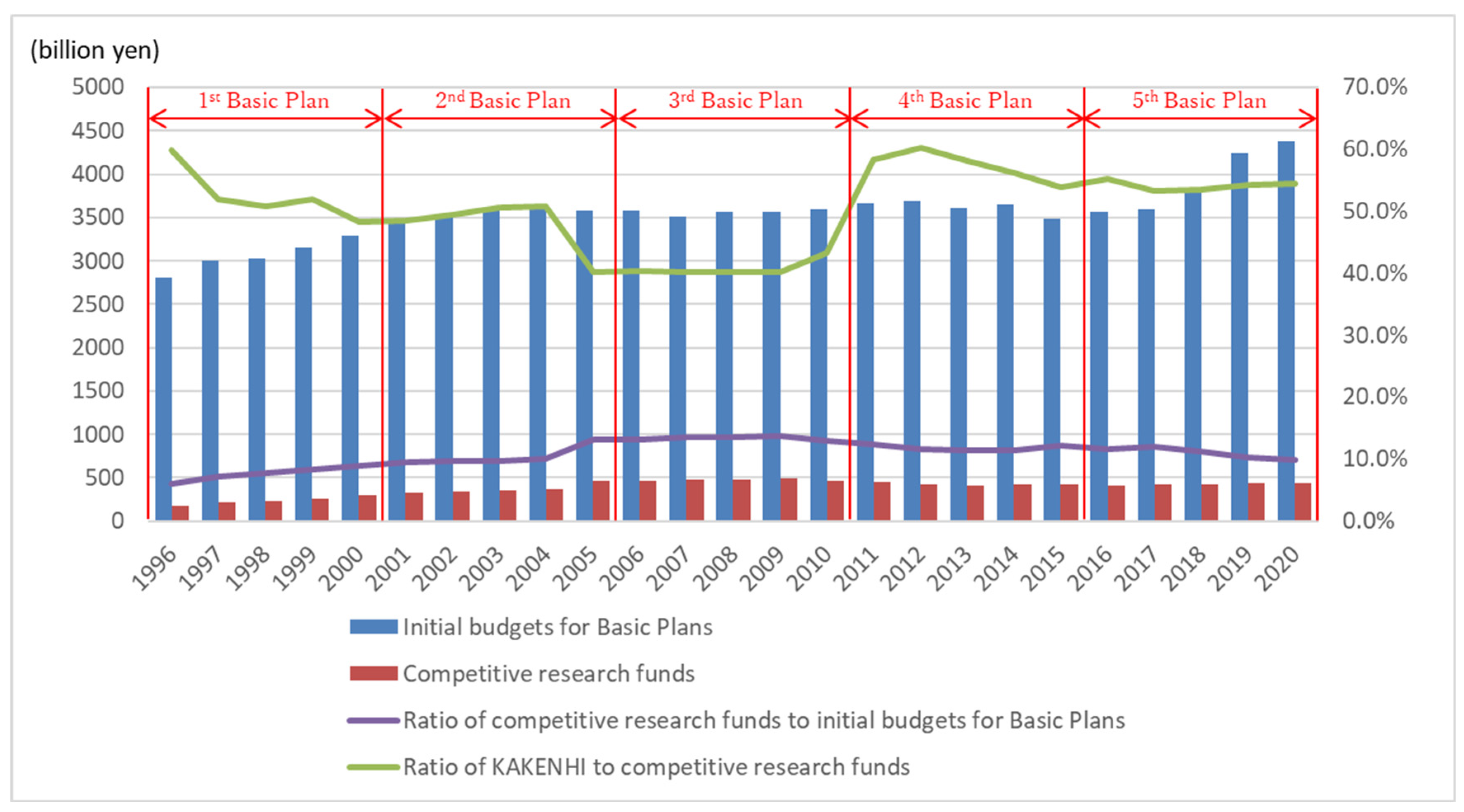
3.1. Transition of the Science and Technology Basic Plan and Competitive Research Funds
3.2. Transformation of S&T Basic Plans
3.3. Japanese University Reforms
4. Materials and Methods
4.1. Data Collection
4.2. Data Analysis
5. Results
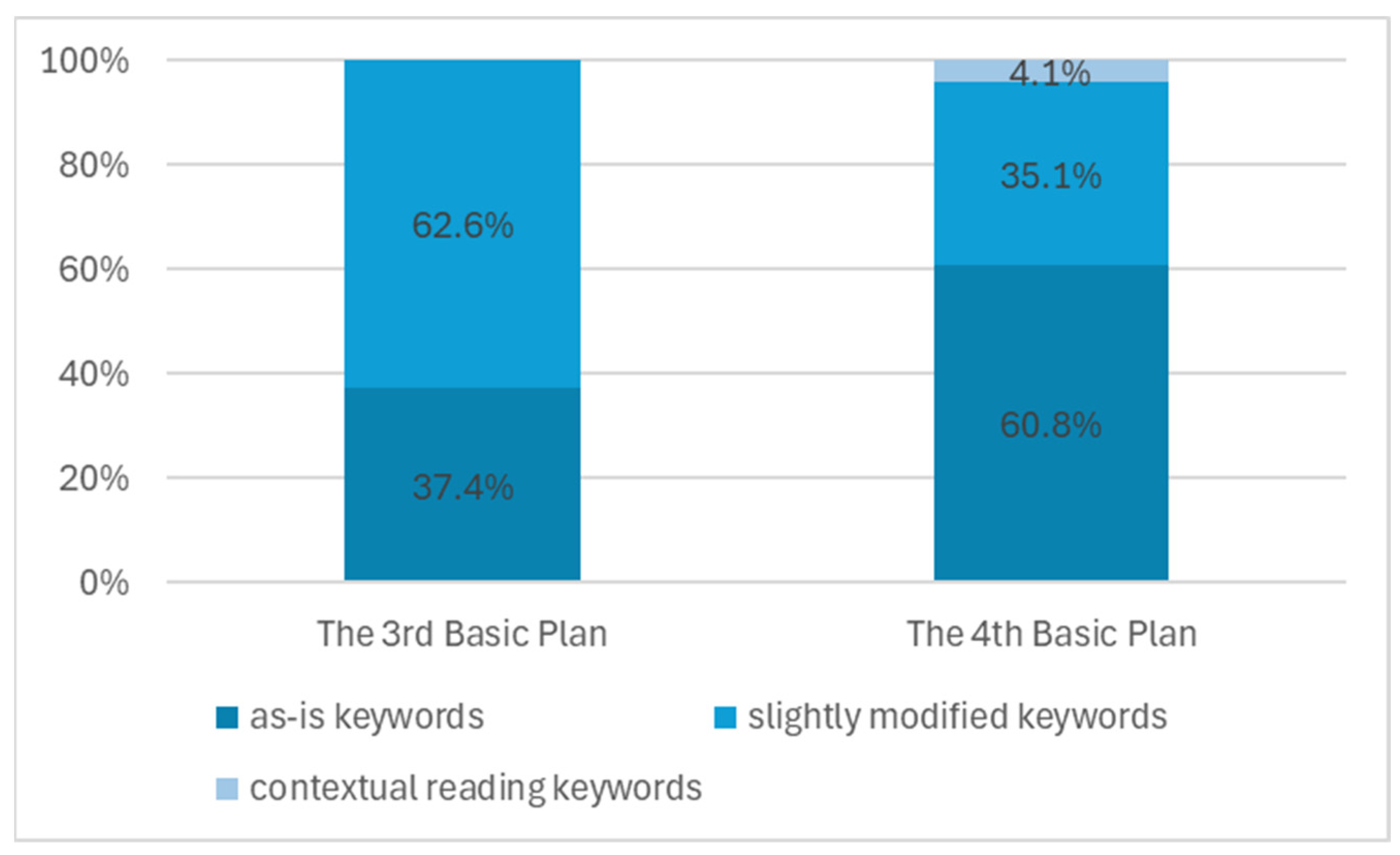
5.1. Responses of Researchers to the Innovation Policy
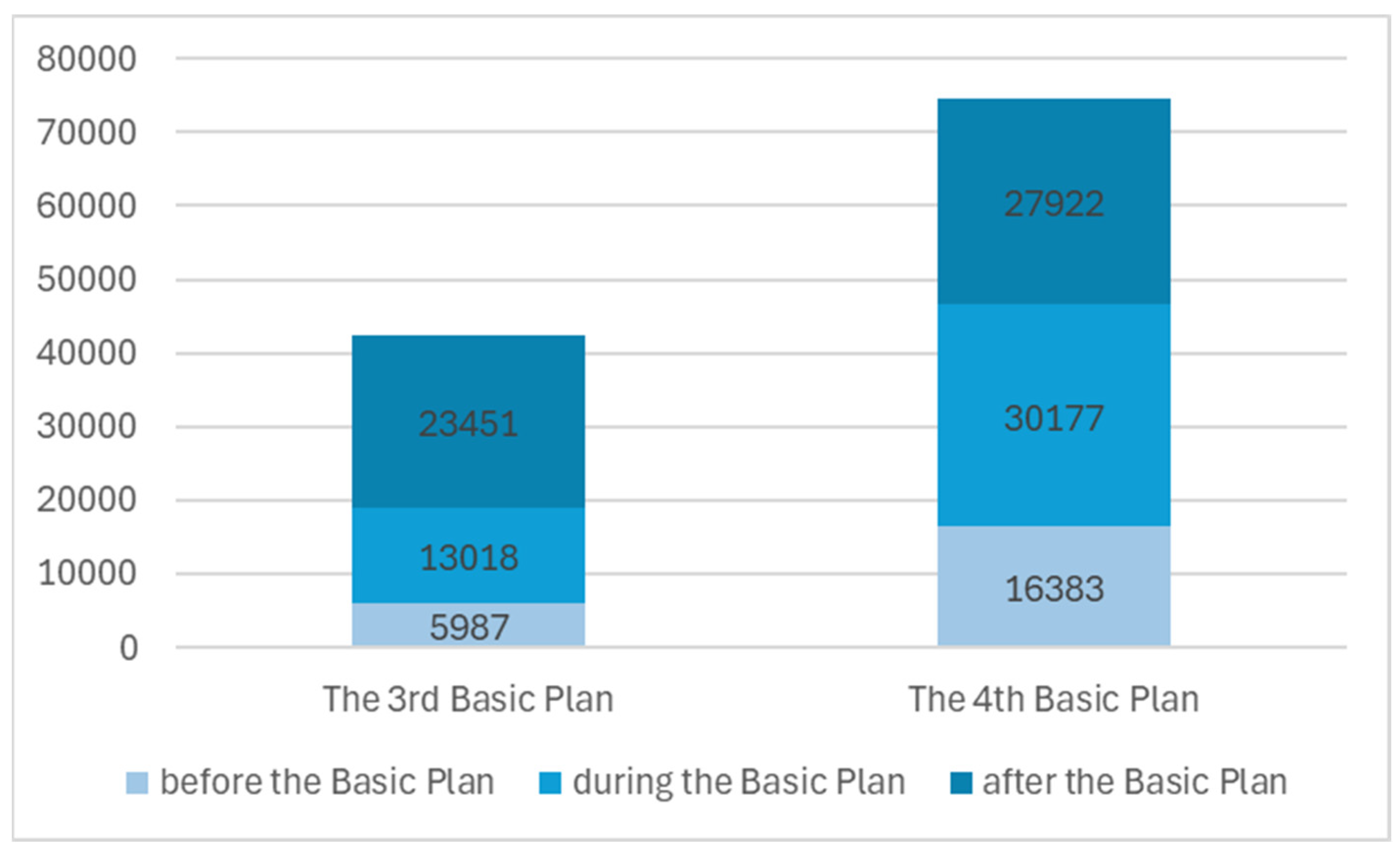
5.2. Progress of KAKENHI-Adopted Research Projects
6. Discussion
6.1. Contributions
6.2. Limitations
6.3. Future Research
7. Conclusions and Implications
Author Contributions
Funding
Institutional Review Board Statement
Informed Consent Statement
Data Availability Statement
Conflicts of Interest
Appendix A

| No | Keywords (Japanese) | Keywords (English) | Original Text (Page) |
|---|---|---|---|
| 1 | 3R消費 システム * | 3R Consumption System * | 環境分野:戦略3環境研究で国民の暮らしを守る…中略…○製品のライフサイクル全般を的確に評価し3Rに適した生産・消費システムを設計する科学技術<3R実践のためのシステム分析・評価・設計技術> (pp. 140–41) |
| 2 | 3R生産 システム * | 3R Production System * | 環境分野:戦略3環境研究で国民の暮らしを守る…中略…○製品のライフサイクル全般を的確に評価し3Rに適した生産・消費システムを設計する科学技術<3R実践のためのシステム分析・評価・設計技術> (pp. 140–41) |
| 3 | FBRサイクル 技術 * | FBR Cycle Technology * | エネルギー分野:<戦略3:基幹エネルギーとしての原子力の推進>○長期的なエネルギーの安定供給を確保する高速増殖炉 (FBR) サイクル技術(p. 231) |
| 4 | GTL 技術 | GTL Technology | エネルギー分野:<戦略2:運輸部門を中心とした石油依存からの脱却>…中略…○石油に代わる自動車用新液体燃料 (GTL) の最先端製造技術 (p. 230) |
| 5 | ITER 計画 | ITER Project | エネルギー分野:<戦略3:基幹エネルギーとしての原子力の推進>…中略…○国際協力で拓く核融合エネルギー:ITER計画 (pp. 230–31) |
| 6 | X線 自由電子レーザー | X-ray Free Electron Laser | ナノテクノロジー・材料分野:○『True Nano』や革新的材料技術によるイノベーションの創出を加速する推進基盤…中略…⑩X線自由電子レーザーの開発・共用(国家基幹技術) (pp. 190–91) |
| 7 | クリーンエネルギー コスト削減 材料技術 * | Clean Energy Cost Reduction Material Technology * | ナノテクノロジー・材料分野:○『True Nano』や革新的材料で困難な社会的課題を解決する科学技術。①クリーンなエネルギーの飛躍的なコスト削減を可能とする革新的材料技術 (p. 188) |
| 8 | コンテンツ 創造 技術 | Content Creation Technology | 情報通信分野:③すべての国民がITの恩恵を実感できる社会の実現…中略…【戦略重点科学技術9】世界と感動を共有するコンテンツ創造及び情報活用技術 (pp. 67–68) |
| 9 | ストレージ 中核 技術 | Storage Core Technology | 情報通信分野:②革新的IT技術による産業の持続的な発展の実現…中略…【戦略重点科学技術4】世界トップを走り続けるためのディスプレイ・ストレージ・超高速デバイスの中核技術 (pp. 65–66) |
| 10 | セキュリティ 技術 | Security Technology | 情報通信分野:③すべての国民がITの恩恵を実感できる社会の実現…中略…【戦略重点科学技術10】世界一安全・安心なIT社会を実現するセキュリティ技術 (pp. 67–69) |
| 11 | ソフトウェア開発 支援 技術 | Software Development Support Technology | 情報通信分野:②革新的IT技術による産業の持続的な発展の実現…中略…【戦略重点科学技術6】世界標準を目指すソフトウェアの開発支援技術 (pp. 65–66) |
| 12 | ディスプレイ 中核 技術 | Display Core Technology | 情報通信分野:②革新的IT技術による産業の持続的な発展の実現、…中略…【戦略重点科学技術4】世界トップを走り続けるためのディスプレイ・ストレージ・超高速デバイスの中核技術 (pp. 67–69) |
| 13 | ディスプレイ部材 製造 技術 * | Display Component Manufacturing Technology * | ものづくり技術分野:戦略重点科学技術(2)-資源・環境・人口制約を克服し、日本のフラッグシップとなる、ものづくりのプロセスイノベーション…中略…○超フレキシブルディスプレイ部材や超ハイブリッド部材の製造技術、ガラス材料の高機能化のための超精密加工技術等の新たな高付加価値材料を生み出す製造技術や加工技術 (p. 263) |
| 14 | ナノ 最先端 加工 技術 | Nano Cutting-edge Processing Technology | ナノテクノロジー・材料分野:○『True Nano』や革新的材料技術によるイノベーションの創出を加速する推進基盤…中略…⑨ナノ領域最先端計測・加工技術 (p. 190) |
| 15 | ナノ 最先端 計測 技術 | Leading-edge Nano Measurement Technology | ナノテクノロジー・材料分野:○『True Nano』や革新的材料技術によるイノベーションの創出を加速する推進基盤…中略…⑨ナノ領域最先端計測・加工技術 (p. 190) |
| 16 | ナノテクノロジー 実用化 | Practical Application of Nanotechnology | ナノテクノロジー・材料分野:○『True Nano』や革新的材料技術によるイノベーションの創出を加速する推進基盤…中略…⑧イノベーション創出拠点におけるナノテクノロジー実用化の先導革新研究開発 (p. 190) |
| 17 | ナノテクノロジー 社会 受容 | Social Acceptance of Nanotechnology | ナノテクノロジー・材料分野:○『True Nano』や革新的材料技術によるイノベーションの創出を加速する推進基盤。⑦ナノテクノロジーの社会受容のための研究開発 (p. 190) |
| 18 | ナノバイオ 技術 | Nano-biotechnology | ナノテクノロジー・材料分野:○『True Nano』で次世代のイノベーションを起こす科学技術…中略…⑥超早期診断と低侵襲治療の実現と一体化を目指す先端的ナノバイオ・医療技術 (pp. 189–90) |
| 19 | ナノ医療 技術 | Nano Medical Technology | ナノテクノロジー・材料分野:○『True Nano』で次世代のイノベーションを起こす科学技術…中略…⑥超早期診断と低侵襲治療の実現と一体化を目指す先端的ナノバイオ・医療技術 (p. 208) |
| 20 | バイオマス 利用 技術 | Biomass Utilization Technology | 環境分野:戦略2我が国が環境分野で国際貢献を果たし、国際協力でリーダーシップをとる…中略…○効率的にエネルギーを得るための地域に即したバイオマス利用技術<草木質系バイオマスエネルギー利用技術><持続可能型地域バイオマス利用システム技術> (p. 140) |
| 21 | ユビキタスネットワーク 利用 技術 | Ubiquitous Network Utilization Technology | 情報通信分野:③すべての国民がITの恩恵を実感できる社会の実現…中略…【戦略重点科学技術8】人の能力を補い生活を支援するユビキタスネットワーク利用技術 (pp. 67–68) |
| 22 | ロボット 中核 技術 | Robot Core Technology | 情報通信分野:②革新的IT技術による産業の持続的な発展の実現…中略…【戦略重点科学技術5】世界に先駆けた家庭や街で生活に役立つロボット中核技術 (pp. 65–66) |
| 23 | 宇宙輸送 システム | Space Transportation Systems | フロンティア分野:(戦略重点科学技術)①信頼性の高い宇宙輸送システム 、②衛星の高信頼性・高機能化技術、③海洋地球観測探査システム(うち、次世代海洋探査技術)、④外洋上プラットフォーム技術 (p. 318) |
| 24 | 衛星 高機能化 技術 | Satellite Functionalization Technology | フロンティア分野:(戦略重点科学技術)①信頼性の高い宇宙輸送システム、②衛星の高信頼性・高機能化技術、③海洋地球観測探査システム(うち、次世代海洋探査技術)、④ 外洋上プラットフォーム技術 (p. 318) |
| 25 | 衛星 高信頼性 技術 | Satellite High Reliability Technology | フロンティア分野:(戦略重点科学技術)①信頼性の高い宇宙輸送システム、②衛星の高信頼性・高機能化技術、③海洋地球観測探査システム(うち、次世代海洋探査技術)、④外洋上プラットフォーム技術 (p. 318) |
| 26 | 化学物質 リスク管理 技術 | Chemical Risk Management Technology | 環境分野:戦略2我が国が環境分野で国際貢献を果たし、国際協力でリーダーシップをとる…中略…○新規の物質への対応と国際貢献により世界を先導する化学物質のリスク評価管理技術<国際間協力の枠組に対応するリスク評価管理><新規の物質・技術に対する予見的リスク評価管理> (p. 140) |
| 27 | 化学物質 リスク管理 社会 普及 | Chemicals Risk Management Society Dissemination | 環境分野:戦略3環境研究で国民の暮らしを守る…中略…○人文社会科学的アプローチにより化学物質リスク管理を社会に的確に普及する科学技術 <リスク管理に関わる人文社会科学> (pp. 140–41) |
| 28 | 化学物質 リスク評価 技術 | Chemicals Risk Assessment Technology | 環境分野:戦略2我が国が環境分野で国際貢献を果たし、国際協力でリーダーシップをとる…中略…○新規の物質への対応と国際貢献により世界を先導する化学物質のリスク評価管理技術<国際間協力の枠組に対応するリスク評価管理><新規の物質・技術に対する予見的リスク評価管理> (p. 140) |
| 29 | 海洋地球 観測探査 システム | Ocean Earth Observation and Exploration System | フロンティア分野:(戦略重点科学技術) ①信頼性の高い宇宙輸送システム、②衛星の高信頼性・高機能化技術、③海洋地球観測探査システム(うち、次世代海洋探査技術)、④ 外洋上プラットフォーム技術 (p. 318) |
| 30 | 外洋上 プラットフォーム 技術 * | Ocean-going Platform Technology * | フロンティア分野:(戦略重点科学技術) ①信頼性の高い宇宙輸送システム、②衛星の高信頼性・高機能化技術、③海洋地球観測探査システム(うち、次世代海洋探査技術)、④ 外洋上プラットフォーム技術 (p. 318) |
| 31 | 核融合 エネルギー | Nuclear Fusion Energy | エネルギー分野:<戦略3:基幹エネルギーとしての原子力の推進>…中略…○国際協力で拓く核融合エネルギー:ITER計画 (pp. 230–31) |
| 32 | 革新 がん医療 技術 | Innovative Cancer Treatment Technology | ライフサイエンス分野:③「標的治療等の革新的がん医療技術」 (p. 15) |
| 33 | 革新 プロセス 技術 | Innovative Process Technology | エネルギー分野:<戦略1:世界一の省エネ国家としての更なる挑戦>…中略…○究極の省エネ工場を実現する革新的素材製造プロセス技術 (p. 230) |
| 34 | 革新 材料 技術 | Innovative Materials Technology | ナノテクノロジー・材料分野:○『True Nano』や革新的材料で困難な社会的課題を解決する科学技術…中略…④イノベーション創生の中核となる革新的材料技術 (pp. 188–89) |
| 35 | 環境研究 人材 育成 | Human Resource Development for Environmental Research | 環境分野:戦略4環境科学技術を政策に反映するための人材育成○人文社会科学と融合する環境研究のための人材育成 (p. 141) |
| 36 | 希少資源 代替材料 技術 | Alternative Materials Technology for Rare Resources | ナノテクノロジー・材料分野:○『True Nano』や革新的材料で困難な社会的課題を解決する科学技術…中略…②資源問題解決の決定打となる希少資源・不足資源代替材料革新技術 (pp. 188–89) |
| 37 | 気候変動 予測 技術 | Climate Change Prediction Technology | 環境分野:戦略1地球温暖化に立ち向かう…中略…○ポスト京都議定書に向けスーパーコンピュータを用いて21世紀の気候変動を正確に予測する科学技術<気候モデルを用いた21世紀の気候変動予測> (p. 140) |
| 38 | 航空機 国産 技術 | Domestic Aircraft Production Technology | 社会基盤分野:2.社会基盤の機能を適切に保持・再生し緊急課題に対応した社会を形成。○新たな社会に適応する交通・輸送システム新技術。交通・輸送予防安全新技術。新需要対応航空機国産技術 (p. 310) |
| 39 | 高レベル 放射性廃棄物 地層処分 技術 | Geological Disposal of High-Level Radioactive Waste | エネルギー分野:<戦略3:基幹エネルギーとしての原子力の推進>…中略…○高レベル放射性廃棄物等の処分実現に不可欠な地層処分技術 (p. 230) |
| 40 | 高機能 地震観測 技術 | Advanced Earthquake Observation Technology | 社会基盤分野:1.減災対策により世界一安全な国・日本を実現。○減災を目指した国土の監視・管理技術。高機能高精度地震観測技術。災害監視衛星利用技術。効果早期発現減災技術。国土保全総合管理技術。社会科学融合減災技術 (p. 310) |
| 41 | 高性能 電力 貯蔵 技術 | High-Performance Power Storage Technology | エネルギー分野:<戦略2:運輸部門を中心とした石油依存からの脱却>…中略…○電源や利用形態の制約を克服する高性能電力貯蔵技術 (p. 230) |
| 42 | 高精度 地震観測 技術 | High-Precision Seismic Observation Technology | 社会基盤分野:1.減災対策により世界一安全な国・日本を実現。○減災を目指した国土の監視・管理技術。高機能高精度地震観測技術。災害監視衛星利用技術。効果早期発現減災技術。国土保全総合管理技術。社会科学融合減災技術 (p. 310) |
| 43 | 高速増殖炉サイクル 技術 * | Fast Breeder Reactor Cycle Technology * | エネルギー分野:<戦略3:基幹エネルギーとしての原子力の推進>…中略…○長期的なエネルギーの安定供給を確保する高速増殖炉 (FBR) サイクル技術 (p. 230) |
| 44 | 高度 IT人材 育成 | Advanced Information Technology Human Resource Development | 情報通信分野:①継続的イノベーションを具現化するための科学技術の研究開発基盤の実現…中略…【戦略重点科学技術2】次世代を担う高度IT人材の育成 (pp. 64–65) |
| 45 | 再興 感染症 技術 | Reemerging Infectious Disease Technology | ライフサイエンス分野:④「新興・再興感染症克服科学技術」 (p. 15) |
| 46 | 災害監視衛星 技術 | Disaster Monitoring Satellite Technology | 社会基盤分野:1.減災対策により世界一安全な国・日本を実現。○減災を目指した国土の監視・管理技術。高機能高精度地震観測技術。災害監視衛星利用技術。効果早期発現減災技術。国土保全総合管理技術。社会科学融合減災技術 (p. 310) |
| 47 | 次世代 スーパーコンピュータ | Next-generation Supercomputer | 情報通信分野:①継続的イノベーションを具現化するための科学技術の研究開発基盤の実現…中略…【戦略重点科学技術1】科学技術を牽引する世界最高水準の次世代スーパーコンピュータ (p. 64) |
| 48 | 次世代 ネットワーク 技術 | Next-generation Network Technology | 情報通信分野:③すべての国民がITの恩恵を実感できる社会の実現…中略…【戦略重点科学技術7】大量の情報を瞬時に伝え誰もが便利・快適に利用できる次世代ネットワーク技術 (pp. 67–68) |
| 49 | 次世代 軽水炉 実用化 技術 * | Next-generation Light Water Reactor Technology * | エネルギー分野:<戦略3:基幹エネルギーとしての原子力の推進>…中略…○安全性・経済性に優れ世界に普及する次世代軽水炉の実用化技術 (p. 230) |
| 50 | 自然共生社会 技術 | Technology for a Nature-Symbiosis Society | 環境分野:戦略3環境研究で国民の暮らしを守る…中略…○健全な水循環を保ち自然と共生する社会の実現シナリオを設計する科学技術<地球・地域規模の流域圏観測と環境情報基盤><自然共生型流域圏・都市実現社会シナリオの設計> (p. 141) |
| 51 | 自動車 新液体燃料 技術 * | New Liquid Fuel Technology for Automobiles * | エネルギー分野:<戦略2:運輸部門を中心とした石油依存からの脱却>…中略…○石油に代わる自動車用新液体燃料(GTL)の最先端製造技術 (p. 230) |
| 52 | 社会資本 再生 革新 技術 | Innovative Technology for Social Capital Regeneration | 社会基盤分野:2.社会基盤の機能を適切に保持・再生し緊急課題に対応した社会を形成。〇大更新時代・少子高齢化社会に対応した社会資本・都市の再生技術。社会資本再生革新技術。都市環境再生技術 (p. 310) |
| 53 | 省エネ 建築物 技術 | Energy-saving Building Technology | エネルギー分野:<戦略1:世界一の省エネ国家としての更なる挑戦>…中略…○実効性のある省エネ生活を実現する先進的住宅・建築物関連技術 (p. 230) |
| 54 | 省エネ 高性能 汎用デバイス 技術 * | Energy-saving High-performance General-purpose Device Technology * | エネルギー分野:<戦略1:世界一の省エネ国家としての更なる挑戦>…中略…○便利で豊かな省エネ社会を実現する先端高性能汎用デバイス技術 (p. 230) |
| 55 | 省エネ 住宅 技術 | Energy-saving Housing Technology | エネルギー分野:<戦略1:世界一の省エネ国家としての更なる挑戦>…中略…○実効性のある省エネ生活を実現する先進的住宅・建築物関連技術 (p. 230) |
| 56 | 省エネ 素材 製造プロセス 技術 | Energy-saving Material Manufacturing Process Technology | エネルギー分野:<戦略1:世界一の省エネ国家としての更なる挑戦>…中略…○究極の省エネ工場を実現する革新的素材製造プロセス技術 (p. 230) |
| 57 | 省エネ 都市システム 技術 | Energy-saving Urban System Technology | エネルギー分野:<戦略1:世界一の省エネ国家としての更なる挑戦>…中略…○エネルギーの面的利用で飛躍的な省エネの街を実現する都市システム技術 (p. 230) |
| 58 | 情報 活用 技術 | Information Utilization Technology | 情報通信分野:③すべての国民がITの恩恵を実感できる社会の実現…中略…【戦略重点科学技術9】世界と感動を共有するコンテンツ創造及び情報活用技術 (pp. 67–68) |
| 59 | 食料供給 技術 | Food Supply Technology | ライフサイエンス分野:「国際競争力を向上させる安全な食料の生産・供給科学技術」 (p. 16) |
| 60 | 食料生産 技術 | Food Production Technology | ライフサイエンス分野:⑤「国際競争力を向上させる安全な食料の生産・供給科学技術」 (p. 16) |
| 61 | 新興 感染症 技術 | Emerging Infectious Disease Technology | ライフサイエンス分野:④「新興・再興感染症克服科学技術」 (p. 15) |
| 62 | 新世代 自動車 中核 技術 | New Generation Vehicle Core Technology | エネルギー分野:<戦略2:運輸部門を中心とした石油依存からの脱却>…中略…○石油を必要としない新世代自動車の革新的中核技術 (p. 230) |
| 63 | 水素 貯蔵 技術 | Hydrogen Storage Technology | エネルギー分野:<戦略2:運輸部門を中心とした石油依存からの脱却>…中略…○先端燃料電池システムと安全な革新的水素貯蔵・輸送技術 (p. 230) |
| 64 | 水素 輸送 技術 | Hydrogen Transportation Technology | エネルギー分野:<戦略2:運輸部門を中心とした石油依存からの脱却>…中略…○先端燃料電池システムと安全な革新的水素貯蔵・輸送技術 (p. 230) |
| 65 | 生活安心 ナノテクノロジー * | Nanotechnology for Safe Life * | ナノテクノロジー・材料分野:○『True Nano』や革新的材料で困難な社会的課題を解決する科学技術…中略…③生活の安全・安心を支える革新的ナノテクノロジー・材料技術 (pp. 188–89) |
| 66 | 生活安心 材料 技術 | Life Safety Materials Technology | ナノテクノロジー・材料分野:○『True Nano』や革新的材料で困難な社会的課題を解決する科学技術…中略…③生活の安全・安心を支える革新的ナノテクノロジー・材料技術 (p. 208) |
| 67 | 生活安全 テクノロジー * | Nanotechnology for Secure Life * | ナノテクノロジー・材料分野:○『True Nano』や革新的材料で困難な社会的課題を解決する科学技術…中略…③生活の安全・安心を支える革新的ナノテクノロジー・材料技術 (p. 189) |
| 68 | 生活安全 材料 技術 | Life Safety Materials Technology | ナノテクノロジー・材料分野:○『True Nano』や革新的材料で困難な社会的課題を解決する科学技術…中略…③生活の安全・安心を支える革新的ナノテクノロジー・材料技術 (p. 208) |
| 69 | 生態系 再生 技術 | Ecosystem Restoration Technology | 環境分野:戦略3環境研究で国民の暮らしを守る…中略…○多種多様な生物からなる生態系を正確にとらえその保全・再生を実現する科学技術<マルチスケールでの生物多様性観測・解析・評価><広域生態系複合における生態系サービス管理技術> (pp. 140–41) |
| 70 | 生態系 保全 技術 | Ecosystem Conservation Technology | 環境分野:戦略3環境研究で国民の暮らしを守る…中略…○多種多様な生物からなる生態系を正確にとらえその保全・再生を実現する科学技術<マルチスケールでの生物多様性観測・解析・評価><広域生態系複合における生態系サービス管理技術> (pp. 140–41) |
| 71 | 生命プログラム 再現 技術 * | Life Program Reproduction Technology * | ライフサイエンス分野:①「生命プログラム再現科学技術」 (p. 13) |
| 72 | 石炭ガス化 技術 | Coal Gasification Technology | エネルギー分野:<戦略2:運輸部門を中心とした石油依存からの脱却>…中略…○クリーン・高効率で世界をリードする石炭ガス化技術 (p. 230) |
| 73 | 先端 エレクトロニクス | Advanced Electronics | ナノテクノロジー・材料分野:○『True Nano』で次世代のイノベーションを起こす科学技術。⑤デバイスの性能の限界を突破する先端的エレクトロニクス (p. 189) |
| 74 | 先端 計測分析 技術 | Advanced Measurement and Analysis Technology | ものづくり技術分野:戦略重点科学技術(1)-日本型ものづくり技術をさらに進化させる、科学に立脚したものづくり「可視化」技術…中略…○革新的ものづくり技術の基盤となる先端計測分析技術や、その技術に基づく機器の開発 (pp. 262–63) |
| 75 | 太陽光 発電 高効率化 | High-Efficiency Photovoltaic Power Generation | エネルギー分野:<戦略2:運輸部門を中心とした石油依存からの脱却>…中略…○太陽光発電を世界に普及するための革新的高効率化・低コスト化技術 (p. 230) |
| 76 | 太陽光 発電 低コスト化 | Photovoltaic Power Generation Cost Reduction | エネルギー分野:<戦略2:運輸部門を中心とした石油依存からの脱却>…中略…○太陽光発電を世界に普及するための革新的高効率化・低コスト化技術 (p. 230) |
| 77 | 大深度科学ライザー * | High-Depth Scientific Riser * | フロンティア分野:深海・深海底探査技術。大深度科学ライザー掘削技術、次世代型深海探査技術の開発、有人深海探査技術、無人深海探査技術、船舶による深海底探査技術等 (p. 324) |
| 78 | 脱温暖化社会 技術 | Technology for a Climate Change-Free Society | 環境分野:戦略1地球温暖化に立ち向かう…中略…○地球温暖化がもたらすリスクを今のうちに予測し脱温暖化社会の設計を可能とする科学技術<気候変動リスクの予測・管理と脱温暖化社会設計> (p. 140) |
| 79 | 超高速デバイス 中核 技術 | Core Technology for Ultra High-Speed Devices | 情報通信分野:②革新的IT技術による産業の持続的な発展の実現…中略…【戦略重点科学技術4】世界トップを走り続けるためのディスプレイ・ストレージ・超高速デバイスの中核技術 (pp. 65–66) |
| 80 | 超微細化 製造 技術 | Ultrafine Manufacturing Technology | 情報通信分野:②革新的IT技術による産業の持続的な発展の実現、【戦略重点科学技術3】次世代半導体の国際競争を勝ち抜く超微細化・低消費電力化及び設計・製造技術 (p. 66) |
| 81 | 超微細化 設計 技術 | Ultrafine Design Technology | 情報通信分野:②革新的IT技術による産業の持続的な発展の実現…中略…【戦略重点科学技術3】次世代半導体の国際競争を勝ち抜く超微細化・低消費電力化及び設計・製造技術 (pp. 65–66) |
| 82 | 低消費電力化 製造 技術 | Low Power Consumption Manufacturing Technology | 情報通信分野:②革新的IT技術による産業の持続的な発展の実現…中略…【戦略重点科学技術3】次世代半導体の国際競争を勝ち抜く超微細化・低消費電力化及び設計・製造技術 (pp. 65–66) |
| 83 | 低消費電力化 設計 技術 | Low Power Consumption Design Technology | 情報通信分野:②革新的IT技術による産業の持続的な発展の実現…中略…【戦略重点科学技術3】次世代半導体の国際競争を勝ち抜く超微細化・低消費電力化及び設計・製造技術 (pp. 65–66) |
| 84 | 不足資源 代替材料 技術 | Alternative Material Technology for Insufficient Resources | ナノテクノロジー・材料分野:○『True Nano』や革新的材料で困難な社会的課題を解決する科学技術…中略…②資源問題解決の決定打となる希少資源・不足資源代替材料革新技術 (p. 208) |
| 85 | 物質環境 改善 技術 | Material Environment Improvement Technology | ライフサイエンス分野:⑥「生物機能活用による物質生産・環境改善科学技術」 (p. 17) |
| 86 | 物質生産 改善 技術 | Material Production Improvement Technology | ライフサイエンス分野:⑥「生物機能活用による物質生産・環境改善科学技術」 (p. 17) |
| 87 | 有害危険物 現場 検知 技術 * | Hazardous Materials On-site Detection Technology * | 社会基盤分野:② 現場活動を支援し人命救助や被害拡大を阻止する新技術…中略…○有害危険物現場検知技術 (p. 288) |
| 88 | 有害物質 管理 技術 | Hazardous Substance Management Technology | 環境分野:戦略2我が国が環境分野で国際貢献を果たし、国際協力でリーダーシップをとる…中略…○廃棄物資源の国際流通に対応する有用物質利用と有害物質管理技術<国際3R対応の有用物質利用・有害物質管理技術> (p. 140) |
| 89 | 有用物質 利用 技術 | Beneficial Substance Utilization Technology | 環境分野:戦略2我が国が環境分野で国際貢献を果たし、国際協力でリーダーシップをとる…中略…○廃棄物資源の国際流通に対応する有用物質利用と有害物質管理技術 (p. 140) |
| 90 | 臨床研究 | Clinical Research | ライフサイエンス分野:②「臨床研究・臨床への橋渡し研究」 (p. 13) |
| 91 | ライフサイエンス | Life Science | ライフサイエンス分野:I. 生命のプログラムの再現(統合的全体像の理解で生命の神秘に迫る)…中略…○本領域の研究を推進する際、イノベーションの源泉となり、高い波及効果や我が国のライフサイエンス研究の国際的優位性の確保が期待できる技術の研究を推進。 (p. 12) |
| No | Keywords (Japanese) | Keywords (English) | Original Text (Page) |
|---|---|---|---|
| 1 | 3次元 映像法 | 3D Imaging Method | また、より小型で侵襲が少ない高性能の内視鏡等の肉眼視技術・機器の開発、3次元映像法などの早期診断に資する新たなイメージング技術の開発を推進する。 (p. 14) |
| 2 | BMI 機器 | BMI Equipment | 高齢者や障害者のQOLの向上や介護者の負担軽減を図るため、生活支援ロボットやブレインマシンインターフェース (BMI) 機器、高齢者用のパーソナルモビリティなど、高齢者や障害者の身体機能を代償する技術、自立支援や生活支援を行う技術、高度なコミュニケーション支援に関する技術、さらには介護者を支援する技術に関して、安全性評価手法の確立も含めた研究開発を推進する。 (p. 15) |
| 3 | ES細胞 細胞増殖 技術 | ES Cell: Cell Proliferation Technology | 疾患の治療や失われた機能の補助、再生につながる再生医療に関しては、iPS細胞、ES細胞、体性幹細胞等の体内及び体外での細胞増殖・分化技術を開発するとともに、その標準化と利用技術の開発、安全性評価技術に関する研究開発を推進する。 (p. 14) |
| 4 | ES細胞 細胞分化 技術 | ES Cell: Cell Differentiation Technology | 疾患の治療や失われた機能の補助、再生につながる再生医療に関しては、iPS細胞、ES細胞、体性幹細胞等の体内及び体外での細胞増殖・分化技術を開発するとともに、その標準化と利用技術の開発、安全性評価技術に関する研究開発を推進する。 (p. 14) |
| 5 | Investigational Device Exemption | Investigational Device Exemption | 国は、医薬品及び医療機器の臨床研究と治験を一体化した制度に関して、海外の類似した制度(例えば、米国における IND (Investigational New Drug)、IDE (Investigational Device Exemption)等)を調査研究し、その導入について検討するとともに、大学等に対して、国際標準に基づく臨床研究の実施を求める。 (p. 15) |
| 6 | Investigational New Drug | Investigational New Drug | 国は、医薬品及び医療機器の臨床研究と治験を一体化した制度に関して、海外の類似した制度(例えば、米国における IND (Investigational New Drug)、IDE (Investigational Device Exemption) 等)を調査研究し、その導入について検討するとともに、大学等に対して、国際標準に基づく臨床研究の実施を求める。 (p. 15) |
| 7 | iPS細胞 細胞増殖 技術 | iPS Cell Proliferation Technology | 疾患の治療や失われた機能の補助、再生につながる再生医療に関しては、iPS細胞、ES細胞、体性幹細胞等の体内及び体外での細胞増殖・分化技術を開発するとともに、その標準化と利用技術の開発、安全性評価技術に関する研究開発を推進する。 (p. 14) |
| 8 | iPS細胞 細胞分化 技術 | iPS Cell Differentiation Technology | 疾患の治療や失われた機能の補助、再生につながる再生医療に関しては、iPS細胞、ES細胞、体性幹細胞等の体内及び体外での細胞増殖・分化技術を開発するとともに、その標準化と利用技術の開発、安全性評価技術に関する研究開発を推進する。 (p. 14) |
| 9 | イメージング 技術 | Imaging Technology | また、より小型で侵襲が少ない高性能の内視鏡等の肉眼視技術・機器の開発、3次元映像法などの早期診断に資する新たなイメージング技術の開発を推進する。 (p. 14) |
| 10 | グリーンイノベーション | Green Innovation | (1)で述べたグリーンイノベーションの目標実現に向けて、具体的には以下に掲げる重要課題を設定する (p. 16) |
| 11 | グリーンサステイナブル ケミストリー | Green Sustainable Chemistry | 製造部門における化石資源の一層の効率的利用を図るため、製鉄等における革新的な製造プロセスや、ここで用いられる材料の高機能化、グリーンサステイナブルケミストリー、バイオリファイナリー、革新的触媒技術に関する研究開発を推進する。 (p. 12) |
| 12 | ゲノム配列 解析 | Genome Sequence Analysis | 国民の健康状態を長期間追跡し、食などの生活習慣や生活環境の影響を調査するとともに、臨床データ、メタボローム、ゲノム配列の解析等のコホート研究を推進し、生活習慣病等の発症と進行の仕組みを解明することで、客観的根拠(エビデンス)に基づいた予防法の開発を進める。さらに、疾患の予兆を発見し、先制介入治療(先制医療)による予防法の確立を目指す。 (p. 14) |
| 13 | スマートグリッド | Smart Grid | さらに基幹エネルギーと分散エネルギーの両供給システム及びエネルギー需要システムを総合的に最適制御するスマートグリッド等のエネルギーマネジメントに関する研究開発及び自律分散エネルギーシステムの研究開発を促進し、これらの海外展開を図る。 (p. 11) |
| 14 | スマートコミュニティ | Smart Community | 国は、地方公共団体や大学、公的研究機関、産業界と協働し、それぞれの地域の特色を活かしつつ、スマートコミュニティ等の新しい社会システムの構築に向けて、研究開発から技術実証、普及、展開までを一体的に行う取組を支援する。 (p. 13) |
| 15 | ゼロエミッション 火力 発電 | Zero-Emission Thermal Power Generation | さらに、基幹エネルギー供給源の効率化と低炭素化に向けて、火力発電の高効率化、高効率石油精製に加え、石炭ガス化複合発電等と二酸化炭素の回収及び貯留を組み合わせたゼロエミッション火力発電の実現に向けた研究開発等の取組を推進する。 (p. 11) |
| 16 | ドラッグデリバリー システム | Drug Delivery Systems | また、核酸医薬、ドラッグデリバリーシステム等の革新的な治療方法の確立を目指した研究開発を推進する。 (p. 14) |
| 17 | ナノカーボン 材料 | Nanocarbon Materials | 我が国の最終エネルギー消費の約半分を占める民生(家庭、業務)及び運輸部門の一層の低炭素化、省エネルギー化に向けて、住宅及び建築物の高断熱化、家電及び照明の高効率化、高効率給湯器(コジェネレーション、次世代型ヒートポンプシステム)、定置用燃料電池、パワー半導体、ナノカーボン材料等の技術に関する研究開発、普及を推進する。 (p. 12) |
| 18 | バイオ リファイナリー | Biorefinery | 製造部門における化石資源の一層の効率的利用を図るため、製鉄等における革新的な製造プロセスや、ここで用いられる材料の高機能化、グリーンサステイナブルケミストリー、バイオリファイナリー、革新的触媒技術に関する研究開発を推進する。 |
| 19 | バイオベンチャー | Bioventure | 国は、革新的な医薬品及び医療機器の開発につながる新たなシーズの創出に向けて、バイオベンチャーを長期的視点から支援するための取組を進める。 (p. 15) |
| 20 | バイオマス 利用 技術 | Biomass Utilization Technology | 太陽光発電、バイオマス利用、風力発電、小水力発電、地熱発電、潮力・波力発電等の再生可能エネルギー技術の研究開発については、これまでの技術を飛躍的に向上させるとともに、例えば、宇宙太陽光発電、藻類バイオマスなど新たなブレークスルーとなり得る革新的技術の獲得を目指し、戦略的に必要な取組や検討を進める。 (p. 11) |
| 21 | パワー半導体 | Power Semiconductors | 我が国の最終エネルギー消費の約半分を占める民生(家庭、業務)及び運輸部門の一層の低炭素化、省エネルギー化に向けて、住宅及び建築物の高断熱化、家電及び照明の高効率化、高効率給湯器(コジェネレーション、次世代型ヒートポンプシステム)、定置用燃料電池、パワー半導体、ナノカーボン材料等の技術に関する研究開発、普及を推進する。 (p. 12) |
| 22 | ブレインマシン インターフェース 機器 | Brain-machine Interface Devices | 高齢者や障害者のQOLの向上や介護者の負担軽減を図るため、生活支援ロボットやブレインマシンインターフェース (BMI) 機器、高齢者用のパーソナルモビリティなど、高齢者や障害者の身体機能を代償する技術、自立支援や生活支援を行う技術、高度なコミュニケーション支援に関する技術、さらには介護者を支援する技術に関して、安全性評価手法の確立も含めた研究開発を推進する。 (p. 15) |
| 23 | メタボローム | Metabolomics | 国民の健康状態を長期間追跡し、食などの生活習慣や生活環境の影響を調査するとともに、臨床データ、メタボローム、ゲノム配列の解析等のコホート研究を推進し、生活習慣病等の発症と進行の仕組みを解明することで、客観的根拠(エビデンス)に基づいた予防法の開発を進める。 (p. 14) |
| 24 | ライフイノベーション | Life Innovation | このため、国として、国民が心身ともに健康で、豊かさや、生きていることの充実感を享受できる社会の実現に向けて、ライフイノベーションを強力に推進する (p. 15) |
| 25 | ロボット 手術 機器 | Robotic Surgical Equipment | 放射線治療機器、ロボット手術機器等の新しい治療機器の開発、内視鏡と治療薬の融合など診断と治療を融合させる薬剤や機器の開発、更に遠隔診断、遠隔治療技術の開発、それを支援する画像情報処理技術の開発を進める。 (p. 14) |
| 26 | 医療機関 ネットワーク | Medical Institution Networks | 全国の大学や企業等に開かれた医療機関ネットワークを構築する。 (p. 15) |
| 27 | 宇宙太陽光 発電 | Space Solar Power | 太陽光発電、バイオマス利用、風力発電、小水力発電、地熱発電、潮力・波力発電等の再生可能エネルギー技術の研究開発については、これまでの技術を飛躍的に向上させるとともに、例えば、宇宙太陽光発電、藻類バイオマスなど新たなブレークスルーとなり得る革新的技術の獲得を目指し、戦略的に必要な取組や検討を進める。 (p. 11) |
| 28 | 遠隔 治療 技術 | Telemedicine Technology | 放射線治療機器、ロボット手術機器等の新しい治療機器の開発、内視鏡と治療薬の融合など診断と治療を融合させる薬剤や機器の開発、更に遠隔診断、遠隔治療技術の開発、それを支援する画像情報処理技術の開発を進める。 (p. 14) |
| 29 | 遠隔 診断 技術 | Remote Diagnostic Technology | 放射線治療機器、ロボット手術機器等の新しい治療機器の開発、内視鏡と治療薬の融合など診断と治療を融合させる薬剤や機器の開発、更に遠隔診断、遠隔治療技術の開発、それを支援する画像情報処理技術の開発を進める。 (p. 14) |
| 30 | 温室効果ガス 排出削減 基準 | Greenhouse Gas Emission Reduction Standards | 国は、例えば、バイオ燃料に関する温室効果ガス排出削減基準等の持続可能性基準の設定や自動車燃費基準の改定など、企業におけるイノベーションに向けた研究開発等の取組を促進するため、国際競争力も勘案しつつ、技術的、経済的合理性に立脚した新たな規制や制度の在り方を検討する (p. 13) |
| 31 | 画像情報処理技術 | Image Information Processing Technology | 更に遠隔診断、遠隔治療技術の開発、それを支援する画像情報処理技術の開発を進める 。(p. 14) |
| 32 | 介護者 支援 技術 | Caregiver Assistive Technology | さらには介護者を支援する技術に関して、安全性評価手法の確立も含めた研究開発を推進する(p.15) |
| 33 | 核酸医薬 | Nucleic Acid Medicine | また、核酸医薬、ドラッグデリバリーシステム等の革新的な治療方法の確立を目指した研究開発を推進する。 (p. 14) |
| 34 | 革新 触媒 技術 | Innovative Catalyst Technology | 製造部門における化石資源の一層の効率的利用を図るため、製鉄等における革新的な製造プロセスや、ここで用いられる材料の高機能化、グリーンサステイナブルケミストリー、バイオリファイナリー、革新的触媒技術に関する研究開発を推進する。 (p. 12) |
| 35 | 緩和医療 | Palliative Medicine | また、がん患者や高齢者の終末期における精神的、肉体的苦痛を取り除く緩和医療に関する研究を推進する。 (p. 15) |
| 36 | 気候変動対応 | Climate Change Countermeasure | 国は、我が国のもつ優れた技術を活かした途上国等への支援促進のため、気候変動対応に関する技術移転とシステム改革を、貧困対策や農業、水資源の開発、防災等の政策と連動させて総合的に推進し、これらの国々の自立的な対応力を強化する。 (p. 15) |
| 37 | 高機能 材料 | High Functional Materials | 製造部門における化石資源の一層の効率的利用を図るため、製鉄等における革新的な製造プロセスや、ここで用いられる材料の高機能化、グリーンサステイナブルケミストリー、バイオリファイナリー、革新的触媒技術に関する研究開発を推進する。 (p. 12) |
| 38 | 高効率 家電 | Highly Efficient Home Appliances | 我が国の最終エネルギー消費の約半分を占める民生(家庭、業務)及び運輸部門の一層の低炭素化、省エネルギー化に向けて、住宅及び建築物の高断熱化、家電及び照明の高効率化、高効率給湯器(コジェネレーション、次世代型ヒートポンプシステム)、定置用燃料電池、パワー半導体、ナノカーボン材料等の技術に関する研究開発、普及を推進する。 (p. 12) |
| 39 | 高効率 火力 発電 | High-efficiency Thermal Power Generation | 基幹エネルギー供給源の効率化と低炭素化に向けて、火力発電の高効率化、高効率石油精製に加え、石炭ガス化複合発電等と二酸化炭素の回収及び貯留を組み合わせたゼロエミッション火力発電の実現に向けた研究開発等の取組を推進する。 (p. 11) |
| 40 | 高効率 給湯器 | High-efficiency Water Heaters | 我が国の最終エネルギー消費の約半分を占める民生(家庭、業務)及び運輸部門の一層の低炭素化、省エネルギー化に向けて、住宅及び建築物の高断熱化、家電及び照明の高効率化、高効率給湯器(コジェネレーション、次世代型ヒートポンプシステム)、定置用燃料電池、パワー半導体、ナノカーボン材料等の技術に関する研究開発、普及を推進する。 (p. 12) |
| 41 | 高効率 交通 システム | High-efficiency Transportation Systems | 環境先進都市の構築に向けて、高効率な交通及び輸送システムの構築に向けた研究開発を推進する。 (p. 12) |
| 42 | 高効率 照明 | High-efficiency Lighting | 我が国の最終エネルギー消費の約半分を占める民生(家庭、業務)及び運輸部門の一層の低炭素化、省エネルギー化に向けて、住宅及び建築物の高断熱化、家電及び照明の高効率化、高効率給湯器(コジェネレーション、次世代型ヒートポンプシステム)、定置用燃料電池、パワー半導体、ナノカーボン材料等の技術に関する研究開発、普及を推進する。 (p. 12) |
| 43 | 高効率 石油 精製 | High-efficiency Oil Refining | 基幹エネルギー供給源の効率化と低炭素化に向けて、火力発電の高効率化、高効率石油精製に加え、石炭ガス化複合発電等と二酸化炭素の回収及び貯留を組み合わせたゼロエミッション火力発電の実現に向けた研究開発等の取組を推進する。 (p. 11) |
| 44 | 高効率 輸送 システム | High-efficiency Transportation Systems | 環境先進都市の構築に向けて、高効率な交通及び輸送システムの構築に向けた研究開発を推進する。 (p. 12) |
| 45 | 高効率 輸送機器 | High-efficiency Transportation Equipment | さらに、高効率輸送機器(次世代自動車、鉄道、船舶、航空機)やモーダルシフト等の物流を効率化するための手法 (p. 12) |
| 46 | 高性能 内視鏡 | High-performance Endoscopes | また、より小型で侵襲が少ない高性能の内視鏡等の肉眼視技術・機器の開発、3次元映像法などの早期診断に資する新たなイメージング技術の開発を推進する。 (p. 14) |
| 47 | 高断熱 建築物 | Highly Insulated Buildings | 我が国の最終エネルギー消費の約半分を占める民生(家庭、業務)及び運輸部門の一層の低炭素化、省エネルギー化に向けて、住宅及び建築物の高断熱化、家電及び照明の高効率化、高効率給湯器(コジェネレーション、次世代型ヒートポンプシステム)、定置用燃料電池、パワー半導体、ナノカーボン材料等の技術に関する研究開発、普及を推進する。 (p. 12) |
| 48 | 高断熱 住宅 | Highly Insulated Housing | 我が国の最終エネルギー消費の約半分を占める民生(家庭、業務)及び運輸部門の一層の低炭素化、省エネルギー化に向けて、住宅及び建築物の高断熱化、家電及び照明の高効率化、高効率給湯器(コジェネレーション、次世代型ヒートポンプシステム)、定置用燃料電池、パワー半導体、ナノカーボン材料等の技術に関する研究開発、普及を推進する。 (p. 12) |
| 49 | 高度 水処理 技術 | Advanced Water Treatment Technology | 高度水処理技術を含む総合水資源管理システムの構築に向けた研究開発等を、実証実験も含めて推進する (p. 12) |
| 50 | 高齢者 パーソナルモビリティ | Personal Mobility for the Elderly | 高齢者や障害者のQOLの向上や介護者の負担軽減を図るため、生活支援ロボットやブレインマシンインターフェース (BMI) 機器、高齢者用のパーソナルモビリティなど、高齢者や障害者の身体機能を代償する技術、自立支援や生活支援を行う技術、高度なコミュニケーション支援に関する技術、さらには介護者を支援する技術に関して、安全性評価手法の確立も含めた研究開発を推進する。(p.15) |
| 51 | 再生可能 エネルギー | Renewable Energy | 太陽光発電、バイオマス利用、風力発電、小水力発電、地熱発電、潮力・波力発電等の再生可能エネルギー技術の研究開発については、これまでの技術を飛躍的に向上させるとともに、例えば、宇宙太陽光発電、藻類バイオマスなど新たなブレークスルーとなり得る革新的技術の獲得を目指し、戦略的に必要な取組や検討を進める。 (p. 11) |
| 52 | 資源再生 技術 | Resource Reclamation Technology | また、資源再生技術の革新、レアメタル、レアアース等の代替材料の創出に向けた取組を推進する。 (p. 12) |
| 53 | 次世代 自動車 | Next-generation Automobiles | また、次世代自動車に用いられる蓄電池、燃料電池、パワーエレクトロニクスによる電力制御等のエネルギー利用の革新を目指した研究開発、普及に関する取組を推進する。 (p. 12) |
| 54 | 次世代 情報通信 ネットワーク | Next-generation Information and Communication Networks | さらに、新産業の創出とともに、経済社会システム全体の効率化を目指し、次世代の情報通信ネットワークの構築、信頼性の高いクラウドコンピューティングの実現に向けた情報通信技術に関する研究開発を推進し、これらの幅広い領域での利用、活用を促進する。 (p. 12) |
| 55 | 自然災害 軽減 | Natural Disaster Mitigation | これらも含め、気候変動や大規模自然災害に対応した、都市や地域の形成、自然環境や生物多様性の保全、森林等における自然循環の維持、自然災害の軽減、持続可能な循環型食料生産の実現等に向けた取組を進める。 (p. 12) |
| 56 | 自然循環 維持 | Natural Circulation Maintenance | これらも含め、気候変動や大規模自然災害に対応した、都市や地域の形成、自然環境や生物多様性の保全、森林等における自然循環の維持、自然災害の軽減、持続可能な循環型食料生産の実現等に向けた取組を進める。 (p. 12) |
| 57 | 循環 食料生産 | Circular Food Production | これらも含め、気候変動や大規模自然災害に対応した、都市や地域の形成、自然環境や生物多様性の保全、森林等における自然循環の維持、自然災害の軽減、持続可能な循環型食料生産の実現等に向けた取組を進める。 (p. 12) |
| 58 | 小水力 発電 | Small-scale Hydroelectric Power Generation | 太陽光発電、バイオマス利用、風力発電、小水力発電、地熱発電、潮力・波力発電等の再生可能エネルギー技術の研究開発については、これまでの技術を飛躍的に向上させるとともに、例えば、宇宙太陽光発電、藻類バイオマスなど新たなブレークスルーとなり得る革新的技術の獲得を目指し、戦略的に必要な取組や検討を進める。 (p. 12) |
| 59 | 水素 供給 システム | Hydrogen Supply System | また、分散エネルギーシステムの革新を目指し、燃料電池や蓄電池等のエネルギーの創出、蓄積システム、製造・輸送・貯蔵にわたる水素供給システム、超電導送電の研究開発、さらに基幹エネルギーと分散エネルギーの両供給システム及びエネルギー需要システムを総合的に最適制御するスマートグリッド等のエネルギーマネジメントに関する研究開発及び自律分散エネルギーシステムの研究開発を促進し、これらの海外展開を図る (p. 11) |
| 60 | 水素ステーション | Hydrogen Station | 国は、次世代自動車、水素ステーション等の供給インフラ設備、再生可能エネルギー設備等の実用化、普及を促進するため、これを妨げるおそれのある関連法の点検、改革を推進する。 (p. 13) |
| 61 | 生活支援 ロボット | Lifestyle Support Robot | 高齢者や障害者のQOLの向上や介護者の負担軽減を図るため、生活支援ロボットやブレインマシンインターフェース (BMI) 機器、高齢者用のパーソナルモビリティなど、高齢者や障害者の身体機能を代償する技術、自立支援や生活支援を行う技術、高度なコミュニケーション支援に関する技術、さらには介護者を支援する技術に関して、安全性評価手法の確立も含めた研究開発を推進する。 (p. 15) |
| 62 | 生活習慣病 | Lifestyle-related Illnesses | 国民の健康状態を長期間追跡し、食などの生活習慣や生活環境の影響を調査するとともに、臨床データ、メタボローム、ゲノム配列の解析等のコホート研究を推進し、生活習慣病等の発症と進行の仕組みを解明することで、客観的根拠(エビデンス)に基づいた予防法の開発を進める。 (p. 14) |
| 63 | 生物多様性 | Bio-diversity | これらも含め、気候変動や大規模自然災害に対応した、都市や地域の形成、自然環境や生物多様性の保全、森林等における自然循環の維持、自然災害の軽減、持続可能な循環型食料生産の実現等に向けた取組を進める。 (p. 12) |
| 64 | 生命科学 基礎 研究 | Basic Life Science Research | 新薬の開発においては、動物疾患モデルやiPS細胞による疾患細胞等を駆使して疾患や治療のメカニズムを解明し、新規創薬ターゲットの探索を行う必要があり、そのために生命科学の基礎的な研究を充実、強化する。 (p. 14) |
| 65 | 生命動態 システム科学 | Biosystems Science | また、生命動態システム科学研究を推進する。 (p. 15) |
| 66 | 先制医療 | Preemptive Medicine | さらに、疾患の予兆を発見し、先制介入治療(先制医療)による予防法の確立を目指す。 (p. 14) |
| 67 | 先制介入治療 | Preemptive Interventional Therapy | さらに、疾患の予兆を発見し、先制介入治療(先制医療)による予防法の確立を目指す。 (p. 14) |
| 68 | 総合 水資源 管理 システム | Integrated Water Resources Management System | さらに、高度水処理技術を含む総合水資源管理システムの構築に向けた研究開発等を、実証実験も含めて推進する。 (p. 12) |
| 69 | 藻類バイオマス | Algae Biomass | 太陽光発電、バイオマス利用、風力発電、小水力発電、地熱発電、潮力・波力発電等の再生可能エネルギー技術の研究開発については、これまでの技術を飛躍的に向上させるとともに、例えば、宇宙太陽光発電、藻類バイオマスなど新たなブレークスルーとなり得る革新的技術の獲得を目指し、戦略的に必要な取組や検討を進める。 (p. 11) |
| 70 | 太陽光 発電 | Solar Power Generation | 太陽光発電、バイオマス利用、風力発電、小水力発電、地熱発電、潮力・波力発電等の再生可能エネルギー技術の研究開発については、これまでの技術を飛躍的に向上させるとともに、例えば、宇宙太陽光発電、藻類バイオマスなど新たなブレークスルーとなり得る革新的技術の獲得を目指し、戦略的に必要な取組や検討を進める。 (p. 11) |
| 71 | 体性幹細胞 細胞増殖 技術 | Somatic Stem Cell: Cell Proliferation Technology | 疾患の治療や失われた機能の補助、再生につながる再生医療に関しては、iPS細胞、ES細胞、体性幹細胞等の体内及び体外での細胞増殖・分化技術を開発するとともに、その標準化と利用技術の開発、安全性評価技術に関する研究開発を推進する。 (p. 11) |
| 72 | 体性幹細胞 細胞分化 技術 | Somatic Stem Cell: Differentiation Technology | 疾患の治療や失われた機能の補助、再生につながる再生医療に関しては、iPS細胞、ES細胞、体性幹細胞等の体内及び体外での細胞増殖・分化技術を開発するとともに、その標準化と利用技術の開発、安全性評価技術に関する研究開発を推進する。 (p. 14) |
| 73 | 代替材料 創出 | Alternative Material Creation | また、資源再生技術の革新、レアメタル、レアアース等の代替材料の創出に向けた取組を推進する。 (p. 12) |
| 74 | 地場産業 再生 | Local Industry Revival | 東日本大震災により、東北及び関東地方の沿岸域を中心として、広範囲にわたり、地場産業である農林水産業等の第一次産業が甚大な被害を受けた。これを踏まえ、これら産業の復興、再生、さらには成長の実現に向けて、汚染された土壌や水質等の調査及び改善改良、海洋生態系の回復、生産性の向上、農林水産物の安全性の向上等に関する研究開発を推進するとともに、その成果の利用、活用を促進する (p. 9) |
| 75 | 地熱 発電 | Geothermal Power Generation | 太陽光発電、バイオマス利用、風力発電、小水力発電、地熱発電、潮力・波力発電等の再生可能エネルギー技術の研究開発については、これまでの技術を飛躍的に向上させるとともに、例えば、宇宙太陽光発電、藻類バイオマスなど新たなブレークスルーとなり得る革新的技術の獲得を目指し、戦略的に必要な取組や検討を進める。 (p. 11) |
| 76 | 潮力 発電 | Tidal Power Generation | 太陽光発電、バイオマス利用、風力発電、小水力発電、地熱発電、潮力・波力発電等の再生可能エネルギー技術の研究開発については、これまでの技術を飛躍的に向上させるとともに、例えば、宇宙太陽光発電、藻類バイオマスなど新たなブレークスルーとなり得る革新的技術の獲得を目指し、戦略的に必要な取組や検討を進める。 (p. 11) |
| 77 | 超電導 送電 | Superconducting Power Transmission | また、分散エネルギーシステムの革新を目指し、燃料電池や蓄電池等のエネルギーの創出、蓄積システム、製造・輸送・貯蔵にわたる水素供給システム、超電導送電の研究開発、さらに基幹エネルギーと分散エネルギーの両供給システム及びエネルギー需要システムを総合的に最適制御するスマートグリッド等のエネルギーマネジメントに関する研究開発及び自律分散エネルギーシステムの研究開発を促進し、これらの海外展開を図る。 (p. 11) |
| 78 | 定置 燃料電池 | Stationary Fuel Cells | 我が国の最終エネルギー消費の約半分を占める民生(家庭、業務)及び運輸部門の一層の低炭素化、省エネルギー化に向けて、住宅及び建築物の高断熱化、家電及び照明の高効率化、高効率給湯器(コジェネレーション、次世代型ヒートポンプシステム)、定置用燃料電池、パワー半導体、ナノカーボン材料等の技術に関する研究開発、普及を推進する。 (p. 12) |
| 79 | 電力 制御 | Power Control | また、次世代自動車に用いられる蓄電池、燃料電池、パワーエレクトロニクスによる電力制御等のエネルギー利用の革新を目指した研究開発、普及に関する取組を推進する。 (p. 12) |
| 80 | 認知症 進行遅延 技術 | Dementia Progression Delay Technology | さらに、認知症等による社会的、経済的な損失や負担の大きさを踏まえ、積極介入研究を推進することにより、認知症等の発症防止や、早期診断、進行の遅延技術等の研究開発を推進する。 (p. 14) |
| 81 | 認知症 早期診断 | Early Diagnosis of Dementia | さらに、認知症等による社会的、経済的な損失や負担の大きさを踏まえ、積極介入研究を推進することにより、認知症等の発症防止や、早期診断、進行の遅延技術等の研究開発を推進する。 (p. 14) |
| 82 | 認知症 発症 防止 | Prevention of Onset of Dementia | さらに、認知症等による社会的、経済的な損失や負担の大きさを踏まえ、積極介入研究を推進することにより、認知症等の発症防止や、早期診断、進行の遅延技術等の研究開発を推進する。 (p. 14) |
| 83 | 燃料電池 | Fuel Cells | また、次世代自動車に用いられる蓄電池、燃料電池、パワーエレクトロニクスによる電力制御等のエネルギー利用の革新を目指した研究開発、普及に関する取組を推進する。 (p. 12) |
| 84 | 波力 発電 | Wave Power Generation | 太陽光発電、バイオマス利用、風力発電、小水力発電、地熱発電、潮力・波力発電等の再生可能エネルギー技術の研究開発については、これまでの技術を飛躍的に向上させるとともに、例えば、宇宙太陽光発電、藻類バイオマスなど新たなブレークスルーとなり得る革新的技術の獲得を目指し、戦略的に必要な取組や検討を進める。 (p. 11) |
| 85 | 被災地 医療 | Medical Care in Disaster Areas | さらに、新しい産業の創成と雇用の創出に向けて、被災地域を中心に、再生可能エネルギーや医療・介護、情報通信技術等の領域における研究開発等の取組を促進する。 (p. 9) |
| 86 | 被災地 介護 | Nursing Care in Disaster Areas | 被災地域を中心に、再生可能エネルギーや医療・介護、情報通信技術等の領域における研究開発等の取組を促進する (p. 10) |
| 87 | 被災地 減災 対策 | Disaster Mitigation Measures | 二次災害防止のため、地方公共団体と連携しつつ、被災地における防災、減災対策に関する取組を強化する (p. 10) |
| 88 | 被災地 交通 インフラ | Transportation Infrastructure in Disaster Areas | 被災地域では、地震と津波、さらには液状化等によって、多くの建築構造物等が倒壊あるいは流失し、社会インフラが寸断され、甚大な被害が発生した。これを踏まえ、家屋やビル等の修繕や修復、堤防等の防災インフラ、港湾、空港、鉄道、橋梁、道路等の交通インフラ、さらに電気、ガス、上下水道、情報通信等の生活インフラの復旧、再生とその機能性、利便性、安全性の向上等に資する研究開発等の取組を進める。 (pp. 9–10) |
| 89 | 被災地 情報通信 技術 | Information and Communication Technology in Disaster Areas | 被災地域を中心に、再生可能エネルギーや医療・介護、情報通信技術等の領域における研究開発等の取組を促進する (p. 10) |
| 90 | 被災地 生活 インフラ | Lifestyle Infrastructure in Disaster Areas | 被災地域では、地震と津波、さらには液状化等によって、多くの建築構造物等が倒壊あるいは流失し、社会インフラが寸断され、甚大な被害が発生した。これを踏まえ、家屋やビル等の修繕や修復、堤防等の防災インフラ、港湾、空港、鉄道、橋梁、道路等の交通インフラ、さらに電気、ガス、上下水道、情報通信等の生活インフラの復旧、再生とその機能性、利便性、安全性の向上等に資する研究開発等の取組を進める。 (pp. 9–10) |
| 91 | 被災地 防災 インフラ | Disaster Prevention Infrastructure | 被災地域では、地震と津波、さらには液状化等によって、多くの建築構造物等が倒壊あるいは流失し、社会インフラが寸断され、甚大な被害が発生した。これを踏まえ、家屋やビル等の修繕や修復、堤防等の防災インフラ、港湾、空港、鉄道、橋梁、道路等の交通インフラ、さらに電気、ガス、上下水道、情報通信等の生活インフラの復旧、再生とその機能性、利便性、安全性の向上等に資する研究開発等の取組を進める。 (pp. 9–10) |
| 92 | 被災地 防災 対策 | Disaster Prevention Measures in Affected Areas | 二次災害防止のため、地方公共団体と連携しつつ、被災地における防災、減災対策に関する取組を強化する (p. 10) |
| 93 | 微量物質 同定 技術 | Trace Substance Identification Technology | 国民の健康を守るためには、疾患の早期発見につながる診断手法の開発が重要であることから、早期診断に資する微量物質の同定技術等の新たな検出法と検出機器の開発、新たなマーカーの探索や同定など、精度の高い早期診断技術の開発を推進する。 (p. 14) |
| 94 | 風力 発電 | Wind Power Generation | 太陽光発電、バイオマス利用、風力発電、小水力発電、地熱発電、潮力・波力発電等の再生可能エネルギー技術の研究開発については、これまでの技術を飛躍的に向上させるとともに、例えば、宇宙太陽光発電、藻類バイオマスなど新たなブレークスルーとなり得る革新的技術の獲得を目指し、戦略的に必要な取組や検討を進める。 (p. 11) |
| 95 | 放射線 治療 機器 | Radiotherapy Equipment | 放射線治療機器、ロボット手術機器等の新しい治療機器の開発、内視鏡と治療薬の融合など診断と治療を融合させる薬剤や機器の開発、更に遠隔診断、遠隔治療技術の開発、それを支援する画像情報処理技術の開発を進める。 (p. 14) |
| 96 | 予防法 | Prevention Methods | (i)革新的な予防法の開発 (p. 14) |
| 97 | 臨床データ | Clinical Data | 国民の健康状態を長期間追跡し、食などの生活習慣や生活環境の影響を調査するとともに、臨床データ、メタボローム、ゲノム配列の解析等のコホート研究を推進し、生活習慣病等の発症と進行の仕組みを解明することで、客観的根拠(エビデンス)に基づいた予防法の開発を進める。 (p. 14) |
References
- Block, Fred, and Matthew R. Keller. 2009. Where Do Innovations Come from? Transformations in the US Economy, 1970–2006. Socio-Economic Review 7: 459–83. [Google Scholar] [CrossRef]
- Bori, Pau, and David Block. 2024. The Discursive Construction of Academic Capitalism in HE: The Case of Catalan University Websites. Critical Inquiry in Language Studies 21: 23–42. [Google Scholar] [CrossRef]
- Cabinet Office. 2006a. The Third Science and Technology Basic Plan of Japan. Tokyo: Cabinet Office, p. 45. [Google Scholar]
- Cabinet Office. 2006b. Strategic Priority Setting on S&T in the Third Basic Plan. Available online: https://www8.cao.go.jp/cstp/kihon3/bunyabetu.html (accessed on 23 May 2024). (In Japanese).
- Cabinet Office. 2011. The Fourth Science and Technology Basic Plan of Japan. Tokyo: Cabinet Office, p. 49. [Google Scholar]
- Cabinet Office. 2021. The Sixth Science and Technology Basic Plan of Japan. Tokyo: Cabinet Office, p. 84. [Google Scholar]
- Carraz, René, and Yuko Harayama. 2018. Japan’s Innovation Systems at the Crossroads: Society 5.0. Digital Asia 13: 33–45. [Google Scholar]
- Cooke, Philip. 2005. Regional Knowledge Capabilities and Open Innovation: Regional Innovation Systems and Clusters in the Asymmetric Knowledge Economy. In Clusters, Networks, and Innovation. Oxford: Oxford University Press, pp. 80–111. [Google Scholar]
- Craens, Jannes, Koen Frenken, and Toon Meelen. 2022. Mission-Oriented Innovation Policy: The Case of the Swedish “Vision Zero” Approach to Traffic Safety. In Innovations in Transport: Success, Failure and Societal Impacts. Cheltenham and Northampton: Edward Elgar Publishing, pp. 343–58. Available online: https://www.elgaronline.com/edcollchap-oa/book/9781800373372/book-part-9781800373372-22.xml (accessed on 5 March 2024).
- Diercks, Gijs, Henrik Larsen, and Fred Steward. 2019. Transformative Innovation Policy: Addressing Variety in an Emerging Policy Paradigm. Research Policy 48: 880–94. [Google Scholar] [CrossRef]
- Etzkowitz, Henry. 2003. Innovation in Innovation: The Triple Helix of University-Industry-Government Relations. Available online: https://journals.sagepub.com/doi/abs/10.1177/05390184030423002 (accessed on 4 March 2024).
- Etzkowitz, Henry, and Loet Leydesdorff. 2000. The Dynamics of Innovation: From National Systems and “Mode 2” to a Triple Helix of University–Industry–Government Relations. Research Policy 29: 109–23. [Google Scholar] [CrossRef]
- Fagerberg, Jan. 2017. Innovation policy: Rationales, lessons and challenges. Journal of Economic Surveys 31: 497–512. [Google Scholar] [CrossRef]
- Foster, Richard. 1986. Innovation: The Attacker’s Advantage. New York: Summit Books. [Google Scholar]
- Freeman, Christopher. 1987. Technology Policy and Economic Performance: Lessons from Japan. London: Printer Publishers. [Google Scholar]
- Godin, Benoit, and Yves Gingras. 2000. The Place of Universities in the System of Knowledge Production. Research Policy 29: 273–78. [Google Scholar] [CrossRef]
- Hall, Bronwyn H., and Josh Lerner. 2010. The Financing of R&D and Innovation. In Handbook of the Economics of Innovation. Amsterdam: North-Holland, vol. 1, pp. 609–39. [Google Scholar]
- Hall, Peter A., and David Soskice. 2001. Varieties of Capitalism: The Institutional Foundations of Comparative Advantage. Oxford: OUP. [Google Scholar]
- Harwood, Tracy G., and Tony Garry. 2003. An Overview of Content Analysis. The Marketing Review 3: 479–98. [Google Scholar] [CrossRef]
- Hekkert, Marko P., Matthijs J. Janssen, Joeri H. Wesseling, and Simona O. Negro. 2020. Mission-Oriented Innovation Systems. Environmental Innovation and Societal Transitions 34: 76–79. [Google Scholar] [CrossRef]
- Hottenrott, Hanna, and Cornelia Lawson. 2017. Fishing for Complementarities: Research Grants and Research Productivity. International Journal of Industrial Organization 51: 1–38. [Google Scholar] [CrossRef]
- Hudson, Cheryl, and Joanna Williams, eds. 2016. Why Academic Freedom Matters: A Response to Current Challenges. London: Civitas. [Google Scholar]
- Jacob, Brian A., and Lars Lefgren. 2011. The Impact of Research Grant Funding on Scientific Productivity. Journal of Public Economics 95: 1168–77. [Google Scholar] [CrossRef] [PubMed]
- Jaffe, Adam B. 2000. The U.S. Patent System in Transition: Policy Innovation and the Innovation Process. Research Policy 29: 531–57. [Google Scholar] [CrossRef]
- Janssen, Matthijs J., Joeri Wesseling, Jonas Torrens, K. Matthias Weber, Caetano Penna, and Laurens Klerkx. 2023. Missions as Boundary Objects for Transformative Change: Understanding Coordination across Policy, Research, and Stakeholder Communities. Science and Public Policy 50: 398–415. [Google Scholar] [CrossRef]
- Kärnä, Anders, Johan Karlsson, Erik Engberg, and Peter Svensson. 2023. Political Failure: A Missing Piece in Innovation Policy Analysis. Economics of Innovation and New Technology 32: 1037–68. [Google Scholar] [CrossRef]
- Kemp, René, and Gaëll Mainguy. 2011. Ten Themes for Eco-Innovation Policies in Europe. Surveys and Perspectives Integrating Environment and Society 4: 1–20. [Google Scholar]
- Kirchherr, Julian, Kris Hartley, and Arnold Tukker. 2023. Missions and Mission-Oriented Innovation Policy for Sustainability: A Review and Critical Reflection. Environmental Innovation and Societal Transitions 47: 100721. [Google Scholar] [CrossRef]
- Koléda, Gilles. 2008. Promoting Innovation and Competition with Patent Policy. Journal of Evolutionary Economics 18: 433–53. [Google Scholar] [CrossRef]
- Krippendorff, Klaus. 2004. Content Analysis: An Introduction to Its Methodology, 2nd ed. Thousand Oaks: Sage Publ. [Google Scholar]
- Larrue, Philippe. 2021. Mission-Oriented Innovation Policy in Japan: Challenges, Opportunities and Future Options. Paris: OECD. [Google Scholar] [CrossRef]
- Lehoux, Pascale, Hudson Pacifico Silva, Fiona Miller, Jean-Louis Denis, and Renata Sabio Pozelli. 2023. How Can Entrepreneurs Experience Inform Responsible Health Innovation Policies? A Longitudinal Case Study in Canada and Brazil. The International Journal of Health Planning and Management 38: 967–85. [Google Scholar] [CrossRef]
- Lerman, Laura Visintainer, Wolfgang Gerstlberger, Mateus Ferreira Lima, and Alejandro G. Frank. 2021. How Governments, Universities, and Companies Contribute to Renewable Energy Development? A Municipal Innovation Policy Perspective of the Triple Helix. Energy Research & Social Science 71: 101854. [Google Scholar] [CrossRef]
- Lin, Grace Tyng-Ruu, Yo-Hsing Chang, and Yung-Chi Shen. 2010. Innovation Policy Analysis and Learning: Comparing Ireland and Taiwan. Entrepreneurship & Regional Development 22: 731–62. [Google Scholar] [CrossRef]
- Lundvall, Bengt-Åke, ed. 1995. National Systems of Innovation: Towards a Theory of Innovation and Interactive Learning. London and New York: Pinter. [Google Scholar]
- Lundvall, Bengt-Åke, Patarapong Intarakumnerd, and Jan Vang. 2006. Asia’s Innovation Systems in Transition: New Horizons in the Economics of Innovation Series. Cheltenham: Edward Elgar Publishing. [Google Scholar]
- Malerba, Franco. 2004. Sectoral Systems of Innovation: Concepts, Issues and Analyses of Six Major Sectors in Europe. Cambridge: Cambridge University Press. [Google Scholar]
- Martin-Sardesai, Ann, Helen Irvine, Stuart Tooley, and James Guthrie. 2017. Government Research Evaluations and Academic Freedom: A UK and Australian Comparison. Higher Education Research & Development 36: 372–85. [Google Scholar] [CrossRef]
- Mazzucato, Mariana. 2014. The Entrepreneurial State: Debunking Public vs. Private Sector Myths. Revised edition. Anthem Frontiers of Global Political Economy. London and New York: Anthem Press. [Google Scholar]
- Mazzucato, Mariana. 2016. From Market Fixing to Market-Creating: A New Framework for Innovation Policy. Industry and Innovation 23: 140–56. [Google Scholar] [CrossRef]
- Mazzucato, Mariana. 2018. Mission-Oriented Innovation Policies: Challenges and Opportunities. Industrial and Corporate Change 27: 803–15. [Google Scholar] [CrossRef]
- METI. 1998. Outline of the Act on the Promotion of Technology Transfer to University and Other Institutions. University Technology Transfer (TLO) (blog). Available online: https://www.meti.go.jp/policy/innovation_corp/tlo.html (accessed on 6 March 2024).
- MEXT, and JSPS. 2018. KAKENHI 100th Anniversary. Available online: https://www.mext.go.jp/a_menu/shinkou/hojyo/1412721.htm (accessed on 4 March 2024).
- MEXT, and JSPS. 2021. KAKENHI: Aratana Chi no Sōzō Sekai wo Rīdosuru Chiteki Shisan no Keisei to Keisyō notameni =: New Knowledge Creation for the Formation and Inheritance of World-Leading Intellectual Assets. Available online: https://www.jsps.go.jp/file/storage/grants/j-grantsinaid/24_pamph/data/kakenhi2021.pdf (accessed on 7 March 2023).
- Morikawa, Izumi. 1994. Shiritsu Daigaku Kaikaku to Shiritsu Digaku Gyosei no Syomondai. Bulletin of JEAS 20: 50–60. [Google Scholar]
- Morrish, Liz. 2020. Academic Freedom and the Disciplinary Regime in the Neoliberal University. In Neoliberalism in Context: Governance, Subjectivity and Knowledge. Edited by Simon Dawes and Marc Lenormand. Cham: Springer International Publishing, pp. 235–53. [Google Scholar] [CrossRef]
- Motohashi, Kazuyuki, Kenta Ikeuchi, and Seokbeom Kwon. 2022. The Impact of National University Incorporation on University Patents: An Empirical Analysis at the Researcher Level. RIETI Discussion Paper Series 22-J-017. Tokyo: RIETI, pp. 1–15. [Google Scholar]
- Mowery, David C. 1998. The Changing Structure of the US National Innovation System: Implications for International Conflict and Cooperation in R&D Policy. Research Policy 27: 639–54. [Google Scholar] [CrossRef]
- Munari, Federico, Elisa Leonardelli, Stefano Menini, Herica Morais Righi, Maurizio Sobrero, Sara Tonelli, and Laura Toschi. 2024. Public Research Funding and Science-Based Innovation: An Analysis of ERC Research Grants, Publications and Patents. Research Evaluation, rvae012. [Google Scholar] [CrossRef]
- Nelson, Richard R. 1993. National Innovation Systems: A Comparative Analysis. Oxford: Oxford University Press. [Google Scholar]
- NISTEP, and MEXT. 2022. Digest of Japanese Science and Technology Indicators 2022. Research Material 318. Available online: https://www.nistep.go.jp/en/wp-content/uploads/NISTEP-RM318-SummaryE_R.pdf (accessed on 7 March 2024).
- North, Douglass. 2005. Understanding the Process of Economic Change. Princeton: Princeton University Press. [Google Scholar]
- North, Douglass C. 1990. Institutions, Institutional Change and Economic Performance, 1st ed. Cambridge: Cambridge University Press. [Google Scholar] [CrossRef]
- Nylén, Erkki-Jussi, Jan-Erik Johanson, and Jarmo Vakkuri. 2023. Mission-Oriented Innovation Policy as a Hybridisation Process: The Case of Transforming a National Fertilising System. Science and Public Policy 50: 509–20. [Google Scholar] [CrossRef]
- OECD. 2010. The OECD Innovation Strategy: Getting a Head Start on Tomorrow. Paris: OECD. [Google Scholar] [CrossRef]
- OECD. 2023. OECD Science, Technology and Innovation Outlook 2023: Enabling Transitions in Times of Disruption. Paris: OECD. [Google Scholar] [CrossRef]
- Olssen, Mark, and Michael A. Peters. 2005. Neoliberalism, Higher Education and the Knowledge Economy: From the Free Market to Knowledge Capitalism. Journal of Education Policy 20: 313–45. [Google Scholar] [CrossRef]
- Reichman, Henry. 2022. Introduction: Academic Capitalism and the Crisis of the Professoriate. Journal of the Early Republic 42: 543–55. [Google Scholar] [CrossRef]
- Rostan, Michele. 2010. Challenges to Academic Freedom: Some Empirical Evidence. European Review 18: S71–S88. [Google Scholar] [CrossRef]
- Sabel, Charles F., and Jonathan Zeitlin. 2008. Learning from Difference: The New Architecture of Experimentalist Governance in the EU. European Law Journal 14: 271–327. [Google Scholar] [CrossRef]
- Salter, Ammon J., and Ben R. Martin. 2001. The Economic Benefits of Publicly Funded Basic Research: A Critical Review. Research Policy 30: 509–32. [Google Scholar] [CrossRef]
- Schot, Johan, and W. Edward Steinmueller. 2018. Three Frames for Innovation Policy: R&D, Systems of Innovation and Transformative Change. Research Policy 47: 1554–67. [Google Scholar] [CrossRef]
- Smith, Simon, Vicky Ward, and Allan House. 2011. “Impact” in the Proposals for the UK’s Research Excellence Framework: Shifting the Boundaries of Academic Autonomy. Research Policy 40: 1369–79. [Google Scholar] [CrossRef]
- Spinrad, Mark L., Stefani R. Relles, and Doris L. Watson. 2022. Not in the Greater Good: Academic Capitalism and Faculty Labor in Higher Education. Education Sciences 12: 912. [Google Scholar] [CrossRef]
- Suzuki, Jun, Satoko Yasuda, and Akira Gotō, eds. 2021. Henbōsuru Nihon No Inobēshon Shisutemu =: Transformation of the National Innovation System of Japan. Tōkyō: Yūhikaku. [Google Scholar]
- The Lancet Public Health. 2023. Mission-Oriented Policy to Address Health Inequalities. The Lancet Public Health 8: e391. [Google Scholar] [CrossRef]
- Torrance, Harry. 2020. The Research Excellence Framework in the United Kingdom: Processes, Consequences, and Incentives to Engage. Qualitative Inquiry 26: 771–79. [Google Scholar] [CrossRef]
- Varghese, N. V., and Michaela Martin. 2014. Governance Reforms in Higher Education: A Study of Institutional Autonomy in Asian Countries. International Institute for Educational Planning. Paris: IIEP. [Google Scholar]
- Walsh, John P., Wesley M. Cohen, and Charlene Cho. 2007. Where Excludability Matters: Material versus Intellectual Property in Academic Biomedical Research. Research Policy 36: 1184–203. [Google Scholar] [CrossRef]
- Wieczorek, Oliver, and Richard Muench. 2023. Academic Capitalism and Market Thinking in Higher Education. In International Encyclopedia of Education, 4th ed. Amsterdam: Elsevier, pp. 37–47. [Google Scholar] [CrossRef]
- Yoshida, Hiroshi. 2007. An Empirical Study on the Relationship between Grants from the Government and Grants from Outside the University―An Effect of Reducing the Government Grants. Daigaku Zaimu Keiei Kenkyu 4: 131–50. [Google Scholar]
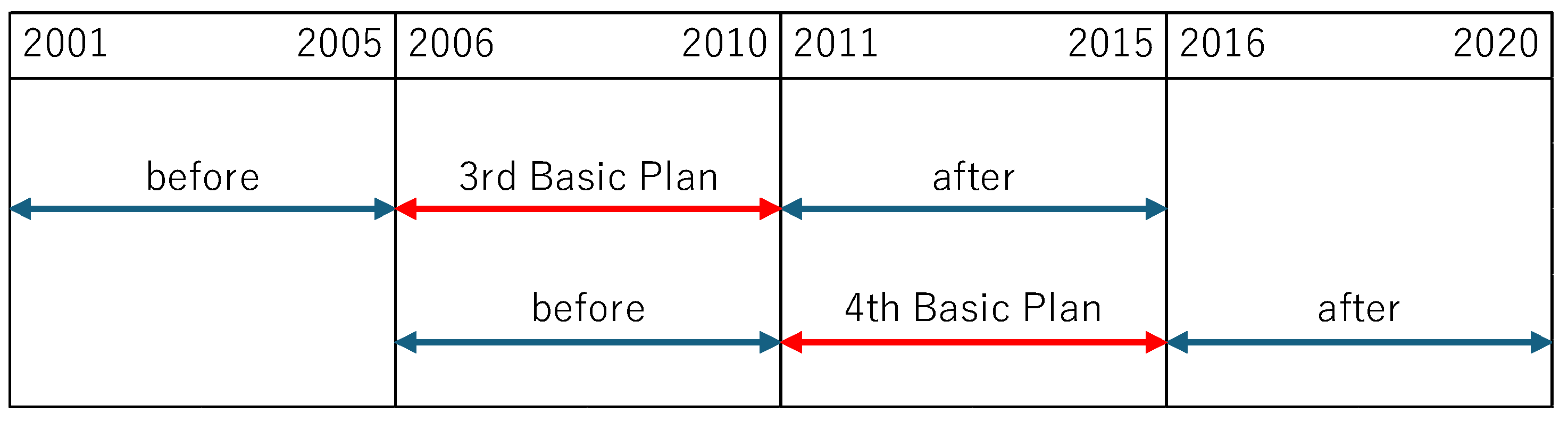
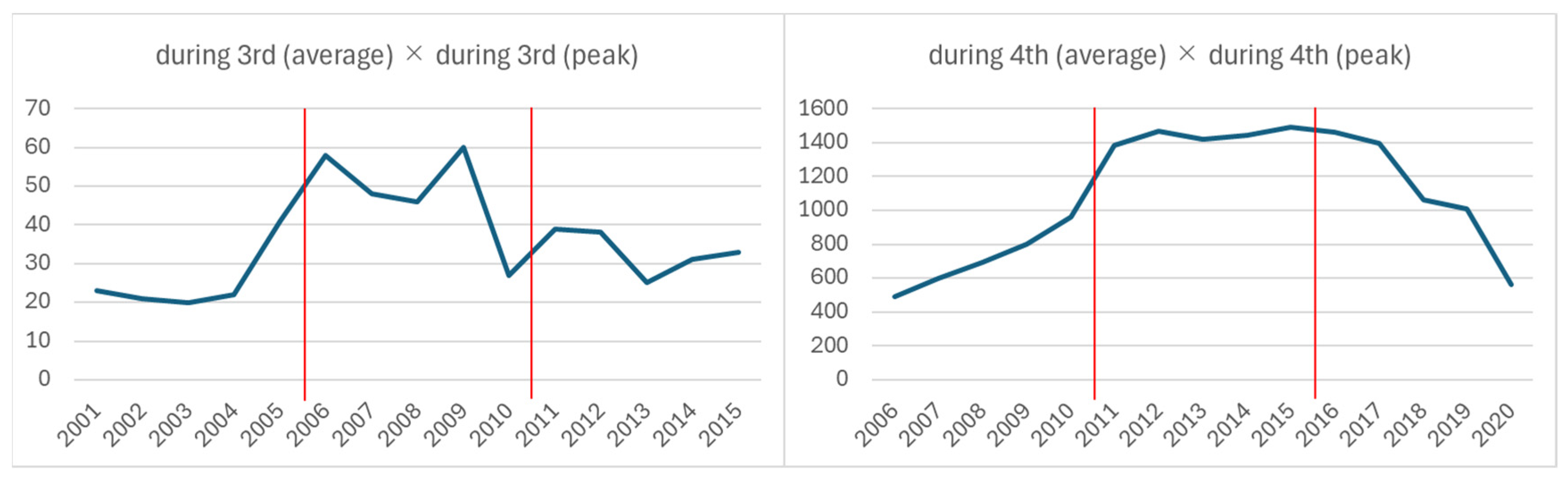
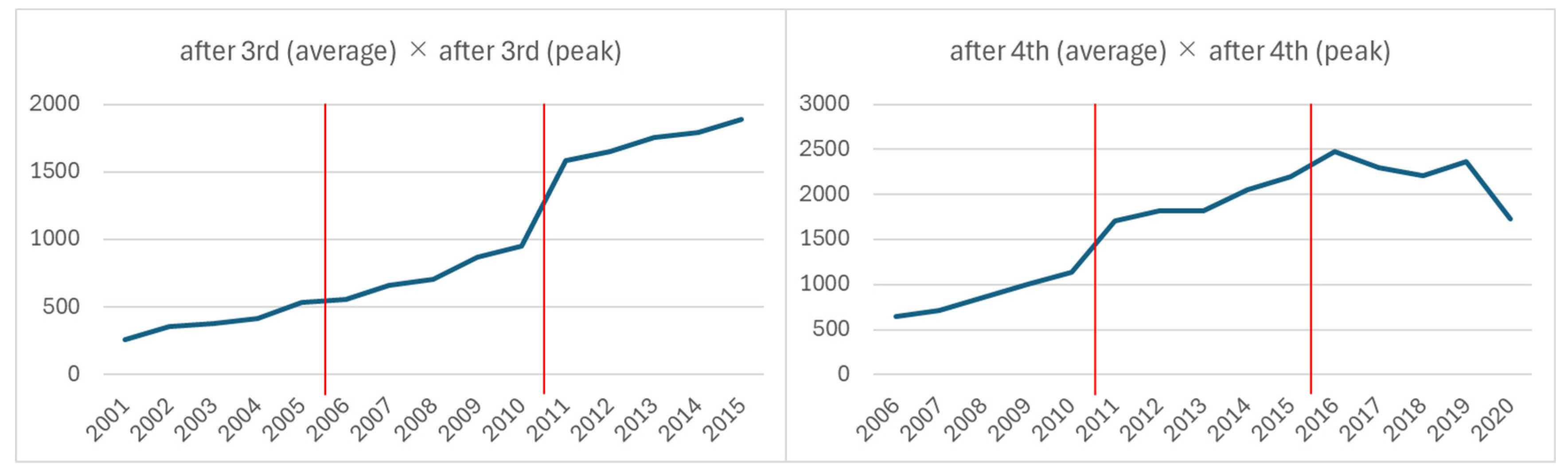
| Peak in the Number of Projects | ||||
|---|---|---|---|---|
| Highest average number of projects | Five years before Basic Plan | Five years during Basic Plan | Five years after Basic Plan | |
| Five years before Basic Plan | ||||
| Five years during Basic Plan | ||||
| Five years after Basic Plan | ||||
| Peaks in the Number of Projects | ||||
|---|---|---|---|---|
| Highest average number of projects | Before the Third (2001–2005) 8 (10.5%) 62 (0.1%) | During the Third (2006–2010) 21 (27.6%) 4035 (9.5%) | After the Third (2011–2015) 47 (61.8%) 38,359 (90.4%) | |
| Before the Third (2001–2005) 6 (7.9%) 32 (0.1%) | 6 (7.9%) 32 (0.1%) | 0 | 0 | |
| During the Third (2006–2010) 18 (23.7%) 2219 (5.2%) | 1 (1.3%) 25 (0.1%) | 15 (19.7%) 521 (1.2%) | 2 (2.6%) 1673 (3.9%) | |
| After the Third (2011–2015) 52 (68.4%) 40,205 (94.7%) | 1 (1.3%) 5 (0.0%) | 6 (7.9%) 3514 (8.3%) | 45 (59.2%) 36,686 (86.4%) | |
| Peaks in the Number of Projects | ||||
|---|---|---|---|---|
| Highest average number of projects | Before the Fourth (2006–2010) 9 (9.3%) 639 (0.9%) | During the Fourth (2011–2015) 49 (50.5%) 16,311 (21.9%) | After the Fourth (2016–2020) 39 (40.2%) 57,532 (77.2%) | |
| Before the Fourth (2006–2010) 7 (7.2%) 568 (0.8%) | 5 (5.2%) 505 (0.7%) | 1 (1.0%) 21 (0.0%) | 1 (1.0%) 42 (0.1%) | |
| During the Fourth (2011–2015) 72 (74.2%) 48,832 (65.6%) | 3 (3.1%) 128 (0.2%) | 47 (48.5%) 16,248 (21.8%) | 22 (22.7%) 32,456 (43.6%) | |
| After the Fourth (2016–2020) 18 (18.6%) 25,082 (33.7%) | 1 (1.0%) 6 (0.0%) | 1 (1.0%) 42 (0.1%) | 16 (16.5%) 25,034 (33.6%) | |
Disclaimer/Publisher’s Note: The statements, opinions and data contained in all publications are solely those of the individual author(s) and contributor(s) and not of MDPI and/or the editor(s). MDPI and/or the editor(s) disclaim responsibility for any injury to people or property resulting from any ideas, methods, instructions or products referred to in the content. |
© 2024 by the authors. Licensee MDPI, Basel, Switzerland. This article is an open access article distributed under the terms and conditions of the Creative Commons Attribution (CC BY) license (https://creativecommons.org/licenses/by/4.0/).
Share and Cite
Hirao, T.; Hoshino, Y. The Dysfunction of Mission-Oriented Innovation Policy: Impeding the Accumulation of Scientific Knowledge in the Japanese Academic Sector. Adm. Sci. 2024, 14, 115. https://doi.org/10.3390/admsci14060115
Hirao T, Hoshino Y. The Dysfunction of Mission-Oriented Innovation Policy: Impeding the Accumulation of Scientific Knowledge in the Japanese Academic Sector. Administrative Sciences. 2024; 14(6):115. https://doi.org/10.3390/admsci14060115
Chicago/Turabian StyleHirao, Takashi, and Yusuke Hoshino. 2024. "The Dysfunction of Mission-Oriented Innovation Policy: Impeding the Accumulation of Scientific Knowledge in the Japanese Academic Sector" Administrative Sciences 14, no. 6: 115. https://doi.org/10.3390/admsci14060115
APA StyleHirao, T., & Hoshino, Y. (2024). The Dysfunction of Mission-Oriented Innovation Policy: Impeding the Accumulation of Scientific Knowledge in the Japanese Academic Sector. Administrative Sciences, 14(6), 115. https://doi.org/10.3390/admsci14060115

