


Abstract
Faced with the pandemic caused by COVID-19, universities worldwide are giving a powerful response to support their communities. One way to provide support is via the collaboration between universities and industries, allowing the co-creation of knowledge that leads to innovation. Historically, universities, as knowledge-intensive organizations (KIOs), have produced knowledge through research. At present, its important contribution to countries’ economy is widely recognized through the development of new knowledge and technical know-how. Universities are a source of innovation for firms, which ultimately translates into social welfare improvements. The objective of this research is to analyze the university–firm linkage. The methodological strategy is carried out using Bayesian networks through a model where the main elements of university–industry linking, which impact competitiveness and innovation, are identified and quantified. The technology transfer model shows that the most crucial processes are Technology Strategy, Value Proposal, Knowledge Management, Control and Monitoring, Innovation Management, Needs Detection, Knowledge Creation, New Products and Services, and Absorption Capacity.
1. Introduction
All countries have experienced the effects of the crisis caused by the COVID-19 pandemic to a greater or lesser degree, and organizations have had to deal with the health crisis as well as a complex situation generated by a series of collateral events threatening their operation and survival. Companies’ nature is to adapt and evolve; however, this situation is unprecedented, so companies must look for alternatives to increase innovativeness and competitiveness. One option is the link with universities and the wide range of services they have to offer (Boardman and Ponomariov 2009).
Whereas knowledge transfer fosters an understanding of what caused a change, technology transfer targets the means for change (Gopalakrishnan and Santoro 2004). Effective knowledge transfer is associated with higher productivity, survivability (Argote et al. 2000), and competitive advantage (Argote and Ingram 2000; Alzubi 2018); however, knowledge transfer may fail if participants are reluctant to cooperate and collaborate (Pasaribu et al. 2017).
Universities, institutes, and public research centers have a strategic role nationally by generating technological knowledge transferable to the industry, which can transform it into economic and social value for users and clients, the institution itself, and society (Godin and Gingras 2000). University work product, as knowledge-intensive organizations, is key to both economic recovery and social cohesion. Moreover, sustainable knowledge transfer has a positive impact on social growth and development (Bendul et al. 2015). For such matters, the need to be more efficient in the use of scientific and technological resources has generated collaboration between various actors (Skute et al. 2019; Sjöö and Hellström 2019).
The objective of this collaboration is to develop and/or complete the innovation process for the production of goods and services competitively. The diversification of generating sources of scientific and technical knowledge notwithstanding, universities continue to be the main knowledge generators and transmitters (Cohen et al. 2002; Arocena and Sutz 2005; Torres et al. 2011; Sarabia-Altamirano 2016). This makes it possible to significantly support other actors’ growth in technological innovation, among them hospitals, industries, laboratories, and the public sector.
There is a clear correlation between a country’s competitiveness and its degree of collaboration with universities; it is evident that the most competitive countries have the highest linkage levels. The stronger the competitive level, the stronger the link (World Economic Forum 2016; Terán-Bustamante and Colla-De-Robertis 2018). However, the academia–business link is also a complex problem, since it includes actors with very different mindsets from academic and business spheres; thus, for the collaboration to be successful, it is necessary to build bridges and break cultural barriers (Rikap 2012; Dutrénit and Jover 2017).
In this context, the objective of this research is to analyze the university–industry link and use it to develop a technology transfer model that would help predict which decisions should be made to generate competitive advantages and dynamically innovate within such an environment. Therefore, this research seeks to elucidate the most significant processes, factors, and generators of value that must be considered by companies deciding to innovate and link with universities. The methodology used in this research is Bayesian networks, through which a predictive model for the company can be obtained.
The questions guiding this research are: Which are the key factors in an optimal university–company link? Which are the key factors for optimal technology transfer between universities and companies? How can a company, using a sustainable technology transfer model, make better decisions for new product/service innovation and new processes? Which are the best correlations between university–industry technology transfer processes?
The present work is organized into three sections. The Section 2 addresses the theoretical framework, specifically the importance of universities as sustainable knowledge-intensive organizations, as well as the importance of university–industry collaboration for innovating and building technology transfer models. Section 3 presents the methodology for the analysis and construction of the model based on Bayesian Networks (BNs). Section 4 and Section 5 presents the results, discussion, and conclusions.
2. Theoretical Framework
2.1. Sustainable Knowledge
Sustainability has been widely discussed by scholars and practitioners since the concept was defined in the WCED’s Our Common Future Report (i.e., Brundtland Report) in the late 1980s. Sustainability was defined as the effort to “meet the needs of the present generation without compromising the ability of future generations to meet their own needs” (UN General Assembly 1987). The definition suggests that both game-changing and quotidian decisions must be weighed to ensure that their consequences will not hinder future generations from satisfying their needs.
Sustainability encompasses economic, social, and environmental elements (Robins 2006), and development relates to people’s quality of life (UN General Assembly 1997); thus, sustainable development is the correlation of all four elements. The UN Secretary-General, Antonio Guterres, has called governments and businesses across sectors to action to achieve the sustainable development goals (SDGs) during the decade of action (Guterres 2019). Now, with the effects of COVID-19, global actions towards sustainable development are crucial.
Sustainable organizations are committed to sustainable development (Munguia Vega 2019), SDG achievement, and the 2030 agenda (UN 2020). Impacting sustainable development is plausible as organizations’ corporate philosophies are created based on sustainability principles. Although sustainability tends to be observed through actions and their effects, it should be part of the conceptualization of ideas rather than results alone; thus, ensuring that the decisions and, ultimately, the actions’ effects will not obstruct future generations. For instance, when research is performed sustainably with a sustainable objective, sustainable knowledge is developed. As a result, sustainable knowledge transfer is elemental for the development of effective solutions that will yield positive effects for current and future generations. As knowledge and technology transfer relate to the causes and means for change (Gopalakrishnan and Santoro 2004), respectively, they are indispensable for sustainability and sustainable transfer of both knowledge and technology, which positively impact development.
2.2. Universities as Sustainable Knowledge-Intensive Organizations
According to Starbuck (1992) and Martínez et al. (2014), Knowledge-Intensive Organizations (KIOs) assume knowledge as the most important resource, and their key characteristic is the ability to solve problems through creative and innovative solutions (Martínez et al. 2014; Robertson and Swan 2003; Kimble et al. 2016). KIOs include, but are not limited to, universities, research centers, consultancies, high technology, and engineering companies.
Universities face a great challenge in the current knowledge society; as for Knowledge-Intensive Organizations (KIOs), it is important to promote university research with an impact on social development (Sjöö and Hellström 2019; Li et al. 2018; Al-Gasim et al. 2021). Thus, universities are integral to the achievement of sustainability (Ralph and Stubbs 2014), and their impact is internal and external. That is, having sustainable development at the university level, which refers to the impact on the economy, sustainability of higher education, research and the environment, and society in general. Following the above, it is expected that universities’ fundamental contribution to society lies in creating and passing on useful knowledge and engaging with society for its application. However, universities are only part of the production process of a successful knowledge economy because of the participation of other actors, i.e., the government; thus, facilitating this link is necessary (Sjöö and Hellström 2019).
KIOs have been conceptualized as organizations having a knowledge system with an input and output (Makani and Marche 2010; Makani and Marche 2012). To analyze them, they propose a typology and two dimensions: one dimension where they identify knowledge intensity and the other focused on the worker. Universities belong to the former, that is, organizations in which knowledge has been considered a critical, strategic resource and a key core competence (Martínez et al. 2012).
2.3. University–Industry Collaboration: Sustainable Technology Transfer Model
Universities not only deal with the academic training of individuals but also owe their existence and subsistence to the social environment in which they develop and have an impact. Universities impact society not only by teaching the next generation, through creating and sharing knowledge, but also by enhancing social awareness (Carl and Menter 2021) and fostering social change. They do so by promoting ethical values, social change, and sustainable development (Leal Filho et al. 2018), reflected on the comprehensive improvement of human beings, their quality of life, and on economic, political, social, cultural, and environmental wellbeing. The latter supports the notion that the university should incorporate a third aspect into its mission—namely a commitment to society (Ortega y Gasset 1975). Hence, the university establishes other relationships with the community and is linked as a strategic part of its mission, responding to the need to interact with its environs and meet the different demands, such as knowledge and technology transfer.
In this context, innovation cannot be understood as the isolated action of one individual or company, but rather as a social process, due to the complex characteristics of knowledge and the relationship interaction it requires. Innovation is achieved through efforts of cooperation, collaboration, exchange of experiences linking by various actors, information, infrastructure training, and other resources, e.g., human beings and finances (Terán-Bustamante and Colla-De-Robertis 2018).
Consequently, the industry needs to link and collaborate with KIOs. Among these collaborations toward innovation, the link between university and industry stands out: it consists of concentrated action by both organizations, with the state playing an important role, participating as an integrator of the linking process and as a public-policy maker to promote those collaborations (Mascarenhas et al. 2018). Thus, the mission of universities is no longer limited to research and training, but rather incorporates a third mission: contributing to the economic growth of the regions in which they are located (Arocena and Sutz 2005; Terán-Bustamante and Colla-De-Robertis 2018; Branscomb et al. 1999; Bell 1999; Etzkowitz and Leydesdorff 2000; Gulbrandsen and Slipersaeter 2007; Barro 2015; Rasmussen and Wright 2015) and societal welfare.
In this context, one of the knowledge services offered by universities is technology transfer. Technology transfer (TT) is conceptualized as passing on a technique or knowledge (Lundquist 2003), which has been developed in an organization, such as universities, to another organization/business, where it is adopted, used, and meets appropriate performance indicators in the recipient’s environment. Thus, TT is considered a continuous, frequent, and strategic process based on close collaboration between the parties involved (Lönnqvist and Laihonen 2017).
As for university relations with the production sector, i.e., companies and universities, in addition to producing research and development (R&D) projects, they can provide a range of technological services that include conducting tests and analyses requiring certification in keeping with international quality standards. To efficiently fulfill this role, the university needs to provide these services with the highest level of effectiveness and efficiency, to ensure the companies’ capacity to innovate and enhance their competitiveness and sustainability.
The ability to innovate technologically constitutes a key element for companies’ achievement of competitive advantage, which can be generated by this link. The main problem of the university–company link derives from the heterogeneous language spoken by each actor since it would seem that both pursue different purposes (Saavedra 2009; Solleiro et al. 2014). Therefore, the importance of elucidating the research action in this relationship is highlighted (Solleiro et al. 2014; Terán-Bustamante and Colla-De-Robertis 2018), whereby researchers are active participants in the process of change, with the presence of a facilitator of this meeting between the production sector and the university, the state, to generate innovation-allowing capabilities.
Moreover, it is also relevant to consider the motivations of each actor. A company is motivated to join mainly to benefit from universities’ infrastructure and human resources, and make use of innovative activities that they do not carry out (Sarabia-Altamirano 2016; Dutrénit and Jover 2017; Azra and López 2011). By linking universities with companies, they seek the opportunity for accessing specialized instruments, practical experience, financial support, job opportunities for graduates, industry-specific education, merging theory with business practice, a source of innovation for business, and a source of economic development for policymakers (Sarabia-Altamirano 2016; Dutrénit and Jover 2017; Lai and Tsai 2009; Muscio 2010).
In addition, it is important to consider that innovation is not neutral; that is, the participating actors and the results it produces affect and impact human beings either with new products/services, processes, or the systems they build or destroy. In this sense, the actors involved have explicit or implicit responsibility. That is, there are complementary and synergistic conditions between innovation and social responsibility (Jasso Villazul 2012). Thus, innovation’s social dimension is a co-evolutionary process where the development of knowledge and innovation is linked with networks and institutional performance (Jasso Villazul et al. 2013); therefore, the person must be the center of all collaborations, which should seek social well-being.
3. Materials and Methods
This research is mixed: qualitative (descriptive) and quantitative via questionnaires and interviews, administered before the COVID-19 pandemic emerged, and a focus group held once the pandemic began. A total of 25 semi-structured interviews were conducted with a company as a case study, the university, and the company’s consultants. The questionnaire was administered to some of the firm’s collaborators who could not carry out the interview. Of these, eighteen interviews were conducted with managers and key personnel performing essential activities and processes, such as innovation management, technology, and knowledge, research, production, and administration. In addition, three interviews were conducted with the company’s consultants and four researchers from the university. All interviewees handle strategic information for the generation of knowledge and technology transfer, either within the company or in the sector under study, and are experts and/or are related to innovation.
A model was built to identify the main processes needed in university–industry collaboration. The model is developed through Bayesian networks. Bayesian networks constitute an alternative to decision trees because they allow the representation of more complex models of diagnosis or prognosis. These are based on the foundations of probability theory and allow combining the expert’s judgment with available data sources, and making inferences between any subset of variables, as is the case presented. That is, the network is designed to represent a problem explained by the probabilistic dependence among the model’s variables.
Unlike other techniques, such as neural networks or complex systems, the advantage of Bayesian networks (BNs) is providing a straightforward mathematical language to express the relations among variables clearly. It can incorporate several variables, and all nodes and probability tables can be interpreted concerning the uncertainty domain. It also provides an explanatory environment that facilitates decision-making. Additionally, BNs have complete knowledge of the state of the system, can make observations (obtain evidence), and update the probabilities of the rest of the system. They produce good results with databases with small instances and consider experts’ knowledge (Terán-Bustamante et al. 2021).
The design of the model is based on Bayesian Networks (BNs), which allow the inclusion of expert opinions and available statistics. Bayesian networks model problems using a set of variables and the dependent relationships among them. After the problem is modeled, the subsequent probability of unknown variables can be estimated based on the probabilities of the known variables. Expert knowledge, such as university researchers, research centers, and company managers, is a key facilitator for the development of the Technology Transfer Sustainability Model. They contribute their experience toward better technology transfer processes in different companies and universities. Detailed knowledge of the variables intervening in the collaboration and their causality is necessary for constructing the interaction model (Figure 1 and Table 1).
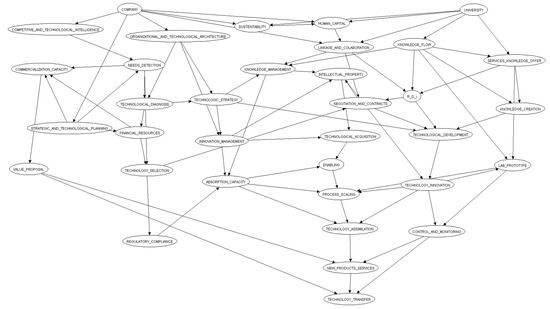
Figure 1.
University–enterprise linkage as a sustainable technology transfer model.

Table 1.
Definition of the variables and nodes.
Innovation is increasingly important, particularly when facing an economic crisis such as the one we are currently experiencing, due to the COVID-19 pandemic, and even more so in the process towards social welfare. However, innovation is a complex and dynamic phenomenon requiring perseverance to be considered strategic as well as a task with long-term results (Terán-Bustamante and Colla-De-Robertis 2018). Therefore, the case presented is current as well as the result of many years of collaboration among various actors in which trial and error have been elemental to innovate.
The model based on the Bayesian Network development was built from two parent nodes called Company and University. Each of these nodes is followed by child nodes. The value measuring the relative importance of each variable varies from 0 to 1, as defined by experts (Figure 2). Uncertainty is natural in the reasoning process where rules are established to infer a certain proposition. Bayesian models simulate different uncertainty conditions. These assign the probability of belief to a hypothesis so that inference is a process of readjustment of belief measures when new axioms are known (Rivera Lozano 2011).
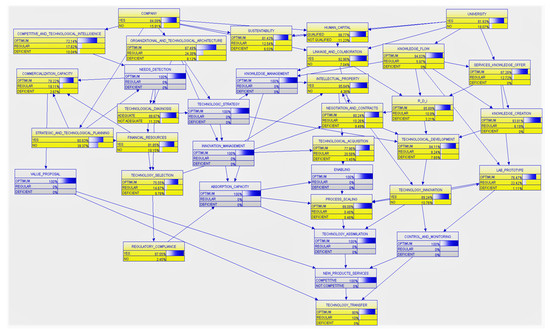
Figure 2.
Bayesian network.
In this research, the nodes’ probabilities for a technology transfer model are inferred. The metrics used to measure the performance of the model are (1) global confusion matrix (GCM) calculated for the selected target node and all chosen evidence; (2) marginal improvement (MI), which is the probability of correct classification obtained by adding the node, presented in the row, to the rest of the nodes; (3) individual probability of correct classification (IPCC), which is the probability of correct classification calculated from the model considering only the evidence presented in the row; and (4) marginal cost (MC) of each variable that indicates the total cost per variable included in the model.
4. Results and Discussion
The case study refers to a technology-based company in the biopharmaceutical sector founded in 1990. It manufactures antivenoms for bites of poisonous animals such as scorpions, snakes, and spiders. It is a medium-sized, family company with 85 collaborators and is a subsidiary of a large pharmaceutical group. The firm develops and promotes its own products and brands. It is located in Mexico City and is the only Mexican company to have received, in 2015, the orphan drug designation from the USA’s FDA (Food and Drugs Administration), for its products against poisoning by scorpion stings and snake bites.
At this point, the objective was to evaluate the proposed model’s performance to understand how much is gained from the nodes’ interaction. The model built has two main nodes: Company and University. The target node is Technology Transfer, where the other variables are evidence nodes. According to the proposed model, the variable Technology Transfer reached a 90% probability of being fulfilled (Figure 2). Since the proposed model was based on the abovementioned experts’ knowledge, structural learning of Bayes networks was used to obtain inferences that allowed the model to be evaluated. To achieve this, a supervised classification was developed, where supervised classification learning was a subset of the field of machine learning. In supervised classification learning, the induction algorithm receives a set of examples, called a training set, in which each instance consists of the present variables’ list of values and a discrete label assigned to the target variable. In this work, the motivation to use supervised learning is to obtain knowledge based on the data generated from the proposed Bayesian network.
A Bayesian network model is a representation of the joint probability distribution over its variables. For this reason, it is possible to use that structure to simulate new data that demonstrate realistic patterns of the underlying causal system. In this work, records were generated that are representative of the proposed network because they come from a joint probability distribution modeled by it. To achieve this, the open-access software UnBBayes version 4.22.18 was used to generate a thousand instances (records) containing randomly created node values from the joint distribution modeled by the network.
The algorithm’s task is to learn models that correctly classify unlabeled instances. The term supervised suggests that the training set’s instances have been tagged through a prior procedure. This makes it possible to measure the influence of the considered variables, as well as the influence they exert on the correct prediction of the target variable. The number of records generated was optimal to achieve the highest probability for the correct classification. This was concluded after doing several experiments with larger and smaller amounts of data. The confusion matrix details the results obtained from one thousand samples, where the optimum state reaches the highest probability for the correct classification 86.03% (Table 2). The confusion matrix indicates the percentage of correct answers obtained when classifying using the Naive Bayes Algorithm; these values are indicated in bold on the diagonal of the matrix.
Table 2.
Global confusion matrix.
The calculation of Marginal Improvement (MI) was used to evaluate the most influential variables to reach the optimal value of the objective variable. MI represents the probability of correct classification gained by adding the variable presented to the rest of the variables. As such, it was observed that the variables with the greatest influence are Technological Strategy, Value Proposition, Knowledge Management, Control and Monitoring, Innovation Management, Needs Detection, Knowledge Creation, New Products and Services, and Absorption Capacity.
The Individual Probability for Correct Classification (IPCC) is the probability of the correct classification considering only the evidence presented in the node. The variable that most contributes individually is Knowledge Creation (35.89%), followed by Technology Strategy (35.54%), Absorption Capacity (33.96%), and Control and Monitoring (33.83%). The Marginal Cost (MC) of each variable specifies the total cost resulting from including the variable in the model. The way the system works is depicted in Table 3, along with the set of variables that work best together by comparing individual performance and marginal improvements.
Table 3.
Marginal improvement variables.
The results presented in this table indicate that the variables that require more attention are those found to be the most influential. It is important to note that other variables should be improved to increase the value obtained for the target variable (Technology Transfer). Additionally, results were compared by classifying the dataset generated by six classification algorithms: AdaBoost, Logistic Regression, Support Vector Machine, K-Nearest Neighborhood, Random Forest, and Naive Bayes. This was done through the Classification Accuracy (CA) metric—CA is a metric that summarizes the performance of a classification model as the number of correct predictions divided by the total number of predictions (Table 4). The values obtained for CA indicate the algorithms used to find similar results when classifying the applied dataset; this allows validating the model proposed in this work.
Table 4.
Model comparison by classification accuracy.
The company’s competitive strategy is based on the technological innovation of its products and processes, the continuous improvement of its manufacturing practices, comprehensive compliance with regulations, development, and use of advanced technologies, development of niches internationally, and under-exploited markets such as rare diseases. The company has created a strong collaboration link with several national and international universities and research centers, mainly with the Universidad Nacional Autónoma de México (UNAM), since 1996; specifically with the Institute of Biotechnology for the research and development of new products.
The UNAM’s Institute of Biotechnology (IB) is a pioneer in the collaboration with the production sector. One of the first links was with the Bioclon Institute (BI), the case study that is analyzed, which currently has several working groups collaborating. The IB has focused on the development of new vaccines against COVID-19 with excellent ideas; however, there is no place to manufacture them, and, above all, there is no place to develop them with the necessary quality for human testing. As a result of this situation and its collaboration experience with the production sector, the IB began construction of a National Laboratory for the Production and Analysis of Biotechnological Molecules and Medicines and a Bioprocess Scaling Plant in the State of Hidalgo, Mexico, with the support of the government. The objective is to promote scientific research on the subject to provide technical services for the pharmaceutical industry, reflected in technology transfer and capacity building at the local level; this will generate benefits for people’s health and the improvement in economic areas and human capital for the entity and the country (Dirección General de Comunicación Social (DGCS) and UNAM 2021). This project seeks to build the path of basic research carried out in universities and national research centers, to bring laboratory developments to patients and improve their health.
A fundamental element in technology management processes is human capital, both within and without the company through interaction with the outside world. The company has created both formal and informal links; it has numerous networks and collaboration agreements. As for academia, it has developed an important, critical mass of knowledge to solve the complexity of production processes, create new products and keep with new knowledge. This has been possible because the company has developed an ability to create codes, languages, and specific relationship behaviors, which have allowed exchanges between the company and researchers—production sector/academia. In this interaction, two types of resources have been contributed to the company: (i) qualified human talent and (ii) knowledge. The first is evident given the researchers who have collaborated or joined the company over the years, and the second is apparent in the transfer of technology, as an acquirer: from the university to the company.
Part of the technological capabilities developed by the company as a result of this link is the development evolution of new anti-poisons from the first to the fourth generation. It has allowed the registration of patents, trademarks, as well as a foray into the international market. Their processes have also been improved to reduce product development time and complete mastery of production processes.
For the company, the object of this case study, establishing a Technology Strategy that allows innovation has meant having achieved synergy between corporate strategic administration and strategic innovation and technology management, all part of the same business plan. Simultaneously, the firm has welcomed new ideas, technologies, and skills from collaboration networks, as evidenced by 58 agreements, nationally and internationally, with different universities, research centers, and technological networks that include scientists, researchers, physicians, consultants, and expert networks (Terán-Bustamante and Torres 2020).
Medicine is an area in constant evolution; the BI seeks to expand the field of knowledge and propose new alternatives for the treatment and prevention of diseases through research. Currently, one factor which has led the company to be more competitive in this area is the investment of approximately 10% of its income in research and development. This investment has also benefited the collaboration between the company and the university. This is reflected in mutual benefits, since the university has the resources to do research and the company generates innovation in products and processes. The IB does not have a laboratory, and thus, all research is carried out in the university facilities; however, they have innovated without problems with technology transfer.
Regarding its value proposal, it is very much in synergy with the client’s Needs Detection—through competitive and technological intelligence—and the development of new products. According to this, the company does not invest in R&D if the product lacks commercialization potential. On the other hand, the company has much tacit knowledge; however, for it to have adequate Knowledge Management, it needs to code it and make it explicit.
The collaboration has enhanced absorption of learning and knowledge, allowing the company to accumulate entrepreneurial organizational capacities—technological and management—which in turn have increased innovation. However, the company has a wealth of tacit knowledge that should be coded (Terán-Bustamante and Torres 2020). As can be seen, this company has developed a strong focus on linking with universities and research centers, which has allowed it to innovate products, processes, marketing, sales, and, as an organization, also created a culture of patenting experts (Terán-Bustamante and Torres 2020).
5. Conclusions
The university is the main axis of society, as it is a generator of knowledge, and contributes to its development; for this reason, linking with the industrial sector should be supported and promoted. This collaboration should be considered a relationship of exchange and cooperation with the following objectives: for higher education institutions, to advance in scientific and academic development, and for the productive sector, to enhance technological development and solve specific problems.
Over the past couple of decades, a vast amount of information and data on the issues that permeate society and the environment has been made available. During this period, we have been working on developing and executing corrective actions to reverse the global damage. However, armed with that knowledge, one of the greatest benefits of university–industry collaborations is that we are currently in the position to create and transfer knowledge conceived sustainably rather than merely counteracting the effects of questionable practices.
It is possible to identify the main processes to carry them out successfully and sustainably through the technology transfer model developed with a sustainable approach between university and industry, whereby there is not only the creation of knowledge but also the capture of value created through this knowledge. All these processes chosen by experts in the Bayesian network model are important; however, the most relevant processes are human capital trained in the transfer model and facilitators of this link, Technology Strategy, Value Proposal, Knowledge Management, Control and Monitoring, Innovation Management, Needs Detection, Knowledge Creation, New Products and Services, and Absorption Capacity.
The presented model allows any company to make better decisions to link with universities and research centers considering its business model and resources. Although knowledge cannot be generalized, the case studied may be a good example for companies that want to link up with universities. Because of the contribution of experts on factors relevant for the sustainable transfer model, the data obtained means properly identifying the processes’ factors that should not be overlooked for an adequate link between universities and the industry. In addition, the company has managed, through its human talent, to speak the same language as researchers, and they speak the language of the company; this has generated patents and win-win negotiations for both organizations.
The results obtained in this research can be improved if additional variables are considered in the proposed model, which will depend on its area of application; this will be addressed in later work.
Based on the information obtained from the CI, MI, and IPCC, it is evident that the combination of the variables can improve the precision obtained when evaluating the model. In future works, it would be convenient to carry out tests taking into account several combinations of the same variables to improve the performance achieved. Regarding the study’s limitations, it is worth considering that the model is specific to companies and universities specializing in pharmaceuticals and, therefore, findings may not be generalizable; however, the methodology used could be useful for research in other industries.
Author Contributions
Conceptualization, A.T.-B., A.M.-V. and A.M.L.-F.; methodology, A.T.-B. and A.M.-V.; software, A.M.-V.; validation A.T.-B. and A.M.-V.; formal analysis, A.T.-B. and A.M.-V.; investigation, A.T.-B., A.M.-V. and A.M.L.-F.; resources, A.T.-B. and A.M.-V.; data curation, A.T.-B. and A.M.-V.; writing—original draft preparation, A.T.-B. and A.M.-V.; writing—review and editing, A.T.-B., and A.M.L.-F.; visualization, A.T.-B., A.M.-V. and A.M.L.-F.; supervision, A.T.-B.; project administration, A.T.-B. All authors have read and agreed to the published version of the manuscript.
Funding
This research received no external funding.
Institutional Review Board Statement
Not applicable.
Informed Consent Statement
Not applicable.
Data Availability Statement
Not applicable.
Conflicts of Interest
The authors declare no conflict of interest.
References
- Al-Gasim, Ziad, Aslan Amat Senin, and Mohd Effandi bin Yusoff. 2021. A Review and Comprehensive Analysis of the Performance of University–Construction Industry Collaboration. Civil Engineering Journal 7: 763–74. [Google Scholar] [CrossRef]
- Alzubi, Yazan. 2018. Knowledge transfer for sustainability: The role of knowledge enablers in the construction industries in Jordan. World Journal of Science, Technology and Sustainable Development 15: 325–37. [Google Scholar] [CrossRef]
- Argote, Linda, and Paul Ingram. 2000. Knowledge Transfer: A Basis for Competitive Advantage in Firms. Organizational Behavior and Human Decision Processes 82: 150–69. [Google Scholar] [CrossRef]
- Argote, Linda, Paul Ingram, John M. Levine, and Richard L. Moreland. 2000. Knowledge Transfer in Organizations: Learning from the Experience of Others. Organizational Behavior and Human Decision Processes 82: 1–8. [Google Scholar] [CrossRef]
- Arocena, Rodrigo, and Judith Sutz. 2005. Latin American universities: From an original revolution to an uncertain transition. Higher Education 50: 573–92. [Google Scholar] [CrossRef]
- Azra, Valeria, and Adrés López. 2011. Firms’ linkages with public research organisations in Argentina: Drivers, perceptions and behaviours. Technovation 31: 384–400. [Google Scholar] [CrossRef]
- Barro, Senen. 2015. La Transferencia de I+ D, la Innovación y el Emprendimiento en las Universidades. Santiago: Centro Interuniversitario de Desarrollo (CINDA). [Google Scholar]
- Bell, Daniel. 1999. The Coming of Post-Industrial Society, Special Anniversary Edition. New York: Basic Books. [Google Scholar]
- Bendul, J., E. Rosca, and T. Hoffmann. 2015. Sustainable Technology Transfer for Poverty Alleviation: A Unified Framework for Challenges and Transdisciplinary Solution Approaches. WIT Transactions on Ecology and the Environment 193: 823–34. [Google Scholar] [CrossRef]
- Boardman, P. Craig, and Branco L. Ponomariov. 2009. University researchers working with private companies. Technovation 29: 142–53. [Google Scholar] [CrossRef]
- Branscomb, Lewis M., Fumio Kodama, and Richard Florida. 1999. Industrializing Knowledge: University Industry Linkages in Japan and the United States. London: MIT Press. [Google Scholar]
- Brundtland, Gro Harlem. 1987. Our common future—Call for action. Environmental Conservation 14: 291–94. Available online: http://www.jstor.org/stable/44518052 (accessed on 27 August 2021). [CrossRef]
- Carl, Johannes, and Matthias Menter. 2021. The social impact of universities: Assessing the effects of the three university missions on social engagement. Studies in Higher Education 46: 965–76. [Google Scholar] [CrossRef]
- Cohen, Wesley M., and Daniel A. Levinthal. 1989. Innovation and learning: The two faces of R & D. The Economic Journal 99: 569–96. [Google Scholar] [CrossRef]
- Cohen, Wesley M., Richard R. Nelson, and John P. Walsh. 2002. Links and impacts: The influence of public research on industrial R&D. Management Science 48: 1–23. [Google Scholar] [CrossRef]
- Dirección General de Comunicación Social (DGCS), and UNAM. 2021. Instalarán UNAM y Estado de Hidalgo aceleradora de negocios biotecnológicos. Boletín UNAM-DGCS-547 Ciudad Universitaria. Available online: https://www.dgcs.unam.mx/boletin/bdboletin/2021_547.html (accessed on 27 August 2021).
- Dutrénit, Gabriela, and Jorge Núñez Jover. 2017. Vinculación Universidad-Sector Productivo Para Fortalecer los Sistemas Nacionales de Innovación: Experiencias de Cuba, México y Costa Rica. La Habana: Editorial UH. [Google Scholar]
- Etzkowitz, Henry, and Loet Leydesdorff. 2000. The dynamics of innovation: From National Systems and “Mode 2” to a Triple Helix of university–industry–government relations. Research Policy 29: 109–23. [Google Scholar] [CrossRef]
- Godin, Benoit, and Yves Gingras. 2000. The Place of Universities in the System of Knowledge Production. Research Policy 29: 273–78. [Google Scholar] [CrossRef]
- Gopalakrishnan, Shanthi, and Michael D. Santoro. 2004. Distinguishing between knowledge transfer and technology transfer activities: The role of key organizational factors. IEEE Transactions on Engineering Management 51: 57–69. [Google Scholar] [CrossRef]
- Gulbrandsen, Magnus, and Stig Slipersaeter. 2007. The third mission and the entrepreneurial university model. In Universities and Strategic Knowledge Creation. Specialization and Performance in Europe. Edited by Andrea Bonaccorsi and Cinzia Daraio. Cheltenham: Edward Elgar Publishing, pp. 112–43. [Google Scholar]
- Guterres, António. 2019. Remarks to High-Level Political Forum on Sustainable Development. The United Nations. Available online: https://www.un.org/sg/en/content/sg/speeches/2019-09-24/remarks-high-level-political-sustainable-development-forum (accessed on 13 August 2021).
- Jasso Villazul, Sergio Javier. 2012. Innovación y Redes en el Sector Salud en México. Una Perspectiva de los Centros de Investigación. XIII Asamblea General ALAFEC. Buenos Aires: ALAFEC. [Google Scholar]
- Jasso Villazul, Javier, Guadalupe Calderón, and Arturo Torres. 2013. Innovación y Patentamiento en Empresas del Sector Salud en México. Paper presented at the Conferencia Internacional LALICS, Sistemas Nacionales de Innovación y Políticas de Ciencia Tecnología e Innovación, Río de Janeiro, Brasli, November 11–12; Available online: http://www.redesist.ie.ufrj.br/lalics/papers/126__Innovacion_y_patentamiento_en_empresas_del_sector_salud_en_Mexico.pdf (accessed on 27 August 2021).
- Kimble, Chris, José Braga de Vasconcelos, and Álvaro Rocha. 2016. A Competence management in knowledge intensive organizations using consensual knowledge and ontologies. Information Systems Frontiers 18: 1119–30. [Google Scholar] [CrossRef]
- Lai, Wen-Hsiang, and Chien-Tzu Tsai. 2009. Fuzzy rule-based analysis of firm’s technology transfer in Taiwan’s machinery industry. Expert Systems with Applications 36: 12012–22. [Google Scholar] [CrossRef]
- Leal Filho, Walter, Luciana Londero Brandli, Deisi Becker, Constantina Skanavis, Aristea Kounani, Chrysoula Sardi, Dimitra Papaioannidou, Arminda Paço, Ulisses Azeiteiro, Luiza Olim de Sousa, and et al. 2018. Sustainable development policies as indicators and pre-conditions for sustainability efforts at universities Fact or fiction? International Journal of Sustainability in Higher Education 19: 85–113. [Google Scholar] [CrossRef]
- Li, Fang, Sheng Zhang, and Yuhuan Jin. 2018. Sustainability of University Technology Transfer: Mediating Effect of Inventor’s Technology Service. Sustainability 10: 2085. [Google Scholar] [CrossRef]
- Lönnqvist, Antti, and Harri Laihonen. 2017. Management of knowledge-intensive organizations: What do we know after 20 years of research? International Journal of Knowledge-Based Development 8: 154–67. [Google Scholar] [CrossRef]
- Lundquist, Gary. 2003. A rich vision of technology transfer technology value management. The Journal of Technology Transfer 28: 265–84. [Google Scholar] [CrossRef]
- Makani, Joyline, and Sunny Marche. 2010. Towards a typology of knowledge intensive organizations: Determinant factors. Knowledge Management Research & Practice 8: 265–77. [Google Scholar] [CrossRef]
- Makani, Joyline, and Sunny Marche. 2012. Classifying organizations by knowledge intensity necessary next steps. Journal of Knowledge Management 16: 243–66. [Google Scholar] [CrossRef]
- Martínez, C., A. Lusa, M. Mas, R. De la Torre, and M. Mateo. 2012. Strategic capacity planning in KIOs: A classification scheme. In Annals of Industrial Engineering. Edited by J. Carlos Prado-Prado and Jesús García-Arca. London: Springer. [Google Scholar]
- Martínez, C., A. Lusa, M. Mas, R. de la Torre, and M. Mateo. 2014. Strategic capacity planning in KIOs: A classification scheme. In Annals of Industrial Engineering. Edited by J. Carlos Prado-Prado and Jesús García-Arca. London: Springer. [Google Scholar]
- Mascarenhas, Carla, João J. Ferreira, and Carla Marques. 2018. University–industry cooperation: A systematic literature review and research agenda. Science and Public Policy 45: 708–18. [Google Scholar] [CrossRef]
- Munguia Vega, Nora E. 2019. Sustainable Organizations. In Encyclopedia of Sustainability in Higher Education. Edited by Filho W. Leal. New York and Cham: Springer. [Google Scholar]
- Muscio, Alessandro. 2010. What drives the university use of technology transfer offices? Evidence from Italy. The Journal of Technology Transfer 35: 181–202. [Google Scholar] [CrossRef]
- Ortega y Gasset, José. 1975. Misión de la Universidad y Otros Ensayos Afines. Madrid: Revista de Occidente. [Google Scholar]
- Pasaribu, Boy I., A. Afrianti, G. G. Gumilar, H. P. Rizanti, and S. Rohajawati. 2017. Knowledge Transfer: A Conceptual Model and Facilitating Feature in Start-up Business. Procedia Computer Science 116: 259–66. [Google Scholar] [CrossRef]
- Ralph, Meredith, and Wendy Stubbs. 2014. Integrating environmental sustainability into universities. Higher Education 67: 71–90. [Google Scholar] [CrossRef]
- Rasmussen, Eina, and Mike Wright. 2015. How can universities facilitate academic spin-offs? An entrepreneurial competency perspective. The Journal of Technology Transfer 40: 782–99. [Google Scholar] [CrossRef]
- Rikap, Cecilia. 2012. La vinculación de la Universidad con el sector productivo Transferencia tecnológica. Ecos de Economía 16: 127–49. [Google Scholar] [CrossRef]
- Rivera Lozano, Miller. 2011. El papel de las redes bayesianas en la toma de decisiones. Laboratorio de Modelación y Simulación 2: 1–11. [Google Scholar]
- Robertson, Maxine, and Jacky Swan. 2003. ‘Control-What control?’ Culture and ambiguity within a knowledge intensive firm. Journal of Management Studies 40: 831–58. [Google Scholar] [CrossRef]
- Robins, Fred. 2006. The challenge of TBL: A responsibility to whom? Business and Society Review 111: 1–14. [Google Scholar] [CrossRef]
- Saavedra, Maria Luisa. 2009. Problemática y desafíos actuales de la vinculación universidad empresa. Actualidad Contable FACES 12: 100–19. [Google Scholar]
- Sarabia-Altamirano, Gabriela. 2016. La vinculación universidad-empresa y sus canales de interacción desde la perspectiva de la academia, de la empresa y de las políticas públicas. Ciencia UAT 10: 13–22. [Google Scholar] [CrossRef][Green Version]
- Sjöö, Karolin, and Tomas Hellström. 2019. University–industry collaboration: A literature review and synthesis. Industry and Higher Education 33: 275–85. [Google Scholar] [CrossRef]
- Skute, Igors, Kasia Zalewska-Kurek, Isabella Hatak, and Petra de Weerd-Nederhof. 2019. Mapping the field: A bibliometric analysis of the literature on university–industry collaborations. The Journal of Technology Transfer 44: 916–47. [Google Scholar] [CrossRef]
- Solleiro, José Luis, and Rosario Castañón. 2008. Gestión Tecnológica: Conceptos y Prácticas. Mexico: Editorial Plaza y Valdés. [Google Scholar]
- Solleiro, José Luis, and Rosario Castañón. 2016. Manual de Gestión Tecnológica Para Pymes Mexicanas. Mexico: CamBioTec. [Google Scholar]
- Solleiro, José Luis, Claudia Gaona, and Rosario Castañon. 2014. Políticas para el Desarrollo de Sistemas de Innovación en México. Journal of Technology Management Innovation 9: 98–109. [Google Scholar] [CrossRef]
- Starbuck, William H. 1992. Learning by Knowledge-Intensive Firms. Journal of Management Studies 29: 713–40. [Google Scholar] [CrossRef]
- Terán-Bustamante, Antonia, Antonieta Martínez-Velasco, and Griselda Dávila-Aragón. 2021. Knowledge Management for Open Innovation: Bayesian Networks through Machine Learning. Journal of Open Innovation: Technology, Market, and Complexity 7: 40. [Google Scholar] [CrossRef]
- Terán-Bustamante, Antonia, and Arturo V. Torres. 2020. Capacidades de emprendimiento e innovación: El caso de una empresa biofarmacéutica en México. Revista Espacios 41: 230–47. [Google Scholar]
- Terán-Bustamante, Antonia, and Esteban Colla-De-Robertis. 2018. Vinculando el talento de investigadores y emprendedores para la innovación. Revista Mexicana de Economía y Finanzas 13: 547–69. [Google Scholar] [CrossRef]
- Torres, Arturo, Gabriela Dutrénit, Noé Becerra, and José Luis Sampedro. 2011. What are the factors driving university–industry linkages in latecomer firms: Evidence from Mexico. Science and Public Policy 38: 31–42. [Google Scholar] [CrossRef]
- UN General Assembly. 1987. Resolution A/42/427. Report of the World Commission on Environment and Development. Available online: https://undocs.org/en/A/42/427 (accessed on 13 January 2021).
- UN General Assembly. 1997. Resolution A/RES/51/240. United Nations Documents. Available online: https://undocs.org/pdf?symbol=en/A/RES/51/240 (accessed on 20 August 2021).
- UN. 2020. Transforming Our World: The 2030 Agenda for Sustainable Development. Department of Economic and Social Affairs Sustainable Development. Available online: https://sdgs.un.org/2030agenda (accessed on 27 August 2021).
- World Economic Forum. 2016. The Global Competitiveness Report 2016–17. Geneva: The World Economic Forum. [Google Scholar]
Publisher’s Note: MDPI stays neutral with regard to jurisdictional claims in published maps and institutional affiliations. |
© 2021 by the authors. Licensee MDPI, Basel, Switzerland. This article is an open access article distributed under the terms and conditions of the Creative Commons Attribution (CC BY) license (https://creativecommons.org/licenses/by/4.0/).