
Article

Impact of Agricultural Practices on Metal Accumulation and Their Associated Health Risks to the Environment and Consumers: A One Health Perspective

Instituto Universitario de Ingeniería de Alimentos Food-UPV, Universitat Politècnica de València, Camino de Vera s/n, 46022 Valencia, Spain
*
Author to whom correspondence should be addressed.
Environments 2026, 13(4), 217; https://doi.org/10.3390/environments13040217
Submission received: 4 March 2026 / Revised: 11 April 2026 / Accepted: 13 April 2026 / Published: 16 April 2026

Abstract

In the context of the One Health approach, this study assessed the environmental and human health risks posed by 21 chemical elements in soil and in food products (bee pollen, honey, and orange fruits). Data were collected from three cultivated and one uncultivated field, considering the agricultural practices employed. Findings revealed higher metal concentrations in the uncultivated field: Zn > Fe > Pb > Co > Cr > Mn > Ni > Al > Mo > P > B. No significant differences were noted for Ca, Cd, Cu, Sb, Se, and U. The geo-accumulation index indicated moderate Cu accumulation in cultivated fields. Only Hg in uncultivated soil poses a considerable risk at the 95th percentile. Orange fruits showed the lowest metal concentration, whereas bee pollen displayed the highest. In this last product, some elements are present at levels up to 10 times those in other food items, primarily Al, Fe, Zn, and Mn. The hazard quotient for non-genotoxic effects was below 1, indicating low concern. In terms of cancer risk, the levels of Pb and Cd were acceptable, while Ni in beehive products and orange fruits posed a moderate risk.

1. Introduction

The presence of trace metal(oid)s represents a significant food safety concern due to their widespread occurrence and long-term persistence in the environment [1]. These pollutants can cause acute damage to target organs such as the kidneys, liver, and brain. In addition, heavy metals such as Cd, Cr, and Pb exhibit genotoxic effects and are classified as carcinogenic substances [2,3].
Although some of these metals may be present in food with a geological origin, the primary sources of contamination are associated with industrial activities and agricultural practices [4,5]. Fertilisers are among the main agricultural sources of heavy metal contamination in soils, which in turn facilitates their transfer through the soil–plant–consumer chain. This issue is particularly significant in intensively cultivated lands managed without fallow periods or crop rotation [6]. Phosphate fertilisers often contain Cd, Pb, and Cr due to impurities present in phosphate rock [7]. N, P, and K fertilisers may also accumulate Cu and Pb during their synthesis. Moreover, organic fertilisers, including composted sewage sludge and animal manure, can introduce Zn, Cu, and As derived from veterinary feed additives and industrial residues [8]. Yeganeh et al. [9] conducted a study stating that the application of sewage sludge, at a rate of 100 tons per hectare, significantly elevated Zn concentrations in the subsoil. Similarly, Tamoutsidis et al. [10] corroborated these findings in horticultural crops, indicating an increase in Zn and Cu concentrations in the edible portions of the plants. It is important to note that the degree of this increase varied depending on the specific crop type and the applied rate. Furthermore, many pesticides, including insecticides, herbicides, and fungicides, contain heavy metals such as Cd, Pb, Cu, and Zn. These metals are absorbed by plants, flowers, fruits, and soils through the direct application of pesticides, interacting with metals already present from other sources such as fertilisers and irrigation water [11].
Recent field studies have shown that metal concentrations in vegetables (onion, tomato, potato) grown in soils treated with fertilisers often exceed the WHO/FAO permissible limits, and the measured levels of Cd and Pb contribute to health hazard indices above safe thresholds [7]. Studies on orange fruits have identified metal concentrations in the following order: Zn > Cu > As > Pb > Cd [12]. While many of these metals remain within permissible limits, some researchers have raised concerns about elevated levels of As, Pb and Cd [13,14]. Most studies on risk assessments indicate that non-genotoxic effects are generally low. However, different evaluations of the probability of cancer in both children and adults suggest that the cancer risk may exceed 1 × 10⁻⁶ at the 95th percentile, which emphasises the need for caution [12,14].
Previous studies on honey, and particularly on bee pollen, have detected potentially toxic elements (PTEs) and heavy metals, including Fe, Zn, Pb, Ni, Cr, Cu, Co, Mn, and Cd [15]. The honey is produced by bees using flower-derived nectar or certain plant secretions, through enzymatic and dehydration processes. Its composition is characterised by a high content of carbohydrates (primarily fructose and glucose) and lesser amounts of nutritionally valuable compounds such as proteins, amino acids, vitamins, polyphenols, and minerals [16]. Among the minerals found, K, Na, Ca, and Mg, which together account for more than 90% of the total mineral content, are particularly important for humans, as well as certain trace elements such as Fe, Zn, and Mn [17]. Bee pollen is an important source of protein and nutritionally more complex than honey, as it contains approximately 250 bioactive components [18]. Considering its mineral profile, bee pollen is richer than honey [19,20]. The compositional characteristics of both bee products make them valuable functional foods, with health benefits primarily associated with muscular, nervous, and skeletal function, the immune system, and wound healing [21,22,23].
In producing hive products, bees interact with their surrounding environment, including flowers, plants, air, soil, and water. The foraging distance of bees varies significantly depending on local conditions and the availability of resources. A study by Kohl et al. [24] found that bees respond differently to flight distances, particularly showing a notable change in behaviour around the 1 km mark, while 3 km is comfortably within their typical foraging range. Consequently, environmental contaminants present in these sources can be transferred to honey and bee pollen. Therefore, their nutritional and functional benefits may be compromised if toxic compounds are present in the vicinity of the hives. Therefore, over the past few decades, both bees and hive products have been studied as potential bioindicators of contamination in ecosystems [25,26,27].
Consequently, it is crucial to advocate for the One Health approach, aimed at enabling the EU and its Member States to better prevent, predict, detect, and respond to the interconnectivity of human, animal, and environmental health [28]. To sustain this vital connection, it is essential to implement multidisciplinary and effective strategies that integrate diverse areas of expertise and foster improved communication among professionals in various fields [29]. The action plan for 2022–2026 underscores the necessity of incorporating this One Health framework into scientific guidance and risk assessment processes [30]. Assessing the risk associated with heavy metal contamination requires a comprehensive approach that considers both ecological impacts and human health. Soil risk indices, such as the geoaccumulation index (Igeo) and the ecological risk index (ER), enable the evaluation of trace metal pollution levels and their potential effects on soil ecosystems. These indices consider both the degree of enrichment relative to the geological background and the specific toxicity of each metal [11]. Conversely, human health risk indices, including the hazard ratio (HQ), hazard index (HI), and carcinogenic risk (CR), allow for the comparison of estimated exposure doses to established toxicological guidelines. This analysis is crucial for identifying the potential for both genotoxic and non-genotoxic effects [31].
This leads to the following research questions:
  • To what extent do conventional treatments with herbicides and pesticides applied in citrus orchards influence the presence of potentially toxic elements (PTEs) in both soils and harvested orange fruits?
  • In relation to the presence of these PTEs in soils, what implications would arise if citrus orchards were managed according to agroecological transition principles, or if the soils were uncultivated, as in the natural park of Sierra Calderona?
  • How would the location of beehives, in conjunction with different types of fields and agricultural practices, affect the level of PTEs in honey and bee pollen products?
  • To what degree does human soil management influence environmental and human health risks?
Therefore, to address this gap, this study focuses on the One Health framework to assess the potential risks to the environment and human health associated with 20 chemical elements in soil and consumer products. This approach considers different pest control treatments used in crops. The analysis includes different scenarios: citrus grove soils managed through conventional practices, soils in the process of ecological transition, and uncultivated soils from a natural park. Additionally, to evaluate risks to the consumer, products from the hive (honey and bee pollen) located in these scenarios and orange fruits from the crop fields were studied.

2. Materials and Methods

2.1. Sample Collection

The samples analysed in this study were collected in 2025 from citrus orchards owned by Cooperativa Rural Sant Vicent Ferrer de Benaguasil (located in eastern Spain, Valencian Region, Pedralba, 39°64′ N 0°42′ W) and from the Sierra Calderona natural park (Spain, Valencian Region, Serra, 39°40′ N 0°24′ W). These areas exhibit a typical Mediterranean coastal climate, with temperatures that rarely drop below 0 °C, characterised by a high mean relative humidity (above 60%) and hot, dry summers.
The orchards have sandy loam soils and an alkaline pH (7.99–8.38); the soil is moderately rich in organic matter and suitable for intensive agriculture, especially for citrus fruits. In this study, the orchards comprise trees aged 5 to 8 years, which are maintained under a drip irrigation system to ensure controlled water delivery. Table 1 summarises the field codes where the use or non-use of herbicide (H) and pesticide (P) [marked by yes (y) or no (n)] or the application of alternative treatments (a) are indicated. It also includes the fields and types of samples collected, which include soil, honey, pollen, and oranges.
Specifically, the active ingredients used in these citrus orchards are the herbicides, Laser® (24% oxyfluorfen, Albaugh, Lausanne, Switzerland), Premium® (36% glyphosate, Syngenta, Basel, Switzerland) and Starane® (Fluroxipir 20%, Corteva Agriscience, Asturias, Spain), and the pesticides, Carnadine® (20% acetamiprid, Nufarm, Bacelona, Spain) and Closer® (sulfoxaflor 11.3%, Corteva Agriscience, Asturias, Spain). When both herbicides and pesticides were used, the code was Hy_Py, and if only the latter were used, it was Hn_Py.
With respect to the agricultural practices here defined as “Alternative”, this refers to orchards managed following the agroecological transition conditions, meaning the progressive transformation to organic farming in line with the rules of EU organic farming eco-schemes [32]. These practices were implemented in this study: introducing seeded ground cover, spontaneous ground cover, and flowerbeds, as well as the preservation of field margins. This type of action included pest control using sticky plastic traps and the release of predatory insects, and the application of vegetable oils when required. Nevertheless, in this present research, herbicides continue to be applied between the rows of trees (code: Hy_Pa).
In contrast, the Sierra Calderona natural park area is mountainous with shallow, rocky soils and limestone outcrops. These soils are generally infertile, with poor water retention. It comprises uncultivated lands and therefore lands without the application of herbicides or pesticides (code: Hn_Pn).
The soil samples were collected randomly from the 3–20 cm top layer using a stainless-steel scoop. Each sample was a composite of five sub-samples thoroughly mixed. This procedure was repeated three times for each condition, and the resulting three samples were sent to the laboratory for further analysis. Therefore, a total of 12 soil samples were analysed. Similarly, each orange sample consisted of 10 oranges from different trees in each type of cultivated orchard. The mixture of their juices constituted 1 sample. This procedure was repeated three times for each condition; therefore, 9 juice samples were sent to the laboratory.
Honey and bee pollen were collected from 30 stationary experimental honeybee colonies associated with the project within which this study was conducted. They were managed by an ecological beekeeper under organic production (without synthetic chemicals). Ten colonies were placed in each type of field considered: Hy_Py, Hy_Pa and Hn_Pn. From each field, 100 g of honey and 20 g of pollen were collected from each of the 10 hives and combined to form a composite sample for laboratory analysis. This procedure was repeated three times at different sampling periods. In total, nine honey samples and nine pollen samples were analysed.

2.2. Chemical Analysis

The quantification of the chemical elements (Al, B, Ca, Cd, Co, Cr, Cu, Fe, Hg, I, K, Mg, Mn, Mo, Ni, P, Pb, Sb, Se, U, and Zn) was performed in the spectrophotometry laboratory of the University of Valencia (Spain) following the method described in [33] with modifications. The determinations were conducted by Inductively Coupled Mass Spectrometry (ICP-MS) (Agilent Technologies, Santa Clara, CA, USA), with a Micromist type concentric nebulizer, Scott type spray chamber, platinum interface cones, double off-axis lens system and hyperbolic quadrupole. Previously, the digestion of all samples (soils, honeys, bee pollens and orange fruits) was performed. The soil (40 g) was dried at 60 °C, then ground, mixed well, and passed through a 0.15 mm nylon sieve; afterwards, it was digested with a HNO3: HCl mixture in an Ethos Easy high-pressure microwave oven (Milestone Srl, Sorisole BG, Italy) at a maximum temperature of 200 °C. Subsequently, the volume was brought up to 10 mL with ultrapure water (Milli-Q, Merck Millipore, Darmstadt, Germany) and filtered through a 0.45 µm nylon filter. Honey, bee pollen and orange juice matrices (1 g) were digested with 750 µL of HNO3 69% (ultratrace ppb-trace analysis grade de Scharlab) in the same microwave oven and then diluted with 5 mL of MiliQ water. To determine iodine (I), the same protocol was followed for all matrices. Microwave digestion was performed in a basic medium at a maximum temperature of 80 °C. Samples were brought to a final volume of 5 mL with MiliQ water and filtered using 0.45 µm nylon filters.
The ICP-MS equipment conditions for the determination of these chemical elements were: Ar plasma gas flow (15.0 L/min), carrier gas (1.0 L/min), RF power (1550 W), RF Matching (1.80 V), Nebulizer pump (0.30 rps), Mode (Helium). These experiments were carried out in collision cell mode with He for all elements except Se, which was carried out in reaction cell mode with H2.
The calibration curves were obtained by dilution from a multi-elemental standard solution prepared from certified high-purity individual standards of each element (HPS, Zepto Metrix, North Charleston, SC, USA or Scharlab, Barcelona, Spain) in the range of 0–2000 µg/L for B, Cd, Co, Cr, Cu, Hg, I, Mn, Mo, Ni, Pb, Sb, Se, U and Zn, and between 0 and 4000 µg/L for Al, Ca, Fe, K, Mg and P. The internal standards used were: 45Sc, 72Ge, 103Rh, 193Ir. The following was considered for quality control: 1. Use of certified calibration standards. 2. To accept calibration curves as valid, the correlation coefficient must be R ≥ 0.9999 and each calibration point must have an RSD ≤ 5% with a minimum of three readings per measurement. 3. After completing the analysis of a sample sequence, a calibration standard is analysed as a sample, and the mean between the reference value and the obtained value must have an RSD ≤ 5%.
The limit of detection (LOD) was determined by applying the formula LOD = 3sB/a, where “3sB” represents three times the standard deviation at a concentration of zero and “a” corresponds to the slope of the calibration curve. The limit of quantification (LOQ) was obtained by multiplying the LOD by the sample dilution factor [34,35]. The LOD and LOQ values obtained for the target elements are shown in Table S1.

2.3. Statistical Analysis

A one-factor analysis of variance (ANOVA) (using Statgraphics version 20 for Windows) was carried out to identify significant differences in the chemical elements among the types of fields and populations. The Least Square Difference (LSD) comparison at a 95% confidence interval was considered. The significance levels are shown in the tables as followed: ns (not significant), and significant difference at 95%, p < 0.05 (*); at 99%, p < 0.01 (**); and at 99.9%, p < 0.001 (***).

2.4. Risk Characterisation

To quantify the magnitude of the ecological hazard associated with the concentrations of toxic elements (i) in the soil, the geo-accumulation index (Igeo) and the ecological risk (ER) were calculated. Equations and parameters of interest were shown in Table 2. Metrics have been calculated only for those cases where reference values for the corresponding chemical element are available. Based on the Igeo values, and following the classification proposed by Gu et al. [36], the soils were classified into four categories: unpolluted soil (Igeo ≤ 0); slight pollution (0 < Igeo ≤ 1); moderate pollution (1 < Igeo ≤ 2); moderate to strong pollution (2 < Igeo ≤ 3); strong pollution (3 < Igeo ≤ 4); strong to extreme pollution (4 < Igeo ≤ 5); and extreme pollution (Igeo > 5). Moreover, the ER value classifies the risk as: low (ER ≤ 40), moderate (40 < ER ≤ 80), considerable (80 < ER ≤ 160), high (160 < ER ≤ 320), and very high (ER ≥ 320). In addition, the hazard quotient (HQ) and the cancer risk (CR) were used to assess the likelihood that contaminants (i) in honey (H), bee pollen (P), and orange fruits (O) would cause non-genotoxic and genotoxic effects on human health, respectively [31]. Conventionally, an HI or HQ below 1 indicates that total exposure remains within an acceptable range, suggesting that individuals are unlikely to encounter levels of toxicity that could result in health issues. In contrast, if these values exceed 1, there is a significant risk of adverse effects on health. To evaluate the likelihood that the estimated daily intake (EDI) exceeds the reference value, the probability of exceedance (POE) metric was calculated. The POE value always ranges between zero and one. A POE value close to zero indicates that the EDI rarely exceeds the suggested reference value (RV), suggesting a low level of concern, although it should not be completely disregarded. Conversely, a value close to one indicates a high probability that exposure exceeds the RV, indicating a high level of concern [31]. Furthermore, a CR of less than one person in a million (1 × 10⁻⁶) is not considered a public health concern. A risk level that falls between 1 × 10⁻⁶ and 1 × 10⁻⁴ is considered moderate, while a risk that surpasses 1 × 10⁻⁴ is classified as unacceptable, and therefore measures to reduce risk should be taken [37].
The characterisation risk was performed with a probabilistic approach using the @Risk version 8 software (Palisade, Newfield, NY, USA). To account for random uncertainty in the input data, the heavy metal concentrations for each matrix (soil, honey, bee pollen, and orange fruits), the ingestion rate and the body weight were fitted to a probability density function (pdf).
The results for each metric were obtained using a standard Monte Carlo method and hypercube Latin sampling, with 10 repetitions of 100,000 iterations. This process yielded a pdf for each evaluated metric. Moreover, a sensitivity analysis was conducted to evaluate the impact of different variables on the characterisation of non-genotoxic effects related to the consumption of honey, bee pollen, and orange fruits. This examination aims to enhance our understanding of the potential implications for human health.

3. Results and Discussion

3.1. Metals and Risk in Soil

The concentrations of the metals studied in the soil (Al, B, Ca, Cd, Co, Cr, Cu, Fe, Hg, I, K, Mn, Mo, Ni, P, Pb, Sb, Se, U and Zn), expressed as average (mg/kg) and the corresponding standard deviation, are shown in Table 3. In addition, the ANOVA results (with homogeneous groups, F-ratio, and significant level) are described in the same table.
The results indicated that Ca exhibited the highest concentration in the soil, followed by Al, Fe, K, P and Mn. Lower values were obtained for B, Zn, Cu, Pb, Cr, I and Ni. Values very close LOQ to or below the LOD have been observed in Cd, Hg, Sb, Se and U. In general, low concentrations of PTE reflect a minimal level of pollution and a limited anthropogenic influence within the studied area. Comparing these results with international regulations collected by He et al. [48], values of Cd, Cr, Cu, Hg, Ni, Pb and Zn comply with regulatory standards of heavy metals in agricultural soil (mg/kg).
Ca and its interactions with other cations influence soil fertility and its structure. P, K, Fe and Mn play critical and interconnected roles in plant nutrition, with complex interactions that significantly affect plant growth and physiological processes [49]. The concentrations of Cd, Hg, Sb, Se and U were observed to be exceptionally low across all scenarios, suggesting a minimal risk of phytotoxicity for plants. It is important to note that both Cd and Hg (even at moderate levels) can induce osmotic stress, delay seed germination, hinder root elongation, and cause oxidative damage to cell membranes, which consequently diminishes the presence of photosynthetic pigments [50,51]. Trace elements such as Cu and Se play a crucial role in the normal growth and development of both plants and animals. However, their bioaccumulation has the potential to cause toxicity that may limit vegetative biomass [51,52,53]. The toxic effects of Cu on plants are influenced by the soil’s absorption capacity and chemical reaction. Concentrations exceeding 20 mg/kg have been observed to produce harmful effects on most plants [54]. Our analysis reveals that all soils evaluated surpass this threshold; however, they remain below the alert level of 100 mg/kg. Notably, the soil within Sierra Calderona natural park exhibits the lowest concentration of Cu. This is attributed to the absence of cultivation practices in this area.
In general, the concentrations of chemical elements observed in the present study were higher in the uncultivated soil of the Sierra Calderona natural park, with significant differences (p < 0.001). Considering the F-ratio values, this effect would be most important for Zn, followed by Fe and Pb, Co, Cr, and Mn. This could be attributed to the physicochemical properties of the soil and the presence of carboxylic and phenolic groups with strong chelation capacity, resulting from the decomposition of organic matter in the natural park [54]. Previous studies on the disparities in Zn, Fe and Mn, and content between forest and cultivated soils, indicated that the concentrations of these elements are significantly higher in forest soils [46,47]. These differences may be due to factors such as reduced soil disturbance, accumulation of organic matter, and different microbial dynamics in forest environments. Sur et al. [55] observed a correlation between metal concentration in the soil, sampling depth, pH, organic carbon and soil texture. This relationship underscores the importance of considering these factors in soil analyses. Hall et al. [56] noted that labile carbon and microbial activity significantly influence iron reduction and oxidation processes, and that the greatest capacity for the iron redox cycle occurs in the surface horizons of the soil. On the other hand, the reduction in Zn in cultivated soil appears to be driven by multiple factors: crop extraction, leaching processes, and agricultural practices that deplete soil nutrients [57]. Shiwakoti et al. [58] found a downward trend in the concentrations of Mn, Cu, and Zn in soils that had been subjected to long-term tillage. Similarly, Wiryawan et al. [59] reported that soil micronutrient concentrations, such as Fe, Zn, and Mg, were significantly higher in forest soil compared to tilled soil. However, the same authors noted that the differences in macronutrient concentrations were not significant, except for Mg, which may be attributed to the addition of macronutrients from fertilisers used in cultivated fields.
Soil properties play a crucial role in the distribution of Co. Factors such as pH, clay content, Fe, and Mn oxides significantly control its availability [60]. Agbenin [61] observed that higher concentrations of total Fe and Mn, free Fe, and Mn oxides, as well as higher clay content, enhance Co retention against leaching. This observation is consistent with the correlation between Co and these soil components. Thus, forest soils tend to have longer Co residence times, and weathering in mineral layers plays a significant role in Co supply [62].
Cr levels differ between forest and cultivated soils, since organic matter content strongly influences its mobility and leaching [63]. In our findings, Cr concentrations ranged from 10.3 to 21 mg/kg, which were in line with usual values found in the literature (2–50 mg/kg) and below the tolerable limit of 100 mg/kg. The uptake of this metal by the plants is limited to the radicular system and rarely accumulates in the other organs of the plants [55].
The soils of the Sierra Calderona have a higher average concentration of Pb (26 mg/kg) than citrus orchards (6.46–9.7 mg/kg). Research conducted by Ettler et al. [64] shows that total Pb concentrations were one order of magnitude lower in tilled soil due to intensive ploughing and the annual removal of crops. Atmospheric deposition and the gradual enrichment of the soil over time, along with its physicochemical properties, play a fundamental role in the deposition, migration, and transformation of Pb in the soil. Factors such as total organic matter, sand, silt, and clay content, as well as pH levels, have been found to correlate with both the total and bioavailable metal content in soil [65,66,67]. On the contrary, Atafar et al. [68] observed that the concentrations of Pb and Cd increased in cultivated soils, which was attributed to the application of fertilisers and pesticides.
The concentrations of Al, Mo, and Ni in the present study showed significant differences (p < 0.01) between soil types. Previous studies also observed higher, more bioavailable Al content in forest soils than in cultivated soils, attributed to the lower pH and higher organic matter content in forest soils [69,70]. Mo availability varies significantly between forest and cultivated soils, with complex interactions involving phosphorus and soil organic matter [71].
Regarding the concentration of Ca, Cd, Cu, Sb, Se and U, no significant differences were observed in the present study between the soils from the different fields studied, shown in Table 3. In relation to this, Nakamaru et al. [72] found that Sb and Se are usually found at low concentrations in soil, but small differences may be due to their mobility being strongly influenced by pH, redox potential, and organic matter content, thus altering their behaviour.
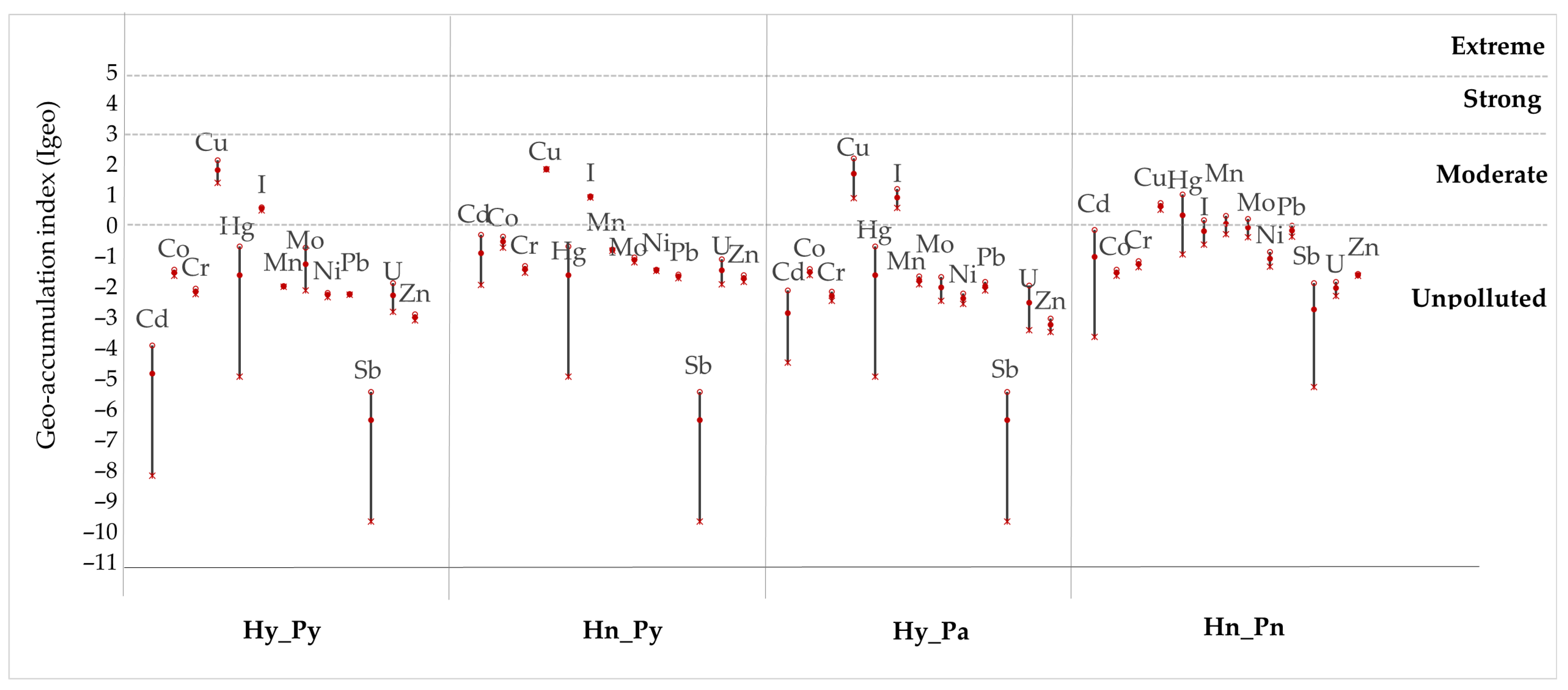
The geo-accumulation index (Igeo) was used to assess soil quality based on PTE accumulation. The mean and 5th and 95th percentiles for the metals Cd, Co, Cr, Cu, Hg, I, Mn, Mo, Ni, Pb, Sb, U, and Zn across the different types of fields studied are shown in Figure 1 and Table S2. In general, the results indicate that in cultivated soils, the accumulation of the metals studied does not cause contamination in the soil. The only exceptions are Cu and I, whose values are in the moderate pollution zone. In the natural park, higher values are observed, although they remain between the zones of no accumulation and moderate accumulation. The high index of Cu Igeo could be attributed to the control of citrus diseases, especially in ecological systems where it remains the primary control agent against fungi. This leads to chronic accumulation of this metal in the soil, with levels frequently exceeding the nutritional needs of crops and reaching phytotoxic levels [73]. Additionally, Cu is primarily bound in stable mineral or organic complexes, such as carbonates and humic metal bonds, restricting their solubility even when organic acids are present [55]. Several studies in citrus plantations show that only a small fraction of this metal is taken up by the tree, while most of it leaches into the soil, where it accumulates year after year, increasing both total and bioavailable Cu and reducing microbial biomass and soil biological quality. Mo et al. [74] revealed that increased levels of Cu in the soil negatively affect its microbial processes, with tolerant microorganisms replacing sensitive taxa. Similarly, Zhou et al. [75] demonstrated that Cu concentration dominantly affects the microbial properties of the soil, causing substantial changes in the composition of bacterial communities. Bakshi et al. [76] found that most of the applied Cu reaches highly mobile forms, which could contaminate groundwater.
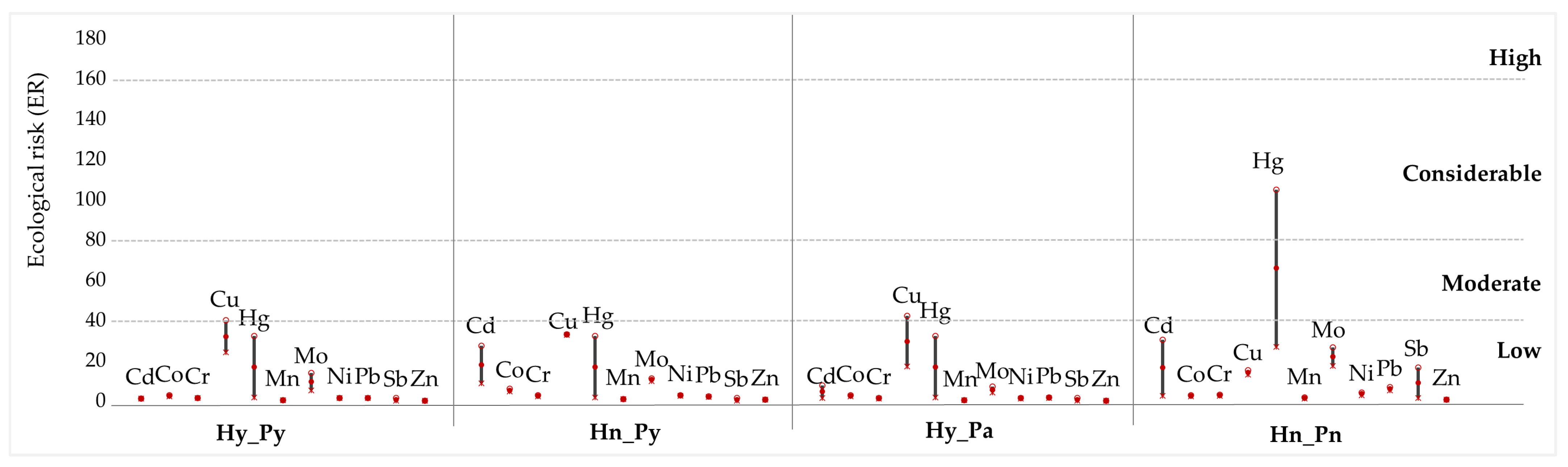
The ecological risk index was calculated to assess the environmental risk caused by the metals Cd, Co, Cr, Cu, Hg, Mn, Mo, Ni, Pb, Sb, and Zn in the soil of the different field types studied. Figure 2 shows that the ecological risk is low in all soils except for the natural park (Hn_Pn), where, in the case of Hg, the mean value is moderate and the 95th percentile value is considerable. Several studies support this pattern of findings. Thus, Gamby et al. [77] found that forest soils had higher Hg concentrations compared to cultivated fields, with an estimated 4.1 mg/m2 of this metal mobilised through deforestation. Almeida et al. [78] reported that forest soils contained between 0.13 and 0.15 mg/kg of Hg, compared to 0.07–0.14 mg/kg in pasture soils. Lacerda et al. [79] confirmed that forest soils had Hg levels 1.5 to 3.0 times higher than pasture soils. Béliveau et al. [80] concluded that agroforestry systems effectively retained Hg from the soil, while total Hg losses were significantly higher in short-cycle crops.

3.2. Metals and Risk in Foodstuffs

The analysis of the chemical elements revealed that the highest concentrations (measured in mg/kg) were found in bee pollen samples, whereas the lowest were observed in orange fruits. Previous studies reported that bee pollen contains metal concentrations between 3 and 10 times higher than those found in honey at identical locations [15,81].
The analysis of macrominerals in the three matrices revealed that K, Ca, P and Mg were the most relevant. K consistently demonstrated the highest concentrations in bee pollen (4349–6084 mg/kg), followed by orange fruits (1196–1368 mg/kg), and honey (242–830 mg/kg). The second most abundant mineral varied by product: P in bee pollen (3116–3852 mg/kg); Ca in honey (40–94 mg/kg); and Mg in orange fruit (97–106 mg/kg). Notably bee pollen contained significantly elevated levels of P (3116–3852 mg/kg) and Mg (736–867 mg/kg) when compared to honey, which had P levels ranging from 21 to 63 mg/kg and Mg levels from 4 to 32 mg/kg. Overall, these mineral concentrations align with the ranges reported in the literature [15,82,83,84,85,86,87], although higher Ca concentrations, approximately 700 mg/kg, have been documented in orange juice from Brazil [88].
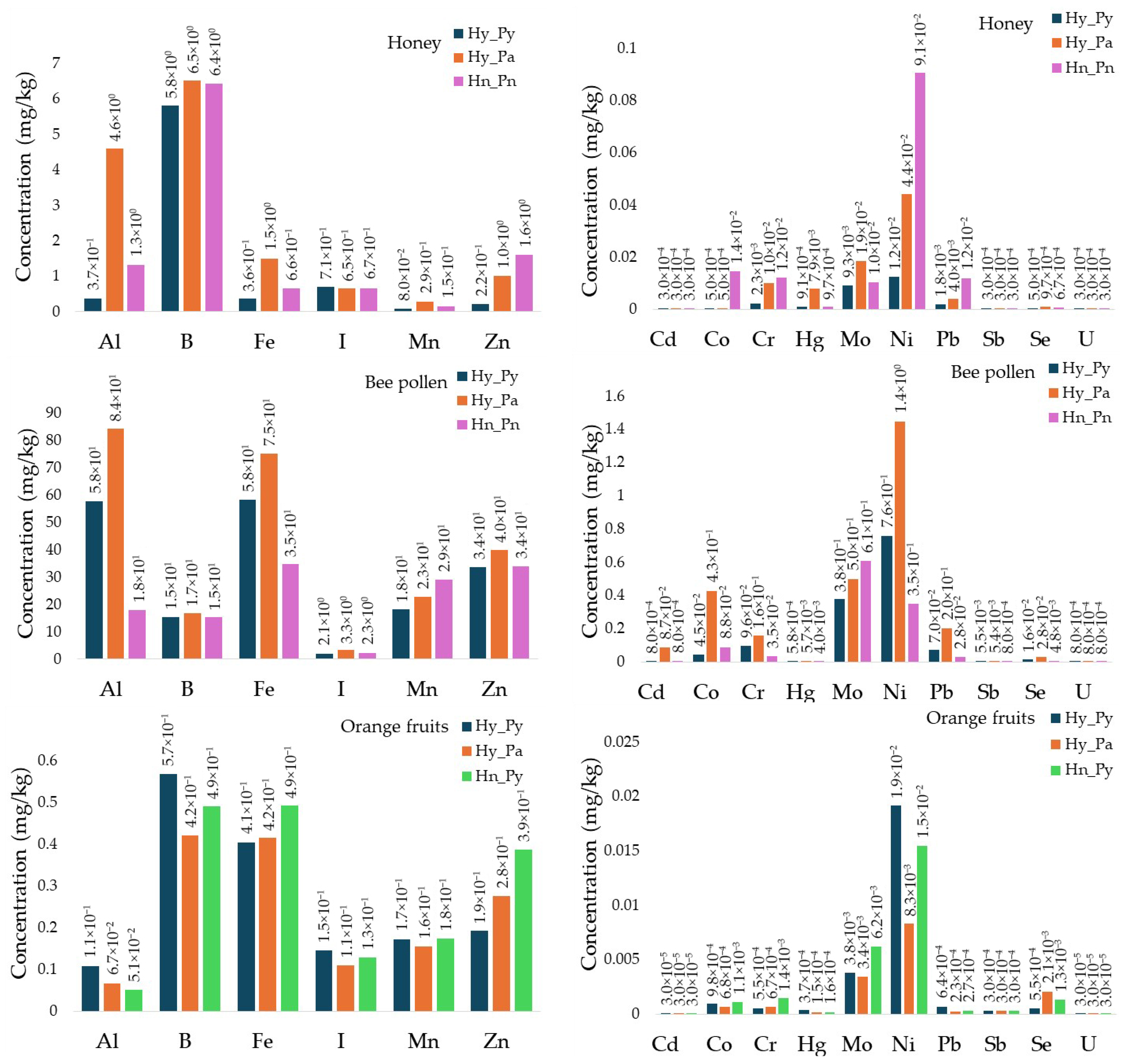
Figure 3 shows the essential trace elements in bee pollen as follows: Fe > Zn > Cu > I> Mo > Se. In comparison, honey and orange fruits contained considerably lower levels of these elements. This information highlights the nutritional superiority of bee pollen in terms of macrominerals and essential trace elements. However, the concentrations of PTEs and heavy metals in bee pollen were also found to be significantly higher than in honey and oranges, even up to two orders of magnitude greater. These findings highlight the notable differences in the presence of these elements across the examined foods.
Zavrtnik et al. [89] gather three decades of research demonstrating that heavy and toxic metals in bee products serve as a reliable indicator of anthropogenic environmental pressures in the surrounding areas. Different studies indicated significant variations in the concentrations of various elements across different geographic regions and sample types. The findings most closely aligned with our results came from research on honey and bee pollen derived from citrus sources and Mediterranean countries [90,91,92,93,94,95,96,97,98,99,100,101]. García et al. [101] reported average concentrations of K, Mg, Mn, and Zn that were one order of magnitude higher in honey samples from Galicia (North of Spain).
Regarding PTEs or heavy metals in citrus honey, Gulfraz et al. [85] noted that the concentrations of B from Pakistan were lower by an order of magnitude. Significantly higher values were reported by Bouhlali et al. [102], Nanda et al. [103], and Yücel et al. [104] for Cu, as well as by Boussaid et al. [82] for Cd and Co. In bee pollen, Sopaj et al. [81] attributed the higher values of PTEs to atmospheric particles and to its greater content of protein-binding metals. In oranges, the trace elements identified in the current study (Figure 3) are consistent with those reported by Dehelean et al. [87] for Zn (approximately 0.19–0.2 mg/kg), Cu (0.03–0.30 mg/kg), and Mn (0.07–0.3 mg/kg). Similarly, average levels of Fe at 0.5 mg/kg, Zn at 0.3 mg/kg, Cu at 0.2 mg/kg, and Mn at 0.2 mg/kg were found by Szymczycha-Madeja et al. [105]. Results documented by Demir et al. [106] for orange fruits in the Turkish market sometimes exhibited higher values, with Fe ranging from 0.4 to 4.9 mg/kg, Zn from 0.2 to 1.2 mg/kg, Cu from 0.1 to 0.5 mg/kg, and Mn from 0.02 to 0.3 mg/kg. Smical et al. [107] highlight that the presence of metals in plants and fruits is influenced by factors such as the availability and mobility of metals in soil and their transfer capacity to each plant.
In accordance with the Commission Regulation (EU) 2023/915, the permissible limit for Pb in honey and apicultural products is set at 0.1 mg/kg, and in fruit juice, it is 0.03 mg/kg [108]. However, there are no specified maximum allowable levels for Cd in honey and bee pollen; thus, any detectable amount is deemed unacceptable. Conversely, the maximum permitted level of Cd in orange juice is 0.02 mg/kg. Consequently, the findings for both metals in the present study comply with this current regulation. Flamminii et al. [15] reported higher Pb concentrations in bee pollen (7.1 mg/kg) compared with those detected in honey (0.0317 mg/kg) from the Abruzzo region (Italy); nevertheless, these levels are still far higher than those observed in the present study. The Pb found in the orange fruits of this study was consistent with that obtained in samples from Morocco (0.019 mg/kg) [14], Romania (less than 0.01 mg/kg) [87], and Turkey (0.01–0.095 mg/kg) [106]. Regarding Cd, some studies also reported levels that did not exceed the maximum permitted level of 0.02 mg/kg in orange fruits from Turkey [106], Poland [105] and Portugal [109]. However, this limit was slightly higher (0.023 mg/kg) in other cases [14].
Concerning Ni, the EU (Commission Regulation (EU) 2024/1987) established a limit value of 0.25–0.5 mg/kg for oranges; therefore, the levels of this metal in the present study (0.008–0.019 mg/kg) are well within the stipulated regulation [110]. Exceptionally low Ni concentrations were also reported by other authors in orange fruits bought in markets from different countries, such as Portugal (0.007–0.019 mg/kg) [109], Poland (0.063 mg/kg [105] or Romania (0.031–0.145 mg/kg) [87].
For total Hg levels, Regulation (EU) 2023/915 establishes, for food products not including fish (a category that contains hive products and fruit juices), a maximum limit of 0.010 mg/kg [108]. In the present work, the Hg values in all matrices were between 100 and 1000 times lower than the EU regulation. However, some authors have reported higher Hg concentrations in beehive products [81].
With respect to the estimated daily intake (EDI) based on metal content, Table S3 presents the average values and standard deviations for the different foodstuffs (honey, bee pollen, and orange fruits), as well as ANOVA results for the field practices and population group factors. The type of field practice did not cause significant differences in any case. However, the findings indicate that in honey, the highest average values were found for Fe, Hg, Al, and Se in the fields treated with herbicides and alternative practices (Hy_Pa), while the lowest were for Cr and Ni in fields treated with herbicides and pesticides (Hy_Py). In bee pollen, higher levels of Cd, Co, and Ni were observed in the Hy_Pa scenario compared to the other two. In oranges, the highest exposure occurred in Fe and B in all three scenarios, followed by Zn in fields treated with pesticides but not herbicides. Regarding population groups, significant differences in EDI values were observed for certain metals, with B being especially important in the three products, as well as Zn in bee pollen and Fe in orange fruits.
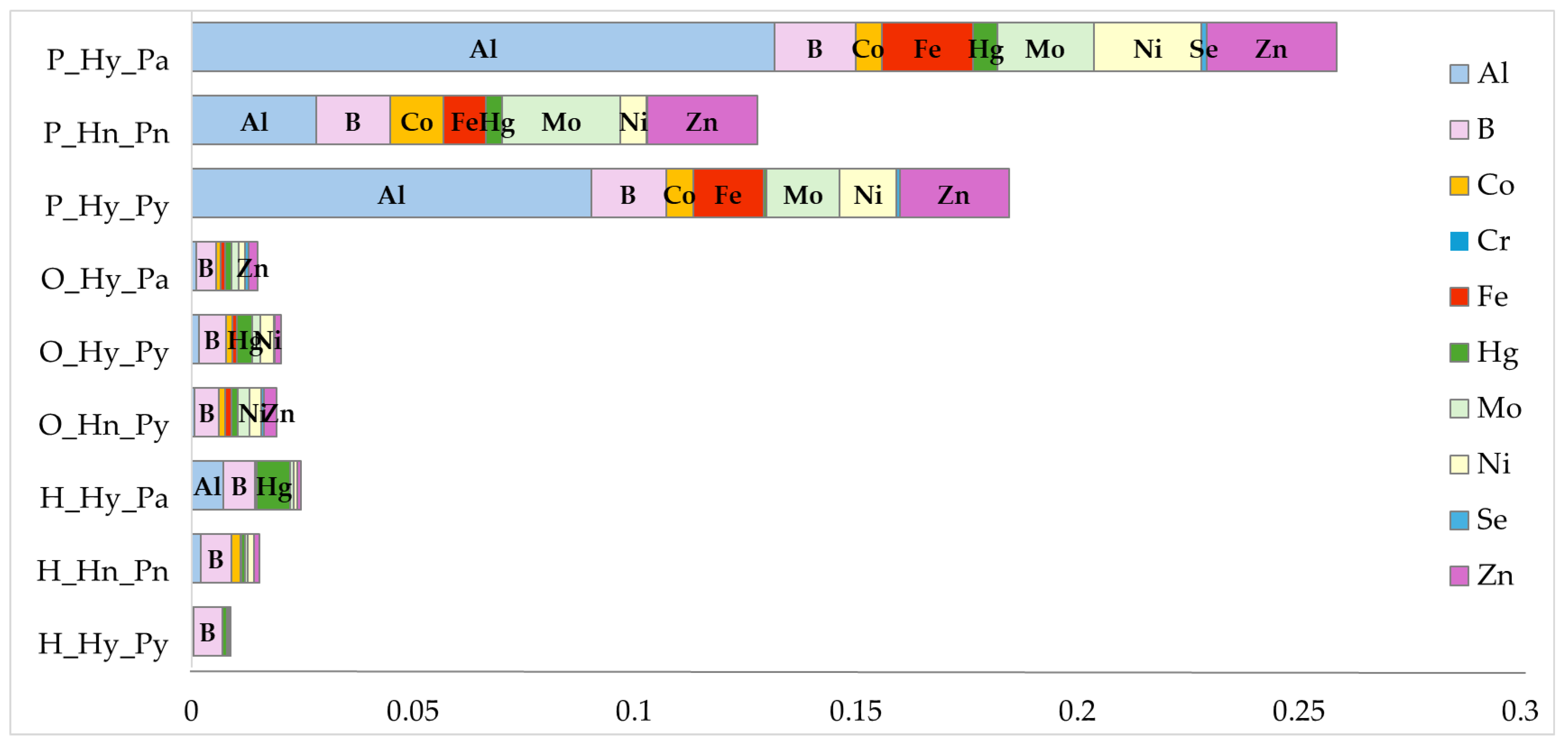
The risk assessment of non-genotoxic effects to which children are exposed due to the presence of metals above the LOQ (Al, B, Co, Cr, Fe, Hg, Mo, Ni, Se, and Zn) in honey (H), bee pollen (P), and orange fruits (O) is shown in Figure 4. This figure presents the hazard quotient (HQ) for each metal, at the 50th percentile, and the hazard index (HI) as a summary of HQs for each field and agricultural practice. The Supplementary Materials (Tables S4 and S5) include additional information on the mean, standard deviation, and the 5th, 50th, 75th, and 95th percentiles for HQ and HI for both adults and children.
The findings indicate that Al, B and Zn often had the highest HQ, highlighting their significant contributions to health risks associated with non-genotoxic effects. The highest risk values, measured by the hazard index (HI), were found in bee pollen harvested from fields treated with herbicides and alternative pesticides like paraffin oil, with an HI of 0.26. In contrast, much lower values were observed for honey and orange fruits, where the HI was less than 0.025. A similar trend was noted in adults, with the highest HI in bee pollen at 0.11, while the values for other products did not exceed 0.015 (refer to Tables S4 and S5). At the 95th percentile, the HI consistently remained below 1 across all examined population groups, fields, and products. The only exception was observed in children consuming bee pollen from cultivated fields.
The POE metric allowed us to calculate the likelihood of EDI exceeding RV. The results indicated that, in all cases, the probability was zero, except for children due to the presence of Al in bee pollen collected from orange orchards with treatments (Hy_Pa and Hy_Py). In these instances, the probabilities were 0.0038 and 0.0006, respectively. The sensitivity analysis conducted reveals that consumption patterns are the primary factors influencing variations in risk, with weight serving as a secondary factor. In children, the impacts associated with these two variables are 77.6% for consumption patterns and 13.2% for weight, concerning orange fruits. For bee products, these contributions are 82.9% and 8.7%, respectively. In adults, consumption contributed to a variance in the health index (HI) by 87.4% for bee products and 91% for orange fruits, while the weight factor had an influence of approximately 8% in the three products.
Risk assessments can vary due to factors such as geographic location, the specific metals involved, and the demographic characteristics of the population under study. The results of the present study are consistent with those reported by other researchers. Ullah et al. [111] documented mean HI values for honey consumption among men, women, and children at 0.006, 0.00621, and 0.00446, respectively. Likewise, Flamminii et al. [15] reported that the average HI risk by consumer groups was as follows: toddlers (0.154), children (0.066), adolescents (0.035), and adults (0.025). Additionally, Scivicco et al. [112] found that the HI did not exceed the threshold of 1 for any population group, including toddlers, adolescents, and adults. The highest HI value was recorded for toddlers at the 95th percentile, measuring 0.69. These results suggest that there are negligible non-carcinogenic health effects in all cases examined. Similarly, Godebo et al. [113] conducted a study on honey samples from the United States and found that the overall and average HI, indicating cumulative risk, were 0.81 and 0.03 for children, and 0.2 and 0.007 for adults, respectively, concluding that no adverse health concerns exist for children and adults from daily honey consumption. Higher values were reported by Mititelu et al. [114], who found HQ values higher than 1 for Cd, Cu and Cr in honey samples from linden, rapeseed, and polyfloral sources originating from highly polluted regions, indicating potential health risks. Similarly, Obasi et al. [115] identified a significant risk (HQ > 1) of As exposure in children consuming honey from Nigeria, with levels that raise concerns regarding cancer risks. Overall, the body of research consistently highlights elevated hazard ratios in honey samples collected from polluted or industrialised areas [81].
In the analysis of bee pollen, the HQ for U in adults was 2.2 × 10⁻⁴, as noted by Flamminii et al. [15]. A comparative study conducted in Italy founded HQ values for P and Cd at 5.1 × 10⁻⁶ and 3.57 × 10⁻⁷, respectively [116]. Furthermore, Zafeiraki et al. [117] reported negligible non-carcinogenic risks for most metals in 45 bee pollen samples; however, Ni and Cr were identified as potential carcinogenic risk factors in several instances. Regarding orange fruits, the HQ values for metals consistently registered below 1, suggesting no significant non-carcinogenic health risk to consumers [14,118]. A similar result was provided in a comprehensive review conducted by Khazaei et al. [13], which examined 44 articles and concluded that the HI for the presence of toxic metals in fruit juices, including orange fruits, remained below 1 across various countries and population groups.
In the present study an evaluation was conducted to assess the cancer risk associated with Cd, Cr, Ni, and Pb in three distinct products under varying agricultural practices. The findings revealed that the risk of developing cancer due to Cd and Pb remained below 1 in 1,000,000 across all scenarios. In contrast, the cancer risk related to Ni in children was categorised as moderate. Specifically, the probabilities for the 50th percentile ranged from 2.04 × 10⁻⁶ to 5.33 × 10⁻⁴, while the 95th percentile ranged from 8 × 10⁻⁶ to 2.07 × 10⁻³. For Cr and children, the CR at the 50th percentile ranged from 2.54 × 10⁻⁷ to 1.73 × 10⁻⁵, and at the 95th percentile, values ranged from 9.9 × 10⁻⁷ to 6.7 × 10⁻⁵. The corresponding values for adults were of a similar magnitude or one order of magnitude lower, as shown in Tables S6 and S7.
Moreover, prior research has assessed the cancer risks associated with honey and bee pollen, highlighting probabilities ranging from 10−5 to 10−4. In this framework, Flamminii et al. [15] reported that the probability of developing cancer associated with bee pollen exceeds 10−4 for Ni in both children and adults. In comparison, the probabilities for Cr, As, Cd, and Pb exceeded 10−5. In the context of citrus fruits, a study by Taghizadeh et al. [119] reported a hazard index (HI) of less than 1 for non-carcinogenic metals in orange fruits and other citrus varieties, although Ni was identified as posing a moderate carcinogenic risk, with an incremental lifetime cancer risk greater than 10−4.

4. Conclusions

Soils from conventional and alternative agricultural systems (including the use of predatory insects, floral strips, and, when needed, vegetable oils) were analysed, along with non-cultivated soils from the protected natural park of Sierra Calderona.
The results revealed significant differences in metal concentrations except for Ca, Cd, Cu, Sb, Se and U. Importantly, all metal concentrations remained well below the threshold limits established for European countries. The environmental risk assessments, using metrics such as the geo-accumulation index (Igeo) and environmental risk (ER), indicated that Cu showed a moderate bio-accumulation index in cultivated soils, potentially linked to the application of agricultural treatments. For the remaining metals, the Igeo values indicated that the soil was unpolluted. Furthermore, ER values indicated that the mean Hg levels posed a moderate risk in uncultivated soils and a considerable risk at the 95th percentile in the uncultivated soils.
The analysis of metal concentrations in the studied foods revealed that bee pollen exhibited the highest levels of metals, ranked as follows: K > P > Ca > Mg. In honey, the most prevalent metals were K > Ca > P > Mg. Orange fruits displayed a similar trend, with the most abundant metals being K > Mg > P > Ca. In terms of health implications, children demonstrated the highest risk values within the studied population. The mean HI for non-genotoxic effects remained below 1 across all cases, except for the HI at the 95th percentile for children consuming bee pollen sourced from cultivated fields. In this specific instance, there is a likelihood between 0.0006 and 0.0038 that exposure to Al exceeds the established reference value. Regarding the probability of cancer, the study indicated that the risk is acceptable for Pb and Cd, but for Ni and bee pollen, the risk was moderate.
The outcomes of the variation in metal concentrations observed in different soils and their associated foods link environmental and public health risks. This underscores the importance of adopting coordinated global measures within the One Health framework.
While the findings of this study are significant, it is important to acknowledge certain limitations that may guide and inform future research. In particular, it would be valuable to consider additional crop types and field management practises such as fertiliser application, since these factors can affect concentrations of PTEs in both soil and crop-derived foods. Moreover, greater attention should be given to the veterinary medicines employed in the management of hive diseases, whether organic or conventional. These substances may also contribute to the exposure of both bees and consumers of hive products to such elements and therefore warrant careful consideration in future research. Additionally, it is recommended to implement targeted measures to reduce metal concentrations, considering soil type, while simultaneously evaluating their effectiveness and potential impact on associated health risks.

Supplementary Materials

The following supporting information can be downloaded at https://www.mdpi.com/article/10.3390/environments13040217/s1: Table S1: Limits of Detection (LOD) and Limits of Quantification (LOQ) values obtained for the target elements. Table S2: Ecological l risk (ER) and geoaccumulation index (Igeo) in soil. Table S3: Estimated Daily Intake (EDI). Average and standard deviation (in brackets) for honey, bee pollen and orange fruits. ANOVA considering field practices and population groups. This table shows the metals used in the risk assessment whose concentrations are above the LOQ. Table S4: Hazard quotient (HQ) and hazard index (HI) in adults. Table S5: Hazard quotient (HQ) and hazard index (HI) in children. Table S6: Cancer risk (CR) in adults. Table S7: Cancer risk (CR) in children.

Author Contributions

Conceptualization, E.D.; methodology, E.D.; software, E.D. and I.E.; validation, E.D. and I.E.; formal analysis, E.D. and I.E.; investigation, E.D. and I.E.; resources, I.E.; data curation, E.D. and I.E.; writing—original draft preparation, E.D. and I.E.; writing—review and editing, E.D.; visualisation, E.D. and I.E.; supervision, E.D. and I.E.; project administration, I.E.; funding acquisition, I.E. All authors have read and agreed to the published version of the manuscript.

Funding

This research was funded by the Next Generation European Union and the Plan de Recuperacion, Transformacion y Resiliencia of the Spanish Government, with the support of Generalitat Valenciana (project AGROALNEXT/2022/043). The authors also wish to thank AGCOOP/2025/0023 Project, co-financed 60% (EAFRD), 16.24% (MAPA) and 23.76% GENERALITAT VALENCIANA in the Aid Program for Cooperation within the framework of interventions for rural development of PEPAC 23-27.

Data Availability Statement

The original contributions presented in the study are included in the article; further inquiries can be directed to the corresponding author.

Acknowledgments

The authors would like to thank “Cooperative Sant Vicent Ferrer de Benaguasil (Valencia)” for providing us with the orchards necessary to carry out this study.

Conflicts of Interest

The authors declare no conflicts of interest. Those that funded the project had no role in the design of the study; in the collection, analyses, or interpretation of data; in the writing of the manuscript; or in the decision to publish the results.

References

  1. Lehel, J.; Pleva, D.; Nagy, A.L.; Süth, M.; Kocsner, T. Potential Metal Contamination in Foods of Animal Origin—Food Safety Aspects. Appl. Sci. 2025, 15, 8468. [Google Scholar] [CrossRef] [Scilit]
  2. Aga, M.B.; Sharma, V.; Dar, A.H.; Dash, K.K.; Singh, A.; Shams, R.; Khan, S.A. Comprehensive review on functional and nutraceutical properties of honey. eFood 2023, 4, e71. [Google Scholar] [CrossRef] [Scilit]
  3. IARC (International Agency for Research on Cancer). List of Classifications. Agents Classified by the IARC Monographs, Volumes 1–135. 2024. Available online: https://monographs.iarc.who.int/list-of-classifications (accessed on 12 April 2026).
  4. Saad, S.; Fatthalla, M.; Abd-Ellah, H.; Taha, S.M.; Mahrous, A.; Shahba, M.A. Antibiotics, pesticides, and heavy metals contaminants of honey as affected by antibiotics usage and agricultural practices in different Egyptian environments. Egypt. Pharm. J. 2024, 23, 555–564. [Google Scholar] [CrossRef] [Scilit]
  5. Mamabolo, E.; Gaigher, R.; Pryke, J.S. Conventional agricultural management negatively affects soil fauna abundance, soil physicochemical quality and multifunctionality. Pedobiologia 2024, 104, 150961. [Google Scholar] [CrossRef] [Scilit]
  6. Rai, P.K.; Lee, S.S.; Zhang, M.; Tsang, Y.F.; Kim, K.H. Heavy metals in food crops: Health risks, fate, mechanisms, and management. Environ. Int. 2019, 125, 365–385. [Google Scholar] [CrossRef] [Scilit] [PubMed]
  7. Tasleem, S.; Masud, S.; Habib, S.S.; Naz, S.; Fazio, F.; Aslam, M.; Ullah, M.; Attaullah, S. Investigation of the incidence of heavy metals contamination in commonly used fertilizers applied to vegetables, fishponds, and human health risk assessments. Environ. Sci. Pollut. Res. 2023, 30, 100646–100659. [Google Scholar] [CrossRef] [Scilit] [PubMed]
  8. Alengebawy, A.; Abdelkhalek, S.T.; Qureshi, S.R.; Wang, M.Q. Heavy metals and pesticides toxicity in agricultural soil and plants: Ecological risks and human health implications. Toxics 2021, 9, 42. [Google Scholar] [CrossRef] [Scilit]
  9. Yeganeh, M.; Afyuni, M.; Khoshgoftarmanesh, A.H.; Rezaeinejad, Y.; Schulin, R. Transport of zinc, copper, and lead in a sewage sludge amended calcareous soil. Soil. Use Manag. 2010, 26, 176–182. [Google Scholar] [CrossRef] [Scilit]
  10. Tamoutsidis, E.; Papadopoulos, I.; Tokatlidis, I.; Zotis, S.; Mavropoulos, T. Wet sewage sludge application effect on soil properties and element content of leaf and root vegetables. J. Plant Nutr. 2002, 25, 1941–1955. [Google Scholar] [CrossRef] [Scilit]
  11. Guadalupe, G.A.; García, L.; Chavez, S.G.; Doménech, E. Ecological and Health Risk Assessment of Metals in Organic and Conventional Peruvian Coffee from a Probabilistic Approach. Agronomy 2024, 14, 2817. [Google Scholar] [CrossRef] [Scilit]
  12. Mehri, F.; Heshmati, A.; Ghane, E.T.; Mahmudiono, T.; Fakhri, Y. Concentration of Heavy Metals in Traditional and Industrial Fruit Juices from Iran: Probabilistic Risk Assessment Study. Biol. Trace Elem. Res. 2024, 202, 5296–5305. [Google Scholar] [CrossRef] [Scilit]
  13. Khazaei, S.; Talebi Ghane, E.; Bashirian, S.; Mehri, F. The concentration of potentially toxic elements (PTEs) in fruit juices: A global systematic review, meta-analysis and probabilistic health risk assessment. Int. J. Environ. Anal. Chem. 2023, 103, 1259–1271. [Google Scholar] [CrossRef] [Scilit]
  14. El Youssfi, M.; Benabbou, A.; Flayou, M.; El Hazzat, M.; Belekbir, S.; Mahnine, N.; Zinedine, A.; Laghzizil, A.; Fegrouche, R.; El Hamidi, A.; et al. Lead and Cadmium in Orange Juices Marketed in Morocco: A Comprehensive Survey and Human Health Risk Assessment. Biol. Trace Elem. Res. 2026, 204, 1936–1945. [Google Scholar] [CrossRef] [Scilit]
  15. Flamminii, F.; Consalvo, A.; Cichelli, A.; Chiaudani, A. Assessing Mineral Content and Heavy Metal Exposure in Abruzzo Honey and Bee Pollen from Different Anthropic Areas. Foods 2024, 13, 1930. [Google Scholar] [CrossRef] [Scilit] [PubMed]
  16. Cianciosi, D.; Forbes-Hernández, T.Y.; Afrin, S.; Gasparrini, M.; Reboredo-Rodriguez, P.; Manna, P.P.; Zhang, J.; Bravo Lamas, L.; Martínez Flórez, S.; Agudo Toyos, P.; et al. Phenolic compounds in honey and their associated health benefits: A review. Molecules 2018, 23, 2322. [Google Scholar] [CrossRef] [Scilit]
  17. Zoroddu, M.A.; Aaseth, J.; Crisponi, G.; Medici, S.; Peana, M.; Nurchi, V.M. The essential metals for humans: A brief overview. J. Inorg. Biochem. 2019, 195, 120–129. [Google Scholar] [CrossRef] [Scilit] [PubMed]
  18. Khalifa, S.A.; Elashal, M.H.; Yosri, N.; Du, M.; Musharraf, S.G.; Nahar, L.; Sarker, S.D.; Guo, Z.; Cao, W.; Zou, X.; et al. Bee pollen: Current status and therapeutic potential. Nutrients 2021, 13, 1876. [Google Scholar] [CrossRef] [Scilit]
  19. Adaškevičiūtė, V.; Kaškonienė, V.; Kaškonas, P.; Barčauskaitė, K.; Maruška, A. Comparison of physicochemical properties of bee pollen with other bee products. Biomolecules 2019, 9, 819. [Google Scholar] [CrossRef] [Scilit]
  20. El Ghouizi, A.; Bakour, M.; Laaroussi, H.; Ousaaid, D.; El Menyiy, N.; Hano, C.; Lyoussi, B. Bee Pollen as Functional Food: Insights into Its Composition and Therapeutic Properties. Antioxidants 2023, 12, 557. [Google Scholar] [CrossRef] [Scilit]
  21. Wang, H.; Li, L.; Lin, X.; Bai, W.; Xiao, G.; Liu, G. Composition, functional properties and safety of honey: A review. J. Sci. Food Agric. 2023, 103, 6767–6779. [Google Scholar] [CrossRef] [Scilit] [PubMed]
  22. Anjum, S.I.; Ullah, A.; Gohar, F.; Raza, G.; Khan, M.I.; Hameed, M.; Ali, A.; Chen, C.C.; Tlak Gajger, I. Bee pollen as a food and feed supplement and a therapeutic remedy: Recent trends in nanotechnology. Front. Nutr. 2024, 11, 1371672. [Google Scholar] [CrossRef] [Scilit]
  23. Bava, R.; Castagna, F.; Lupia, C.; Poerio, G.; Liguori, G.; Lombardi, R.; Naturale, M.D.; Bulotta, R.M.; Biondi, V.; Passantino, A.; et al. Hive Products: Composition, Pharmacological Properties, and Therapeutic Applications. Pharmaceuticals 2024, 17, 646. [Google Scholar] [CrossRef] [Scilit]
  24. Kohl, P.L.; Rutschmann, B. Honeybees communicate distance via non-linear waggle duration functions. PeerJ 2021, 9, e11187. [Google Scholar] [CrossRef] [Scilit]
  25. Herrero-Latorre, C.; Barciela-García, J.; García-Martín, S.; Peña-Crecente, R.M. The use of honeybees and honey as environ-mental bioindicators for metals and radionuclides: A review. Environ. Rev. 2017, 25, 463–480. [Google Scholar] [CrossRef] [Scilit]
  26. Girotti, S.; Ghini, S.; Ferri, E.; Bolelli, L.; Colombo, R.; Serra, G.; Porrini, C.; Sangiorgi, S. Bioindicators and biomonitoring: Honeybees and hive products as pollution impact assessment tools for the Mediterranean area. Euro-Mediterr. J. Environ. Integr. 2020, 5, 62. [Google Scholar] [CrossRef] [Scilit]
  27. Mair, K.S.; Irrgeher, J.; Haluza, D. Elucidating the Role of Honeybees as Biomonitors in Environmental Health Research. Insects 2023, 14, 874. [Google Scholar] [CrossRef] [Scilit] [PubMed]
  28. Aguirre, A.A.; Beasley, V.R.; Augspurger, T.; Benson, W.H.; Whaley, J.; Basu, N. One health—Transdisciplinary opportunities for SETAC leadership in integrating and improving the health of people, animals, and the environment. Environ. Toxicol. Chem. 2016, 35, 2383–2391. [Google Scholar] [CrossRef] [Scilit]
  29. World Health Organization. A Health Perspective on the Role of the Environment in One Health (No. WHO/EURO: 2022-5290-45054-64214). World Health Organization. Regional Office for Europe. Available online: https://www.who.int/europe/publications/i/item/WHO-EURO-2022-5290-45054-64214 (accessed on 12 April 2026).
  30. FAO, One Health Joint Plan of Action, 2022–2026. FAO; UNEP; WHO; World Organisation for Animal Health (WOAH) (founded as OIE). 2022. Available online: https://openknowledge.fao.org/handle/20.500.14283/cc2289en (accessed on 12 April 2026). [CrossRef] [Scilit]
  31. Doménech, E.; Martorell, S. Review of the terminology, approaches, and formulations used in the guidelines on quantitative risk assessment of chemical hazards in food. Foods 2024, 13, 714. [Google Scholar] [CrossRef] [Scilit] [PubMed]
  32. European Commission. Proposal for a Regulation of the European Parliament and of the Council on Nature Restoration. Communication for the Commission to the European Parliament. 2022. Available online: https://eur-lex.europa.eu/legal-content/EN/TXT/?uri=celex:52022PC0304 (accessed on 12 April 2026).
  33. Calleja-Gomez, M.; Marti-Quijal, F.J.; Roig, P.; Castagnini, J.M.; Barba, F.J. Pulsed electric field extracts obtained from edible mushrooms: A detailed ICP-MS analysis of their mineral and heavy metal contents and their cytotoxic effect on CACO-2 cells. Food Bioprocess Technol. 2025, 18, 4551–4565. [Google Scholar] [CrossRef] [Scilit]
  34. Wenzl, T.; Haedrich, J.; Schaechtele, A.; Piotr, R.; Stroka, J.; Eppe, G.; Scholl, G. Guidance Document on the Estimation of LOD and LOQ for Measurements in the Field of Contaminants in Food and Feed. 2016, pp. 1–52. Available online: https://hdl.handle.net/2268/199914 (accessed on 12 April 2026).
  35. Ramos, L.C.; Rodríguez-García, A.; Castagnini, J.M.; Salgado-Ramos, M.; Martínez-Culebras, P.V.; Barba, F.J.; Pallarés, N. HPLC-MS/MS and ICP-MS for evaluation of mycotoxins and heavy metals in edible insects and their defatted cakes resulting from supercritical fluid extraction. Foods 2024, 13, 3233. [Google Scholar] [CrossRef] [Scilit]
  36. Gu, Q.; Yu, T.; Yang, Z.; Ji, J.; Hou, Q.; Wang, L.; Wei, X.; Zhang, Q. Prediction and risk assessment of five heavy metals in maize and peanut: A case study of Guangxi, China. Environ. Toxicol. Pharmacol. 2019, 70, 103199. [Google Scholar] [CrossRef] [Scilit]
  37. Doménech, E.; Simó-Alfonso, E.A.; Barragán-Huerta, B.E.; Escriche, I. A probabilistic approach to compare the risk associated with heavy metals and bromine in honey from Dominican Republic, Mexico, Mozambique and Spain. Food Chem. Toxicol. 2024, 183, 114306. [Google Scholar] [CrossRef] [Scilit]
  38. Crespo-Toledo, T.; Avelar-González, F.; Guerrero-Barrera, A.; Mitchell, K.; Yamamoto-Flores, L.; Flores-Amaro, O. Integrative assessment of heavy metal risks in mining polluted sediments and soils of Aguascalientes, Mexico. Case Stud. Chem. Environ. Eng. 2025, 11, 101130. [Google Scholar] [CrossRef] [Scilit]
  39. Ferreira, S.L.C.; da Silva, J.B.; dos Santos, I.F.; de Oliveira, O.M.C.; Cerda, V.; Queiroz, A.F.S. Use of pollution indices and ecological risk in the assessment of contamination from chemical elements in soils and sediments—Practical aspects. Trends Environ. Anal. Chem. 2022, 35, e00169. [Google Scholar] [CrossRef] [Scilit]
  40. Agyeman, P.C.; Kingsley, J.O.; Kebonye, N.M.; Ofori, S.; Borůvka, L.; Vašát, R.; Kočárek, M. Ecological risk source distribution, uncertainty analysis, and application of geographically weighted regression cokriging for prediction of potentially toxic elements in agricultural soils. Process Saf. Environ. Prot. 2022, 164, 729–746. [Google Scholar] [CrossRef] [Scilit]
  41. Biswas, A.; Choudhary, A.; Darbha, G.K. From ground to gut: Evaluating the human health risk of potentially toxic elements in soil, groundwater, and their uptake by Cocos nucifera in arsenic-contaminated environments. Environ. Pollut. 2024, 344, 123342. [Google Scholar] [CrossRef] [Scilit] [PubMed]
  42. EFSA OpenFoodTox: EFSA’s Chemical Hazards Database. 2023. Available online: https://www.efsa.europa.eu/en/microstrategy/openfoodtox (accessed on 12 April 2026).
  43. EPA IRIS Assessments. United States Environmental Protection Agency. 2025. Available online: https://iris.epa.gov/AtoZ/?list_type=alpha (accessed on 12 April 2026).
  44. Foodex2. Food Consumption Statistics for FoodEx2: Level 3 (Honey). 2025. Available online: https://www.efsa.europa.eu/en/microstrategy/foodex2-level-7 (accessed on 12 April 2026).
  45. EFSA Scientific Committee. Guidance on selected default values to be used by the EFSA Scientific Committee, Scientific Panels and Units in the absence of actual measured data. EFSA J. 2012, 10, 2579. [Google Scholar] [CrossRef] [Scilit]
  46. Ejaz, U.; Khan, S.M.; Shah, S.F.A.; Khalid, N.; Jehangir, S.; Rizvi, Z.F.; Svenning, J.C. Integrative data-driven analytics for assessing ecological and human health risks of soil heavy metal contamination. J. Hazard. Mater. Adv. 2025, 17, 100596. [Google Scholar] [CrossRef] [Scilit]
  47. Gelaye, G.; Ezez, D.; Tefera, M. Distribution, pollution status of metals and human health risk evaluation in honey: Chemo-metric approach. Environ. Chall. 2024, 16, 100958. [Google Scholar] [CrossRef] [Scilit]
  48. He, Z.; Shentu Yang, X.; Baligar, V.C.; Zhang, T.; Stoffella, P.J. Heavy Metal Contamination of Soils: Sources, Indicators and Assessment. J. Environ. Indic. 2015, 9, 17–18. [Google Scholar]
  49. Gupta, S.; Kaur, N.; Kant, K.; Jindal, P.; Ali, A.; Naeem, M. Calcium: A master regulator of stress tolerance in plants. S. Afr. J. Bot. 2023, 163, 580–594. [Google Scholar] [CrossRef] [Scilit]
  50. El Rasafi, T.; Oukarroum, A.; Haddioui, A.; Song, H.; Kwon, E.E.; Bolan, N.; Tack, F.M.; Sebastian, A.; Prasad, M.N.; Rinklebe, J. Cadmium stress in plants: A critical review of the effects, mechanisms, and tolerance strategies. Crit. Rev. Environ. Sci. Technol. 2022, 52, 675–726. [Google Scholar] [CrossRef] [Scilit]
  51. Reddy, S.H.; Al-kalbani, H.; Al-Qalhati, S.; Al-Kahtani, A.A.; Al Hoqani, U.; Azmi, S.N.; Kumar, A.; Kumar, S.; Settaluri, V.S. Proline and other physiological changes as an indicator of abiotic stress caused by heavy metal contamination. J. King Saud Univ. Sci. 2024, 36, 103313. [Google Scholar] [CrossRef] [Scilit]
  52. Efroymson, R.A.; Will, M.E.; Suter, G.W.; Wooten, I.A.C. Toxicological Benchmarks for Screening Contaminants of Potential Concern for Effects on Terrestrial Plants: Revision. 1997. Available online: https://rais.ornl.gov/documents/tm126r21.pdf (accessed on 12 April 2026).
  53. Kapustka, L.A. Issue Paper on the Ecological Effects of Metals. US Environmental Protection Agency. 2004. Available online: https://www.epa.gov/caddis/metals (accessed on 12 April 2026).
  54. Sur, I.M.; Prodan, V.C.; Micle, V.; Nasui, M.; Hegyi, A.; Pop, V.S.; Scurtu, L.I. Washing Procedure with Several Reagents for Ecological Rehabilitation of Soil Polluted with Heavy Metals. Soil. Syst. 2025, 9, 130. [Google Scholar] [CrossRef] [Scilit]
  55. Sur, I.M.; Micle, V.; Polyak, E.T.; Gabor, T. Assessment of soil quality status and the ecological risk in the Baia Mare, Romania area. Sustainability 2022, 14, 3739. [Google Scholar] [CrossRef] [Scilit]
  56. Hall, S.J.; Liptzin, D.; Buss, H.L.; DeAngelis, K.; Silver, W.L. Drivers and patterns of iron redox cycling from surface to bedrock in a deep tropical forest soil: A new conceptual model. Biogeochemistry 2016, 130, 177–190. [Google Scholar] [CrossRef] [Scilit]
  57. Han, R.; Liu, W.; Xu, Z. The constraint of soil Zn isotope compositions by diverse land utilizations: Evidence from geochemical fingerprint in a typical karst area. Catena 2024, 240, 108005. [Google Scholar] [CrossRef] [Scilit]
  58. Shiwakoti, S.; Zheljazkov, V.D.; Gollany, H.T.; Kleber, M.; Xing, B. Micronutrients decline under long-term tillage and nitrogen fertilization. Sci. Rep. 2019, 9, 12020. [Google Scholar] [CrossRef] [Scilit] [PubMed]
  59. Wiryawan, A.; Eginarta, W.S.; Hermanto, F.E.; Ustiatik, R.; Dinira, L.; Mustafa, I. Changes in Essential Soil Nutrients and Soil Disturbance Directly Affected Soil Microbial Community Structure: A Metagenomic Approach. J. Ecol. Eng. 2022, 23, 238–245. [Google Scholar] [CrossRef]
  60. Jović, M.; Šljivić-Ivanović, M.; Dimović, S.; Marković, J.; Smičiklas, I. Sorption and mobility of Co (II) in relation to soil properties. Geoderma 2017, 297, 38–47. [Google Scholar] [CrossRef] [Scilit]
  61. Agbenin, J.O. The impact of long-term cultivation and management history on the status and dynamics of cobalt in a savanna Alfisol in Nigeria. Eur. J. Soil Sci. 2002, 53, 169–174. [Google Scholar] [CrossRef] [Scilit]
  62. Michopoulos, P.; Kostakis, M.; Kaoukis, K.; Bourletsikas, A.; Solomou, A.; Pasias, I.; Thomaidis, N. Cycling and status of cobalt in some forest types. Folia Oecologica 2023, 50, 72–79. [Google Scholar] [CrossRef] [Scilit]
  63. Banks, M.K.; Schwab, A.P.; Henderson, C. Leaching and reduction of chromium in soil as affected by soil organic content and plants. Chemosphere 2006, 62, 255–264. [Google Scholar] [CrossRef] [Scilit]
  64. Ettler, V.; Vaněk, A.; Mihaljevič, M.; Bezdička, P. Contrasting lead speciation in forest and tilled soils heavily polluted by lead metallurgy. Chemosphere 2005, 58, 1449–1459. [Google Scholar] [CrossRef] [Scilit] [PubMed]
  65. Elberling, B.; Breuning-Madsen, H.; Hinge, H.; Asmund, G. Heavy metals in 3300-year-old agricultural soils used to assess present soil contamination. Eur. J. Soil Sci. 2010, 61, 74–83. [Google Scholar] [CrossRef] [Scilit]
  66. Zhou, J.; Du, B.; Wang, Z.; Zhang, W.; Xu, L.; Fan, X.; Liu, X.; Zhou, J. Distributions and pools of lead (Pb) in a terrestrial forest ecosystem with highly elevated atmospheric Pb deposition and ecological risks to insects. Sci. Total Environ. 2019, 647, 932–941. [Google Scholar] [CrossRef] [Scilit]
  67. Wieczorek, J.; Baran, A.; Urbański, K.; Mazurek, R.; Klimowicz-Pawlas, A. Assessment of the pollution and ecological risk of lead and cadmium in soils. Environ. Geochem. Health 2018, 40, 2325–2342. [Google Scholar] [CrossRef] [Scilit]
  68. Atafar, Z.; Mesdaghinia, A.; Nouri, J.; Homaee, M.; Yunesian, M.; Ahmadimoghaddam, M.; Mahvi, A.H. Effect of fertilizer application on soil heavy metal concentration. Environ. Monit. Assess. 2010, 160, 83–89. [Google Scholar] [CrossRef] [Scilit]
  69. Adams, M.L.; Davis, M.R.; Powell, K.J. Effects of grassland afforestation on exchangeable soil and soil solution aluminium. Aust. J. Soil Res. 2001, 39, 1003–1014. [Google Scholar] [CrossRef] [Scilit]
  70. Palleiro, L.; Patinha, C.; Rodríguez-Blanco, M.L.; Taboada-Castro, M.M.; Taboada-Castro, M.T. Aluminum Forms in Solid Phase of Soils Developed over Schists as a Function of Land Use. Commun. Soil Sci. Plant Anal. 2016, 47, 90–96. [Google Scholar] [CrossRef] [Scilit]
  71. Wurzburger, N.; Bellenger, J.P.; Kraepiel, A.M.L.; Hedin, L.O. Molybdenum and phosphorus interact to constrain asymbiotic nitrogen fixation in tropical forests. PLoS ONE 2012, 7, e33710. [Google Scholar] [CrossRef] [Scilit]
  72. Nakamaru, Y.M.; Altansuvd, J. Speciation and bioavailability of selenium and antimony in non-flooded and wetland soils: A review. Chemosphere 2014, 111, 366–371. [Google Scholar] [CrossRef] [Scilit]
  73. Lombardo, M.F.; Panebianco, S.; Azzaro, A.; Catara, V.; Cirvilleri, G. Assessing Copper-Alternative Products for the Control of Pre- and Postharvest Citrus Anthracnose. Plants 2023, 12, 904. [Google Scholar] [CrossRef] [Scilit]
  74. Mo, X.; Chen, C.; Riaz, M.; Moussa, M.G.; Chen, X.; Wu, S.; Tan, Q.; Sun, X.; Zhao, X.; Shi, L.; et al. Fruit Characteristics of Citrus Trees Grown under Different Soil Cu Levels. Plants 2022, 11, 2943. [Google Scholar] [CrossRef] [Scilit]
  75. Zhou, X.; He, Z.; Liang, Z.; Stoffella, P.J.; Fan, J.; Yang, Y.; Powell, C.A. Long-Term Use of Copper-Containing Fungicide Affects Microbial Properties of Citrus Grove Soils. Soil Sci. Soc. Am. J. 2011, 75, 898–906. [Google Scholar] [CrossRef] [Scilit]
  76. Bakshi, S.; He, Z.L.; Harris, W.G. Particulate copper in soils and surface runoff from contaminated sandy soils under citrus production. Environ. Sci. Pollut. Res. 2013, 20, 8801–8812. [Google Scholar] [CrossRef] [Scilit] [PubMed]
  77. Gamby, R.L.; Hammerschmidt, C.R.; Costello, D.M.; Lamborg, C.H.; Runkle, J.R. Deforestation and cultivation mobilize mercury from topsoil. Sci. Total Environ. 2015, 532, 467–473. [Google Scholar] [CrossRef] [Scilit] [PubMed]
  78. Almeida, M.D.; Lacerda, L.D.; Bastos, W.R.; Herrmann, J.C. Mercury loss from soils following conversion from forest to pasture in Rondônia, Western Amazon, Brazil. Environ. Pollut. 2005, 137, 179–186. [Google Scholar] [CrossRef] [Scilit] [PubMed]
  79. Lacerda, L.D.; De Souza, M.; Ribeiro, M.G. The effects of land use change on mercury distribution in soils of Alta Floresta, Southern Amazon. Environ. Pollut. 2004, 129, 247–255. [Google Scholar] [CrossRef] [Scilit]
  80. Béliveau, A.; Lucotte, M.; Davidson, R.; Paquet, S.; Mertens, F.; Passos, C.J.; Romana, C.A. Reduction of soil erosion and mercury losses in agroforestry systems compared to forests and cultivated fields in the Brazilian Amazon. J. Environ. Manag. 2017, 203, 522–532. [Google Scholar] [CrossRef] [Scilit]
  81. Sopaj, F.; Kastrati, G.; Stafilov, T.; Šajn, R.; Tašev, K.; Paçarizi, M. Honey and bee pollen as bioindicators of mercury and thallium exposure in Kosovo. Toxicol. Environ. Chem. 2025, 107, 952–970. [Google Scholar] [CrossRef] [Scilit]
  82. Boussaid, A.; Chouaibi, M.; Rezig, L.; Hellal, R.; Donsì, F.; Ferrari, G.; Hamdi, S. Physicochemical and bioactive properties of six honey samples from various floral origins from Tunisia. Arab. J. Chem. 2018, 11, 265–274. [Google Scholar] [CrossRef] [Scilit]
  83. Di Bella, G.; Lo Turco, V.; Potortì, A.G.; Bua, G.D.; Fede, M.R.; Dugo, G. Geographical discrimination of Italian honey by multi-element analysis with a chemometric approach. J. Food Compos. Anal. 2015, 44, 25–35. [Google Scholar] [CrossRef] [Scilit]
  84. Di Rosa, A.R.; Leone, F.; Cheli, F.; Chiofalo, V. Novel approach for the characterisation of Sicilian honeys based on the correlation of physico-chemical parameters and artificial senses. Ital. J. Anim. Sci. 2019, 18, 389–397. [Google Scholar] [CrossRef] [Scilit]
  85. Gulfraz, M.; Ifftikhar, F.; Asif, S.; Raja, G.K.; Asad, M.J.; Imran, M.; Abbasi, K.; Zeenat, A. Quality assessment and antimicrobial activity of various honey types of Pakistan. Afr. J. Biotechnol. 2010, 9, 6906. [Google Scholar] [CrossRef]
  86. Harmankaya, M.; Gezgin, S.; Özcan, M.M. Comparative evaluation of some macro- and micro-element and heavy metal contents in commercial fruit juices. Environ. Monit. Assess. 2012, 184, 5415–5420. [Google Scholar] [CrossRef] [Scilit]
  87. Dehelean, A.; Magdas, D.A. Analysis of mineral and heavy metal content of some commercial fruit juices by inductively coupled plasma mass spectrometry. Sci. World J. 2013, 2013, 215423. [Google Scholar] [CrossRef] [Scilit]
  88. Tormen, L.; Torres, D.P.; Dittert, I.M.; Araújo, R.G.O.; Frescura, V.L.A.; Curtius, A.J. Rapid assessment of metal contamination in commercial fruit juices by inductively coupled mass spectrometry after a simple dilution. J. Food Compos. Anal. 2011, 24, 95–102. [Google Scholar] [CrossRef] [Scilit]
  89. Zavrtnik, S.; Loborec, J.; Kapelj, S.; Grčić, I. Environmental biomonitoring of heavy and toxic metals using honeybees and their products—An overview of previous research. Sustainability 2024, 16, 8526. [Google Scholar] [CrossRef] [Scilit]
  90. Fernández-Torres, R.; Pérez-Bernal, J.L.; Bello-López, M.Á.; Callejón-Mochón, M.; Jiménez-Sánchez, J.C.; Guiraúm-Pérez, A. Mineral content and botanical origin of Spanish honeys. Talanta 2005, 65, 686–691. [Google Scholar] [CrossRef] [Scilit] [PubMed]
  91. De Alda-Garcilope, C.; Gallego-Picó, A.; Bravo-Yagüe, J.C.; Garcinuño-Martínez, R.M.; Fernández-Hernando, P. Characterization of Spanish honeys with protected designation of origin “miel de Granada” according to their mineral content. Food Chem. 2012, 135, 1785–1788. [Google Scholar] [CrossRef] [Scilit]
  92. Bilandžić, N.; Gajger, I.T.; Kosanović, M.; Čalopek, B.; Sedak, M.; Kolanović, B.S.; Varenina, I.; Luburić, Đ.B.; Varga, I.; Đokić, M. Essential and toxic element concentrations in monofloral honeys from southern Croatia. Food Chem. 2017, 234, 245–253. [Google Scholar] [CrossRef] [Scilit]
  93. Bontempo, L.; Camin, F.; Ziller, L.; Perini, M.; Nicolini, G.; Larcher, R. Isotopic and elemental composition of selected types of Italian honey. Measurement 2017, 98, 283–289. [Google Scholar] [CrossRef] [Scilit]
  94. González-Miret, M.L.; Terrab, A.; Hernanz, D.; Fernández-Recamales, M.Á.; Heredia, F.J. Multivariate correlation between color and mineral composition of honeys and by their botanical origin. J. Agric. Food Chem. 2005, 53, 2574–2580. [Google Scholar] [CrossRef] [Scilit]
  95. Karabagias, I.K.; Louppis, A.P.; Karabournioti, S.; Kontakos, S.; Papastephanou, C.; Kontominas, M.G. Characterization and geo-graphical discrimination of commercial Citrus spp. honeys produced in different Mediterranean countries based on min-erals, volatile compounds and physicochemical parameters, using chemometrics. Food Chem. 2017, 217, 445–455. [Google Scholar] [CrossRef] [Scilit]
  96. Louppis, A.P.; Karabagias, I.K.; Kontakos, S.; Kontominas, M.G.; Papastephanou, C. Botanical discrimination of Greek unifloral honeys based on mineral content in combination with physicochemical parameter analysis, using a validated chemometric approach. Microchem. J. 2017, 135, 180–189. [Google Scholar] [CrossRef] [Scilit]
  97. Nanda, V.; Singh, B.; Kukreja, V.K.; Bawa, A.S. Characterisation of honey produced from different fruit plants of northern India. Int. J. Food Sci. Technol. 2009, 44, 2629–2636. [Google Scholar] [CrossRef] [Scilit]
  98. Perna, A.; Simonetti, A.; Intaglietta, I.; Sofo, A.; Gambacorta, E. Metal content of southern Italy honey of different botanical origins and its correlation with polyphenol content and antioxidant activity. Int. J. Food Sci. Technol. 2012, 47, 1909–1917. [Google Scholar] [CrossRef] [Scilit]
  99. Terrab, A.; Díez, M.J.; Heredia, F.J. Palynological, Physico-Chemical and Colour Characterization of Moroccan Honeys. II. Orange (Citrus Sp.) Honey. Int. J. Food Sci. Technol. 2003, 38, 387–394. [Google Scholar] [CrossRef] [Scilit]
  100. Aazza, S.; Lyoussi, B.; Antunes, D.; Miguel, M.G. Physicochemical characterization and antioxidant activity of commercial portuguese honeys. J. Food Sci. 2013, 78, C1159–C1165. [Google Scholar] [CrossRef] [Scilit]
  101. García, J.C.R.; Rodríguez, R.I.; Crecente, R.M.P.; García, J.B.; Martín, S.G.; Latorre, C.H. Preliminary chemometric study on the use of honey as an environmental marker in Galicia (northwestern Spain). J. Agric. Food Chem. 2006, 54, 7206–7212. [Google Scholar] [CrossRef] [Scilit]
  102. Bouhlali, E.D.; Bammou, M.; Sellam, K.; El Midaoui, A.; Bourkhis, B.; Ennassir, J.; Alem, C.; Filali-Zegzouti, Y. Physicochemical properties of eleven monofloral honey samples produced in Morocco. Arab. J. Basic. Appl. Sci. 2019, 26, 476–487. [Google Scholar] [CrossRef] [Scilit]
  103. Nanda, V.; Sarkar, B.C.; Sharma, H.K.; Bawa, A.S. Physico-chemical properties and estimation of mineral content in honey produced from different plants in Northern India. J. Food Compos. Anal. 2003, 16, 613–619. [Google Scholar] [CrossRef] [Scilit]
  104. Yücel, Y.; Sultanoglu, P. Determination of industrial pollution effects on citrus honeys with chemometric approach. Food Chem. 2012, 135, 170–178. [Google Scholar] [CrossRef] [Scilit]
  105. Szymczycha-Madeja, A.; Welna, M. Evaluation of a simple and fast method for the multi-elemental analysis in commercial fruit juice samples using atomic emission spectrometry. Food Chem. 2013, 141, 3466–3472. [Google Scholar] [CrossRef] [Scilit]
  106. Demir, F.; Kipcak, A.S.; Dere Ozdemir, O.; Moroydor Derun, E. Determination of essential and non-essential element concentrations and health risk assessment of some commercial fruit juices in Turkey. J. Food Sci. Technol. 2020, 57, 4432–4442. [Google Scholar] [CrossRef] [Scilit]
  107. Smical, I.; Muntean, A.; Micle, V.; Sur, I.M.; Moldovan, A.C. Study on human health risks associated with consuming vegetables grown in industrially polluted soil in Sasar area, NW Romania, in the context of sustainable development. Sustainability 2025, 17, 4072. [Google Scholar] [CrossRef] [Scilit]
  108. Commission Regulation (EU) 2023/915 of 25 April 2023 on Maximum Levels for Certain Contaminants in Food and Repealing Regulation (EC) No 1881/2006. Available online: https://eur-lex.europa.eu/legal-content/EN/TXT/PDF/?uri=CELEX:32023R0915 (accessed on 12 April 2026).
  109. Anastácio, M.; dos Santos, A.P.M.; Aschner, M.; Mateus, L. Determination of trace metals in fruit juices in the Portuguese market. Toxicol. Rep. 2018, 5, 434–439. [Google Scholar] [CrossRef] [Scilit]
  110. Commission Regulation (EU) 2024/1987 of 30 July 2024 Amending Regulation (EU) 2023/915 as Regards Maximum Levels of Nickel in Certain Foodstuffs. Available online: https://eur-lex.europa.eu/eli/reg/2024/1987/oj/eng (accessed on 12 April 2026).
  111. Ullah, R.; Jan, F.A.; Gulab, H.; Saleem, S.; Ullah, N.; Wajidullah. Metals Contents in Honey, Beeswax and Bees and Human Health Risk Assessment Due to Consumption of Honey: A Case Study from Selected Districts in Khyber Pakhtunkhwa, Pakistan. Arch. Environ. Contam. Toxicol. 2022, 82, 341–354. [Google Scholar] [CrossRef] [Scilit]
  112. Scivicco, M.; Squillante, J.; Velotto, S.; Esposito, F.; Cirillo, T.; Severino, L. Dietary exposure to heavy metals through polyfloral honey from Campania region (Italy). J. Food Compos. Anal. 2022, 114, 104748. [Google Scholar] [CrossRef] [Scilit]
  113. Godebo, T.R.; Stoner, H.; Taylor, P.; Jeuland, M. Metals in honey from bees as a proxy for environmental contamination in the United States. Environ. Pollut. 2025, 364, 125221. [Google Scholar] [CrossRef] [Scilit]
  114. Mititelu, M.; Udeanu, D.I.; Docea, A.O.; Tsatsakis, A.; Calina, D.; Arsene, A.L.; Nedelescu, M.; Neacsu, S.M.; Velescu, B.Ș.; Ghica, M. New method for risk assessment in environmental health: The paradigm of heavy metals in honey. Environ. Res. 2023, 236, 115194. [Google Scholar] [CrossRef] [Scilit]
  115. Obasi, N.A.; Aloke, C.; Obasi, S.E.; Famurewa, A.C.; Ogbu, P.N.; Onyeji, G.N. Elemental composition and associated health risk of honey obtained from apiary farms in southeast Nigeria. J. Food Prot. 2020, 83, 1745–1756. [Google Scholar] [CrossRef] [Scilit]
  116. Naccari, C.; Macaluso, A.; Giangrosso, G.; Naccari, F.; Ferrantelli, V. Risk Assessment of Heavy Metals and Pesticides in Honey from Sicily (Italy). J. Food Res. 2014, 3, 107. [Google Scholar] [CrossRef] [Scilit]
  117. Zafeiraki, E.; Kasiotis, K.M.; Nisianakis, P.; Manea-Karga, E.; Machera, K. Occurrence and human health risk assessment of mineral elements and pesticides residues in bee pollen. Food Chem. Toxicol. 2022, 161, 112826. [Google Scholar] [CrossRef] [Scilit] [PubMed]
  118. Fathi, L.; Mirza Alizadeh, A.; Esmi, F.; Dezhangah, S.; Mehrasbi, M.R.; Nazari, F.; Taran, J.; Nezami, A.; Kamali, K.; Hosseini, M.J. Determination of lead and cadmium in fruit juice: Occurrenc. Determination of lead and cadmium in fruit juice: Occurrence and risk characterisation in Iranian population. Int. J. Environ. Anal. Chem. 2024, 104, 7088–7102. [Google Scholar] [CrossRef] [Scilit]
  119. Taghizadeh, S.F.; Azizi, M.; Hassanpourfard, G.; Rezaee, R.; Karimi, G. Assessment of Carcinogenic and Non-carcinogenic Risk of Exposure to Metals via Consumption of Coffee, Tea, and Herbal Tea in Iranians. Biol. Trace Elem. Res. 2023, 201, 1520–1537. [Google Scholar] [CrossRef] [Scilit] [PubMed]
Figure 1. Geo-accumulation index (Igeo) per field. Mean (•), 5th (*) and 95th (o) percentile values. Field codes (Hy_Py, Hn_Py, Hy_Pa and Hn_Pn) explained in Table 1.
Environments 13 00217 g001
Figure 2. Ecological risk (ER) per field. Mean (•), 5th (*) and 95th (o) percentile values. Field codes (Hy_Py, Hn_Py, Hy_Pa and Hn_Pn) are explained in Table 1.
Environments 13 00217 g002
Figure 3. Concentration (mg/kg) of the chemical elements studied per foodstuff. Field codes (Hy_Py, Hn_Py, Hy_Pa and Hn_Pn) are explained in Table 1.
Environments 13 00217 g003
Figure 4. HI and HQ for children of Al, B, Co, Cr, Fe, Hg, Mo, Ni, Se, and Zn per agricultural and beekeeping practices at the 50th and 95th percentiles. Where P: bee pollen; O: orange fruits; and H: honey. Details of field codes (Hy_Py, Hn_Py, Hy_Pa and Hn_Pn) are explained in Table 1.
Environments 13 00217 g004
Table 1. Information on agricultural practices and the samples analysed in the fields studied.
Field CodesAgricultural PracticesType of Collected Samples
HerbicidePesticideSoil
(n = 12)
Honey
(n = 9)
Bee Pollen
(n = 9)
Orange Fruits
(n = 9)
Hy_PyYesYesXXXX
Hn_PyNonYesX--X
Hy_PaYesAlternativeXXXX
Hn_PnNonNonXXX-
Table 2. Equations and parameters used to evaluate the environmental and human risk.
DescriptionValueSource
I g e o  (Geo-accumulation index) I g e o = l o g 2 C s o i l 1.5   B n [36,38]
Csoil (Concentration of metals in soil)This study
B n (Background value)Cd: 0.14; Co: 4; Cr:33; Cu: 12.9; Hg: 0.03; I: 9; Mn: 250; Mo: 0.6; Ni: 18; Pb: 20; Sb: 0.4; U: 1.6; Zn: 71[39]
ER (Ecological risk) E R r i = T r i × P I [11,40]
T r i (Toxicity response coefficient)Cd: 22; Co: 5; Cr:4.5; Cu: 6; Hg: 34; Mn: 1; Mo: 15; Ni: 5; Pb: 4.5; Sb: 40; Zn: 1.5[40]
PI (Single pollution index) P I = C s o i l B n [40]
HQ (Hazard quotient) H Q i = E D I R V [41]
RV (Reference value)Al: 0.14; B: 0.2; Cd:0.0005; Co: 0.0016; Cr: 0.3; Fe: 0.8; Hg: 0.00023; Mo: 0.005; Ni: 0.013; Sb: 0.006; Se: 0.005; U: 600; Zn: 0.3[42,43]
EDI (Estimated daily intake) E D I = C f o o d I R f o o d B w [44,45]
Cfood (Concentration of metals in food)Honey (H); bee pollen (P); orange fruits (O)This study
POE (probability of exceedance) P O E i = P r E D I i > H Q i = H Q i f ( E ) d E [31]
HI (Hazard index) H I = H Q s [31]
CR (Cancer risk) C R i = E D I     S F [31]
SF (Slope factor)Cd: 0.38; Cr: 0.5; Ni: 1.7; Pb: 0.0085[46,47]
Table 3. Mean, standard deviation and ANOVA F-ratio of the metal concentrations (mg/kg) in the different fields studied.
MetalsHy_PyHn_PyHy_PaHn_PnANOVA
Al13,142 (1016) ab16,821 (3377) bc10,433 (1353) a18,943 (2102) c12.2 **
B8.01 (0.16) a11 (3) a,b5 (1) a39 (25) b4.2 *
Ca192,022 (2948)179,144 (10,159)202,375 (27,943)165,024 (36,282)n.s.
Cd<LOD0.12 (0.09)0.03 (0.02)0.08 (0.10)n.s.
Co2.12 (0.23) a4.3 (0.8) b2.14 (0.15) a5.4 (0.6) c36 ***
Cr11.4 (1.1) a19 (2) b10.3 (1.2) a21 (2) b31 ***
Cu69 (27)70.9 (0.8)59 (29)31 (3)n.s.
Fe6668 (668) a9618 (524) b5825 (435) a12,336 (632) c93 ***
Hg<LOD a<LOD a<LOD a0.07 (0.03) b3 *
I20.2 (1.1) a,b26.4 (0.5) b25 (5) b13 (4) a7 *
K3708 (152) a,b4874 (684) b,c2726 (417) a6169 (1654) c8 *
Mn96.7 (0.9) a219 (5) b109 (10) a384 (91) c21 ***
Mo0.4 (0.3) a0.43 (0.04) a0.23 (0.06) a0.9 (0.2) b10 **
Ni5.8 (0.4) a10.02 (0.21) b5.4 (0.6) a13 (3) b17 **
P141 (1) a,b477 (144) c128 (14) a290 (131) b,c8 *
Pb6.46 (0.03) a9.7 (0.6) a7.7 (0.7) a26 (4) b48 ***
Sb<LOD<LOD<LOD0.11 (0.08)n.s.
Se0.07 (0.03)0.10 (0.08)0.07 (0.03)0.15 (0.06)n.s.
U0.5 (0.3)0.9 (0.4)0.4 (0.2)0.61 (0.11)n.s.
Zn13.6 (1.4) a33 (4) b11.4 (1.6) a35.7 (0.7) b123 ***
Different letters in the same row indicate significant differences at 95% confidence level as obtained by the LSD test. n.s.: Non-significant; * p < 0.05 (95%); ** p < 0.01 (99%); *** p < 0.001 (99.9%).
Disclaimer/Publisher’s Note: The statements, opinions and data contained in all publications are solely those of the individual author(s) and contributor(s) and not of MDPI and/or the editor(s). MDPI and/or the editor(s) disclaim responsibility for any injury to people or property resulting from any ideas, methods, instructions or products referred to in the content.