


Taking Action towards an Inclusive Career Counselling for Asylum Seekers and Refugees—A Literature Review Based on the PRISMA Model

Abstract
1. Introduction
2. Materials and Methods
- -
- What practical insights can be gathered from the literature on the career development of As&R in hosting countries?
- -
- Which intervention features are recommended to support the career development of this population?
3. Results
3.1. First Group: Psychosocial Resources
3.2. Second Group: Identity Transformation Processes
3.3. Third Group: Lived Experiences and Meaning-Making Processes
4. Discussion
4.1. Thematic Aspects
4.1.1. Challenges Related to Migration Contexts
4.1.2. Self-Regulating Personal Resources and Skills
4.1.3. Sense of Self and Identity in Career Transitions
4.2. Design
4.2.1. Heterogeneity of the Target Population
4.2.2. Setting
4.2.3. Approaches
4.2.4. Career Intervention and Tools
4.3. Limitations
5. Conclusions
Author Contributions
Funding
Institutional Review Board Statement
Informed Consent Statement
Data Availability Statement
Conflicts of Interest
References
- Global Trends Report 2022. Available online: https://www.unhcr.org/global-trends-report-2022 (accessed on 25 July 2023).
- Bakker, L.; Dagevos, J.; Engbersen, G. Explaining the Refugee Gap: A Longitudinal Study on Labour Market Participation of Refugees in the Netherlands. J. Ethn. Migr. Stud. 2017, 43, 1775–1791. [Google Scholar] [CrossRef] [Scilit]
- Michael Eve Superare il Refugee Gap. Sistemi di Accoglienza per i Rifugiati e Difficoltà di Inserimento Lavorativo. Available online: https://multiblog.uniupo.it/extracampus/superare-il-refugee-gap-sistemi-di-accoglienza-i-rifugiati-e-difficolt%C3%A0-di-inserimento (accessed on 10 December 2022).
- Cheung, H.K.; Baranik, L.E.; Burrows, D.; Ashburn-Nardo, L. Hiring Discrimination against Refugees: Examining the Mediating Role of Symbolic and Realistic Threat. J. Vocat. Behav. 2022, 138, 103765. [Google Scholar] [CrossRef] [Scilit]
- Kelly, E.; Huot, S.; Park, S.J. Occupational Experiences of Forced Migrants: A Scoping Review. Aust. Occup. Ther. J. 2016, 63, 186–205. [Google Scholar] [CrossRef] [Scilit]
- Suleman, A.; Whiteford, G.E. Understanding Occupational Transitions in Forced Migration: The Importance of Life Skills in Early Refugee Resettlement. J. Occup. Sci. 2013, 20, 201–210. [Google Scholar] [CrossRef] [Scilit]
- Geneva Refugee Convention and Protocol. Available online: https://home-affairs.ec.europa.eu/networks/european-migration-network-emn/emn-asylum-and-migration-glossary/glossary/geneva-refugee-convention-and-protocol_en (accessed on 30 September 2023).
- The Lisbon Treaty. Available online: https://www.europarl.europa.eu/about-parliament/en/powers-and-procedures/the-lisbon-treaty (accessed on 30 September 2023).
- McMahon, M.; Watson, M.; Patton, W. Context-Resonant Systems Perspectives in Career Theory. In Handbook of Career Development: International Perspectives; Arulmani, G., Bakshi, A.J., Leong, F.T.L., Watts, A.G., Eds.; International and Cultural Psychology; Springer: New York, NY, USA, 2014; pp. 29–41. ISBN 978-1-4614-9460-7. [Google Scholar]
- Duffy, R.D.; Velez, B.L.; England, J.W.; Autin, K.L.; Douglass, R.P.; Allan, B.A.; Blustein, D.L. An examination of the Psychology of Working Theory with racially and ethnically diverse employed adults. J. Couns. Psychol. 2018, 65, 280–293. [Google Scholar] [CrossRef] [Scilit]
- McMahon, M.; Watson, M.; Abkhezr, P. People with Refugee Backgrounds: Innovating Career Research and Practice through Systems and Narrative Approaches. In Handbook of Innovative Career Counselling; Maree, J.G., Ed.; Springer Nature Switzerland AG: Cham, Switzerland, 2019; pp. 375–389. ISBN 978-3-030-22798-2. [Google Scholar]
- Brewster, M.E.; Molina, D.A.L. Centering Matrices of Domination: Steps Toward a More Intersectional Vocational Psychology. J. Career Assess. 2021, 29, 547–569. [Google Scholar] [CrossRef] [Scilit]
- Massengale, M.; Shebuski, K.M.; Karaga, S.; Choe, E.; Hong, J.; Hunter, T.L.; Dispenza, F. Psychology of Working Theory With Refugee Persons: Applications for Career Counseling. J. Career Dev. 2020, 47, 592–605. [Google Scholar] [CrossRef] [Scilit]
- Liberati, A.; Altman, D.G.; Tetzlaff, J.; Mulrow, C.; Gøtzsche, P.C.; Ioannidis, J.P.A.; Clarke, M.; Devereaux, P.J.; Kleijnen, J.; Moher, D. The PRISMA Statement for Reporting Systematic Reviews and Meta-Analyses of Studies That Evaluate Health Care Interventions: Explanation and Elaboration. Ann. Intern. Med. 2009, 151, W-65. [Google Scholar] [CrossRef] [PubMed]
- Moher, D.; Shamseer, L.; Clarke, M.; Ghersi, D.; Liberati, A.; Petticrew, M.; Shekelle, P.; Stewart, L.A.; PRISMA-P Group. Preferred Reporting Items for Systematic Review and Meta-Analysis Protocols (PRISMA-P) 2015 Statement. Syst. Rev. 2015, 4, 1. [Google Scholar] [CrossRef]
- Page, M.J.; McKenzie, J.E.; Bossuyt, P.M.; Boutron, I.; Hoffmann, T.C.; Mulrow, C.D.; Shamseer, L.; Tetzlaff, J.M.; Akl, E.A.; Brennan, S.E.; et al. The PRISMA 2020 Statement: An Updated Guideline for Reporting Systematic Reviews. Syst. Rev. 2021, 10, 89. [Google Scholar] [CrossRef] [Scilit]
- Morici, R.; Massaro, D.; Bruno, F.B.; Boerchi, D. Increasing Refugees’ Work and Job Search Self-Efficacy Perceptions by Developing Career Adaptability. Soc. Sci. 2022, 11, 197. [Google Scholar] [CrossRef] [Scilit]
- Obschonka, M.; Hahn, E.; Bajwa, N.u.H. Personal Agency in Newly Arrived Refugees: The Role of Personality, Entrepreneurial Cognitions and Intentions, and Career Adaptability. J. Vocat. Behav. 2018, 105, 173–184. [Google Scholar] [CrossRef] [Scilit]
- Pajic, S.; Ulceluse, M.; Kismihók, G.; Mol, S.T.; den Hartog, D.N. Antecedents of Job Search Self-Efficacy of Syrian Refugees in Greece and the Netherlands. J. Vocat. Behav. 2018, 105, 159–172. [Google Scholar] [CrossRef] [Scilit]
- Santilli, S.; Di Maggio, I.; Ginevra, M.C.; Nota, L.; Soresi, S. Stories of Courage in a Group of Asylum Seekers for an Inclusive and Sustainable Future. Int. J. Educ. Vocat. Guid. 2023, 23, 149–168. [Google Scholar] [CrossRef] [Scilit]
- Udayar, S.; Fedrigo, L.; Durante, F.; Clot-Siegrist, E.; Masdonati, J. Labour Market Integration of Young Refugees and Asylum Seekers: A Look at Perceived Barriers and Resources. Br. J. Guid. Couns. 2020, 49, 287–303. [Google Scholar] [CrossRef] [Scilit]
- Ginevra, M.C.; Di Maggio, I.; Santilli, S.; Nota, L. The Role of Career Adaptability and Future Orientation on Future Goals in Refugees. Br. J. Guid. Couns. 2021, 49, 272–286. [Google Scholar] [CrossRef] [Scilit]
- Wehrle, K.; Kira, M.; Klehe, U.-C. Putting Career Construction into Context: Career Adaptability among Refugees. J. Vocat. Behav. 2019, 111, 107–124. [Google Scholar] [CrossRef] [Scilit]
- Yoon, H.J.; Bailey, N.; Amundson, N.; Niles, S. The Effect of a Career Development Programme Based on the Hope-Action Theory: Hope to Work for Refugees in British Columbia. Br. J. Guid. Couns. 2019, 47, 6–19. [Google Scholar] [CrossRef] [Scilit]
- Abkhezr, P.; McMahon, M.; Campbell, M. A Systemic and Qualitative Exploration of Career Adaptability among Young People with Refugee Backgrounds. Int. J. Educ. Vocat. Guid. 2022, 22, 363–383. [Google Scholar] [CrossRef] [Scilit]
- Berr, K.; Marotzki, U.; Schiller, S. Broadening the Understanding of Employment and Identity of Syrian Women Living in Germany: A Biographical Study. J. Occup. Sci. 2019, 26, 294–307. [Google Scholar] [CrossRef] [Scilit]
- Nyabvudzi, T.; Chinyamurindi, W.T. The Career Development Processes of Women Refugees in South Africa: An Exploratory Study. SAJIP S. Afr. J. Ind. Psychol. 2019, 45, 1–11. [Google Scholar] [CrossRef] [Scilit]
- Mackenzie Davey, K.; Jones, C. Refugees’ Narratives of Career Barriers and Professional Identity. Career Dev. Int. 2020, 25, 49–66. [Google Scholar] [CrossRef] [Scilit]
- Wehrle, K.; Klehe, U.-C.; Kira, M.; Zikic, J. Can I Come as I Am? Refugees’ Vocational Identity Threats, Coping, and Growth. J. Vocat. Behav. 2018, 105, 83–101. [Google Scholar] [CrossRef] [Scilit]
- Abkhezr, P.; McMahon, M.; Campbell, M.; Glasheen, K. Exploring the Boundary between Narrative Research and Narrative Intervention: Implications of Participating in Narrative Inquiry for Young People with Refugee Backgrounds. Narrat. Inq. 2020, 30, 316–342. [Google Scholar] [CrossRef] [Scilit]
- Abkhezr, P.; McMahon, M.; Glasheen, K.; Campbell, M. Finding Voice through Narrative Storytelling: An Exploration of the Career Development of Young African Females with Refugee Backgrounds. J. Vocat. Behav. 2018, 105, 17–30. [Google Scholar] [CrossRef] [Scilit]
- Petersen, I.-L.V.L.; Mariager-Anderson, K.; Patillon, T.-V.; Bernaud, J.-L. Existential Career Guidance for Groups of Young Refugees and Migrants: A Danish Initiative. Int. J. Educ. Vocat. Guid. 2022, 22, 511–529. [Google Scholar] [CrossRef] [Scilit]
- Pierce, L.M.; Gibbons, M.M. An Ever-Changing Meaning: A Career Constructivist Application to Working With African Refugees. J. Humanist. Couns. 2012, 51, 114–127. [Google Scholar] [CrossRef] [Scilit]
- Schultheiss, D.E.; Watts, J.; Sterland, L.; O’Neill, M. Career, Migration and the Life CV: A Relational Cultural Analysis. J. Vocat. Behav. 2011, 78, 334–341. [Google Scholar] [CrossRef] [Scilit]
- Słowik, A. ‘Life Space Mapping’ as an Innovative Method in Career Counselling for Refugees, Asylum Seekers and Migrants. Procedia -Soc. Behav. Sci. 2014, 114, 80–85. [Google Scholar] [CrossRef] [Scilit]
- Magnano, P.; Zarbo, R.; Zammitti, A.; Sgaramella, T.M. Approaches and Strategies for Understanding the Career Development Needs of Migrants and Refugees: The Potential of a Systems-Based Narrative Approach. Int. J. Educ. Vocat. Guid. 2022, 22, 385–405. [Google Scholar] [CrossRef] [Scilit]
- Savickas, M.L.; Porfeli, E.J. Career Adapt-Abilities Scale: Construction, Reliability, and Measurement Equivalence across 13 Countries. J. Vocat. Behav. 2012, 80, 661–673. [Google Scholar] [CrossRef] [Scilit]
- Savickas, M.L. The Theory and Practice of Career Construction. Career Dev. Couns. Putt. Theory Res. Work 2005, 1, 42–70. [Google Scholar]
- McMahon, M.; Watson, M.; Bimrose, J. Career Adaptability: A Qualitative Understanding from the Stories of Older Women. J. Vocat. Behav. 2012, 80, 762–768. [Google Scholar] [CrossRef] [Scilit]
- Cigrand, D.L.; Fawcett, M.; Miyakuni, R.; Arredondo, P.; Onderak, G. A Phenomenological Study of Perseverance and Resilience through the Migration Journey. J. Couns. Dev. 2022, 100, 157–170. [Google Scholar] [CrossRef] [Scilit]
- Sorgoni, B. Antropologia Delle Migrazioni. L’età Dei Rifugiati; Carocci: Rome, Italy, 2022. [Google Scholar]
- Sultana, R.G. The Labour Market Integration of Migrants and Refugees: Career Guidance and the Newly Arrived. Int. J. Educ. Vocat. Guid. 2022, 22, 491–510. [Google Scholar] [CrossRef] [Scilit] [PubMed]
- Baranik, L.E.; Hurst, C.S.; Eby, L.T. The Stigma of Being a Refugee: A Mixed-Method Study of Refugees’ Experiences of Vocational Stress. J. Vocat. Behav. 2018, 105, 116–130. [Google Scholar] [CrossRef] [Scilit]
- Herlihy, J.; Turner, S.W. The Psychology of Seeking Protection. Int. J. Refug. Law 2009, 21, 171–192. [Google Scholar] [CrossRef] [Scilit]
- Herlihy, J.; Gleeson, K.; Turner, S. What Assumptions about Human Behaviour Underlie Asylum Judgments. Int. J. Refug. Law 2010, 22, 351–366. [Google Scholar] [CrossRef] [Scilit]
- Laban, C.J.; Komproe, I.H.; Gernaat, H.B.P.E.; de Jong, J.T.V.M. The Impact of a Long Asylum Procedure on Quality of Life, Disability and Physical Health in Iraqi Asylum Seekers in the Netherlands. Soc. Psychiatry Psychiatr. Epidemiol. 2008, 43, 507–515. [Google Scholar] [CrossRef] [Scilit]
- Laban, C.J.; Gernaat, H.B.P.E.; Komproe, I.H.; van der Tweel, I.; De Jong, J.T.V.M. Postmigration Living Problems and Common Psychiatric Disorders in Iraqi Asylum Seekers in the Netherlands. J. Nerv. Ment. Dis. 2005, 193, 825–832. [Google Scholar] [CrossRef] [Scilit]
- Phillimore, J.; Cheung, S.Y. The Violence of Uncertainty: Empirical Evidence on How Asylum Waiting Time Undermines Refugee Health. Soc. Sci. Med. 2021, 282, 114154. [Google Scholar] [CrossRef] [Scilit] [PubMed]
- Yakushko, O.; Backhaus, A.; Watson, M.; Ngaruiya, K.; Gonzalez, J. Career Development Concerns of Recent Immigrants and Refugees. J. CAREER Dev. 2008, 34, 362–396. [Google Scholar] [CrossRef] [Scilit]
- Campion, E.D. The Career Adaptive Refugee: Exploring the Structural and Personal Barriers to Refugee Resettlement. J. Vocat. Behav. 2018, 105, 6–16. [Google Scholar] [CrossRef] [Scilit]
- Shea, M.; Ma, P.-W.W.; Yeh, C.J. Development of a Culturally Specific Career Exploration Group for Urban Chinese Immigrant Youth. Career Dev. Q. 2007, 56, 62–73. [Google Scholar] [CrossRef] [Scilit]
- Duffy, R.D.; Blustein, D.L.; Diemer, M.A.; Autin, K.L. The Psychology of Working Theory. J. Couns. Psychol. 2016, 63, 127. [Google Scholar] [CrossRef] [Scilit] [PubMed]
- Yakushko, O. Career Concerns of Immigrant Women: Issues and Implications for Career Counseling. In Handbook of Career Counseling for Women, 2nd ed.; Walsh, W.B., Heppner, M.J., Eds.; Contemporary Topics in Vocational Psychology; Lawrence Erlbaum Associates Publishers: Mahwah, NJ, USA, 2006; pp. 387–426. ISBN 978-0-8058-4888-5. [Google Scholar]
- Willott, J.; Stevenson, J. Attitudes to Employment of Professionally Qualified Refugees in the United Kingdom. Int. Migr. 2013, 51, 120–132. [Google Scholar] [CrossRef] [Scilit]
- Cadenas, G.A.; McWhirter, E.H. Critical Consciousness in Vocational Psychology: A Vision for the Next Decade and Beyond. J. Career Assess. 2022, 30, 411–435. [Google Scholar] [CrossRef] [Scilit]
- Hertzberg, F.; Sundelin, A. Counseling between Recognition, Justice and Difference: The Significance of Power Asymmetries, Communicative Projects and Unintended Consequences in Career Counseling of Immigrants in Sweden. Int. J. Educ. Vocat. Guid. 2014, 14, 89–102. [Google Scholar] [CrossRef] [Scilit]
- Arulmani, G. The Cultural Preparation Process Model and Career Development. In Handbook of Career Development; Arulmani, G., Bakshi, A.J., Leong, F.T.L., Watts, A.G., Eds.; International and Cultural Psychology; Springer New York: New York, NY, USA, 2014; pp. 81–103. ISBN 978-1-4614-9459-1. [Google Scholar]
- Collins, S.; Arthur, N. Culture-Infused Counselling: A Model for Developing Multicultural Competence. Couns. Psychol. Q. 2010, 23, 217–233. [Google Scholar] [CrossRef] [Scilit]
- Leong, F.T.L.; Hartung, P.J. Adapting to the Changing Multicultural Context of Career. In The Future of Career; Collin, A., Young, R.A., Eds.; Cambridge University Press: Cambridge, UK, 2000; pp. 212–227. ISBN 978-0-521-64965-0. [Google Scholar]
- Pinto, J.C.; Pinto, H.R. What Do We Know About Refugees’ Models of Career Development and Their Implications for Career Counseling? In Strategies, Policies and Directions for Refugee Education; Sengupta, E., Blessinger, P., Eds.; Emerald Group Publishing Ltd.: Bingley, UK, 2018; Volume 13, pp. 205–218. ISBN 978-1-78714-797-3. [Google Scholar]
- Abkhezr, P.; McMahon, M. Narrative Career Counselling for People with Refugee Backgrounds. Int. J. Adv. Couns. 2017, 39, 99–111. [Google Scholar] [CrossRef] [Scilit]
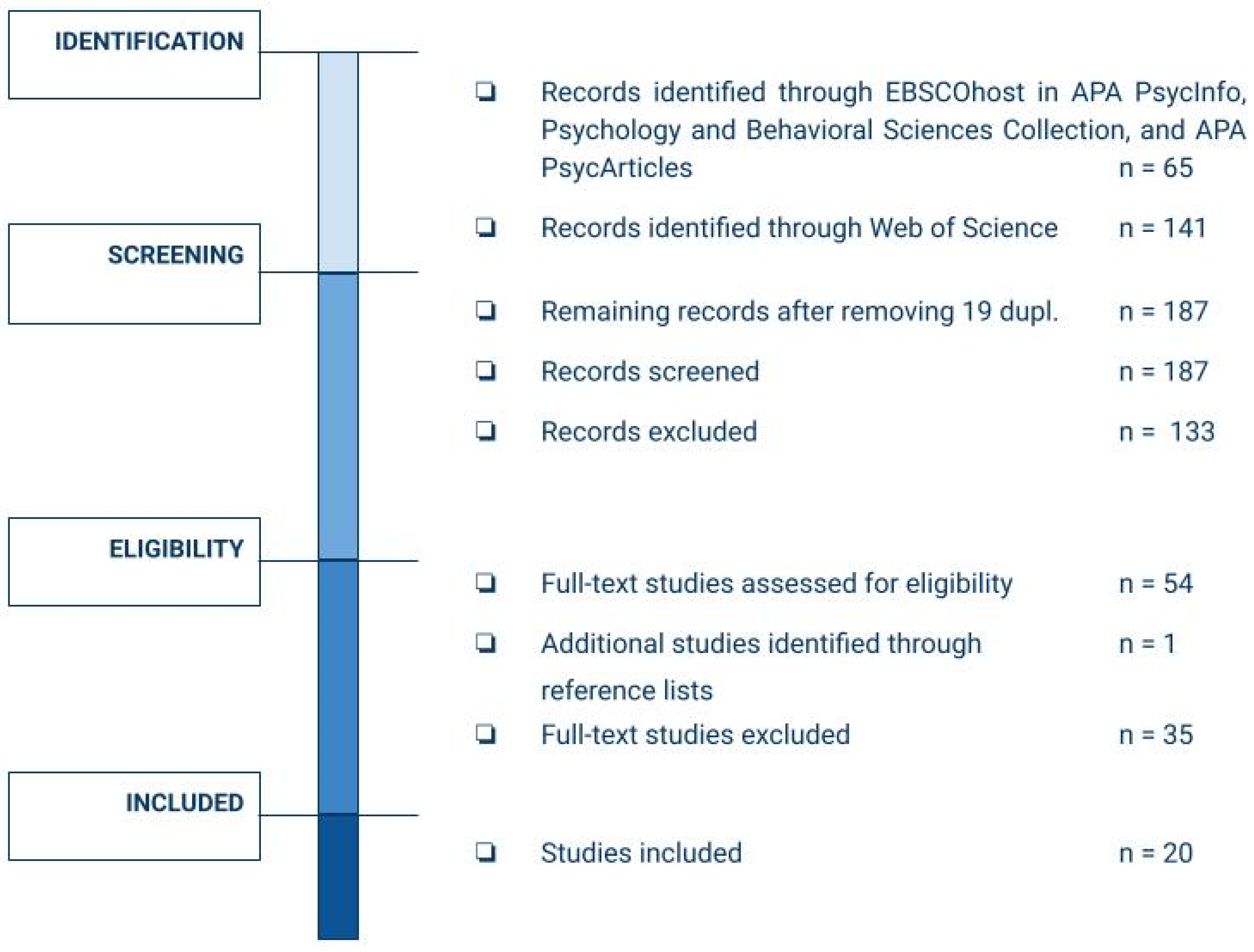
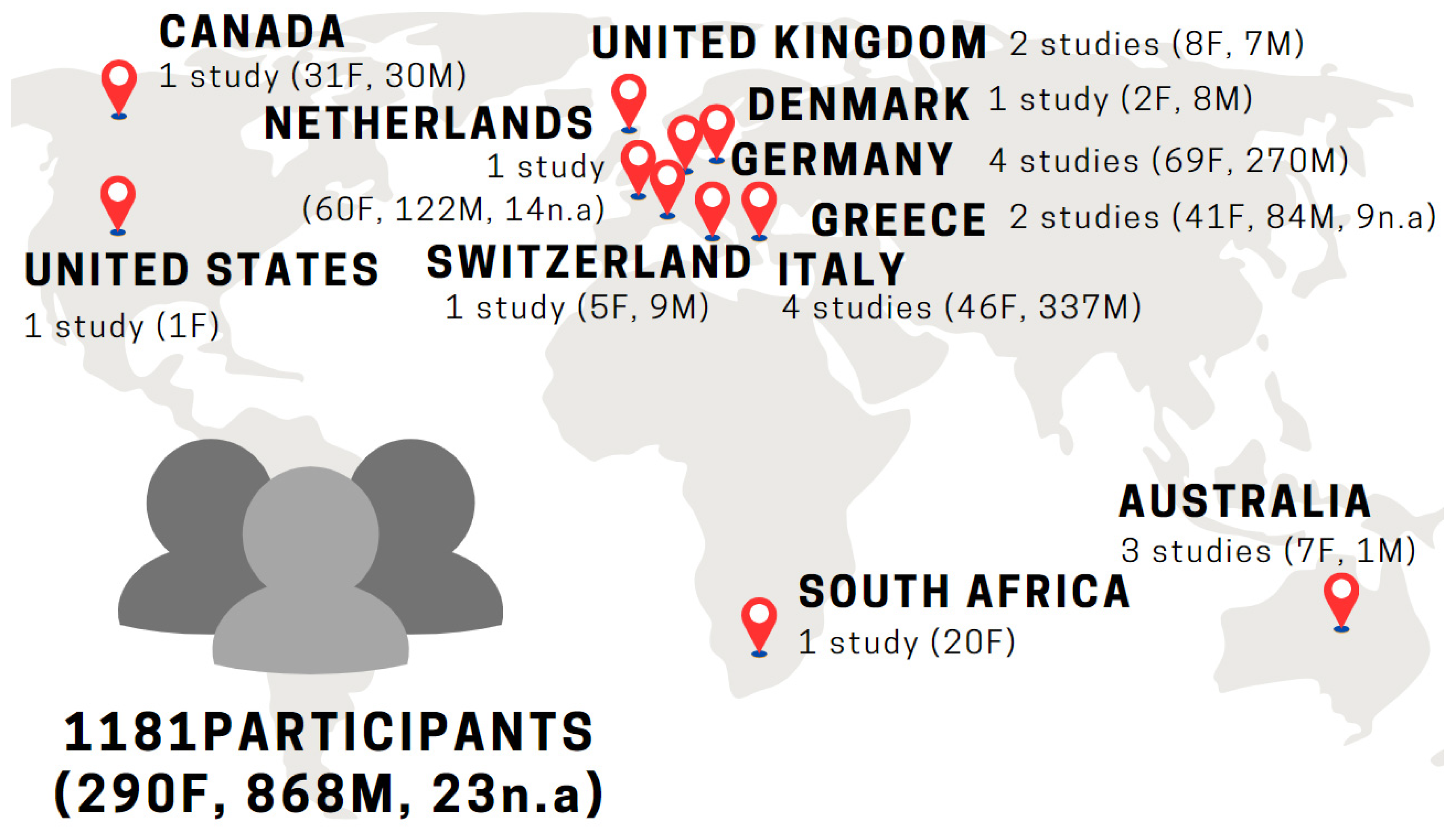
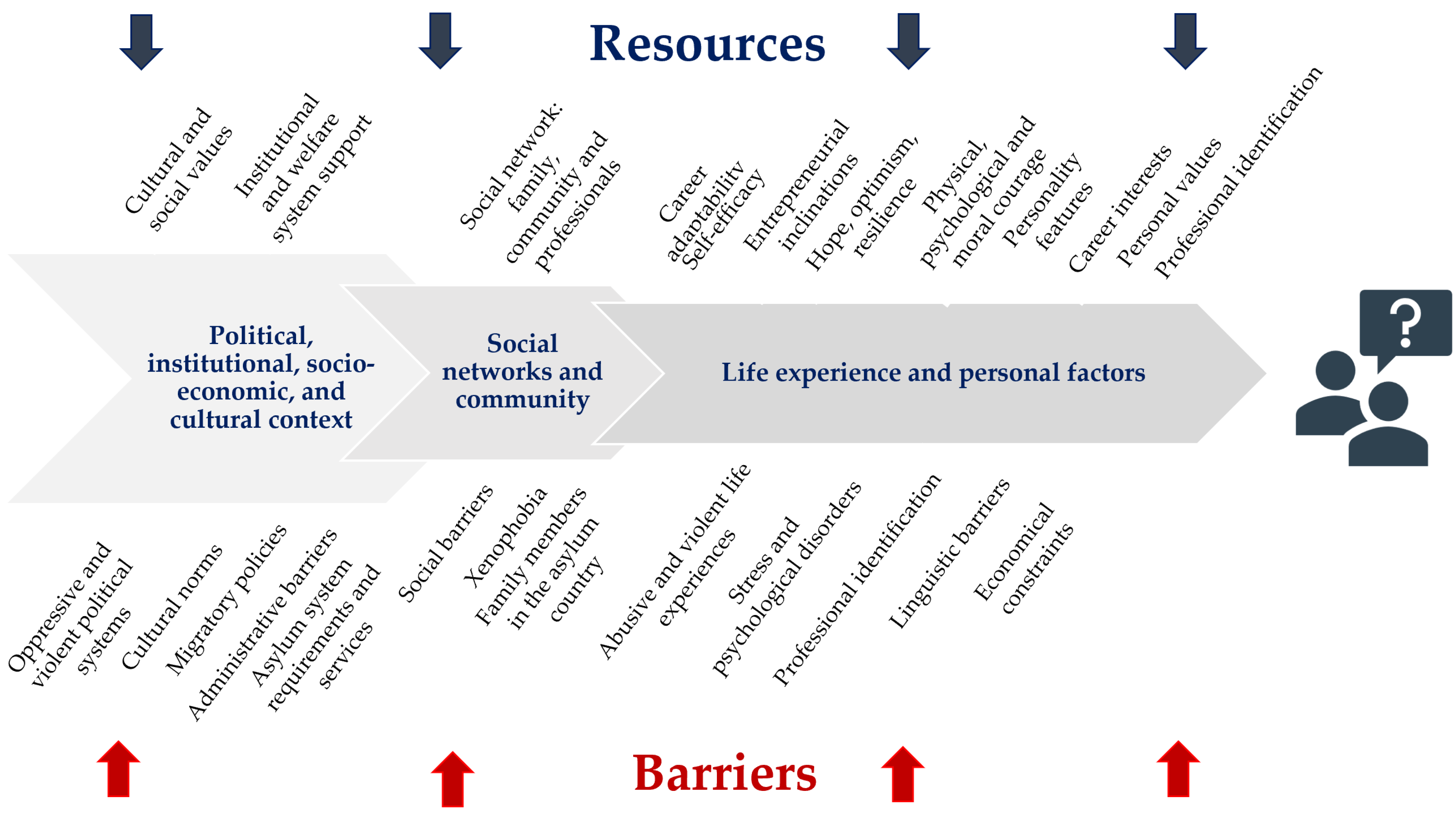

| Study Reference and Participants | Aim of the Study | Design/Methods | Main Findings |
|---|---|---|---|
| Morici et al., 2022 [17] Increasing refugees’ work and job search self-efficacy perceptions by developing career adaptability. Italy (Milan) 233 As&R (191 M; 42 F) Age ranged between 18 to 56 years African and Asian countries of origin | Explore the effects of a career counselling intervention in terms of greater job satisfaction, higher levels of career adaptability and perceptions of both work self-efficacy (WSe) and job search self-efficacy (JSSe). | Quantitative Experimental Administration of three scales:
| Participants were involved in a career counselling intervention in Italy (two individual interviews of one hour each and nine group interventions of three hours each). The three scales were administered one week before and after the intervention. After the intervention, all variables increased: The greatest increase was seen in the values of concern, curiosity and JSSe. There was also a medium-sized increase in the levels of control, confidence and WSe. WSe and JSSe values increased due to the growth of career adaptability, but their effect does not seem to depend on the starting level of career adaptability. |
| Obschonka et al., 2018 [18] Personal agency in newly arrived refugees: The role of personality, entrepreneurial cognitions and intentions, and career adaptability. Germany 267 As&R (M = 27.56 years; 78.1% male; 90% Syrians; 47.3% highly educated High employment rates in their country: 42.1% employed and 43% self-employed | Investigate the role of entrepreneurial intention and career adaptability as main personal agency indicators in facilitating the early transition process and the professional and social integration of newly arrived refugees in Germany. | Quantitative Experimental Measures:Statistical data analysis: correlations and structural equation model. | Entrepreneurial inclinations, when fostered by self-efficacy and resilience, contribute to increasing skills of career adaptability. Self-efficacy and resilience predict entrepreneurial alertness, which mediates the link between these personality factors and career adaptability in newly arrived refugees. It is important for As&R in the early stages of integration to adopt an agentic perspective. |
| Pajic et al., 2018 [19] Antecedents of job search self-efficacy of Syrian refugees in Greece and the Netherlands. 330 Syrian refugees 40.6% settled in Greece and 59.4% in the Netherlands 30.6% F, 62.4% M, 7% undefined Average age about 32 years | Investigate the relationships among psychological resources, career adaptability, career barriers and job search self-efficacy. | Quantitative Experimental Administration of scales:
| Participants in Greece had a higher average age and a lower level of professional qualifications and skills, compared to those in the Netherlands. In Greece, social barriers were perceived to be higher than in the Netherlands. Refugees in Greece had higher levels of career adaptability and self-efficacy in job search. Individuals with higher psychological capital are more confident in engaging in job search behaviours, due to their increased career adaptability. Yet, with higher social barriers this relationship weakened while with higher administrative barriers it strengthened. |
| Santilli et al., 2023 [20] Stories of courage in a group of asylum seekers for an inclusive and sustainable future. Italy 71 As&R (2 F, 69 M) | Giving asylum seekers a voice by exploring their stories of courage. Supporting them to design a sustainable future by promoting their positive assets. | Qualitative experimental. Snowball sampling of asylum seekers living in various reception centres. Administration of semi-structured interviews (inspired by Pury et al., 2007 in [20]). Thematic analysis of the interviews (recorded and transcribed) according to a circular inductive and deductive procedure. | Through their life stories, a greater understanding of contextual and personal barriers was gained. Classification of stories according to 3 forms of courage (moral, physical and psychological) and 3 life stages:
|
| Udayar et al., 2020 [21] Labour market integration of young refugees and asylum seekers: a look at perceived barriers and resources. Switzerland. 14 As&R from Eritrea and Somalia (5 F, 9 M) Age 19–25 years | Explore the perceived barriers and resources of newcomers (As&R) through a narrative career counselling intervention. Understand the impact of a state-level integration programme on the participants’ perception of their situation. | Qualitative experimental. Administration of a semi-structured interview (15 items) developed on the narrative metaphor of life’s journey (Denborough, 2014 in [21]) supported by a graphical tool that participants completed in itinere: a path representing life’s journey, a circle at the centre reflecting the present and a suitcase indicating resources. Data analysis:
| Main features emerging from the interviews. Barriers:
|
| Ginevra et al., 2021 [22] The role of career adaptability and future orientation on future goals in refugees. North Italy 75 (M) African As&R living in reception centres over 12 months | Explore refugees’ future goals and examine the relationship between career adaptability and future orientation. | Full mixed-method design and snowball sampling. Theoretical lens: Social constructivism—Life Design (Savickas et al., 2009 in [22]). Future goals: semi-structured interview ‘A Glance at the Future’. Qualitative data analysis to identify common categories of future goals. Career adaptability: Career Adapt-Abilities scale—short version (Maggiori et al., 2017 in [22]). Path analysis—relationship between the 4 components; Future orientation: Design My Future (Di Maggio et al., 2016 in [22]); Test: saturated model and covariances among variables and outcomes. | Qualitative data analysis showed that:
|
| Wehrle et al., 2019 [23] Putting career construction into context: Career adaptability among refugees. Germany 36 As&R (6 F, 30 M), mostly from Syria (19) Mean age 32 years Employed in jobs or internships and resident for av. 3 years and 7 months | Exploring refugees’ career adaptation in the host country and the role of context in shaping adaptive responses. | Qualitative experimental. References to the Career construction theory [38] and to the four dimensions of career adaptability: concern, control, confidence, and curiosity [37]. Sampling: snowballing or via social service organizations. Data collection: Semi-structured interviews up to theoretical saturation. Data analysis: Coding and thematic analysis (NVIVO). | The ability of As&R to adapt their careers is strongly influenced by contextual barriers that hinder their agency. The impact of contextual factors on adaptive behaviour varied across the four dimensions of career adaptability:
|
| Yoon et al., 2019 [24] The effect of a career development programme based on the Hope-Action Theory: Hope to work for refugees in British Columbia Canada 61 refugees (80% from Syria, 20% from Middle Eastern countries) Residents in British Columbia (Canada) for an average period of 12 months; searching for a job. At least 10 years of education, or 6 years and 4 years of work experience, able to commit to full-time employment. | Assess the proximal and distal outcomes of the ‘Hope to Work (H2W)’ career development programme for refugees based on the HAT (Hope Action Theory). | Quantitative Experimental 2 groups: experimental and control (t- student test). Test administration: before (T1), immediately after (T2), and 3 months after completion (T3) of the career intervention. Proximal outcome measures: | The experimental group participated in the 2- week-long H2W programme, while the control group could only be referred to the employment career services. The programme included strengthening hope-action skills, visits to workplaces and 3 days of individual sessions to define an enhanced action plan for the development of HAT skills. The H2W programme was effective in increasing hope-action competencies, general self-efficacy, and job search clarity. There were no differences between the two groups with regard to career adaptability, the intensity of job-seeking activities, and the employment status or type of employment, but the work engagement of the experimental group was higher due to a hopeful career state. |
| Abkhezr, et al., 2022 [25] A systemic and qualitative exploration of career adaptability among young people with refugee backgrounds. Australia 5 young African people with refugee backgrounds (4 F, 1 M); Age: 20–28 Residents in Australia for 6–12 months in the framework of UNHCR resettlement programmes | Understand how career adaptability manifests in the participants’ lives and how it contributes to their career development after resettlement. | Secondary analysis of data collected through qualitative research. 2 semi-structured narrative interviews on life career stories and future career plans. Data analysis: | The double level of qualitative analysis (thematic analysis and deductive analysis based on SFT) revealed that:
|
| Study Reference and Participants | Aim of the Study | Design/Methods | Summary/Main Findings |
|---|---|---|---|
| Berr et al., 2019 [26] Broadening the understanding of employment and identity of Syrian women living in Germany: A biographical study. Germany 5 Syrian women with refugee status and high professional qualifications Age: 25–55 years Residence of at least 2 years in Germany, enrolled in UNHCR resettlement programmes | Understanding the interplay between forced migration, employment, and identity. Giving refugee women a voice and contributing to overcoming stereotyped images about them. Exploring the professional identity construction processes of Syrian women in relation to their life stories and life conditions after migration. | Qualitative experimental Biographical narrative interviews. Thematic and conversation analysis according to the ‘reconstruction of narrative identity’ (Lucius-Hoene and Deppermann, 2004 in [30]). Analysis of three different levels of narration:
| Professional histories were collected, and identity processes were explored. Five life themes were identified and the interaction between them:
|
| Nyabvudzi & Chinyamurindi, 2019 [27] The career development processes of women refugees in South Africa: An exploratory study South Africa 20 As&R women from African countries | Explore the career development processes of women refugees in the host country and the main influences and structural constraints to their career and lived experiences. | Qualitative experimental adopting a feminist, intersectional and career constructivist theoretical lens. Snowball sampling. In-depth narrative interviews on the career development of the participants. Data were audio-recorded, transcribed and e-mailed to the participants for accuracy. Thematic and content analysis. | Main findings from the data analysis:
|
| Mackenzie Davey & Jones, 2020 [28] Refugees’ narratives of career barriers and professional identity. United Kingdom. 15 persons with refugee status; professionally qualified in medicine and teaching | Explore the identity processes of refugees with high qualifications and status in their home country while facing barriers to the recognition of qualifications and professional status in the UK. Investigate how identity tensions between past, present, and future professional experiences are managed. | Qualitative experimental Interviews and focus groups on career barriers, plans and future aspirations. Inductive thematic analysis. | Participants were subjected to narrative interviews and took part in focus groups discussing the obstacles they encountered in their career path, career planning and future aspirations. Attempting to restore a coherent self-narrative, participants implemented actions to recover previous professional identities and to build new ones. Professional identification and identity work were found to be both a supporting and hindering factor for refugees with former high career status. |
| Wehrle et al., 2018 [29] Can I come as I am? Refugees’ vocational identity threats, coping, and growth. Germany (resident for more than 2 years) 31 As&R (7 F, 24 M), mostly from Syria (23), average age 28 years, employed in jobs or internships | Understand the impact of primary contextual threat sources on vocational identities of As&R and their integration into society. | Qualitative experimental. Snowball sampling. Semi-structured interviews up to theoretical saturation. Coding and thematic analysis (NVIVO). Codes: partly informed by the literature on identity threats, coping mechanisms and psychological growth and partly derived from the data. | Participants stressed the importance of work as a financial and self-defining means. The main contextual threat sources were insecurity, language, social exclusion and external stereotypical attributions. These factors threaten the basic human needs for a sense of worth, distinctiveness, continuity, and control. Coping responses consisted of protection or restructuring identity strategies, but also proactive attitudes to prevent threats. |
| Study Reference and Participants | Aim of the Study | Design/Methods | Main Findings |
|---|---|---|---|
| Abkhezr et al., 2020 [30] Exploring the boundary between narrative research and narrative intervention: implications of participating in narrative inquiry for young people with refugee backgrounds. Australia 5 young African people with refugee backgrounds (4 F, 1 M) Age: 20–28 Residents in Australia for 6–12 months—UNHCR resettlement programmes | Exploring the boundaries between a narrative career counselling intervention and qualitative narrative inquiry research. Exploring career development through the narratives of life career stories. | Qualitative experimental. Social constructionist perspective. Semi-structured narrative interviews of 70–90 min. Test FCA (The Future Career Autobiography; Rehfuss, 2009, 2015 in [30]): i.e., writing a text about one’s professional future, before the first interview (T1) and after the second interview (T2). Inductive thematic analysis of interviews. Comparative narrative analysis on the FCA texts in T1 and T2. | The comparative analysis of the FCA revealed changes in participants’ future career plans. While career counselling interventions require explicit change, participation in narrative research does not. These impacts should be considered when designing narrative research. Focus points on the researcher’s role:
|
| Abkhezr et al., 2018 [31] Finding voice through narrative storytelling: An exploration of the career development of young African females with refugee backgrounds. Australia 3 African women with refugee backgrounds living in Australia UNHCR resettlement programmes | Explore the career development processes of 3 young women with refugee backgrounds through a careful exploration of the cultural and contextual features of their career stories. | Qualitative research: exploratory multiple case study. Semi-structured narrative interviews on life career stories. Data analysis: social constructionist approach based on a voice-centred relational analysis—VCRA (Brown & Gilligan, 1993; Gilligan et al., 2003; Mauthner & Doucet, 1998 in [31]):
| Narrative career counselling proved useful by enabling participants to re-contextualise their skills, strengths, knowledge, and future career plans. This gives space to voices that may have been lost and enhance a greater sense of agency for implementing future career plans. Each participant’s career story reflects the interaction between various voices, relationships, social structures, and dominant narratives that influence career plans. Voices create different relationships with other inner voices, those of others or those representing specific social or cultural contexts. |
| Petersen et al., 2022 [32] Existential career guidance for groups of young refugees and migrants: A Danish initiative. Denmark 10 young migrants and refugees from the Middle East Average age 17 years | Apply and investigate the effects of a five-step intervention model of existential career guidance with a group of young refugees and migrants. | Action research project—career intervention Implementation of the existential career guidance model for groups: 10 group sessions for a 6-month period. Thematic analysis of the empirical data: 9 semi-structured group interviews (3 with counsellors and 6 with participants, before, during, and after the intervention). | The existential career counselling group intervention consisted of ten 2.5-h sessions in which participants reflected on their life experiences aimed at building a meaningful life. The intervention proved effective in developing a greater sense of belonging, feeling understood and respected, having self- awareness, hope and the willingness to care for others, as well as improving language skills. By employing self-disclosure, counsellors gained a deeper acceptance of the participants, modified their prejudices and activated self-reflective skills. |
| Pierce & Gibbons, 2012 [33] An ever-changing meaning: a career constructivist application to working with African refugees. United States 26-year-old female Somali refugee, mother of 2 children, ages 4 and 6 | Illustrate how to use narrative constructivist career counselling to address career-related issues with African refugees. | Application of a constructivist narrative career counselling through a case study. Intervention phases:
| Recommendations:
|
| Schultheiss et al., 2011 [34] Career, migration and the life CV: A relational cultural analysis. 3 As&R United Kingdom | Understand the career path of migrants and As&R and explore alternative approaches to effective career guidance and counselling interventions for As&R. | Participatory arts and action research/workshop: application of a career intervention model through the creation of a ‘life CV’. Career intervention approach: integration between the relational cultural paradigm (Schultheiss, 2007 in [34]) focused on the intertwined nature of relational and working life and the Life Design model (Savickas et al., 2009 in [34]). Workshops involving refugees, researchers, and artists in 3 small groups to complete a personalised ‘life CV’ through narratives and artistic means, such as poetry, photography and drawing. | The life CV process allows one to examine As&R employability potential within the context of their biographies and life experiences, including their past, their journeys, and their current situations. This approach appears to be effective in improving the understanding of competences, abilities and skills and in giving voice to experiences and visions of the future It facilitates the understanding of the impact of historical, political and cultural contexts on identity. The construction of meanings related to the whole life supports the development of new perspectives, life projects and identities. |
| Słowik, 2014 [35] ‘Life space mapping’ as an innovative method in career counselling for refugees, asylum seekers and migrants. As&R Greece | Implementation of a multicultural narrative career counselling model. | Applied theoretical study—presented during a workshop for professionals and students of psychology during a conference in Greece. A narrative career counselling model based on constructivist life design, a multicultural approach and the graphic tool of the ‘life space map’ (Peavy, R.V., 1997 in [35]). The map consists of drawing three circles (past, present and future) and a ’ladder’ (a rainbow) to represent the future steps and tasks (actions, changes). | This career counselling model supports As&R in constructing meanings and future planning and facilitates contact and awareness of stereotypes and barriers. The approach places significant emphasis on cultural aspects and utilises visualisation tools to reduce anxiety and resistance that AS&R may experience due to cultural and living experiences as well as language difficulties. Visualisation and plastic materials support the process of biographical exploration and stimulate self-analysis of both needs and solutions. Counsellors ought to cultivate non-verbal communication proficiency and intercultural awareness, embrace a curious and open-minded approach, and utilise active listening methods. |
| Magnano et al., 2022 [36] Approaches and strategies for understanding the career development needs of migrants and refugees: The potential of a systems-based narrative approach. Italy 4 participants: 2 women from Romania and 2 men—from Pakistan and Cameroon | Highlight how narrative career counselling supports individuals in activating meaning-making processes. | Qualitative research/Intervention study–analysis of case studies. Interviews conducted by counselling experts based on the MSCI (My System of Career Influences) maps of the participants (McMahon, Watson, & Patton, 2013 in [36]). 2 levels of analysis: Themes and relationships—focused on systems of influences. Meaning attributed to systems of influences through the Voice-centred relation analysis (Gilligan et al., 2003 in [36]) | Participants shared their experiences using different perspectives, emphasizing the impact of their own internal voices or external voices from others, as well as social, cultural, and historical influences. The findings highlight that career development takes place in different social systems. Narrative systemic counselling supports the development of a comprehensive and cohesive understanding about the influence of life contexts and systems on personal experiences, as well as on social and work integration for As&R. |
| System of Policy Orientations and Collective Representations of As&R | |||||
| Contextual Factors | Impact | Assisting Counsellee’s Processes | Career Counselling Approaches and Methods | Recommendations for Career Counsellors | Advocacy and Interventions at the Socio-Political Level |
| Restrictive migration policies based on control and repression. | Dangerous migratory routes (dehumanisation, abuse and violence). ‘Natural selection effect’ of borders: wealthier, more resilient and skilled As&R reaching the Global North. | Critical analysis of the influence of the socio-cultural and political systems. Supporting identity processes (defensive and proactive strategies). | Targeted intervention according to the specific legal and social status in each asylum country. Reconstruction of narratives within socio-cognitive or systemic frameworks in combination with cultural, critical consciousness and social justice perspectives. |
|
|
| Disparities between countries with regard to the standard of services and access to social and labour rights. | Difficult post-migratory paths (degrading living conditions). As&R experiencing low self-esteem, powerlessness, threat to basic identity needs and humiliation. | ||||
| Representation of As&R as suffering victims and survivors. | Impact on As&R:
| Valuing positive narratives of courage and resilience. Enhancement of individual resources (resilience, adaptability, courage and coping strategies). Voicing internal parts and depowered narratives. | VCRA: exploration of interacting voices, relationships, social structures and dominant narratives. Biographical exploration through nonverbal forms of expression (graphic and artistic means). |
|
|
| Institutional System for The Status Determination | |||||
| Contextual Factors | Impact | Assisting Counsellee’s Processes | Career Counselling Approaches and Methods | Recommendations for Career Counsellors | Advocacy and Interventions at the Socio-Political level |
| Indefinite waiting times for status recognition procedures. | Risk of developing psychological disorders with lingering effects. | Strengthen psychological capital, self-efficacy, career adaptability. Support protective, proactive, and restructuring identity processes. Planning and defining professional and social networking goals. | Approaches: Constructivist, socio-constructivist, socio-cognitive (working on agency and decision-making processes). Asylum system and service network coaching. Creating ‘life CVs’. |
|
|
| Autobiographical interviews (doubts about the credibility and consistency of memories in status recognition procedures). | Attitude of decision-makers: discretion in decisions, distrust, and rejection of authenticity of life stories, avoidance of trauma, low level of empathy, cynical attitudes and power asymmetry. | Stimulating visions of the self as a multiplicity and not as a single, circumscribed, and objective unity. Turning attention to the interpretative processes of the self. | Systemic approaches and VCRA analysis. Using alternative or complementary tools to autobiographical narration (e.g., life space map, graphic and expressive tools). |
| |
| Reception andIntegration System | |||||
| Contextual Factors | Impact | Assisting Counsellee’s Processes | Career Counselling Approaches and Methods | Recommendations for Career Counsellors | Advocacy and Interventions at the Socio-Political Level |
| Management of the reception system: humanitarian logic superimposed on state supervision. | It reinforces control, repression, and merit on the basis of suffering and weakness. It compels As&R to adopt attitudes of gratitude and conformity. | Stimulating freedom of expression and identifying critical issues in the system. Voicing internal parts and valuing positive narratives of courage and resilience | Attention to the setting within reception centres or participation referred by institutional services. Explain the duty of confidentiality and ethics of career counselling. |
|
|
| Social and professional integration services. | Impact on As&R: dependency on services, limitation of autonomy, risk of marginalisation, power asymmetry, perceived lack of control and influence on systems and services, bias in interventions (perceived lack of freedom of expression and omission of critical issues). | Strengthening skills, psychological capital and increasing career adaptability and self- efficacy in job search and work. Develop a critical understanding of services and labour market and share reflections and critical experiences | Individual interventions with group modules. Exploration of meaningful and positive narratives of the self. Support the construction of long-term perspectives. Create ‘life CV’. |
| |
| Linguistic, social, and economic barriers and obstacles regarding qualifications and skills recognition. | Powerlessness, perceived lack of recognition, continuity and control. | Develop a contextualised reading ability of experiences and counteract identification with suffering and powerlessness. |
| ||
Disclaimer/Publisher’s Note: The statements, opinions and data contained in all publications are solely those of the individual author(s) and contributor(s) and not of MDPI and/or the editor(s). MDPI and/or the editor(s) disclaim responsibility for any injury to people or property resulting from any ideas, methods, instructions or products referred to in the content. |
© 2023 by the authors. Licensee MDPI, Basel, Switzerland. This article is an open access article distributed under the terms and conditions of the Creative Commons Attribution (CC BY) license (https://creativecommons.org/licenses/by/4.0/).
Share and Cite
Beqiraj, G.; Ferrari, L. Taking Action towards an Inclusive Career Counselling for Asylum Seekers and Refugees—A Literature Review Based on the PRISMA Model. Behav. Sci. 2023, 13, 962. https://doi.org/10.3390/bs13120962
Beqiraj G, Ferrari L. Taking Action towards an Inclusive Career Counselling for Asylum Seekers and Refugees—A Literature Review Based on the PRISMA Model. Behavioral Sciences. 2023; 13(12):962. https://doi.org/10.3390/bs13120962
Chicago/Turabian StyleBeqiraj, Gresa, and Lea Ferrari. 2023. "Taking Action towards an Inclusive Career Counselling for Asylum Seekers and Refugees—A Literature Review Based on the PRISMA Model" Behavioral Sciences 13, no. 12: 962. https://doi.org/10.3390/bs13120962
APA StyleBeqiraj, G., & Ferrari, L. (2023). Taking Action towards an Inclusive Career Counselling for Asylum Seekers and Refugees—A Literature Review Based on the PRISMA Model. Behavioral Sciences, 13(12), 962. https://doi.org/10.3390/bs13120962

