Revisiting the Species Delimitation Within Amolops mantzorum (David, 1872), with a Description of a New Subspecies (Anura, Ranidae)


 , , and
Simple Summary
Abstract
1. Introduction
2. Material and Methods
2.1. Samples
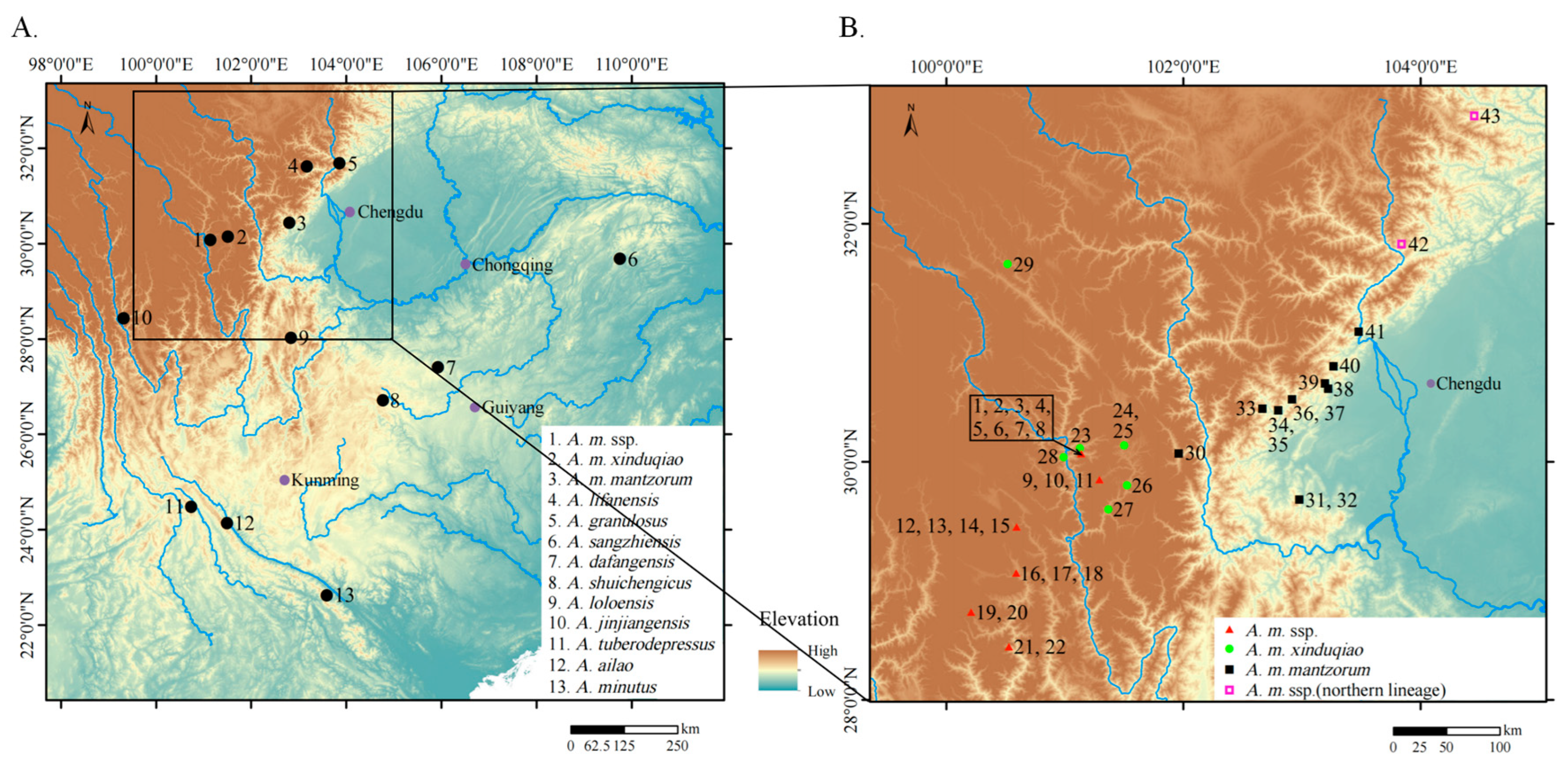

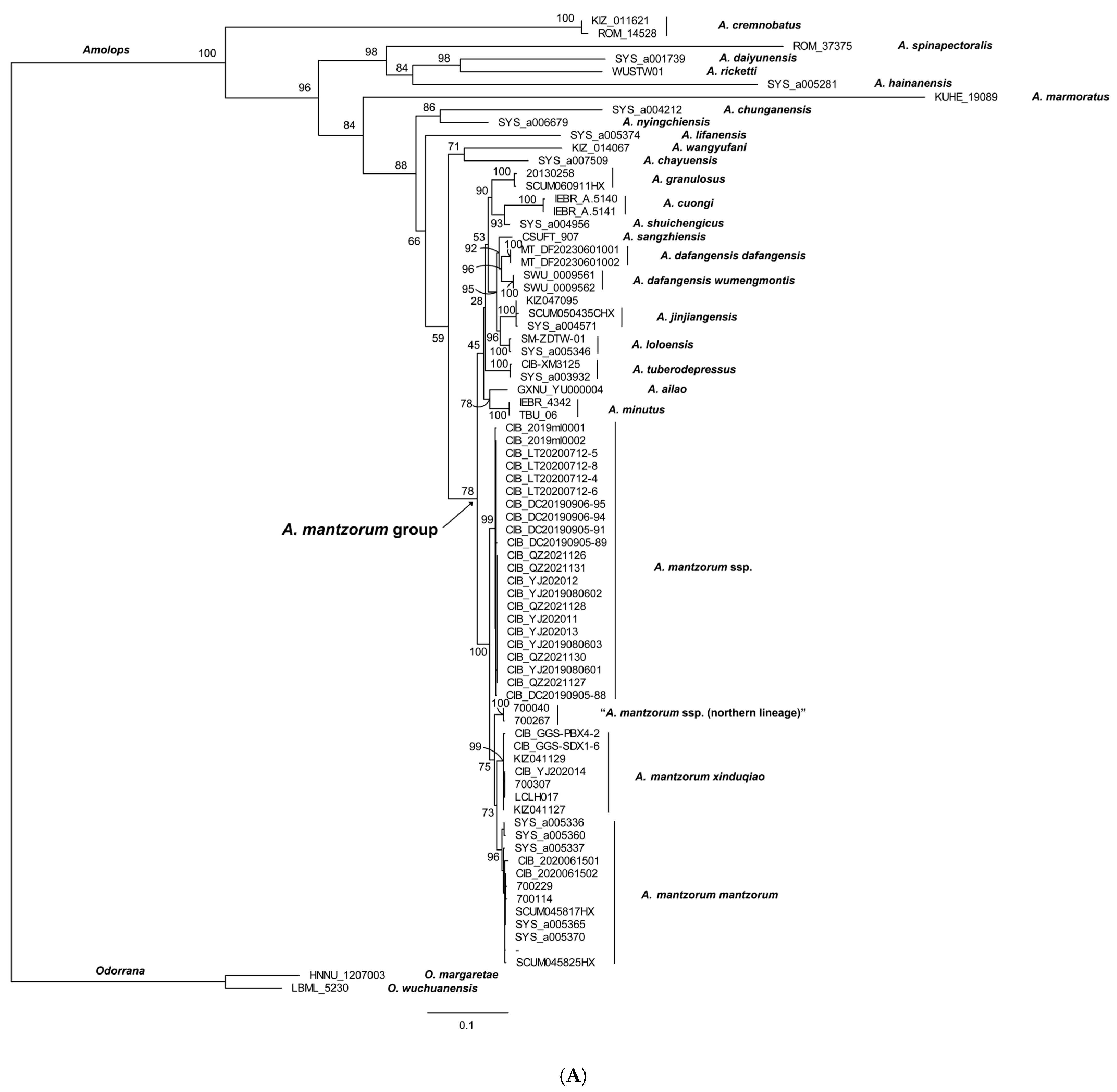
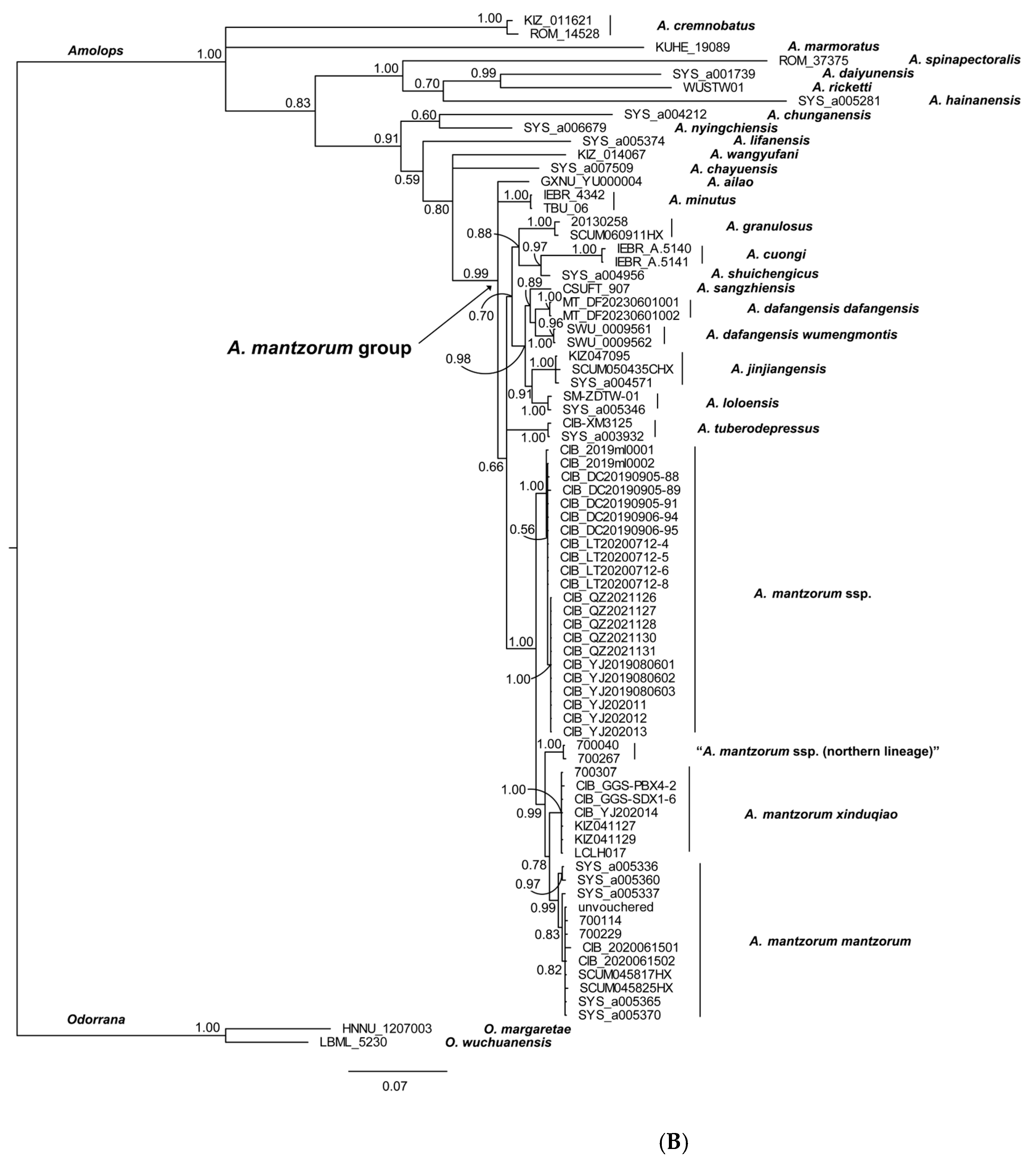
| ID | Species | Voucher Number | Locality | 16S | COI | Cytb |
|---|---|---|---|---|---|---|
| 1 | Amolops mantzorum ssp. | CIB QZ2021130 | Bajiaolou Village, Bajiaolou Town, Yajiang, Sichuan | PX599057 | PX599084 | PX620422 |
| 2 | A. m. ssp. | CIB QZ2021126 | Bajiaolou Village, Bajiaolou Town, Yajiang, Sichuan | PX599068 | PX599095 | PX620433 |
| 3 | A. m. ssp. | CIB QZ2021131 | Bajiaolou Village, Bajiaolou Town, Yajiang, Sichuan | PX599075 | PX599102 | PX620438 |
| 4 | A. m. ssp. | CIB QZ2021128 | Bajiaolou Village, Bajiaolou Town, Yajiang, Sichuan | PX599077 | PX599104 | PX620440 |
| 5 | A. m. ssp. | CIB QZ2021127 | Bajiaolou Village, Bajiaolou Town, Yajiang, Sichuan | PX599079 | PX599106 | PX620442 |
| 6 | A. m. ssp. | CIB YJ2019080602 | Bajiaolou Village, Bajiaolou Town, Yajiang, Sichuan | PX599080 | PX599107 | PX620443 |
| 7 | A. m. ssp. | CIB YJ2019080601 | Bajiaolou Village, Bajiaolou Town, Yajiang, Sichuan | PX599081 | PX599108 | PX620444 |
| 8 | A. m. ssp. | CIB YJ2019080603 | Bajiaolou Village, Bajiaolou Town, Yajiang, Sichuan | PX599082 | PX599109 | PX620445 |
| 9 | A. m. ssp. | CIB YJ202012 | Nimazong Village, Zhusang Town, Yajiang, Sichuan | PX599083 | PX599110 | PX620446 |
| 10 | A. m. ssp. | CIB YJ202011 | Nimazong Village, Zhusang Town, Yajiang, Sichuan | PX599058 | PX599085 | PX620423 |
| 11 | A. m. ssp. | CIB YJ202013 | Nimazong Village, Zhusang Town, Yajiang, Sichuan | PX599059 | PX599086 | PX620424 |
| 12 | A. m. ssp. | CIB LT20200712-4 | Dewu Town, Litang, Sichuan | PX599060 | PX599087 | PX620425 |
| 13 | A. m. ssp. | CIB LT20200712-5 | Dewu Town, Litang, Sichuan | PX599061 | PX599088 | PX620426 |
| 14 | A. m. ssp. | CIB LT20200712-6 | Dewu Town, Litang, Sichuan | PX599062 | PX599089 | PX620427 |
| 15 | A. m. ssp. | CIB LT20200712-8 | Dewu Town, Litang, Sichuan | PX599063 | PX599090 | PX620428 |
| 16 | A. m. ssp. | CIB DC20190905-89 | Rihuo Village, Shengmu Town, Daocheng, Sichuan | PX599064 | PX599091 | PX620429 |
| 17 | A. m. ssp. | CIB DC20190905-88 | Rihuo Village, Shengmu Town, Daocheng, Sichuan | PX599065 | PX599092 | PX620430 |
| 18 | A. m. ssp. | CIB DC20190905-91 | Rihuo Village, Shengmu Town, Daocheng, Sichuan | PX599066 | PX599093 | PX620431 |
| 19 | A. m. ssp. | CIB DC20190906-94 | Maize Village, Mula Town, Daocheng, Sichuan | PX599067 | PX599094 | PX620432 |
| 20 | A. m. ssp. | CIB DC20190906-95 | Maize Village, Mula Town, Daocheng, Sichuan | PX599069 | PX599096 | PX620434 |
| 21 | A. m. ssp. | CIB 2019ml0002 | Xianggelila Village, Shuiluo Town, Muli, Sichuan | PX599070 | PX599097 | PX620435 |
| 22 | A. m. ssp. | CIB 2019ml0001 | Xianggelila Village, Shuiluo Town, Muli, Sichuan | PX599071 | PX599098 | PX620436 |
| 23 | A. m. xinduqiao | CIB YJ202014 | Wangxia Village, Bajiaolou Town, Yajiang, Sichuan | PX599072 | PX599099 | PX620437 |
| 24 | A. m. xinduqiao | KIZ 041127 | Xinduqiao Town, Kangding, Sichuan | MN953764 | MN961465 | - |
| 25 | A. m. xinduqiao | KIZ 041129 | Xinduqiao Town, Kangding, Sichuan | MN953765 | MN961466 | - |
| 26 | A. m. xinduqiao | CIB GGS-PBX4-2 | Geridi Village, Jiagenba Town, Kangding, Sichuan | PX599073 | PX599100 | - |
| 27 | A. m. xinduqiao | CIB GGS-SDX1-6 | Laha Village, Shade Town, Kangding, Sichuan | PX599074 | PX599101 | - |
| 28 | A. m. xinduqiao | 700307 | Yajiang, Sichuan | - | - | KJ008410 |
| 29 | A. m. xinduqiao | LCLH017 | Luhuo, Sichuan | - | - | KJ008392 |
| 30 | A. m. mantzorum | SYS a005360 | Kangding, Sichuan | MK573807 | MK568322 | - |
| 31 | A. m. mantzorum | SYS a005336 | Mt. Wawu, Hongya, Sichuan | MK573804 | MK568319 | - |
| 32 | A. m. mantzorum | SYS a005337 | Mt. Wawu, Hongya, Sichuan | MK604853 | MK605611 | - |
| 33 | A. m. mantzorum | 700114 | Longdong Town, Baoxing, Sichuan | - | - | KJ008297 |
| 34 | A. m. mantzorum | CIB 2020061501 | Dongsheng Village, Wulong Town, Baoxing, Sichuan | PX599076 | PX599103 | PX620439 |
| 35 | A. m. mantzorum | CIB 2020061502 | Dongsheng Village, Wulong Town, Baoxing, Sichuan | PX599078 | PX599105 | PX620441 |
| 36 | A. m. mantzorum | SYS a005370 | Fengtongzhai, Baoxing, Sichuan | MK604865 | MK605623 | - |
| 37 | A. m. mantzorum | SYS a005365 | Fengtongzhai, Baoxing, Sichuan | MK573808 | MK568323 | - |
| 38 | A. m. mantzorum | SCUM045825HX | Mt. Xiling Snow, Dayi, Sichuan | MN953707 | MN961409 | - |
| 39 | A. m. mantzorum | - | Mt. Xiling Snow, Dayi, Sichuan | KJ546429 | KJ546429 | KJ546429 |
| 40 | A. m. mantzorum | 700229 | Chongzhou, Sichuan | - | - | KJ008339 |
| 41 | A. m. mantzorum | SCUM045817HX | Wolong, Wenchuan, Sichuan | MN953706 | MN961408 | - |
| 42 | A. m. ssp. (northern lineage) | 700040 | Maoxian, Sichuan | - | - | KJ008277 |
| 43 | A. m. ssp. (northern lineage) | 700267 | Wenxian, Gansu | - | - | KJ008360 |
| 44 | A. tuberodepressus | SYS a003932 | Mt. Wuliang, Jingdong, Yunnan | MK573800 | MG991934 | - |
| 45 | A. tuberodepressus | CIB-XM3125 | Jingdong, Yunnan | KR559270 | KR559270 | KR559270 |
| 46 | A. ailao | GXNU YU000004 | Mt. Ailao, Xinping, Yunnan | MN650754 | MN650740 | MN650746 |
| 47 | A. shuichengicus | SYS a004956 | Shuicheng, Guizhou | MK604845 | MK605603 | - |
| 48 | A. granulosus | SCUM060911HX | Anxian, Sichuan | MN953681 | MN961381 | - |
| 49 | A. granulosus | 20130258 | Mt. Wawu, Sichuan, China | MH922934 | MH922934 | MH922934 |
| 50 | A. loloensis | SYS a005346 | Zhaojue, Sichuan | MK604854 | MK605612 | - |
| 51 | A. loloensis | SM-ZDTW-01 | Shimian, Sichuan | KT750963 | KT750963 | KT750963 |
| 52 | A. jinjiangensis | SYS a004571 | Mt. Gaoligong, Yunnan | MK573801 | MK568316 | - |
| 53 | A. jinjiangensis | SCUM050435CHX | Deqing, Yunnan | EF453741 | MN961403 | - |
| 54 | A. jinjiangensis | KIZ047095 | Chuxiong, Yunnan | MN953701 | MN961404 | - |
| 55 | A. sangzhiensis | CSUFT 907 | Mt. Doupeng, Sangzhi, Hunan | OQ079540 | OQ078905 | - |
| 56 | A. chayuensis | SYS a007509 | Baxoi, Xizang | MK573820 | MK568333 | - |
| 57 | A. lifanensis | SYS a005374 | Lixian, Sichuan | MK573809 | MK568324 | - |
| 58 | A. dafangensis dafangensis | MT DF20230601002 | Dafang, Guizhou | OR936315 | OR924345 | - |
| 59 | A. d. dafangensis | MT DF20230601001 | Dafang, Guizhou | OR936314 | OR924344 | - |
| 60 | A. d. wumengmontis | SWU 0009561 | Mt. Wumeng, Zhaotong, Yunnan, China | PX411479 | PX410826 | - |
| 61 | A. d. wumengmontis | SWU 0009562 | Mt. Wumeng, Zhaotong, Yunnan, China | PX411478 | PX410827 | - |
| 62 | A. minutus | IEBR 4342 | Muong La, Son La, Vietnam | - | - | MK941135 |
| 63 | A. minutus | TBU 06 | Muong La, Son La, Vietnam | - | - | MK941136 |
| 64 | A. chunganensis | SYS a004212 | Mt. Jinggang, Jinggang, Jiangxi | MK263263 | MG991914 | - |
| 65 | A. nyingchiensis | SYS a006679 | Lhunze, Xizang | MK573814 | MK568329 | - |
| 66 | A. cremnobatus | ROM 14528 | Khe Moi, Nghe An, Vietnam | DQ204477 | - | - |
| 67 | A. daiyunensis | SYS a001739 | Mt. Daiyun, Fujian, China | MK263243 | KX507328 | - |
| 68 | A. hainanensis | SYS a005281 | Mt. Wuzhi, Hainan, China | MK263281 | MG991916 | - |
| 69 | A. ricketti | WUSTW01 | Mt. Wugong, Jiangxi, China | KF956111 | KF956111 | KF956111 |
| 70 | A. marmoratus | KUHE 19089 | Chiang Mai, Thailand | AB211486 | - | AB259738 |
| 71 | A. spinapectoralis | ROM 37375 | Ngoc Linh vicinity, Kon Tum, Vietnam | MN953726 | MN961428 | - |
| 72 | A. cremnobatus | KIZ 011621 | Puhu National Reserve, Thanh Hoa, Vietnam | MN953672 | MN961368 | - |
| 73 | A. wangyufani | KIZ 014067 | Zayü, Tibet, China | MN953740 | MN961440 | - |
| 74 | A. cuongi | IEBR A.5140 | Tam Duong, Lai Chau, Vietnam | PX113529 | - | PX119668 |
| 75 | A. cuongi | IEBR A.5141 | Tam Duong, Lai Chau, Vietnam | PX113530 | - | PX119669 |
| 76 | Odorrana wuchuanensis | LBML 5230 | Libo, Guizhou, China | KU680791 | KU680791 | KU680791 |
| 77 | Odorrana margaretae | HNNU 1207003 | - | KJ815050 | KJ815050 | KJ815050 |
2.2. Molecular Analysis
2.3. Morphological Analysis
3. Results
3.1. Molecular Phylogeny
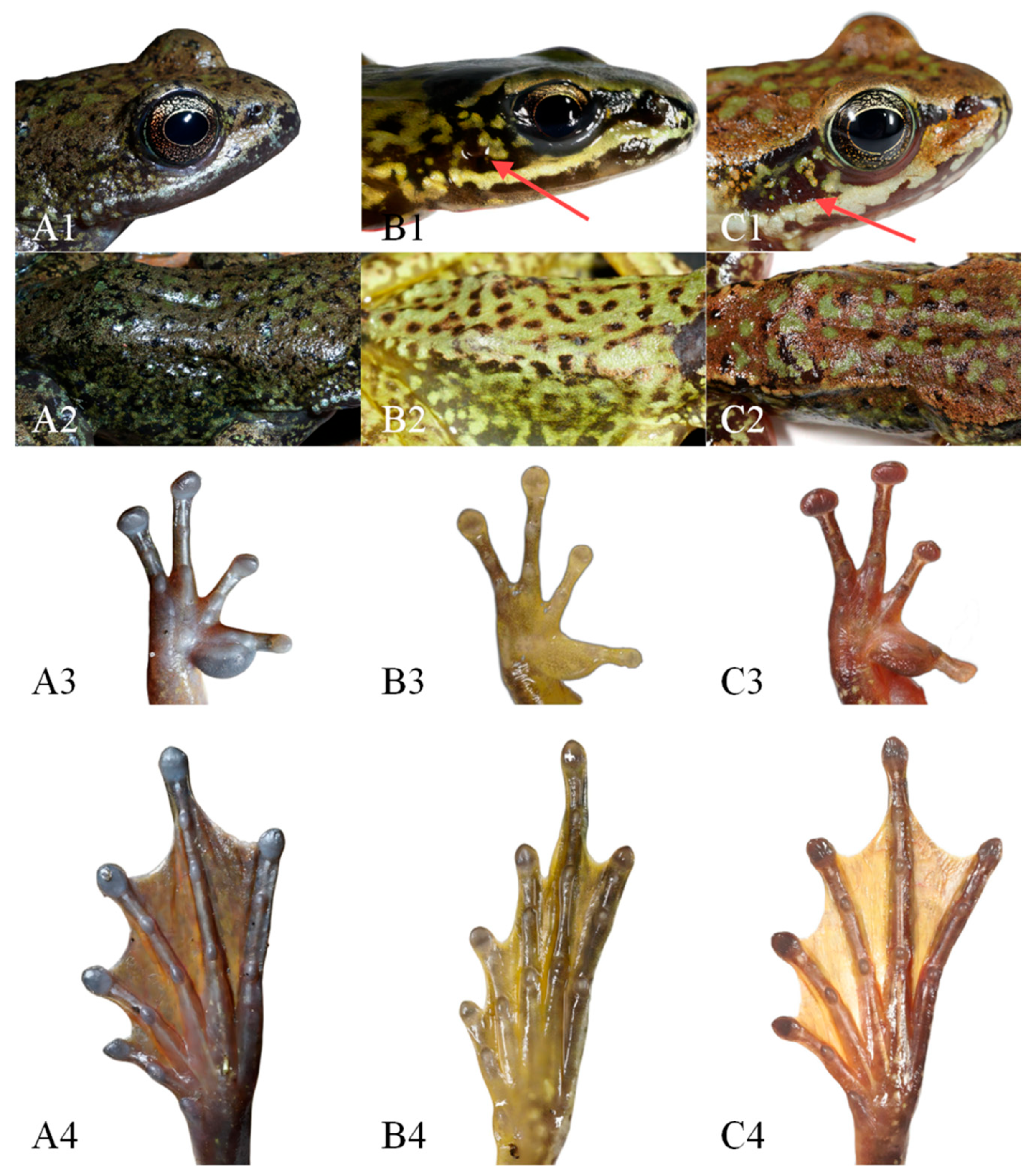
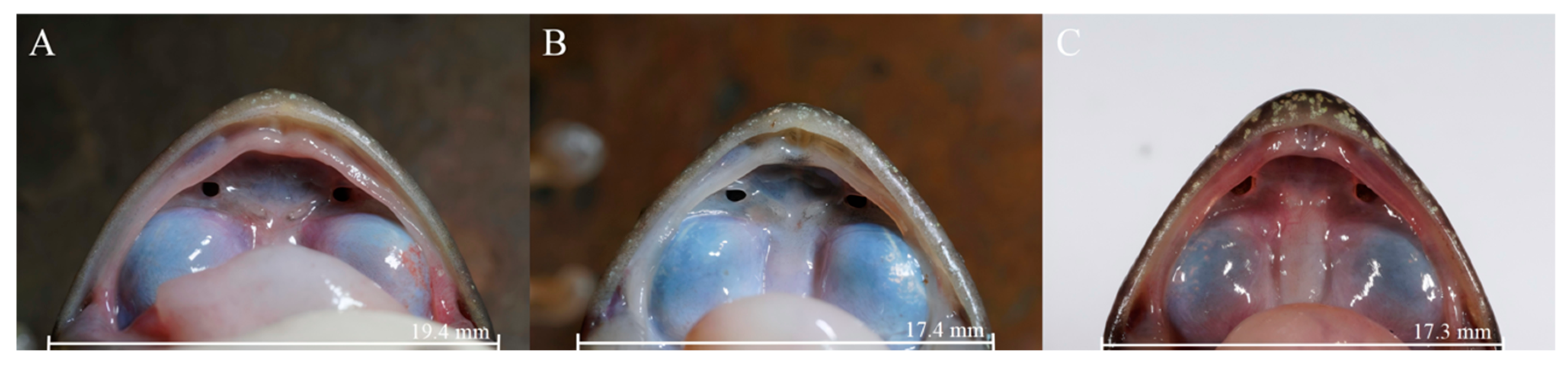
3.2. Morphological Comparisons Within Subspecies of A. mantzorum
3.3. Morphometric Analysis
3.4. Comparisons Between the New Lineage and Other Species Within the A. mantzorum Group
3.5. Taxonomic Account
4. Discussion
5. Conclusions
Supplementary Materials
Author Contributions
Funding
Institutional Review Board Statement
Informed Consent Statement
Data Availability Statement
Acknowledgments
Conflicts of Interest
Appendix A. Specimens Examined
References
- Cai, H.X.; Zhao, E.M. The validity of four Amolops species in Hengduan Mountains China. Sichuan J. Zool. 2008, 27, 483–488, (In Chinese with English Abstract). [Google Scholar]
- Fei, L.; Ye, C.Y.; Wang, Y.F.; Jiang, K. A new species of the genus Amolops (Anura: Ranidae) from high-altitude Sichuan, southwestern China, with a discussion on the taxonomic status of Amolops kangtingensis. Zool. Res. 2017, 38, 138–145. [Google Scholar]
- Wu, Y.H.; Yan, F.; Stuart, B.L.; Prendini, E.; Suwannapoom, C.; Dahn, H.A.; Zhang, B.L.; Cai, H.X.; Xu, Y.B.; Jiang, K.; et al. A combined approach of mitochondrial DNA and anchored nuclear phylogenomics sheds light on unrecognized diversity, phylogeny, and historical biogeography of the torrent frogs, genus Amolops (Anura: Ranidae). Mol. Phylogenet. Evol. 2020, 148, 106789. [Google Scholar] [CrossRef]
- Zeng, Z.C.; Liang, D.; Li, J.X.; Lyu, Z.T.; Wang, Y.Y.; Zhang, P. Phylogenetic relationships of the Chinese torrent frogs (Ranidae: Amolops) revealed by phylogenomic analyses of AFLP-Capture data. Mol. Phylogenet. Evol. 2020, 146, 106753. [Google Scholar] [CrossRef] [PubMed]
- Dufresnes, C.; Litvinchuk, S.N. Diversity, distribution and molecular species delimitation in frogs and toads from the Eastern Palaearctic. Zool. J. Linn. Soc. 2022, 195, 695–760. [Google Scholar] [CrossRef]
- Tang, S.J.; Sun, T.; Liu, S.; Luo, S.D.; Yu, G.H.; Du, L. A new species of cascade frog (Anura: Ranidae: Amolops) from central Yunnan, China. Zool. Lett. 2023, 9, 15. [Google Scholar] [CrossRef]
- Frost, D.R. Amphibian Species of the World, Version 6.2, an Online Reference; American Museum of Natural History: New York, NY, USA. Available online: https://amphibiansoftheworld.amnh.org (accessed on 13 February 2025).
- Li, P.Y.; Li, J.Y.; Zhang, W.; Yi, X.B.; Yuan, Z.Y.; Huang, J.K.; Liu, X.L. Integrated evidence reveals a new subspecies of Amolops Cope, 1865 (Anura, Ranidae) from northeastern Yunnan, China. ZooKeys 2025, 1257, 39–54. [Google Scholar] [CrossRef] [PubMed]
- Lu, B.; Bi, K.; Fu, J.Z. A phylogeographic evaluation of the Amolops mantzorum species group: Cryptic species and plateau uplift. Mol. Phylogenet. Evol. 2014, 73, 40–52. [Google Scholar] [CrossRef] [PubMed]
- Zhang, C.H.; Yuan, S.Q.; Xia, Y.; Zeng, X.M. Species delimitation of Amolops kangtingensis. Sichuan J. Zool. 2015, 34, 801–809, (In Chinese with English Abstract). [Google Scholar]
- Simon, C.; Frati, F.; Beckenbach, A.; Crespi, B.; Liu, H.; Flook, P. Evolution, weighting and phylogenetic utility of mitochondrial gene sequences and a compilation of conserved polymerase chain reaction primers. Ann. Entomol. Soc. Am. 1994, 87, 651–701. [Google Scholar] [CrossRef]
- Che, J.; Chen, H.M.; Yang, J.X.; Jin, J.Q.; Jiang, K.; Yuan, Z.Y.; Murphy, R.W.; Zhang, Y.P. Universal COI primers for DNA barcoding amphibians. Mol. Ecol. Resour. 2012, 12, 247–258. [Google Scholar] [CrossRef]
- Wu, X.Y. Genetic Structure and Phylogeography of Amolops wuyiensis Based on Mitochondrial DNA Cytb Gene. Master’s Thesis, Anhui Normal University, Wuhu, China, 2015. [Google Scholar]
- Lyu, Z.T.; Zeng, Z.C.; Wan, H.; Yang, J.H.; Li, Y.L.; Pang, H.; Wang, Y.Y. A new species of Amolops (Anura: Ranidae) from China, with taxonomic comments on A. liangshanensis and Chinese populations of A. marmoratus. Zootaxa 2019, 4609, 247–268. [Google Scholar] [CrossRef]
- Kuraku, S.; Zmasek, C.M.; Nishimura, O.; Katoh, K. aLeaves facilitates on-demand exploration of metazoan gene family trees on MAFFT sequence alignment server with enhanced interactivity. Nucleic Acids Res. 2013, 41, W22–W28. [Google Scholar] [CrossRef]
- Katoh, K.; Rozewicki, J.; Yamada, K.D. MAFFT online service: Multiple sequence alignment, interactive sequence choice and visualization. Brief. Bioinfom. 2019, 20, 1160–1166. [Google Scholar] [CrossRef]
- Borowiec, M.L. AMAS: A fast tool for alignment manipulation and computing of summary statistics. PeerJ 2016, 4, e1160. [Google Scholar] [CrossRef] [PubMed]
- Nguyen, L.; Schmidt, H.A.; von Haeseler, A.; Minh, B.Q. IQ-TREE: A Fast and Effective Stochastic Algorithm for Estimating Maximum-Likelihood Phylogenies. Mol. Biol. Evol. 2015, 32, 268–274. [Google Scholar] [CrossRef]
- Wong, T.K.F.; Ly-Trong, N.; Ren, H.; Banos, H.; Roger, A.J.; Susko, E.; Bielow, C.; De Maio, N.; Goldman, N.; Hahn, M.W.; et al. IQ-TREE 3: Phylogenomic Inference Software Using Complex Evolutionary Models. Ecoevorxiv. 2025. Available online: https://ecoevorxiv.org/repository/view/8916/ (accessed on 18 December 2025).
- Ronquist, F.; Teslenko, M.; Mark, P.; Ayres, D.L.; Darling, A.; Höhna, S.; Larget, B.; Liu, L.; Suchard, M.A.; Huelsenbeck, J.P. MrBayes 3.2: Efficient Bayesian phylogenetic inference and model choice across a large model space. Syst. Biol. 2012, 61, 539–542. [Google Scholar] [CrossRef]
- Kalyaanamoorthy, S.; Minh, B.Q.; Wong, T.K.F.; von Haeseler, A.; Jermiin, L.S. ModelFinder: Fast model selection for accurate phylogenetic estimates. Nat. Method. 2017, 14, 587–589. [Google Scholar] [CrossRef] [PubMed]
- Fei, L.; Hu, S.Q.; Ye, C.Y.; Huang, Y.Z. Fauna Sinica Amphibia, Vol. 2: Anura; Science Press: Beijing, China, 2009; pp. 1–958. (In Chinese) [Google Scholar]
- Jiang, K.; Wang, K.; Yan, F.; Xie, J.; Zhou, D.H.; Liu, W.L.; Jiang, J.P.; Li, C.; Che, J. A new species of the genus Amolops (Amphibia: Ranidae) from southeastern Tibet, China. Zool. Res. 2016, 37, 31–40. [Google Scholar]
- Fei, L.; Hu, S.Q.; Ye, C.Y.; Huang, Y.Z. Fauna Sinica Amphibia, Vol. 3: Anura Ranidae; Science Press: Beijing, China, 2009; pp. 959–1847. (In Chinese) [Google Scholar]
- Liu, W.Z.; Yang, D.T. A new species of Amolops (Anura: Ranidae) from Yunnan, China, with a discussion of karyological diversity in Amolops. Herpetologica 2000, 56, 231–238. [Google Scholar]
- Orlov, N.L.; Ho, C.T. Two new species of cascade ranids of Amolops genus (Amphibia: Anura: Ranidae) from Lai Chau Province (northwest Vietnam). Russian J. Herpetol. 2007, 14, 211–228. [Google Scholar]
- Su, C.Y.; Yang, D.T.; Li, S.M. A new species of Amolops from the Hengduan Shan Mountains. Acta Herpetol. Sin. 1986, 5, 204–206. [Google Scholar]
- Qian, T.Y.; Xiang, J.J.; Jiang, J.P.; Yang, D.D.; Gui, J. A new species of the Amolops mantzorum group (Anura: Ranidae: Amolops) from northwestern Hunan Province, China. Asian Herpetol. Res. 2023, 14, 54–64. [Google Scholar]
- Fei, L. Atlas of Amphibians in China (Field Edition); Henan Science and Technology Press: Zhengzhou, China, 2020; pp. 549–562. (In Chinese) [Google Scholar]
- Li, S.Z.; Liu, J.; Ke, X.C.; Cheng, G.; Wang, B. A new species of Amolops (Amphibia, Anura, Ranidae) from Guizhou Province, China. ZooKeys 2024, 1189, 33–54. [Google Scholar] [CrossRef] [PubMed]
- Wang, K.; Zhang, D.R.; Hou, S.B.; Wu, Y.H. Annual Review: Taxonomic Changes of Herpetofauna from China in 2022. AmphibiaChina 2022, 1–16. Available online: https://www.amphibiachina.org/news/scientifictrends/321–2023 (accessed on 3 November 2025).
- AmphibiaChina. The Database of Chinese Amphibians. Kunming Institute of Zoology (CAS), Kunming, Yunnan, China. Available online: http://www.amphibiachina.org/ (accessed on 26 February 2025).
- Chan, K.O.; Hertwig, S.T.; Neokleous, D.N.; Flury, J.M.; Brown, R.M. Widely used, short 16S rRNA mitochondrial gene fragments yield poor and erratic results in phylogenetic estimation and species delimitation of amphibians. BMC Ecol. Evol. 2022, 22, 37. [Google Scholar] [CrossRef]
- Hupało, K.; Copilaș-Ciocianu, D.; Leese, F.; Weiss, M. Morphology, nuclear SNPs and mate selection reveal that COI barcoding overestimates species diversity in a Mediterranean freshwater amphipod by an order of magnitude. Cladistics 2022, 39, 129–143. [Google Scholar] [CrossRef]
- Vences, M.; Miralles, A.; Dufresnes, C. Next-generation species delimitation and taxonomy: Implications for biogeography. J. Biogeogr. 2024, 51, 1709–1722. [Google Scholar] [CrossRef]


| Species | Male SVL | Female SVL | HL/HW | Dorsolateral Fold | Vocal Sac | |
|---|---|---|---|---|---|---|
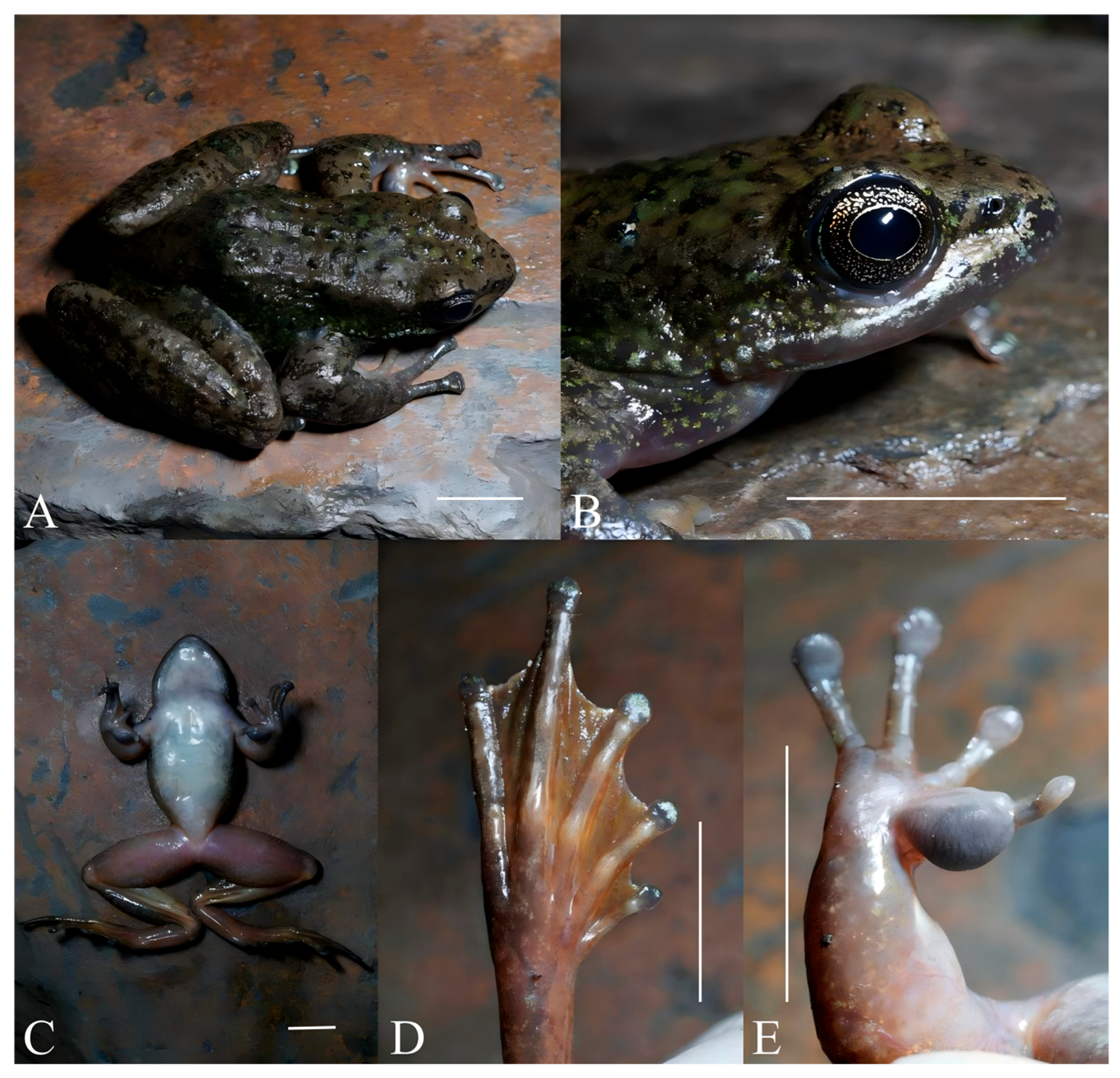
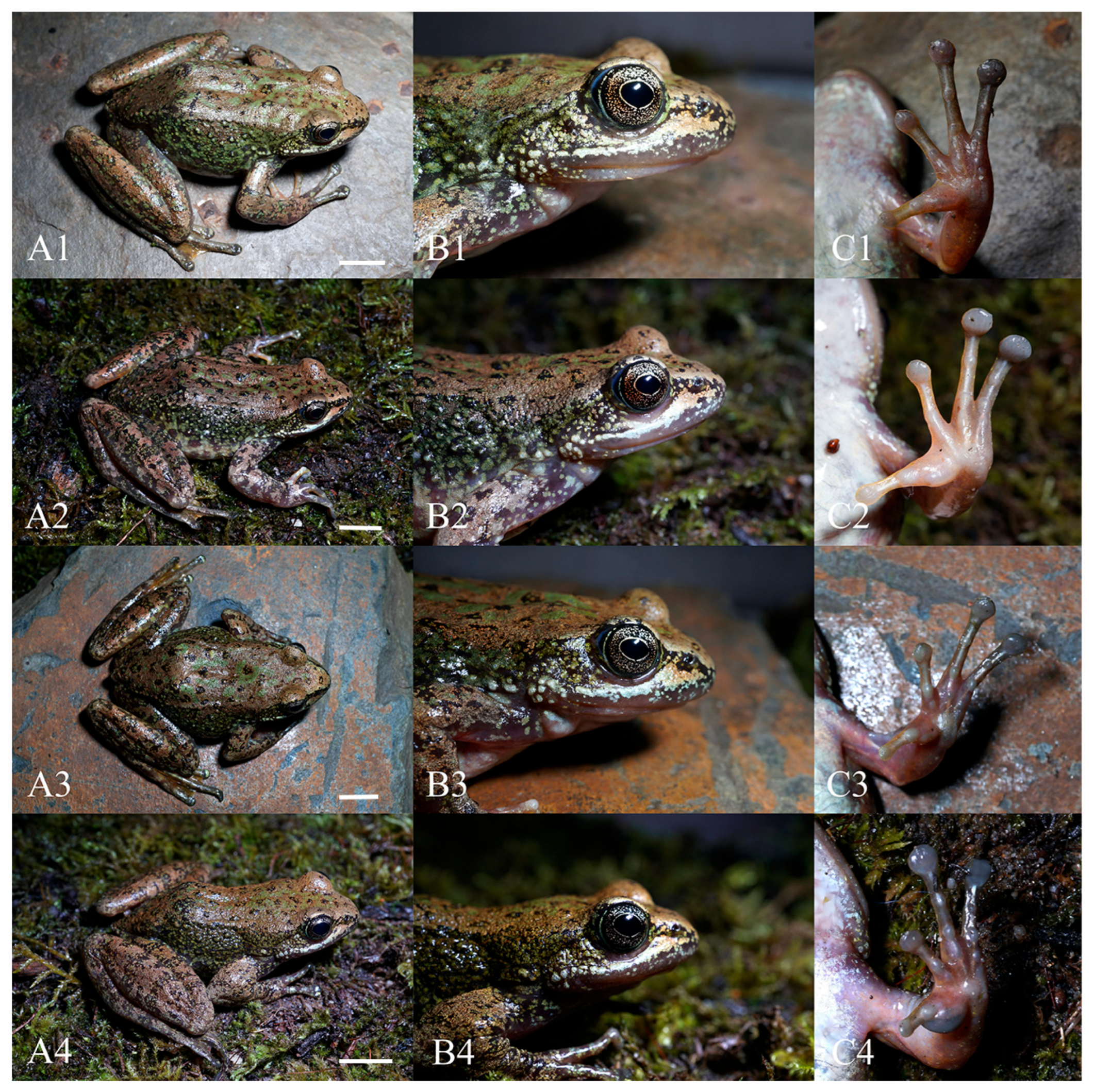
| Amolops mantzorum ssp. | 42.3–51.2 (n = 10) * | 56.7–63.7 (n = 10) * | head width slightly larger than the head length * | absent (dorsolateral fold-like glands thick and flat) * | absent * | |
| A. m. xinduqiao | 40.3–46.7 (n = 15) * | 48.5–56.6 (n = 15) | head width slightly larger than the head length * | absent * | absent * | |
| A. m. mantzorum | 51.4–57.8 (n = 10) * | 59.0–72.0 (n = 10) | head width slightly larger than the head length * | absent * | absent * | |
| A. tuberodepressus | 44.3–56.7 (n = 68) | 60.8–71.1 (n = 43) | head slightly longer than broad | absent * | absent | |
| A. granulosus | 36.3–41.8 (n = 10) | 51.9 (n = 1) | head length slightly larger than head width | absent (dorsolateral fold-like glands present) | present | |
| A. ailao | 33.0–35.1 (n = 6) | 41.3 (n = 1) | head slightly longer than wide | absent (dorsolateral folds formed by series of glands present) | absent | |
| A. minutus | 29.70–36.42 (n = 8) | 38.47–50.22 (n = 5) | head length more than head width | very poorly developed | well developed | |
| A. shuichengicus | 34.6–39.6 (n = 8) | 48.5–55.5 (n = 4) | head length slightly larger than head width | present | absent | |
| A. jinjiangensis | 43.0–53.8 (n = 22) | 53.6–66.4 (n = 20) | head length slightly larger than the head width | present | absent | |
| A. loloensis | 54.5–62.0 (n = 19) | 69.5–77.5 (n = 20) | head length almost equal to the head width | absent | absent | |
| A. sangzhiensis | 40.3–40.9 (n = 3) | 52.6–57.7 (n = 3) | head length about equal to or larger than head width | absent (developed a series of elongated glands forming an incomplete line) | absent | |
| A. lifanensis | 52.0–56.0 (n = 5) | 61.0–79.0 (n = 10) | head length almost equal to the head width | - | absent | |
| A. dafangensis | 43.2–46.8 (n = 3) | - | head length larger than head width slightly | weak formed by series of glands | absent | |
| Species | Vomerine Teeth | Tympanum | Canthus Rostralis | Type Locality | Data Resource | |
| Amolops mantzorum ssp. | distinct and strong * | absent * | distinct and blunt * | Bajiaolou Village, Bajiaolou Town, Yajiang, Sichuan * | This study | |
| A. m. xinduqiao | small, two tiny rows * | small but distinct * | distinct * | Xinduqiao Town, Kangding, Sichuan | Fei et al. [2] | |
| A. m. mantzorum | weak and small | small but distinct | slightly distinct | Baoxing, Sichuan | Fei et al. [24] | |
| A. tuberodepressus | patches in two short, oblique rows | distinct | distinct | Mt. Wuliang, Jingdong, Yunnan | Liu and Yang [25] | |
| A. granulosus | two short lines | small but distinct | distinct | Maoxian, Sichuan | Fei et al. [24] | |
| A. ailao | absent | distinct | distinct | Xinping, Yunnan | Tang et al. [6] | |
| A. minutus | strongly developed | well developed | - | Ho Thau Village, Ho Thau Commune, Tam Duong District, Lao Chai, Vietnam | Orlov and Ho [26] | |
| A. shuichengicus | present | indistinct | distinct and blunt | Shuicheng, Guizhou | Lyu et al. [14] | |
| A. jinjiangensis | oblique arrangement | indistinct | distinct | Benzilan Town, Deqin, Yunnan | Su et al. [27] | |
| A. loloensis | absent | small and indistinct | indistinct | Zhaojue, Sichuan | Fei et al. [24] | |
| A. sangzhiensis | present | indistinct and small | - | Mt. Doupeng, Sangzhi, Hunan | Qian et al. [28] | |
| A. lifanensis | developed | indistinct | indistinct | Lixian, Sichuan | Fei et al. [24]; Fei [29] | |
| A. dafangensis | present | distinct | - | Dafang, Guizhou | Li et al. [30] | |
| Characters | A. m. ssp. (n = 10) | A. m. xinduqiao (n = 15) | A. m. mantzorum (n = 10) |
|---|---|---|---|
| SVL | 46.8 ± 2.9 (42.3–51.2) | 43.3 ± 2.2 (40.3–46.7) | 54.1 ± 2.3 (51.4–57.8) |
| HL | 15.0 ± 1.1 (12.9–16.4) | 14.2 ± 1.2 (12.4–15.9) | 15.8 ± 1.1 (13.8–17.3) |
| HW | 16.0 ± 1.3 (14.2–18.0) | 15.3 ± 0.9 (13.5–16.6) | 17.6 ± 1.2 (15.9–20.0) |
| SL | 6.5 ± 0.4 (6.0–7.3) | 6.5 ± 0.3 (5.9–7.1) | 6.8 ± 0.4 (6.1–7.6) |
| INS | 5.3 ± 0.2 (5.0–5.7) | 4.8 ± 0.3 (4.3–5.5) | 5.5 ± 0.6 (4.4–6.5) |
| IOS | 4.2 ± 0.2 (3.9–4.6) | 4.1 ± 0.3 (3.6–4.6) | 4.2 ± 0.4 (3.6–5.0) |
| UEW | 3.4 ± 0.3 (2.8–3.8) | 3.6 ± 0.4 (3.1–4.8) | 3.8 ± 0.7 (3.1–5.2) |
| ED | 5.1 ± 0.5 (4.1–6.1) | 5.9 ± 0.4 (5.2–6.3) | 5.6 ± 0.4 (4.9–6.3) |
| LAHL | 23.6 ± 1.8 (20.0–26.4) | 22.3 ± 1.0 (21.0–24.7) | 28.0 ± 1.5 (26.0–31.8) |
| HAL | 13.5 ± 1.6 (10.4–16.2) | 14.0 ± 0.8 (13.0–15.9) | 16.2 ± 1.2 (14.3–18.6) |
| TL | 27.4 ± 1.3 (25.7–29.2) | 25.6 ± 1.5 (22.8–28.6) | 33.9 ± 1.4 (31.6–36.5) |
| TFL | 39.3 ± 2.6 (35.4–43.7) | 34.2 ± 1.7 (31.8–37.9) | 45.9 ± 2.9 (41.4–51.5) |
| FL | 27.7 ± 2.2 (25.5–32.0) | 25.0 ± 1.2 (23.7–27.6) | 30.5 ± 2.2 (25.7–32.6) |
| Character | A. m. ssp. vs. A. m. xinduqiao | A. m. ssp. vs. A. m. mantzorum | A. m. xinduqiao vs. A. m. mantzorum |
|---|---|---|---|
| log10 (SVL) | 0.010722 * | 0.000157 ** | 0.000032 ** |
| log10 (HL/SVL) | 0.244071 | 0.005159 ** | 0.000202 ** |
| log10 (HW/SVL) | 0.052204 | 0.034294 * | 0.000385 ** |
| log10 (SL/SVL) | 0.01982 * | 0.00194 ** | 0.000032 ** |
| log10 (INS/SVL) | 0.911664 | 0.010165 * | 0.009132 ** |
| log10 (IOS/SVL) | 0.107697 | 0.012611 * | 0.000584 ** |
| log10 (UEW/SVL) | 0.006567 ** | 0.596701 | 0.009132 ** |
| log10 (ED/SVL) | 0.000385 ** | 0.449692 | 0.000032 ** |
| log10 (LAHL/SVL) | 0.134214 | 0.226476 | 0.911664 |
| log10 (HAL/SVL) | 0.001294 ** | 0.173617 | 0.003921 ** |
| log10 (TL/SVL) | 0.374799 | 0.00194 ** | 0.012555 * |
| log10 (TFL/SVL) | 0.002282 ** | 0.405679 | 0.001568 ** |
| log10 (FL/SVL) | 0.134214 | 0.173617 | 0.541749 |
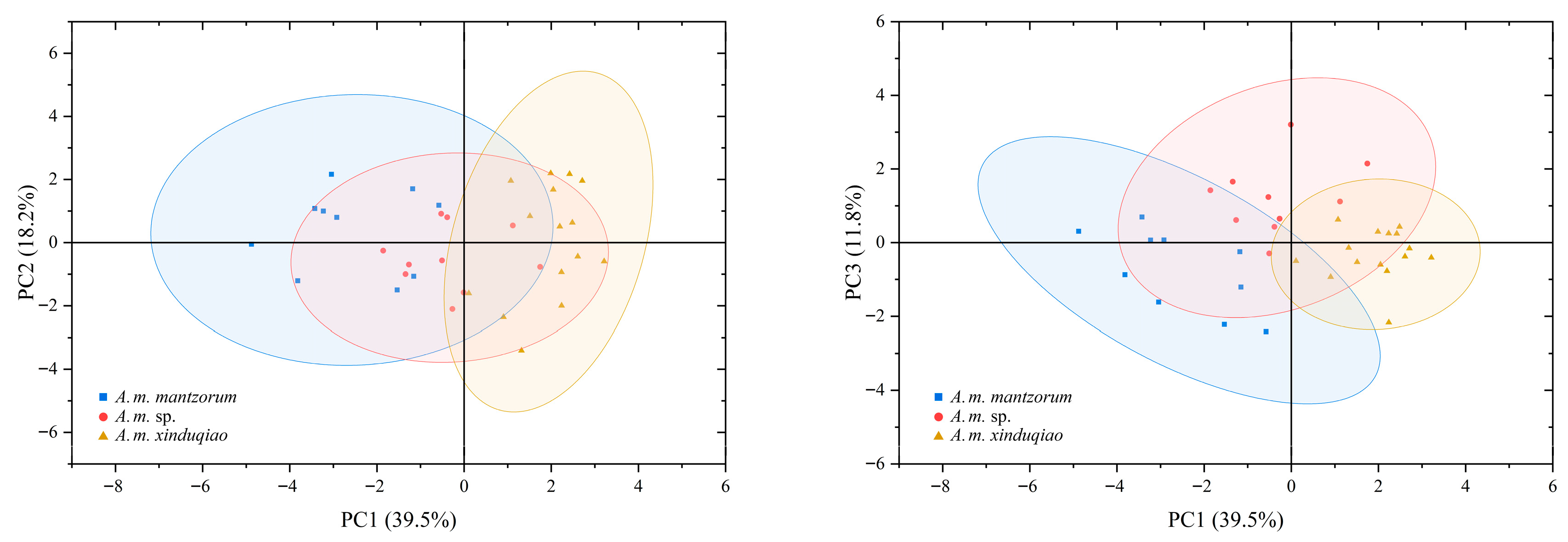
| Characters | PC1 | PC2 | PC3 |
|---|---|---|---|
| log10 (HL/SVL) | 0.3447 | −0.1823 | 0.0592 |
| log10 (HW/SVL) | 0.3467 | 0.1735 | −0.0007 |
| log10 (SL/SVL) | 0.3917 | 0.0735 | 0.1646 |
| log10 (INS/SVL) | 0.2514 | −0.0279 | 0.3357 |
| log10 (IOS/SVL) | 0.3651 | 0.1035 | 0.3069 |
| log10 (UEW/SVL) | 0.3432 | 0.0282 | −0.2217 |
| log10 (ED/SVL) | 0.3817 | −0.0123 | −0.0292 |
| log10 (LAHL/SVL) | 0.0741 | 0.5217 | −0.3162 |
| log10 (HAL/SVL) | 0.2176 | 0.3498 | −0.4449 |
| log10 (TL/SVL) | −0.1416 | 0.4890 | −0.0373 |
| log10 (TFL/SVL) | −0.2731 | 0.4042 | 0.3064 |
| log10 (FL/SVL) | 0.0085 | 0.3490 | 0.5652 |
| Eigenvalue | 4.7367 | 2.1870 | 1.4104 |
| Percentage of variance (%) | 39.4727 | 18.2248 | 11.7533 |
| Cumulative percentage (%) | 39.4727 | 57.6976 | 69.4509 |
| Characters | Males (n = 10) | Ratio to the SVL (%) | Females (n = 10) | Ratio to the SVL (%) |
|---|---|---|---|---|
| SVL | 46.8 ± 2.9 (42.3–51.2) | 60.3 ± 2.0 (56.7–63.7) | ||
| HL | 15.0 ± 1.1 (12.9–16.4) | 32.0 ± 1.9 (28.1–34.1) | 17.5 ± 0.9 (15.6–18.8) | 29.0 ± 1.3 (25.8–30.2) |
| HW | 16.0 ± 1.3 (14.2–18.0) | 34.1 ± 1.2 (32.1–35.8) | 19.6 ± 1.1 (17.8–21.2) | 32.5 ± 1.1 (31.2–34.6) |
| SL | 6.5 ± 0.4 (6.0–7.3) | 14.0 ± 1.0 (12.1–15.7) | 7.8 ± 0.6 (7.0–9.1) | 13.0 ± 0.8 (12.0–14.3) |
| INS | 5.3 ± 0.2 (5.0–5.7) | 11.3 ± 0.9 (10.4–13.0) | 6.1 ± 0.3 (5.6–6.8) | 10.2 ± 0.6 (9.2–11.1) |
| IOS | 4.2 ± 0.2 (3.9–4.6) | 9.0 ± 0.6 (8.3–10.2) | 4.5 ± 0.4 (4.3–5.5) | 7.5 ± 0.6 (6.7–8.7) |
| UEW | 3.4 ± 0.3 (2.8–3.8) | 7.4 ± 0.8 (5.8–8.3) | 3.8 ± 0.3 (3.4–4.4) | 6.3 ± 0.6 (5.5–7.2) |
| ED | 5.1 ± 0.5 (4.1–6.1) | 10.9 ± 1.3 (9.0–14.1) | 6.0 ± 0.2 (5.7–6.4) | 9.9 ± 0.5 (9.4–10.9) |
| LAHL | 23.6 ± 1.8 (20.0–26.4) | 50.4 ± 1.8 (47.3–52.6) | 28.8 ± 1.1 (27.0–30.2) | 47.8 ± 1.7 (44.5–49.4) |
| HAL | 13.5 ± 1.6 (10.4–16.2) | 28.9 ± 2.5 (24.7–31.8) | 15.6 ± 1.3 (13.2–17.8) | 25.9 ± 2.4 (21.5–28.9) |
| TL | 27.4 ± 1.3 (25.7–29.2) | 58.6 ± 1.7 (56.2–61.8) | 32.9 ± 0.6 (32.1–33.8) | 54.6 ± 1.5 (52.0–56.9) |
| TFL | 39.3 ± 2.6 (35.4–43.7) | 84.0 ± 2.1 (80.1–87.3) | 45.9 ± 2.5 (39.6–48.8) | 76.1 ± 4.7 (64.3–80.7) |
| FL | 27.7 ± 2.2 (25.5–32.0) | 59.3 ± 2.7 (54.5–63.9) | 32.4 ± 2.2 (27.3–35.1) | 53.8 ± 4.5 (44.4–59.3) |
Disclaimer/Publisher’s Note: The statements, opinions and data contained in all publications are solely those of the individual author(s) and contributor(s) and not of MDPI and/or the editor(s). MDPI and/or the editor(s) disclaim responsibility for any injury to people or property resulting from any ideas, methods, instructions or products referred to in the content. |
© 2025 by the authors. Licensee MDPI, Basel, Switzerland. This article is an open access article distributed under the terms and conditions of the Creative Commons Attribution (CC BY) license.
Share and Cite
Qian, T.; Guo, Y.-J.; Tian, K.; Shi, S.-C.; Ma, S.; Zhang, D.; Hou, Y.-M.; Xie, F.; Jiang, J.-P. Revisiting the Species Delimitation Within Amolops mantzorum (David, 1872), with a Description of a New Subspecies (Anura, Ranidae). Animals 2026, 16, 55. https://doi.org/10.3390/ani16010055
Qian T, Guo Y-J, Tian K, Shi S-C, Ma S, Zhang D, Hou Y-M, Xie F, Jiang J-P. Revisiting the Species Delimitation Within Amolops mantzorum (David, 1872), with a Description of a New Subspecies (Anura, Ranidae). Animals. 2026; 16(1):55. https://doi.org/10.3390/ani16010055
Chicago/Turabian StyleQian, Tianyu, Yu-Juan Guo, Kaidi Tian, Sheng-Chao Shi, Shun Ma, Di Zhang, Yin-Meng Hou, Feng Xie, and Jian-Ping Jiang. 2026. "Revisiting the Species Delimitation Within Amolops mantzorum (David, 1872), with a Description of a New Subspecies (Anura, Ranidae)" Animals 16, no. 1: 55. https://doi.org/10.3390/ani16010055
APA StyleQian, T., Guo, Y.-J., Tian, K., Shi, S.-C., Ma, S., Zhang, D., Hou, Y.-M., Xie, F., & Jiang, J.-P. (2026). Revisiting the Species Delimitation Within Amolops mantzorum (David, 1872), with a Description of a New Subspecies (Anura, Ranidae). Animals, 16(1), 55. https://doi.org/10.3390/ani16010055