Simple Summary
Comparative analyses of the Y chromosome provide valuable insights into genetic diversity, species differentiation, and evolutionary history in Bovidae. In this study, we examined the Y chromosomes of European bison (Bison bonasus, n = 32), American bison (Bison bison, n = 2), and domestic cattle (Bos taurus, n = 6). Using classical cytogenetic methods (C-banding), we measured key structural features: length, relative length, area, relative area, and heterochromatin content. The analyses revealed consistent morphological differences among species, with the C-band identified as the most informative parameter. Multivariate statistical methods, including principal component and discriminant analyses, demonstrated that domestic cattle are distinct from both Bison species, while European and American bison are more similar yet still separable. The high classification accuracy confirmed the robustness of the applied markers. These findings highlight the potential of Y chromosome morphology as a powerful comparative approach for distinguishing closely related species and its relevance for biodiversity and conservation research.
Abstract
In this study, we examined Y chromosome morphology in three species: European bison (Bison bonasus), American bison (Bison bison), and domestic cattle (Bos taurus). Peripheral blood lymphocytes were cultured, and C-banded metaphase preparations were analyzed to measure key Y chromosome parameters—absolute and relative length, absolute and relative area, and heterochromatin (C-band) content—using ImageJ software (ver. 1.54p). All traits deviated from normality (Shapiro–Wilk, p < 0.05). Non-parametric analyses revealed significant interspecific differences, with the strongest effects observed for C-band, followed by absolute and relative length. Principal Component Analysis (PCA) indicated a two-class structure, where domestic cattle formed a distinct cluster, while European and American bison grouped closely but remained separable. Linear Discriminant Analysis (LDA) achieved high classification accuracy (0.94), with misclassifications limited to American versus European bison. Generalized Linear Model (GLM) analyses further confirmed a strong species effect on C-band content (R2 = 0.916). These results identify the C-band as the most powerful discriminant, providing robust morphological differentiation among the three species and demonstrating the value of Y chromosome morphometry for comparative cytogenetic studies. Due to the limited sample size of American bison (n = 2), interpretations for this species should be made with caution.
Keywords:
European bison; American bison; domestic cattle; cytogenetics; chromosome Y; Bovidae; Bos; Bison 1. Introduction
The Bovidae family comprises species of considerable ecological, cultural, and economic relevance. Within this family, the European bison (Bison bonasus), American bison (Bison bison), and domestic cattle (Bos taurus) represent a closely related group that diverged approximately one million years ago [1,2,3]. Their shared ancestry and well-documented history of hybridization have made them a valuable model for comparative research, including studies where genomic and cytogenetic data are incomplete. All three species share a conserved karyotype (2n = 60), and evolutionary analyses indicate substantial chromosomal similarity across Bovidae [4,5,6,7]. However, one notable exception is the Y chromosome, whose morphology differs strikingly between cattle and both Bison species: domestic cattle possess a submetacentric or metacentric Y chromosome [8,9,10], whereas the European and American bison consistently exhibit an acrocentric form [5,11,12].
These differences have prompted two major hypotheses regarding the origin of Y chromosome variability in Bovidae: structural rearrangements such as pericentric inversions or translocations, and evolutionary shifts in the abundance of repetitive DNA sequences [6]. A further hypothesis proposes that the acrocentric configuration represents the ancestral state within the Bovinae [5]. Because the Y chromosome is enriched in repetitive sequences and displays extensive heterochromatin, particularly in the pericentromeric region, it is highly sensitive to lineage-specific changes in repeat organization [13,14,15,16]. Such variability, even within closely related taxa, may provide informative cytogenetic markers for species differentiation and for studying male-specific evolutionary processes.
Despite advances in long-read sequencing, the Y chromosome remains one of the least resolved components of mammalian genomes. Several assemblies for domestic cattle have improved overall genome contiguity (e.g., ROSLIN_BTT_NDA1, ARS-UCD2.0), yet the repetitive structure of the Y chromosome has remained challenging to reconstruct [17]. Recently, Olagunju et al. [18] generated complete assemblies of the Y chromosomes of cattle and sheep, revealing extensive structural divergence and variable gene content. The Y chromosome of domestic cattle is 59.4 Mb long, contains roughly 50% repetitive sequences, includes 352 protein-coding genes and 50 pseudogenes, and its extensively expanded ~40 Mb ampliconic region (with numerous copies of TSPY, HSFY, PRAME, ZNF280A/B, and RBMY) is the primary feature shaping its structure and overall size [18]. Comparable assemblies for the European and American bison are currently unavailable; existing genomes are at the scaffold level and do not include a complete Y chromosome sequence [19,20,21]. Consequently, cytogenetic analyses continue to play an important role in characterizing Y chromosome organization in these species.
The European bison provides an additional context in which Y chromosome data may be particularly informative. The species experienced a severe demographic decline, with complete extinction in the wild by 1919, and subsequently recovered with only 12 individuals remaining [22,23,24]. This history has resulted in extreme genetic erosion, as documented at the molecular level [25,26,27,28,29,30,31,32] and likely reflected in Y chromosome variation as well. Understanding the structure and variability of the Y chromosome may therefore contribute to ongoing conservation and management efforts.
Studying Y chromosome morphology in Bovidae presents practical and methodological challenges. Access to material is often limited due to legal or conservation constraints, resulting in small sample sizes that reduce statistical power and make subtle intraspecific variation difficult to detect [33,34]. Moreover, morphometric analyses rely on precisely executed measurements that may introduce random variation related to landmark placement or scoring angle, even under standardized conditions [35,36,37]. Such residual variability does not systematically bias results but reinforces the need for rigorous analytical procedures, including nonparametric tests and cross-validated multivariate approaches [38], to ensure robust interpretation.
Against this background, the present study focuses on quantifying Y chromosome variation in the European bison, American bison, and domestic cattle. By integrating morphometric parameters, including Y chromosome length and area, expressed in both absolute and relative values, with heterochromatin content assessed through C-banding, the study aims to determine how these features contribute to species differentiation and what they reveal about Y chromosome evolution within the three studied Bovidae species. Multivariate analyses further assess the diagnostic value of these traits for distinguishing among the three taxa.
2. Materials and Methods
2.1. Research Samples
The material consisted of peripheral blood from European bison, American bison, and domestic cattle bulls collected in sterile, heparinized 9 mL tubes (Medlab, Raszyn, Poland). The material was collected between 2015 and 2022. The European bison samples were deposited in the European Bison Gene Bank at the Department of Genetics and Animal Conservation of the Warsaw University of Life Sciences, in accordance with the permit issued by the Regional Director for Environmental Protection in Warsaw for the keeping of parts of protected animal species dated 10 April 2014, ref. No. WPN-I.6401.90.2014.EB.1. Samples were collected during routine veterinary procedures, including microchipping, transport, release into the wild herd, or elimination for health reasons. The material from European bison came from 10 locations in Poland, breeding centers and wild herds (Białowieża n = 2; Bieszczady n = 8; Gołuchów n = 1; Muczne n = 8; Niepołomice n = 2; Pszczyna n = 6; Borecka Forest n = 2; Knyszyńska Forest n = 1; Smardzewice n = 1; Toruń n = 1). A total of 32 samples were collected from European bison. Based on their origin and pedigree data, it was determined that 16 samples came from males of the LB line, and 16 samples were collected from individuals from the LC line.
Research material from male American bison (n = 2) was obtained in Poland, where this species is listed as an Invasive Alien Species (IAS). Its legal status prohibits breeding and severely limits the availability of biological material. Blood samples were collected from the only existing captive group in the country during routine veterinary procedures. For comparison, material from domestic cattle bulls of the Limousine breed (n = 6) was collected at a slaughterhouse. Samples were obtained from domestic cattle bulls during routine slaughter at a licensed slaughterhouse. No animals were explicitly handled for this research, and no procedures beyond standard slaughter practices were performed. Therefore, no informed consent from animal owners or farms was required. All samples were transported to the laboratory under refrigerated conditions (4 °C).
2.2. Cell Culture
Cell culture was performed according to the standard cell culture protocol [39] with modifications: the incubation temperature was increased to 38.5 °C, and pokeweed lectin was used as a mitogen. Under standard culture conditions with phytohemagglutinin, the lymphocyte cultures exhibited very low mitotic activity, which informed our decision to modify the protocol by replacing phytohemagglutinin with pokeweed mitogen to enhance mitotic stimulation and chromosome quality (Supplementary Note S1). The lymphocyte cultures were supplemented with 8.5 mL of RPMI 1640 culture medium (Merck, Darmstadt, Germany), 10% fetal bovine serum (Merck, Darmstadt, Germany), pokeweed mitogen (100 µg/mL) (Merck, Darmstadt, Germany), and antibiotics (penicillin and streptomycin; 100 µg/mL) (Merck, Darmstadt, Germany). The blood was thoroughly mixed and then added to the culture to a final volume of 10 mL. The cultures were prepared in two replicates for each individual, labeled A and B. The tubes were incubated at 38.5 °C for 72 h in a horizontal position and gently mixed twice daily. One hour before the harvest, 1 μg/mL of colchicine (Merck, Darmstadt, Germany) was added to the tubes. Then, after one hour, the cultures were treated with a hypotonic solution—0.075 M KCl (Avantor Performance Materials, Gliwice, Poland) for 20 min at 38.5 °C in a water bath, and then fixed three times with freshly prepared, cold methanol/acetic acid (3:1). The fixed cell pellet was stored at −20 °C until the preparation of microscope slides.
2.3. Preparation of the Microscope Slides and C-Banding
Before preparing the microscope slides, the fixed, frozen cell pellets were centrifuged for 7 min at 1100 rpm, excess fixative was removed, and the remaining pellets were resuspended in freshly prepared and cold methanol/acetic acid (3:1). Cytogenetic preparations were made immediately before staining; the cell pellet was applied to SuperFrost microscope slides (Thermo Fisher Scientific, Waltham, MA, USA) previously stored at −20 °C and then air-dried. The C-banding method was used to identify constitutive heterochromatin in chromosomes. The preparations were subjected to a method described by Chaves et al. [40]. Briefly, slides were incubated with the restriction enzyme MspI (Thermo Fisher Scientific, Waltham, MA, USA) at 37 °C for a minimum of 16 h. After this, the slides were rinsed in deionized water and air-dried. Next, the procedure for C-band staining, as described by Sumner [41], was applied with minor modifications. Specifically, the incubation time in HCl was shortened, and the duration in Ba(OH)2 was adjusted based on experimental optimization to prevent over-digestion and better preserve chromosome morphology. In brief, the preparations were incubated in a 0.2 M HCl (Avantor Performance Materials, Gliwice, Poland) solution for 30 min at room temperature, washed in deionized water (at room temperature), and incubated in a 5% Ba(OH)2 (Avantor Performance Materials, Gliwice, Poland) solution for 15 min at 50 °C (Supplementary Note S1). After this step, the preparations were rinsed in deionized water at 50 °C and incubated in a 2× saline-sodium citrate (Avantor Performance Materials, Gliwice, Poland) solution at 60 °C for 1 h. The preparations were then rinsed again in deionized water to remove any remaining salt sediment from the surface and air-dried. Finally, propidium iodide was used instead of Giemsa to enhance contrast and facilitate more precise visualization of chromosomes. Preparations were stained with propidium iodide (2 μg/mL) (Merck, Darmstadt, Germany) for 2 min, air-dried, and then mounted with VECTASHIELD® Antifade Mounting Medium (Vector Laboratories, Newark, NJ, USA) to preserve the fluorescence.
2.4. Analysis of Microscopic Preparations and Y Chromosome Measurements
Metaphase spreads were observed and analyzed using a Leica DM3000 microscope (Leica Microsystems, Wetzlar, Germany), connected to a CV-M4+CL digital camera (JAI, Copenhagen, Denmark) and an EL6000 fluorescence illumination system (Leica Microsystems, Wetzlar, Germany). The prepared photographic documentation was analyzed using CytoVision Software, ver. 7.3.1 (Leica Microsystems, Wetzlar, Germany). In the initial stage, 20 metaphase plates from each male European bison (i.e., a total of 640 cells) were analyzed, 50 metaphase plates from each male American bison (i.e., a total of 100 cells), and 20 metaphase plates from each domestic cattle bull (i.e., a total of 120 cells), giving a total of 860 cells analyzed. The number of metaphase plates analyzed per species was determined based on preliminary analyses, which showed that these numbers provided stable mean values, allowing for a reliable morphometric characterization of the Y chromosome while balancing accuracy and experimental efficiency. Next, a representative group of cells was selected for each individual analyzed. Y chromosomes were identified based on their distinctive morphology and C-banding pattern, which allowed them to be clearly distinguished from autosomes in each species. Twenty Y chromosome measurements for each individual were converted into a dataset, from which measurements from four metaphase plates around the median representing the given set were selected. As a result, the following were analyzed: 8 American bison cells, 24 domestic cattle cells, and 128 European bison cells, of which 64 belonged to individuals from the LB line and 64 to individuals from the LC line (Table S1). The choice of 20 measurements per individual was supported by preliminary tests, which showed that additional metaphase analyses produced no meaningful improvement in the stability of mean values or variance estimates.
Y chromosome measurements were performed based on the chromosome length normalization system developed by Levan et al. [42]. Absolute chromosome length and area were measured; relative length and relative area were calculated as percentages of all chromosomes’ total length and area in the same metaphase plate. Based on the absolute area data, the area of constitutive heterochromatin within the Y chromosome was also measured. The measurements were performed using the IMAGEJ software [43] with the LEVAN plugin [44]. The analyses included, among others, adjusting the scale from pixels to µm or µm2 based on the scale from the photograph, determining the length of chromosomes by measuring the length of each of the two chromatids (function: straight line or segmented line) and averaging the results, as well as measuring the surface area of chromosomes and the surface area of the C-band using the threshold function.
2.5. Statistical Analysis
All statistical analyses were conducted in R (R Core Team, version 4.4.3) [45]. Data quality control included verifying naming consistency, detecting missing values and outliers, and checking for unit homogeneity. Distributional assumptions were tested with the Shapiro–Wilk test for normality and Levene’s test for homogeneity of variances (rstatix; ver. 0.7.2) [46]. As these assumptions were not met, interspecific comparisons were carried out using the Kruskal–Wallis test (rstatix), followed by Dunn’s post hoc tests with Benjamini–Hochberg correction for multiple comparisons (PMCMRplus (ver. 1.9.12) [47], rstatix). Effect sizes (η2(H)) were computed with the effect size package (ver. 1.0.1) [48].
Covariance structure was investigated using Principal Component Analysis (PCA [49], FactoMineR (ver. 2.12) [50], factoextra (ver. 1.0.7) [51]). Species classification was assessed by Linear Discriminant Analysis (LDA [52]; MASS [52]). Models were trained on two independent data partitions—an 80/20 train–test split and 10-fold cross-validation—to evaluate robustness and prevent overfitting. The optimal number of clusters was determined using the NbClust package (ver. 3.0.1) [53], which implements a comprehensive suite of indices and criteria, providing a robust, data-driven justification for cluster selection. Classification performance was evaluated using multiple complementary metrics: overall accuracy, balanced accuracy, sensitivity, specificity, and Cohen’s kappa [54,55].
Data were randomly partitioned into training (80%) and testing (20%) subsets using the initial_split() function from the rsample package (ver. 1.3.1), with stratification by species to preserve proportional representation across groups. A fixed random seed (set.seed = 123) ensured full reproducibility of the split. The stratified random division was methodologically justified despite the small overall sample size—particularly the limited number of American bison (Bison bison) specimens—because it prevents exclusion of the rarest class from either subset and allows each species to contribute to model training and evaluation.
For small and imbalanced datasets, stratified random sampling combined with repeated cross-validation is recognized as a best-practice approach [56]: it reduces sampling bias, maximizes data use efficiency, and provides a more reliable estimate of model generalization performance compared with deterministic or per-species partitioning. Therefore, ten-fold cross-validation was implemented as an additional safeguard against overfitting, ensuring that each observation was used for training and testing across iterations. This strategy enhances the stability of discriminant functions while maintaining the interpretability of species-level contrasts under constrained sample conditions.
Additionally, generalized linear models (GLM [57]; stats (ver. 4.4.3) [47], emmeans (ver. 1.11.2) [58]) were fitted to estimate the effect of species identity on each chromosomal trait. Model outputs included parameter estimates with standard errors, 95% confidence intervals, and Tukey-adjusted pairwise contrasts based on estimated marginal means.
All results were considered statistically significant at p < 0.05 after correction for multiple testing.
3. Results
3.1. C-Banding
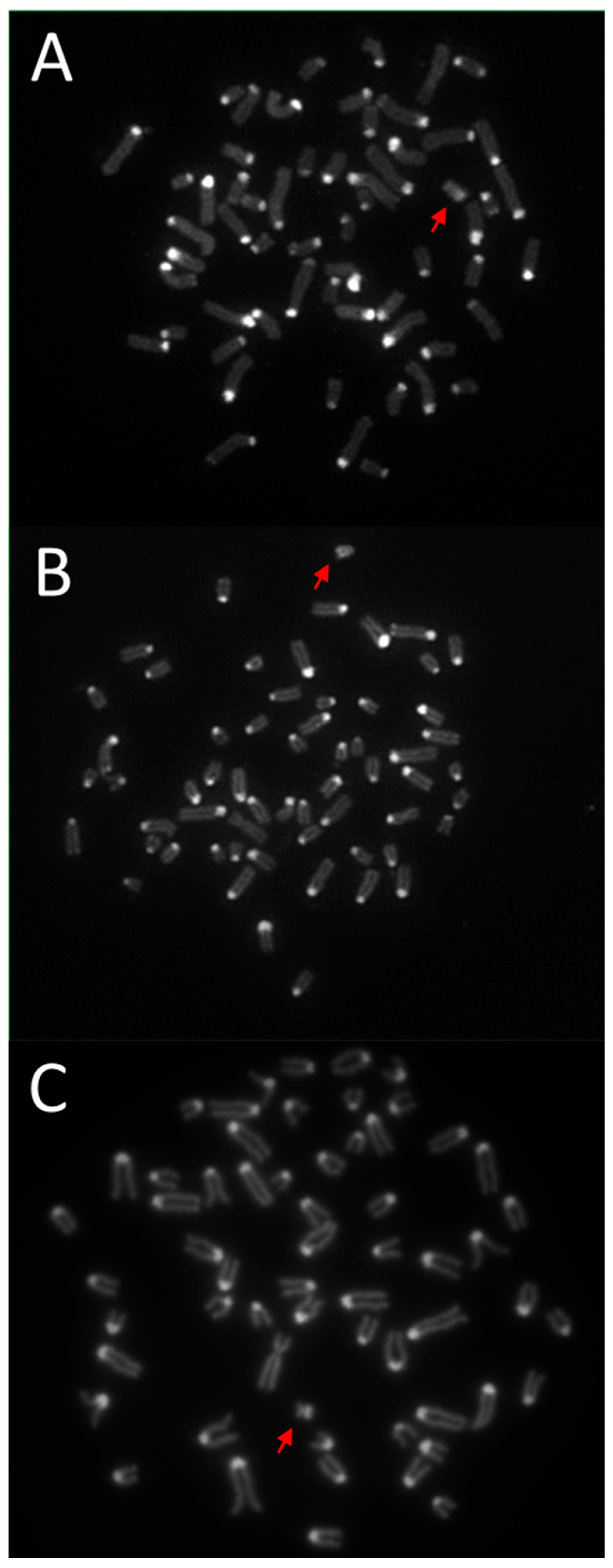
The modified method for obtaining C-bands enabled the visualization of blocks of constitutive heterochromatin in the Y chromosomes of the studied species. The results of differential C-banding staining are presented in Figure 1. Based on the results obtained, it was determined that the C-band in the European and American bison is located at the end of the long arm of this chromosome (Figure 1A and Figure 1B, respectively). In contrast, in the Y chromosome of domestic cattle, a distinct C-band is visible in the short arm (Figure 1C). It is worth noting that the Y chromosome of the European and American bison differs in appearance from the other chromosomes. This chromosome is lighter in color, particularly evident when observing the original image, i.e., after fluorescent staining with propidium iodide. The negatives of the original photos are included in the Supplementary Materials (Supplementary Note S1).
Figure 1.
Results of the C-banding method with propidium iodide staining. Metaphase plates of: (A)—European bison (Bison bonasus), (B)—American bison (Bison bison), (C)—domestic cattle (Bos taurus). The Y chromosomes are marked with a red arrow. Magnification 100×.
3.2. Y Chromosome Measurements
The analyses demonstrated clear interspecific distinctions in the Y chromosome’s morphometric dimensions and C-banding patterns. Domestic cattle possessed visibly longer and more heterochromatin-rich Y chromosomes than the Bison species, reflecting their distinctive karyotypic organization. This was evident in the markedly higher C-band content in cattle (mean: 0.599 ± 0.049) compared to American bison (0.459 ± 0.037) and European bison (0.366 ± 0.017). In parallel, absolute chromosome length in cattle reached 2.057 ± 0.118 μm, distinctly exceeding values recorded in American (1.620 ± 0.147 μm) and European bison (1.560 ± 0.020 μm).
In contrast, the smaller Y chromosomes observed in American and European bison indicate a more compact chromosomal structure, with the European bison showing an exceptionally narrow range of values—for instance, the C-band IQR (interquartile range) spans only 0.352–0.378, highlighting remarkable chromosomal uniformity within the species.
Despite similar absolute surface areas across the three species (all around 1.74–1.78 μm2), relative measures revealed subtle yet consistent differences in chromosome proportion and heterochromatin content. The higher relative length of the American bison Y chromosome (mean 1.177 ± 0.064) may point to species-specific organization of centromeric or euchromatic regions. In contrast, the reduced C-band content in European bison (median: 0.362) suggests a less heterochromatinized and possibly more conserved Y-chromosome architecture. These descriptive outcomes are summarized in Table 1.
Table 1.
Descriptive statistics (mean ± standard deviation (SD), median (IQR), and range) of Y chromosome morphometric parameters in American bison, domestic cattle, and European bison. Sample sizes are shown in column headings; “All” denotes pooled values across species.
The unequal sample sizes among the studied taxa resulted from practical and legal constraints rather than sampling bias. The American bison is classified in Poland as an invasive alien species, severely limiting the collection and availability of biological material. Consequently, the number of American bison samples was considerably lower than that of domestic cattle and European bison. These discrepancies in group size, combined with non-normal data distributions and heteroskedasticity revealed by the Shapiro–Wilk and Levene’s tests, precluded the use of classical parametric procedures. To ensure reliable inference, non-parametric, robust, and cross-validated multivariate approaches were applied, emphasizing effect sizes and confidence intervals rather than sole reliance on p-values. While unequal n can reduce statistical power—particularly for the smallest group—it does not compromise the validity of the results when appropriate distribution-free methods and robust estimators are used.
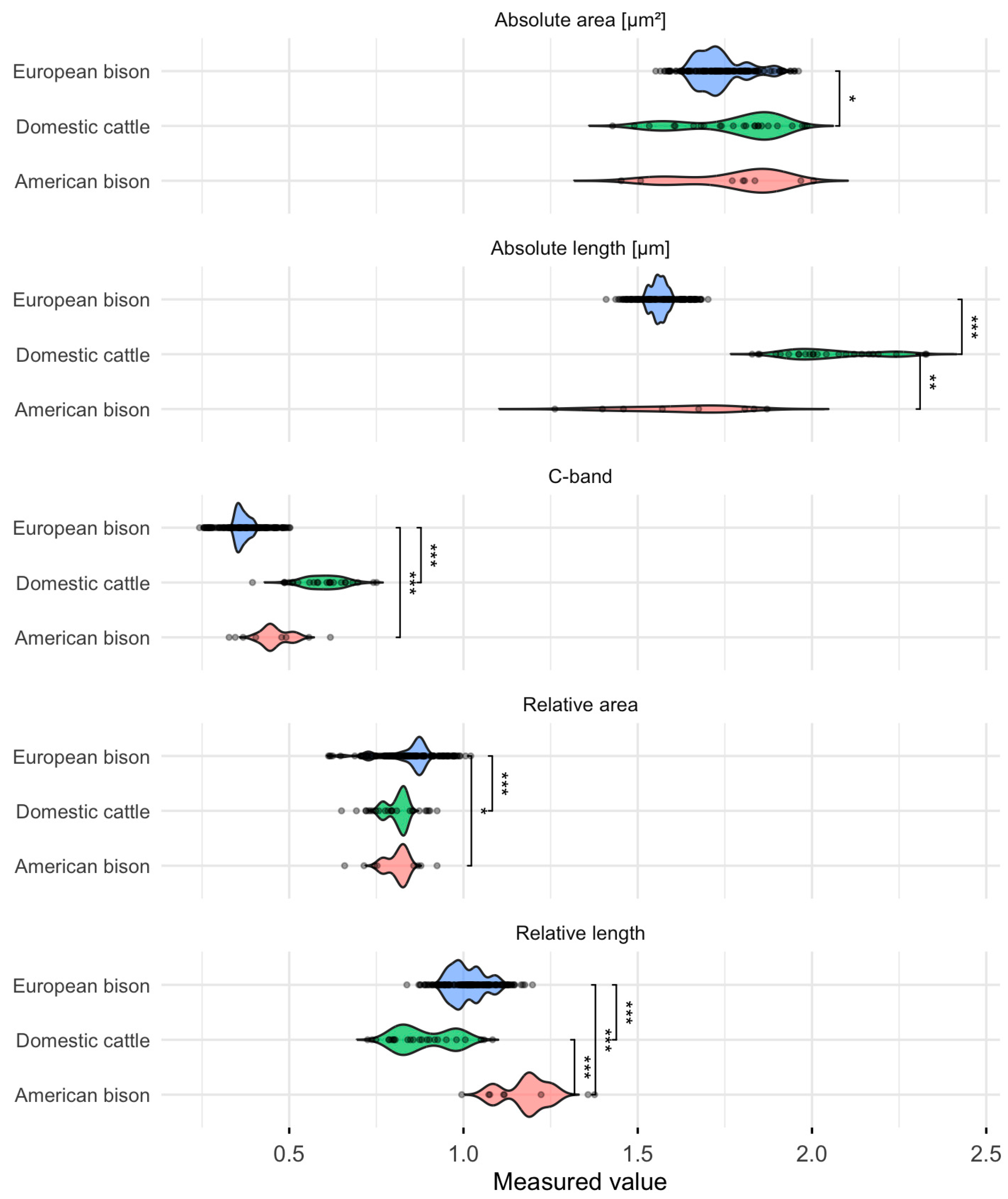
Nonparametric testing supported the descriptive observations. Kruskal–Wallis analyses revealed highly significant differences among species for all traits (p < 0.001). The assumption checks and global test statistics are summarized in Table 2, while the distribution of values with pairwise post hoc comparisons is visualized in Figure 2. Dunn’s tests with Benjamini–Hochberg correction confirmed that each species pair differed significantly, as indicated by the asterisks on the violin plots. Effect size estimates (η2(H)) further demonstrated that the observed differences were statistically significant and biologically meaningful, ranging from moderate to strong magnitudes.
Table 2.
Results of Kruskal–Wallis tests assessing interspecific differences in Y chromosome morphometric and C-banding traits. All traits showed significant species effects (p < 0.001). For each variable, the table presents the effect size (η2(H)) with 95% confidence intervals, along with results of assumption checks (Shapiro–Wilk test for normality and Levene’s test for homogeneity of variances).
Figure 2.
Violin plots illustrating variation in Y chromosome morphometric traits and C-band heterochromatin content in domestic cattle (Bos taurus), American bison (Bison bison), and European bison (Bison bonasus). Each panel represents the distribution and variability of a given trait within a species. Asterisks denote statistically significant pairwise differences according to Dunn’s post hoc tests with Benjamini–Hochberg correction * p < 0.05, ** p < 0.01, *** p < 0.001).
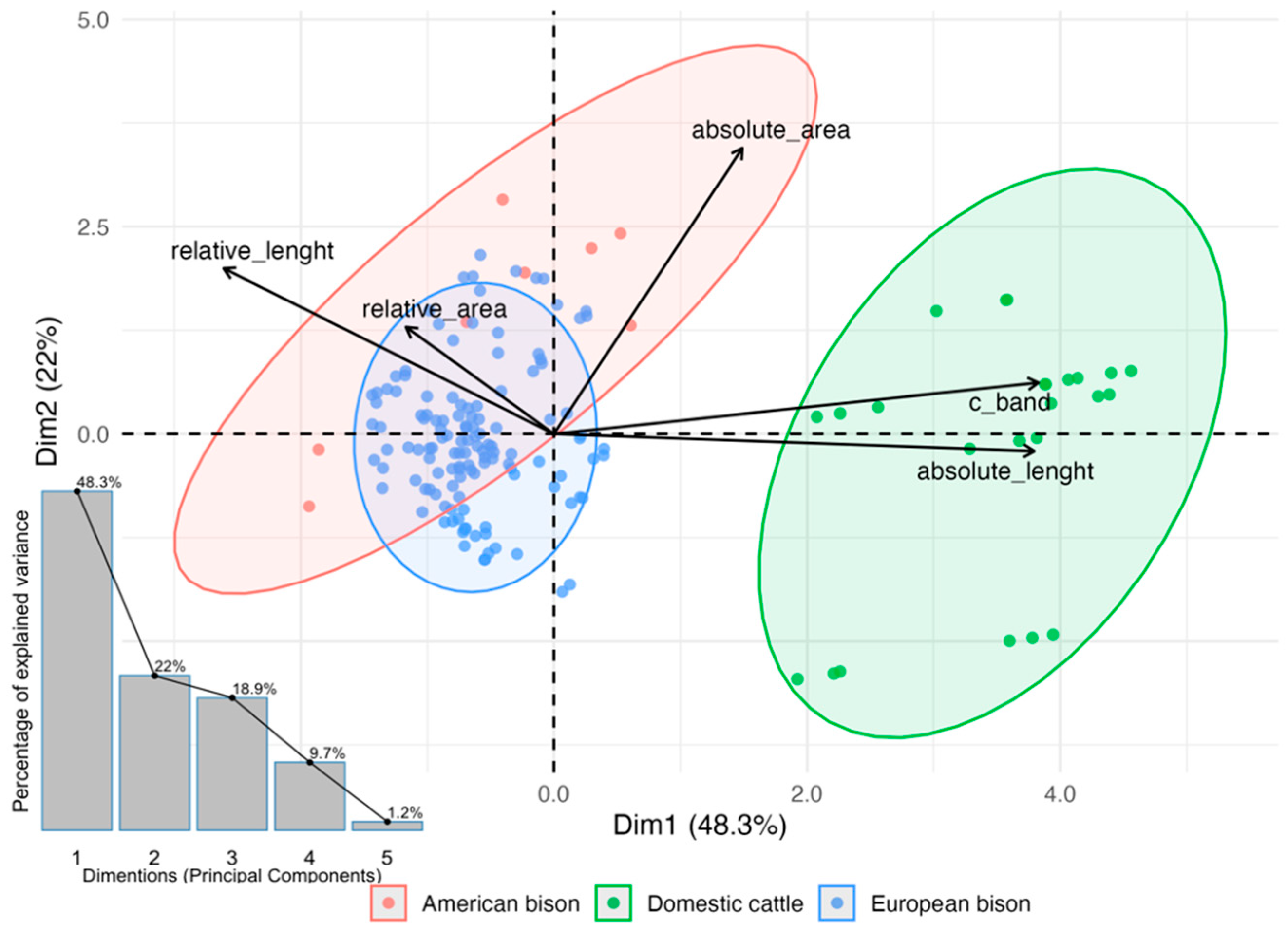
Principal Component Analysis (PCA) was employed to explore interspecific differentiation in Y chromosome morphometric and cytogenetic traits without assuming normality. The first two principal components explained most of the total variance and arranged the three taxa into well-separated clusters. Absolute and relative length contributed most strongly to PC1, whereas surface measures and C-band heterochromatin dominated PC2. In the PCA biplot (Figure 3), domestic cattle were characterized by larger absolute size and higher C-band content, American bison by the greatest relative length, and European bison by elevated relative surface values and reduced variability. Although PCA is mathematically unaffected by unequal sample sizes, visual separation can be influenced by the dominant contribution of larger groups; therefore, all variables were standardized to ensure comparable scaling across the three studied species.
Figure 3.
Principal component analysis (PCA) of Y chromosome morphometric traits and C-band heterochromatin content in domestic cattle (Bos taurus), American bison (Bison bison), and European bison (Bison bonasus). Black arrows represent variable loadings contributing to the first two principal components, which account for most of the total variance. Ellipses depict 95% confidence intervals around group centroids, showing clear separation among the three species. The inset scree plot illustrates the proportion of total variance explained by each principal component.
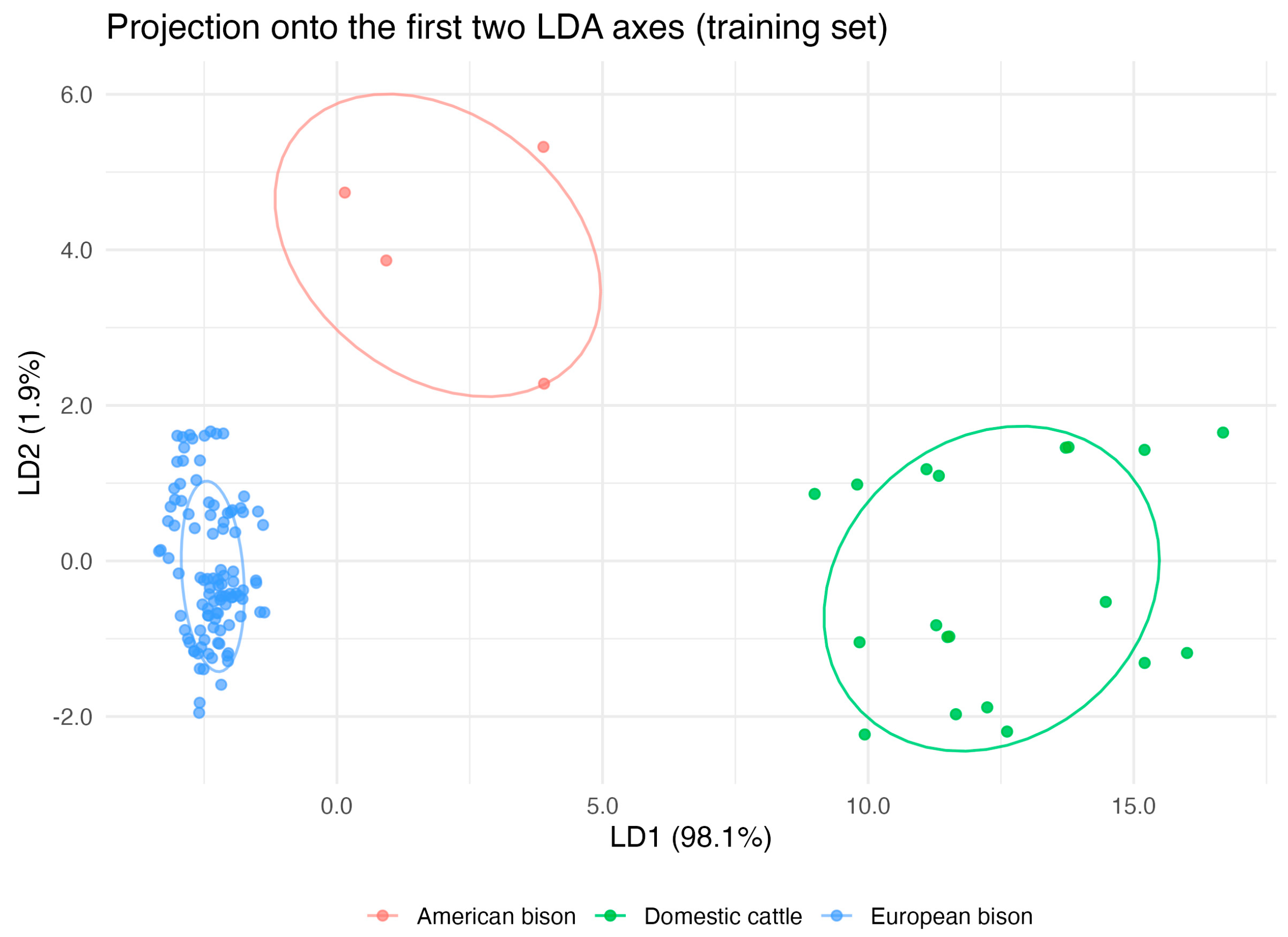
Linear Discriminant Analysis (LDA) confirmed these multivariate patterns and demonstrated strong discriminatory power of Y chromosome traits. The model achieved over 93% classification accuracy, and 10-fold cross-validation produced concordant results, confirming its stability. Sensitivity and specificity values were consistently high across species, indicating robust discrimination even for the small American bison sample (Figure 4). These findings reinforce the reliability of the interspecific differentiation suggested by PCA and validate the biological distinctness of the analyzed taxa despite unequal group sizes.
Figure 4.
Linear discriminant analysis (LDA) of Y chromosome morphometric traits and C-band content in domestic cattle (Bos taurus), American bison (Bison bison), and European bison (Bison bonasus). The projection onto the first two discriminant functions reveals clear species separation, with 95% confidence ellipses around group centroids. The model demonstrated strong discriminatory performance, confirming reliable differentiation among species.
Generalized Linear Models (GLM) provided additional confirmation of these trends. In every model, species identity exerted a highly significant effect on the response variable (all p < 0.001). Estimated marginal means and post hoc contrasts mirrored the ranking patterns observed in the descriptive and multivariate analyses, further supporting consistent species-specific differentiation (Table 3). Robust variance estimation and model diagnostics were employed to account for heteroskedasticity and the unbalanced design, ensuring that the inference remained valid and biologically interpretable.
Table 3.
Results of generalized linear models (GLM) assessing the effect of species identity on Y chromosome morphometric traits. The table presents regression coefficients with standard errors, t-values, significance levels, and pairwise post hoc contrasts (Tukey adjustment) with estimated marginal means (EMMeans) and 95% confidence intervals. All models indicated highly significant species effects (p < 0.001).
The combined use of non-parametric tests, PCA, LDA, and GLM ensured that statistical conclusions were resilient to deviations from normality and unequal sample sizes. This integrative and distribution-free framework allowed the detection of biologically meaningful patterns of Y chromosome variation even under the practical limitations imposed by the invasive status of the American bison.
4. Discussion
In the mid-19th century, unsustainable and uncontrolled hunting led to the near-total extermination of millions of American bison, causing a dramatic population collapse, particularly within the prairie subspecies. The survival of the American bison was ensured mainly through the efforts of five private breeders and the preservation of a free-ranging herd inhabiting the area now known as Yellowstone National Park [59]. Because private breeders maintained most surviving animals, frequent crossbreeding with domestic cattle occurred in an effort to enhance commercially valuable traits such as musculature, endurance, and resilience [59,60,61]. By 2007, only about 1.5% of American bison were estimated to be free from domestic cattle gene introgression [62]. A similar demographic crisis affected the European bison, which became extinct in the wild by 1919 due to hunting, habitat loss, and the effects of World War I [22]. At that time, only 54 individuals remained in captivity, and all modern European bison populations descend from just 12 founders [23,24]. This severe genetic bottleneck drastically reduced genetic diversity, a pattern also reflected in the variability of the Y chromosome. Currently, three Y chromosome haplotypes can be distinguished among males of this species, originating from the Plebejer (pedigree no. 45), Begründer (pedigree no. 15), and Kaukasus (pedigree no. 100) bulls. All occur in males of the LC line, whereas in males of the LB line only the Plebejer-derived Y chromosome is present. Their distribution was historically uneven (the Begründer haplotype was rare) [63], though planned breeding has partially altered this pattern.
Early cytogenetic studies of domestic cattle demonstrated that the short arm of the Y chromosome consists of material similar to centromeric regions of autosomes and contains highly condensed, repetitive DNA sequences [14,15,16,64]. The conservative nature of these sequences suggests an important functional role in maintaining proper Y chromosome structure and activity in Bovidae [65]. Substantial differences in Y chromosome morphology among cattle breeds have been documented, and Y chromosome polymorphism is heritable [66,67,68]. Reported estimates of longer Y chromosome length in domestic cattle range from 0.44–0.53% to 1.8–2.8% of the total genome length [69,70,71,72,73], whereas in the American bison, the relative length is approximately 1.9% [69], with absolute length reaching 1–2 µm [74]. Discrepancies between studies likely result from methodological variation and intrinsic Y chromosome polymorphism [58,71,72,75]. The observed diversity in Y chromosome structure among Bos and Bison species likely mirrors their evolutionary history and the dynamic processes shaping Y-linked sequences. Molecular studies indicate that the ancestral lineages of domestic cattle, European bison, and American bison diverged approximately one million years ago [1,2,3]. As in other mammals, the Y chromosome in these species comprises a recombining pseudoautosomal region and a male-specific region that does not recombine [76]. The absence of recombination in the male-specific region facilitates the accumulation of repetitive elements, gene duplications, and structural rearrangements, accelerating divergence between species and populations [77,78].
Although our data do not allow direct inference regarding specific chromosomal rearrangements, the observed differences in C-band content and Y chromosome length are consistent with previously proposed mechanisms involving structural and evolutionary modifications. In this study, this pattern positions the American bison as intermediate between domestic cattle and the European bison, reflecting their proximity within the Bovidae phylogeny. The differentiation in Y chromosome morphology and C-band distribution suggests that, despite shared evolutionary affinities, the two Bison species display distinct species-specific features, potentially reflecting shared ancestral variation rather than recent introgression from domestic cattle [59,62]. The acrocentric structure of the Y chromosomes in both European and American bison can complicate their identification using conventional staining methods. These chromosomes exhibit a distinctly brighter appearance under C-banding and propidium iodide staining, which highlights regions of constitutive heterochromatin, indicating a relatively high proportion of heterochromatin compared to other chromosomes in the metaphase plate. In contrast, the domestic cattle Y chromosome is typically submetacentric or metacentric, allowing for easier identification without the need for differential staining. Combining classical cytogenetic techniques with quantitative morphometry and multivariate statistics provides a strong methodological framework for resolving interspecific relationships and identifying potential hybridization events.
Differences in Y chromosome morphometry between domestic cattle and European bison reflect both intrinsic species characteristics and historical demographic processes. Domestic cattle exhibit longer Y chromosomes, whereas European bison show markedly reduced variability, consistent with their narrow genetic base. The interspecific variation in heterochromatin organization agrees with previous observations of C-band distribution in Bos and Bison [65], underscoring its potential as a diagnostic and evolutionary marker. Statistical analyses further confirmed pronounced interspecies differences across multiple traits. Both chromosome length and C-band organization proved particularly informative for distinguishing taxa, highlighting the value of Y chromosome morphometry as a diagnostic and phylogenetic tool in Bovidae research.
The main limitation of this study is the small sample size of the American bison, which is directly attributed to legal and logistical restrictions associated with collecting material from this invasive alien species. Although robust, non-parametric, and cross-validated statistical approaches were applied, the limited sample size inevitably reduces statistical power and may obscure subtle within-species variability. Consequently, interpretations concerning the American bison should be approached cautiously and verified as additional material becomes available. Similar challenges have been noted in population and molecular studies, where restricted sampling or environmental pressures can influence reproductive or genomic parameters [33,34].
Another potential source of uncertainty arises from the use of manual morphometric measurements. Despite rigorous calibration, repeated assessments, and standardized measurement criteria, minor inconsistencies in landmark placement or measurement angle can introduce random errors, especially when working with microscopic structures. Such manual variability is known to contribute predominantly to random rather than systematic bias in other biological measurement systems, thereby increasing residual variance without distorting true biological differences [35,36,37]. Any measurement noise in our dataset would therefore make the observed interspecific differences conservative rather than inflated. The use of digital image capture, repeated scoring, and statistical cross-validation further minimized these risks, following recommendations consistent with best practices for measurement reliability and data preprocessing [38].
Overall, our findings highlight the utility of Y chromosome morphology as a marker for interspecific differentiation within the studied species in the Bovidae family. Integrating cytogenetic, morphometric, and multivariate methods provides a robust framework for identifying diagnostic traits, assessing evolutionary relationships, and inferring limited introgression among closely related taxa. Future comparative studies incorporating Y chromosome morphometry with molecular methods, including PCR-based assays, sequencing, or fluorescence in situ hybridization, could offer additional resolution and further validate the diagnostic value of cytogenetic markers in Bovidae.
5. Conclusions
This study examined interspecific variation in Y chromosome morphology in domestic cattle, European bison, and American bison. The analysis showed consistent differences in Y chromosome length, heterochromatin content, and C-band content, indicating that these features provide reliable diagnostic value for distinguishing species. The small sample size of American bison, imposed by legal and logistical constraints, limits the statistical strength of the findings for this species and requires cautious interpretation. Despite this limitation, the results underscore the usefulness of Y chromosome morphology as a complementary approach in comparative cytogenetics and taxonomy, with potential relevance for evolutionary studies and conservation strategies.
Supplementary Materials
The following supporting information can be downloaded at: https://www.mdpi.com/article/10.3390/ani15233442/s1, Supplementary Note S1: Figure S1: Bison bonasus, Figure S2: Bison bison, Figure S3: Bos taurus; Table S1_Raw data.
Author Contributions
Conceptualization, M.K. and W.O.; methodology, M.K., M.P.-T. and W.O.; validation, M.K., M.W., M.P.-T., J.J. and W.O.; formal analysis, M.P.-T.; investigation, M.K.; resources, M.K. and W.O.; data curation, M.K. and M.P.-T.; writing—original draft preparation, M.K. and M.P.-T.; writing—review and editing, M.K., M.W., M.P.-T., J.J. and W.O.; visualization, M.K., M.W. and M.P.-T.; supervision, W.O.; project administration, M.K.; funding acquisition, W.O. All authors have read and agreed to the published version of the manuscript.
Funding
This research was funded by the Forest Fund (Poland), (1) Complex Project of European Bison Conservation by State Forests, grant number OR.271.3.10.2017, and (2) Optimization of management methods of European bison populations, grant number EZ.281.3.8.25.
Institutional Review Board Statement
Not applicable.
Informed Consent Statement
Not applicable.
Data Availability Statement
The data presented in this study are available on request from the corresponding author.
Acknowledgments
We thank everyone directly involved in European bison conservation. This research would not have been possible without the dedication of breeders and veterinarians.
Conflicts of Interest
The authors declare no conflicts of interest.
Abbreviations
The following abbreviations are used in this manuscript:
| LB | European bison Lowland line |
| LC | European bison Lowland-Caucasian line |
| IAS | Invasive Alien Species |
| PCA | Principal component analysis |
| LDA | Linear discriminant analysis |
| GLM | Generalized linear models |
| IQR | Interquartile range |
References
- Loftus, R.T.; MacHugh, D.E.; Bradley, D.G.; Sharp, P.M.; Cunningham, P. Evidence for two independent domestications of cattle. Proc. Natl. Acad. Sci. USA 1994, 91, 2757–2761. [Google Scholar] [CrossRef]
- Verkaar, E.L.C.; Nijman, I.J.; Beeke, M.; Hanekamp, E.; Lenstra, J.A. Maternal and paternal lineages in cross-breeding bovine species. Has wisent a hybrid origin? Mol. Biol. Evol. 2004, 21, 1165–1170. [Google Scholar] [CrossRef]
- Nijman, I.J.; Van Boxtel, D.C.J.; Van Cann, L.M.; Marnoch, Y.; Cuppen, E.; Lenstra, J.A. Phylogeny of Y chromosomes from bovine species. Cladistics 2008, 24, 723–726. [Google Scholar] [CrossRef]
- Iannuzzi, L.; Di Meo, G.P. Chromosomal evolution in bovids: A comparison of cattle, sheep and goat G- and R-banded chromosomes and cytogenetic divergences among cattle, goat and river buffalo sex chromosomes. Chromosome Res. 1995, 3, 291–299. [Google Scholar] [CrossRef] [PubMed]
- Gallagher, D.S., Jr.; Davis, S.K.; De Donato, M.; Burzlaff, J.D.; Womack, J.E.; Taylor, J.F.; Kumamoto, A.T. A molecular cytogenetic analysis of the tribe Bovini (Artiodactyla: Bovidae: Bovinae) with an emphasis on sex chromosome morphology and NOR distribution. Chromosome Res. 1999, 7, 481–492. [Google Scholar] [CrossRef] [PubMed]
- Di Meo, G.P.; Perucatti, A.; Floriot, S.; Incarnato, D.; Rullo, R.; Caputi Jambrenghi, A.; Ferretti, L.; Vonghia, G.; Cribiu, E.; Eggen, A.; et al. Chromosome evolution and improved cytogenetic maps of the Y chromosome in cattle, zebu, river buffalo, sheep and goat. Chromosome Res. 2005, 13, 349–355. [Google Scholar] [CrossRef]
- Iannuzzi, L.; Di Berardino, D. Tools of the trade: Diagnostics and research in domestic animal cytogenetics. J. Appl. Genet. 2008, 49, 357–366. [Google Scholar] [CrossRef]
- Koulischer, L.; Tijskens, T.; Mortelmans, J. Mammalian cytogenetics. I. The chromosomes of three species of Bovidae: Bos taurus, Bison bonasus, Cephalophus grimmi. Acta Zool. Pathol. Antverp. 1967, 43, 135–141. [Google Scholar]
- Evans, H.J.; Buckland, R.A.; Sumner, A.T. Chromosome homology and heterochromatin in goat, sheep and ox studied by banding techniques. Chromosoma 1973, 42, 383–402. [Google Scholar] [CrossRef]
- Ford, C.E.; Pollock, D.L.; Gustavsson, I. Proceedings of the First International Conference for the Standardisation of Banded Karyotypes of Domestic Animals University of Reading, Reading, England 2nd–6th August 1976. Hereditas 1980, 92, 145–162. [Google Scholar] [CrossRef]
- Ciechańska, J.; Kruszyński, W. Analiza polimorfizmu cytogenetycznego u wybranych gatunków z rodzajów Bos, Bison i Oryx. Zesz. Nauk. UP Wroc. Biol. Hod. Zwierz. 2011, 583, 15–23. [Google Scholar]
- Kloch, M.; Życzyński, A.; Olech, W.; Nowak-Życzyńska, Z. Cytogenetic study of the Bison bonasus; I: Identification of heterochromatic regions and NORs in European bison karyotype and comparison with domestic cattle (Bos taurus). Caryologia 2020, 73, 3–9. [Google Scholar] [CrossRef]
- Lawce, H.J. Chromosome stains. In The AGT Cytogenetics Laboratory Manual, 4th ed.; Arsham, M.S., Barch, M.J., Lawce, H.J., Eds.; Whiley Blackwell: Hoboken, NJ, USA, 2017; pp. 213–300. [Google Scholar] [CrossRef]
- Gvozdev, V.A.; Kogan, G.L.; Usakin, L.A. The Y chromosome as a target for acquired and amplified genetic material in evolution. BioEssays 2005, 27, 1256–1262. [Google Scholar] [CrossRef] [PubMed]
- Erlandsson, R.; Wilson, J.F.; Paeaebo, S. Sex chromosome transposable element accumulation and male-driven substitutional evolution in humans. Mol. Biol. Evol. 2000, 17, 804–812. [Google Scholar] [CrossRef]
- Skaletsky, H.; Kuroda-Kawaguchi, T.; Minx, P.J.; Cordum, H.S.; Hillier, L.; Brown, L.G.; Repping, S.; Pyntikova, T.; Ali, J.; Bieri, T.; et al. The male-specific region of the human Y Chromosome is a mosaic of discrete sequence classes. Nature 2003, 423, 825–837. [Google Scholar] [CrossRef]
- Liu, W.S.; de Leon, F.A.P. Mapping of the bovine Y chromosome. Electron. J. Biol. 2007, 3, 5–12. [Google Scholar]
- Olagunju, T.A.; Rosen, B.D.; Neibergs, H.L.; Becker, G.M.; Davenport, K.M.; Elsik, C.G.; Hadfield, T.S.; Koren, S.; Kuhn, K.L.; Rhie, A.; et al. Telomere-to-telomere assemblies of cattle and sheep Y-chromosomes uncover divergent structure and gene content. Nat. Commun. 2024, 15, 8277. [Google Scholar] [CrossRef]
- Wang, K.; Wang, L.; Lenstra, J.A.; Jian, J.; Yang, Y.; Hu, Q.; Lai, D.; Qiu, Q.; Ma, T.; Du, Z.; et al. The genome sequence of the wisent (Bison bonasus). Gigascience 2017, 6, gix016. [Google Scholar] [CrossRef]
- Dobson, L.K.; Zimin, A.; Bayles, D.; Fritz-Waters, E.; Alt, D.; Olsen, S.; Blanchong, J.; Reecy, J.; Smith, T.P.L.; Derr, J.N. De novo assembly and annotation of the North American bison (Bison bison) reference genome and subsequent variant identification. Anim. Genet. 2021, 52, 263–274. [Google Scholar] [CrossRef] [PubMed]
- Oppenheimer, J.; Rosen, B.D.; Heaton, M.P.; Vander Ley, B.L.; Shafer, W.R.; Schuetze, F.T.; Stroud, B.; Kuehn, L.A.; McClure, J.C.; Barfield, J.P.; et al. A Reference Genome Assembly of American Bison, Bison bison bison. J. Hered. 2021, 112, 174–183. [Google Scholar] [CrossRef] [PubMed]
- Pucek, Z.; Belousova, I.P.; Krasińska, M.; Krasiński, Z.A.; Olech, W.; IUCN; SSC Bison Specialist Group. European Bison. Status Survey and Conservation Action Plan; IUCN: Gland, Switzerland; Cambridge, UK, 2004; p. 68. ISBN 2-8317-0762-5. [Google Scholar]
- Slatis, H.M. An Analysis of Inbreeding in the European Bison. Genetics 1960, 45, 275–287. [Google Scholar] [CrossRef]
- Olech, W. The changes of founders number and their contribution to the European bison population during 80 years of species restitution. Eur. Bison Conserv. Newsl. 2009, 2, 54–60. [Google Scholar]
- Tokarska, M.; Marshall, T.; Kowalczyk, R.; Wójcik, J.M.; Pertoldi, C.; Kristensen, T.N.; Loeschecke, V.; Gregersen, V.R.; Bendixen, C. Effectiveness of microsatellite and SNP markers for parentage and identity analysis in species with low genetic diversity: The case of European bison. Heredity 2009, 103, 326–332. [Google Scholar] [CrossRef]
- Kamiński, S.; Olech, W.; Oleński, K.; Nowak, Z.; Ruść, A. Single nucleotide polymorphisms between two lines of European bison (Bison bonasus) detected by the use of Illumina Bovine 50 K BeadChip. Conserv. Genet. Resour. 2012, 4, 311–314. [Google Scholar] [CrossRef]
- Wojciechowska, M.; Nowak, Z.; Gurgul, A.; Olech, W.; Drobik, W.; Szmatoła, T. Panel of informative SNP markers for two genetic lines of European bison: Lowland and Lowland–Caucasian. Anim. Biodivers. Conserv. 2017, 40, 17–25. [Google Scholar] [CrossRef]
- Oleński, K.; Kamiński, S.; Tokarska, M.; Hering, D.M. Subset of SNPs for parental identification in European bison Lowland-Białowieża line (Bison bonasus bonasus). Conserv. Genet. Resour. 2018, 10, 73–78. [Google Scholar] [CrossRef]
- Wojciechowska, M.; Puchała, K.; Nowak-Życzyńska, Z.; Perlińska-Teresiak, M.; Kloch, M.; Drobik-Czwarno, W.; Olech, W. From Wisent to the Lab and Back Again—A Complex SNP Set for Population management as an effective tool in European Bison conservation. Diversity 2023, 15, 116. [Google Scholar] [CrossRef]
- Lapickis, R.; Griciuvienė, L.; Kibiša, A.; Lipatova, I.; Aleksandravičienė, A.; Ražanskė, I.; Wojciechowska, M.; Kloch, M.; Olech, W.; Paulauskas, A. Analysis of the genetic diversity of the European bison (Bison bonasus) population in Lithuania. Diversity 2023, 15, 406. [Google Scholar] [CrossRef]
- Olech, W.; Wojciechowska, M.; Kloch, M.; Perlińska-Teresiak, M.; Nowak-Życzyńska, Z. Genetic diversity of Wisent Bison bonasus based on STR loci analyzed in a large set of samples. Diversity 2023, 15, 399. [Google Scholar] [CrossRef]
- Wehrenberg, G.; Tokarska, M.; Cocchiararo, B.; Nowak, C. A reduced SNP panel optimised for non-invasive genetic assessment of a genetically impoverished conservation icon, the European bison. Sci. Rep. 2024, 14, 1875. [Google Scholar] [CrossRef]
- Gao, Y.; Wang, C.; Wang, K.; He, C.; Hu, K.; Liang, M. The effects and molecular mechanism of heat stress on spermatogenesis and the mitigation measures. Syst. Biol. Reprod. Med. 2022, 68, 331–347. [Google Scholar] [CrossRef]
- Li, L.; Sun, Y.; Luo, J.; Liu, M. Circulating immune cells and risk of osteosarcoma: A Mendelian randomization analysis. Front. Immunol. 2024, 15, 1381212. [Google Scholar] [CrossRef]
- Chen, E.; Chen, C.; Chen, F.; Yu, P.; Lin, L. Positive association between MIC gene polymorphism and tuberculosis in Chinese population. Immunol. Lett. 2019, 213, 62–69. [Google Scholar] [CrossRef] [PubMed]
- Chen, J.; Chen, F.; Peng, S.; Ou, Y.; He, B.; Li, Y.; Lin, Q. Effects of Artemisia argyi Powder on Egg Quality, Antioxidant Capacity, and Intestinal Development of Roman Laying Hens. Front. Physiol. 2022, 13, 902568. [Google Scholar] [CrossRef] [PubMed]
- Tang, W.; Wu, J.; Jin, S.; He, L.; Lin, Q.; Luo, F.; He, X.; Feng, Y.; He, B.; Bing, P.; et al. Glutamate and aspartate alleviate testicular/epididymal oxidative stress by supporting antioxidant enzymes and immune defense systems in boars. Sci. China Life Sci. 2020, 63, 116–124. [Google Scholar] [CrossRef] [PubMed]
- He, B.; Zhu, R.; Yang, H.; Lu, Q.; Wang, W.; Song, L.; Sun, X.; Zhang, G.; Li, S.; Yang, J.; et al. Assessing the Impact of Data Preprocessing on Analyzing Next Generation Sequencing Data. Front. Bioeng. Biotechnol. 2020, 8, 817. [Google Scholar] [CrossRef] [PubMed]
- Moorhead, P.S.; Nowell, P.C.; Mellman, W.J.; Battips, D.M.; Hungerford, D.A. Chromosome preparations of leukocytes cultured from human peripheral blood. Exp. Cell Res. 1960, 20, 613–616. [Google Scholar] [CrossRef]
- Chaves, R.; Heslop-Harrison, J.S.; Guedes-Pinto, H. Centromeric heterochromatin in the cattle rob(1;29) translocation: α-satellite I sequences, in-situ MspI digestion patterns, chromomycin staining and c-bands. Chromosome Res. 2000, 8, 621–626. [Google Scholar] [CrossRef]
- Sumner, A.T. A simple technique for demonstrating centromeric heterochromatin. Exp. Cell Res. 1972, 75, 304–305. [Google Scholar] [CrossRef]
- Levan, A.; Fredga, K.; Sandberg, A.A. Nomenclature for centromeric position on chromosomes. Hereditas 1964, 52, 201–220. [Google Scholar] [CrossRef]
- Schneider, C.A.; Rasband, W.S.; Eliceiri, K.W. NIH Image to ImageJ: 25 years of image analysis. Nat. Methods 2012, 9, 671–675. [Google Scholar] [CrossRef] [PubMed]
- Sakamoto, Y.; Zacaro, A.A. LEVAN, an ImageJ Plugin for Morphological Cytogenetic Analysis of Mitotic and Meiotic Chromosomes. Initial Version. An Open Source Java Plugin Distributed over the Internet. 2009. Available online: http://rsbweb.nih.gov/ij/ (accessed on 1 March 2025).
- R Core Team. R: A Language and Environment for Statistical Computing; R Foundation for Statistical Computing: Vienna, Austria, 2024; Available online: https://www.R-project.org/ (accessed on 1 August 2025).
- Kassambara, A. rstatix: Pipe-Friendly Framework for Basic Statistical Tests, R Package Version 0.7.2. 2023. Available online: https://cran.r-project.org/web/packages/rstatix/index.html (accessed on 1 August 2025).
- Pohlert, T. PMCMRplus: Calculate Pairwise Multiple Comparisons of Mean Rank Sums Extended, R Package Version 1.9.0. 2018. Available online: https://CRAN.R-project.org/package=PMCMRplus (accessed on 1 August 2025).
- Ben-Shachar, M.; Lüdecke, D.; Makowski, D. effectsize: Estimation of Effect Size Indices and Standardized Parameters. J. Open Source Softw. 2020, 5, 2815. [Google Scholar] [CrossRef]
- Jolliffe, I.T. Principal Component Analysis; Springer: New York, NY, USA, 2002. [Google Scholar]
- Lê, S.; Josse, J.; Husson, F. FactoMineR: An R Package for Multivariate Analysis. J. Stat. Softw. 2008, 25, 1–18. Available online: https://www.jstatsoft.org/article/view/v025i01 (accessed on 1 August 2025). [CrossRef]
- Kassambara, A.; Mundt, F. factoextra: Extract and Visualize the Results of Multivariate Data Analyses, R Package Version 1.0.7. 2020. Available online: https://kassambara.r-universe.dev/factoextra (accessed on 1 August 2025).
- Venables, W.N.; Ripley, B.D. Modern Applied Statistics with S, 4th ed.; Springer: New York, NY, USA, 2002; ISBN 0-387-95457-0. [Google Scholar]
- Charrad, M.; Ghazzali, N.; Boiteau, V.; Niknafs, A. NbClust: An R Package for Determining the Relevant Number of Clusters in a Data Set. J. Stat. Softw. 2014, 61, 1–36. [Google Scholar] [CrossRef]
- Cohen, J. A coefficient of agreement for nominal scales. Educ. Psychol. Meas. 1960, 20, 37–46. [Google Scholar] [CrossRef]
- Brodersen, K.H.; Ong, C.S.; Stephan, K.E.; Buhmann, J.M. The balanced accuracy and its posterior distribution. In Proceedings of the 20th International Conference on Pattern Recognition, Istanbul, Turkey, 23–26 August 2010; IEEE: Piscataway, NJ, USA; pp. 3121–3124. [Google Scholar]
- Mahesh, T.R.; Geman, O.; Margala, M.; Guduri, M. The stratified K-folds cross-validation and class-balancing methods with high-performance ensemble classifiers for breast cancer classification. Healthc. Anal. 2023, 4, 100247. [Google Scholar] [CrossRef]
- Bates, D.; Mächler, M.; Bolker, B.; Walker, S. Fitting Linear Mixed-Effects Models Using lme4. J. Stat. Softw. 2015, 67, 1–48. [Google Scholar] [CrossRef]
- Lenth, R.V. emmeans: Estimated Marginal Means, Aka Least-Squares Means, R Package Version 1.10.2. 2024. Available online: https://CRAN.R-project.org/package=emmeans (accessed on 1 August 2025).
- Halbert, N.D.; Derr, J.N. A comprehensive evaluation of cattle introgression into US federal bison herds. J. Hered. 2007, 98, 1–12. [Google Scholar] [CrossRef]
- Halbert, N.D.; Raudsepp, T.; Chowdhary, B.P.; Derr, J.N. Conservation genetic analysis of the Texas State Bison Herd. J. Mammal. 2004, 85, 924–931. [Google Scholar] [CrossRef][Green Version]
- Hedrick, P.W. Conservation genetics and North American bison (Bison bison). J. Hered. 2009, 100, 411–420. [Google Scholar] [CrossRef]
- Freese, C.H.; Aune, K.E.; Boyd, D.P.; Derr, J.N.; Forrest, S.C.; Gates, C.C.; Gogan, P.J.P.; Grassel, S.M.; Halbert, N.D.; Kunkel, K.; et al. Second chance for the plains bison. Biol. Conserv. 2007, 136, 175–184. [Google Scholar] [CrossRef]
- Olech, W. The number of ancestors and their contribution to European bison (Bison bonasus L.) population. Ann. Wars. Agric. Univ. Anim. Sci. 1999, 35, 111–117. [Google Scholar]
- Schnedl, W. Giemsa banding, quinacrine fluorescence and DNA-replication in chromosomes of cattle (Bos taurus). Chromosoma 1972, 38, 319–328. [Google Scholar] [CrossRef] [PubMed]
- Alves, B.C.; Mayer, M.G.; Taber, A.P.; Egito, A.A.; Fagundes, V.; McElreavey, K.; Moreira-Filho, C.A. Molecular characterization of a bovine Y-specific DNA sequence conserved in taurine and zebu breeds. DNA Seq. 2006, 17, 199–202. [Google Scholar] [CrossRef][Green Version]
- Hansen, K.M.; Ellebby, F. Chromosome investigation of Danish A.I. beef bulls. Nord. Veterinaermed. 1975, 27, 102–105. [Google Scholar] [PubMed][Green Version]
- Świtoński, M. Cytogenetic examination of bulls. Variants of the Y chromosome. Genet. Pol. 1984, 25, 427–434. [Google Scholar][Green Version]
- Kozubska-Sobocińska, A.; Słota, E.; Danielak-Czech, B.; Rejduch, B. Classification of the chromosome Y polymorphism in four cattle breeds based on the measurements of sex chromosome length. Rocz. Nauk. Zootech. 1995, 22, 29–36. [Google Scholar][Green Version]
- Bhambhani, R.; Kuspira, J. The somatic karyotypes of American bison and domestic cattle. Can. J. Genet. Cytol. 1969, 11, 243–249. [Google Scholar] [CrossRef] [PubMed]
- Gustavsson, I. Cytogenetics, distribution and phenotypic effects of a translocation in Swedish cattle. Hereditas 1969, 63, 68–169. [Google Scholar] [CrossRef]
- Stranzinger, G.F.; Steiger, D.; Kneubühler, J.; Hagger, C.Y. chromosome polymorphism in various breeds of cattle (Bos taurus) in Switzerland. J. Appl. Genet. 2007, 48, 241–245. [Google Scholar] [CrossRef]
- Halnan, C.; Watson, J.I. Y chromosome variants in cattle Bos taurus and Bos indicus. Ann. Génét. Sél. Anim. 1982, 14, 1–16. [Google Scholar] [CrossRef]
- Parada, R.; Kawka, M.; Sacharczuk, M.; Urbański, P.; Jaszczak, K. Cytogenetic and genetic study of a Y-linked microsatellite polymorphism in Polish Black-and-White cattle breed. Saudi J. Biol. Sci. 2017, 25, 1406–1410. [Google Scholar] [CrossRef]
- Hansen, K.M. Heterochromatin (C bands) in bovine chromosomes. Hereditas 1973, 73, 65–69. [Google Scholar] [CrossRef] [PubMed]
- Zhivalev, I.K.; Goldman, I.L. Y-chromosome polymorphism in a cattle population. Dokl. Vses. Akad. S-Kh. Nauk 1973, 3, 30–32. (In Russian). Available online: https://www.cabidigitallibrary.org/doi/full/10.5555/19750114735 (accessed on 1 August 2025).
- Raudsepp, T.; Chowdhary, B.P. The eutherian pseudoautosomal region. Cytogenet. Genome Res. 2015, 147, 81–94. [Google Scholar] [CrossRef] [PubMed]
- Trombetta, B.; D’Atanasio, E.; Cruciani, F. Patterns of inter-chromosomal gene conversion on the male-specific region of the human Y Chromosome. Front. Genet. 2017, 8, 54. [Google Scholar] [CrossRef]
- Liu, R.; Low, W.Y.; Tearle, R.; Koren, S.; Ghurye, J.; Rhie, A.; Phillippy, A.M.; Rosen, B.D.; Bickhart, D.M.; Smith, T.P.L.; et al. New insights into mammalian sex chromosome structure and evolution using high-quality sequences from bovine X and Y chromosomes. BMC Genom. 2019, 20, 1000. [Google Scholar] [CrossRef]
Disclaimer/Publisher’s Note: The statements, opinions and data contained in all publications are solely those of the individual author(s) and contributor(s) and not of MDPI and/or the editor(s). MDPI and/or the editor(s) disclaim responsibility for any injury to people or property resulting from any ideas, methods, instructions or products referred to in the content. |
© 2025 by the authors. Licensee MDPI, Basel, Switzerland. This article is an open access article distributed under the terms and conditions of the Creative Commons Attribution (CC BY) license (https://creativecommons.org/licenses/by/4.0/).