


Abstract
Background: Autism spectrum disorder (ASD) is a group of neurodevelopmental illnesses characterized by difficulty in social communication, social interaction, and repetitive behaviors. These clinical diagnostic criteria can be seen in children as early as one year old and are commonly associated with long-term difficulties. ASD is connected with a higher frequency of various medical diseases such as gastrointestinal complaints, seizures, anxiety, interrupted sleep, and immunological dysfunction, in addition to the range of developmental abnormalities listed. Methods: From 1 January 2013 to 28 February 2023, we searched PubMed, Scopus and Web of Science for English-language papers that matched our topic. The following Boolean keywords were utilized in the search approach: “autism” AND “microbiota”. After deleting duplicates, a total of 2370 publications were found from the databases, yielding 1222 articles. (1148). Nine hundred and eighty-eight items were excluded after their titles and abstracts were scrutinized. The method resulted in the removal of 174 items for being off-topic. The final 18 articles for qualitative analysis are included in the evaluation. Conclusion: The findings of this extensive study revealed that probiotics, prebiotics, their combination as synbiotics, fecal microbiota transplantation, and microbiota transfer therapy may benefit ASD patients suffering from both gastrointestinal and central nervous system symptoms.
1. Introduction
Autism spectrum disorder (ASD) is a group of neurodevelopmental disorders characterized by a variety of deficits in behavioral areas such as social communication, social interaction, and repetitive activities [1]. These clinical diagnostic criteria can be seen in children as early as one year old and are often associated with lifetime difficulties [2]. ASD is associated with a higher prevalence of other medical conditions, such as gastrointestinal (GI) symptoms, seizures, anxiety, disordered sleep, and immune dysfunction, in addition to the spectrum of developmental impairments described; these conditions may have an impact on individual and family quality of life, as well as increase the cost and complexity of medical care [3,4,5]. GI problems, in particular diarrhea, constipation, and abdominal discomfort, are commonly reported in children with ASD, and growing data suggest that GI comorbidity may have downstream consequences on problematic behaviors in ASD [6]. A relationship between the gut and the brain has long been suspected, but research in recent years has begun to investigate the gut–brain interaction in ASD, leading to the identification of links between the gut microbiota (GM) and the pathophysiology of ASD [7]. Microorganisms (mostly bacteria, but also fungi, viruses, archaea, bacteriophages, and protozoa) that live in the lower GI tract, particularly the small intestine and colon, are referred to as the gut microbiome [7,8]. Individuals with ASD have altered gut bacteria profiles when compared to neurotypical controls, suggesting a potential role for GM in ASD [9,10,11]. The influence of GM on the GI system has been widely established, with GI motility, intestinal epithelial permeability, and mucus production all being influenced [12]. The severity of GI symptoms in ASD patients has been linked to derangements in the GM, such as during antibiotic administration. It was also discovered that if the antibiotics were withdrawn, the GI and behavioral problems resolved [13,14]. This offers new study opportunities for the function of GM-altering medicines such as probiotics as a possible treatment alternative. Recent research suggests that probiotics can help with a variety of psychological symptoms, including depression and anxiety [15,16]. The microbiota–gut–brain axis (MGBA) is thought to be a complex interaction between the brain and the GI tract [17]. The gut bacteria play a crucial role in controlling this gut–brain axis, and dysbiosis can have a deleterious impact not only on the GI tract but also on psychiatric symptoms [18,19]. Food restrictions and supplements have been studied in the therapy of ASD symptoms [20]. Apart from probiotics, the effect of prebiotics on the gut flora should not be overlooked. Nondigestible carbohydrates are one example. Exclusion diets and prebiotics were recently studied in children with ASD, with results showing substantial changes in GM composition and metabolism, as well as improvement in GI and behavioral symptoms [21,22]. A recent study found that transplanting gut microbial communities from ASD patients to wild-type germ-free mice induced classic autistic symptoms (increased repetitive behavior, decreased locomotion, and decreased communication compared to mice colonized with samples from typically developing controls) [23]. Treatment with microbial metabolites reduced (i.e., 5-aminovaleric acid) in the ASD microbiome; on the other hand, it regulated neuronal excitability in the prefrontal cortex (a regulator of social cognition), hence enhancing repetitive and social behaviors [23,24,25]. These findings provide additional evidence for a link between the GM and the area of the central nervous system (CNS) that underpins the pathology of ASD, providing a possible foundation for modulating the microbiota–gut–brain axis with microbial-based therapies to address ASD behavioral symptoms. Probiotics and prebiotics have received a lot of interest as possible therapy for ASD [26,27]. When a probiotic and a prebiotic are combined to provide health advantages, the combo is referred to as a complementary synbiotic (each component operates independently) or a synergistic synbiotic (prebiotic is selectively utilized by the co-administered live microorganisms) [28]. Fecal microbiota transplantation (FMT) is another treatment option being researched in ASD [29,30,31]. FMT may rebuild the recipient’s microbiota in a considerable and long-lasting way by injecting a solution of fecal matter from a healthy donor into the recipient’s digestive tract [32]. In 2019, the FDA awarded fast track status to an FMT therapy for the children with ASD [33]. In reference to this, one must also consider that microbiota transfer treatment (MTT), a treatment that includes antibiotics, an intestinal cleanse, a stomach acid suppressor, and FMT therapy, was developed. These therapies may influence ASD symptoms or progression via multiple GM-mediated immune, endocrine, and direct neural pathways (Figure 1) [7].
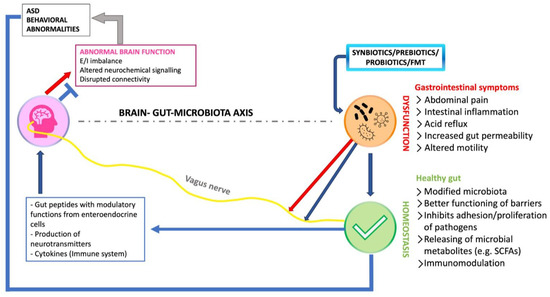
Figure 1.
Manipulation of microbiota–gut–brain signals in autism spectrum disorder (ASD) using probiotics or fecal microbiota transplantation (FMT). The red arrows represent processes related with gut dysfunction and gut microbiota disturbances, whereas the blue arrows represent probiotic/prebiotic/FMT processes and effects. The vagus nerve (yellow) connects to enteric neurons and acts as a communication link between the gut and the brain.
Locally, these actions may change the microbial ecology toward helpful bacteria and away from harmful bacteria [34]. Beneficial bacteria may boost the synthesis of microbial metabolites (for example, short-chain fatty acids (SCFAs)) and anti-inflammatory cytokines, which may improve intestinal barrier integrity and reduce intestinal and systemic inflammation [35]. Moreover, neuroactive metabolites such as SCFAs may have an influence on the CNS by modulating neuroplasticity, epigenetics, and gene expression [36]. The vagus nerve is a primary communication channel between the stomach and the brain that is activated in response to particular microorganisms. The stimulation of the vagus nerve, as carried out using L. reuteri therapy, may enhance oxytocin levels in the brain, positively altering behavioral elements of brain function [37]. Moreover, neurotransmitters and their precursors, such as gamma-aminobutyric acid (GABA), serotonin (5-hydroxytryptamine), tryptophan, glutamate, and dopamine, are produced by the microbiota [38,39]. Probiotics that stimulate inhibitory neurotransmission (e.g., greater GABA concentrations) may assist in restoring excitatory/inhibitory balance and hence correct the decreased social interaction associated with ASD [40,41]. Because there are few evidence-based therapy options for ASD, it is critical to investigate potential novel therapeutic targets for the social and behavioral symptoms. Preclinical studies on the GM offer intriguing new paths for behavior modification, and the rationale for testing gut microbial-based therapy for ASD grows stronger [42,43]. The goal of this scoping review is to provide an overview of the available data on the efficacy and safety of probiotic, prebiotic, synbiotic, and FMT therapies and MTT for the treatment of core and co-occurring behavioral symptoms in persons with autism spectrum disorder. The effect of these therapies on GI symptoms was also investigated. Several clinical trials have been filed with the goal of developing viable microbial-based therapeutics for ASD; this review provides an overview assessment of these trials as well as clarification of recent exploratory achievements.
2. Materials and Methods
2.1. Protocol and Registration
This review was conducted using the standards of the Preferred Reporting Items for Systematic Reviews and Meta-analysis (PRISMA) Extension for Scoping Reviews (PRISMA-ScR) [44].
2.2. Search Processing
We searched PubMed, Scopus and Web of Science with a constraint on English-language papers from 1 January 2013 through 28 February 2023 that matched our topic. The following Boolean keywords were utilized in the search strategy: “autism” AND “microbiota”. These terms were chosen because they best described the goal of our inquiry, which was to learn more about the interconnectedness between microbiota dysbiosis in patients with autism spectrum and whether the gut–diet–brain axis undergoing treatment through the use of prebiotics and/or probiotics, FMT, and MTT has positive neurological and gastrointestinal outcomes. The search indicators are listed below in Table 1.

Table 1.
Database search indicators.
2.3. Eligibility Criteria and Study Selection
We chose studies that looked at the effects of prebiotics, probiotics, synbiotics, FMT, and MTT on ASD. The selection method was divided into two stages: (1) title and abstract evaluation and (2) full text examination. Any article that met the following criteria was considered: (a) human intervention studies (clinical trials); (b) supplementation with probiotics, prebiotics, synbiotic combinations, FMT, or MTT; (c) studies assessing ASD; (d) treatment was compared to a placebo, no intervention, or other interventions; (e) English language full text; and (f) behavioral assessments were performed before and after the interventions using validated measures. Publications that did not include original data (e.g., meta-analyses, research procedures, conference abstracts, in vitro or animal studies) were excluded. The preliminary search’s titles and abstracts were retrieved and assessed for relevancy. For additional evaluation, full publications from relevant research were obtained. Two separate reviewers (F.P. and F.I.) evaluated the retrieved studies for inclusion using the criteria specified above, and disagreements were addressed by consensus.
2.4. Data Processing
Author differences over the article selection were discussed and resolved.
2.5. Data Extraction
A standardized form was used to capture data on research design and locations, population characteristics (e.g., sex, age, presence of comorbidities), type of intervention and comparison, baseline measurements, and reported results. Each study was also evaluated for its handling of missing data and effect measurements. For extraction accuracy, two reviewers (F.P. and F.I.) worked separately; divergences were resolved by consensus. Because of the substantial variability in the treatments and outcomes reported, meta-analysis was not possible; consequently, papers were synthesized qualitatively.
2.6. Data Analysis
For homogeneous research, the fixed effect model was used, while for heterogeneous studies, the random effect model was used. In all analyses, the effect size was calculated using the standardized difference of means.
2.7. PICOS Criteria
Table 2 depicts the PICOS (population, intervention, comparison, outcome, study design) criteria components, which include population, intervention, comparison, outcomes, and research design, as well as their use in this evaluation.
Table 2.
PICOS criteria.
2.8. Study Evaluation
The article data were independently evaluated by the reviewers using a special electronic form designed according to the following categories: number of subjects, dose and type of intervention, study duration, type of study, age average of subjects, year of study, and main results.
3. Results
A total of 2370 publications were identified from the following databases: PubMed (720), Scopus (973), and Web of Science (677), which led to 1222 articles after removing duplicates (1148). Analysis of the title and abstract resulted in the exclusion of 988 articles. The writers successfully sought the remaining 234 papers for retrieval and evaluated their eligibility. The approach resulted in the exclusion of 174 articles for being off-topic. The evaluation includes the final 18 papers for qualitative analysis (Figure 2). The characteristics of the included studies are described in Table 3.
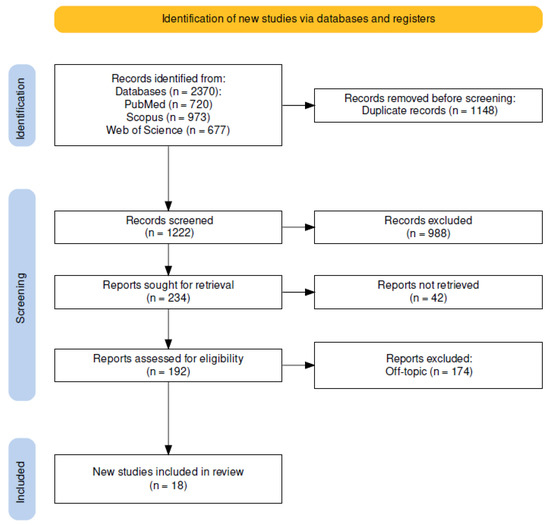
Figure 2.
PRISMA flowchart diagram of the inclusion process.
Table 3.
Characteristics of the included studies.
4. Discussion
We surveyed the original literature on therapeutic options targeting the GM for ASD in this scoping review, offering a resource to guide therapy based on evidence. There is mounting evidence that the GM may impact the onset and course of ASD. However, the lack of consistent knowledge implicit in the novelty of these considerations, as well as the ongoing lack of understanding of the complex microbial and metabolome distinctive signature in ASD patients, frequently translates into difficulties in microbiota-based therapy planning, which is typically performed on a basis of trial and error. This scoping review looked at 18 clinical studies that looked at the use of probiotics, prebiotics, probiotic/prebiotic compounds, FMT, or MTT in the treatment of core symptoms in juvenile ASD patients. The administration of these therapies had an effect on ASD symptoms in the fifteen RCTs. Moreover, the three non-RCT studies, on the other hand, imply that probiotics and prebiotics may modify behavior and GI symptoms in children with ASD. Prebiotics and the studied synbiotic formulations appear to be effective in selected ASD behaviors, although the extent of benefit is unknown, and there is less research that utilizes these techniques. Although clinical trial findings are limited, they urge additional investigation into FMT in ASD. This scoping review found that probiotic, prebiotic, synbiotic, FMT, or MTT supplementation improved different domains of ATEC score, including sociability, sensory or cognitive awareness, speech/communication/language, and health/physical/behavior, and there were improvements in behavioral symptoms in other studies that used different questionnaires (not ATEC) [29,45,46,47,48,50,52,54,55,57,58]. Concerning GI symptoms, all of the included trials found that probiotic, prebiotic, or symbiotic treatment improved the frequency of bowel movement-associated pain, diarrhea, constipation, and stool frequency [45]. It is difficult to determine which product is better for ASD symptoms among prebiotics, probiotics, or synbiotics because each study uses mostly one of these products, and even studies that use the same product differ in terms of dosage, treatment duration, or even the checklists they use to evaluate the results.
4.1. Probiotics/Prebiotics
Probiotics have the ability to mitigate gut dysbiosis, in some cases increasing the Bacteroidetes/Firmicutes ratio to that of healthy individuals; decreasing the growth of Candida, Desulfovibrio, and Clostridia species; and increasing beneficial bacteria such as Lactobacilli and Enterococci [61,62,63,64]. Lactobacilli species were also increased by prebiotic administration with galactooligosaccharide B-GOS® [21,65]. MTT, on the other hand, appears to enhance Desulfovibrio species [29,56,60,61,66,67]. Probiotic investigation found a reduction in short-chain fatty acids (SCFAs), which are fermentation products of dietary carbohydrates generated by Clostridium, Ruminococcaceae, Lachnospiraceae, and Desulfovibrio, among others [50,60,68,69]. SCFA levels have been reported to be elevated in ASD [70,71,72,73]. However, with ketogenic diet (KD) adoption in ASD youngsters, which boosted SCFA-producing species, autistic core symptoms significantly improved but their significance in the etiopathogenesis of ASD remains unknown [74,75,76,77]. L. reuteri, for example, is an indigenous bacteria of the human GI tract that has been extensively researched, with accumulating evidence indicating its advantages as a probiotic [78]. In numerous mice models of ASD, L. reuteri was repeatedly demonstrated to produce OXT-dependent behavioral improvement [11,37,79,80,81]. It appears to have therapeutic promise in enhancing social and behavioral functioning in people with ASD. Nevertheless, only one experiment has been completed but not yet published that looked into the effectiveness of L. reuteri in ASD patients [50,82]. The bulk of probiotics utilized in research are from a small number of species, including Lactobacillus spp., Limosilactobacillus spp., and Bifidobacterium spp., and Eubacterium coprostanoligenes are not isolated from human GI tracts [58,83]. Bifidobacteria levels appear to be inversely associated via feedback interactions with Desulfovibrio and Clostridium, two of the most likely bacteria strains involved in ASD etiopathogenesis [84]. In this vein, our analysis suggests that when baseline counts are aberrant, enhancing Bifidobacterial populations (MTT, B-GOS® supplementation) or reducing Desulfovibrio and Clostridium growth rates might be viable targets in microbiota-based ASD therapy [46,47,48,49,50,51,52]. It is critical to understand which gut commensals are associated with better symptoms in order to generate next-generation probiotics (also known as live biotherapeutic products) that evolve the features required to complete within the GI tract of ASD patients [85].
4.2. Alternative Medicines
It should be mentioned that alternative medicines such as Ayurveda, used in Dinesh’s study, also have positive implications on rebalancing the microbiota in ASD patients. A polyherbal formulation increased bifidobacterial abundance in the test group compared to the control group [53].
4.3. Synbiotics
Existing data on the effectiveness of probiotic, prebiotic, or synbiotic combinations in ASD is inconclusive and complicated by the fact that treatment regimens across studies are very varied, with varying formulations, doses, treatment periods, and administration procedures [86]. Increased efforts are recommended to focus on the effects of prebiotics in future clinical studies, since they may be safer, less expensive, affect a wide range of microorganisms, and be more widely accepted by all demographic groups [87]. Creating a synbiotic is more difficult. In an ideal world, a synbiotic would provide a health benefit greater than the sum of its individual components [88]. One published trial examining probiotic/prebiotic combinations in people with ASD did not systematically evaluate whether the combined products increase the ecological features and/or health effects of certain probiotic strains when compared to the probiotic alone [54,89]. Future research should look at other combinations and dosages, as well as comparing the ecological and functional aspects of each rationally chosen synbiotic to the substrate alone, the living microbes alone, and a control. At least one well-designed trial demonstrating a health advantage (complementary synbiotic) or both selective utilization of the substrate and a health benefit (synergistic synbiotic) in the target host has been carried out [28,54].
4.4. Dietary Supplements
Detailed dietary data should be included to assist in elucidating variables such as the influence of nondigestible carbohydrate consumption. In fact, the study by Bent et al. [55] discussed the beneficial effects of sulforaphane, which is a chemical produced when cruciferous vegetables such as broccoli, cauliflower, and broccoli sprouts are chewed. A component in these veggies called glucoraphanin interacts with a human enzyme called myrosinase to make sulforaphane. Through the intake of this product, it could be seen that urine metabolite changes were connected to oxidative stress, amino acid metabolism/gut microbiome metabolites, neurotransmitters, stress, and other hormones, while behavioral benefits have been associated with seven different chemical forms of sphingomyelin [55].
4.5. FMT and MTT
Fecal microbiota transplantation is an untargeted therapeutic for GM. Kang and colleagues created a modified FMT procedure called MTT for autistic youngsters [29]. This therapy alleviated ASD behavioral symptoms to some extent, with excellent tolerance indicated and improvements lasting 2 years after treatment ceased. The therapeutic relevance of these increases in behavioral assessment scores and improvement of GI disorders are confirmed in subsequent studies by Kang [57,60]: one of this two studies demonstrated that only p-cresol sulfate altered considerably following MTT. Significant associations have been made between p-cresol sulfate and Desulfovibrio, indicating that Desulfovibrio may have a role in p-cresol sulfate metabolism and the genesis of autism [60]. In a study by Turriziani et al., variation in p-cresol absorption appeared to contribute minimally, if at all, to behavioral alterations; in fact, a lowering of p-cresol was noted subsequent to PEG ingestion [45]. There are several other studies that support the beneficial effects of FMT and MTT, such as the Nirmalkar study, which found that the abundance of Prevotella and Bifidobacterium decreased over time (2 years), implying that a longer MTT treatment period or a booster after a certain amount of time may be required to retain these bacteria. MTT, in a similar manner, resulted in the normalization of numerous bacterial gene levels. Fascinatingly, microbial metabolic genes for folate biosynthesis, oxidative stress defense, and sulfur metabolism were dissimilar from those found in normally developing (TD) patients at ASD baseline but mirrored those found in TD and/or donors following MTT [56]. The positive effects of FMT can also be seen in a study by Li et al. [58]. In a meta-analysis of FMT in recurrent Clostridium difficile infection, Tariq et al. [90] discovered that the therapy was linked with decreased cure rates in randomized trials (67.7%) compared to open-label studies (82.7%; p = 0.001). To further study the causation between the GM and ASD symptoms, larger, randomized, double-blind trials comprising a matched control group of children with ASD who undergo an autologous transplant should be carried out. The FMT experiment discovered no difference in effectiveness between oral and rectal delivery [59]. Repeated FMT injections may be necessary to accomplish therapy goals. Depending on the mode of delivery, there are procedural hazards. For stool delivery, colonoscopy and oral routes have been demonstrated to be more successful than nasoduodenal tubes and enema [91]. It is also critical to anticipate potential issues with children with ASD’s willingness to receive FMT. However, FMT candidates should be examined in order to determine the most safe and effective FMT delivery mechanism in the setting of ASD. Continuing research into the mechanisms of action, the impact on the host’s immune response, and the refinement of the microbial inoculum may lead to a wider use of the treatment in the future. Furthermore, the safety profile of FMT in ASD is unknown, while the reported long-term experience of FMT for ASD patients in Kang and colleagues’ studies is reassuring. In the near future, further safety data will be provided by planned FMT studies that will conduct long-term monitoring and assessments. The reported FMT study subjects exhibited a variety of GI disorders, including diarrhea, constipation, and alternating diarrhea/constipation [29]. Current trials with bigger sample numbers involve more homogenous cohorts and may identify patients who are most likely to react [92]. In these research, adjunct therapies such as antibiotic pretreatment and colon cleansing were employed to reduce bacterial load and allow engraftment of potentially beneficial microbial taxa in the host [93]. Future research should focus on differences between patients within the same cohort as well as differences between study cohorts. Individuals’ illness presentations and levels of impairment might vary greatly. Individual disparities in responsiveness to intervention have been observed in previous studies into ASD treatments; treatment results may be impacted by biological characteristics such as age, linguistic ability, and autistic severity, as well as environmental factors (e.g., mother age and education) [94]. None of the included research investigated the possible impacts of traditional ASD medication therapies, such as proton pump inhibitors, as a confounding factor that might create a unique microbial profile [95].
Moreover, animal evidence shows that the microbiota’s modulatory CNS effects are sex-specific [96]; more female patients should be included in trials examining microbial-based therapy. Age is a crucial factor to consider in future ASD therapy research and should be adequately recorded in every intervention trial. Liu et al. [52] discovered that younger children who were treated with PS128 benefited more than older children. Previous research has found that a younger child’s age at the commencement of intervention is connected with favorable treatment results [94]. Probiotic, prebiotic, synbiotic interventions, FMT or MTT in early life with the goal of enhancing development in children at risk of ASD could become treatments of common use in the near future, as the GM shapes in infancy and any interventions in later years must be sustained for a long time, if not forever, to sustain the conferred benefit. Maintaining a healthy gut in infancy, which would most likely support healthy brain development throughout important developmental windows, may be more cost-effective and practicable than taking the supplements for extended periods of time later in life.
Based on the research presented in this review, it is theoretically possible to use multiple-strain combinations to investigate the attenuating effects of probiotics, prebiotics, synbiotics, FMT, and MTT on gut microbiota with the goal of reducing neurogastrointestinal symptoms in people with ASD. Similar research examining the effect of different strains on the GM can be conducted in order to create novel anti-ASD foods. Such analyses may reveal fresh and revolutionary pharmacological and food product pipelines with vast industrial uses. Some recent studies on the issue can serve as a good theoretical foundation for future study into GM regulation by assessing the impacts of these items. Future studies may need investigations into the manipulation of these pathogenic microbes for microbiota therapy reasons. In the near future, fresh starting cultures with more in vivo trials may emerge to support the hypothesis that microbiota therapies have more direct impacts on the inhibition of pathways and processes inside the human GM that predispose persons to ASD. This area of study is expected to significantly reduce the present ethical, cultural, and religious constraints inhibiting microbiota biotechnology research and the marketing of functional food components.
5. Conclusions
Several investigations in recent years have indicated qualitative and quantitative changes in the gut flora in a variety of neuropsychiatric illnesses, supporting the role of GM in the maintenance of physiological condition in the CNS. Within neurobehavioral disorders, it appears that at least a portion of ASD instances are linked to, and maybe reliant on, the health and wellbeing of the GM. The rising prevalence of ASD in recent years, combined with indications of a strong relationship between ASD and GI disorders, has sparked a specific interest in studying the reciprocal impacts between GM, brain, and microbiota under the so-called MGBA. The findings of this comprehensive analysis indicated that supplementation with probiotics, prebiotics, or their combination as synbiotics might be useful in alleviating both GI and CNS symptoms in ASD patients. It may also be argued that additional homogeneous trials using the same dosages and certain well-known probiotic or prebiotic products are required to apply the findings of these studies with more confidence. The research describes changes in GM composition in children with ASD that mostly consist of lower amounts of Bifidobacterium and higher levels of Clostridium spp. and Desulfovibrio. However, the current data do not allow for the definition of a distinct ASD profile. If dysbiosis is proven to be a precipitating factor in ASD, a variety of possible therapeutic options ranging from probiotics and prebiotics to FMT, MTT, and other nutritional techniques may be beneficial adjuvant therapy in these individuals. Furthermore, because dysbiosis contributes to a major proportion of ASD, identifying particular ASD endophenotypes would enable patient classification and targeted therapies. Addressing microbial processes might be the goal of the next ASD pharmaceutical therapy, which could assist in relieving the burden of this condition for the millions of individuals worldwide.
Author Contributions
Conceptualization, A.M.I., F.P., A.M., A.D.I. and G.D.; methodology, G.P., F.I., F.P., G.M. and A.P. (Assunta Patano); software, A.D.I., A.P. (Andrea Palermo), G.D., A.M.I. and F.I.; validation, F.P., F.I., G.M., A.P. (Assunta Patano) and G.P.; formal analysis, G.P., A.M.I., A.D.I., F.P. and A.M.; investigation, A.P. (Andrea Palermo), F.I., G.M., G.D. and A.P. (Assunta Patano); resources, A.P. (Andrea Palermo), A.M., F.P., F.I. and G.M.; data curation, A.M.I., G.P., A.P. (Andrea Palermo), F.I. and G.P.; writing—original draft preparation, G.M., F.P., A.P. (Assunta Patano), A.M. and F.I.; writing—review and editing, A.M.I., A.D.I., G.D., A.P. (Andrea Palermo) and A.M.I.; visualization, A.P. (Assunta Patano), F.P., G.P., A.D.I. and G.D.; supervision, G.D., A.M.I., F.I., A.D.I. and A.P. (Assunta Patano); project administration, G.P., A.P. (Assunta Patano), G.D., A.D.I. and A.P. (Andrea Palermo); funding acquisition, G.M., A.M.I., F.P., F.I. and A.P. (Assunta Patano). All authors have read and agreed to the published version of the manuscript.
Funding
This research received no external funding.
Institutional Review Board Statement
Not applicable.
Informed Consent Statement
Not applicable.
Data Availability Statement
Not applicable.
Conflicts of Interest
The authors declare no conflict of interest.
Abbreviations
| ABC | Aberrant Behavior Checklist; |
| ABC-2 | Aberrant Behavior Checklist second edition; |
| AFU | Active Fluorescent Units; |
| ASD | autism spectrum disorders; |
| ATECAutism | Treatment Evaluation Checklist; |
| CARS | Childhood Autism Rating Scale; |
| CFU | colony-forming units; |
| CNS | central nervous system; |
| CGI | Clinical Global Impression; |
| CPRS-R | Conners’ Parent Rating Scale—Revised; |
| FDA | Food and Drug Administration; |
| FMT | fecal microbiota transplantation; |
| GABA | gamma-aminobutyric acid; |
| GI | gastrointestinal; |
| GM | gut microbiota; |
| GOS | galactooligosaccharides; |
| GR | glucoraphanin; |
| ISAPP | International Scientific Association for Probiotics and Prebiotics; |
| IU | international unit; |
| KD | ketogenic diet; |
| LPS | lipopolysaccharide; |
| MGBA | microbiota–gut–brain axis; |
| MTT | microbiota transfer therapy; |
| OXT | oxytocin; |
| PEG | polyethylene glycol; |
| PICOS | population, intervention, comparison, outcome, study design; |
| PRISMA | Preferred Reporting Items for Systematic Reviews and Meta-Analyses; |
| PRIMSA-Scr | PRISMA Extension for Scoping Reviews; |
| PROSPERO | International Prospective Register of Systematic Reviews; |
| RBS-R | Repetitive Behavior Scale—Revised; |
| SCFA | short-chain fatty acids; |
| SHGM | Standardized Human Gut Microbiota; |
| SpCO | carboxyhemoglobin; |
| SRS | Social Responsiveness Scale; |
| TD | typically developing. |
References
- American Psychiatric Association. Diagnostic and Statistical Manual of Mental Disorders, 5th ed.; American Psychiatric Association: Arlington, VA, USA, 2013; pp. 5–25. ISBN 978-0-89042-555-8. [Google Scholar]
- Lord, C.; Spence, S.J. Autism Spectrum Disorders: Phenotype and Diagnosis. In Understanding Autism: From Basic Neuroscience to Treatment; CRC Press/Routledge/Taylor & Francis Group: Boca Raton, FL, USA, 2006; pp. 1–23. ISBN 978-0-8493-2732-2. [Google Scholar]
- Hossain, M.; Khan, N.; Sultana, A.; Ma, P.; McKyer, E.L.J.; Ahmed, H.U.; Purohit, N. Prevalence of comorbid psychiatric disorders among people with autism spectrum disorder: An umbrella review of systematic reviews and meta-analyses. Psychiatry Res. 2020, 287, 112922. [Google Scholar] [CrossRef]
- Kohane, I.S.; McMurry, A.; Weber, G.; MacFadden, D.; Rappaport, L.; Kunkel, L.; Bickel, J.; Wattanasin, N.; Spence, S.; Murphy, S.; et al. The Co-Morbidity Burden of Children and Young Adults with Autism Spectrum Disorders. PLoS ONE 2012, 7, e33224. [Google Scholar] [CrossRef]
- Ballini, A.; Santacroce, L.; Cantore, S.; Bottalico, L.; Dipalma, G.; Topi, S.; Saini, R.; De Vito, D.; Inchingolo, F. Probiotics Efficacy on Oxidative Stress Values in Inflammatory Bowel Disease: A Randomized Double-Blinded Placebo-Controlled Pilot Study. Endocr. Metab. Immune Disord.-Drug Targets 2019, 19, 373–381. [Google Scholar] [CrossRef] [PubMed]
- Ferguson, B.J.; Dovgan, K.; Takahashi, N.; Beversdorf, D.Q. The Relationship Among Gastrointestinal Symptoms, Problem Behaviors, and Internalizing Symptoms in Children and Adolescents with Autism Spectrum Disorder. Front. Psychiatry 2019, 10, 194. [Google Scholar] [CrossRef]
- Cryan, J.F.; O’Riordan, K.J.; Cowan, C.S.M.; Sandhu, K.V.; Bastiaanssen, T.F.S.; Boehme, M.; Codagnone, M.G.; Cussotto, S.; Fulling, C.; Golubeva, A.V.; et al. The Microbiota-Gut-Brain Axis. Physiol. Rev. 2019, 99, 1877–2013. [Google Scholar] [CrossRef]
- Santacroce, L.; Charitos, I.A.; Ballini, A.; Inchingolo, F.; Luperto, P.; De Nitto, E.; Topi, S. The Human Respiratory System and its Microbiome at a Glimpse. Biology 2020, 9, 318. [Google Scholar] [CrossRef]
- Ho, L.K.H.; Tong, V.J.W.; Syn, N.; Nagarajan, N.; Tham, E.H.; Tay, S.K.; Shorey, S.; Tambyah, P.A.; Law, E.C.N. Gut microbiota changes in children with autism spectrum disorder: A systematic review. Gut Pathog. 2020, 12, 6. [Google Scholar] [CrossRef] [PubMed]
- Liu, F.; Li, J.; Wu, F.; Zheng, H.; Peng, Q.; Zhou, H. Altered composition and function of intestinal microbiota in autism spectrum disorders: A systematic review. Transl. Psychiatry 2019, 9, 43. [Google Scholar] [CrossRef]
- Isacco, C.G.; Ballini, A.; De Vito, D.; Nguyen, K.C.D.; Cantore, S.; Bottalico, L.; Quagliuolo, L.; Boccellino, M.; Di Domenico, M.; Santacroce, L.; et al. Rebalancing the Oral Microbiota as an Efficient Tool in Endocrine, Metabolic and Immune Disorders. Endocr. Metab. Immune Disord.-Drug Targets 2021, 21, 777–784. [Google Scholar] [CrossRef]
- Burger-van Paassen, N.; Vincent, A.; Puiman, P.J.; Van Der Sluis, M.; Bouma, J.; Boehm, G.; van Goudoever, J.B.; Van Seuningen, I.; Renes, I.B. The regulation of intestinal mucin MUC2 expression by short-chain fatty acids: Implications for epithelial protection. Biochem. J. 2009, 420, 211–219. [Google Scholar] [CrossRef] [PubMed]
- Sandler, R.H.; Finegold, S.M.; Bolte, E.R.; Buchanan, C.P.; Maxwell, A.P.; Väisänen, M.-L.; Nelson, M.N.; Wexler, H.M. Short-Term Benefit From Oral Vancomycin Treatment of Regressive-Onset Autism. J. Child Neurol. 2000, 15, 429–435. [Google Scholar] [CrossRef]
- Contaldo, M.; Fusco, A.; Stiuso, P.; Lama, S.; Gravina, A.G.; Itro, A.; Federico, A.; Itro, A.; Dipalma, G.; Inchingolo, F.; et al. Oral Microbiota and Salivary Levels of Oral Pathogens in Gastro-Intestinal Diseases: Current Knowledge and Exploratory Study. Microorganisms 2021, 9, 1064. [Google Scholar] [CrossRef] [PubMed]
- Ng, Q.X.; Peters, C.; Ho, C.Y.X.; Lim, D.Y.; Yeo, W.-S. A meta-analysis of the use of probiotics to alleviate depressive symptoms. J. Affect. Disord. 2018, 228, 13–19. [Google Scholar] [CrossRef]
- Foster, J.A.; McVey Neufeld, K.-A. Gut–brain axis: How the microbiome influences anxiety and depression. Trends Neurosci. 2013, 36, 305–312. [Google Scholar] [CrossRef] [PubMed]
- Signorini, L.; Ballini, A.; Arrigoni, R.; De Leonardis, F.; Saini, R.; Cantore, S.; De Vito, D.; Coscia, M.F.; Dipalma, G.; Santacroce, L.; et al. Evaluation of a Nutraceutical Product with Probiotics, Vitamin D, Plus Banaba Leaf Extracts (Lagerstroemia speciosa) in Glycemic Control. Endocr. Metab. Immune Disord.-Drug Targets 2021, 21, 1356–1365. [Google Scholar] [CrossRef] [PubMed]
- Ng, Q.X.; Soh, A.Y.S.; Venkatanarayanan, N.; Ho, C.Y.X.; Lim, D.Y.; Yeo, W.-S. A Systematic Review of the Effect of Probiotic Supplementation on Schizophrenia Symptoms. Neuropsychobiology 2019, 78, 1–6. [Google Scholar] [CrossRef]
- Ballini, A.; Signorini, L.; Inchingolo, A.D.; Saini, R.; Gnoni, A.; Scacco, S.; Cantore, S.; Dipalma, G.; Inchingolo, F.; Santacroce, L. Probiotics May Improve Serum Folate Availability in Pregnant Women: A Pilot Study. Open Access Maced. J. Med. Sci. 2020, 8, 1124–1130. [Google Scholar] [CrossRef]
- Li, Y.-J.; Ou, J.-J.; Li, Y.-M.; Xiang, D.-X. Dietary Supplement for Core Symptoms of Autism Spectrum Disorder: Where Are We Now and Where Should We Go? Front. Psychiatry 2017, 8, 155. [Google Scholar] [CrossRef]
- Grimaldi, R.; Gibson, G.R.; Vulevic, J.; Giallourou, N.; Castro-Mejía, J.L.; Hansen, L.H.; Gibson, E.L.; Nielsen, D.S.; Costabile, A. A prebiotic intervention study in children with autism spectrum disorders (ASDs). Microbiome 2018, 6, 133. [Google Scholar] [CrossRef]
- Isacco, C.G.; Ballini, A.; De Vito, D.; Inchingolo, A.M.; Cantore, S.; Paduanelli, G.; Nguyen, K.C.D.; Inchingolo, A.D.; Dipalma, G.; Inchingolo, F. Probiotics in Health and Immunity: A First Step toward Understanding the Importance of Microbiota System in Translational Medicine. In Prebiotics and Probiotics-Potential Benefits in Nutrition and Health; Franco-Robles, E., Ramírez-Emiliano, J., Eds.; IntechOpen: London, UK, 2020; ISBN 978-1-78985-921-8. [Google Scholar]
- Sharon, G.; Cruz, N.J.; Kang, D.-W.; Gandal, M.J.; Wang, B.; Kim, Y.-M.; Zink, E.M.; Casey, C.P.; Taylor, B.C.; Lane, C.J.; et al. Human Gut Microbiota from Autism Spectrum Disorder Promote Behavioral Symptoms in Mice. Cell 2019, 177, 1600–1618.e17. [Google Scholar] [CrossRef]
- Bicks, L.K.; Koike, H.; Akbarian, S.; Morishita, H. Prefrontal Cortex and Social Cognition in Mouse and Man. Front. Psychol. 2015, 6, 1805. [Google Scholar] [CrossRef] [PubMed]
- Campanella, V.; Syed, J.; Santacroce, L.; Saini, R.; Ballini, A.; Inchingolo, F. Oral probiotics influence oral and respiratory tract infections in pediatric population: A randomized double-blinded placebo-controlled pilot study. Eur. Rev. Med. Pharmacol. Sci. 2018, 22, 8034–8041. [Google Scholar] [PubMed]
- Deehan, E.C.; Duar, R.M.; Armet, A.M.; Perez-Muñoz, M.E.; Jin, M.; Walter, J. Modulation of the Gastrointestinal Microbiome with Nondigestible Fermentable Carbohydrates To Improve Human Health. Microbiol. Spectr. 2017, 5, BAD-0019-2017. [Google Scholar] [CrossRef]
- Casu, C.; Mosaico, G.; Natoli, V.; Scarano, A.; Lorusso, F.; Inchingolo, F. Microbiota of the Tongue and Systemic Connections: The Examination of the Tongue as an Integrated Approach in Oral Medicine. Hygiene 2021, 1, 56–68. [Google Scholar] [CrossRef]
- Swanson, K.S.; Gibson, G.R.; Hutkins, R.; Reimer, R.A.; Reid, G.; Verbeke, K.; Scott, K.P.; Holscher, H.D.; Azad, M.B.; Delzenne, N.M.; et al. The International Scientific Association for Probiotics and Prebiotics (ISAPP) consensus statement on the definition and scope of synbiotics. Nat. Rev. Gastroenterol. Hepatol. 2020, 17, 687–701. [Google Scholar] [CrossRef] [PubMed]
- Kang, D.-W.; Adams, J.B.; Gregory, A.C.; Borody, T.; Chittick, L.; Fasano, A.; Khoruts, A.; Geis, E.; Maldonado, J.; McDonough-Means, S.; et al. Microbiota Transfer Therapy alters gut ecosystem and improves gastrointestinal and autism symptoms: An open-label study. Microbiome 2017, 5, 10. [Google Scholar] [CrossRef] [PubMed]
- Zhao, H.; Gao, X.; Xi, L.; Shi, Y.; Peng, L.; Wang, C.; Zou, L.; Yang, Y. Mo1667 Fecal microbiota transplantation for children with autism spectrum disorder. Gastrointest. Endosc. 2019, 89, AB512–AB513. [Google Scholar] [CrossRef]
- Pacifici, L.; Santacroce, L.; DiPalma, G.; Haxhirexha, K.; Topi, S.; Cantore, S.; Altini, V.; Pacifici, A.; De Vito, D.; Pettini, F.; et al. Gender medicine: The impact of probiotics on male patients. Clin. Ter. 2021, 171, e8–e15. [Google Scholar]
- Gupta, S.; Allen-Vercoe, E.; Petrof, E.O. Fecal microbiota transplantation: In perspective. Ther. Adv. Gastroenterol. 2016, 9, 229–239. [Google Scholar] [CrossRef]
- Finch Therapeutics Receives Fast Track Designation for the Investigation of Full-Spectrum Microbiota as a Treatment for Children with Autism Spectrum Disorder. Available online: https://www.businesswire.com/news/home/20190429005087/en/Finch-Therapeutics-Receives-Fast-Track-Designation-for-the-Investigation-of-Full-Spectrum-Microbiota-as-a-Treatment-for-Children-with-Autism-Spectrum-Disorder (accessed on 2 April 2023).
- Ballini, A.; Gnoni, A.; De Vito, D.; DiPalma, G.; Cantore, S.; Isacco, C.G.; Saini, R.; Santacroce, L.; Topi, S.; Scarano, A.; et al. Effect of probiotics on the occurrence of nutrition absorption capacities in healthy children: A randomized double-blinded placebo-controlled pilot study. Eur. Rev. Med. Pharmacol. Sci. 2019, 23, 8645–8657. [Google Scholar] [CrossRef]
- Inchingolo, A.D.; Cazzolla, A.P.; Di Cosola, M.; Greco Lucchina, A.; Santacroce, L.; Charitos, I.A.; Topi, S.; Malcangi, G.; Hazballa, D.; Scarano, A.; et al. The integumentary system and its microbiota between health and disease. J. Biol. Regul. Homeost. agents 2021, 35, 303–321. [Google Scholar] [CrossRef]
- Dalile, B.; Van Oudenhove, L.; Vervliet, B.; Verbeke, K. The role of short-chain fatty acids in microbiota–gut–brain communication. Nat. Rev. Gastroenterol. Hepatol. 2019, 16, 461–478. [Google Scholar] [CrossRef]
- Sgritta, M.; Dooling, S.W.; Buffington, S.A.; Momin, E.N.; Francis, M.B.; Britton, R.A.; Costa-Mattioli, M. Mechanisms Underlying Microbial-Mediated Changes in Social Behavior in Mouse Models of Autism Spectrum Disorder. Neuron 2019, 101, 246–259.e6. [Google Scholar] [CrossRef] [PubMed]
- Santacroce, L.; Sardaro, N.; Topi, S.; Pettini, F.; Bottalico, L.; Cantore, S.; Cascella, G.; Del Prete, R.; Dipalma, G.; Inchingolo, F. The Pivotal Role of Oral Microbiota in Health and Disease. J. Biol. Regul. Homeost. Agents 2020, 34, 733–737. [Google Scholar] [CrossRef]
- Dipalma, G.; Inchingolo, A.D.; Mancini, A.; Tartaglia, G.M.; Malcangi, G.; Semjonova, A.; Ferrara, E.; Lorusso, F.; Scarano, A.; Ferati, K.; et al. High-grade glioma and oral microbiome: Association or causality? what we know so far. J. Biol. Regul. Homeost. Agents 2022, 36, 11–20. [Google Scholar] [CrossRef]
- El-Ansary, A.; Ben Bacha, A.; Bjørklund, G.; Al-Orf, N.; Bhat, R.S.; Moubayed, N.; Abed, K. Probiotic treatment reduces the autistic-like excitation/inhibition imbalance in juvenile hamsters induced by orally administered propionic acid and clindamycin. Metab. Brain Dis. 2018, 33, 1155–1164. [Google Scholar] [CrossRef] [PubMed]
- Pacifici, A.; Pacifici, L.; Nuzzolese, M.; Cascella, G.; Ballini, A.; Santacroce, L.; DiPalma, G.; Aiello, E.; Amantea, M.; Saini, R.; et al. The alteration of stress-related physiological parameters after probiotics administration in oral surgeons with different degrees of surgical experience. Clin. Ter. 2020, 171, e197–e208. [Google Scholar] [PubMed]
- Inchingolo, F.; Santacroce, L.; Cantore, S.; Ballini, A.; Del Prete, R.; Topi, S.; Saini, R.; Dipalma, G.; Arrigoni, R. Probiotics and EpiCor® in human health. J. Biol. Regul. Homeost. Agents 2019, 33, 1973–1979. [Google Scholar] [CrossRef]
- Ballini, A.; Cantore, S.; Saini, R.; Pettini, F.; Fotopoulou, E.A.; Saini, S.R.; Georgakopoulos, I.P.; DiPalma, G.; Isacco, C.G.; Inchingolo, F. Effect of activated charcoal probiotic toothpaste containing Lactobacillus paracasei and xylitol on dental caries: A randomized and controlled clinical trial. J. Biol. Regul. Homeost. Agents 2019, 33, 977–981. [Google Scholar]
- Tricco, A.C.; Lillie, E.; Zarin, W.; O’Brien, K.K.; Colquhoun, H.; Levac, D.; Moher, D.; Peters, M.D.J.; Horsley, T.; Weeks, L.; et al. PRISMA Extension for Scoping Reviews (PRISMA-ScR): Checklist and Explanation. Ann. Intern. Med. 2018, 169, 467–473. [Google Scholar] [CrossRef]
- Turriziani, L.; Ricciardello, A.; Cucinotta, F.; Bellomo, F.; Turturo, G.; Boncoddo, M.; Mirabelli, S.; Scattoni, M.L.; Rossi, M.; Persico, A.M. Gut mobilization improves behavioral symptoms and modulates urinary p-cresol in chronically constipated autistic children: A prospective study. Autism Res. 2022, 15, 56–69. [Google Scholar] [CrossRef] [PubMed]
- Zhang, L.; Xu, Y.; Li, H.; Li, B.; Duan, G.; Zhu, C. The role of probiotics in children with autism spectrum disorders: A study protocol for a randomised controlled trial. PLoS ONE 2022, 17, e0263109. [Google Scholar] [CrossRef] [PubMed]
- Sherman, H.T.; Liu, K.; Kwong, K.; Chan, S.-T.; Li, A.C.; Kong, X.-J. Carbon monoxide (CO) correlates with symptom severity, autoimmunity, and responses to probiotics treatment in a cohort of children with autism spectrum disorder (ASD): A post-hoc analysis of a randomized controlled trial. BMC Psychiatry 2022, 22, 536. [Google Scholar] [CrossRef]
- Guidetti, C.; Salvini, E.; Viri, M.; Deidda, F.; Amoruso, A.; Visciglia, A.; Drago, L.; Calgaro, M.; Vitulo, N.; Pane, M.; et al. Randomized Double-Blind Crossover Study for Evaluating a Probiotic Mixture on Gastrointestinal and Behavioral Symptoms of Autistic Children. J. Clin. Med. 2022, 11, 5263. [Google Scholar] [CrossRef] [PubMed]
- Kong, X.-J.; Liu, J.; Liu, K.; Koh, M.; Sherman, H.; Liu, S.; Tian, R.; Sukijthamapan, P.; Wang, J.; Fong, M.; et al. Probiotic and Oxytocin Combination Therapy in Patients with Autism Spectrum Disorder: A Randomized, Double-Blinded, Placebo-Controlled Pilot Trial. Nutrients 2021, 13, 1552. [Google Scholar] [CrossRef]
- Kong, X.-J.; Liu, J.; Li, J.; Kwong, K.; Koh, M.; Sukijthamapan, P.; Guo, J.J.; Sun, Z.J.; Song, Y. Probiotics and oxytocin nasal spray as neuro-social-behavioral interventions for patients with autism spectrum disorders: A pilot randomized controlled trial protocol. Pilot Feasibility Stud. 2020, 6, 20. [Google Scholar] [CrossRef]
- Arnold, L.E.; Luna, R.A.; Williams, K.; Chan, J.; Parker, R.A.; Wu, Q.; Hollway, J.A.; Jeffs, A.; Lu, F.; Coury, D.L.; et al. Probiotics for Gastrointestinal Symptoms and Quality of Life in Autism: A Placebo-Controlled Pilot Trial. J. Child Adolesc. Psychopharmacol. 2019, 29, 659–669. [Google Scholar] [CrossRef]
- Liu, Y.-W.; Liong, M.T.; Chung, Y.-C.E.; Huang, H.-Y.; Peng, W.-S.; Cheng, Y.-F.; Lin, Y.-S.; Wu, Y.-Y.; Tsai, Y.-C. Effects of Lactobacillus plantarum PS128 on Children with Autism Spectrum Disorder in Taiwan: A Randomized, Double-Blind, Placebo-Controlled Trial. Nutrients 2019, 11, 820. [Google Scholar] [CrossRef]
- Dinesh, K.S.; Krishnendhu, C.; Balakrishnan, G.; AS, S.K.; George, M.J.; Patel, A. Effect of Ayurveda in management of dysbiosis with special reference to Bifidobacterium in children with autism spectrum disorders. Biomedicine 2022, 42, 325–332. [Google Scholar] [CrossRef]
- Sanctuary, M.R.; Kain, J.N.; Chen, S.Y.; Kalanetra, K.; Lemay, D.G.; Rose, D.R.; Yang, H.T.; Tancredi, D.J.; German, J.B.; Slupsky, C.M.; et al. Pilot study of probiotic/colostrum supplementation on gut function in children with autism and gastrointestinal symptoms. PLoS ONE 2019, 14, e0210064. [Google Scholar] [CrossRef]
- Bent, S.; Lawton, B.; Warren, T.; Widjaja, F.; Dang, K.; Fahey, J.W.; Cornblatt, B.; Kinchen, J.; Delucchi, K.; Hendren, R.L. Identification of urinary metabolites that correlate with clinical improvements in children with autism treated with sulforaphane from broccoli. Mol. Autism 2018, 9, 35. [Google Scholar] [CrossRef]
- Nirmalkar, K.; Qureshi, F.; Kang, D.-W.; Hahn, J.; Adams, J.B.; Krajmalnik-Brown, R. Shotgun Metagenomics Study Suggests Alteration in Sulfur Metabolism and Oxidative Stress in Children with Autism and Improvement after Microbiota Transfer Therapy. Int. J. Mol. Sci. 2022, 23, 13481. [Google Scholar] [CrossRef]
- Kang, D.-W.; Adams, J.B.; Coleman, D.M.; Pollard, E.L.; Maldonado, J.; McDonough-Means, S.; Caporaso, J.G.; Krajmalnik-Brown, R. Long-term benefit of Microbiota Transfer Therapy on autism symptoms and gut microbiota. Sci. Rep. 2019, 9, 5821. [Google Scholar] [CrossRef] [PubMed]
- Li, N.; Chen, H.; Cheng, Y.; Xu, F.; Ruan, G.; Ying, S.; Tang, W.; Chen, L.; Chen, M.; Lv, L.; et al. Fecal Microbiota Transplantation Relieves Gastrointestinal and Autism Symptoms by Improving the Gut Microbiota in an Open-Label Study. Front. Cell. Infect. Microbiol. 2021, 11, 759435. [Google Scholar] [CrossRef] [PubMed]
- Qureshi, F.; Adams, J.; Hanagan, K.; Kang, D.-W.; Krajmalnik-Brown, R.; Hahn, J. Multivariate Analysis of Fecal Metabolites from Children with Autism Spectrum Disorder and Gastrointestinal Symptoms before and after Microbiota Transfer Therapy. J. Pers. Med. 2020, 10, 152. [Google Scholar] [CrossRef]
- Kang, D.-W.; Adams, J.B.; Vargason, T.; Santiago, M.; Hahn, J.; Krajmalnik-Brown, R. Distinct Fecal and Plasma Metabolites in Children with Autism Spectrum Disorders and Their Modulation after Microbiota Transfer Therapy. mSphere 2020, 5, e00314-20. [Google Scholar] [CrossRef] [PubMed]
- Tomova, A.; Husarova, V.; Lakatosova, S.; Bakos, J.; Vlkova, B.; Babinska, K.; Ostatnikova, D. Gastrointestinal microbiota in children with autism in Slovakia. Physiol. Behav. 2015, 138, 179–187. [Google Scholar] [CrossRef] [PubMed]
- Kałużna-Czaplińska, J.; Błaszczyk, S. The level of arabinitol in autistic children after probiotic therapy. Nutrition 2012, 28, 124–126. [Google Scholar] [CrossRef] [PubMed]
- Parracho, H.M.R.T.; Gibson, G.R.; Knott, F.; Bosscher, D.; Kleerebezem, M.; McCartney, A.L. A double-blind, placebo-controlled, crossover-designed probiotic feeding study in children diagnosed with autistic spectrum disorders. Int. J. Probiotics Prebiotics 2010, 5, 69–74. [Google Scholar]
- Cantore, S.; Ballini, A.; De Vito, D.; Abbinante, A.; Altini, V.; DiPalma, G.; Inchingolo, F.; Saini, R. Clinical results of improvement in periodontal condition by administration of oral probiotics. J. Biol. Regul. Homeost. Agents 2018, 32, 1329–1334. [Google Scholar]
- Grimaldi, R.; Cela, D.; Swann, J.R.; Vulevic, J.; Gibson, G.R.; Tzortzis, G.; Costabile, A. In vitro fermentation of B-GOS: Impact on faecal bacterial populations and metabolic activity in autistic and non-autistic children. FEMS Microbiol. Ecol. 2017, 93, 233. [Google Scholar] [CrossRef]
- Hsiao, E.Y.; McBride, S.W.; Hsien, S.; Sharon, G.; Hyde, E.R.; McCue, T.; Codelli, J.A.; Chow, J.; Reisman, S.E.; Petrosino, J.F.; et al. Microbiota Modulate Behavioral and Physiological Abnormalities Associated with Neurodevelopmental Disorders. Cell 2013, 155, 1451–1463. [Google Scholar] [CrossRef]
- Inchingolo, F.; DiPalma, G.; Cirulli, N.; Cantore, S.; Saini, R.S.; Altini, V.; Santacroce, L.; Ballini, A.; Saini, R. Microbiological results of improvement in periodontal condition by administration of oral probiotics. J. Biol. Regul. Homeost. Agents 2018, 32, 1323–1328. [Google Scholar]
- Adams, J.B.; Johansen, L.J.; Powell, L.D.; Quig, D.; Rubin, R.A. Gastrointestinal flora and gastrointestinal status in children with autism–Comparisons to typical children and correlation with autism severity. BMC Gastroenterol. 2011, 11, 22. [Google Scholar] [CrossRef]
- Signorini, L.; De Leonardis, F.; Santacroce, L.; Haxhirexha, K.; Topi, S.; Fumarola, L.; Dipalma, G.; Coscia, M.F.; Inchingolo, F. Probiotics May Modulate the Impact of Aging on Adults. J. Biol. Regul. Homeost. Agents 2020, 34, 1601–1606. [Google Scholar] [CrossRef] [PubMed]
- Den Besten, G.; van Eunen, K.; Groen, A.K.; Venema, K.; Reijngoud, D.-J.; Bakker, B.M. The role of short-chain fatty acids in the interplay between diet, gut microbiota, and host energy metabolism. J. Lipid Res. 2013, 54, 2325–2340. [Google Scholar] [CrossRef] [PubMed]
- Foley, K.A.; Ossenkopp, K.-P.; Kavaliers, M.; MacFabe, D.F. Pre- and Neonatal Exposure to Lipopolysaccharide or the Enteric Metabolite, Propionic Acid, Alters Development and Behavior in Adolescent Rats in a Sexually Dimorphic Manner. PLoS ONE 2014, 9, e87072. [Google Scholar] [CrossRef] [PubMed]
- Macfabe, D.F. Short-chain fatty acid fermentation products of the gut microbiome: Implications in autism spectrum disorders. Microb. Ecol. Health Dis. 2012, 23, 19260. [Google Scholar] [CrossRef]
- Wang, L.; Christophersen, C.T.; Sorich, M.J.; Gerber, J.P.; Angley, M.T.; Conlon, M.A. Low Relative Abundances of the Mucolytic Bacterium Akkermansia muciniphila and Bifidobacterium spp. in Feces of Children with Autism. Appl. Environ. Microbiol. 2011, 77, 6718–6721. [Google Scholar] [CrossRef]
- Newell, C.; Bomhof, M.R.; Reimer, R.A.; Hittel, D.S.; Rho, J.M.; Shearer, J. Ketogenic diet modifies the gut microbiota in a murine model of autism spectrum disorder. Mol. Autism 2016, 7, 37. [Google Scholar] [CrossRef]
- Ruskin, D.N.; Svedova, J.; Cote, J.L.; Sandau, U.; Rho, J.M.; Kawamura, M., Jr.; Boison, D.; Masino, S.A. Ketogenic Diet Improves Core Symptoms of Autism in BTBR Mice. PLoS ONE 2013, 8, e65021. [Google Scholar] [CrossRef]
- Ruskin, D.N.; Fortin, J.A.; Bisnauth, S.N.; Masino, S.A. Ketogenic diets improve behaviors associated with autism spectrum disorder in a sex-specific manner in the EL mouse. Physiol. Behav. 2017, 168, 138–145. [Google Scholar] [CrossRef] [PubMed]
- Ruskin, D.N.; Murphy, M.I.; Slade, S.L.; Masino, S.A. Ketogenic diet improves behaviors in a maternal immune activation model of autism spectrum disorder. PLoS ONE 2017, 12, e0171643. [Google Scholar] [CrossRef] [PubMed]
- Mu, Q.; Tavella, V.J.; Luo, X.M. Role of Lactobacillus reuteri in Human Health and Diseases. Front. Microbiol. 2018, 9, 757. [Google Scholar] [CrossRef] [PubMed]
- Buffington, S.A.; Di Prisco, G.V.; Auchtung, T.A.; Ajami, N.J.; Petrosino, J.F.; Costa-Mattioli, M. Microbial Reconstitution Reverses Maternal Diet-Induced Social and Synaptic Deficits in Offspring. Cell 2016, 165, 1762–1775. [Google Scholar] [CrossRef]
- Varian, B.J.; Poutahidis, T.; DiBenedictis, B.T.; Levkovich, T.; Ibrahim, Y.; Didyk, E.; Shikhman, L.; Cheung, H.K.; Hardas, A.; Ricciardi, C.E.; et al. Microbial lysate upregulates host oxytocin. Brain Behav. Immun. 2017, 61, 36–49. [Google Scholar] [CrossRef]
- Inchingolo, A.D.; Inchingolo, A.M.; Malcangi, G.; Avantario, P.; Azzollini, D.; Buongiorno, S.; Viapiano, F.; Campanelli, M.; Ciocia, A.M.; De Leonardis, N.; et al. Effects of Resveratrol, Curcumin and Quercetin Supplementation on Bone Metabolism—A Systematic Review. Nutrients 2022, 14, 3519. [Google Scholar] [CrossRef]
- Inchingolo, A.D.; Di Cosola, M.; Inchingolo, A.M.; Greco Lucchina, A.; Malcangi, G.; Pettini, F.; Scarano, A.; Bordea, I.R.; Hazballa, D.; Lorusso, F.; et al. Correlation between occlusal trauma and oral microbiota: A microbiological investigation. J. Biol. Regul. Homeost. Agents 2021, 35, 295–302. [Google Scholar] [CrossRef]
- Dipalma, G.; Inchingolo, A.D.; Inchingolo, F.; Charitos, I.A.; Di Cosola, M.; Cazzolla, A.P. Focus on the cariogenic process: Microbial and biochemical interactions with teeth and oral environment. J. Biol. Regul. Homeost. Agents 2021, 35, 429–440. [Google Scholar] [CrossRef]
- Weston, B.; Fogal, B.; Cook, D.; Dhurjati, P. An agent-based modeling framework for evaluating hypotheses on risks for developing autism: Effects of the gut microbial environment. Med. Hypotheses 2015, 84, 395–401. [Google Scholar] [CrossRef]
- Inchingolo, A.D.; Malcangi, G.; Inchingolo, A.M.; Piras, F.; Settanni, V.; Garofoli, G.; Palmieri, G.; Ceci, S.; Patano, A.; De Leonardis, N.; et al. Benefits and Implications of Resveratrol Supplementation on Microbiota Modulations: A Systematic Review of the Literature. Int. J. Mol. Sci. 2022, 23, 4027. [Google Scholar] [CrossRef] [PubMed]
- Borsani, E.; Bonazza, V.; Buffoli, B.; Nocini, P.F.; Albanese, M.; Zotti, F.; Inchingolo, F.; Rezzani, R.; Rodella, L.F. Beneficial Effects of Concentrated Growth Factors and Resveratrol on Human Osteoblasts In Vitro Treated with Bisphosphonates. BioMed Res. Int. 2018, 2018, 4597321. [Google Scholar] [CrossRef]
- Inchingolo, F.; Hazballa, D.; Inchingolo, A.D.; Malcangi, G.; Marinelli, G.; Mancini, A.; Maggiore, M.E.; Bordea, I.R.; Scarano, A.; Farronato, M.; et al. Innovative Concepts and Recent Breakthrough for Engineered Graft and Constructs for Bone Regeneration: A Literature Systematic Review. Materials 2022, 15, 1120. [Google Scholar] [CrossRef] [PubMed]
- Inchingolo, A.M.; Isacco, C.G.; Inchingolo, A.D.; Nguyen, K.C.D.; Cantore, S.; Santacroce, L.; Scacco, S.; Cirulli, N.; Corriero, A.; Puntillo, F.; et al. The human microbiota key role in the bone metabolism activity. Eur. Rev. Med. Pharmacol. Sci. 2023, 27, 2659–2670. [Google Scholar] [CrossRef] [PubMed]
- Rapone, B.; Ferrara, E.; Montemurro, N.; Converti, I.; Loverro, M.; Loverro, M.T.; Gnoni, A.; Scacco, S.; Siculella, L.; Corsalini, M.; et al. Oral Microbiome and Preterm Birth: Correlation or Coincidence? A Narrative Review. Open Access Maced. J. Med. Sci. 2020, 8, 123–132. [Google Scholar] [CrossRef]
- Tariq, R.; Pardi, D.S.; Bartlett, M.G.; Khanna, S. Low Cure Rates in Controlled Trials of Fecal Microbiota Transplantation for Recurrent Clostridium difficile Infection: A Systematic Review and Meta-analysis. Clin. Infect. Dis. 2019, 68, 1351–1358. [Google Scholar] [CrossRef]
- Inchingolo, F.; Martelli, F.S.; Gargiulo Isacco, C.; Borsani, E.; Cantore, S.; Corcioli, F.; Boddi, A.; Nguyễn, K.C.D.; De Vito, D.; Aityan, S.K.; et al. Chronic Periodontitis and Immunity, Towards the Implementation of a Personalized Medicine: A Translational Research on Gene Single Nucleotide Polymorphisms (SNPs) Linked to Chronic Oral Dysbiosis in 96 Caucasian Patients. Biomedicines 2020, 8, 115. [Google Scholar] [CrossRef]
- Montemurro, N.; Perrini, P.; Marani, W.; Chaurasia, B.; Corsalini, M.; Scarano, A.; Rapone, B. Multiple Brain Abscesses of Odontogenic Origin. May Oral Microbiota Affect Their Development? A Review of the Current Literature. Appl. Sci. 2021, 11, 3316. [Google Scholar] [CrossRef]
- Inchingolo, A.D.; Malcangi, G.; Semjonova, A.; Inchingolo, A.M.; Patano, A.; Coloccia, G.; Ceci, S.; Marinelli, G.; Di Pede, C.; Ciocia, A.M.; et al. Oralbiotica/Oralbiotics: The Impact of Oral Microbiota on Dental Health and Demineralization: A Systematic Review of the Literature. Children 2022, 9, 1014. [Google Scholar] [CrossRef]
- Ben Itzchak, E.; Zachor, D.A. Who benefits from early intervention in autism spectrum disorders? Res. Autism Spectr. Disord. 2011, 5, 345–350. [Google Scholar] [CrossRef]
- Imhann, F.; Bonder, M.J.; Vila, A.V.; Fu, J.; Mujagic, Z.; Vork, L.; Tigchelaar, E.F.; Jankipersadsing, S.A.; Cenit, M.C.; Harmsen, H.J.M.; et al. Proton pump inhibitors affect the gut microbiome. Gut 2016, 65, 740–748. [Google Scholar] [CrossRef] [PubMed]
- Clarke, G.; Grenham, S.; Scully, P.; Fitzgerald, P.; Moloney, R.D.; Shanahan, F.; Dinan, T.G.; Cryan, J.F. The microbiome-gut-brain axis during early life regulates the hippocampal serotonergic system in a sex-dependent manner. Mol. Psychiatry 2013, 18, 666–673. [Google Scholar] [CrossRef] [PubMed]
Disclaimer/Publisher’s Note: The statements, opinions and data contained in all publications are solely those of the individual author(s) and contributor(s) and not of MDPI and/or the editor(s). MDPI and/or the editor(s) disclaim responsibility for any injury to people or property resulting from any ideas, methods, instructions or products referred to in the content. |
© 2023 by the authors. Licensee MDPI, Basel, Switzerland. This article is an open access article distributed under the terms and conditions of the Creative Commons Attribution (CC BY) license (https://creativecommons.org/licenses/by/4.0/).