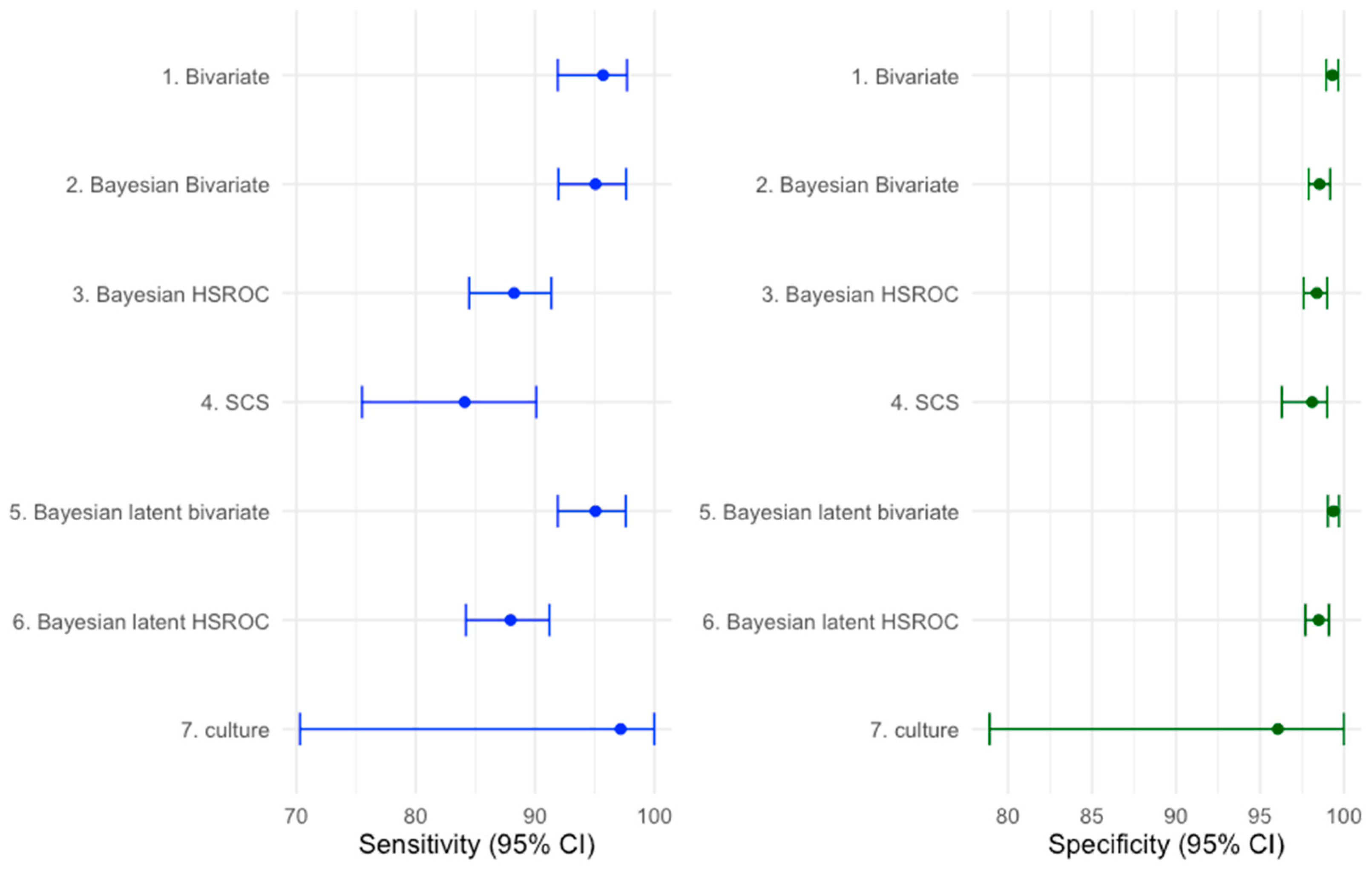

Diagnostic Accuracy of Multiplex NAAT/PCR and Culture Against Salmonella spp.: A Comparison of Meta-Analytical Methods

 , ,
, ,  , and
, and
Abstract
1. Introduction
2. Materials and Methods
2.1. Search Strategy and Selection Criteria
2.2. Data Extraction and Quality Assessment
2.3. Statistical Analysis
2.3.1. Software
2.3.2. Sensitivity Analysis
Bayesian Methods
Subgroup Analysis
3. Results
3.1. Literature Search
3.2. Study Characteristics
3.3. Risk of Bias Analysis (QUADAS 2 Tool)
3.4. Overall Analysis
3.5. Subgroup Analysis
3.6. Conditional Dependence Model and Informative Priors
4. Discussion
Supplementary Materials
Author Contributions
Funding
Institutional Review Board Statement
Informed Consent Statement
Data Availability Statement
Conflicts of Interest
References
- European Food Safety Authority. The European Union One Health 2022 Zoonoses Report. EFSA J. 2023, 21, e8442. [Google Scholar] [CrossRef] [Scilit]
- European Food Safety Authority; European Centre for Disease Prevention and Control. The European Union One Health 2019 Zoonoses Report. EFSA J. 2021, 19, e06406. [Google Scholar] [CrossRef] [Scilit]
- European Food Safety Authority; European Centre for Disease Prevention and Control. The European Union summary report on antimicrobial resistance in zoonotic and indicator bacteria from humans, animals and food in 2021–2022. EFSA J. 2024, 22, e8583. [Google Scholar]
- Ruiz, J.; Núñez, M.-L.; Díaz, J.; Lorente, I.; Pérez, J.; Gómez, J. Comparison of five plating media for isolation of Salmonella species from human stools. J. Clin. Microbiol. 1996, 34, 686–688. [Google Scholar] [CrossRef] [Scilit]
- O’Neill, W.; Cooke, R.P.D.; Plumb, H.; Kennedy, P. ABC chromogenic agar: A cost-effective alternative to standard enteric media for Salmonella spp. isolation from routine stool samples. Br. J. Biomed. Sci. 2003, 60, 187–190. [Google Scholar] [CrossRef] [Scilit]
- Maddocks, S.; Olma, T.; Chen, S. Comparison of CHROMagar salmonella medium and xylose-lysine-desoxycholate and Salmonella-Shigella agars for isolation of Salmonella strains from stool samples. J. Clin. Microbiol. 2002, 40, 2999–3003. [Google Scholar] [CrossRef] [Scilit] [PubMed]
- Church, D.L.; Emshey, D.; Lloyd, T.; Pitout, J. Clinical and economic evaluation of BBLTM CHROMagarTM Salmonella (CHROMSal) versus subculture after selenite broth enrichment to CHROMSal and Hektoen enteric agars to detect enteric Salmonella in a large regional microbiology laboratory. Diagn. Microbiol. Infect. Dis. 2010, 68, 13–19. [Google Scholar] [CrossRef] [Scilit] [PubMed]
- Dusch, H.; Altwegg, M. Evaluation of five new plating media for isolation of Salmonella species. J. Clin. Microbiol. 1995, 33, 802–804. [Google Scholar] [CrossRef] [Scilit]
- Hapuarachchi, C.T.; Jeffery, K.J.M.; Bowler, I.C.J.W. Stool PCR may not be a substitute for enrichment culture for the detection of salmonella. J. Med. Microbiol. 2019, 68, 395–397. [Google Scholar] [CrossRef] [Scilit]
- Furuya-Kanamori, L.; Kostoulas, P.; Doi, S.A.R. A new method for synthesizing test accuracy data outperformed the bivariate method. J. Clin. Epidemiol. 2021, 132, 51–58. [Google Scholar] [CrossRef] [Scilit] [PubMed]
- Doi, S.A.R.; Barendregt, J.J.; Khan, S.; Thalib, L.; Williams, G.M. Advances in the meta-analysis of heterogeneous clinical trials I: The inverse variance heterogeneity model. Contemp. Clin. Trials 2015, 45, 130–138. [Google Scholar] [CrossRef] [Scilit]
- Reitsma, J.B.; Glas, A.S.; Rutjes, A.W.S.; Scholten, R.J.P.M.; Bossuyt, P.M.; Zwinderman, A.H. Bivariate analysis of sensitivity and specificity produces informative summary measures in diagnostic reviews. J. Clin. Epidemiol. 2005, 58, 982–990. [Google Scholar] [CrossRef] [Scilit]
- Chu, H.; Cole, S.R. Bivariate meta-analysis of sensitivity and specificity with sparse data: A generalized linear mixed model approach. J. Clin. Epidemiol. 2006, 59, 1331–1332. [Google Scholar] [CrossRef] [Scilit] [PubMed]
- Xie, X.; Sinclair, A.; Dendukuri, N. Evaluating the accuracy and economic value of a new test in the absence of a perfect reference test. Res. Synth. Methods 2017, 8, 321–332. [Google Scholar] [CrossRef] [Scilit] [PubMed]
- Cerullo, E.; Sutton, A.J.; Jones, H.E.; Wu, O.; Quinn, T.J.; Cooper, N.J. MetaBayesDTA: Codeless Bayesian meta-analysis of test accuracy, with or without a gold standard. BMC Med. Res. Methodol. 2023, 23, 127. [Google Scholar] [CrossRef] [Scilit]
- Yao, M.; Schiller, I.; Dendukuri, N. Shiny App for Bayesian Diagnostic Test Accuracy Meta-Analysis; Centre for Outcomes Research, McGill University Health Centre-Research Institute: Montréal, QC, Canada, 2023. [Google Scholar]
- Rutter, C.M.; Gatsonis, C.A. A hierarchical regression approach to meta-analysis of diagnostic test accuracy evaluations. Stat. Med. 2001, 20, 2865–2884. [Google Scholar] [CrossRef] [Scilit]
- Dendukuri, N.; Schiller, I.; Joseph, L.; Pai, M. Bayesian Meta-Analysis of the Accuracy of a Test for Tuberculous Pleuritis in the Absence of a Gold Standard Reference. Biometrics 2012, 68, 1285–1293. [Google Scholar] [CrossRef] [Scilit] [PubMed]
- Whiting, P.F.; Rutjes, A.W.; Westwood, M.E.; Mallett, S.; Deeks, J.J.; Reitsma, J.B.; Leeflang, M.M.; Sterne, J.A. BPQ-2 G. QUADAS-2: A Revised Tool for the Quality Assessment of Diagnostic Accuracy Studies. Ann. Intern. Med. 2011, 155, 529. [Google Scholar] [CrossRef] [Scilit]
- Moses, L.E.; Shapiro, D.; Littenberg, B. Combining independent studies of a diagnostic test into a summary roc curve: Data-analytic approaches and some additional considerations. Stat. Med. 1993, 12, 1293–1316. [Google Scholar] [CrossRef] [Scilit]
- Ochodo, E.A.; Reitsma, J.B.; Bossuyt, P.M.; Leeflang, M.M.G. Survey revealed a lack of clarity about recommended methods for meta-analysis of diagnostic accuracy data. J. Clin. Epidemiol. 2013, 66, 1281–1288. [Google Scholar] [CrossRef] [Scilit]
- Diaz, M. Performance measures of the bivariate random effects model for meta-analyses of diagnostic accuracy. Comput. Stat. Data Anal. 2015, 83, 82–90. [Google Scholar] [CrossRef] [Scilit]
- Furuya-Kanamori, L.; Meletis, E.; Xu, C.; Kostoulas, P.; Doi, S.A.R. Overconfident results with the bivariate random effects model for meta-analysis of diagnostic accuracy studies. J. Evid. Based Med. 2022, 15, 6–9. [Google Scholar] [CrossRef] [Scilit] [PubMed]
- Takwoingi, Y.; Dendukuri, N.; Schiller, I.; Rücker, G.; Jones, H.E.; Partlett, C.; Macaskill, P. Supplementary material 1 to Chapter 10: Code for undertaking meta-analysis. In Cochrane Handbook for Systematic Reviews of Diagnostic Test Accuracy; Deeks, J.J., Bossuyt, P.M., Leeflang, M.M., Takwoingi, Y., Eds.; Version 2.0 (Updated July 2023); Cochrane: London, UK, 2023; Available online: https://training.cochrane.org/handbook-diagnostic-test-accuracy/current (accessed on 26 December 2025).
- Zamora, J.; Abraira, V.; Muriel, A.; Khan, K.; Coomarasamy, A. Meta-DiSc: A software for meta-analysis of test accuracy data. BMC Med. Res. Methodol. 2006, 6, 31. [Google Scholar] [CrossRef] [Scilit] [PubMed]
- Patel, A.; Cooper, N.; Freeman, S.; Sutton, A. Graphical enhancements to summary receiver operating characteristic plots to facilitate the analysis and reporting of meta-analysis of diagnostic test accuracy data. Res. Synth. Methods 2021, 12, 34–44. [Google Scholar] [CrossRef] [Scilit]
- Freeman, S.C.; Kerby, C.R.; Patel, A.; Cooper, N.J.; Quinn, T.; Sutton, A.J. Development of an interactive web-based tool to conduct and interrogate meta-analysis of diagnostic test accuracy studies: MetaDTA. BMC Med. Res. Methodol. 2019, 19, 81. [Google Scholar] [CrossRef] [Scilit]
- R Core Team. R: A Language and Environment for Statistical Computing; R Foundation for Statistical Computing: Vienna, Austria, 2019; Available online: https://www.r-project.org/ (accessed on 1 March 2023).
- Denwood, M.J. runjags: An R package providing interface utilities, model templates, parallel computing methods and additional distributions for MCMC models in JAGS. J. Stat. Softw. 2016, 71, 1–25. [Google Scholar] [CrossRef] [Scilit]
- Zhou, Y.; Dendukuri, N. Statistics for quantifying heterogeneity in univariate and bivariate meta-analyses of binary data: The case of meta-analyses of diagnostic accuracy. Stat. Med. 2014, 33, 2701–2717. [Google Scholar] [CrossRef] [Scilit]
- Ahmed, A.O.; Abdelaziz, A.M.; Rashed, H.-A.G.; Tolba, M.; Mahmoud, A.A. Evaluation of a multiplex polymerase chain reaction for the diagnosis of infectious diarrhea in intensive care unit patients in Upper Egypt. Egypt. J. Immunol. 2024, 31, 1–9. [Google Scholar]
- Bessède, E.; Delcamp, A.; Sifré, E.; Buissonnière, A.; Mégraud, F. New Methods for Detection of Campylobacters in Stool Samples in Comparison to Culture. J. Clin. Microbiol. 2011, 49, 941–944. [Google Scholar] [CrossRef] [Scilit]
- Buchan, B.W.; Olson, W.J.; Pezewski, M.; Marcon, M.J.; Novicki, T.; Uphoff, T.S.; Chandramohan, L.; Revell, P.; Ledeboer, N.A. Clinical evaluation of a real-time PCR assay for identification of salmonella, shigella, campylobacter (Campylobacter jejuni and C. coli), and shiga toxin-producing escherichia coli isolates in stool specimens. J. Clin. Microbiol. 2013, 51, 4001–4007. [Google Scholar] [CrossRef] [Scilit]
- Buss, S.N.; Leber, A.; Chapin, K.; Fey, P.D.; Bankowski, M.J.; Jones, M.K.; Rogatcheva, M.; Kanack, K.J.; Bourzac, K.M. Multicenter Evaluation of the BioFire FilmArray Gastrointestinal Panel for Etiologic Diagnosis of Infectious Gastroenteritis. J. Clin. Microbiol. 2015, 53, 915–925. [Google Scholar] [CrossRef] [Scilit]
- Claas, E.C.; Burnham, C.-A.D.; Mazzulli, T.; Templeton, K.; Topin, F. Performance of the xTAG® gastrointestinal pathogen panel, a multiplex molecular assay for simultaneous detection of bacterial, viral, and parasitic causes of infectious gastroenteritis. J. Microbiol. Biotechnol. 2013, 23, 1041–1045. [Google Scholar] [CrossRef] [Scilit]
- Coupland, L.J.; Mcelarney, I.; Meader, E.; Cowley, K.; Alcock, L.; Naunton, J.; Gray, J. Simultaneous detection of viral and bacterial enteric pathogens using the Seeplex® Diarrhea ACE detection system. Epidemiol. Infect. 2013, 141, 2111–2121. [Google Scholar] [CrossRef] [Scilit]
- Cybulski, R.J.; Bateman, A.C.; Bourassa, L.; Bryan, A.; Beail, B.; Matsumoto, J.; Cookson, B.T.; Fang, F.C. Clinical Impact of a Multiplex Gastrointestinal Polymerase Chain Reaction Panel in Patients with Acute Gastroenteritis. Clin. Infect. Dis. 2018, 67, 1697–1704. [Google Scholar] [CrossRef] [Scilit]
- Deng, J.; Luo, X.; Wang, R.; Jiang, L.; Ding, X.; Hao, W.; Peng, Y.; Jiang, C.; Yu, N.; Che, X. A comparison of Luminex xTAG® Gastrointestinal Pathogen Panel (xTAG GPP) and routine tests for the detection of enteropathogens circulating in Southern China. Diagn. Microbiol. Infect. Dis. 2015, 83, 325–330. [Google Scholar] [CrossRef] [Scilit] [PubMed]
- Dror, S.K.; Pavlotzky, E.; Barak, M. Evaluation of the NanoCHIP® Gastrointestinal Panel (GIP) Test for Simultaneous Detection of Parasitic and Bacterial Enteric Pathogens in Fecal Specimens. PLoS ONE 2016, 11, e0159440. [Google Scholar] [CrossRef] [Scilit]
- Duong, V.T.; Phat, V.V.; Tuyen, H.T.; Dung, T.T.N.; Trung, P.D.; Minh, P.V.; Tu, L.T.P.; Campbell JILe Phuc, H.; Ha, T.T.T.; Ngoc, N.M.; et al. Evaluation of Luminex xTAG Gastrointestinal Pathogen Panel Assay for Detection of Multiple Diarrheal Pathogens in Fecal Samples in Vietnam. J. Clin. Microbiol. 2016, 54, 1094–1100. [Google Scholar] [CrossRef] [Scilit] [PubMed]
- Halligan, E.; Edgeworth, J.; Bisnauthsing, K.; Bible, J.; Cliff, P.; Aarons, E.; Klein, J.; Patel, A.; Goldenberg, S. Multiplex molecular testing for management of infectious gastroenteritis in a hospital setting: A comparative diagnostic and clinical utility study. Clin. Microbiol. Infect. 2014, 20, O460–O467. [Google Scholar] [CrossRef] [Scilit]
- Harrington, S.M.; Buchan, B.W.; Doern, C.; Fader, R.; Ferraro, M.J.; Pillai, D.R.; Rychert, J.; Doyle, L.; Lainesse, A.; Karchmer, T.; et al. Multicenter Evaluation of the BD Max Enteric Bacterial Panel PCR Assay for Rapid Detection of Salmonella spp., Shigella spp., Campylobacter spp. (C. jejuni and C. coli), and Shiga Toxin 1 and 2 Genes. J. Clin. Microbiol. 2015, 53, 1639–1647. [Google Scholar] [CrossRef] [Scilit]
- Hu, Q.; Lyu, D.; Shi, X.; Jiang, Y.; Lin, Y.; Li, Y.; Qiu, Y.; He, L.; Zhang, R.; Li, Q. A Modified Molecular Beacons–Based Multiplex Real-Time PCR Assay for Simultaneous Detection of Eight Foodborne Pathogens in a Single Reaction and Its Application. Foodborne Pathog. Dis. 2014, 11, 207–214. [Google Scholar] [CrossRef] [Scilit]
- Huang, R.S.P.; Johnson, L.C.; Pritchard, L.; Hepler, R.; Ton, T.T.; Dunn, J.J. Performance of the Verigene® enteric pathogens test, Biofire FilmArrayTM gastrointestinal panel and Luminex xTAG® gastrointestinal pathogen panel for detection of common enteric pathogens. Diagn. Microbiol. Infect. Dis. 2016, 86, 336–339. [Google Scholar] [CrossRef] [Scilit]
- Huang, S.-H.; Lin, Y.-F.; Tsai, M.-H.; Yang, S.; Liao, M.-L.; Chao, S.-W.; Hwang, C.-C. Detection of common diarrhea-causing pathogens in Northern Taiwan by multiplex polymerase chain reaction. Medicine 2018, 97, e11006. [Google Scholar] [CrossRef] [Scilit]
- Jo, S.J.; Kang, H.M.; Kim, J.O.; Cho, H.; Heo, W.; Yoo, I.Y.; Park, Y.-J. Evaluation of the biofire gastrointestinal panel to detect diarrheal pathogens in pediatric patients. Diagnostics 2022, 12, 34. [Google Scholar] [CrossRef] [Scilit]
- Kellner, T.; Parsons, B.; Chui, L.; Berenger, B.M.; Xie, J.; Burnham, C.-A.D.; Tarr, P.I.; Lee, B.E.; Nettel-Aguirre, A.; Szelewicki, J.; et al. Comparative Evaluation of Enteric Bacterial Culture and a Molecular Multiplex Syndromic Panel in Children with Acute Gastroenteritis. J. Clin. Microbiol. 2019, 57, e00205-19. [Google Scholar] [CrossRef] [Scilit]
- Khare, R.; Espy, M.J.; Cebelinski, E.; Boxrud, D.; Sloan, L.M.; Cunningham, S.A.; Pritt, B.S.; Patel, R.; Binnicker, M.J. Comparative evaluation of two commercial multiplex panels for detection of gastrointestinal pathogens by use of clinical stool specimens. J. Clin. Microbiol. 2014, 52, 3667–3673. [Google Scholar] [CrossRef] [Scilit]
- Knabl, L.; Grutsch, I.; Orth-Höller, D. Comparison of the BD MAX® Enteric Bacterial Panel assay with conventional diagnostic procedures in diarrheal stool samples. Eur. J. Clin. Microbiol. Infect. Dis. 2016, 35, 131–136. [Google Scholar] [CrossRef] [Scilit]
- Knoth, C.; Humphries, R.; Johnson, J.K.; Patel, A.; Lima, A.; Silbert, S.; Vinjé, J. Multicenter evaluation of BioCode GPP for syndromic molecular detection of gastrointestinal pathogens from stool specimens. J. Clin. Microbiol. 2024, 62, e0154523. [Google Scholar] [CrossRef] [Scilit] [PubMed]
- Koeffer, J.; Kolb, M.; Sorel, O.; Ulekleiv, C.; Feenstra, J.D.M.; Eigner, U. Clinical performance evaluation of TAQPATH Enteric Bacterial Select Panel for the detection of common enteric bacterial pathogens in comparison to routine stool culture and other qPCR-based diagnostic tests. Microbiol. Spectr. 2024, 12, e0317223. [Google Scholar] [CrossRef] [Scilit] [PubMed]
- Köffer, J.; Frontzek, A.; Eigner, U. Development and validation of a bacterial gastrointestinal multiplex RT-PCR assay for use on a fully automated molecular system. J. Microbiol. Methods 2023, 210, 106754. [Google Scholar] [CrossRef] [Scilit]
- Koo, S.H.; Heng, Y.X.; Jiang, B.; Ng, L.S.Y.; Sim, D.M.F.; Tan, T.Y. Evaluation of the clinical sensitivity and specificity of the BD MaxTM Enteric Bacterial Panel for molecular detection of pathogens for acute gastroenteritis in the Singaporean population. J. Microbiol. Methods 2022, 197, 106478. [Google Scholar] [CrossRef] [Scilit] [PubMed]
- Kosai, K.; Suzuki, H.; Tamai, K.; Okada, Y.; Akamatsu, N.; Ueda, A.; Notake, S.; Yaguchi, Y.; Yanagihara, K. Multicenter evaluation of Verigene Enteric Pathogens Nucleic Acid Test for detection of gastrointestinal pathogens. Sci. Rep. 2021, 11, 3033. [Google Scholar] [CrossRef] [Scilit]
- Liu, J.; Gratz, J.; Maro, A.; Kumburu, H.; Kibiki, G.; Taniuchi, M.; Howlader, A.M.; Sobuz, S.U.; Haque, R.; Talukder, K.A.; et al. Simultaneous Detection of Six Diarrhea-Causing Bacterial Pathogens with an In-House PCR-Luminex Assay. J. Clin. Microbiol. 2012, 50, 98–103. [Google Scholar] [CrossRef] [Scilit]
- Liu, J.; Gratz, J.; Amour, C.; Kibiki, G.; Becker, S.; Janaki, L.; Verweij, J.J.; Taniuchi, M.; Sobuz, S.U.; Haque, R.; et al. A Laboratory-Developed TaqMan Array Card for Simultaneous Detection of 19 Enteropathogens. J. Clin. Microbiol. 2013, 51, 472–480. [Google Scholar] [CrossRef] [Scilit]
- Martín, A.; Pérez-Ayala, A.; Chaves, F.; Lora, D.; Orellana, M.Á.Á. Evaluation of the multiplex PCR Allplex-GI assay in the detection of bacterial pathogens in diarrheic stool samples. J. Microbiol. Methods 2018, 144, 33–36. [Google Scholar] [CrossRef] [Scilit]
- McAuliffe, G.; Bissessor, L.; Williamson, D.; Moore, S.; Wilson, J.; Dufour, M.; Taylor, S.; Upton, A. Use of the EntericBio Gastro Panel II in a diagnostic microbiology laboratory: Challenges and opportunities. Pathology 2017, 49, 419–422. [Google Scholar] [CrossRef] [Scilit]
- Navidad, J.F.; Griswold, D.J.; Gradus, M.S.; Bhattacharyya, S. Evaluation of Luminex xTAG Gastrointestinal Pathogen Analyte-Specific Reagents for High-Throughput, Simultaneous Detection of Bacteria, Viruses, and Parasites of Clinical and Public Health Importance. J. Clin. Microbiol. 2013, 51, 3018–3024. [Google Scholar] [CrossRef] [Scilit] [PubMed]
- O’Leary, J.; Corcoran, D.; Lucey, B. Comparison of the EntericBio Multiplex PCR System with Routine Culture for Detection of Bacterial Enteric Pathogens. J. Clin. Microbiol. 2009, 47, 3449–3453. [Google Scholar] [CrossRef] [Scilit] [PubMed]
- Onori, M.; Coltella, L.; Mancinelli, L.; Argentieri, M.; Menichella, D.; Villani, A.; Grandin, A.; Valentini, D.; Raponi, M.; Russo, C. Evaluation of a multiplex PCR assay for simultaneous detection of bacterial and viral enteropathogens in stool samples of paediatric patients. Diagn. Microbiol. Infect. Dis. 2014, 79, 149–154. [Google Scholar] [CrossRef] [Scilit] [PubMed]
- Pankhurst, L.; Macfarlane-Smith, L.; Buchanan, J.; Anson, L.; Davies, K.; O’cOnnor, L.; Ashwin, H.; Pike, G.; Dingle, K.E.; Peto, T.E.; et al. Can rapid integrated polymerase chain reaction-based diagnostics for gastrointestinal pathogens improve routine hospital infection control practice? A diagnostic study. Health Technol. Assess. 2014, 18, 1–167. [Google Scholar] [CrossRef] [Scilit]
- Park, K.; Shin, B.-M. Comparative evaluation of two molecular multiplex syndromic panels with acute gastroenteritis: Multiplex Syndromic Tests for Gastroenteritis. Diagn. Microbiol. Infect. Dis. 2024, 109, 116211. [Google Scholar] [CrossRef] [Scilit]
- Patel, A.; Navidad, J.; Bhattacharyya, S. Site-specific clinical evaluation of the Luminex xTAG gastrointestinal pathogen panel for detection of infectious gastroenteritis in fecal specimens. J. Clin. Microbiol. 2014, 52, 3068–3071. [Google Scholar] [CrossRef] [Scilit]
- Perry, M.D.; Corden, S.A.; Howe, R.A. Evaluation of the luminex xTAG Gastrointestinal Pathogen Panel and the Savyon Diagnostics Gastrointestinal Infection Panel for the detection of enteric pathogens in clinical samples. J. Med. Microbiol. 2014, 63, 1419–1426. [Google Scholar] [CrossRef] [Scilit] [PubMed]
- Rintala, A.; Munukka, E.; Weintraub, A.; Ullberg, M.; Eerola, E. Evaluation of a multiplex real-time PCR kit Amplidiag® Bacterial GE in the detection of bacterial pathogens from stool samples. J. Microbiol. Methods 2016, 128, 61–65. [Google Scholar] [CrossRef] [Scilit] [PubMed]
- Roy, C.; Robert, D.; Bénéjat, L.; Buissonnière, A.; Ducournau, A.; Mégraud, F.; Bessède, E.; Boraud, D.; Lehours, P. Performance Evaluation of the Novodiag Bacterial GE+ Multiplex PCR Assay. J. Clin. Microbiol. 2020, 58, e01033-20. [Google Scholar] [CrossRef] [Scilit]
- Tilmanne, A.; Martiny, D.; Quach, C.; Wautier, M.; Vandenberg, O.; Lepage, P.; Hallin, M. Enteropathogens in paediatric gastroenteritis: Comparison of routine diagnostic and molecular methods. Clin. Microbiol. Infect. 2019, 25, 1519–1524. [Google Scholar] [CrossRef] [Scilit] [PubMed]
- Van Lint, P.; De Witte, E.; De Henau, H.; De Muynck, A.; Verstraeten, L.; Van Herendael, B.; Weekx, S. Evaluation of a real-time multiplex PCR for the simultaneous detection of Campylobacter jejuni, Salmonella spp., Shigella spp./EIEC, and Yersinia enterocolitica in fecal samples. Eur. J. Clin. Microbiol. Infect. Dis. 2015, 34, 535–542. [Google Scholar] [CrossRef] [Scilit]
- Wiemer, D.; Loderstaedt, U.; von Wulffen, H.; Priesnitz, S.; Fischer, M.; Tannich, E.; Hagen, R.M. Real-time multiplex PCR for simultaneous detection of Campylobacter jejuni, Salmonella, Shigella and Yersinia species in fecal samples. Int. J. Med. Microbiol. 2011, 301, 577–584. [Google Scholar] [CrossRef] [Scilit]
- Wohlwend, N.; Tiermann, S.; Risch, L.; Risch, M.; Bodmer, T. Evaluation of a Multiplex Real-Time PCR Assay for Detecting Major Bacterial Enteric Pathogens in Fecal Specimens: Intestinal Inflammation and Bacterial Load Are Correlated in Campylobacter Infections. J. Clin. Microbiol. 2016, 54, 2262–2266. [Google Scholar] [CrossRef] [Scilit]
- Yoo, J.; Park, J.; Lee, H.K.; Yu, J.K.; Lee, G.D.; Park, K.G.; Oak, H.C.; Park, Y.-J. Comparative evaluation of Seegene allplex gastrointestinal, luminex XTAG gastrointestinal pathogen panel, and BD Max enteric assays for detection of gastrointestinal pathogens in clinical stool specimens. Arch. Pathol. Lab. Med. 2019, 143, 999–1005. [Google Scholar] [CrossRef] [Scilit]
- Zhang, C.; Niu, P.; Hong, Y.; Wang, J.; Zhang, J.; Ma, X. A probe-free four-tube real-time PCR assay for simultaneous detection of twelve enteric viruses and bacteria. J. Microbiol. Methods 2015, 118, 93–98. [Google Scholar] [CrossRef] [Scilit]
- Zhang, J.; Guan, H.; Zhao, W.; Zhang, H.; Wang, W.; Ling, X.; Xiao, Y.; Guo, J.; Huang, Z.; Xu, Y.; et al. Evaluation of the BioFire FilmArray Gastrointestinal Panel and Real-Time Polymerase Chain Reaction Assays for the Detection of Major Diarrheagenic Pathogens by a Multicenter Diarrheal Disease Surveillance Program in China. Foodborne Pathog. Dis. 2019, 16, 788–798. [Google Scholar] [CrossRef] [Scilit] [PubMed]
- Chang, L.-J.; Hsiao, C.-J.; Chen, B.; Liu, T.-Y.; Ding, J.; Hsu, W.-T.; Su-Ortiz, V.; Chen, S.-T.; Su, K.-Y.; Wu, H.-P.; et al. Accuracy and comparison of two rapid multiplex PCR tests for gastroenteritis pathogens: A systematic review and meta-analysis. BMJ Open Gastroenterol. 2021, 8, e000553. [Google Scholar] [CrossRef] [Scilit] [PubMed]
- Haddaway, N.R.; Page, M.J.; Pritchard, C.C.; McGuinness, L.A. PRISMA2020: An R package and Shiny app for producing PRISMA 2020-compliant flow diagrams, with interactivity for optimised digital transparency and Open Synthesis. Campbell Syst. Rev. 2022, 18, e1230. [Google Scholar] [CrossRef] [Scilit] [PubMed]


| Model | Strengths | Key Limitations | Best Use When |
|---|---|---|---|
| Split Component Synthesis (SCS) [10,11] | Robust to overdispersion; performs well with few studies; accommodates threshold-related heterogeneity | No meta-regression; does not model Se-Sp correlation explicitly sensitive to zero cells (requires continuity correction) | Small meta-analyses threshold effect quick synthesis when overdispersion is present normality of the data is questionable |
| Bivariate Model (Frequentist) [12,13] | Standard approach; allows meta-regression; models Se–Sp correlation; available shiny app; handles zero cells (exact binomial model by Chu and Cole [13]) | Sensitive to zero cells if Reitsma model [12] is used; convergence issues in small datasets; assumes normally distributed logits; overconfident under high heterogeneity/threshold effect | Large dataset; no or modest threshold effect; need covariate adjustment available applications/metaDisc and MetaDTA |
| Bayesian Bivariate Model [14] | Handles zero cells; allows priors; supports covariates; can incorporate imperfect reference/conditional dependence; available shiny app | Computationally intensive (requires MCMC), however to a lesser extend when using the available shinny apps; usually assumes normally distributed logits | Small number of studies; use of imperfect reference standard; use of multiple reference standards; need for covariate adjustment; test for conditional dependence available applications: MetaBayesDTA [15] and bayesdta [16] |
| Bayesian HSROC (BHSROC) [17,18] | Explicitly models threshold heterogeneity (threshold parameter); sROC curve; allows priors; supports covariates; can incorporate imperfect reference/conditional dependence; more robust to non-normality | More complex model and parameterisation; computationally intensive (requires MCMC); requires careful prior/model specification; no available applications; usually assumes normally distributed logits | Substantial heterogeneity (threshold effect); use of imperfect reference standard; use of multiple reference standards; can include covariates; test conditional dependence |
| Study | Sampling Period (MM/YY) | Study Design | Number of Patients | Participants | Age Category |
|---|---|---|---|---|---|
| Ahmed A.O. et al. 2024 [31] | 02/2020–10/2020 | Prospective | 50 | Secretory diarrhoea (acute and persistent) | Paediatric and adult |
| Bessede E. et al. 2011 [32] | 15/06/2009–30/10/2009 | Prospective | 242 | Gastrointestinal illness, hospitalised for less than 48 h | Paediatric and adult |
| Buchan B.W. et al. 2013 [33] | 2007–2011 | Retrospective | 105 | Routine testing 4 US laboratories | Paediatric and adult |
| Buchan B.W. et al. 2013 [33] | 07/2011–11/2011 | Prospective | 1139 | Routine testing 4 US laboratories | Paediatric and adult |
| Buss et al. 2015 [34] | 05/2013–09/2013 | Prospective | 1556 | Routine testing; 4 geographically distinct sites | Paediatric and adult |
| Claas et al. 2013 [35] | 02/2010–10/2010 | Prospective | 489 | Routine testing; 4 countries | Paediatric and adult |
| Coupland L.J. et al. 2013 [36] | NR | Retrospective | 201 | Semi-formed or liquid faecal samples | Paediatric and adult |
| Cybulski R.J. et al. 2018 [37] | 01/2017–09/2017 | Prospective | 1887 | Symptoms of gastroenteritis, newly-admitted (<3 days) inpatients and outpatients; 17 outpatient clinics | Paediatric and adult |
| Deng J. et al. 2015 [38] | 11/2012–05/2013 | Prospective | 290 | Diarrhoeal faecal samples submitted to Zhujiang Hospital | Paediatric and adult |
| Dror S.K. et al. 2016 [39] | 11/2013–04/2014 | Retrospective two regional laboratories | 161 | Frozen stool bank; two regional laboratories | NR |
| Dror S.K. et al. 2016 [39] | 11/2013–04/2014 | Prospective | 94 | NR | NR |
| Duong V.T. et al. 2016 [40] | 2009–2014 | NR | 479 | Diarrhoeal disease; 3 hospitals; 3 watery or loose stools within 24 h or one episode of bloody and/or mucoid diarrhoea | Paediatric and adult |
| Halligan E. et al. 2014 [41] | 11/2011–07/2012 | Prospective | 1396 | Diarrhoeal faecal samples (3 or more liquid stools in 24 h); some patients had hospital associated diarrhea | Paediatric and adult |
| Harrington et al. 2015 [42] | 12/2012–09/2013 | Prospective | 2922 | Soft or diarrhoeal faecal samples; 6 clinical centers in the United States, 1 in Canada, and 1 in Mexico | Paediatric and adult |
| Harrington et al. 2015 [42] | 2007, 2013, 03/2012, 08/2013 | Retrospective | 618 | Soft or diarrhoeal faecal samples; 6 clinical centers in the United States 1 in Canada and 1 in Mexico | Paediatric and adult |
| Hu Q. et al. 2014 [43] | NR | Prospective | 9439 | Stool specimens from diarrhoeal outpatients were collected in 11 hospitals in Shenzhen. | NR |
| Huang R.S.P. et al. 2016 [44] | 05/2013–01/2014 and m-PCR testing in 2015 | Prospective retrospective | 152 | Acute gastroenteritis | Paediatric |
| Huang Shu-Huan et al. 2018 [45] | 07/2015–04/2016 | Prospective | 217 | Symptoms of gastroenteritis | Paediatric and adult |
| Jo S.J. et al. 2022 [46] | 10/2019–08/2020 | Prospective | 184 | Paediatric patients with diarrhoea who visited Seoul St. Mary’s hospital. Routine laboratory tests were ordered for patients with diarrhoea that started within 72 h of presentation | Paediatric |
| Kellner T. et al. 2019 [47] | 12/2014–03/2018 | Prospective | 3089 | ≥3 episodes of vomiting and/or diarrhoea in the preceding 24 h and <7 days of symptoms two large hospitals, emergency departments (EDs) and a provincial nursing triage telephone advice line | Paediatric |
| Khare R. et al. 2014 [48] | NR | Retrospective | 270 | Routine GI testing | NR |
| Khare R. et al. 2014 [48] | NR | Prospective | 230 | Routine GI testing | NR |
| Knabl L. et al. 2016 [49] | 02/2015–03/2015 | Prospective | 893 | Stool specimens of patients with diarrhoea; practitioners and hospitals (1 tertiary and 9 district hospitals) | Paediatric and adult |
| Knoth C. et al. 2024 [50] | 01/2015–08/2017 | Prospective/ retrospective | 1554 | Routine testing; 4 geographically different US sites; previously characterised: randomly chosen 260 positive specimens and 152 negative specimens | Paediatric and adult |
| Koeffer J. et al. 2024 [51] | 01/2023–03/2023 | Prospective | 500 | Acute gastroenteritis | Paediatric and adult |
| Koffer J. and Frontzek A. 2023 [52] | NR | Retrospective | 745 | Leftover samples from daily routine; 2 laboratories | |
| Koo S.H. et al. 2022 [53] | 02/2016–10/2016 | Prospective | 299 | Acute gastroenteritis; specimens within 72 h of patient admission | Adults |
| Kosai K. et al. 2021 [54] | 10/2016–03/2018 | Prospective | 268 | Clinical stool samples submitted to laboratories | |
| Liu J. et al. 2012 [55] | NR | 205 | Patients from Tanzania, Bangladesh, Pakistan; 181 were previously tested as positive | Paediatric and adult | |
| Liu J. et al. 2013 [56] | 2010–2011, Tanzania 2008–2009, Bangladesh | Retrospective | 109 | Clinical samples from Tanzania and Bangladesh | Paediatric and adult |
| Martin A. et al. 2018 [57] | 01/2016–09/2016 | Prospective and retrospective | 394 | Diarrhoeal faecal samples (consecutive). University hospital | Paediatric and adult |
| McAuliffe G.N. et al. 2017 [58] | 06/2015–10/2015 | Prospective | 237 | Routine testing; 1 large laboratory | Paediatric and adult |
| Navidad J.F. et al. 2013 [59] | 06/2011–06/2012 | Prospective | 254 | Gastroenteritis; hospitals, long-term-care facilities, child care facilities, area restaurants, and the Milwaukee refugee screening facility | Paediatric and adult |
| O’Leary J. et al. 2009 [60] | 04/2008–06/2008 | Prospective | 773 | Gastroenteritis (did not exclude travellers) | |
| Onori M. et al. 2014 [61] | 04/2010–08/2011 | Prospective | 245 | Paediatric patients, admitted for presumptive infectious diarrhoea to the Paediatric and Infectious Disease Unit of Bambino Gesù Children’s Hospital in Rome, Italy | Paediatric |
| Pankhurst L. et al. 2014 [62] | 06/2009–09/2012 | 839 | NR | ||
| Pankhurst L. et al. 2014 [62] | 06/2009–09/2012 | 948 | NR | ||
| Park K. and Shin B.-M. 2024 [63] | 01/2021–07/2022 | Prospective | 366 | Acute gastroenteritis | Adults |
| Patel A. et al. 2014 [64] | 07/2013–12/2013 | Prospective | 211 | Gastroenteritis | Paediatric and adult |
| Perry M.D. et al. 2014 [65] | one summer month 2012 | Prospective | 991 | Diarrhoeal faecal samples | Paediatric and adult |
| Rintala A. et al. 2016 [66] | 04/2014–06/2014 | Prospective | 1168 | Routine testing; 2 large laboratories; 2 countries | Paediatric and adult |
| Roy C. et al. 2020 [67] | 04/2011; 01/2019;11/2018; 03/2019 | Retrospective/prospective | 251 | Samples collected from the Pediatric and Adult Emergency Department of the university hospital | Paediatric and adult |
| Tilmanne A. et al. 2019 [68] | 05/2015–10/2016 | Prospective, case control study | 178 | Acute gastroenteritis; 2 large hospitals | Paediatric |
| Van Lint P. et al. 2015 [69] | NR | Prospective | 1687 | Routine testing | |
| Wiemer D. et al. 2011 [70] | 2007–12/2008 | Prospective | 393 | Routine testing | Paediatric and adult |
| Wohlwend N. et al. 2016 [71] | 07/2013–08/2013 (262) 11/2014–03/2014 (794) | Prospective | 1056 | NR | |
| Yoo J. et al. 2019 [72] | 01/2016–10/2016 | 182 | Stool samples submitted to the department of laboratory medicine in the Seoul St Mary’s Hospital, The Catholic University of Korea, Seoul, Korea | Paediatric and adult | |
| Zhang C. et al. 2015 [73] | 01/2012–12/2012 | Cross sectional | 122 | Hospitalised children with acute diarrhoea, during routine surveillance Diarrhea Department, National Institute for Infectious Disease Control and Prevention (DD-IVDC) | Paediatric |
| Zhang J. et al. 2019 [74] | 01/2016–09/2016 retrospective before December 2015 | Prospective and retrospective | 462 | faecal specimens; 3 locations | Paediatric and adult |
| Study | Discrepancy Analysis | Test * | Conflict of Interest | Transport Medium | Culture * | TP | FP | TN | FN |
|---|---|---|---|---|---|---|---|---|---|
| Ahmed A.O. et al. 2023 [31] | NR | FilmArray | No | No | XLD, SS enrichment | 2 | 0 | 48 | 0 |
| Bessede E. et al. 2011 [32] | NR | Allplex/ Seeplex | NR | No | NR | 14 | 8 | 215 | 5 |
| Buchan B.W. et al. 2013 [33] | NR | ProGastro | Yes | Yes | XLD, HE; incubated at 35 °C; 48 h | 3 | 0 | 102 | 0 |
| Buchan B.W. et al. 2013 [33] | All FP -> TP bidirectional sequencing | ProGastro | Yes | Yes | XLD, HE; incubated at 35 °C; 48 h | 20 | 10 | 1108 | 1 |
| Buss et al. 2015 [34] | rt-PCR; sequencing | FilmArray | Yes | Yes | HE or EMB GN enrichment | 31 | 6 | 1519 | 0 |
| Claas et al. 2013 [35] | PCR, bidirectional sequencing; primers targeting different genomic regions | Luminex | Yes | No | Standardised procedures | 62 | 13 | 408 | 6 |
| Coupland L.J. et al. 2013 [36] | NR | Allplex/Seeplex | No | No | XLD enrichment | 16 | 0 | 182 | 3 |
| Cybulski R.J. et al. 2018 [37] | NR | FilmArray | Yes | Yes | SS | 13 | 6 | 1878 | 1 |
| Deng J. et al. 2015 [38] | PCR; sequencing 3 FP -> TP | Luminex | No | No | SS, HE; enrichment | 25 | 6 | 254 | 5 |
| Dror S.K. et al. 2016 [39] | qPCR, G-DiaBact, 1 FP -> TP | NanoCHIP | No | Yes | CHROM; enrichment in MKT | 13 | 8 | 140 | 0 |
| Dror S.K. et al. 2016 [39] | qPCR; 1 FP -> TP | NanoCHIP | No | Yes | CHROM; enrichment in MKT | 2 | 2 | 90 | 0 |
| Duong V.T. et al. 2016 [40] | rtPCR; 44 FP -> TP | Luminex | No | No | XLD; SB enrichment; 37 °C overnight | 38 | 172 | 267 | 2 |
| Halligan E. et al. 2014 [41] | NR | Luminex | Yes | No | XLD SB enrichment before ABC Harlequin chromogenic agar | 11 | 36 | 1349 | 0 |
| Harrington et al. 2015 [42] | bidirectional sequencing | BD Max | Yes | Both | XLD, HE, SS, CHROM; SB or GN enrichment; 48 h at 35 °C | 34 | 26 | 2857 | 5 |
| Harrington et al. 2015 [42] | bidirectional sequencing; PCR | BD Max | Yes | Both | XLD, HE, SS, CHROM; SB or GN enrichment; 48 h at 35 °C | 166 | 1 | 450 | 1 |
| Hu Q. et al. 2014 [43] | NR | LD | No | NR | standardised procedures; enrichment | 278 | 3 | 9158 | 0 |
| Huang R.S.P. et al. 2016 [44] | NR | FilmArray | No | Yes | XLD, HE; incubated at 35 °C; 48 h | 23 | 1 | 127 | 1 |
| Huang R.S.P. et al. 2016 [44] | NR | Luminex | No | Yes | XLD, HE; incubated at 35 °C; 48 h | 19 | 1 | 127 | 5 |
| Huang Shu-Huan et al. 2018 [45] | NR | Luminex | No | NR | Blood agar/EMB, XLD with GN enrichment | 36 | 8 | 173 | 0 |
| Jo S.J. et al. 2022 [46] | BD MAX | FilmArray | NR | Yes | MacConkey; incubated in ambient air at 35 °C No enrichment | 6 | 2 | 176 | 0 |
| Kellner T. et al. 2019 [47] | RT-qPCR targeting a conserved region of the Salmonella invA gene | Luminex | Yes | Yes | SS, WB; SB enrichment atmospheric oxygen (35 °C, 24 h) | 43 | 9 | 3025 | 12 |
| Khare R. et al. 2014 [48] | rt-PCR | Luminex | NR | Yes | Standard methods | 20 | 0 | 246 | 4 |
| Khare R. et al. 2014 [48] | rt-PCR | FilmArray | NR | Yes | Standard methods | 24 | 0 | 246 | 0 |
| Khare R. et al. 2014 [48] | rt-PCR | Luminex | NR | Yes | Standard methods | 1 | 0 | 229 | 0 |
| Khare R. et al. 2014 [48] | rt-PCR | FilmArray | NR | Yes | Standard methods | 1 | 1 | 228 | 0 |
| Knabl L. et al. 2016 [49] | NR | BD Max | NR | SB enrichment-24 h; HE: 37 °C, 24 h | 6 | 8 | 877 | 2 | |
| Knoth C. et al. 2024 [50] | Additional PCR/sequencing assays or retesting with a separate aliquot of stool | BioCode | NR | both | GN enrichment; standardised procedures | 25 | 12 | 1512 | 5 |
| Koeffer J. et al. 2024 [51] | NR | LD | Yes, inclusion in the acknowledgements | NR | SB enrichment: 35 °C ± 2 °C, 24 h, then CSE and XLD; 24 h, 35 °C ± 2 °C | 2 | 0 | 498 | 0 |
| Koffer J. and Frontzek A. 2023 [52] | Allplex PCR 3 of 3 FP, then TP | LD | NR | NR | NR | 216 | 3 | 323 | 0 |
| Koo S.H. et al. 2022 [53] | LD PCR assays 16 FP -> TP | BDMax | No | No | SS; SB enrichment | 42 | 17 | 238 | 2 |
| Kosai K. et al. 2021 [54] | Luminex for the FP results and re-examination with the Verigene for the FN results. All FN -> TP | Verigene | Yes | No | CHROM, SS No enrichment | 53 | 1 | 211 | 3 |
| Liu J. et al. 2012 [55] | q-PCR; all FP -> TP FN -> TN | LD | No | XLD | 14 | 9 | 181 | 1 | |
| Liu J. et al. 2013 [56] | NR | LD | NR | No | XLD | 6 | 0 | 72 | 0 |
| Martin A. et al. 2018 [57] | NR | Allplex | Yes | No | SB enrichment: 35 °C ± 2 °C, 24 h SS | 40 | 11 | 342 | 1 |
| McAuliffe G.N. et al. 2017 [58] | BD MAX | EntericBio | No | No | XLD; 36 °C in ambient air; SB enrichment; 36 °C for 18–24 h prior to inoculation onto XLD plates | 1 | 0 | 236 | 0 |
| Navidad J.F. et al. 2013 [59] | m-PCR was repeated or16S DNA sequencing | Luminex | No | Both | XLD enrichment | 26 | 0 | 226 | 2 |
| O’Leary J. et al. 2009 [60] | NR | EntericBio | No | NR | XLD, DC, Hal1 incubation overnight at 37 °C; enrichment overnight in SB; subculture to Hal1 | 4 | 0 | 769 | 0 |
| Onori M. et al. 2014 [61] | PCR; 6 FN -> TP | Seeplex | No | No | HE, CHROM; 35–37 °C aerobic; SB enrichment | 9 | 0 | 229 | 7 |
| Pankhurst L. et al. 2014 [62] | PCR; FP not enough sample to test if TP by PCR; 10 FN -> TP | Luminex | NR | NR | XLD, SB, incubated at 37 °C; 24 h; after 24 h, SB inoculated onto SALM and incubated for a further 24 h at 37 °C | 15 | 9 | 797 | 18 |
| Pankhurst L. et al. 2014 [62] | PCR, 2 FP -> TP 19 FN -> TP | MassCode | NR | NR | XLD, SB, incubated at 37 °C; 24 h; after 24 h, SB inoculated onto SALM and incubated for a further 24 h at 37 °C | 26 | 16 | 872 | 34 |
| Park K. and Shin B.-M. 2024 [63] | NR | Seeplex | NR | NR | HE, SS; No enrichment | 8 | 19 | 326 | 0 |
| Patel A. et al. 2014 [64] | NR | Luminex | No | NR | SS, XLD SB; GN enrichment | 19 | 3 | 289 | 3 |
| Perry M.D. et al. 2014 [65] | NR | Luminex | Yes | No | NR | 4 | 3 | 984 | 0 |
| Perry M.D. et al. 2014 [65] | NR | Savyon GIP | Yes | No | NR | 3 | 0 | 984 | 1 |
| Rintala A. et al. 2016 [66] | RIDA®GENE Bacterial Stool Panel (R-Biopharm AG, Germany) | Amplidiag | Yes | No | NR | 16 | 4 | 1148 | 0 |
| Roy C. et al. 2020 [67] | RIDA®GENE Bacterial Stool Panel (R-Biopharm AG, Germany) | Novodiag | Yes, kits provided by manufacturer | Yes, only the retrospective samples | HE; selenite–lactose broth enrichment overnight at 35 °C ambient air; second HE plate after enrichment | 46 | 0 | 195 | 0 |
| Tilmanne A. et al. 2019 [68] | Luminex | No | No | SS No enrichment | 7 | 22 | 149 | 0 | |
| Van Lint P. et al. 2015 [69] | rtPCR | LD | No | SS enrichment | 96 | 33 | 1556 | 0 | |
| Wiemer D. et al. 2011 [70] | rtPCR | LD | No | No | SS enrichment | 71 | 1 | 318 | 3 |
| Wohlwend N. et al. 2016 [71] | NR | BD Max | No | Both | HE, XLD; SB was subcultured after 15 h of aerobic incubation onto HE and XLD agar | 14 | 3 | 1039 | 0 |
| Yoo J. et al. 2019 [72] | Other m-PCRs | Luminex | Yes | No | HE incubated at 37 °C overnight; GN enrichment: GN incubated for 6 h and subcultured on HE agar | 14 | 54 | 110 | 4 |
| Yoo J. et al. 2019 [72] | Other m-PCRs | BDMax | Yes | No | HE incubated at 37 °C overnight; GN enrichment: GN incubated for 6 h and subcultured on HE agar | 13 | 1 | 163 | 5 |
| Yoo J. et al. 2019 [72] | Other m-PCRs | Seegene/Allplex | Yes | No | HE incubated at 37 °C overnight; GN enrichment: GN incubated for 6 h and subcultured on HE agar | 12 | 4 | 160 | 6 |
| Zhang C. et al. 2015 [73] | NR | LD | No | No | NR | 3 | 0 | 119 | 0 |
| Zhang J. et al. 2019 [74] | NR | FilmArray | Both | CHROM; SBGB enrichment | 15 | 21 | 426 | 0 |
| Subgroup | Sensitivity (95% CrI) | Specificity (95% CrI) | Studies (n) |
|---|---|---|---|
| Laboratory developed | |||
| Yes | 88.51 (63.84, 98.39) | 96.96 (83.25, 99.99) | 7 |
| No | 87.33 (83.3, 90.56) | 98.65 (97.9, 99.28) | 38 |
| culture | 96.86 (70.56, 99.98) | 94.5 (66.27, 99.99) | |
| Index test brand | |||
| FilmArray | 83.19 (60.07, 95.71) | 98.08 (94.77, 99.79) | 7 |
| Luminex | 87.71 (79.87, 94.07) | 97.99 (94.77, 99.73) | 14 |
| BDMax | 85.5 (80.4, 96.68) | 97.85 (91.11, 99.99) | 5 |
| Allplex/Seeplex | 81.01 (58.22, 95.67) | 98.48 (92.74, 99.999) | 6 |
| Laboratory developed | 88.45 (63.8, 98.12) | 96.98 (82.89, 99.99) | 8 |
| Other commercial NAAT/PCRs | 83.62 (69.51, 93.09) | 98.87 (96.52, 99.92) | 7 |
| culture | 96.82 (69.33, 99.99) | 97.26 (78.39, 99.998) | |
| Manufacturer funded | |||
| Yes | 87.77 (81.3, 92.45) | 98.3 (96.62, 99.39) | 13 |
| No | 89.69 (83.33, 94.51) | 97.88 (94.67, 99.48) | 20 |
| No information | 79.15 (63.19, 89.45) | 98.8 (97.5, 99.72) | 11 |
| culture | 97.04 (70.83, 99.98) | 94.51 (66.38, 99.998) | |
| Transport medium | |||
| Yes | 85.79 (77.79, 91.72) | 98.57 (97.37, 99.43) | 11 |
| No | 85.796 (80.17, 90.56) | 98.8 (97.52, 99.8) | 19 |
| No information | 88.02 (71.29, 97.02) | 97.1 (93.15, 99.33) | 14 |
| culture | 97.14 (70.88, 99.98) | 94.37(66.33, 99.998) |
| Culture Agar Type * | Sensitivity (95% CrI) * | Specificity (95% CrI) * | Studies (n) |
|---|---|---|---|
| HE | 95.23 (64.94, 99,99) | 98.33 (80.39, 99.99) | 3 |
| XLD | 95.81 (66.07, 99,98) | 98.14 (79.87, 99.99) | 6 |
| SS | 94.35 (63.58, 99.98) | 97.88 (76.61, 99.998) | 5 |
| more than one type | 96.46 (68.29, 99.97) | 97.07 (75.23, 99.99) | 13 |
| Overall index test accuracy | 87.68 (81.8, 92.42) | 98.45 (97.12, 99.42) |
Disclaimer/Publisher’s Note: The statements, opinions and data contained in all publications are solely those of the individual author(s) and contributor(s) and not of MDPI and/or the editor(s). MDPI and/or the editor(s) disclaim responsibility for any injury to people or property resulting from any ideas, methods, instructions or products referred to in the content. |
© 2025 by the authors. Licensee MDPI, Basel, Switzerland. This article is an open access article distributed under the terms and conditions of the Creative Commons Attribution (CC BY) license.
Share and Cite
Rousou, X.; Furuya-Kanamori, L.; Meletis, E.; Lioupi, O.; Solomakos, N.; Kostoulas, P.; Doi, S.A.R. Diagnostic Accuracy of Multiplex NAAT/PCR and Culture Against Salmonella spp.: A Comparison of Meta-Analytical Methods. Pathogens 2026, 15, 45. https://doi.org/10.3390/pathogens15010045
Rousou X, Furuya-Kanamori L, Meletis E, Lioupi O, Solomakos N, Kostoulas P, Doi SAR. Diagnostic Accuracy of Multiplex NAAT/PCR and Culture Against Salmonella spp.: A Comparison of Meta-Analytical Methods. Pathogens. 2026; 15(1):45. https://doi.org/10.3390/pathogens15010045
Chicago/Turabian StyleRousou, Xanthoula, Luis Furuya-Kanamori, Eleftherios Meletis, Olympia Lioupi, Nikolaos Solomakos, Polychronis Kostoulas, and Suhail A. R. Doi. 2026. "Diagnostic Accuracy of Multiplex NAAT/PCR and Culture Against Salmonella spp.: A Comparison of Meta-Analytical Methods" Pathogens 15, no. 1: 45. https://doi.org/10.3390/pathogens15010045
APA StyleRousou, X., Furuya-Kanamori, L., Meletis, E., Lioupi, O., Solomakos, N., Kostoulas, P., & Doi, S. A. R. (2026). Diagnostic Accuracy of Multiplex NAAT/PCR and Culture Against Salmonella spp.: A Comparison of Meta-Analytical Methods. Pathogens, 15(1), 45. https://doi.org/10.3390/pathogens15010045