1. Introduction
In the early 17th century, townspeople gained stable livelihoods due to the Edo shogunate’s infrastructure development and the spread of a monetary economy. They began to enjoy reading and theater, gradually forming the basis of the culture during Edo period.
Ukiyo-e emerged as a form of entertainment in the latter half of the 17th century. While some were expensive, hand-painted works, townspeople cherished inexpensive woodblock prints. Initially printed in a single color, Ukiyo-e gradually increased the number of colors used. By the late 18th century, the multicolor woodblock printing technique, known as “Nishiki-e (錦絵),” had been established (
Yoshida [1974] 2025).
This paper focuses on the work of engravers and printers, whose contributions have been overshadowed by those of the painters. It will analyze extant works, historical documents and the latest high-resolution images. The production of Nishiki-e involved four main roles: publisher (han-moto: 版元), painter (e-shi: 絵師), engraver (hori-shi: 彫師) and printer (suri-shi: 摺師). (
Kobayashi and Okubo 1994) Nishiki-e have long been celebrated for their outstanding designs. As these designs were traditionally attributed solely to the painters, much of the scholarly discourse has centered on specific artists, such as Torii Kiyonaga (鳥居清長) and Katsushika Hokusai (葛飾北斎). Extensive research also exists on Japonism sparked by their designs in the West. However, little attention has been paid to engravers and printers who composed the production process, except in contexts related to preserving traditional techniques. Research on these craftsmen remains limited compared to that on the painters.
However, one of the few surviving works is the preliminary sketch
1 for Utagawa Kuniyoshi’s
Nijūshi-kō dōji kagami Tōei (
Dong Yong (
Tōei),
from the series “
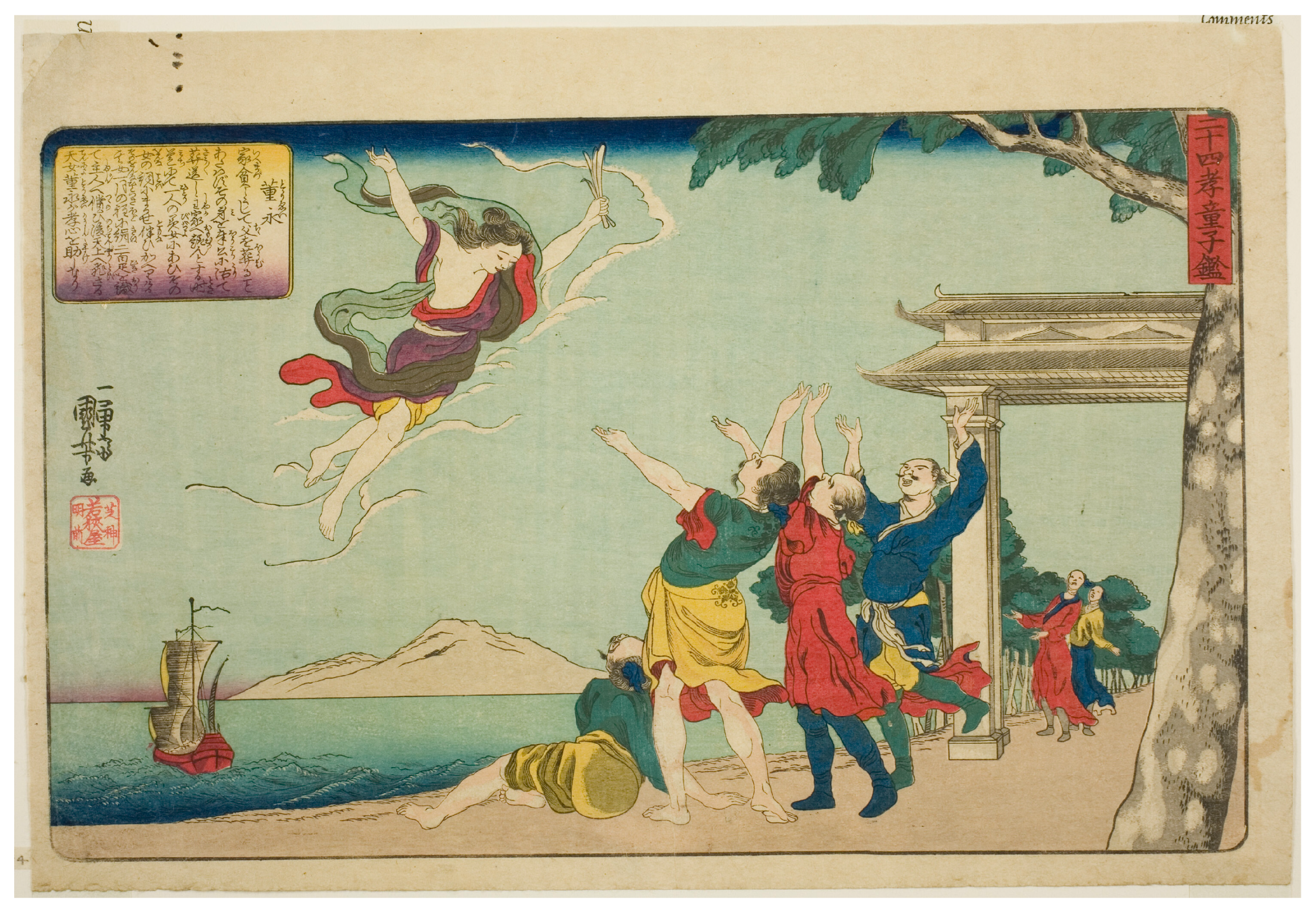
Twenty-four Paragons of Filial Piety as a Mirror for Children”) (歌川国芳, 二十四孝童子鑑 董永, 1844). Compared to the rough sketch depicting one man sending off a heavenly weaver (and another riding a horse without any context), we can see that this has been changed to four men looking up at her in the finished work (
Figure 1). In detail, the man’s face presented in the sketch, now has a beard and hair added, and the shape and folds of his clothing are shown more clearly. The tree on the right, depicted with multiple lines in the sketch, has been refined into a straight-growing tree with a trunk in the foreground.
Can we assume that a single painter made all of these changes in imagery during the collaborative production process involving multiple craftsmen? Or does this assumption simply reflect the imposition of a Western, modern conception of “art” on Nishiki-e production? Indeed, in his research on publishers from the Edo to Meiji periods, Andreas Marks characterized the production process of Nishiki-e as the “Ukiyo-e quintet
2,” emphasizing that it was a collaborative process involving five participants: publisher, painter, engraver, printer, and consumer (
Marks 2011). Based on his argument, this paper will focus on the roles of engravers and printers. If engravers’ and printers’ technical practices were crucial to the visual expression of Nishiki-e, what did this mean for the creativity of works produced through mass reproduction?
Exploring the empirical evidence of their work seems to be the best approach to answering these questions. However, as their techniques were often passed down orally from master to apprentice, documentation is rare. Furthermore, as will be explained later, the craftsmen’s work has been historically undervalued. While research on the painters flourished, insufficient investigation was conducted into the techniques of the engravers and printers. Additionally, the number of practitioners inheriting these skills has declined. Traditional Nishiki-e research has relied on limited materials, leaving unclear aspects regarding the specific work of the craftsmen.
This paper aims to examine the work of engravers and printers from a different perspective. Drawing on an anthropological approach, it focuses on Tim Ingold’s discussion of “line-making”. Regarding craftsmen, Ingold states the following, using architects and carpenters as examples:
A famous modern architect designs a building, the like of which the world has never seen before. He is celebrated for his creativity. Yet his design will get no further than the drawing board or portfolio until the builders step in to implement it. (…) In order to accommodate the inflexible design to the realities of a fickle and inconstant world, builders have to improvise all the way. (…) Why, then, do we not celebrate the creativity of their work, as we do that of the architect?
From his unique lens of “linealogy” (
Ingold 2007), Ingold shifts the focus from architects traditionally regarded as “creative” to carpenters who implement designs in ever-changing environments. In linealogy, the world is composed of “lines”—not only through activities such as walking, weaving, drawing, and writing, but also through footprints on the ground, cloth, paintings, calligraphy, fungi, and plants. This approach sheds light on humans such as carpenters or craftsmen and non-humans which were previously excluded from discussions of creativity.
Regarding the keyword “line,” anthropologists have believed that Western modern societies comprehend history and the passage of time in a linear manner, while non-Western societies are believed to be non-linear. Thus, applying linear perspectives to non-Western life was considered ethnocentric or colonialist. Ingold’s argument, however, approaches the “line” itself. He interprets colonialism as the act of imposing a different line onto the line that inherently existed within that community (
Ingold 2007, pp. 2–3).
Ingold states that, regardless of Western or non-Western context, “Life is lived, I reasoned, along paths, not just places, and paths are lines of a sort” (
Ingold 2015, p. 2). Here, “life” is expanded to include not only humans but all living things, even to weather phenomena like wind and rain. What Ingold sought to achieve through linealogy was to transcend not only the traditional Western–non-Western dichotomy but also divisions like art–non-art and nature–artifice, uncovering the creative activities that unfold within the “life of lines” where everything is tangled (
Ingold 2015).
To what extent can Ingold’s argument be applied to Nishiki-e produced in pre-modern Japan? Does the work of the engravers and printers involved in Nishiki-e production offer a different perspective on creativity than the cases Ingold has discussed thus far?
To unveil the work of engravers and printers that are often overlooked as “Japanese craftsmanship” under Western values and Japonism,
Section 2 introduces the key concepts necessary to connect Ingold’s linealogy with Nishiki-e, and
Section 3 compares the production process of Nishiki-e with that of Western copperplate engraving workshops in the 17th–18th centuries, based on these concepts.
Section 4 and
Section 5 then examine the artistic practices of engravers and printers in detail, from three perspectives: (1) imagery, (2) coloring and (3) texture, exploring how these expressive elements were incorporated. Through these discussions, this paper aims to clarify what “creativity” means for engravers’ and printers’ works.
3. How Were the Lines Determined?
As mentioned, previous scholarship has not emphasized the roles of engravers and printers in producing Nishiki-e. There were several reasons for this, but the most significant factor was likely the introduction of Western “art” to Japan after the end of the shogunate’s isolation policy (
Sato 1996). After the Meiji era, starting from 1868, the new Japanese government led a drive to modernize the country, modelling it on Western countries. One of the Western cultural elements that was actively adopted at that time was the concept of “art.”
Before that time, Japan had no equivalent terms for “art” and “artist”. Those who painted were all regarded as craftsmen, called “Gakō (画工).” Their status depended on their employer. Among the works produced by such craftsmen, only those created by painters employed by the privileged few, such as court nobles and members of the warrior class came to be recognized as “art” in Meiji Japan. Conversely, works like pottery and textiles, which today are termed “crafts,” were separated from art. Despite being created by numerous skilled craftsmen, these works were excluded from the art system.
Nishiki-e existed in this liminal space. Though they were underestimated as a part of commercial culture (
Sato 1996, pp. 65–66), Japanese people at the time recognized that these prints greatly influenced Western artists, to whom they were exported
9. Meiji Japan treated Nishiki-e as popular commodities while simultaneously studying their excellent designs as works of art
10. With the concept of the “artist”, all such designs came to be regarded as the work of the painter, E-shi who designed the first drafts. This led to “painter-centrism” in the production process of Nishiki-e, in whereby painters received attention while engravers and printers were overlooked.
This is reminiscent of situation in early modern Western printers. According to William Ivins, Jr., the 17th and 18th centuries saw the expansion of copperplate engraving, as well as the development of techniques that enabled the same plate to be used much longer. During this period, some artists, such as Rembrandt
11, engraved and printed their own works (
Ivins 1953, pp. 79–81). However, there were also works produced by artists who organized and supervised schools of engravers directly. Ivins cites Peter Paul Rubens as a representative example. The engravers in Rubens’s workshop invented their own line mesh to print his artwork in high quality in the long term. To use the original plate for an extended period, the depth and distances of the lines had to be calculated to prevent wear. Ivins states that any work engraved and printed by Rubens’s workshop was accepted as an artwork bearing Rubens’s trademark. He argues that Rubens’s international influence would have been impossible without these prints (
Ivins 1953, pp. 71–73).
In contrast, prints made without the artist’s supervision were copied by draftsmen from the original artwork and then transferred onto the plate by an engraver. Ivins points out that these prints differed from the original artist’s intended expression, being mere imitations of the original’s content and composition (
Ivins 1953, pp. 88–90).
These observations demonstrate Western artists’ authority to control every aspect of the printing process, from the original plates to the quality of the prints. Craftsmen worked under the artist’s supervision, striving to utilize and preserve the original plates. Additionally, they show that reproducing artworks without the artist’s supervision was considered to have little artistic value.
This hierarchy was also embedded in Japanese academic research on Nishiki-e, which has led to painter-centrism. Within this framework, works that were created directly by the artist were considered supreme, and those closer to them were deemed more valuable. Nishiki-e can be divided into two types: “Sho-zuri (初摺り),” meaning “first prints,” and “Ato-zuri (後摺り),” meaning “later prints.” Since the Meiji period, Sho-zuri have been highly valued in Nishiki-e studies because the woodblocks were new, resulting in clear lines. Additionally, the artist approved the final product, which placed earlier prints closer to the painter’s intent, whereas Ato-zuri were regarded as having lesser value. They were produced using worn woodblocks, and the printer made additional prints under the publisher’s direction. Such academic evaluations have long overshadowed the works of engravers and printers, placing them behind painters.
This painter-centrism is similar to what Ingold sought to critique by focusing on improvisation with the example of the architect and carpenter. While Ivins acknowledges the unique line-making techniques developed by Rubens’s engravers, his tendency to undervalue craftsmen working outside the artist’s direct supervision suggests that he had not fully escaped from this framework. The following example of Nishiki-e shows the importance of focusing on the craftsmen’s line production rather than on the artist’s involvement in the printing process.
Between the finished product (
Figure 1) and the preliminary sketch shown at the beginning, there were in fact two intermediate stages. The first was the Hanshita-e, which was used to create woodblocks
12. The second was the pre-prints (Kyōgō-zuri
13), printed by the engraver using the first woodblock and intended for the painter to add color instructions. Like the Hanshita-e, these pre-prints were usually carved while still affixed to the woodblocks and therefore rarely survived. In this case, however, Kyōgō-zuri has survived. Although it is rare for materials from each stage of a single work to remain, these three pieces reveal how imagery changed during the Nishiki-e production process. First, the multiple thick lines in rough sketch evolved into a single, refined line in the pre-print. The painter draws a rough sketch, and the engraver carved the woodblock from which the pre-print was printed. During this process, the figure’s outline becomes clearer, and its facial expressions become discernible. Furthermore, color becomes visible only at the final stage, in the finished work. As the engraver carved the woodblock according to the painter’s coloring instructions and the printer printed it, the colors of the heavenly weaver’s robes and the blue of the sea were gradually determined. Through this correspondence between the painter, engraver, and printer, the lines became increasingly refined.
The changes in line and color seen in these three works pose a crucial question. How were the lines and colors within the production of Nishiki-e determined? To what extent were the engravers and printers involved in making these decisions? The next section examines these issues by analyzing traces left in the works themselves.
4. Analysis and Consideration
As mentioned in the previous section, there are few records detailing the specific practices of engravers and printers. For this reason, this paper refers to Ishii Kendo’s
Nishiki-e no Hori to Suri (
The Engraving and Printing of Nishiki-e) (石井研堂, 錦絵の彫と摺, 1929), a work based on primary-source research and interviews with engravers. In addition, it draws on materials obtained from recent Nishiki-e reprinting projects. These projects employ high-resolution scanners and high-definition monitors to reveal previously unseen printing techniques in Nishiki-e. To what extent do the work of engravers and printers revealed by these materials align with or differ from the creativity in carpentry pointed out by Ingold? To answer the questions posed in
Section 3 about the authority to select lines and colors, this section examines specific examples from three perspectives: (1) imagery, (2) coloring, and (3) texture.
4.1. Imagery
As discussed earlier, changes in imagery during the production process can be observed by comparing the final product with the preliminary sketch. However, engravers often glued the preliminary sketch directly to the woodblock, causing it to disappear when the block is carved. This makes investigative methods like this one difficult in most cases. Therefore, this study compares finished products and preliminary sketches by the same artist that depict similar motifs and compositions.
The preliminary sketch for
Girō Jū-niji Umanokoku (
The Twelve Hours in the Brothel: The Hour of the Horse) (妓楼十二時 午ノ刻), found among Ishii’s documents
14, and the finished work
Yoshiwara Tokei Umanokoku (
Yoshiwara Clock: The Hour of the Horse) (吉原時計 午ノ刻, 1818)
15, are both works by Utagawa Kunisada (歌川国貞) (also known as Utagawa Toyokuni III (三代歌川豊国)). Both depict a woman holding a long pipe with her face tilted to the left. This section focuses on the contour lines and facial expression. An examination of preliminary sketch reveals that the contour lines are thick with little variation. For instance, the lines for the woman’s toes are not clearly defined. Furthermore, her facial expression appears crude. The thick lines around her eyes and lips make it difficult to discern her gaze or expression. In contrast, the lines in the finished work show variation in thickness, and the face is rendered with greater delicacy. The clear boundary between the iris and the white of the eye makes her gaze discernible, and her eyebrows are beautifully curved.
In fact, it was not uncommon for engravers to depict these facial features, which were considered particularly important in portraiture. Katsushika Hokusai, known for
Kanagawa Oki Namiura (
The Great Wave) (神奈川沖浪裏, 1830–1832), once wrote a letter about an engraver altering his preliminary sketch when carving the woodblock. In the letter, Hokusai drew detailed diagrams of eyes and noses and politely but firmly expressed his concerns: “Do not carve the lower eyelids with a small knife,” “Unlike the Utagawa school, I want the nose carved as shown in this diagram,” and “Although such imagery is fashionable, I wish to refrain from it” (
Iijima 1893, pp. 57–58). Furthermore, Hokusai was particular about the printing of his works, and letters remain in which he requested specific engravers for his work (
Tinios 2015).
Do these letters suggest that Hokusai held more power over the engravers and printers, meaning that he controlled the quality of their work? It would be premature to conclude this. Before becoming a painter, Hokusai apprenticed as an engraver at the age of 14 or 15 (
Iijima 1893, p. 4). Given this background, his frustration with carving and printing can be understood as stemming from his deep understanding of the engravers’ work. He knew that a single carved line could alter the image’s vitality. However, these letters highlight the fact that engravers often made their own modifications.
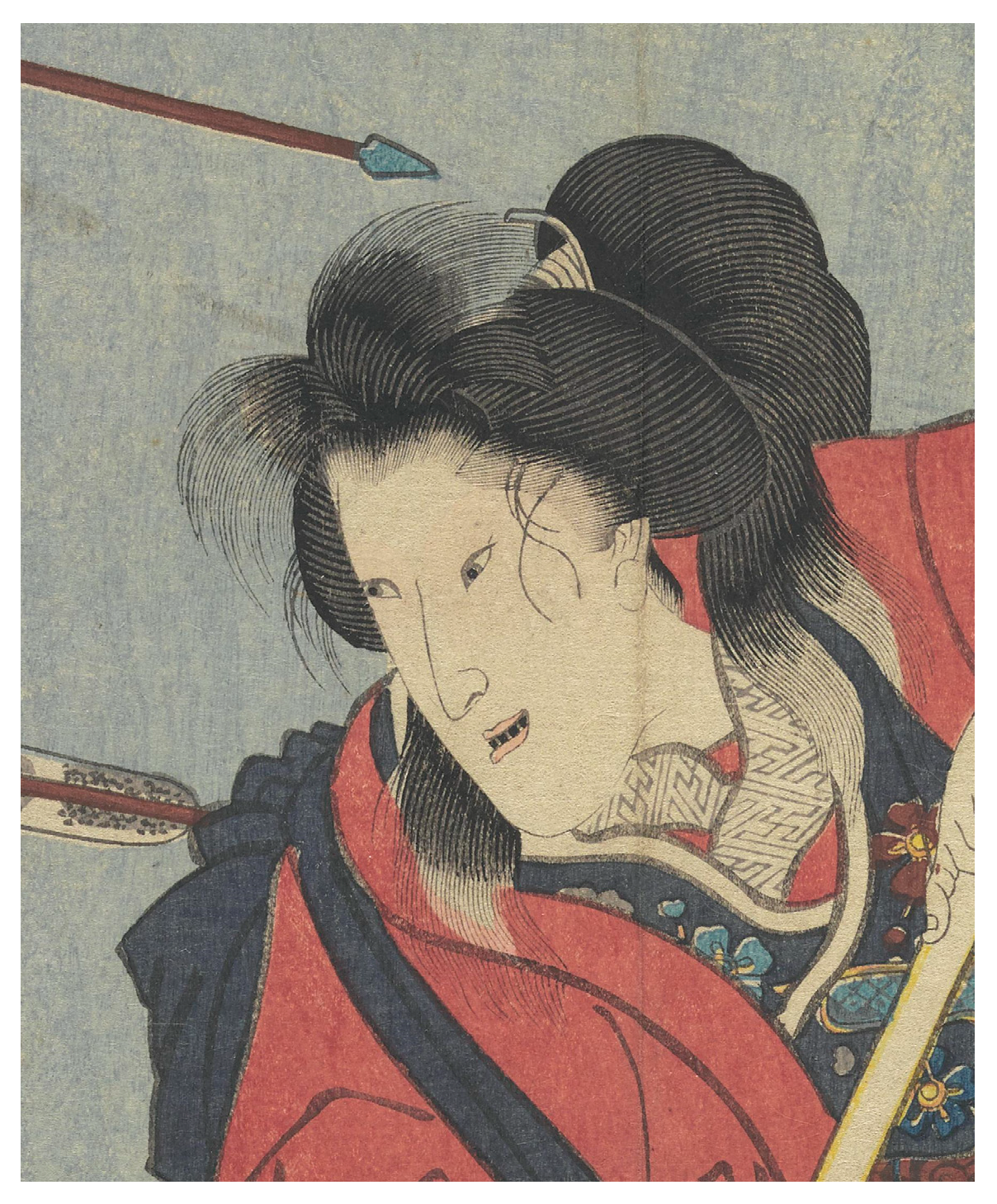
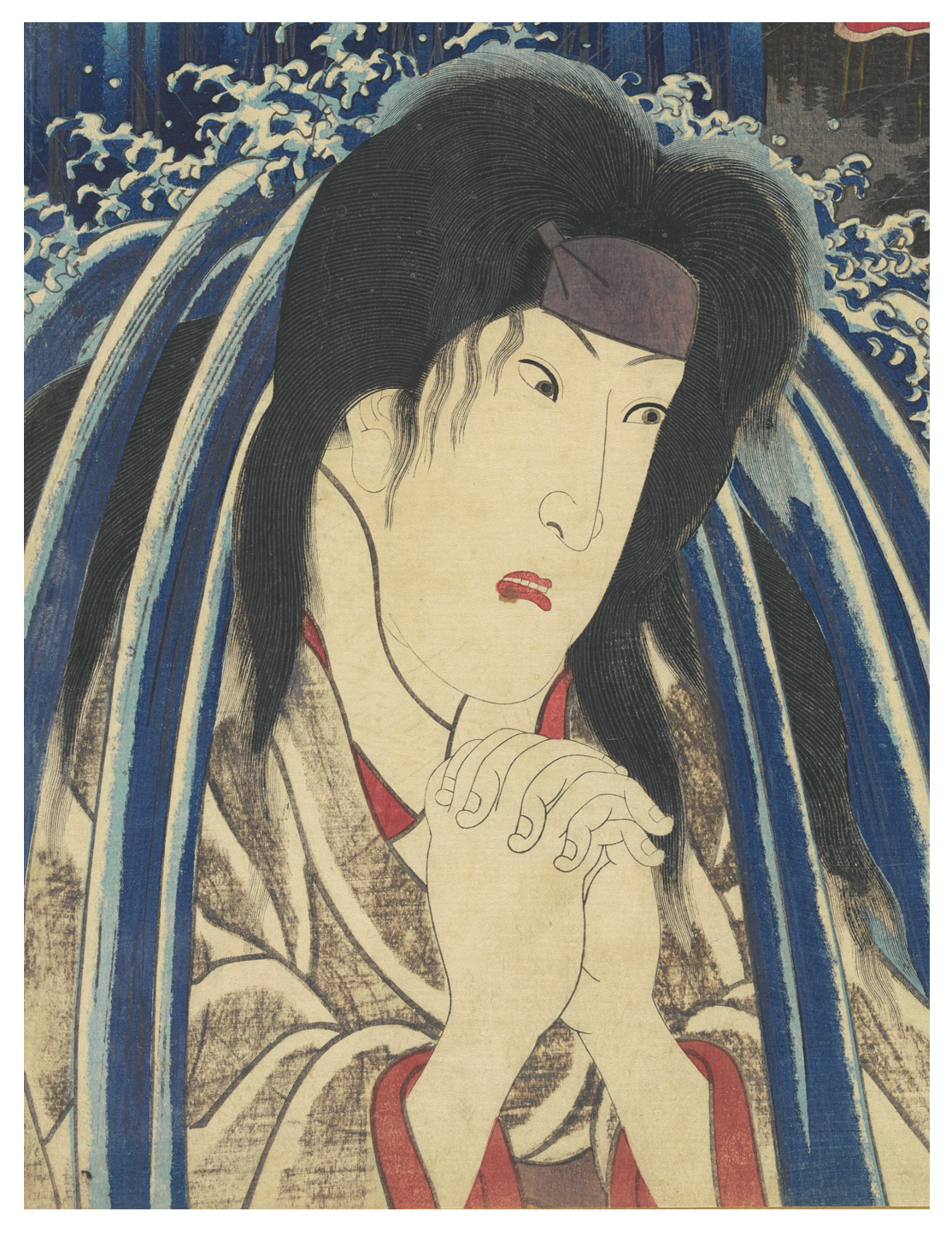
If engravers were altering the preliminary sketches, a detailed examination of the works by the same engraver would be necessary. The depiction of hair particularly well reveals an engraver’s skill. In Nishiki-e, special attention was paid to the hairline and the hair itself.
Figure 2,
Tametomo Homare no Jikketsu (
Ten Famous Excellences of Tametomo) (為朝誉十傑, 1851);
Figure 3,
Tōkaidō Gojūsantsugi no uchi Hakone Hatsuhana (
Hakone: Hatsuhana,
from the series Fifty-three Stations of the Tōkaidō Road) (東海道五十三次の内 箱根 初花, 1852) and
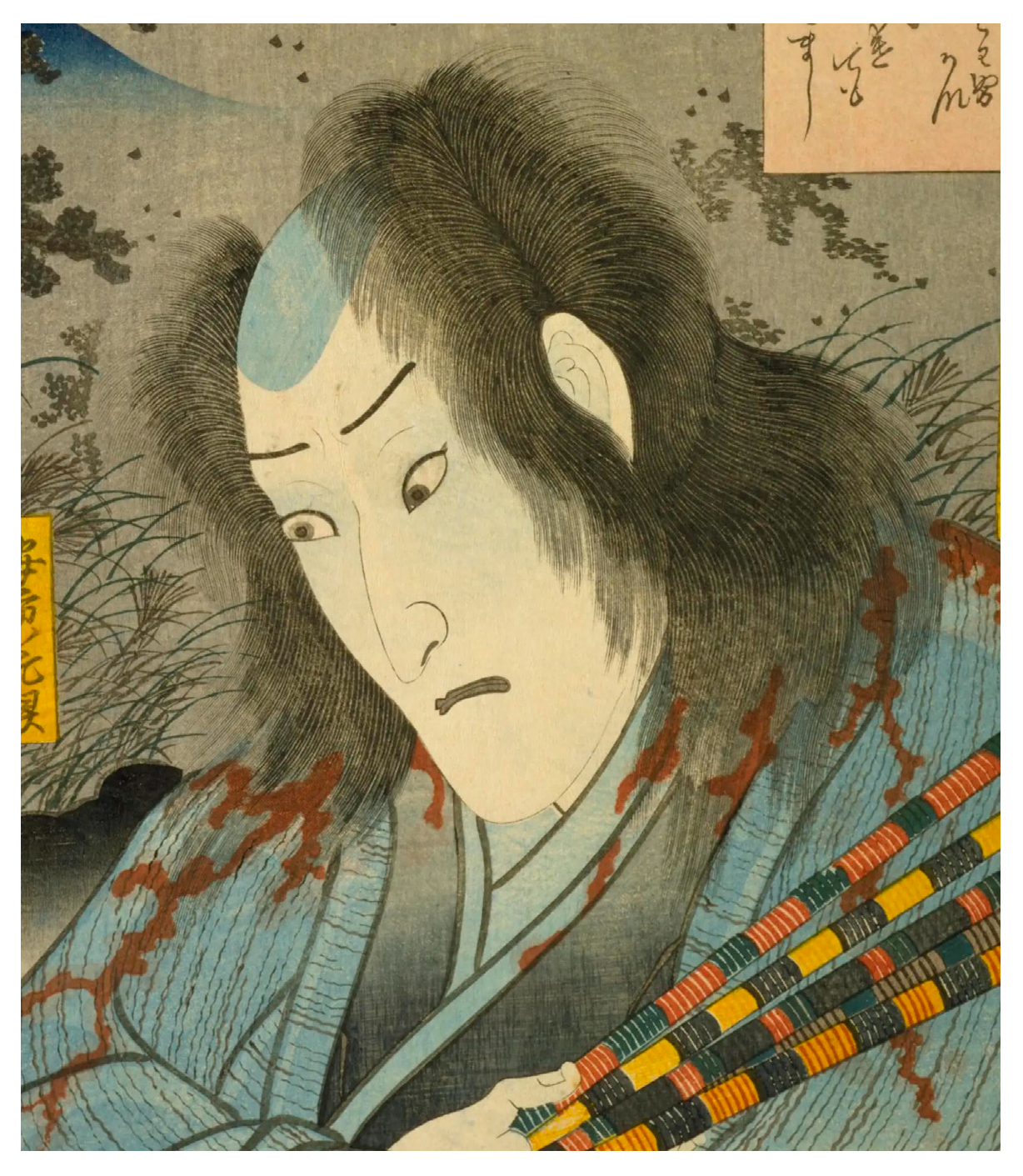
Figure 4 Mitate Sanjūrokkasen no uchi Nakatsukasa (
Viewed As the Thirty-six Immortal Poets Nakatsukasa) (見立三十六歌撰之内 中務, 1852) are all by a engraver known as “Horitake (彫竹).” However, each features a distinct style of hair flow and strands.
For instance,
Figure 2 depicts a heroine in battle. Her hair is deep black, and her bangs stand tall and vibrant. Though her hair is tied back, it appears disheveled from the fight.
Figure 3 is a Nishiki-e depicting a woman under a waterfall. Her hair is wet, so the flow is less distinct, and the strands are carved thicker than in other works. Additionally, her hair clings to her face and body.
Figure 4 depicts a male ghost. His hair is thin and pale. The lack of volume in his hair makes him appear to be a terrifying and lifeless presence.
These variations in hair depiction add realism to the figures and scenes. The painters’ preliminary sketches lack detailed depictions of hairlines and the flow of hair (
Ishii [1929] 2005, p. 20). It is thought that the most skilled engravers added these details (
Ishii [1929] 2005, pp. 107–8). Engravers filled in areas that were shaded black in the preliminary sketches with various lines. As these lines become tighter and denser—each measured in tenths of a millimeter—life is breathed into the Nishiki-e.
Rather than celebrating the engravers’ meticulous work, what is relevant here is that the Nishiki-e was produced through a meshwork process, not merely along a production line. First, the image was generated by the myriad fine lines coming from the interplay with the woodblock. Second, the image was created through the collaboration of the painter and engraver; neither had exclusive authority over creative decisions. Both the painter and the engraver were necessary for the Nishiki-e to exist.
4.2. Color
Here, the focus shifts to the coloring of Nishiki-e. In the usual production process, the printer selected dyes and prints based on the painter’s instructions. In practice, however, these instructions were only written as broad color names, such as “ai: indigo,” “kusa: green,” and “netsumi: gray” (
Ishii [1929] 2005, n.p.). Of course, shades of indigo vary, but the instructions omit such detailed specifications. Ishii’s document introduces the various dyes used by printers and notes their selective application. This clearly indicates that printers bore significant responsibility for Nishiki-e coloring (
Ishii [1929] 2005, pp. 61–73). The printer may have improvised colors based on the condition of the woodblocks, working from color instructions provided solely in text. While the engravers had the authority to select lines, the printers were responsible for choosing colors.
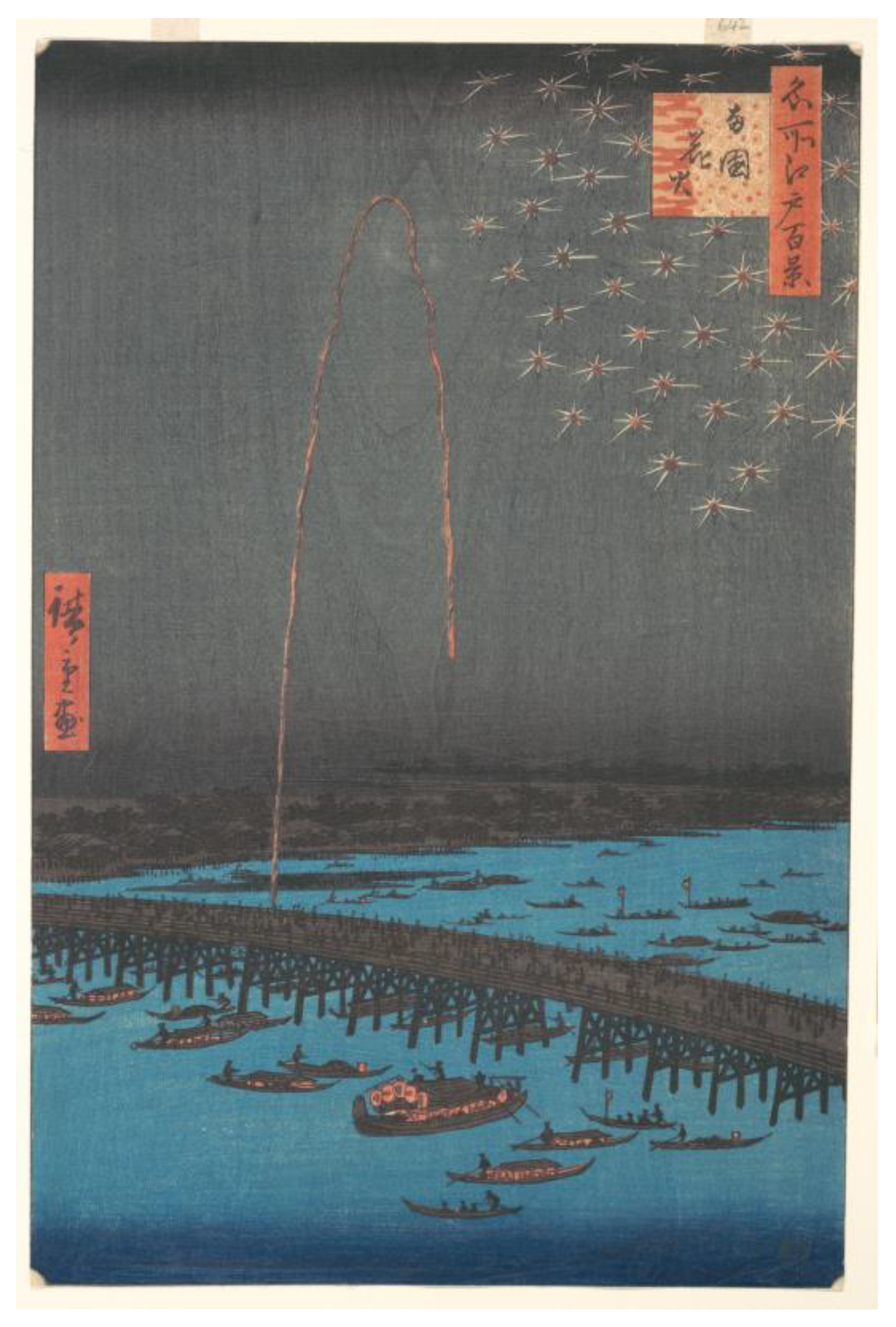
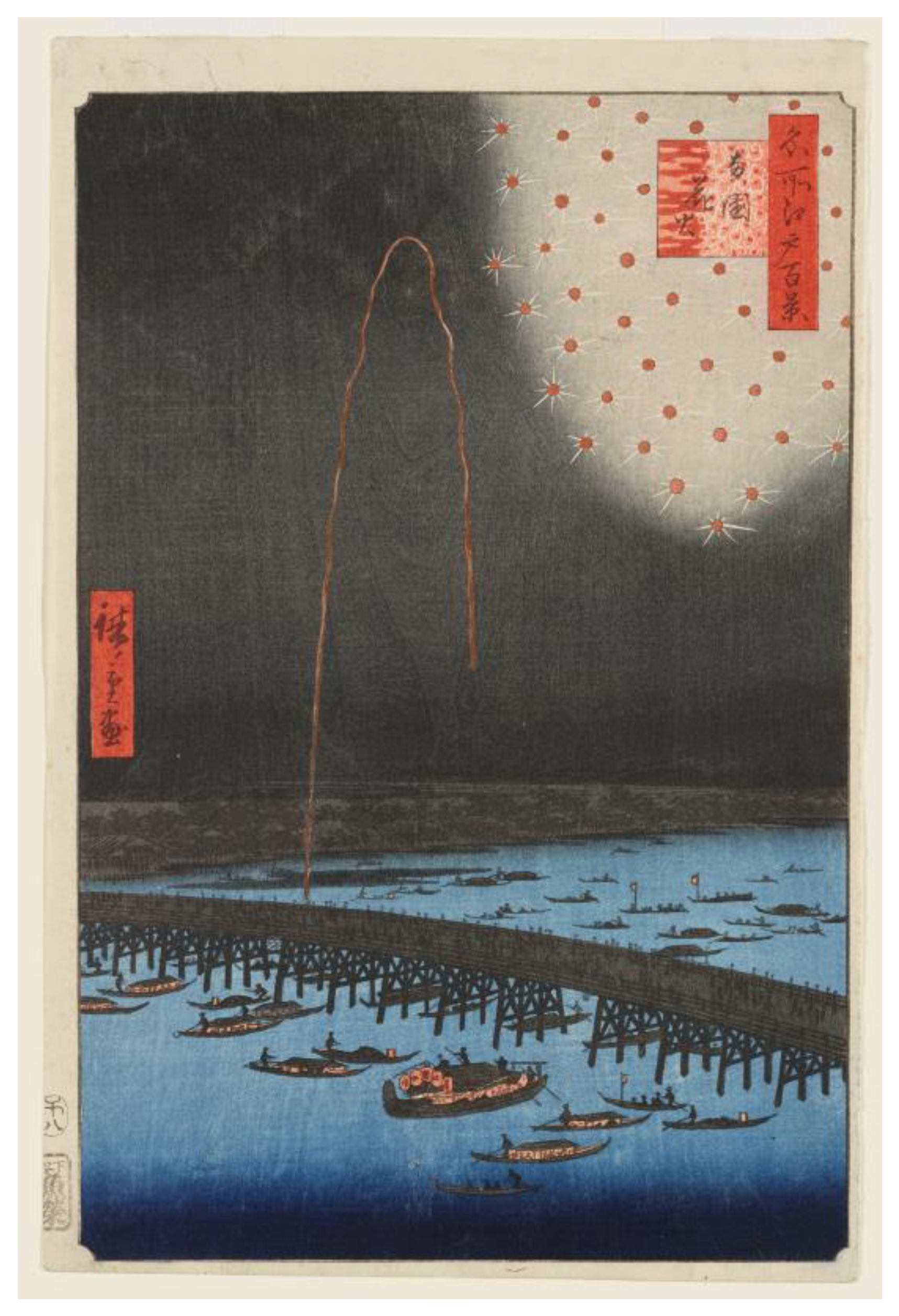
To illustrate this point, examine
Figure 5 and
Figure 6. Both figures are the
Meisho Edo Hyakkei Ryōgoku Hanabi (
Fireworks at Ryōgoku,
from the series One Hundred Famous Views of Edo (名所江戸百景 両国花火, 1858).
Figure 5 is the first printing (Sho-zuri), and
Figure 6 is a later printing (Ato-zuri) (
Miyao 1968). There are three distinct changes between the two prints. First, the depiction of the fireworks in the upper right differs. The blurred gradation in the sky is omitted in the later print. Second, the color of the bridge and boats differs. In the first print, the colors are dark, making it difficult to see the people on the bridge; in the latter, the colors are slightly lighter brown, which makes them easier to see. Third, the gradation on the water’s surface differs. In the first print, the gradation starts with a deep color, but in the latter print, the deep color appears as a nearly straight line.
The color changes between the earlier and later versions significantly alter the overall impression of the work.
Figure 5 and
Figure 6 appear to be photographs taken in quick succession.
Figure 5 captures the moment the fireworks explode, while
Figure 6 shows the moment their light illuminates the river’s surface and the bridge. These images are published in the order that aligns with the chronological sequence of the scenes depicted.
Printers made these changes at their discretion in response to wear on the woodblocks or in order to simplify the printing process (
Ishii [1929] 2005, p. 54). Printers may have improvised these responses; the final section revisits this point. Nevertheless, both the earlier and later prints correspondingly depict the moment the fireworks burst and fade. While the earlier print is considered more valuable, the later print also demonstrates the craftsmen’s ingenuity and ability to adapt to changes in materials.
We can explain these changes with what Ingold calls “joined up” and “joined with.” If the Nishiki-e production line had taken an object-oriented approach and aimed to produce “precise copies of the first print,” the printing process would have been repeated relentlessly as the woodblocks wore down and the lines became smudged. However, the Nishiki-e production line was different. Printers adjusted the colors to match the condition of the materials during printing. Craftsmen corresponded to the woodblocks, altering the design to compensate for wear and tear on the wood in order to produce beautiful prints.
As a result, two or more distinct corresponding patterns emerged, all of which were accepted as variations of the same work. The printers interpreted the artist’s broad coloring instructions independently, maximized the potential of the given woodblocks, and adapted to print runs and the condition of the blocks. It could be said that the printers’ work involved bringing correspondence to the entire production line and finished images by fostering sympathy among people, among materials and between people and things.
4.3. Texture
As noted earlier, the work of engravers and printers includes both improvised work and expressions that are intentionally designed and executed. These expressions do not involve lines or color. Here, these details will be examined from the perspective of texture.
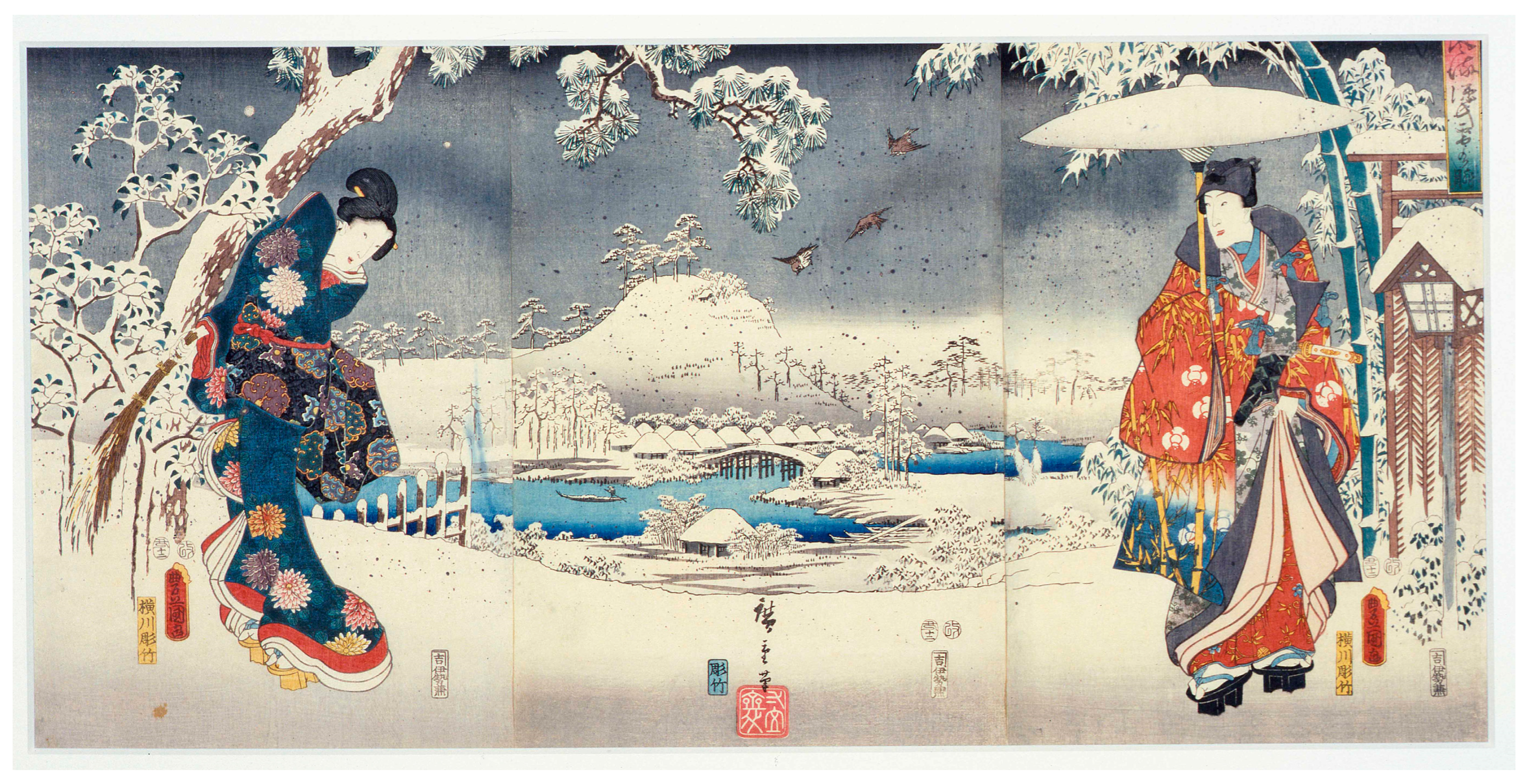
Figure 7 shows
Fūryū Genji Yuki no Nagame (
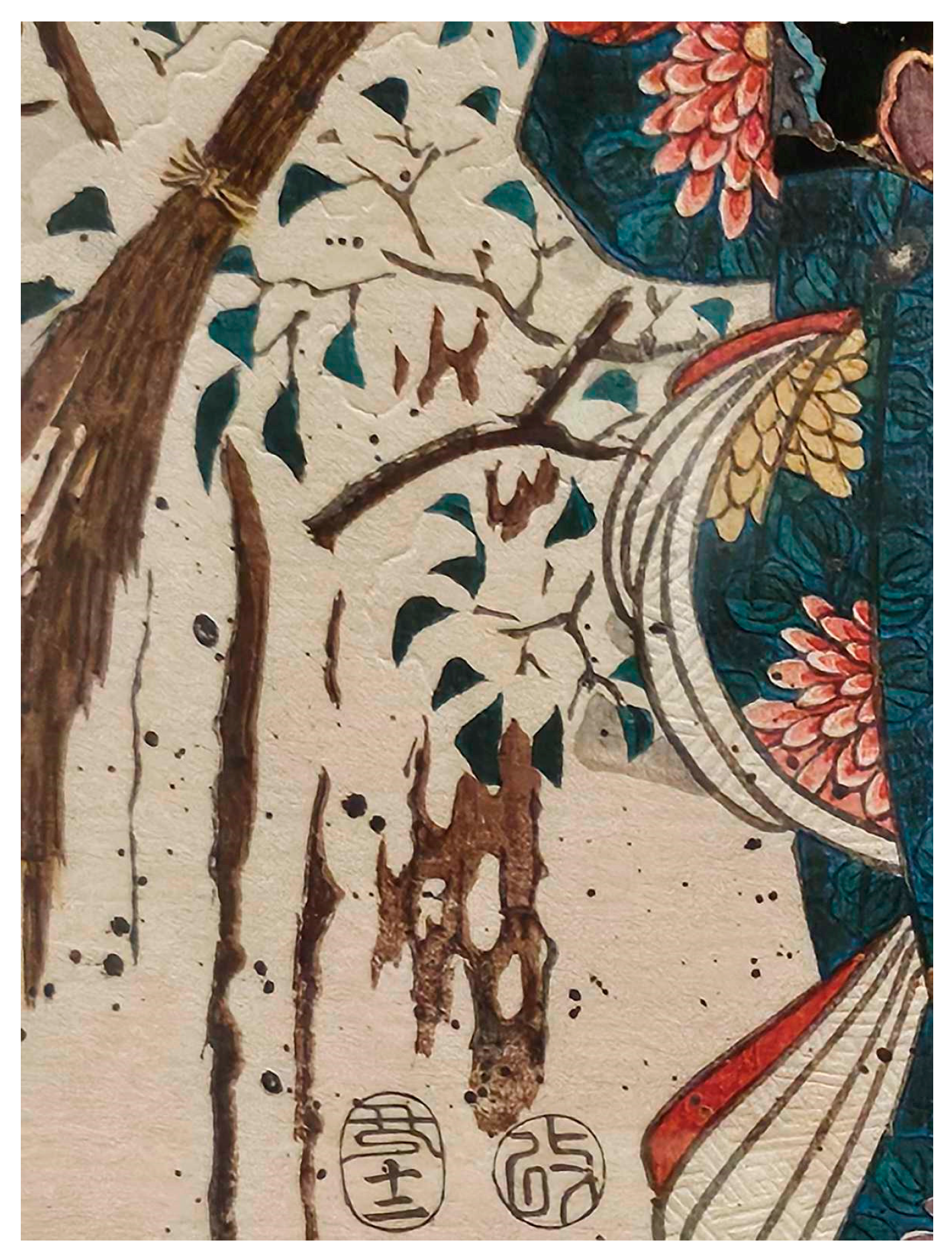
Elegant Snow Scenery of Genji) (風流源氏 雪の眺, 1853), a preliminary sketch by Utagawa Kunisada and Utagawa Hiroshige (歌川広重), with the woodblock carved by Horitake; the printer is unknown. At first glance, the work draws our attention to its colorful imagery. However, a closer look reveals that patterns have been applied to areas that initially appear to be simply white. This technique, known as “Kara-zuri (空摺り)” in Nishiki-e, involves pressing washi paper onto the woodblock without applying dye. Using a Baren, pressure is applied to imprint the block’s relief onto the paper. This process adds relief lines to the work, giving it a three-dimensional, tactile quality and texture (
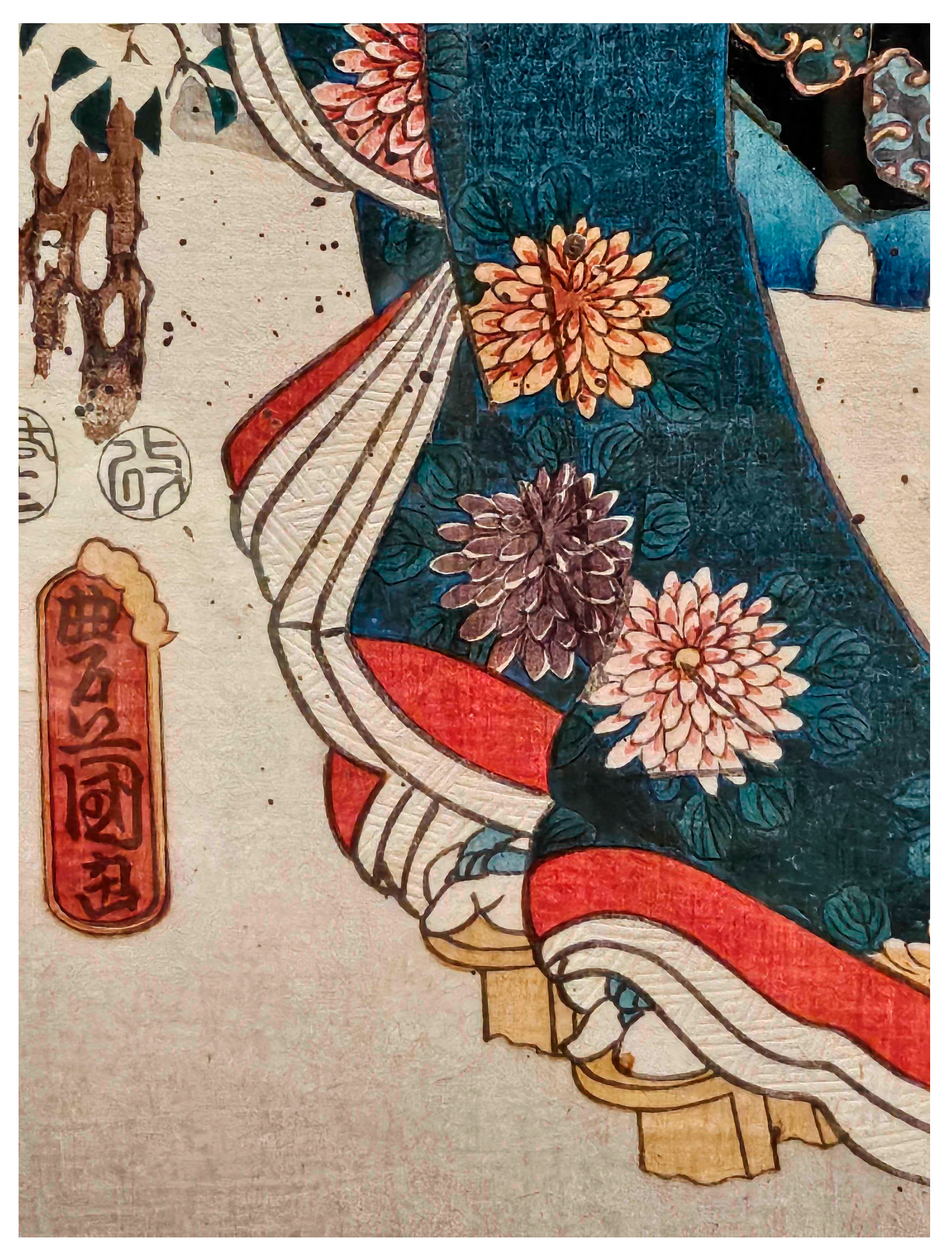
Tokyo Traditional Woodblock Print Craft Association Edit, Kobayashi, Tadashi Supervised 2005, p. 50). However, lines created by Kara-zuri often disappear when viewed from the front and are nearly invisible in digital images. They only become visible when the angle of light hitting the work changes. These lines are brought to life through the collaborative effort of the engravers and printers (
Kubota 2022).
Enlarging the kimono pattern (
Figure 8), for example, reveals the Kara-zuri patterns applied to the white areas. These patterned weaves are called “ji-mon (地紋)” and can be found on real kimonos. Rather than drawing patterns during the dyeing process, these ground patterns are made by weaving patterns into the fabric through changes in thread or technique. With the Kara-zuri technique, the patterns add thickness to the kimono, evoking its texture for the spectator
16.
Additionally, enlarging the snow-covered tree (
Figure 9) reveals its outline, which is rendered through raised and recessed areas. These textures create tactile senses and produce sheen and shadow when light hits them, conveying the three-dimensionality of accumulated snow. Thus, the lines printed with dye and the subtle details physically applied to the washi paper both support the Nishiki-e’s imagery and color expression.
Why did engravers and printers design such intricate details that are barely noticeable at first? One reason lies in the consumption style of Nishiki-e prints. These prints were inexpensive, mass-produced commodities. Consumers enjoyed them by holding the prints in their hands and moving them closer to or farther from their faces. This mode of consumption differed from that of Western paintings, which were expensive originals framed and hung on walls. Nishiki-e were more deeply tangled in the lives of their consumers than Western paintings were. In his example of a building, Ingold argues the importance of considering the inhabitants who settle within a changing environment and maintain their homes. The application of this idea to Nishiki-e means the prints needed to correspond with the relationship between the spectators and the washi paper to become part of their daily lives. The craftsmen’s obsession with minute details likely stemmed from this necessity. Engravers and printers sought to meet these demands in different ways than painters did. Their work produced lines that emerged and faded, reflecting differences in the way light fell and in texture.
5. Conclusions
This paper aimed to re-examine the production process of pre-modern Japanese Nishiki-e using Ingold’s perspective of “line-making.” Ingold’s three concepts—meshwork, correspondence, and improvisation—provide an effective lens through which to view the craftsmen’s work within the Nishiki-e production line. This is especially true for engravers and printers, whose roles have been overshadowed by the role of painters. Ingold’s model, which focuses on the creative process rather than the visual resemblance between the preliminary sketch and the finished product, can be applied to Nishiki-e craftsmen. It revealed how the lines of Nishiki-e prints appeared on the printed surface.
As we have seen thus far, the production process of Nishiki-e has traditionally been understood as a “joined-up” model divided by roles, grounded in a painter-centric perspective that formed the basis of conventional Nishiki-e research. However, their actual production lines were more akin to the “joined-with” model, involving close interaction among craftsmen.
Section 3 raised the crucial questions: “How were lines and colors determined in Nishiki-e production?” and “To what extent were the engravers and printers involved in making these decisions?” It can be concluded that engravers and printers had as much authority as painters to modify the lines and colors of Nishiki-e.
The Nishiki-e production line, formed by different craftsmen joining each stage, is a true meshwork. Within this meshwork, the corresponding image of Nishiki-e was created through the collaboration of people and the interplay of materials, such as woodblocks and dyes. The Nishiki-e itself, produced by this collaborative production process, is also a meshwork. As their name suggests, Nishiki-e were indeed luxurious patterned textiles woven from diverse threads. Furthermore, this meshwork extended to the spectators, entangling their lives and enabling the Nishiki-e to survive from the late 18th century until the end of the 19th century.
While this conclusion may be interpreted as a praise for the production systems of pre-modern craftsmen, I would like to add a remark to Ingold’s argument. His celebration of improvisation may be difficult to accept uncritically. Nishiki-e craftsmen did not always improvise; some designs were intentional. As discussed in
Section 4, Nishiki-e prints were produced as commodities that needed to possess commercial value. The craftsmen constantly weighed the effort to generate this value against its cost
17. For instance, areas that could be colored with expensive pigments were limited, and woodblocks for works with short sales periods were often partially re-carved and reused to cut costs. The question of improvisation arises precisely because these economic factors are absent.
Nevertheless, applying Ingold’s argument, which focuses on the process of implementing an artist’s script, to Nishiki-e highlights the value of the copies themselves. The creativity discernible in the work of Nishiki-e craftsmen differs slightly from Ingold’s concept because these craftsmen continually accepted that Nishiki-e circulated as copies. As we have seen, the production process of Nishiki-e did not strictly aim to reproduce the painter’s preliminary sketch. However, the craftsmen understood better than anyone that Nishiki-e were subject to change according to the condition of the woodblocks, washi paper and the spectator’s pleasure. The craftsmen engaged directly with this inherent nature. The work of the engravers and printers, influenced by economic factors yet focused on the copy itself, is undoubtedly a form of creativity. The beautiful lines of Nishiki-e reveal the relationship between humans and materials.