



Next Issue
Volume 14, December
Previous Issue
Volume 14, October


Humanities, Volume 14, Issue 11 (November 2025) – 20 articles
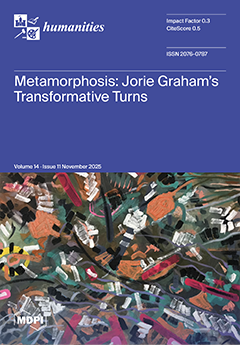
Cover Story (view full-size image): The turn—a significant shift in rhetorical and/or dramatic trajectory—is a considerably under-realized element of poetry. This certainly is true with regard to the poetry of Jorie Graham: though many of Graham’s statements of poetics acknowledge the centrality of the turn, no critic has yet followed up on this invitation to explore Graham’s poems in terms of their relationship to the turn, until now. In “Metamorphosis: Jorie Graham’s Transformative Turns,” Michael Theune attends closely to Graham’s turning. Doing so, he uncovers instances of uniquely inventive turns, both in the context of the poet’s oeuvre and in poetry, more broadly. Ultimately, Theune reveals that more fully realizing the turn can offer a strong method for making surprising, critical discoveries. View this paper
  • Issues are regarded as officially published after their release is announced to the table of contents alert mailing list.
  • You may sign up for e-mail alerts to receive table of contents of newly released issues.
  • PDF is the official format for papers published in both, html and pdf forms. To view the papers in pdf format, click on the "PDF Full-text" link, and use the free Adobe Reader to open them.
Order results
Result details
Section
Select all
Export citation of selected articles as:
18 pages, 509 KB  
Article
Physical Dramaturgy: An Embodied Approach to Exploring Shakespeare’s Text Through Devising and Collaborative Creation
by Doreen Bechtol
Humanities 2025, 14(11), 225; https://doi.org/10.3390/h14110225 - 20 Nov 2025
Viewed by 1133
Abstract
This essay introduces an experiential process through which student actors can explore any Shakespearean play. Anne Bogart’s Viewpoints technique serves as the foundation for a creative process informed by devising exercises and physical composition. In this essay, I demonstrate how this physically based [...] Read more.
This essay introduces an experiential process through which student actors can explore any Shakespearean play. Anne Bogart’s Viewpoints technique serves as the foundation for a creative process informed by devising exercises and physical composition. In this essay, I demonstrate how this physically based dramaturgical process enables students to pay particular attention to the foundational elements that uniquely shape the story, such as time, space, sound, architecture, and gesture. This process gives student actors the agency to create material inspired by Shakespeare yet infused with their own imagination and curiosity. It allows students to wake up Shakespeare’s text in unexpected ways, embrace collaboration, and embody the richly detailed expression of Shakespeare’s poetic language. This essay aims to be a resource for educators and directors alike who are interested in a collaborative process that can either be integrated into rehearsals or serve as a foundation for classroom-based discussions. As such, this process can be mapped onto any classical or contemporary play, even though this essay features Shakespeare as the foundation for exploration. Full article
Show Figures

Figure 1

19 pages, 237 KB  
Article
“Instead of Saying ‘Had They Done Their Duty,’ It Would Be More True to Say ‘Had They Not Scandalously Neglected It:’” Policing Scandals in Periodical Publishing, c. 1865–1900
by Samuel Saunders
Humanities 2025, 14(11), 224; https://doi.org/10.3390/h14110224 - 18 Nov 2025
Viewed by 1048
Abstract
As Francis Dodsworth argues, histories of nineteenth-century British policing and detection have neglected to examine the extent, influence and legacy of corruption, scandal and organisational mismanagement within the police itself. Rather than face these issues head on, studies generally prefer to touch upon [...] Read more.
As Francis Dodsworth argues, histories of nineteenth-century British policing and detection have neglected to examine the extent, influence and legacy of corruption, scandal and organisational mismanagement within the police itself. Rather than face these issues head on, studies generally prefer to touch upon the subject carefully, incidentally, and in a perhaps ‘curated’ manner, leaving a significant gap in the history of police reform driven by public outrage and political influence. However, this also means that the influence of scandal and corruption in the police force on the development and representation of police officers and detectives in contemporaneous fiction also remains under-examined. This essay contextualises the presence of police officers and detectives in popular fiction from the mid-to-late nineteenth century against a swathe of contemporaneous scandals and corruption cases, as well as organisational mishaps and the resultant downturn in public opinion of the police, as they were reported in the periodical and newspaper press. It builds a more sophisticated picture of the relationship between the police, the press, and the publishing industry in the latter half of the nineteenth century, using events such as the 1867 Clerkenwell Prison bombing, the 1877 ‘Great Detective Case,’ the 1888 Whitechapel Murders, and the 1888 Thames Torso Murders, among others, as anchor points, and contextualises them against contemporaneous writing to argue that the history of ‘detective’ fiction should be historicized alongside ‘detection’ itself. Full article
(This article belongs to the Special Issue Scandal and Censorship)
15 pages, 257 KB  
Article
Scandals of Misreading: Serial Killer Shockers and Imaginative Resistance
by Tero Eljas Vanhanen
Humanities 2025, 14(11), 223; https://doi.org/10.3390/h14110223 - 17 Nov 2025
Viewed by 1953
Abstract
In the winter of 1991, the frenzied scandal around Bret Easton Ellis’s serial killer smash American Psycho overshadowed another, no less serious literary controversy. Published less than two months after Ellis’s blockbuster, Dennis Cooper’s transgressive queer classic Frisk may have been largely ignored [...] Read more.
In the winter of 1991, the frenzied scandal around Bret Easton Ellis’s serial killer smash American Psycho overshadowed another, no less serious literary controversy. Published less than two months after Ellis’s blockbuster, Dennis Cooper’s transgressive queer classic Frisk may have been largely ignored in mainstream cultural outlets, but in the queer community the scandal was deadly serious. Seemingly connecting queer sexuality with serial murder and pedophilia, the novel incited intensely angry demands for censorship. The controversy culminated in a very public death threat against Cooper from members of Queer Nation, a gay rights group known for its shock tactics. The critical response has mostly dismissed the scandals surrounding the novels as based on a particular kind of misreading or misinterpretation. Both works use similar narrative strategies to shock and scandalize their audience but aim to mitigate this response through the strategic use of unreliable narration. While scholars have often made the argument that the violence in the novels should be interpreted as mere fantasies of their unreliable narrators, this kind of nuanced interpretation was wholly absent in the scandalized response to the novels. The common critical defense, however, is itself based on a misunderstanding of the scandals. Fictionality and narrative reliability as such have little to do with the responses of imaginative resistance and moral disgust prompted by the representation of extreme violence. In this article, I analyze and compare the public and scholarly receptions of the novels, highlighting how scholarly discourse has often overlooked how the novels anticipated and aimed to incite the scandalized public response they ultimately provoked. Full article
(This article belongs to the Special Issue Scandal and Censorship)
15 pages, 223 KB  
Article
Realism, Affect, and the Battle of the Senses: Historicity and Cultural Memory in Dag Solstad’s War Trilogy
by Sigurd Tenningen
Humanities 2025, 14(11), 222; https://doi.org/10.3390/h14110222 - 17 Nov 2025
Viewed by 751
Abstract
This article examines Dag Solstad’s War Trilogy (1977–81) as a key work of realism and cultural memory in postwar Norwegian literature. Long dismissed as doctrinaire Marxist fiction, the trilogy is, in fact, one of the most ambitious literary engagements with World War II [...] Read more.
This article examines Dag Solstad’s War Trilogy (1977–81) as a key work of realism and cultural memory in postwar Norwegian literature. Long dismissed as doctrinaire Marxist fiction, the trilogy is, in fact, one of the most ambitious literary engagements with World War II in Scandinavia. Drawing on Georg Lukács’s theory of the historical novel and Fredric Jameson’s account of realism’s “antinomies,” this article argues that Solstad’s realism is defined by contradiction: it is both a didactic mapping of social conflict and an aesthetic registration of lived sensation. The trilogy insists on the persistence of class antagonisms across civilian and military spheres; however, it also dwells on affective residues—hygiene, beauty, emotions, atmosphere—that resist narrative closure. This duality is framed through the concept of dual historicity: Solstad’s novels remember the 1930s and 1940s from the vantage point of the 1970s, while today they reach us as artifacts of that political and aesthetic moment. In light of this, the War Trilogy operates not only as historical fiction but as a medium of cultural memory, dramatizing the contradictions of remembrance itself. Realism here becomes neither transparency nor nostalgia, but a “battle of the senses” in which ideology and perception vie over the conditions of historical experience. Full article
(This article belongs to the Special Issue Memories of World War II in Norwegian Fiction and Life Writing)
4 pages, 128 KB  
Editorial
Introduction
by Marina S. Brownlee
Humanities 2025, 14(11), 221; https://doi.org/10.3390/h14110221 - 17 Nov 2025
Viewed by 410
Abstract
Curiosity and Modernity offer an inevitable pairing [...] Full article
(This article belongs to the Special Issue Curiosity and Modernity in Early Modern Spain)
13 pages, 244 KB  
Article
“A Girl Is Like a Flower. … If a Rough Wind Blows near Her, Her Bloom Is Faded”: The Southern Lady in Macaria, The Battle-Ground, and Gone with the Wind
by M. Carmen Gómez-Galisteo
Humanities 2025, 14(11), 220; https://doi.org/10.3390/h14110220 - 13 Nov 2025
Viewed by 1160
Abstract
This article examines how the Southern lady is represented in three major Southern women’s novels set during the American Civil War: Macaria (1864) by Augusta Jane Evans Wilson, The Battle-Ground (1902) by Ellen Glasgow, and Gone with the Wind (1936) by Margaret Mitchell. [...] Read more.
This article examines how the Southern lady is represented in three major Southern women’s novels set during the American Civil War: Macaria (1864) by Augusta Jane Evans Wilson, The Battle-Ground (1902) by Ellen Glasgow, and Gone with the Wind (1936) by Margaret Mitchell. Although separated by over seven decades and distinct historical perspectives—Wilson as a contemporary witness, Glasgow as a postwar observer, and Mitchell as a nostalgic inheritor—their works collectively shaped enduring images of the South in American popular culture. Through textual analysis, the study explores how each author depicts female endurance, illness, and mortality to symbolize both individual and social transformation. The heroines (Wilson’s Electra and Irene, Glasgow’s Betty Ambler, and Mitchell’s Scarlett O’Hara) embody resilience amid collapse, assuming active roles in the reconstruction of Southern identity. Their struggles reflect broader tensions between traditional femininity and emerging female agency. Ultimately, the article argues that portrayals of women’s frailty and death function as metaphors for the decline of the antebellum order and the inevitable demise of the Southern lady ideal, revealing illness and death as physical and cultural markers of the South’s transformation in war and its aftermath. Full article
(This article belongs to the Section Literature in the Humanities)
13 pages, 252 KB  
Article
Viperine Ecologies, Obeah, Hermeneutical Insurgence: Robert Wedderburn’s Afrodiasporic Audience
by Alick D. McCallum
Humanities 2025, 14(11), 219; https://doi.org/10.3390/h14110219 - 7 Nov 2025
Viewed by 979
Abstract
Son of the “rebellious” Rosanna, and grandson of an obeah woman, ‘Talkee Amy’, Robert Wedderburn was a formerly enslaved ultra-radical prophet, pamphleteer, and anti-abolitionist campaigner who migrated to England from Jamaica in 1778. A recent uptick in Wedderburn scholarship, in the words of [...] Read more.
Son of the “rebellious” Rosanna, and grandson of an obeah woman, ‘Talkee Amy’, Robert Wedderburn was a formerly enslaved ultra-radical prophet, pamphleteer, and anti-abolitionist campaigner who migrated to England from Jamaica in 1778. A recent uptick in Wedderburn scholarship, in the words of Shelby Johnson, centers “Caribbean history in our approaches to Wedderburn, whose career in London looms large in critical assessments of his work.” However, even this tradition overlooks the place of Black political actors in Wedderburn’s audiences. By reading spy reports of “West Indian” attendees at Wedderburn’s debates and his frequent address of “ye Africans” in his periodical The Axe Laid to the Root, I argue there is an important difference between approaching Caribbean history as a means of explaining where Wedderburn’s political orientations came from versus regarding the Caribbean as a place where Afrodiasporic people developed critical apparatuses of their own which were themselves used to interpret Wedderburn’s work in his own time. By reapproaching Wedderburn’s archives through interpretive frameworks that may have been available to his Afro-Caribbean audiences, I argue Wedderburn curated spaces of Black political belonging through which Black political agents circulated Black political thought around the Atlantic world of his time. Full article
(This article belongs to the Special Issue Anglophone Riot)
13 pages, 213 KB  
Article
“Words, Words, Words”: Hamlet, Polonius, and the Death of Philosophy in the State
by John Hawkins
Humanities 2025, 14(11), 218; https://doi.org/10.3390/h14110218 - 5 Nov 2025
Viewed by 2447
Abstract
This essay argues that Hamlet should be read not merely as a domestic or dynastic tragedy, but as a political–philosophical ALLEGORY in which language itself becomes a site of crisis. Beginning with Hamlet’s contemptuous reply to Polonius—”Words, words, words” (2.2.191)—the play dramatizes the [...] Read more.
This essay argues that Hamlet should be read not merely as a domestic or dynastic tragedy, but as a political–philosophical ALLEGORY in which language itself becomes a site of crisis. Beginning with Hamlet’s contemptuous reply to Polonius—”Words, words, words” (2.2.191)—the play dramatizes the death of philosophy in the state, where speech is emptied of wisdom and reduced to surveillance, platitude, or performance. Had events unfolded differently, Prince Hamlet might have become a philosopher-king in the Platonic sense, ruling through reflection and justice. Instead, succession ambiguity, Claudius’s manipulative election, and the corruption of logos foreclose that possibility. The Mousetrap, often interpreted as a test of guilt, can also be read as a thought experiment about succession itself: a theatrical attempt to expose the fragility of legitimacy in an elective monarchy. Hamlet’s wager that words and representation can secure truth collapses, leaving only suspicion and violence. Polonius parodies philosophy’s degeneration into bureaucratic rhetoric, while Horatio inherits the burden of words as memory—tasked with telling a story that remains undecidable. Drawing on Plato, Foucault, Kewes, and recent scholarship, the essay contends that Shakespeare stages the foreclosure of philosophical sovereignty: a tragedy for Denmark and, symbolically, for the world. Full article
16 pages, 291 KB  
Article
Arthur Conan Doyle’s Stories of Gothic Spiritualism and/as Feminist Counter-Narratives
by Adrian Tait
Humanities 2025, 14(11), 217; https://doi.org/10.3390/h14110217 - 4 Nov 2025
Viewed by 1544
Abstract
Arthur Conan Doyle’s most famous creation, Sherlock Holmes, is a determined rationalist, yet Doyle was himself a convert to spiritualism. Doyle’s interest in spiritualism informs four, somewhat neglected Gothic tales written during the last decades of the century: “The Winning Shot [...] Read more.
Arthur Conan Doyle’s most famous creation, Sherlock Holmes, is a determined rationalist, yet Doyle was himself a convert to spiritualism. Doyle’s interest in spiritualism informs four, somewhat neglected Gothic tales written during the last decades of the century: “The Winning Shot” (1883); “John Barrington Cowles” (1884); the short novel The Parasite (1894); and “Playing with Fire” (1900). These narratives are notable not only because they respond to the contemporary fascination with spiritualism, but because, in doing so, they explore (sometimes explode) the gendered assumptions of a heteronormative and patriarchal society, which carried over into the close, if erroneous, association of women with the powers of mediumship and mesmerism. Doyle complicates this binary: in his own stories, he presents women as victims of spiritualist power as well as manipulators of it. And while his fictional women do sometimes use that power for their own, self-serving ends, they also use it as a means of taking control back in a male-dominated world. While fascinating in itself, I argue, Doyle’s creation of a Gothicized spiritualism reflects a nuanced engagement with the gendered politics of his historical moment, as the “New Woman” sought to assert herself over the domestic ideology of the day. Full article
(This article belongs to the Special Issue Nineteenth-Century Gothic Spiritualisms: Looking Under the Table)
13 pages, 243 KB  
Article
“There Is No Limit to the Effect of Mind upon Matter”: Lettice Galbraith’s Spiritualist Challenge to Victorian Medical Orthodoxy
by Emanuela Ettorre
Humanities 2025, 14(11), 216; https://doi.org/10.3390/h14110216 - 3 Nov 2025
Viewed by 887
Abstract
The literary career of Lettice Galbraith (1859–1932) coincided with a transformative period in British intellectual history, when the boundaries between scientific rationalism and occult epistemologies were being vigorously contested. This paper argues that Galbraith’s supernatural fiction represents a sharp challenge to Victorian medical [...] Read more.
The literary career of Lettice Galbraith (1859–1932) coincided with a transformative period in British intellectual history, when the boundaries between scientific rationalism and occult epistemologies were being vigorously contested. This paper argues that Galbraith’s supernatural fiction represents a sharp challenge to Victorian medical science, using Gothic tropes to expose its deeply gendered structures of power. Situating her work within what Alex Owen has termed “modern enchantment”, it contends that Galbraith does not merely use the supernatural as a metaphor for social critique, but treats spiritualist practice as a legitimate methodology, a way of knowing that privileges embodied experience, and the testifying power of the material world over the cold, isolating rationality of institutional orthodoxy. Through a close reading of “In the Séance Room” and “The Ghost of Vittoria Pandelli”, and by employing a theoretical framework that combines feminist theory with new materialist perspectives, this analysis demonstrates how Galbraith’s stories reconfigure the séance as a ‘feminist counter-laboratory’. In this space, women—both as mediums and as spectral presences—reclaim agency from male dominated medicine and psychiatry. Matter itself becomes an agential force: objects, sounds, and even atmospheres intra-act with human participants to produce truths that medical authority cannot access or suppress. Ultimately, Galbraith’s stories deliver a powerful and enduring claim, that systems of power designed to silence and erase will be undone by the vibrant presence of the material world itself. Full article
(This article belongs to the Special Issue Nineteenth-Century Gothic Spiritualisms: Looking Under the Table)
46 pages, 638 KB  
Article
Rewriting the Surface: On Graffiti, the Law, and the Nature of Things
by Hans J. Lind
Humanities 2025, 14(11), 215; https://doi.org/10.3390/h14110215 - 28 Oct 2025
Viewed by 3774
Abstract
The article believes that the legal field needs to reconsider its approach to the surface of things. Using examples from jurisprudence of the United States, the United Kingdom, and the European Union and considering the legal tradition from the Roman Republic to today, [...] Read more.
The article believes that the legal field needs to reconsider its approach to the surface of things. Using examples from jurisprudence of the United States, the United Kingdom, and the European Union and considering the legal tradition from the Roman Republic to today, the paper inquires why the law has evident problems in dealing with surface-oriented artforms, such as graffiti and postmodern literature. By consulting theorists of the surface, from Hegel over Critical Theory to Postmodernism, it will show that the law is outdated in the sense that it has failed to adapt its understanding of the nature of things. It will furthermore consider how property law and intellectual property law (including copyright) need to be revised in order to bring the law up-to-date with above developments. Full article
(This article belongs to the Special Issue Law and Literature: Graffiti)
20 pages, 322 KB  
Article
Water, Noise, and Energy: The Story of Irish Hydropower in Three Plays
by Katherine M. Huber
Humanities 2025, 14(11), 214; https://doi.org/10.3390/h14110214 - 28 Oct 2025
Viewed by 968
Abstract
Hydroelectric power projects were an integral part of twentieth-century postcolonial modernisation in Ireland. In 1925, the Cumann na nGaedheal government began the Shannon Scheme, which created the then-largest dam in Europe at Ardnacrusha. Hydroelectric power stations have since emerged across Ireland, from Poulaphouca [...] Read more.
Hydroelectric power projects were an integral part of twentieth-century postcolonial modernisation in Ireland. In 1925, the Cumann na nGaedheal government began the Shannon Scheme, which created the then-largest dam in Europe at Ardnacrusha. Hydroelectric power stations have since emerged across Ireland, from Poulaphouca and Ballyshannon to Inniscarra and Carrigadrohid. Despite the importance of hydropower in shaping Irish environments, ecocritical scholars like Matthew Henry and Sharae Deckard have shown that depictions of hydropower are generally understudied in the environmental and energy humanities and in Irish studies. This article traces twentieth-century hydroelectric power projects in Ireland through three plays: Denis Johnston’s The Moon in the Yellow River (1931), Frank Harvey’s Farewell to Every White Cascade (1958), and Conor McPherson’s The Weir (1997). Depictions of hydropower in these stage and radio dramas reveal an ongoing cultural awareness of one of modernity’s more insidious pollutants, namely, noise pollution. Exploring sound elements in representations of hydropower across diverse media and genres requires grappling with the legacy of colonialism on material environments in technocratic solutions to postcolonial national development and to planetary crises like climate change. Using postcolonial ecocritical and ecomedia studies lenses, this article analyses aural environments in Johnston, Harvey, and McPherson’s plays to elucidate intersections of medium, energy extraction, and hydropower that continue to resonate across Ireland. Besides providing historical insight into changing relationships with material environments, these plays also expose environmental and multispecies injustices caused by energy extraction projects on Ireland’s rivers. The aural environments in these plays also raise questions about what kind of modernisation and infrastructure projects would support multispecies modernities for more just and decolonial futures. Ultimately, this article demonstrates how these twentieth-century literary representations of hydroelectric energy extraction imagine alternative possibilities to anthropocentric modernisation through attending to multisensory and multispecies attachments to place. Full article
(This article belongs to the Special Issue Modernist Ecologies in Irish Literature)
18 pages, 325 KB  
Article
Interpreting Literary Characters Through Diagnostic Properties
by Emilio M. Sanfilippo, Claudio Masolo and Gaia Tomazzoli
Humanities 2025, 14(11), 213; https://doi.org/10.3390/h14110213 - 28 Oct 2025
Viewed by 859
Abstract
This paper investigates an approach to studying analytic relations (identity, similarity, borrowing, etc.) between literary characters using properties and, in particular, properties that are interpretively considered as diagnostic. In our proposal, properties serve as interpretative tools rather than strict ontological features. Unlike most [...] Read more.
This paper investigates an approach to studying analytic relations (identity, similarity, borrowing, etc.) between literary characters using properties and, in particular, properties that are interpretively considered as diagnostic. In our proposal, properties serve as interpretative tools rather than strict ontological features. Unlike most ontological theories of literary characters developed in analytic philosophy, our study focuses on how real-world interpreters construct textual meaning while remaining agnostic about the ontological status of literary entities (ficta, in a more general sense). By integrating perspectives from literary criticism, philosophy, and formal methods, we explore how scholars infer relations between characters through textual evidence, common knowledge, and interpretive frameworks. This research aims at refining methodological approaches to character analysis and at contributing to broader discussions on literary interpretation and fictionality. Full article
9 pages, 203 KB  
Editorial
Beyond History: Rise of a New World
by Curdella Forbes and Kezia Page
Humanities 2025, 14(11), 212; https://doi.org/10.3390/h14110212 - 28 Oct 2025
Viewed by 844
Abstract
Writing in Culture and Imperialism in 1993, fifteen years after Orientalism, the book widely seen as having launched the practice of postcolonial theory, Edward Said situates Caribbean literature and ideas within his later thought on European empire and colonialism in the world [...] Read more.
Writing in Culture and Imperialism in 1993, fifteen years after Orientalism, the book widely seen as having launched the practice of postcolonial theory, Edward Said situates Caribbean literature and ideas within his later thought on European empire and colonialism in the world beyond the Middle East [...] Full article
(This article belongs to the Special Issue Rise of a New World: Postcolonialism and Caribbean Literature)
13 pages, 227 KB  
Article
Metamorphosis: Jorie Graham’s Transformative Turns
by Michael Theune
Humanities 2025, 14(11), 211; https://doi.org/10.3390/h14110211 - 27 Oct 2025
Viewed by 2009
Abstract
The poetic turn—a significant shift in the rhetorical and/or dramatic trajectory of a poem—is a considerably under-recognized aspect of poetry. Despite being a crucial element in the working of so many poems, no large-scale critical conversation on the turn, such as a monograph [...] Read more.
The poetic turn—a significant shift in the rhetorical and/or dramatic trajectory of a poem—is a considerably under-recognized aspect of poetry. Despite being a crucial element in the working of so many poems, no large-scale critical conversation on the turn, such as a monograph or a collection of essays, exists. Despite its supposed innovations, the criticism of and about hybrid poetry has done little to change this. While many accomplished poets, including a number of hybrid poets, are alert to the structural dynamics of their poems—that is, they are aware of and significantly engage turns in their work—hybrid poet Jorie Graham is relatively unique in that her poetics and poems foreground turns to an extent and in ways that few others do. Specifically, Graham tropes the turn so that it represents even as it enacts transformative power. Such troping is at work in much of Graham’s oeuvre; however, it reveals itself especially clearly in her most recent collection, To 2040, in which the turn itself becomes one more natural, if sublime, element that is being lost to the ravages of unremitting environmental degradation. In To 2040, the turn becomes a hopeless craning—“we feel our soul turn frantic/in us, craning this way and that”—a desperate gesture that is ultimately empty as it has no safe place to land, no alternative position on which to rest or from which to relaunch. This powerful, if frightening, trajectory in Graham’s work can be difficult to recognize, especially given hybridity’s continued missing of the turn, but it is important to see: doing so can help to recenter the turn in discussions about poetry while also leading to an improved comprehension of Graham’s prophetic, apocalyptic vision. Full article
(This article belongs to the Special Issue Hybridity and Border Crossings in Contemporary North American Poetry)
13 pages, 5474 KB  
Article
Curating Archaeological Provenience Data Across Excavation Recording Formats
by Sarah A. Buchanan, Tiana R. Stephenson, Diletta Nesti and Marcello Mogetta
Humanities 2025, 14(11), 210; https://doi.org/10.3390/h14110210 - 23 Oct 2025
Viewed by 1465
Abstract
Archaeological excavations today generate extensive datasets across survey, excavation, and analysis activities, especially when they are conducted in collaborative structures such as field schools. Working across such activities, data archivists contribute to the goals and research outcomes of the dig by establishing data [...] Read more.
Archaeological excavations today generate extensive datasets across survey, excavation, and analysis activities, especially when they are conducted in collaborative structures such as field schools. Working across such activities, data archivists contribute to the goals and research outcomes of the dig by establishing data practices that are participatory and educational (two pillars of data literacy) as they permanently record information about the archaeological results. At the Venus Pompeiana Project (VPP), a collaborative archaeological investigation of the Sanctuary of Venus in Pompeii, both provenance and provenience data are recorded into a database at the trenches’ edge, which optimises the accuracy of the data by allowing direct input and review by the data creators and archaeological site experts. When legacy data about work conducted decades or even centuries earlier are brought into the data picture, scholars stand to gain a deeper understanding of the geographic locations of key interest over time. Yet, the integration of analogue legacy and digital archival datasets is collaborative and longitudinal work. In this paper, we bring together experiential reflections on data archiving conducted at both the excavation site and in the physical archives of the Pompeii Archaeological Park. We then provide an integrative analysis of the outcomes of such data curation, highlighting what each data archiving contributor “discovered” about the site as a whole or a specific artefact, feature, or data category. Our findings contribute deeper insights into what data archiving and format-specific curation activities are most effective for learning experiences, archaeological scholarship, and professional practices. Full article
Show Figures

Figure 1

21 pages, 293 KB  
Article
“Girl, I Got My Mind. And What Goes on in It. Which Is to Say, I Got Me”: Artistic Self-Fashioning/Self-Mothering in Toni Morrison’s Sula (1973)
by Hannah Baker Saltmarsh
Humanities 2025, 14(11), 209; https://doi.org/10.3390/h14110209 - 23 Oct 2025
Viewed by 1441
Abstract
This essay highlights how, in lieu of a supportive community, Toni Morrison’s artistic daughter-protagonist, Sula, creates her own safe space within her liberated imagination through self-mothering. Thematic motifs of creative identity, the social role of the artist, and revolutionary self-care are relevant not [...] Read more.
This essay highlights how, in lieu of a supportive community, Toni Morrison’s artistic daughter-protagonist, Sula, creates her own safe space within her liberated imagination through self-mothering. Thematic motifs of creative identity, the social role of the artist, and revolutionary self-care are relevant not only to Sula but to how Morrison herself conceived of transformative, safe spaces for Black women writers through her work as a writer and editor. In addition to discussing Sula, I briefly expound on Morrison’s novels, Beloved, Song of Solomon, Tar Baby, Paradise, and Bluest Eye, showing how audacious self-preservation undergirds the moral, political, and social dimensions of art, leading to personal and communal good. Reflecting on how Morrison flourished as a writer and editor after her divorce, while being the single parent to two young boys, I explicate Morrison’s understanding of motherwork as a complement to her artistic life, instructive of the ways in which carework, including self-care, helps artists and communities thrive. Morrison praised self-mothering in her unconventional artistic characters to reveal how female community and self-love are essential to sustain Black women artists. Full article
18 pages, 225 KB  
Article
National Identity and Nomadic Subjectivity in Norwegian War Poetry
by Hans Kristian Strandstuen Rustad
Humanities 2025, 14(11), 208; https://doi.org/10.3390/h14110208 - 22 Oct 2025
Viewed by 1208
Abstract
This article aims to explore how subjectivity is portrayed and reflected in Norwegian poetry on World War II and post-2000 wars. The material will include only a small number of anthologized poems from World War II by the poets Arnulf Øverland, Inger Hagerup, [...] Read more.
This article aims to explore how subjectivity is portrayed and reflected in Norwegian poetry on World War II and post-2000 wars. The material will include only a small number of anthologized poems from World War II by the poets Arnulf Øverland, Inger Hagerup, and Nordahl Grieg, and contemporary war poetry by Priya Bains and Pedro Carmona-Alvarez. It suggests that Norwegian World War II poems often exhibit a fixed rhythm, include rhymes, and emphasize national identity, utilizing binary oppositions such as “we”–“the others,” “friend”–“enemy”. In contrast, contemporary Norwegian war poetry seems to feature structures that reflect global, nomadic subjectivities. These contemporary works may engage more with fluid identities and intricate networks of connection, moving beyond the rigid dichotomies seen in earlier war poetry in Norway. These insights suggest a shift in how poets express and conceptualize war, influenced by changing global dynamics and understandings of identity and subjectivity. Full article
(This article belongs to the Special Issue Memories of World War II in Norwegian Fiction and Life Writing)
15 pages, 273 KB  
Article
The Linguistic Pandemic and the Crisis of Subjectivity: A Metamodern Memory Analysis of the Novel Sıcak Kafa
by Engin Keflioğlu
Humanities 2025, 14(11), 207; https://doi.org/10.3390/h14110207 - 22 Oct 2025
Viewed by 1227
Abstract
This study positions Afşin Kum’s dystopian novel Sıcak Kafa [Hot Skull] within the contemporary cultural logic of metamodernism, addressing a critical lacuna in the scholarship concerning memory’s function after postmodernism. It asks how the novel engages with Alison Landsberg and Timotheus [...] Read more.
This study positions Afşin Kum’s dystopian novel Sıcak Kafa [Hot Skull] within the contemporary cultural logic of metamodernism, addressing a critical lacuna in the scholarship concerning memory’s function after postmodernism. It asks how the novel engages with Alison Landsberg and Timotheus Vermeulen’s nascent theory of “metamodern memory,” which posits a shift toward a politically paralyzing obsession with authenticity, origin, and the proprietorship of lived experience. Using a methodology of close reading guided by this theoretical framework, the analysis first demonstrates how Sıcak Kafa serves as a powerful diagnostic tool, meticulously instantiating the pathologies of the metamodern condition: a fragile subjectivity defined by trauma, a fetishistic reliance on corporeal indexes, and the societal balkanization fostered by a centrally controlled information ecosystem. The study’s central finding, however, is that the novel stages a radical break from this bleak diagnosis. It charts the protagonist’s ultimate rejection of the rational, trauma-defined self in favor of a post-rational, post-linguistic consciousness, culminating in a speculative vision of collective liberation. The article concludes that Sıcak Kafa is not merely an example of metamodernism but a profound and transformative critique of its political pessimism, offering a speculative path beyond its contemporary impasse. Full article
(This article belongs to the Section Literature in the Humanities)
19 pages, 724 KB  
Article
Political Theology of Empire: Hispanidad from Doctrine to Spectacle
by Santiago Juan-Navarro
Humanities 2025, 14(11), 206; https://doi.org/10.3390/h14110206 - 22 Oct 2025
Viewed by 988
Abstract
This article reimagines Hispanidad as a flexible cultural repertoire rather than a fixed ideology, examining how Francoism, after 1945, staged official doctrine as public spectacle that then served as “evidence” of its own legitimacy. Through a combined lens of political theology (Schmitt on [...] Read more.
This article reimagines Hispanidad as a flexible cultural repertoire rather than a fixed ideology, examining how Francoism, after 1945, staged official doctrine as public spectacle that then served as “evidence” of its own legitimacy. Through a combined lens of political theology (Schmitt on decision and secularization) and media theory (Benjamin on the aestheticization of politics; Agamben on glory and acclamation), it analyzes Juan de Orduña’s Alba de América (1951) and its paratexts to show how National-Catholic principles—unity of faith and language, providential destiny, and obedience-based authority—were translated into affect through narrative voice, emblematic staging, liturgical music, and choreographed acclamation. Although the film underperformed commercially, it thrived institutionally, excerpted in newsreels and rebroadcast annually on October 12 as a ritual object of state culture. The article argues that spectacle in Francoist Spain functioned not only as propaganda but also as a mechanism for stabilizing power by shaping collective memory and everyday habits, revealing how aesthetic form can naturalize political authority and offering a model for analyzing the everyday workings of power across media and regimes. Full article
(This article belongs to the Section Transdisciplinary Humanities)
Show Figures

Figure 1

Previous Issue
Next Issue
Back to TopTop
