


Abstract
This essay introduces an experiential process through which student actors can explore any Shakespearean play. Anne Bogart’s Viewpoints technique serves as the foundation for a creative process informed by devising exercises and physical composition. In this essay, I demonstrate how this physically based dramaturgical process enables students to pay particular attention to the foundational elements that uniquely shape the story, such as time, space, sound, architecture, and gesture. This process gives student actors the agency to create material inspired by Shakespeare yet infused with their own imagination and curiosity. It allows students to wake up Shakespeare’s text in unexpected ways, embrace collaboration, and embody the richly detailed expression of Shakespeare’s poetic language. This essay aims to be a resource for educators and directors alike who are interested in a collaborative process that can either be integrated into rehearsals or serve as a foundation for classroom-based discussions. As such, this process can be mapped onto any classical or contemporary play, even though this essay features Shakespeare as the foundation for exploration.
Keywords:
Shakespeare; physical dramaturgy; embodied; devising; ensemble; collaboration; theatre pedagogy; Viewpoints 1. Introduction
When working on a Shakespeare play, whether as an actor, director, dramaturg, designer, or choreographer, it is customary to begin your process with the text front and center. Long before the first rehearsal, the classical actor will have scanned their text, labeled their rhetorical figures, loosely memorized lines, identified character objectives, and begun constructing a character backstory from clues in the text. And then, in most regional theatre settings, the first day of rehearsal will begin with actors reading the text aloud, followed by the artistic team sharing their pre-production research and design concepts developed after weeks or months of investigating the text. In other words, for the classical theatre maker, many hours of work occur on the page before anyone steps foot on the stage. After all, Shakespeare’s “pages” are rich poetic tapestries where language, history, politics, religion, socio-political and cultural dynamics, music, dance, intimacy, combat, and clowning must be unpacked and digested by a production’s artistic team before these colorful threads are woven together to tell a compelling story.
But, while it might seem intuitive to start with the text, especially given that Shakespeare’s language holds significant cultural and literary cache, this mode of work serves a product-oriented mindset, in which the beginning, middle, and end of the journey is already laid out according to an itinerary explicitly set by Shakespeare, and the job of the company is to realize that journey as efficiently as possible. A process in which artists have all separately studied the text and determined their approach to it ensures that the text unifies and defines the artistry, and the role of the artists is to deliver said product by the end of the rehearsal period. However, within an educational context that emphasizes exploration and self-discovery, there is the potential to instead think of the text as a map that theatre makers can use to plot their own expedition, rather than tread a route that leads to a pre-determined destination. In this essay, using the example of a semester-long graduate course entitled “Early/Modern Ensemble,” I set out the value of a process-oriented approach for exploring Shakespeare through a physical dramaturgy lens before traditional rehearsals with the text begin. After detailing exploratory exercises, I will then demonstrate how discoveries made in devised exercises translate into material that informs rehearsals and performance. While the design for this approach specifically focuses on a Shakespeare play, the exercises and lessons can be applied more broadly to modern playwrights or to theatrical contexts other than Shakespeare.
Inspired by early modern company models, Early/Modern Ensemble trains performers to work collaboratively as a company to mount a professional-quality Shakespeare production at the American Shakespeare Center’s Blackfriars Playhouse, the world’s first recreation of Shakespeare’s indoor playhouse. Rather than following the typical American model of a three-week rehearsal process that leads to a product, which we find deeply limits the creative potential of the ensemble, instead, we effectively create a fifteen-week process-oriented rehearsal that allows for true exploration. This lengthier process challenges the capitalistic drive to reduce time in service of an efficiently run process that quickly leads to a product and favors a model that respects and recognizes the value of ensemble collaboration over individual, siloed contributions. To implement this process-oriented approach, students begin rehearsals by participating in several weeks of text-based explorations and devising exercises that inform all aspects of the production from character development to the culture within the play-world. Students explore scansion and rhetoric, investigate Stanislavski-inspired character objectives, build ensemble skills through physical training, and create devised performance pieces inspired by the text. Even though we do read the play together on our first day of class, my co-director and I do not arrive with preconceived notions about the production concept or the design, nor do we prepare thoughts about the style of choreography or musical genre. Instead, all participants in the class read the play together and ask questions, allowing students’ perspectives and ideas to lead the creative process. We might ask the following questions: What does the play look, sound, or smell like? What is the most tender moment, or the most violent? What is the most heartbreaking or the most comedic moment? Why this play now? Why this play for our community? To make discoveries about our play-world, our directorial and pedagogical approach thrives on exploratory work that harnesses the collective imagination of the ensemble and privileges process over an end-product. Furthermore, this path reflects our program’s ethos to promote collaboration, to train multi-hyphenate theatre makers, and to inspire an entrepreneurial spirit by encouraging the ensemble to take agency in not only what they create but how they create their work, be it a character, costume, or musical composition.
As a movement practitioner, essential to my ensemble-based approach is the development of a common performance language that prioritizes embodiment of language. Inspired by the Viewpoints technique, my physical process introduces elements of time and space, which are the building blocks for physical storytelling. Armed with a common physical vocabulary, performers then work together to mine the text for inspiration to wake up character relationships and narrative events affected by time and space. Tasked with being “physical dramaturgs,” performers research all references to time and space to discover how they operate within the world of the play. Next, they synthesize their research and use it to create a devised performance piece that physically demonstrates an aspect of their research. The presentation and the performance serve as a foundation for the ensemble (faculty co-directors included) to talk about how our production will look, feel, and sound. While this approach does not eschew the text, it does engage in a physical exploration of language that both is and is not the play. By starting with physical dramaturgy and ensemble creation, this pre-production process also teaches the group about their collaborative approach. After all, before we can build the culture within the play, we first must understand our own culture, our habits, desires, and how we relate to one another as collaborators.
This essay will set out the pedagogical approach that we have developed over several years to integrate embodied creative work and textual practice into a rigorous approach to ensemble production. I will briefly detail the origins of the term “physical dramaturgy,” then I will provide background information on the Viewpoints technique and on the principles of devising that guide our practice. I will then illustrate these principles through detailed examples of physical exercises and devising prompts used in pre-production explorations, and will discuss how these discoveries fueled choices made in rehearsal and performance for our 2025 production of Cymbeline at the Blackfriars Playhouse.
2. Origins of Physical Dramaturgy
In their 2007 article, “Dramaturgy on Shifting Grounds”, Hans-Thies Lehmann and Patrick Primavesi note the need for evolving approaches to the field of production dramaturgy, arguing the following:
In postdramatic theater, performance art, and dance, the traditional hierarchy of theatrical elements has almost vanished: as the text is no longer the central and superior factor, all the other elements, like space, sound, music, movement, and gesture, tend to have unequal weight in the performance process (Lehmann and Primavesi 2009, p. 1).
As Lehmann and Primavesi observe, the decentering of the text away from its center stage position in post-dramatic theatre has brought other production elements into the light. And, in turn, this shift has opened the door for movement practitioners and choreographers to elevate the body as a means of expression in traditional classical theatre as well as contemporary devised theatre. For example, the American Shakespeare Center (ASC) employs both a production dramaturg who supports the textual storytelling and a physical dramaturg/movement consultant who supports the embodied storytelling, both with attention to the practices appropriate to an early modern-inspired space. As the ASC’s current and first physical dramaturg, I have been called upon to contribute to productions in a range of ways, from developing character physicality to teaching period-style movement etiquette to staging complex moments of movement such as the ship splitting in the watery storm conjured in The Tempest or Lady Macbeth’s gestural language in her sleepwalking scene. Even though the theatre visually and architecturally reflects a historical tradition that is usually thought to be rooted in language, the company recognizes the importance of the body as the primary vehicle for storytelling alongside the word. Without technical lighting effects or complex sets and scenery, the body is the site for visual theatrical spectacle.
Inspired by Lehmann and Primavesi’s work, Rachel Bowditch, Jeff Casazza, and Annette Thornton took up the mantle of identifying how the shift in production dramaturgy might include research on the dramaturgy of the body. Their initial inquiry, “What is physical dramaturgy?” culminated in a collection of essays published in 2018 entitled Physical Dramaturgy: Perspectives in the Field1. In this book, Bowditch, Casazza, and Thornton introduce the term “physical dramaturgy” to expand the concept of the production dramaturg. Physical dramaturgy, in their formulation, responds to the need for new forms of dramaturgy that engage with both traditional and non-traditional performance through a visceral and somatic lens. The distinction they make is that physical dramaturgy allows for “[T]he supplementation of scholarly research with a kinesthetic and embodied understanding of the impact of a theatrical production” (Bowditch et al. 2018, p. 4). Simply put, they distinguish the difference between traditional dramaturgy and physical dramaturgy as, “traditional dramaturgy is the ‘what’ and physical dramaturgy is the ‘how’” (Bowditch et al. 2018, p. 5).
Bowditch, Casazza, and Thornton’s work investigates how “we get into the body of the performer the intellectual knowledge, emotional intelligence, and actual moment-to-moment experienced behavior that conveys history, context, and meaning” (Bowditch et al. 2018, p. 7). An embodied practice can help the performer wake up their creative instincts and give physical and emotional expression to insights that might not easily be put into words, or provide directors with a physical vocabulary that conveys the culture within the world of the play. This work might occur prior to tablework or supplement tablework within the rehearsal process. While they note that there are many definitions and descriptions of the role that physical dramaturgy plays in contemporary performance, they see the physical dramaturg as “the bridge between theory and practice, between doing and thinking—translating ideas and thoughts into action and movement” (Bowditch et al. 2018, p. 5). In contrast to those sectors of the Shakespeare industry that marshal an intellectualized, literary, or historically based scrutiny of his language, a physical dramaturgy approach promotes an experiential understanding that features a visceral expression of elements within the text, whether they are metaphors, themes, locales, character descriptors, sound effects, or objects. Embodied knowledge puts ideas into three dimensions and allows practitioners to discuss what they see and feel in addition to what they read and think.
While devising and movement-based companies have been working with embodied practices for decades, the application of these methods to classical plays remains undertheorized. However, as a professor at Mary Baldwin University’s innovative MLitt/MFA graduate program in Shakespeare and Performance, a program steeped in cutting-edge practice-oriented scholarship paired with contemporary ensemble-driven creation, I can explore how physical dramaturgy infuses a text-based rehearsal process with a more nuanced understanding of process and performance of early modern plays. My approach is informed and inspired by theatre companies such as the London-based Frantic Assembly;2 Synetic Theatre in Washington, DC;3 and SITI Company, formerly based in NYC.4 While these companies may not specifically use the term “physical dramaturgy,” they nevertheless all utilize the bodies and the breath to forge connections between performers, which leads to viscerally present performance. This presence is a result of hours of rigorous training to prepare performers to live in their bodies, listen to physical impulses, and trust their instincts, rather than rely on an over-intellectualized or rigid connection to text, which can leave performances feeling disconnected and flat.
In approaching the needs of a large-cast ensemble working on Shakespeare, I primarily employ SITI Company’s artistic director, Anne Bogart’s Viewpoints technique to bring performers back into their bodies to cultivate what Bogart calls exquisite listening. This physical practice invites performers to work from a place of impulse and discovery. This place of discovery is also where the imagination lives, where performers can leverage their own experience to explore a fictional world and forge their own identity, where spontaneity and curiosity challenge the desire to arrive at a product too soon.
3. Viewpoints Technique
Theatre director and professor Anne Bogart, in collaboration with playwright and director Tina Landau, created the Viewpoints technique, which leverages elements of time and space to train physical presence in performers, to build ensemble-driven work, and to create movement for the stage with a bold spontaneity that harnesses the performers’ natural instincts. Bogart and Landau point out that “Viewpoints and Composition offer a way to collectively address the questions that arise during rehearsal…[and] shift the tables so that every participant must find a compelling reason to be in the room, to have a stake in the process, and to claim ownership in the outcome” (Bogart and Landau 2005, p. 18). Their practice evolved from the work of post-modern dance choreographer Mary Overlie, who pioneered the Six Viewpoints, which were part of the core curriculum in NYU’s Experimental Theatre Wing in the Tisch School of Arts. Bogart and Landau expanded the Viewpoints from six to nine and applied them in play rehearsals, original devised work, and company building. When used in rehearsals, Viewpoints similarly challenges traditional hierarchies where the director might craft the stage pictures, or block scenes, and instead favors an actor-led process where performers generate material that the director can then edit or reframe to support the text.
The nine Viewpoints, or principles of movement, are divided into two categories: those related to time (tempo, duration, kinesthetic response, and repetition), and those related to space (spatial relationships, architecture, floor pattern/topography, shape, and gesture). Training these physical principles awakens the performer’s body to the basic building blocks of storytelling and creates a greater sensitivity to what is occurring from moment to moment. For instance, when executing an action like “bidding farewell,” we might examine how waving a hand goodbye in a particular tempo can produce different emotional resonances when performed at breakneck speed or at a glacial pace. Then, if you apply spatial relationships to this same farewell action, you might explore how the story changes if characters bid farewell in a very close proximity or at a distance. If you add architecture, then you can explore how the character’s connection to their environment can affect the story; perhaps one character bids farewell from the balcony, while another remains in the shadows on the edge of the space.
These principles of movement provide the physical vocabulary in which students in the Early/Modern Ensemble class train before creating devised compositions of their own that explore the physical dramaturgy within the play. In the same way that ballet dancers must train at a bar before approaching dance choreography, I use the individual Viewpoints as physical training before exploring the play’s physical dramaturgy. Just as scansion wakes up the rhythm of verse-speaking, and attention to rhetorical devices reveals thought and intention within the language, the Viewpoints vocabulary wakes up the physical rhythms of performance and gives shape to the dynamic choices needed to convey character intentions on stage. Similarly, while Shakespeare’s language makes use of both poetry and prose, the body is likewise poised to harness both abstract expression—as with orchestrating King Lear’s internal storm—and pedestrian behavior—such as Lady Macbeth summoning her husband to bed. As such, Viewpoints sits alongside such tried-and-tested techniques as scansion and rhetorical analysis to begin informing a rich dramaturgical investigation of the play.
4. Application of Viewpoints Training in a Process-Oriented Approach
During the first six weeks of class, I introduce individual Viewpoints of time and space using exercises and drills to embody each physical principle. For example, in the first week, we examine time by exploring how bodies move in a particular tempo, the duration of how long they occupy a particular tempo, the timing of kinesthetic response to an external impulse, and the ability to repeat an action in time with others. We then work with more complex notions of opposition and juxtaposition to explore how multiple time signatures can generate a story. For instance, if one person spontaneously drops to the ground, then others might respond with an oppositional quality of their own, such as slowly backing away or jumping into the air. After exploring time, we then examine space by investigating how spatial relationships, or the distance between bodies, affect the story. For instance, we consider what relationships are conveyed if one person places themself apart from a clump of eight people, or if two people stand in close proximity with a third standing at a distance.
We then explore the architecture of the Blackfriars Playhouse to discover how its unique elements support storytelling. We consider the features that highlight the highest status person or the lowest; we relate to the vertical space known as “the heavens” and the space beneath the stage surface accessed through the trapdoor. We also examine floor patterns, or the pathways that actors take through space that potentially heighten a character’s story; for instance, we might experiment with skulking in corners, striding in grand diagonals, slipping through a doorway, or blasting through curtains. Taking a slight shift away from physicality, we also spend time investigating the Viewpoints of sound to better understand how vocal elements such as volume, pitch, tempo, and silence are used to shape a variety of situations, like public versus private moments. Or we might experiment with how vocal choices can support a scene played in darkness, or create a chaotic cacophony in a battle, or shape the way we communicate with a friend versus a foe.
Finally, we examine how the shape of our bodies contributes to a more nuanced expression of the gestures we use to convey a story. For example, expressionistic or symbolic gestures can convey abstract concepts like freedom versus tyranny, while pedestrian gestures convey more mundane behaviors such as wiping sweat from a brow, or any number of personal actions that reveal status, age, health, or personal habits. We might create gestures that reflect the way the culture reveres authority or their deities, or demonstrate the era we choose through the way characters greet and bid farewell. Overall, the exercises in these initial six weeks introduce skills to understand how the performer’s physical instrument conveys meaning to an audience, how to practice nuanced listening with fellow ensemble members, and how to harness the creative potential that exists within the theater’s architecture. Most importantly, this work teaches performers to listen to their own creative impulses, which are not dictated by a director or the text.
While this work supports physical awareness and builds ensemble skills, it can also reveal obstacles to being physically and mentally present. When engaging in new exercises, often students are distracted by their own internal critic that judges the process of learning something new and heightens the desire to get the exercise “right.” This impulse stems from a product-oriented mindset that values arriving at concrete decisions that a director will either confirm or ask for reconsideration. However, this process supports students’ efforts to stay open to their own and others’ physical exploration through an investment in active listening. Active listening invites a softer focus as students take in events unfolding in time and space, and prioritize receiving information with a sense of curiosity, rather than taking in information and judging it or attaching a label to it.
In terms of embodiment, active listening invites you to stay open to your own breath, to the physical changes in your body, to the moments when you lose interest and then when you reinvest in the events unfolding before you. As the instructor, I remind students that we all momentarily disconnect from what is happening in the room, but our job as physical practitioners is to notice when the disconnect happens and then to focus attention back on the work. During these exercises, it is less important to ponder why the disconnect occurred than it is to find your way back into your body and breath. Practicing engagement through the body teaches performers to trust their instincts to make creative choices as individuals and as a group. Given that they are the creators who will eventually craft the production, developing ownership and agency early in the process makes for a potent rehearsal experience. By slowing down and engaging in ensemble-led training, they make more discoveries and connections to each other as well as with the text, rather than racing toward a product.
5. Devising and Collaborative Creation
Viewpoints training also fuels the devised theatre exercises that are foundational for our class’s dramaturgical exploration of Shakespeare’s text. Devising short compositions inspired by the text invites students to use the play as a vehicle for the stories they want to tell. These original creations harness the collective imagination of the group and strengthen the students’ agency by encouraging them to be active co-creators, exploring details that might have gone unnoticed had we simply started blocking the play. Devised theatre-maker Alison Oddey reinforces this notion in her discussion of devised theatre practices: “The significance of this form of theatre is in the emphasis it places on an eclectic process requiring innovation, invention, imagination, risk, and above all, an overall group commitment to the developing work” (Oddey 1994, p. 2). The students’ commitment to the work elevates their ideas and sparks creation that is unique to the people making theatre together. This commitment is something particularly enabled by the inherent collaborative nature of Viewpoints training, giving the students ownership of their physical work and sparking creation that is unique to this group of theatre-makers. Moreover, this approach, Oddey argues, “is different from text-based theatre, where the play script defines and determines the parameters of the performance, however abstract the content might be” (Oddey 1994, p. 7). In the Early/Modern Ensemble process, while the play script informs the devised performance pieces, it does not determine the parameters of performance. Instead, armed with a particular Viewpoint, students work together to invent a performance or composition5 that reflects their discoveries, questions, and collective imagination.
Rather than focusing on the play’s narrative structure—which suggests a linear approach to understanding the play—students choose moments, images, or lines from the text and apply a magnifying lens to explode a moment that resonates with their theatrical sensibilities. This non-linear approach to exploring the text often yields abstract depictions that help the ensemble make deeper connections within the play-world and simultaneously reveal the ensemble’s individual and group-preferred modes of expression. During this phase of exploration, students create roughly twenty-five compositions, and after each presentation, the ensemble talks about what was memorable, which choices seemed to resonate with the group, what actions were surprising, and what ideas we hope to hold onto once we rehearse with the text. Not only does devising allow us to talk about the world of the play, but it also teaches us about the collective taste of the ensemble, where the group converges and where they differ, but most importantly, how everyone’s unique perspective fuels a more complex understanding of the play. As Oddey wisely notes, “The process of devising is about the fragmentary experience of understanding ourselves, our culture, and the world we inhabit” (Oddey 1994, p. 1). Benefits of this approach include training the students’ ability to recognize each other’s individual skills and expertise, and learning when to listen to their collaborators versus when to instigate an idea. Although this process takes time and is more challenging than simply starting with tablework and blocking, its rewards are manifold.
6. Building Collaboration
Because devising, for our purposes, begins with the people in the room, it is important to discuss guiding principles that govern how groups start working together, given that they do so without faculty oversight. I have generated a list of guiding principles to help students set off on their group work by discussing principles that resonate with them and that they will uphold in their collaborative work sessions. The list is by no means exhaustive but offers some practical and digestible advice for any group working on physical material together, especially if devising is unfamiliar.
- (1)
- How you show up is important.
- (a)
- Arrive on time and be ready for work. Consistent lateness or being unprepared can erode the trust of fellow collaborators and show a lack of commitment to the group.
- (b)
- Develop a quick check-in with your group to let them know if you need some sort of accommodation or support. Respect everyone’s needs. Make this a ritual at the start of each work session.
- (c)
- Use consent-based practices before engaging in any touch by always asking your scene partner/s about their boundaries. Do not touch another person without asking permission. If your partner says “no”, then the appropriate response is “thank you.” You can work with your partner to find an alternative solution that does not include touch. A simple question when initiating touch is “Does this work for your boundaries?”
- (2)
- How to share ideas with a group
- (a)
- Bring ideas to the work session, but be ready to let them go, to transform them, integrate them, or turn them inside-out and upside-down in service of the work unfolding in the room.
- (b)
- Be wary of talking ideas out, rather than physically engaging with ideas. Ideas are invisible until they are embodied. In this work, the body reveals more than the intellect, so trust that it might know more than you expect.
- (c)
- Ideas are offerings. Saying “I have an offering” is a respectful way to invite others to engage with your idea.
- (3)
- How self-awareness can shape your work
- (a)
- When working with a group, examine whether you are reading or writing. Reading is an act of listening, of taking information in through the senses, of mustering your attention toward what others are doing in the room. Writing is an act of creating material, of generating actions that tell a story, of crafting moments with others in time and space. Learn to do both well.
- (b)
- Notice if you have a quiet voice or a louder voice. Louder voices can dominate a process, but it is the responsibility of the whole group to practice making space for and integrating quieter voices.
- (c)
- Agree to fail. Failure often means you are willing to try something new, to play at the edges of your imagination. The edge is where transformation happens rather than the safe middle, so “failing” spectacularly might yield interesting results and promote personal growth.
- (d)
- Acknowledge your needs and be willing to voice them to the group, like taking regular breaks for food and water.
- (4)
- How group awareness can shape your work
- (a)
- Acknowledging each other’s work helps build trust and a sense of belonging within your community. This requires that you intentionally take in your fellow collaborators’ contributions, not only what they offer, but how they offer it.
- (b)
- Laughter is a necessary ingredient for collaboration. Remember that humor can disarm a group and promote harmony.
- (c)
- If a problem arises in a group rehearsal that cannot be resolved, then take a break, and when you return, look for where there is agreement. Open communication will allow you to help each other grow and learn how to be better collaborators. Remember, there is no shame if a problem arises—problems occur even when everyone has good intentions.
- (d)
- Find a way to close out your work session as a group, like using a group clap or breath, or an acknowledgement of something positive that supported the ensemble’s work.
- (5)
- General reminders to engage your physical instrument in the work
- (a)
- Never underestimate the power of breath. When you feel lost or uncertain, return to your breath. Listen to your collaborators breathe and see if you can breathe with them—what changes? Accessing your breath from moment to moment helps you stay present in your body, rather than slipping into an intellectual headspace.
- (b)
- Silence is a creative tool, as is stillness. Both are exceedingly difficult to occupy in a theatrically resonant manner, but it is worth a try.
- (c)
- Repetition is a necessary ingredient when creating physical work. Like learning choreography, repetition allows you to codify and improve upon what you have made. Repetition can strengthen your group’s connection to the work, which promotes confidence.
These guidelines provide a baseline for student collaboration. Students will sometimes need refreshers or reminders of these principles, but they are designed to achieve a respectful and welcoming environment where people can create work together with a shared vision for how they will be present in relation to one another.
7. Embodying Time: Practical Resources for Training the Body and Devising Compositions Using Tempo, Duration, Kinesthetic Response, and Repetition
To illustrate the above principles, over the following pages, I will provide an example of my physical dramaturgy process over the course of two work sessions. The first work session introduces foundational Viewpoints exercises that we practice as a group, along with advanced exercises, and ends with a prompt for discussions about the exercises. The example below focuses on the Viewpoints of time: tempo, duration, kinesthetic response, and repetition. Then, in the next section, I provide a lesson plan that details how students apply their learned skills to a Shakespeare play through a devising composition and group presentation focused on time within the play-world. The second session is a “show and tell” day where students present their research and devised compositions on time, and the group reflects upon the material presented. Given that the devising composition assignment is open-ended, in the subsequent section, I provide practical resources for instructors that detail three examples of potential approaches for building compositions inspired by text. The base text used for these lessons is Cymbeline (Shakespeare 2017), as it was the play assigned for this Shakespeare-based graduate course, but the same process can be applied to any Shakespeare play, or more widely to other play genres. To conclude, I will reflect on how our class translated discoveries made in physical dramaturgy compositions and presentations into legible staging choices while rehearsing Act 2, Scene 2 of Cymbeline.
8. First Work Session: Introducing Viewpoints of Time
Warm Up—To begin an exploration of moving in time together, the group starts by standing equidistantly in stillness in a circle. After a few breaths, the group starts to walk slowly in place, trying to maintain a unified tempo. Once a slow tempo is established, then the group has permission to accelerate to a fast tempo, or light jog, while maintaining a unified tempo, meaning that the group’s fastest speed is a tempo that everyone can accomplish together. Then, the group can play with more nuanced forms of tempo like acceleration, deceleration, and stillness. This exercise cultivates a sense of wakefulness, develops a collective presence and sensitivity to the impulses of energy shared by the group as they shift in time together. This exploration might take roughly ten minutes.
Tempo—Next, the instructor invites students to walk on an imaginary grid laid out on the floor to explore tempo while moving in straight lines and turning at right angles to change direction. While students walk on the grid, the instructor sets the tempo for the group and prompts them to examine a glacially slow tempo, a medium pedestrian tempo, a fast-paced urban tempo, and utter stillness. In this version of the exercise, unity is not the focus; instead, students are invited to explore their individual relationship to each tempo by trying out their personal slowest, medium, or fastest speed while moving safely with others. In each instance, the instructor invites students to notice their breath, or how each time signature affects emotions, to help students make a personal connection between tempo and its effect on their body. It is also important to remind students that their individual expressions of tempo will naturally be different from their peers’; yet, by staying aware of other people’s speed, they can gain insight into their own connection to time.
Duration—Following this exploration, the instructor introduces the other three Viewpoints of time, starting with duration—the length of time a person occupies a particular action, or in this case, a particular tempo. While students still walk on the grid, the instructor prompts them to stay in one tempo for an extended period (perhaps something that feels “too long”), then the instructor prompts short bursts of varying tempos by using a hand clap and verbal command to signal when to switch tempos. Then, the instructor can invite students to individually explore their favorite tempo or their least favorite tempo on their own without the instructor’s clap and verbal command, taking note of how duration affects the internal landscape of emotion.
Kinesthetic Response—After the group individually explores duration, the instructor transitions to kinesthetic response—the time it takes to respond to an external event or stimulus that occurs in the space. In this case, the instructor can use the hand clap to initiate an external event that students can respond to by changing their tempo. In this exercise, the students should individually choose their tempo every time they hear a clap, noting how quickly their body responds with a physical change. Students should also stay aware of the various tempos in the space, looking for similarities and differences as they cultivate an interest in how bodies occupy time together. Whenever the group hears a clap, a new landscape of tempos unfolds, and new stories emerge. Then, the instructor prompts students to use each other’s actions to prompt a change in tempo, instead of responding to a clap. For instance, someone changing direction or changing tempo or suddenly stopping is an opportunity for students to kinesthetically respond with a particular change in their own. Armed with the freedom to respond to events occurring before them, students begin to generate new relationships to time while connecting to their partners in space.
Repetition—Finally, the instructor prompts students to focus on repetition, or repeating an action, in this case, the tempo of someone else in the group. Even if they are moving in different directions, repetition can occur between people who are near or far away from each other, and students have the freedom to follow someone new at will, while still walking on the grid. Repetition can create pockets of unity and encourage students to open up their peripheral vision to notice how the entire group moves in time with one another. It is often exciting when suddenly half of the group starts moving in unison, which produces a feeling of interconnectedness, like a school of fish moving seemingly without a leader.
Advanced Exercises with Time—After students explore these individual Viewpoints, the instructor then introduces advanced exercises to deepen the group’s exploration of time during the first session. Examples include releasing students from walking on the imagined grid and inviting them to explore walking in curves, serpentine patterns, and diagonal lines, while still exploring the elements of time. Or, given that students learn through observation, the instructor can invite a trio of students, or a duet, to explore time with a deeper focus on how shifting tempo impacts relationships. The instructor invites students to consider what story might emerge when two people walk slowly toward each other, while a third circles them at a frantic pace. With fewer students on the floor, the instructor can also point out how working with opposing time signatures can make a story more legible to observers. Allowing that our bodies constantly communicate a story, if students make specific choices about the elements of time in relation to one another, then observers will generate meaning, which results in an imagined story. Rather than needing to impose a story, students can simply explore a moment-to-moment connection to the elements of time by responding to the impulses that occur between themselves and their partners.
Discussion of Time and Conclusion of First Session—After exploring time through the body, the instructor invites students to process their physical exploration by discussing the ways in which we talk about time. This group discussion and reflection is the culmination of the physical training exercises and is a preliminary step that supports the devised composition assignment. After reflecting on discoveries that students made while training, the instructor invites the group to generate an exhaustive list of words or phrases that describe time to ponder the variety of ways we encounter time in daily life. Time might feel hasty, lingering, fleeting, monotonous, eternal, urgent, interrupted, bound, free, wasted; or time might define a day, night, month, year, spring, summer, autumn, winter; or time might indicate the past, present, future, and so forth. After this discussion, the instructor invites overall impressions about time in relation to the play. To conclude the first session, the instructor introduces the assignment for the second session, which includes a group presentation and a devised composition for each act of the play.
9. Second Work Session: Physical Dramaturgy of Time Presentation and Devised Composition
Each of the five groups is assigned to an act of the play. Within their group, students will focus their investigation of time through a close reading of the text, noting time’s impact on the narrative. Students will then synthesize their findings and prepare a brief presentation (or lecture) along with a devised composition that embodies their discoveries. Similarly, the devised composition (or performance) should reflect a moment that contains a heightened use of time. In terms of product, the presentation and composition both serve as foundations for the ensemble to talk about how the production eventually might look, feel, and sound. In terms of process, the presentation and composition teach students about their collaborative and creative approach, both as individuals and more broadly as an ensemble. It is therefore important to remind students to honor not only what they make together, but also how they make work together.
Parameters for the Presentation of Time Assignment—Each group will make a list of all references to time within their assigned act to discover its function, implications, and influence on the characters and actions that drive the narrative. Students are encouraged to synthesize their findings and present their most compelling notions about time’s function within the play-world, rather than presenting a catalog of every instance of where time is mentioned. The goal is to generate ideas that will inform our choices within text-based rehearsals. The presentation length is short—roughly eight minutes—to encourage a synthesis of ideas that both point to bigger takeaways and uncover tiny details that might have gone unnoticed. Students should start by identifying the given circumstances affected by time. For instance, consider the time of day, month, and season within the play act; how much chronological time passes inside the scene or in the act overall. Other questions to guide the students’ investigation:
- How long are scenes? What might that imply about the action or characters?
- Who “takes up the most time” by speaking or performing actions? What is the impact?
- Is time ambiguous or concrete?
- Which actions repeat within the act, and whether they are actions that are inferred or referenced?
- How might time feel for characters—is it pressing, leisurely, interrupted, rushed, delayed, and how might this affect their situation?
- Who feels time most acutely, and how? Who wastes it, and how? Are characters thinking about the past (memory), concerned only with the present, or contemplating the future?
Oftentimes, the answers to these questions require imagination, and students are welcome and encouraged to apply curiosity and make creative assumptions, to embrace incongruities and unpack inconsistencies for their dynamic potential.
Parameters for the Devised Composition on Time Assignment—After investigating time’s function within their act, students will examine a moment, or a series of moments, to embody their discoveries within an original composition of their making. When staging the composition, students consider how to make specific and legible choices for the ways in which tempo, duration, kinesthetic response, and repetition function to heighten the actions in the story. To accomplish this physical task, students must be able to repeat and refine their physical composition in a similar way to performing dance choreography. A rehearsal strategy might be to repeat the composition several times, and each time refine the movement by focusing on one particular Viewpoint of time.
Ingredients for the Devised Composition on Time Assignment—Providing students with an ingredient list of tasks to include in their composition gives them concrete information to springboard them into action, rather than spending too much time talking about “what to do,” which forces them to reach for a product. These elements are meant to help students generate material, and the Viewpoints can help shape the physical material they create. A sample of ingredients for the Time Composition may include the following:
- A clear beginning, middle, and end structure with specific choices about how and where characters enter and exit the space.
- A total of 5–7 lines of spoken text from the assigned act. However, you have creative license with how you adapt or edit this text. The selected text must be repeated three times.
- Fifteen seconds of stillness for everyone on stage (time it and get it precise).
- One legible moment of unison action for everyone onstage (breath is action).
- An action that repeats three times (each time with a different tempo: slow, medium, fast).
- A moment where an action legibly accelerates and a moment where an action legibly decelerates.
- A kinesthetic response that changes someone’s level in space. This might include a jump, a carry, a fall to the ground, a kneel, etc.
- A clear demonstration of the physical elements of time: shifts in tempo and duration, kinesthetic response, and repetition.
10. Practical Resources for Building a Composition for Cymbeline
Compositions are the backbone of this physical dramaturgical process and, as such, provide a framework to generate material and explore ideas in three dimensions. Below are a few examples of different routes to build an original, devised composition. These different approaches are meant to help instructors and students new to this process understand how to connect a physical vocabulary to a play-text. Starting a devising project from scratch is daunting, so the hypothetical examples below hopefully demystify the process of activating the text through a physically expressive mode. With that in mind, I offer Cymbeline as a case study to demonstrate how to apply this work to Shakespeare’s text by working with three elements: detailed actions, thematic actions, and hidden actions.
Working with Detailed Actions—In Act 1, Scene 1, Imogen and Posthumus exchange love tokens (ring and bracelet) to honor their marriage commitment just moments prior to Posthumus’ banishment from court. The Queen tells the newlyweds to “be brief” before Cymbeline, the king, catches sight of them. A hypothetical example of mining the text for detailed actions might lead students to focus on Imogen and Posthumus’s exchange of tokens to explore how they express their love for one another, followed by the king’s intrusion on their exchange. If students choose a route that explores detailed actions set out in the text, then the questions below exemplify how to apply the Viewpoints of time to the above-mentioned scene. However, students are expected to select their own material when they set off on devising their own composition.
- How might using a slow tempo affect the action of placing a ring on a finger or a bracelet on a wrist?
- How might duration affect the character’s physical connection by paying attention to the moment when the lovers release their physical bond, or release their eye contact?
- What might the lovers’ kinesthetic response be if Cymbeline enters and catches sight of Posthumus after he commands his banishment?
- What tempo might Posthumus use to exit this scene, and what does that say about his emotional state, status?
- How does his tempo on his exit affect others who witness it? Does it cause a seismic shift in response?
In this example, by slowing down this physical exchange, the students have the opportunity to explore an emotional connection to their actions and behaviors as they delve into what intimacy looks and feels like between Imogen and Posthumus. Furthermore, working in minute detail allows the students to build trust and encourages open communication. In this process, the students have the agency to make choices inspired by the text without having to simply execute what is on the page.
Working with Thematic Actions—On the other hand, working with a more expansive physical dramaturgical approach, a devised composition might string together a series of brief moments that take on a thematic significance—such as moments of curses, vows of love, or long goodbyes—to demonstrate how time affects characters and relationships over the course of an entire play act. For instance, in Act 1 of Cymbeline, a composition might portray five moments when Imogen expresses her love for Posthumus to explore how her story evolves over time. Below, I offer five pieces of text that support this expansive vision of Imogen and Posthumus’ story across Act 1. In this example, students might choose to create a composition that explores these characters’ story arc as it evolves over time.
- Imogen speaks to Posthumous while exchanging love tokensLook here, love;This diamond was my mother’s: take it, heart;But keep it till you woo another wife,When Imogen is dead. (Cym 1.1.112-14)
- Imogen speaks to Posthumous before they are separatedO the gods!When shall we see again? (Cym 1.1.123-24)
- Imogen speaks to Pisanio, who watched Posthumous board a shipI would have broke mine eye-strings; crack’d them, butTo look upon him, till the diminutionOf space had pointed him sharp as my needle. (Cym 1.3.17-18)
- Imogen speaks to herself, pondering the loss of her husband:O, that husband/My supreme crown of grief! (Cym 1.6.3-4)
- Imogen speaks to Iachimo, upon learning that her husband may be disloyal:My lord, I fear, /Has forgot Britain. (Cym 1.6.111-12)
In this example, students might craft a gesture that Imogen and Posthumus repeat throughout the composition to see how the meaning changes over time, especially once they are separated and doubt each other’s fidelity. To reiterate, this example asks students to anchor their composition in lines from across the entire act, which not only provides a productive boundary for students to explore within, but also teaches them to notice time’s influence on relationships should they choose this route.
Working with Hidden Actions—In a similar vein, another approach to examine the text is to select a moment that a character mentions, but is not meant to be staged, and therefore is referred to as a “hidden action.” For example, at the end of Act 1, Scene 1, Imogen tells Posthumus’s servant Pisanio to find his master and see him safely off as he boards a ship for Italy. Later in Act 1, Scene 3, Pisanio reports back to his mistress and describes how he watched Posthumus set sail until he could no longer see him.
In this example, a composition might stage time’s influence on the final goodbye between the trusted servant, Pisanio, and his master, Posthumus. Even though the characters have the bond of master and trusted servant, they never appear onstage together until the final act of the play. The physical embodiment of the “last time” they ostensibly see each other helps to solidify the characters’ connection by waking up a hidden aspect of their relationship. And crafting a more nuanced connection builds trust among performers and provides them with a wealth of material to fuel performance.Pisanio: for so longAs he could make me with this eye or earDistinguish him from others, he did keepThe deck, with glove, or hat, or handkerchief,Still waving, as the fits and stirs of’s mindCould best express how slow his soul sail’d on,How swift his ship. (Cym 1.3.8-15)
11. Translating Material Generated in Compositions into Text-Based Rehearsals and Production
The first day of show and tell is a highly anticipated event with everyone eager to share their discoveries and revel in the bounty of material that the group generates. After each presentation and composition, we have a brief conversation about what moments stood out to the group as memorable and make a list of our impressions, so that we can access it when we shift into text-based rehearsals. Below, I will offer a glimpse into a student group’s composition for the Time assignment and share some insight into how we translated that material into our text-based rehearsal.
For this first “show and tell” time assignment, the four students who worked on the physical dramaturgy for Act 2 chose a route that exploded a moment within Act 2, scene 2—a short three-person scene that features the princess Imogen, her lady-in-waiting, Helen, and Iachimo, the antagonist. For context, Imogen, restless with grief over her husband’s banishment, is up late at night reading by candlelight. Her attendant, Helen, arrives close to midnight to encourage her mistress to sleep. Helen attempts to take the candle or to snuff it out, but Imogen commands that she “Take not away the taper, leave it burning” (Cym 2.2.5). In a previous scene, Iachimo had convinced Imogen to guard his cherished possessions for one night, and she had promised to keep his trunk safely guarded in her bedchamber. Now, Iachimo makes his entrance from a trunk where he is stowed himself within the bedchamber. This scene takes place in almost total darkness, punctuated only by the flame of a single candle, which allows Iachimo to take notes on Imogen’s bedchamber and even her body as she sleeps, notes that he uses to convince her husband that she has been disloyal to his bed in his absence.
In brief, the students who worked on this scene, Lydia Sophia Christensen, Nick Trusty, Irene Keeney, and Elle Lewis-Eme, were interested in playing with different tempos that highlighted each character’s emotional state as reflected in the scene. Imogen prepared for sleep using an extraordinarily slow tempo with a constant duration, while her lady-in-waiting occupied a pedestrian medium tempo as she urged her mistress to sleep, and Iachimo explored a fast-paced tempo that punctured the quiet sanctuary of the space. Given that this scene contains three people, the students were unsure how to include their fourth scene partner until that scene partner exclaimed that they could embody the candle. While this choice at first seemed like a comedic insertion into an otherwise serious scene, Keeney’s offering to portray the candle flickering in the corner provided the ensemble with a clever embodiment of time, given that you can observe time passing as a candle melts. The room erupted into conversation after they performed their composition, and the discussions that followed fueled our imaginations in productive ways. For instance, while Shakespeare’s scene is full of tension and deceit as Iachimo takes advantage of the sleeping Imogen, the composition captured the emotional intensity of a malevolent intrusion, yet the insertion of the candle offered a bit of comedic relief that we could make use of later in staging the scene.
Moving from an open-ended physical dramaturgy devising process into a rehearsal and staging process designed to create a product is challenging. As such, a key role of the instructor is to help students make connections and remind them that not all aspects of physical dramaturgy work will be directly translated into production. However, in the example that follows, I show how one set of explorations created an explicit through-line that inspired a series of staging choices in our text-based rehearsal process, directly resulting from our composition work. Lydia Sophia Christensen, as Imogen in the composition, imagined that the presence of candlelight helped her keep the nightmares of her husband’s banishment at bay, much like Lady Macbeth needing continual light in her sleepwalking scene. Even though Imogen does not explicitly reference having nightmares in the text, Christensen intuited this information while exploring a physical expression of Imogen’s text. Later in the semester, during staging rehearsals, these same discoveries helped Christensen (now cast as Imogen) experiment with a clear emotional state at the top of the scene that fueled her despair and hesitance to give in to sleep. Also, because the devised composition unwittingly woke up the candle’s relevance to Iachimo’s plot, we explored a staging moment in which the lady-in-waiting (played by Lewis-Eme in the composition and Lora Lassiter in the production) almost blew out the candle. Instead, at Imogen’s request, she carefully placed the burning taper near enough to Imogen to suggest a comforting beacon. Even though this is a tiny detail, it supported the actors’ exploratory interpretation of the scene and uplifted choices discovered in devising, which is an advantage of an ensemble-driven process.
Our initial discussions about Keeney’s embodied candle also revealed that the presence of candlelight is key to the play’s plot point of Iachimo successfully carrying out his scheme to stain Imogen’s honor. Without the light, he could not take incriminating notes about the tapestries, bed coverings, and the mole under Imogen’s left breast that he later uses to “prove” her infidelity to her husband. When we staged the scene in rehearsal, this point prompted the actor playing Iachimo, Katie Mitchell, to experiment with carrying the taper around the room as Iachimo made note of his surroundings as a way to highlight the necessity of the light.
Furthermore, when staging the scene, our focus on time prompted us to viscerally highlight time passing. Helen mentions it is almost midnight at the top of the scene, and Iachimo comments that a clock chimes three times at the end of the scene, meaning that he spends three hours in her bedchamber before climbing back into the trunk. The text is less than forty lines—roughly two to three minutes of stage time—which challenged us to slow down time to mark the hours passing. While there is a stage direction at the end of the scene for a clock to chime three times, we experimented with adding twelve chimes at the top of the scene to highlight the midnight hour, and then we inserted a chime at one o’clock and at two o’clock. Working with Mitchell, we experimented with adding the chimes at moments in the text when Iachimo experienced a new thought or action, as if he kinesthetically responded to the sound of a chime with a physical change in tactics. The actor playing Iachimo thus discovered how time exerted a productive pressure on his actions, supported by the music team creating a sound score that heightened the urgency of those actions, skillfully underscoring his final line in the scene: “One, two, three: time, time” (Cym 2.2.50).
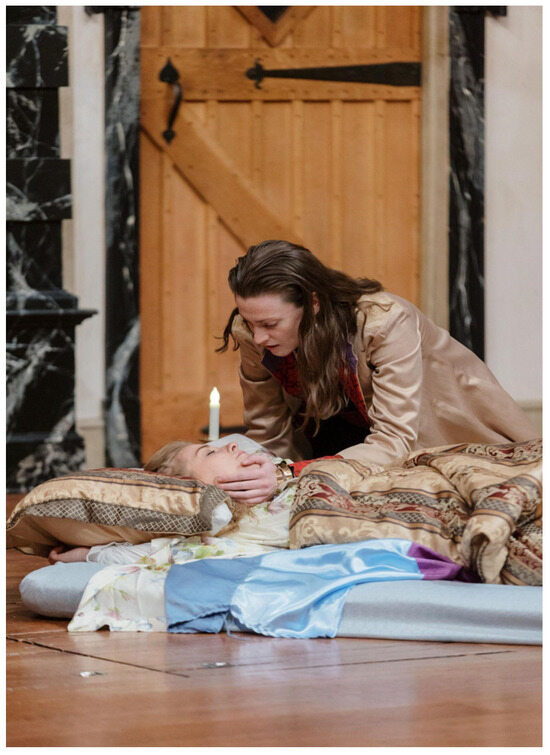
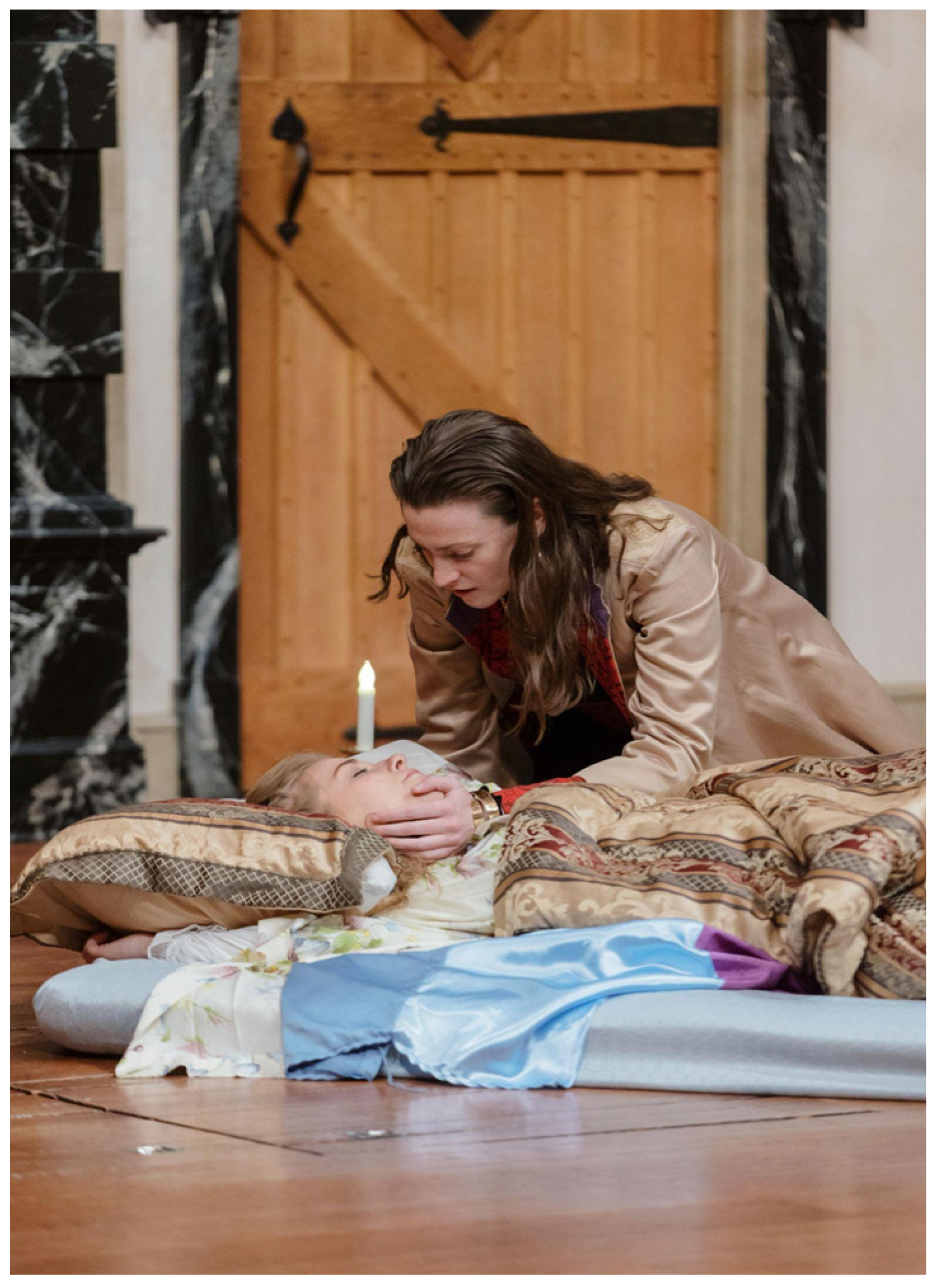
Finally, knowing this scene would eventually be performed at the Blackfriars Playhouse—a space where chandeliers and sconces provide what the theater calls “universal lighting,” a uniform lighting wash that covers both stage and audience—the candle, as you will note in Figure 1 below, helped convey darkness by serving as a visible symbol for “nighttime.”
Figure 1.
Lydia Sophia Christensen, asleep as Imogen, and Katie Mitchell as Iachimo. Photo credit: Miscellaneous Media Photography.
Just as in the composition, the candle became the single most important object to assist Iachimo’s plan, a plan that eventually impacted the lives of the characters he sought to disgrace. In fact, on opening night, a hush fell over the audience as Imogen fell asleep and Iachimo climbed out of the trunk to quietly stalk through her bedchamber with a candle in hand, noting evidence to dishonor Imogen and cuckold Posthumus. The audience’s almost breathless observation, combined with the quality of Iachimo’s stealthy movement and the addition of the single burning flame, prompted us to imagine a terrifying scene taking place in the dead of night.
12. Conclusions
In sharing these examples, I hope to demonstrate how a physical dramaturgy process generates fruitful discussions and unique insights that support a creative interpretation of Shakespeare’s text through embodied exploration. Rather than adhering to a hierarchical rehearsal process driven by a director’s vision, this approach relies on a multiplicity of voices driven by active participation from every individual performer. In this process, directors learn as much about the text from the actors who give physical expression to their imagination as they do by merely reading and interpreting the text. Furthermore, as a director within a collaborative process, my role is to shape and edit choices made by the entire creative team into a coherent and engaging story, and to do so, everyone must have the freedom to explore text for its creative potential. Having a stake in the process encourages ownership, which we find makes for more resonant performance and, thus, a more compelling product.
By decentering the text and focusing on physical expression, students develop their creative instincts as they learn how to harness their body to shape time and space -- the tools used to craft a story. As they master these tools by crafting compositions together, students make important discoveries about their creative potential as a community. Moreover, the process of repeatedly meeting each other inside of devised work impacts the staging process in unique and exciting ways. Students come to rehearsals armed with their ideas and an eagerness to explore them within the context of a scene. This sense of agency and enthusiasm is the value of a process-oriented approach, which can be applied to any rehearsal process, not just Shakespeare. And, while this work serves as a “bridge” between an intellectual understanding of Shakespeare’s poetic and muscular language and its visceral expression, the goal of this process is to support a student’s ability to meaningfully translate a rich story in a way that feels uniquely and importantly their own. Even though Shakespeare served as the foundation for this essay, above all, embodied exploration allows students to build on their own authority, making space for their ideas to flourish in a holistic way.
Funding
This research received no external funding.
Data Availability Statement
Data is contained within the article.
Acknowledgments
I would like to thank Cynthia Lewis for her encouragement and skillful editorial support. I would also like to thank my colleague, Matt Davies, whose collaborative contributions to this work as co-teacher and co-director ground, strengthen, and add much-needed humor to our process. My dearest thanks to the students of REN 531 Early/Modern Ensemble 2025, whose creative devising contributions and glorious performance of Cymbeline inspired this essay. Finally, to my colleague Peter Kirwan for his vigilant editorial eye and steadfast support.
Conflicts of Interest
This author declares no conflicts of interest.
Notes
| 1 | Initial conversations around the topic of physical dramaturgy occurred at the Association of Movement Educators meeting taking place during the Association for Theatre in Higher Education (ATHE) conference in 2017. |
| 2 | Frantic Assembly is a UK-based physical theatre company co-founded by Artistic Director Scott Graham, committed to creating “brave and bold theatre. At times, it is physically dynamic and brutal. At others, it is proudly tender and fragile.” I incorporate their training into my pedagogical practice, especially when engaging in partner work with touch. |
| 3 | Synetic Theatre was founded by Georgian theatre makers Paata and Irina Tsikurishvili in the 1990s, and their brand of innovative physical storytelling engages with the classics through performances both speaking and silent. Their 200 production of Hamlet…the rest is silence was a landmark production that elevated the company’s work on an international level. |
| 4 | Saratoga International Theatre Institute, founded in 1992, is an ensemble-based theatre company committed to training performers, creating new and original work, and engaging in international exchange. Anne Bogart helmed the company before it dissolved in 2019. |
| 5 | Bogart and Landau describe a Composition as “the act of writing as a group, in time and space, using the language of the theater. Participants create short pieces for the stage by putting together raw material into a form that is repeatable, theatrical, communicative, and dramatic. The process of creating Compositions is, by nature, collaborative: within a short amount of time, participants arrive at solutions to certain delineated tasks. These solutions, arranged and performed as a piece, are what constitute a Composition” (p. 137). |
References
- Bogart, Anne, and Tina Landau. 2005. The Viewpoints Book, a Practical Guide to Viewpoints and Composition. New York: Theatre Communications Group. [Google Scholar]
- Bowditch, Rachel, Jeff Casazza, and Annette Thornton, eds. 2018. Physical Dramaturgy: Perspectives from the Field. Abingdon-on-Thames: Routledge. [Google Scholar]
- Lehmann, Hans-Theis, and Patrick Primavesi. 2009. Dramaturgy on Shifting Grounds: Performance Research. Abingdon: Taylor and Francis, vol. 14. [Google Scholar]
- Oddey, Allison. 1994. Devising Theatre: A Practical and Theoretical Handbook. Abingdon-on-Thames: Routledge. [Google Scholar]
- Shakespeare, William. 2017. Cymbeline. Edited by Valerie Wayne. The Arden Shakespeare, Third Series. London: Bloomsbury Publishing Plc. [Google Scholar]
Disclaimer/Publisher’s Note: The statements, opinions and data contained in all publications are solely those of the individual author(s) and contributor(s) and not of MDPI and/or the editor(s). MDPI and/or the editor(s) disclaim responsibility for any injury to people or property resulting from any ideas, methods, instructions or products referred to in the content. |
© 2025 by the author. Licensee MDPI, Basel, Switzerland. This article is an open access article distributed under the terms and conditions of the Creative Commons Attribution (CC BY) license (https://creativecommons.org/licenses/by/4.0/).