Pedestrian Physiological Response Map Prediction Model for Street Audiovisual Environments Using LSTM Networks


Abstract
1. Introduction
1.1. Research Background and Significance of the Study
1.2. Review of Existing Research
1.2.1. Street-Level Perception and Urban Emotion Studies
1.2.2. Multisensory and Audiovisual Environmental Cognition
1.2.3. Temporal Modeling Approach
1.3. The Present Work
- Construct an LSTM-based predictive model linking dynamic audiovisual environmental features with EEG/HRV physiological responses and emotional states, based on a dataset incorporating audiovisual factors and exposure duration, thereby enabling the generation of physiological response maps.
- Further analyze the contributions and cumulative effects of the duration, timing of changes, and magnitude of variation of audiovisual factors on emotional responses, providing actionable quantitative guidance for street micro-renewal and the coordinated optimization of environmental elements.
2. Materials and Methods
2.1. Data Collection
2.2. Data Processing and Outlier Removal
2.2.1. EEG Preprocessing and Feature Extraction
2.2.2. ECG Processing with Artifact-Resistant Filtering and Robust Analysis
2.2.3. Audiovisual Feature Extraction and Multisource Data Integration
2.3. Model Development
2.3.1. Correlation Analysis Between Environmental Factors and Physiological Indicators
2.3.2. LSTM-Based Emotion Prediction Model Architecture
Temporal Sequence Construction and Recurrent Modeling
Computational Learning Formulation
- Normalization. For each feature j, training-set statistics (mean μj, standard deviation σj > 0) are computed; inputs are standardized as = (xt,j − μj)/σj, and the target is scaled consistently before metrics are computed in the original scale where applicable.
- Correlation-guided input scaling. Let w = (w1, …, wF)T be nonnegative weights derived from Pearson, Kendall, or mutual-information analysis with the target, normalized to a stable scale. The gated input is = w ⊙ (Hadamard product), applied before the linear projection.
- Recurrent mapping and readout. A linear layer maps to zt = ReLU(Win + bin). Stacked LSTM layers update hidden states ht and cell states ct via (ht, ct) = LSTM(zt, ht−1, ct−1). A ReLU-activated linear readout maps the trajectory of hidden states to the next H time steps (batch-first LSTM, dropout on inputs, and linear output layer).
- Training objective. With predictions and targets y, the empirical Huber risk is Lδ = (1/N) Σi ρδ( − yi), where ρδ(a) = ½a2 if |a| ≤ δ, and ρδ(a) = δ(|a| − ½δ) otherwise. MAE is used as an alternative. Optimization uses Adam with L2 weight decay and gradient clipping; learning rate scheduling and early stopping are based on the validation loss.
- Evaluation metrics. We report MAE, RMSE = √[(1/N) Σi ( − yi)2], and R2 = 1 − Σi(yi − )2/Σi(yi − )2 on held-out routes after inverse scaling where applicable.
Training Protocol and Hyperparameter Specification
3. Results
3.1. Correlation and Differential Analysis of Environmental Factors
3.1.1. Pearson Correlation Analysis
3.1.2. Kendall’s Tau-b Correlation Analysis
3.1.3. Mutual Information Analysis
3.1.4. Differential Analysis
3.2. LSTM Model
3.3. Physiological Response Map Prediction
3.4. Reveal the Mechanisms of Physiological Feedback
3.4.1. Lag Effect of Physiological Responses
3.4.2. Transition Effect of Physiological Responses
3.5. Design Decision Support
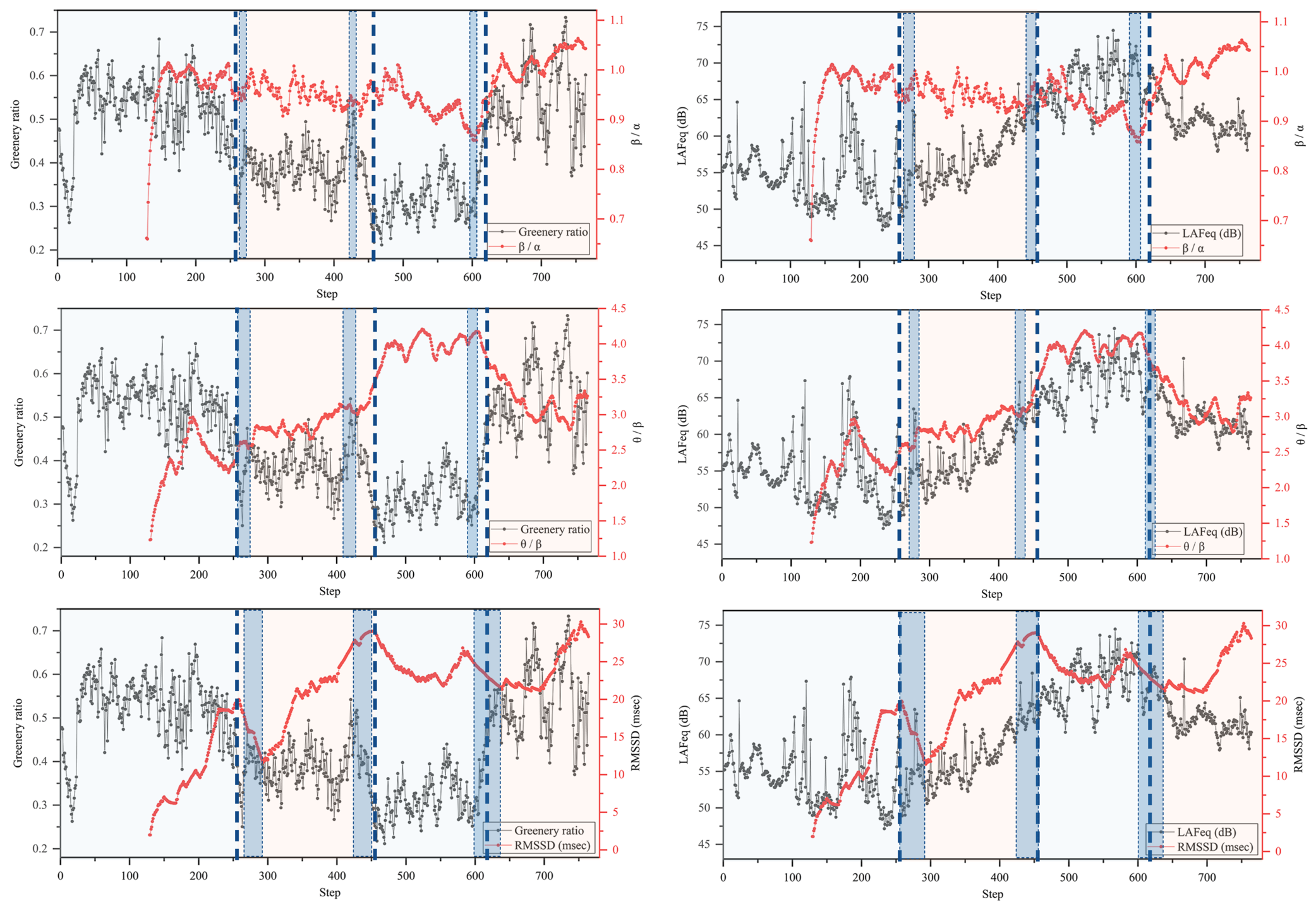
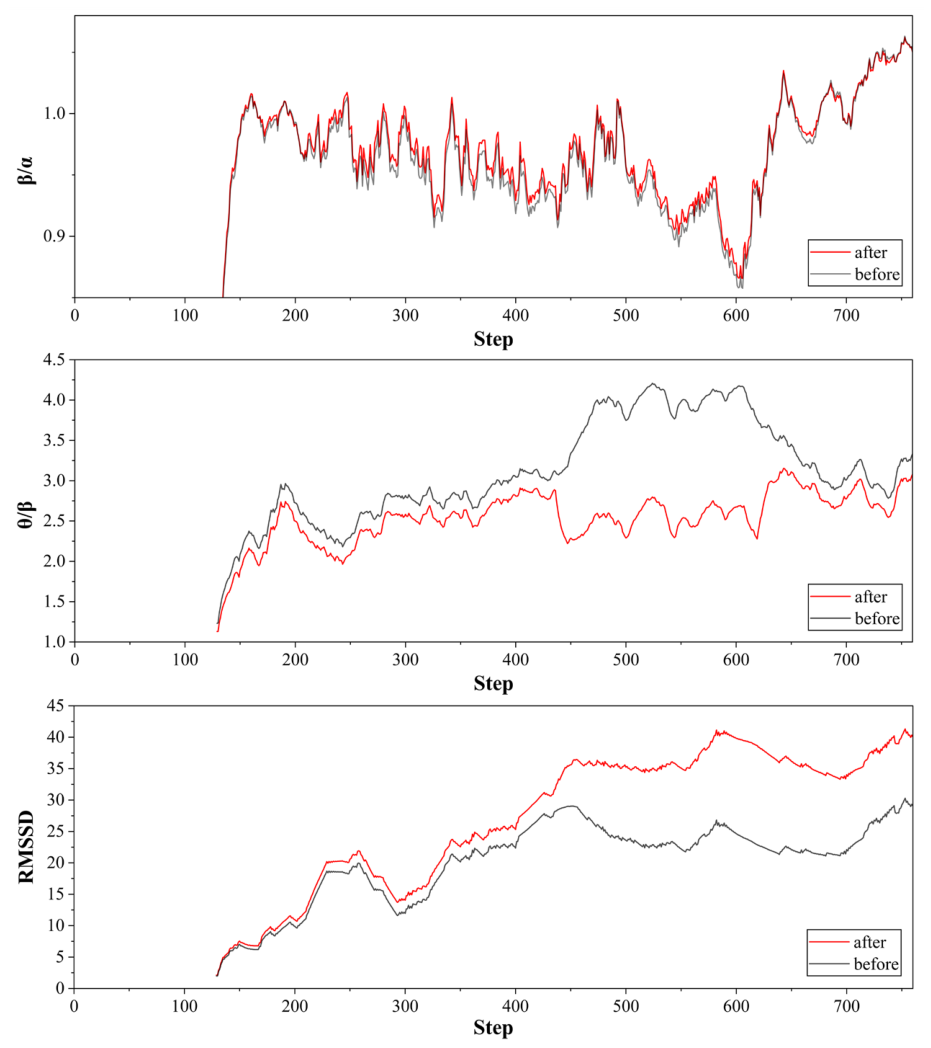
- Given the significant positive effect of greenery visibility on physiological responses, and considering its relatively low implementation cost, the study increased greenery visibility by 10 per cent in the initial segment of the route (128–434 s). The revised predictions indicate that the EEG β/α ratio increased by an average of 0.68 per cent, the EEG θ/β ratio decreased by an average of 8.4 per cent, while RMSSD increased by 11.4 per cent.
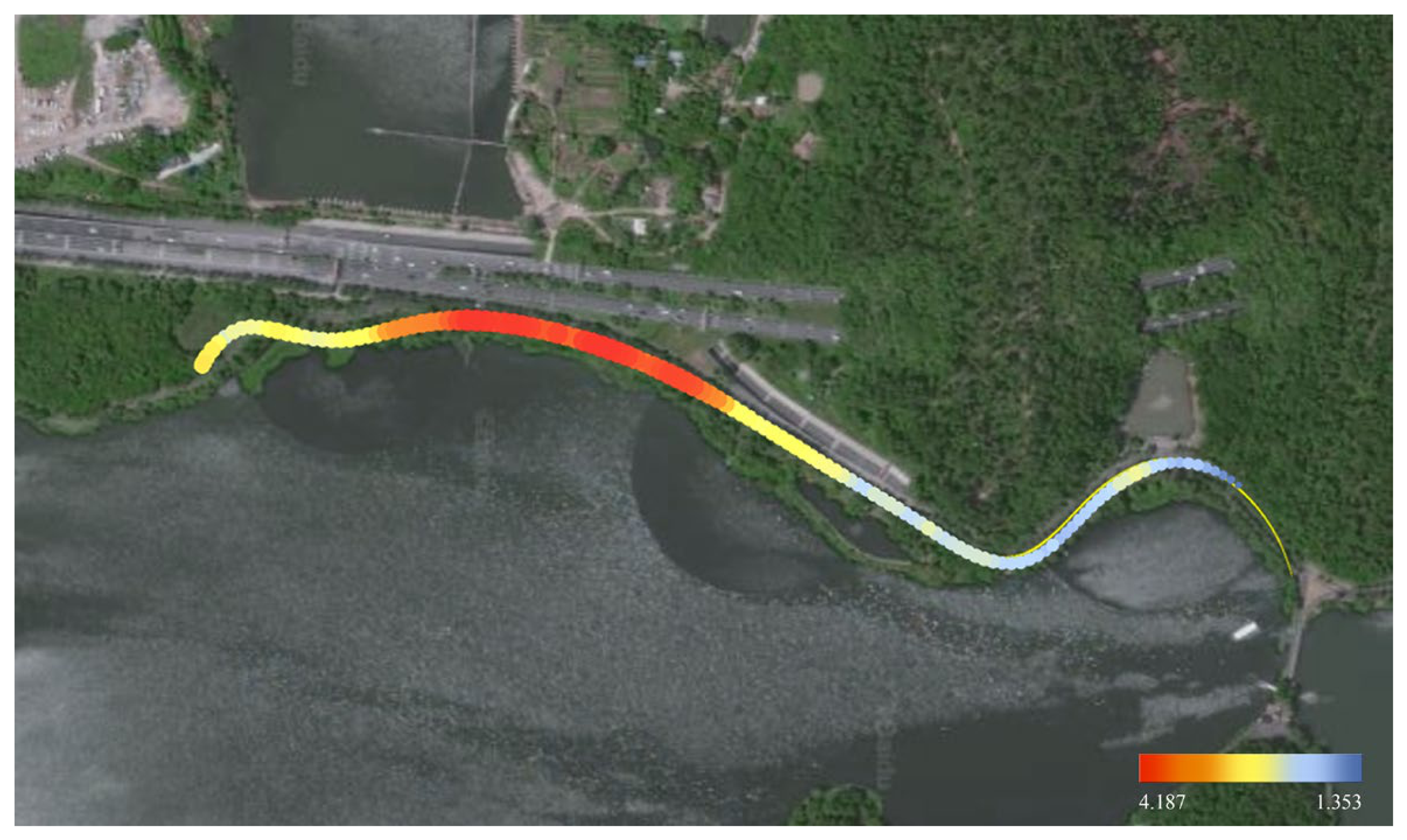
- In the mid-segment (434–616 s), which is located near the exit of the elevated roadway, greenery visibility is notably lower, and the sound pressure level rises sharply compared to other sections. Field investigation revealed that the elevated roadway segment on the right side of the study area is relatively short and carries a low traffic volume. Therefore, a strategy to remove the elevated roadway was adopted, aiming to reduce the sound pressure level by 10 dB, increase greenery visibility by 20 per cent, and incorporate additional birdsong to further improve the auditory environment. The simulated post-intervention results show that the EEG β/α ratio increased by 0.72 per cent on average, the EEG θ/β ratio decreased by 35.1 per cent on average, and RMSSD increased by 48.3 per cent.
- Similarly, due to the positive influence of greenery visibility and its cost-effectiveness, the study increased greenery visibility by 10 per cent in the final segment (616–760 s). The updated predictions show that the EEG β/α ratio increased by 0.69 per cent on average, the EEG θ/β ratio decreased by 11 per cent on average, and RMSSD increased by 54.2 per cent.
4. Conclusions & Discussion
4.1. Discussion of Correlations
4.2. Model Performance Enhancement
4.3. Model Prediction
5. Limitations and Future Work
- Limited environmental variables: This study primarily focuses on audiovisual perceptual factors (e.g., greenery visibility, sky visibility, and sound pressure level), while spatial morphological parameters (e.g., street width, segment length, and enclosure) are not included. Future research should incorporate these spatial metrics to achieve a more comprehensive representation of the built environment.
- Limited sample size: The dataset (32 sets of data samples) remains relatively small, which may constrain the robustness of the analysis and limit the ability to capture inter-individual variability in physiological responses. Future studies should expand the sample size to improve the reliability and generalizability of the findings.
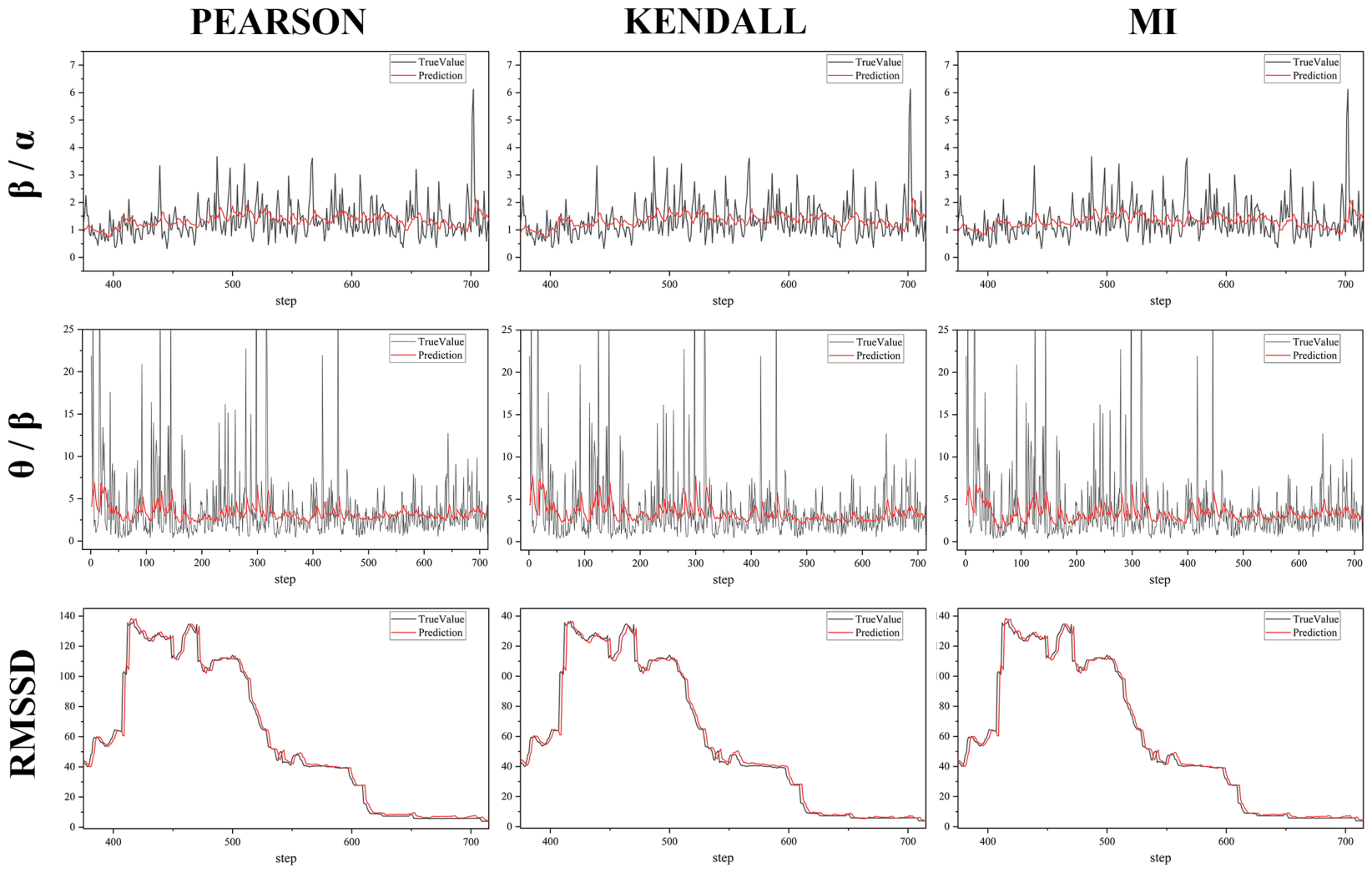
- Limited EEG predictive performance: Although the MI-LSTM model performs well for HRV prediction, its accuracy for EEG indicators remains low, likely due to high temporal variability and individual differences. Future work should explore more advanced feature extraction and modeling approaches to improve EEG prediction.
- Potential temporal synchronization uncertainty: Although a multi-device temporal alignment strategy was implemented to synchronize audiovisual, physiological, and GPS data, residual temporal discrepancies may still exist due to inherent measurement latency and hardware-level timing inaccuracies across different devices. Such minor misalignments could affect the predictive performance.
Author Contributions
Funding
Institutional Review Board Statement
Informed Consent Statement
Data Availability Statement
Acknowledgments
Conflicts of Interest
Abbreviations
| ECG | Electrocardiogram |
| EEG | Electroencephalogram |
| EMG | Electromyography |
| GPS | Global Positioning System |
| HRV | Heart Rate Variability |
| IIR | Infinite Impulse Response |
| LSTM | Long Short-Term Memory |
| MAE | Mean Absolute Error |
| MI | Mutual Information |
| PCHIP | Piecewise Cubic Hermite Interpolating Polynomial |
| PSD | Power Spectral Density |
| ReLU | Rectified Linear Unit |
| RMSE | Root Mean Square Error |
| RMSSD | Root Mean Square of Successive Differences |
| SPL | Sound Pressure Level |
References
- Zhang, Z.; Amegbor, P.M.; Sigsgaard, T.; Sabel, C.E. Assessing the Association between Urban Features and Human Physiological Stress Response Using Wearable Sensors in Different Urban Contexts. Health Place 2022, 78, 102924. [Google Scholar] [CrossRef] [Scilit]
- Feng, J.; Li, Q. Investigate Physiological and Psychological Responses to Environment Scenes, Elements and Components in Different Urban Settings. Sci. Rep. 2025, 15, 3694. [Google Scholar] [CrossRef] [Scilit]
- Zhang, Z.; Zhuo, K.; Wei, W.; Li, F.; Yin, J.; Xu, L. Emotional Responses to the Visual Patterns of Urban Streets: Evidence from Physiological and Subjective Indicators. Int. J. Environ. Res. Public Health 2021, 18, 9677. [Google Scholar] [CrossRef] [Scilit]
- Anand, S.; Pujara, T. Impact of Streetscapes on Anxiety: A Physiological Evidence. In Urban Resilience, Livability, and Climate Adaptation; Pigliautile, I., Piselli, C., Karunathilake, H.P., Fabiani, C., Eds.; Advances in Science, Technology & Innovation; Springer Nature: Cham, Switzerland, 2024; pp. 99–116. [Google Scholar]
- Zhao, G.; Zhang, Y.; Ge, Y.; Zheng, Y.; Sun, X.; Zhang, K. Asymmetric Hemisphere Activation in Tenderness: Evidence from EEG Signals. Sci. Rep. 2018, 8, 8029. [Google Scholar] [CrossRef] [Scilit] [PubMed]
- Koelstra, S.; Muhl, C.; Soleymani, M.; Lee, J.-S.; Yazdani, A.; Ebrahimi, T.; Pun, T.; Nijholt, A.; Patras, I. DEAP: A Database for Emotion Analysis; Using Physiological Signals. IEEE Trans. Affect. Comput. 2012, 3, 18–31. [Google Scholar] [CrossRef] [Scilit]
- Zheng, W.-L.; Zhu, J.-Y.; Lu, B.-L. Identifying Stable Patterns over Time for Emotion Recognition from EEG. IEEE Trans. Affect. Comput. 2019, 10, 417–429. [Google Scholar] [CrossRef] [Scilit]
- Yu, X.; Li, Z.; Zang, Z.; Liu, Y. Real-Time EEG-Based Emotion Recognition. Sensors 2023, 23, 7853. [Google Scholar] [CrossRef] [Scilit]
- Jatupaiboon, N.; Pan-Ngum, S.; Israsena, P. Real-Time EEG-Based Happiness Detection System. Sci. World J. 2013, 2013, 618649. [Google Scholar] [CrossRef] [Scilit] [PubMed]
- Yu, C.; Wang, M. Survey of Emotion Recognition Methods Using EEG Information. Cogn. Robot. 2022, 2, 132–146. [Google Scholar] [CrossRef] [Scilit]
- Suzuki, Y.; Tanaka, S.C. Functions of the Ventromedial Prefrontal Cortex in Emotion Regulation under Stress. Sci. Rep. 2021, 11, 18225. [Google Scholar] [CrossRef] [Scilit]
- Medvedeva, A.; Rudenkiy, N.; Shelepenkov, D.; Kosonogov, V. The Role of Prefrontal Cortex in Emotion Regulation: A More Naturalistic Magnetoencephalographic Study. Behav. Brain Res. 2026, 507, 116169. [Google Scholar] [CrossRef] [Scilit]
- Watanabe, D.K.; Pourmand, V.; Lai, J.; Park, G.; Koenig, J.; Wiley, C.R.; Thayer, J.F.; Williams, D.P. Resting Heart Rate Variability and Emotion Regulation Difficulties: Comparing Asian Americans and European Americans. Int. J. Psychophysiol. 2023, 194, 112258. [Google Scholar] [CrossRef] [Scilit]
- Thayer, J.F.; Lane, R.D. A Model of Neurovisceral Integration in Emotion Regulation and Dysregulation. J. Affect. Disord. 2000, 61, 201–216. [Google Scholar] [CrossRef] [Scilit]
- You, M.; Laborde, S.; Borges, U.; Vaughan, R.S.; Dosseville, F. Cognitive Failures: Relationship with Perceived Emotions, Stress, and Resting Vagally-Mediated Heart Rate Variability. Sustainability 2021, 13, 13616. [Google Scholar] [CrossRef] [Scilit]
- De Brito, J.N.; Pope, Z.C.; Mitchell, N.R.; Schneider, I.E.; Larson, J.M.; Horton, T.H.; Pereira, M.A. The Effect of Green Walking on Heart Rate Variability: A Pilot Crossover Study. Environ. Res. 2020, 185, 109408. [Google Scholar] [CrossRef] [Scilit]
- Barros, A.; Pereira, F.; Rudnicki, K.; Van Renterghem, T.; Machado, D.; Kampen, J.K.; Decorte, P.; Poels, K.; Sousa, E.; Freitas, E.; et al. Psychophysiological Stress Response to Urban Traffic: The Effect of Speed Limits, Road Surface Type, and Greenery. Build. Environ. 2025, 277, 112921. [Google Scholar] [CrossRef] [Scilit]
- Shao, H.; Liu, Y.; Ren, H.; Li, Z. Research on Healing-Oriented Street Design Based on Quantitative Emotional Electroencephalography and Eye-Tracking Technology. Front. Hum. Neurosci. 2025, 19, 1546933. [Google Scholar] [CrossRef] [Scilit] [PubMed]
- Ghamari, H.; Golshany, N.; Naghibi Rad, P.; Behzadi, F. Neuroarchitecture Assessment: An Overview and Bibliometric Analysis. Eur. J. Investig. Health Psychol. Educ. 2021, 11, 1362–1387. [Google Scholar] [CrossRef] [Scilit] [PubMed]
- Zhao, M.; Crossley, T.; Shinohara, H. The Implications of EEG Neurophysiological Data in Human-Centered Architectural Design: A Systematic Review and Bibliometric Analysis. J. Environ. Psychol. 2025, 103, 102550. [Google Scholar] [CrossRef] [Scilit]
- Taherysayah, F.; Malathouni, C.; Liang, H.-N.; Westermann, C. Virtual Reality and Electroencephalography in Architectural Design: A Systematic Review of Empirical Studies. J. Build. Eng. 2024, 85, 108611. [Google Scholar] [CrossRef] [Scilit]
- Llinares, C.; Nolé, M.L.; Pérez-Martínez, M.; Barranco-Merino, R.; Higuera-Trujillo, J.L. An Exploratory Neuroarchitecture Study: Emotional Responses to Residential Spaces Using Psychological and Physiological Indicators. VITRUVIO 2025, 10, e24201. [Google Scholar] [CrossRef] [Scilit]
- Ojha, V.K.; Griego, D.; Kuliga, S.; Bielik, M.; Bus, P.; Schaeben, C.; Treyer, L.; Standfest, M.; Schneider, S.; Konig, R.; et al. Machine Learning Approaches to Understand the Influence of Urban Environments on Human’s Physiological Response. Inf. Sci. 2019, 474, 154–169. [Google Scholar] [CrossRef] [Scilit]
- Fernandes, J.V.M.R.; Alexandria, A.R.D.; Marques, J.A.L.; Assis, D.F.D.; Motta, P.C.; Silva, B.R.D.S. Emotion Detection from EEG Signals Using Machine Deep Learning Models. Bioengineering 2024, 11, 782. [Google Scholar] [CrossRef] [Scilit] [PubMed]
- Topic, A.; Russo, M. Emotion Recognition Based on EEG Feature Maps through Deep Learning Network. Eng. Sci. Technol. Int. J. 2021, 24, 1442–1454. [Google Scholar] [CrossRef] [Scilit]
- Huang, Z.; Ma, Y.; Wang, R.; Li, W.; Dai, Y. A Model for EEG-Based Emotion Recognition: CNN-Bi-LSTM with Attention Mechanism. Electronics 2023, 12, 3188. [Google Scholar] [CrossRef] [Scilit]
- Du, X.; Ma, C.; Zhang, G.; Li, J.; Lai, Y.-K.; Zhao, G.; Deng, X.; Liu, Y.-J.; Wang, H. An Efficient LSTM Network for Emotion Recognition From Multichannel EEG Signals. IEEE Trans. Affect. Comput. 2022, 13, 1528–1540. [Google Scholar] [CrossRef] [Scilit]
- Kim, Y.; Choi, A. EEG-Based Emotion Classification Using Long Short-Term Memory Network with Attention Mechanism. Sensors 2020, 20, 6727. [Google Scholar] [CrossRef] [Scilit]
- Firdou, T.B.; Ashra, M.; Kalpan, A.V. Deep Learning-Based Emotion Recognition Using CNN, LSTM for Multimodal Text, Speech, and Facial Analysis. In Proceedings of the 2024 5th International Conference on Data Intelligence and Cognitive Informatics (ICDICI), Tirunelveli, India, 18–20 November 2024; IEEE: New York, NY, USA, 2024; pp. 1291–1295. [Google Scholar]
- Siirtola, P.; Tamminen, S.; Chandra, G.; Ihalapathirana, A.; Röning, J. Predicting Emotion with Biosignals: A Comparison of Classification and Regression Models for Estimating Valence and Arousal Level Using Wearable Sensors. Sensors 2023, 23, 1598. [Google Scholar] [CrossRef] [Scilit]
- Jeon, J.Y.; Hong, J.Y. Classification of Urban Park Soundscapes through Perceptions of the Acoustical Environments. Landsc. Urban. Plan. 2015, 141, 100–111. [Google Scholar] [CrossRef] [Scilit]
- Sun, C.; Meng, Q.; Yang, D.; Wu, Y. Soundwalk Path Affecting Soundscape Assessment in Urban Parks. Front. Psychol. 2023, 13, 1096952. [Google Scholar] [CrossRef] [Scilit]
- ISO 12913-2; Acoustics Soundscape Part 2: Data Collection and Reporting Requirements. The International Organization for Standardization: Geneva, Switzerland, 2018.
- Alvarsson, J.J.; Wiens, S.; Nilsson, M.E. Stress Recovery during Exposure to Nature Sound and Environmental Noise. Int. J. Environ. Res. Public Health 2010, 7, 1036–1046. [Google Scholar] [CrossRef] [Scilit]
- Pise, A.W.; Rege, P.P. Comparative Analysis of Various Filtering Techniques for Denoising EEG Signals. In Proceedings of the 2021 6th International Conference for Convergence in Technology (I2CT), Maharashtra, India, 2–4 April 2021; IEEE: New York, NY, USA, 2021; pp. 1–4. [Google Scholar]
- Delorme, A.; Makeig, S. EEGLAB: An Open Source Toolbox for Analysis of Single-Trial EEG Dynamics Including Independent Component Analysis. J. Neurosci. Methods 2004, 134, 9–21. [Google Scholar] [CrossRef] [Scilit]
- Sanei, S.; Chambers, J. EEG Signal Processing; John Wiley & Sons: Chichester, UK; Hoboken, NJ, USA, 2007. [Google Scholar]
- Webster, J.G.; Nimunkar, A.J. (Eds.) Medical Instrumentation: Application and Design, 5th ed.; Wiley: Hoboken, NJ, USA, 2020. [Google Scholar]
- Fritsch, F.N.; Carlson, R.E. Monotone Piecewise Cubic Interpolation. SIAM J. Numer. Anal. 1980, 17, 238–246. [Google Scholar] [CrossRef] [Scilit]
- Welch, P. The Use of Fast Fourier Transform for the Estimation of Power Spectra: A Method Based on Time Averaging over Short, Modified Periodograms. IEEE Trans. Audio Electroacoust. 1967, 15, 70–73. [Google Scholar] [CrossRef] [Scilit]
- Pan, J.; Tompkins, W.J. A Real-Time QRS Detection Algorithm. IEEE Trans. Biomed. Eng. 1985, BME-32, 230–236. [Google Scholar] [CrossRef] [Scilit] [PubMed]
- Elgendi, M. Fast QRS Detection with an Optimized Knowledge-Based Method: Evaluation on 11 Standard ECG Databases. PLoS ONE 2013, 8, e73557. [Google Scholar] [CrossRef] [Scilit] [PubMed]
- Zidelmal, Z.; Amirou, A.; Ould-Abdeslam, D.; Moukadem, A.; Dieterlen, A. QRS Detection Using S-Transform and Shannon Energy. Comput. Methods Programs Biomed. 2014, 116, 1–9. [Google Scholar] [CrossRef] [Scilit]
- Castaldo, R.; Melillo, P.; Pecchia, L. Acute Mental Stress Assessment via Short Term HRV Analysis in Healthy Adults: A Systematic Review. In 6th European Conference of the International Federation for Medical and Biological Engineering; Lacković, I., Vasic, D., Eds.; IFMBE Proceedings; Springer International Publishing: Cham, Switzerland, 2015; Volume 45, pp. 1–4. [Google Scholar]
- Shaffer, F.; Ginsberg, J.P. An Overview of Heart Rate Variability Metrics and Norms. Front. Public Health 2017, 5, 258. [Google Scholar] [CrossRef] [Scilit]
- Munoz, M.L.; Van Roon, A.; Riese, H.; Thio, C.; Oostenbroek, E.; Westrik, I.; De Geus, E.J.C.; Gansevoort, R.; Lefrandt, J.; Nolte, I.M.; et al. Validity of (Ultra-)Short Recordings for Heart Rate Variability Measurements. PLoS ONE 2015, 10, e0138921. [Google Scholar] [CrossRef] [Scilit]
- Yao, Y.; Liang, Z.; Yuan, Z.; Liu, P.; Bie, Y.; Zhang, J.; Wang, R.; Wang, J.; Guan, Q. A Human-Machine Adversarial Scoring Framework for Urban Perception Assessment Using Street-View Images. Int. J. Geogr. Inf. Sci. 2019, 33, 2363–2384. [Google Scholar] [CrossRef] [Scilit]
- Kraskov, A.; Stoegbauer, H.; Grassberger, P. Estimating Mutual Information. Phys. Rev. E 2004, 69, 066138. [Google Scholar] [CrossRef] [Scilit]
- Croux, C.; Dehon, C. Influence Functions of the Spearman and Kendall Correlation Measures. Stat. Methods Appl. 2010, 19, 497–515. [Google Scholar] [CrossRef] [Scilit]
- Cohen, I.; Huang, Y.; Chen, J.; Benesty, J. Noise Reduction in Speech Processing; Springer Topics in Signal Processing; Springer: Berlin/Heidelberg, Germany, 2009; Volume 2. [Google Scholar]






| Hyperparameter | Value |
|---|---|
| Input window length T (window_size) | 128 |
| Prediction horizon H (pre_len) | 1 (alignment script; other experiments may use H > 1) |
| Hidden size | 128 |
| Number of LSTM layers (layer_num) | 1 |
| Batch size | 64 |
| Maximum epochs | 40 |
| Optimiser | Adam (lr = 0.001, weight_decay = 5 × 10⁻⁴) |
| Loss | Huber (δ = 1.0) or MAE (L1Loss) |
| Gradient clipping | max norm 1.0 |
| LR scheduler | ReduceLROnPlateau (factor = 0.5, patience = 5, min_lr = 1 × 10⁻⁶) on validation MAE |
| Early stopping | patience 10 (validation MAE) |
| Train/validation/test split (by route) | 0.75/0.20/0.05 |
| Random seed | 42 |
| Target winsorisation (percentiles) | 0.5–99.5 |
| Correlation gate (optional) | corr_type = mi, corr_abs = True, corr_pow = 1.0, corr_min = 0.05 |
| Greenery Visibility | Road Visibility | Building Visibility | Sky Visibility | LAFeq (TH) | |
|---|---|---|---|---|---|
| β/α | 0.0231 | 0.0165 | 0.0005 | 0 | 0.0073 |
| θ/β | 0.0123 | 0.0026 | 0 | 0.0101 | 0.0223 |
| RMSSD | 0.0979 | 0.1415 | 0.0754 | 0.1006 | 0.1567 |
| Model Name | Result Parameters | β/α | θ/β | RMSSD |
|---|---|---|---|---|
| PEARSON | MAE (normalization) | 0.37 | 0.12 | 0.30 |
| MAE (average) | 0.51 | 2.27 | 15.46 | |
| RMSE | 0.74 | 4.32 | 19.14 | |
| R2 | 0.02 | 0.02 | 0.69 | |
| KENDALL | MAE (normalization) | 0.39 | 0.13 | 0.28 |
| MAE (average) | 0.53 | 2.30 | 14.42 | |
| RMSE | 0.76 | 4.33 | 17.35 | |
| R2 | 0.02 | 0.01 | 0.74 | |
| MI | MAE (normalization) | 0.38 | 0.13 | 0.26 |
| MAE (average) | 0.52 | 2.28 | 13.19 | |
| RMSE | 0.74 | 4.33 | 16.25 | |
| R2 | 0.02 | 0.02 | 0.77 |
Disclaimer/Publisher’s Note: The statements, opinions and data contained in all publications are solely those of the individual author(s) and contributor(s) and not of MDPI and/or the editor(s). MDPI and/or the editor(s) disclaim responsibility for any injury to people or property resulting from any ideas, methods, instructions or products referred to in the content. |
© 2026 by the authors. Licensee MDPI, Basel, Switzerland. This article is an open access article distributed under the terms and conditions of the Creative Commons Attribution (CC BY) license.
Share and Cite
Xing, J.; He, X.; Li, X.; Wang, T.; Mao, S.; Li, L. Pedestrian Physiological Response Map Prediction Model for Street Audiovisual Environments Using LSTM Networks. Buildings 2026, 16, 1648. https://doi.org/10.3390/buildings16091648
Xing J, He X, Li X, Wang T, Mao S, Li L. Pedestrian Physiological Response Map Prediction Model for Street Audiovisual Environments Using LSTM Networks. Buildings. 2026; 16(9):1648. https://doi.org/10.3390/buildings16091648
Chicago/Turabian StyleXing, Jingwen, Xuyuan He, Xinxin Li, Tianci Wang, Siqing Mao, and Luyao Li. 2026. "Pedestrian Physiological Response Map Prediction Model for Street Audiovisual Environments Using LSTM Networks" Buildings 16, no. 9: 1648. https://doi.org/10.3390/buildings16091648
APA StyleXing, J., He, X., Li, X., Wang, T., Mao, S., & Li, L. (2026). Pedestrian Physiological Response Map Prediction Model for Street Audiovisual Environments Using LSTM Networks. Buildings, 16(9), 1648. https://doi.org/10.3390/buildings16091648