1. Introduction
Research on bridge landscapes has increasingly shifted from descriptive appreciation toward interpretable relationships between structural logic and visible form. While bridges fundamentally serve transportation and connectivity purposes, contemporary long-span crossings—especially landmark bridges in major river corridors—are also expected to convey cultural meaning and landscape identity. However, bridge landscape studies still lack a systematic framework that links component-level mechanical cognition to morphological expression in a way that is explainable, comparable, and applicable at the conceptual design stage.
To address this gap, this study adopts the Force–Form Integration concept as a qualitative theoretical foundation for interpreting suspension bridge landscape morphology. In this study, “force” refers to the structural mechanics rationale that is legible at the conceptual level (e.g., load paths, constraint conditions, stiffness characteristics, and intuitive deformation tendencies) rather than to detailed structural analysis or verification. “Form” refers to the morphological configuration through which this mechanical logic becomes visually readable and culturally expressive, particularly in key local components such as pylons and crossbeams. The purpose of Force–Form Integration here is therefore interpretative: it provides a conceptual lens for explaining how mechanically rational configurations can correspond to distinct landscape imagery.
The proposed Force–Form Integration principle is conceptually adjacent to well-known design positions such as “form follows function” and the structural-art tradition, but it is not intended as a general aesthetic manifesto. Instead, it is formulated as a component-level interpretative framework for cable-supported bridges, where “force” is operationalized as legible mechanical cognition (load paths, constraints, stiffness tendencies, deformation intuition), and “form” is operationalized as the morphological configuration of key subsystems (here, pylons and crossbeams) through which that cognition becomes visually readable. The novelty therefore lies not in restating “function determines form”, but in providing a decomposable and comparable vocabulary (typology + parameters + force–form reading) that supports consistent interpretation across a bridge inventory and enables later quantitative descriptors to be meaningfully attached to morphological units [
1,
2].
The Yangtze River Basin offers a uniquely rich and representative context for such an investigation due to its large number of long-span bridges, wide geographic coverage, and diverse typologies. Large-span crossings are often constrained by site-specific boundary conditions, including hydrogeological settings and risk exposure (e.g., scour, extreme hydrological events, navigation requirements, and environmental hazards) [
3,
4]. These contextual constraints are acknowledged as part of the real-world background, while the present study remains focused on component-scale morphological interpretation rather than geotechnical or risk assessment.
The current research on bridge landscape features can be summarized as follows. Xu [
5,
6] synthesized the mainstream contemporary trends and characteristic concerns in bridge aesthetics, including structural elegance, refinement, and the expression of local identity, and further proposed relevant theories for urban bridge architecture [
7]. Ding et al. [
8,
9] discussed a design-oriented perspective on landscape bridge structural systems and introduced the concept of “deconstruction–reconstruction” as an approach to form generation rather than as a prescriptive structural theory. Zhu and Liu [
10] systematically reviewed the development of bridges from ancient to contemporary periods and outlined key topics in bridge aesthetics, including basic aesthetic principles, architectural aesthetic elements, structural aesthetic design, color and materiality, and landscape design. Xu [
11] proposed a theoretical framework that periodizes bridge aesthetics into three stages—early modern, modern, and contemporary—and discussed their corresponding aesthetic connotations. However, these studies have mainly focused on pedestrian bridges and park bridges. Because such bridges usually have smaller spans, lighter loads, and greater formal diversity, existing studies have often remained at the level of individual case analyses or discussions of the design philosophy of specific landmark bridges. As a result, a comprehensive and systematic theoretical framework for bridge aesthetics has not yet been fully established. Moreover, systematic research specifically addressing the landscape characteristics of large-span bridges remains relatively limited, particularly for cable-stayed and suspension bridges with spans exceeding one kilometer that primarily serve major river-crossing functions.
Based on the available literature, only a limited number of scholars have conducted preliminary explorations in this specific area. In terms of case-based research in bridge aesthetics, Honigmann [
12] demonstrated a close relationship between aesthetic decisions and structural performance and further decomposed bridge aesthetics into elemental components. Lu and Zhou [
13] summarized development trends in pedestrian bridges and proposed major contemporary design considerations related to design philosophy, structural configuration, and environmental landscape innovation. Huang [
14] emphasized that conceptual design is the most challenging stage of bridge design, requiring a strong engineering foundation, extensive experience, creativity, and imagination. Li [
15] examined the detailed workflow for shaping cable-stayed bridge pylons through a three-dimensional parametric approach using the Shennong Lake Bridge as a case study, and showed that the integration of bridge morphology and aesthetics is central to the conceptual design of landscape bridges. Heggade [
16] argued that structural configuration and aesthetic design should be balanced during the conceptual design stage, highlighted the guiding role of cultural connotations and natural principles such as the golden ratio and the Fibonacci sequence in form optimization, and further proposed a “Four-Element Model” consisting of Inspiration, Validation, Creation, and Realization to systematize the realization of landmark bridges from concept to completion. Hong et al. [
17] focused on rapid prototyping in computer-aided bridge design by developing an entity-based modeling system on the Grasshopper platform, which dynamically linked bridge form with force-flow diagrams and enabled the rapid generation and comparison of multiple cable-stayed bridge schemes, thereby seeking a balance between aesthetics and efficiency. Williams [
18] likewise emphasized that aesthetic design should remain grounded in safety principles and fundamental design requirements so that proposed solutions can achieve a balance between technical feasibility and construction practicality. In addition, modern technological developments have provided new tools for conceptual design. Tang [
19] summarized the key stages of bridge conceptual design and highlighted the role of digital and collaborative design workflows, without placing particular emphasis on any single software platform.
Internationally, research related to bridge aesthetics and force–form reasoning can be broadly classified into three strands. Billington et al. [
1,
20,
21] emphasized the form–force philosophy and the tradition of structural art, arguing that aesthetic quality may arise from structural efficiency, constructability, and the legibility of force flow. A second strand of research focused on practice-oriented visual and aesthetic evaluation. Studies in this strand developed structured assessment approaches based on appearance appraisal, visual impact procedures, and workflow-oriented landscape review, with the aim of translating qualitative judgments into explicit evaluation criteria and decision-making procedures [
22,
23,
24]. A third strand advanced computational approaches to bridge design, including parametric and generative design, form-finding, and performance-informed exploration, in some cases combining these methods with quantitative descriptors of visual features and geometric proportions [
14,
16,
17,
18,
19,
25].
Further international studies have expanded the discussion in directions that are particularly relevant to the present research. Moore et al. [
26] discussed computational support for bridge aesthetics and highlighted the long-standing difficulty of making aesthetic reasoning more explicit and operable within design processes. Hailemariam and Nuramo [
27] examined the role of a multicriteria framework in sustainable urban bridge design, indicating that bridge aesthetic and visual quality should be assessed through more systematic criteria and integrated evaluation procedures rather than treated as a purely intuitive concern. Arslan [
28] examined bridges as city landmarks from the perspective of aesthetics and iconicity, showing that bridge form also operates as a perceptual and symbolic component of the urban landscape. Collectively, these international studies indicate that bridge aesthetic research has progressed from conceptual reflection and computational support to more structured evaluation and landscape-oriented interpretative
However, these strands still leave a methodological gap for long-span bridges: existing work often remains at the level of general philosophy, project-oriented evaluation workflows, or tool-driven parametric exploration, while a compact, component-level framework that is simultaneously decomposable, comparable across a bridge inventory, and reproducible from explicit measurement rules remains limited, particularly for pylons and crossbeams that dominate both force transmission and visual identity in long-span suspension bridges. To address this gap, the present study operationalizes Force–Form Integration at the component level by combining subsystem decomposition (Sets A–C), typological normalization, and explicit geometric parameterization linked to computable indicators, enabling systematic cross-case comparison within the Yangtze River sample and facilitating future transfer to other regional bridge inventories.
Taking the assemblage of landscape bridges within the Yangtze River bridge clusters as the empirical basis, this study aims to explore aesthetic principles applicable to long-span bridges with spans exceeding one kilometer. Quantitative approaches to aesthetics have been widely applied across multiple engineering and artistic fields. For example, Li [
29] proposed a computational aesthetics-based evaluation framework to address stylistic diversity and multidimensional metrics in assessing the aesthetic quality of physical interfaces. Hu [
30] developed a morphological aesthetics evaluation model by integrating an improved Criteria Importance Through Intercriteria Correlation–Technique for Order Preference by Similarity to Ideal Solution method with computational aesthetics to reduce the subjectivity, uncertainty, and randomness in existing evaluations of computer numerical control machine tool appearance. Wu [
31] introduced a computational aesthetics framework for the multidimensional analysis of sand painting, incorporating features such as color schemes, color themes, and color wheel patterns to enable numerical computation and statistical analysis based on the input of multiple artists. Building on these multidisciplinary advances in aesthetic quantification, the present study further narrows the focus to the construction of an analytical framework for landscape bridge aesthetics. Drawing on a substantial number of real bridge cases, it seeks to advance bridge aesthetics from primarily perceptual interpretation toward a more systematic, theoretical, and quantitative line of inquiry.
This study recognizes that a central challenge in bridge engineering aesthetics lies in the absence of a systematic and quantifiable theoretical and evaluative framework. As a result, aesthetic judgment has long relied heavily on subjective experience, making it difficult to achieve scientifically grounded decision-making and coordinated optimization alongside objectives such as structural performance and economic efficiency [
8,
32]. At the level of design practice, however, parametric design methods have emerged as widely explored technical tools, particularly in landscape bridge design, and have partially compensated for this methodological deficiency. Current practice exhibits several notable characteristics. First, its development largely follows a tool-driven and application-oriented trajectory. In many cases, design exploration does not proceed from an established aesthetic theory, but instead directly employs the technical capabilities of parametric platforms such as Rhino and Grasshopper to rapidly generate and screen formal alternatives through the adjustment of control parameters [
9]. Second, these applications are mainly directed toward specific tasks such as morphological generation, structural form-finding, and performance optimization. For example, parametric models have been used to coordinate main girder alignment with spatial structural layouts [
33] and to explore materially efficient design strategies in bridge structures [
26]. Although aesthetic considerations may be involved in such studies, their primary emphasis generally remains on engineering performance, with aesthetic effects often emerging only as secondary or indirect outcomes of the optimization process. In addition, parametric and generative design approaches have been applied to a wide range of bridge projects, from large landmark bridges to urban pedestrian bridges, resulting in a growing body of digital models and project-based design experience reported in the literature. However, from a broader perspective, most existing studies still remain at the level of project-specific experience or software-oriented technical application [
34]. While these practices have provided powerful means for form generation and design problem-solving, they have not yet led to a systematic theoretical abstraction of the general relationships among design parameters, generative rules, and aesthetic perception. This condition, in which practice has advanced more rapidly than theory, reflects both the current state of the field and an important direction for future theoretical development. Against this background, the cross-disciplinary studies cited in this paper are introduced not as directly transferable solutions for particular bridge components, but as methodological references for translating qualitative visual or morphological attributes into explicit and comparable parameters. They therefore provide conceptual support for parameter-based interpretation rather than prescriptive design guidance.
With the development of civil and bridge structures, research on bamboo- and timber-related structural forms has gradually expanded. Existing studies can be broadly divided into two directions. One direction has focused on structural and material behavior, examining the effects of material composition, sectional form, and loading conditions on structural performance [
35,
36,
37,
38,
39,
40]. The other direction is more closely related to the present study, as it has addressed the landscape and morphological expression of bridges, especially bamboo and timber landscape bridges. Compared with studies centered on mechanical behavior and structural response, this latter body of work is more directly concerned with visible form, spatial expression, and aesthetic perception, and therefore provides a more relevant reference context for the present research. In parallel with these practice- and form-oriented studies, some scholars have also attempted to interpret bridge aesthetics through the relationship among structural behavior, deformation characteristics, and visible form. Dong [
41] introduced a qualitative and teaching-oriented method based on Force–Form Integration, deformation characteristics, and shape, emphasizing that structural force-resisting behavior and deformation tendencies can be interpreted together with morphological expression. At the international level, practice-oriented approaches to bridge landscape assessment have also been discussed for decades. Early studies developed rule-based or expert system procedures for structured appearance evaluation [
42,
43], while subsequent engineering guidance advanced classification- and workflow-based approaches to visual impact assessment [
44,
45], emphasizing operability through viewpoint definition, evaluation criteria, and assessment procedures. Taken together, these studies provide useful methodological references for translating qualitative structural or visual judgments into more explicit interpretative procedures. However, they have not yet established a concise component-level framework tailored to the dominant local elements of long-span suspension bridges.
Accordingly, the scope of this study is limited to component-level interpretation rather than comprehensive system-level structural analysis or design evaluation. Instead, this study deliberately focuses on the qualitative interpretation of the force–form relationship in key local components—specifically, bridge pylons and pylon crossbeams—which play a dominant role in both force transmission and landscape expression in long-span suspension bridges. Accordingly, the proposed analysis is conceptual and morphological in nature, emphasizing interpretability and landscape logic rather than quantitative structural optimization, global structural behavior, or safety verification.
2. Framework
2.1. The Force–Form Integration Principle: A Landscape Aesthetic Interpretative Framework
For long-span suspension bridges, landscape character does not arise solely from decorative treatment or isolated visual composition. Rather, it is largely generated by the visible organization of primary structural components, especially those that simultaneously perform key mechanical functions and dominate visual perception. Among such components, pylons and crossbeams are particularly important because they act both as critical nodes of force transmission and as concentrated carriers of bridge imagery. From the perspective of landscape aesthetics, their visual expression is therefore not merely a matter of external styling, but a perceptible manifestation of how structural force, stiffness, constraint, and deformation tendencies are organized and communicated through form.
Against this background, the Force–Form Integration principle is introduced in this study as a conceptual and analytical framework for interpreting the landscape characteristics of long-span suspension bridges. This interpretative position is conceptually related to previous discussions on structural art, bridge aesthetics, and the readable relationship between force, form, and structural expression in bridge design theory and education [
1,
20,
21,
41,
46,
47], while the present study further develops it into a component-level framework for the landscape aesthetic analysis of suspension bridge pylons and crossbeams. It is not proposed as a structural design code, optimization procedure, or verification method. Instead, it serves as an interpretative bridge between structural–mechanical cognition and visual–morphological reading. In this framework, “force” refers to qualitative mechanical logic, including load transfer paths, boundary constraints, stiffness distribution, and characteristic deformation tendencies under external actions. “Form” refers to the visible morphological configuration through which such mechanical logic becomes legible at the component level. The central assumption is that, in major bridge components, mechanical organization is not visually neutral: it tends to externalize itself through recurrent geometric features such as inclination, curvature, continuity, sectional proportion, and contour organization, which are subsequently perceived as landscape character.
Accordingly, the present study approaches bridge landscape aesthetics not as a purely subjective visual response, but as a process in which structural logic is transformed into observable form and then interpreted as aesthetic expression. This transformation can be summarized as a three-stage chain: mechanical logic → morphological expression → landscape perception. The first stage concerns how force is transmitted, constrained, and stabilized within the structural system; the second concerns how these tendencies are embodied in geometric organization; and the third concerns how such organization is visually read as stability, lightness, tension, openness, restraint, or monumentality. In this sense, the Force–Form Integration principle provides the theoretical basis for linking mechanical meaning to aesthetic interpretation.
To support qualitative interpretation, the following simplified mechanical relationships are introduced solely as illustrative aids, highlighting intuitive links between force transmission, deformation tendencies, and structural configuration. Here, structural stiffness is used in a conceptual sense as resistance to deformation and is qualitatively influenced by boundary conditions, material properties, sectional characteristics, and span length. The expressions in Equations (1) and (2) are therefore used only as explanatory references to assist force–form interpretation, rather than as design, optimization, or verification formulas.
where
—external load acting on the structure (conceptual);
—structural stiffness in a qualitative sense, representing resistance to deformation;
δ—structural deformation;
EI—bending stiffness;
—span length;
—constraint coefficient reflecting boundary conditions.
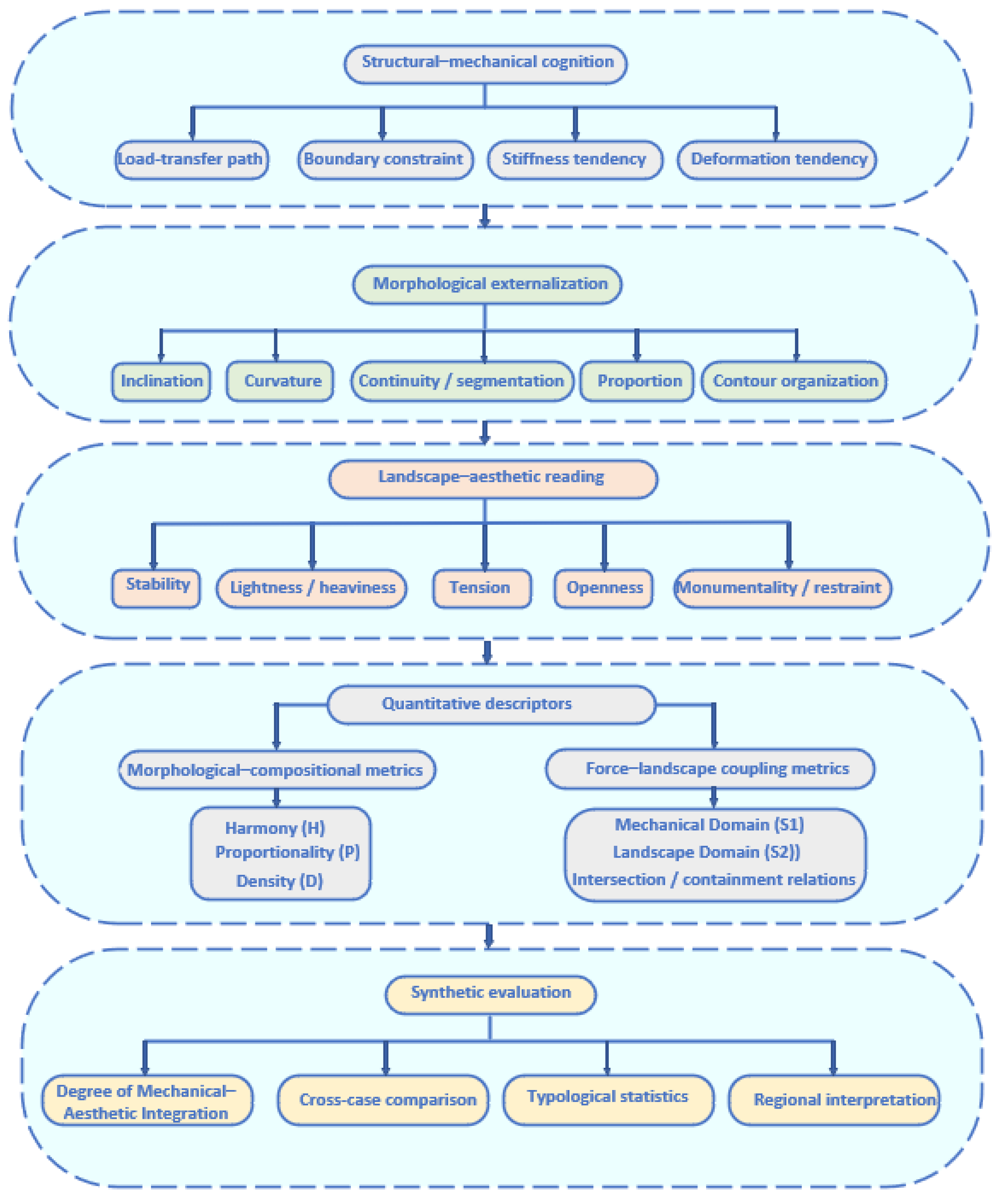
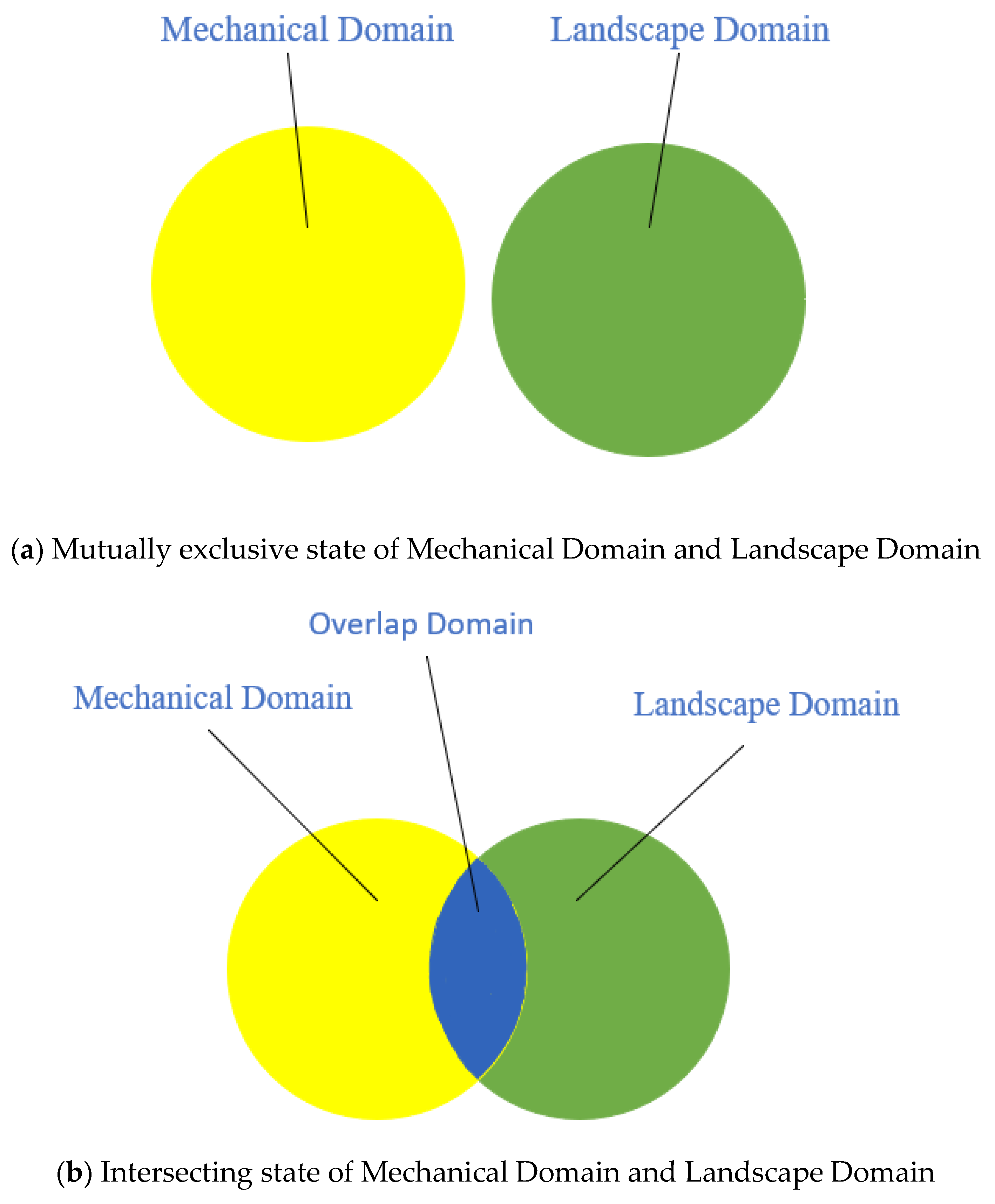
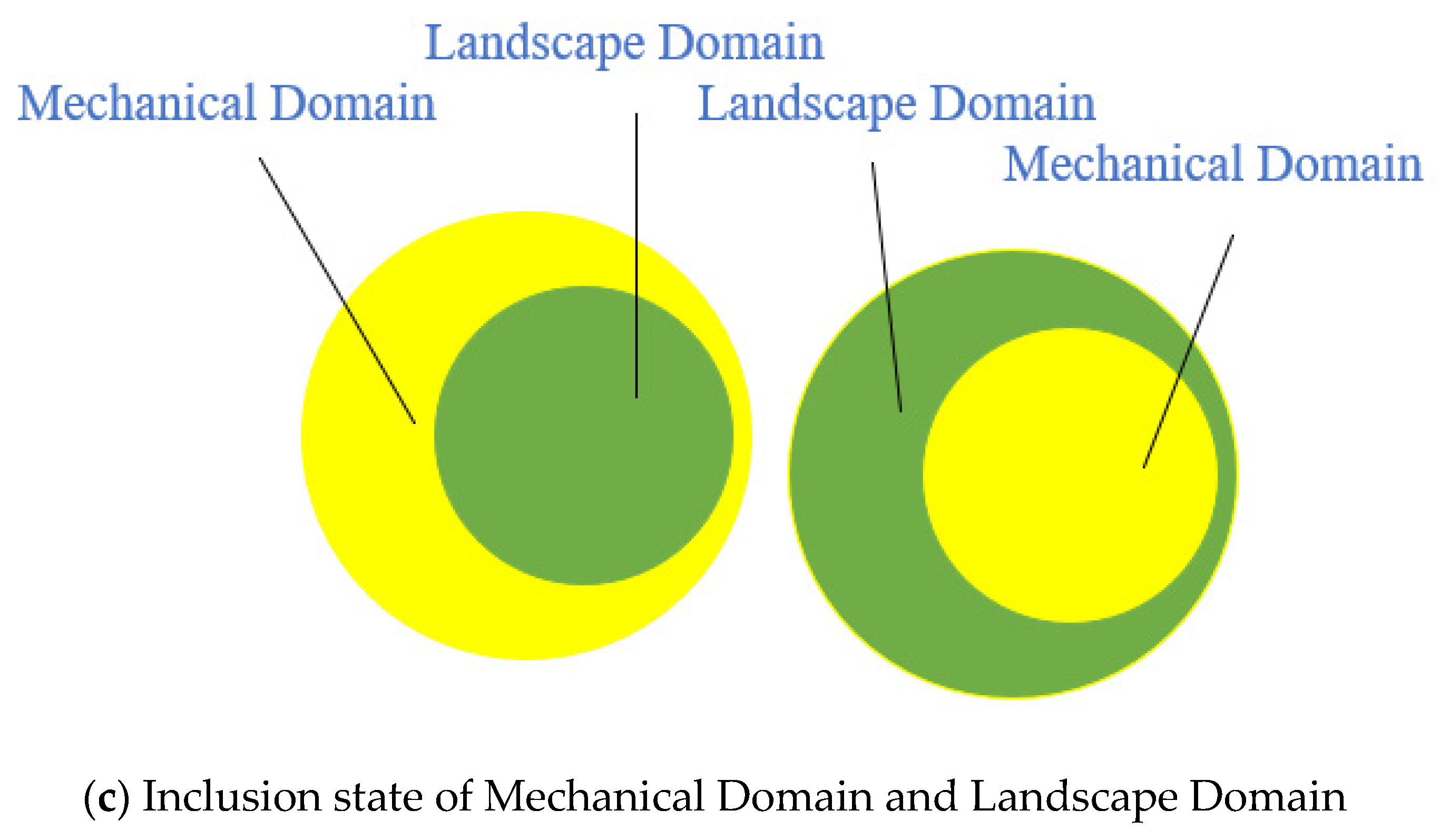
Based on this interpretative premise, the subsequent quantitative indicators used in this study are not treated as arbitrary geometric descriptors. Instead, they are selected because they serve as relatively stable visual proxies of force–form coupling. At the level of frontal-elevation composition, the indicators of Harmony, Proportionality, and Density are used to describe centroidal balance, proportional coordination, and structural area coverage, respectively. These metrics quantify different aspects of visible morphological organization through which mechanical tendencies become visually legible. At the level of force–landscape correspondence, the relationship between the Mechanical Domain and the Landscape Domain is further introduced to evaluate the extent to which primary load-bearing regions overlap with dominant visual image regions. In this way, the study links compositional morphology and mechanical–aesthetic coupling within a unified interpretative framework.
On this basis, the Force–Form Integration Degree proposed later in this study is defined as a synthesized measure of the correspondence between qualitative mechanical logic and observable morphological expression. Its calculation does not attempt to quantify structural safety or actual internal force values. Rather, it evaluates how strongly and consistently visible morphology reflects identifiable mechanical tendencies at the component level. In methodological terms, the subsequent quantitative analysis is organized at two complementary levels. First, Harmony, Proportionality, and Density are used to quantify the compositional organization of visible form in the frontal elevation. Second, the topological relationship between the Mechanical Domain and the Landscape Domain is used to calculate the Degree of Mechanical–Aesthetic Integration, thereby evaluating the extent to which mechanically governed regions coincide with visually dominant landscape regions. Together, these steps connect qualitative force–form reading with explicit geometric descriptors and a comparative integration index.
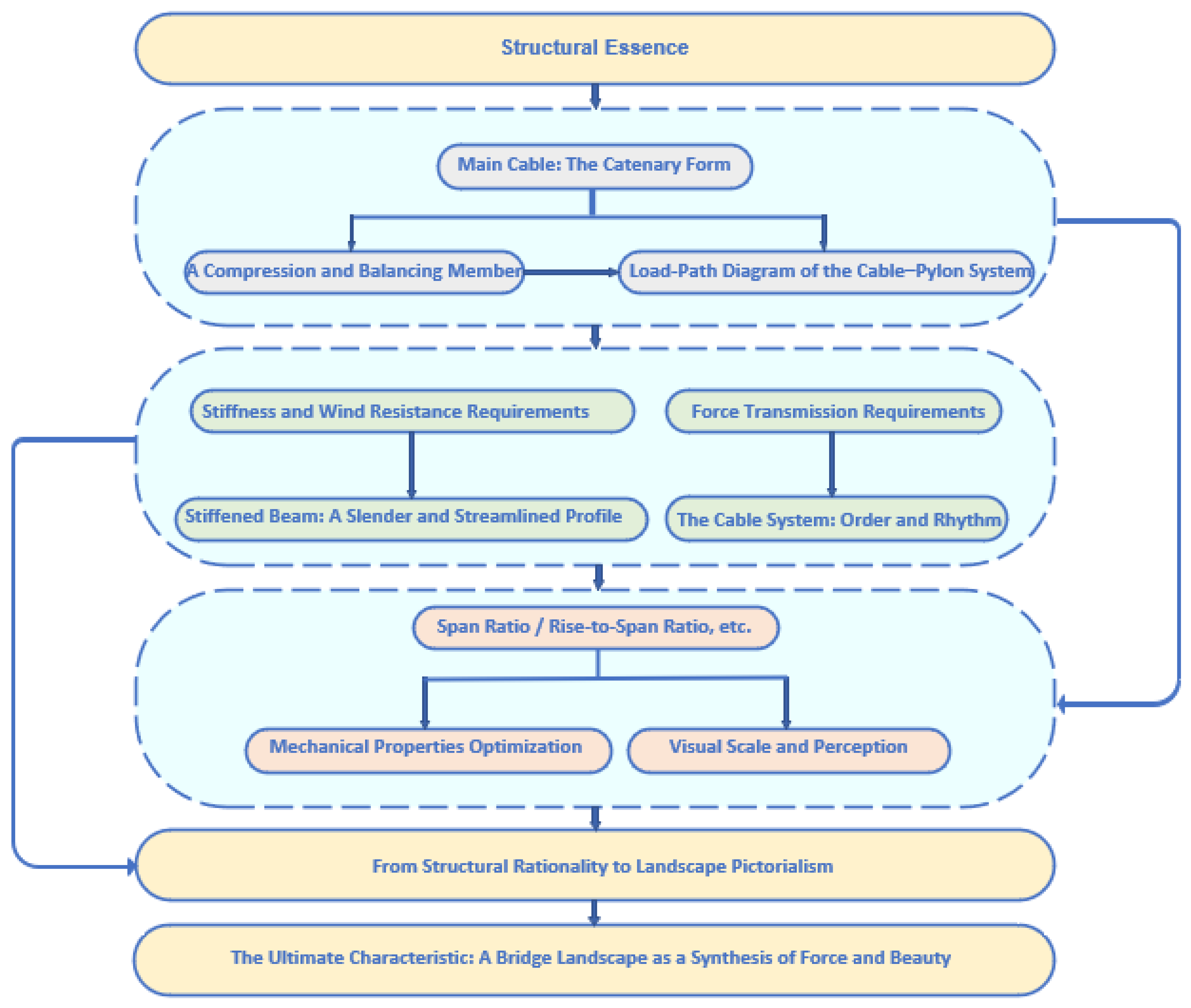
In this sense, the proposed framework enables bridge landscape aesthetics to be discussed not only in descriptive or intuitive terms, but also through a structured analytical pathway that connects mechanical meaning, morphological organization, and comparative visual evaluation. From this perspective, the Force–Form Integration framework differs from general statements such as “form follows function” or from broad structural art narratives. Its purpose is not to restate that structural efficiency may generate beauty, but to provide a component-level analytical pathway through which the visual landscape characteristics of suspension bridges can be decomposed, parameterized, and comparatively interpreted. This is why the framework is operationalized in the present study through subsystem decomposition, typological normalization, geometric parameterization, and integration degree evaluation. Together, these steps establish a bridge between qualitative landscape aesthetic analysis and subsequent quantitative assessment. As illustrated in
Figure 1, the proposed framework translates qualitative mechanical cognition into visible morphological features, then into measurable geometric descriptors, and finally into a composite evaluation of mechanical–aesthetic integration.
2.2. The Core Principles of Bridge Aesthetics
The deep-seated logic of bridge aesthetics can be articulated through a comprehensive perspective that integrates both induction and deduction. Inductively, one can distill concrete, describable design principles—such as the “dialectical unity of form and function,” the “fusion of force and form,” and “structural elegance”—from numerous classic bridge cases [
46]. From a broader engineering and design perspective, several studies have emphasized that considerations of structural elegance are closely intertwined with efficiency and economy in bridge design [
21]. In this study, this perspective is further interpreted as positioning structural elegance as a core guiding ideal for formal exploration.
Induction supplies the specific design “vocabulary” and “grammar,” while deduction establishes the overarching “theme” and “artistic conception” of the creative endeavor. The two approaches complement each other, collectively forming a complete cognitive framework that extends from the technical foundation to artistic expression. This framework lays a solid theoretical groundwork for the subsequent selection and systematic construction of quantitative indicators.
2.3. Deepening the Understanding of Suspension Bridge Aesthetics and the Generative Logic of Localized Beauty
The dialectical relationship between “the whole and the part” in architecture provides a foundational perspective for research in bridge aesthetics. Alexander’s A Pattern Language internalizes the logic of “from the whole to the part” within the structure of the book itself [
48], while Dieter Rams’ Ten Principles for Good Design emphasizes how meticulous details and a minimalist whole complement each other [
49]. Collectively, these theories demonstrate that systemic beauty stems not only from macroscopic order but is also deeply rooted in expressive micro-level compositions. Wu Hongde further points out that examining “independent parts” can renew the connotations of systemic understanding [
50], providing a basis for deepening aesthetic research from a partial perspective.
Applying this perspective to long-span suspension bridges, their aesthetics can be divided into the macro-aesthetics of the whole and the micro-aesthetics of the parts. This study focuses on the latter—namely, the generative logic of beauty in the local, detailed components of suspension bridges (e.g., the texture of main cable strands, the ordered spacing of hangers, the tapering form of bridge pylons, and the detailed treatment of anchorages). These parts are not mere derivatives of the whole; they follow their own logic of construction, materials, and vision, creating rich visual tension and cognitive layers through their integration into a “difficult whole” with the overall structure. Just as “independent parts” in architecture often serve as starting points for innovation [
50], an in-depth study of the aesthetics of these local components in suspension bridges (such as the industrial aesthetics of cable clamps or the color psychology of coatings) represents a deepening of our understanding of the bridge’s overall aesthetics. Furthermore, it provides a more nuanced and operable empirical pathway for the quantitative evaluation of bridge aesthetics, facilitating the ultimate unity of “force and beauty”.
2.4. Materials and Form: The Foundation of Force–Form Integration
Existing studies have highlighted that material properties—such as strength, self-weight, durability, and construction methods—play a decisive role in shaping both structural behavior and formal expression in bridge design [
51]. Accordingly, in the present study, considerations of material properties are treated as an essential foundation for interpreting the relationship between force and form at the conceptual level.
Focusing on key bridge components, material properties profoundly influence the morphological expression of pylons and crossbeams. Steel, with its superior tensile and compressive performance, is commonly employed to realize tall, slender pylons and long-span crossbeam structures. Such applications yield forms that embody both the precision of industrial fabrication and the efficiency of mechanical logic. Concrete excels in its formidable compressive strength and plasticity, allowing pylons to be shaped into flowing curves or geometric masses, while crossbeams can utilize formwork techniques to achieve rich profiles and surface textures. Furthermore, the application of new materials such as composites further expands formal freedom. Their lightweight, high-strength, and corrosion-resistant properties offer new possibilities for achieving lightweight, integrated, and aerodynamically optimized forms for both pylons and crossbeams. This material-centric analysis of form generation establishes a solid foundation for the subsequent in-depth discussion of bridge morphology evolution.
2.5. Study Context and Bridge Sample in the Yangtze River Basin
To avoid an over-extended Introduction and to provide a clear basis for the case inventory, this subsection summarizes the Yangtze River context and explains why the Yangtze bridge clusters form an appropriate empirical basis for a landscape-oriented study. The corridor spans highly differentiated geomorphological and socio-economic regions, leading to substantial variation in span demand, navigational constraints, wind environment, constructability, and landscape expectations. These contextual differences contribute to the formal diversity of long-span bridges, particularly in visually dominant components such as pylons and crossbeams.
From 1956 to 2025, bridge development along the Yangtze River can be broadly described in three phases: Phase I (1956–1978), exploration and foundation, with landscape expression often concentrated in bridgehead and auxiliary elements; Phase II (1979–2000), technological breakthroughs and scale expansion, during which landmark intentions became more explicit while efficiency and constructability remained primary drivers; and Phase III (2001–present), comprehensive enhancement, where long-span bridges increasingly serve both infrastructural and landmark roles and the formal refinement of pylons, crossbeams, and cable–pylon composition becomes more prominent. Representative projects illustrate diverse formal strategies (e.g., distinct pylon silhouettes and cable arrangements, or locally inspired geometric cues), but these examples are only provided to indicate observed diversity rather than to claim deterministic causality between a single cultural motif and engineering form.
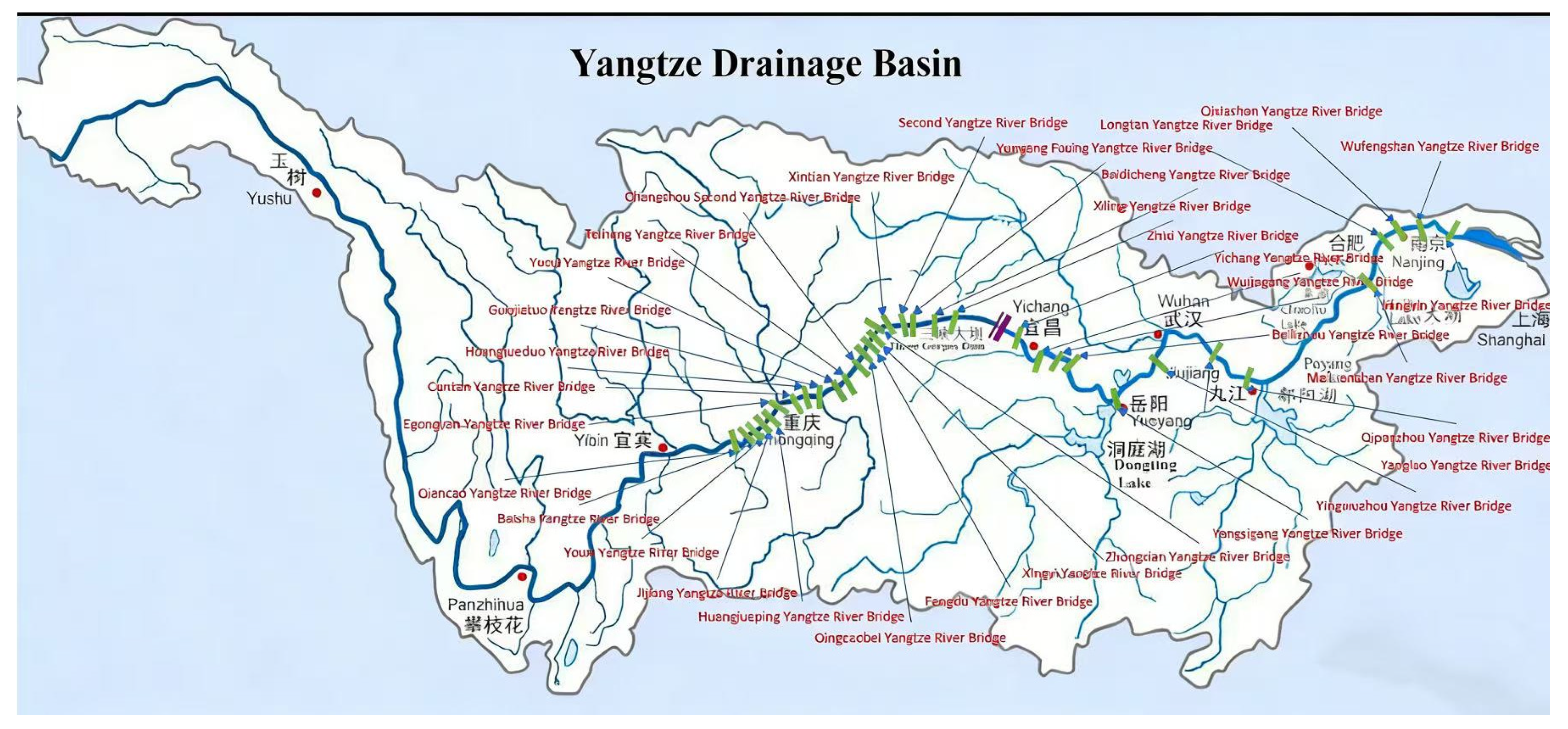
Based on this context, a set of representative long-span suspension bridges distributed across the upper, middle, and lower reaches of the Yangtze River Basin is analyzed in this study, covering diverse pylon and crossbeam configurations. To aid navigation, the inventory map (
Figure 2) and the bridge name–ID index (
Appendix B) summarizes sample coverage. For transparency and reproducibility,
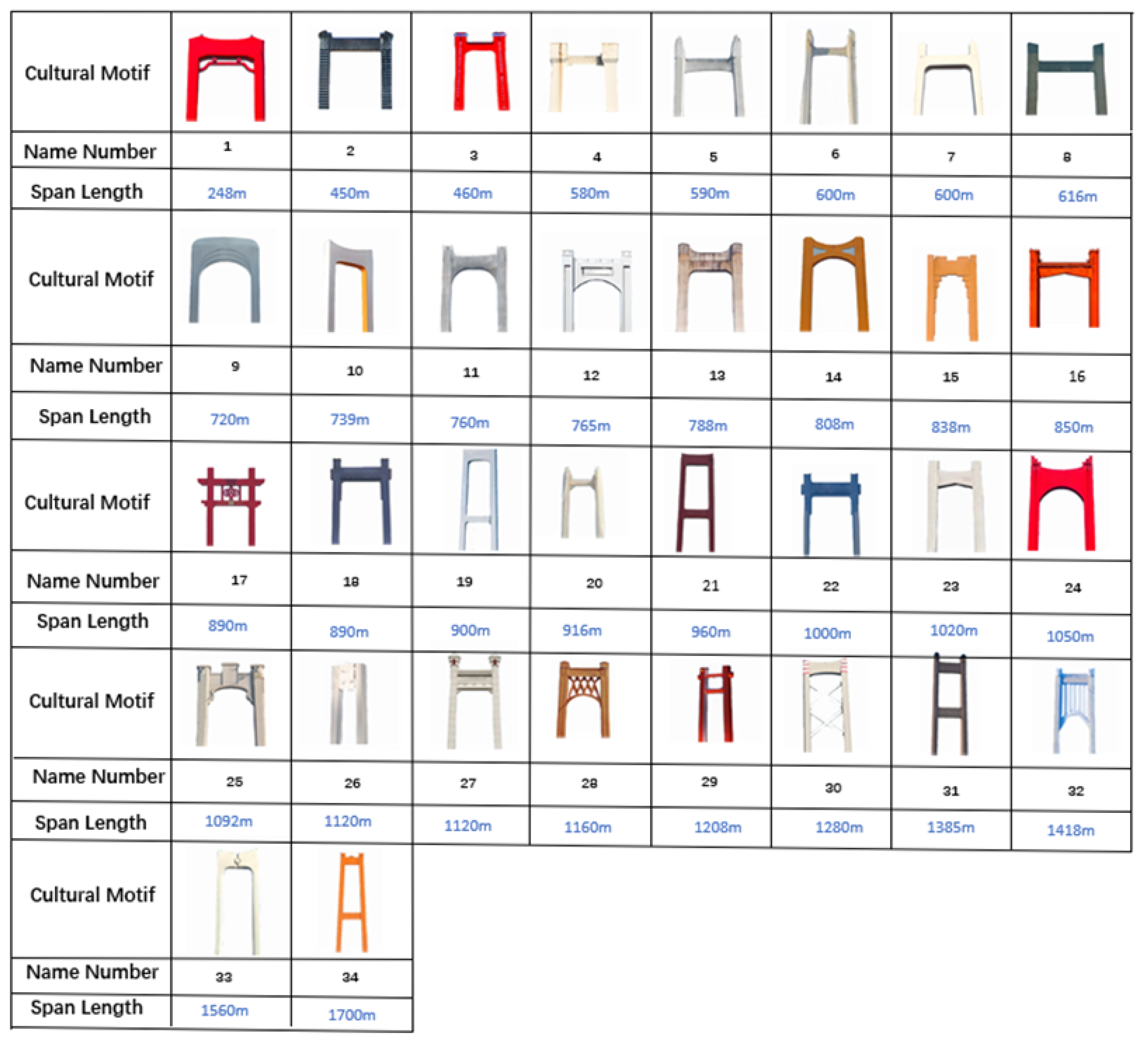
Appendix A provides the case inventory and pylon façade images;
Appendix B summarizes the sample coverage with the bridge name–ID index;
Appendix C compiles representative beam-form cases and auxiliary case details; and
Appendix D reports the detailed metric calculations. To aid navigation, the inventory map (
Figure 2) is provided.
As clarified in the Introduction, the analyses below focus on pylon and crossbeam morphology rather than system-level performance evaluation.
To improve reproducibility, the data sources and measurement workflow are summarized as follows. The sample comprises 34 long-span suspension bridges in the Yangtze River Basin. Near-frontal pylon elevation photographs and, where available, published design drawings or official project documentation were collected from publicly accessible sources and used solely for geometric and compositional measurement. For image-based computation, only cases with a sufficiently near-frontal pylon façade and comparable viewing direction were retained to reduce perspective-induced bias, resulting in 30 computable cases (
Appendix A).
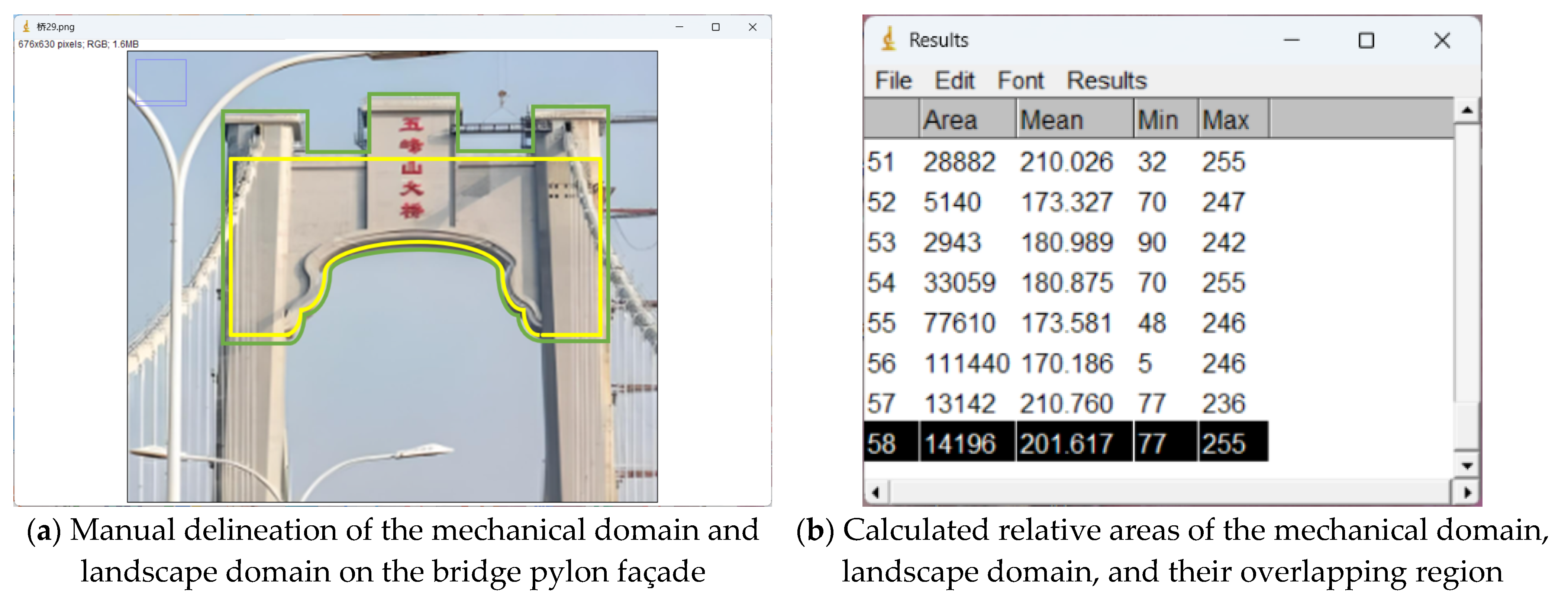
The extraction and computation procedure is standardized in five steps: (1) For each bridge, a near-frontal elevation view is selected and the pylon façade is defined as the region of interest (ROI). (2) A reference coordinate system is established on the elevation image, and an approximate scale is set using a stable dimensional proxy (e.g., published principal dimensions such as main-span length or pylon height, where available) so that geometric ratios remain comparable across cases even when absolute scaling is approximate. (3) Key geometric descriptors of local components are measured from the elevation/geometry, including beam chord length , rise , inclination angle , and a cross-sectional ratio proxy (e.g., ) for practical comparison. (4) For the mechanical–landscape integration index, the Mechanical Domain () and Landscape Domain () are delineated on the pylon façade ROI using ImageJ 1.54g, and the corresponding relative areas are computed; the overlap area is recorded when applicable. (5) The measured descriptors and areas are then substituted into Equations (5)–(17) to obtain Harmony, Proportionality, Density, and the integration-type classification, and the results are aggregated for statistical reporting.
The Yangtze River Basin inventory map and bridge ID–name index are provided in
Appendix B, representative beam form classification cases are summarized in
Appendix C, the force-evolution diagram for the pylon section is given in
Appendix C, and the raw measurements and computed metrics for the 30 analyzed pylons are reported in
Appendix D.
2.6. Typological Scaffold of Bridge Structural Morphology
This section provides the typological scaffold used throughout the manuscript. It defines a shared morphological vocabulary (meta-models and classification rules) for consistently describing and comparing pylon and crossbeam configurations across the Yangtze River bridge sample. The categories established here ensure that subsequent analyses are reproducible rather than case-by-case descriptions. Morphology, derived from Greek morphē and logos, refers to the constitutive logic of form [
52]. Its core philosophy is to explore the relationship between internal laws and external manifestations. As a branch of morphology, structural morphology applies this logic to engineering structures. In this study, structural morphology is understood as the integrated configuration of a structural system, constituted by three fundamental elements: geometric form, topological relationships, and mechanical expression.
Bridge structural systems may be classified, from the perspective of dominant structural and load transfer mechanisms, into four commonly recognized archetypal systems: beam, arch, cable-stayed, and suspension bridges. It should be emphasized that such a classification does not imply that these systems represent independent or irreducible “basic forms.” In particular, cable-supported bridges—such as suspension bridges and cable-stayed bridges—are inherently composite structural systems, in which beam elements, cable systems, and pylons interact to achieve load transfer and global stability. Accordingly, the morphological archetypes (hereafter referred to as “meta-models”) discussed in this study are employed as conceptual abstractions of prevailing force–form relationships, rather than as elementary or isolated structural forms.
The structural morphology of bridges encompasses two fundamental dimensions. Structural “Form” refers to geometric profiles, member arrangement patterns, and dimensional attributes, which together constitute the structure’s external manifestations. Structural “Behavior” refers to the internal force distribution under external loads, representing the intrinsic mechanism of structural response. This dialectical relationship establishes bridges as phenomenological syntheses of form and force. Thus, the Force–Form Integration principle provides the essential theoretical framework for comprehending the morphology of landscape bridges. In cable-supported bridges, these morphological archetypes (meta-models) coexist and interact within a single structural system, rather than operating as isolated forms.
As discussed in the previous section, each primary bridge type—beam, arch, cable-stayed, and suspension—exhibits distinct structural behavior. Building on this foundation, the present section examines their specific morphological archetypes (meta-models). These archetypes constitute a refined classification scheme that decomposes each primary type into constituent morphological families governed by distinct mechanical and compositional principles: beam morphology, arch morphology, cable-stayed morphology, and suspension morphology.
The beam morphology is subdivided into simply supported beams, cantilever beams, truss beams, and beam-string structures. Notably, truss beams and beam-string structures can be derived from simply supported beams and cantilever beams. The arch morphology includes deck arch bridges, through arch bridges, half-through arch I, and half-through arch II. Among these, half-through arch I and half-through arch II are derived from deck arch bridges and through arch bridges, respectively. The cable-stayed morphology comprises cable-stayed bars, cable-stayed beams, symmetric cable-staying (with backstays), and asymmetric cable-staying (without backstays). The suspension morphology is categorized into suspended beams, stressed ribbon bridges, earth-anchored suspension bridges, and self-anchored suspension systems. In this context, earth-anchored suspension bridges refer to cables anchored to the ground, whereas self-anchored suspension systems are anchored to the stiffening girder (or deck) itself.
To reduce subjectivity in classification, the pylon-type labels and the force–form relationship types used in the subsequent statistical analysis—including the Mechanical/Landscape domain delineations (S1/S2)—were coded strictly according to the explicit definitions and decision rules established in
Section 3. Two authors independently completed the coding for all cases using the same set of near-frontal façade images and the same criteria (component category, connection pattern, and domain contour rules). Any disagreements were resolved through rule-based adjudication by returning to the predefined definitions until a consistent assignment was reached. The finalized labels were then fixed and used for the frequency statistics and comparative discussions.
5. Landscape Design Evolution of Suspension Bridge Pylons Based on the Force–Form Integration Principle
5.1. Pylon Morphology Evolution
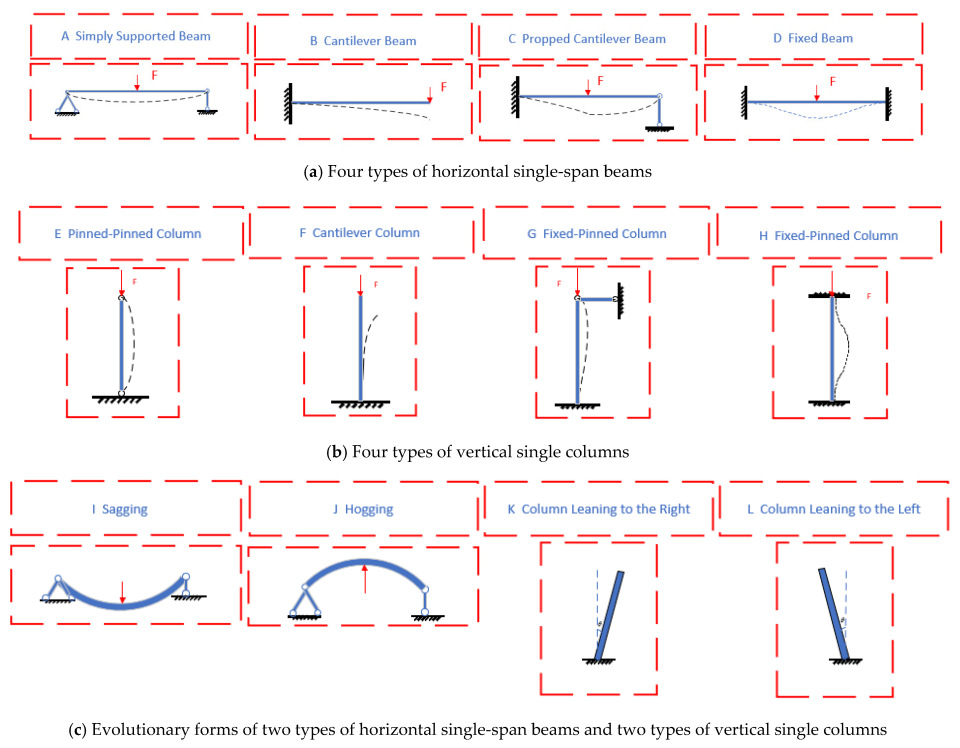
The morphological evolution of suspension bridge pylons can be described using combinations of four fundamental horizontal-beam forms, four vertical single-column forms, and four special cases. These twelve fundamental forms are defined as morphological archetypes (hereafter referred to as “meta-models”), and most suspension bridge pylon configurations can be compositionally derived from them. For a detailed visual representation, see
Figure 4.
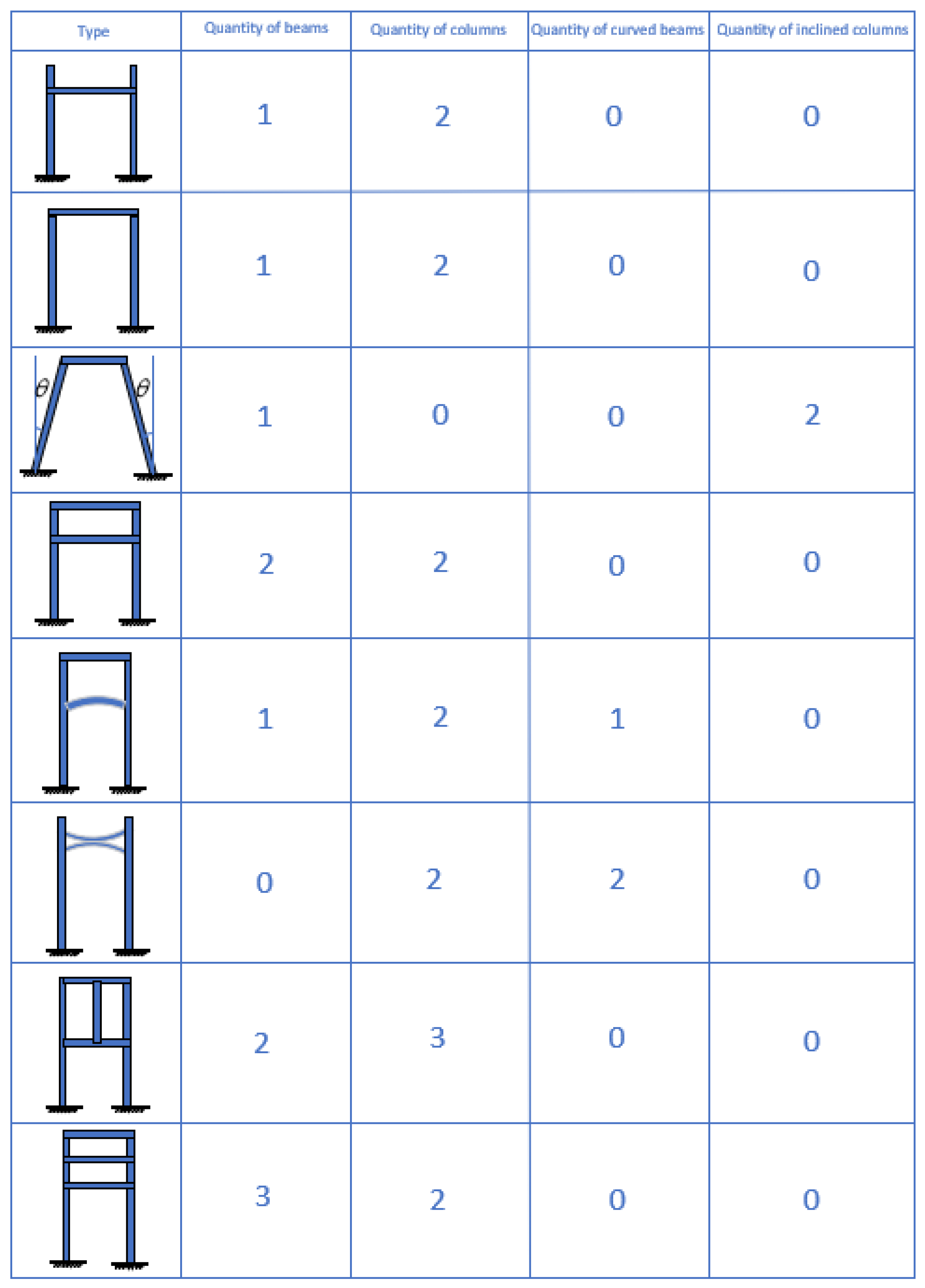
Within the classification system for structural components, a systematic distinction is established along two complementary dimensions: qualitative type and quantitative composition. The qualitative dimension categorizes components into beam-type, column-type, curved beam-type, and inclined column-type elements according to their geometric configuration, connection characteristics, and associated force transfer behavior.
Figure 5 summarizes eight representative pylon types defined under this qualitative dimension, illustrating how variations in geometry correspond to different structural roles within the suspension bridge system.
From a functional and mechanical perspective, these pylon types reflect distinct strategies for load transmission and stiffness organization. Vertical column-dominated configurations primarily emphasize axial compression and direct force transfer to the foundation, while portal-frame and H-frame pylons introduce transverse stiffness through horizontal or inclined members, improving resistance to lateral loads and cable-induced bending effects. Splayed-leg and inclined-column configurations redistribute cable forces through inclined load paths, reducing bending demand in individual members while enhancing overall structural stability.
The quantitative dimension further characterizes pylon morphology by the number and combination of components of the same type. For example, the portal-frame pylon can be expressed as a combination of one beam-type component and two column-type components (A + 2E), while the H-frame pylon corresponds to A + 2F, and the splayed-leg pylon to A + 2H. Among four-component configurations, pylons incorporating both upper and lower curved beams (A + I + J) enhance force redirection and visual continuity, whereas double-crossbeam pylons (2A + 2E) prioritize stiffness amplification and redundancy.
At a finer scale, similar components are further differentiated through explicit geometric control parameters governing beam–column connections. As illustrated in
Figure 5, the primary distinction between Type 1 and Type 2 connections lies in the vertical offset of the beam relative to the column top. In Type 1, a vertical displacement
is introduced between the beam axis and the column top, modifying local force transfer and visual proportion. In Type 2, the beam axis intersects the column top (
= 0), resulting in a more direct and compact force path. The distinction between Type 2 and Type 3 is defined by the presence of in-plane rotational displacement. Type 3 introduces an angular rotation
of the beam about its theoretical central axis, enabling further adjustment of force-flow direction and formal expression. Clockwise rotation is defined as positive, and counterclockwise rotation as negative.
The figure illustrates how different combinations of beam-type, column-type, curved-beam-type, and inclined-column-type elements correspond to distinct load transfer mechanisms, stiffness distributions, and formal expressions in suspension bridge pylons.
From an aesthetic-reading perspective, these connection parameters also provide a controllable interface between mechanical logic and visual articulation. Variations in Δy and θ affect the perceived compactness of the joint, the continuity of the pylon outline, and the rhythm of the pylon “window” region, which are commonly read as cues of stability, openness, and tension. Therefore, the observed diversity of Yangtze River pylons can be interpreted as a constrained morphological evolution: aesthetic differentiation is achieved mainly through systematic variations in component type, quantity, and joint geometry under dominant mechanical actions and boundary conditions, rather than through arbitrary stylistic choices.
5.2. A Comparative Analysis of Pylon Archetypes Based on Landscape Aesthetics
Following the aerodynamic and morphological analysis of the eight archetypal structures, this section further examines and compares them from the perspective of landscape aesthetics. Although all eight archetypes fulfill the overall function of long-span suspension bridges, variations in the morphology of their local component—the pylon—result in distinctly different visual characteristics. This observation aligns with the original intent of this study: to focus on the aesthetic attributes of local components rather than on generalized evaluations of bridge typologies as a whole. In terms of silhouette and rhythm, portal-frame, H-frame, and double-crossbeam pylons (based on meta-models A, E, F) exhibit a stable rhythm characterized by clear, repetitive vertical lines and horizontal beams, conveying a sense of clarity and rational order. In contrast, pylons with both upper and lower curves, those with a straight upper and curved lower beam, and splayed-leg pylons (involving meta-models H, I, J) introduce curved or slanted elements, disrupting the strictly orthogonal arrangement and creating a more cadenced and dynamic silhouette rhythm. Regarding the contrast between solid and void, multi-component pylons (e.g., 2A + 2E + H, 3A + 2E) feature increased structural layers and component counts, creating richer visual porosity and interplay of light and shadow, along with more complex proportions and forms of negative space. Concerning environmental harmony, the choice of different archetypes implies distinct design intents. Archetypes with rigid lines and uniform rhythm (e.g., portal-frame, H-frame) blend more seamlessly with modern, geometrically emphatic urban or industrial landscapes. Archetypes incorporating curved or slanted elements (e.g., those with both upper/lower curves, splayed-leg) are often better suited to harmonize with the undulating lines of natural mountains and rivers or to express specific cultural motifs (such as the “Two Dragons Playing with a Pearl” allegory embodied by the Longtan pylon), thereby facilitating a dialog between the form of the local component and the regional context.
In summary, while the eight pylon archetypes all fall within the category of suspension bridges, variations in the “quality” (component type and connection) and “quantity” (number and combination of components) of their local morphology directly give rise to a diversification of landscape aesthetic characteristics. This aesthetic analytical framework, which originates from the local component, enables us to transcend vague descriptions of a bridge’s “overall style” and instead develop a deeper understanding of how the morphology of key local components (such as the pylon) within a specific structural type systematically shapes its final overall landscape expression. This approach also underscores the value of the classification system established in this study: it provides a practical interpretative tool for relating local component morphology to landscape expression within the force–form framework.
5.3. Evolutionary Mechanics of Bridge Pylon Structural Forces
From a structural engineering perspective, the primary role of a bridge pylon in a suspension bridge system is not limited to resisting axial compression; it also includes redirecting cable forces, transmitting loads to the foundations, and contributing to the global stiffness and stability of the bridge. Acting as the interface between the cable system and the substructure, the pylon transforms tensile forces from the main cables into compressive and bending actions within its members.
More specifically, the pylon is subjected to several major categories of actions whose directions and origins govern its structural role. The most fundamental action is the vertical compressive effect transmitted from the main cable system, which carries the self-weight of the cables, hangers, deck, and superimposed traffic loads. At the top of the pylon, the cable force is redirected through the saddle or cable support region, producing not only vertical compression but also significant horizontal force components along the bridge direction. In addition, the pylon is subjected to transverse lateral actions, most notably wind loads acting on the tower itself and on the cable–deck system, which may induce out-of-plane bending and global sway. Under asymmetric loading conditions—such as unbalanced live loads, construction stage effects, or uneven cable force distribution—the two pylon legs may also experience differential horizontal actions and bending effects. As a result, the pylon must resist a coupled state of axial compression, bending, shear, and stability demand, rather than simple compressive action alone.
From the perspective of form generation, these load characteristics are not mechanically neutral. Different directions and combinations of loading impose different demands on stiffness, stability, load transfer continuity, and joint restraint, and these demands are gradually externalized in the morphology of the pylon. For example, dominant compressive action tends to favor forms with clear vertical load paths and stable support expression; pronounced horizontal components and bending effects increase the importance of transverse restraint, crossbeam participation, and overall geometric balance; and asymmetric force conditions often require morphological adjustments that enhance torsional resistance, directional stiffness, or differential load redistribution. In this sense, pylon shape is not treated in this study as an independent stylistic choice, but as a visible response to the way loads are introduced, redirected, distributed, and stabilized within the structural system.
The design and evolution of a bridge pylon can therefore be understood through three interrelated aspects: first, the composition and evolution of pylon form based on four types of single-beam and four types of single-column meta-models; second, the variation in structural stiffness arising from different component combinations and connection conditions; and third, the global deformation behavior of the pylon under combined loading, in which vertical compression, horizontal cable force components, and lateral actions may jointly induce bending, differential deformation, and stability demands. A brief overview is provided below; for a more detailed explanation, see Bridge Aesthetics [
48]. Because the external form of a bridge pylon should correspond to its load-bearing behavior, a logical derivation for landscape-oriented design can be established by correlating formal variations with these characteristic mechanical responses.
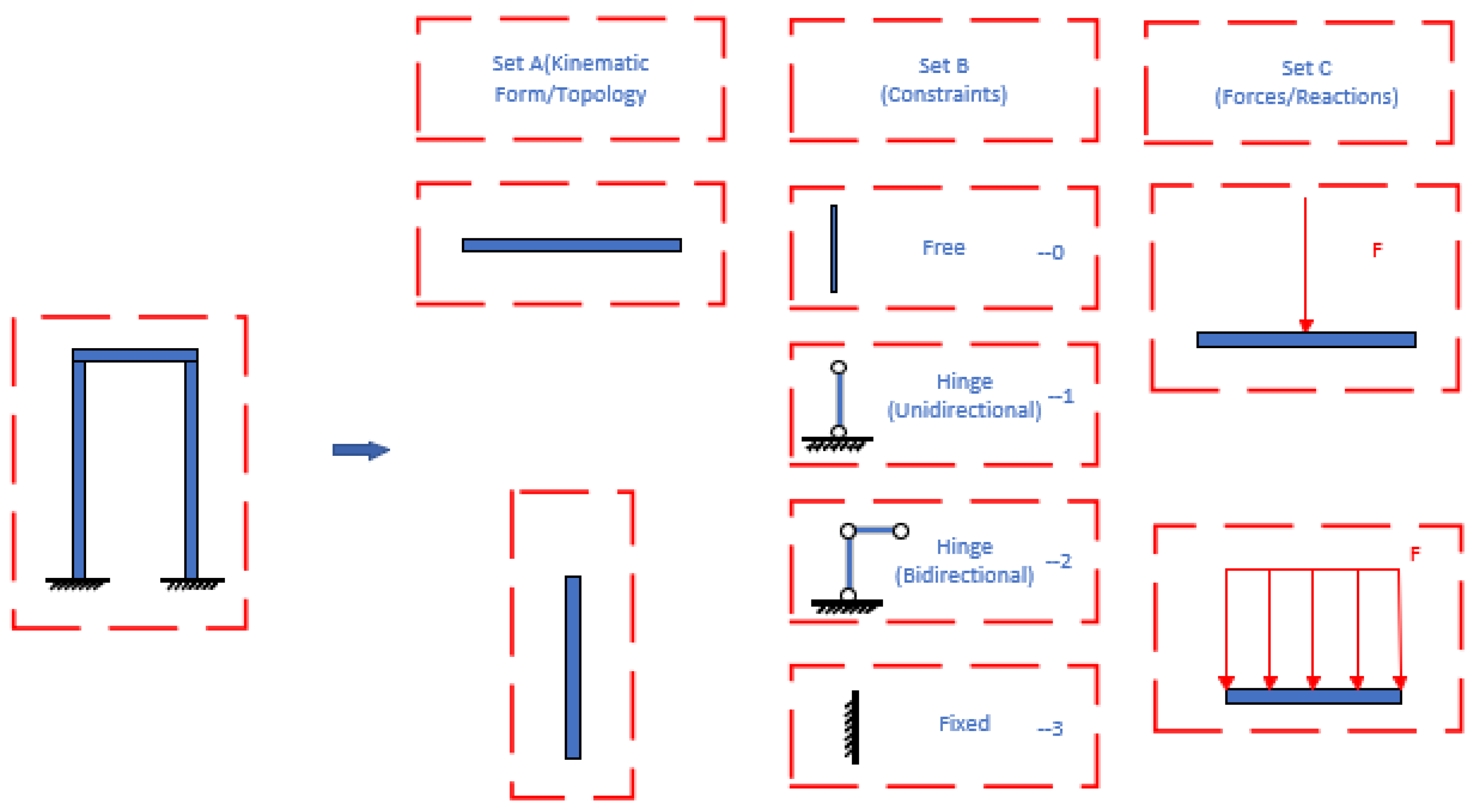
The bridge system can be decomposed into three fundamental sets: Set A (Morphological Components), Set B (Constraint Systems), and Set C (Force Transmission Mechanisms). A summary table of Sets A–C and their definitions is provided in
Figure 6.
Set A: This set constitutes the integrated beams and columns that form the pylon structure. A crucial characteristic is the functional interchangeability of these elements: beams act as horizontally oriented columns, while columns function as vertically oriented beams. This interchangeability allows the pylon morphology to adapt to different force-flow requirements while maintaining structural continuity.
Set B: Within Set B (Constraint Systems), the rotational constraints at pylon joints are mechanically modeled using a rotational spring model. In this conceptual framework, the boundary condition transitions between two idealized limit states: a fixed connection when the rotational stiffness is very high (
), and a pinned connection when the rotational stiffness approaches zero (
). Between these two extremes, the joint behavior is characterized by intermediate semi-rigid conditions, represented by a continuous stiffness range
. It can be expressed using

.
Accordingly, the constraint behavior at rotational joints is described here over a continuous stiffness interval rather than by a binary fixed-or-pinned assumption, solely for qualitative force–form interpretation.
Here, the rotational stiffness parameter is introduced solely as a conceptual indicator of constraint conditions rather than as a quantity intended for quantitative analysis or structural design.
Set C describes the force transmission mechanisms through which external actions are introduced into and redistributed within the pylon system. These actions include the vertical force transferred from the cable-supported superstructure, the horizontal cable-force components generated at the pylon top, and lateral loads such as wind action. Their combined effects govern the internal distribution of axial force, bending moment, and shear within the pylon. Under relatively balanced loading, the response tends to exhibit a more symmetric deformation mode; under uneven horizontal action or asymmetric cable force conditions, the pylon may develop directional leaning, differential bending, and coupled axial–bending behavior. Representative deformation patterns for both cases are illustrated in
Figure 6.
This systematic framework offers a unified method for deconstructing any bridge subsystem, including the pylon. Specifically, for a bridge pylon, its Morphological Component Set (Set A) comprises the pylon columns (vertical cantilever components) and the crossbeams (horizontal connecting components). The Constraint System Set (Set B) includes the column–foundation connections and the nodal connections between the columns and crossbeams, which are commonly treated as fixed or rigid at the global structural level while exhibiting variable and continuous rotational stiffness at the local joint level. The Force Transmission Mechanism Set (Set C) describes how vertical loads from the main cables and hangers, combined with wind loads, are distributed through shear and bending in the crossbeams and ultimately transmitted via the pylon columns to the foundation. Therefore, the morphological design of a pylon crossbeam emerges from coordinated optimization—within this framework—of Set A (as the primary horizontal component), Set B (whose connection methods determine joint stiffness), and Set C (which defines its core mechanical function). Accordingly, the visible form of the pylon and its crossbeam can be understood as the morphological outcome of how the structure accommodates dominant load directions, joint constraints, and force transfer requirements. This also explains why certain recurring geometric features—such as inclination, opening proportion, crossbeam position, and contour balance—can be interpreted as both mechanical responses and landscape-signifying forms.
6. Landscape Morphology Evolution of Suspension Bridge Crossbeams Driven by the Force–Form Integration Principle
6.1. Morphological Evolution of Bridge Crossbeams
The deduction of landscape morphology is not an arbitrary formal creation but follows a rigorous deductive process from internal logic to external expression. Its general principle can be summarized as a generative model that progresses from “syntax” to “rules” and finally to “imagery.” This model takes basic morphological elements—such as points, lines, planes, and volumes—as the initial “syntactic units.” Through a series of spatial organizational rules driven by function, environment, and visual perception, these units undergo logical deduction and variation, ultimately sublimating into a holistic imagery imbued with specific cultural and aesthetic meaning. This process achieves a systemic coupling between material space, human behavioral experience, and spiritual conception. This deductive principle has been systematically explained and empirically supported in Lu Shaoming’s academic monograph Landscape Narratives [
54]. The study indicates that landscape narrative is a key mechanism connecting material space with cultural semantics; by parsing the elements, structure, and clues of a landscape, it reveals the generative logic behind its form.
By extending the deductive logic of “structural–visual” unity from landscape morphology to industrial structures, it becomes clear that the forms of industrial facilities (e.g., factories, process towers, pipeline trestles, and tank farms) are direct outward expressions of their internal production processes, mechanical logic, and construction techniques. The morphological deduction of these structures follows a more rigid and deterministic path: starting from the functional core, being shaped by technical rationality, and ultimately crystallizing into a distinctive industrial aesthetic image. This is not an exercise in free formal creation but the visual solidification of a functionally and technically resolved solution. In this sense, the underlying logic is consistent with the general design principle that form should arise from function, constraint, and practical necessity.
The landscape-oriented morphological interpretation of the long-span suspension bridge pylon–crossbeam system in this study follows a qualitative generative logic of “mechanical legibility → geometric parameterization → structural imagery interpretation.” This logic is not intended as a system-level structural analysis method; rather, it serves as an interpretative framework for explaining how qualitative structural reasoning (e.g., load paths, constraints, stiffness tendencies, and deformation intuition) becomes visually legible through local morphological features.
At the conceptual level, the macro-configuration of pylons and crossbeams is first understood in relation to dominant force-flow characteristics and stability requirements of the cable system, establishing an interpretable correspondence between force paths and geometric arrangement. Subsequently, key local parameters—such as crossbeam vertical displacement and rotation angle—are adjusted in a coordinated manner to explore their influence on visual proportion, spatial tension, and morphological expressiveness, while remaining consistent with basic structural logic.
Engineering examples reported in the literature, such as the triangular-arch pylon configuration of the Hechuan Qujiang Landscape Bridge [
55], are referenced here only as illustrative cases showing how mechanical considerations may be reflected in structural form at the conceptual level. These examples are not adopted as methodological templates, but serve to contextualize the present force–form interpretative approach within existing engineering practice.
In a similar vein, studies on stress-based shaping and material-driven form generation demonstrate that distinctive bridge morphologies can emerge from mechanical and material constraints rather than from subjective formal invention. Such observations support the central premise of this study: that the landscape expression of bridge components can be interpreted as an endogenous outcome of structural rationality, without duplicating system-level analytical approaches.
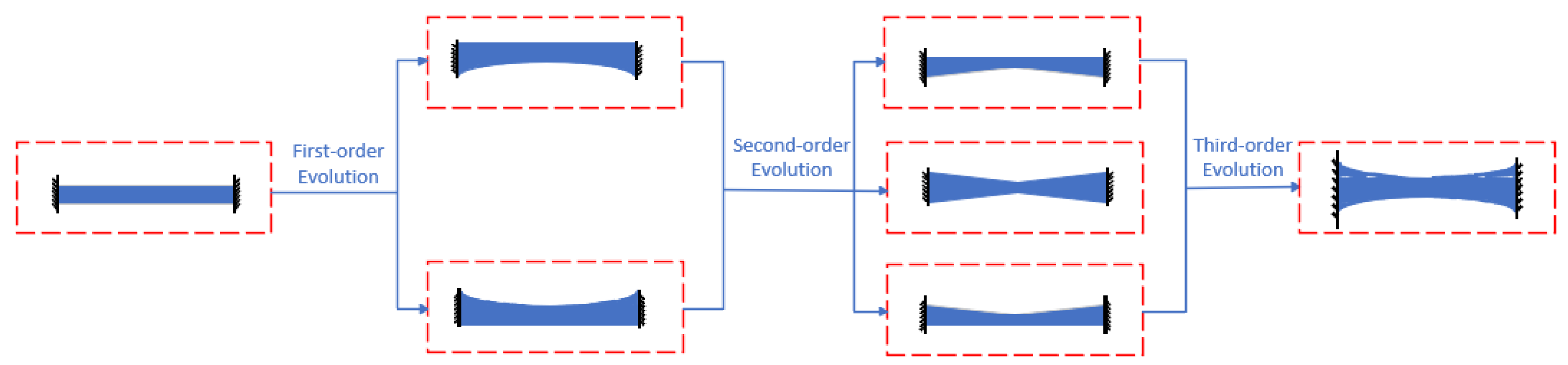
The straight beam represents the archetypal model among beam forms. Through the removal of an arc-shaped segment from either its upper or lower portion, it evolves into the straight-upper-curved-lower or curved-upper-straight-lower beam types, respectively. Similarly, removing an isosceles triangular segment transforms it into the straight-upper-angled-lower or angled-upper-straight-lower beam types. Furthermore, the removal of two arc-shaped or two isosceles triangular segments yields the curved-upper-curved-lower or angled-upper-angled-lower types, respectively.
Figure 7 schematically illustrates the evolutionary process of these seven common beam types. The process initiates from the straight beam as the meta-model. It undergoes a primary evolution phase involving addition or subtraction operations to reach an intermediate stage, followed by a secondary evolution phase (also involving addition or subtraction), ultimately resulting in several specialized beam forms. These variations cover most regular beam forms, although irregular configurations also exist. Representative beam-form cases and exceptional configurations referenced in this subsection are compiled in
Appendix C.
6.2. Curvature, Inclination, and Cross-Sectional Ratio of the Beam
This study focuses on key geometric parameters, such as curvature (κ) and cross-section ratio, to establish a quantitative link between the objective morphological characteristics of local bridge components (e.g., pylon crossbeams) and their subjective visual perception as well as structural performance. Specifically, these parameters correspond to two core dimensions of component morphology: curvature (κ) and related measures (e.g., rise f) directly describe the bending extent and dynamic tendency of the component’s profile, relating them to visual proportion and rhythmic quality. The cross-section ratio characterizes the axial tapering of the component’s cross-section, reflecting material distribution efficiency and the visual gradation of mass. Through this parametric analysis, we can move beyond qualitative descriptions, systematically correlating aesthetic imagery—such as “proportion,” “forcefulness,” and “lightness”—with engineering concepts like stiffness distribution and material optimization in structural design. This approach thereby supports more explicit comparison and informed decision-making in the morphological design of local bridge components.
In mathematics, curvature is one of several closely related concepts in differential geometry that intuitively quantify the extent to which a curve deviates from a straight line or a surface deviates from a plane. Denoting the curvature as κ and the corresponding radius of curvature as
, the relationship is given by the following formula (Equation (3)):
For a beam with chord length L (defined as the horizontal distance between its two ends) and rise f (defined as the vertical distance from the apex of the curve to the chord), the curvature is described through a geometric idealization. By assuming that the beam axis can be approximated as a circular arc in the vertical plane, the radius of curvature R can be determined from elementary plane geometry, leading to the relationship expressed in Equation (4) [
56]. This geometric relation establishes a direct correspondence between observable morphological parameters (
L and
f) and curvature, and does not represent a structural deformation under load.
The corresponding inclination angle of the beam can be obtained through direct measurement from drawings or through basic geometric calculation. In addition, the cross-sectional ratio is defined as the ratio of the minimum cross-sectional area to the maximum cross-sectional area along the beam (). For beams with similar cross-sectional shapes, this ratio may be approximated in practice by the corresponding sectional height ratio, expressed as .
As an illustrative example, Beam No. 14 is considered. Based on geometric estimation, with
L ≈ 30 m and
f ≈ 5 m, the corresponding curvature is
κ ≈ 0.046. Similarly, for the lower beam of Pylon No. 23, which is rotated clockwise to a horizontal inclination of approximately 30°, the cross-sectional ratio is estimated to be approximately 0.58 (see
Appendix C). These values are introduced solely to demonstrate the application of geometric parameters in morphological description, rather than to serve as results of structural analysis or design calculation.
6.3. Evolution of Force Transmission Mechanisms in Bridge Crossbeams
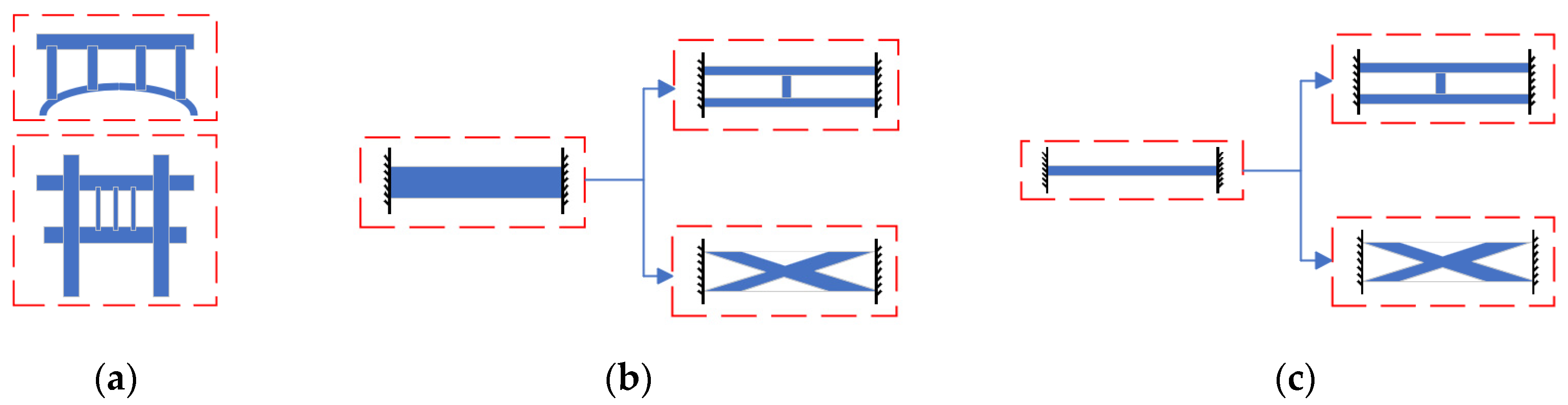
An auxiliary structural system comprises components that are not part of the primary load-bearing system. These elements may carry incidental loads or serve purely aesthetic functions, and they are subordinate to the primary structural framework. Common configurations of such systems are illustrated in
Figure 8a.
The evolution of auxiliary structures can be described through topological operations (addition or subtraction) performed on morphological primitives, as demonstrated in
Figure 8b,c.
Building upon the concepts of primary and auxiliary structural systems, a rational classification framework for bridge structures has been established. Within this framework, the primary structure is defined as the assembly of core components that directly bear and transfer the fundamental loads of the bridge’s transit function—such as dead loads, live loads, and primary lateral forces. It establishes the basic load path and ensures global stability. The auxiliary system refers to additional components or subsystems that engage only under specific loading conditions or when certain thresholds are exceeded. Its role is to provide redundant load paths, participate in internal force redistribution, and thereby enhance the structural resistance and safety margin. In this system, “morphology” denotes the integrated manifestation of both the load-bearing mechanism and formal characteristics. Thus, primary morphology reflects the unified mechanical–formal entity presented by the primary structure in performing its fundamental load transfer function. Correspondingly, auxiliary morphology pertains to the integrated mechanical–formal features exhibited by the auxiliary system when activated under specific conditions. This classification framework clarifies the systematic relationships among structural function, mechanical behavior, and morphogenesis.
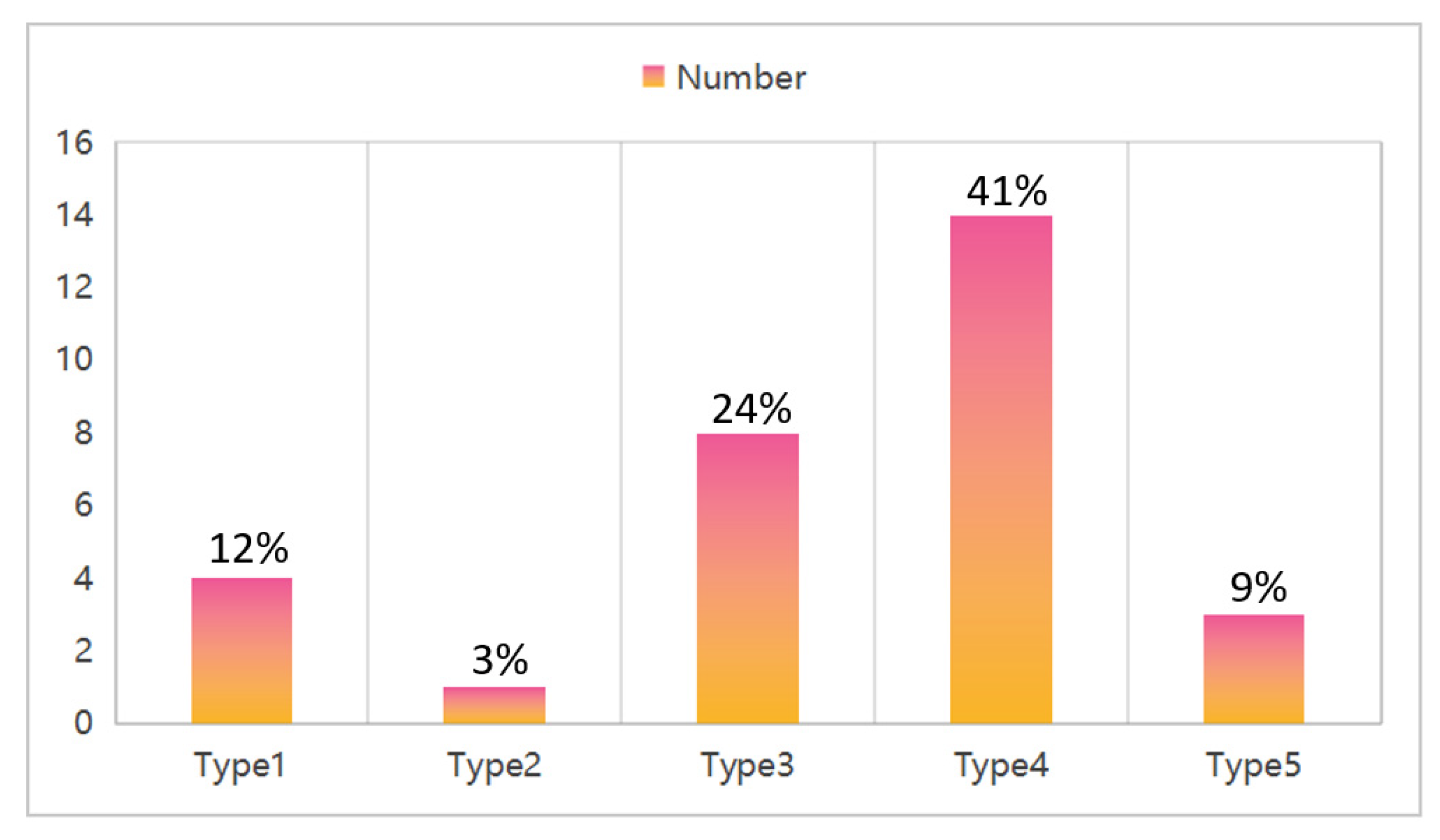
This framework categorizes crossbeams into three distinct types: Crossbeam Type ① resists lateral forces through a single constraint point (with one crossbeam); Type ② resists lateral forces through two constraint points (with two crossbeams); and Type ③ resists lateral forces through three or more constraint points (with three or more crossbeams). Statistical analysis of the bridge sample (34 bridges in total) reveals the following distribution: Type ①: 24 bridges (Bridge Nos. 1–16, 18, 20, 22, 23, 24, 25, 27, 33), accounting for 71%. Type ②: 9 bridges (Bridge Nos. 17, 19, 21, 26, 28, 29, 31, 32, 34), accounting for 26%. Type ③: 1 bridge (Bridge No. 30), accounting for 3%. The results indicate that the majority (71%) of crossbeams in the Yangtze River bridge cluster utilize a single-constraint lateral force resistance system. Further case information is provided in
Appendix A.
This pronounced statistical predominance indicates that, in major engineering projects such as the Yangtze River bridges where transportation efficiency is paramount. This statistical predominance suggests a preference for structurally straightforward and visually restrained configurations within the sampled bridge inventory, consistent with the prevalence of single-constraint lateral force-resisting arrangements in the case set. This reflects the prevailing “pragmatism and efficiency” engineering philosophy that characterized China’s era of rapid urbanization and large-scale bridge construction.
7. Calculation Method for the Aesthetic Measure of Suspension Bridge Landscapes
7.1. Development and Computational Results of the Aesthetic Quantification Framework
The planar projections of suspension bridges along the Yangtze River predominantly exhibit symmetrical and well-proportioned forms. This underscores the need for quantitative aesthetic metrics to integrate qualitative and quantitative evaluations. The frontal elevation is often the most iconic and widely recognized view of a major bridge, particularly in photographic media and distant observation, making its morphological composition crucial for public perception and symbolic representation. Therefore, we have selected three key aesthetic indicators—, , and —and applied computational formulas to quantify their aesthetic measures.
The aesthetic measure of harmony is introduced to describe overall visual coordination by evaluating the geometric relationship between individual interface elements and the reference framework. In this study, harmony is interpreted as a compositional and geometric property, quantified through the deviation between the centroid coordinates of all interface elements and those of the interface framework [
31]. The relevant geometric definitions and calculation steps are provided in Equations (5)–(11).
where
is the aesthetic measure of interface harmony;
is the deviation along the
x-axis between the centroid coordinates of the interface elements and the interface framework;
is the deviation along the
y-axis between the centroid coordinates of the interface elements and the interface framework;
and
are the centroid coordinates of the interface elements and the interface framework, respectively;
is the area of the interface element;
represents the coordinate parameters of the interface element
i;
and
denote the width and height of the interface element;
and
specify the width and height of the interface framework;
n indicates the total number of interface elements.
From the perspective of visual interpretation, balanced and orderly geometric arrangements are commonly associated with a stronger sense of stability and coherence. In this study, references to public perception are used only to support the interpretative linkage between geometric balance and commonly observed visual tendencies, rather than to model individual psychological responses.
Here, “the public” refers to general observers without specialized engineering background, who primarily experience the bridge through its visual appearance. While individual aesthetic preferences may vary, geometric equilibrium represents a widely accepted organizing principle in visual composition. Accordingly, the harmony measure defined in Equation (5) functions as an interpretative indicator that reflects, in a comparative and statistical sense, the tendency toward visual balance in a bridge’s frontal elevation, rather than as a predictive measure of subjective aesthetic judgment.
Formula (5) defines a harmony measure that quantifies the weighted average distance between the centroids of all interface elements and the centroid of the interface framework. A smaller deviation indicates that the visual elements are more concentrated around the geometric center, resulting in a stronger sense of balance and order. This aligns with the pursuit of “equilibrium” within the classical aesthetic principle of “unity and variation.” Consequently, by quantifying the degree of central convergence, this formula provides a computable metric for the abstract concept of “harmony.”
- 2.
Proportionality
The relationship between a bridge as a whole and its morphological landscape elements can be described through proportional relationships that are commonly associated with visually coherent and well-organized compositions. In this study, proportionality is introduced as a geometric descriptor for characterizing the relative relationships among structural and landscape elements, rather than as a direct measure of aesthetic quality. The use of comparable or classical proportional relationships across different components contributes to overall visual coherence and coordination [
32]. The relevant proportional descriptors and calculation procedures are defined in Equations (12)–(16).
where
is the proportionality measure;
and
are the deviations of the proportion of an element and the proportion of the entire element cluster within the landscape morphology from the classical proportion, respectively;
and
denote the width and height of the element *i*, respectively;
and
are the width and height of the element cluster;
is the classical proportion.
In architecture and aesthetics, the golden ratio (φ ≈ 1.618) is a time-honored and widely recognized classical proportion, representing a specific and extensively validated harmonious relationship. However, for modern large-scale bridges characterized by diverse functions, scales, and contexts, their aesthetic appeal often stems from the systematic synergy of multiple proportional relationships, not from strict adherence to a singular “perfect” ratio. The Proportionality Metric (PM) defined in this study does not aim to assess conformity to a specific ideal proportion. Instead, it quantifies two aspects: the closeness between its actual proportions and a set of classical proportions (which may include the golden ratio, square root proportions, etc.), and the coordination between the component’s own proportions and those of the overall component group. Accordingly, the Proportionality Metric (PM) functions as an interpretative and comparative indicator, providing designers and engineers with structured geometric feedback during scheme exploration and refinement. It is not intended to prescribe optimal proportions or to predict subjective aesthetic responses, but rather to support the systematic examination of proportional coordination within and between components. Through this parameter-based description, the metric facilitates a more transparent discussion of proportional relationships in large-scale bridge morphology.
- 3.
Density
Density refers to the extent of area covered by morphological structural elements within a bridge landscape. A larger covered area tends to create a sense of crowding, while a smaller one may appear hollow, with the optimal density being approximately 50% [
32]. [Equation (17)]
The Density metric measures the area-coverage ratio of structural morphological elements within the frontal elevation; i.e., the proportion of the elevation occupied by the identified structural components relative to the overall bounding frame (Equation (17)). In interpretative terms, very high density may correspond to a visually “heavy” or crowded composition, whereas very low density may appear sparse. Following prior aesthetic geometry discussions that treat mid-range coverage as a practical reference for balancing “presence” and “lightness” in visual compositions [
32], we use Density primarily as a diagnostic indicator for comparing cases and identifying extreme conditions. It is not used as a prescriptive target, and its interpretation should be considered together with bridge scale, viewing distance, and design intent.
This study employs three quantitative metrics—Harmony (H), Proportionality (P), and Density (D)—as computable descriptors for the frontal-elevation composition of the analyzed bridge pylons. Harmony (H) reflects centroidal balance among elements in the composition; Proportionality (P) describes how component and group proportions relate to a set of reference ratios; Density (D) captures the extent of structural area coverage within the elevation frame.
All metrics are normalized to the [0, 1] interval to facilitate comparison across cases. These values should be interpreted as relative indicators rather than absolute design objectives: higher scores do not universally imply “better” aesthetics for every bridge, because practical outcomes are shaped by structural arrangement, viewing conditions, and contextual intent. The primary value of the metrics is to support transparent comparison, diagnosis across schemes, and the subsequent statistical reporting of regional and typological tendencies.
Schematic diagrams for the 30 cases included in the image-based metric computation are provided in
Appendix A. The full 34-bridge inventory and case IDs are provided in
Appendix B, and the exclusion of four cases from the image-based computation is solely due to insufficiently consistent near-frontal elevation imagery.
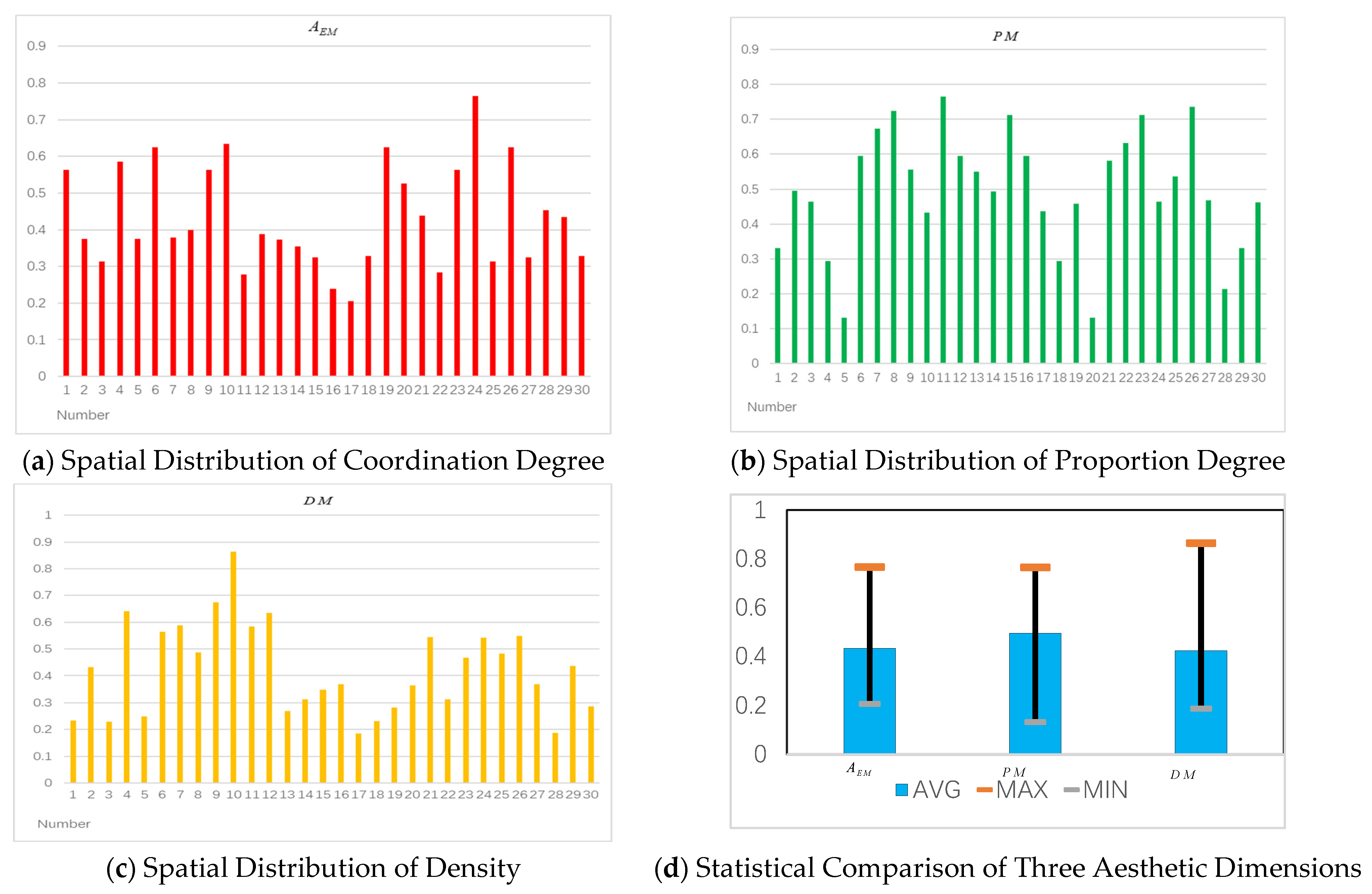
As illustrated in
Figure 9a, the coordination degree is comparatively low in the Hubei section of the middle Yangtze River. In contrast,
Figure 9b shows a more balanced distribution for the proportion degree, though relatively lower values are observed in Chongqing and in the latter sections of Hubei and Jiangsu provinces. According to
Figure 9c, density is generally higher in the middle and upper reaches of the Yangtze River and becomes relatively lower in the middle and lower reaches. A comparison of the three aesthetic dimensions reveals distinct regional patterns. The quantified statistical results are presented in
Figure 9d. Metric
has the highest mean value of approximately 0.495, with relatively minor variation. The mean values for
and
are 0.433 and 0.424, respectively. This indicates that, on average, the overall coordination along the Yangtze River is relatively low, while the density values are closer to 0.5, approaching the theoretically optimal level.
7.2. The Scientific Validity and Limitations of Bridge Aesthetic Evaluation
The quantitative description of bridge aesthetics is valuable because it helps move part of the discussion from purely experience-based intuition toward a more explicit and analyzable domain structured by identifiable geometric and morphological relationships. Although aesthetic perception remains partly subjective, quantitative descriptors can still provide a useful basis for discussing and comparing visible formal tendencies such as harmony, proportional coordination, and compositional density. In this sense, the indicator system established in this study is not intended to define a universal standard of beauty, but to provide a set of interpretable and comparable descriptors through which otherwise vague terms such as “harmony” and “elegance” can be discussed more explicitly at the component level. By translating selected aspects of visible morphology into computable geometric parameters, the framework supports more transparent comparison and analysis during conceptual-stage exploration and evaluation. This role is consistent with previous efforts to make bridge aesthetic reasoning more explicit, systematic, and computationally operable within design and assessment processes [
57].
At the same time, the limitations of this quantitative approach should be clearly recognized. It cannot fully capture the aesthetic meanings associated with cultural symbolism, regional context, or historical interpretation, nor can it reproduce the full spatial experience generated by movement, viewpoint change, and environmental interaction. Accordingly, quantitative aesthetics should be understood as a supporting analytical grammar for description, comparison, and rational discussion, rather than as a substitute for artistic creativity or integrated humanistic judgment.
In practical terms, the proposed descriptors and integration index may support conceptual-stage comparison of alternative local component schemes by making force–form relationships more explicit and comparable.
7.3. Application of Aesthetic Metrics in Design, Appreciation, and Public Perception
In bridge engineering practice, the quantitative descriptors proposed in this study—Harmony (H), Proportionality (P), and Density (D)—are intended primarily as analytical aids for conceptual-stage interpretation, structured comparison, and interdisciplinary discussion, rather than as prescriptive design criteria or direct optimization targets. On the design side, these descriptors may help designers identify dominant force–form characteristics, compare alternative pylon and crossbeam schemes, and discuss the consistency between structural logic and landscape expression during early-stage exploration. In this sense, the proposed metrics provide a more explicit and comparable vocabulary for describing visible morphological organization in suspension bridge pylons. During scheme refinement, the metrics can be integrated with structural and economic parameters to form a multi-objective optimization function. Optimization algorithms can then be employed to find the equilibrium between mechanical performance and aesthetic goals, transforming aesthetic intent from a subjective aspiration into an iterative and verifiable design variable [
8].
On the evaluation side, this indicator system provides an objective framework for professional review and academic comparison. More importantly, it offers a quantifiable medium for analyzing public aesthetic perception. In this study, “the public” specifically refers to non-specialist observers—the primary experiencers of the bridge landscape—whose aesthetic judgments are based on immediate visual perception. The connection between the metrics and public perception is established on three levels: 1. Theoretical Foundation: The metrics are rooted in visual principles (order, harmony, moderate complexity) that elicit cross-cultural aesthetic appeal; their quantitative results correspond to a common underlying basis for public preference. 2. Empirical Correlation: The macroscopic statistical patterns of the metrics (as shown in
Figure 8) reveal correlations between bridge morphology and public perception, explaining why certain bridges are widely accepted as “beautiful.” 3. Practical Integration: This connection rationally links professional design operations with public aesthetic acceptance, providing a systematic pathway toward the goal of “creating publicly cherished landscapes.” Therefore, the application of quantitative metrics fundamentally shifts aesthetics from an experience-dependent domain into operable, debatable systematic knowledge, ultimately fostering the integration of engineering rationality, artistic intuition, and public cognition at a higher level.
International relevance and transferability. Although the empirical sample is drawn from the Yangtze River Basin, the proposed framework is not region-locked because it is defined by an explicit input–procedure–output structure. The inputs are the pylon–crossbeam façade geometry (from near-frontal views) together with a qualitative interpretation of boundary conditions and force transmission; the procedure applies the same component–constraint–force transmission decomposition (Sets A–C), typological rules, and geometric descriptors; and the outputs are comparable categories and metrics (typology, parameters, and indicators). Therefore, the framework can be applied to suspension bridge pylons in other contexts where design drivers differ (e.g., navigation clearance, wind climate, constructability, or landmark requirements), enabling cross-region comparisons using a consistent analytical grammar. In this sense, the Yangtze River inventory serves as a rich empirical testbed, while the method is intended to support international comparative studies rather than to encode region-specific stylistic conclusions.
8. Force–Form Integration (In Suspension Bridges)
Therefore, an objective quantitative indicator is needed to address issues related to bridge aesthetics. To this end, we propose an indicator termed the Degree of Mechanical–Aesthetic Integration, based on the concept of Domains. When analyzing a bridge pylon case, we define set (the yellow area) as the Mechanical Domain, representing the projected area of the primary structural load-bearing components (e.g., pylon legs and the pylon crossbeam) essential for global stability in a two-dimensional frontal analysis. Similarly, set (the green area) is defined as the Landscape Domain, representing the area contributing to the bridge’s overall visual landscape. The intersection of these two sets is defined as (the blue area), signifying the area belonging to both the Mechanical and Landscape Domains.
We define the basic states of the structural domain and landscape domain under three scenarios: The sets
and
are mutually exclusive in
Figure 10a. The sets
and
intersect, with their intersection denoted as
in
Figure 10b. Set
is contained in set
or set
is contained in set
in
Figure 10c.
Therefore, we define five distinct topological types based on set relationships: Type 1 (Disjoint): When and are disjoint, there exists no interaction between structural and landscape domains. The intersection = 0, thus the interaction coefficient is assigned 0. Type 2 (Intersecting): When and intersect, but structural and landscape domains remain uncorrelated. Therefore, the intersection is denoted as . We define the structural index as and landscape index as for this case. Type 3 (A ⊆ B): When is contained in (), the structural index is defined as and landscape index as . Type 4 (B ⊆ A): When is contained in (), the structural index is similarly and landscape index . Type 5 (Equality): When and are identical (), the structural index remains and landscape index .
We selected long-span suspension bridges along the Yangtze River whose pylon façades are visible from a nearly frontal perspective. Taking Bridge #25 (listed in
Appendix A) as an example, its pylon façade image was analyzed using ImageJ 1.54g. First, the relevant regions were delineated through manual selection, as shown in
Figure 11a. The calculated relative area of the Mechanical Domain
is 77,610 (see
Figure 11b), and that of the Landscape Domain
is 111,440. The overlapping area
, which in this case entirely encompasses the Mechanical Domain (77,610), is also indicated. Consequently, the derived metric values are:
= 1,
= 0.696,
= 1.437, (areas are relative and unitless). The error margin is maintained to four significant figures. The computed area ratios for all bridges are based on the inventory in
Appendix A, and the corresponding metric calculations are reported in
Appendix D.
Based on the typological definitions established in
Section 3 (with independent double-coding and rule-based adjudication as described above) and the tabulated results in
Figure 12, the 34 bridges are classified into five force–form relationship types. Type 1 (Disjoint) includes Bridges #1, #5, #13, and #30 (4/34, 11.8%), indicating no systematic correspondence between the structural (mechanical) and landscape domains in these cases. Type 2 (Intersecting) contains only Bridge #21 (1/34, 2.9%), suggesting that partial overlap is rare within this sample. Type 3 (A ⊆ B) includes Bridges #2, #9–#12, and #23–#25 (8/34, 23.5%), representing cases where the structural domain is fully contained within the landscape domain. Type 4 (B ⊆ A) includes Bridges #3, #4, #6–#8, #14–#17, #19, and #26–#29 (14/34, 41.2%), representing cases where the landscape domain is contained within the structural domain. Type 5 (A ≡ B) includes Bridges #18, #20, and #22 (3/34, 8.8%), indicating approximate equivalence between the two domains.
Type 4 (B ⊆ A) is the most prevalent pattern (14/34, 41.2%). This proportion is reported with uncertainty: 14/34 = 41.2% (95% binomial Wilson CI: 26.4–57.8%). Within this type, the structural domain proportion most frequently falls in the 50–70% band (7/14, 50%), followed by values below 30% (5/14, 35.7%) and 70–80% (2/14, 14.3%). Overall, the distribution suggests that, for a substantial portion of the Yangtze River suspension bridge sample, mechanical considerations tend to provide the dominant boundary conditions within which landscape expression is developed. This tendency is consistent with the function-first emphasis commonly observed in long-span bridge engineering practice, particularly during earlier development stages when span capacity, constructability, and safety performance are prioritized; in such contexts, aesthetic qualities often emerge as a legible by-product of resolving these technical constraints. Accordingly, the morphological diversity of pylons in this cluster is largely realized through controlled variations in component geometry and connection patterns under mechanically governed constraints rather than through forms that override the primary force transfer logic.




 .
.