


Abstract
The relationship between architecture and sloping terrain constitutes a persistent subject in architectural discourse. Western scholarship has often emphasized structural, technical, and formal strategies, whereas systematic sectional studies focusing on Japanese residential works in sloped environments remain comparatively underexplored. This study aims to elucidate the characteristics and design logic of sectional composition through an analysis of 55 independent Japanese residential projects on sloping terrain from the period 2015 to 2024. Employing an analytical framework that integrates external composition (orientation of the approach path and grounding condition of the building volume) with internal composition (sectional relationship between the entrance and the main room), the research identifies six fundamental sectional types and their sub-patterns. From these, three core design logics are derived: transforming slope directionality into internal circulation sequences, establishing a contrastive relationship between building volume and terrain, and adapting the terrain through leveling to prioritize functional layout. By maintaining a consistent analytical framework with the foundational study, the research enables a diachronic comparison that reveals both continuities and shifts in sectional design strategies over the past two decades. Architects’ own design statements are incorporated to corroborate the spatial narratives embedded in these compositional strategies. The findings demonstrate that contemporary Japanese sloping terrain residences employ diverse approaches ranging from topographic integration to volumetric dialog, showing that sectional organization not only responds to topographic conditions but also shapes spatial experience and dwelling logic. This study provides a typological reference for sloping terrain residential design and contributes an empirical foundation for understanding the intrinsic compositional relationship between architecture and terrain.
1. Introduction
1.1. Research Background
The relationship between architecture and sloping terrain has long been a central concern in both Western and Eastern architectural discourse. In Western scholarship, research on sloping terrain architecture has predominantly emphasized structural innovation, geotechnical adaptation, and the integration of sustainable technologies in response to complex topographic conditions. Particular attention has been paid to how slope gradients influence construction methods, spatial efficiency, and environmental performance, with strong interests in parametric design, terrain modeling, and ecological responsiveness. In parallel, the experiential and pictorial potential of sloped sites, including panoramic views, sectional complexity, and dynamic spatial sequences, has been extensively explored in modern and contemporary architectural practices across Europe and North America, yielding a substantial body of formal and technical strategies.
Underpinning these practices and explorations is a sustained theoretical discourse within Western architecture concerning the relationship between architecture and environment. Since Christian Norberg-Schulz introduced the phenomenological concept of “Genius Loci”, asserting that architecture should reveal and integrate with the unique geographical and atmospheric character of a site, the response to topography has transcended technical necessity to become a cultural act in search of meaning [1]. Kenneth Frampton further developed this line of thinking within the framework of Critical Regionalism, positioning tectonics and site-specific dialog as core strategies to counter architectural homogenization. He underscored the section as a critical medium linking earth and sky, interior and exterior [2]. Separately, the “Design with Nature” paradigm, rooted in ecological planning, advocates for viewing architecture as part of a topographic continuum, calling for cautious intervention and systemic integration [3]. Collectively, these theoretical trajectories have shaped the central aspirations of Western sloping terrain architecture: structural clarity, spatial experientiality, and environmental integration.
However, since the turn of the twenty-first century, architectural discourse has increasingly moved beyond the conventional “architecture/terrain” binary toward a more integrated perspective—namely, “landform building”—which posits that architecture should function as an extension of topography rather than an object imposed upon it [4]. This paradigm shift reflects a broader recognition that the relationship between built form and natural terrain is not merely technical but fundamentally topological and experiential.
In contrast, Japanese architectural theory possesses a distinct intellectual lineage concerning the relationship between topography and dwelling. Scholars and practitioners in Japan have long examined the dynamic interplay between architecture and terrain, frequently grounding their inquiry in pragmatic orientations such as “topographic conformity” and “environmental coexistence.” The architect Osamu Ishii (1922–2007), for example, advanced the proposition that “architecture does not require a façade.” Central to this claim is a critique of formalist, autonomous expression; instead, architecture is understood as something that must fundamentally engage with and assimilate into its site conditions. Ishii advocated for working with, rather than against, the slope’s gradient and orientation, thereby weaving the building’s layout and spatial sequence together with the inherent features of the terrain. This position treats topography as an essential generative foundation for design [5]. Such views exemplify a persistent tendency within Japanese architectural culture to prioritize environmental coherence and the contextual subordination of the built form. This Japanese sensibility diverges notably from the European Alpine tradition, which has often emphasized “defensive tectonics” rooted in material weight and structural resistance to extreme conditions [6].
However, the majority of this discourse remains centered on universal design principles or region-specific case studies within Western contexts. Systematic analysis focusing specifically on how Japanese residential architecture engages with sloped landscapes remains comparatively scarce. Japan’s distinct geographical, cultural, and esthetic traditions have cultivated a unique approach to building on inclined sites—one that frequently prioritizes subtle integration with nature, spatial gradation, and the poetic interplay between interior and exterior. The Japanese treatment of the slope is thus not merely a technical response but a deeply embedded spatial philosophy that fundamentally shapes the overall architectural composition. Particularly between 2015 and 2024, advances in design tools have enabled Japanese architects to move beyond simple terracing or pilotis (slender columns that raise the building volume above the ground) strategies, instead employing sophisticated “sectional design” to dynamically reconfigure the relationship between interior life, landform, and visual connection to the landscape [7]. Despite the richness of this contemporary practice, research remains largely dispersed across Japanese-language publications, with limited engagement with international English-language scholarship on sectional logics and landscape integration [7,8].
This study contends that a focused examination of Japanese sloping terrain residences is warranted on several grounds. First, Japan’s extensive mountainous topography has historically necessitated sophisticated adaptive strategies, yielding a diverse and refined architectural vocabulary specific to sloped sites. Second, the Japanese sensitivity to topography frequently extends beyond functional accommodation to engender profound experiential and perceptual qualities—lessons of considerable relevance to contemporary design in topographically varied regions worldwide. Finally, while existing Western-led research offers important engineering and formal insights, a concentrated analysis of Japanese examples can reveal alternative modes of spatial thinking, in which the slope is understood not as a constraint but as a generative driver of architectural organization and atmosphere.
The spatial composition of residential architecture is shaped through its response to a range of environmental conditions—topography, orientation, region, and climate among them. On sloping terrain in particular, not only do conditions such as landscape, views, sunlight, ventilation, and drainage differ from those on flat land, but the slope’s inherent vertical directionality, combined with the fundamental necessity of achieving level floor plates on an inclined plane, means that the physical relationship between terrain and building profoundly influences the organization of both interior and exterior spaces. This gives rise to a diversity of spatial expressions specifically adapted to sloped conditions.
Examples include residences with facades parallel to the slope gradient, residences approached from above the slope that contain interior spaces with expansive downward views, and residences in which floor levels are stepped along the incline. Each of these can be understood as a spatial composition that articulates the vertical directionality inherent in sloping terrain. As these examples illustrate, the spatial characteristics of a slope inflect not only the external form but also the internal organization of the building. In this sense, sloped sites foster a more dynamic and reciprocal relationship between environment and architectural composition than do flat terrains.
Accordingly, this study aims to systematically characterize the architectural composition of residences on sloping terrain by analyzing their external composition, including the approach path and building form, and their internal composition, as determined by the sectional arrangement of rooms, and subsequently synthesizing these two dimensions. In doing so, the study does not treat the environment as a passive given; rather, it positions the environment as an active, formative element in architectural composition. The objective is to offer a conceptual framework for rethinking the holistic integrity of residential architecture in dialog with its topographic setting.
1.2. Review of Previous Research and Purpose
Academic studies on Japanese independent residences situated on sloping terrain have addressed a range of dimensions. Endo et al. [9] systematically investigated the relationship between overall residential composition and sloping topography from a sectional perspective, focusing on works completed before 2000. Their study established an important typological framework for understanding the spatial correspondence between architecture and terrain. Beyond this typological approach, recent scholarship has expanded the discourse to incorporate interdisciplinary perspectives. Stan Allen’s concept of “landform building” [4] positions architecture as an extension of topography, shifting the focus from structural accommodation to the topological integration of built form and natural terrain. Similarly, James Corner’s notion of “landscape imagination” [10] emphasizes that slope design must engage with ecological continuity and sensory experience beyond the building footprint. These frameworks provide a broader theoretical lens for understanding the architecture–terrain relationship. Other relevant research includes an analysis of the residential environment in sloping residential areas based on occupant evaluations [11]; an examination of vernacular house orientation in slope villages through the relationship between slope gradient and orientation [12]; and a study of the spatial composition of front lots in mountain village residential sites in relation to topographical features [13]. The author’s prior work has also contributed to this body of research [14]. In existing studies on the composition of interior and exterior space in Japanese independent residences, in addition to the author’s prior work [15,16,17], examples include research on the planar configuration of residential works in relation to site boundaries [18]; studies on architectural composition through external volumes and room arrangement [19]; and analyses of courtyard design and its connection with living rooms in courtyard houses [20].
While the studies above have largely focused on cultural attributes, artistic expression, and qualitative spatial descriptions, recent research has begun to employ new methodological approaches to examine vernacular and contemporary dwellings from a more systematic perspective. In the domain of vernacular architecture, Liang et al. [21] integrated computer vision and GIS techniques to conduct large-scale morphological mapping and driving force analysis of courtyard dwellings, demonstrating the potential of quantitative methods for typological studies of residential architecture. Their related work on the spontaneous green evolution of vernacular architecture in southern Hebei province revealed how spatial transformations in courtyard dwellings, such as the shift from open to enclosed configurations, reflect changing patterns of domestic life and environmental adaptation, while also exploring the interaction between professional architectural intervention and folk wisdom [22]. These studies illustrate a growing methodological trend toward systematic analysis of residential spatial composition, which aligns with the typological approach adopted in the present research.
Beyond methodological advancements, contemporary scholarship has also expanded the geographical and cultural scope of residential architecture studies. For instance, Xu et al. [23] examined the contemporary evolution of Tibetan-style dwellings under urbanization, providing insights into how traditional dwelling forms adapt to modern pressures in a distinct East Asian cultural context. Parallel to these geographically focused studies, research on building performance has contributed to understanding the environmental responsiveness of residential architecture. Yang et al. [24] investigated the green renovation and multi-objective optimization of Tibetan courtyard dwellings, while Yang et al. [25] explored passive strategies for energy-saving retrofitting and their climatic adaptability, offering empirical evidence for sustainable construction strategies that are increasingly relevant to contemporary residential design. Collectively, these studies reflect a broader trend toward systematic, performance-oriented, and context-sensitive approaches to residential architecture research.
Among the existing scholarship, the study by Endo et al. [9] serves as the principal methodological foundation of the present research. Centering on sloping terrain residences completed in the late twentieth century, that work pioneered sectional analysis as a core analytical device and clarified the spatial-logical relationship between approach paths and internal sectional sequences. Although the corpus of cases examined predates 2000, the analytical framework they established retains considerable methodological relevance.
While Endo et al. established a foundational typology, recent English-language scholarship has expanded the discourse by situating Japanese sloping terrain residences within broader theoretical frameworks and comparative perspectives. Recent English-language scholarship on Japanese architecture provides complementary insights. Ciorra and Ostende [8] argue that post-1945 Japanese dwellings function as laboratories for negotiating social transformation and topographic constraint. Within this context, architects such as Terunobu Fujimori have pursued a form of “primitivist” integration, where buildings appear to grow organically from the ground through the incorporation of vegetation and earth [26]. Kazuyo Sejima, by contrast, dissolves horizontal planes to create fluid sectional layers that maintain transparency and lightness even on undulating terrain [8]. These diverse approaches underscore the centrality of sectional thinking in contemporary Japanese residential design. Furthermore, the methodological toolkit for sectional analysis has been systematized internationally by Lewis et al. [27], whose categorization of sectional types (inclined, stacked, nested) provides a standardized framework for examining interior-exterior relationships in sloped sites. Nevertheless, it remains insufficient to fully capture the new spatial characteristics that have emerged in Japanese sloping terrain residential design over the past decade—characteristics conditioned by shifting technical capacities, spatial conceptions, and domestic lifestyles.
To address this gap, the present study systematically analyzes 55 independent residential works on sloping terrain completed between 2015 and 2024, applying and refining the sectional methodology established by Endo et al. (2002) [9]. Through an integrated analytical framework that combines external composition, defined by the orientation of the approach path and the grounding condition of the building volume, with internal composition, defined by the sectional relationship between the entrance and the main room, it identifies fundamental sectional types and their derivative patterns, thereby elucidating the core spatial logics and topographical design tendencies that characterize the interior–exterior organization of contemporary Japanese sloping terrain residences. By maintaining a consistent analytical framework with Endo et al., this study enables a diachronic comparison that reveals both continuities and shifts in sectional design strategies over the two decades between the two studies, with the objective of clarifying the continuities, shifts, and nascent tendencies that define the sectional composition of contemporary works, a comparison that will be undertaken in the conclusion.
2. Research Method
This study selects its case samples from Shinkenchiku Jutaku Tokushu (Special Issue on New Architecture and Housing), which is widely recognized in Japan as the most authoritative and comprehensive journal dedicated exclusively to contemporary residential design. Its monthly publication and rigorous editorial selection process ensure that the featured works represent the cutting edge of design trends and spatial experimentation in Japanese housing. While the authors acknowledge that this single source introduces a potential editorial bias (as noted in the limitations section), it was chosen deliberately to maintain a consistent level of architectural discourse and documentation quality across all cases, which is essential for a typological study focused on spatial composition. While precise slope gradient data is unavailable, a qualitative observation of the sectional drawings suggests that the 55 cases cover a wide spectrum of topographic conditions, from gentle slopes (where the building footprint spans a modest vertical drop) to steep inclines (where the height difference necessitates multi-story split-level arrangements). This diversity ensures that the derived typology is not biased toward a particular slope condition.
All selected projects meet the following inclusion criteria:
Building Type: Strictly independent, single-family residences. Projects with mixed-use commercial/residential programs, multi-family dwellings (apartments), or primarily office functions were excluded.
The classification of a project as an “independent residence” is based on its functional and ownership status as a single-family dwelling, rather than on its gross floor area. While some selected cases, such as No. 06 House Plateau (497.87 m2), have floor areas that exceed typical Japanese detached houses, they remain functionally and programmatically independent residences intended for a single household. Their inclusion is justified by their clear status as single-family dwellings in the source journal and by the fact that their spatial composition—particularly the relationship between entrance, main room, and sloping terrain—follows the same architectural logics as smaller residences. Excluding them based on size alone would arbitrarily truncate the sample and potentially obscure important design strategies that operate across scales.
Topographic Condition: The site must exhibit a significant and original topographic height difference. For the purposes of this study, “significant” is operationally defined as a natural slope gradient that necessitates a vertical level change equivalent to at least one full story height (approximately 2.5 m or more) between any two points within the building footprint. This determination was made by visually analyzing site plans, section drawings, and accompanying descriptions provided in the journal. Cases where the slope was entirely graded to create a flat platform were included only if the retaining structures or the sectional relationship still clearly demonstrated an engagement with the original topography.
It is important to note that the criterion of “at least one full story height difference” does not necessarily require the building itself to have multiple stories. In several single-story cases (e.g., No. 01 House in Itsuura and No. 13 The House in Grove), the required height difference is achieved through the sectional relationship between the building and the sloping site. For instance, in House in Itsuura, the single-story volume is embedded into the slope such that the entrance on the uphill side connects directly to the ground while the opposite side of the same floor opens onto a lower ground level, effectively creating a sectional height difference equivalent to a full story. Similarly, The House in Grove employs a split-level strategy within a nominally single-story volume, where the floor plate is vertically offset to follow the terrain, resulting in a sectional height variation that meets the inclusion criterion. These configurations were verified through visual analysis of the published sections and site plans, as described above.
Publication Period: Projects published between January 2015 and August 2024.
A total of 55 cases meet these criteria. Table 1 summarizes their basic information. It is important to note that precise slope gradient data (in degrees) is not consistently available in the source material, a limitation that restricts quantitative correlation analysis but does not impede the qualitative sectional analysis that is the focus of this study.
Table 1.
Basic Information of Cases.
This study investigates the compositional logic through a two-dimensional analytical framework: External Composition and Internal Composition. To ensure analytical rigor and replicability, each dimension is broken down into a set of operationally defined variables.
External Composition is analyzed based on the following variables:
a. Approach Path Orientation: Determined by the relationship between the direction of the main access path and the slope’s contour lines.
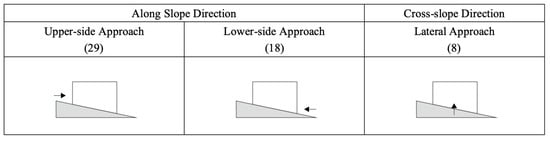
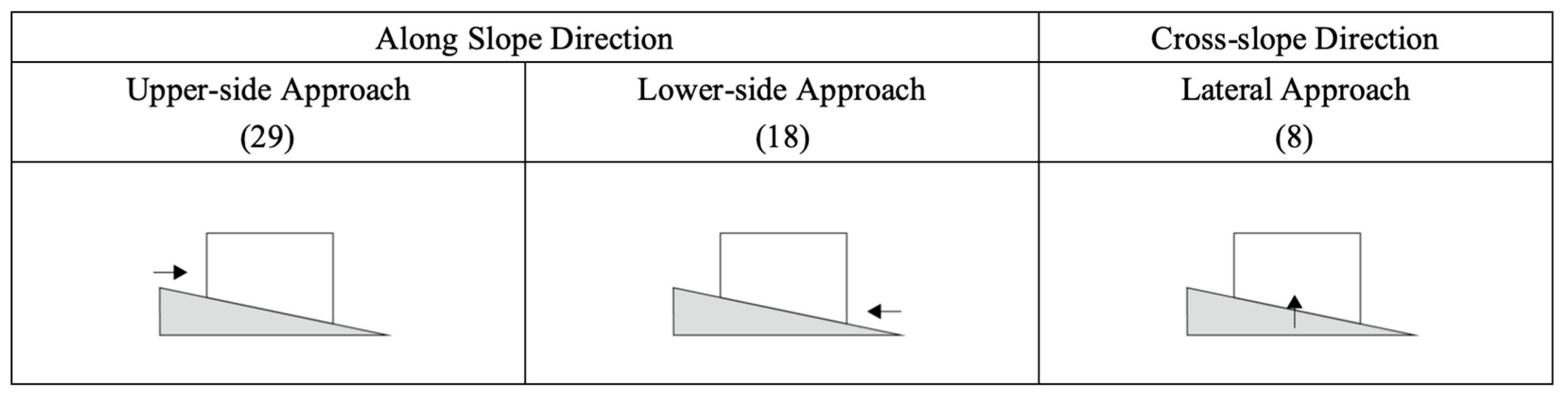
- Upper-side Approach: The path arrives at the building from an elevation higher than the main entrance level, generally descending towards the slope.
- Lower-side Approach: The path arrives from an elevation lower than the main entrance level, generally ascending towards the slope.
- Lateral Approach: The path runs approximately parallel to the contour lines, with minimal elevation change relative to the entrance.
b. Connection Method: The physical means by which the approach path links to the building’s entrance.
- Direct Ground Contact: The path leads directly to the entrance via the graded or natural ground surface.
- External Staircase: A dedicated outdoor stair connects a path landing to the entrance.
- Bridge: An elevated structure, often with a significant void underneath, connects the path to the entrance.
c. Volume Grounding Condition: The sectional relationship between the building’s underside and the terrain.
- Underside Configuration:
Flat Underside: The floor slabs are horizontally continuous without internal level changes at the ground contact points.
Stepped Underside: The floor slabs are split into different horizontal planes that follow the slope.
- Contact with Terrain (classified by visual analysis of sections):
Embedded: The volume is partially or fully set into a cut-and-leveled platform, with earth contact on at least one side.
Elevated & Detached: The volume sits above the natural slope on pilotis or posts, with a clear gap between the underside and the ground.
Surface Contact: The volume rests directly on a leveled portion of the site, with minimal cut or fill.
d. Site Topography Characteristics: In addition to the building volume’s grounding condition, the inherent characteristics of the sloping site itself are classified based on the relationship between sloped and leveled areas within the building footprint, as revealed through sectional analysis.
- Surface Exposure: The natural slope continues uninterrupted beneath or alongside the building volume, with no significant grading or terracing within the building footprint. The building engages directly with the continuous inclined plane.
- Continuous Transition: A portion of the site has been graded to create a level area that transitions smoothly into the natural slope without a distinct vertical retaining element. The building typically straddles the boundary between the leveled and sloped zones.
- Terrace Transition: A distinct vertical retaining structure (e.g., retaining wall) mediates between a leveled platform (either cut or fill) and the natural slope. This is the most common condition in the sample, involving clear topographic modification.
Internal Composition is analyzed based on the following variables:
a. Vertical Relationship (Entrance vs. Main Room): Determined by comparing the floor levels of these two key spaces.
- Same Floor: Both spaces are on the same main level.
- Split-level Subtype: A special condition where they are on the same “floor” but vertically offset by a few steps (less than one full story) due to the topography.
- Main Room Above Entrance: The main living area is on a higher floor.
- Main Room Below Entrance: The main living area is on a lower floor.
b. Spatial Continuity: Assessed based on the visual and physical connection between the entrance and the main room.
- Continuous: The two spaces are part of the same volumetric space, with no full-height wall partitions separating them. Visual connection is immediate.
- Discontinuous: The two spaces are separated by walls and doors, or are located on different floors without a direct visual axis.
c. Direct Ground Access: A binary variable noting whether the main room has a door or opening that provides immediate, step-less access to the exterior ground level.
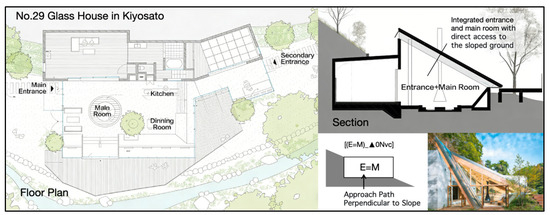
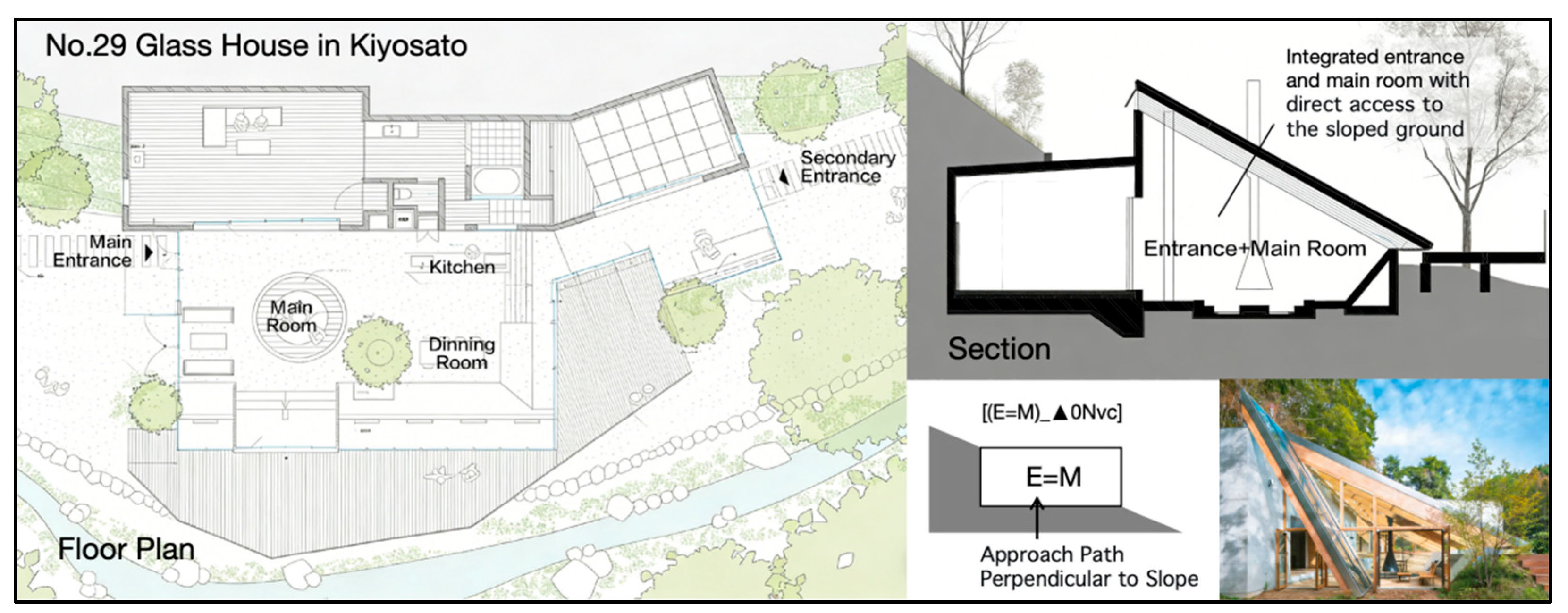
Analytical Procedure: Each of the 55 cases was analyzed by two researchers independently using the above variables. The analysis relied on the scaled plans, sections, elevations, and accompanying texts provided in the source journal. Any discrepancies in coding were discussed and resolved to ensure consistency. Figure 1 illustrates this process for a representative case. The coded data for each variable were then compiled to generate the frequency distributions shown in Figure 2, Figure 3, Figure 4, Figure 5 and Figure 6 and ultimately synthesized to form the typological matrix in Figure 7.
Figure 1.
Analysis example (source: author).
Figure 2.
The approach paths relative to the slope (source: author).
Figure 3.
The connection methods between the approach path and the building entrance (source: author).
Figure 4.
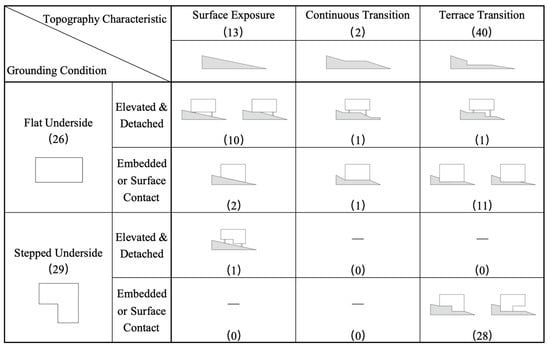
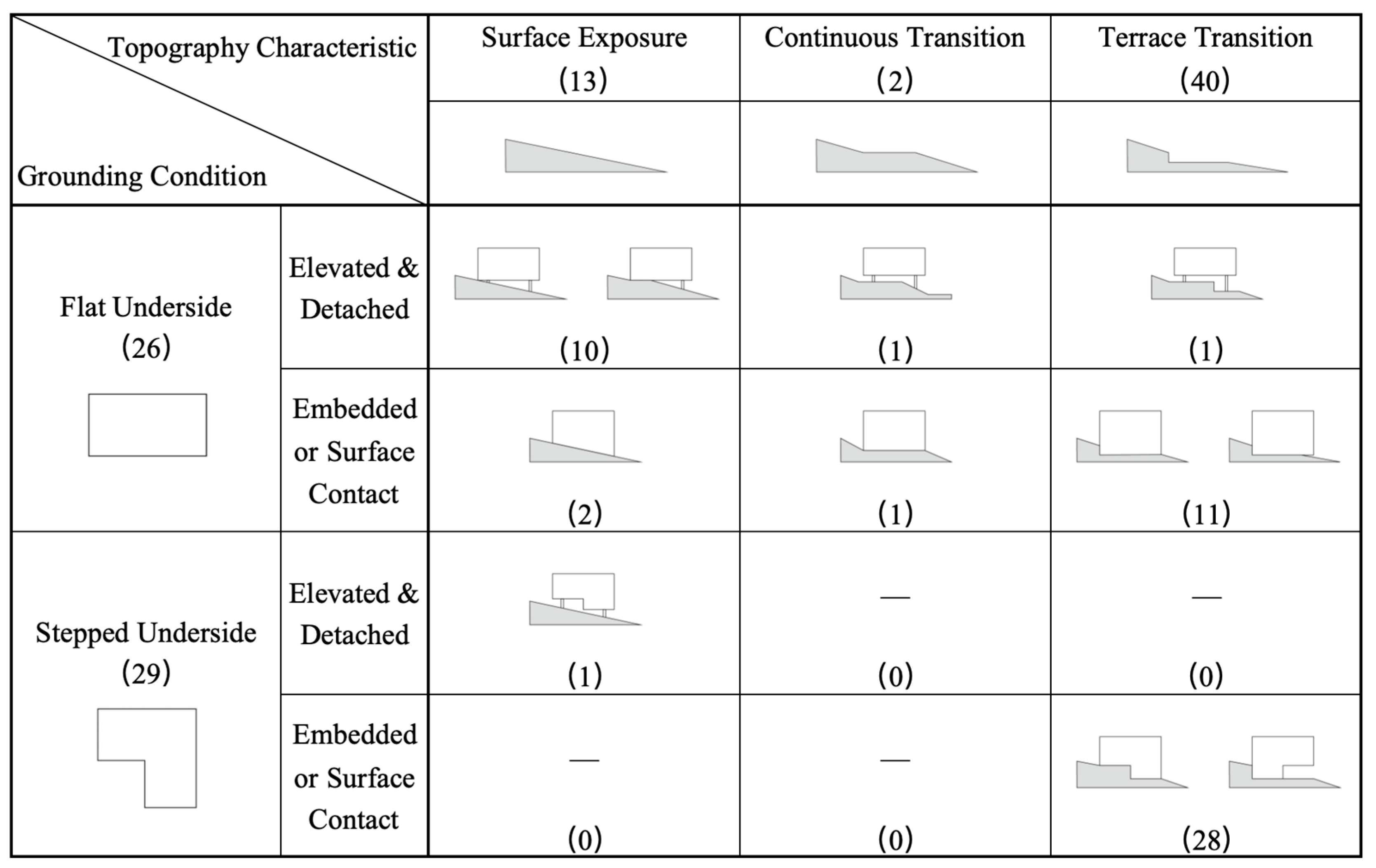
Grounding characteristics of building volume, analyzed through the intersection of underside configuration (flat/stepped) and contact with terrain (embedded/elevated & detached/surface contact). Site topography characteristics are also indicated (source: author).
Figure 5.
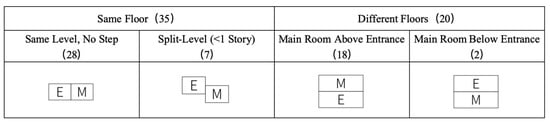
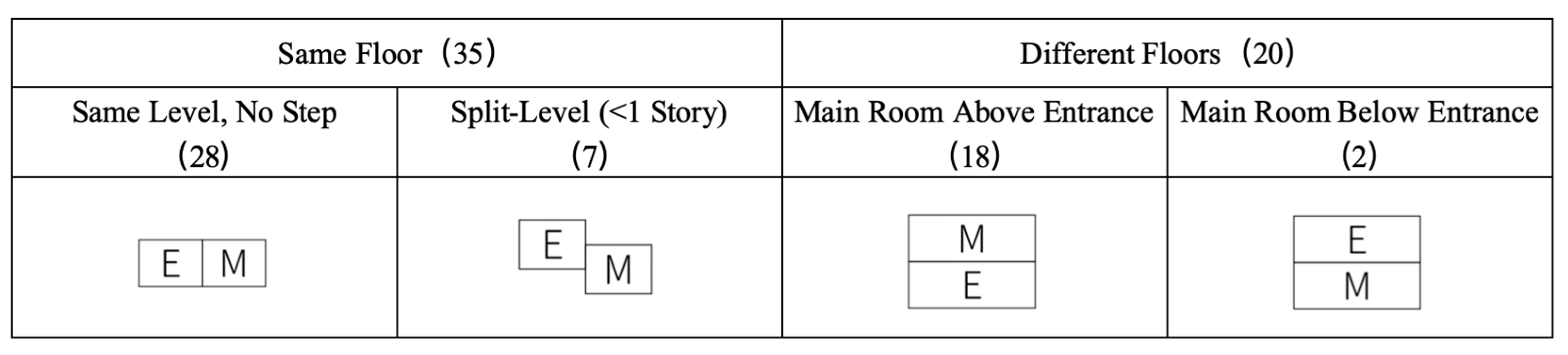
Vertical relationship between entrance and main room (source: author).
Figure 6.
Spatial continuity between entrance and main room (source: author).
Figure 7.
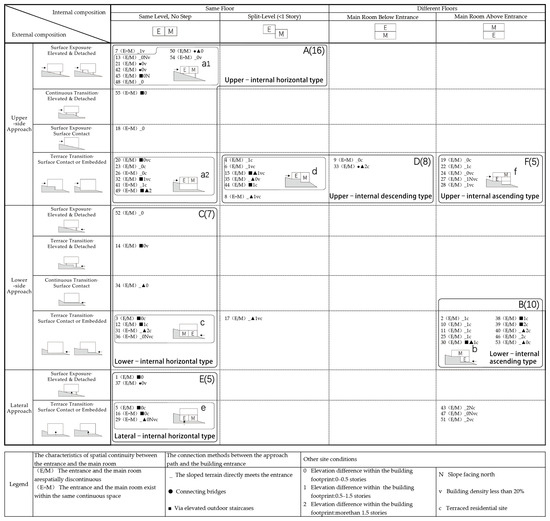
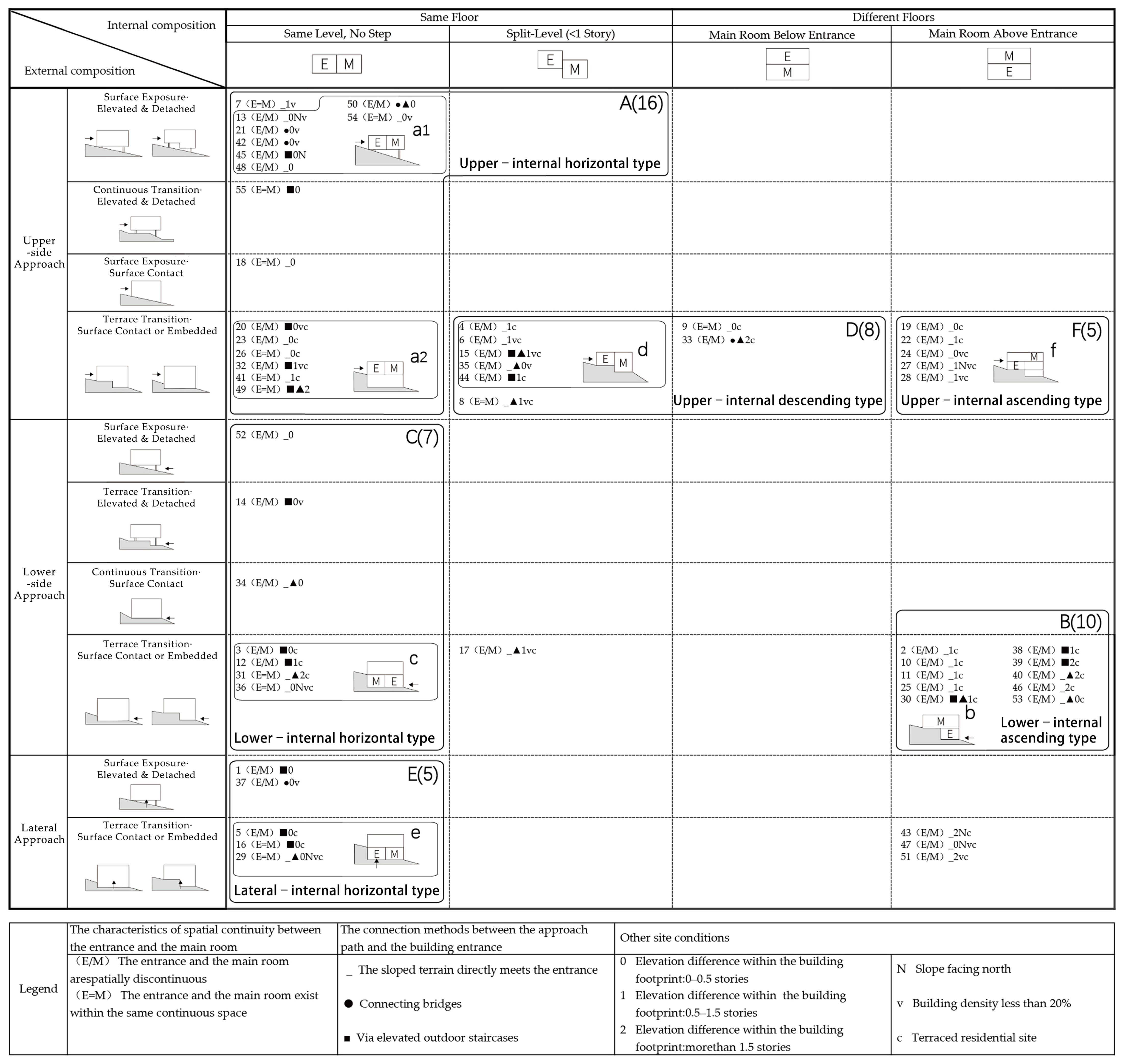
The Sectional Organization through External and Internal Composition (source: author).
To further enhance transparency and replicability, the following operational thresholds and decision rules were established prior to coding:
Split-level threshold: A vertical offset between the entrance and main room was classified as “split-level” only when the difference in floor elevation was less than one full story height (approximately 2.5 m) and required between two and five steps to negotiate. Cases with a single step or a difference exceeding one story were coded according to the primary vertical relationship category (Same Floor, Above, or Below).
Spatial continuity criteria: “Continuous” was coded when the entrance and main room were visually connected through an opening with no full-height opaque partition obstructing the line of sight from a standing position at the entrance threshold. Spaces separated by full-height walls, doors, or a change in floor level without a direct visual axis were coded as “Discontinuous.” Partial-height elements such as furniture, half-walls, or glazed partitions were not considered as disrupting continuity unless accompanied by a change in floor level.
Direct ground access: This variable was coded positively only when the main room had a door or fully openable glazed opening providing immediate, step-free access to the exterior ground level at the same floor elevation. Decks, terraces, or balconies accessible via a step or level change were not counted.
Main room identification: The main room was defined as the largest habitable space in the residence, typically combining living, dining, and kitchen functions in an open plan. In cases where multiple spaces of similar size existed, the space with the most prominent visual connection to the exterior or the clearest orientation toward the slope was selected, based on the accompanying descriptive text in the source journal.
In addition, an inter-rater reliability check was conducted on a random subsample of 10 cases (approximately 18% of the total) after the initial independent coding by two researchers. The percentage of agreement was 92% across all variables. Disagreements were primarily related to the interpretation of “spatial continuity” in cases with complex glazed partitions; these were resolved through joint re-examination of the drawings and refinement of the coding criteria, which were then applied consistently to the remaining cases. This process ensured that the final typology is based on a shared and replicable analytical protocol.
It should also be acknowledged that the exclusive reliance on a single journal—Shinkenchiku Jutaku Tokushu—deliberately targets the domain of architect-designed residential works rather than the broader spectrum of mass-produced speculative housing in Japan. As a publication renowned for its rigorous editorial selection and its focus on design innovation, it captures projects that have gained professional recognition and that embody the spatial experiments and design discourses shaping contemporary Japanese residential architecture. The findings of this study therefore pertain to this specific architectural discourse—the corpus of works deemed significant within professional circles—rather than to the entire population of sloping-site residences built in Japan during this period. This boundary is consistent with the study’s aim to elucidate the compositional logic of architecturally authored works, and should be considered when interpreting the results.
3. Topography of Sloping Sites and Sectional Composition of Residential Buildings
Sloping terrain enables residential buildings to achieve spatial configurations rarely possible on flat land—for instance, positioning the entrance on the upper side of the slope while locating other functional spaces on lower floors beneath it. Accordingly, the compositional logic of residences on sloping terrain can be articulated at two levels: external composition and internal composition.
External composition encompasses the orientation of the approach path relative to the slope, the grounding condition of the building volume, and the method by which the path connects to the building. Internal composition concerns the sectional arrangement of key spaces (notably the entrance and the main room), the spatial and visual continuity between rooms, and the presence or absence of openings oriented toward the slope.
This section presents a comprehensive cross-sectional analysis of all 55 case studies, structured around these two compositional dimensions.
3.1. Relationship Between Slope Terrain and Approach Path
The siting conditions of residences on sloping terrain vary considerably, from relatively spacious sites akin to resort villas to densely subdivided plots within terraced residential developments. The orientation of the approach path relative to both the slope and the building entrance is a primary determinant of how the building engages with the topography.
Figure 2 summarizes the orientation of the approach path relative to the slope across all 55 cases. In 29 cases, more than half of the total, the approach path is of the “Upper-side Approach” type. In 18 cases it is introduced the “Lower-side Approach” type, and in 8 cases the path is of the “Lateral Approach” type, that is, parallel to the contour lines. Among these, one case exhibits a notable variation: the path enters the site from the lower slope but wraps around to access an entrance located on the upper side, thereby traversing the entire slope gradient.
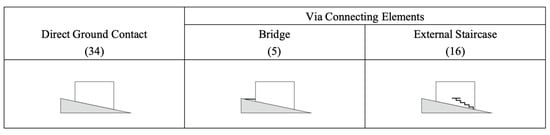
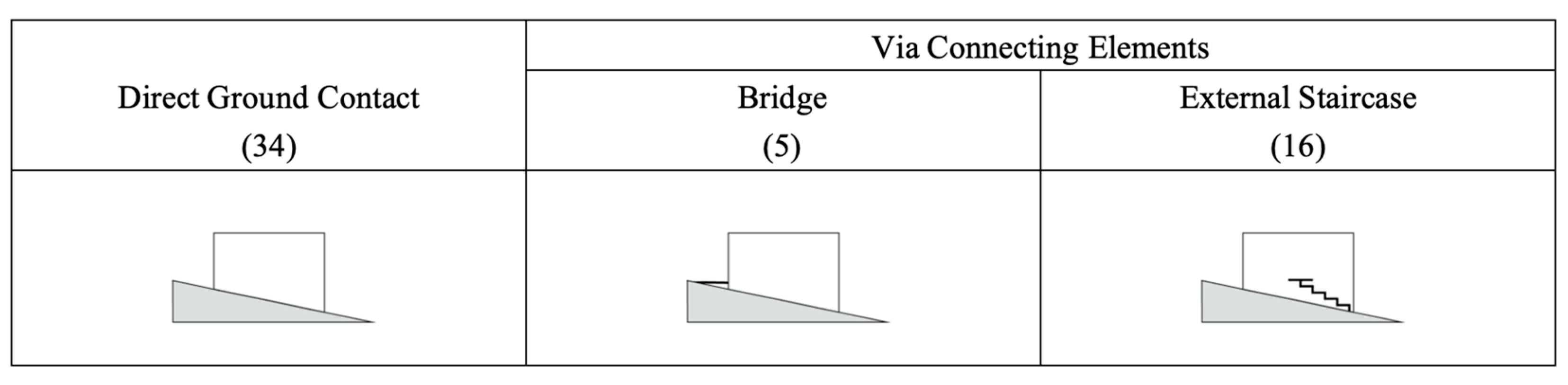
Figure 3 illustrates the connection methods between the approach path and the building entrance. In 34 cases (more than half), the path connects via “Direct Ground Contact”; in 16 cases, access is provided by an “External Staircase”; and in 5 cases, a “Bridge” is used.
3.2. Grounding Characteristics of Building Volume
Following the operational definitions established in Section 2, the grounding condition of each building volume was classified independently by two researchers through visual analysis of the published sections and site plans. The classification considered two interrelated dimensions: underside configuration (flat vs. stepped) and contact with terrain (embedded, elevated & detached, or surface contact). Disagreements were resolved through joint re-examination of the drawings, ensuring consistency across all 55 cases.
The grounding condition of the building volume is analyzed through two interrelated dimensions: underside configuration (flat vs. stepped) and contact with terrain (embedded, elevated & detached, or surface contact). Figure 4 presents a matrix combining these two dimensions, revealing three predominant grounding conditions that account for 50 of the 55 cases: (1) stepped underside with embedded contact (28 cases); (2) flat underside with embedded contact (11 cases); and (3) flat underside with elevated & detached contact (10 cases).
3.3. Internal Spatial Configuration Based on Entrance and Main Room
This study understands the internal composition of a residence as an assembly of discrete spatial units, namely rooms. Particular analytical attention is given to the sectional relationship between two key elements. The first is the main room, defined as the largest space and the primary family gathering area, typically comprising the living room and any spatially integrated dining and kitchen zones. The second is the entrance (genkan), the threshold space that mediates between interior and exterior. This subsection examines, through sectional diagrams, both the vertical positioning of these two spaces, that is, which floor each occupies, and the compositional characteristics of their spatial continuity.
The vertical relationship between the entrance and the main room is examined first. Figure 5 shows that in 35 of the 55 cases, more than half, both spaces are on the “Same Floor”. Within this group, 7 cases exhibit a split-level subtype of less than one full story between the entrance and the main room, a direct response to the sloping topography. In the remaining 20 cases, the main room is “Above Entrance” in 18 cases and “Below Entrance” in 2 cases. These figures illustrate a range of sectional strategies for positioning the core living space relative to the point of entry.
Based on the operational definition established in Section 2, spatial continuity between the entrance and the main room was assessed according to whether a clear visual axis exists without full-height opaque partitions (see Section 2 for detailed criteria).
As shown in Figure 6, in the majority of cases (42 out of 55), the two spaces are spatially discontinuous. Within this group, 23 cases locate them in separate rooms on the same floor, while 19 cases place them on different floors. In the remaining 13 cases, the entrance and the main room are part of a continuous space; among these, 12 cases share the same floor within a unified spatial volume, and one case integrates the entrance with the main room via a double-height void above the latter.
In summary, the cross-sectional analysis of the 55 cases reveals three prevailing tendencies. First, regarding the relationship between the slope and the approach path, the majority of cases adopt an approach from above, with the path typically following the existing ground surface. Second, concerning the grounding condition of the building volume, two dominant strategies emerge: either embedding the volume on a leveled platform created through cut and fill, or elevating it above the natural slope. Third, with respect to internal composition, a clear tendency is observed for the entrance and the main room to be located on the same floor.
4. Spatial Composition Patterns and Characteristics of Interior and Exterior
This chapter integrates two key analytical dimensions, namely, the orientation of the approach path as an external compositional attribute and the vertical relationship between entrance and main room as an internal compositional attribute. Through this integration, it establishes a typology of six basic sectional composition types (A through F) for residences on sloping terrain (Figure 7). Within each basic type, further differentiation is achieved by overlaying additional compositional variables, including the grounding condition of the building volume, the degree of spatial continuity between entrance and main room, and the method of connecting the approach path to the building, for instance bridges or outdoor stairs. This layered analysis yields a set of representative sub patterns (a through f) that articulate specific design variations within each fundamental typology.
Based on the operational definitions of external and internal composition variables established in Section 2, the 55 case studies can be synthesized into six fundamental sectional types (A through F), each characterized by a specific combination of approach orientation, vertical relationship, and grounding condition, as detailed below (Table 2).
Table 2.
Summary of the six basic sectional types (source: author).
Basic Type A (16 cases) is defined by an “Upper-side Approach” path and a “Same Floor” arrangement of entrance and main room, a configuration we term the “upper-internal horizontal type”. Within this type, two contrasting sub-patterns emerge. In sub-pattern A-a1, the building volume features a “Flat Underside” and is “Elevated & Detached” from the sloping terrain. The entrance and main room, though on the “Same Floor”, are “Discontinuous” spaces; the elevated position grants the main room expansive downward views while simultaneously accentuating the building volume as a conspicuous formal object. In sub-pattern A-a2, by contrast, the building volume has a “Flat Underside” and is “Embedded” into a cut-and-leveled platform within the slope. Here, the entrance and main room are also on the “Same Floor”, typically the upper level, but the volume’s partial concealment by the topography on the uphill side results in an appearance of greater topographic integration. Despite this difference in volumetric expression, both sub-patterns retain the core attributes of Type A: entry from above and a horizontally organized main living level.
Basic Type B (10 cases) is characterized by a “Lower-side Approach” and a vertical stratification where the entrance is on a lower floor and the main room is above it (Main Room Above Entrance), a configuration we term the “lower–internal ascending type”. All instances conform to sub-pattern B-b, wherein the building volume features a “Stepped Underside” and is “Embedded” into a cut-and-leveled platform. The entrance is placed on the lowest habitable level, while the main room benefits from superior daylight and outlook on the floor above. This sectional organization generates an ascending internal circulation that follows the natural upward direction of the slope, thereby transforming topographic ascent into a sequential spatial experience.
Basic Type C (7 cases) also features a “Lower-side Approach”, but here the entrance and main room are located on the “Same Floor”, defining the “lower–internal horizontal type”. The representative sub-pattern, C-c, places the building on either naturally level ground or a cut-and-leveled terrace. Both key spaces are situated on the lower level(s), prioritizing immediate access to the main living area; secondary functions such as bedrooms are relegated to upper floors, where they can capitalize on enhanced views and natural light. This arrangement privileges functional convenience and programmatic hierarchy over the exploitation of sectional drama.
Basic Type D (8 cases) again employs an “Upper-side Approach”, but unlike Type A, the main room is below the entrance (Main Room Below Entrance), yielding the “upper–internal descending type”. In sub-pattern D-d, the entrance and main room are on the “Same Floor” but are vertically offset by a split-level condition that follows the natural fall of the terrain. The building volume engages the topography precisely through this internal level change, creating a descending internal circulation that mirrors the downward gradient of the site.
Basic Type E (5 cases) is distinguished by a “Lateral Approach” (parallel to the contour lines), combined with a “Same Floor” arrangement of entrance and main room, defining the “lateral-internal horizontal type”. The characteristic sub-pattern, E-e, employs a volume with a “Flat Underside” that is “Embedded” into a leveled terrace. As in Type C, the primary living spaces are located on the lower level to maximize accessibility, while bedrooms and ancillary functions are consigned to upper floors with superior outlook and illumination. This type demonstrates that lateral access can serve as an alternative strategy for achieving horizontal internal organization, avoiding direct confrontation with the slope’s fall line.
Basic Type F (5 cases) shares with Types A and D an “Upper-side Approach”, but uniquely positions the main room above the entrance (Main Room Above Entrance), giving rise to the “upper-internal ascending type”. All instances conform to sub-pattern F-f: the volume is “Embedded” into a cut-and-leveled platform (typically with a “Flat Underside”), placing the main room on an upper floor (Main Room Above Entrance), affording optimal light and outlook, while the entrance remains below. The resultant ascending internal circulation deliberately opposes the downward gradient of the slope, introducing a subtle yet deliberate counter topographic tension. This inversion of expected sectional logic distinguishes Type F as the most explicitly anti orographic among the six basic types.
Table 3 presents the distribution of site topography characteristics, namely, Surface Exposure, Continuous Transition, and Terrace Transition, across the six basic sectional types identified above. This cross tabulation, derived from the coded data presented in Section 3, reveals systematic relationships between topographic conditions and sectional organization.
Table 3.
Distribution of Site Topography Characteristics across the Six Basic Sectional Types (source: author).
Several patterns are noteworthy. First, Terrace Transition, which involves clear topographic modification through retaining structures, dominates the sample with 40 cases and appears across all six types. This underscores its status as the most prevalent strategy for engaging sloping terrain. It is particularly concentrated in embedded types such as A-a2, B, C-c, D, E-e, and F (all 5 cases), where cut and fill operations are necessary to accommodate level floor plates.
Second, Surface Exposure, where the natural slope continues uninterrupted beneath or alongside the building, occurs exclusively in elevated or detached configurations. Notably, 7 of the 13 Surface Exposure cases belong to Type A-a1. This confirms that preserving the natural slope without major grading is intrinsically linked to strategies that elevate the building volume above the terrain.
Third, Continuous Transition, a smooth grading between leveled and sloped zones without distinct retaining elements, is rare in the sample with only two cases. This suggests that Japanese sloping terrain residences tend to favor either minimal intervention through Surface Exposure or clear terracing through Terrace Transition, rather than intermediate solutions.
These patterns demonstrate that the six basic types, while defined by approach orientation and entrance–main room vertical relationship, are systematically associated with distinct modes of topographic engagement.
5. Discussion
This chapter discusses the three core design logics identified in the study, examines their evolution through a diachronic comparison with Endo et al. (2002) [9], situates them within a cross-cultural context, and draws out their implications for design practice.
5.1. Three Core Design Logics in Contemporary Practice
The six basic types and their sub-patterns exhibit systematic regularities that can be grouped into three overarching compositional logics, each corresponding to a distinct cluster of types as elaborated below.
Spatial transformation and expression of slope directionality.
This logic is primarily embodied by Type B (lower-internal ascending) and Type D (upper-internal descending), both of which align internal vertical circulation with the natural fall line of the slope. In Type B, entry from below the slope leads to a sequential ascent through the section, culminating in the main room on an upper level. In Type D, entry from above initiates a downward trajectory that follows the topographic gradient. In both types, the directionality of the slope is translated into a clear vertical sequence that structures the inhabitant’s movement through the dwelling. This pattern suggests that, for a significant subset of contemporary projects, the slope is treated not merely as a constraint to be neutralized, but as an ordering device that organizes internal circulation.
This design intention is often explicitly articulated in the architects’ own descriptions. For instance, the design statement for Case No. 02 (Jofu-an) in Table 1, a representative Type B project, describes the interior as “a terrain-like sequence composed of various floor levels” that orchestrates movement through the dwelling, directly confirming the strategy of transforming topographic ascent into a spatial narrative of arrival (see project description in issue 2015-04 of the source journal). In Type D projects, where entry from above initiates a downward trajectory that follows the natural gradient, architects similarly speak of guiding inhabitants through a deliberate descent that unfolds the dwelling in relationship to the sloping site. The description for Case No. 04 (House in Hibaru) in Table 1 vividly illustrates this experience: “Upon entering, one encounters an enclosed hall; beyond it, the core functions are arranged. Gazing toward the waterside, the opening framed by the roof reflects only the water surface, evoking the sensation of being on a boat floating on the water. Descending the stairs and moving toward the water, the landscape before one’s eyes shifts, and the spatial atmosphere gradually transforms” (see project description in issue 2015-07 of the source journal). These statements confirm that the spatial narratives identified are not merely analytical constructs but were intentional design goals.
Contrastive relationship between building volume and sloping terrain.
This logic is primarily embodied by Type A-a1, Type F, and to a lesser extent Type E. These types share a common design intention: they foreground the distinction between architectural form and topographic substrate rather than seeking seamless integration. In Type A-a1, the volume features a flat, uninterrupted underside elevated on pilotis, detaching it completely from the sloping ground. This configuration secures unobstructed downward views while simultaneously rendering the building as a distinct geometric figure set against the irregular terrain. In Type F, although the volume is typically embedded into the slope, its internal circulation ascends counter to the topographic fall, creating a sectional relationship that diverges from the natural gradient. In Type E, lateral approach—parallel to the contour lines rather than along the fall line—attenuates the direct confrontation between building and slope. Collectively, these patterns demonstrate that contrast, separation, and even mild opposition constitute valid design strategies alongside integration and mimicry.
“Leveling” adaptation and function prioritized layout.
This logic is characteristic of Type A-a2 and Type C-c, both of which employ extensive cut-and-fill operations to create level platforms that accommodate conventional plan layouts. In Type A-a2, the building volume is embedded into a leveled terrace, with the entrance and main room occupying the upper floor(s) while the lower portion recedes into the cut face. In Type C-c, the building stands on fully leveled ground, placing both key spaces on the ground floor for maximum accessibility. In both cases, topographic complexity is traded for planimetric regularity and everyday convenience, revealing a pragmatic design philosophy that prioritizes functional efficiency over expressive sectional tension.
5.2. Diachronic Comparison: Continuities and Shifts
A dialogue with the foundational study by Endo et al. (2002) [9] situates our findings within a broader temporal trajectory. Based on works from 1956 to 1999, Endo et al. identified four basic sectional types and three overarching tendencies: “architecturalization of slope directionality,” “contrast between building and slope,” and “abstraction of slope characteristics.” To systematically articulate the continuities and shifts between their findings and ours, Table 4 maps the six sectional types identified in our 2015–2024 sample onto the framework established by Endo et al.
Table 4.
Comparative Analysis: Evolution of Sectional Composition from Endo et al. (2002) [9] to the Present Study (2015–2024) (source: author).
As Table 4 illustrates, the conceptual nucleus identified two decades ago remains operative, yet its contemporary manifestations have undergone significant evolution. The “architecturalization of slope directionality” tendency continues as a fundamental strategy, with Types B and D serving as pure exemplars of this enduring logic. The “contrast” tendency, however, has intensified and diversified: while Type A-a1 represents a more pronounced form of visual contrast through complete elevation, Type F introduces a novel “internalized contrast” by creating counter-topographic circulation within an embedded volume—a more subtle and sophisticated opposition that was less explicit in earlier works. The “abstraction” tendency has evolved toward systematization and pragmatic prioritization: Types A-a2 and C-c demonstrate a matured “leveling” logic where functional convenience and planimetric regularity take precedence over expressive sectional tension—a shift that may reflect changing domestic lifestyles and technical possibilities. Furthermore, Type E emerges as a complementary strategy with no direct equivalent in Endo et al.’s framework, expanding the typological repertoire for sloped sites through lateral approach and horizontal internal organization.
The shifts observed between Endo et al.’s (2002) [9] findings and our contemporary sample—particularly the intensification of the “contrast” tendency, the systematization of the “abstraction” tendency, and the emergence of Type E as a complementary strategy—invite speculation about underlying socio-cultural drivers. Japan’s aging population and changing family structures may have increased demand for single-level living convenience, potentially contributing to the prevalence of “leveling” strategies (Types A-a2 and C-c) that prioritize accessibility over sectional drama. Concurrently, evolving work-from-home patterns and changing conceptions of domestic privacy may have encouraged the clearer spatial demarcation observed in the increased spatial discontinuity between entrance and main room (42 out of 55 cases)—a phenomenon that aligns with the more pronounced contrast strategies (Types A-a1 and F) that emphasize the distinction between domestic realms and the outside world. While our typological analysis cannot establish causal relationships, these correlations suggest fruitful hypotheses for future interdisciplinary research that integrates spatial analysis with sociological and ethnographic methods.
In conclusion, this study’s primary contribution lies not merely in proposing a new typology, but in demonstrating a methodological framework for tracing the evolution of design thinking. By diachronically comparing the sectional types from 2015–2024 with the foundational work of Endo et al. (2002) [9], we move beyond a static snapshot to reveal a dynamic process of design language evolution. The findings show that while core principles (like transforming slope directionality) remain a persistent undercurrent, their architectural expressions have diversified and intensified in response to contemporary technical capacities and social needs. This study thus provides both a practical toolkit for designers and an empirical model for understanding how architectural culture perpetuates and renews itself over time.
5.3. Cross-Cultural Observations
While this study focuses specifically on Japanese examples, a preliminary comparison with international scholarship on sloping terrain residential design reveals both convergences and divergences. For instance, research on European alpine architecture has often emphasized structural adaptation to extreme topographic and climatic conditions [6], whereas Mediterranean sloped settlements frequently prioritize viewshed optimization and thermal performance [28]. In contrast, the Japanese strategies identified in this study—particularly the transformation of slope directionality into internal circulation sequences (Types B and D) and the counter-topographic tension in Type F—suggest a greater emphasis on experiential and phenomenological qualities rather than purely technical or environmental optimization. This distinction may reflect deeper cultural attitudes toward nature in Japanese architectural thought, where integration with topography is often pursued through subtle spatial articulation rather than overt formal expression. A systematic comparative study between Japanese and Western sloped residential strategies would be a valuable direction for future research, enabling the identification of culturally specific versus universally applicable design principles.
5.4. Design Implications for Practice
The typologies and patterns identified in this study are not merely phenomenological descriptions; rather, they disclose a set of effective operational logics for organizing residential space under complex topographic conditions. As such, these strategies possess direct and transferable value for the design practice of sloping terrain residences.
First, the study establishes that the pathway–entrance–main room sequence constitutes a critical axis for both interpreting and shaping the spatial experience of residences on sloping terrain. Designers may consciously select a basic type as a generative point of departure, guided by the spatial relationship between the site and the access road—whether the approach arrives from above, below, or the side. For example, when entry is necessarily from below the slope, Type B (lower–internal ascending type) provides a means of converting what might be perceived as a constraint into a positive spatial narrative, namely, a sense of ascending arrival. Conversely, on sites that afford a downward view, the designer can choose between Type A, which accentuates volumetric autonomy, and Type D, which follows the natural descent of the land; the two options embody distinct esthetic postures toward the same topographic condition.
Second, the study foregrounds the diversity of interface strategies between building volume and terrain, along with the distinct design intentions they embody. Whether through the complete elevation of A-a1, which accentuates formal presence and optimizes outlook; the embedding and leveling of A-a2 and C-c, which prioritize stability and everyday convenience; or the deliberate alignment or counter alignment of internal circulation within the embedded volumes of B-b and F-f, each grounding strategy reveals itself as a central instrument for reconciling formal ambition, spatial experience, and engineering pragmatism. This suggests that the treatment of terrain ought not to be reduced to a merely technical operation of site grading; rather, it should be approached as a formal gesture that actively participates in the definition of space and the construction of architectural meaning.
Finally, the very multiplicity of types and patterns confirms that no single optimal solution exists for designing on sloping terrain. The three core spatial tendencies identified—transforming directionality, establishing contrast, and adaptive leveling—embody fundamentally distinct design philosophies: the slope may be approached as a source of inspiration, a dialogic partner, or a substrate to be domesticated. The typological framework developed in this study enables designers to establish a clear logical position and make strategic choices in the early phases of a project, fostering designs that are at once internally coherent and contextually distinctive.
6. Conclusions
6.1. Research Summary
This study conducted a systematic analysis of 55 Japanese independent residences built on sloping terrain between 2015 and 2024. By developing an analytical framework that integrates external composition, including approach path orientation and the grounding condition of the building volume, with internal composition, defined by the sectional relationship between the entrance and the main room, the research identified six fundamental sectional types, designated A through F, along with their corresponding sub patterns. From these types, three core design logics were derived. The first logic transforms the physical directionality of the slope into internal circulation sequences, as exemplified by Type B, where entry from below initiates an ascending movement, and Type D, where entry from above generates a descending trajectory. The second logic establishes a contrastive relationship between building volume and terrain, evident in the elevated and detached configuration of Type A-a1, the counter topographic circulation of Type F, and the lateral approach of Type E that avoids direct confrontation with the slope’s fall line. The third logic employs leveling strategies to prioritize functional layout and everyday convenience, as seen in the embedded and terraced configurations of Types A-a2 and C-c. A diachronic comparison with the foundational study by Endo et al. from 2002 revealed both continuities and shifts over the past two decades. While the conceptual nucleus of translating slope directionality persists, the contrast tendency has intensified and diversified, the abstraction tendency has evolved toward systematic leveling, and a complementary lateral approach type has emerged. This study provides a typological reference for sloping terrain residential design and contributes an empirical foundation for understanding the intrinsic compositional relationship between architecture and terrain.
6.2. Principal Contributions
At the academic level, the contribution of this study resides in its systematic, typologically driven approach to advancing the understanding of the architecture–terrain relationship, a core concern within landscape architecture. This contribution is especially pertinent as it is situated at the residential scale and within an East Asian cultural context.
First, this study develops an analytical framework that explicitly links external environmental conditions to internal spatial organization. While previous research on sloping terrain architecture has tended to concentrate either on site planning and landscape visual assessment or on the form and structure of the building in isolation, the present study integrates two critical variables, namely, approach path orientation and the sectional relationship between entrance and main room. In doing so, it demonstrates precisely how topographic constraints cross the building threshold and come to shape the sequence of everyday domestic spaces. This outside-in perspective on sectional composition offers a concrete and powerful analytical instrument for deciphering the symbiotic reciprocity between architecture and its topographic ground.
Second, the study uncovers a spatial narrativity embedded within the topographic adaptations of contemporary Japanese residences. In contrast to research that primarily frames slope response as a matter of technical accommodation, this study reveals that a substantial number of cases deliberately transpose the physical directionality of the slope into choreographed sequences of bodily movement and visual perception.
While the three logics identified in Section 5.1 are grounded in the empirical analysis of sectional types, their deeper resonance with Japanese architectural thought—particularly the emphasis on experiential sequence and the integration of topography—suggests that these design strategies are not merely pragmatic responses but also carriers of cultural meaning.
6.3. Limitations and Future Research Directions
Regarding the positioning of this study within landscape architecture, it is important to clarify that our contribution lies not in the analysis of biophysical landscape variables (e.g., vegetation, hydrology, or soil conditions), but in the systematic examination of architecture–terrain compositional relationships—a core theoretical concern within the discipline. The variables we analyze—approach orientation, grounding condition, site topography characteristics—directly address how built form engages with topographic ground, which is a fundamental issue in landscape architectural discourse on site design and terrain intervention. While broader landscape variables are beyond the scope of the current study, the typological framework developed here provides a structured foundation for future interdisciplinary research that integrates sectional composition with analyses of ecological performance, landscape visual assessment, or geotechnical behavior.
Beyond the disciplinary positioning, the study also faces empirical scope limitations. It is important to reiterate the scope boundaries discussed in Section 2. The findings are drawn exclusively from projects published in a single architectural journal that specializes in architect-designed works. While this ensures a consistent level of design discourse and documentation quality, it necessarily excludes the vast field of speculative housing and vernacular building practices. The typology developed here should therefore be understood as a systematization of design strategies within the professional architectural culture of contemporary Japan.
Extending this line of inquiry, future research could integrate sectional composition with analyses of material tectonics, structural behavior, and detailed landscape sightlines, thereby advancing toward a more multidimensional understanding of sloping terrain architecture. Building upon the typological foundation established in this study, subsequent work might collect precise slope gradient data and employ statistical methods to test the correlations suggested by our qualitative framework, such as whether steeper slopes tend to generate specific sectional types like the stepped underside configurations (Types B and D). Further studies could also incorporate contextual variables beyond the current scope, including quantitative slope data, regional climatic conditions (snowfall, solar radiation), urban versus rural site contexts, and construction materiality. A comparative approach controlling for these factors would reveal deeper influences on sectional design strategies and test the applicability of our typology across diverse environmental and cultural settings.
Author Contributions
Conceptualization, Y.S.; methodology, L.L.; validation, Y.S. and L.L.; formal analysis, J.L.; data curation, X.L. and J.L.; writing—original draft preparation, Y.S. and L.L.; writing—review and editing, Y.S. and L.L.; visualization, X.L. All authors have read and agreed to the published version of the manuscript.
Funding
This research is supported by “BUCEA Talent Pyramid Cultivation Program” (JDYC20220801), “The Cultivation project Funds for Beijing University of Civil Engineering and Architecture” (X25004), and “BUCEA Young Teachers’ Research Capacity Enhancement Program” (X21042).
Data Availability Statement
Data are contained within the article.
Conflicts of Interest
The authors declare no conflicts of interest.
References
- Norberg-Schulz, C. Genius Loci: Towards a Phenomenology of Architecture; Rizzoli: New York, NY, USA, 1980. [Google Scholar]
- Frampton, K. Modern Architecture: A Critical History, 3rd ed.; Thames & Hudson: London, UK, 1992. [Google Scholar]
- McHarg, I.L. Design with Nature; Natural History Press: New York, NY, USA, 1969. [Google Scholar]
- Allen, S.; McQuade, M. Landform Building: Architecture’s New Terrain; Lars Müller Publishers: Zurich, Switzerland, 2011. [Google Scholar]
- Ishii, O. Residential Space and Greenery; Kenchiku Shiryo Kenkyusha: Tokyo, Japan, 1988. (In Japanese) [Google Scholar]
- Zumthor, P. Thinking Architecture, 3rd ed.; Birkhäuser: Basel, Switzerland, 2010. [Google Scholar]
- Pollock, N.R. Jutaku: Japanese Houses; Phaidon Press: London, UK, 2015. [Google Scholar]
- Ciorra, P.; Ostende, F. (Eds.) The Japanese House: Architecture and Life After 1945; Marsilio: Venice, Italy, 2017. [Google Scholar]
- Endo, K.; Sakamoto, K.; Terauchi, M. Sectional Composition of Japanese Contemporary Residences Located on the Inclined Ground-A Study on Spatial Composition of Relation Between Architecture and Environment. J. Archit. Plan. Trans. AIJ 2002, 561, 145–150. (In Japanese) [Google Scholar] [CrossRef] [Scilit] [PubMed]
- Corner, J. The Landscape Imagination: Collected Essays of James Corner 1990–2010; Princeton Architectural Press: New York, NY, USA, 2014. [Google Scholar]
- Hiroko, S. A Study of Residents’ Evaluation of Living Environment with Natural Forests and Natural Geographical Features in Detached Housing Area: Residents’ Evaluation of Green Areas with Natural Forests at Residential Areas. J. Archit. Plan. Trans. AIJ 2000, 527, 185–192. (In Japanese) [Google Scholar]
- Tomoo, S.; Katsuyoshi, T. On the Direction of Front Rooms of a Main residence in Villages Located in a Slope and a Base of a Mountain: Study on Plane Composition of Rural Landscape in Okinawa Part 4. J. Archit. Plan. Trans. AIJ 1985, 350, 113–123. (In Japanese) [Google Scholar]
- Atsushi, O.; Motohiro, K.; Tetsuzo, M. Case Study on the Elements and Composition of Front Space of Housing Lot in Rural Settlement on Mountain Area: Part 2 Study on the Border Space of the residence in Rural Area. J. Archit. Plan. Trans. AIJ 2000, 534, 139–145. (In Japanese) [Google Scholar]
- Li, L.; Shen, Y. Study on the Arrangement Method of Detached residence from Works of Japanese Architect Osamu Ishii. Chin. Landsc. Archit. 2018, 34, 105–111. (In Chinese) [Google Scholar]
- Li, L.; Liu, B.; Li, H. Approach Design Inheriting Traditional Spatial Ambiguity: An Analysis of Arrangement and Composition in Takehara Yoshiji’s Independent Residential Works. Buildings 2025, 15, 1191. [Google Scholar] [CrossRef] [Scilit]
- Li, L.; Chen, Y.; Li, H. Reimagining Kyokai: Layered Permeability in Yoshiji Takehara’s Modern Residences. Buildings 2025, 15, 1591. [Google Scholar] [CrossRef] [Scilit]
- Sun, Y.; Wang, A.; Zheng, K.; Li, L. Research on the Configuration and Composition Characteristics of Courtyards in Japanese Independent Residential Works: A Case Study of Projects from 2015 to 2024. Buildings 2025, 15, 3253. [Google Scholar] [CrossRef] [Scilit]
- Endo, K.; Shiozaki, T.; Okuyama, S. Relationship Between the Boundary of Site and the Outline of Plan in Contemporary Japanese residences Located on the Irregular Shaped Site: A Study on the Correspondence of Architecture to the Site. J. Archit. Plan. Trans. AIJ 2015, 709, 579–589. (In Japanese) [Google Scholar] [CrossRef] [Scilit]
- Kogawa, J.; Onoda, T.; Sakamoto, K. Composition of Outside Volumes and Rooms in Contemporary Japanese residences: Architectural Composition of Contemporary Japanese residences in Terms of Relation Between Interior and Exterior. J. Archit. Plan. Trans. AIJ 2000, 537, 117–123. (In Japanese) [Google Scholar]
- Murata, R.; Negayama, A.; Yasuda, K. Furnishing of Courtyards and Connection with Living Rooms in Contemporary Japanese Courtyard residences. J. Archit. Plan. Trans. AIJ 2012, 676, 1365–1371. (In Japanese) [Google Scholar] [CrossRef] [Scilit]
- Liang, L.; Li, X.; Liu, S.; Guo, Z.; Tang, S.; Wen, B. Integrating Computer Vision and GIS for Large-Scale Morphological Mapping and Driving Force Analysis of Vernacular Courtyard Dwellings. Buildings 2026, 16, 1118. [Google Scholar] [CrossRef] [Scilit]
- Liang, L.; Wen, B.; Xu, F.; Yang, Q. From Poor Buildings to High Performance Buildings: The Spontaneous Green Evolution of Vernacular Architecture. Appl. Sci. 2023, 13, 10162. [Google Scholar] [CrossRef] [Scilit]
- Xu, F.; Bai, Y.; Wen, B.; Xie, W.; Huang, L.; Ou, Y.; Luo, X.; Yang, Q. Contemporary Evolution of Tibetan-Style Dwellings under Urbanization: A Case Study of the Shannan City. J. Asian Archit. Build. Eng. 2025, 1–18. [Google Scholar] [CrossRef] [Scilit]
- Yang, Q.; Xu, F.; Lu, W.; Yang, Z.; Bai, Y.; Wen, B. Green Renovation and Multi-Objective Optimization of Tibetan Courtyard Dwellings. Build. Environ. 2025, 279, 113071. [Google Scholar] [CrossRef] [Scilit]
- Yang, Q.; Lu, W.; Xu, F.; Luo, X.; Wen, B. A Passive Strategy for Energy-Saving Retrofitting of Courtyard Dwellings and Its Climatic Adaptability. Energy Build. 2026, 352, 116811. [Google Scholar] [CrossRef] [Scilit]
- Buhrs, M.; Rössler, H. (Eds.) Terunobu Fujimori: Architect; Hatje Cantz: Ostfildern, Germany, 2012. [Google Scholar]
- Lewis, P.; Tsurumaki, M.; Lewis, D.J. Manual of Section; Princeton Architectural Press: New York, NY, USA, 2016. [Google Scholar]
- Rudofsky, B. Architecture Without Architects: A Short Introduction to Non-Pedigreed Architecture; Museum of Modern Art: New York, NY, USA, 1964. [Google Scholar]



Disclaimer/Publisher’s Note: The statements, opinions and data contained in all publications are solely those of the individual author(s) and contributor(s) and not of MDPI and/or the editor(s). MDPI and/or the editor(s) disclaim responsibility for any injury to people or property resulting from any ideas, methods, instructions or products referred to in the content. |
© 2026 by the authors. Licensee MDPI, Basel, Switzerland. This article is an open access article distributed under the terms and conditions of the Creative Commons Attribution (CC BY) license.