Systematic Review

Optimization of Loss Determination in Claims Settlement Using Smart Industry Tools: A Systematic Review and Implications for the Construction Industry


by
Jorge Acevedo-Bastías
1,*,
Sebastián González Fernández
2,
Luis López-Quijada
1 and
Vinicius Minatogawa
1
1
School of Construction and Transportation Engineering, Pontificia Universidad Catȯlica de Valparaíso, Valparaíso 2340000, Chile
2
School of Civil Engineering, University of Valparaíso, Valparaíso 2360000, Chile
*
Author to whom correspondence should be addressed.
Buildings 2026, 16(6), 1175; https://doi.org/10.3390/buildings16061175
Submission received: 17 December 2025 / Revised: 27 January 2026 / Accepted: 5 February 2026 / Published: 17 March 2026

Abstract

The claims resolution process is a cornerstone of the insurance industry, aiming to fairly and accurately determine the economic losses caused by adverse events. Traditionally, adjusters have relied heavily on expert judgment to perform this task. While this approach is essential, it often suffers from subjectivity, inconsistent criteria, and difficulty integrating complex data sources into objective analyses. In this context, Smart Industry tools—such as Artificial Intelligence (AI), Machine Learning (ML), Computer Vision (CV), and the Internet of Things (IoT)—have demonstrated high potential to automate damage detection and assessment; however, their effective integration into loss determination remains uneven across different productive sectors. This study addresses this problem through two objectives. First, we conducted a systematic literature review following PRISMA guidelines to identify which Smart Industry tools are currently used in the insurance sector for loss determination and to analyze their level of maturity in different productive sectors. We searched the Web of Science and Scopus databases, identifying 253 studies, of which 23 met our inclusion criteria. Second, based on the gaps we identified between the construction sector and more advanced industries such as automotive, we propose a methodological framework based on Building Information Modeling (BIM). Our results show that most solutions focus on the detection and technical classification of damage, especially in the automotive sector, while construction lacks methods to convert these technical findings into operational economic estimates. The proposed framework addresses this gap by standardizing technical and economic data from the underwriting stage, enabling more automated, traceable, and objective loss determination for infrastructure claims.

1. Introduction

The claims settlement process is a cornerstone of the insurance industry, aimed at determining—fairly and accurately—the economic losses caused by adverse events [1,2]. Traditionally, this task has relied heavily on the expert judgment of adjusters. While essential, this human-centric approach is often constrained by subjectivity and heterogeneity of criteria. Additionally, manually integrating complex data sources into a streamlined, objective analysis remains challenging [3].
These challenges are particularly acute in the construction and infrastructure sectors. Unlike mass-produced assets, infrastructure projects are unique, complex systems where translating physical damage into a precise economic value presents significant difficulties [4,5]. In this context, Smart Industry tools have opened new avenues to optimize these traditionally manual processes. Key technologies include Artificial Intelligence [6] (AI), Machine Learning (ML) [7], Computer Vision (CV) [8], and the Internet of Things (IoT) [9]. These technologies promise to enhance accuracy, reduce response times, and introduce objectivity into both damage classification and loss estimation [10,11]
However, the current literature indicates an uneven adoption of these technologies. While sectors such as automotive insurance have achieved high levels of automation by leveraging standardized data, the construction industry lags behind. Most solutions in the built environment focus on isolated tasks, such as visual damage detection (e.g., crack identification) [12], but fail to comprehensively address the direct determination of economic losses [13]. A critical barrier remains the lack of standardized, verifiable technical information at the time of underwriting, which prevents the seamless translation of technical damage into monetary compensation.
Given this problem, the objective of this study is twofold. First, to conduct a systematic review of the scientific literature to identify which smart industry tools are currently being used in the insurance industry for loss determination, analyzing their maturity levels across different sectors. Second, to propose a methodological framework based on Building Information Modeling (BIM). This framework addresses the gaps identified between the construction sector and more advanced industries, such as automotive. This framework aims to solve the data standardization challenge, enabling the effective application of automated tools in the construction claims process.
While the primary focus of this study is the construction industry, preliminary searches revealed that the adoption of automated loss determination tools is significantly more advanced in sectors such as automotive insurance. Consequently, restricting the review solely to the construction sector would limit the understanding of available technological capabilities. Therefore, this systematic review adopted a cross-sectoral benchmarking approach. Smart Industry tools have reached a high level of automation in vehicle damage assessment. By analyzing the mature algorithms and workflows used in this sector, this study aims to identify transferable methodologies. The goal is to define how these mature technologies can be adapted to the complex, non-standardized nature of construction infrastructure, thereby accelerating the modernization of claims settlement in the built environment.
The results of the systematic review show that although smart industry tools have made significant progress in the detection and technical classification of damage, there remains a critical gap in translating this information into economic assessments applicable to the claims settlement process, especially in the field of infrastructure. This gap, identified across the studies analyzed, highlights the absence of a standardized and verifiable technical information base for the insured asset. In this context, the proposed BIM-based conceptual framework arises directly from the findings of the review. It proposes the use of BIM models as a structured support to define insured elements, systems, and components from the underwriting stage. This approach facilitates a more objective, traceable, and consistent determination of losses, aligned with contractual conditions. In this way, the review not only characterizes the state-of-the-art, but also directly underpins the design of the proposed framework.

2. Materials and Methods

As part of the methodology, this systematic review aimed to identify scientific studies that addressed the application of smart industry tools in the claims settlement process, focusing specifically on those that allowed the actual damage to be determined. To this end, a comprehensive and structured search strategy was designed using high-impact academic databases, specifically Web of Science and Scopus. The purpose was to analyze the relevant literature integrating smart industry technological applications in the technical assessment of accident-related damage.
In this context, the systematic review aimed to identify which Smart Industry tools are being used in the insurance industry and evaluate their potential. Additionally, it sought to analyze the main difficulties faced for their effective adoption in the insurance market, particularly in the claims settlement process, with an emphasis on determining the actual damage incurred.
This study is framed as a systematic scoping review, aimed at mapping the state-of-the-art, identifying technological patterns, and detecting structural gaps in the application of Smart Industry tools for loss determination in the insurance context. Although PRISMA guidelines were adopted to ensure transparency and traceability in the literature search and selection process, the purpose of the review was not to conduct methodological quality appraisal or risk-of-bias assessment, but rather to characterize heterogeneous evidence across sectors, technologies, and application contexts (Supplementary Materials).
In line with the PRISMA-ScR approach, and given the high methodological and technological heterogeneity of the included studies, no formal quality appraisal or risk-of-bias assessment was performed. Instead, the analysis prioritizes the identification of maturity levels, adoption patterns, and structural limitations affecting the automation of loss determination processes, particularly in the construction and infra-structure sectors.

2.1. Research Questions

In order to address these issues comprehensively, the following research questions were defined to guide the methodological design and analysis:
  • Research Question 1: What Smart Industry tools are used?
This question allows us to identify the technologies currently used in the process of determining losses in the claims settlement process in the insurance industry. Its inclusion is essential to characterize the state-of-the-art and recognize the technological lines with the greatest development and impact in the insurance field.
  • Research Question 2: In which productive sectors have Smart Industry tools been applied most frequently?
This question seeks to contextualize the application of these technologies, identifying the productive sectors where their implementation has been most active, i.e., most frequent, and which sectors lack process optimization.
  • Research Question 3: In which specific processes are these Smart Industry tools implemented?
This question seeks to analyze, in a structured manner, the implementation of Smart Industry tools within specific loss determination processes, identifying those in which these technologies are applied most frequently and with the greatest impact. Its purpose is to map the areas of technology adoption, allowing us to understand at which stages of the process automation is most prevalent.
  • Research Question 4: What results have been obtained from the implementation of these technological tools?
Finally, this question seeks to synthesize the results and evaluate the impact of implementing these technological tools. This allows for a comparison of the performance, accuracy, and practical applicability of the tools, providing empirical evidence to determine their potential for adoption in the construction industry. These questions guided the methodological design and analysis of the information.

2.2. Search Strategy

The literature search followed the PRISMA principles for systematic reviews. The aim was to identify relevant scientific studies addressing the use of Smart Industry tools in loss determination within the insurance industry. This search was conducted in the Web of Science (WoS) and Scopus databases due to their relevance and breadth of coverage of high-quality scientific publications.
A structured search strategy was designed, combining key terms related to three fundamental themes: the insurance industry, loss determination, and smart industry tools.
The final expression used was as follows:
(TITLE-ABS-KEY ((“Loss modeling” OR “automation” OR “neural networks” OR “artificial intelligence” OR “deep learning” OR “machine learning” OR “BIM” OR “blockchain” OR “CPS” OR “artificial intelligence” OR “AI” OR “data analytics” OR “big data” OR “Internet of Things” OR “augmented reality” OR “AR” OR “virtual reality” OR “VR” OR “cloud computing” OR “real-time monitoring”)) AND TITLE-ABS-KEY ((“Actuarial modeling” OR “Loss reserving” OR “General insurance” OR “Loss Assessment” OR “loss estimation” OR “damage assessment” OR “cost estimation”)) AND TITLE-ABS-KEY ((“insurance” OR “claims processing” OR “claims management”))).
Publications in English and Spanish were considered, limited to the period 2018–2025, taking into account the notable increase in scientific production related to the subject of study since 2018.

2.3. Selection of Articles

The article selection process followed a multi-stage filtering procedure:
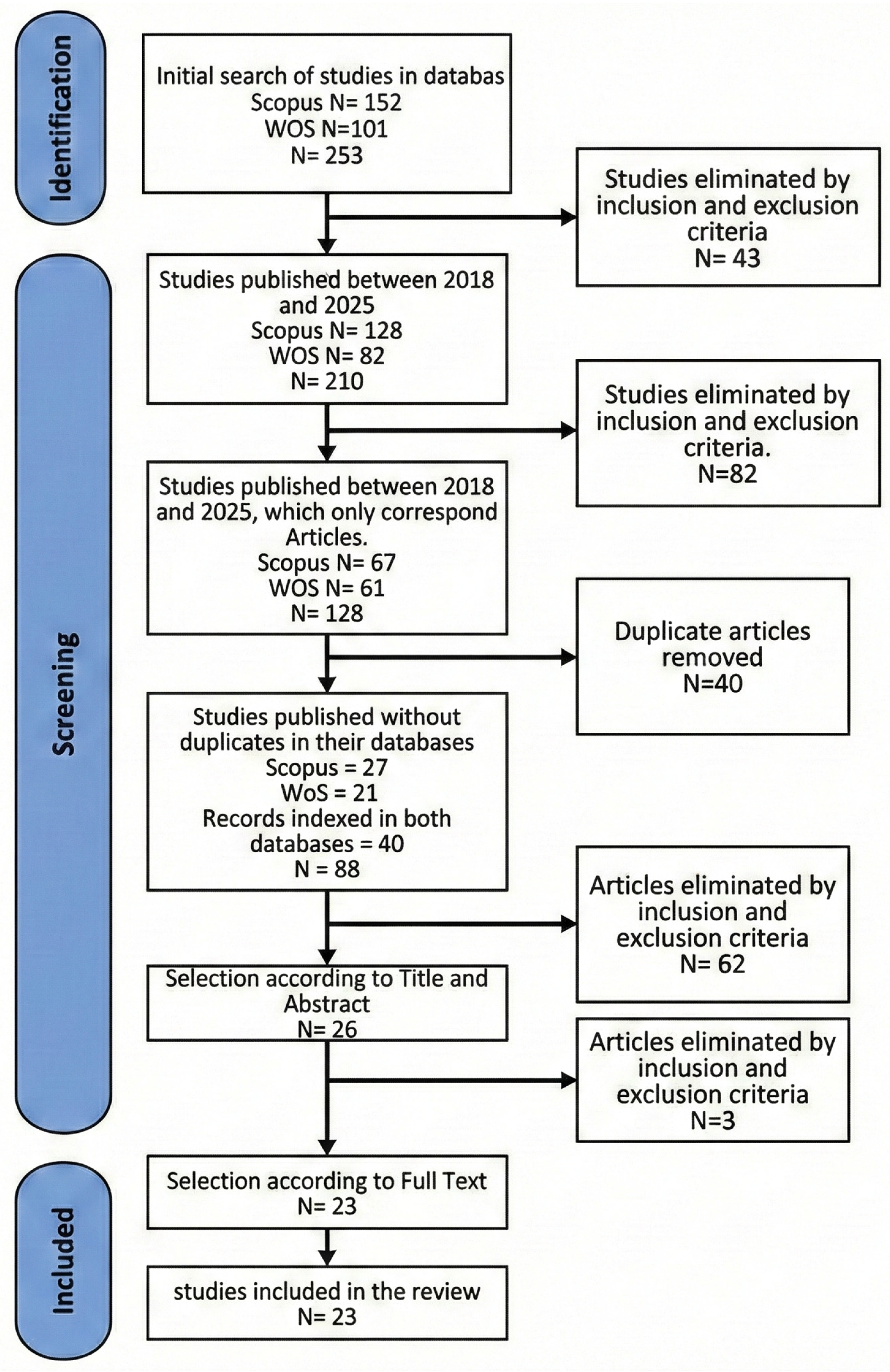
  • Identification: A total of 152 articles were retrieved from Scopus and 101 from Web of Science (N = 253).
  • Filtering by year of publication: Articles prior to 2018 were excluded, considering the significant increase in publications since that year, leaving 128 in Scopus and 82 in WoS (N = 210).
  • Filtering by publication type: Documents other than scientific articles (e.g., conference proceedings, reviews, book chapters) were excluded in order to ensure the methodological rigor. This resulted in 67 articles in Scopus and 61 in WoS (N = 128).
  • Duplicate removal: A total of 40 duplicate records indexed in both Scopus and Web of Science were identified and removed. After this process, 88 unique articles remained and were retained for the subsequent title and abstract screening stage.
  • Screening by title and abstract: Titles and abstracts were reviewed, selecting 26 articles that explicitly addressed the determination of actual damage using smart industry tools in the context of the insurance industry.
  • Full-text review: These 26 articles were read thoroughly, eliminating those that did not address the research objectives in sufficient depth. This stage ended with 23 articles selected for analysis.
The selection of articles was validated independently by the researchers using the Rayyan application. This tool allowed the screening results to be managed and compared systematically. Any discrepancies identified were discussed until consensus was reached, which helped to reduce the risk of selection bias and ensure the transparency and reproducibility of the review process. The entire process is illustrated in the PRISMA flow diagram (Figure 1).

2.4. Review of the Relevance and Quality of Articles

The selected articles were subjected to a qualitative assessment using an analysis matrix designed to answer the research questions. This matrix allowed specific information to be extracted on:
  • The Smart Industry tools applied (such as artificial intelligence, machine learning, computer vision, blockchain, among others).
  • The processes within claims settlement in which these technologies are applied.
  • The type of insurance industry or productive context in which they are implemented.
  • The results and benefits observed in each study.
Articles that formally met the criteria but did not provide concrete evidence for the analysis of actual damage in insurance contexts were excluded. This includes articles focused on probabilistic damage estimates. Studies addressing processes unrelated to loss assessment, such as premium calculation or other administrative aspects of insurance, were also excluded.

2.5. Information Analysis

The information analysis was divided into two stages:
  • Qualitative analysis: The information from the selected articles was synthesized, identifying patterns, trends, and gaps in the adoption of smart technologies in loss determination.
  • Bibliometric analysis: The Bibliometrix tool was used to analyze key metrics, including the most relevant keywords, local impact of studies, and countries with the highest scientific output. Additionally, we identified the most influential journals and the most cited authors. This analysis allowed us to contextualize the state-of-the-art of research in the area.
No formal assessment of methodological quality or risk of bias was performed. The purpose of this review was to map and characterize the available evidence on the use of Smart Industry tools, rather than to compare the effectiveness or internal validity of the included studies. Rather, the analysis aimed at answering the research questions, providing a structured overview of emerging technologies, their applicability, the challenges of adoption in the insurance industry, and opportunities for improvement in loss determination using Smart Industry tools.

3. Results

3.1. General Characterization of the Selected Studies

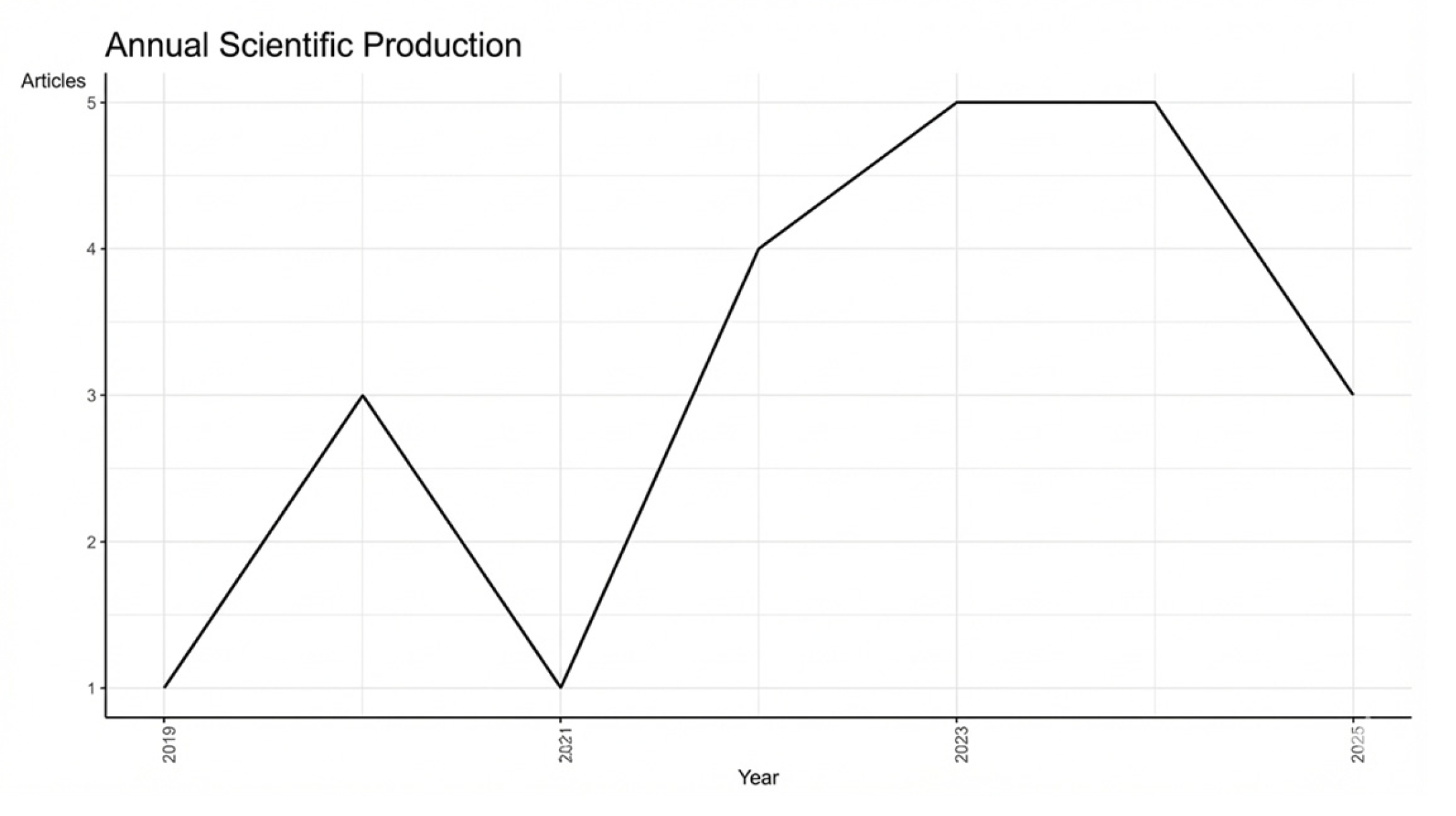
The selection process resulted in 23 articles published between 2019 and 2025, showing an increase in scientific output on the application of smart technologies in the insurance field. The annual evolution showed an upward trend, with a concentration of publications from 2020 onwards, as shown in Figure 2. The field has maintained an average annual growth rate of 20.09% in the publication of articles on this subject. This reflects the scientific community’s interest in incorporating technological tools into the processes of damage assessment and loss determination.
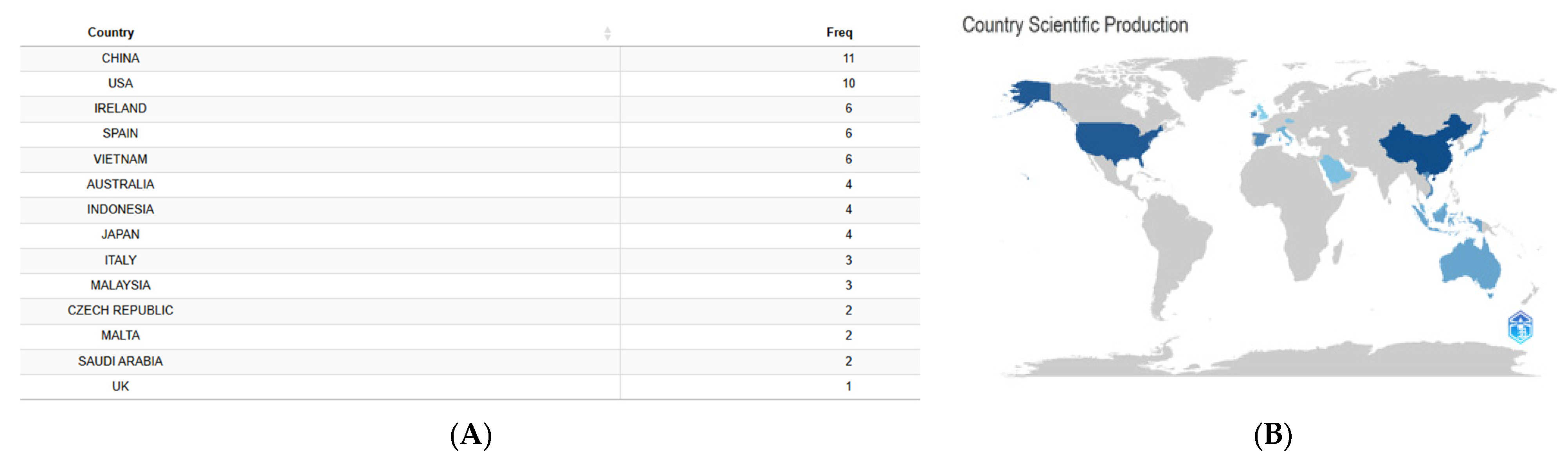
As shown in Figure 3, countries with the highest publication rates, such as China, the United States, Ireland, Spain, Japan, and Australia, showed a direct correlation between their scientific productivity and levels of investment in research and technological innovation. This pattern demonstrates that nations with a consolidated infrastructure in artificial intelligence, data analysis, and industrial automation lead the way in generating knowledge applied to loss determination and damage assessment.
Of the six countries with the highest scientific output identified, five belonged to the OECD. This reinforces the relationship between scientific productivity and institutional development in innovation, as OECD member countries maintain consolidated policies of investment in science, international cooperation [14], and technology transfer. However, China is a significant exception. Its high publication rate is not due to the collaborative mechanisms typical of OECD countries, but rather to a state strategy of scientific expansion aimed at global technological leadership [15].
Over the last decade, China has steadily increased its investment in research and development, even surpassing the United States in total volume of publications in areas such as artificial intelligence and deep learning. This growth is a response to national policies that have consolidated a centralized, state-led, strategically oriented research model that differs from the decentralized scientific governance characteristic of OECD countries. However, China’s rapid advancement in digital technologies is not solely a response to market dynamics, but rather a deliberate state strategy aimed at modernizing public governance through digitization.
Under the national Digital China policy, the country has promoted sustained investment in digital infrastructure, e-government platforms, digital identity systems, and smart city solutions, creating an integrated ecosystem of digital public services [16]. This strategy has not only improved administrative efficiency, but also structurally transformed the interaction between the state and its citizens, incorporating big data tools, digital platforms, and data-driven governance models. Added to this is strong coordination between universities, research centers, and local governments, which has facilitated the rapid transfer of scientific knowledge into practical applications in the public sector.
As a result, China has consolidated its position as a global leader in digital government [17]. This demonstrates that its technological leadership stems from institutional planning, strategic investments, and coordinated implementation at multiple levels of government.
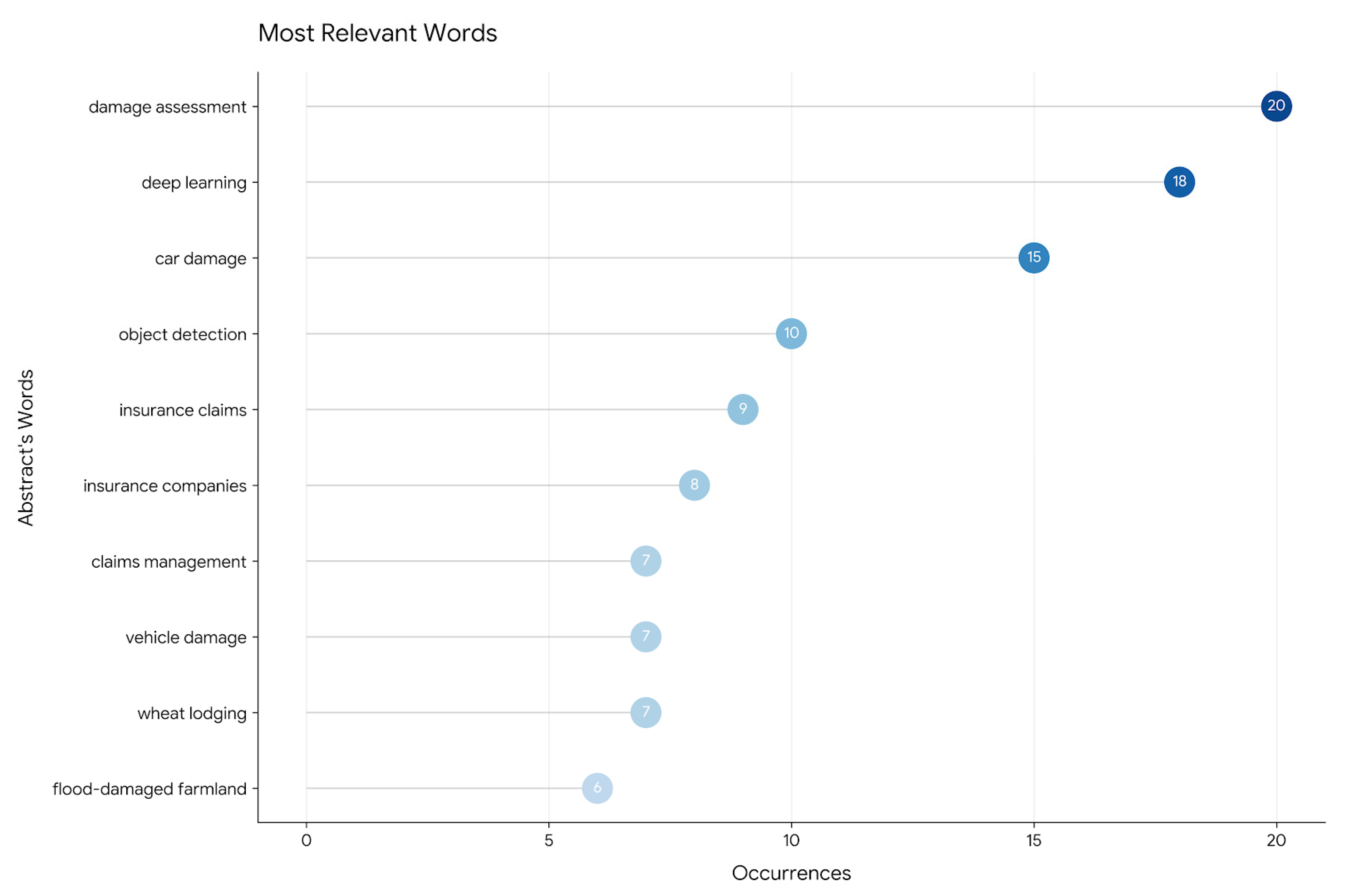
The analysis of the abstracts, carried out using the Bibliometrix tool, identified trends in the use of smart technologies aimed at automating damage assessment processes. Among the most representative keywords are “damage assessment”, “deep learning”, “car damage”, and “object detection”. These reflect a focus on damage detection, the use of AI-based models, and a predominance in the implementation of these tools in vehicle damage assessment. Terms related to claims management and insurance operations were observed, such as “insurance claims”, “claims management” and “insurance companies”. This demonstrates the scientific community’s interest in incorporating digitization into administrative and expert analysis stages. To a lesser extent, mentions of sectors such as agriculture and construction were identified, indicating that the application of these tools in these productive sectors is still in its infancy.
Figure 4 summarizes this trend, showing how the most frequently used keywords are grouped around automated damage detection and assessment processes. This confirms that the dominant focus of current research continues to be the automation of technical diagnosis, rather than economic estimation or loss assessment.

3.2. Overview of the Studies Reviewed

As a result of the selection process described in the methodology, 23 scientific articles that met the established inclusion criteria were identified and analyzed. For each article, the elements necessary to answer the study’s guiding questions were extracted. These include the tools used, the productive sector in which they are applied, the specific process addressed, and the reported results. Table 1 presents the details of each study according to these criteria.

3.3. Sectors and Processes That Integrate the Use of Smart Technologies

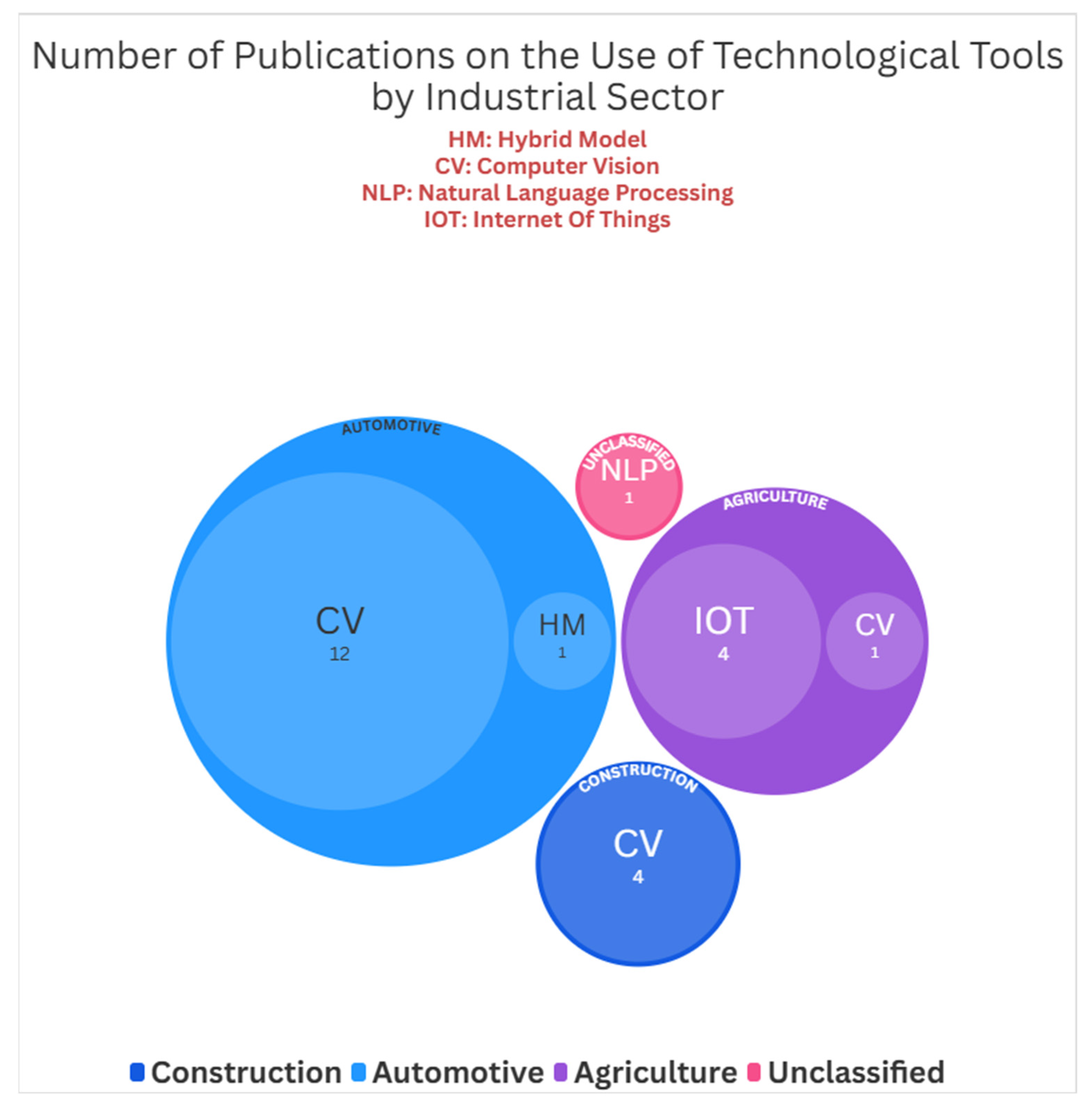
Analysis of the tools used by the industrial sector (Figure 5) revealed a significant concentration of studies in the automotive field, where computer vision (CV) represents the dominant core with 12 documented applications. There was a prevalence in processes such as damage detection, automated inspection, and dimensional control, favored by the availability of structured datasets and highly controlled operating conditions [27]. In contrast, the agricultural sector is positioned as an intermediate space, with a significant presence of IoT technologies (n = 4), reflecting a focus on continuous monitoring and decision-making based on environmental sensors [21]. On the other hand, the construction sector has limited participation (n = 4), predominantly based on CV. This shows an incipient level of technological implementation, characterized by isolated solutions without multidimensional integration with other tools such as NLP or IoT. Finally, it is worth noting the scarce presence of NLP (n = 1), which lacks specific sectoral allocation and instead covers all sectors through a cross-cutting process, namely the contracting process. This evidences a critical gap in the processing of unstructured information, despite the high volume of descriptive documents existing in the insurance industry.
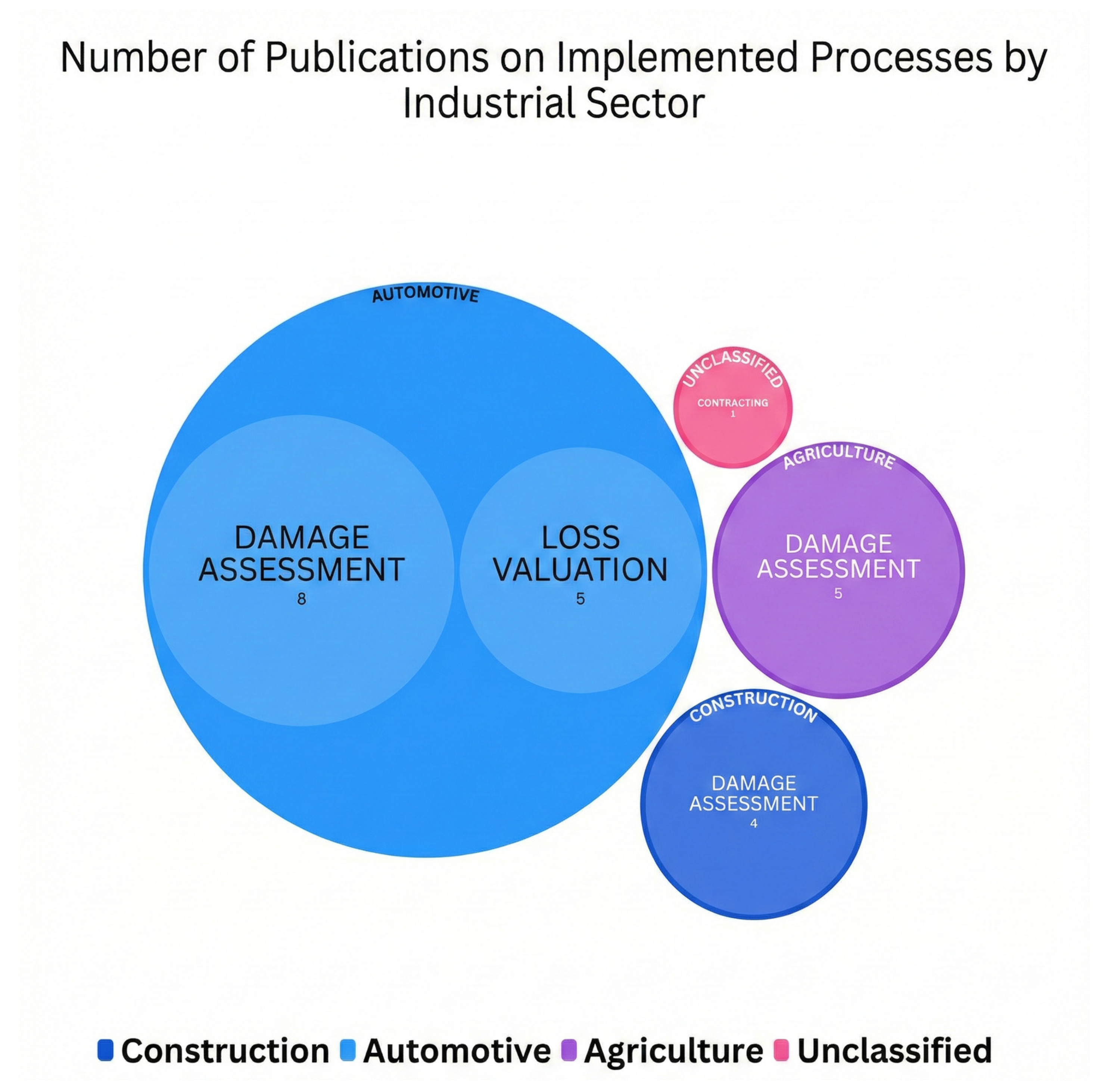
In terms of the processes implemented (Figure 6), the evidence shows that damage assessment accounts for the majority of technological applications, with a marked presence in the automotive (n = 8), agricultural (n = 5), and construction (n = 4) sectors. This predominance suggests that Smart Industry tools have been mainly oriented towards the identification and classification of physical damage, prioritizing visual recognition and damage characterization over other stages of the loss cycle. In contrast, the damage assessment process is only represented in the automotive sector (n = 5), indicating a more advanced capacity in this sector to integrate predictive models and quantitative systems that translate identified damage into economic estimates. This difference reveals a cross-cutting gap: while damage identification has reached a level of relative maturity, the translation of that evidence into monetary metrics remains largely unaddressed, especially in sectors such as construction and agriculture. Furthermore, the presence of a single study without sectoral classification suggests an incipient exploration of cross-cutting or adaptable methodological frameworks between industries, such as the contracting process. These results reflect a high degree of fragmentation between the damage detection and quantification stages. This highlights the need for hybrid approaches that integrate visual, contextual, and economic analysis to move toward automated systems for determining and assessing losses.
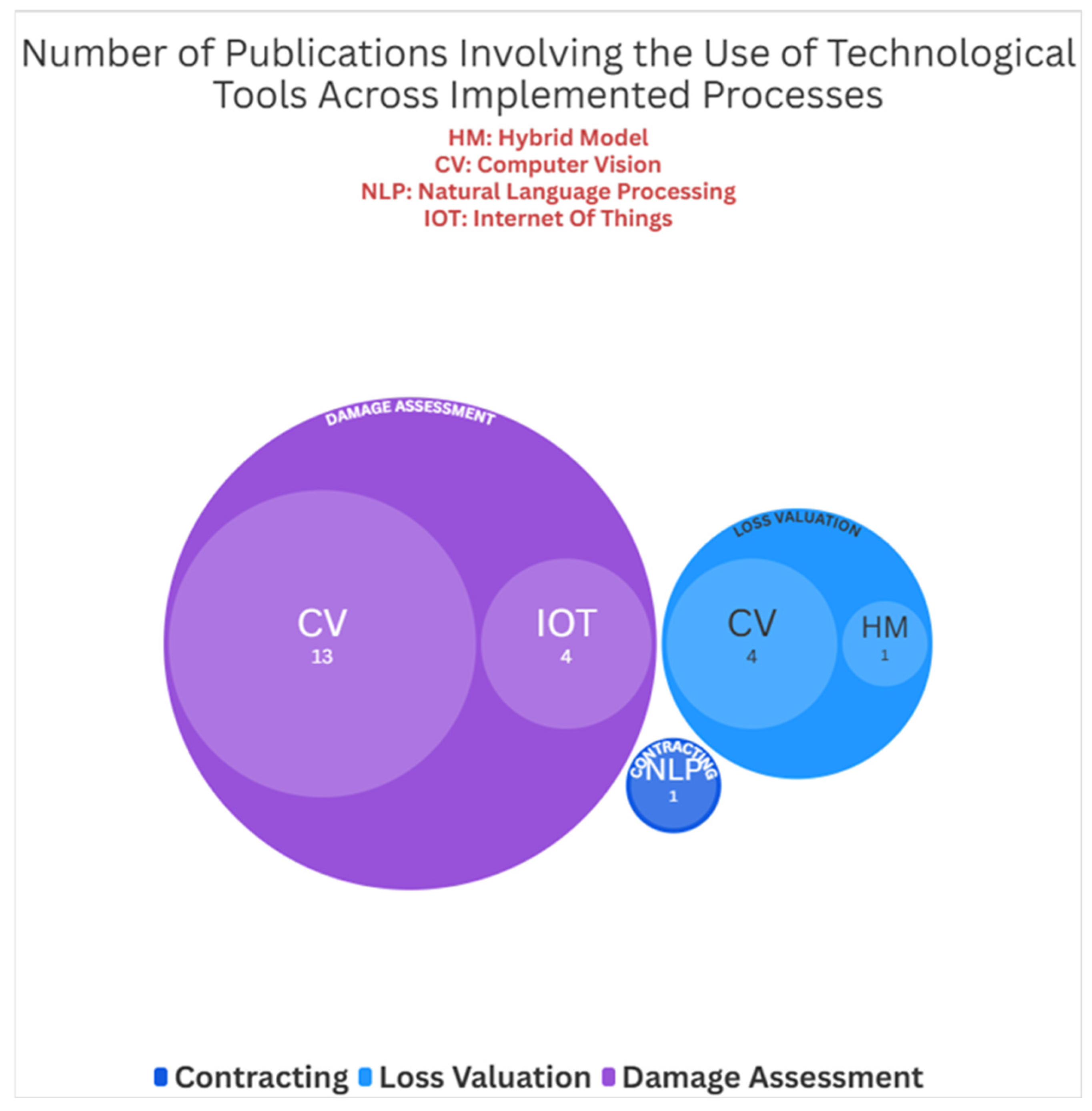
In terms of the tools most widely used within the processes analyzed (Figure 7), there was a clear predominance of computer vision (CV), especially in the damage determination stage, where it accounted for 13 identified applications. This dominance shows that visual detection and automatic classification of damage has been the most developed approach, favored by the availability of mature algorithms, labeled data, and its high performance in structured or semi-structured environments. At this same stage, the Internet of Things (IoT) had a smaller but still relevant share (n = 4), focused on continuous monitoring and capture of environmental variables, although it plays a complementary rather than a central role. In contrast, damage assessment showed less technological diversity and was also dominated by CV (n = 4), suggesting initial attempts to extend visual recognition capabilities to quantitative damage estimation, albeit with limited methodological depth. The use of hybrid models (HMs) appears incipiently (n = 1) in assessment, indicating emerging efforts to integrate multiple data sources and approaches to improve economic accuracy. Finally, the isolated use of natural language processing (NLP) in the contracting stage stands out. This highlights the low incorporation of tools dedicated to the semantic analysis of unstructured information, despite the potential NLP offers in complex documentary processes such as claims, technical reports, or insurance policies. Overall, the results show a strong dependence on visual methods and limited cross-cutting technological integration, particularly in stages that require contextual interpretation and economic assessment.

3.3.1. Automotive

The use of technologies in this sector is based on reducing processing time, costs, and the labor required, since the current method is very time-consuming and demands a large number of human resources, making it an ineffective method [39].
The most widely addressed process within the automotive insurance sector is damage assessment, which involves both the detection and classification of damage [34]. On the other hand, research seeks to classify damage according to its severity, as is the case in the article “Powering AI-driven car damage identification based on VeHIDE dataset” [31], which classified damage into dents, broken glass, and other categories using computer vision.
Although much of the research focuses on damage assessment, other studies present cost predictions for either repairs or compensation based on the severity of the vehicle damage [33].
The results show that the automotive sector has been one of the most advanced in adopting technological tools applied to damage assessment. Its emphasis on the automation of inspection processes, damage classification, and cost estimation has significantly reduced the response times and dependence on human judgment. This has established the automotive sector as a benchmark in the practical application of computer vision within the insurance field, providing a basis that can be applied to other productive sectors.
In the automotive sector, the high implementation of smart industry technologies is largely explained by the strong standardization of its products and the massive scale of its market. Unlike construction projects, which are often unique and highly heterogeneous, the automotive industry operates on repetitive components produced in millions of units. This allows artificial intelligence models to be trained on consistent structures and highly comparable damage patterns. This homogeneity makes it easier for algorithms to learn more efficiently and generalize, favoring the robust automation of inspection, classification, and damage estimation processes [29].
Added to this structural condition is the availability of large volumes of data, which has been a decisive factor in the technological advancement of the sector. The ability to classify images in the automotive field is exceptional due to the existence of massive public databases such as the VehiDE model [27], which provide standardized material for training and validating computer vision algorithms. This abundance of data has allowed researchers and developers around the world to continuously refine their models, accelerating the progress of Smart Industry tools in the insurance sector.

3.3.2. Agriculture

The use of technological tools adopted in the processes focuses on replacing traditional methods of manual and visual inspection in the field, which are tedious, time-consuming, present a high risk of error, and are not very viable for large-scale application [28].
Within this sector, two processes are favored: on the one hand, damage detection, which is carried out remotely using satellite images [24] or unmanned aerial systems [28].
On the other hand, there is its use for crop control, as in the article “Automated Identification of Crop Tree Crowns from UAV Multispectral Imagery by Means of Morphological Image Analysis” [21], which focuses on a model that quantifies the crop area, providing a total tree count.
The results show that the agricultural sector has been one of the first to incorporate technological tools to optimize crop observation and control, especially through remote sensing and image analysis. These applications have not only increased the accuracy of large-scale damage detection, but have also demonstrated the value of automation in reducing costs and improving operational efficiency. The experience of this sector shows how the integration of remote sensors and computer vision models can serve as a basis for the development of similar methodologies in other areas, particularly in the inspection of infrastructure and buildings.
In the agricultural sector, the adoption of Smart Industry technologies has enabled the development of advanced automated inspection and large-scale territorial monitoring systems, which offer direct lessons for the construction and claims management sectors. For example, drones (UAVs) are used to count plants and detect damage caused by pests, droughts, or fires. This demonstrates how low-cost aerial platforms can perform rapid, objective, and repeatable surveys over large areas, reducing dependence on manual inspections and improving damage traceability [21]. This same approach can be transferred to the construction sector for the post-disaster inspection of buildings. It allows for the faster and safer identification of collapses, deformations, or affected areas, especially in disaster scenarios where physical access is limited.
In addition, agriculture has integrated change detection and near real-time monitoring systems using satellite imagery, such as Sentinel-2 and Landsat-8, to track the evolution of floods, droughts, and other extreme events on agricultural land [20]. This continuous observation approach allows for dynamic assessment of an event’s progression and spatial impact, which is directly applicable to assessing infrastructure damage after earthquakes, floods, or fires. Furthermore, the identification of plants using aerial photogrammetry and the generation of 3D point clouds and Digital Surface Models (DSMs) illustrates how it is possible to digitally reconstruct the physical state of a territory or asset. This logic can be adopted by the construction industry to create three-dimensional models of damaged buildings, quantify structural deformations, and support loss estimation processes in an objective and data-driven manner.

3.3.3. Construction

In the field of construction, there is no clearly defined trend, with the use of technological tools for the structural assessment of buildings [23] standing out, with the aim of determining whether, from an economic perspective, it is more viable to opt for demolition or repair.
It can be seen that damage assessment is approached from different perspectives. On the one hand, a quick and accurate estimate of damage to buildings affected by flooding is sought, through the input of specific parameters [18]. On the other hand, unmanned aerial systems are used to detect damage to tile roofs after natural disasters, with the aim of supporting real estate agents and insurance companies in their decision-making by providing an overview of the situation [19].
Despite the advances observed, significant gaps remain in the construction sector. Most studies focus on damage detection or classification, without translating these findings into a concrete economic assessment, but rather into a severity index for the damage. There is no clear integration between damage identification and repair cost estimation based on the affected components. In addition, much of the research continues to rely on severity indices or general visual metrics, which limits its practical applicability in claims settlement processes. These gaps highlight the need to move toward models that incorporate economic and construction variables, allowing for more accurate and contextualized automatic estimates based on the affected components.
Based on the analysis of the research results, it is evident that the construction sector has a lower level of technological implementation compared to other productive industries. This lag is particularly noticeable when contrasted with sectors such as the automotive industry, where the adoption of Smart Industry tools is significantly more advanced. In the automotive field, the availability of large volumes of structured and standardized data has enabled the training of artificial intelligence models with large-scale datasets. These datasets reach figures in the order of tens of thousands of records, and even more than two hundred thousand images for damage detection and severity estimation [38].
In contrast, research carried out in the construction sector tends to be based on considerably smaller datasets, with training carried out on approximately 1000 records, which limits the robustness and generalization of the proposed models [23]. However, the gap observed cannot be explained solely by the smaller amount of data available, but mainly by the low standardization and heterogeneity of the information associated with constructed assets. This condition increases the internal dispersion of datasets and hinders the generation of comparable and scalable models, directly affecting the technological maturity of the sector [41].
In the context of the digital transformation observed in other data-intensive industries, such as automotive and agriculture, it is clear that the incorporation of smart technologies is most effective when there is an infrastructure that allows for the collection, standardization, and continuous circulation of information. These industries have demonstrated that high accuracy in damage detection, cost estimation, and asset management is based on the availability of structured data, interoperable digital models, and platforms that reduce fragmentation and dependence on subjective judgment. In contrast, the construction sector faces a technical-economic gap stemming from its historical dependence on heterogeneous information, unstructured documents, and manual evaluations. In this scenario, BIM emerges as the enabling technology to close this gap. However, its implementation must be articulated on a BIM Data Infrastructure (BDI) that allows for the effective standardization of geometry, costs, materials, damage conditions, and schedules. This coordination is key, since it is not the mere adoption of the BIM standard that generates value, but its integration into an interoperable data ecosystem. Such an ecosystem facilitates the instantaneous flow of information between actors, systems, and algorithms, enabling the effective use of Smart Industry tools. This significantly reduces subjectivity in inspection processes, loss quantification, and economic decision-making.

3.3.4. No Classification

An article that did not fit into a specific sector of the insurance industry is “Actuarial Applications of Word Embedding Models” [30]. This study uses the first approach with the insured as a basis. Its main objective is to estimate the magnitude of the loss based on the textual description provided by the customer, applying word embedding models to transform that text into structured information useful for actuarial analysis. However, it does not mention the specific sector or sectors where it makes this damage estimate.

3.4. Technologies Used

3.4.1. Text Processing

Text mining is one of the least frequently used technologies in approaches to loss determination. Its main function is to extract information from textual descriptions for processing using machine learning models [30]. The importance of analyzing these descriptions lies in the fact that it allows the economic reserve associated with the claim to be estimated from the outset [25]. One of the most notable characteristics of this type of model is its robustness, as it offers flexibility in the face of different forms of language used, even managing to interpret abbreviations and unstructured expressions [30].
Within the type of text processed, one of the articles worked within the context of insurance claim descriptions. A total of 6030 case observations obtained from an insurance company were used to train this model [30]. Another context involved the use of textual descriptions of storm damage, using 2479 observations of storm damage for training [25].
Among the results obtained by these models, the accuracy rates achieved in the analysis of textual descriptions of insurance claims stand out. The reviewed study reported an average accuracy of 63.9%, accompanied by an error rate of 6.37% [30]. Meanwhile, the model for analyzing storm damage descriptions used a Spearman’s correlation coefficient, which reached a value of 76.06% [25].

3.4.2. Computer Vision

Many of the articles reviewed addressed the automation of processes such as the detection, identification, location, and assessment of the severity of damage to automobiles based on images [21,26,27,29,31,32,33,34,35,38,40]. One of the most widely used models is YOLO in its different versions, a machine learning model whose main engine is object detection [27]. The most notable variants are YOLOv5 and YOLOv8, which demonstrated greater accuracy compared to previous generations. This improvement is attributed to training with data labeled by specialists, particularly insurance company appraisers [27]. This contrasts with models such as VehiDE, which are trained solely with statistical data provided by insurers, without direct intervention by experts [31].
While the use of machine learning in conjunction with computer vision is widespread in the auto insurance sector, its application has also expanded, albeit to a more limited extent, to areas such as infrastructure and agriculture. In this context, models have been developed that are capable of identifying damage to roofs affected by typhoons. Although they do not determine the specific type of damage, these models allow the severity to be classified into five levels. They achieved accuracy levels of 0.97 and an F1-score of 0.81, reflecting a good balance between accuracy and sensitivity [22]. Likewise, solutions have been implemented for other natural disasters, such as earthquakes, where photographs of damage to structural elements were used to support decisions on repair or demolition, achieving an accuracy of 90.62% [23]. On the other hand, there are simpler models that determine losses in buildings without requiring images. These models use parameters such as the type of material affected and the height reached by a flood, allowing for accurate predictions in this type of scenario [18].

3.4.3. Remote Sensors

Within the agricultural insurance sector, the use of satellite images and unmanned aerial systems stands out with the aim of obtaining and processing images for crop monitoring [21,24,28]. The purposes of these technologies are diverse, one of them being the identification and classification of the severity of damage. In a study applied to corn crops affected by lodging, the images were processed using three models, of which only two achieved satisfactory results: RetinaNet and YOLOv2. These models achieved accuracy levels ranging from 98.43% to 73.24% and from 97.0% to 55.99%, respectively [28]. Other approaches, on the other hand, focus more on quantifying damage than on its severity. For example, by processing images captured by drones, a model was developed for the automated counting of trees in olive plantations, achieving an accuracy of 99.7%. However, this is a specific model for counting in a defined area, without the ability to determine damage to trees [21].
On the other hand, high-resolution satellite images combined with deep learning techniques were implemented, allowing for the remote identification of wheat lodging. This approach achieved the following accuracy indicators: the Jaccard index obtained a value of 73.97%, which reflects the overlap between the prediction and the actual affected area; in addition, an F1 value of 85.04% was achieved [36].

3.4.4. Hybrid Technologies

GrouundingCarDD [37] seeks to generate a more robust model by integrating computer vision, text processing, and machine learning techniques. This improves damage identification, as the integration of these technologies solves problems inherent in computer vision models that are altered by reflections or shadows in their images.
This integration is implemented by adding captions or descriptions to the images, with the aim of more effectively associating the image with the damage, the characteristics of the vehicle, or its surroundings. The model achieved a recall of 85.6%, indicating its ability to correctly identify vehicle components, i.e., the proportion of relevant elements that were adequately recognized by the system [37].
Articles mentioning the use of hybrid methods were identified; however, they were discarded in this analysis as they combine technologies from the same category, as is the case with hybrid algorithm models [18], which integrate different algorithmic techniques, but not technologies involving different types of inputs or data sources.

4. Discussion

This systematic review seeks to analyze the development of advanced Smart Industry techniques for optimizing loss determination in the claims settlement process. Accordingly, the following sections present each technique’s approach and discuss its practical applicability in the insurance industry.

4.1. Textual Data Analysis

This technique consists of transforming textual data into a numerical format that can be used in standard regression models, which represents significant potential for the insurance industry, allowing its use in different processes.
The article “Actuarial Applications of Word Embedding Models” [30] presents its application for two very important stages in the claims settlement process, namely claims classification and risk analysis. “This article demonstrates how textual data can be easily used in insurance analysis. Using the concept of word similarities, we illustrate how to extract variables from text and incorporate them into claims analysis using a standard generalized linear model or a generalized additive regression model. First, we show how the problem of claim classification can be solved using textual information. Second, we analyze the relationship between risk metrics and the probability of large losses. We obtain good results for both applications, where short textual descriptions of insurance claims are used for feature extraction” [30]. The use of these techniques, both for claim classification and for risk analysis, while representing a significant advance for the insurance industry, does not directly point to the determination of losses for a particular claim, since their use is limited to detecting the probability of claims occurring, allowing high-risk claims to be identified.
On the other hand, the article “Extracting information from textual descriptions for actuarial applications” [25] developed a predictive model to estimate the amount of loss in claims based on textual descriptions included in insurance claim reports, with the aim of improving the case reserving process using text analysis techniques and generalized additive models with dimensionality reduction. “To better understand the relationship between the words in the claim description and the amount of property loss, each word is represented by a vector. Recent advances in word embedding models have made it possible to obtain these representations easily” [25]. This undoubtedly represents a major advance for the industry, since it is essential for insurers to have early information that allows them to provision for each claim. However, this article aims to predict the loss amount rather than determine the actual loss for a specific claim.
In summary, although textual data analysis techniques and predictive models based on claim descriptions represent significant advances for the insurance industry, their practical application does not yet allow for the direct and accurate determination of actual losses for a particular claim. These methodologies, such as those presented in the reviewed articles, are mainly aimed at optimizing processes such as claim classification, high-risk claim detection, and estimated reserve provisioning, but they do not integrate all the elements necessary for the final settlement of claims. Current approaches lack connection between textual analysis, specific technical damage information (such as location, materiality, or severity), and updated cost databases. Additionally, no standardized methodology exists for translating descriptions into case-specific economic loss amounts. These gaps indicate that substantial development remains necessary before these technologies can serve as complete solutions for loss determination in insurance.

4.2. Computer Vision for Damage Assessment

This approach involves obtaining information from image analysis. The reviewed articles describe automated systems for vehicle damage assessment using computer vision and deep learning.
The article “Automated Car Damage Assessment Using Computer Vision: Insurance Company Use Case” [27] presents a system based on computer vision and deep learning for the automatic detection of vehicle damage, designed for use by insurance companies through object detection (identifying and locating damaged parts), damage classification (categorizing the type of damage), and damage segmentation (precisely delimiting the damaged areas). The system presented in the article is capable of detecting whether there is damage in the images; locating the damage (with bounding boxes); and classifying the type of damage into categories (scratches, dents, cracks or fractures, paint defects, material loss, and missing parts).
The system proposed in this article does not assign a monetary cost to the damage detected nor does it evaluate the severity in levels that allow repair values or prices to be automatically associated, expressly stating that the economic quantification of the damage was beyond the scope of this research and that in order to perform an automatic economic assessment, it would be necessary to:
  • Link the damage detected to a system of parts prices and repair costs;
  • Consider local factors, as repair prices vary by country and company.
Although this article addresses the issue of determining losses due to accidents, its main objective was to develop a system for the automatic detection of damage, aimed at streamlining the internal processes of insurance companies. The economic valuation of the damage was beyond the scope of this work, remaining the responsibility of human experts.
The article “GroundingCarDD: Text-Guided Multimodal Phrase Grounding for Car Damage Detection” [37] proposes an innovative solution that combines computer vision and natural language to detect vehicle damage more accurately than traditional methods. The proposed process consists of capturing an image of the vehicle, using text (descriptions or phrases) to guide the model on what to look for, detecting the precise location of the damage, segmenting the affected area, and allowing differentiation between actual damage and other characteristics of the vehicle or its environment. To this end, the authors trained vehicle damage detection models using an approach based on the collection of a comprehensive dataset, composed of public sources and a valuable private dataset. This proposal is aimed at damage prediction, not at determining specific economic losses associated with an accident. The article focuses on detecting, locating, and segmenting damage with high precision, without yet addressing automatic economic valuation of the damage. The latter is proposed as a later phase, in which additional modules, considering the size, type, and location of the damage, could incorporate specific rates and quotes to estimate repair costs.
The article “Powering AI-driven car damage identification based on VeHIDE dataset” [31] presents the VeHiDE dataset, a database of high-resolution vehicle damage images containing 13,945 images with more than 32,000 annotated damages, developed to improve and evaluate automatic car damage identification and segmentation systems. The main objective is to address the lack of robust public datasets for training vehicle damage detection and segmentation models, evaluate different computer vision techniques applied to the VeHiDE dataset, and explore the use of methods such as Salient Object Detection (SOD) to identify hard-to-detect damage, such as scratches and broken glass. The system proposed in the article allows for the automatic detection, localization, and segmentation of vehicle damage. The detailed segmentation obtained can serve as input for later stages of the process, where policy conditions could be applied, parts and labor costs could be integrated, and a more accurate damage estimate could be generated. The main contribution of this article lies in improving the performance of the technique associated with damage identification; however, it did not calculate the economic repair values.
“Smart Car Damage Assessment Using Enhanced YOLO Algorithm and Image Processing Techniques” [32] proposes an intelligent system for detecting and assessing damage to vehicles, using an enhanced version of YOLOv9, called YOLOv9-CS (YOLOv9 + CBAM + SIoU). The main objective is to automatically detect six types of damage to cars (dents, scratches, cracks, broken glass, damaged lights, and flat tires), calculate the severity of the damage using an index called the Damage Severity Index (DSI), and improve the accuracy and robustness of the system in real image conditions, such as lighting variations and the presence of small or difficult-to-detect damage. This article advances in the direction of quantitative damage assessment by proposing a Damage Severity Index (DSI) that allows for the assignment of an objective measure of the severity of the damage detected. However, the DSI does not represent a direct economic valuation in monetary terms; rather, it establishes a basis for defining ranges of estimated costs, which allows repairs to be prioritized according to their urgency and the economic impact to be estimated by applying rules associated with the level of severity. In this way, the article makes a significant contribution to the development of methodologies for the quantitative estimation of vehicle damage.
The success of YOLO models in detecting and classifying diverse vehicle damage types (such as dents, scratches, and broken glass) demonstrates high potential for transferability to construction scenarios. The algorithmic logic used to identify surface irregularities on car bodies is technically analogous to detecting pathologies, such as cracks, spalling, or corrosion in reinforced concrete structures. However, a critical gap remains: unlike the automotive sector, which benefits from structured datasets like VeHiDE, the construction industry lacks standardized, open-access image libraries to train these models with comparable precision for economic loss assessment.
The article “Vehicle Damage Severity Estimation for Insurance Operations Using In-The-Wild Mobile Images” [33] presents another approach, which consists of predicting the cost by combining structured information from the claimant with damage assessment based on computer vision.
“The purpose of our overall process is to predict the cost estimate of the damage by combining the structured information provided by the claimant with knowledge about the extent of the damage, measured through the computer vision-based workflow.
To train a model that can predict cost estimates considering this information, we used a dataset consisting of approximately 18,000 claims, including more than 200,000 images for training, and an additional dataset of 2600 claims, containing 30,000 images for validation”.
[33]
The cost estimate presented in this article is based on a predictive approach, using information on detected damage, severity per panel, and vehicle data (such as make, age, and level of operability) to estimate the associated economic cost. Although this information is useful and timely for insurance companies, its application mainly aims to support resource allocation and the overall analysis of reported claims, not at determining specific losses associated with a specific claim.
The proposed system significantly improves the prediction of damage severity compared to previous approaches by fully integrating automatic economic valuation, combining computer vision and structured vehicle data. However, it is important to note that this methodology provides a general estimate and not a detailed assessment for each individual case, which still requires the intervention of experts for the final determination of losses in particular claims.
The article “Automatic damaged vehicle estimator using enhanced deep learning algorithm” [34] proposes an automatic vehicle damage assessment system using advanced deep learning techniques to detect whether an object corresponds to a car, determine whether the vehicle is damaged, locate the affected area (front, side, or rear), and classify the severity of the damage into categories of minor, moderate, or severe. However, the system is limited to classifying severity at these levels without assigning monetary values to the damage detected. In the conclusion, the authors mention that future work will involve integrating databases of parts prices, as well as information about the vehicle, its make, and model, with the aim of enabling economic estimation of damage in future versions of the system.
The article “Real-Time Instance Segmentation Models for Identification of Vehicle Parts” [35] proposes a system based on real-time instance segmentation that allows specific parts of a vehicle to be visually identified and damage to be detected, with the aim of automating technical and economic assessment in contexts such as insurance and automotive repair.
On the other hand, “Deep Learning Based Car Damage Classification and Cost Estimation” [29] proposes a Deep Learning model based on Mask R-CNN (a convolutional neural network for instance segmentation) to:
  • Detect the areas of the vehicle (front, rear, left, right), as the repair cost varies depending on the affected area;
  • Detect and classify the type of damage (bumps, dents, scratches, broken lights);
  • Then, estimate the overall cost based on the side of the vehicle affected and the type of damage, using a weighting factor for each side (for example, front damage costs more because it includes the engine, headlights, etc.).
The article highlights the need to automate the vehicle damage assessment process for insurance companies, with the aim of reducing delays and human error in repair cost estimates. However, it does not detail the specific costs associated with repairing particular components, such as bumpers, doors, headlights, or hoods. The proposed cost estimate is based on the damaged area and the type of damage detected, without providing a breakdown by individual parts or specific unit prices. In conclusion, the article does not provide a detailed valuation of vehicle parts and components, limiting itself to a general approximation based on areas of damage and categories of impact.
Researchers also use computer vision to assess structural damage, such as detecting damage to roofs after natural disasters using aerial photos, as presented in “Damage Detection and Level Classification of Roof Damage after Typhoon Faxai Based on Aerial Photos and Deep Learning” [22]. The article addresses the application of computer vision techniques for the detection and classification of damage to infrastructure, with a particular focus on its use in assessing damage to roofs after natural disasters. Using aerial images captured after Typhoon Faxai in 2019, the authors proposed a deep learning-based system that automatically identifies damaged roofs, segments affected areas, and classifies the level of damage. As the article mentions: “The ultimate goal was to use the test model to classify the level of roof damage”, that is, the main objective is to automatically classify the level of damage to the roofs detected.
The system detects three types of objects: intact roofs, roofs with blue tarps (indicators of partial damage), and completely destroyed roofs, classifying the severity into five levels (0 to 4) according to the extent of the damage. However, the model does not calculate a direct economic estimate of the damage, as it is limited to providing a technical classification and accurate spatial segmentation. Performing automatic economic assessment would require linking the model’s results with databases containing material prices, labor costs, and structure-specific factors such as geographic region and insurance conditions. This limitation is implicitly mentioned in the article by not addressing the translation of the technical classification into economic values, which represents one of the main difficulties for its direct application in claims settlement processes.
In summary, this work provides an innovative methodology for the automatic detection and classification of roof damage using aerial imagery and deep learning, which can significantly streamline the tasks of inspection and repair prioritization in emergency situations. However, it does not yet replace the work of experts in the economic assessment of damage caused by a particular incident. Even if integrated with databases containing material prices, labor costs, and structure-specific factors, this tool’s scope would remain limited to external roof damage and would not cover other direct effects or consequential damage that often results from an accident.

4.3. Remote Sensors for Large-Scale Damage

Several studies have addressed damage detection over large areas using satellite or aerial imagery, which is relevant for agricultural or property insurance claims after disasters.
The article “Winter Wheat Lodging Area Extraction Using Deep Learning with GaoFen-2 Satellite Imagery” [36] proposes a computer vision-based system for the automatic detection and segmentation of lodging areas in wheat crops, i.e., areas where plants have collapsed due to storms, wind, or other factors. This work uses high-resolution satellite imagery (GaoFen-2) and a deep learning model called PTCNet, specifically designed to overcome the limitations of traditional Unmanned Aerial Vehicle (UAV)-based methods, including low coverage and intensive manual labor requirements. The methodology allows for the precise delimitation of damaged areas, which constitutes a significant advance in large-scale agricultural monitoring.
Regarding economic valuation, the model does not directly calculate monetary losses. While the article notes that affected-area maps can serve as input for insurance compensation calculations based on damaged area and projected yield, the proposed system does not automatically integrate economic data, such as wheat market prices, production costs, or local factors that impact monetary estimates. This lack of economic data integration presents a major difficulty for direct application in determining agricultural losses. An accurate loss estimate would require considering not only the damaged area, but also market prices, specific crop conditions, regional variations, and insurance policy clauses.
In summary, the model proposed in this article allows for the technical and automated detection of large-scale crop damage using satellite imagery, which provides valuable input for analysis and preliminary reserve estimates. However, it does not replace the detailed economic assessment that must be carried out on a case-by-case basis by experts or specialized analysts, especially when seeking to quantify the real economic impact of a specific disaster.
The study “Emergency-oriented fine change detection of flood-damaged farmland from medium-resolution remote sensing images” [24] proposes an intelligent system for the accurate detection and segmentation of flood-damaged agricultural areas, using medium-resolution satellite images (10–16 m) and advanced deep learning techniques, particularly the MRFloodedCDNet model, complemented by a semi-supervised sample generation framework (SSLSampleGen). The approach allows for the automatic detection of changes in crop status before and after a disaster, differentiating degrees of damage in agricultural plots.
However, the model does not calculate or estimate economic losses in monetary terms. Although the system generates accurate damage maps and classifies damage severity, users must take additional steps to convert this technical information into monetary valuations. This would require the integration of complementary economic data, such as crop market prices, production costs, regional tariffs, local factors, and specific insurance policy clauses. The main difficulty lies in the fact that the model focuses on the technical detection of damage using satellite imagery, but does not take into account the variability and complexity of associated economic factors, such as price fluctuations, insurance contract terms, or the indirect and consequential impacts of flooding.
In summary, this system provides a critical basis for loss assessment by offering the automated, rapid, and accurate identification of damaged areas, which is useful for insurance companies. However, it does not replace expert judgment in the economic assessment of a loss, as it does not transform the technical classification of damage into specific compensation amounts.
These methods provide valuable information for large-scale loss assessment. Satellite imagery-based detection allows analysts to identify damage extent, which is a key input for preliminary estimates in disaster situations. However, integrating these tools with systems capable of accurate claim-specific economic valuation remains a challenge. Such integration must consider not only damaged areas but also market prices, production costs, and specific insurance contract clauses.

4.4. Hybrid Models

Several studies also suggest combining different data sources or methods. For example, predicting the cost of damage to vehicles combines image analysis with structured information from the insured.
The article “Hybrid genetic algorithm-based approach for estimating flood losses on structures of buildings.” [18] used economic data such as indicative prices and bills of costs in loss estimation models, verifying model accuracy against traditional calculations. This article presents an innovative hybrid model for quickly and accurately estimating the economic losses caused by flooding in the interior structures of residential buildings. The model combines genetic algorithms, ordinary least squares (OLS), and unit budgets (bill of costs), allowing for the generation of a detailed economic assessment of damage to walls, floors, doors, and windows, validated with real case studies.
The model takes structured input consisting of geometric and construction data for each affected room, including the room area, length/width ratio, height, flood depth, type of material on floors (vinyl, wood, ceramic, carpet), walls (plaster, lime, brick), type of doors and windows, along with specific factors such as damage coefficients, weights per water resistance, and penalties for irregular geometry. The system parameterizes this information in a digitized BoC file, which includes unit costs per type of material and element. Users enter this data manually via an Excel spreadsheet or through the authors’ software interface, where they select material type, geometry, and depth. The system then transforms these inputs into numerical variables for the model.
The system processes this information by applying the rational function of the THP model to estimate the base damage. It uses genetic algorithms to adjust the parameters and least squares to locally optimize the solution, ultimately delivering damage estimates in monetary terms (EUR or equivalent currency) per premises or entire dwelling.
Although the model can assess damage economically, its practical use presents difficulties: users must manually collect detailed geometric and construction data for each building, limiting automation. While connecting the model to cadastral databases, BIM, or insurance systems is technically possible, the article does not address implementing these integrations. Therefore, the tool serves as support for experts or adjusters, who must manually enter the information.
In summary, this work demonstrates that it is possible to automate the economic estimation of flood damage to interior structures with high accuracy, which is valuable for insurance claims settlement. However, its practical application on a large scale will depend on overcoming the barriers associated with data integration and extension to other types of damage that are not currently covered.
Researchers also use ensemble models that combine predictions from multiple deep learning models to improve overall performance, for example, by reducing the false positive rate in the detection of car damage.
The article “VEBD-HEL: A novel approach to vehicle exterior body damage parts classification in intelligent transportation systems” [38] presents VEBD-HEL, an advanced system based on heterogeneous ensemble learning (HEL) designed for the automatic classification of damaged parts in the exterior bodywork of vehicles (bumpers, headlights, doors, etc.). This system is aimed at improving the accuracy and efficiency of insurance claim processing and damage assessment within intelligent transportation systems, achieving outstanding results: 99.93% accuracy and superior metrics compared to reference models.
However, VEBD-HEL does not provide a direct economic estimate of the cost of repair or replacement. Its function is limited to identifying with high precision which parts of the vehicle are damaged, as a key input for automatic quotation systems. Assessing damage economically would require integrating the system with additional databases, such as spare parts price lists, labor rates, and insurance companies’ specific business rules.
The main difficulties in achieving automatic economic valuation are:
  • Price variability depending on region, vehicle type, and year of manufacture;
  • The lack of integration with updated cost catalogs;
  • The need to incorporate the specific conditions of the insurance policy;
  • The system’s limited ability to assess internal damage or indirect consequences of the impact (such as alignment or mechanical systems).
In summary, VEBD-HEL is a key component for the technical detection of damage to external parts of vehicles, but it does not replace the economic assessment work that remains the responsibility of experts or additional systems specialized in converting technical data into specific monetary estimates.
For hybrid models, the literature illustrates a shift toward data-driven techniques and machine learning to automate and improve loss and cost estimation in insurance claims. This includes extracting valuable information from unstructured data such as text and images, which analysts previously found difficult to process, and integrating it into predictive models. These advances promise greater accuracy in estimates, operational efficiency, and the ability to obtain interpretable information for risk mitigation.
While these technological advances represent a significant step toward automating damage identification and classification for infrastructure and vehicles, substantial development remains necessary. These tools cannot yet determine economic losses directly within the insurance industry. Current models, while promising, are limited to providing technical inputs such as damage maps, classification of affected parts, or severity metrics, without achieving effective integration that allows this information to be translated into specific compensation amounts. Several barriers prevent these systems from replacing expert judgment in loss estimation: the absence of direct connections to updated price databases, limitations in considering contextual factors (policy conditions, regional cost variability, indirect impacts), and the lack of automatic data flows. The challenge ahead is in developing integrated, robust, and adaptable solutions that transform technical damage identification into accurate economic assessments applicable to real claims. This would bridge the gap between available technology and the insurance industry’s practical needs.

4.5. Implications for the Construction Industry: A Proposal for BIM-Based Underwriting

The results of this systematic review highlight a fundamental disparity in the adoption of Smart Industry tools. The automotive sector leads in automation largely due to the availability of structured datasets and standardized asset characteristics. In contrast, the construction sector shows limited technological implementation, primarily restricted to isolated damage detection tasks without economic integration.
This “automation gap” is not merely technological but structural. The review of automotive studies, such as those utilizing the VeHiDE dataset, demonstrates that efficient AI training relies on pre-existing, labeled data—a resource that is currently scarce in the infrastructure sector. Furthermore, studies on loss determination emphasize that visual damage detection alone is insufficient for claims settlement if it cannot be automatically linked to component costs.
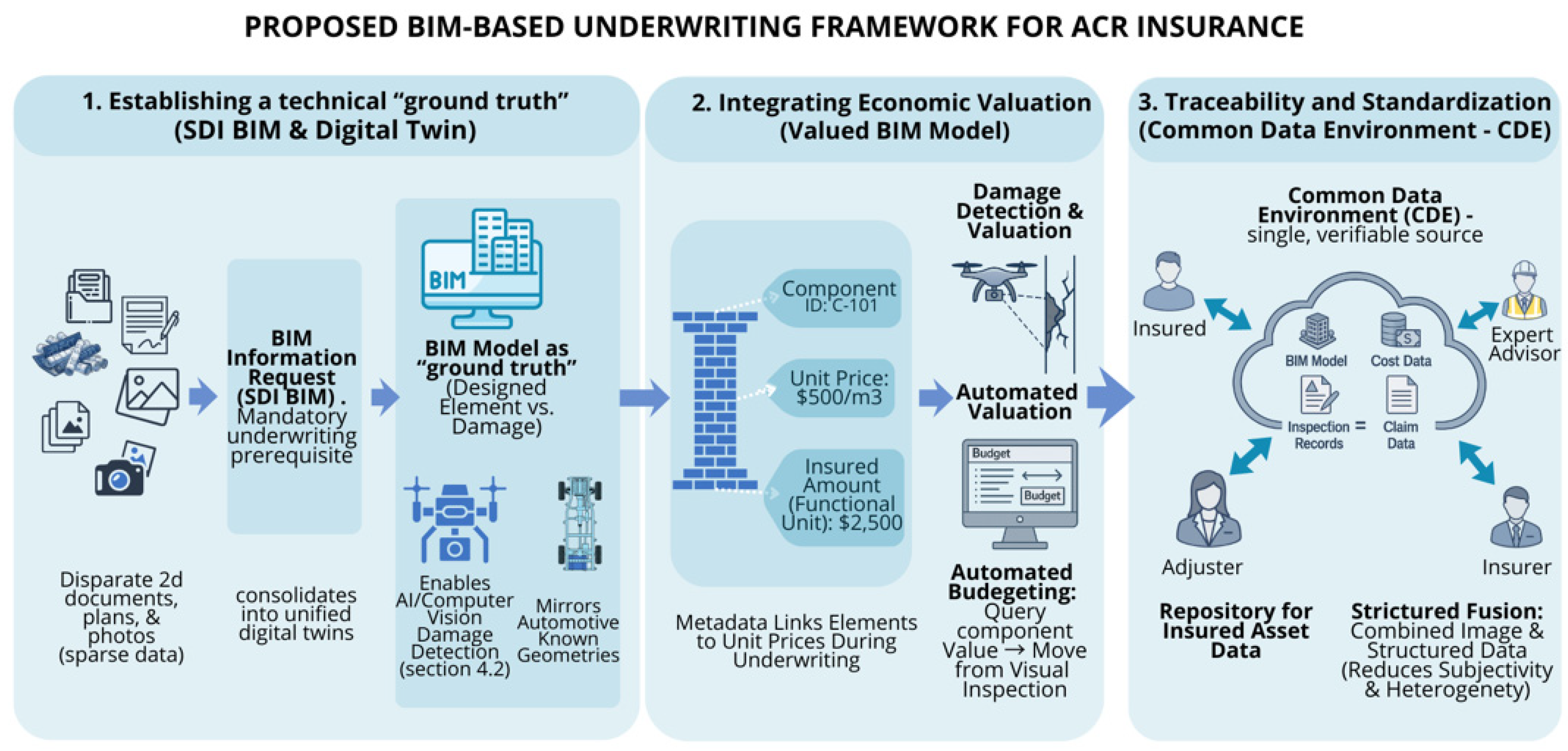
To bridge this gap and replicate the efficiency observed in the automotive and agricultural sectors, this study proposes a methodological framework for ACR (All Construction Risk) insurance underwriting based on BIM (Figure 8). This framework addresses the specific limitations the literature identified through three key mechanisms:
  • Establishing a Technical “Ground Truth” (Addressing the Data Gap): The review showed that agricultural monitoring relies on comparing “before and after” satellite images to detect changes. In construction, reliable “before” data are often missing or consist of disparate 2D documents.
    • Proposal: The introduction of a “BIM Information Request” (SDI BIM) as a mandatory underwriting prerequisite.
    • Connection to Results: This creates a digital twin that serves as the “ground truth”. Just as automotive algorithms rely on known car geometries, construction AI algorithms can rely on the BIM model to distinguish between a “designed element” and “damage”, enabling the transfer of the computer vision technologies identified in Section 4.2 to the construction site.
  • Integrating Economic Valuation (Addressing the Valuation Gap): A recurring finding in the review was the difficulty of converting technical damage detection into monetary loss. Even advanced models often stop at “severity classification”.
    • Proposal: The requirement for a Valued BIM Model, where construction elements are linked to unit prices within the model’s metadata during the underwriting phase.
    • Connection to Results: This solves the disconnect identified in Section 3.3 regarding the separation of “Damage Assessment” and “Loss Determination”. By structuring the Insured Amount into systems and functional units within the BIM environment, the economic value is pre-defined. When damage is detected, the system can automatically query the affected component’s value, moving from “visual inspection” to “automated budgeting”.
  • Traceability and Standardization (Addressing the Subjectivity Gap): The literature indicates that current construction claims rely heavily on expert judgment due to heterogeneity.
    • Proposal: Implementing a Common Data Environment (CDE) as the repository for the insured asset’s data.
    • Connection to Results: This mirrors the “structured fusion” approach seen in advanced automotive models, where image data are combined with structured claim data. The CDE ensures that the insurer, insured, and adjuster operate on a single, verifiable source of information, reducing the subjectivity that currently hampers infrastructure claims.
Thus, the limited adoption of smart tools in construction stems not from a lack of algorithms, but from a lack of structured data. This BIM-based underwriting framework provides the necessary data infrastructure to unlock the potential of the AI and IoT tools reviewed in this study.

5. Conclusions

This systematic review identified the current state of Smart Industry tools used for loss determination in insurance. The findings show significant advances in computer vision and deep learning, particularly in the automotive sector, where standardized manufacturing data enable high levels of automation.
However, the application of these technologies in the construction sector remains limited to technical damage detection, lacking integration with economic valuation systems. This gap is largely due to the absence of standardized, verifiable technical information at the time of underwriting, which prevents the creation of an objective baseline for post-loss comparisons.
To address this critical limitation, this study proposed a methodology to integrate Building Information Modeling (BIM) into the underwriting of ACR (All Construction Risk) policies. By establishing a valued BIM model as a mandatory requirement during the contracting phase, the industry can create the “ground truth” necessary to enable the automated loss determination tools that are already mature in other industries.
Moving forward, the effective adoption of these tools requires overcoming three main challenges: (i) standardizing methodologies to translate technical damage into economic values, (ii) integrating heterogeneous data sources, and (iii) developing interoperable systems between predictive models and claims management platforms. This research highlights that while the technology exists, the construction industry must first solve its data standardization challenge—via BIM—to fully leverage the potential of the Smart Industry.

Supplementary Materials

The following supporting information can be downloaded at: https://www.mdpi.com/article/10.3390/buildings16061175/s1. Reference [42] are cited in the Supplementary Materials.

Author Contributions

Conceptualization, J.A.-B.; methodology, J.A.-B., S.G.F. and V.M.; validation, J.A.-B.; formal analysis, J.A.-B.; investigation, J.A.-B. and S.G.F.; resources, S.G.F.; data curation, V.M.; writing—original draft preparation, J.A.-B. and S.G.F.; writing—review and editing, V.M., L.L.-Q. and J.A.-B.; visualization, S.G.F.; supervision, V.M.; project administration, J.A.-B. and L.L.-Q. All authors have read and agreed to the published version of the manuscript.

Funding

This research received no external funding.

Data Availability Statement

No new data were created or analyzed in this study.

Acknowledgments

The authors are grateful for the use of a generative artificial intelligence tool (ChatGPT-5.2, developed by OpenAI) to support the editing, review, and improvement of this manuscript. This tool was used to identify spelling and grammatical errors, optimize the coherence of the discourse, and refine the argumentative structure of the text. All suggestions generated by the AI were carefully evaluated and validated by the authors, who ensured the fidelity of the original content, as well as the clarity, accuracy, and consistency of the final document.

Conflicts of Interest

The authors declare that there are no conflicts of interest related to this work.

Abbreviations

The following abbreviations are used in this manuscript:
AbbreviationMeaning
IoTInternet of Things
UAVUnmanned Aerial Vehicles (drones)
CNNConvolutional Neural Networks
GEEGoogle Earth Engine
BIMBuilding Information Modeling
ARAugmented Reality
VRVirtual Reality
AIArtificial Intelligence
CPSCyber-Physical Systems
PSOParticle Swarm Optimization
SVMSupport Vector Machines
DTDecision Trees
RFRandom Forest
ANNArtificial Neural Networks
GAMGeneralized Additive Models
IoUIntersection over Union Index
mIoUMean Intersection over Union
F1F1 measure (balance between precision and recall)
APAverage Precision
mAPMean Average Precision
AUCArea Under the Curve
DSIDamage Severity Index
SODSalient Object Detection
HELHeterogeneous Ensemble Learning
VeHIDEDataset specialized in Vehicle Damage
GF-2GaoFen-2 satellite (high-resolution images)
PTCNetConvolutional Neural Network for Satellite Image Processing (in the context of the article)
ACRAll Construction Risk
Damage assessmentProcess aimed exclusively at the identification and technical quantification of physical damage
Loss determinationSeeks to translate technical information about damage into an objective and traceable economic estimate

References

  1. Eling, M.; Lehmann, M. The Impact of Digitalization on the Insurance Value Chain and the Insurability of Risks. Geneva Pap. Risk Insur. Issues Pract. 2018, 43, 359–396. [Google Scholar] [CrossRef]
  2. Yusuf, T.O.; Ajemunigbohun, S.S. Effectiveness, Efficiency, and Promptness of Claims Handling Process in the Nigerian Insurance Industry. Eur. J. Bus. Econ. 2015, 10, 686. [Google Scholar] [CrossRef]
  3. Sudabathula, B. Revolutionizing Insurance: The Impact of AI on Claims Processing. Int. J. Sci. Res. Comput. Sci. Eng. Inf. Technol. 2025, 11, 3007–3014. [Google Scholar] [CrossRef]
  4. Gupta, S.; Sharma, A.K. Evolution of Infrastructure as an Asset Class: A Systematic Literature Review and Thematic Analysis. J. Asset Manag. 2022, 23, 173–200. [Google Scholar] [CrossRef]
  5. Allen, M.A.H.R.E.; Hall, R.E.; Lazear, V.A. Reference Manual on Scientific Evidence, 3rd ed.; The National Academies Press: Washington, DC, USA, 2011. [Google Scholar]
  6. Pan, Y.; Zhang, L. Roles of Artificial Intelligence in Construction Engineering and Management: A Critical Review and Future Trends. Autom. Constr. 2021, 122, 103517. [Google Scholar] [CrossRef]
  7. Flah, M.; Nunez, I.; Ben Chaabene, W.; Nehdi, M.L. Machine Learning Algorithms in Civil Structural Health Monitoring: A Systematic Review. Arch. Comput. Methods Eng. 2021, 28, 2621–2643. [Google Scholar] [CrossRef]
  8. Spencer, B.F.; Hoskere, V.; Narazaki, Y. Advances in Computer Vision-Based Civil Infrastructure Inspection and Monitoring. Engineering 2019, 5, 199–222. [Google Scholar] [CrossRef]
  9. Abdelgawad, A.; Yelamarthi, K. Internet of Things (IoT) Platform for Structure Health Monitoring. Wirel. Commun. Mob. Comput. 2017, 2017, 6560797. [Google Scholar] [CrossRef]
  10. Oesterreich, T.D.; Teuteberg, F. Understanding the Implications of Digitisation and Automation in the Context of Industry 4.0: A Triangulation Approach and Elements of a Research Agenda for the Construction Industry. Comput. Ind. 2016, 83, 121–139. [Google Scholar] [CrossRef]
  11. Forcael, E.; Ferrari, I.; Opazo-Vega, A.; Pulido-Arcas, J.A. Construction 4.0: A Literature Review. Sustainability 2020, 12, 9755. [Google Scholar] [CrossRef]
  12. Dung, C.V.; Anh, L.D. Autonomous Concrete Crack Detection Using Deep Fully Convolutional Neural Network. Autom. Constr. 2019, 99, 52–58. [Google Scholar] [CrossRef]
  13. Braik, A.M.; Koliou, M. Automated Building Damage Assessment and Large-scale Mapping by Integrating Satellite Imagery, GIS, and Deep Learning. Comput.-Aided Civ. Infrastruct. Eng. 2024, 39, 2389–2404. [Google Scholar] [CrossRef]
  14. OECD. OECD Science, Technology and Innovation Outlook 2016; OECD Publishing: Paris, France, 2016. [Google Scholar]
  15. Mah, J.S.; Yeo, M. El Papel Del Gobierno En La Promoción de La I+D y El Desarrollo de Industrias de Alta Tecnología En China. China Rep. 2014, 50, 91–107. [Google Scholar] [CrossRef]
  16. Xinru, W.; Manaf, H.B.A. A Digital Participation Transformation in the Chinese Local Government: A Bibliometric Analysis. Multidiscip. Rev. 2026, 9, e2026273. [Google Scholar] [CrossRef]
  17. Li, J.; Pogodin, S. “Made in China 2025”: China Experience in Industry 4.0. In IOP Conference Series: Materials Science and Engineering; IOP Publishing: Bristol, UK, 2019; Volume 497. [Google Scholar] [CrossRef]
  18. Hanák, T.; Tuscher, M.; Přibyl, O. Hybrid Genetic Algorithm-Based Approach for Estimating Flood Losses on Structures of Buildings. Sustainability 2020, 12, 3047. [Google Scholar] [CrossRef]
  19. Alzarrad, A.; Awolusi, I.; Hatamleh, M.T.; Terreno, S. Automatic Assessment of Roofs Conditions Using Artificial Intelligence (AI) and Unmanned Aerial Vehicles (UAVs). Front. Built Environ. 2022, 8, 1026225. [Google Scholar] [CrossRef]
  20. Farhadi, H.; Ebadi, H.; Kiani, A.; Asgary, A. Near Real-Time Flood Monitoring Using Multi-Sensor Optical Imagery and Machine Learning by GEE: An Automatic Feature-Based Multi-Class Classification Approach. Remote Sens. 2024, 16, 4454. [Google Scholar] [CrossRef]
  21. Sarabia, R.; Aquino, A.; Ponce, J.M.; López, G.; Andújar, J.M. Automated Identification of Crop Tree Crowns from Uav Multispectral Imagery by Means of Morphological Image Analysis. Remote Sens. 2020, 12, 748. [Google Scholar] [CrossRef]
  22. Xu, J.; Zeng, F.; Liu, W.; Takahashi, T. Damage Detection and Level Classification of Roof Damage after Typhoon Faxai Based on Aerial Photos and Deep Learning. Appl. Sci. 2022, 12, 4912. [Google Scholar] [CrossRef]
  23. Dogan, G.; Hakan Arslan, M.; Ilki, A. Detection of Damages Caused by Earthquake and Reinforcement Corrosion in RC Buildings with Deep Transfer Learning. Eng. Struct. 2023, 279, 115629. [Google Scholar] [CrossRef]
  24. Qin, G.; Wang, S.; Wang, F.; Wang, Z.; Li, S.; Gu, X.; Hu, K.; Liu, L. Emergency-Oriented Fine Change Detection of Flood-Damaged Farmland from Medium-Resolution Remote Sensing Images. Int. J. Appl. Earth Obs. Geoinf. 2025, 138, 104442. [Google Scholar] [CrossRef]
  25. Manski, S.; Yang, K.; Lee, G.Y.; Maiti, T. Extracting Information from Textual Descriptions for Actuarial Applications. Ann. Actuar. Sci. 2021, 15, 605–622. [Google Scholar] [CrossRef]
  26. Lin, S.L.; Chen, Y.H. Technique on Vehicle Damage Assessment After Collisions Using Optical Radar Technology and Iterative Closest Point Algorithm. IEEE Access 2024, 12, 174507–174518. [Google Scholar] [CrossRef]
  27. Pérez-Zarate, S.A.; Corzo-García, D.; Pro-Martín, J.L.; Álvarez-García, J.A.; Martínez-del-Amor, M.A.; Fernández-Cabrera, D. Automated Car Damage Assessment Using Computer Vision: Insurance Company Use Case. Appl. Sci. 2024, 14, 9560. [Google Scholar] [CrossRef]
  28. Hamidisepehr, A.; Mirnezami, S.V.; Ward, J.K. Comparison of Object Detection Methods for Corn Damage Assessment Using Deep Learning. Trans. ASABE 2020, 63, 1969–1980. [Google Scholar] [CrossRef]
  29. Mohammed, N.A.; Potrus, M.Y.; Ali, A.M. Deep Learning Based Car Damage Classification and Cost Estimation. Zanco J. Pure Appl. Sci. 2023, 35, 1–9. [Google Scholar] [CrossRef]
  30. Lee, G.Y.; Manski, S.; Maiti, T. Actuarial Applications of Word Embedding Models. ASTIN Bull. 2020, 50, 1–24. [Google Scholar] [CrossRef]
  31. Hoang, V.D.; Huynh, N.T.; Tran, N.; Le, K.; Le, T.M.C.; Selamat, A.; Nguyen, H.D. Powering AI-Driven Car Damage Identification Based on VeHIDE Dataset. J. Inf. Telecommun. 2024, 9, 24–43. [Google Scholar] [CrossRef]
  32. Ramazhan, M.R.S.; Bustamam, A.; Buyung, R.A. Smart Car Damage Assessment Using Enhanced YOLO Algorithm and Image Processing Techniques. Information 2025, 16, 211. [Google Scholar] [CrossRef]
  33. Mallios, D.; Xiaofei, L.; McLaughlin, N.; Rincon, J.M.D.; Galbraith, C.; Garland, R. Vehicle Damage Severity Estimation for Insurance Operations Using In-The-Wild Mobile Images. IEEE Access 2023, 11, 78644–78655. [Google Scholar] [CrossRef]
  34. Qaddour, J.; Siddiqa, S.A. Automatic Damaged Vehicle Estimator Using Enhanced Deep Learning Algorithm. Intell. Syst. Appl. 2023, 18, 200192. [Google Scholar] [CrossRef]
  35. Aldawsari, A.; Yusuf, S.A.; Souissi, R.; Al-Qurishi, M. Real-Time Instance Segmentation Models for Identification of Vehicle Parts. Complexity 2023, 2023, 6460639. [Google Scholar] [CrossRef]
  36. Tang, Z.; Sun, Y.; Wan, G.; Zhang, K.; Shi, H.; Zhao, Y.; Chen, S.; Zhang, X. Winter Wheat Lodging Area Extraction Using Deep Learning with GaoFen-2 Satellite Imagery. Remote Sens. 2022, 14, 4887. [Google Scholar] [CrossRef]
  37. Hasan, M.J.; Nalwan, A.; Ong, K.L.; Jahani, D.H.; Boo, Y.L.; Nguyen, K.C.; Hasan, M. GroundingCarDD: Text-Guided Multimodal Phrase Grounding for Car Damage Detection. IEEE Access 2024, 12, 179464–179477. [Google Scholar] [CrossRef]
  38. Berwo, M.A.; Fang, Y.; Khan, A.; Manzor, A.; Mahmood, J. VEBD-HEL: A Noval Approach to Vehicle Exterior Body Damage Parts Classification in Intelligent Transportation Systems. Alex. Eng. J. 2024, 108, 961–975. [Google Scholar] [CrossRef]
  39. Atanasious, M.M.H.; Becchetti, V.; Giuseppi, A.; Pietrabissa, A.; Arconzo, V.; Gorga, G.; Gutierrez, G.; Omar, A.; Pietrini, M.; Rangisetty, M.A.; et al. An Insurtech Platform to Support Claim Management Through the Automatic Detection and Estimation of Car Damage from Pictures. Electronics 2024, 13, 4333. [Google Scholar] [CrossRef]
  40. Tian, X.; Han, H. Deep Convolutional Neural Networks with Transfer Learning for Automobile Damage Image Classification. J. Database Manag. 2022, 33, 16. [Google Scholar] [CrossRef]
  41. Giwa, F.; Omotayo, T.; Tzortzopoulos, P.; Malalgoda, C. BIM-Enabled Claims Management Concept: Implications for Dispute Avoidance and Management. J. Leg. Aff. Disput. Resolut. Eng. Constr. 2024, 16, 04524009. [Google Scholar] [CrossRef]
  42. Tricco, A.C.; Lillie, E.; Zarin, W.; O’Brien, K.K.; Colquhoun, H.; Levac, D.; Moher, D.; Peters, M.D.J.; Horsley, T.; Weeks, L.; et al. PRISMA Extension for Scoping Reviews (PRISMAScR): Checklist and Explanation. Ann. Intern. Med. 2018, 169, 467–473. [Google Scholar] [CrossRef]
Figure 1. PRISMA diagram.
Buildings 16 01175 g001
Figure 2. Annual production graph extracted from the Bibliometrix platform.
Buildings 16 01175 g002
Figure 3. Scientific production by country. (A) Total scientific articles per country. (B) Global geographic concentration of publications. The intensity of the blue color in (B) represents the concentration of publications; darker tones indicate a higher concentration, while lighter tones indicate a lower one.
Buildings 16 01175 g003
Figure 4. Frequency of keywords in article abstracts extracted from the Bibliometrix platform.
Buildings 16 01175 g004
Figure 5. Use of technological tools by industrial sector.
Buildings 16 01175 g005
Figure 6. Number of processes implemented by industrial sector.
Buildings 16 01175 g006
Figure 7. Use of technological tools by implemented processes.
Buildings 16 01175 g007
Figure 8. Proposed BIM-Based Underwriting Framework for ACR Insurance.
Buildings 16 01175 g008
Table 1. Characterization of the studies included in the systematic review.
SourceName of the
Article
What
are the Smart Industry Tools Used?
In which Productive Sectors Have Smart Industry Tools Been Most Frequently Applied?In which Specific Processes are These Smart Industry Tools Implemented?What Results Have Been Obtained from the Implementation of These Technological Tools?
[18]Hybrid Genetic Algorithm-Based Approach for Estimating Flood Losses on Structures of BuildingsHybrid genetic algorithm + least squares + cost listResidential property insuranceEstimation of flood damage to interior building structuresHigh accuracy (error less than 2%) compared to traditional estimates. Rapid estimation
[19]Automatic assessment of roof conditions using artificial intelligence (AI), and unmanned aerial vehicles (UAVs)Deep learning (YOLOv5), UAVs, supervised learningReal estate and insurance sectorAutomatic inspection of residential roofs using aerial images86% precision, 81% accuracy in detecting missing tiles. Significant reduction in risks and time.
[20]Near Real-Time Flood Monitoring Using Multi-Sensor Optical Imagery and Machine Learning by GEEMachine learning (Random Forest), spectral indices, GEEEmergency management and agricultural/urban insuranceDetection of flooded areas through automatic multitemporal classificationOverall accuracy of 90.57%, Kappa 0.89. Better results than other methods (SVM, DT, spectral indices).
[21]Automated Identification of Crop Tree Crowns from UAV Multispectral Imagery by Means of Morphological Image AnalysisRemote sensing, UAV, morphological image analysis, photogrammetryAgricultureAutomatic detection, counting, and geolocation of trees in intensive orchardsAccuracy 99.92%, sensitivity 99.67%, F1-score 99.75% in counting 3919 olive trees.
[22]Damage Detection and Level Classification of Roof Damage after Typhoon Faxai Based on Aerial Photos and Deep LearningDeep learning (Mask R-CNN), aerial photo interpretation, image segmentationInfrastructureAutomatic detection and classification of roof damage after a typhoonModel accuracy greater than 98% (mIoU). Classification into 5 levels of damage. Processing in less than 10 min.
[23]Detection of damages caused by earthquake and reinforcement corrosion in RC buildings with Deep Transfer LearningDeep learning (CNN), Transfer learning (VGG19), digital imageInfrastructure Automatic classification of earthquake damage vs. corrosion damage in reinforced concrete elements90.62% accuracy in classification. External validation with 84% in new earthquake.
[24]Emergency-oriented fine change detection of flood-damaged farmland from medium-resolution remote sensing imagesDeep learning (U-Net + ConvNeXt), semi-supervised learning, Sentinel-2, Gaofen-1, Environmental Disaster Reduction-2Agriculture (agricultural insurance, emergency management)Fine detection of changes in flood-damaged farmland using multi-temporal RS imagesF1-score of 0.9047 (supervised), improved to 0.9241 with semi-supervised pseudo-labeling. High accuracy, robustness across regions and sensors.
[25]Extracting information from textual descriptions for actuarial applicationsWord embeddings (GloVe), textual analysis, GAM with adaptive lassoGeneral insuranceAutomated prediction of loss amount based on textual descriptionsInterpretable and scalable model with good predictive performance. MSPE = 0.996. Spearman = 76.06%.
[26]Technique on Vehicle Damage Assessment After Collisions Using Optical Radar Technology and ICPArtificial vision, deep learning neural networkAutomotive insuranceVehicle damage assessment by comparing pre- and post-collision point clouds Reduction in RMSE from 1.27 to 0.29 and relative rotation from 4.03° to 0.04°. Improved accuracy for claims and repairs.
[27]Automated Car Damage Assessment Using Computer Vision: Insurance Company Use CaseDeep learning (ensemble YOLOv5), artificial vision, particle swarm optimization (PSO)Automotive insuranceAutomatic detection of vehicle damage from images sent by customersReduction in false positives to 9%, AUC 0.15, mAP50 3.77%. CPU inference in 2.82 s. Scalable for production.
[28]Comparison of Object Detection Methods for Corn Damage Assessment Using Deep LearningDeep learning (YOLOv2, RetinaNet, Faster R-CNN), Artificial vision.Agriculture (corn)Automatic detection of lodging damage in corn using computer visionAP from 98.43% to 73.24% (RetinaNet) and 97.0% to 55.99% (YOLOv2). Faster R-CNN with lower performance. Better performance with non-rotated images.
[29]Deep Learning Based Car Damage Classification and Cost EstimationDeep learning (Mask R-CNN), supervised learningAutomotive insuranceAutomatic classification of damage type and cost estimation in vehicles98.5% accuracy with two Mask R-CNN models. Estimation based on location, type, and area of damage.
[30]Actuarial Applications of Word Embedding ModelsWord embeddings (GloVe, word2vec), generalized additive regression (GAM)Government property insuranceAutomatic classification of claims and risk analysis with textual descriptionsClassification accuracy of 93.62%. Interpretable GAM for textual variables. Improvement in risk management and mitigation.
[31]Powering AI-driven car damage identification based on VeHIDE datasetDeep learning (YOLOv5, Mask R-CNN), Artificial vision, CNNAutomotive insuranceDetection, segmentation, and identification of vehicle damage using proprietary dataset (VeHIDE)VeHIDE: 13,945 images with 8 damage classes. mAP (YOLOv5) = 50.4%. SGL-KRN excels in SOD with Fβ = 0.832. Dataset improves accuracy in irregular damage.
[32]Smart Car Damage Assessment Using Enhanced YOLO Algorithm and Image Processing TechniquesDeep learning (YOLOv9 + CBAM), SCYLLA-IoU, spatial attention, damage severity index (DSI), data augmentationAutomotive insuranceAutomatic detection and quantification of vehicle damage from images97.2% accuracy, 78.8% recall. Introduction of the DSI index to standardize damage severity. Improved performance compared to other YOLO algorithms.
[33]Vehicle Damage Severity Estimations for Insurance Operations Using In-The-Wild Mobile ImagesDeep learning (Mask R-CNN, artificial vision, YOLOv4, ResNet, XGBoost, structured fusion Automotive insuranceAutomatic estimation of damage severity in vehicles using unstructured mobile imagesImproved classification accuracy by combining images + structured data. >2% increase in AUC compared to the traditional model. Reduction in false negatives.
[34]Automatic Damaged Vehicle Estimator Using Enhanced Deep Learning AlgorithmDeep learning (enhanced Mask R-CNN), transfer learning (VGG-16, VGG-19, Inception-ResNetV2), artificial visionAutomotive insuranceAutomatic detection, localization, and classification of damage and severity in vehicle imagesInception-ResNetV2 achieved the best results: detection (92%), localization (85%), severity (80%). Implemented in a functional web app.
[35]Real-Time Instance Segmentation Models for Identification of Vehicle PartsDeep learning (YOLACT, SipMask, SipMask++), instance segmentation, artificial visionAutomotive insurance and repair shopsReal-time segmentation of vehicle parts for automated assessment and repairSipMask++ achieved better mAP (57.0) and location accuracy. YOLACT stood out in speed (21.1 fps). Robust segmentation in noisy and varied images.
[36]Winter Wheat Lodging Area Extraction Using Deep Learning with GaoFen-2 Satellite ImageryDeep learning (PTCNet), satellite imagery (GF-2), vegetation indices, edge operatorsAgriculture and agricultural inputsLarge-scale detection and segmentation of lodging areas in wheat for agricultural insuranceF1-score of 85.31%, IoU of 74.38%. Better performance than DeepLabv3+, PSPNet, FPN, and SegNet.
[37]GroundingCarDD: Text-Guided Multimodal Phrase Grounding for Car Damage DetectionMultimodal (vision + text), phrase grounding, attention, SAM2, DETR, YOLOv9Auto insuranceLocation and classification of vehicle damage using images and textual descriptionsAP50 = 80, Recall = 86.7, mAP = 64.1. Lower false positive rate. Accurate segmentation with SAM2.
[38]VEBD-HEL: A Novel Approach to Vehicle Exterior Body Damage Parts ClassificationEnsemble learning (HEL: DenseNet-169, ResNet-50/101), Bayesian optimizationAutomotive insuranceClassification of damaged vehicle exterior parts in ITS contextsAccuracy = 99.93%, AUC = 99.85%. Surpasses 12 base classifiers. Better stability and accuracy in class imbalance.
[39]An Insurtech Platform to Support Claim Management Through the Automatic Detection and Estimation of Car Damage from PicturesDeep learning, computer vision, image segmentationAutomotive insuranceAutomation of damage identification and cost estimation from customer imagesPlatform applicable to real management. Reduction in time and risk of fraud. Improvement in appraisal efficiency.
[40]Deep Convolutional Neural Networks With Transfer Learning for Automobile Damage Image ClassificationDeep convolutional neural networks (CNN) + Transfer learning + SVM, ANN, RF, LG, DTVehicle insurance industryAutomatic classification of vehicle damage images for claims adjustmentAccuracy of up to 97% with augmented images
Disclaimer/Publisher’s Note: The statements, opinions and data contained in all publications are solely those of the individual author(s) and contributor(s) and not of MDPI and/or the editor(s). MDPI and/or the editor(s) disclaim responsibility for any injury to people or property resulting from any ideas, methods, instructions or products referred to in the content.