1. Introduction
The COVID-19 pandemic has brought about profound changes in people’s lifestyles [
1,
2], significantly influencing the way residential spaces are planned and utilized. The widespread adoption of remote work, online education, and home-based leisure activities has accelerated the demand for flexible and multifunctional spatial layouts. In addition, heightened concerns over health and well-being have increased the importance of incorporating natural elements and promoting psychological comfort within living environments [
3]. For example, living rooms are transforming into multifunctional spaces with open layouts and ample natural lighting, while balconies are evolving into hybrid spaces that blur the boundary between indoors and outdoors. In addition, entrances are being redesigned as quarantine-oriented buffer zones to block viruses and external contaminants. In this way, in the post-pandemic era, the functional boundaries of residential spaces are gradually dissolving, the conventional frames of life and space are being reorganized, and new forms of daily routines and residential patterns are emerging.
In this context, investigating residential design trends in the Post-pandemic era is crucial not only for understanding how spatial configurations have responded to societal changes, but also for providing evidence-based guidance for future housing design. In this study, “residential design trends” refer to recurring spatial configurations, functional arrangements, and visual design features that are collectively observed across residential spaces within a specific socio-temporal context, reflecting shared design intentions and lifestyle adaptations rather than individual preferences. Identifying spatial features that correspond to evolving user needs can support the development of flexible, resilient, and user-centered residential environments capable of accommodating hybrid lifestyles that integrate living, working, and leisure activities.
Previous studies on changes in residential spaces have primarily relied on surveys, in-depth interviews, and field observations [
4,
5,
6]. Although these methods offer insights into residents’ subjective experiences, they are limited in their ability to systematically and quantitatively capture visual and aesthetic characteristics or to identify large-scale spatial trends reflected in built environments. In contrast, the proliferation of social networking services (SNS) and interior design-oriented platforms has enabled the continuous sharing and accumulation of vast numbers of residential interior images. Platforms such as Pinterest and Instagram function as large-scale visual repositories of residential spaces, capturing evolving design practices and everyday spatial adaptations. These platforms are also widely used by Korean designers, developers, and residents as primary sources of design inspiration, reflecting globally shared yet locally adopted residential design trends.
Recent advances in deep learning, particularly in image recognition, provide new opportunities for analyzing design trends through large-scale visual data [
7,
8]. Convolutional Neural Networks (CNNs) are well suited for this purpose, as they can automatically learn hierarchical visual features from complex images, capturing both spatial composition and object relationships [
9,
10,
11]. In architectural and interior design research, such capabilities enable the systematic extraction of visual characteristics from residential images, supporting the quantitative analysis of spatial patterns that reflect design intentions and user adaptations. By processing large volumes of visual data, image-based deep learning methods allow researchers to identify recurring spatial features and emerging tendencies, thereby offering an empirical approach to understanding design trends over time.
Accordingly, this study aims to quantitatively compare and evaluate changes in residential space design before and after the COVID-19 pandemic by applying a deep learning-based image analysis algorithm to residential interior images. Residential images were collected from SNS and interior design-oriented platforms, where users and designers continuously share visual records of actual living environments and design outcomes. The research procedure involves extracting visual features from these images and conducting a visual ratio analysis, in which the relative proportions of three spatial attributes—(1) openness and comfort, (2) spatial flexibility and diversity, and (3) nature-friendliness—are quantified and compared across time periods. Unlike conventional methodologies that rely on subjective surveys or qualitative interviews, this approach analyzes large-scale visual datasets using a consistent computational framework, thereby constituting a big data-driven study based on visual information. Through this process, the study seeks to empirically identify the impact of the pandemic on residential design trends and to provide data-driven implications for residential design, architecture, and real estate in the post-pandemic era.
This study addresses the lack of empirical, large-scale methods for identifying how desired residential design attributes have shifted between the pre-pandemic and post-pandemic eras. While prior studies rely largely on surveys or qualitative observations, this research proposes an image-based deep learning approach as an analytical tool to quantitatively capture and compare these temporal design shifts.
2. Research Background
2.1. Changes in Residential Space Functions and Designs
As contactless socializing has become part of the natural transition post-COVID-19, more people have grown comfortable performing a large proportion of their daily activities (e.g., working, learning, shopping, leisure, and socializing) online from home [
12]. Accordingly, changes have been made to partially adapt the residential spaces of people who used to frequent coworking spaces or cafes into spaces for learning and working, while adhering to social distancing requirements to minimize the risk of infection. Consequently, with the increased transition of certain activities, including learning, work, and leisure, to home settings, the physical boundaries of residential spaces have expanded [
13], requiring the residential space designs to respond to social changes in this new era.
Peters and Halleran (2021) suggested that three factors are crucial in co-living housing planning for populations vulnerable to infectious diseases: social distancing, disconnection from nature, and changing housing functions [
14]. Since COVID-19, changes in the frequency of daily living activities within the dwelling have been particularly evident in “caring for family and household members” and “household management,” reflecting increased time spent at home [
2]. Accordingly, this study does not directly observe or measure daily activities, but instead examines how changes in everyday practices are translated into spatial configurations and design features. By analyzing residential interior images, the study captures the visual and functional adaptations of living spaces that indirectly represent shifts in daily activities and domestic needs.
As the nature of traditional residential spaces has shifted, the resident needs for planning and design have changed, requiring expansion, reduction, separation, and integration of spaces. Accordingly, more studies have suggested the effective utilization of spaces by examining preferences and needs for residential spaces [
15,
16]. Traditional residential spaces in Korea have a residential function that emphasizes openness, with the living room in the center of the dwelling. That is, the design function of indoor spaces emphasizes the LDK (Living + Dining + Kitchen) format, by locating the living room in the center and connecting the kitchen and dining room [
17,
18]. Although traditional Korean housing has historically emphasized distinct cultural and spatial characteristics, contemporary residential design in Korea has increasingly adopted globally standardized layouts and design references, particularly those rooted in Western housing models such as the LDK (Living–Dining–Kitchen) configuration. As a result, global interior design platforms and social media channels function not merely as external influences, but as practical reference standards that shape current Korean residential design practices.
Residential functions are categorized as safety, convenience, socialization, relaxation, and multifunctionality; while all residential functions increased after COVID-19, “comfort” experienced the greatest increase. Meanwhile, in the post-pandemic era, multifunctionality refers to the ability of residential spaces to accommodate activities that were traditionally conducted outside the home, including remote work, online learning, indoor exercise, leisure activities, and small-scale social interactions [
2].
2.2. Deep Learning Literature Review
Deep learning is based on artificial neural networks that enable machines to automatically learn hierarchical features from data by simulating the structure of human biological neurons through multiple neural layers [
19]. In image analysis, these features may include low-level visual attributes such as edges, textures, and colors, as well as higher-level spatial patterns such as object shapes, layout configurations, and material compositions. Because of this capability, deep learning has been widely applied to image recognition, speech classification, and natural language processing [
20].
In architectural and spatial research, image-based deep learning has been used to analyze building façades, interior layouts, and spatial components by extracting visual features related to form, proportion, and spatial organization [
21]. In design practice, the integration of information models during the architectural design phase—such as Building Information Modeling (BIM)—has been shown to reduce design errors, including spatial conflicts between structural and mechanical systems, misalignment of building components, and inconsistencies between drawings and specifications. This process, often referred to as design informatization, involves the systematic digitalization and structuring of design information to support decision-making, coordination, and error prevention throughout the design process. In addition, a methodology for identifying patterns by detecting image features has been applied to analyze images of land areas and to effectively design building floor plans [
22].
Meanwhile, previous space design research has primarily examined interior design styles by categorizing reference images into predefined style types. Recent deep learning-based approaches have enabled the automatic recognition and evaluation of interior design styles directly from reference images [
23]. This allows the derivation of feature relationships through image analysis, and identification of clear furniture and color combination patterns through object detection, color extraction, and network analysis [
10]. Furthermore, automatic layouts have been suggested for space design [
9] and a model has been designed to find similar products through visual search in image space [
24]. The findings of these studies are predominantly grounded in subjective design interpretations, which shape the derivation of conclusions and the formulation of customized design recommendations.
Deep learning techniques can be adopted to respond to residents’ lifestyles and needs by analyzing big data regarding individual needs [
25] and spatial images, suggesting appropriate space designs for rapidly changing residential functions. The technique has been employed to detect and classify objects in images as well as myriad other research areas. In fact, its applicability has been broadened to fields previously considered subjective, such as emotions, art, and design [
11,
26,
27,
28,
29].
This study analyzed spatial design trends using SNS images based on visual elements. SNS is a platform where users continuously upload photos reflecting the latest trends, so it is easy to secure data in real time and reflect various user perspectives, making it easy to capture popular preferences or lifestyle changes. SNS images are generated and shared directly by residents at the time of space use or renovation, reflecting actual living environments and everyday spatial practices. Because these images are continuously uploaded by a large and diverse user group, the repeated appearance of specific visual elements—such as flexible furniture layouts, integrated workspaces, or indoor greenery—can be interpreted as collective indicators of emerging residential design trends. Thus, SNS-based image data enable the identification of popular preferences and lifestyle changes through large-scale visual pattern analysis.
2.3. Convolutional Neural Network (CNN)-Based Image Classification
Machine learning models based on Convolutional Neural Networks (CNNs) are among the most widely used deep learning techniques for image recognition and classification [
30]. CNNs operate by applying convolutional filters to input images in order to automatically extract hierarchical visual features, ranging from low-level patterns such as edges and textures to high-level semantic features such as object shapes and spatial configurations. For example, in residential interior images, early convolutional layers may capture basic visual elements such as lines, color contrasts, and lighting conditions, while deeper layers identify more complex spatial features, including furniture arrangements, window openings, and the presence of natural elements such as plants.
In 1989, LeCun et al. introduced a CNN-based image classification algorithm for recognizing handwritten digits, which laid the foundation for modern feature extraction and image classification systems [
31,
32,
33,
34]. Since then, CNN architectures such as AlexNet, VGG, GoogleNet, and ResNet have been developed and widely applied for visual image analysis due to their effectiveness in extracting discriminative features from input images and classifying image categories [
30,
35].
CNN has been designed for feature extraction and image classification. It contains a convolutional layer that detects image features and analyzes images through multiple filters (kernels) to assess characteristic patterns; the pooling layer lowers the spatial resolution and computation requirement, while the fully connected layer (FCL)—a neural network structure—classifies images based on extracted features. The convolutional operation identifies and extracts the overall image features, and the pooling operation exaggerates the image features to increase the neural network efficiency while improving the result direction of the images to be analyzed and maximizing the morphological features. Finally, the FCL classifies and extracts the features comprehensively, and the output layer presents the classification results [
7]. This CNN utilization methodology has been proposed in architectural planning and interior design to improve the classification accuracy of spatial images and analysis [
36]. Such studies have classified interior design styles [
11] and quantitatively estimated preferences for building patterns [
37] based on CNN.
In this study, we modified the Python code from the existing algorithm to optimize and construct the training data set. We then applied collected residential space images from social media to classify and analyze the colors of physical elements such as walls, ceilings, and floors, as well as lighting, furniture, and decorative items, ultimately deriving analytical results.
3. Research Methods
3.1. Research Design
This study was designed to classify and analyze residential space images from the post-COVID-19 period using an image-based deep learning approach. Rather than extracting culturally exclusive or traditional Korean housing characteristics, the study focuses on identifying emerging standardized design tendencies that have been widely adopted in Korean residential spaces through global design circulation.
In this study, the “Post-pandemic” period is defined as beginning in 2020, following the outbreak of COVID-19. Although architectural design and construction generally involve time lags, this study analyzes image-based representations of residential spaces shared on social media, which reflect relatively rapid changes in design intentions, interior configurations, and lifestyle-oriented spatial responses. Accordingly, images posted from 2020 onward are considered appropriate for capturing emerging residential design trends in the Post-pandemic era.
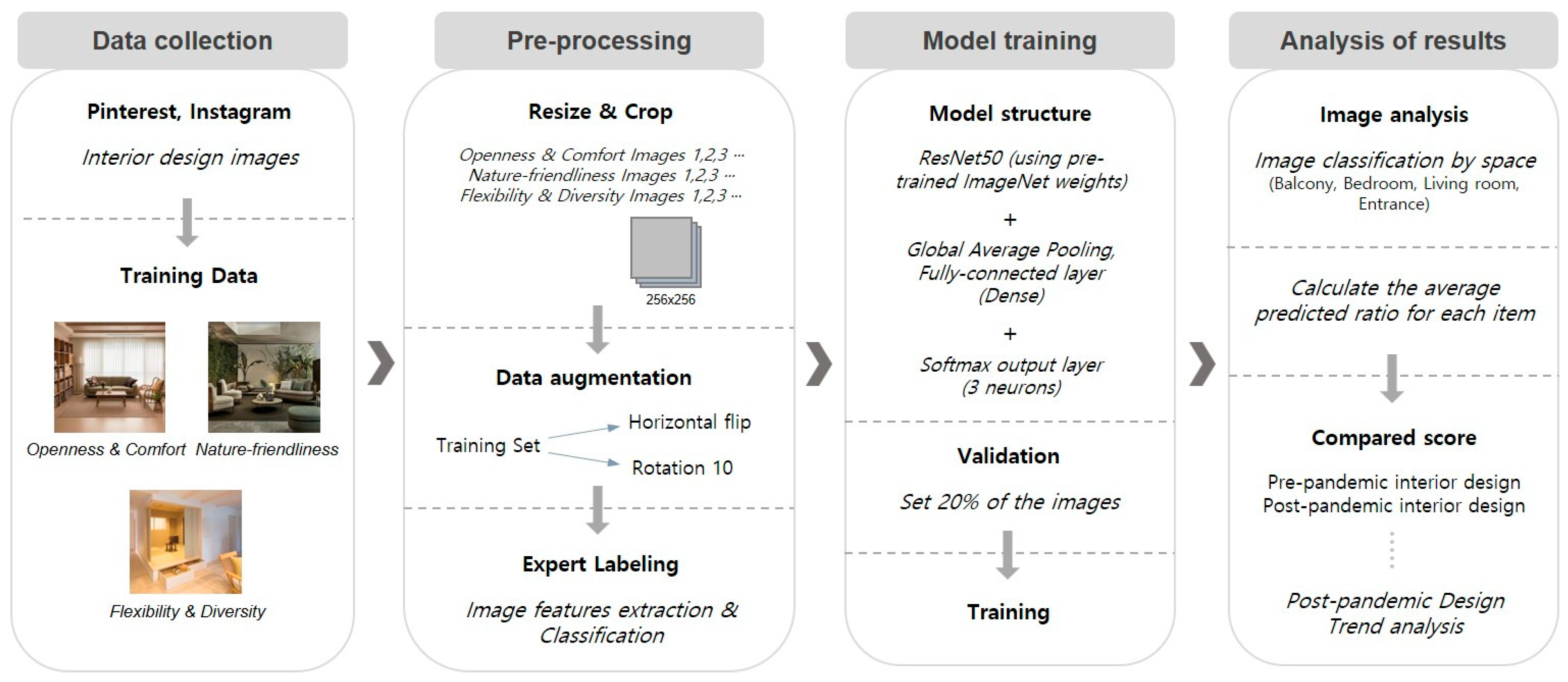
Image data were collected using Python-based automated scripts that retrieved publicly available residential interior images from social curation platforms, specifically Instagram and Pinterest. The data collection process complied with platform usage policies and focused on images tagged with residential interior-related keywords. A deep learning-based Convolutional Neural Network (CNN) was then employed to classify and quantify the collected residential space images. Among the various CNNs, we employed ResNet50 with standard transfer learning protocols following He et al. (2016) [
7]. The model was initialized with ImageNet pre-trained weights, with the final classification layer modified for our three-factor evaluation scheme (openness, flexibility, nature-friendliness). The deep learning model was implemented using Python (version 3.9, Python Software Foundation, Wilmington, DE, USA) with TensorFlow (version 2.x, Google LLC, Mountain View, CA, USA) and Keras (version 2.x, Google LLC, Mountain View, CA, USA) as the primary deep learning frameworks.
The evaluation scale for image classification was divided into three factors: openness and comfort, flexibility [
38] and diversity, and nature-friendliness, according to changes in residential functions [
39]. Residential spaces were also divided into bedroom, living room, entrance, and balcony for spatial analysis; images of residential spaces before the pandemic and the Post-pandemic era were compared. The specific research methods have been presented in
Figure 1.
3.2. Image Training Dataset
A total of 625 images, with approximately 200 per keyword, collected from Pinterest were included for residential space image training [
40]. For learning progress and performance evaluation, 60% of the collected images were utilized as training data, 20% as validation data, and 20% as test data. The image dataset was divided based on three evaluation scales (i.e., openness and comfort, flexibility and diversity, and nature-friendliness), and the training images were selected by setting each criterion. In particular, spatial flexibility and diversity were not defined by object density or visual clutter. Instead, images were labeled based on the presence of structured spatial configurations, such as partitions, movable or reconfigurable furniture, and clearly implied multifunctional zoning (e.g., work, rest, or storage within a single space). Although visually cluttered spaces may also contain many objects, such environments typically lack coherent spatial organization or functional intent and were not categorized as flexible spaces.
To ensure consistent feature extraction across images, only images that clearly displayed at least three spatial planes (walls, floor, and ceiling) were selected. This criterion was applied not to emphasize perceived spaciousness, but to ensure that key architectural elements required for spatial interpretation were present in each image. While wide-angle photography is common in interior imagery, images exhibiting extreme lens distortion or artificially exaggerated depth were excluded during the data screening process. Moreover, since the same selection criteria were consistently applied to both pre-pandemic and post-pandemic datasets, potential perceptual bias introduced by photographic techniques is assumed to be systematically controlled across comparative groups.
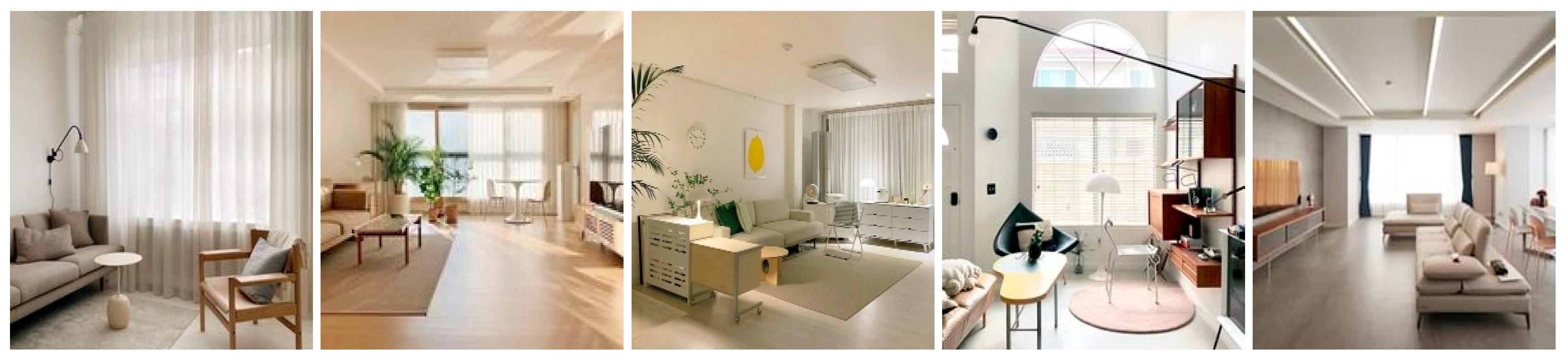
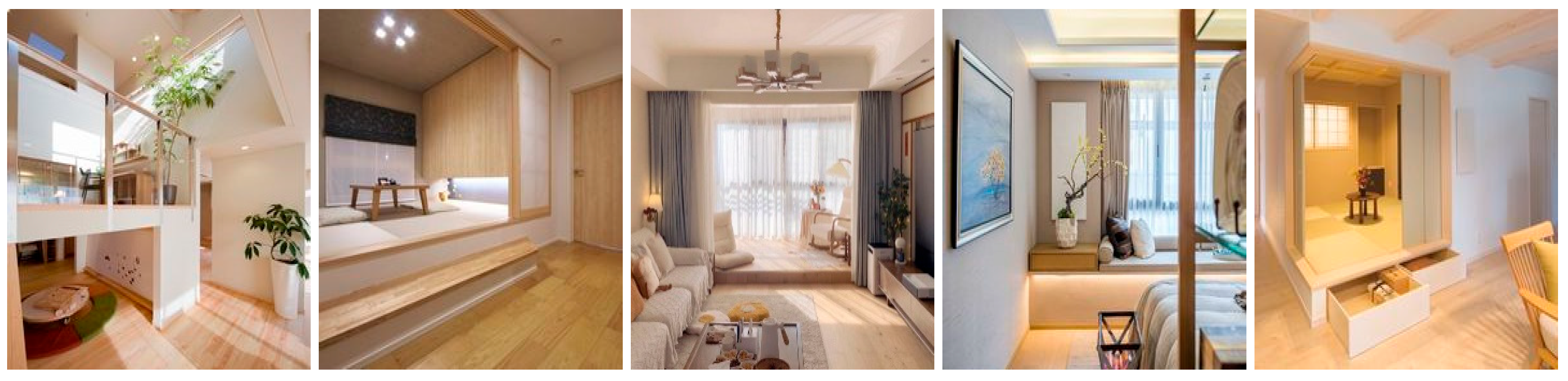
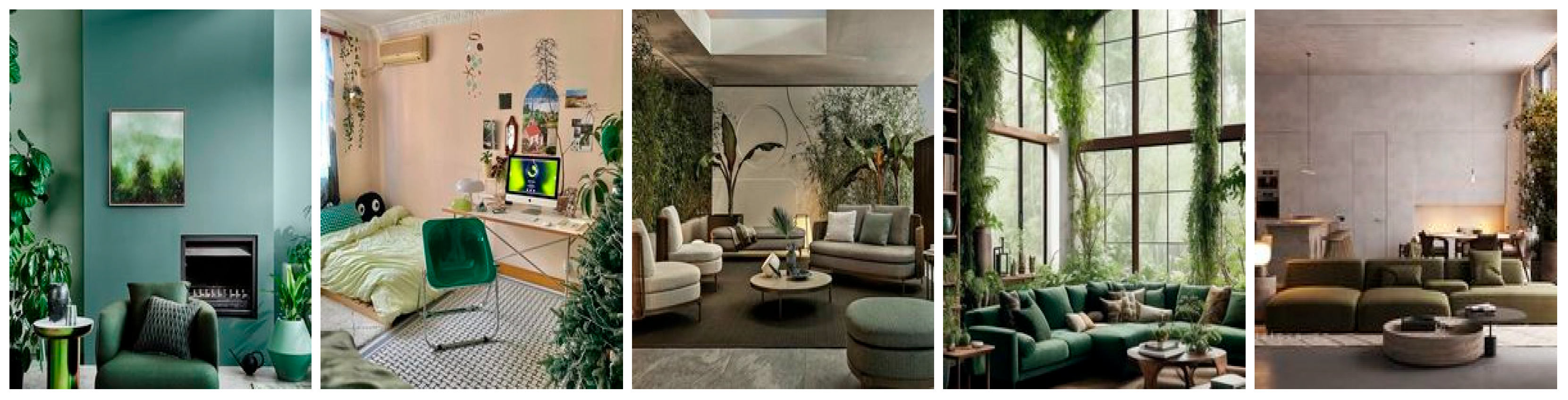
Examples of images corresponding to the dataset’s keywords are provided in
Figure 2,
Figure 3 and
Figure 4, and the criteria for image selection are clarified. Prior to model training, data pre-processing was conducted to enhance image consistency and suitability for CNN-based analysis. This process included standardizing labeling formats, resizing all images to a fixed resolution of 256 × 256 pixels (horizontal × vertical), and adjusting image proportions to maintain aspect ratio. Images with excessive distortion, noise, or insufficient visual information were excluded to reduce inconsistencies in the dataset [
41].
Images with Openness and Comfort had open spaces, large windows, and good ventilation. Bright lighting and colors were selected as the design factors [
42]. Data images with flexibility and diversity had images with separated spaces through partitions, furniture, and differences in floor level, with more than one function or use of the space. Meanwhile, the data images with nature-friendliness functions included plants on the walls or ceiling within the space or accessories such as pots and flowers: the design color tone was primarily mainly green, and the spaces had natural materials rather than artificial materials [
43].
3.3. Training Image Prediction and Performance Evaluation
To train the deep learning model and ensure robust prediction performance, image augmentation techniques were applied to mitigate overfitting and improve generalization, particularly given the relatively limited dataset size [
44]. Image augmentation artificially expands the training dataset by applying controlled transformations—such as rotation, horizontal flipping, and noise injection—while preserving the semantic content of the images [
45]. These techniques are widely used in CNN-based image analysis to enhance model stability and prevent bias toward specific image compositions.
In this study, Keras’ ImageDataGenerator (Keras version 2.x, Google LLC, Mountain View, CA, USA) was used to perform random rotations, flips, and noise additions during training. This approach allowed the model to learn invariant visual features related to spatial structure and design elements rather than memorizing specific photographic viewpoints or compositions.
The trained model outputs three continuous values corresponding to the spatial attributes of openness and comfort, flexibility and diversity, and nature-friendliness. A Softmax activation function was applied at the output layer to normalize these values into proportional scores, representing the relative emphasis of each attribute within a given space. Although these spatial attributes are not conceptually mutually exclusive in architectural practice, the Softmax formulation was adopted to enable consistent comparison of dominant spatial tendencies across different space types and time periods. Accordingly, the predicted values should be interpreted as relative ratio indicators, not as binary or mutually exclusive classifications.
Model performance was evaluated using a confusion matrix based on a test dataset comprising 20% of the total images. The confusion matrix enabled a detailed assessment of classification accuracy by comparing predicted labels with expert-validated reference labels. From this matrix, precision, recall, and F1-score metrics were calculated to assess predictive reliability across the three spatial attributes.
Overall, the model demonstrated high classification performance, indicating that the extracted visual features effectively captured spatial design characteristics relevant to the evaluation criteria. While minor discrepancies were observed in attributes related to spatial flexibility and diversity—likely due to subtle variations in spatial partitioning and furniture-based zoning—the overall performance confirms the suitability of the proposed CNN-based approach for analyzing residential space design trends.
Although the predictability analysis of the evaluated training data had differences per residential function within the space, the model correctly predicted 38, 28, and 36 images per dwelling function, respectively, among a total of 125 images. Moreover, it learned images with an average accuracy of 90% due to training (
Table 1). Accuracy indicates that the learning model precisely classified the residential functions within the space in all cases and intuitively evaluated the prediction performance. As the classification performance may differ depending on the data, we confirmed accuracy, precision, recall, and F1 score, which measure the classifier’s performance by combining the evaluation metrics’ values to assess performance. Precision refers to the prediction of a specific dwelling function within the space that reflects the correct dwelling function in reality. Recall refers to the model’s ability to correctly predict the percentage of the corresponding dwelling function. The F1 score is a weighted harmonic average of the precision and recall values; this circumvents the skewness of applying a single metric.
Table 1 presents the results of calculating each performance metric based on the confusion matrix.
Although there were differences per residential function within the space, overall, high performance in precision (0.88) and recall (0.93) was achieved. However, relatively low precision (0.76) was observed in the spatial flexibility and diversity function. Regarding flexibility and diversity, we trained images with space separation using differences in the floor or ceiling, or assessed space division using furniture and partitions; hence, it is assumed that slight differences in space separation and division were not accurately predicted. In general, the F1-score is widely used to evaluate classification performance by balancing precision and recall, particularly in cases of class imbalance. Previous studies have suggested that an F1-score above 0.90 indicates excellent performance, values above 0.80 indicate good performance, and values above 0.50 indicate acceptable or usable performance [
46]. For example, Sokolova and Lapalme [
47] applied these thresholds when evaluating text and image classification models, demonstrating that models with F1-scores above 0.90 achieved reliable and robust classification results across multiple categories. Based on these criteria, the CNN model employed in this study demonstrated excellent overall performance, with an average F1-score of 0.92.
While the CNN effectively captures visual patterns associated with spatial flexibility, it should be noted that image-based analysis cannot perfectly distinguish functional adaptability from all forms of visual complexity. Therefore, the predicted flexibility scores should be interpreted as relative visual indicators rather than direct measurements of actual spatial use.
3.4. Training of Residential Space Images
To identify the design trends of residential spaces in the post-pandemic era, we classified four space images, namely bedroom, living room, entrance, and balcony, by applying them to the learning model. Furthermore, we compared the existing residential space images with the post-pandemic dwelling space images to assess space designs that has changed along with residential functions. In this study, images representing the post-pandemic era were defined as those collected between 2020 and 2022, whereas the pre-pandemic era was operationalized as the period from January 2017 to December 2019, during which housing trends remained relatively stable and were not yet influenced by the pandemic.
We selected images showing residential spaces’ walls, floors, and ceilings under the same conditions as the training data, including various interior design factors (e.g., furniture and decoration).
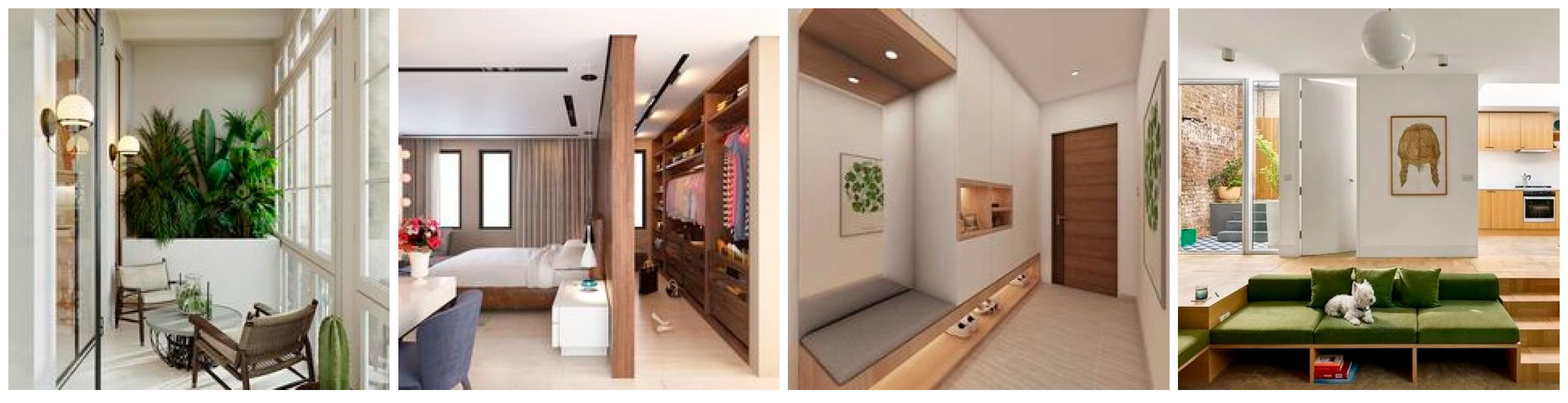
Figure 5 provides examples of representative interior design images used in this study. These images reflect contemporaneous residential design characteristics and visual trends commonly observed in recent interior design practices.
In this study, residential space images representing the new normal era were selected based on spatial structures and functional characteristics identified in previous studies on post-COVID-19 residential changes [
48,
49]. Rather than selecting images arbitrarily, we applied space-specific criteria reflecting newly emphasized residential functions.
Balcony images were selected to represent flexible and multifunctional structures that support diverse leisure and hobby-related activities, such as camping-style setups, indoor gardening, and home exercise, reflecting increased time spent on leisure activities within the home [
50,
51]. Entrance images were chosen based on their expanded spatial capacity to accommodate storage and management of hygiene-related items, delivery goods, outdoor clothing, and exercise equipment, highlighting their role as buffer zones between indoor and outdoor environments.
Bedroom images were selected when spatial separation or zoning elements were visually identifiable, reflecting the transformation of bedrooms into multifunctional spaces supporting sleeping, studying, and working activities. Living room images were chosen to represent high spatial flexibility and diversity, as these spaces increasingly accommodate overlapping functions such as work, learning, relaxation, communication, and dining, resulting in higher levels of spatial concentration and functional tension [
52].
4. Results
4.1. Deep Learning-Based Residential Space Image Analysis
This study applied an image-based deep learning model to classify residential space images according to three visual design attributes: openness and comfort, flexibility and diversity, and nature-friendliness. The trained model assigns normalized relative scores to each attribute based on visual features extracted from the images. These scores do not represent absolute physical measurements or intensities of spatial attributes; rather, they indicate the relative visual prominence of each attribute within a given image and enable comparative analysis across space types and time periods.
For example, in one living room image, the model assigned relative scores of 0.56 for openness and comfort, 0.15 for flexibility and diversity, and 0.32 for nature-friendliness, reflecting the comparative emphasis of these attributes in the visual composition of the space.
Table 2 presents representative results for selected residential space images from the pre- and post-pandemic periods.
4.1.1. Pre-Pandemic Era
In the pre-pandemic era, balcony images generally exhibited a combination of openness and comfort and flexibility and diversity, with relatively higher visual emphasis on flexibility and diversity. Bedroom images showed notable levels of openness and comfort and flexibility and diversity, while nature-friendliness appeared at low levels. This limited presence of nature-related attributes may be associated with the occasional inclusion of decorative elements such as plants or green-toned interior finishes rather than explicit nature-oriented design features.
Entrance images displayed patterns similar to those of bedrooms, characterized primarily by openness and comfort and flexibility and diversity, with minimal visual indicators of nature-friendliness. Living room images were dominated by openness and comfort, accompanied by moderate levels of nature-friendliness, while flexibility and diversity were visually less prominent. Overall, residential spaces in the pre-pandemic era tended to emphasize spatial openness and comfort, with limited incorporation of multifunctional or nature-oriented elements.
4.1.2. Post-Pandemic Era
In the post-pandemic era, balcony images showed a pronounced increase in nature-friendliness, alongside sustained levels of openness and comfort. This shift suggests a stronger visual emphasis on incorporating natural elements into balcony spaces compared to the pre-pandemic period. Bedroom images demonstrated a substantial increase in flexibility and diversity, indicating a growing visual representation of multifunctional use, while nature-friendliness remained minimal. Openness and comfort were present at moderate levels.
Entrance images exhibited a marked increase in flexibility and diversity, accompanied by a slight reduction in openness and comfort, reflecting a visual shift toward multifunctional and task-oriented spatial configurations. Living room images displayed a more balanced combination of openness and comfort and flexibility and diversity, with a limited number of images showing relatively high levels of nature-friendliness. Collectively, these patterns indicate that residential spaces in the post-pandemic era visually emphasize multifunctionality and selective integration of nature-related elements, particularly in semi-outdoor spaces such as balconies.
4.2. Pre- and Post-Pandemic Changes in Residential Design
The CNN-based image analysis revealed differentiated changes in residential space characteristics between the pre-pandemic and post-pandemic periods (
Table 3). Balcony spaces showed increased visual representations of openness, comfort, and nature-related elements, indicating a growing emphasis on environmental qualities such as daylight, ventilation, and greenery in post-pandemic images. Bedrooms and entrance areas exhibited marked increases in spatial flexibility and diversity, reflecting their frequent depiction as multifunctional spaces accommodating work, study, storage, and hygiene-related activities. In contrast, openness and comfort decreased in bedrooms and entrance spaces, suggesting a shift toward more enclosed and function-oriented spatial representations. Living rooms showed relatively moderate average changes but displayed increased variability across all evaluated criteria, indicating heterogeneous spatial configurations rather than a uniform design trend. Overall, the comparative results summarized in
Table 3 suggest that post-pandemic residential images reflect a redistribution of spatial attributes across domestic spaces, characterized by functional differentiation and diversified visual expressions.
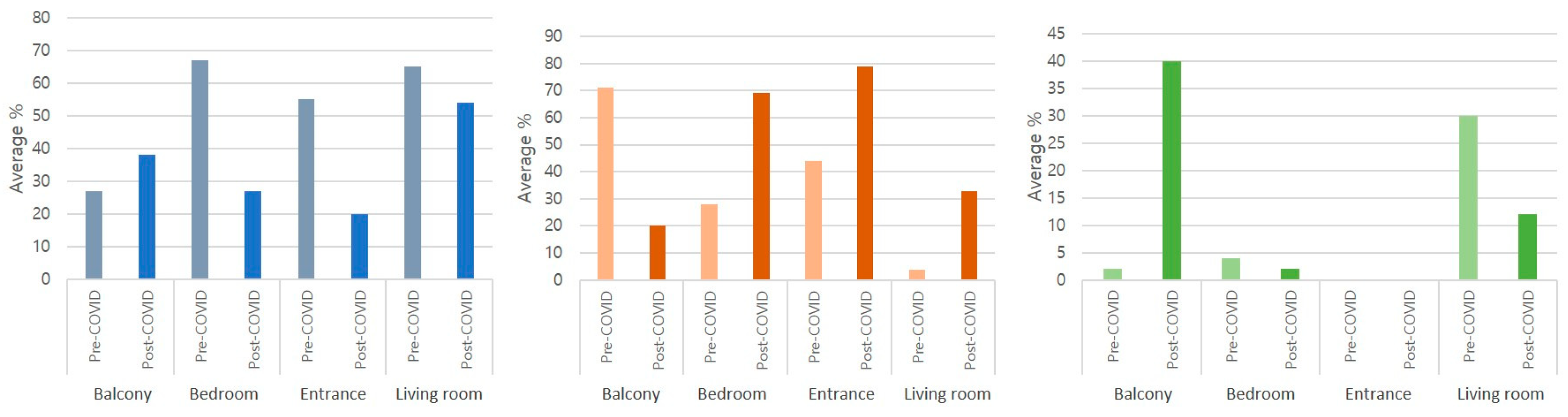
The deep learning-based image comparison revealed that residential spaces in the post-pandemic era exhibit distinct shifts in functional emphasis (see
Table 3 and
Figure 6). As visualized in
Figure 6, balconies show increased openness and nature-related attributes, whereas bedrooms and entrance spaces tend to appear more enclosed and task-oriented. Flexibility and diversity increased notably in bedrooms, entrances, and living rooms, reflecting the growing demand for multifunctional residential spaces. In contrast, nature-friendliness increased primarily in balconies, indicating a spatially concentrated expression of nature-oriented design responses.
Figure 6 provides a side-by-side visualization of the model-predicted attributes, supporting the quantitative comparisons reported in
Table 3.
4.2.1. Changes in Spatial Openness and Comfort
The analysis revealed differentiated changes in openness and comfort across residential spaces between the pre- and post-pandemic periods. Balcony spaces showed an increase in predicted openness and comfort from 0.27 to 0.38 (40.7%), accompanied by a decrease in standard deviation from 0.22 to 0.17. This pattern indicates a relatively consistent shift in how balcony spaces were visually represented in post-pandemic images. The results suggest that balconies were increasingly depicted as spaces emphasizing environmental qualities such as daylight, ventilation, outdoor views, and limited natural elements, which became more salient under prolonged indoor living conditions.
In contrast, bedroom spaces exhibited a substantial decline in openness and comfort, decreasing from 0.67 to 0.27 (59.7%), with a slight reduction in standard deviation (0.12 → 0.08). This shift reflects a change in the visual characteristics of bedrooms, where enclosed layouts and function-oriented arrangements were more frequently observed in post-pandemic images. The results suggest that bedrooms were increasingly represented as spaces accommodating work, study, and other task-oriented activities, where spatial enclosure and functional efficiency were visually emphasized.
Entrance spaces also showed a marked decrease in openness and comfort, from 0.55 to 0.20 (63.6%), with reduced variability (SD: 0.15 → 0.11). This trend indicates a shift in the visual portrayal of entrances toward more defined and enclosed configurations, consistent with their depiction as buffer zones separating interior and exterior spaces.
Living rooms exhibited a relatively moderate decline in openness and comfort (0.65 → 0.54, 16.9%). However, the standard deviation increased substantially from 0.10 to 0.26, indicating greater variability in how openness and comfort were visually expressed across different living room images in the post-pandemic period. This suggests heterogeneous spatial representations rather than a uniform directional change.
4.2.2. Changes in Spatial Flexibility and Diversity
Changes in spatial flexibility and diversity exhibited a pattern distinct from that observed for openness and comfort. Bedroom spaces showed a pronounced increase in flexibility and diversity, rising from 0.28 to 0.69 (146.4%), while the standard deviation decreased (0.15 → 0.08). This pattern indicates a consistent increase in the visual depiction of bedrooms as spaces accommodating multiple functions, such as work, study, and leisure activities.
Entrance spaces also demonstrated an increase in flexibility and diversity, from 0.44 to 0.79 (79.5%), with a slight decrease in variability (SD: 0.15 → 0.12). Post-pandemic images frequently depicted entrance areas with storage systems, partitioning elements, and functional furnishings, suggesting an expansion of their visually identifiable roles beyond simple circulation.
Living rooms showed a notable numerical increase in flexibility and diversity from 0.04 to 0.33, accompanied by an increase in standard deviation (0.03 → 0.16). This indicates that while flexibility-related features appeared more frequently in living room images, the degree and manner of their visual expression varied considerably across cases.
In contrast, balconies exhibited a decrease in flexibility and diversity from 0.71 to 0.20 (71.8%), with reduced variability (SD: 0.22 → 0.14). This suggests that post-pandemic balcony images tended to emphasize a narrower range of visually identifiable uses, such as seating or small-scale gardening, rather than multifunctional spatial configurations.
4.2.3. Changes in Spatial Nature-Friendliness
Among all spatial types, balcony spaces showed the most pronounced change in nature-friendliness. The predicted nature-friendliness score increased from 0.02 in the pre-pandemic period to 0.40 in the post-pandemic period, representing the largest absolute increase observed in this study. This change indicates a substantial rise in the visual presence of nature-related elements, including plants, greenery, and outdoor-oriented furnishings, in post-pandemic balcony images.
The accompanying increase in standard deviation (0.04 → 0.24) suggests considerable variability in how nature-related elements were incorporated into balcony spaces. Rather than indicating a uniform design response, this pattern reflects heterogeneous visual expressions across different residential contexts.
In contrast, indoor spaces generally exhibited declining trends in nature-friendliness. Living rooms showed a decrease from 0.30 to 0.12 (SD: 0.08 → 0.24), while bedrooms declined from 0.04 to 0.02 (SD: 0.06 → 0.02). These results indicate that visually identifiable natural elements appeared less frequently in indoor spaces within post-pandemic images, where functional and hygiene-related design features were more prominently represented.
4.3. Expert Evaluation and Methodological Supplementation
To validate the results of deep learning-based image analysis, five architecture and interior design experts with over 10 years of experience conducted expert evaluations focusing on images of the post-pandemic residential space designs. This was used as a cross-validation process to complement the limitations of machine learning-based analysis and assess the consistency between the experts’ intuitive judgments and quantitative analysis results. The experts were asked to rate the proportion of each characteristic of each space as a percentage using the same evaluation criteria used in the deep learning analysis (openness and comfort, flexibility and diversity, and nature-friendliness). This approach allowed for verification of the alignment between the directional changes in residential space characteristics identified through deep learning and expert perceptions (
Table 4).
Expert evaluations generally corroborated the deep learning findings. Balconies were rated highest in openness and comfort (52%), aligning with the observed increase in openness (0.27 → 0.38), and were recognized as key pleasant spaces in the post-pandemic era. Bedrooms received the highest score for spatial flexibility and diversity (56%), strongly supporting the sharp rise identified in the analysis (0.28 → 0.69), with experts agreeing that bedrooms have evolved into multifunctional spaces. Entrance areas were also consistently evaluated (43%), reinforcing their recognition as multifunctional zones for disinfection, parcel reception, and buffering. Finally, balconies received the highest rating for nature-friendliness (50%), confirming the deep learning results (0.02 → 0.40) and highlighting their transformation into core spaces integrating indoor gardens, natural lighting, and ventilation.
However, while the expert evaluation indicated a relatively high level of nature-friendliness in living rooms (44%), the deep learning analysis showed a decline in this aspect (0.30 → 0.12). This discrepancy suggests a gap between perception and actual implementation. Experts recognize that living rooms in the post-pandemic era should be designed with nature-friendly elements, yet in practice, such features appear to be limited due to multifunctional requirements and hygiene concerns.
These results do not simply reiterate existing professional knowledge but rather clarify the relationship between expert perceptions and actual design implementation. While experts consistently recognized the importance of openness, flexibility, and nature-friendliness in post-pandemic housing, the image-based deep learning analysis revealed how unevenly these elements are realized across different residential spaces.
For example, although experts rated living rooms as highly nature-friendly, the visual analysis showed a notable decline in nature-related elements in practice. This discrepancy highlights a gap between design intention and real-world application. By quantifying such gaps and identifying which spatial attributes are consistently implemented versus aspirational, this study provides evidence-based guidance that complements professional expertise and supports more targeted and realistic residential design strategies.
4.4. Comprehensive Interpretation of Spatial Change Patterns
Synthesizing the results, the pandemic has generated two contrasting phenomena in residential spaces: functional specialization and multifunctionality. Balconies have been specialized as well-being spaces emphasizing comfort and nature-friendliness, while bedrooms and living rooms have evolved into multifunctional areas accommodating diverse activities.
These changes signify a reconfiguration of spatial hierarchy. The balcony, traditionally regarded as an auxiliary space, has emerged as a core living area, whereas primary living spaces such as bedrooms and living rooms have been redefined as flexible spaces that shift functions depending on circumstances.
Furthermore, variations in standard deviation highlight the growing prevalence of personalized space use. In particular, the substantial increases observed in balconies (SD: 0.04 → 0.24) and living rooms (SD: 0.03 → 0.16; 0.08 → 0.24) indicate that even within the same spatial type, utilization differs considerably according to residents’ needs and preferences.
5. Conclusions
This study investigated changes in residential spatial characteristics before and after the COVID-19 pandemic by applying a deep learning-based image analysis framework and expert evaluation. By quantitatively comparing spatial attributes across different residential spaces, the study aimed to identify how the post-pandemic context has influenced residential space design and usage patterns.
Rather than positioning deep learning as the primary contribution, this study demonstrates how an image-based analytical tool can support empirical investigation of residential design transformation in response to societal disruption.
The results reveal that spatial transformations in the post-pandemic era are not uniformly distributed across all residential spaces, but are instead concentrated in specific areas such as balconies, bedrooms, and entrance spaces. Among these, balconies exhibited the most pronounced changes across multiple dimensions, including openness, comfort, and nature-friendliness. Rather than reflecting a single standardized design trend, these changes suggest a diversification of balcony usage, responding to increased time spent at home and limitations on outdoor activities. The increased variation observed in nature-related attributes further indicates that residents adopt different strategies depending on spatial conditions and lifestyles. Bedrooms demonstrated a notable increase in spatial flexibility and diversity, supporting the interpretation that they have evolved beyond traditional sleeping functions into multifunctional spaces accommodating work, rest, and leisure. Entrance areas also showed consistent changes, reflecting their emerging role as buffer zones that mediate hygiene, circulation, and transitional activities in response to pandemic-related concerns. In contrast, living rooms and other indoor spaces exhibited relatively modest or even declining changes in nature-related attributes, suggesting that functional efficiency and hygiene considerations may have constrained the incorporation of nature-oriented elements indoors.
Expert evaluations largely supported the deep learning results, particularly regarding the increased multifunctionality of bedrooms and the enhanced nature-friendliness of balconies. However, discrepancies were observed in the assessment of living rooms, where experts expressed higher expectations for nature-oriented design than were reflected in the image-based analysis. This divergence highlights the value of combining computational analysis with expert judgment, as it allows for the identification of gaps between design intentions, professional expectations, and realized spatial configurations.
It is acknowledged that images shared on social media platforms tend to be visually curated and may emphasize aspirational aesthetics rather than everyday functional realities. Accordingly, this study does not interpret social media images as direct representations of daily residential use. Instead, they are understood as visual artifacts that reflect socially shared design intentions, aspirations, and normative expectations of residential spaces at a given time. In this sense, the dataset captures emerging design ideals that influence how residential spaces are planned, renovated, and represented, which constitute a critical dimension of residential design trends in the post-pandemic era.
Several limitations should be noted. First, the analysis is based on visual data and does not directly capture residents’ subjective experiences or actual behavioral patterns within residential spaces. Second, cultural and regional factors were not explicitly modeled, which may limit the generalizability of the findings across different housing contexts. Future studies could address these limitations by integrating image-based deep learning with surveys, interviews, behavioral data, or cross-cultural comparisons to further validate the relationship between visual design trends and lived residential experiences. Third, while social media-based image data enables large-scale and timely analysis of housing design trends, reliance on platforms like Instagram and Pinterest can lead to selection bias, as images tend to reflect visually appealing or curated images rather than everyday living environments. Future research could expand data sources to include other design platforms or validate image-based analyses with survey or interview data to enhance their validity.
Despite these limitations, this study demonstrates the potential of deep learning–based image analysis as a complementary methodological tool in residential design research. By quantitatively structuring widely observed yet often intuitively discussed design changes, the findings provide empirical evidence of how residential spaces adapt under societal disruptions. The results offer practical insights for architects, designers, and housing planners seeking to develop adaptable and resilient residential environments in response to future public health crises and lifestyle transformations.
While this study does not directly propose regulatory or engineering parameters such as Floor Area Ratios (FAR), zoning codes, or HVAC system specifications, the findings provide quantitative spatial evidence that can inform such technical discussions. For example, the increased functional significance of balconies and entrance areas as buffer zones suggests a need to reconsider their spatial allocation, environmental control, and infrastructural support in future housing guidelines. The data-driven identification of space-specific functional shifts offers a foundation upon which architectural regulations, building services planning, and environmental control strategies may be further developed in interdisciplinary research.