Article

Study on Mix Proportion Optimization and Multi-Scale Mechanism of High-Volume Aeolian Sand Cement-Fly Ash Stabilized Gravel Base

1
College of Civil Engineering and Architecture, Xinjiang University, Urumqi 830047, China
2
Xinjiang Transportation Planning, Survey and Design Institute Co., Ltd., Urumqi 830006, China
3
Xinjiang Key Laboratory for Safety and Health of Transportation Infrastructure in Alpine and High-Altitude Mountainous Areas, Urumqi 830006, China
4
School of Civil Engineering, Anhui Jianzhu University, Hefei 230031, China
5
Xinjiang Academy of Transportation Science, Co., Ltd., Urumqi 830011, China
*
Author to whom correspondence should be addressed.
Buildings 2026, 16(3), 590; https://doi.org/10.3390/buildings16030590 (registering DOI)
Submission received: 6 January 2026 / Revised: 23 January 2026 / Accepted: 27 January 2026 / Published: 31 January 2026

Abstract

Aeolian sand is abundant in arid deserts, but its high replacement in cement-stabilized bases can reduce strength and raise cracking risk. Strain localization and crack evolution are also poorly quantified. This study aimed to optimize the early age performance of cement-fly ash stabilized aeolian sand gravel (CFSAG) and clarify its failure mechanism. A Box–Behnken response surface methodology varied the cement content, cement-to-fly ash ratio, coarse aggregate gradation, and aeolian sand content. The 7-d unconfined compressive strength (UCS) and splitting tensile strength (STS) were tested. Digital image correlation (DIC) recorded full-field strains and crack metrics in compression and splitting. SEM–EDS was used to interpret microstructural changes. The aeolian sand content dominated UCS, whereas the cement content and cement-to-fly ash ratio mainly controlled STS. Factor interactions were non-negligible and supported the joint optimization of the two strength indices. DIC identified a crack propagation threshold near 0.9 Pmax in splitting. Excess aeolian sand (>50%) caused earlier localization, more cracks, and wider openings. In the appropriate amount of aeolian sand mixtures, hydration products filled voids and improved paste continuity. SEM–EDS indicated that excessive fines increased porosity and weakened the interfacial transition zone. Overall, the combined RSM–DIC–SEM approach links mix design with deformation and microstructure evidence. It provides practical guidance to balance strength and cracking resistance at early ages for cement-stabilized bases in desert highway engineering.

1. Introduction

With the advancement of the Belt and Road Initiative, highway construction in desertification regions of China has expanded rapidly. Traditional cement-stabilized gravel base faces two major problems in arid deserts. One is the severe scarcity of high-quality gravel aggregate, leading to increased transportation costs [1]. Another is the high cement content, which tends to induce arching deformation and cracking [2,3], resulting in higher maintenance costs. Therefore, how to address these issues is important for desert highway construction.
Aeolian sand is widely distributed in desert regions. Its engineering utilization has gradually been regarded as an important way to address resource shortages. Khan [4] first demonstrated the feasibility of utilizing aeolian sand in pavement base construction and recommended cement stabilization. However, cement as a single stabilizer requires a high dosage [5,6], which easily causes distresses. The incorporation of fly ash can reduce cement consumption through its pozzolanic effect and can improve performance [7]. Previous studies by the authors have confirmed that a semi-rigid base prepared with cement, fly ash, aeolian sand, and gravel was feasible [8,9]. Nonetheless, existing studies mainly focus on a single or few factors, such as binder systems or aeolian sand content. The influence of aggregate gradation has not been fully considered. As a base material, gradation is also a key factor influencing strength and long-term durability [10,11,12]. Optimization of gradation improves the aggregate packing density, thereby reducing the cement content [13]. Therefore, a clear gap exists in the current research. Systematic studies examining the complex interactions among multiple factors are lacking. Meanwhile traditional mechanical methods also fail to capture full-field strain and crack evolution. As a result, our understanding of failure mechanisms is limited.
To address the above research gap, a response surface methodology (RSM) was introduced for an in-depth investigation. RSM is a statistical optimization method that establishes a global, approximate relationship between factors and responses by testing and analyzing representative local design points [14]. Through regression modeling, nonlinear relationships are characterized and the independent and interactive effects of factors on responses are quantified. Optimal factor levels can thus be identified [15]. Compared with conventional single-factor optimization, RSM achieves process optimization with fewer tests. The experimental cost and workload are therefore reduced substantially [16]. In recent years, RSM has been widely applied in materials engineering. It has matured into an efficient tool for experimental optimization [17,18].
Digital image correlation (DIC) is a non-contact optical technique that reconstructs full-field displacement and strain by correlating sequential images of a stochastic speckle pattern on the specimen surface. In a typical DIC workflow, a high-contrast random speckle pattern is applied to the specimen surface. Images are continuously acquired during loading, and subset-based correlation provides displacement fields. Strain maps and strain-localization features can be derived from these fields. These full-field measurements enable the quantitative identification of crack initiation, stable propagation, and crack-opening evolution. Recent studies on quasi-brittle cementitious materials have shown that DIC can reveal early stage microcracks and provide deformation/crack metrics that are consistent with experimental observations and analytical predictions [19,20,21]. However, the strain distribution and crack evolution of cement-stabilized base-course materials remain insufficiently documented in the DIC literature. In particular, quantitative criteria for pinpointing strain localization and describing crack development from initiation to propagation under compressive and splitting loading are still poorly established.
This study addresses the above gaps by proposing an integrated macro–meso–micro framework for the performance optimization and mechanism interpretation of cement-fly ash stabilized aeolian sand gravel (CFSAG) base materials. First, a response surface methodology (RSM) is adopted to systematically design experiments and to quantify the coupled effects of multiple mixture factors. Particular attention is paid to aggregate gradation and factor interactions, which are often overlooked in existing studies. Second, DIC is introduced to capture full-field deformation and strain localization during compressive and splitting failures, providing a direct basis for interpreting crack initiation and subsequent propagation. Finally, SEM and XRD are employed to link macroscopic responses and meso-scale deformation features with microstructural characteristics and phase evolution. Overall, the proposed multi-scale methodology offers a more comprehensive understanding of failure mechanisms and supports rational mix design for desert highway base courses.

2. Materials and Methods

2.1. Materials

The cement used in this study was P.O 42.5 ordinary Portland cement, produced by Tianshan Cement Co., Ltd., Urumqi, Xinjiang, China. The initial and final setting times were 270 min and 448 min, respectively, and the 28 d compressive strength was 49.7 MPa. The fly ash was Class F, Grade II, obtained from the power plant of Xinjiang Tianlong Mining Co., Changji, Xinjiang, China. It had a loss on ignition of 2.0% and a specific surface area of 3056 cm2·g−1. The total content of SiO2, Al2O3, and Fe2O3 was 80.8%. All properties met the technical requirements. The coarse aggregate (4.75–31.5 mm) was natural gravel, and its properties are listed in Table 1.
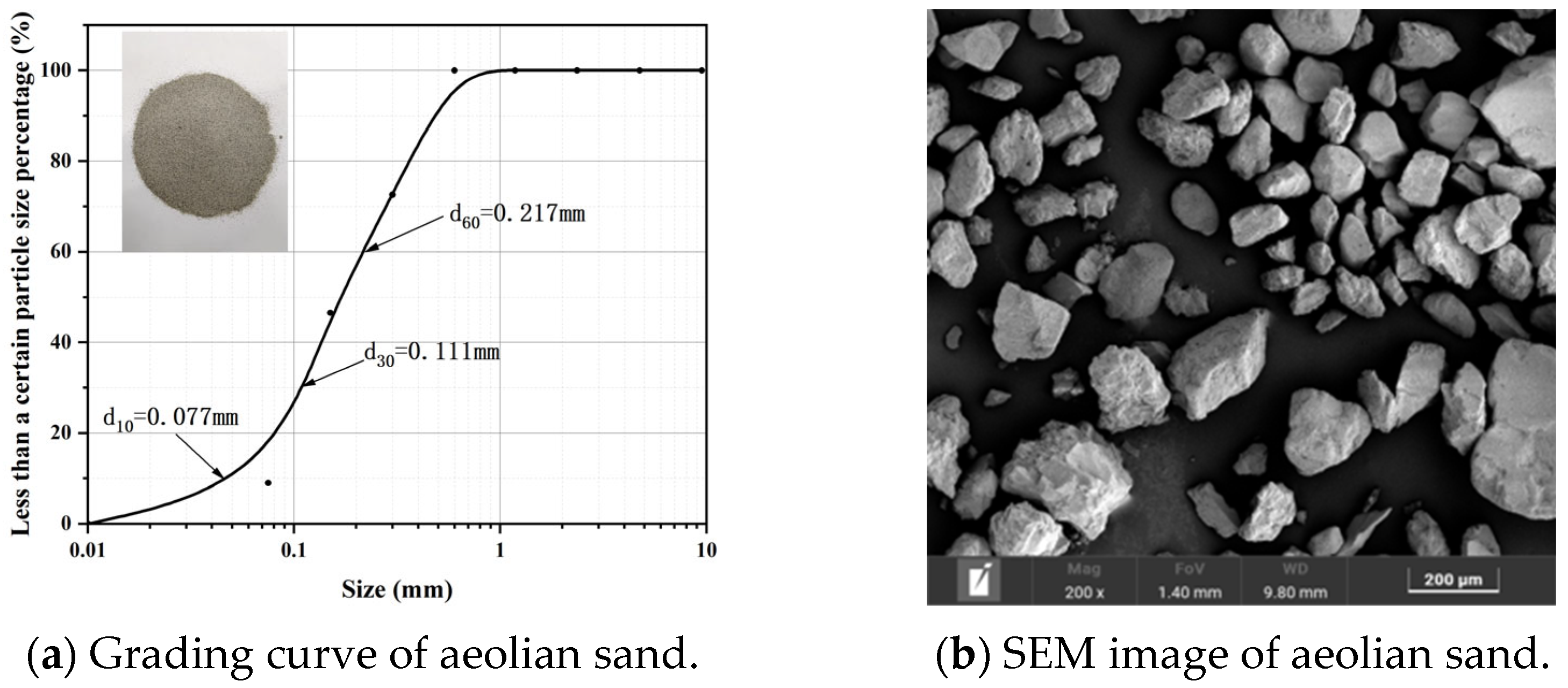
The aeolian sand was collected from the Taklamakan Desert. It appeared gray-brown, with an apparent density of 2.687 g·cm−3 and a mud content of 2.79%. The gradation curve is shown in Figure 1a. Most particles were 0.075–0.6 mm, accounting for 91% of the total. The coefficient of non-uniformity (Cu) was calculated as 2.84, indicating poorly graded sand. The SEM micrograph of the aeolian sand is also provided in Figure 1b. It exhibits an irregular, angular morphology with pronounced edges and corners.

2.2. Methods

2.2.1. Overall Procedure

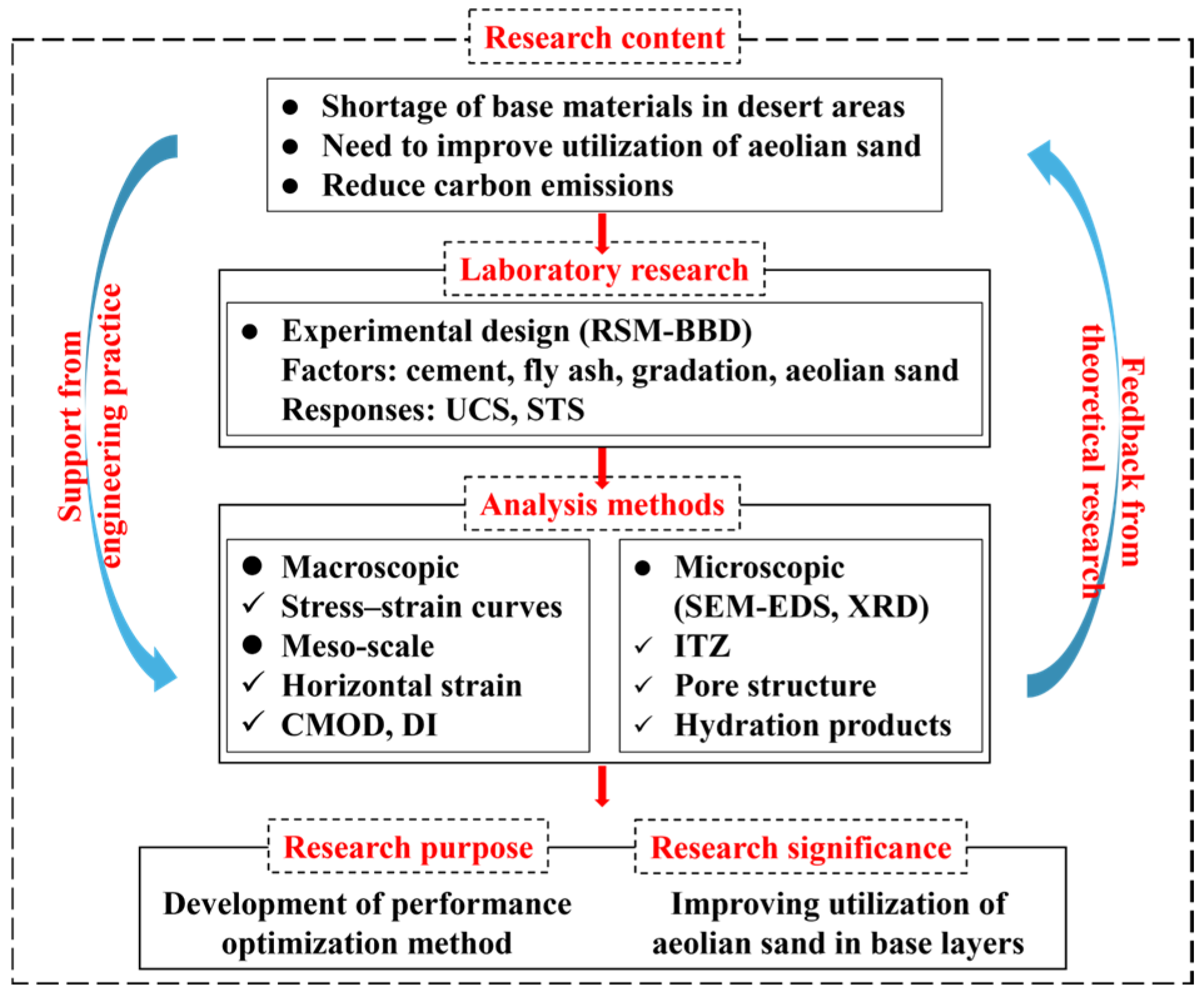
This study aimed to optimize the performance of the CFSAG system. Three tasks were carried out in sequence. First, a response surface methodology (RSM) was used for the experimental design and model construction. Key factors and their interactions were then identified. Second, DIC was employed to capture displacement and strain evolution during failure. The relation between crack development and aeolian sand content was revealed. Finally, SEM and XRD tests were applied to analyze the microstructure and composition of the material. A multi-scale study was carried out, integrating macroscopic performance, meso-scale failure mechanisms, and microscopic characterization. A scientific basis is thereby provided for the rational use of aeolian sand in base materials in arid desert regions. Figure 2 shows the research procedure of this work.

2.2.2. Mechanical Properties Test

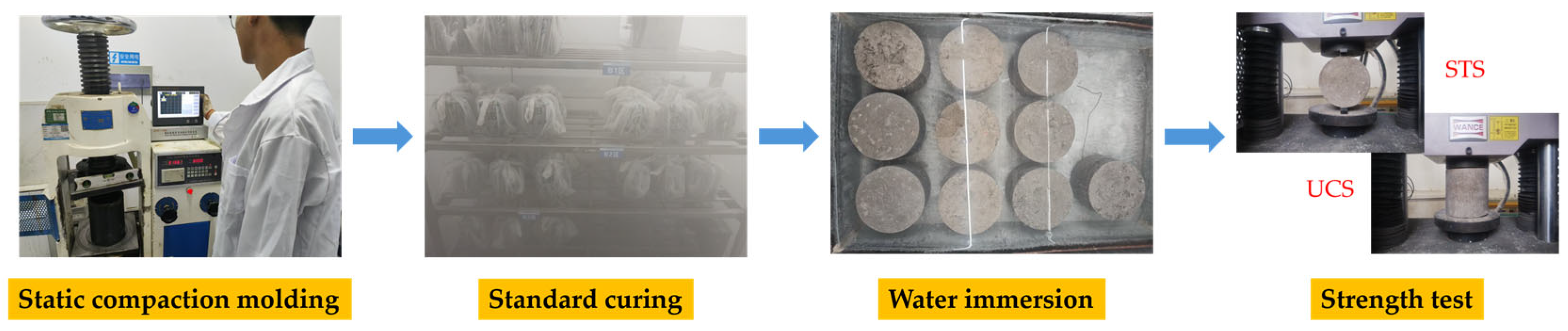
The specimen preparation followed the testing code: JTG E51—2009 [22]. Cylindrical specimens with a size of Φ150 mm × 150 mm were prepared by the static compaction method at the optimum moisture content and maximum dry density determined from compaction tests. The specimens were cured for 7 d at 20 ± 2 °C and a relative humidity of >95%. One day before the end of curing, the specimens were immersed in water for 24 h. Finally, unconfined compressive strength (UCS) and splitting tensile strength (STS) tests were conducted using a HUT305A electro-hydraulic servo universal testing machine at a loading rate of 1 mm·min−1. For each mix proportion, three parallel specimens were fabricated. The main experimental steps are shown in Figure 3.

2.2.3. DIC Test

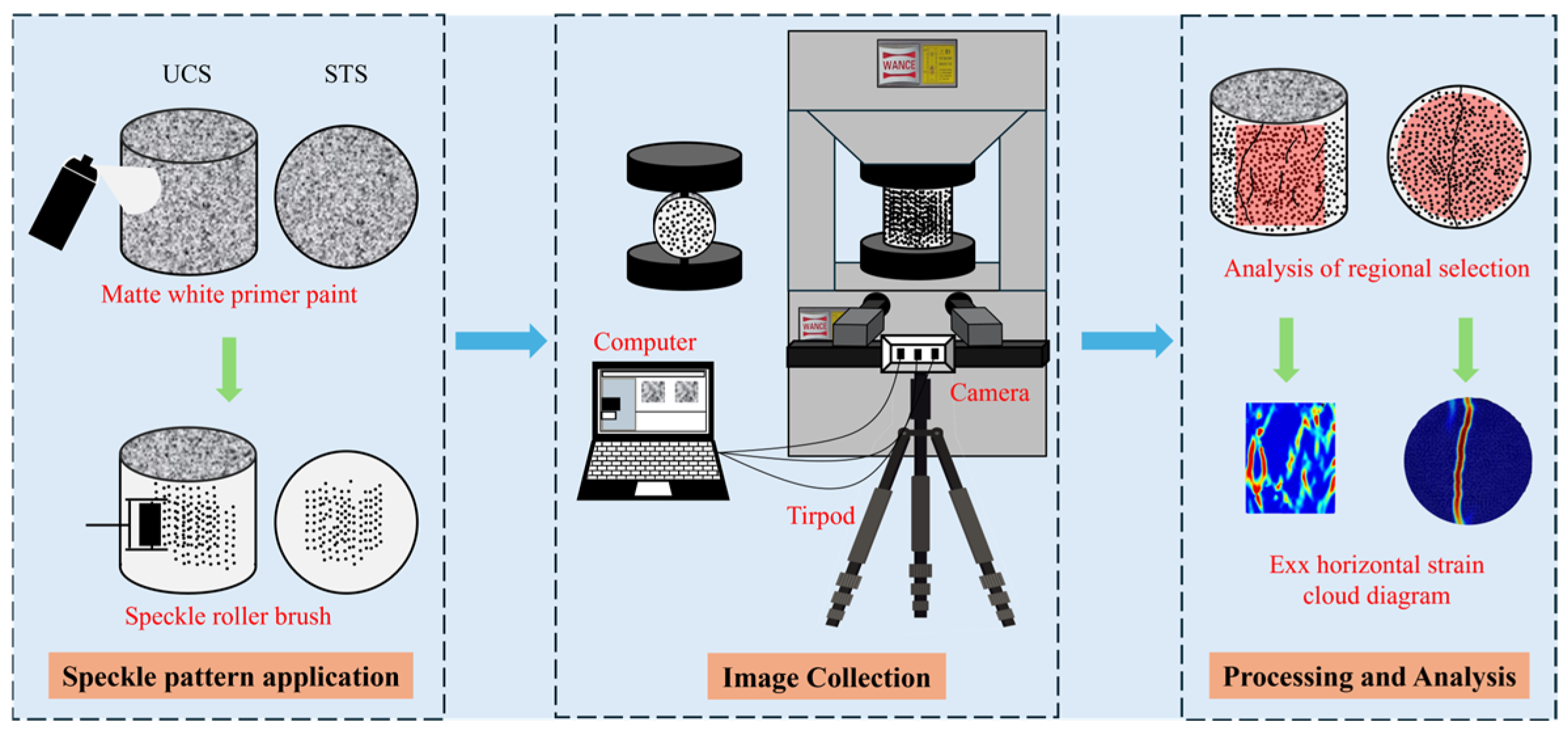
The digital image correlation (DIC) method was adopted to monitor and analyze the displacement and strain fields of cylindrical specimens during the deformation and failure. To reduce errors in crack capturing, a random white background with black speckles was sprayed on the specimen surface [23,24]. An industrial area scan camera A7A20MU201 (Revealer, Hefei, China) with a resolution of 12 megapixels was used for image acquisition. The curved surface observation in compression required two cameras, while the flat-surface observation in splitting required only one [25]. The acquisition frequency was set to 2 Hz. The commercial software, RDIC 1.28.7B, was applied for the three-dimensional correlation computing, while the open-source software, Ncorr V1.2, was employed for two-dimensional correlation computing. Following the recommendation of Schreier et al. [26], the step size was set to 1/4 of the subset size to improve the computational accuracy. According to the size of the observed region, the subset and step sizes were set to 47 and 12 for 3D calculations, and 23 and 6 for 2D calculations, respectively. The procedures of the DIC test are illustrated in Figure 4.

2.2.4. Microscopic Test

SEM was performed using a ZEISS SUPRA 55VP scanning electron microscope located in Urumqi, China. Core samples taken after mechanical testing were soaked in anhydrous ethanol to inhibit hydration and dried in an oven at 50 °C. Prior to imaging, they were sputter-coated with gold to improve conductivity. Observations were performed at 10 kV.
XRD was carried out using a Bruker D8 Advance diffractometer (Germany) located in Xi’an, China. A copper target was used as the X-ray source, operated at 40 kV and 40 mA. Measurements were performed in the θ/2θ scanning mode with a scanning rate of 2°/min over the range of 5–80°.
For each mixture, five specimens were examined. SEM–EDS scans were taken at 3–5 locations on each specimen. SEM images were taken at a high magnification focusing on the matrix/ITZ microstructure; thus, gravel particles were outside the field of view.

2.3. RSM-Based Mix Proportion Design

The materials used in this study included aggregates and binders. The maximum nominal diameter of the aggregates was 31.5 mm, with fine aggregates below 4.75 mm entirely replaced by aeolian sand. Therefore, the gradation optimization only considered the gradation of the coarse aggregate. The k-value method was adopted for gradation adjustment. Equations (1)–(3) are the corresponding theoretical expressions used to calculate the adjusted gradation parameters [27].
P x = 100 × ( 1 K x 1 K y 1 )
x = 3.32 lg ( D / d )
y = 3.32 lg ( D / 0.004 )
where, Px is the mass percentage of the aggregate passing the sieve with aperture dx (%); D is the maximum particle size (mm); d is the size of the particle to be calculated (mm).
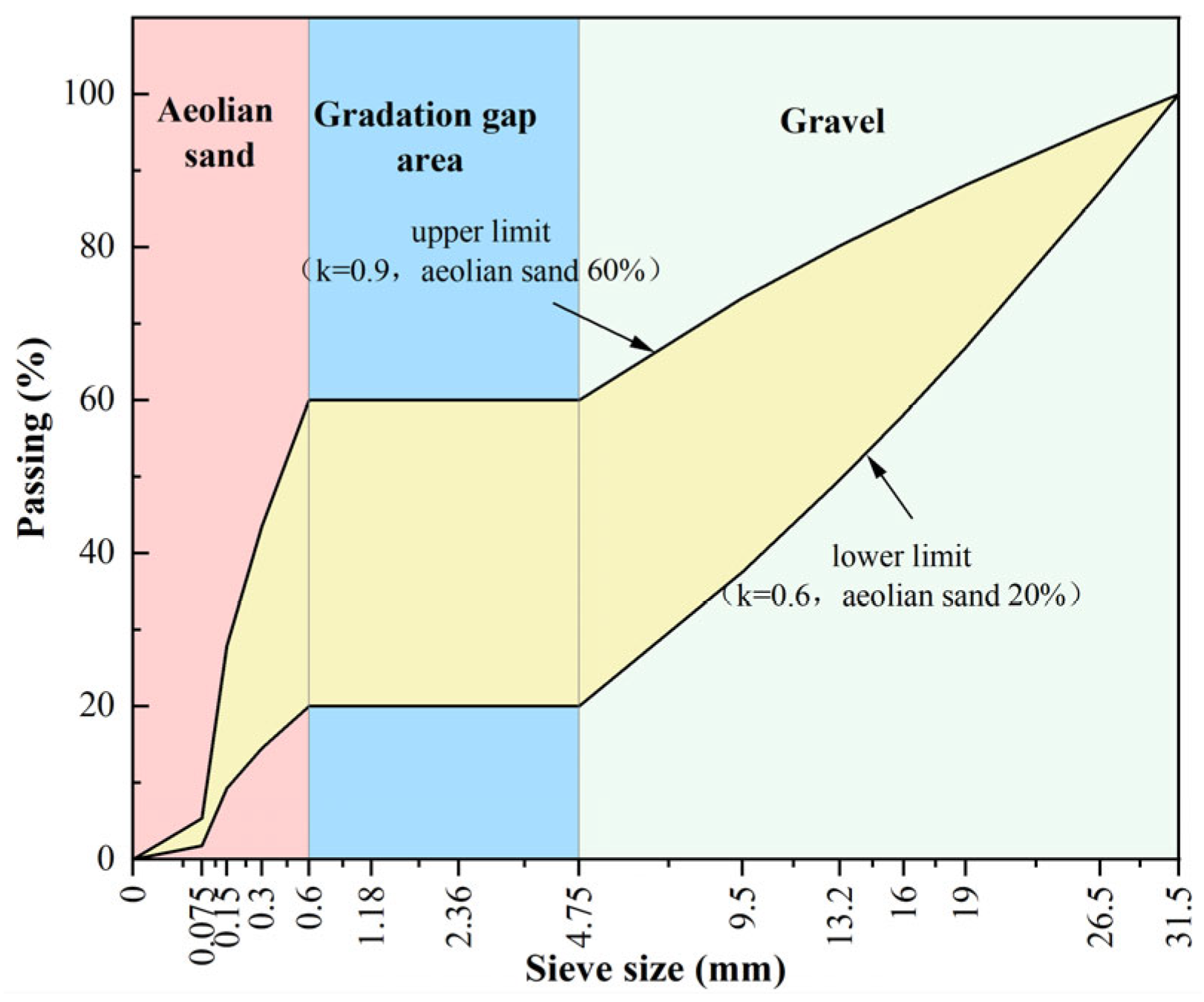
The Box–Behnken Design (BBD) in Design-Expert 12.0 was used for the experimental design, statistical analysis, data modeling, and parameter optimization. Following the previous studies of Liu et al. [8,9], the cement content (A), cement-to-fly ash ratio (B), k-value (C), and aeolian sand content (D) were taken as independent variables. The 7-d UCS and STS of the mixtures were selected as response values. Based on preliminary single-factor tests, the ranges were set as follows: cement content 2–4%, cement-to-fly ash ratio 1:2–1:5, k-value 0.6–0.9, and aeolian sand content 20–60%. Within these ranges, the 7-d UCS of the mixtures met most road design requirements [28]. The coding of the test factors is shown in Table 2. The synthetic gradation ranges are illustrated in Figure 5.
The quadratic multiple regression model established by fitting the experimental data was expressed in Equation (4) [29].
Y = β 0 + i = 1 n β i x i + i = 1 n β ii x i 2 + i = 1 n j > i n β ij x i x j + ε
where, Y is the predicted response; X is the independent variable; β is the regression coefficient; ε is the error of random.
To improve the reliability of testing and analysis, the central point was repeated five times during both stages. The test results were taken by an average value of three specimens. The detailed experimental matrix based on the response results is presented in Table 3. Based on the experimental results, modeling and optimization were conducted using the selected analytical model. Analysis of Variance (ANOVA) was used to evaluate the significance of each factor and the interactions of the response values in the selected regression model.

3. Analysis of Mix Proportion Optimization

3.1. ANOVA of the Predictive Models

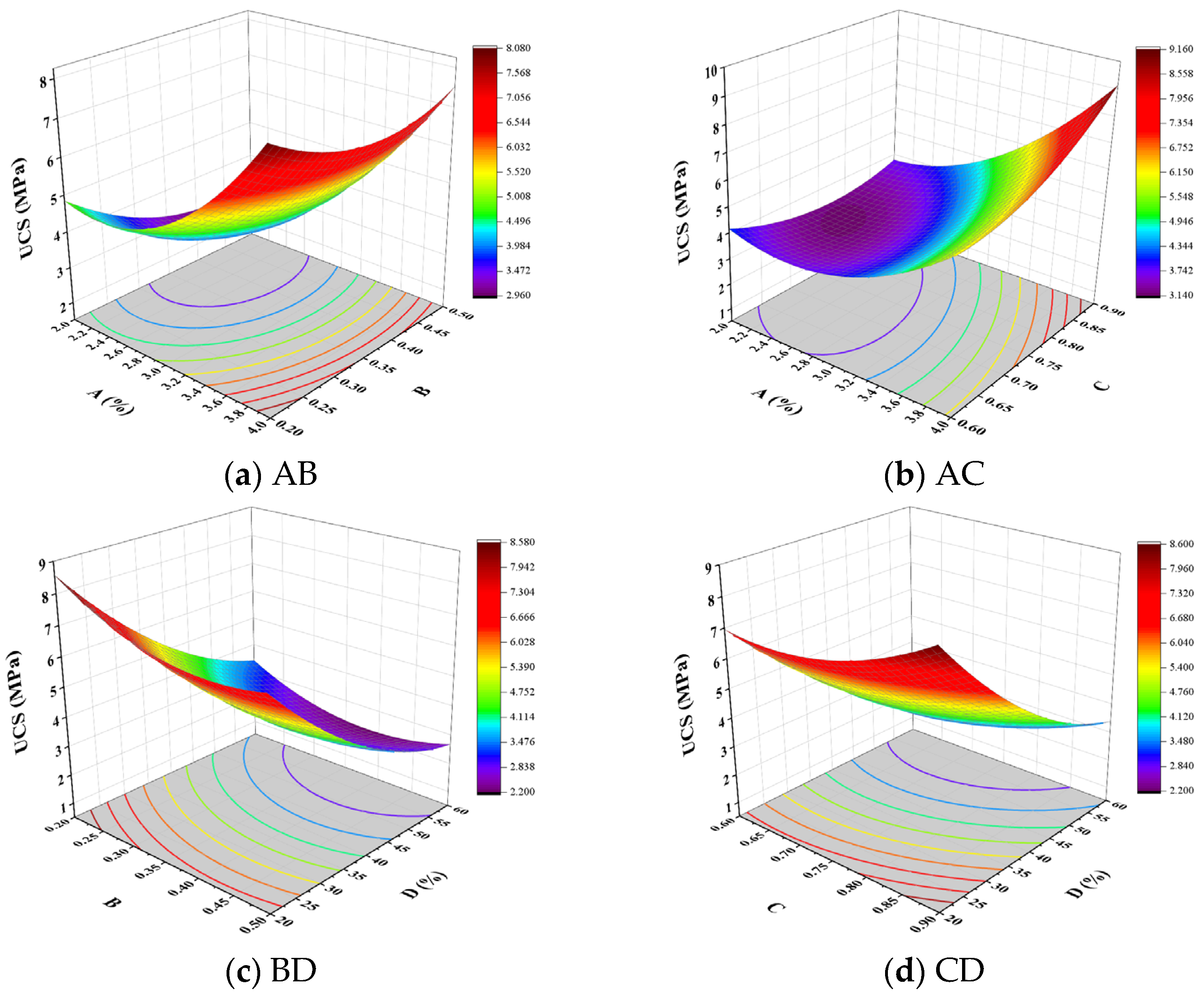
Table 4 shows the Analysis of Variance (ANOVA) results of the predictive models. The F-values of the two models were 347.32 and 91.76, and the p-values were both less than 0.05. This indicates that the models were highly significant at the 95% confidence level with a high fitting reliability. When the p-value is less than 0.0001, the factor is considered to have highly significant effects on the response [30]. It was found that changing A (cement content), B (cement-to-fly ash ratio), C (k-value), and D (aeolian sand content) individually had significant effects on the UCS of the mixtures. Changing A, B, and D had significant effects on STS. Comparison of F-values further showed that the order of influence on UCS was D > A > C > B, while that on STS was A > B > D > C. A non-significant LOF was obtained for both models, indicating a reliable description of the factor–response relationships.
Table 4 also indicates that some insignificant factors were included in the model. To improve the accuracy, model reduction was performed [30]. After removing the insignificant factors, the reduced response model equations were obtained, as shown in Equations (5) and (6). The positive and negative signs in the equations indicate the synergistic and antagonistic effects of the independent variables on the response values.
UCS = 3.84 + 1.89 A 0.5483 B + 0.61 C 2.41 D + 0.2775 AB + 0.8075 AC + 0.185 BD 0.205 CD + 1.29 A 2 + 0.7747 B 2 + 0.7072 C 2 + 0.8209 D 2
STS = 0.484 + 0.146 A 0.103 B 0.011 C 0.084 D 0.027 AD + 0.075 CD 0.118 D 2

3.2. Verification of the Prediction Model

Fit statistics of all responses are summarized in Table 5. The coefficients of determination (R2) of the two models were 0.9962 and 0.9683. After model reduction, the adjusted R2 (Adj-R2) decreased to 0.9933 and 0.9578, which were very close to R2, indicating good model fitting. The differences between Adj-R2 and predicted R2 (Pre-R2) were both less than 0.2, suggesting a high model accuracy and good predictive ability. In addition, the C.V.% was below 10%, and the adequate precision (AP) was greater than 4 for both response variables. All these results indicate that the models had sufficient signal strength and that the experimental data provided strong support to the models [31,32,33].
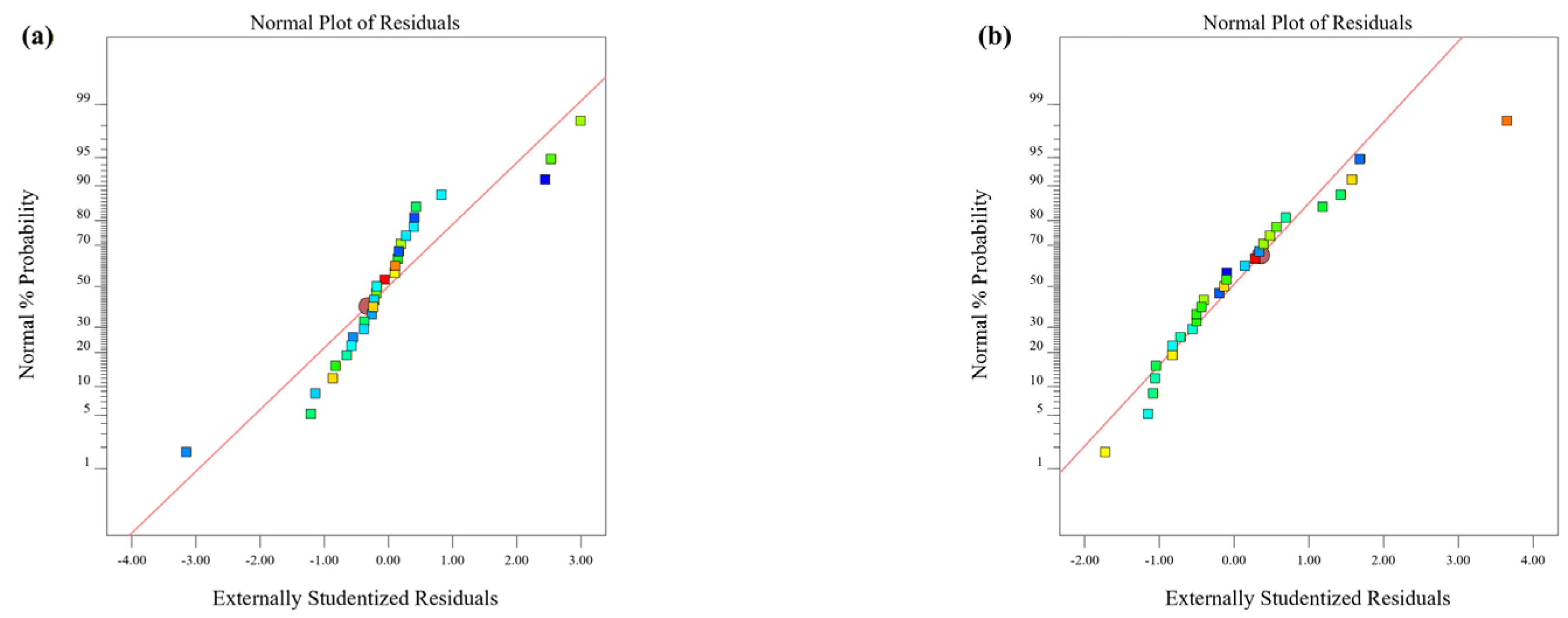
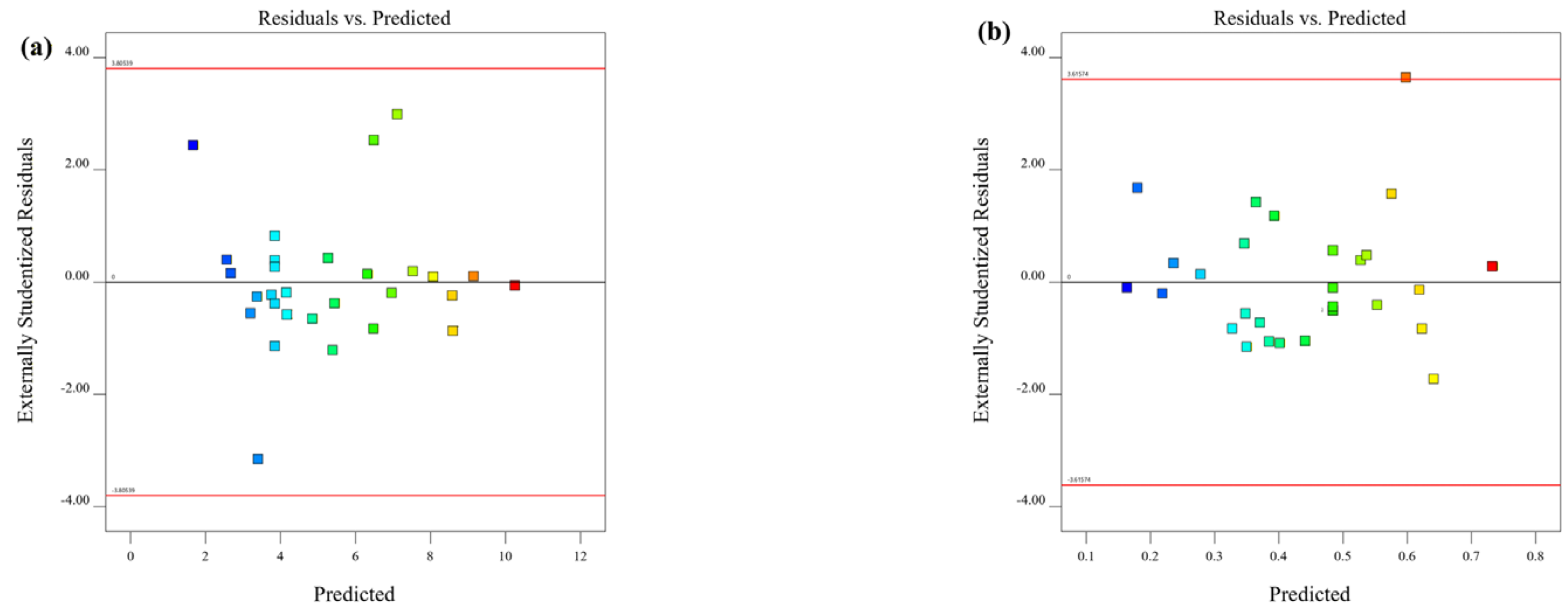
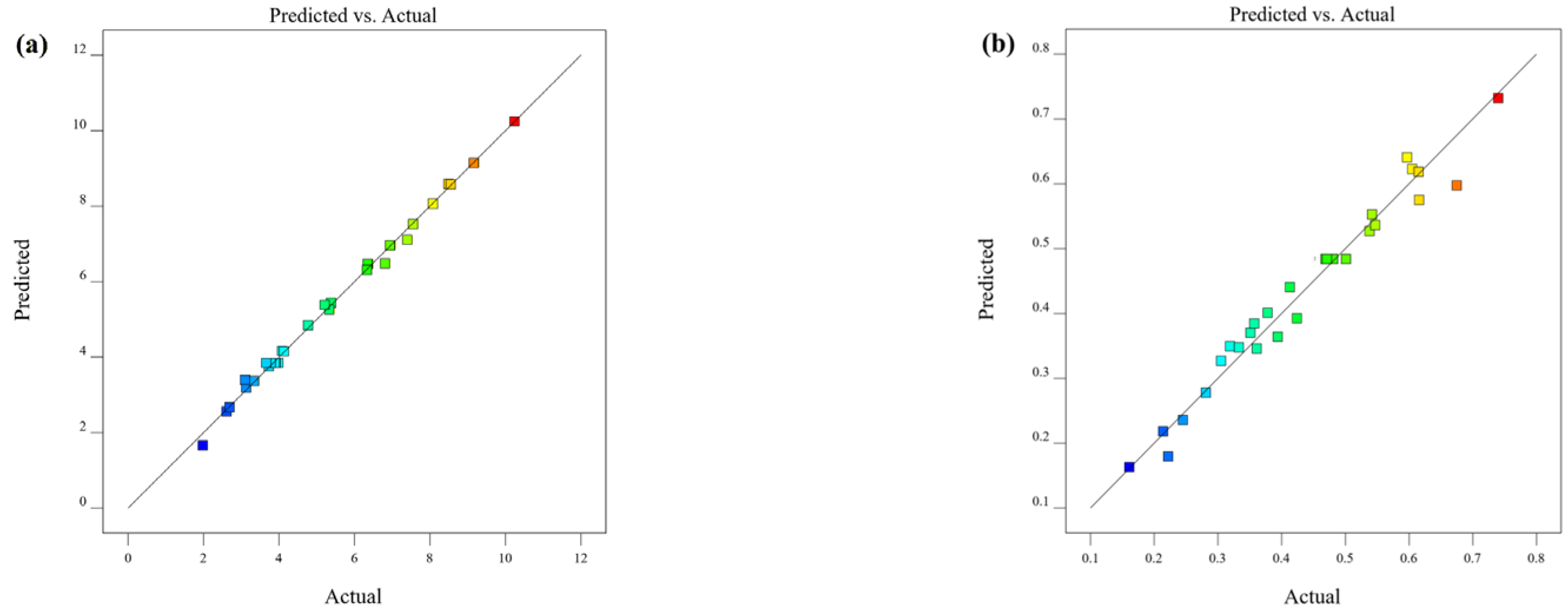
The quality of the models was further evaluated and the related assumptions were verified by analyzing diagnostic plots. The normal probability plot of residuals in Figure 6 shows that the residual points were approximately distributed along a straight line, confirming the assumption of the normality of errors. This indicates that the models could effectively predict UCS and STS within the target ranges. Figure 7 presents the plots of residuals and predicted responses. The data were irregularly distributed, and all standardized residuals were concentrated near the zero-residual line without obvious systematic bias. The reference line indicates that the residuals were centered near zero. Figure 8 shows the relationship between predicted and actual values. The data points were mostly distributed along the y = x line, and the remaining points were evenly scattered on both sides, further confirming the good fitting performance of the models.

3.3. Influences of Various Factors and Their Interaction on Responses

3.3.1. UCS

Figure 9 shows the 3D response surfaces of factor effects on UCS. Factor A had a clear positive effect, whereas C showed only a minor influence, with a minimum at 0.75. The interaction of AC was significant, while the AB, BD, and CD terms were negligible. For the CD interaction, UCS increased from 2 MPa to 7–8.5 MPa as D decreased from 60% to 20%. The contour plot’s color scale (purple–green–red) indicates increasing UCS [34]. The contour density further confirmed that the influence of D was much greater than that of C [35]. Overall, the order of factor importance on UCS was D > A > C > B, consistent with the findings of Liu et al. [9].
The above analysis indicates that, under single-factor effects, D was the key factor influencing the UCS of CFSAG. This dominant role mainly arose from the fundamental impact of the aeolian sand content on the aggregate gradation system. The effect of gradation variation on material strength originated from differences in the proportion of coarse and fine aggregates, which generated different interlocking forces [36]. The main source of UCS was the coarse aggregate skeleton. Voids between coarse particles were filled by fine aggregates, which reduced porosity and enhanced compactness [37]. Due to the small particle size and poor gradation of aeolian sand [38], the complete replacement of fine aggregates resulted in gap gradation (Figure 5). In addition, with a higher aeolian sand content, the relative amount of gravel gradually decreased. The weakening of the interlocking capacity hindered the formation of a strong skeleton, leading to a looser structure. Even with optimized coarse aggregate gradation, the compactness of the skeleton could not be fully restored. Excessive aeolian sand occupied too much space, preventing cementitious materials from fully coating aggregates and weakening the ITZ, which reduced bond strength, as discussed in detail in Section 4.2. Cement hydration products provided early strength, whereas the pozzolanic activity of fly ash relied on Ca(OH)2 from cement hydration and became effective only after more than 28 d [39]. Therefore, B primarily influenced long-term strength, and its contribution to early strength was weaker than that of the other factors.
The interaction between A and C had the most significant effect among all the interactions. C controlled the density and void ratio of the coarse aggregate skeleton, while A determined the amount of hydration products available to fill voids and bond aggregates. When C was optimized to form a dense skeleton, an appropriate cement content allowed hydration products to fully fill the voids, thereby maximizing strength. This suggests that, although D had a pronounced influence, strength could still be effectively improved by optimizing coarse aggregate gradation and adjusting the cement content.

3.3.2. STS

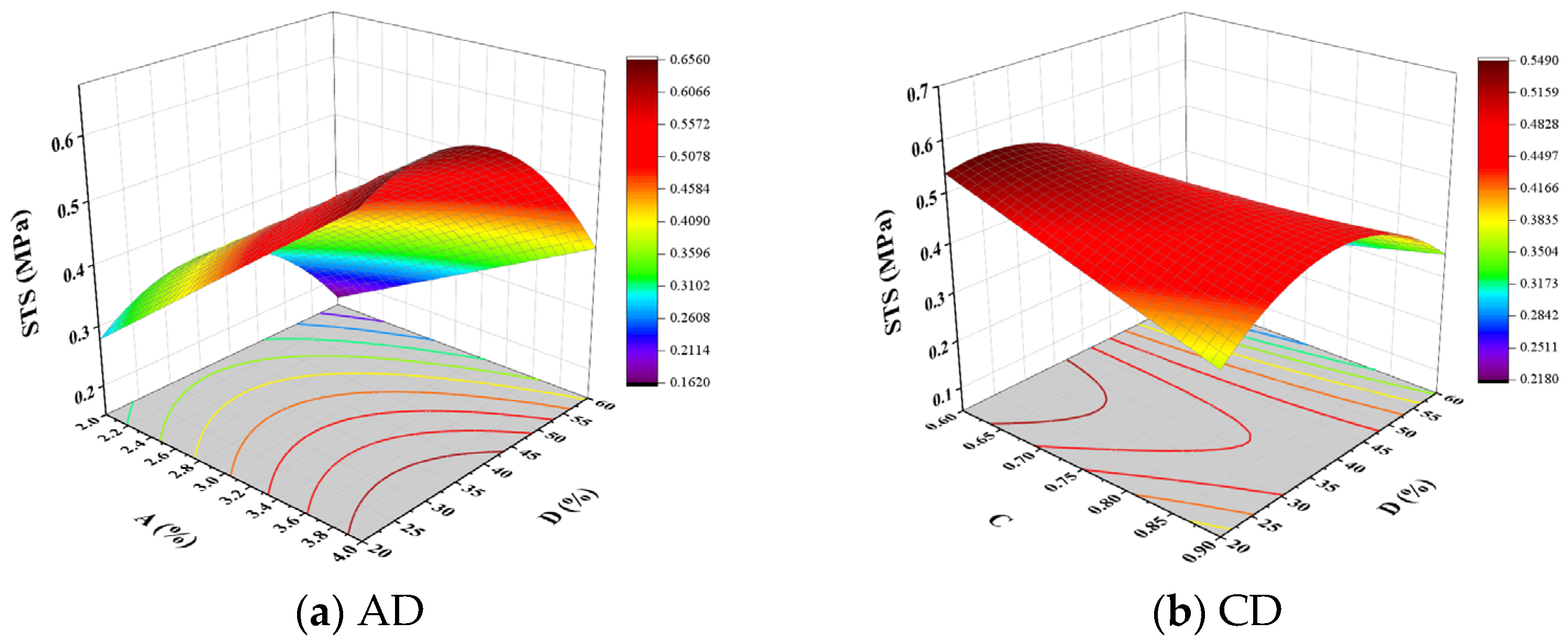
Figure 10 shows the 3D response surfaces of the factor effects on STS. The contour colors were evenly distributed with no obvious step changes, and no elliptical contours were observed. Thus, the AD and CD interactions were not significant, and single-factor effects dominated. In the model analysis, AD showed p = 0.0922 with a regression coefficient β14 = −0.027, confirming its insignificance, which was consistent with the graphical results. The CD interaction was statistically significant (p < 0.0001) with a regression coefficient β34 = 0.075, indicating that the effect of C on STS depended strongly on the level of D. However, the 3D contour plot in Figure 10b did not visually reflect this significance. This inconsistency may be attributed to the presence of the quadratic term D244 = −0.118), which offset the visual effect of the interaction and led to local flattening of the response surface.
Based on the model analysis, the order of influence on STS was A > B > D > C. This can be explained by the different failure mechanisms. Splitting failure was governed by tensile crack propagation along the bonding interface and was therefore more sensitive to cementitious effects [40]. The cement content, as the fundamental source of bonding, generated large amounts of C-S-H gel during early hydration and directly determined the early bonding strength [41]. Fly ash mainly acted as a micro-filler at early ages, improving compactness and strengthening the ITZ, thereby suppressing crack initiation [42]. By contrast, long-term durability and crack resistance were controlled mainly by gradation optimization, with aggregate interlocking providing only marginal benefits to short-term tensile behavior [11]. These results suggest that improving cracking resistance should focus on optimizing the cementitious system (A, B) rather than merely adjusting aggregate gradation (C, D).

3.4. Validation of Predicted Models

A multi-objective synchronous nonlinear optimization method based on the BBD experimental design was applied to systematically optimize the mix proportions of CFSAG. The goal was to design CFSAG mixtures that met the practical requirements of road performance while pursuing low-carbon and resource-efficient utilization. The optimization targets were: (1) to satisfy the specification requirements for secondary and higher-class highways under very heavy traffic (3–5 MPa) [28]; (2) to minimize the cement content while maximizing the contents of fly ash and aeolian sand. Table 6 presents three optimized mix proportions of CFSAG.
Table 7 shows the measured and predicted mechanical properties of each mix proportion. To validate the model, Equation (7) was used to calculate the percentage error between the predicted values and the experimental data. As shown in Table 7, the percentage errors of all responses were less than 5%, indicating good agreement between the predicted and experimental results. This also demonstrates that the model generated by RSM was accurate.
Error = Actual   value Predicted   value Actual   value × 100

4. Analysis of Multi-Scale Mechanism

4.1. Analysis of DIC Test Results

4.1.1. Analysis of Stress–Strain Curves

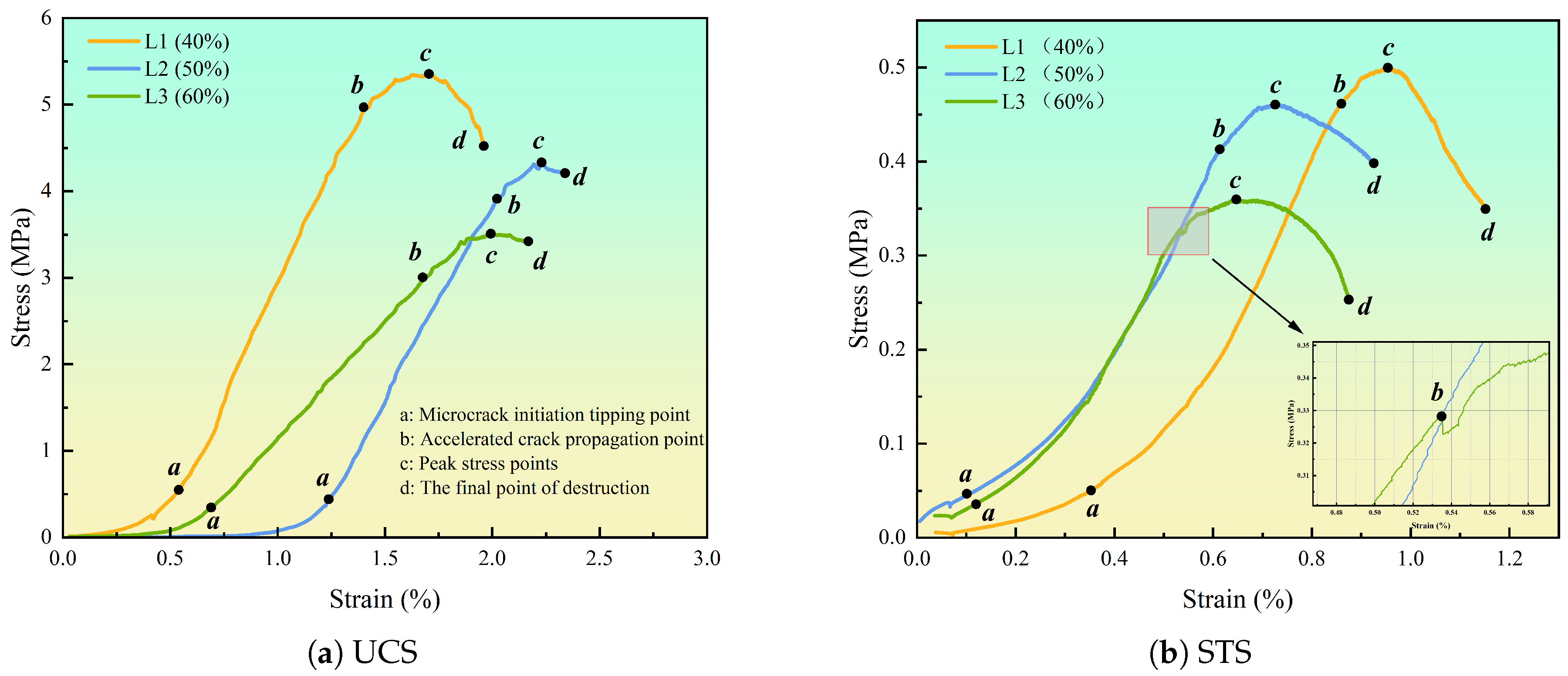
Figure 11 shows the stress–strain curves of specimens during compressive and splitting failure. According to the studies of Ruan et al. [43] and Sun et al. [44], the curves can be systematically divided into four typical stages. The initial compaction stage (0a) was characterized by a slow, nonlinear increase of stress with strain. The elastic stage (ab) showed an approximately linear relationship between stress and strain, with a much higher growth rate. The elastoplastic hardening stage (bc) displayed nonlinear behavior with gradually reduced stress growth, eventually reaching the peak stress. The post-peak softening stage (cd) began with stress descending from the peak.
As shown in Figure 11a, L1 reached peak stress in the shortest time. Its curve dropped sharply after the peak, with the load-bearing capacity lost rapidly. In contrast, L3 showed a gentler decline after the peak and exhibited higher residual strength. Correspondingly, in Figure 11b, the peak stress of L3 was the lowest and appeared earlier. This indicated that higher aeolian sand content led to more severe deterioration of the tensile load-bearing system.
In both curves, stress increased slowly before point a, mainly because higher aeolian sand content increased the initial porosity. At the early loading stage, more energy was consumed in compacting pores rather than being effectively transmitted, which slowed down the stress growth. It should be noted that the peak stress of L3 was much lower than that of L1, and the time required to reach point a was longer. This suggests that the initial structure of L3 was looser, and the compaction and rearrangement of internal particles required more loading time.

4.1.2. Analysis of Horizontal Strain in UCS

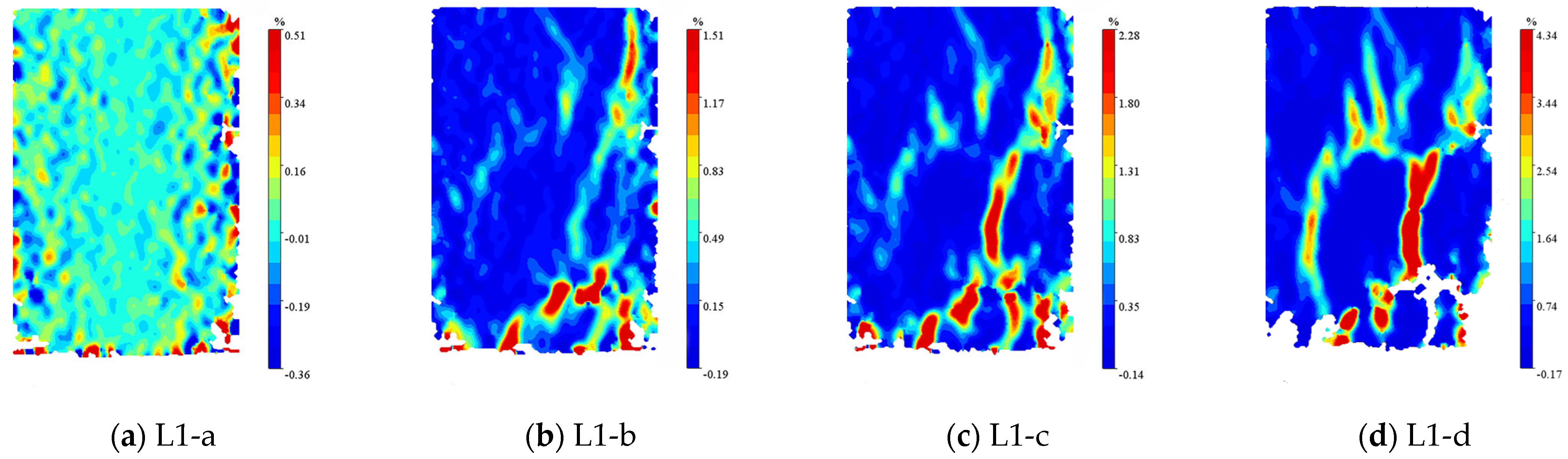
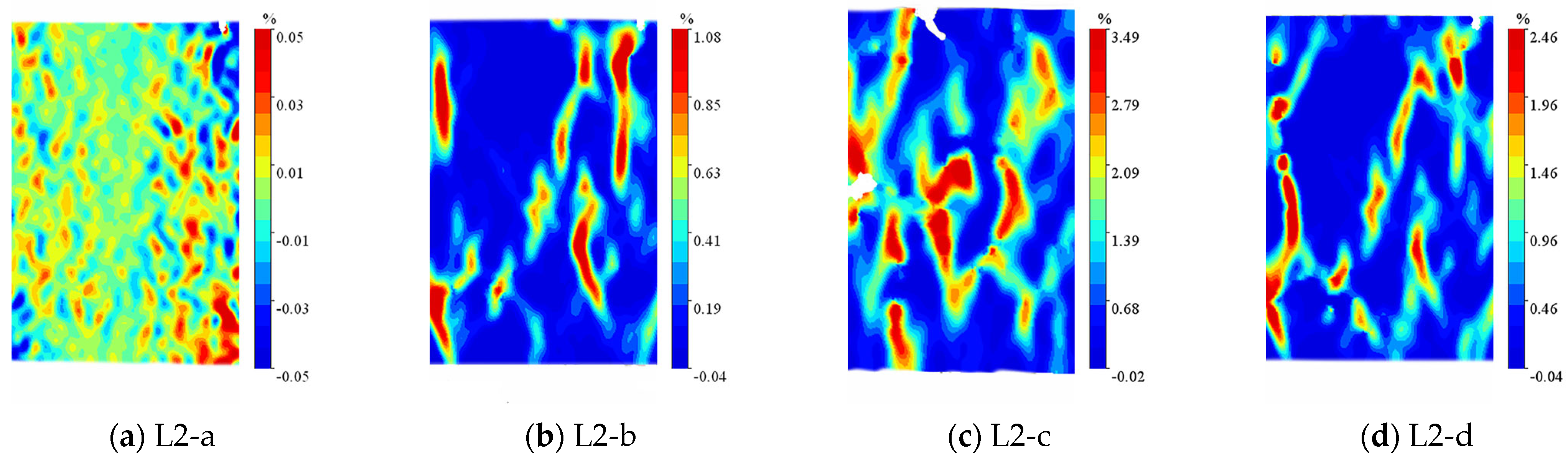
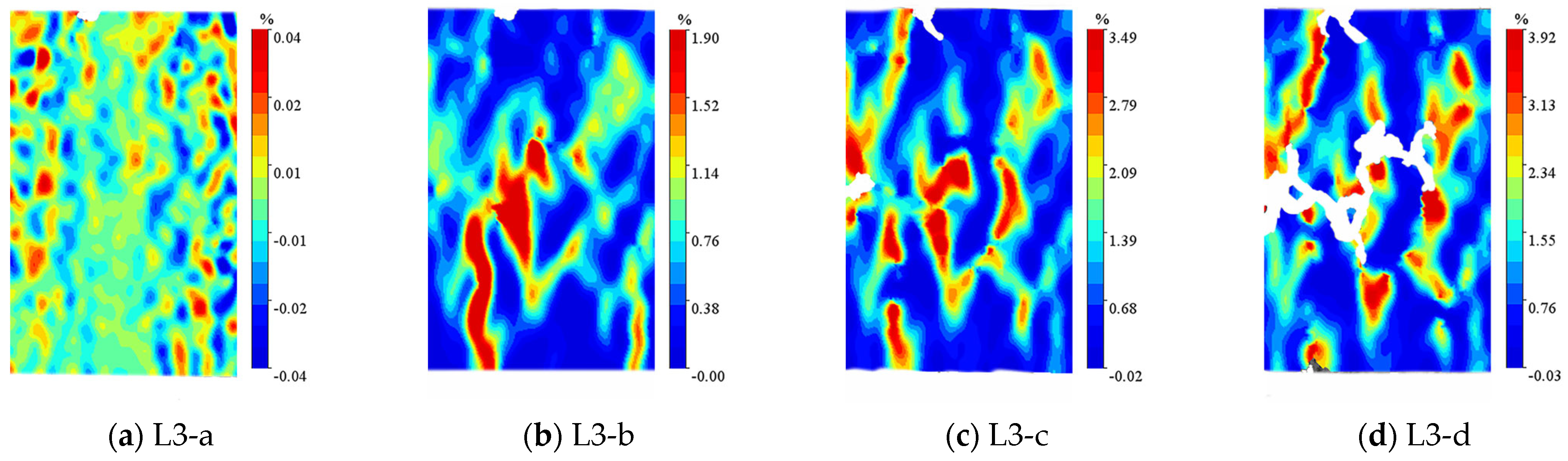
The horizontal strain (Exx) cloud diagrams of the specimens during failure are shown in Figure 12, Figure 13 and Figure 14. Based on the diagram evolution, the development of cracks could be divided into four stages corresponding to the stress–strain curve: initial, initiation, propagation, and penetration. Taking Figure 12 as an example, the initial stage (0a) showed overall compression with limited horizontal strain. However, stress concentrations arising from internal defects and weak surface zones at a high aeolian sand content resulted in randomly distributed high-strain zones (red). In the initiation stage (ab), discrete strain concentration zones expanded and connected, triggering the formation of microcracks. In the propagation stage (bc), the overall horizontal strain decreased, and microcracks rapidly developed into macrocracks. In the penetration stage (cd), cracks continued to expand until specimen failure. During this stage, some large deformation zones on the surface exceeded the recognition range of the DIC system.
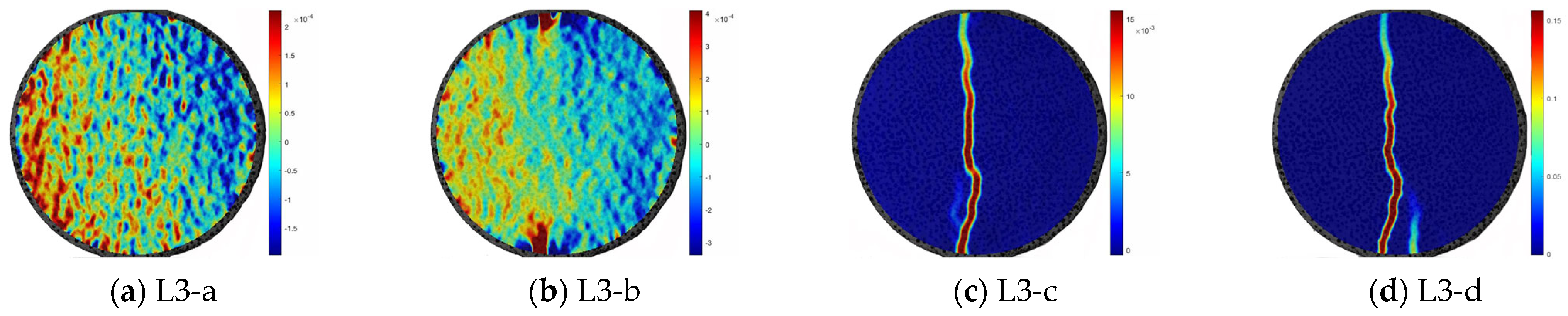
Increasing the aeolian sand content significantly intensified the initial damage. Specimens with a higher content showed dense high-strain zones already in the initial stage (Figure 13a and Figure 14a). Moreover, a higher content led to more cracks (Figure 13c), wider cracks, and blocky spalling (Figure 14c). This occurred because under vertical loading, the internal stress was gradually transferred outward through particle contacts. At the surface, a large number of aeolian sand particles were insufficiently coated by cementitious materials, resulting in a significant weakening of particle–matrix interfacial bonding. The final failure in Figure 14d was more complete, which reflects the sharp decline in the cementitious coating effectiveness at 60% aeolian sand content and the development of weak interfacial zones throughout the material.

4.1.3. Analysis of Horizontal Strain in STS

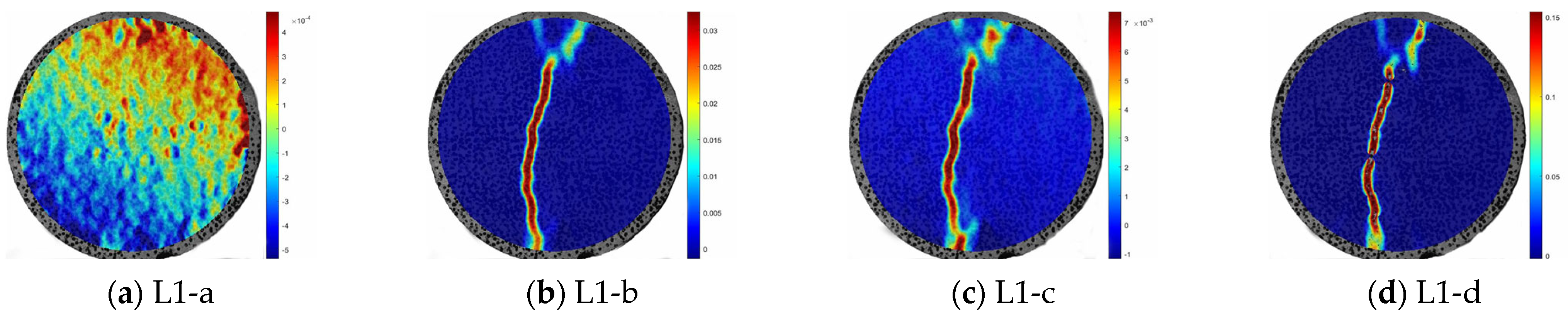
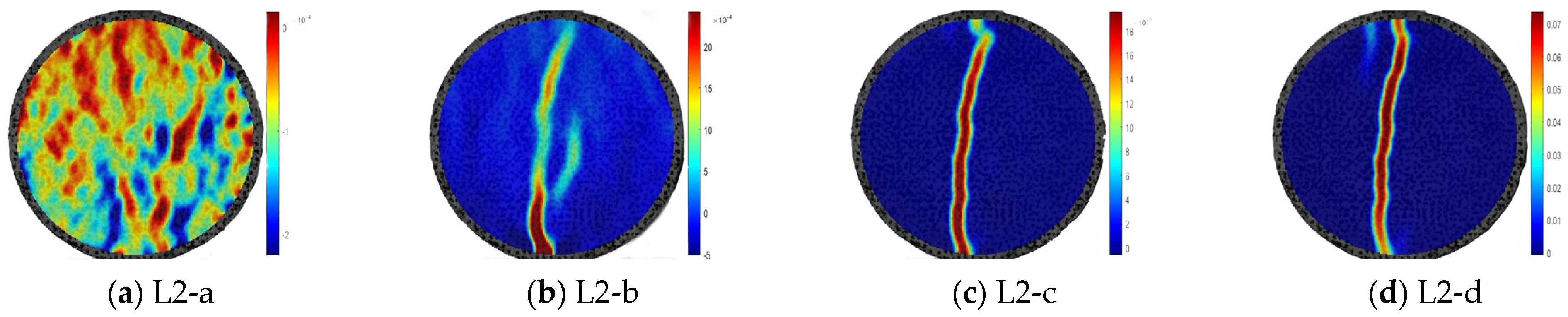
Figure 15, Figure 16 and Figure 17 show the horizontal strain (Exx) cloud diagrams on specimen surfaces at different times during splitting failure. When the aeolian sand content increased from 40% (L1) to 60% (L3), the coating effect of cementitious materials on aggregates was significantly weakened. The crack paths of groups L1 and L2 were relatively smooth and straight (Figure 15d and Figure 16d), while those of group L3 were frequently deflected and distorted (Figure 17c). Although such zigzag cracking paths could prolong failure duration and contribute to a higher load capacity [45], Figure 11b shows that the failure duration of L3 was the shortest. This indicates that the path complexity was a forced choice during crack growth. Cracks bypassed coarse aggregates and followed paths of least resistance. Due to the discontinuity of gradation, excessive aeolian sand tended to cluster, forming local weak zones. As a result, cracks were forced to propagate through regions requiring a lower fracture strength.

4.1.4. Analysis of STS Damage Evolution

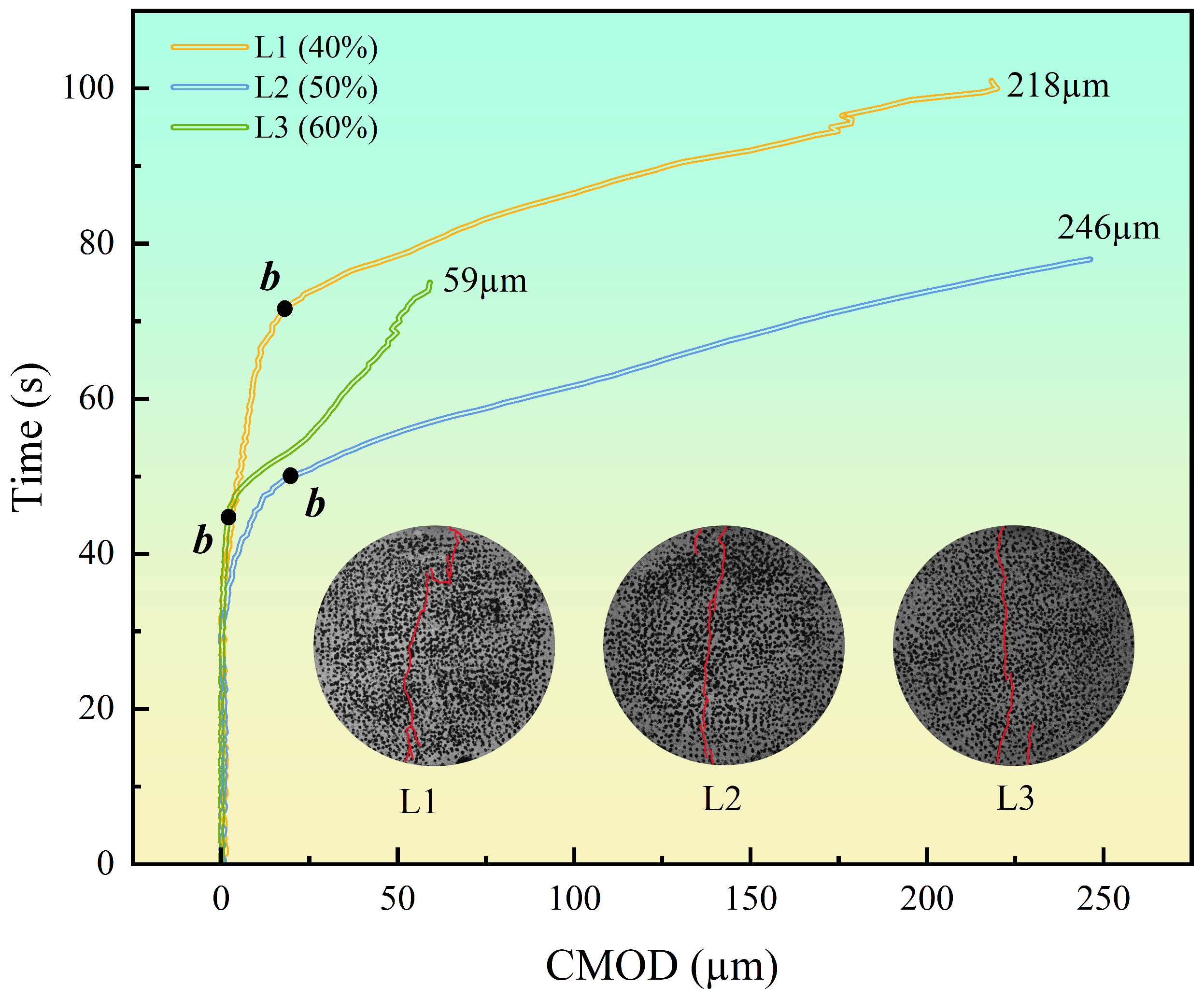
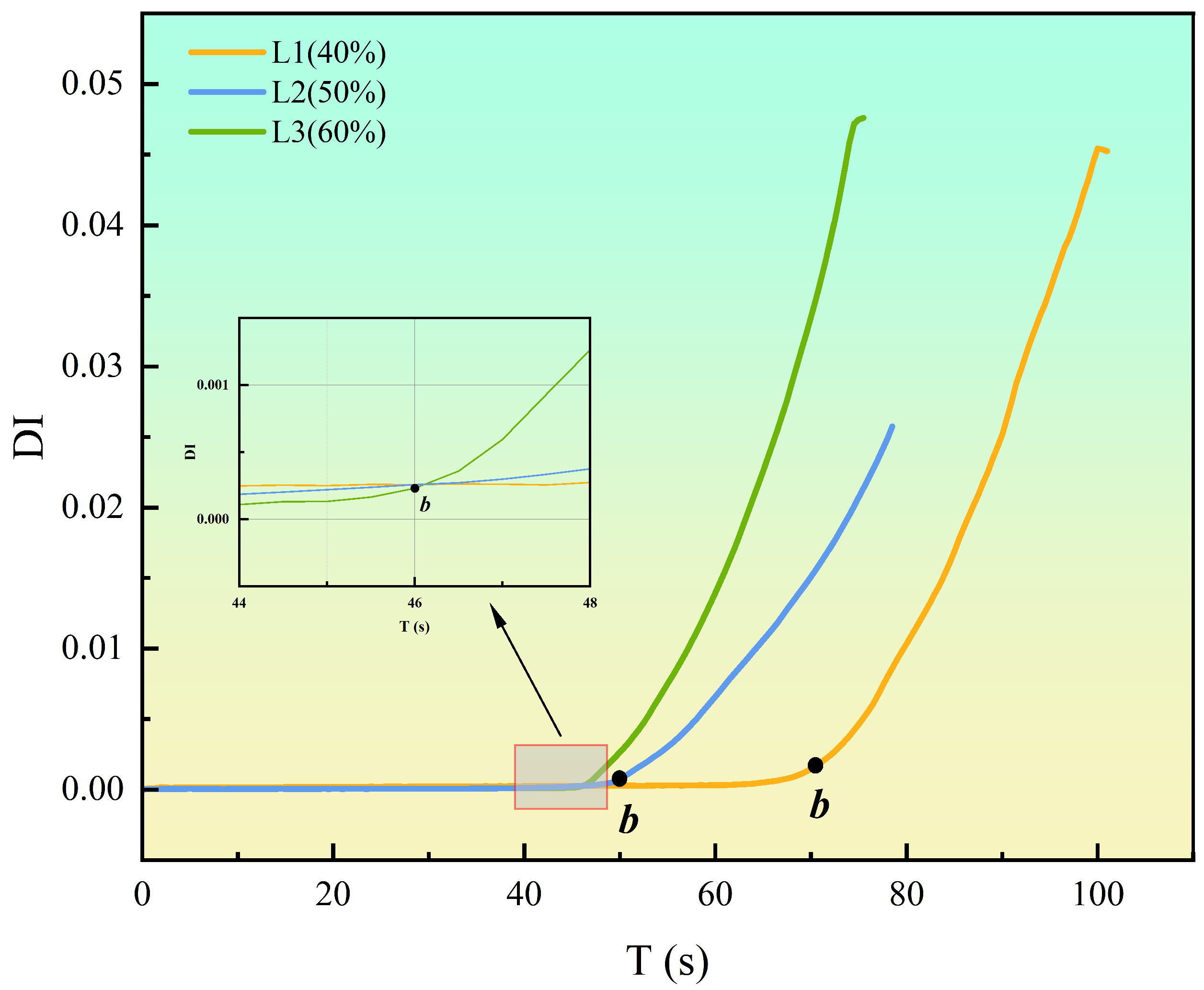
From the strain cloud diagrams, cracks were observed to initiate mainly at the specimen bottom, with some initiating simultaneously at both ends. For consistency, the crack mouth opening displacement (CMOD) was defined as the crack opening at the bottom end [46]. Considering that DIC measurements near the crack tips are easily affected by local noise and edge effects, an error elimination zone method was adopted. On both sides of the crack, two 5 × 5 pixel regions were selected, and the transverse displacement component was averaged. The difference between the two averages was defined as CMOD. A time–CMOD (t–CMOD) curve was plotted (Figure 18). In addition, the transverse strain Exx was extracted from the central region of the specimen (x = ±15 mm, y = ±60 mm). Its standard deviation was defined as the damage index (DI) to characterize the degree of strain concentration. The DI-T curve was obtained, as shown in Figure 19.
Figure 18 shows that the crack development varied significantly with the aeolian sand content. The earliest crack initiation occurred in L3 (44 s), followed by L2 (50 s), and the latest in L1 (72 s). It indicates that increasing aeolian sand content markedly shortened the crack initiation time and reduced the CMOD amplitude at failure (CMODL1 = 218 µm, CMODL2 = 246 µm, CMODL3 = 59 µm). This suggests that stable crack growth was reduced, and cracks tended to undergo rapid instability. Figure 19 shows that as the aeolian sand content increased from 40% to 60%, the turning point of the DI curve appeared earlier (TL1 = 70 s, TL2 = 50 s, TL3 = 47 s), and the growth rate during the stable propagation stage was significantly accelerated. This indicates that higher aeolian sand contents led to earlier initiation and faster accumulation of internal microcracks. Consequently, the CMOD curve entered the linear expansion stage earlier, and failure occurred at smaller displacements.
It is noteworthy that the turning points of the CMOD and DI curves were almost identical. Combined with Figure 11b, this moment corresponded to a stress of about 0.9 Pmax (point b). At this stage, CMOD changed from slow growth to nearly linear expansion, while DI showed a significant acceleration and the two changes occurred at nearly the same time. This suggests that when the load reached about 0.9 Pmax, a stable strain localization band had already formed inside the specimen. This was manifested in the displacement field as an obvious increase in the crack opening rate. Therefore, 0.9 Pmax can be regarded as the criterion for the transition from crack initiation to stable propagation. With increasing aeolian sand content, this turning point appeared earlier, and the stable propagation stage was shortened accordingly, reflecting the gradual reduction of crack resistance.

4.2. Analysis of Microscopic Test Results

4.2.1. SEM–EDS

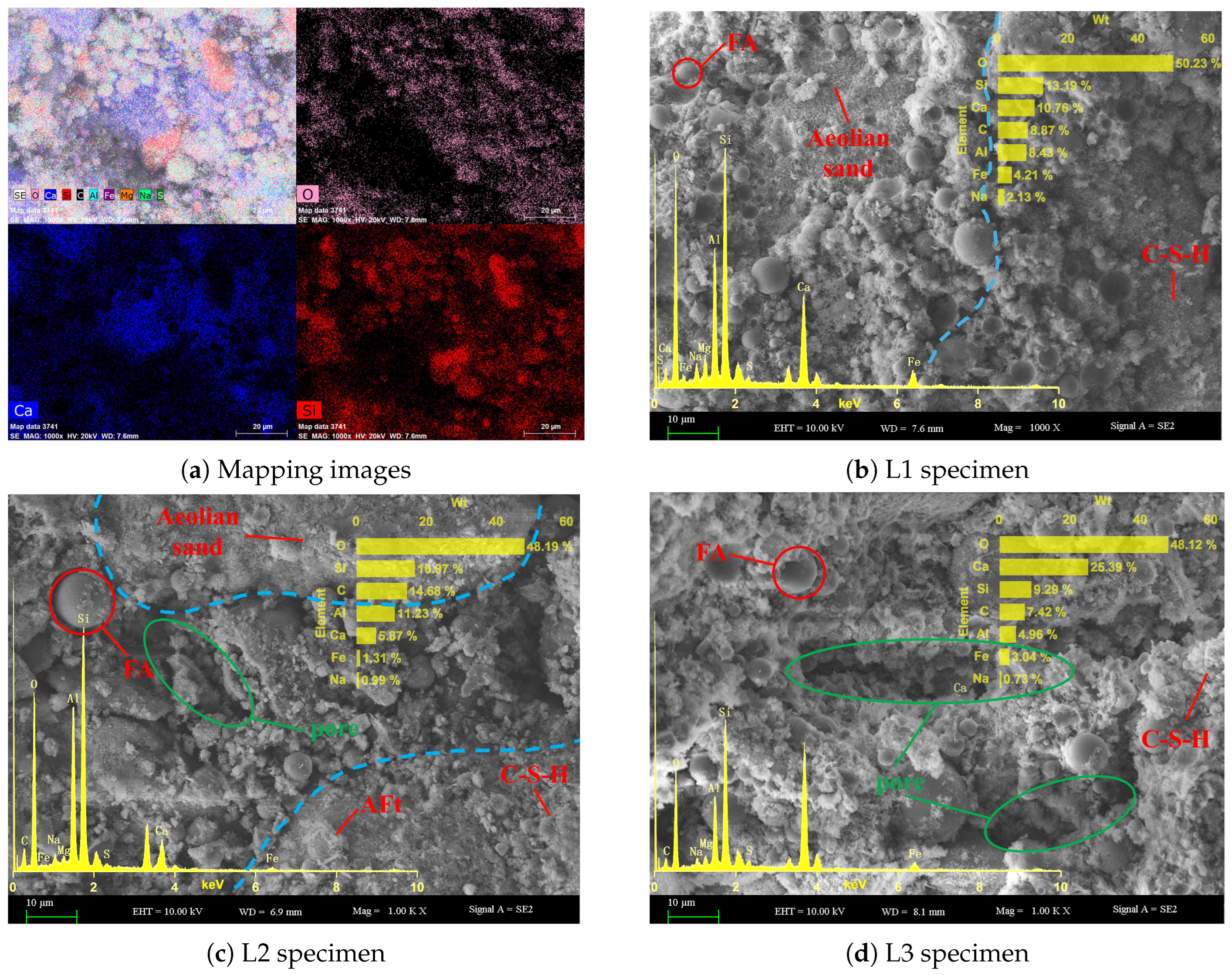
Figure 20 shows the micro-morphology of specimens with different aeolian sand contents, together with typical mapping images. The element mapping in Figure 20a revealed that Ca was mainly concentrated in hydration product regions, while O and Si were uniformly distributed. This indicated a wide distribution of aeolian sand and fly ash in the matrix. However, hydration product formation was limited due to an insufficient Ca supply. In Figure 20b, FA and aeolian sand particles were observed to be evenly distributed, and the particle surfaces were covered by hydration products, mainly C-S-H gel. Some FA particles remained unreacted, serving as potential active components. The EDS results indicated that the main elements were Si, Ca, and Al, with a pronounced Ca peak, suggesting abundant C-S-H. Such a structure helped to fill the voids between aggregates and improve material compactness. With increased aeolian sand content, Figure 20c exhibited more obvious local pores. The C-S-H gel formed on aggregate surfaces, but partial debonding from aeolian sand particles was evident, and the ITZ appeared relatively weak. The EDS analysis showed enhanced Si peaks but reduced Ca content, indicating an insufficient pozzolanic reaction and the limited formation of hydration products. When the aeolian sand content increased to 60%, the internal porosity further increased, and obvious loose regions appeared in some areas, as seen in Figure 20d. The formation of C-S-H was limited, and aeolian sand particles were poorly coated, resulting in weak interfacial bonding. At this stage, many unreacted particles and pores were present, leading to reduced compactness and strength degradation.
In summary, as the aeolian sand content increased from 40% to 60%, the microstructure of the CFSAG system changed from relatively dense to increasingly porous. In the L1 specimen, hydration products were abundant, effectively filling pores and enhancing aggregate bonding. In the L2 and L3 specimens, porosity gradually increased, unreacted particles accumulated, and the ITZ became weaker, reducing structural integrity. This trend suggests that at higher aeolian sand contents, the cementitious reaction was insufficient to form a continuous and compact C-S-H network, which adversely affected the macroscopic mechanical performance.

4.2.2. XRD

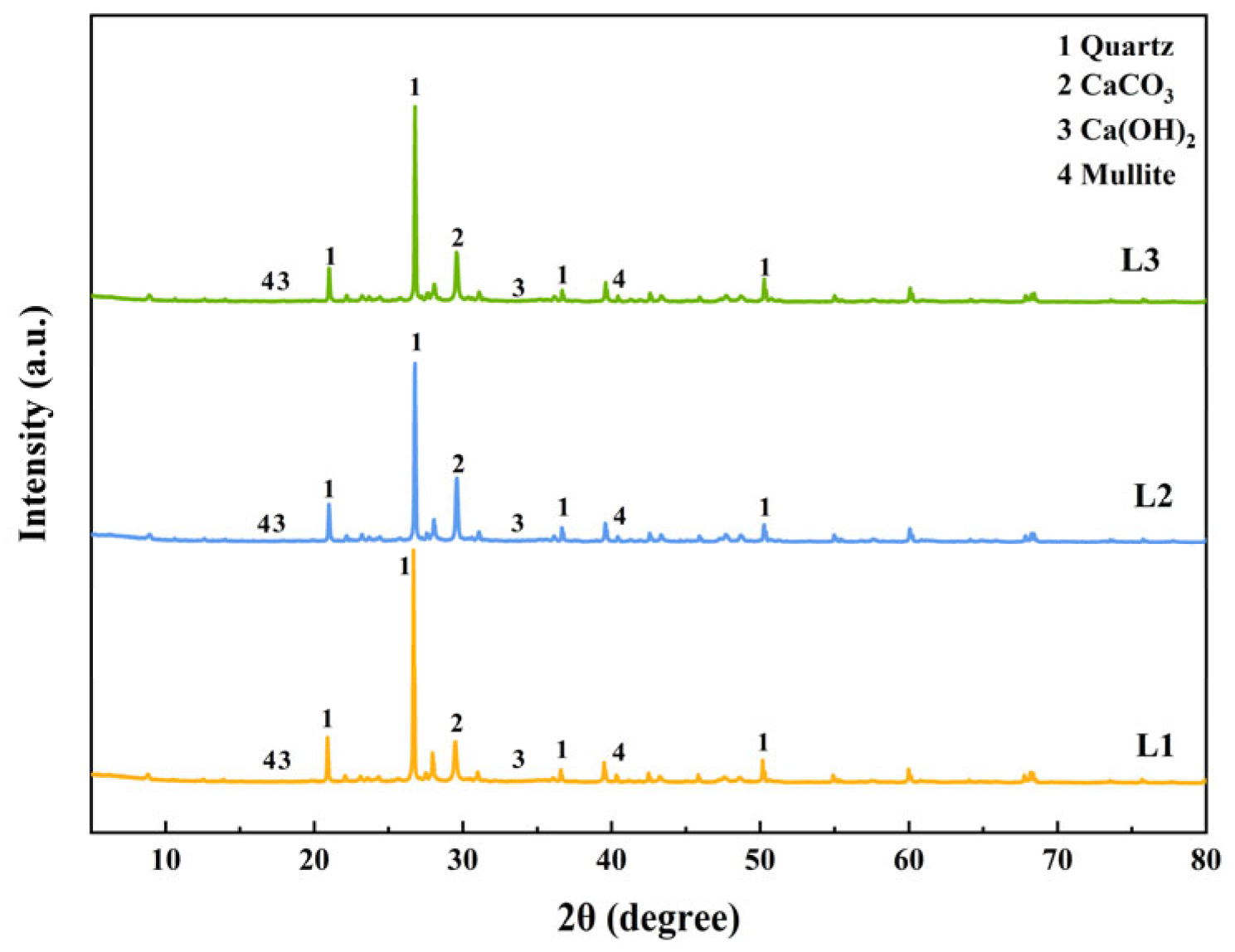
Figrue 21 shows the 7-d XRD patterns of specimens with different aeolian sand contents. Diffraction peaks were quantitatively analyzed to determine phase contents, and the results are summarized in Table 8. As shown in Figure 21, only minor differences in peak intensity were observed among specimens with different aeolian sand contents, while the main phases remained quartz, CaCO3, Ca(OH)2, and mullite. Table 8 further illustrates the variation in phase contents. Quartz, mainly derived from aggregates, fluctuated between 73.5% and 77.2%. Mullite remained stable, indicating that the crystalline inert phase in fly ash did not significantly participate in the reaction. In the L2 specimen, the diffraction peaks of CaCO3 and Ca(OH)2 both increased, suggesting that hydration and the formation of calcium-bearing products were enhanced when the aeolian sand content was 50%. However, due to the unfavorable particle gradation and pore structure, the products were not uniformly distributed, making it difficult to form a continuous cementitious network (Figure 20c), which led to a reduction in macroscopic strength. In the L3 specimen, the Ca(OH)2 content was the lowest, implying that the secondary pozzolanic reaction of fly ash was more pronounced at higher aeolian sand contents, with the most significant consumption of Ca(OH)2. Although more C-S-H gel was generated, the paste volume fraction was relatively insufficient. The fine particles diluted the overall structure, preventing the cementitious network from forming an effective load-bearing skeleton (Figure 20d).
In summary, the influence of aeolian sand content on system performance can be attributed to two main aspects: (1) regulating the ITZ area and fine particle distribution, which affects the degree of cement and fly ash hydration; and (2) altering the paste continuity and pore structure, which determines whether hydration products can form an effective spatial skeleton. As a result, an appropriate amount of aeolian sand promoted hydration and structural densification (L1 exhibited the highest strength), whereas excessive content led to severe structural deterioration (L3 exhibited the lowest strength).

5. Discussion

5.1. Mechanism of Aeolian Sand Content on Cracking Evolution

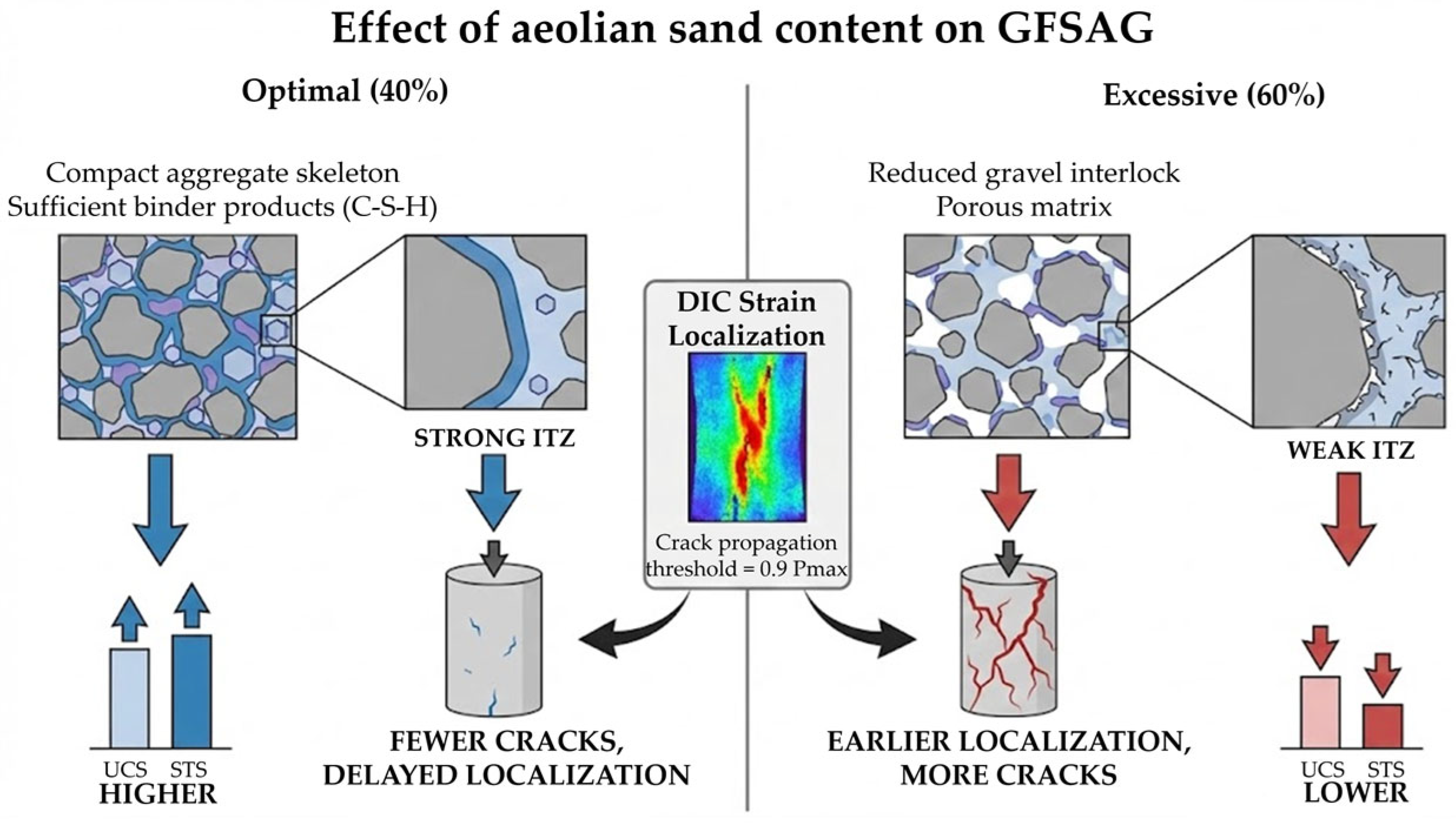
Cracking in cementitious materials is typically initiated at microstructural weak zones (especially the ITZ) and is then enlarged through the development and coalescence of microcracks. The early microcrack traces and strain-localization bands captured by DIC can be interpreted as the surface manifestation of damage that is preferentially developing along pore-rich regions and at ITZ weak points. Based on these observations, a multi-scale mechanism diagram (Figure 22) was developed to illustrate how the aeolian sand content affects the material response from the micro- to meso- and macro-scales.
When the aeolian sand content is 40%, the aggregate skeleton maintains a good interlock. The binder products are more uniformly distributed. A stronger and more continuous ITZ is thus formed. Under loading, deformation can be transferred and redistributed more effectively through the skeleton. The onset of localized strain is thereby delayed. When the aeolian sand content is excessive (60%), the increased fine fraction disrupts the gravel interlock and increases matrix porosity. The binder bridging around coarse aggregates is weakened. These changes reduce the ITZ strength and promote a more heterogeneous stress and strain field. Accordingly, DIC shows an earlier onset of strain localization and more dispersed microcrack activity; these microcracks subsequently coalesce into dominant cracks, resulting in premature macroscopic failure.
Accordingly, the DIC observed localization patterns provide a quantitative link between the macroscopic strength loss and the microstructural deterioration inferred from SEM; the microstructural evidence explains why weak zones form. The DIC results further reveal how these weak zones evolve into observable cracking and when this occurs during loading.
Comparison with previous studies: the observed trend that a moderate aeolian sand content improves the overall mechanical response while excessive sand may weaken the aggregate skeleton is consistent with prior reports on aeolian sand-based stabilized materials [8,9]. Compared with those mainly macroscopic observations, the DIC-based strain localization results provide direct mesoscale evidence on how weak zones initiate and coalesce into dominant cracks, offering a mechanistic explanation for the strength cracking evolution reported in earlier studies [10,11,12].

5.2. Economic and Feasibility Analysis

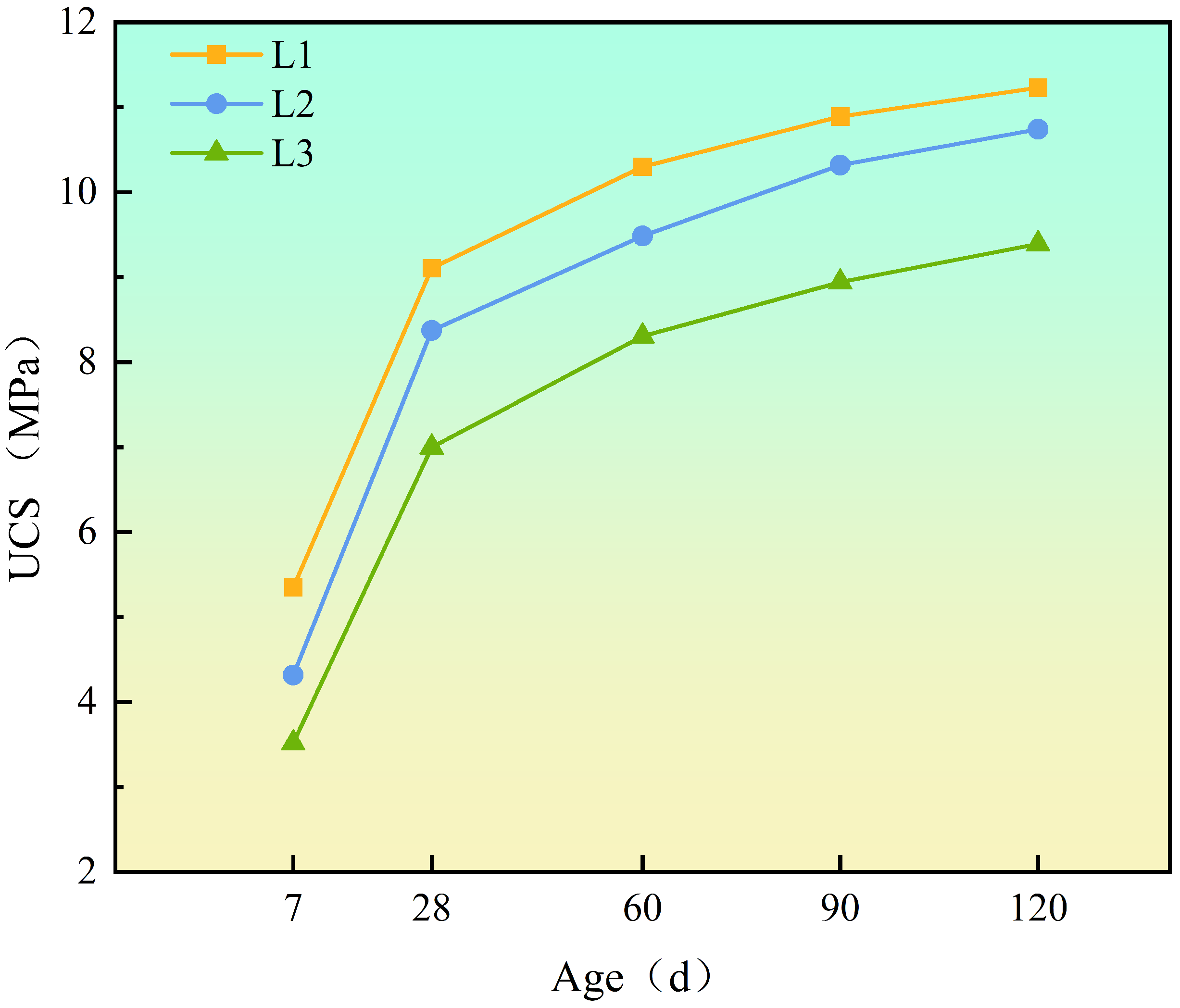
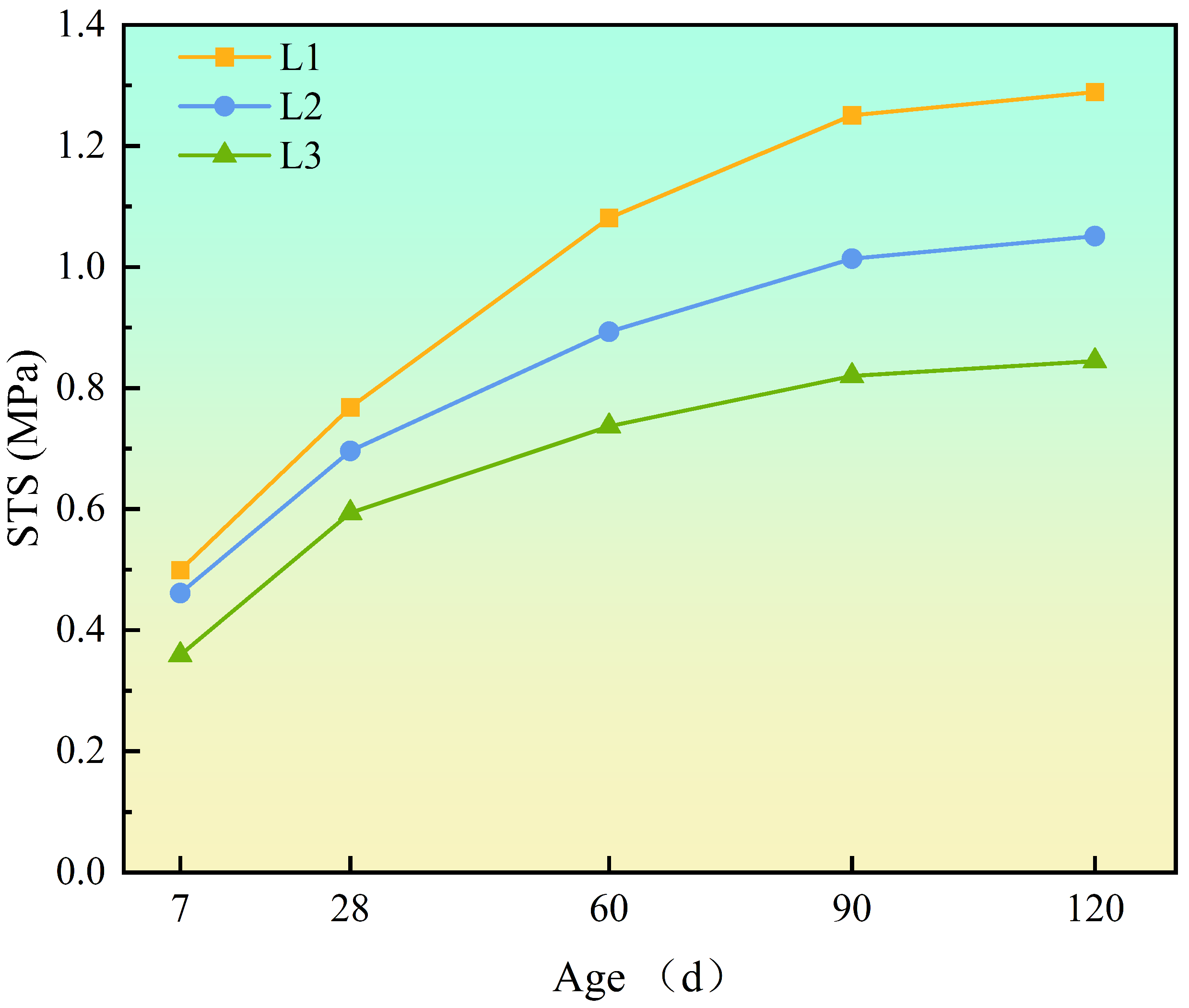
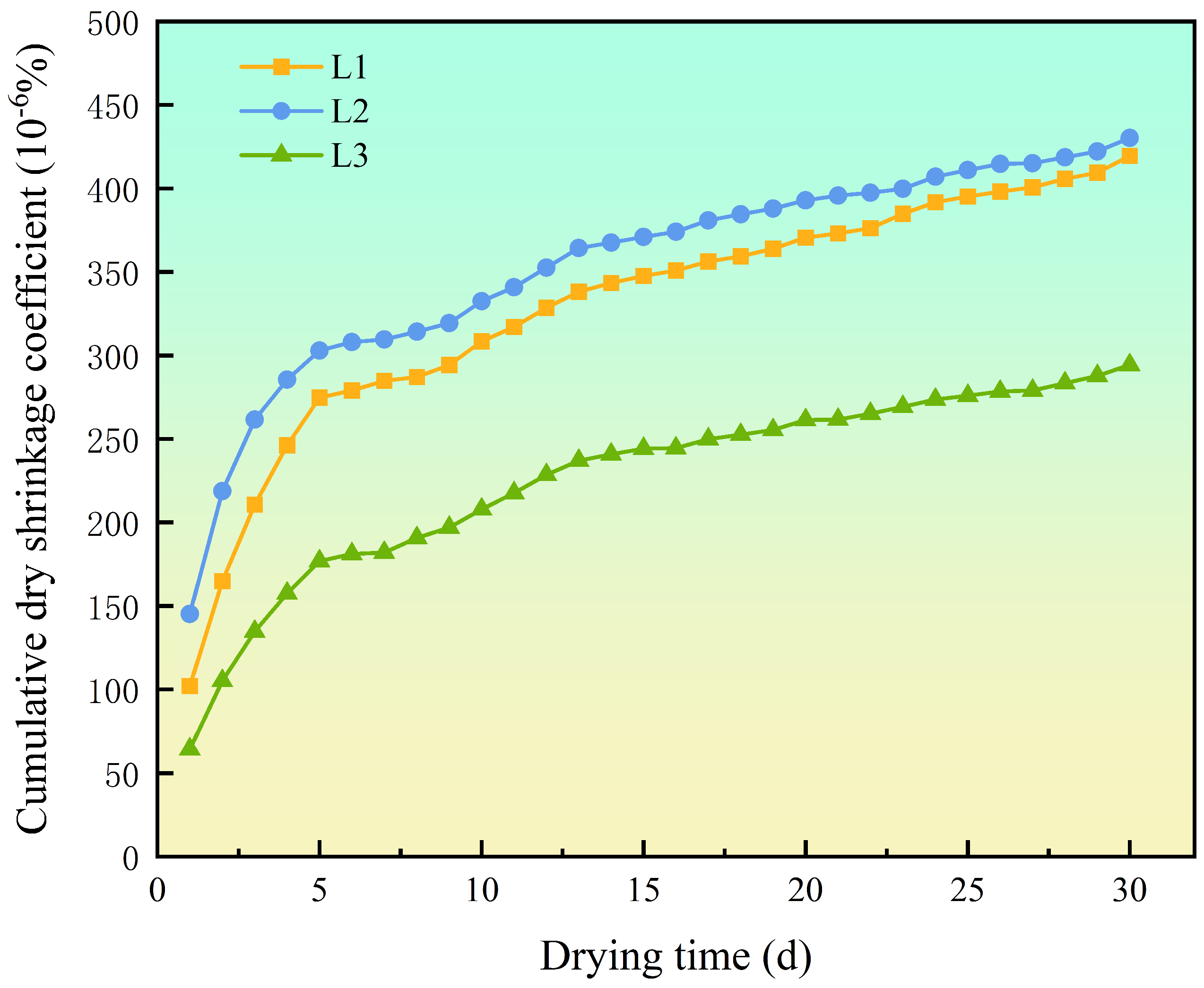
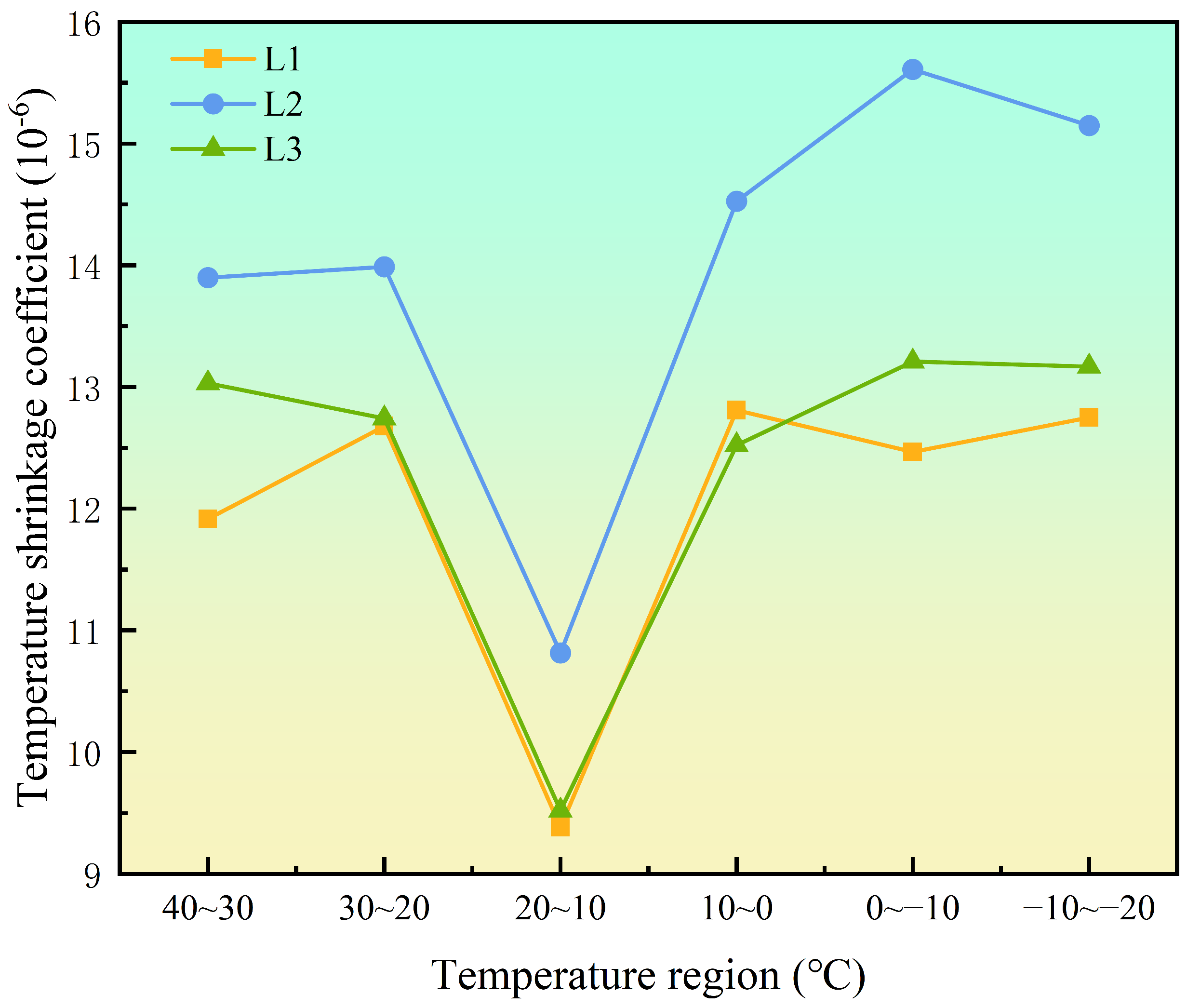
To further verify the feasibility of CFSAG in engineering practice, long-term mechanical and shrinkage tests were conducted on three mixes (L1, L2, L3). The results are shown in Figure 23, Figure 24, Figure 25 and Figure 26.
During 120 d of curing, UCS and STS were increased. The growth rate was slowed after 28 d. Compared with 7 d, strengths were at least doubled, thereby demonstrating long-term stability and considerable later-age potential. The drying shrinkage results (Figure 25) showed the smallest 30 d cumulative drying shrinkage coefficient for L3. L1 and L2 were similar. This outcome is attributed to the fine particles of aeolian sand, which optimize pore structure and reduce capillary tension [47]. More importantly, most of the drying shrinkage strain occurred in the early stage (0–5 d) and subsequently stabilized. This behavior is beneficial, as most shrinkage is completed soon after construction, reducing the risk of later-age cracking. Temperature shrinkage results (Figure 26) indicated low temperature shrinkage coefficients for all mixes between −20 °C and 40 °C. In deserts and adjacent regions with large diurnal ranges, shrinkage stresses induced by temperature changes would be smaller. The continuous strength gain with curing age and the shrinkage sensitivity across mixtures agree with the generally reported behavior of cement fly-ash stabilized materials, where ongoing hydration and pozzolanic reactions densify the matrix and the mixture design governs shrinkage susceptibility [7,8].
Considering the overall performance, the L2 mix was selected for a cost comparison with the conventional cement-stabilized sand gravel base commonly used for very heavy traffic expressways and first-class highways in southern Xinjiang. The analysis is normalized to a base area of 1000 m2 with a compacted thickness of 0.30 m, and transportation and other costs are excluded. Table 9 summarizes the material–cost breakdowns and unit costs.
As shown in Table 9, the L2 CFSAG base reduces the material cost by 15.3 CNY/m2 compared with the conventional cement-stabilized sand gravel base. Because aeolian sand can be sourced locally in southern Xinjiang, transportation costs are expected to further increase the economic advantage in practice.

5.3. Limitations and Future Work

Several limitations remain in this study. First, the RSM model is empirical in nature. Its validity is restricted to the investigated factor ranges. The influence of environmental variables, such as temperature and moisture, has not been explicitly characterized. Second, the testing duration was relatively short. Strength development beyond 120 d has not been verified. Shrinkage behavior after 30 d was not monitored. Long-term stability therefore remains to be confirmed. Third, feasibility was mainly evaluated using mechanical performance indicators. The evaluation scope is thus limited. Freeze–thaw cycling and fatigue tests were not conducted. Service life under coupled environmental actions and traffic loading cannot be fully predicted.
In the next stage, deformation under shrinkage will be tracked under controlled drying and temperature regimens. An imaging setup will be adopted. Full-field strain localization will then be resolved using DIC. Crack initiation and subsequent propagation will be quantified using localization- and crack-metric descriptors. Durability against coupled actions will also be examined. Repeated-loading and representative freeze–thaw protocols will be applied. The resulting degradation patterns will be interpreted by linking macro-scale responses to micro-/meso-scale structural evolution. Finally, field validation will be pursued through trial sections. Long-term monitoring will be carried out to assess the practical reliability of the laboratory-derived mix-design scheme.

6. Conclusions

In this study, RSM, DIC, and SEM–EDS were combined to establish an optimization and failure-mechanism framework for CFSAG materials. A DIC-based threshold indicator was proposed. The main conclusions are as follows:
(1)
RSM predicted the 7-d UCS and STS reliably. UCS was dominated by aeolian sand content; STS was mainly controlled by the cement content and cement-to-fly ash ratio. Interactions were non-negligible and supported multi-objective optimization.
(2)
At fixed optimized binder parameters, a higher aeolian sand content reduced both the 7-d UCS and STS and weakened the stress–strain load-bearing response. Excess aeolian sand thus degrades the binder–aggregate skeleton and hastens failure.
(3)
Mixtures with excessive aeolian sand showed earlier strain localization and more dispersed microcracking, leading to premature failure. In splitting, the shift from crack initiation to propagation occurred near 0.9 Pmax, providing a practical crack evolution threshold.
(4)
Strength loss stems from higher porosity, poorer paste continuity, and ITZ weakening at elevated aeolian sand contents. Moderate aeolian sand enables denser C-S-H filling, whereas excess sand leaves insufficient hydration products.

Author Contributions

Conceptualization, B.W. (Bo Wu); methodology, S.Z.; validation, C.P.; formal analysis, B.W. (Bo Wu); investigation, C.P.; resources, P.Z.; data curation, J.L.; writing—original draft, B.W. (Bo Wu); writing—review and editing, B.W. (Bin Wang) and S.Z.; visualization, B.W. (Bo Wu); supervision, B.W. (Bin Wang); project administration, P.Z.; funding acquisition, J.L. All authors have read and agreed to the published version of the manuscript.

Funding

This research was funded by the Xinjiang Transportation Design Institute Company Scientific Research Fund (Funder: J.L. Grant No. KY2020112301), the Xinjiang Transportation Department 2022 Transportation Industry Science and Technology Projects (Funder: J.L. Grant No. 2022-ZD-007), and the Ministry of Transport 2022 Transportation Industry Key Science and Technology Projects—Top-Level Projects (Funder: J.L. Grant No. 2022-MS4-109).

Data Availability Statement

The raw data supporting the conclusions of this article will be made available by the authors on request.

Conflicts of Interest

Authors Bo Wu, Ping Zheng, Bin Wang and Chao Pu were employed by the company Xinjiang Transportation Planning, Survey and Design Institute Co., Ltd. Author Jie Liu was employed by the company Xinjiang Academy of Transportation Science, Co., Ltd. The remaining author declares that the research was conducted in the absence of any commercial or financial relationships that could be construed as a potential conflict of interest.

Abbreviations

The following abbreviations are used in this manuscript:
RSMResponse surface methodology
DICDigital image correlation
SEMScanning electron microscopy
XRDX-ray diffraction
ITZInterfacial transition zone
CFSAGCement-fly ash stabilized aeolian sand gravel
UCSUnconfined compressive strength
STSSplitting tensile strength

References

  1. Che, J.; Wang, D.; Liu, H.; Zhang, Y. Mechanical Properties of Desert Sand-Based Fiber Reinforced Concrete (DS-FRC). Appl. Sci. 2019, 9, 1857. [Google Scholar] [CrossRef]
  2. Zhu, S.; Ji, X.; Liu, J.; Hu, C.; Pu, C.; Wu, T.; Luo, J.; Lin, Y. Study on the Decay Laws and Deterioration Mechanism of Mechanical Properties of Cement-Stabilized Gravel under Water-Heat-Salt Coupled Conditions. Constr. Build. Mater. 2024, 453, 139142. [Google Scholar] [CrossRef]
  3. Wang, X.; Zhu, S.; Zhang, M.; Song, L.; Zhang, X. Macro-micro Study on Arch Expansion of Cement Stabilized Gravel Material in Desert Area with Large Temperature Difference. J. Chongqing Jiaotong Univ. Nat. Sci. 2022, 41, 87–95. [Google Scholar] [CrossRef]
  4. Khan, I.H. Soil Studies for Highway Construction in Arid Zones. Eng. Geol. 1982, 19, 47–62. [Google Scholar] [CrossRef]
  5. Cui, Q.; Liu, G.; Zhang, Z.; Fang, Y.; Gu, X. Experimental Investigation on the Strength and Microscopic Properties of Cement-Stabilized Aeolian Sand. Buildings 2023, 13, 395. [Google Scholar] [CrossRef]
  6. Lopez-Querol, S.; Arias-Trujillo, J.; GM-Elipe, M.; Matias-Sanchez, A.; Cantero, B. Improvement of the Bearing Capacity of Confined and Unconfined Cement-Stabilized Aeolian Sand. Constr. Build. Mater. 2017, 153, 374–384. [Google Scholar] [CrossRef]
  7. Jin, S.; Yang, Y.; Sun, Y.; Xu, L.; Xu, J. Experimental Research on Anti-Freezing and Thawing Performance of Basalt Fiber Reinforced Fly Ash Concrete in the Corrosive Conditions. KSCE J. Civ. Eng. 2023, 27, 3455–3470. [Google Scholar] [CrossRef]
  8. Liu, J.; Xu, X.; Wang, B.; Dong, G.; Si, W. Study on the Macro-micro Properties of High Volume Aeolian Sand-cement Fly Ash Stabilized Gravel. China J. Highw. Transp. 2025, 4, 54–68. [Google Scholar] [CrossRef]
  9. Liu, J.; Wang, B.; Hu, C.; Chen, J.; Zhu, S.; Xu, X. Multiscale Study of the Road Performance of Cement and Fly Ash Stabilized Aeolian Sand Gravel Base. Constr. Build. Mater. 2023, 397, 131842. [Google Scholar] [CrossRef]
  10. Revilla-Cuesta, V.; Skaf, M.; Faleschini, F.; Manso, J.M.; Ortega-López, V. Self-Compacting Concrete Manufactured with Recycled Concrete Aggregate: An Overview. J. Clean. Prod. 2020, 262, 121362. [Google Scholar] [CrossRef]
  11. Gowripalan, N.; Shakor, P.; Rocker, P. Pressure Exerted on Formwork by Self-Compacting Concrete at Early Ages: A Review. Case Stud. Constr. Mater. 2021, 15, 00642. [Google Scholar] [CrossRef]
  12. Chu, H.; Wang, F.; Wang, L.; Feng, T.; Wang, D. Mechanical Properties and Environmental Evaluation of Ultra-High-Performance Concrete with Aeolian Sand. Materials 2020, 13, 3148. [Google Scholar] [CrossRef] [PubMed]
  13. Ghoddousi, P.; Javid, A.A.S.; Sobhani, J. A Fuzzy System Methodology for Concrete Mixture Design Considering Maximum Packing Density and Minimum Cement Content. Arab. J. Sci. Eng. 2015, 40, 2239–2249. [Google Scholar] [CrossRef]
  14. Box, G.E.P.; Wilson, K.B. On the Experimental Attainment of Optimum Conditions. In Breakthroughs in Statistics; Springer Series in Statistics; Springer: New York, NY, USA, 1992. [Google Scholar] [CrossRef]
  15. Soltani, M.; Moayedfar, R.; Vun, C.V. Using Response Surface Methodology to Assess the Performance of the Pervious Concrete Pavement. Int. J. Pavement Res. Technol. 2023, 16, 576–591. [Google Scholar] [CrossRef]
  16. Li, H.; Wu, Y.; Zhou, A.; Zhao, C.; Deng, L.; Lu, F. Experimental Study on Self-Healing Performance of Tunnel Lining Concrete Based on Response Surface Methodology. Constr. Build. Mater. 2024, 425, 136105. [Google Scholar] [CrossRef]
  17. Ma, J.; Cui, Y.; Xing, Y.; Chen, X.; Wu, J. Optimization and Pavement Performance of Buton-Rock-Asphalt Modified Asphalt Mixture with Basalt-Fibre. Case Stud. Constr. Mater. 2024, 21, e03429. [Google Scholar] [CrossRef]
  18. Li, Z.; Lu, D.; Gao, X. Optimization of Mixture Proportions by Statistical Experimental Design Using Response Surface Method—A Review. J. Build. Eng. 2021, 36, 102101. [Google Scholar] [CrossRef]
  19. Özkılıç, Y.O.; Başaran, B.; Aksoylu, C.; Karalar, M.; Zeybek, Ö.; Althaqafi, E.; Beskopylny, A.N.; Stel’makh, S.A.; Shcherban’, E.M.; Umiye, O.A. Bending Performance of Reinforced Concrete Beams with Partial Waste Glass Aggregate Replacement Assessed by Experimental, Theoretical and Digital Image Correlation Analyses. Sci. Rep. 2025, 15, 36737. [Google Scholar] [CrossRef]
  20. Aksoylu, C.; Başaran, B.; Karalar, M.; Zeybek, Ö.; Althaqafi, E.; Beskopylny, A.N.; Stel’makh, S.A.; Shcherban’, E.M.; Umiye, O.A.; Özkılıç, Y.O. Experimental, Theoretical and Digital Image Correlation Methods to Assess Bending Performance of RC Beams with Recycled Glass Powder Replacing Cement. Sci. Rep. 2025, 15, 25163. [Google Scholar] [CrossRef]
  21. Karalar, M.; Başaran, B.; Aksoylu, C.; Zeybek, Ö.; Althaqafi, E.; Beskopylny, A.N.; Stel’makh, S.A.; Shcherban’, E.M.; Umiye, O.A.; Özkılıç, Y.O. Utilizing Recycled Glass Powder in Reinforced Concrete Beams: Comparison of Shear Performance. Sci. Rep. 2025, 15, 6919. [Google Scholar] [CrossRef]
  22. JTG E51; Test Methods of Materials Stabilized with Inorganic Binders for Highway Engineering. Beijing COC Tech Co., Ltd.: Beijing, China, 2009.
  23. Song, Y.; Sun, Y. Low-Temperature Crack Resistance of Basalt Fiber-Reinforced Phase-Change Asphalt Mixture Based on Digital-Image Correlation Technology. J. Mater. Civ. Eng. 2023, 35, 4023141. [Google Scholar] [CrossRef]
  24. Zhao, P.; Li, L.; Zhou, S.; Qiu, L.; Qian, Z.; Liu, X.; Cao, X.; Zhang, H. TPGS Functionalized Mesoporous Silica Nanoparticles for Anticancer Drug Delivery to Overcome Multidrug Resistance. Mater. Sci. Eng. C 2018, 84, 108–117. [Google Scholar] [CrossRef]
  25. Qin, W.; Zhao, Y.; Jin, A.; Chen, S.; Liu, J. Analysis of Precursor and Failure Mechanisms of Granite under High Temperature: Based on Acoustic Emission and 3D-DIC Perspectives. Constr. Build. Mater. 2025, 473, 141049. [Google Scholar] [CrossRef]
  26. Schreier, H.; Orteu, J.-J.; Sutton, M.A. Image Correlation for Shape, Motion and Deformation Measurements: Basic Concepts, Theory and Applications; Springer: Boston, MA, USA, 2009. [Google Scholar]
  27. Shi, C.; Yu, H.; Qian, G.; Li, X.; Zhu, X.; Yao, D.; Zhang, C. Research on the Characteristics of Asphalt Mixture Gradation Curve Based on Weibull Distribution. Constr. Build. Mater. 2023, 366, 130151. [Google Scholar] [CrossRef]
  28. JTG/T F20; The Technical Guidelines for Construction of Highway Roadbases. China Communications Press Co., Ltd.: Beijing, China, 2015.
  29. Obaid, H.A.; Eltwati, A.; Hainin, M.R.; Al-Jumaili, M.A.; Enieb, M. Modeling and Design Optimization of the Performance of Stone Matrix Asphalt Mixtures Containing Low-Density Polyethylene and Waste Engine Oil Using the Response Surface Methodology. Constr. Build. Mater. 2024, 446, 138037. [Google Scholar] [CrossRef]
  30. Yaro, N.S.A.; Napiah, M.B.; Sutanto, M.H.; Usman, A.; Saeed, S.M. Modeling and Optimization of Mixing Parameters Using Response Surface Methodology and Characterization of Palm Oil Clinker Fine Modified Bitumen. Constr. Build. Mater. 2021, 298, 123849. [Google Scholar] [CrossRef]
  31. Montgomery, D.C. Design and Analysis of Experiments; John wiley & Sons: Hoboken, NJ, USA, 2017. [Google Scholar]
  32. Bala, N.; Napiah, M.; Kamaruddin, I. Nanosilica Composite Asphalt Mixtures Performance-Based Design and Optimisation Using Response Surface Methodology. Int. J. Pavement Eng. 2020, 21, 29–40. [Google Scholar] [CrossRef]
  33. Rafiq, W.; Napiah, M.; Habib, N.Z.; Sutanto, M.H.; Alaloul, W.S.; Khan, M.I.; Musarat, M.A.; Memon, A.M. Modeling and Design Optimization of Reclaimed Asphalt Pavement Containing Crude Palm Oil Using Response Surface Methodology. Constr. Build. Mater. 2021, 291, 123288. [Google Scholar] [CrossRef]
  34. Yaro, N.S.A.; Sutanto, M.H.; Habib, N.Z.; Napiah, M.; Usman, A.; Muhammad, A. Comparison of Response Surface Methodology and Artificial Neural Network Approach in Predicting the Performance and Properties of Palm Oil Clinker Fine Modified Asphalt Mixtures. Constr. Build. Mater. 2022, 324, 126618. [Google Scholar] [CrossRef]
  35. Long, X.; Cai, L.; Li, W. RSM-Based Assessment of Pavement Concrete Mechanical Properties under Joint Action of Corrosion, Fatigue, and Fiber Content. Constr. Build. Mater. 2019, 197, 406–420. [Google Scholar] [CrossRef]
  36. Chen, X.; Deng, C.; Zhai, X.; Di, W.; Cao, X.; Guan, B. Study on Anti-Segregation Performance of Cement Stabilized Macadam and Its Impact on Mechanical and Shrinkage Properties. Front. Mater. 2024, 11, 1411558. [Google Scholar] [CrossRef]
  37. Fang, M.; Park, D.; Singuranayo, J.L.; Chen, H.; Li, Y. Aggregate Gradation Theory, Design and Its Impact on Asphalt Pavement Performance: A Review. Int. J. Pavement Eng. 2019, 20, 1408–1424. [Google Scholar] [CrossRef]
  38. Elipe, M.G.M.; López-Querol, S. Aeolian Sands: Characterization, Options of Improvement and Possible Employment in Construction—The State-of-the-Art. Constr. Build. Mater. 2014, 73, 728–739. [Google Scholar] [CrossRef]
  39. Cho, Y.K.; Jung, S.H.; Choi, Y.C. Effects of Chemical Composition of Fly Ash on Compressive Strength of Fly Ash Cement Mortar. Constr. Build. Mater. 2019, 204, 255–264. [Google Scholar] [CrossRef]
  40. Huang, K.; Huang, S.; Ding, X.; Zhang, Y.; Liu, Z.; Han, G.; Dai, Z. Mechanical Behavior and Failure Characteristics of Limestone-Concrete Specimens with Different Prefabricated Fracture Angles under Compressive-Shear Loading. Constr. Build. Mater. 2025, 476, 141284. [Google Scholar] [CrossRef]
  41. Elmrabet, R.; El Harfi, A.; El Youbi, M.S. Study of Properties of Fly Ash Cements. Mater. Today Proc. 2019, 13, 850–856. [Google Scholar] [CrossRef]
  42. Chen, X.-F.; Zhang, X.-C.; Peng, Y. Multi-Scale Investigation of Fly Ash Aggregates (FAAs) in Concrete: From Macroscopic Physical–Mechanical Properties to Microscopic Structure of Hydration Products. Materials 2025, 18, 2651. [Google Scholar] [CrossRef]
  43. Ruan, B.; Zheng, S.; Ding, H.; Nie, R.; Ruan, C.; Chen, D. Experimental study on unconfined compressive strength of cement-stabilized aeolian sand cured at low temperature. J. Railw. Sci. Eng. 2020, 17, 2540–2548. [Google Scholar] [CrossRef]
  44. Sun, Q.; Zhang, J.; Zhou, N. Early-Age Strength of Aeolian Sand-Based Cemented Backfilling Materials: Experimental Results. Arab. J. Sci. Eng. 2018, 43, 1697–1708. [Google Scholar] [CrossRef]
  45. Ye, J.; Cui, C.; Yu, J.; Yu, K.; Xiao, J. Fresh and Anisotropic-Mechanical Properties of 3D Printable Ultra-High Ductile Concrete with Crumb Rubber. Compos. Part B Eng. 2021, 211, 108639. [Google Scholar] [CrossRef]
  46. Gümüş, M. Introducing a Novel LLD-CMOD Equivalence Fracture Model for Quasi-Brittle Materials Exposed to Three-Point Bending. Eng. Fract. Mech. 2024, 297, 109869. [Google Scholar] [CrossRef]
  47. Ren, Z.; Dong, W.; Dong, X. Analysis of Fractal and Erosion Characteristics of Aeolian Sand Concrete Pore Structure under Capillary Absorption. J. Build. Eng. 2025, 104, 112258. [Google Scholar] [CrossRef]
Figure 1. Grading characteristics and micro-morphology of aeolian sand.
Buildings 16 00590 g001
Figure 2. Research route.
Buildings 16 00590 g002
Figure 3. The main experimental steps.
Buildings 16 00590 g003
Figure 4. The procedure of the DIC test.
Buildings 16 00590 g004
Figure 5. Aggregate gradation for mixture.
Buildings 16 00590 g005
Figure 6. Residual distribution for: (a) UCS; (b) STS.
Buildings 16 00590 g006
Figure 7. Residuals vs. predictions for: (a) UCS; (b) STS.
Buildings 16 00590 g007
Figure 8. Predictions vs. actual values for: (a) UCS; (b) STS.
Buildings 16 00590 g008
Figure 9. Influences of various factors and their interactions on UCS.
Buildings 16 00590 g009
Figure 10. Influences of various factors and their interactions on STS.
Buildings 16 00590 g010
Figure 11. Stress–strain curves.
Buildings 16 00590 g011
Figure 12. Horizontal strain cloud diagrams of L1 under the compressive test.
Buildings 16 00590 g012
Figure 13. Horizontal strain cloud diagrams of L2 under the compressive test.
Buildings 16 00590 g013
Figure 14. Horizontal strain cloud diagrams of L3 under the compressive test.
Buildings 16 00590 g014
Figure 15. Horizontal strain cloud diagrams of L1 under the splitting test.
Buildings 16 00590 g015
Figure 16. Horizontal strain cloud diagrams of L2 under the splitting test.
Buildings 16 00590 g016
Figure 17. Horizontal strain cloud diagrams of L3 under the splitting test.
Buildings 16 00590 g017
Figure 18. T-CMOD curve of the STS test.
Buildings 16 00590 g018
Figure 19. DI-T curve of the STS test.
Buildings 16 00590 g019
Figure 20. SEM–EDS images of the 7-d cured specimen.
Buildings 16 00590 g020
Figure 21. XRD patterns of a specimen with different aeolian sand content.
Buildings 16 00590 g021
Figure 22. Mechanism of aeolian sand.
Buildings 16 00590 g022
Figure 23. Variation of UCS with curing age.
Buildings 16 00590 g023
Figure 24. Variation of STS with curing age.
Buildings 16 00590 g024
Figure 25. Variation of the cumulative drying shrinkage coefficient.
Buildings 16 00590 g025
Figure 26. Variation of the temperature shrinkage coefficient.
Buildings 16 00590 g026
Table 1. Aggregate test results.
Size
(mm)
Apparent Density
(g·cm−3)
Crush Value
(%)
Needle-like Content
(%)
Mud Content
(%)
4.75–9.52.649/9.80.94
9.5–192.66117.911.50.57
19–31.52.670/13.10.16
Table 2. Coding of test factors.
FactorCodeCode Levels
−101
Cement content (%)A234
Cement–fly ash ratioB0.20.350.5
k-valueC0.60.750.9
Aeolian sand content (%)D204060
Table 3. BBD test design and results.
RunCodeOptimum Moisture Content (%)Maximum Dry
Density (g/cm3)
Responses
ABCDUCS (MPa)STS (MPa)
1−1−1006.072.28714.770.413
21−1006.762.26838.080.740
3−11006.062.31563.130.245
411006.072.28947.550.538
500−1−15.012.40106.940.547
6001−15.032.40358.490.394
700−116.982.13732.610.214
800116.982.15193.340.361
9−100−15.112.46846.350.281
10100−15.292.487010.240.605
11−10016.962.14641.980.161
1210017.362.10935.380.378
130−1−106.032.31325.330.675
1401−105.832.24794.080.424
150−1106.082.28846.810.616
1601105.992.25985.210.351
17−10−106.042.31124.130.319
1810−106.422.27736.330.597
19−10106.042.30153.730.305
2010106.172.27179.160.615
210−10−14.992.38168.550.542
22010−14.782.38747.40.333
230−1017.592.14913.10.357
2401016.892.04602.690.222
2500006.092.27503.980.501
2600006.092.27503.910.481
2700006.092.27503.890.469
2800006.092.27503.780.469
2900006.092.27503.660.471
Table 4. Analysis of Variance (ANOVA) for the regression models.
SourceSum of SquaresFree DegreeMean SquareF-Valuep-Value
UCS (MPa)
Model138.561211.55347.32<0.0001significant
A42.75142.751285.98<0.0001
B3.6113.61108.53<0.0001
C4.4714.47134.31<0.0001
D69.46169.462089.26<0.0001
AB0.308010.30809.270.0077
AC2.6112.6178.46<0.0001
BD0.136910.13694.120.0594
CD0.168110.16815.060.0390
A210.81110.81325.15<0.0001
B23.8913.89117.09<0.0001
C23.2413.2497.57<0.0001
D24.3714.37131.49<0.0001
Residual0.5319160.0332
Lack of Fit0.4690120.03912.480.1967not significant
Pure Error0.062940.0157
Cor Total139.0928
STS (MPa)
Model0.590370.084391.76<0.0001significant
A0.254910.2549277.36<0.0001
B0.126110.1261137.17<0.0001
C0.001510.00151.630.2159
D0.084810.084892.31<0.0001
AD0.002910.00293.110.0922
CD0.022510.022524.48<0.0001
D20.097610.0976106.23<0.0001
Residual0.0193210.0009
Lack of Fit0.0186170.00115.830.0500not significant
Pure Error0.000740.0002
Cor Total0.609628
Table 5. The fit statistics for all responses.
ResponsesStd. Dev.MeanC.V. (%)R2Adj-R2Pre-R2Adeq Precision
UCS0.18235.333.420.99620.99330.986770.338
STS0.03030.4356.960.96830.95780.939435.744
Table 6. Optimization of mixing ratios.
NumberA (%)BCD (%)Optimum Moisture Content (%)Maximum Dry
Density (g/cm3)
L131:30.9405.692.2191
L231:30.9506.112.1773
L331:30.9606.632.0914
Table 7. Model validation of optimization results.
ResponsesNumberPredicted Value (MPa)Actual Value (MPa)Error (%)
UCS (MPa)L15.2325.3492.19
L24.1234.3174.49
L33.4213.5172.73
STS (MPa)L10.4840.4993.01
L20.4500.4612.39
L30.3570.3590.56
Table 8. Quantitative analysis results of the main phases.
SampleQuartz (%)Mullite (%)Calcite (%)Ca(OH)2 (%)
L177.21.719.02.0
L273.51.722.42.4
L375.91.820.51.8
Table 9. Engineering cost analysis.
SchemeMaterialUnitQuantityUnit Price (CNY)Cost (CNY)
CFSAG (L2)Cementt17.163367.526307.75
Fly asht51.487145.637498.05
Aeolian sandm3238.3662.50595.92
Gravel (4 cm)m351.31461.173138.88
Gravel (2 cm)m3121.69763.117680.30
Waterm339.1142.72106.39
Total 25,327.29
Unit costCNY/m2 25.3
Conventional
(cement-stabilized sand gravel)
Cementt28.9367.5210,615.61
Sand gravelm3641.946.629,911.45
Waterm328.92.7278.63
Total 40,605.69
Unit costCNY/m2 40.6
Disclaimer/Publisher’s Note: The statements, opinions and data contained in all publications are solely those of the individual author(s) and contributor(s) and not of MDPI and/or the editor(s). MDPI and/or the editor(s) disclaim responsibility for any injury to people or property resulting from any ideas, methods, instructions or products referred to in the content.