


Abstract
Drying shrinkage cracking of hydraulic cementitious materials, induced by moisture loss under varying environmental conditions, significantly compromises structural durability. The utilization of construction waste powder (CWP) in cement composites presents a sustainability opportunity, but its impact on shrinkage behavior remains poorly understood. This study aims to systematically investigate the drying shrinkage characteristics of cement-CWP composite mortar and to identify optimal mix proportions and curing conditions for shrinkage control. A series of experiments were conducted on mortar specimens with varying water-to-binder ratios (W/B = 0.45, 0.50, 0.55) and CWP incorporation rates (0, 5%, 10%, 20%). Three curing regimes were employed: outdoor curing, standard curing (20 °C, 95% RH), and outdoor film curing. Drying shrinkage was monitored over time. Key findings indicate that the optimal CWP content for shrinkage mitigation is 10%. Excessive CWP (>10%) induces a “weak bonding” effect, leading to an increase in shrinkage due to reduced cohesion. Increasing the W/B ratio to 0.55 effectively reduced shrinkage, with the minimum shrinkage value observed at this ratio. Among curing methods, outdoor film demonstrated superior performance in maintaining moisture and suppressing shrinkage. Predictive modeling revealed that the logarithmic model in accurately capturing the nonlinear evolution of shrinkage over time, effectively reflecting the influences of CWP content, W/B ratio, and curing condition. The drying shrinkage of cement-CWP composite mortar can be effectively optimized by incorporating 10% CWP, utilizing a W/B ratio of 0.55, and implementing outdoor film curing. This paper reveals, for the first time, the dual-mechanism regulation of early-age drying shrinkage behavior in cement-based materials by CWP as a supplementary cementitious material and establishes a shrinkage prediction model applicable to various mix proportions and curing conditions, offering practical strategies for enhancing the durability of sustainable construction materials utilizing construction waste powder.
1. Introduction
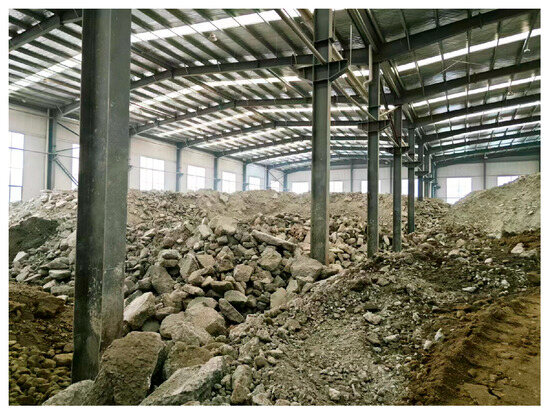
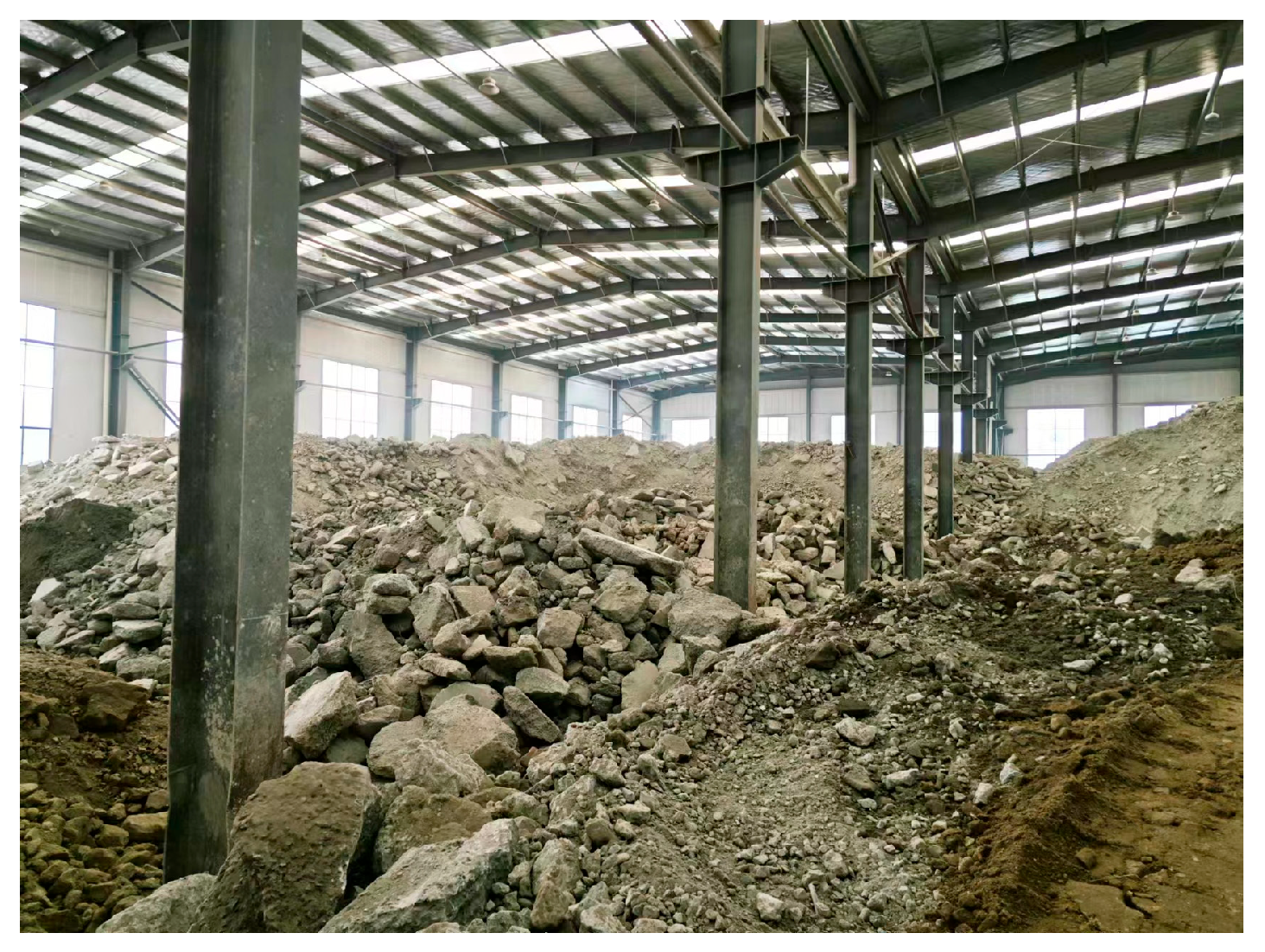
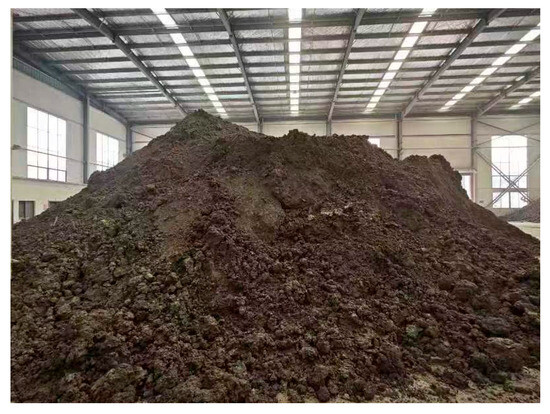
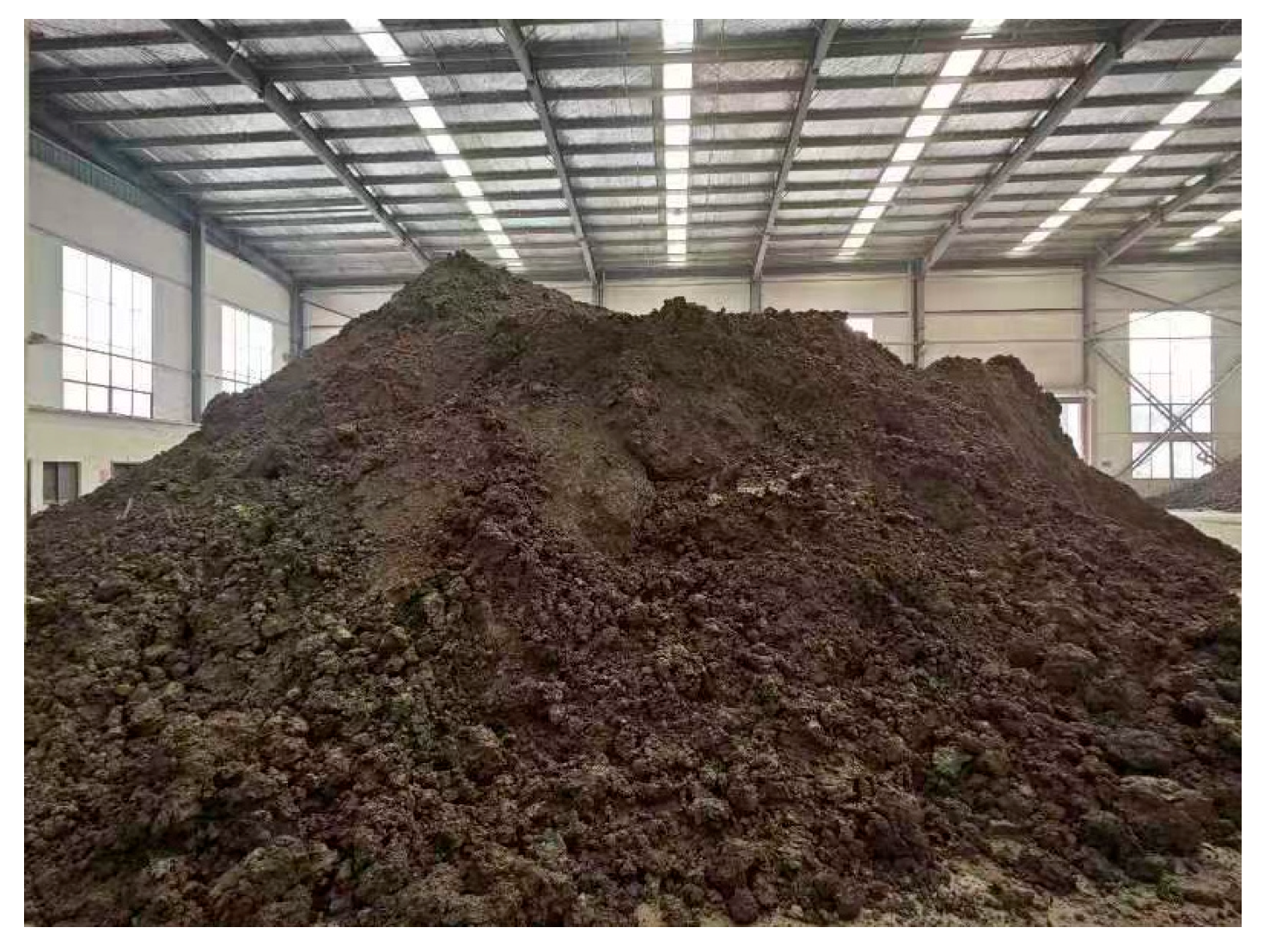
The rapid acceleration of global urbanization and the continued expansion of infrastructure have rendered the construction industry a major driver of economic development. However, this progress is accompanied by the generation of massive quantities of construction and demolition waste (CDW). In China, the annual generation of urban construction solid waste exceeds 35 billion tons (Figure 1 and Figure 2), accounting for more than 40% of the total urban waste, yet the resource utilization rate remains below 10% [1,2]. This figure stands in stark contrast to developed regions such as the European Union, Japan, and South Korea, where the resource utilization rate exceeds 90% [3]. Disposal of untreated CDW in landfills not only consumes valuable land resources but also leads to secondary environmental pollution through dust emission and leachate generation, adversely affecting soil, water bodies, and atmospheric quality.
Figure 1.
Construction waste.
Figure 2.
Construction waste powder.
Among various CDW streams, construction waste powder (CWP)—a byproduct of aggregate washing operations—has garnered significant attention due to its substantial global annual output, estimated at over 22.0 billion tons, and its distinctive chemical composition [4]. The primary chemical constituents of CWP are silicon dioxide (SiO2) and calcium oxide (CaO), which together typically constitute over 80% of its mass, endowing it with potential pozzolanic activity [5,6]. Sobuz, M. H. R. et al. conducted a comprehensive evaluation of the impact of crushed brick powder (CBP) and recycled concrete aggregate (RCA) on the performance of eco-friendly concrete, demonstrating that optimal strength can be achieved by substituting 20% of fine aggregates with CBP and 30% of coarse aggregates with RCA [7]. Li, L. et al. systematically elaborated on the feasibility of using waste ceramic powder (MCP), ground to an average particle size of approximately 3.5 μm, as a supplementary cementitious material (SCM) to partially replace cement (up to 40%). The study confirmed that MCP’s pozzolanic activity and micro-filling effect can refine the pore structure, enhance long-term mechanical properties [8]. Utilizing CWP as a Supplementary Cementitious Material (SCM) to partially replace cement offers dual benefits: (1) effectively diverting solid waste from landfills and conserving natural raw materials, and (2) significantly mitigating the substantial environmental footprint of cement production. The cement industry is a principal source of global carbon emissions, contributing approximately 5–8% of anthropogenic CO2, with nearly 1 ton of CO2 emitted per ton of cement produced [9,10]. Therefore, the partial substitution of cement by industrial byproducts like CWP represents a viable strategy for reducing the carbon footprint of the construction sector and advancing the national “dual-carbon” strategic objectives (peak carbon emissions and carbon neutrality).
Despite its potential environmental benefits, the large-scale application of CWP in cementitious materials necessitates a comprehensive evaluation of its impact on long-term durability. Drying shrinkage, defined as the volumetric reduction in cement-based materials caused by the loss of internal pore water under environmental influence, is a primary cause of non-load-related cracking that compromises structural durability and service life [11]. The underlying mechanisms are complex, involving capillary tension, disjoining pressure, and surface energy changes as pore water is lost sequentially from larger to smaller pores. It is generally accepted that at low relative humidity (<50%), the loss of adsorbed water from the surfaces of C–S–H gel induces significant surface tension, which is a primary driver of shrinkage [12]. In contrast, at higher humidity levels (>70%), capillary tension becomes predominant [11]. The development of drying shrinkage is profoundly influenced by material mix design, including the water-binder ratio (W/B) and environmental conditions. Conventionally, a higher W/B is associated with increased free water content and thus higher shrinkage potential [12]. Furthermore, curing conditions critically influence early and later-age shrinkage behavior by governing both the rate of moisture evaporation and the hydration process. For example, a decrease in environmental relative humidity from 100% to 50% has been shown to markedly amplify the drying shrinkage of cement-based mortars [13]. However, recent studies suggest that within a conventional workability adjustment range, the direct correlation between increased water content for slump adjustment and long-term drying shrinkage may be weaker than traditionally assumed [14].
The utilization of CWP as a supplementary cementitious material (SCM) or fine aggregate replacement presents a promising pathway for sustainable construction, reducing both landfill burdens and the carbon footprint of cement production [8]. Existing research has extensively documented the effects of CWP on the mechanical properties (e.g., compressive and tensile strength) and certain durability aspects (e.g., chemical resistance) of cementitious composites [14]. For instance, studies have shown that CWP can act as an inert filler at early ages and exhibit pozzolanic reactivity at later stages, influencing the microstructure and interface strength [11]. However, a critical knowledge gap persists regarding its long-term volumetric stability, specifically its drying shrinkage behavior and the underlying mechanisms.
The specific limitations of previous studies that this work aims to address are threefold:
Lack of Systematic Investigation on Multi-Factor Synergy: While individual factors like CWP content or W/B have been partially studied, there is a paucity of research that systematically investigates the synergistic effects of CWP content, water-binder ratio (W/B), and diverse curing conditions on drying shrinkage [14]. The interaction between these key mix design and environmental variables is complex and non-linear, yet it is precisely this interplay that dictates the material’s performance in real-world applications. Understanding this synergy is essential for predictive modeling and mix design optimization.
Insufficient Mechanistic Understanding Linked to Microstructure: Although the general mechanisms of drying shrinkage in cementitious materials are well-established [2], how the unique properties of CWP alter these mechanisms remains unclear. CWP, with its distinct particle morphology and potential pozzolanic activity, can significantly modify the pore structure, pore solution chemistry, and the C-S-H gel matrix [15]. For example, its filler effect may refine the pore structure, while its reactivity may consume Ca(OH)2 and form additional C-S-H, both of which could profoundly influence moisture transport, capillary pressure development, and the disjoining forces between solid surfaces—the core drivers of shrinkage [2]. A mechanistic link between CWP incorporation, the resulting microstructural evolution (e.g., pore size distribution), and the macroscopic shrinkage response is largely missing.
Limited Data under Realistic Curing Regimes Simulating Field Conditions: Most laboratory studies on CWP-modified materials employ standard curing conditions (e.g., 20 °C, >95% RH). However, the shrinkage behavior under curing regimes that better simulate real-world construction scenarios—such as outdoor natural curing (with fluctuating temperature and humidity), film curing (simulating membrane curing practices), or curing at elevated temperatures—is critically under-researched [13]. These conditions directly affect the kinetics of hydration, moisture loss, and the development of early-age microstructure, thereby governing the long-term shrinkage trajectory. The absence of such data hinders the formulation of practical, condition-specific guidelines for curing and construction scheduling when using CWP.
Hence, this study aims to systematically bridge these identified gaps by investigating the effects of CWP content, water-binder ratio (W/B), and diverse curing conditions on the drying shrinkage performance of cement-CWP composite mortar. The objectives are as follows: (1) quantify the individual and interactive impacts of these three key variables on shrinkage strain development over time; (2) elucidate the underlying mechanisms by correlating macroscopic shrinkage data with microstructural analyses (e.g., SEM) to understand how CWP alters pore structure and hydration products; and (3) based on the findings, provide a theoretical basis and practical data for optimizing mix design, formulating effective shrinkage mitigation strategies, and establishing appropriate, performance-based curing protocols for CWP-containing mortars.
This study will for the first time reveal the synergistic mechanism by which CWP regulates the internal humidity field through the dual mechanisms of “micro-aggregate filling” and “pozzolanic reaction,” thereby suppressing shrinkage. Additionally, a logarithmic prediction model for early-age drying shrinkage is established, comprehensively considering the combined effects of water-to-binder ratio (W/B), CWP content, and curing regime. The ultimate goal is to facilitate the safe, reliable, and performance-predictable application of this environmentally friendly construction material.
2. Materials and Methods
2.1. Raw Materials
2.1.1. Construction Waste Powder
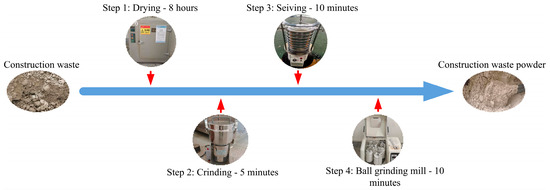
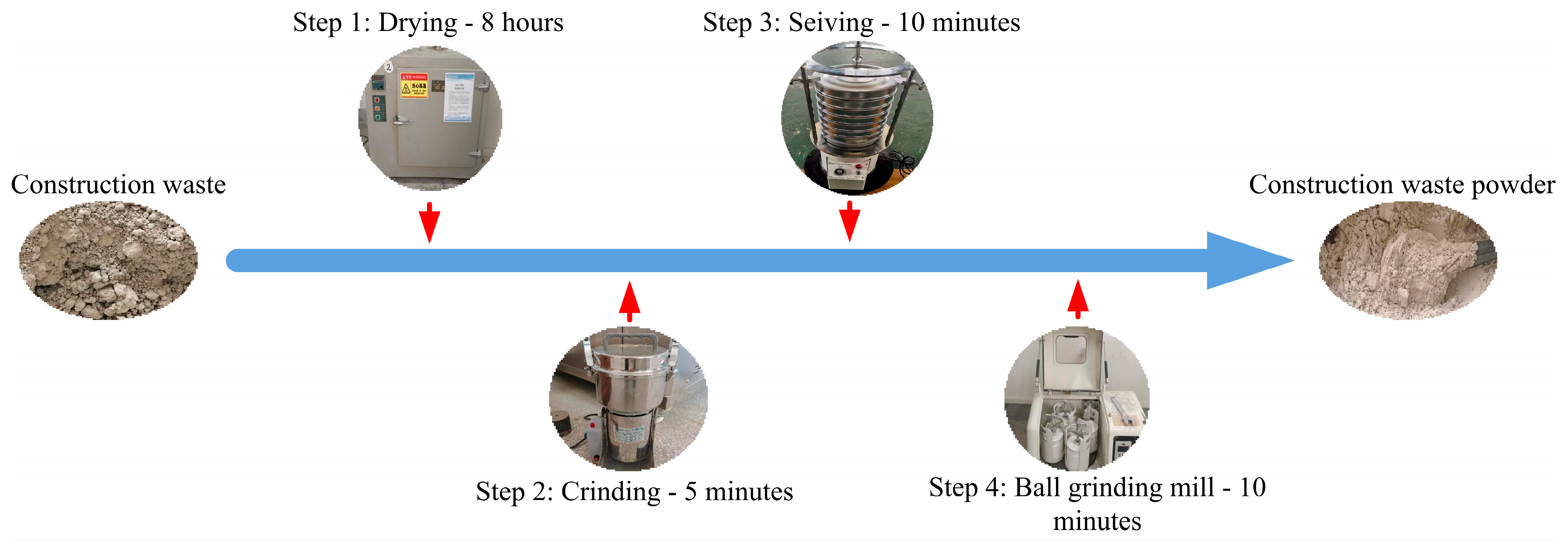
The construction waste comes from Jiangsu Kangju Renewable Resources Technology Co., Ltd., Suqian, China. The waste powder is processed through drying, grinding, screening, and ball grinding mill to obtain activated construction waste powder (CWP) with a fineness of 1500–1700 m2/kg and a mud content of 10–15%. The processing flow is shown in Figure 3, and the main chemical composition and physical indicators are listed in Table 1.
Figure 3.
Preparation process of construction waste powder.
Table 1.
Chemical composition of CWP and cement (wt%).
2.1.2. Cement
Cement (P.O.) is the P.O.42.5 grade ordinary silicate cement produced by Suqian Sanxishui Cement Co., Ltd., Suqian, China. Its chemical composition is shown in Table 1. The basic performance indicators of cement are shown in Table 2.
Table 2.
Basic Performance indicators of P.O.
2.1.3. Standard Sand
The standard sand produced by Xiamen Aixiu Co., Ltd., Suqian, China. has a standard sand particle size distribution (Table 3).
Table 3.
Distribution of standard sand particle sizes.
2.1.4. Water
The test water was tap water from Suqian City. All performance indicators met the relevant provisions of the “Standard for Water Use in Concrete” (JGJ63-2006) [16].
2.1.5. Polyacrylate Superplasticizer
Due to the high specific surface area of construction waste (up to 1600 m2/kg), which is much higher than that of cement (approximately 450 m2/kg), adding the waste portion to replace cement will significantly reduce the workability of the mortar. Therefore, a water reducer needs to be used to maintain the good workability of the composite mortar made of waste and cement. Compared with traditional naphthalene-based or aliphatic water reducers, polyacrylic acid-based water reducers have better water reduction effects (with a water reduction rate greater than 25%), so in this study, Polyacrylate superplasticizer was selected to adjust the workability of the mortar. The water reducer Produced by the Materials Company of China Communications Fourth Navigation Engineering Research Institute, Fuzhou, China. Its performance indicators are shown in Table 4.
Table 4.
Performance indicators of polycarboxylate superplasticizers.
2.1.6. Super Absorbent Polymer
Super absorbent polymer (SAP) was introduced as an internal curing agent in this study. During the mixing stage, SAP particles absorbed a portion of the mixing water. As the cement hydration process progressed, the internal relative humidity decreased, and the stored water in these SAP particles would be slowly released to continue supplying the unhydrated cement particles for the hydration reaction. This “internal curing” effect can effectively reduce the self-drying shrinkage of the cement matrix and prevent early cracking, which is of great significance. In this study, we used sodium polyacrylate-based SAP (with a dosage of 0.1% of the cement mass), as it has extremely high water absorption capacity, relatively stable performance, and good chemical compatibility with cement-based materials.
Super absorbent polymer was produced by Meiyuan Water Purification Materials Co., Ltd., Zhengzhou, China. Its chemical composition is 88% low-crosslinked polyacrylic acid sodium (containing 24.5% sodium), 8–10% water, and 0.5–1.0% crosslinking agent. Its performance indicators are shown in Table 5.
Table 5.
Performance indicators of SAP.
2.2. Experimental Mixing Ratio
To investigate the drying shrinkage characteristics of cement-CWP composite mortar, three key variables were selected: water-binder ratios of 0.45, 0.50, and 0.55; soil waste contents of 5%, 10%, and 20% by mass of cement (used as a cement replacement); and three curing conditions (outdoor curing, standard curing, and outdoor film curing). It should be noted that in this study, the film preservation was achieved by applying the SAP composite sodium silicate developed by my research team, which forms a sealing film with a lower permeability of (1.26 g/(m2·d)) and a spraying thickness of approximately 0.3 mm. To efficiently study the effects of these three factors each at three levels. The specific mix proportions for all cement-CWP mortar specimens are provided in Table 6.
Table 6.
Cement and CWP composite motor mix ratio (g).
2.3. Drying Shrinkage Test Method
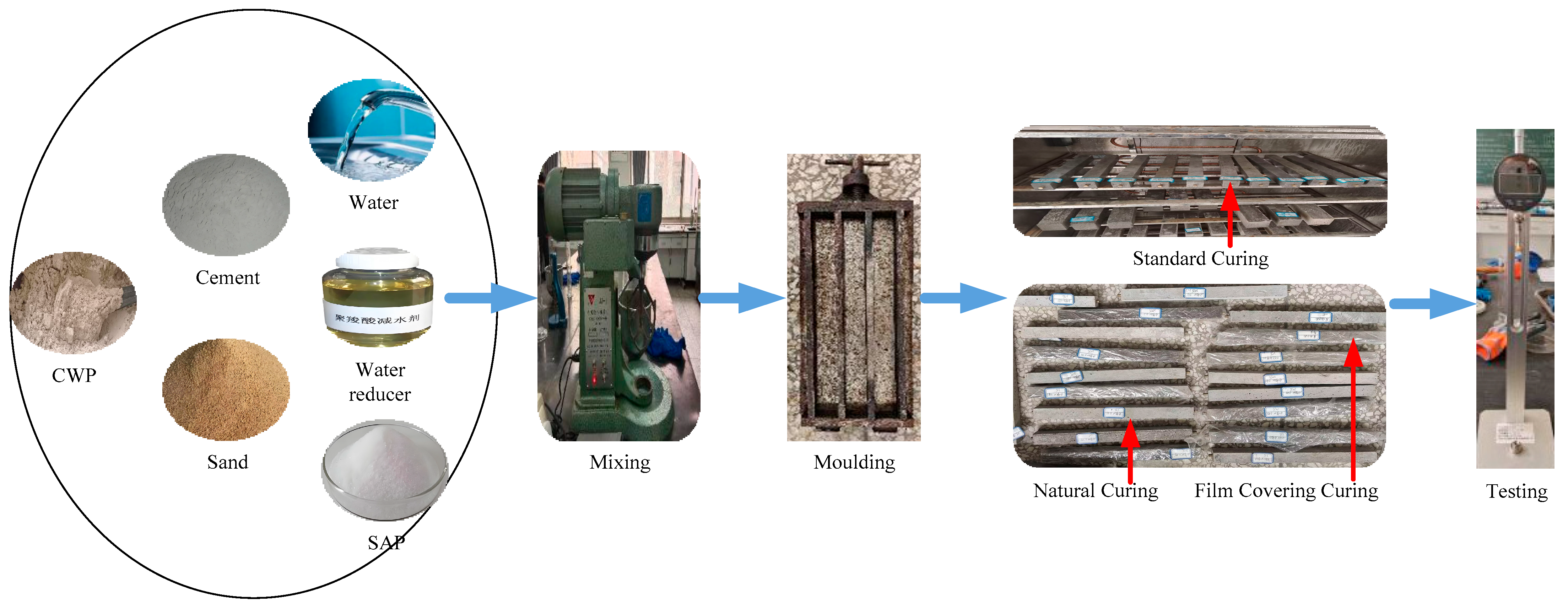
Under conditions of relatively low relative humidity, cement-based mortar specimens undergo volume shrinkage due to water loss. Several methods can be used to measure this phenomenon, such as the resistance strain method [17], the optical method [18], and the length change method [19]. In this experiment, the length change method was adopted. Specimens for the drying shrinkage test were cast in three-piece molds to form 25 mm × 25 mm × 280 mm prisms. The preparation and measurement process is shown in Figure 4. Length changes were measured using a BC-300 type comparator, which had a measuring range of 156 to 305 mm. The dial gauge on the instrument had a travel range of 0 to 10 mm and an accuracy (least count) of 0.01 mm. The specific test steps are as follows:
Figure 4.
Preparation process.
(1) Clean the mold thoroughly and apply a thin layer of lubricating oil evenly on the inner wall.
(2) After cleaning the nail head, insert it into the mold hole and rotate it left and right to ensure a precise fit between the nail head and the hole.
(3) Use the cement mortar mixer (see Figure 4) to mix the prepared mortar. For each CWP sample, replace 5%, 10%, and 20% of the cement by mass, and prepare three sets of mortar specimens following the same steps. Refer to the standard “Test Method for Cement Mortar Strength (ISO Method)” (GB/T17671-2021) [20] and prepare three 25 mm × 25 mm × 280 mm mortar specimens for each group.
(4) After the first layer is placed in the mold, use a small knife to scrape it flat, especially on the sides of the nail head. If necessary, remove the excess part.
(5) Then, starting from the inner side of the nail head, use a tamper to repeatedly strike 10 times, for a total of 20 strikes.
(6) After the striking is completed, use a small knife to push the mortar at the edge of the mold back into the mold, and scrape off the excess mortar outside the mold.
(7) Place the specimen in the YH-40B type standard constant temperature and humidity curing box for curing. After 24 h, remove the mold, and cure it in outdoor conditions, using outdoor film curing and standard curing (see Figure 4). The curing temperature of the curing box is (20 ± 2) °C, and the relative humidity is not less than 90%.
(8) Measure the initial length Lt: at ages of 1 d (demolding), 3 d, 7 d, 14 d, and 28 d, a total of 5 times, and calculate the drying shrinkage rate according to Formula (1).
where εt is the drying shrinkage rate at age t and t is calculated from the measured initial value.
L0—is the micrometer reading at age t, mm.
Lt—the initial micrometer reading of the specimen, mm.
Lb—the measured gauge length of the specimen, mm.
2.4. Microstructure Characterization
The morphology and hydration characteristics of CWP particles were investigated using a scanning electron microscope (SEM), equipped with an electro-cooled energy dispersive spectrometer (resolution 129 eV @ Mn Kα), the elemental analysis range is from beryllium (Be, atomic number 4) to uranium (U, atomic number 92). The analysis was conducted with a Nova NanoSEM 450 field emission scanning electron microscope (FEG-SEM), manufactured by FEI Company (now part of Thermo Fisher Scientific, Philadelphia, PA, USA). This instrument enables ultra-high-resolution microscopic observation and analysis of solid samples under both high-vacuum and low-vacuum conditions.
Key technical specifications:
Resolution: High-vacuum mode, 1.0 nm (at 15 kV accelerating voltage), 1.8 nm (at 1 kV), 0.8 nm (at 30 kV); Low-vacuum mode, 1.5 nm (at 10 kV), 1.8 nm (at 3 kV).
Accelerating voltage range: 200 V–30 kV, continuously adjustable.
Magnification range: 10×–800,000× (digital magnification).
Electron beam current range: 0.3 pA–100 nA.
Standard sample magnification range: 40×–400,000× (optical magnification).
3. Results and Discussion
3.1. Influence of CWP Content on Drying Shrinkage
3.1.1. Dry Shrinkage Variation Characteristics of Cement-CWP Composite Mortar
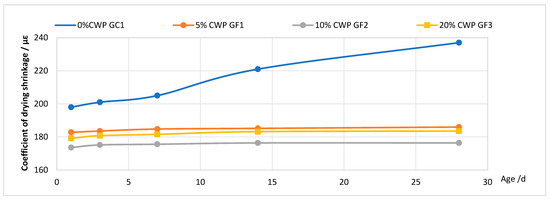
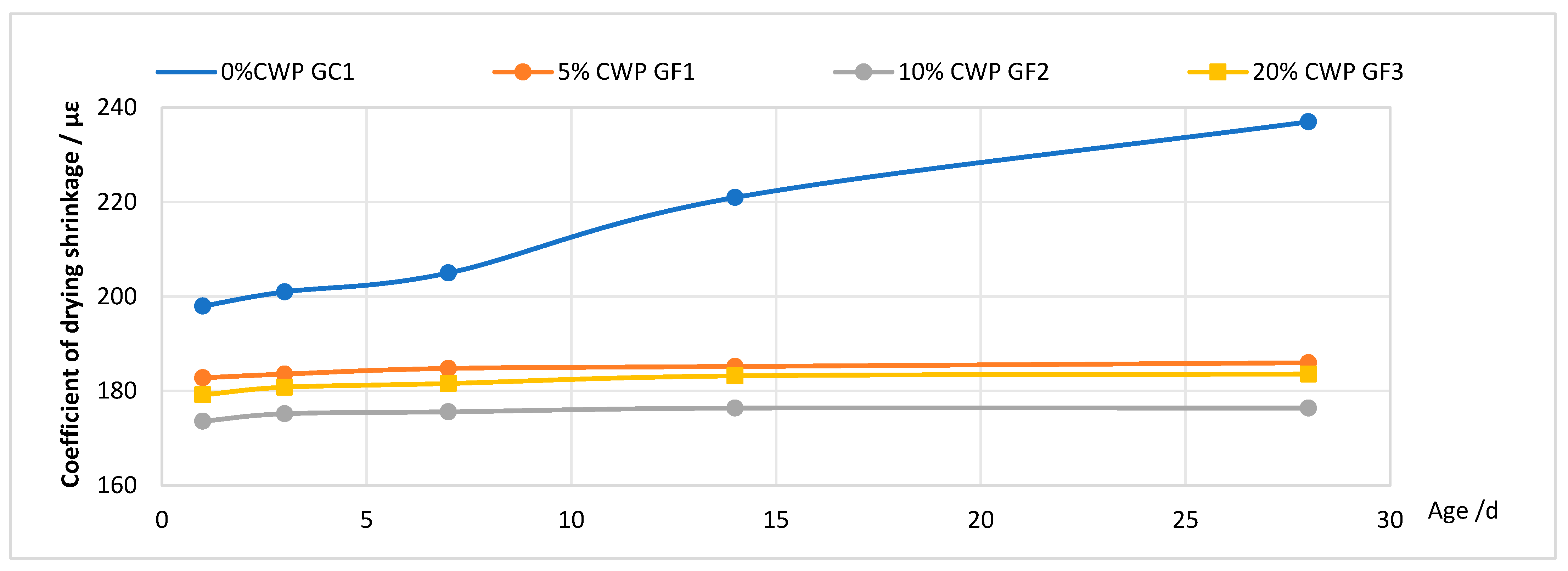
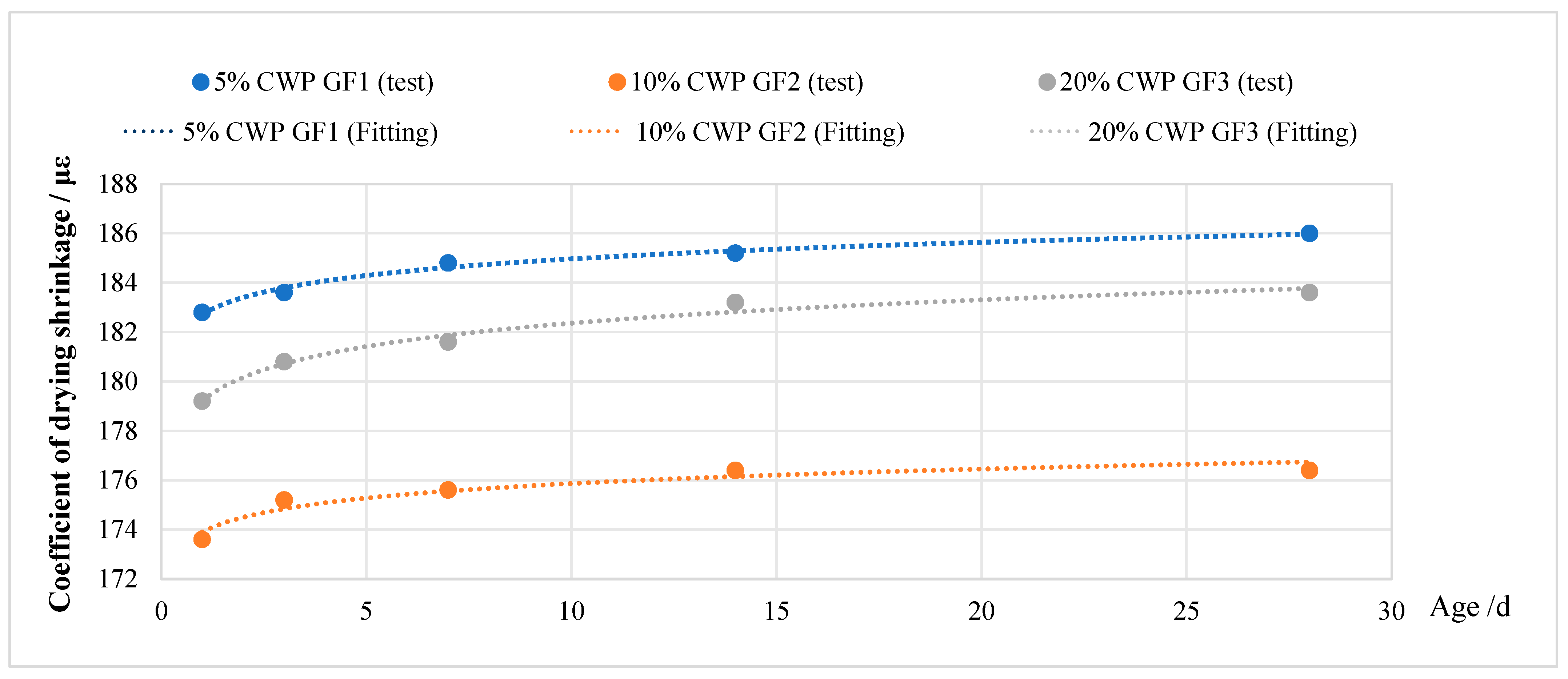
Under a fixed water-binder ratio of 0.50, the dry shrinkage rates of cement composite mortar with varying CWP content (5%, 10%, 20%) exhibit distinct stage-wise evolution over 28 days of curing (Figure 5). Compared to pure cement mortar, incorporating 5–20% CWP reduces dry shrinkage by 4.87–14.3 με. It is particularly important to note that the comparison between GF1 and GF3 shows that the measured process of the shrinkage change and the final strain values are 185.9 με and 183.8 με, respectively, which are very close. The reason is that the incorporation of CWP leads to two effects: filling and volcanic ash reaction [21,22]. This process significantly alters the pore structure and shrinkage evolution of the system. Firstly, due to its low activity, adding CWP will definitely produce the filling effect. Compared with 10% CWP in GF2, there is a more favorable dosage point. Too little or too much CWP will affect the content of hydration products and the filling of pores, with too little having limited volcanic ash reaction and too much affecting the hydration of cement due to the increase in the free water adsorbed, thereby significantly influencing the shrinkage behavior. Therefore, the similarity between GF1 and GF3 precisely highlights that the exertion of volcanic ash activity of CWP requires an appropriate dosage to become the more dominant factor influencing the shrinkage behavior. When this active component is lacking in the system, the macroscopic influence on shrinkage under this experimental condition is not significant.
Figure 5.
Variation in dry shrinkage of cement-CWP composite mortar with time under different CWP contents.
The shrinkage process can be systematically divided into three phases:
- 1.
- Early Stage (1–3 days)
Intense hydration reactions dominate, accompanied by significant internal moisture evaporation and autogenous drying, driving rapid shrinkage development [22]. The 10% and 20% CWP groups exhibit accelerated early shrinkage rates (1.6 με/d), with shrinkage values increasing from 173 με to 175 με and 179 με–181 με, respectively. In contrast, the 5% group demonstrates the slowest progression (0.8 με/d), with shrinkage rising marginally from 183 με to 184 με. This suggests that moderate CWP content (10%) optimizes early hydration product formation and pore structure, while excessive addition (20%) may increase water demand and internal porosity due to fine particle accumulation and unreacted material, exacerbating early moisture loss [23].
- 2.
- Intermediate Stage (3–14 days)
Shrinkage rates decline sharply as hydration stabilizes. The 10% group achieves exceptional stability, with shrinkage increasing minimally from 175 με to 176 με at a rate of 0.11 με/d (the lowest among all groups), indicating rapid microstructural densification [23]. The 20% group shows a relatively higher rate (0.24 με/d), reaching 183 με, reflecting slower structural consolidation. The 5% group also decelerates significantly (0.13 με/d), with shrinkage rising to 185 με.
- 3.
- Late Stage (14–28 days)
Shrinkage approaches stagnation across all groups, reflecting final structural equilibrium. The 10% group fully stabilizes by 14 days (176 με, zero growth rate), confirming optimal long-term volume stability. The 5% group gradually increases to 186 με (0.06 με/d), while the 20% group reaches 184 με (0.03 με/d), both nearing equilibrium.
3.1.2. Dry Shrinkage Evolution and Mechanism Analysis of Cement-CWP Composite Mortar
Throughout the 28—day period, the 10% CWP group consistently exhibits the lowest dry shrinkage and earliest stabilization, highlighting superior early structural integrity and shrinkage resistance. The data reveal a critical trend: shrinkage rates diminish with curing age, but an optimal CWP dosage exists. The 10% addition likely balances micro-aggregate filling and pozzolanic activity [24].
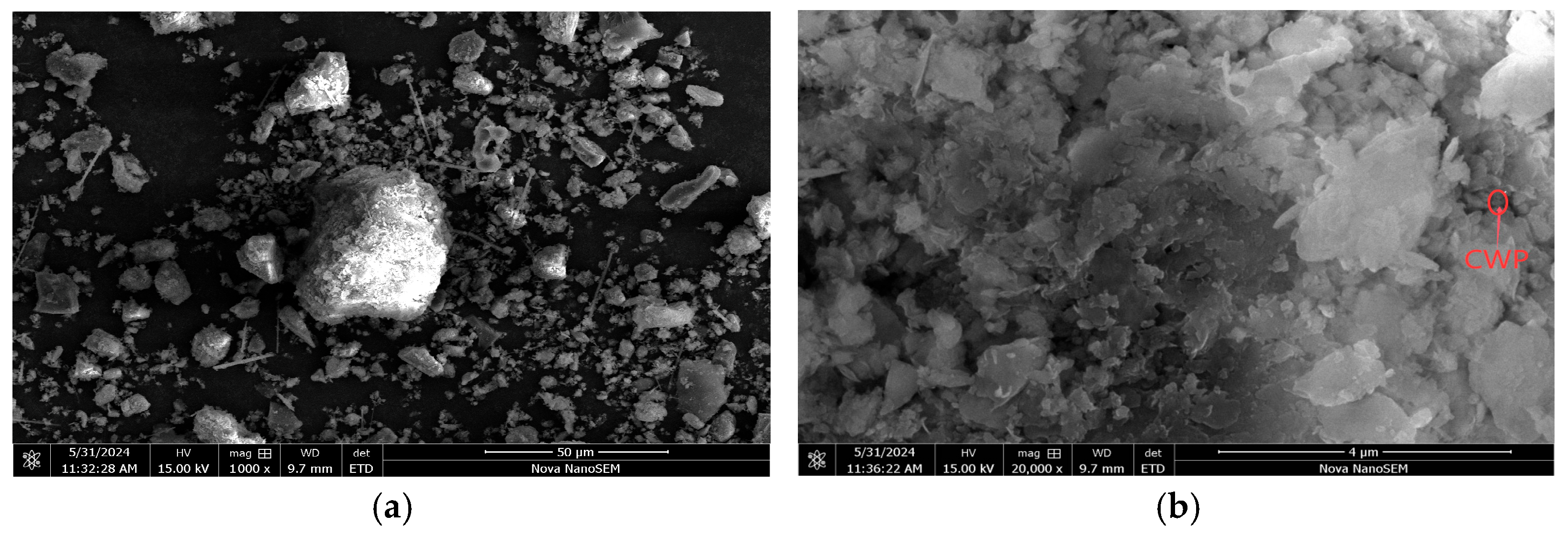
- Micro-Aggregate Filling: In the 10% CWP sample, the fine CWP particles fill inter-granular voids in the early stage of hydration (Figure 6), reducing porosity and optimizing pore structure, thereby minimizing moisture migration pathways and shrinkage driving forces [25].
Figure 6.
Micro-filling effect of CWP particles. (a) Original CWP particles; (b) CWP particles in the pores.
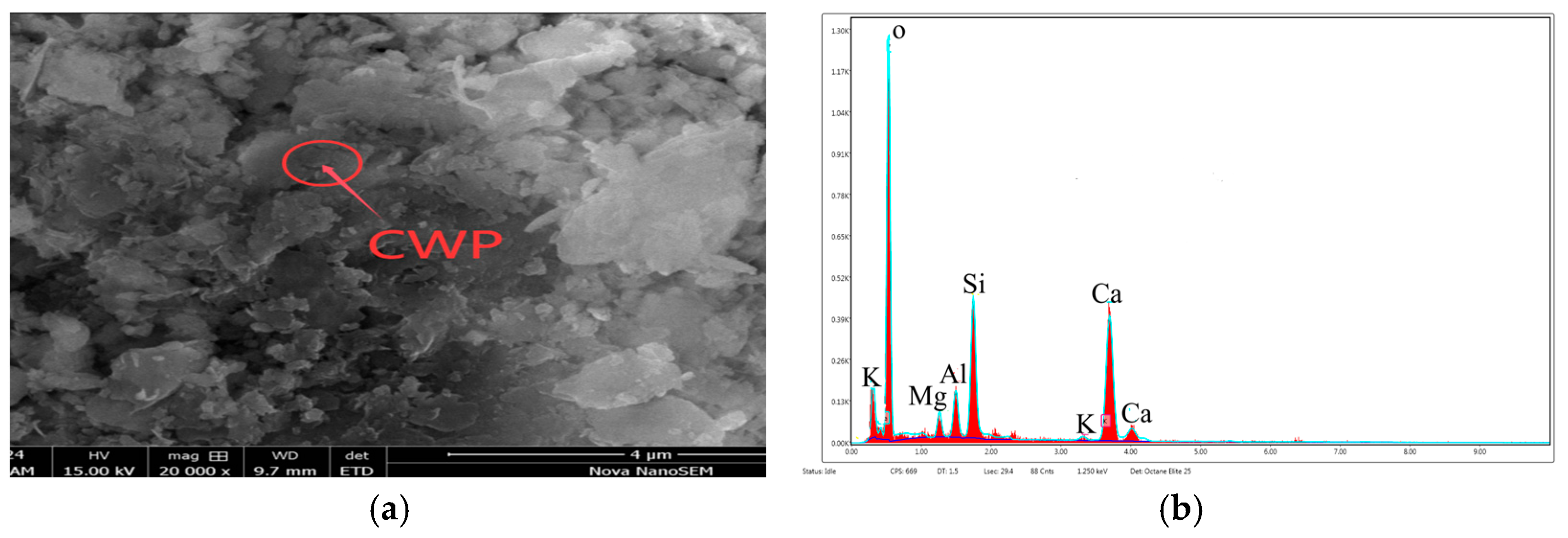
- Pozzolanic Reaction: A greater amount of hydration gels were formed on the CWP surface, during the late stage of hydration (Figure 7). Active components react with hydration products, generating supplementary C-S-H gel, enhancing densification and early strength, which collectively inhibit shrinkage [26]. This improvement in the microstructure effectively reduces the complexity of the water evaporation path and enhances the constraint of the matrix on shrinkage.
Figure 7.
Pozzolanic effect of CWP particles. (a) Partially hydrated CWP particles; (b) spectrogram of hydrated CWP particles.
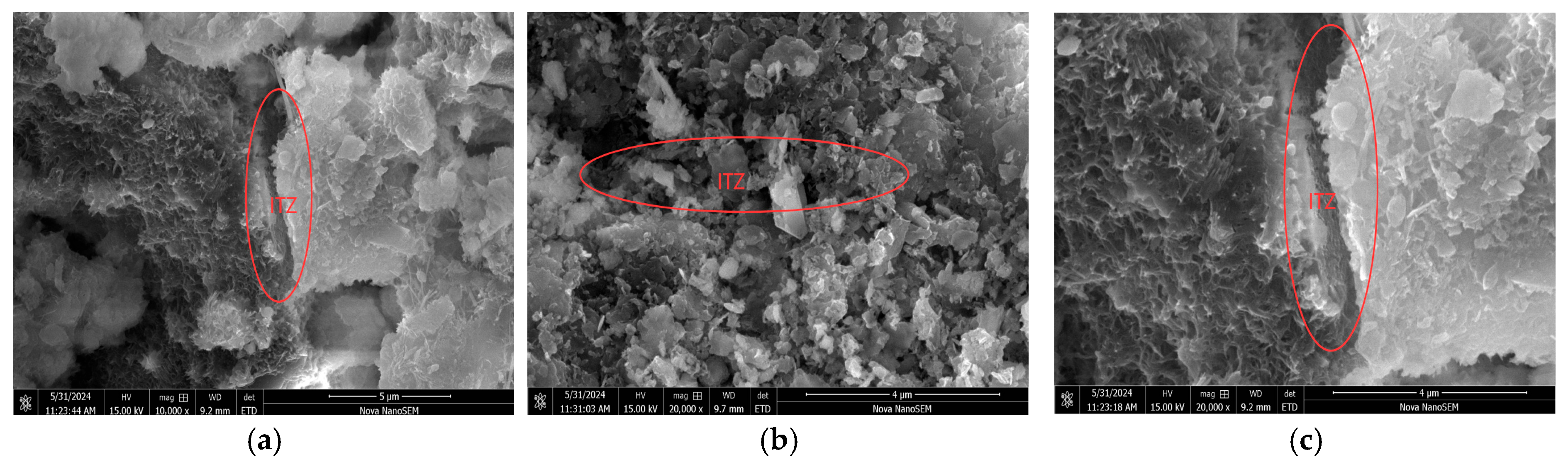
- Dosage Effects: We have polished samples with 0%, 10%, and 20% CWP content and used the backscatter electron (BSE) mode of the scanning electron microscope (SEM) to perform high-resolution imaging of the interface transition zone (ITZ) between the CWP particles and the cement paste matrix (Figure 8). The images clearly show that compared with the control group and the 10% concentration group, the ITZ region of the 20% CWP concentration sample has more significant and continuous microcracks. At the same time, the morphology of the hydration products in this region is also more porous. These morphological features directly visualize the existence of “weak bonding effect”. Excessive content (20%) may elevate water demand or dilute the cementitious matrix, impairing early hydration network strength and prolonging shrinkage stabilization.
These findings provide a pivotal reference for optimizing CWP utilization in developing low-shrinkage, high-stability cementitious materials.
Figure 8.
Dosage effect of CWP particles. (a) Non-additive Portland cement; (b) 10% CWP content; (c) 20% CWP content.
3.2. Influence of Water to Binder Ratio on Drying Shrinkage
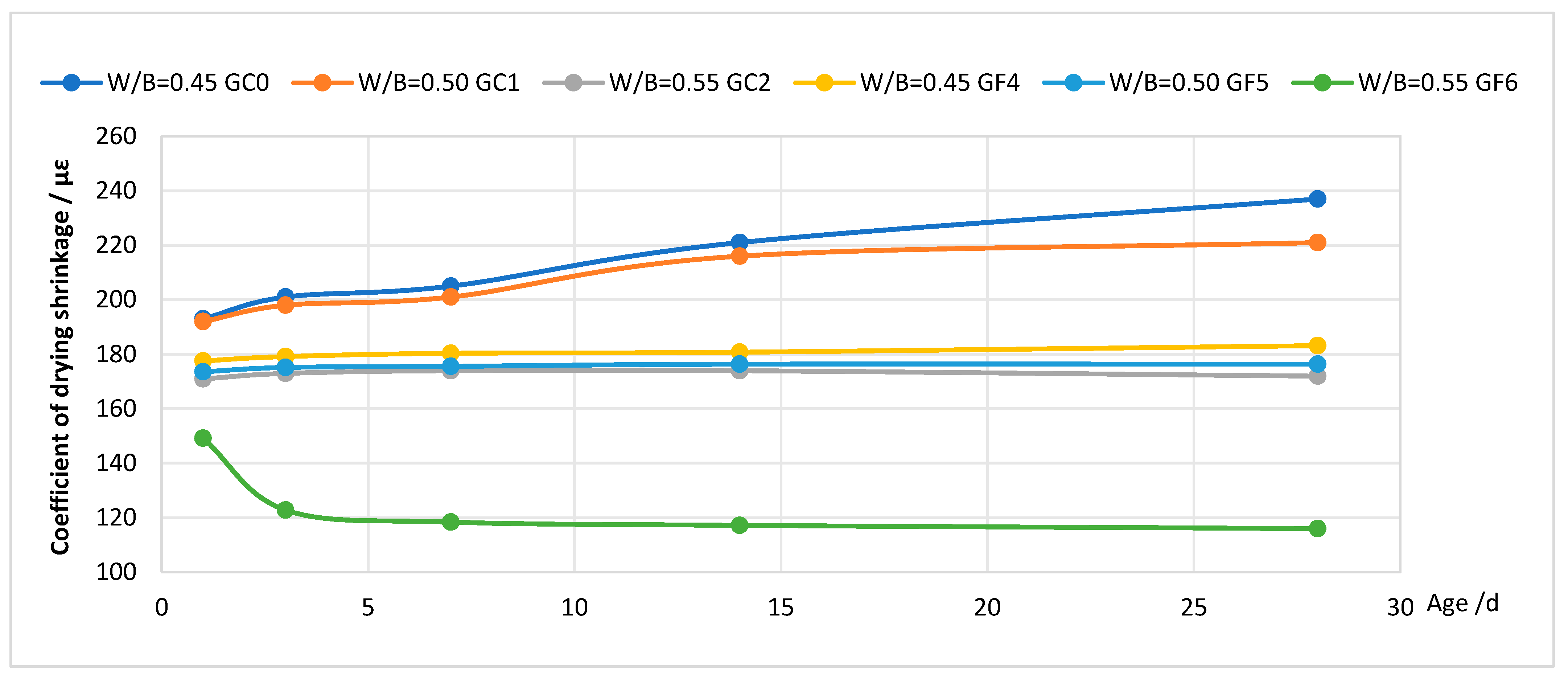
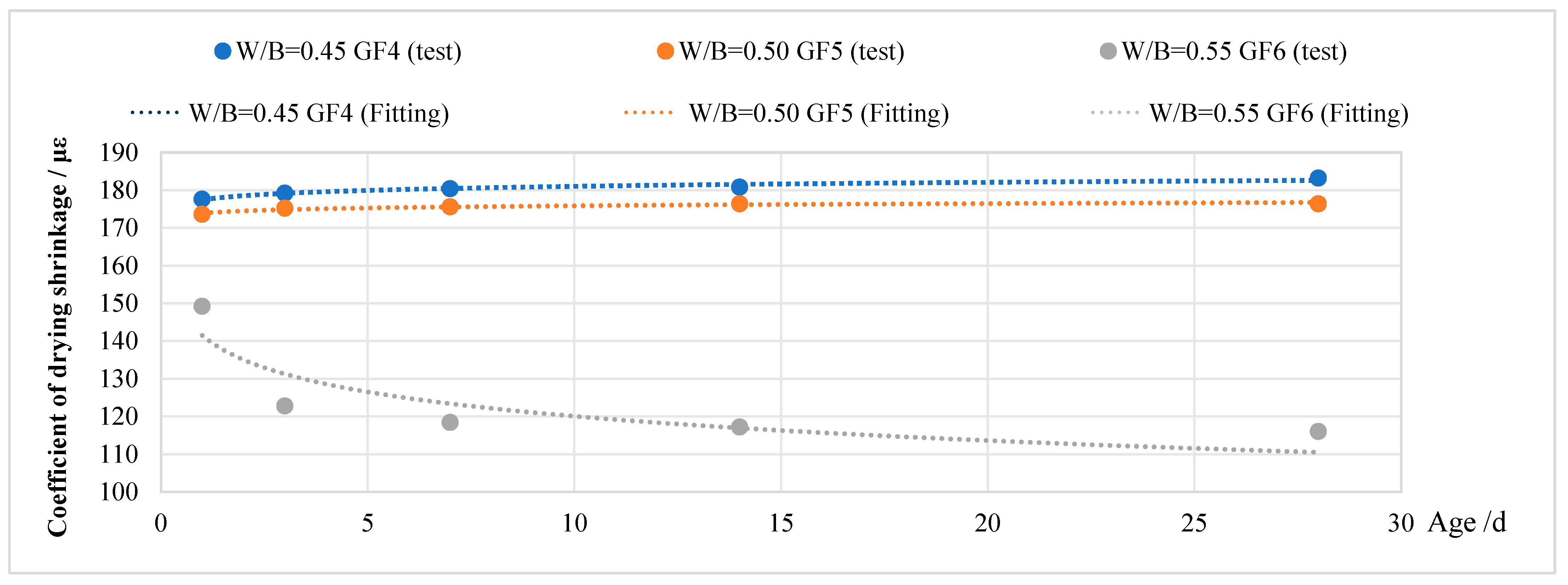
Figure 9 shows the drying shrinkage development of cement-CWP mortar at different water-binder ratios (Abbreviated as W/B): 0.45, 0.50 and 0.55. Generally, the drying shrinkage decreases significantly with increasing water-binder ratio, and its influence is far greater than that of curing age.
Figure 9.
Drying shrinkage of cement-CWP mortar under different water-cement ratios with age.
3.2.1. Time-Dependent Characteristics of Drying Shrinkage
The drying shrinkage of cement-CWP mortar exhibited stage-dependent behaviors during the 28-day curing period, which can be categorized into three phases based on shrinkage development rates (Figure 9):
- 1.
- Early Stage (1–3 days)
Specimens with water-to-binder ratios (W/B) of 0.45 and 0.50 showed minimal shrinkage increments, with values increasing from 177.6 με to 179.2 με and 173.6 με to 175.2 με, respectively, at a rate of 0.8 με/d. In contrast, the W/B 0.55 specimen exhibited a rapid negative shrinkage rate (−13.2 με/d), with values decreasing from 149.2 με to 122.8 με, indicating significant early-stage volume rebound or structural adjustment.
- 2.
- Intermediate Stage (3–14 days)
Shrinkage rates for W/B 0.45 and 0.50 specimens decelerated to 0.15 με/d and 0.11 με/d, respectively, entering a near-stagnation plateau. The W/B 0.55 specimen continued to shrink (122.8 με to 117.2 με) but at a reduced rate (−0.51 με/d).
- 3.
- Late Stage (14–28 days)
The W/B 0.45 specimen resumed slight growth (0.17 με/d), reaching 183.2 με at 28 d, while the W/B 0.50 specimen stabilized (0 με/d). The W/B 0.55 specimen further decreased to 116 με at 0.08 με/d, demonstrating structural stabilization.
3.2.2. Critical Effect of Water-to-Binder Ratio and Mechanism Analysis
The experimental results revealed a threshold effect of W/B on drying shrinkage:
- Low W/B Range (0.45–0.50): The 28-day drying shrinkage values remained stable at 176.4–183.2 με, with a 43.8–53.8 με reduction compared to ordinary cement mortar. The negligible shrinkage fluctuations suggested a dense internal structure with low porosity, where capillary tension dominated drying shrinkage, rendering the process insensitive to W/B variations [27].
- High W/B Range (>0.50): A sharp decline in drying shrinkage occurred at all ages. The 28-day shrinkage value dropped from 176.4 με (W/B 0.50) to 116 με (W/B 0.55), a 34.2% reduction, exhibiting a strong negative correlation. This phenomenon was attributed to:
- (i)
- Increased free water content reducing capillary negative pressure from evaporation and self-desiccation, thereby decreasing drying shrinkage driving force [28];
- (ii)
- Enlarged pore dimensions due to excess water, weakening capillary force effects. Notably, the near-perfect overlap of shrinkage curves across curing ages and their minimal variations confirmed that W/B was the dominant factor controlling drying shrinkage in this system, outweighing the influence of curing time.
3.3. Influence of Curing Conditions on Drying Shrinkage
3.3.1. Dry Shrinkage Rate Under Different Curing Conditions
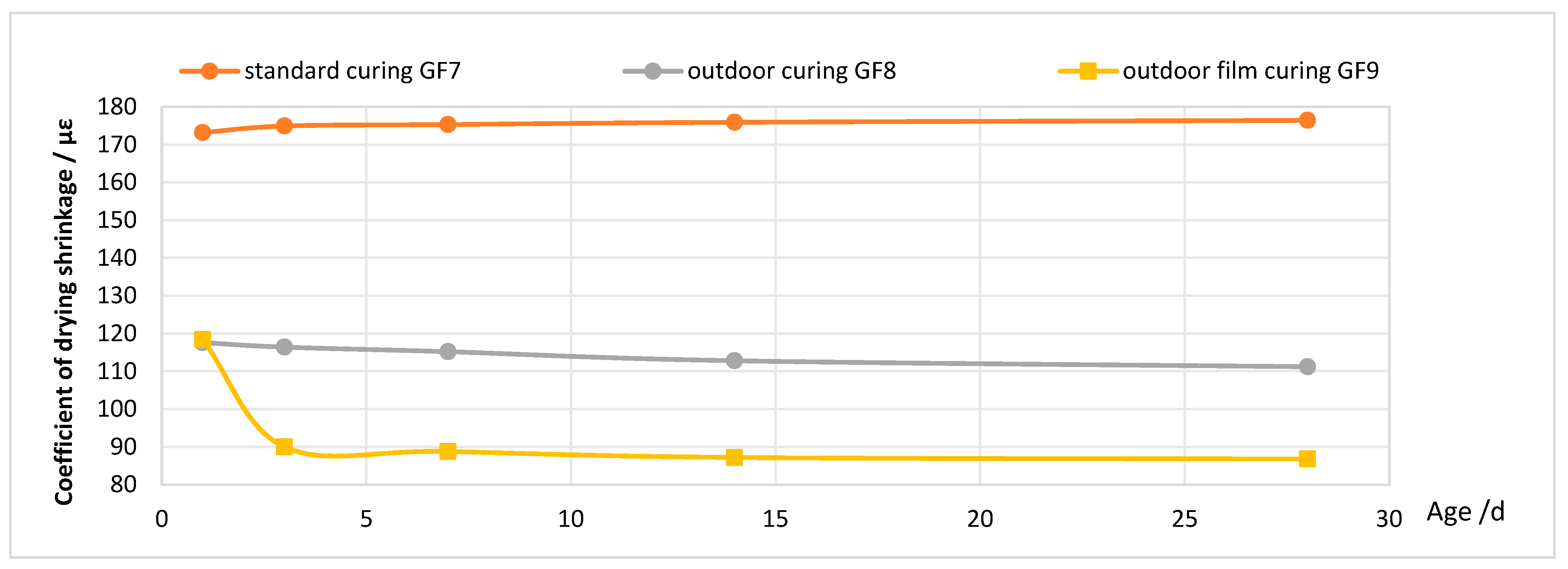
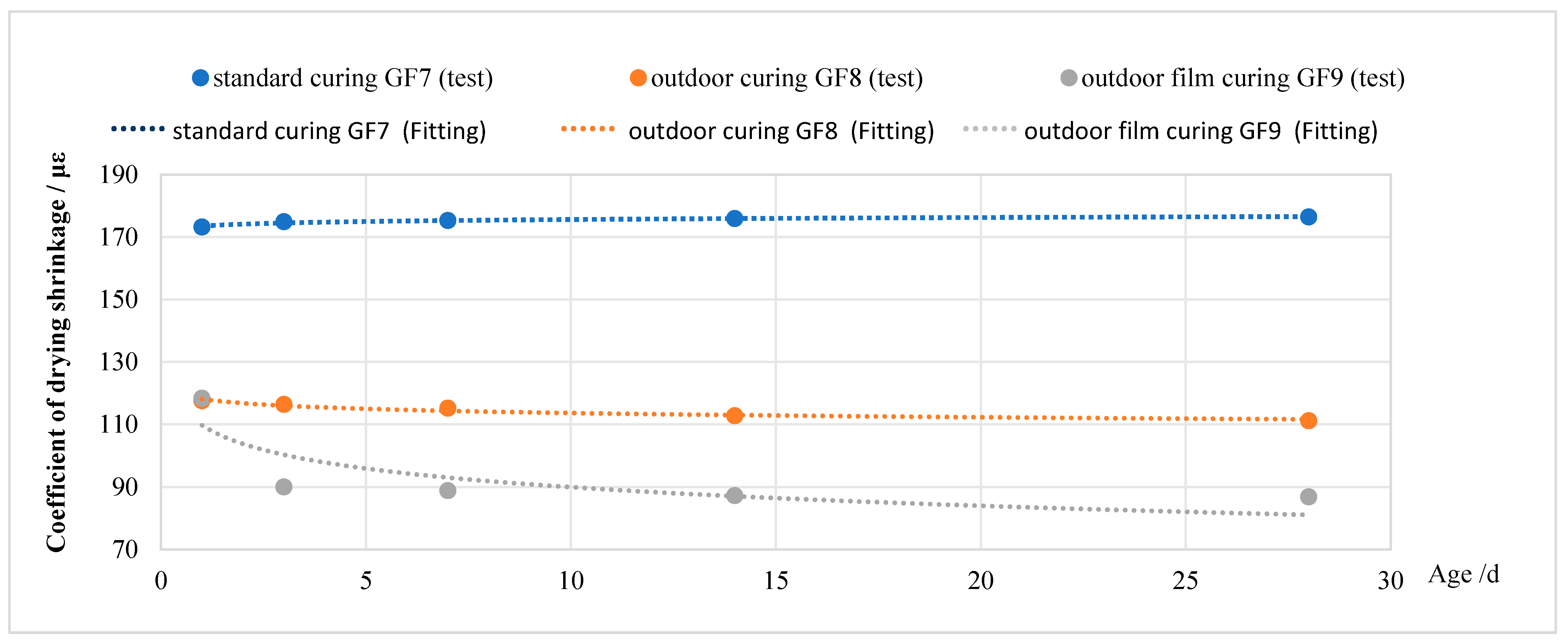
Under identical curing ages, the dry shrinkage rates exhibited significant variations among the three curing regimes (Figure 10). Standard curing consistently yielded the highest shrinkage values at 3 d, 7 d, and 28 d, surpassing those of other conditions. This phenomenon can be attributed to the stable environment of constant temperature (20 ± 2 °C) and high humidity (RH ≥ 95%), which promotes complete and sustained hydration reactions. The resultant microstructural rearrangement of hydration products amplifies drying shrinkage [29].
Figure 10.
Drying shrinkage of cement-CWP mortar under different curing conditions with age.
In contrast, outdoor curing demonstrated moderately lower shrinkage rates than standard curing. The diurnal fluctuations in temperature and humidity in natural environments likely moderated moisture evaporation, preventing “over-hydration” and internal saturation that could otherwise exacerbate shrinkage [30]. Notably, outdoor film curing exhibited the most effective shrinkage inhibition, with the lowest shrinkage rates at all ages. Specifically, its 28 d dry shrinkage rate (86.8 με) was 25.2% and 22.0% lower than that of standard curing (116 με) and outdoor curing (111.2 με), respectively. This highlights the superior moisture retention capacity of plastic film, which forms a physical barrier to minimize internal moisture loss and thereby suppress drying shrinkage.
3.3.2. Time-Dependent Shrinkage Development and Mechanisms
Across all curing conditions, dry shrinkage rates decreased with prolonged curing age, indicating enhanced structural densification and improved resistance to deformation. However, the temporal evolution patterns diverged significantly among regimes.
Standard curing followed a “sharp initial decline, gradual stabilization” trajectory. During early stages (1–3 d), shrinkage rates dropped markedly due to high porosity and permeability, facilitating rapid moisture migration under stable temperature-humidity gradients [27]. In later stages, increased hydration product formation and reduced permeability slowed shrinkage progression, though rates remained elevated [31].
Outdoor curing exhibited a “slow, uniform decline” trend, with shrinkage rates consistently lower than those of standard curing. The open-air environment, subject to natural climatic factors (e.g., wind speed, solar radiation, humidity) [30], enabled more balanced moisture evaporation, avoiding abrupt humidity fluctuations and thus mitigating shrinkage intensity.
Outdoor film curing displayed a “rapid initial suppression, long-term stable low shrinkage” pattern. This technology operates through a “external prevention and internal supplementation” synergy mechanism.
(1) The most direct effect of film curing is to form a dense physical isolation layer on the concrete surface. This film effectively blocks the direct and rapid evaporation channel of water from the surface of freshly mixed concrete to the dry and windy outdoor environment. This blocking effect produces two key effects: Firstly, it significantly reduces the early water evaporation rate of the concrete, thereby directly weakening the main driving force of drying shrinkage—the negative pressure (capillary tension) formed by the concave-convex surface due to water loss from capillary pores. Secondly, it creates a relatively high-humidity micro-environment on the surface of the concrete component. Even if the external humidity is low, this film can maintain a relatively high relative humidity in the surface area of the component during the early hydration critical period, delaying the formation of the humidity gradient and reducing the concentration of shrinkage stress caused by the uneven humidity gradient [30].
(2) The super absorbent polymer (SAP) introduced in this study is the key material for achieving the “internal replenishment” function. During the mixing stage, SAP absorbs and stores a large amount of mixing water. During the concrete hardening process, as the cement hydration continues, the relative humidity of the internal pores begins to decrease. At this time, SAP particles sense the decrease in humidity and start to slowly and continuously release the stored water to the surrounding cement matrix. This process is called “internal curing” or “self-curing”. This internal water replenishment has multiple positive effects: Firstly, it continuously provides water to the unhydrated cement particles, promoting the subsequent hydration process, generating more hydration products (such as C-S-H gel), thereby filling the pores, reducing pore diameters, and making the structure more dense. Secondly, it effectively maintains a high internal relative humidity within the system, weakening the capillary tension contraction mechanism shared with dry shrinkage [32].
Shrinkage rates dropped sharply in early stages and stabilized at a low level, underscoring the film’s exceptional moisture retention [33]. By effectively delaying or preventing rapid moisture loss, the film suppressed shrinkage drivers early, facilitating rapid transition to a low-deformation stable state. The influence of curing conditions on the drying shrinkage of cement-CWP composite mortar is fundamentally governed by their capacity to regulate moisture loss rates and internal humidity retention. Under standard curing (20 ± 2 °C, RH ≥ 95%), the stable environment accelerates early-stage drying, permitting full development of shrinkage due to enhanced hydration reaction continuity and microstructural rearrangement. In contrast, outdoor curing exhibits moderated shrinkage due to diurnal fluctuations in temperature and humidity, which balance moisture evaporation and prevent excessive internal drying. This phenomenon aligns with findings in other cementitious systems [34]. For instance, steam curing regimes critically determine material strength and shrinkage behavior by altering hydration kinetics. Additionally, while supplementary cementitious materials (SCMs) such as silica fume enhance mechanical properties, their incorporation may inadvertently increase drying shrinkage due to accelerated pore refinement and heightened internal stress.
4. Establishment of the Drying Shrinkage Model
4.1. Commonly Used Drying Shrinkage Models
To quantify drying shrinkage in cementitious materials, both empirical and mechanistic models have been proposed. Three representative models are introduced below:
- ①
- GL2000 Model
Proposed by Gardner and Lockman (2000) [34], the GL2000 model is an extension of the ACI209 committee’s framework for predicting shrinkage and creep in conventional concrete. Its main appeal lies in offering simplified calculations with fewer input parameters, notably by eliminating the need to consider curing regime, casting temperature, or the effects of chemical/mineral admixtures. This simplification enhances its practicality for preliminary engineering estimates under standard conditions. However, this very simplicity may limit its predictive accuracy for complex, non-standard materials or under coupled environmental-mechanical loading scenarios. For instance, in cementitious systems containing pozzolans (e.g., fly ash, slag), which alter the hydration kinetics and microstructure, the standard ACI model and its derivatives often require significant adjustment or correction factors to achieve reliable predictions. The model is expressed as Formula (2):
where —Drying shrinkage strain at time t; —Maximum shrinkage strain; τ—Time constant related to material drying rate; n—Shape parameter.
- ②
- ACI 209 Model
The ACI 209 model, developed by the American Concrete Institute Committee 209 [35], is a widely used semi-empirical framework for predicting the time-dependent evolution of drying shrinkage (and creep) in concrete. It provides a practical basis for engineering design and mix proportion optimization under standard conditions, with formulations that account for different curing regimes (e.g., moist-cured vs. steam-cured).
However, its reliance on a limited set of input parameters, while advantageous for simplicity, inherently restricts its ability to model complex physicochemical interactions in modern cementitious systems. Research indicates that for concrete containing supplementary cementitious materials (SCMs) like fly ash or slag, which alter hydration kinetics and microstructure, the standard ACI model often requires significant adjustments or correction factors to achieve reliable predictions. This limitation is particularly pronounced for materials like stabilized bases, where performance degradation is governed by coupled transport-mechanical processes (e.g., capillary suction and chemical dissolution) that are not explicitly captured by the model. Therefore, its application to such non-standard or multi-physics coupling scenarios necessitates careful validation and potential mechanistic enhancement. The model Equations (3) and (4) vary by curing condition:
where —Shrinkage strain at time t; —Maximum shrinkage strain; t—Curing period; —Initial measurement age of shrinkage.
- ③
- Asymptotic Model
Saeid Babaei et al. proposed a pore network—asymptotic coupling model [36], which represents an important transition from macroscopic phenomenological descriptions to microscopic mechanism-driven predictions. It links the microscopic physical and chemical processes (such as cement hydration, self-drying) with the macroscopic shrinkage strain by simulating the transport and phase change in water in the capillary pore network. This method provides a new approach to addressing the limitations of traditional models in predicting the long-term performance of concrete containing supplementary cementitious materials or special cements (such as sulphoaluminate cement). For example, traditional models like GL2000 often require the introduction of correction coefficients when applied to concrete containing fly ash, slag, or silica fume. However, the mechanism model is expected to achieve more universal predictions by characterizing the fundamental changes in these materials to the hydration kinetics and pore structure. The expression is presented below in Formula (5):
where —Shrinkage strain at time t; A—Final stable strain; B—initial strain offset; k—Decay constant, governing shrinkage rate and linked to pore structure and moisture diffusivity.
4.2. Model Comparison and Selection
The GL2000 model is a semi-empirical model developed on the basis of extensive engineering practice. Its most notable advantage lies in its outstanding prediction accuracy for concrete systems containing supplementary cementitious materials such as slag and fly ash [37]. By simplifying input parameters, the model has good engineering practicality under standard conditions. It should be noted that the GL 2000 model includes a parameter for the volume fraction of aggregates, and its influence is partially embedded in the overall material stiffness indirectly reflected by the concrete strength. The strength of mortar is usually higher than that of the pure cement paste with the same water-cement ratio but lower than that of concrete. This to some extent reflects the reinforcing (constraining) effect of fine aggregates on the paste. However, we admit that this implicit consideration may not be precise enough. Directly applying the original GL 2000 model to predict the shrinkage of mortar may lead to systematic deviations. We mainly use its prediction results as a reference for trend comparison rather than an absolutely precise prediction. Some studies have evaluated the shrinkage model of self-compacting concrete (SCC, which has a high mortar content) and have also explored the performance of models such as GL 2000 in systems containing high proportions of fine particles (including mineral admixtures and fillers) [29]. This provides an indirect reference for applying such models to systems with high cement content (such as the mortar in this study).
The ACI209 model is a widely adopted framework that provides a solid foundation for performance estimation under standard conditions. It offers specific formulas for different curing conditions, such as steam curing and standard curing, and incorporates various environmental and material correction factors, demonstrating its responsiveness to the demands of engineering practice [38]. However, its reliance on a limited number of input parameters, while ensuring simplicity, also limits its ability to fully characterize the complex physicochemical interactions in modern cementitious material systems, restricting its application in non-standard and complex material systems.
Asymptotic analysis is a mathematical method used to study the long-term behavior of a system as time approaches infinity or when a certain parameter approaches a limit. In shrinkage prediction, it is often used to analyze the final stable value (i.e., the asymptotic shrinkage value) of the shrinkage over time. Represented by the pore network-asymptotic coupling model proposed by Saeid Babaei et al., such models mark a significant shift from macroscopic phenomenological descriptions to microscopic mechanism predictions [39]. The core innovation lies in dynamically linking key microscale mechanisms (such as hydration and self-drying) with macroscopic shrinkage strain through numerical simulation of water transport and phase change in the capillary pore network.
In a comprehensive comparison, the high-precision potential of the GL2000 model in cementitious material systems with admixtures and the mechanistic advantages of asymptotic models in simulating multi-scale, time-dependent physical processes are most compatible with the performance prediction requirements of the cement-CWP composite mortar in this study. The application of classical asymptotic theory has its limitations. For example, it assumes that the system dynamics are time-invariant, while the drying shrinkage of cement-based materials is a complex, non-autonomous process closely coupled with the constantly changing internal humidity field. Therefore, we mainly used asymptotic analysis to quantitatively describe the stable stage of shrinkage observed in the experiments.
Therefore, this study selects the asymptotic model and the GL2000 model for in-depth comparative analysis and experimental verification.
4.3. Cement-CWP Composite Mortar Drying Shrinkage Prediction Model
To evaluate the predictive performance of the proposed asymptotic model for concrete dry shrinkage, a comparative analysis was conducted against the widely recognized GL2000 model. Both models were fitted to the experimental data using MATLAB R2020a software. The fitting procedure and evaluation metrics are detailed as follows:
(1) Data Preprocessing and Import
The experimental data, comprising concrete curing age (independent variable) and measured shrinkage strain (dependent variable), were imported into the MATLAB workspace. The xlsread function was utilized to read data from structured spreadsheet files, ensuring accurate data transfer. The curing age data were stored as a vector t, and the corresponding shrinkage strain data were stored as vector . Prior to fitting, a preliminary data quality check was performed to identify and handle any potential outliers or missing values, thereby ensuring the reliability of the subsequent analysis.
(2) Model Function Definition
Two distinct mathematical models were defined within the MATLAB software, version R2025b for the curve-fitting process:
① GL2000 Model: This empirical model, incorporates multiple influencing factors such as time, concrete composition, member size, and ambient relative humidity into its formulation. Its complexity aims to provide a general prediction for concrete shrinkage.
② Asymptotic Model: The newly proposed model in this study features a mathematical structure designed to capture the time-dependent evolution of shrinkage strain. It primarily involves parameters defining the asymptotic value (ultimate shrinkage) and the rate constant governing the progression towards this asymptote.
(3) Parameter Estimation and Curve Fitting
Nonlinear least squares fitting was employed to estimate the optimal parameters for each model. The lsqcurvefit function in MATLAB’s Optimization Toolbox was used for this purpose. The core of this optimization process is to minimize the objective function S(θ), defined as the sum of squared residuals (SSR) between the model-predicted shrinkage strain and the experimentally observed strain for all data points.
(4) Evaluation of Fitting Performance
The goodness-of-fit for both models was rigorously assessed. The optimal parameters obtained from lsqcurvefit were substituted back into their respective model functions to generate predicted shrinkage strain curves. A visual and quantitative comparison between these predictions and the original experimental data was conducted. The analysis of residuals (the differences between observed and predicted values) was performed to check for systematic biases. Furthermore, the coefficient of determination (R2) was calculated to quantify the proportion of variance in the experimental data explained by each model. A value of R2 closer to 1 indicates a superior fit. The finalized model parameters and the corresponding R2 values for the asymptotic model and the GL2000 model are summarized in Table 7 and Table 8, respectively.
Table 7.
Parameters of the asymptotic model and prediction results of drying shrinkage.
Table 8.
Parameters of the GL2000 and prediction results of drying shrinkage.
4.3.1. Analysis and Comparison of Existing Model Predictive Performance
This study evaluated the predictive performance of the asymptotic model and the GL2000 model for concrete drying shrinkage. Taking a specific mix proportion with a water-binder ratio (W/B) of 0.55 and a curing period of 3 days as an example, the measured drying shrinkage rate was 123 με. The analysis revealed that the asymptotic model predicted a value of 130 με, with a relative error of 5.70%, demonstrating high predictive accuracy (RMSE 6.08, MAE 4.34). In contrast, the GL2000 model yielded a predicted value of only 86 με, exhibiting a significantly higher relative error of 29.32% and substantial prediction bias (RMSE 80.78, MAE 80.54).
To further quantify the overall applicability of both models within the mix proportions tested in this study, the coefficient of determination (R2) between their predicted values and experimental data was calculated. The results indicated that the R2 values for the asymptotic model ranged from 0.7202 to 0.9922, suggesting good to excellent fit with the experimental data. However, the GL2000 model showed R2 values spanning from −80.7507 to 0.6585. Negative values in this range signify that, in certain cases, the model’s predictions were even less accurate than using the average of the measured data, indicating a negative correlation between model outputs and actual observations.
4.3.2. Development and Validation of a Novel Predictive Model
The GL2000 and ACI209 models are excellent general models designed to predict the long-term shrinkage and creep behavior of concrete after standard curing (typically after 28 days of age). However, numerous studies have shown that the volume deformation (especially the initial stage of drying shrinkage) of cement-based materials in the extremely early stage (such as within 24 h) and the early stage (within 28 days) after pouring exhibits significant differences from the long-term behavior. During this period, the hydration reaction is intense, the microstructure evolves rapidly, and the deformation rate is often very fast and highly nonlinear. Logarithmic functions or their variants can mathematically describe this phenomenon of rapid initial development followed by a gradual deceleration in rate. The derivative (deformation rate) of the logarithmic function is inversely proportional to time, which aligns with the physical intuition that the driving force of deformation due to rapid moisture loss and the rapid formation of hydration products gradually weakens. Our experimental data clearly show a good linear relationship between shrinkage strain and the logarithm of time, while fitting the early data with the GL2000 or ACI209 models results in systematic deviations (low R2). Therefore, from the perspective of data fitting accuracy and the accuracy of characterizing early behavior, the logarithmic model is a better choice.
To enhance the accuracy of drying shrinkage prediction, a new logarithmic model was proposed based on an analysis of the limitations of existing models. The mathematical expression for this model is presented below (Equation (6)):
where —Shrinkage strain at time t; A—Rate of change of shrinkage strain over time; B—initial strain offset.
The proposed logarithmic model was rigorously validated against the comprehensive experimental dataset. Specific predictive equations for each mix proportion were derived through parameter fitting, with the detailed parameters (95% confidence interval) and performance metrics—including the coefficient of determination (R2) and root-mean-square error (RMSE)—compiled in Table 9. To visually assess the fit, predicted curves were plotted against measured drying shrinkage data (Figure 11, Figure 12 and Figure 13). The results demonstrate that the model consistently achieved high predictive accuracy across all standard mixes, with R2 values exceeding 0.92, RMSE values less than 0.53 and MAE values less than 0.48 (indicating that over 92% of the data variance is explained by the model) and low RMSE values ranging between 0.1 and 1.0 με. Furthermore, the model’s predicted curves effectively captured the characteristic trend of drying shrinkage development, including the rapid initial increase followed by a gradual plateauing at later ages, which aligns well with the known physical behavior of the material [27,28].
Table 9.
Parameters and correlation indicators obtained using the logarithmic model.
Figure 11.
Comparison of measured and predicted dry shrinkage values of cement-CWP composite mortar with varying CWP contents.
Figure 12.
Comparison of measured and predicted dry shrinkage values of cement-CWP composite mortar with varying W/B.
Figure 13.
Comparison of measured and predicted dry shrinkage values of cement-CWP composite mortar with varying curing conditions.
It should be noted that the current logarithmic model shows good predictive accuracy under standard dry curing conditions for low W/B ratios (≤0.45) and medium W/B ratios (0.50). It is candidly pointed out that this model exhibits systematic deviations under film curing and high W/B conditions. The reasons for this are as follows: The film significantly alters the boundary conditions for water evaporation, causing the “timeline” of shrinkage development to be elongated. However, the model fails to capture the dynamic changes caused by the alteration of environmental conditions. More research is needed to further clarify this.
However, the validation also revealed specific boundary conditions where the model’s performance degraded, necessitating a discussion on its applicability limits. For mixes with high water-binder ratios (W/B ≥ 0.50) and those subjected to outdoor film curing, the predictive reliability was notably reduced. This suggests that the current model formulation, while robust for standard conditions, may not fully encapsulate the underlying mechanisms in these scenarios. For instance, higher W/B ratios likely lead to a more porous microstructure and different internal moisture kinetics, while film curing creates a distinct moisture barrier compared to open-air drying. These factors might not be adequately represented by the simple logarithmic time-dependence. Therefore, these conditions fall outside the current model’s validation scope and highlight areas for future model refinement.
A comparative analysis with the asymptotic model and the GL2000 model revealed significant improvements in both predictive accuracy and stability for the proposed logarithmic model. This superiority was particularly evident under standard curing conditions and outdoor curing (excluding film curing) for mixes with W/B < 0.50. The enhanced performance of the logarithmic model establishes it as a more reliable tool for predicting drying shrinkage under the material system and conditions investigated in this study.
The validation results confirm that the logarithmic model not only provides more accurate quantitative predictions but also better qualitatively represents the time-dependent shrinkage behavior of cement-CWP composite mortars. This combination of accuracy and physical interpretability makes the model particularly valuable for practical engineering applications in sustainable construction practices.
5. Conclusions and Future Perspectives
5.1. Key Findings and Material Design Implications
The drying shrinkage behavior of cement-CWP composite mortar exhibits significant dependence on three key factors: CWP content, water-binder ratio (W/B), and curing conditions. The experimental results demonstrate that:
- (1)
- CWP Content Optimization: The drying shrinkage rate initially decreases and subsequently increases with rising CWP content. A CWP content of 10% achieves optimal shrinkage inhibition, while higher proportions induce a “weak bonding” effect due to reduced mortar cohesion, leading to increased shrinkage rates.
- (2)
- Water-Binder Ratio Optimization: The drying shrinkage value transitions from stability to rapid reduction with increasing W/B. The minimum shrinkage value (116 με) is achieved at W/B = 0.55, indicating superior volume stability and crack resistance compared to ratios of 0.45 and 0.50. Therefore, a moderate increase in W/B is recommended as a technical strategy to enhance durability, provided that mechanical performance requirements are satisfied.
- (3)
- Curing Condition Optimization: Among standard curing, outdoor curing, and outdoor film curing, the latter demonstrates the most effective shrinkage control performance. Film curing maintains moisture retention, effectively reducing early-stage cracking and long-term deformation, thereby improving material durability.
- (4)
- Comprehensive Optimization Strategy: To optimize the mix design and reduce drying shrinkage, the following measures are recommended: increasing the W/B to 0.55; controlling CWP content at 10%; and implementing outdoor film curing. This combined approach can effectively reduce drying shrinkage and enhance material durability.
- (5)
- Shrinkage Modeling: A logarithmic shrinkage model effectively captures the time-dependent evolution of drying shrinkage, providing theoretical support for understanding the shrinkage behavior of cement-CWP composite mortar.
- (6)
- Based on the above findings, the following recommendations are proposed for industrial practice:
- Material Design and Selection: In engineering scenarios requiring high early strength and low drying shrinkage (e.g., prestressed components, large-area slabs), it is recommended to adopt a medium-to-low water-to-binder ratio (W/B ≤ 0.45) and incorporate 10–20% CWP. This approach ensures strength while effectively controlling early cracking risk.
- Curing Regime Optimization: For CWP-containing concrete, particularly under high water-to-binder ratios, single-film curing should be avoided. A composite curing strategy of “film curing + late-stage wet curing” is recommended, or internal humidity monitoring during film curing to regulate its unique shrinkage development dynamics.
- Quality Control and Prediction: The modified logarithmic model proposed in this study can be used as an auxiliary tool for preliminary assessment of early shrinkage trends in CWP concrete, especially for sensitivity analysis during mix proportion design.
5.2. Future Research Directions
Based on the current research findings, the following aspects warrant further investigation:
(1) Mechanism of CWP Content Influence: The “weak bonding” effect observed at high CWP content necessitates further exploration of the underlying mechanisms. Future studies should focus on analyzing the interfacial transition zone (ITZ) between CWP particles and cement paste using advanced characterization techniques such as Interface Hardness Testing Method and X-ray diffraction (XRD).
(2) Durability under Harsh Conditions: While film curing demonstrates excellent performance under standard conditions, its effectiveness in extreme environments (e.g., high temperature, high humidity, or freeze–thaw cycles) requires validation. Long-term field monitoring and accelerated aging tests should be conducted to assess durability performance.
(3) Curing Condition Optimization: The influence of curing conditions on shrinkage at different ages and its effect on the bond strength between old and new mortar interfaces require further quantification. Developing curing protocols tailored to specific application scenarios (e.g., repair mortar, precast elements) would be beneficial.
(4) Model Refinement and Application: Despite the proposed logarithmic shrinkage model should be validated against a broader range of materials and conditions, but the logarithmic model proposed in this study exhibited systematic deviations under film curing and high W/B (≥0.50) conditions. Future research efforts will be dedicated to developing a unified model for the shrinkage of cement-based materials driven by environmental factors.
(5) Long-Term (90–180 Days and Beyond) Properties: Volume stability, carbonation behavior, and chloride ion permeability of CWP-modified cement-based materials should be monitored, aiming to establish the correlation between short-term performance and long-term durability, and providing more comprehensive data support and theoretical basis for the engineering full-life cycle design and application of this material.
(6) Life Cycle Assessment: Conducting a life cycle assessment (LCA) of the optimized material system would provide insights into its environmental impact and sustainability, facilitating its broader adoption in green construction practices.
Author Contributions
S.Z. designed the experiments; J.W., M.L. and S.L. analyzed the data; S.Z. wrote the paper. All authors have read and agreed to the published version of the manuscript.
Funding
This research was funded by the Natural Science Research Project of Jiangsu Province Higher Education Institutions (Grant No. 23KJA560007); the Suqian Science & Technology Program (Grant No. H202313); the 2025 Suqian Talent Elite Program for Introducing Talents (Grant No. SQXY202526); the Jiangsu Civil Architecture Society Project (Grant No. 2023 No. 4 Item 9); the Suqian University Talent Introduction Research Startup Fund (Grant No. Suqian University 2022XRC087).
Data Availability Statement
The original contributions presented in this study are included in the article. Further inquiries can be directed to the corresponding author.
Acknowledgments
Thank you to School of Civil Engineering and Architecture, Suqian University, for providing equipment and experimental site support.
Conflicts of Interest
The authors declare no conflicts of interest.
Abbreviations
The following abbreviations are used in this manuscript:
| CDW | Construction and demolition waste |
| CWP | Directory of open access journals |
| ITZ | Interfacial transition zone |
| W/B | Water-binder ratio |
References
- Zhan, L.; Yang, F.; Shen, L.; Zhang, S.; Chen, Y. Construction and demolition waste management in China: Analyzing challenges and proposing strategic solutions. Environ. Eng. 2025, 12, 1–12. [Google Scholar]
- Li, J.; Ji, J. Exploring key factors and driving mechanisms of construction waste recycling development in China: Combination of pest model and fuzzy-set qualitative comparative analysis. Sustainability 2023, 15, 16177. [Google Scholar] [CrossRef] [Scilit]
- Kailash Shweta, P.; Subhashini, S.; Kantha Deivi, A. Concepts of Advanced Zero Waste Tools. Present and Emerging Waste Management Practices; Elsevier: Amsterdam, The Netherlands, 2021; pp. 23–43. [Google Scholar]
- Ray, S.; Ng, K.T.W.; Mahmud, T.S.; Richter, A.; Karimi, N. Temporal analysis of settlement areas and city footprints on construction and demolition waste quantification using Landsat satellite imagery. Sustain. Cities Soc. 2024, 105, 105351. [Google Scholar] [CrossRef] [Scilit]
- Proença, M.P.; Oliveira, D.R.B.; Risson, K.D.B.d.S.; Possan, E. CDW Powder Activated by Mechanical, Thermal and Tannic Acid Treatment: An Option for Circularity in Construction. Waste Biomass Valorization 2024, 16, 2367–2390. [Google Scholar] [CrossRef] [Scilit]
- Frías, M.; Monasterio, M.; Moreno-Juez, J. Physical and Mechanical Behavior of New Ternary and Hybrid Eco-Cements Made from Construction and Demolition Waste. Materials 2023, 16, 3093. [Google Scholar] [CrossRef] [Scilit]
- Sobuz, M.H.R.; Khan, M.H.; Islam, M.R.; Kabbo, M.K.I.; Alzlfawi, A.; Jameel, M.; Khan, M.M.H. Combined Influence of Crushed Brick Powder and Recycled Concrete Aggregate on the Mechanical, Durability and Microstructural Properties of Eco-Concrete: An Experimental and Machine Learning-Based Evaluation. J. Mater. Res. Technol. 2025, 36, 8757–8776. [Google Scholar] [CrossRef] [Scilit]
- Li, L.; Liu, W.; You, Q.; Chen, M.; Zeng, Q. Waste ceramic powder as a pozzolanic supplementary filler of cement for developing sustainable building materials. J. Clean. Prod. 2020, 259, 120853. [Google Scholar] [CrossRef] [Scilit]
- Semenov, S.M. Intergovernmental Panel on Climate Change: Results, Problems, and Prospects. Izv. Atmos. Ocean. Phys. 2025, 60, S323–S330. [Google Scholar] [CrossRef] [Scilit]
- Li, Z.; Sun, L.; Zhang, R.; Hanaoka, T. Decarbonization pathways promote improvements in cement quality and reduce the environmental impact of China’s cement industry. Commun. Earth Environ. 2024, 5, 01929. [Google Scholar] [CrossRef] [Scilit]
- Wittmann, F.H. On the action of capillary pressure in fresh concrete. Cem. Concr. Res. 2003, 6, 49–56. [Google Scholar] [CrossRef] [Scilit]
- Nghia, P.; Tran, N.T.; Chamila Gunasekara, C.G.; David, W.; Law, D.L.; Shadi Houshyar, S.H.; Sujeeva Setunge, S.S.; Andrzej Cwirzen, A.C. A critical review on drying shrinkage mitigation strategies in cement-based materials. J. Build. Eng. 2021, 38, 102210. [Google Scholar] [CrossRef] [Scilit]
- Bian, H.; Chai, L.; Liu, Y.; Duan, P.; Shi, W.; Chen, J.; Zhang, H.; Ge, Z. Prediction model for time-dependent drying shrinkage of recycled coarse and fine aggregate concrete based on internal relative humidity. Constr. Build. Mater. 2024, 439, 137426. [Google Scholar] [CrossRef] [Scilit]
- Xue, C.; Wang, Z.; Qiao, H.; Su, L.; Feng, Q. The Characteristics of Recycled Concrete Powder and Its Influences on the Properties of Cement-based Materials. J. Wuhan Univ. Technol. Mater. Sci. Ed. 2025, 40, 496–508. [Google Scholar] [CrossRef] [Scilit]
- Liu, M.; Wu, H.; Yao, P.; Wang, C.; Ma, Z. Microstructure and macro properties of sustainable alkali-activated fly ash mortar with various construction waste fines as binder replacement up to 100%. Cem. Concr. Compos. 2022, 134, 104733. [Google Scholar] [CrossRef] [Scilit]
- JGJ63-2006; Ministry of Construction of the People’s Republic of China. Standard for Water Use in Concrete. China Architecture & Building Press: Beijing, China, 2006.
- Li, C.; Li, X.; Li, S.; Guan, D.; Xiao, C.; Xu, Y.; Soloveva, V.Y.; Dalerjon, H.; Qin, P.; Liu, X. Effect of Maintenance and Water–Cement Ratio on Foamed Concrete Shrinkage Cracking. Polymers 2022, 14, 2703. [Google Scholar] [CrossRef] [Scilit]
- Hondros, G. The protection and manipulation of electrical-resistance strain gauges of the bonded-wire type for use in concrete, particularly for internal strain measurement. Mag. Concr. Res. 2015, 9, 173–180. [Google Scholar] [CrossRef] [Scilit]
- Mele, G.; Gargiulo, L. A radiographic method for the measurement of soil core volume in shrinkage analysis. Geoderma 2021, 404, 115291. [Google Scholar] [CrossRef] [Scilit]
- GB/T 17671-2021; National Standard of the People’s Republic of China. Test Method for Cement Mortar Strength (ISO Method). China Standards Press: Beijing, China, 2021.
- Mokarem, D.W.; Weyers, R.E.; Lane, D.S. Development of Performance Specifications for Shrinkage of Portland Cement Concrete. Transp. Res. Rec. 2007, 1834, 40–47. [Google Scholar] [CrossRef] [Scilit]
- Scherer, G.W. Drying, Shrinkage, and Cracking of Cementitious Materials. Transp. Porous Media 2015, 110, 311–331. [Google Scholar] [CrossRef] [Scilit]
- Neto, A.A.M.; Cincotto, M.A.; Repette, W. Drying and autogenous shrinkage of pastes and mortars with activated slag cement. Cem. Concr. Res. 2008, 38, 565–574. [Google Scholar] [CrossRef] [Scilit]
- Gailitis, R.; Figiela, B.; Abelkalns, K.; Sprince, A.; Sahmenko, G.; Choinska, M.; Guigou, M.D. Creep and Shrinkage Behaviour of Disintegrated and Non-Disintegrated Cement Mortar. Materials 2021, 14, 7510. [Google Scholar] [CrossRef] [Scilit] [PubMed]
- Guo, Y.; Wu, S.; Lyu, Z.; Shen, A.; Yin, L.; Xue, C. Pore structure characteristics and performance of construction waste composite powder-modified concrete. Constr. Build. Mater. 2020, 269, 121262. [Google Scholar] [CrossRef] [Scilit]
- He, Z.-H.; Han, X.-D.; Zhang, M.-Y.; Yuan, Q.; Shi, J.-Y.; Zhan, P.-M. A novel development of green UHPC containing waste concrete powder derived from construction and demolition waste. Powder Technol. 2021, 398, 117075. [Google Scholar] [CrossRef] [Scilit]
- Chen, S.; Zhang, J.; Yang, H. Effects of Water-to-Cement and Sand-to-Binder Ratio on Mechanical and Drying Shrinkage Properties of Low-Carbon Mortar Containing Biochar Aggregate. Materials 2025, 18, 2750. [Google Scholar] [CrossRef] [Scilit]
- Zhang, L.; Qian, X.; Yu, C.; Fang, M.; Qian, K.; Lai, J. Influence of evaporation rate on pore size distribution, water loss, and early-age drying shrinkage of cement paste after the initial setting. Constr. Build. Mater. 2019, 226, 299–306. [Google Scholar] [CrossRef] [Scilit]
- Zhang, W.; Hama, Y.; Na, S.H. Drying shrinkage and microstructure characteristics of mortar incorporating ground granulated blast furnace slag and shrinkage reducing admixture. Constr. Build. Mater. 2015, 93, 267–277. [Google Scholar] [CrossRef] [Scilit]
- Quy, N.X.; Kim, J.; Hama, Y. Effect of 10-Year Outdoor Exposure and Curing Conditions on the Pore Structure Characteristics of Hardened Cement Mortar. J. Adv. Concr. Technol. 2018, 16, 461–475. [Google Scholar] [CrossRef] [Scilit]
- Wan, Z.; He, T.; Zheng, B.; Qu, Q.; Qiu, H.; Xue, R.; Xie, X. Influence of fly ash and granulated blast furnace slag on autogenous shrinkage and drying shrinkage of cement-based materials mixed with alkali accelerator and alkali-free accelerator. Dry. Technol. 2024, 10, 2137–2154. [Google Scholar] [CrossRef] [Scilit]
- Xie, Z.; Zhou, S.; Wei, W.; Liu, W.; Jiao, X.; Wang, B. Anti-Early Plastic Cracking Properties of Concrete Bridge Deck Pavement with Internal Curing. Bull. Chin. Ceram. Soc. 2020, 39, 3837–3843. [Google Scholar]
- Ito, Y.; Sakai, Y.; Makiura, R.; Na, S.; Toyota, T. Direct causality between film formation and water-retaining effect of surfactant-based film-forming curing compound for concrete. J. Build. Eng. 2021, 43, 102930. [Google Scholar] [CrossRef] [Scilit]
- Gardner, N.J.; Lockman, M.J. Design provisions for drying shrinkage and creep of normal-strength concrete. ACI Mater. J. 2000, 97, 159–167. [Google Scholar]
- ACI 209R-92; Prediction of Creep, Shrinkage, and Temperature Effects in Concrete Structures. American Concrete Institute: Farmington Hills, MI, USA, 1992.
- Boucherit, D.; Kenai, S.; Kadri, E.; Khatib, J.M. A simplified model for the prediction of long term concrete drying shrinkage. KSCE J. Civ. Eng. 2014, 18, 2196–2208. [Google Scholar] [CrossRef] [Scilit]
- Jaime, S.K.; Yeung, J.Y.; Michael, C.H.; Yam, M.Y.; Wong, Y.L. Model for predicting shrinkage of concrete using calcium sulfoaluminate cement blended with OPC, PFA and GGBS. J. Build. Eng. 2020, 32, 101671. [Google Scholar] [CrossRef] [Scilit]
- ACI 209.2R-08; Guide for Modeling and Calculating Shrinkage and Creep in Hardened Concrete. American Concrete Institute: Farmington Hills, MI, USA, 2008.
- Bissonnette, B.; Pierre, P.; Pigeon, M. Influence of key parameters on drying shrinkage of cementitious materials. Cem. Concr. Res. 2002, 29, 1655–1662. [Google Scholar] [CrossRef] [Scilit]

Disclaimer/Publisher’s Note: The statements, opinions and data contained in all publications are solely those of the individual author(s) and contributor(s) and not of MDPI and/or the editor(s). MDPI and/or the editor(s) disclaim responsibility for any injury to people or property resulting from any ideas, methods, instructions or products referred to in the content. |
© 2026 by the authors. Licensee MDPI, Basel, Switzerland. This article is an open access article distributed under the terms and conditions of the Creative Commons Attribution (CC BY) license.